ICSE Class 10 Chemistry — All Questions

611 solved questions from 16 papers. Filter by year, section or marks, or search the full bank.

Year
Section
Marks
Insight
1(i)1 Mark · 2027 · Section A · 2027 SpecimenFull page

X and Y are diatomic elements. X is less reactive than Y.

What are elements X and Y?

Show SolutionHide Solution↓

X - iodine, Y - bromine

Reason — Halogens exist as diatomic molecules and their chemical reactivity decreases on moving down the group. As iodine lies below bromine in Group 17, iodine is less reactive than bromine. Hence, X is iodine and Y is bromine.

1(ii)1 Mark · 2027 · Section A · 2027 SpecimenFull page

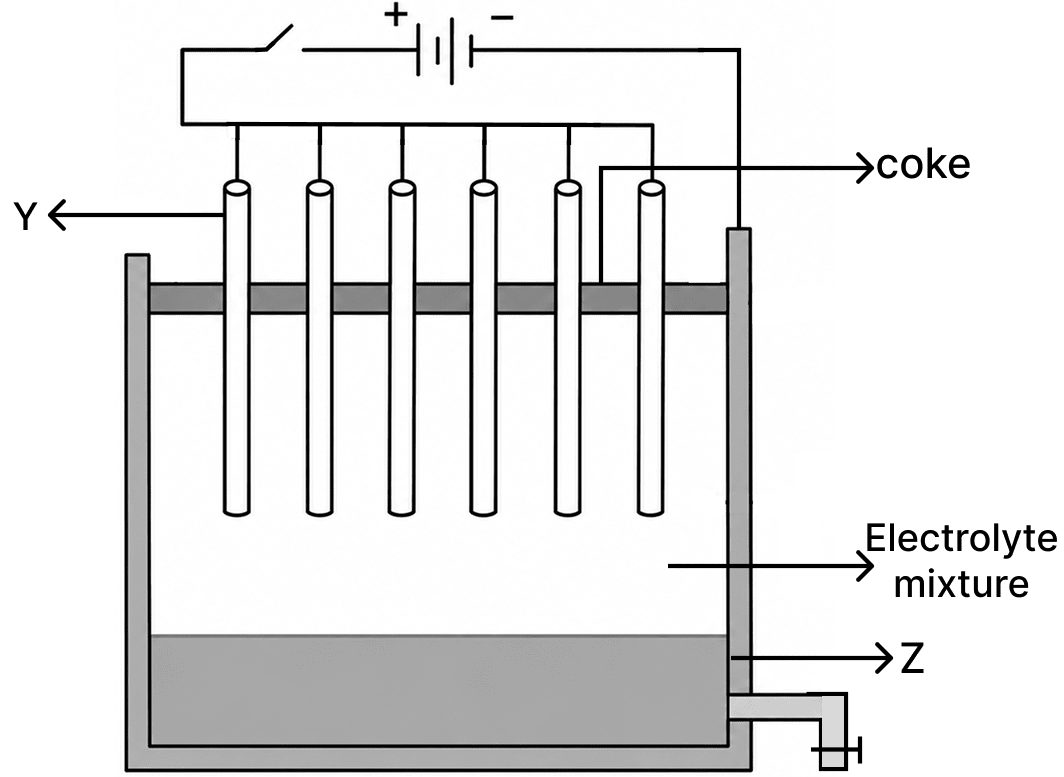
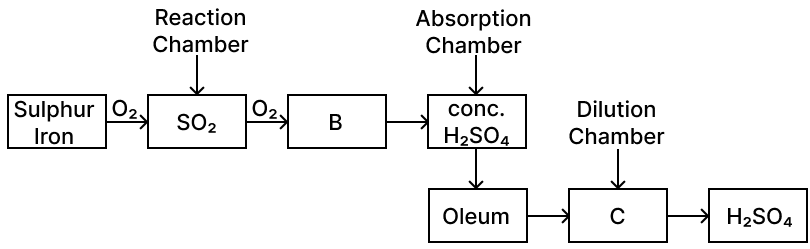
The diagram given below represents the industrial process for the manufacture of concentrated sulphuric acid by the Contact process.

The diagram given below represents the industrial process for the manufacture of concentrated sulphuric acid. ICSE 2027 Specimen Chemistry Solved Question Paper.

What is used in step R to obtain sulphuric acid from sulphur trioxide?

Show SolutionHide Solution↓

concentrated sulphuric acid followed by water

Reason — Sulphur trioxide is not dissolved directly in water as the reaction is highly exothermic and forms a dense mist of sulphuric acid. So, SO3 is first absorbed in concentrated sulphuric acid to form oleum (H2S2O7), which is then diluted with water to obtain sulphuric acid.

1(iii)1 Mark · 2027 · Section A · 2027 SpecimenFull page

Which statement given below is correct with reference to the flow of electric current?

Show SolutionHide Solution↓

In acidic solutions, current is carried by ions.

Reason — In metallic conductors, current is carried by free electrons, whereas in electrolytes (acidic solutions, molten electrolytes and aqueous ionic solutions) current is carried by free ions. Hence, in acidic solutions current is carried by ions.

1(v)1 Mark · 2027 · Section A · 2027 SpecimenFull page

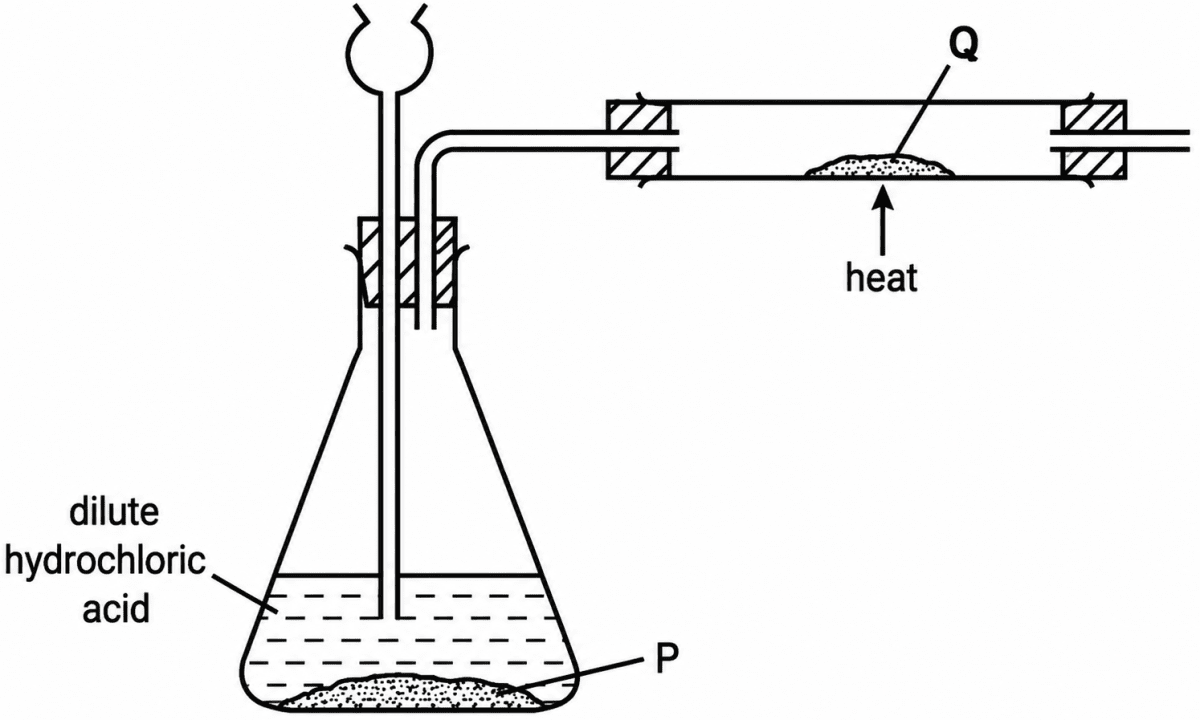
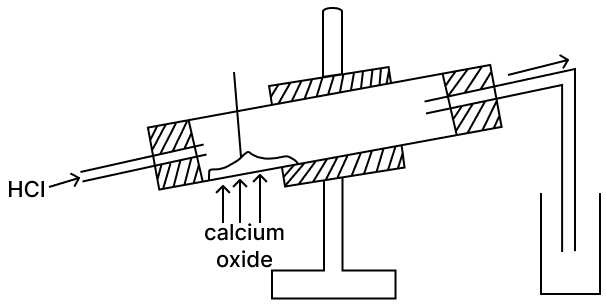
The diagram given below shows that P reacts with dilute hydrochloric acid to produce a gas which when passed through substance Q, reduces it.

The diagram given below shows that P reacts with dilute hydrochloric acid to produce a gas which when passed through substance Q, reduces it. ICSE 2027 Specimen Chemistry Solved Question Paper.

What are substances P and Q?

Show SolutionHide Solution↓

P - zinc, Q - copper (II) oxide

Reason — Zinc reacts with dilute hydrochloric acid to liberate hydrogen gas. Hydrogen is a reducing agent, so on passing over heated copper(II) oxide it reduces the black oxide to reddish-brown copper.

Zn + 2HCl ⟶ ZnCl2 + H2

CuO + H2 ⟶ Cu + H2O

1(vi)1 Mark · 2027 · Section A · 2027 SpecimenFull page

Non-metals like chlorine and iodine on reaction with hydrogen give:

Show SolutionHide Solution↓

acid

Reason — Chlorine and iodine react with hydrogen to form the hydrogen halides hydrogen chloride and hydrogen iodide. These dissolve in water to form hydrochloric acid and hydroiodic acid respectively.

1(vii)1 Mark · 2027 · Section A · 2027 SpecimenFull page

Statement I: Halogens are very reactive.

Statement II: Halogens have high electron affinity.

Show SolutionHide Solution↓

Both the statements are true.

Reason — Halogens have seven electrons in their valence shell and need only one electron to complete their octet. This gives them a very high electron affinity, which makes them very reactive. Hence, both statements are true.

1(viii)1 Mark · 2027 · Section A · 2027 SpecimenFull page

Assertion (A): Ionic compounds have high melting points.

Reason (R): A strong electrostatic force of attraction exists between the oppositely charged ions.

Show SolutionHide Solution↓

Both (A) and (R) are true, and (R) is the correct explanation of (A).

Reason — In ionic compounds, the oppositely charged ions are held together by strong electrostatic forces of attraction. A large amount of heat energy is required to break these forces, so ionic compounds have high melting points. Thus, (R) correctly explains (A).

1(ix)1 Mark · 2027 · Section A · 2027 SpecimenFull page

A student tested the nature of four different solutions P, Q, R, and S using pH paper. He noted the following observations:

 PQRS
Colour of the pH paper after testingBlueGreenRedViolet

Which of the above solutions is neutral in nature?

Show SolutionHide Solution↓

Q

Reason — On the pH scale, a neutral solution (pH 7) turns pH paper green. Red indicates an acidic solution, while blue and violet indicate basic (alkaline) solutions. Hence, solution Q (green) is neutral.

1(x)1 Mark · 2027 · Section A · 2027 SpecimenFull page

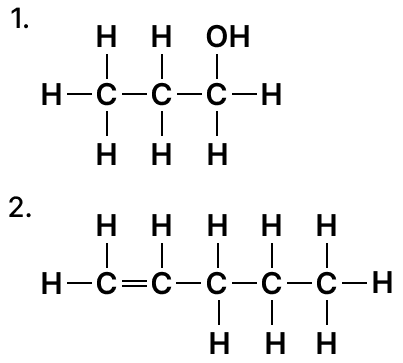
Identify the organic compound(s) with the molecular formula C3H8O.

1. propanol
2. propanal
3. propanoic acid

Show SolutionHide Solution↓

Only 1

Reason — Propanol (C3H7OH) has the molecular formula C3H8O. Propanal (C2H5CHO) is C3H6O and propanoic acid (C2H5COOH) is C3H6O2. Hence, only propanol has the formula C3H8O.

1(xi)1 Mark · 2027 · Section A · 2027 SpecimenFull page

An organic compound X containing carbon and hydrogen only has Vapour Density (V.D.) 14. The molecular formula of X is ............... (At. wt. of C=12, H=1)

Show SolutionHide Solution↓

C2H4

Reason — Molecular mass = 2 × Vapour Density = 2 × 14 = 28.

The molecular mass of C2H4 = 2(12) + 4(1) = 24 + 4 = 28, which matches. Hence, the molecular formula of X is C2H4.

1(xii)1 Mark · 2027 · Section A · 2027 SpecimenFull page

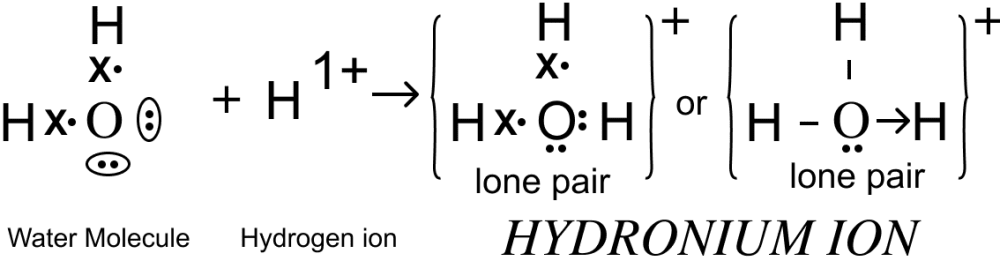
Identify the ion that contains one lone pair of electrons.

Show SolutionHide Solution↓

H3O+

Reason — A pair of electrons that is not shared in bond formation is called a lone pair of electrons. H3O+ has one lone pair of electrons. OH1- has three lone pairs, whereas NH4+ and H+ have no lone pairs of electrons.

1(xiii)1 Mark · 2027 · Section A · 2027 SpecimenFull page

When compound X reacts with dilute hydrochloric acid, it releases a gas that turns moist lead acetate paper black and decolourises acidified potassium permanganate solution. Which of the following is compound X?

Show SolutionHide Solution↓

Sodium sulphide

Reason — Sodium sulphide reacts with dilute hydrochloric acid to release hydrogen sulphide gas. H2S turns moist lead acetate paper black (due to the formation of black lead sulphide) and being a reducing gas, it also decolourises acidified potassium permanganate solution.

Na2S + 2HCl ⟶ 2NaCl + H2S ↑

1(xiv)1 Mark · 2027 · Section A · 2027 SpecimenFull page

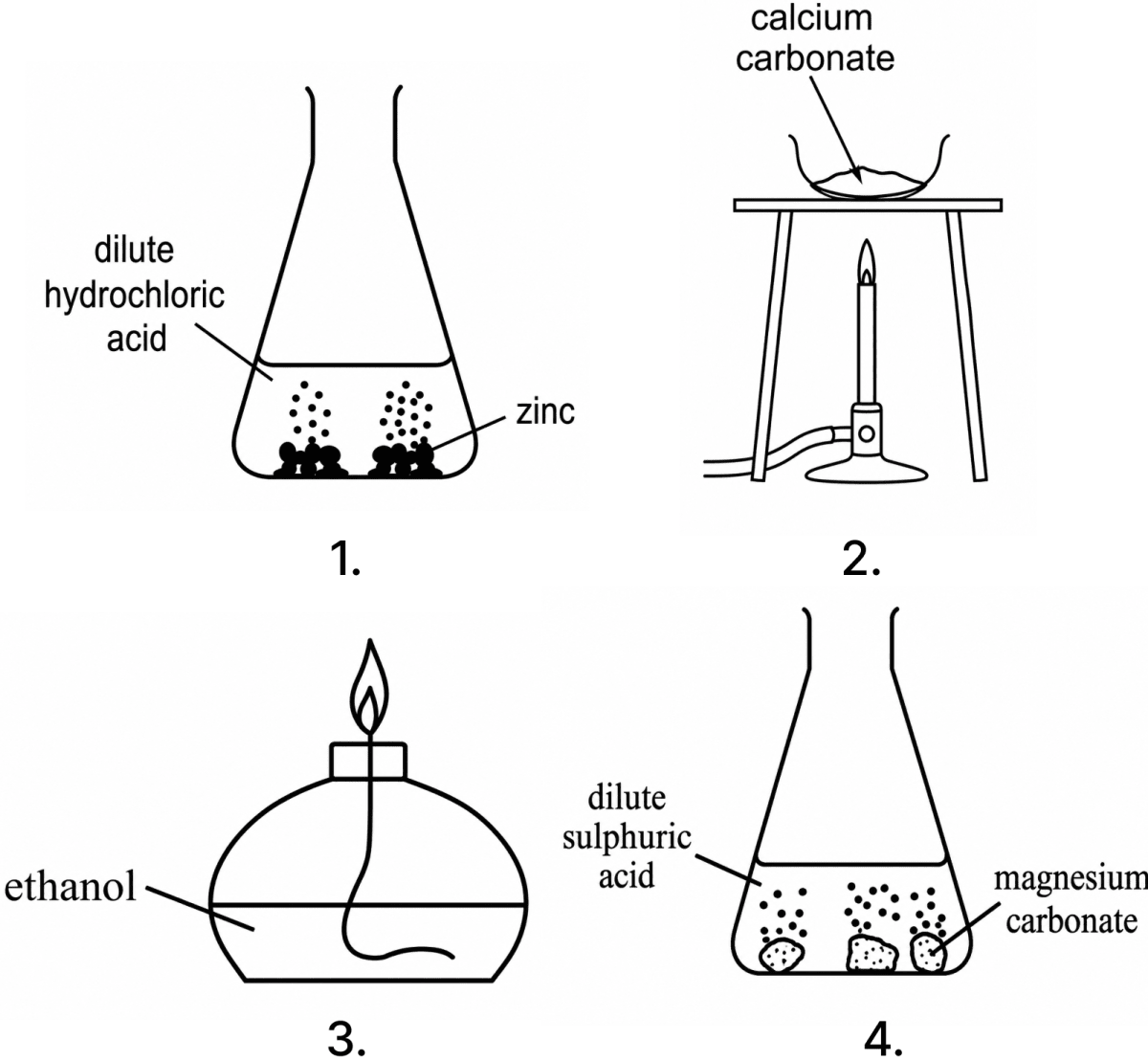
A teacher demonstrated four different reactions as shown in the diagram below:

A teacher demonstrated four different reactions as shown in the diagram below: ICSE 2027 Specimen Chemistry Solved Question Paper.

Which reactions will produce water?

Show SolutionHide Solution↓

3 and 4

Reason — Reaction 3 is the combustion of ethanol, which produces carbon dioxide and water. Reaction 4 is dilute sulphuric acid reacting with magnesium carbonate, which produces a salt, water and carbon dioxide. Hence, reactions 3 and 4 produce water.

1(xv)1 Mark · 2027 · Section A · 2027 SpecimenFull page

The volume occupied by 0.2 moles of a gas at S.T.P. is:

Show SolutionHide Solution↓

4.48 litres

Reason — One mole of any gas occupies 22.4 litres at S.T.P.

∴ Volume of 0.2 mole of gas = 0.2 × 22.4 = 4.48 litres.

2(i)1 Mark · 2027 · Section A · 2027 SpecimenFull page

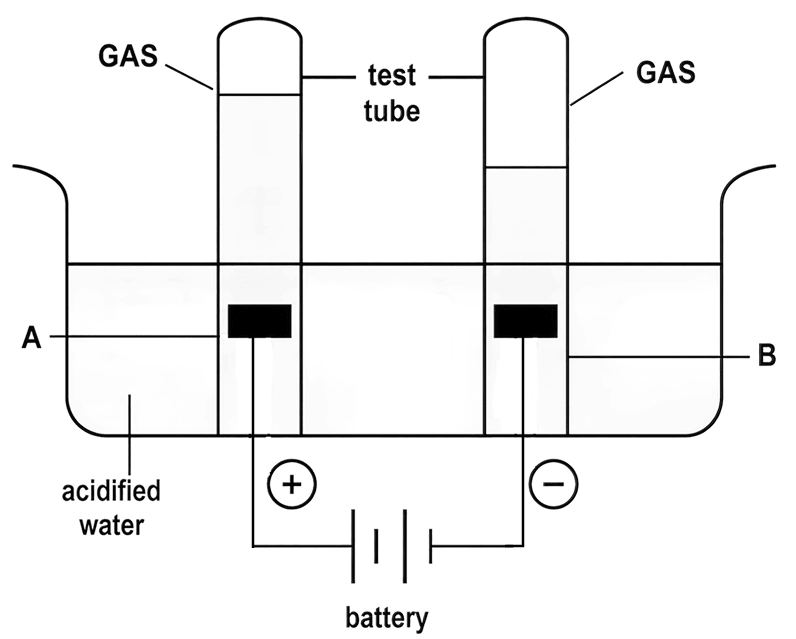
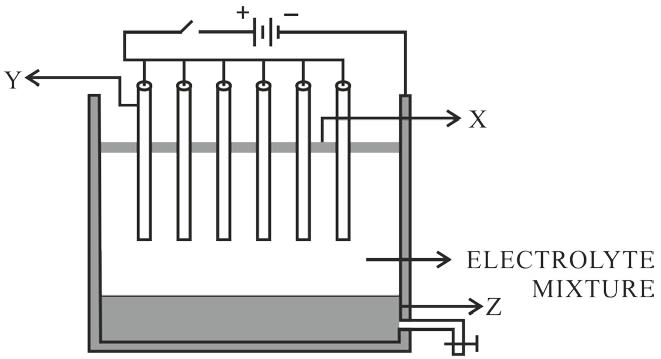
The diagram given below shows the electrolysis of acidulated water. With reference to the diagram, answer the following questions:

The diagram given below shows the electrolysis of acidulated water. With reference to the diagram, answer the following questions: ICSE 2027 Specimen Chemistry Solved Question Paper.

(a) Write an equation for the reaction that takes place at A.

(b) Give a test to confirm the product formed at A.

(c) Which gas is liberated at B?

(d) Why is water acidified for electrolysis?

(e) What is the ratio by volume of the gases liberated at A and B?

Show SolutionHide Solution↓

(a) A is the anode (positive electrode) where oxygen gas is liberated.

4OH- - 4e- ⟶ 2H2O + O2

(b) The gas at A is oxygen. It rekindles a glowing splinter brought near it.

(c) Hydrogen gas is liberated at B.

(d) Pure water is a very poor conductor of electricity as it has very few ions. Water is acidified by adding a little dilute sulphuric acid to provide ions, which makes it a good conductor so that electrolysis can take place.

(e) The ratio by volume of gases at A (oxygen) and B (hydrogen) is 1 : 2.

2(ii)1 Mark · 2027 · Section A · 2027 SpecimenFull page

Write balanced chemical equations for the following:

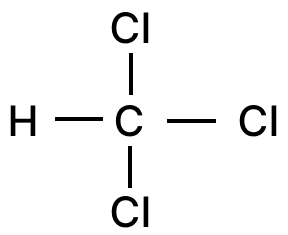
(a) Chlorination of chloroform in the presence of diffused sunlight.

(b) Hydrated aluminium oxide is treated with caustic soda.

(c) Zinc oxide is treated with caustic alkali.

(d) Copper reacts with cold dilute nitric acid.

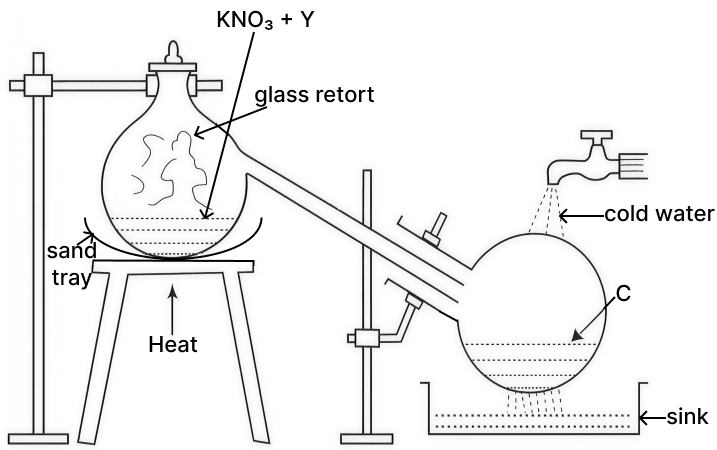
(e) Laboratory preparation of nitric acid using sodium nitrate.

Show SolutionHide Solution↓

(a) CHCl3 + Cl2 $\xrightarrow{\text{diffused sunlight}}$ CCl4 + HCl

(b) Al2O3.2H2O + 2NaOH ⟶ 2NaAlO2 + 3H2O

(c) ZnO + 2NaOH ⟶ Na2ZnO2 + H2O

(d) 3Cu + 8HNO3 (dilute) ⟶ 3Cu(NO3)2 + 4H2O + 2NO

(e) NaNO3 + H2SO4 $\xrightarrow{\text{below 200°C}}$ NaHSO4 + HNO3

2(iii)1 Mark · 2027 · Section A · 2027 SpecimenFull page

Complete the following sentences by choosing the correct option from the brackets:

(a) The general formula of an alkyl group is ............... (CnH2n+1/CnH2n-1).

(b) The aqueous solution of ............... (zinc chloride/ sodium sulphate) gives white precipitate with barium nitrate.

(c) The gas liberated when alkalis are heated with ammonium salts is ............... (N2/NH3).

(d) The alloy that contains a non-metal as one of its constituents is ............... (bronze/steel).

(e) A salt prepared by neutralization in which titration is involved is ............... (CaCl2/ NH4Cl).

Show SolutionHide Solution↓

(a) The general formula of an alkyl group is CnH2n+1.

(b) The aqueous solution of sodium sulphate gives white precipitate with barium nitrate.

(c) The gas liberated when alkalis are heated with ammonium salts is NH3.

(d) The alloy that contains a non-metal as one of its constituents is steel.

(e) A salt prepared by neutralization in which titration is involved is NH4Cl.

Note: In part (b), the chemically correct answer is sodium sulphate, since barium nitrate reacts with the sulphate ion of sodium sulphate to give a white precipitate of barium sulphate (Na2SO4 + Ba(NO3)2 ⟶ BaSO4 ↓ + 2NaNO3). Zinc chloride would not give any precipitate with barium nitrate as both products would be soluble.

2(iv)1 Mark · 2027 · Section A · 2027 SpecimenFull page

Match Column A with Column B:

Column AColumn B
(a) CuO + C ⟶ Cu + CO1. Oxidation
(b) Al3+ + 3e- ⟶ Al2. Ionization
(c) PbBr2 ⟶ Pb2+ + 2Br1-3. Reduction
(d) 2O2- - 4e- ⟶ O24. Redox
(e) HCl ⟶ H+ + Cl1-5. Electrolytic dissociation
Show SolutionHide Solution↓
Column AColumn B
(a) CuO + C ⟶ Cu + CO4. Redox
(b) Al3+ + 3e- ⟶ Al3. Reduction
(c) PbBr2 ⟶ Pb2+ + 2Br1-5. Electrolytic dissociation
(d) 2O2- - 4e- ⟶ O21. Oxidation
(e) HCl ⟶ H+ + Cl1-2. Ionization
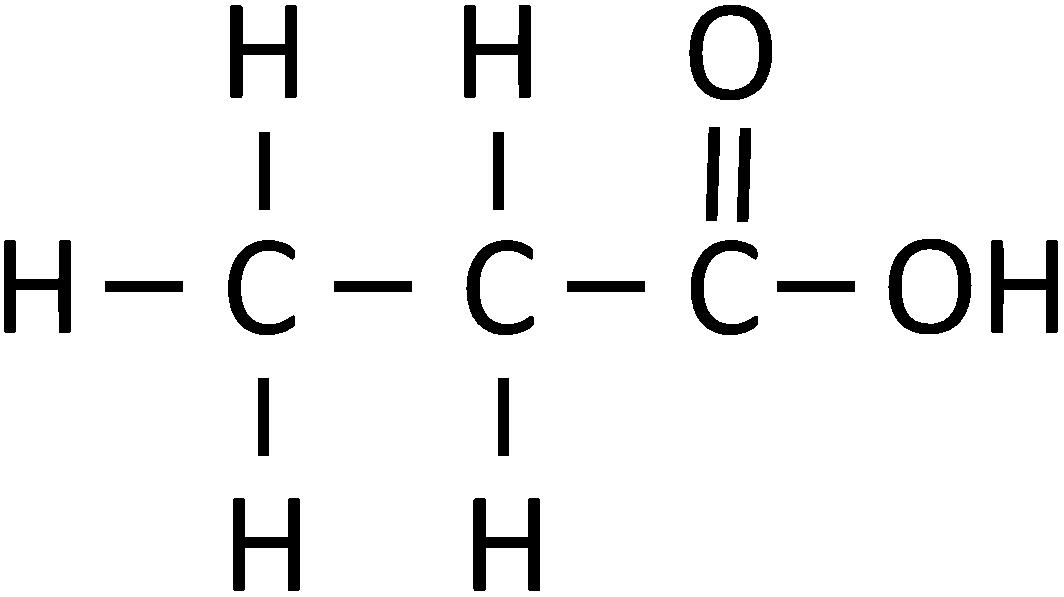
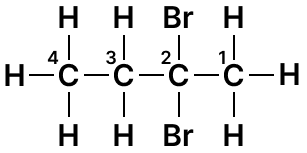
2(v)1 Mark · 2027 · Section A · 2027 Specimen · 🔁 also 2026Full page

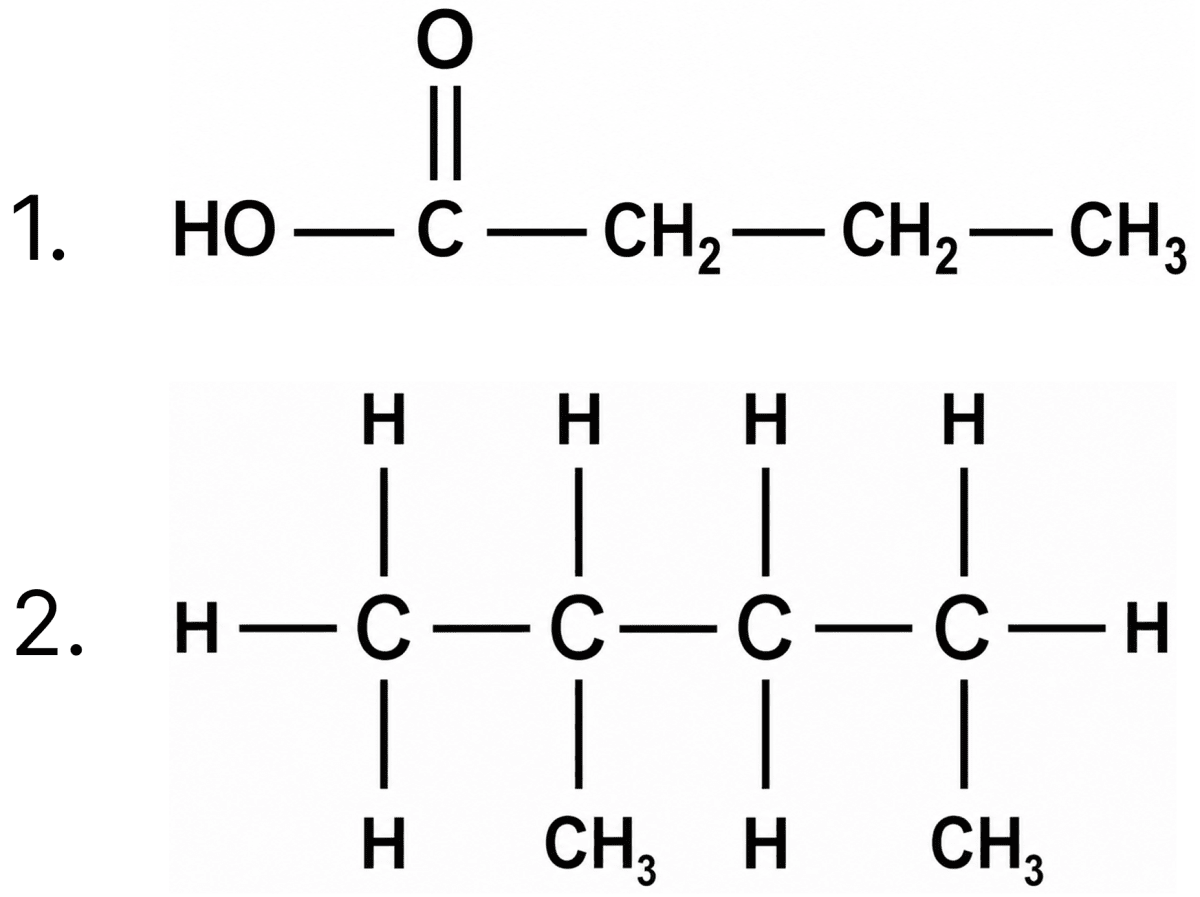
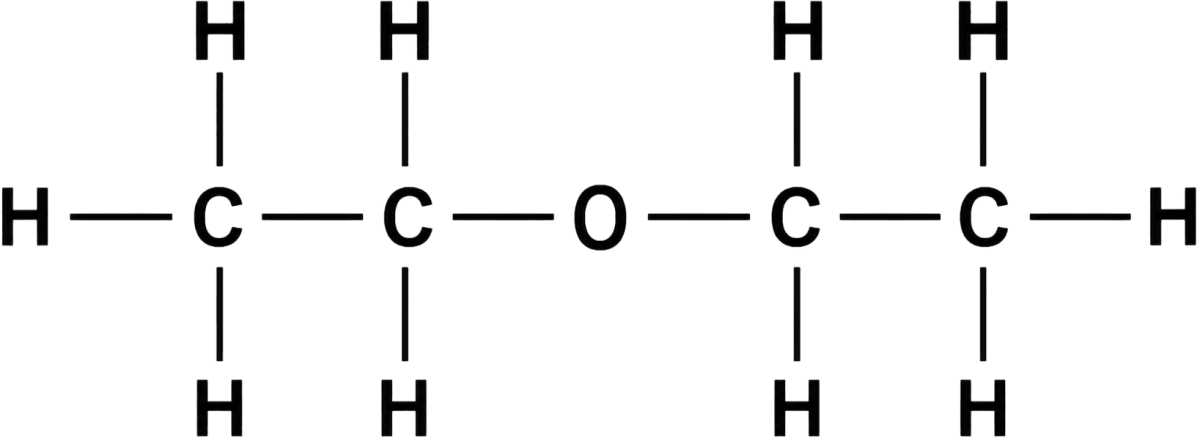
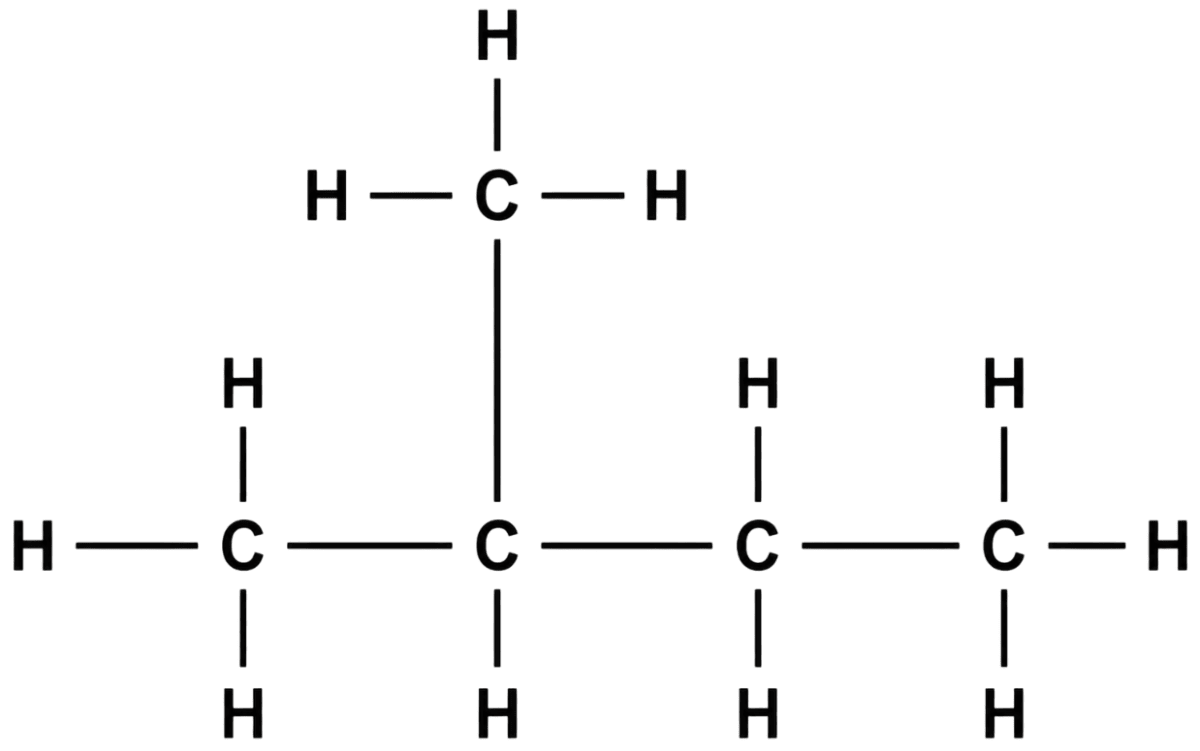
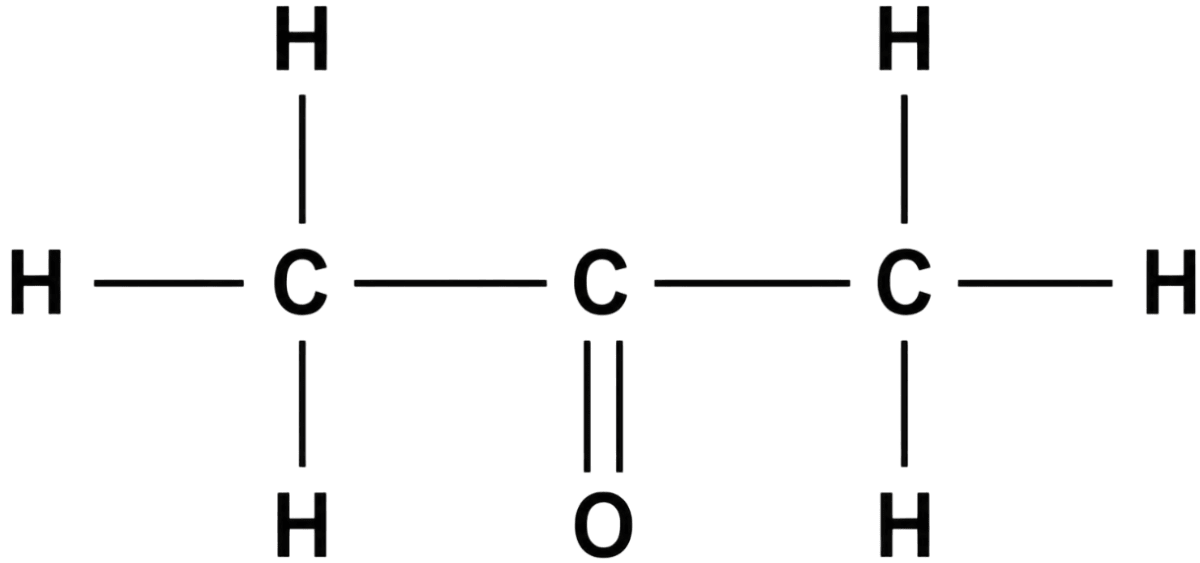
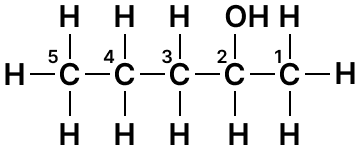
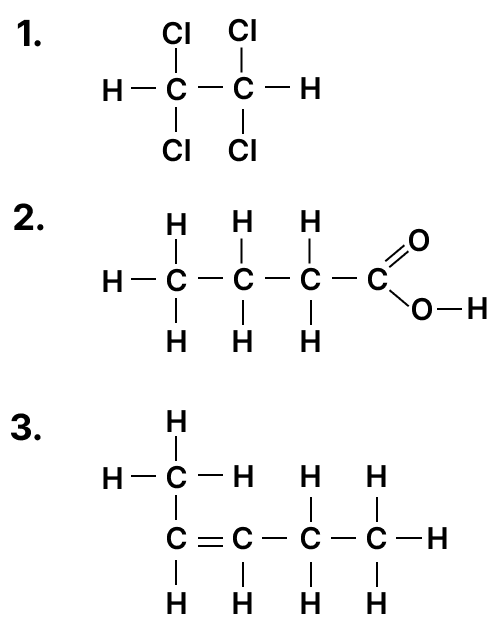
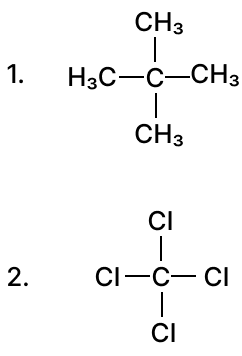
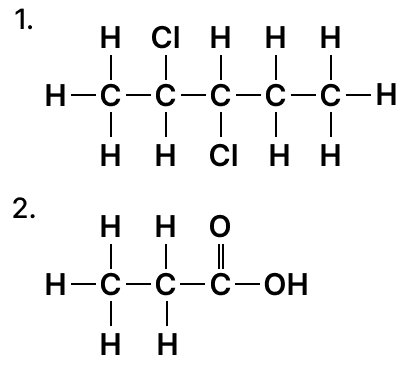
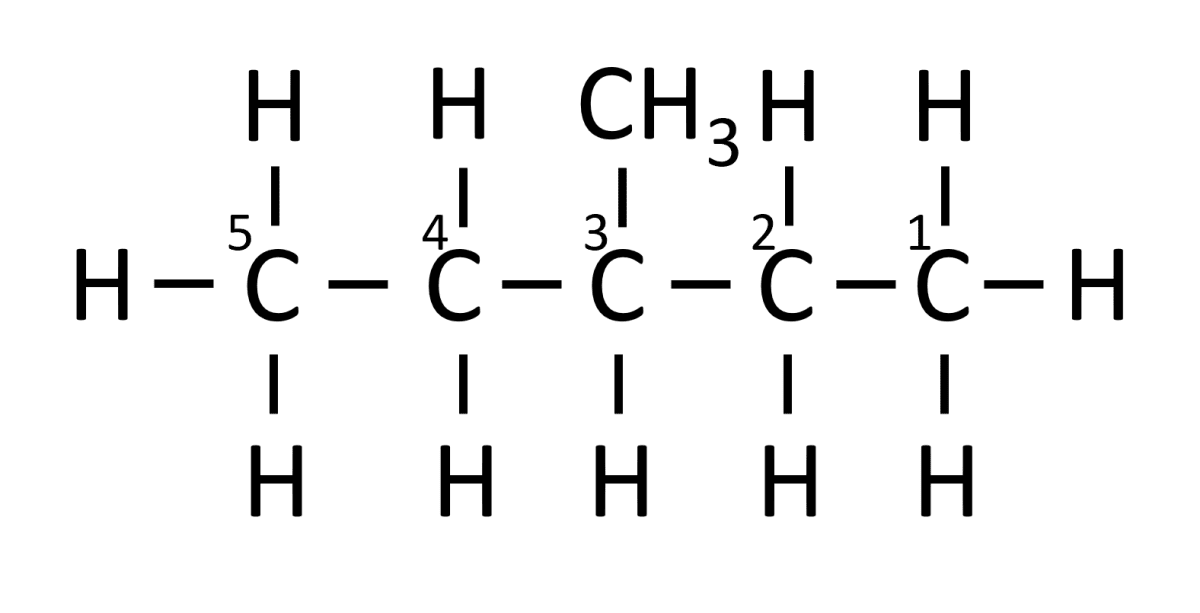
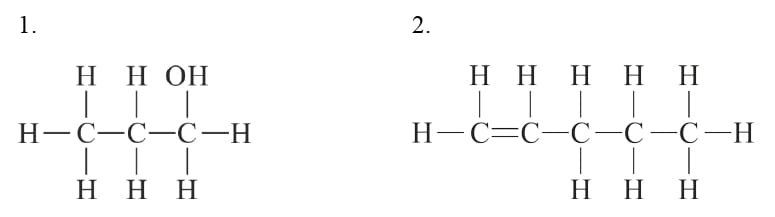
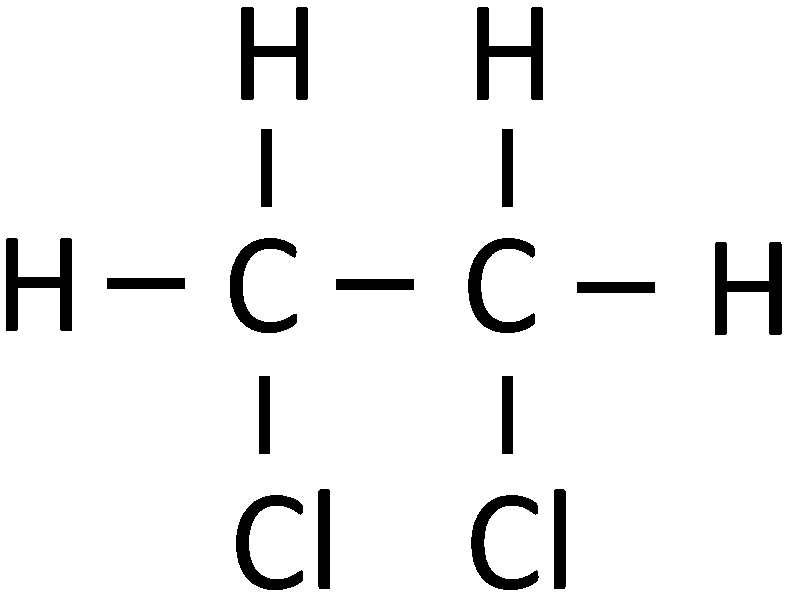
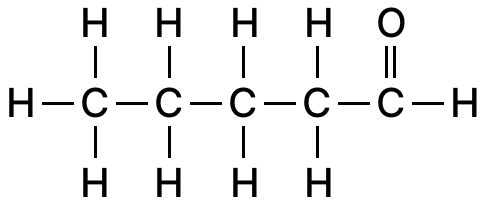
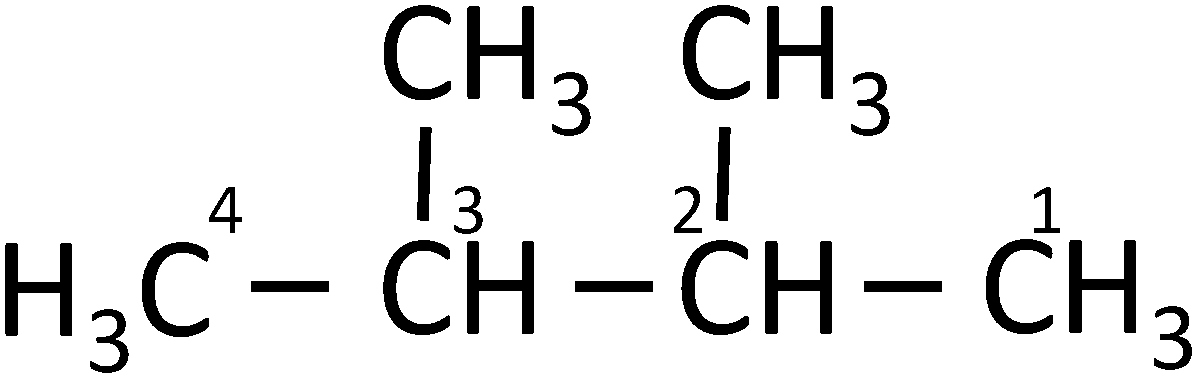
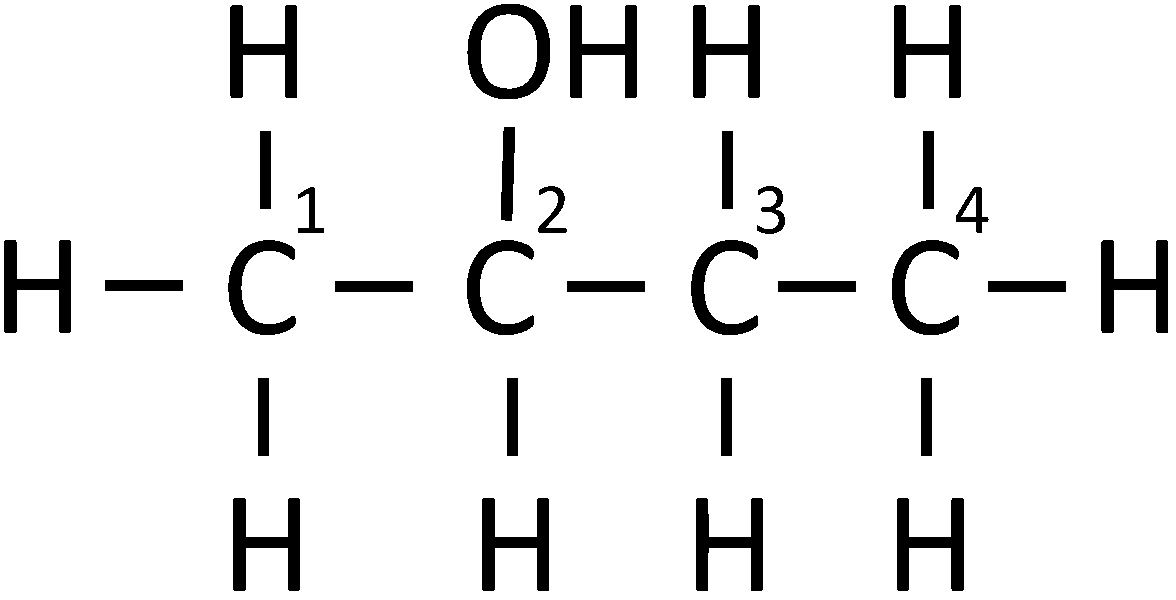
(a) Give the IUPAC name of the following organic compounds:

Give the IUPAC name of the following organic compounds: ICSE 2027 Specimen Chemistry Solved Question Paper.

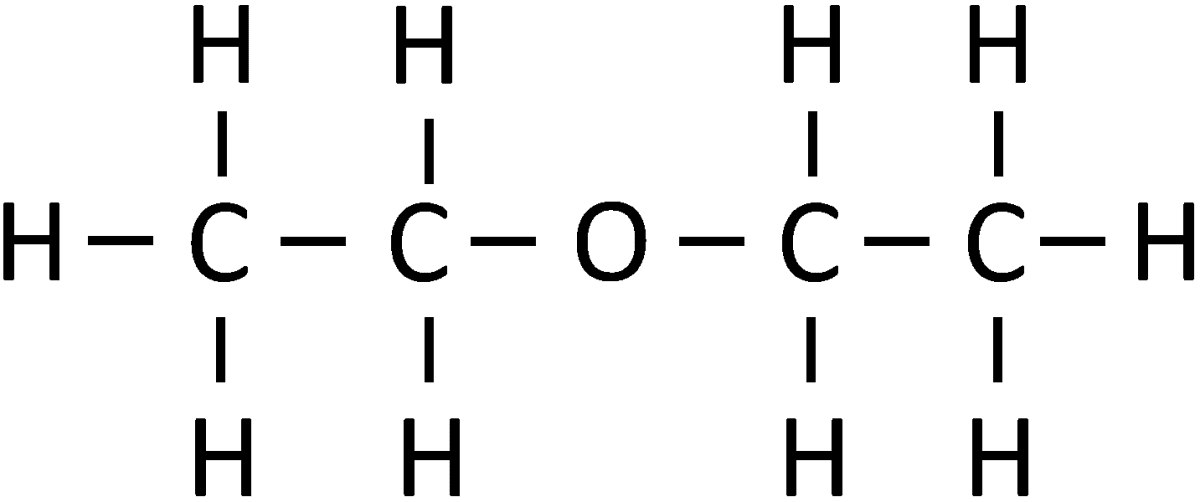
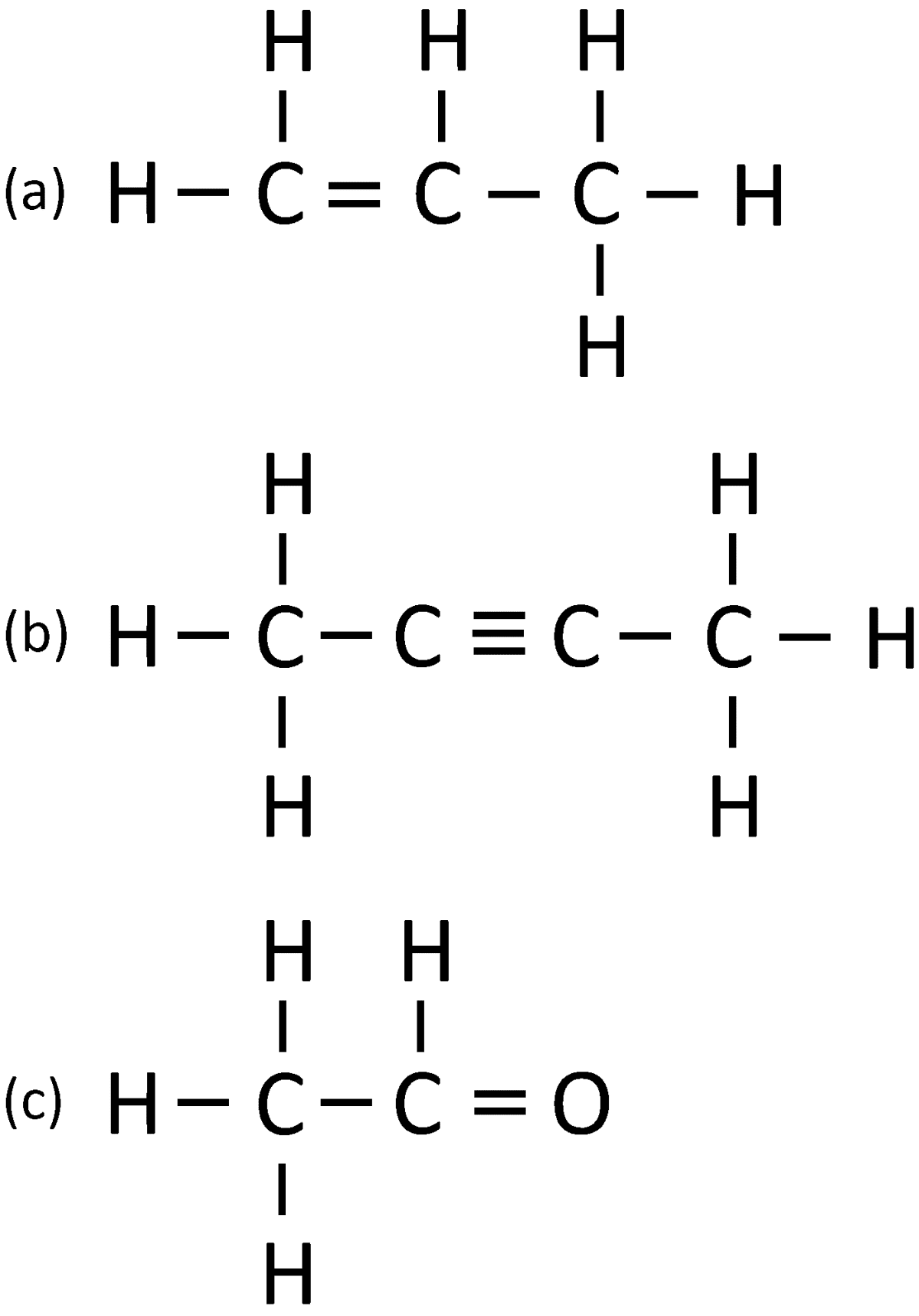
(b) Draw the structural diagram for the following compounds:

Show SolutionHide Solution↓

(a) IUPAC names of the given organic compounds are:

  1. butanoic acid
  2. 2-methylpentane

(b) Structural diagrams:

1. diethyl ether

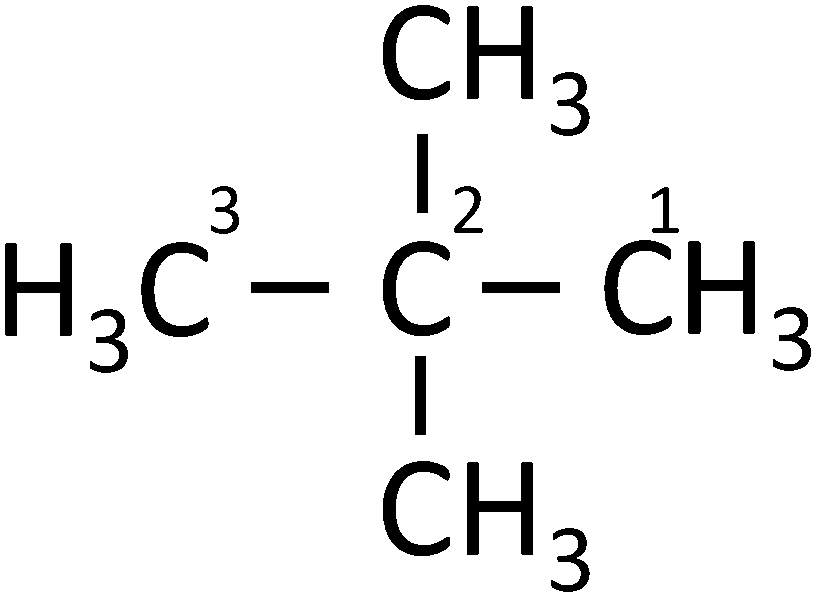
Draw the structural diagram for the following compounds ICSE 2027 Specimen Chemistry Solved Question Paper.

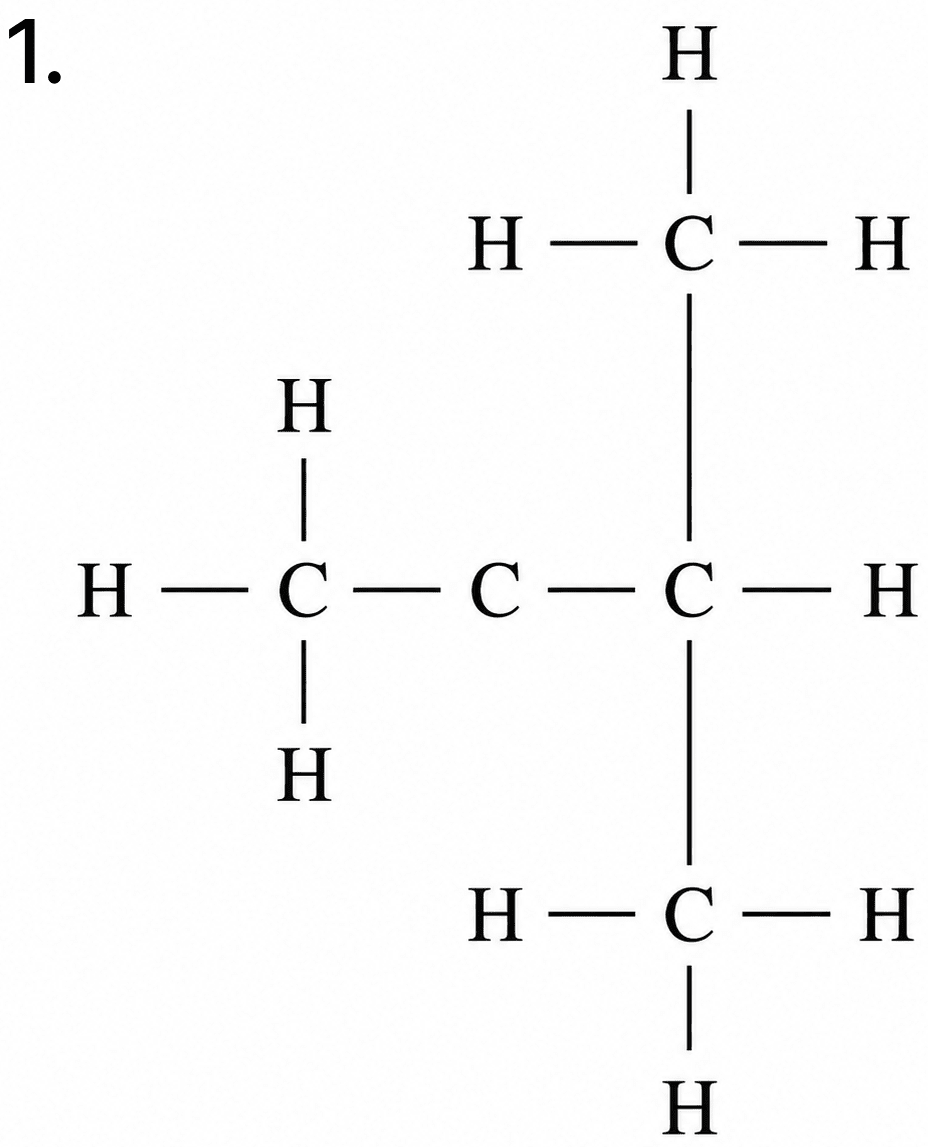
2. isopentane

Draw the structural diagram for the following compounds ICSE 2027 Specimen Chemistry Solved Question Paper.

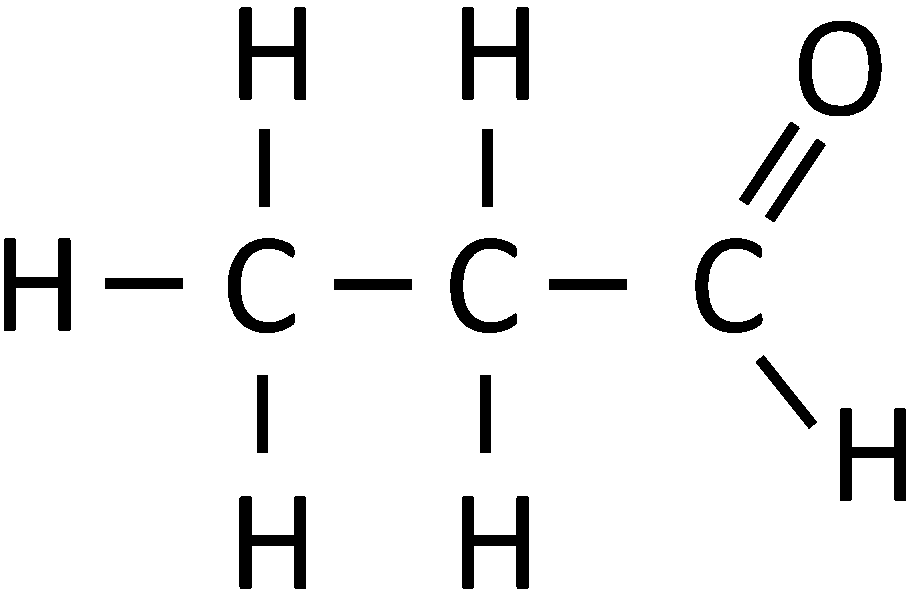
3. propanone

Draw the structural diagram for the following compounds ICSE 2027 Specimen Chemistry Solved Question Paper.
3(i)Written · 2027 · Section B · 2027 SpecimenFull page

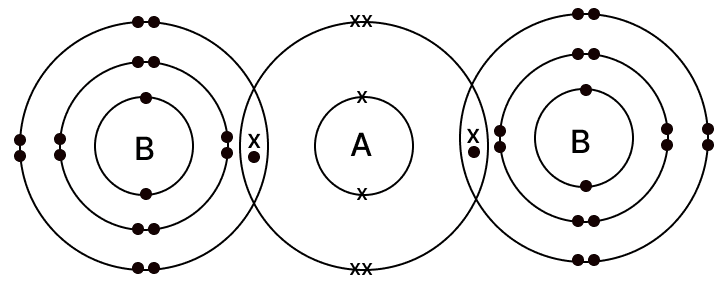
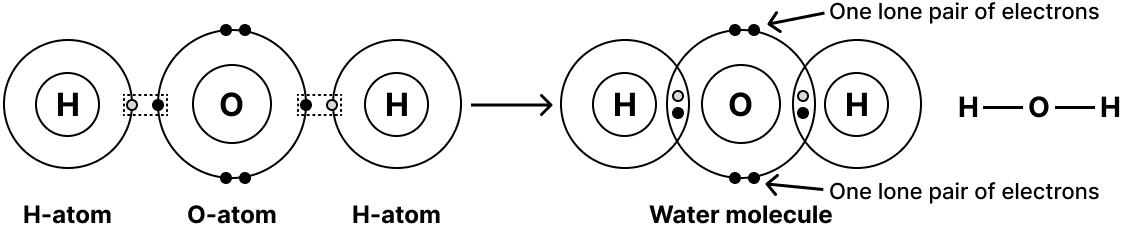
A compound commonly used in the laboratory has formula H2P.

H represents hydrogen, P represents a non-metal.

Draw a dot and cross structure for the formation of the compound H2P.

Show SolutionHide Solution↓

P is a divalent non-metal having six electrons in its valence shell. Each of the two hydrogen atoms shares one electron with P to form two covalent bonds, so that P completes its octet while each H completes its duplet. The dot and cross structure for the formation of H2P is shown below:

A compound commonly used in the laboratory has formula H. ICSE 2027 Specimen Chemistry Solved Question Paper.
3(ii)Written · 2027 · Section B · 2027 Specimen · 🔁 also 2026Full page

Give one significant observation when:

(a) Excess of chlorine gas reacts with ammonia.

(b) Zinc nitrate is strongly heated in a test tube.

Show SolutionHide Solution↓

(a) Colourless ammonia gas reacts with excess greenish-yellow chlorine to form a yellow, explosive liquid (nitrogen trichloride).
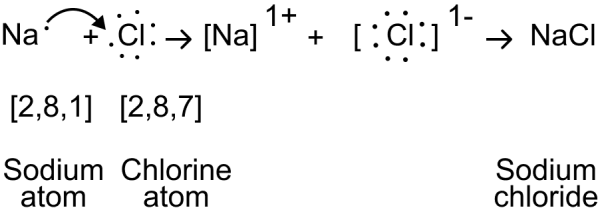
NH3 + 3Cl2 [excess] ⟶ 3HCl + NCl3

(b) Reddish-brown nitrogen dioxide gas is evolved on heating zinc nitrate crystals.
$2\text{Zn(NO}_3)_2 \xrightarrow{\Delta} 2\text{ZnO} + \text{O}_2 + 4\text{NO}_2$

3(iii)Written · 2027 · Section B · 2027 SpecimenFull page

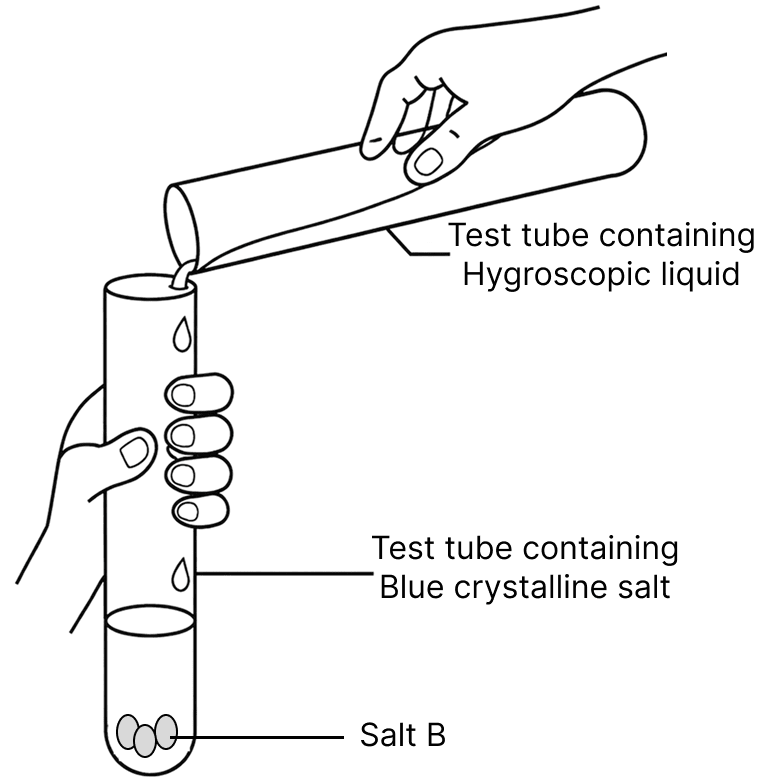
A student was given a crystalline salt 'B' for analysis which was blue in colour. He added a few drops of dense oily hygroscopic liquid to it and observed a colourless neutral gas/vapour being released and the salt turning white.

A student was given a crystalline salt. ICSE 2027 Specimen Chemistry Solved Question Paper.

(a) Identify the blue crystalline salt B.

(b) Which property of the hygroscopic liquid is demonstrated in this reaction?

(c) Write a balanced chemical equation for the above reaction.

Show SolutionHide Solution↓

(a) The blue crystalline salt B is copper(II) sulphate pentahydrate, CuSO4·5H2O.

(b) The dehydrating property of the hygroscopic liquid (concentrated sulphuric acid) is demonstrated, as it removes the water of crystallisation from the blue salt, leaving behind white anhydrous copper sulphate.

(c) CuSO4·5H2O $\xrightarrow{\text{conc. H}_2\text{SO}_4}$ CuSO4 + 5H2O

3(iv)Written · 2027 · Section B · 2027 SpecimenFull page

N is a metal which forms a basic oxide.

N has atomic no. 11.

(a) What is the molecular formula of the oxide of N?

(b) Write the balanced equation for the reaction that takes place when the oxide of N is treated with water.

(c) State the formula of the product obtained other than water when sulphuric acid is added to the product obtained in (b) above.

Show SolutionHide Solution↓

N has atomic number 11, so its electronic configuration is 2, 8, 1 and its valency is 1.

(a) The molecular formula of the oxide is N2O (i.e., Na2O).

(b) N2O + H2O ⟶ 2NOH

(c) The formula of the product other than water is N2SO4.

4(i)Written · 2027 · Section B · 2027 SpecimenFull page

Name the following:

(a) The non-metallic element which is used as the anode during electrolytic reduction of fused alumina in Hall Heroult's process.

(b) An alloy which is made up of aluminium and magnesium only.

(c) The process of heating the concentrated ore in a limited supply of air or in the absence of air.

Show SolutionHide Solution↓

(a) Carbon (graphite)

(b) Magnalium

(c) Calcination

4(ii)Written · 2027 · Section B · 2027 SpecimenFull page

Rohit has three solutions X, Y and Z that have pH 2, 7 and 13 respectively. Which solution out of X, Y or Z will:

(a) liberate sulphur dioxide gas when heated with sodium sulphite?

(b) liberate ammonia gas when reacted with ammonium chloride?

(c) not have any effect on litmus paper?

Show SolutionHide Solution↓

(a) X

Reason — Sodium sulphite reacts with an acid to liberate sulphur dioxide gas. Hence, solution X with pH 2 is acidic and will liberate sulphur dioxide.

SO32- + 2H+ ⟶ SO2 + H2O

(b) Z

Reason — Ammonium salts liberate ammonia gas on reaction with an alkali. Hence, solution Z with pH 13 is alkaline and will liberate ammonia from ammonium chloride.

NH4+ + OH- ⟶ NH3 + H2O

(c) Y

Reason — The solution Y with pH 7 will not have any effect on litmus paper as it is neither acidic nor basic.

4(iii)Written · 2027 · Section B · 2027 SpecimenFull page

A chloride of iron 'R', when treated with sodium hydroxide gives P and Q as a product. Q is a reddish-brown precipitate.

(a) Identify R.

(b) State the formula of the compounds P and Q formed after the reaction.

(c) What do you observe when excess NaOH is added to Q?

Show SolutionHide Solution↓

(a) R is ferric chloride (iron(III) chloride), FeCl3.

(b) P is NaCl and Q is Fe(OH)3.

FeCl3 + 3NaOH ⟶ Fe(OH)3 ↓ + 3NaCl

(c) On adding excess sodium hydroxide, the reddish-brown precipitate of Fe(OH)3 remains insoluble, i.e., there is no change.

5(i)Written · 2027 · Section B · 2027 SpecimenFull page

20 grams of a gas M2P has lesser number of moles than 20 grams of the gas MP.

Justify the above statement using mathematical calculations.

[At.wt. M=14, P=16]

Show SolutionHide Solution↓

Molecular mass of M2P = 2(14) + 16 = 44 g/mol

Molecular mass of MP = 14 + 16 = 30 g/mol

Number of moles = $\frac{\text{Mass}}{\text{Molecular mass}}$

∴ Moles in 20 g of M2P = $\frac{20}{44}$ = 0.45 mol

∴ Moles in 20 g of MP = $\frac{20}{30}$ = 0.67 mol

Since 0.45 < 0.67, 20 grams of M2P has a lesser number of moles than 20 grams of MP. Hence, the statement is justified.

5(ii)Written · 2027 · Section B · 2027 SpecimenFull page

State giving reasons if:

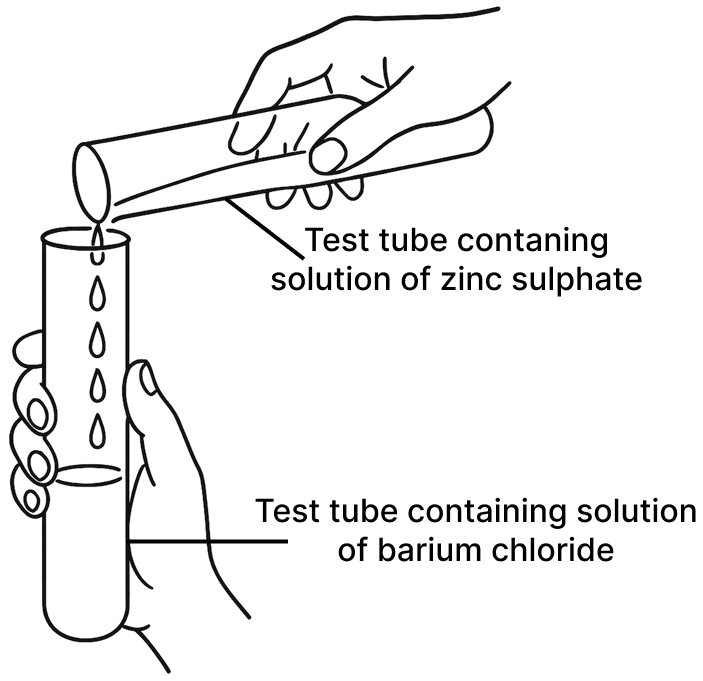
(a) Zinc metal and aluminium metal can be distinguished by heating the metal powders separately in two different test tubes with concentrated sodium hydroxide solution.

(b) Zinc nitrate and lead nitrate can be distinguished by adding ammonium hydroxide solution to the salt solution.

Show SolutionHide Solution↓

(a) No, zinc and aluminium cannot be distinguished by this method. Both metals react with concentrated sodium hydroxide solution to form soluble sodium salts and liberate hydrogen gas, which burns with a pop sound.

Zn + 2NaOH ⟶ Na2ZnO2 + H2

2Al + 2NaOH + 2H2O ⟶ 2NaAlO2 + 3H2

(b) Yes, they can be distinguished. With zinc nitrate, ammonium hydroxide gives a white precipitate of Zn(OH)2 which is soluble in excess of ammonium hydroxide. With lead nitrate, a white precipitate of Pb(OH)2 is formed which is insoluble in excess of ammonium hydroxide.

5(iii)Written · 2027 · Section B · 2027 SpecimenFull page

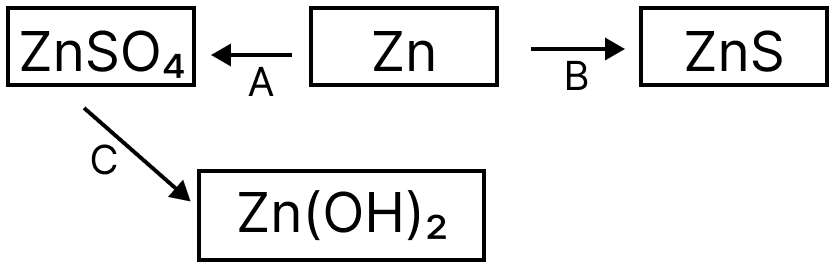
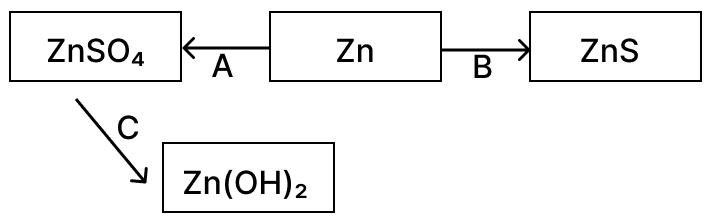
Write balanced chemical equations for the following conversions (A to C):

Write balanced chemical equations for the following conversions (A to C): ICSE 2027 Specimen Chemistry Solved Question Paper.
Show SolutionHide Solution↓

A: Zn + H2SO4 ⟶ ZnSO4 + H2

B: Zn + S ⟶ ZnS

C: ZnSO4 + 2NaOH ⟶ Zn(OH)2 + Na2SO4

5(iv)Written · 2027 · Section B · 2027 SpecimenFull page

An element 'P' has 3 valence electrons in its L - shell and an element 'Q' has 7 valence electrons in its M - shell. Using this information, answer the following questions:

(a) Identify the exact position of element 'Q' in terms of group and period in the Modern Periodic Table.

(b) The atomic radius of P is ............... (more/less) than that of Q.

Show SolutionHide Solution↓

Element P has the L shell as its outermost shell with 3 valence electrons, so its configuration is 2, 3 (period 2). Element Q has the M shell as its outermost shell with 7 valence electrons, so its configuration is 2, 8, 7 (period 3).

(a) Element Q has 7 valence electrons, so it belongs to Group 17, and its outermost shell is the M (third) shell, so it belongs to Period 3.

Position of Q: Group 17, Period 3.

(b) The atomic radius of P is less than that of Q.

Element P has only two shells whereas Q has three shells. As the number of shells increases, the atomic radius increases. Hence, P (fewer shells) has a smaller atomic radius than Q.

6(i)Written · 2027 · Section B · 2027 SpecimenFull page

Identify the reactants P, Q and R in the following reactions:

(a) Copper (II) oxide + P ⟶ Copper + Water + Nitrogen

(b) Iron pyrite + Q ⟶ Iron oxide + Sulphur dioxide

(c) Ammonia + R ⟶ Nitrogen + Water

Show SolutionHide Solution↓

(a) P is Ammonia (NH3).

3CuO + 2NH3 ⟶ 3Cu + 3H2O + N2

(b) Q is Oxygen (O2).

4FeS2 + 11O2 ⟶ 2Fe2O3 + 8SO2

(c) R is Oxygen (O2).

4NH3 + 3O2 ⟶ 2N2 + 6H2O

6(ii)Written · 2027 · Section B · 2027 Specimen · 🔁 also 2026Full page

Solid ammonium dichromate decomposes as under:

(NH4)2Cr2O7 ⟶ N2 + Cr2O3 + 4H2O

If 126 g of ammonium dichromate decomposes, calculate:

(a) the number of moles of ammonium dichromate that undergoes decomposition.

(b) the mass of chromic oxide formed at the same time.

(c) the volume of nitrogen gas evolved at STP.

[At. Wt: N=14, Cr=52, O=16, H=1]

Show SolutionHide Solution↓

$$\begin{matrix} (\text{NH}_4)_2\text{Cr}_2\text{O}_7 & \xrightarrow{\Delta} & \text{N}_2 & + & 4\text{H}_2\text{O} & + & \text{Cr}_2\text{O}_3 \\ 2[14 + 4(1)] & & & & & & 2(52) \\ + 2(52) + 7(16) & & & & & & + 3(16) \\ = 36 + 104 & & & & & & = 104 + 48 \\ + 112 = 252 \text{ g} & & & & & & = 152 \text{ g} \\ \end{matrix}$$

(a) 252 g of (NH4)2Cr2O7 = 1 mole

∴ 126 g of (NH4)2Cr2O7 = $\frac{1}{252}$ x 126 = 0.5 moles

Hence, no. of moles = 0.5 moles

(b) 252 g of (NH4)2Cr2O7 gives 152 g of Cr2O3

126 g of (NH4)2Cr2O7 will give $\frac{152 \times 126}{252}$ = 76 g of Cr2O3

Hence, mass in gms of Cr2O3 formed = 76 g.

(c) 252 g of (NH4)2Cr2O7 produces 22.4 lit of N2

126 g of (NH4)2Cr2O7 will produce $\frac{22.4 \times 126}{252}$ = 11.2 lit of N2

Hence, volume of N₂ evolved at s.t.p = 11.2 lit.

6(iii)Written · 2027 · Section B · 2027 SpecimenFull page

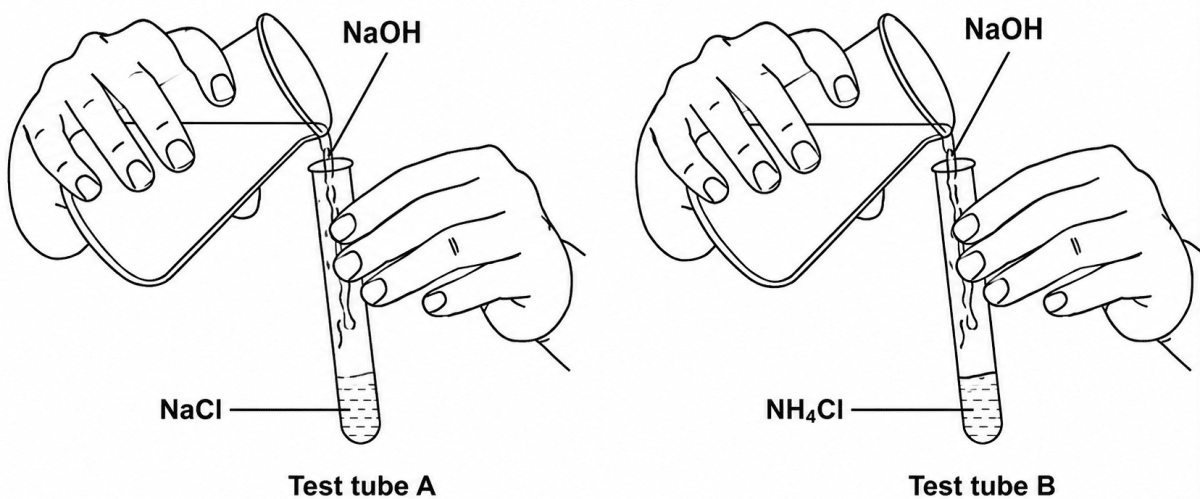
Rohan has two test tubes, A containing sodium chloride and B containing ammonium chloride as shown in the diagram below. He adds sodium hydroxide solution to both the test tubes and warms them gently.

Rohan has two test tubes, A containing sodium chloride and B containing ammonium chloride as shown in the diagram below. He adds sodium hydroxide solution to both the test tubes and warms them gently. ICSE 2027 Specimen Chemistry Solved Question Paper.

Answer the following questions:

(a) In which test tube (A or B) will Rohan observe the evolution of a gas?

(b) Name the gas that is evolved.

(c) What will be the colour of the flame when this gas burns in oxygen?

(d) Write an equation for the reaction that occurs in the test tube in which the gas has evolved.

Show SolutionHide Solution↓

(a) The gas is evolved in test tube B (containing ammonium chloride).

(b) The gas evolved is ammonia (NH3).

(c) Ammonia burns in oxygen with a greenish-yellow flame.

(d) NH4Cl + NaOH ⟶ NaCl + NH3 + H2O

7(i)Written · 2027 · Section B · 2027 SpecimenFull page

What is the ratio of methane to the acidic gaseous product obtained when methane undergoes complete combustion? Give a balanced equation for the above reaction.

Show SolutionHide Solution↓

On complete combustion, the acidic gaseous product is carbon dioxide.

CH4 + 2O2 ⟶ CO2 + 2H2O

The ratio of methane (CH4) to carbon dioxide (CO2) is 1 : 1.

7(ii)Written · 2027 · Section B · 2027 SpecimenFull page

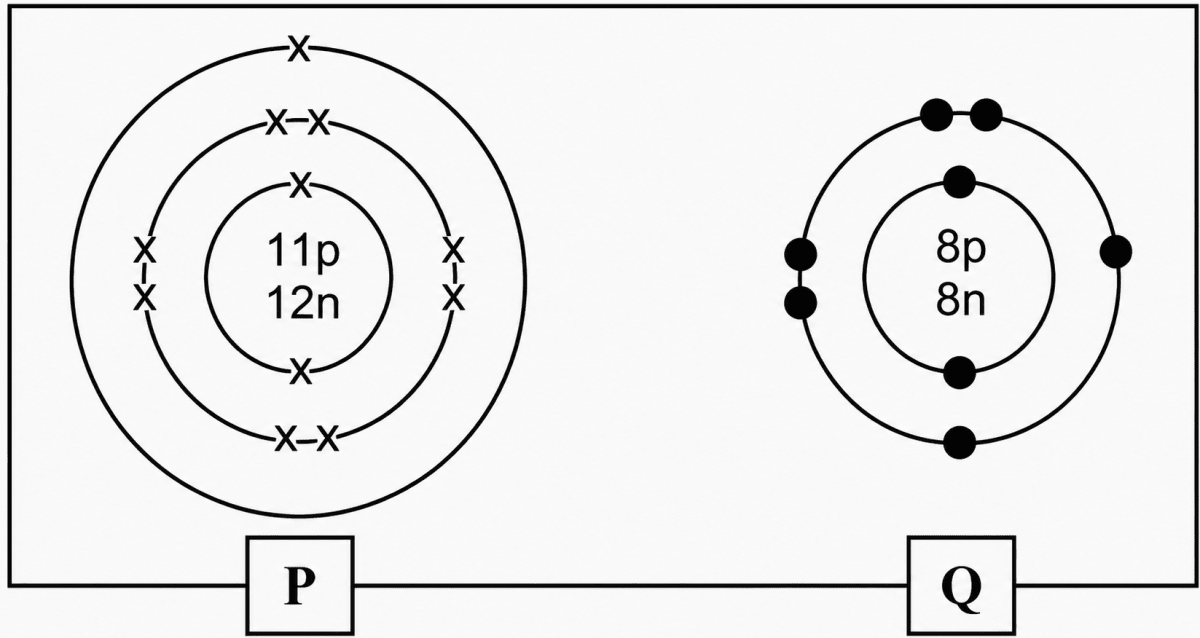
The diagram below illustrates the structures of two atoms P and Q.

The diagram below illustrates the structures of two atoms P and Q. ICSE 2027 Specimen Chemistry Solved Question Paper.

What is the formula and mass of one mole of the compound formed when P and Q react together?

[At. wt of P is 23 and Q is 16]

Show SolutionHide Solution↓

From the diagram, P has 11 protons (2, 8, 1) and is a monovalent metal, while Q has 8 protons (2, 6) and is a divalent non-metal. When they react, P loses one electron and Q gains two electrons, so two atoms of P combine with one atom of Q.

Formula of the compound = P2Q

Mass of one mole = 2 × (At. wt of P) + (At. wt of Q)

= 2 × 23 + 16

= 46 + 16

= 62 g

∴ The formula is P2Q and one mole has a mass of 62 g.

7(iii)Written · 2027 · Section B · 2027 SpecimenFull page

Give balanced equations for each of the following:

(a) Action of warm water on calcium carbide.

(b) Oxidation of sulphur with conc. nitric acid.

(c) Laboratory preparation of ethane by using sodium propionate and soda lime.

Show SolutionHide Solution↓

(a) CaC2 + 2H2O ⟶ Ca(OH)2 + C2H2

(b) S + 6HNO3 (conc.) ⟶ H2SO4 + 6NO2 + 2H2O

(c) C2H5COONa + NaOH $\xrightarrow{\text{CaO}}$ C2H6 + Na2CO3

7(iv)Written · 2027 · Section B · 2027 SpecimenFull page

In a round bottom flask, a mixture of ethanol, acetic acid and concentrated sulphuric acid was heated.

Answer the following questions:

(a) Name the type of reaction occurring in the above set up.

(b) What is the role of sulphuric acid in this reaction?

(c) State one observation that takes place during the reaction.

Show SolutionHide Solution↓

(a) Esterification reaction

$\underset{\text{ethyl alcohol}}{\text{C}_2\text{H}_5\text{OH}} + \text{CH}_3\text{COOH} \xrightarrow{\text{conc. H}_2\text{SO}_4} \underset{\text{ethyl acetate}}{{\text{CH}_3\text{COOC}_2\text{H}_5}} + \text{H}_2\text{O}$

(b) Dehydrating agent

(c) Fruity smell is observed due to the formation of ester by the reaction of ethanol and acetic acid.

8(i)Written · 2027 · Section B · 2027 SpecimenFull page

In the reactivity series of metals, Z is a metal above hydrogen and its oxide has the formula ZO. It was found that ZO reacted with water and formed a hydroxide as the product. With reference to the above context, answer the following questions:

(a) State the number of valence electrons present in element Z.

(b) Name the group which Z belongs to.

(c) What will be the formula of the hydroxide of Z?

Show SolutionHide Solution↓

(a) The oxide has the formula ZO, so Z is divalent. Hence, Z has 2 valence electrons.

(b) Z belongs to Group 2 (alkaline earth metals).

(c) The formula of the hydroxide of Z is Z(OH)2.

8(ii)Written · 2027 · Section B · 2027 SpecimenFull page

Draw the electron dot structure of:

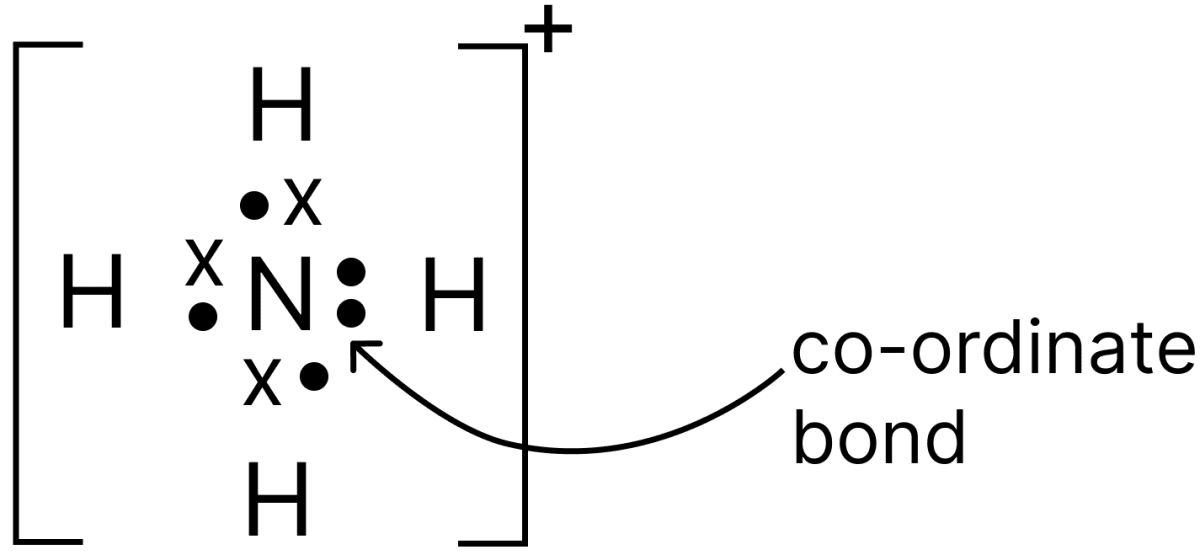
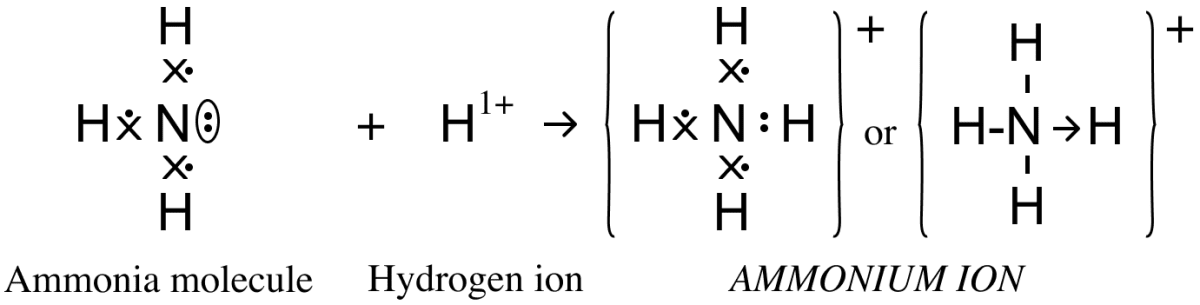
(a) ammonium ion (also label the co-ordinate bond)

(b) nitrogen molecule

[Atomic No.: N = 7, H = 1]

Show SolutionHide Solution↓

(a) Electron dot structure of the ammonium ion (with the co-ordinate bond labelled):

In the reactivity series of metals, Z is a metal above hydrogen and its oxide has the formula ZO. It was found that ZO reacted with water and formed a hydroxide as the product. With reference to the above context, answer the following questions: ICSE 2027 Specimen Chemistry Solved Question Paper.

(b) Electron dot structure of the nitrogen molecule (which contains a triple bond between the two nitrogen atoms):

In the reactivity series of metals, Z is a metal above hydrogen and its oxide has the formula ZO. It was found that ZO reacted with water and formed a hydroxide as the product. With reference to the above context, answer the following questions: ICSE 2027 Specimen Chemistry Solved Question Paper.
8(iii)Written · 2027 · Section B · 2027 SpecimenFull page

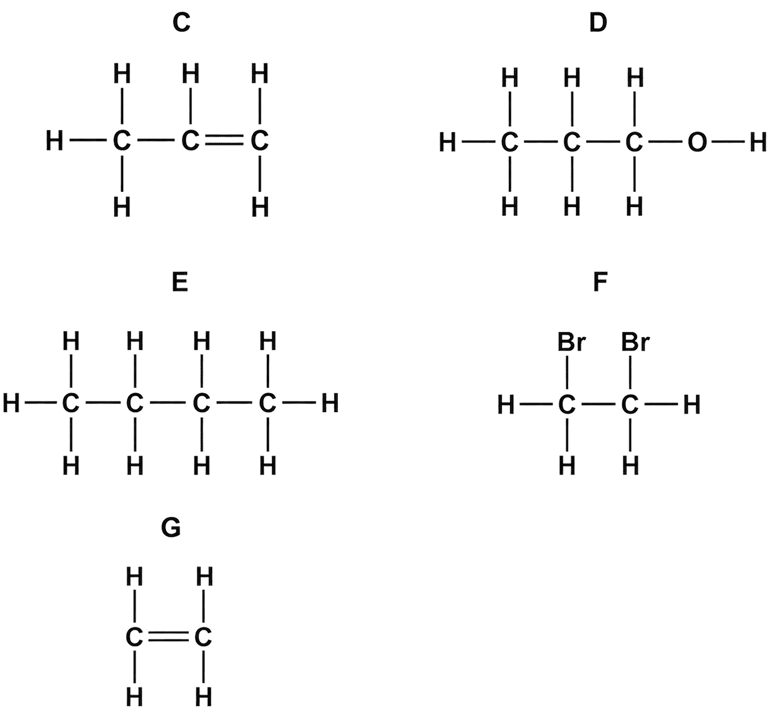
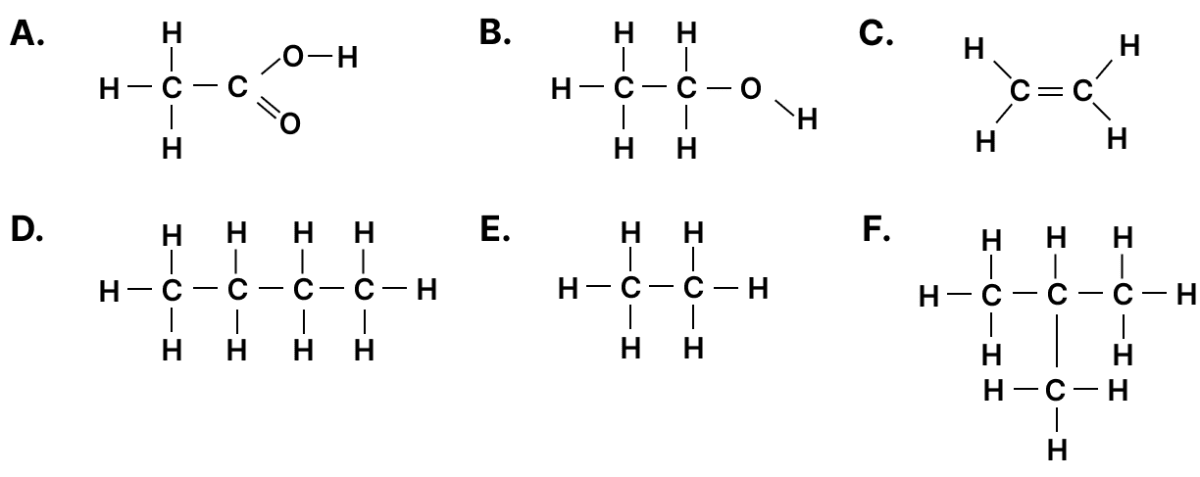
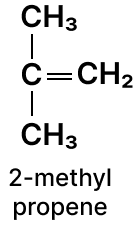
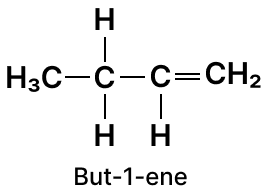
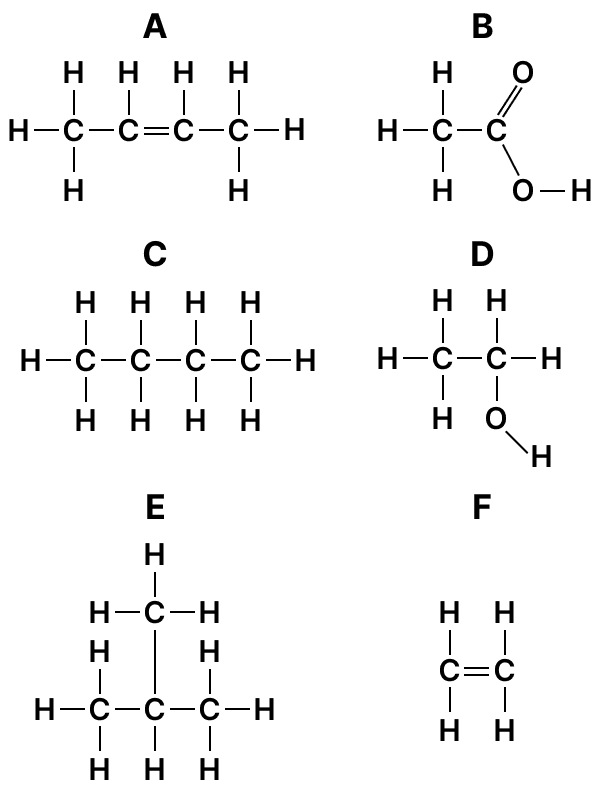
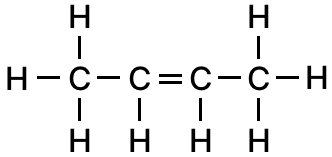
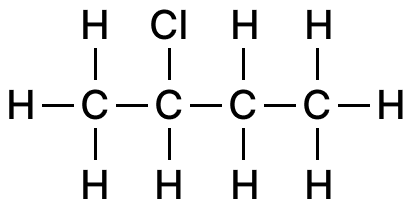
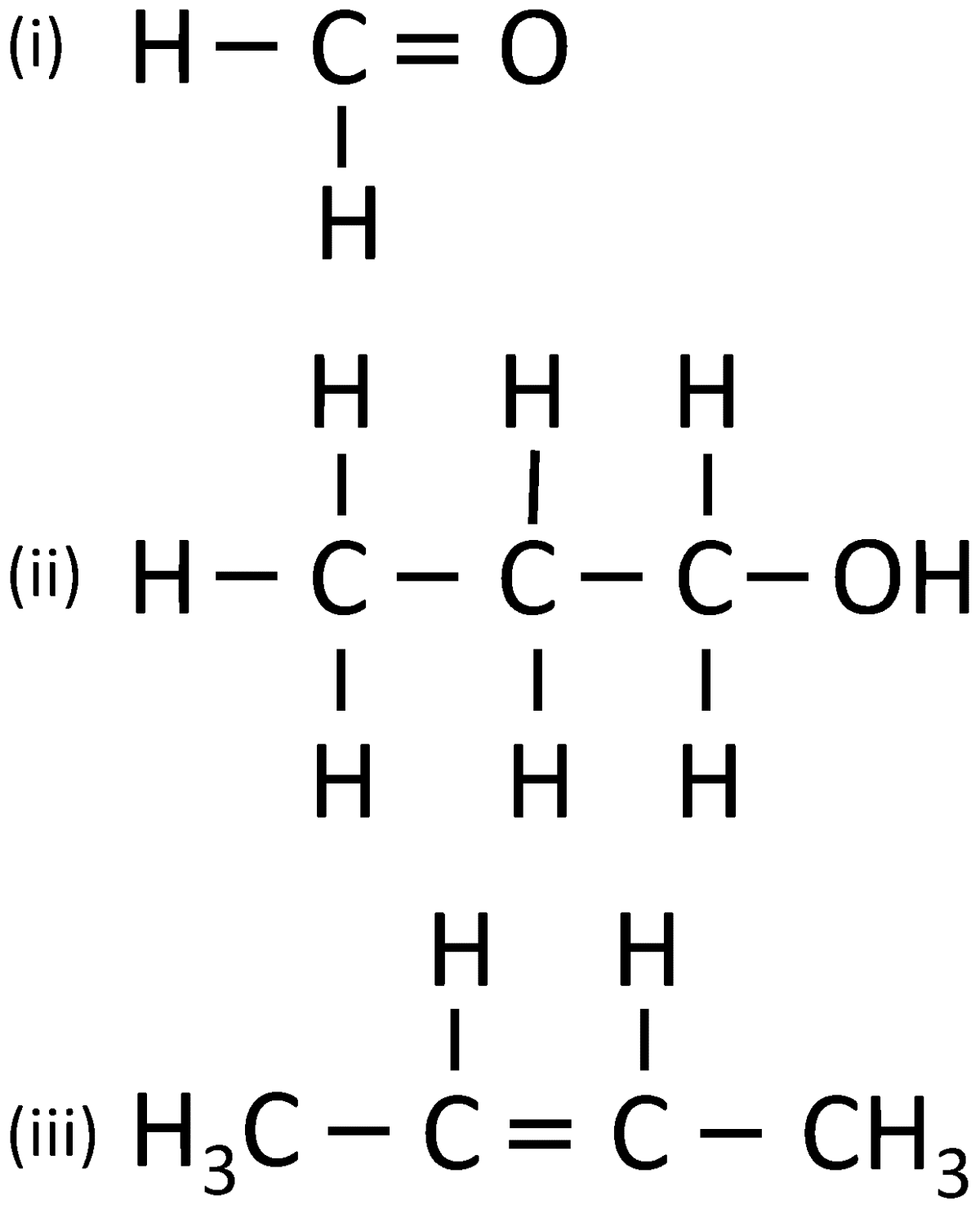
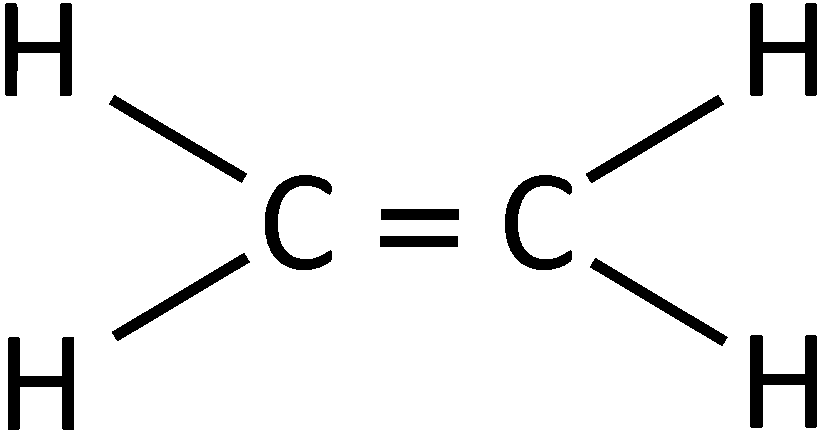
The structures of five organic compounds, C, D, E, F and G are shown.

The structures of five organic compounds. ICSE 2027 Specimen Chemistry Solved Question Paper.

Answer the following questions about these compounds.

(Each compound may be used once, more than once or not at all.)

State which compound, C, D, E, F or G:

(a) on halogenation will form F.

(b) is an alcohol.

(c) is an isomer of 2-methyl propane.

(d) is in the same homologous series as ethene.

Show SolutionHide Solution↓

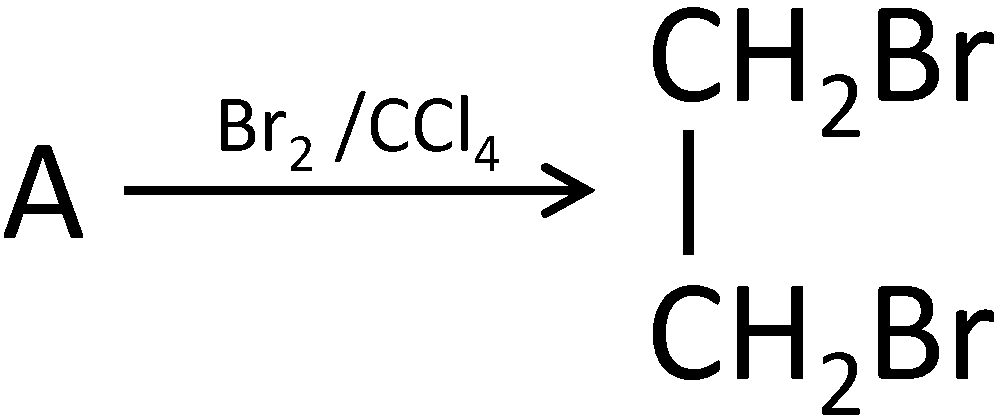
(a) G — ethene (G) on halogenation, i.e., addition of bromine, forms 1,2-dibromoethane (F).

(b) D — it contains the –OH (hydroxyl) functional group, so it is an alcohol.

(c) E — 2-methyl propane has the formula C4H10. Compound E (n-butane) is a saturated hydrocarbon with the same molecular formula C4H10, so it is an isomer of 2-methyl propane.

(d) C — ethene belongs to the alkene series (contains a C=C double bond). Compound C also contains a carbon-carbon double bond, so it belongs to the same homologous series as ethene.

1(i)1 Mark · 2026 · Section A · 2026 PaperFull page

A non-metal which reacts with concentrated sulphuric acid to form two gases which turn lime water milky is ............... .

Show SolutionHide Solution↓

Carbon

Reason — Carbon (a non-metal) reacts with hot concentrated sulphuric acid to form two gases — carbon dioxide (CO2) and sulphur dioxide (SO2). Both these gases turn lime water milky.

C + 2H2SO4 [conc.] ⟶ CO2 + 2H2O + 2SO2

1(ii)1 Mark · 2026 · Section A · 2026 PaperFull page

Which of the following element pairs will form an ionic bond?

Pair 
PElements of Group 1 & Group 2
QElements of Group 14 & Group 16
RElements of Group 2 & Group 17
SElements of Group 15 & Group 18
Show SolutionHide Solution↓

R

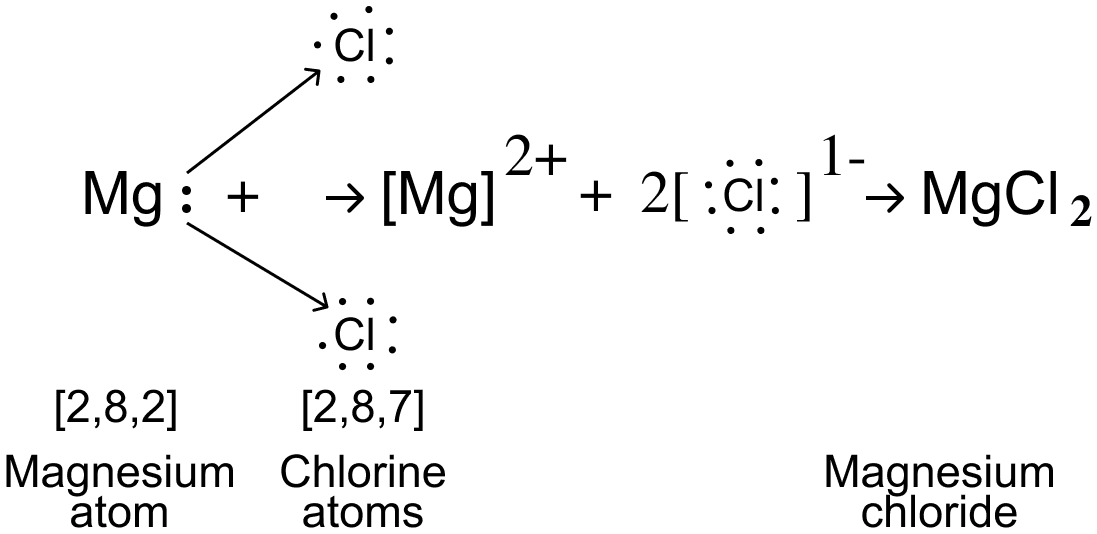
Reason — An ionic bond is formed between a metal (low ionisation potential) and a non-metal (high electron affinity). Group 2 elements are metals which lose 2 electrons, while Group 17 elements are non-metals which gain 1 electron. Hence, the elements of Group 2 and Group 17 form ionic bond (e.g., MgCl2, CaCl2).

Pair P consists of two metals (no bond formation), Q consists of two non-metals (covalent bond), and S consists of a non-metal and a noble gas (no bond formed).

1(iii)1 Mark · 2026 · Section A · 2026 PaperFull page

The electronic configuration of an element is 2,8,2. The hydroxide of this element can produce ............... hydroxyl ions per molecule.

Show SolutionHide Solution↓

2

Reason — An element with electronic configuration 2, 8, 2 is magnesium (Mg) with valency 2. Its hydroxide is Mg(OH)2, which contains 2 hydroxyl (OH-) ions per molecule.

Mg(OH)2 ⟶ Mg2+ + 2OH-

1(iv)1 Mark · 2026 · Section A · 2026 PaperFull page

With respect to the electrolysis of copper (II) sulphate solution using copper electrodes, which statement is correct?

Show SolutionHide Solution↓

Copper metal is deposited at the negative electrode.

Reason — During electrolysis of copper(II) sulphate solution using copper electrodes:

  • At the cathode (negative electrode): Cu2+ + 2e- ⟶ Cu, so copper is deposited here and the cathode increases in mass.
  • At the anode (positive electrode): Cu - 2e- ⟶ Cu2+, so copper of the anode dissolves and the anode decreases in mass.

No oxygen gas is produced because the copper is preferentially oxidised over the OH- ions.

1(v)1 Mark · 2026 · Section A · 2026 PaperFull page

Identify the equation that shows the reaction of ethane with chlorine in the presence of ultraviolet light.

Show SolutionHide Solution↓

C2H6 + Cl2 ⟶ C2H5Cl + HCl

Reason — In the presence of ultraviolet (UV) light, ethane (a saturated hydrocarbon) undergoes a substitution reaction with chlorine. One hydrogen atom of ethane is replaced by a chlorine atom forming chloroethane (C2H5Cl) and hydrogen chloride (HCl) is released.

C2H6 + Cl2 $\xrightarrow{\text{UV light}}$ C2H5Cl + HCl

1(vi)1 Mark · 2026 · Section A · 2026 PaperFull page

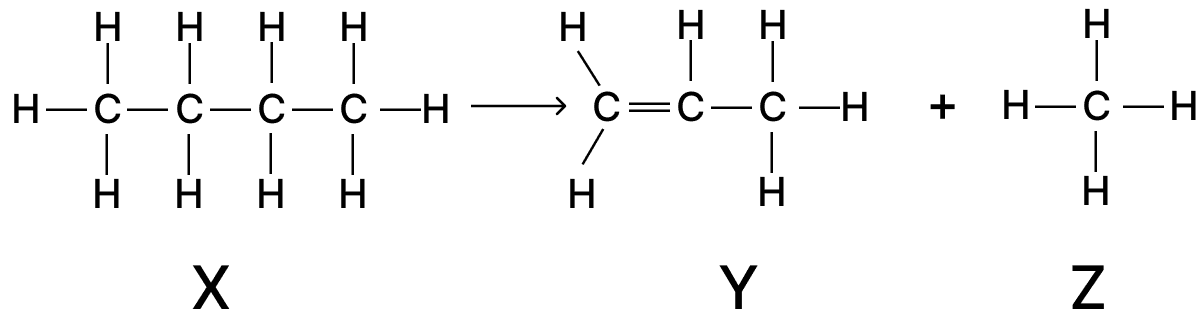
A hydrocarbon X undergoes the reaction under suitable conditions as shown below:

A hydrocarbon X undergoes the reaction under suitable conditions as shown below: ICSE 2026 Chemistry Solved Question Paper.

Which compound(s) is/are unsaturated?

Show SolutionHide Solution↓

Y only

Reason — The reaction shown is cracking (thermal decomposition) of butane (X = C4H10), a saturated hydrocarbon, into propene (Y = C3H6) and methane (Z = CH4).

  • X (butane, C4H10) — saturated (only single bonds).
  • Y (propene, C3H6) — unsaturated (contains one C=C double bond).
  • Z (methane, CH4) — saturated (only single bonds).

Hence, only Y is unsaturated.

1(vii)1 Mark · 2026 · Section A · 2026 PaperFull page

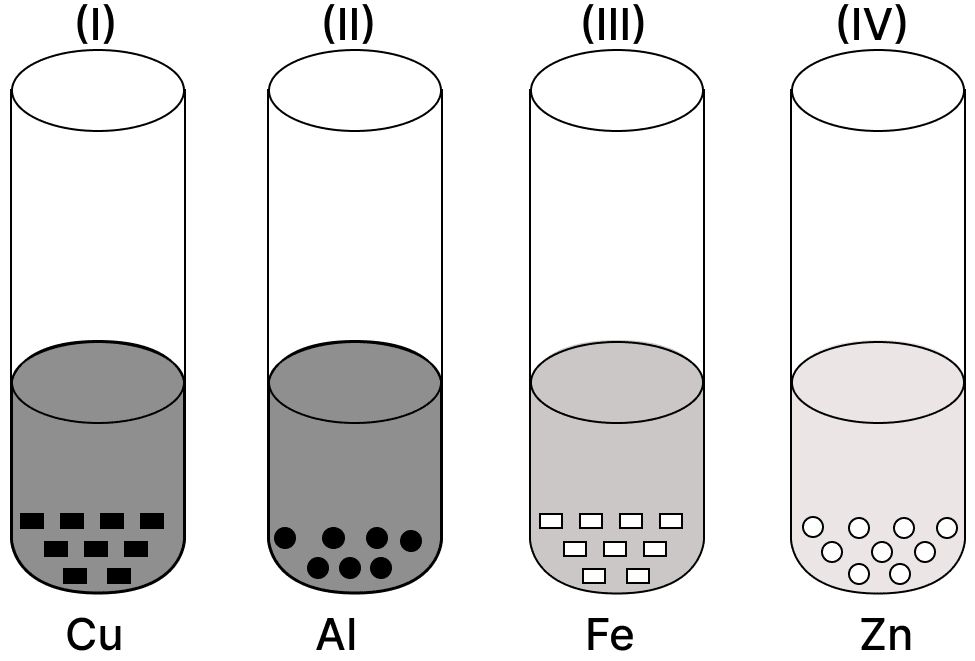
Rita added dilute hydrochloric acid to four metals. She recorded her observations in the table given below. While noting her observations she made some errors.

 MetalsObservations
1coppera gas was given off
2irona gas was given off
3magnesiumno gas was given off
4zinca gas was given off

Which observation(s) made by Rita is/are correct?

Show SolutionHide Solution↓

Both 2 and 4

Reason — The reactivity of these metals with dilute HCl depends on their position in the activity series:

  • Copper lies below hydrogen in the activity series, so it does not react with dilute HCl. Hence, no gas is given off — observation (1) is incorrect.
  • Iron is above hydrogen in the activity series, hence it reacts with dilute HCl liberating hydrogen gas — observation (2) is correct.
    Fe + 2HCl ⟶ FeCl2 + H2 ↑
  • Magnesium is highly reactive and reacts vigorously with dilute HCl liberating hydrogen gas — observation (3) is incorrect.
    Mg + 2HCl ⟶ MgCl2 + H2 ↑
  • Zinc is above hydrogen in the activity series and reacts with dilute HCl liberating hydrogen gas — observation (4) is correct.
    Zn + 2HCl ⟶ ZnCl2 + H2 ↑

Hence, observations 2 and 4 are correct.

1(viii)1 Mark · 2026 · Section A · 2026 PaperFull page

An atom of X forms an ion according to the equation X ⟶ X+2.

The atomic number of the atom X is:

Show SolutionHide Solution↓

12

Reason — An element with atomic number 12 has the electronic configuration 2, 8, 2. It loses its 2 valence electrons easily to attain a stable octet configuration (2, 8) and forms a divalent positive ion X2+. This element is magnesium (Mg).

Mg ⟶ Mg2+ + 2e-

Whereas, atomic number 16 (Sulphur) gains 2 electrons to form S2-, atomic number 10 (Neon) is a noble gas which doesn't form ions, and atomic number 14 (Silicon) shares electrons.

1(ix)1 Mark · 2026 · Section A · 2026 PaperFull page

Salts can be prepared by the action of dilute acid on:

  1. bases
  2. carbonates
  3. metals
  4. sulphites

The method which cannot be used for the preparation of copper salts is:

Show SolutionHide Solution↓

3

Reason — Copper lies below hydrogen in the activity series, so it does not displace hydrogen from dilute acids. Hence, copper salts cannot be prepared by the action of dilute acids on the metal copper.

However, copper salts can be prepared from copper bases like Cu(OH)2, copper carbonate (CuCO3), and copper sulphite by the action of dilute acid.

1(x)1 Mark · 2026 · Section A · 2026 PaperFull page

The compound that has the highest melting point amongst the following is:

Show SolutionHide Solution↓

Sodium chloride

Reason — Sodium chloride (NaCl) is an ionic compound. Ionic compounds have very strong electrostatic forces of attraction between oppositely charged ions, requiring a large amount of energy to break, so they have very high melting points.

Whereas, methane, ammonia and ethanol are covalent compounds with weak intermolecular forces, so they have low melting points.

1(xi)1 Mark · 2026 · Section A · 2026 PaperFull page

Assertion (A): Dilute Sulphuric acid is a stronger electrolyte than concentrated Sulphuric acid.

Reason (R): Dilute Sulphuric acid has a higher concentration of mobile ions.

Show SolutionHide Solution↓

Both (A) and (R) are true and (R) is the correct explanation of (A).

Reason — Dilute sulphuric acid is a stronger electrolyte because the presence of water causes greater ionisation, producing more mobile ions. Concentrated sulphuric acid contains comparatively fewer free ions, hence Assertion (A) is true.
The strength of an electrolyte depends on the concentration of mobile ions. In dilute sulphuric acid greater ionisation and ion mobility make it a better conductor of electricity, hence Reason (R) is true and is the correct explanation of (A).

H2SO4 ⟶ 2H+ + SO42-

1(xii)1 Mark · 2026 · Section A · 2026 PaperFull page

What volume of carbon dioxide is produced at STP when 5 litres of propane is burnt completely according to the equation given below?

C3H8 + 5O2 ⟶ 3CO2 + 4H2O

Show SolutionHide Solution↓

15 litres

Reason — According to Gay-Lussac's law of gaseous volumes, when gases react they do so in volumes which bear a simple whole number ratio to one another, given temperature and pressure remain constant.

From the equation: 1 volume of C3H8 produces 3 volumes of CO2.

∴ 5 litres of C3H8 will produce 5 × 3 = 15 litres of CO2.

1(xiii)1 Mark · 2026 · Section A · 2026 PaperFull page

An unsaturated hydrocarbon with three atoms of carbon and six atoms of hydrogen is:

Show SolutionHide Solution↓

propene

Reason — Propene is an alkene with molecular formula C3H6, which contains 3 carbon atoms and 6 hydrogen atoms with a C=C double bond, making it unsaturated. It follows the general formula of alkenes (CnH2n).

CH2=CH-CH3 (propene)

Whereas, propyne (C3H4) has 4 hydrogens, propane (C3H8) is saturated, and propanol (C3H8O) is an alcohol containing oxygen.

1(xiv)1 Mark · 2026 · Section A · 2026 PaperFull page

Assertion (A): In the electrolysis of acidified water, the volume of hydrogen liberated is twice the volume of oxygen formed.

Reason (R): Water has hydrogen and oxygen in the ratio of 1:2 by volume.

Show SolutionHide Solution↓

(A) is true but (R) is false.

Reason — During the electrolysis of acidified water:

  • At cathode: 4H+ + 4e- ⟶ 2H2
  • At anode: 4OH- - 4e- ⟶ 2H2O + O2

The ratio of H2 to O2 liberated is 2:1, so the volume of hydrogen liberated is twice the volume of oxygen formed. Hence, assertion (A) is true.

However, on electrolysis water gives hydrogen and oxygen in the ratio of 2:1 by volume, and not 1:2 as stated. Hence, reason (R) is false.

1(xv)1 Mark · 2026 · Section A · 2026 PaperFull page

In the electrolysis of molten aluminium oxide for extraction of aluminium, the following reactions take place:

  1. Al3+ + 3e- ⟶ Al
  2. 2O2- ⟶ O2 + 4e-
  3. C + O2 ⟶ CO2
  4. Al2O3 ⇌ 2Al3+ + 3O2-

The reaction that takes place at the negative electrode is:

Show SolutionHide Solution↓

1

Reason — The negative electrode is the cathode where reduction takes place. At the cathode, the positively charged Al3+ ions get attracted, gain 3 electrons, and get deposited as aluminium metal.

Al3+ + 3e- ⟶ Al

Reaction (2) takes place at the anode (oxidation), reaction (3) is the reaction of carbon anode with oxygen, and reaction (4) is the dissociation of alumina.

2(i)1 Mark · 2026 · Section A · 2026 PaperFull page

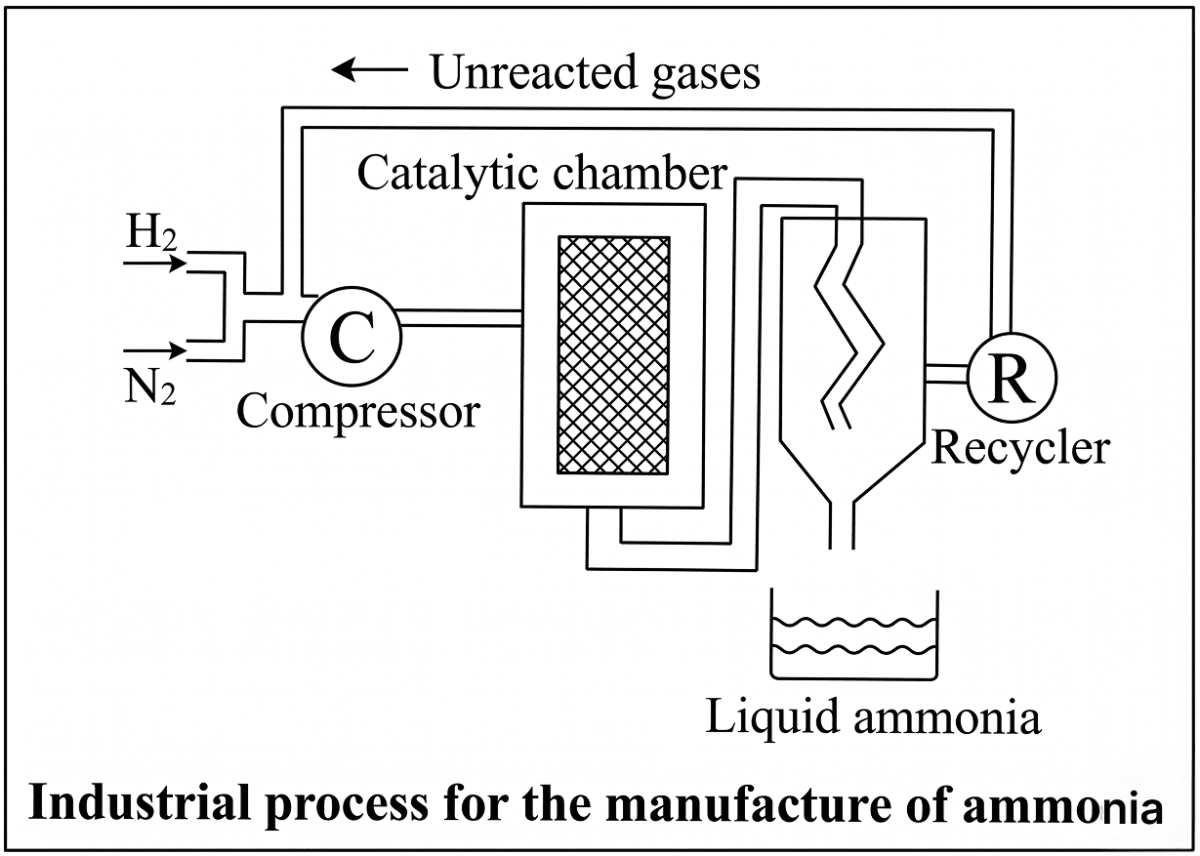
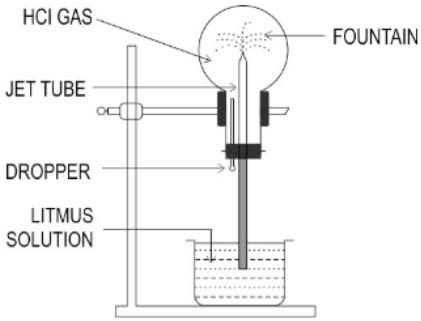
Given below is the industrial process for the manufacture of ammonia gas. Study the schematic diagram to answer the following questions.

Given below is the industrial process for the manufacture of ammonia gas. Study the schematic diagram to answer the following questions. ICSE 2026 Chemistry Solved Question Paper.

(a) Name the process.

(b) Which catalyst is used in the above process?

(c) In the above diagrammatic setup, how is ammonia gas separated from the unreacted gases to obtain liquid ammonia?

(d) Which two properties of ammonia gas can be demonstrated by the Fountain Experiment?

Show SolutionHide Solution↓

(a) Haber's process.

(b) Finely divided iron.

(c) The mixture of ammonia and unreacted gases (N2 and H2) coming out of the catalytic chamber is passed through the cooling pipes (condenser). Ammonia liquefies first, whereas nitrogen and hydrogen do not liquefy easily. The ammonia produced is stored as liquid under pressure.

(d) The two properties of ammonia gas demonstrated by the Fountain Experiment are:

  1. Ammonia gas is highly soluble in water.
  2. Ammonia is a basic gas (its aqueous solution turns red litmus blue / phenolphthalein turns pink).
2(ii)1 Mark · 2026 · Section A · 2026 PaperFull page

Identify the following terms / compounds:

(a) A compound which reacts with water to give acetylene gas.

(b) The gas evolved when sodium propanoate is heated with soda lime.

(c) A reddish-brown precipitate formed when ferric chloride solution reacts with an alkali.

(d) A pair of electrons present in an atom which is not shared with any other atom during bond formation.

(e) The relative molecular mass of a substance expressed in grams.

Show SolutionHide Solution↓

(a) Calcium carbide (CaC2)

(b) Ethane (C2H6)

(c) Ferric hydroxide [Fe(OH)3]

(d) Lone pair of electrons

(e) Gram molecular mass

2(iii)1 Mark · 2026 · Section A · 2026 PaperFull page

Match Column A with Column B:

Column AColumn B
(a) CuO + C ⟶ Cu + CO1. Oxidation
(b) Al3+ + 3e- ⟶ Al2. Ionisation
(c) PbBr2 ⟶ Pb2+ + 2Br1-3. Reduction
(d) 2O2- - 2e- ⟶ O24. Redox
(e) HCl ⟶ H+ + Cl1-5. Electrolytic dissociation
Show SolutionHide Solution↓
Column AColumn B
(a) CuO + C ⟶ Cu + CO4. Redox
(b) Al3+ + 3e- ⟶ Al3. Reduction
(c) PbBr2 ⟶ Pb2+ + 2Br1-5. Electrolytic dissociation
(d) 2O2- - 2e- ⟶ O21. Oxidation
(e) HCl ⟶ H+ + Cl1-2. Ionisation
2(iv)1 Mark · 2026 · Section A · 2026 PaperFull page

Complete the following sentences by choosing the correct option from the brackets:

(a) The oxide that dissolves in caustic potash (KOH) is ............... . [ZnO / CuO]

(b) The reaction that takes place at the anode during the electrolysis of molten lead bromide is ............... . [2Br - 2e– ⟶ 2Br– / 2Br– - 2e– ⟶ Br2]

(c) The volume occupied by 8 grams of oxygen gas at STP is ............... litres. [5.6 / 8.96] [Atomic weight of O = 16]

(d) ............... does not give hydrogen gas when it reacts with cold and very dilute nitric acid. [Cu / Mn]

(e) ............... is a polar covalent compound. [HCl / CCl4]

Show SolutionHide Solution↓

(a) The oxide that dissolves in caustic potash (KOH) is ZnO.
Reason — ZnO is amphoteric in nature, so it dissolves in both acids and alkalis like KOH.
ZnO + 2KOH ⟶ K2ZnO2 + H2O

(b) The reaction that takes place at the anode during the electrolysis of molten lead bromide is 2Br- - 2e- ⟶ Br2.

(c) The volume occupied by 8 grams of oxygen gas at STP is 5.6 litres.
Reason —
Molar mass of O2 = 32 g
32 g of O2 at STP occupies 22.4 L
∴ 8 g of O2 occupies $\frac{22.4}{32}$ × 8 = 5.6 L

(d) Cu does not give hydrogen gas when it reacts with cold and very dilute nitric acid.
Reason — Copper lies below hydrogen in the activity series, so it does not liberate hydrogen with nitric acid.

(e) HCl is a polar covalent compound.
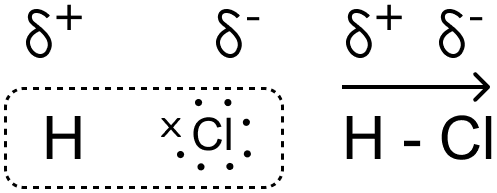
Reason — HCl is formed by sharing of electrons between H and Cl, but due to large electronegativity difference, the bonding electrons are unequally shared, giving the molecule a polar character. CCl4 is a non-polar covalent compound due to symmetric structure.

2(v)1 Mark · 2026 · Section A · 2026 PaperFull page

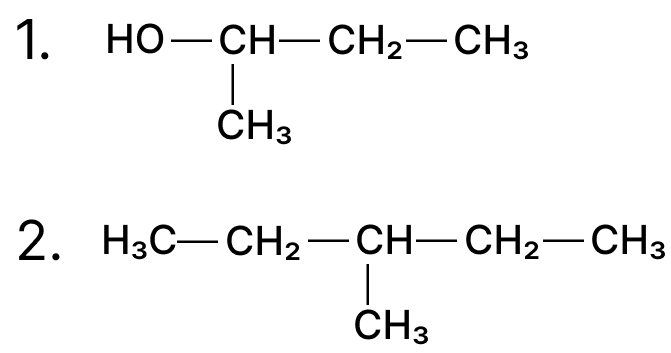
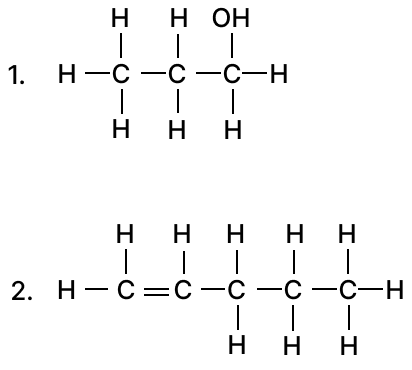
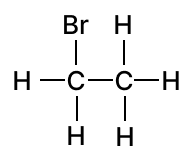
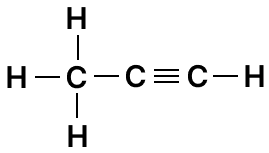
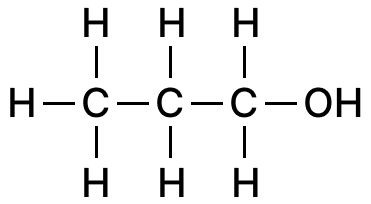
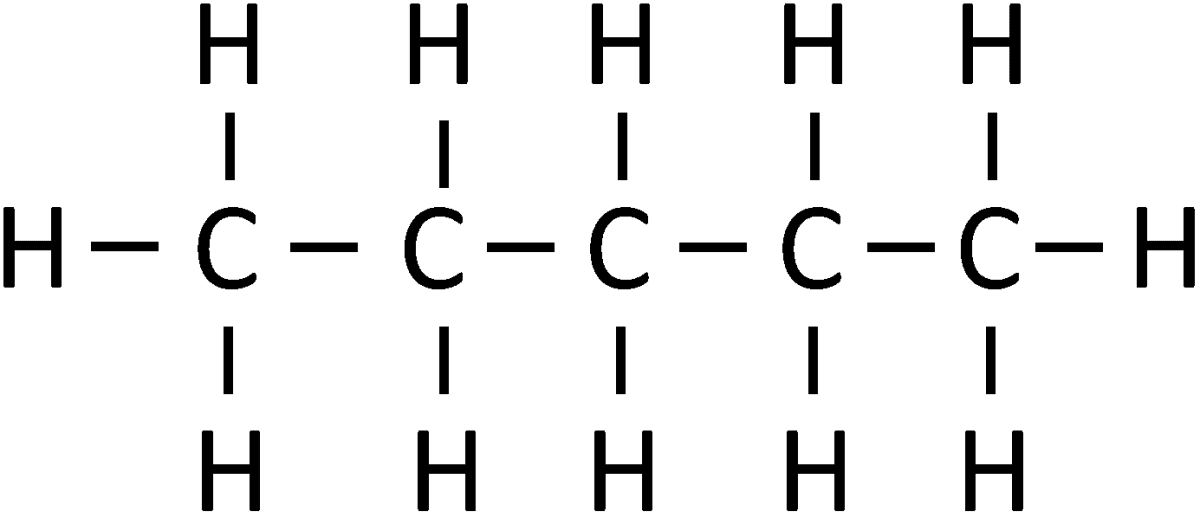
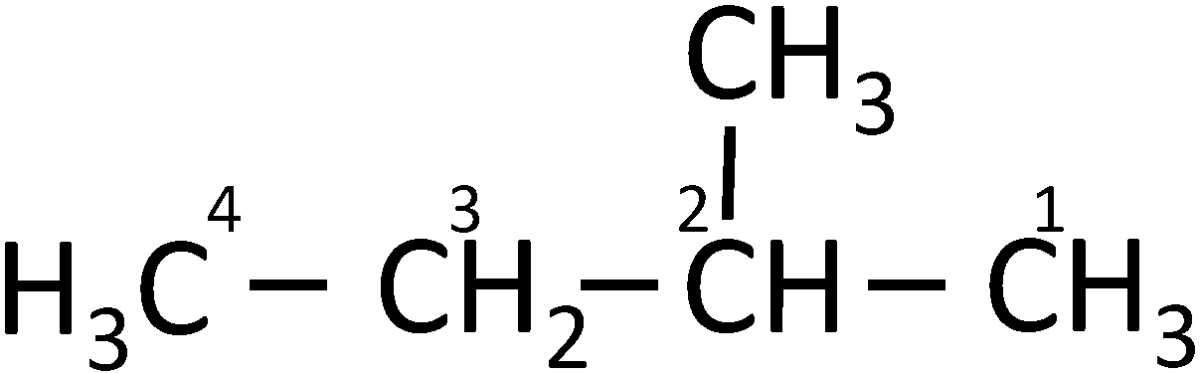
(a) Give the IUPAC name for the following organic compounds:

(a) Give the IUPAC name for the following organic compounds. ICSE 2026 Chemistry Solved Question Paper.

(b) Draw the structural diagram for each of the following organic compounds:

Show SolutionHide Solution↓

(a) IUPAC names of the given compounds:

  1. Butan-2-ol
  2. 3-methylpentane

(b) Structural diagrams:

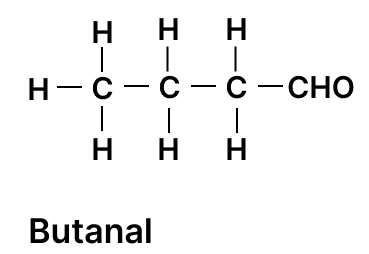
1. butanal

Give IUPAC name for the following organic compounds: ICSE 2026 Chemistry Solved Question Paper.

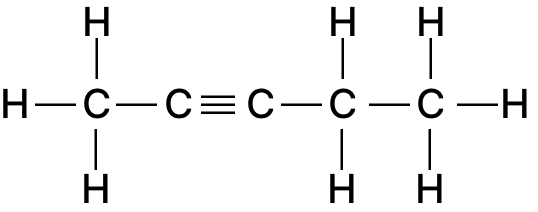
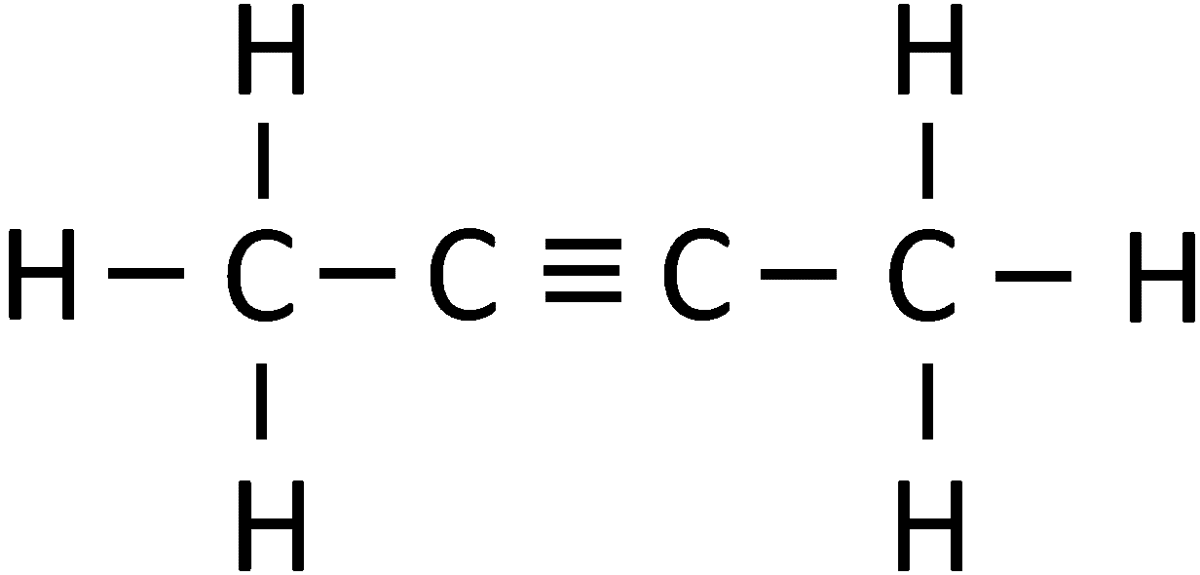
2. Pent-2-yne (CH3—C≡C—CH2—CH3)

Give IUPAC name for the following organic compounds: ICSE 2026 Chemistry Solved Question Paper.

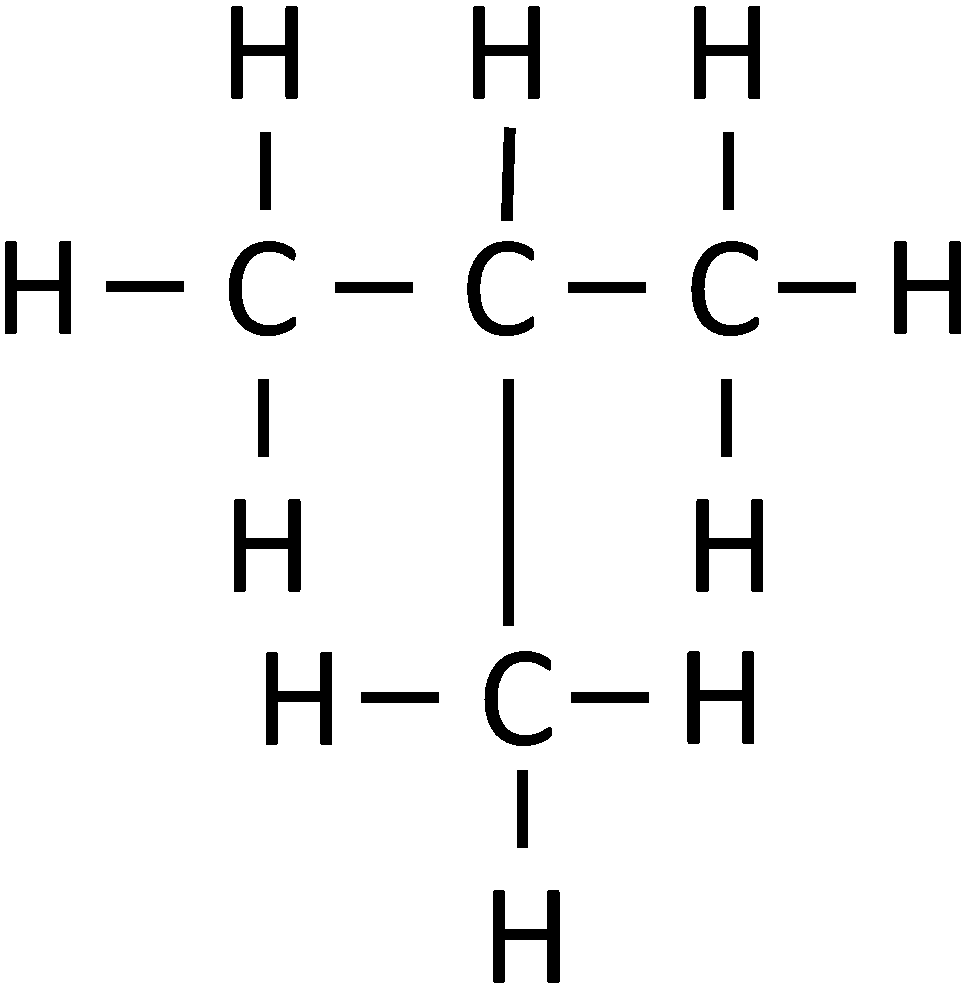
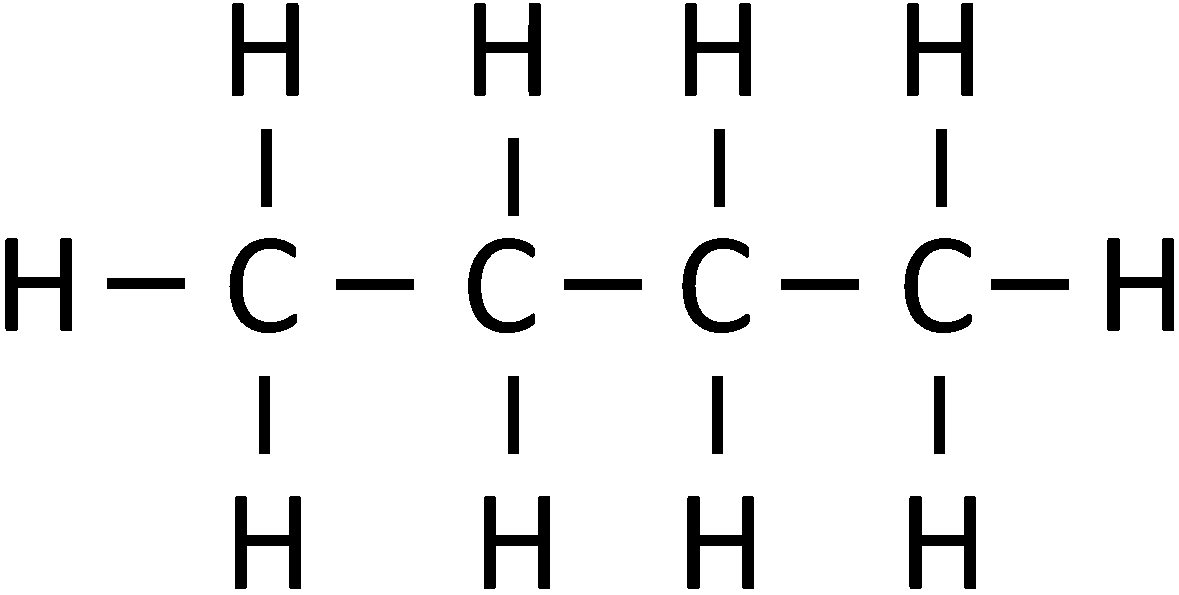
3. The isomer of n-butane is 2-methylpropane (iso-butane).

Give the structural formulae of 2-methyl propane. Organic Chemistry, Simplified Chemistry Dalal Solutions ICSE Class 10
3(i)Written · 2026 · Section B · 2026 PaperFull page

Alex was given a solution of an unknown salt Y for analysis. He performed the following tests and recorded his observations:

  • To a part of the solution Y, he added silver nitrate solution and obtained a white precipitate which was soluble in ammonium hydroxide solution.
  • To the remaining solution he added a few drops of sodium hydroxide solution and obtained a pale blue precipitate.

Based on the observations made by Alex, identify:

(a) the anion and

(b) the cation present in salt Y.

Show SolutionHide Solution↓

(a) Anion — Chloride (Cl-)

(b) Cation — Copper(II) (Cu2+)

Reason —

(a) The white precipitate formed with silver nitrate solution which is soluble in ammonium hydroxide is silver chloride (AgCl). This indicates the presence of chloride ion (Cl-) as the anion.

AgNO3 + Cl- ⟶ AgCl ↓ [white ppt.] + NO3-

AgCl + 2NH4OH ⟶ [Ag(NH3)2]Cl + 2H2O

(b) The pale blue precipitate formed with sodium hydroxide solution is copper(II) hydroxide [Cu(OH)2]. This indicates the presence of copper(II) ion (Cu2+) as the cation.

Cu2+ + 2NaOH ⟶ Cu(OH)2 ↓ [pale blue ppt.] + 2Na+

Hence, the salt Y is copper(II) chloride (CuCl2).

3(ii)Written · 2026 · Section B · 2026 PaperFull page

Study the reaction given below and answer the questions that follow:

NaNO3 + H2SO4 (Conc.) $\xrightarrow{\lt \space 200^{\circ}\text C}$ NaHSO4 + HNO3

(a) Give one reason for maintaining the temperature below 200°C.

(b) Why is concentrated Sulphuric acid used in the above reaction?

Show SolutionHide Solution↓

(a) The temperature is maintained below 200°C because nitric acid decomposes at higher temperature to give nitrogen dioxide, water and oxygen.

4HNO3 ⟶ 4NO2 + 2H2O + O2

(b) Concentrated sulphuric acid is used because it is a non-volatile acid with a high boiling point. It displaces the more volatile nitric acid from sodium nitrate and does not distil over with nitric acid vapours.

3(iii)Written · 2026 · Section B · 2026 PaperFull page

Element A belongs to group 15 and period 2 of the Periodic Table.

(a) Identify the element A.

(b) Write the formula of the compound formed when element A combines with hydrogen.

(c) Draw the dot (•) and cross (×) structure of the compound formed in (b) above.

Show SolutionHide Solution↓

(a) Element A is Nitrogen (N) with electronic configuration 2, 5.

(b) Nitrogen has a valency of 3 and combines with hydrogen (valency 1) to form ammonia (NH3).

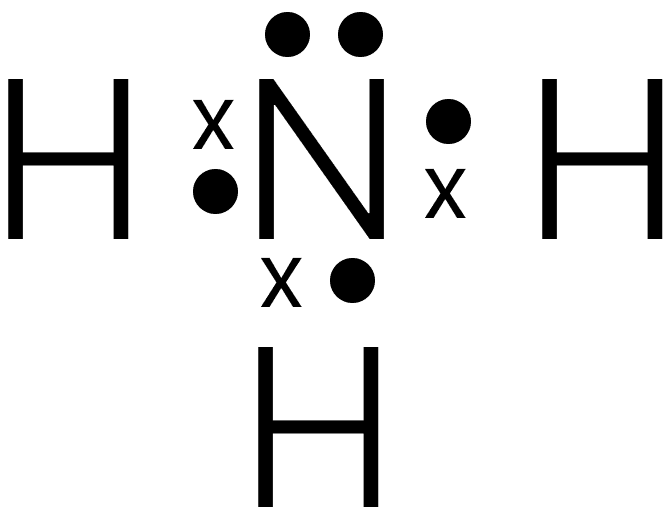
(c) Dot (•) and cross (×) structure of NH3:

Element A belongs to group 15 and period 2 of the Periodic Table. ICSE 2026 Chemistry Solved Question Paper.
3(iv)Written · 2026 · Section B · 2026 PaperFull page

Complete and balance the following equations:

(a) C2H4Br2 + KOH (alcoholic) ⟶

(b) NH3 (excess) + Cl2 ⟶

(c) C12H22O11 $\xrightarrow{\text{(conc.) H}_2\text{SO}_4}$

Show SolutionHide Solution↓

(a) C2H4Br2 + 2KOH (alcoholic) ⟶ C2H2 + 2KBr + 2H2O

(b) 8NH3 (excess) + 3Cl2 ⟶ N2 + 6NH4Cl

(c) C12H22O11 $\xrightarrow{\text{(conc.) H}_2\text{SO}_4}$ 12C + 11H2O

4(i)Written · 2026 · Section B · 2026 PaperFull page

Differentiate between the following pairs based on the criteria given in the bracket:

(a) Acetic acid and Sulphuric acid (number of replaceable hydrogen ion per molecule)

(b) Electrolyte and Metallic conductor (the particles conducting electricity)

Show SolutionHide Solution↓

(a)

Acetic acidSulphuric acid
Acetic acid (CH3COOH) is a monobasic acid, having only one replaceable hydrogen ion per molecule.Sulphuric acid (H2SO4) is a dibasic acid, having two replaceable hydrogen ions per molecule.

(b)

ElectrolyteMetallic conductor
In an electrolyte, electricity is conducted by the movement of ions (cations and anions) in the molten state or in aqueous solution.In a metallic conductor, electricity is conducted by the movement of free electrons through the metal lattice.
4(ii)Written · 2026 · Section B · 2026 PaperFull page

Equal volumes of ammonia gas and chlorine gas are kept in two different containers under the same conditions of temperature and pressure.

Find the number of molecules contained in chlorine gas when the mass of ammonia is 34 g.

[Atomic weight: Cl=35.5, H=1, N=14]

Show SolutionHide Solution↓

According to Avogadro's Law, equal volumes of all gases under the same conditions of temperature and pressure contain the same number of molecules.

Hence, the number of molecules of chlorine gas = number of molecules of ammonia gas.

Molar mass of NH3 = 14 + 3(1) = 17 g

Number of moles of NH3 = $\frac{\text{Mass}}{\text{Molar mass}}$ = $\frac{34}{17}$ = 2 moles

Number of molecules in 1 mole = 6.022 × 10²³

∴ Number of molecules in 2 moles of NH3 = 2 × 6.022 × 1023 = 1.2044 × 1024 molecules

Hence, the number of molecules in chlorine gas = 1.2044 × 1024 molecules.

4(iii)Written · 2026 · Section B · 2026 PaperFull page

Elements P, Q, and R are in the same period of the modern periodic table.

  • P readily loses its one valence electron to form a stable ion.
  • Q shares its electrons in bonding but does not form ions easily.
  • R has high electronegativity.

Answer the following questions based on the above information:

(a) Which element would be most difficult to reduce among P, Q and R?

(b) Which element is expected to have the smallest atomic radius among P, Q and R?

(c) Arrange P, Q and R in order of decreasing ionisation potential.

Show SolutionHide Solution↓

P loses one valence electron, so P is a Group 1 metal (most electropositive). R has high electronegativity, so R is a non-metal on the right side of the periodic table. Q shares electrons (covalent), so Q is in Group 14 (between P and R).

(a) P would be most difficult to reduce.
Reason — Reduction means gain of electrons. Element P readily loses its valence electron and is the most electropositive (strongest reducing agent itself). Hence, its tendency to gain electrons (be reduced) is the lowest, so it is most difficult to reduce.

(b) R has the smallest atomic radius.
Reason — Across a period from left to right, the atomic radius decreases due to increasing nuclear charge. R is on the rightmost side, so it has the smallest atomic radius.

(c) Decreasing ionisation potential: R > Q > P
Reason — Across a period, ionisation potential increases from left to right because atomic size decreases and the effective nuclear charge increases.

4(iv)Written · 2026 · Section B · 2026 PaperFull page

Given below are some chemicals.

Lead nitrate, Copper, Hydrochloric acid, Lead oxide, Iron, Sodium carbonate, Copper carbonate, Chlorine

Using suitable chemicals from the box given above, write balanced chemical equations for the preparation of the following salts.

(Note: The chemicals may be used more than once, if needed.)

(a) Lead (II) carbonate

(b) Copper (II) chloride

(c) Iron (II) chloride

Show SolutionHide Solution↓

(a) Pb(NO3)2 + Na2CO3 ⟶ PbCO3 ↓ + 2NaNO3

(b) CuCO3 + 2HCl ⟶ CuCl2 + H2O + CO2 ↑

(c) Fe + 2HCl ⟶ FeCl2 + H2 ↑

5(i)Written · 2026 · Section B · 2026 PaperFull page

An unsaturated hydrocarbon having two carbon atoms was made to react with two moles of hydrogen gas in the presence of a catalyst to give a saturated hydrocarbon. Using the above information, answer the following questions:

(a) The type of reaction that occurred is ............... . (addition / substitution)

(b) Name a suitable catalyst which is used in the reaction.

(c) Write a balanced chemical equation for the above reaction.

Show SolutionHide Solution↓

(a) The type of reaction that occurred is addition.

(b) Nickel (Ni)

(c) C2H2 + 2H2 $\xrightarrow{\text{Ni}}$ C2H6

5(ii)Written · 2026 · Section B · 2026 PaperFull page

During the manufacture of sulphuric acid, a chemist collected the gas formed after catalytic oxidation of sulphur dioxide.

(a) Name the gas collected.

(b) Which acid is formed when the gas collected by the chemist is dissolved directly in water?

(c) Why should we not dissolve this gas directly in water?

Show SolutionHide Solution↓

(a) Sulphur trioxide

(b) Sulphuric acid (H2SO4)

(c) Sulphur trioxide (SO3) does not dissolve in water satisfactorily and it gives a lot of heat and forms misty droplets of sulphuric acid which are difficult to condense and escape into the atmosphere. Hence, it is not directly dissolved in water.

5(iii)Written · 2026 · Section B · 2026 PaperFull page

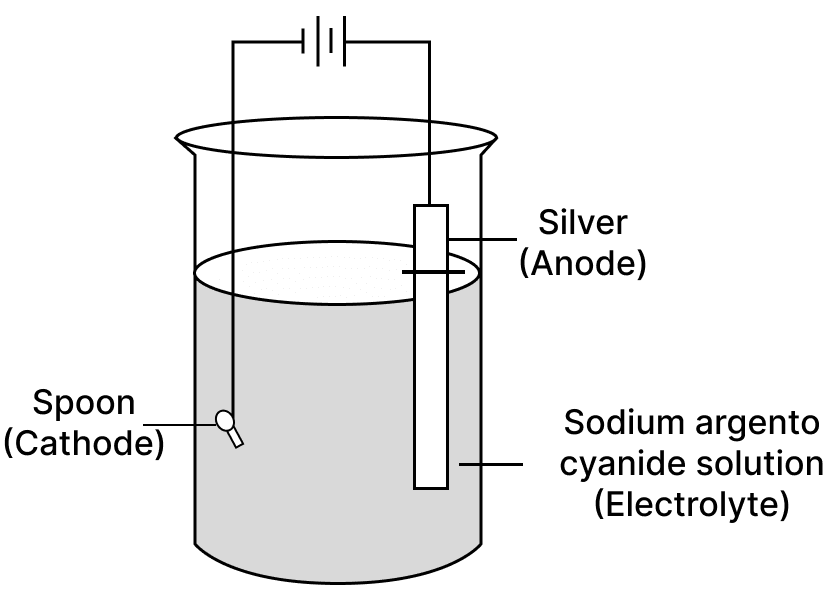
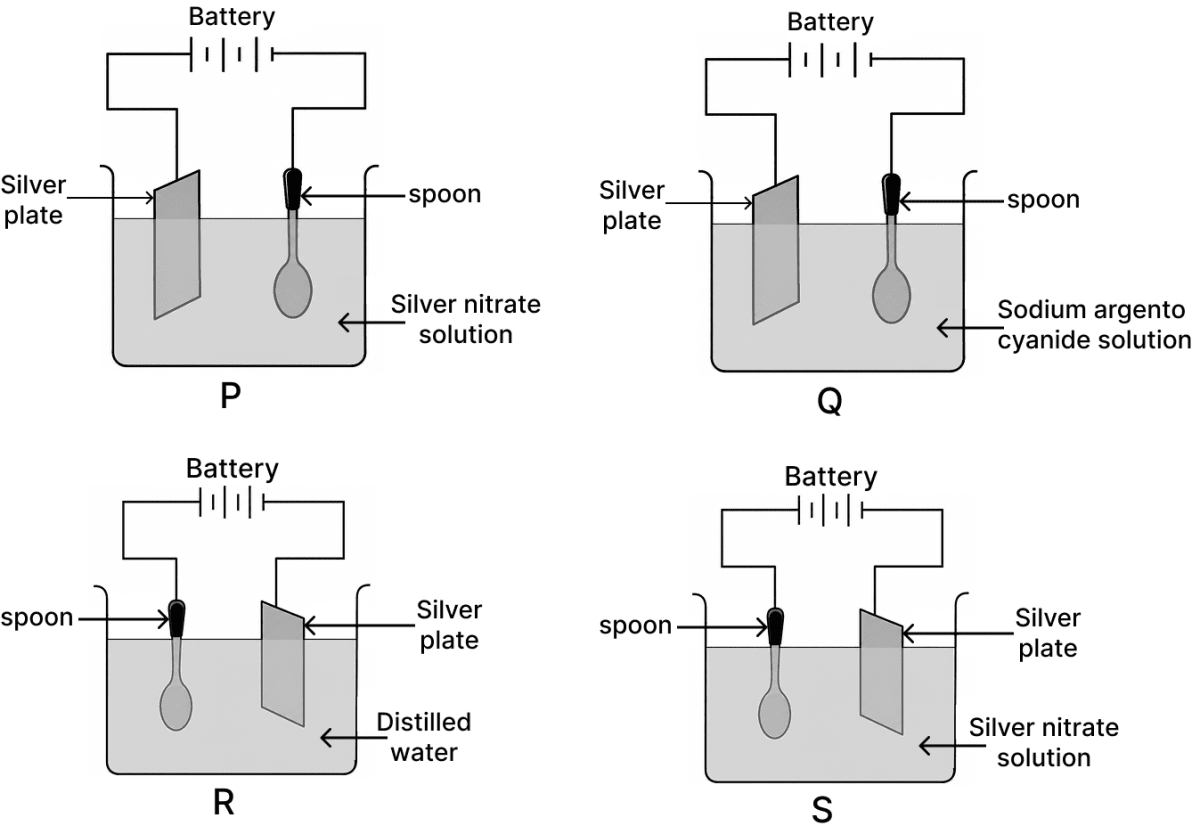
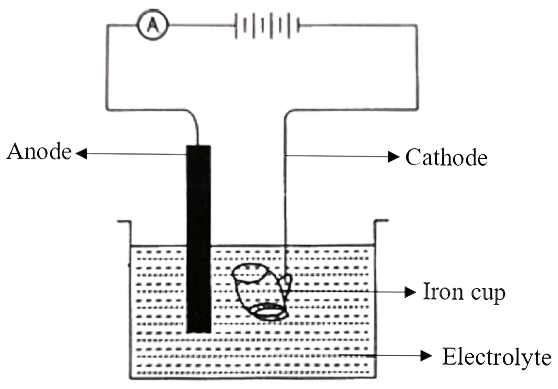
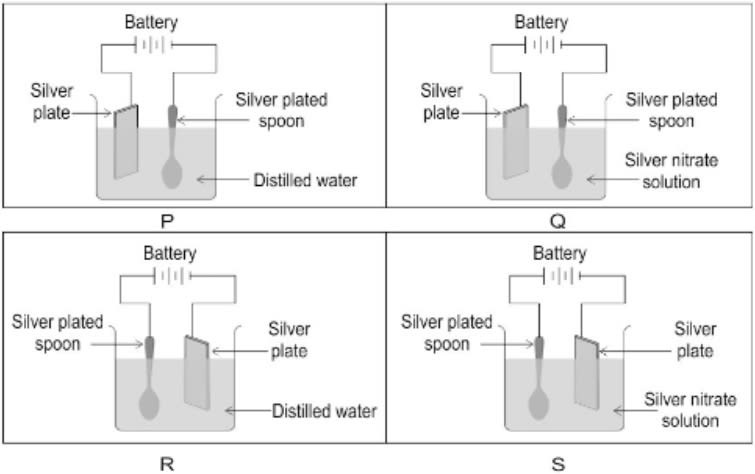
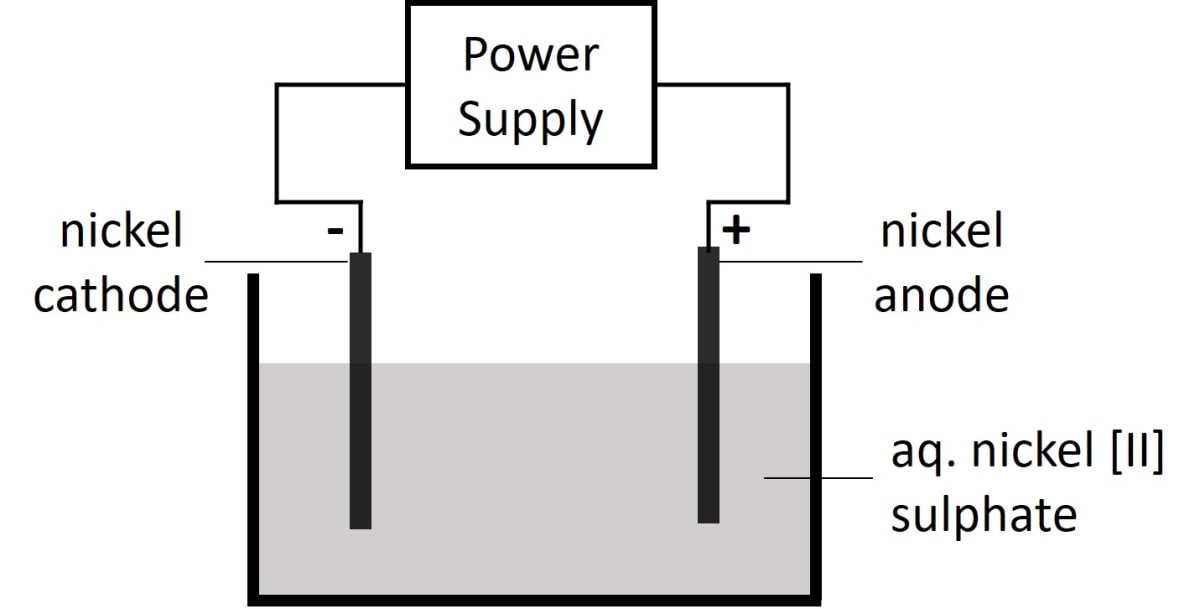
The diagram given below shows the electroplating of a spoon with silver. With reference to the diagram, answer the following questions:

The diagram given below shows the electroplating of a spoon with silver. With reference to the diagram, answer the following questions: ICSE 2026 Chemistry Solved Question Paper.

(a) Write an equation for the reaction that occurs at the cathode.

(b) Silver nitrate solution is not preferred as an electrolyte in the above process. Give a reason.

(c) Why is alternating current not used in the process?

(d) What is the observation at the anode?

Show SolutionHide Solution↓

(a) Ag+ + e- ⟶ Ag

(b) Silver nitrate solution is not preferred because it ionises very readily releasing a high concentration of Ag+ ions. This causes silver to be deposited too rapidly on the spoon, producing a non-uniform, loose, and rough coating with poor adhesion. Sodium argentocyanide, on the other hand, releases Ag+ ions slowly, producing a smooth, uniform, and shiny coating.

(c) Alternating current (AC) is not used because in AC, the polarity of electrodes keeps changing. As a result, silver deposited on the spoon at one moment would dissolve back into the electrolyte at the next moment. Hence, direct current (DC) is used to ensure uni-directional flow of ions and continuous deposition of silver on the spoon.

(d) The silver anode gradually dissolves into the electrolyte as silver ions:

Ag - e- ⟶ Ag+

The mass of the anode decreases during the process.

6(i)Written · 2026 · Section B · 2026 PaperFull page

Give reasons why:

(a) Hydrochloric acid cannot form an acid salt.

(b) Electronegativity increases across a period.

Show SolutionHide Solution↓

(a) Hydrochloric acid (HCl) is a monobasic acid, i.e., it has only one replaceable hydrogen ion per molecule. Acid salts are formed by the partial replacement of replaceable hydrogen ions of an acid by a metal, which requires the acid to be at least dibasic (with two or more replaceable H+). Since HCl has only one replaceable hydrogen, it can only form normal salts and not acid salts.

(b) On moving across a period from left to right, the nuclear charge increases while the number of shells (energy levels) remains the same. As a result, the atomic radius decreases and the effective pull of the nucleus on the bonding electrons increases. Hence, the tendency of an atom to attract the shared pair of electrons (electronegativity) increases across a period.

6(ii)Written · 2026 · Section B · 2026 PaperFull page

State whether the following statements are True or False:

(a) Organic compounds having different molecular formula, but same structural formula are called isomers.

(b) A salt is a compound formed by partial or complete replacement of the hydrogen ion of an acid by a metal or electropositive ion.

Show SolutionHide Solution↓

(a) False
Reason — Isomers are organic compounds having the same molecular formula but different structural formulae.

(b) True
Reason — A salt is indeed formed when the hydrogen ion of an acid is partially or completely replaced by a metal or electropositive radical (such as the ammonium ion).

6(iii)Written · 2026 · Section B · 2026 PaperFull page

Anil is a laboratory assistant in a college. He prepared nitric acid but stored it in a transparent container exposed to sunlight. After a few days, brown fumes were observed in the container and the acid turned slightly yellowish in colour.

(a) What was the error made by Anil while storing the acid?

(b) Why were brown fumes observed in the container?

(c) How can the yellowish tinge in the acid be removed?

Show SolutionHide Solution↓

(a) The error made by Anil was that he stored the nitric acid in a transparent container exposed to sunlight. Nitric acid should be stored in a dark-coloured (brown) reagent bottle kept in a cool and dark place to prevent decomposition.

(b) Nitric acid is unstable and decomposes on exposure to light and heat to release reddish-brown nitrogen dioxide (NO2) gas, water and oxygen:

4HNO3 $\xrightarrow{\text{light/heat}}$ 4NO2 ↑ + 2H2O + O2 ↑

The brown fumes seen in the container are due to NO2 gas.

(c) The yellowish tinge in nitric acid (caused by dissolved NO2) can be removed by bubbling air or carbon dioxide gas through the acid. This drives out the dissolved nitrogen dioxide and the acid becomes colourless again.

6(iv)Written · 2026 · Section B · 2026 PaperFull page

Zn + 4HNO3 ⟶ Zn(NO3)2 + 2H2O + 2NO2

32.5 g of zinc reacts with concentrated nitric acid as given in the above equation.

(a) How many moles of zinc was required in the reaction?

(b) Find the mass of nitric acid needed to react with 32.5 g of zinc.

(c) Find the volume of nitrogen dioxide liberated in (b).

[Atomic weight: H=1, N=14, O=16, Zn=65]

Show SolutionHide Solution↓

$$\begin{matrix} \text{Zn} & + & 4\text{HNO}_3 & \longrightarrow \\ 1 \text{ mole} && 4 \text{ moles} & \\ 65 && 4[1 + 14 + 3(16)] & \\ = 65 \text{ g} & & = 252 \text{ g} & \\ & & & \\ \text{Zn(NO}_3)_2 & + & 2\text{H}_2\text{O} & + & 2\text{NO}_2 \\ 1\text{ mole}&& 2 \text{ moles} && 2\text{ moles} \\ 65 + 2[14 + 3(16)] & & 2[2(1) + 16] && 2[14 + 2(16)] \\ = 189 \text{ g} & & = 36 \text{ g} & & = 92 \text{ g} \\ \end{matrix}$$

(a) Number of moles of Zn = $\frac{\text{Mass}}{\text{Molar mass}}$ = $\frac{32.5}{65}$ = 0.5 mole

(b) From the equation, 65 g of Zn reacts with 252 g of HNO3

∴ 32.5 g of Zn reacts with $\frac{252}{65}$ × 32.5 = 126 g of HNO3

(c) From the equation, 65 g of Zn produces 2 × 22.4 = 44.8 L of NO2 at STP

∴ 32.5 g of Zn produces $\frac{44.8}{65}$ × 32.5 = 22.4 L of NO2 at STP

Hence, 0.5 mole of zinc is required, 126 g of nitric acid is needed, and 22.4 L of NO2 is liberated at STP.

7(i)Written · 2026 · Section B · 2026 PaperFull page

Carbon reacts with an acid to form carbon dioxide, water and nitrogen dioxide.

(a) Name the acid used in the reaction.

(b) Write a balanced chemical equation for the reaction that occurs.

Show SolutionHide Solution↓

(a) Concentrated Nitric Acid (HNO3)

(b) C + 4HNO3 [conc.] ⟶ CO2 + 2H2O + 4NO2

7(ii)Written · 2026 · Section B · 2026 PaperFull page

Bauxite is the principal ore used in the commercial extraction of aluminium. The Bayer's process is used to refine bauxite into pure alumina, with caustic soda playing a crucial role in the initial stage of the process.

Based on this, answer the following questions:

(a) Explain the reason behind the addition of caustic soda during the Bayer's process.

(b) Write a balanced chemical equation representing the reaction between bauxite and caustic soda during the Bayer's process.

Show SolutionHide Solution↓

(a) Bauxite contains alumina along with impurities such as ferric oxide and sand. Alumina is amphoteric and dissolves in hot concentrated caustic soda to form soluble sodium meta-aluminate, while the insoluble impurities remain as red mud and are removed by filtration.

(b) Al2O3·2H2O + 2NaOH ⟶ 2NaAlO2 + 3H2O

7(iii)Written · 2026 · Section B · 2026 PaperFull page

Give one relevant observation for the following:

(a) Sodium hydroxide is added dropwise to Calcium nitrate solution.

(b) Dilute Hydrochloric acid is added to Iron (II) sulphide.

(c) An amphoteric metal is added to hot concentrated alkali.

Show SolutionHide Solution↓

(a) A white precipitate of calcium hydroxide is formed, which is insoluble in excess sodium hydroxide.
$Ca(NO_{3})_{2} + 2NaOH \longrightarrow \underset{[\text{white ppt.}]}{Ca(OH)_{2} \downarrow} + 2NaNO_{3}$

(b) A colourless gas with the smell of rotten eggs, hydrogen sulphide (H2S), is evolved with effervescence.
FeS + 2HCl ⟶ FeCl2 + H2S ↑

(c) The amphoteric metal (e.g., zinc or aluminium) dissolves in the hot concentrated alkali showing vigorous effervescence (bubbling) due to the evolution of a colourless, odourless gas. This gas burns with a "pop" sound when a burning splinter is brought near the mouth of the test tube, confirming it is hydrogen.

$Zn + 2NaOH \longrightarrow \underset{\text{(sodium zincate)}}{Na_{2}ZnO_{2}} + H_{2} \uparrow$

7(iv)Written · 2026 · Section B · 2026 PaperFull page

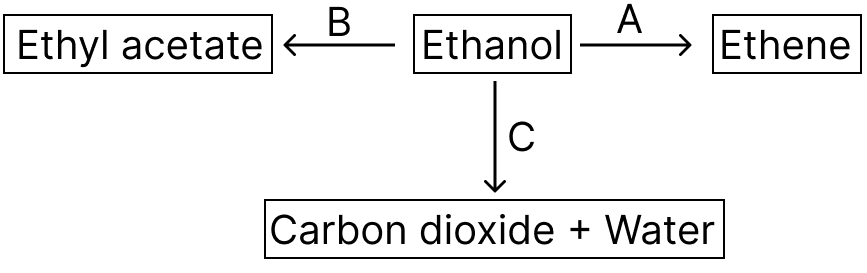
Study the reaction scheme shown below and identify the reactants A, B and C.

Study the reaction scheme shown below and identify the reactants A, B and C. ICSE 2026 Chemistry Solved Question Paper.
Show SolutionHide Solution↓

A → Concentrated Sulphuric Acid (conc. H2SO4)
B → Acetic acid (CH3COOH)
C → Oxygen (O2)

Explanation

  • Ethanol ⟶ Ethene (with reactant A): This is dehydration of ethanol. A is concentrated sulphuric acid (conc. H2SO4) at 170°C.
    C2H5OH $\xrightarrow[170^{\circ}\text{C}]{\text{conc. H}_2\text{SO}_4}$ C2H4 + H2O

  • Ethanol ⟶ Ethyl acetate (with reactant B): This is esterification. B is acetic acid (CH3COOH) in the presence of conc. H2SO4 (acts as a catalyst).
    C2H5OH + CH3COOH $\xrightarrow{\text{conc. H}_2\text{SO}_4}$ CH3COOC2H5 + H2O

  • Ethanol ⟶ Carbon dioxide + Water (with reactant C): This is combustion. C is oxygen (O2).
    C2H5OH + 3O2 ⟶ 2CO2 + 3H2O

Hence, A = Concentrated H2SO4, B = Acetic acid (CH3COOH), and C = Oxygen (O2).

8(i)Written · 2026 · Section B · 2026 PaperFull page

5.6 litres of gas Z weighs 32 g at STP. What is the molecular weight and vapour density of Z?

Show SolutionHide Solution↓

At STP, 22.4 L of any gas = 1 mole

∴ Number of moles of Z = $\frac{5.6}{22.4}$ = 0.25 mole

Molecular weight of Z = $\frac{\text{Mass}}{\text{Number of moles}}$ = $\frac{32}{0.25}$ = 128 g/mol

Vapour density = $\frac{\text{Molecular weight}}{2}$ = $\frac{128}{2}$ = 64

Hence, the molecular weight of Z is 128 and its vapour density is 64.

8(ii)Written · 2026 · Section B · 2026 PaperFull page

Name the following:

(a) The most electronegative element of Period 2.

(b) The largest atom of Period 3.

Show SolutionHide Solution↓

(a) Fluorine (F)

(b) Sodium (Na)

8(iii)Written · 2026 · Section B · 2026 PaperFull page

Given below are a few elements.

$\boxed{\text{Li},\quad\text{K},\quad\text{Ca},\quad\text{F}}$

Identify the element which:

(a) has the least atomic radius.

(b) has two valence electrons.

(c) is the most electropositive.

Show SolutionHide Solution↓

(a) Fluorine (F)

(b) Calcium (Ca)

(c) Potassium (K)

Explanation

(a) Fluorine (F) has the least atomic radius. It is on the rightmost side of period 2, where atomic radius is minimum.

(b) Calcium (Ca) has two valence electrons (electronic configuration: 2, 8, 8, 2). It belongs to Group 2 of the periodic table.

(c) Potassium (K) is the most electropositive. Within Group 1, electropositive character increases down the group; potassium is below lithium and hence is more electropositive.

8(iv)Written · 2026 · Section B · 2026 PaperFull page

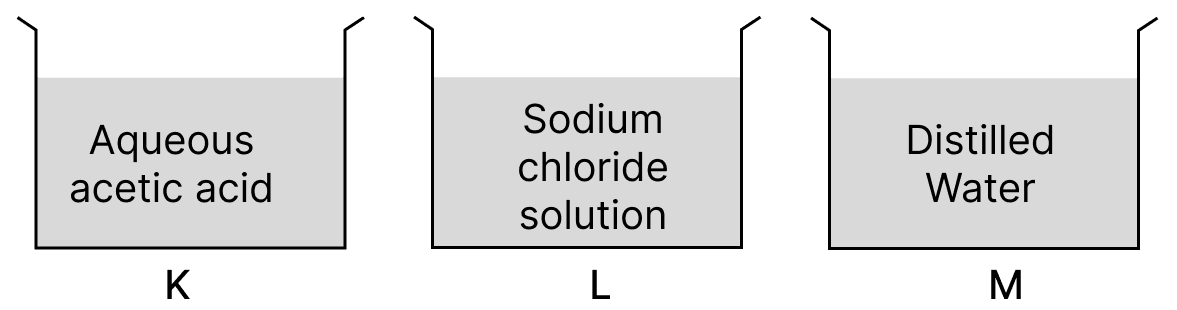
K, L and M are beakers containing three different solutions as shown below.

K, L and M are beakers containing three different solutions as shown below. ICSE 2026 Chemistry Solved Question Paper.

Name the beaker which:

(a) contains only ions.

(b) contains only molecules.

(c) has pH less than 7.

Show SolutionHide Solution↓

(a) L — Sodium chloride is a strong electrolyte and ionises completely in water, dissociating fully into Na+ and Cl- ions.

NaCl ⟶ Na+ + Cl-

(b) M — Distilled water consists almost entirely of H2O molecules and contains no ions (its self-ionisation is negligible).

(c) K — Aqueous acetic acid is acidic in nature (it is a weak acid which partially ionises to give H+ ions), and hence has a pH less than 7.

CH3COOH ⇌ CH3COO- + H+

1(i)1 Mark · 2026 · Section A · 2026 ImprovementFull page

Acid + Metal oxide on reaction gives:

Show SolutionHide Solution↓

salt + water

Reason — A metal oxide is basic in nature. When it reacts with an acid, neutralisation takes place to give a salt and water only.

CuO + H2SO4 ⟶ CuSO4 + H2O

1(ii)1 Mark · 2026 · Section A · 2026 ImprovementFull page

A polar covalent compound with two lone pairs of electrons is:

Show SolutionHide Solution↓

water

Reason — In a water molecule (H2O), oxygen forms two polar O—H covalent bonds and still carries two unshared (lone) pairs of electrons. The bent shape makes the molecule polar. Ammonia has only one lone pair, while chlorine (Cl2) and oxygen (O2) are non-polar molecules.

1(iii)1 Mark · 2026 · Section A · 2026 ImprovementFull page

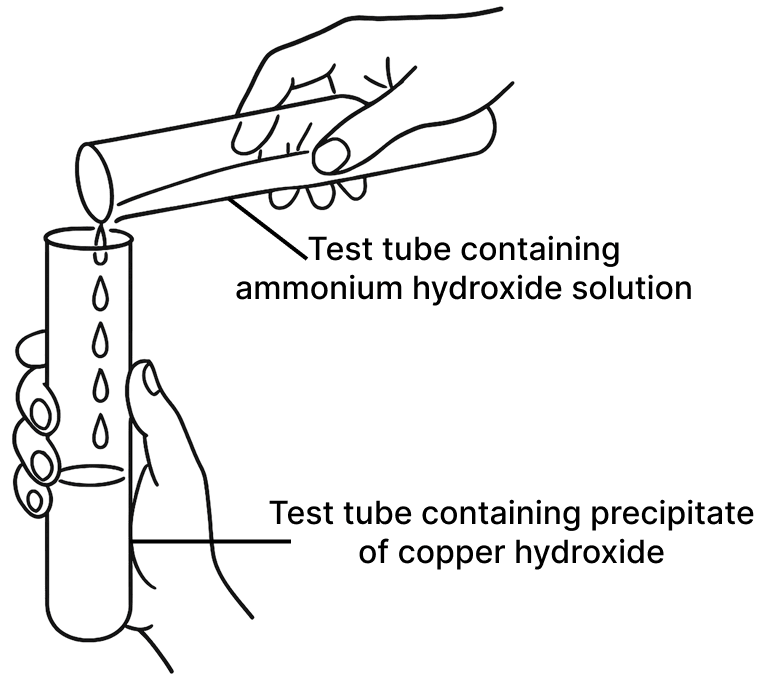
What do you observe when ammonium hydroxide solution is added first dropwise and then in excess to a solution of copper sulphate?

Show SolutionHide Solution↓

A pale blue precipitate is formed that dissolves in excess of ammonium hydroxide to form a deep blue solution.

Reason — On adding ammonium hydroxide dropwise, a pale blue precipitate of copper hydroxide is formed. In excess ammonium hydroxide, the precipitate dissolves to form a deep blue solution of tetraammine copper(II) sulphate.

CuSO4 + 2NH4OH ⟶ Cu(OH)2 ↓ [pale blue] + (NH4)2SO4

1(iv)1 Mark · 2026 · Section A · 2026 ImprovementFull page

Identify the statement(s) that is/are NOT true for Group 1 elements:

  1. They are good conductors of heat.
  2. They are good conductors of electricity.
  3. They are strong oxidising agents.
  4. They form covalent compounds with non-metals.
Show SolutionHide Solution↓

Both 3 and 4

Reason — Group 1 elements (alkali metals) are good conductors of heat and electricity, so statements 1 and 2 are true. They readily lose their single valence electron, so they are strong reducing agents (not oxidising agents); hence statement 3 is false. They form ionic (electrovalent) compounds, not covalent compounds, with non-metals; hence statement 4 is also false.

1(v)1 Mark · 2026 · Section A · 2026 Improvement · 🔁 also 2018Full page

The organic compound which undergoes substitution reaction is:

Show SolutionHide Solution↓

C2H6

Reason — C2H6 (ethane) is a saturated hydrocarbon (alkane) containing only single bonds, and saturated hydrocarbons undergo substitution reactions. C2H4, C2H2 and C10H18 are unsaturated and undergo addition reactions.

1(vi)1 Mark · 2026 · Section A · 2026 ImprovementFull page

What do you observe when concentrated hydrochloric acid is added to manganese dioxide and then heated?

Show SolutionHide Solution↓

A greenish yellow gas is liberated that turns moist starch iodide paper blue-black.

Reason — Manganese dioxide oxidises concentrated hydrochloric acid on heating to liberate chlorine, a greenish-yellow gas. Chlorine liberates iodine from starch iodide paper, turning it blue-black.

MnO2 + 4HCl ⟶ MnCl2 + 2H2O + Cl2

1(vii)1 Mark · 2026 · Section A · 2026 ImprovementFull page

Which of the following occupies the maximum volume at STP? [At. wt. C=12, O=16]

Show SolutionHide Solution↓

3 moles of hydrogen

Reason — At STP, 1 mole of any gas occupies 22.4 L.

  • 3 moles of hydrogen = 3 × 22.4 = 67.2 L
  • 1 mole of helium = 22.4 L
  • 64 g of oxygen = $\frac{64}{32}$ = 2 moles = 44.8 L
  • 44 g of carbon dioxide = $\frac{44}{44}$ = 1 mole = 22.4 L

Hence, 3 moles of hydrogen occupy the maximum volume (67.2 L).

1(viii)1 Mark · 2026 · Section A · 2026 ImprovementFull page

The table below shows the atomic numbers of elements W, X, Y and Z.

ElementAtomic Number
W4
X13
Y7
Z10

Which of the above elements will combine to form an electrovalent compound?

Show SolutionHide Solution↓

X and Y

Reason — An electrovalent (ionic) compound is formed between a metal and a non-metal. X (atomic number 13, configuration 2, 8, 3) is a metal that loses 3 electrons to form X3+, and Y (atomic number 7, configuration 2, 5) is a non-metal that gains 3 electrons to form Y3-. They combine to form an electrovalent compound (XY). Z (atomic number 10) is a noble gas and does not form compounds.

1(ix)1 Mark · 2026 · Section A · 2026 ImprovementFull page

Assertion (A): Noble gases are unreactive under standard conditions.

Reason (R): Noble gases have complete valence shells making them stable and less likely to gain or lose electrons.

Show SolutionHide Solution↓

Both (A) and (R) are true and (R) is the correct explanation of (A).

Reason — Noble gases have completely filled valence shells (a stable octet, or a duplet in the case of helium). Because of this stable configuration they have almost no tendency to gain or lose electrons, and so they are unreactive under standard conditions. Thus the reason correctly explains the assertion.

1(x)1 Mark · 2026 · Section A · 2026 ImprovementFull page

The process of dressing (purification) of the ore which involves separation of ore from gangue due to preferential wetting is:

Show SolutionHide Solution↓

Froth flotation method

Reason — In the froth flotation method, the powdered ore is stirred with water and pine oil. The ore particles are preferentially wetted by the oil and rise up with the froth, while the gangue particles are wetted by water and settle down. This separation based on preferential wetting is the froth flotation method.

1(xi)1 Mark · 2026 · Section A · 2026 ImprovementFull page

If an element A belongs to Period 3 and Group 2, then it will have:

Show SolutionHide Solution↓

3 shells and 2 valence electrons

Reason — The period number gives the number of shells and, for Groups 1 and 2, the group number gives the number of valence electrons. Hence an element in Period 3 and Group 2 has 3 shells and 2 valence electrons (electronic configuration 2, 8, 2).

1(xii)1 Mark · 2026 · Section A · 2026 ImprovementFull page

The vapour density of nitrogen dioxide [At. wt. N = 14, O = 16] is:

Show SolutionHide Solution↓

23

Reason — Vapour density = $\frac{\text{Molecular mass}}{2}$. Molecular mass of NO2 = 14 + 2(16) = 46. So vapour density = $\frac{46}{2}$ = 23.

1(xiii)1 Mark · 2026 · Section A · 2026 ImprovementFull page

Metallic and non-metallic elements can both be extracted by electrolysis. Which of the following will undergo reduction at the electrode?

Show SolutionHide Solution↓

Hydrogen

Reason — Reduction (gain of electrons) takes place at the cathode. Hydrogen ions (H+) migrate to the cathode and gain electrons to be reduced to hydrogen gas. Bromine, chlorine and oxygen are formed by oxidation (loss of electrons) at the anode.

2H+ + 2e- ⟶ H2

1(xiv)1 Mark · 2026 · Section A · 2026 ImprovementFull page

Sodium is in Group I of the Periodic Table and chlorine is in Group VII. Which statement correctly describes what happens when sodium bonds ionically with chlorine?

Show SolutionHide Solution↓

Sodium atom loses an electron to form Na+ and chlorine atom gains an electron to form Cl-

Reason — Sodium has one valence electron which it loses to attain a stable octet, forming Na+. Chlorine has seven valence electrons and gains one electron to complete its octet, forming Cl-. These oppositely charged ions are held together by an ionic bond.

1(xv)1 Mark · 2026 · Section A · 2026 ImprovementFull page

Hydrogen chloride is soluble in water because it is a / an:

Show SolutionHide Solution↓

polar covalent compound

Reason — HCl is a polar covalent compound formed by the unequal sharing of electrons between hydrogen and the more electronegative chlorine. Being polar, it dissolves readily in water and ionises to form H3O+ and Cl- ions.

2(i)1 Mark · 2026 · Section A · 2026 ImprovementFull page

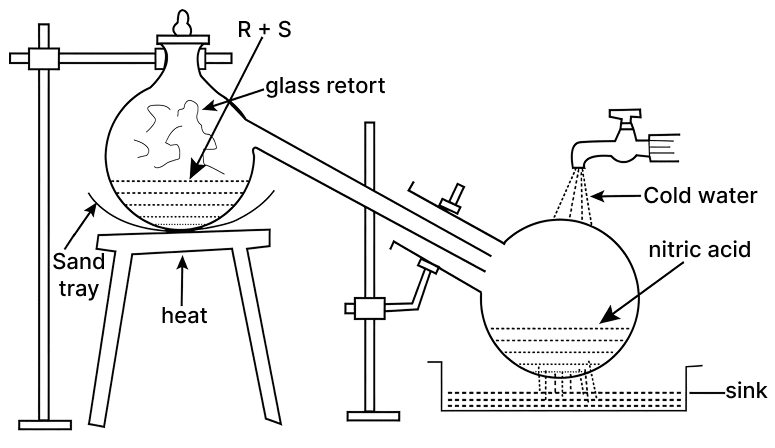
The figure given below illustrates the apparatus used in the laboratory preparation of nitric acid.

The figure given below illustrates the apparatus used in the laboratory preparation of nitric acid. ICSE 2026 Improvement Chemistry Solved Question Paper.

(a) Name:

(b) Why should we use only glass apparatus in the laboratory preparation of nitric acid?

(c) Write an equation to show how nitric acid undergoes decomposition.

(d) What do you observe when copper is oxidized by concentrated nitric acid?

Show SolutionHide Solution↓

(a)

  1. R — Concentrated sulphuric acid (H2SO4)
  2. S — Sodium nitrate (NaNO3) [potassium nitrate, KNO3, is also acceptable]

(b) Only glass apparatus is used because nitric acid vapours attack rubber and cork.

(c) 4HNO3 $\xrightarrow{\text{heat / light}}$ 4NO2 + 2H2O + O2

(d) Dense reddish-brown fumes of nitrogen dioxide are evolved and a blue solution of copper(II) nitrate is formed.

Cu + 4HNO3 [conc.] ⟶ Cu(NO3)2 + 2H2O + 2NO2

2(ii)1 Mark · 2026 · Section A · 2026 ImprovementFull page

Match Column 1 with Column 2 without repeating the options from Column 2.

Column 1Column 2
(a) Ammonia1. triple covalent bond
(b) Carbon tetrachloride2. double covalent bond
(c) Sodium chloride3. three single covalent bonds
(d) Nitrogen4. electrovalent bond
(e) Oxygen5. non-polar covalent bond
Show SolutionHide Solution↓
Column 1Column 2
(a) Ammonia3. three single covalent bonds
(b) Carbon tetrachloride5. non-polar covalent bond
(c) Sodium chloride4. electrovalent bond
(d) Nitrogen1. triple covalent bond
(e) Oxygen2. double covalent bond
2(iii)1 Mark · 2026 · Section A · 2026 ImprovementFull page

Name the following:

(a) A salt which is soluble in hot water, but insoluble in cold water.

(b) An alkali in which both copper hydroxide and zinc hydroxide can be dissolved.

(c) The cation that forms a reddish brown precipitate when its salt solution reacts with a strong alkali.

(d) The law which states that 'equal volumes of all gases, at the same temperature and pressure, have the same number of molecules'.

(e) Two metal wires/plates through which electricity enters and leaves the electrolytic cell during electrolysis.

Show SolutionHide Solution↓

(a) Lead(II) chloride (PbCl2)

(b) Ammonium hydroxide (NH4OH)

(c) Ferric ion / Iron(III) ion (Fe3+)

(d) Avogadro's Law

(e) Electrodes

2(iv)1 Mark · 2026 · Section A · 2026 ImprovementFull page

Complete the following sentences by choosing the correct word(s) from the brackets.

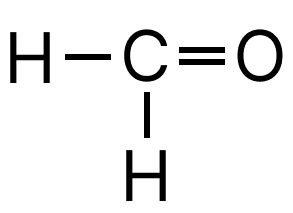
(a) The IUPAC name for formaldehyde is ............... (methanal / ethanal)

(b) A black solid, ............... (manganese dioxide / copper oxide) reacts with dilute sulphuric acid to form a blue-coloured solution.

(c) The drying agent not used for drying ammonia is ............... (CaO / P2O5)

(d) The salt formed when iron reacts with dilute HCl is ............... (FeCl3 / FeCl2)

(e) Ammonia reacts with excess chlorine to form ............... (NCl3 / NH4Cl)

Show SolutionHide Solution↓

(a) The IUPAC name for formaldehyde is methanal.

(b) A black solid, copper oxide reacts with dilute sulphuric acid to form a blue-coloured solution.

(c) The drying agent not used for drying ammonia is P2O5.

(d) The salt formed when iron reacts with dilute HCl is FeCl2.

(e) Ammonia reacts with excess chlorine to form NCl3.

2(v)1 Mark · 2026 · Section A · 2026 Improvement · 🔁 also 2025Full page

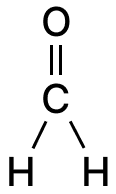
(a) Draw the structural diagram for the following organic compounds.

(b) Give IUPAC name for the following organic compounds.

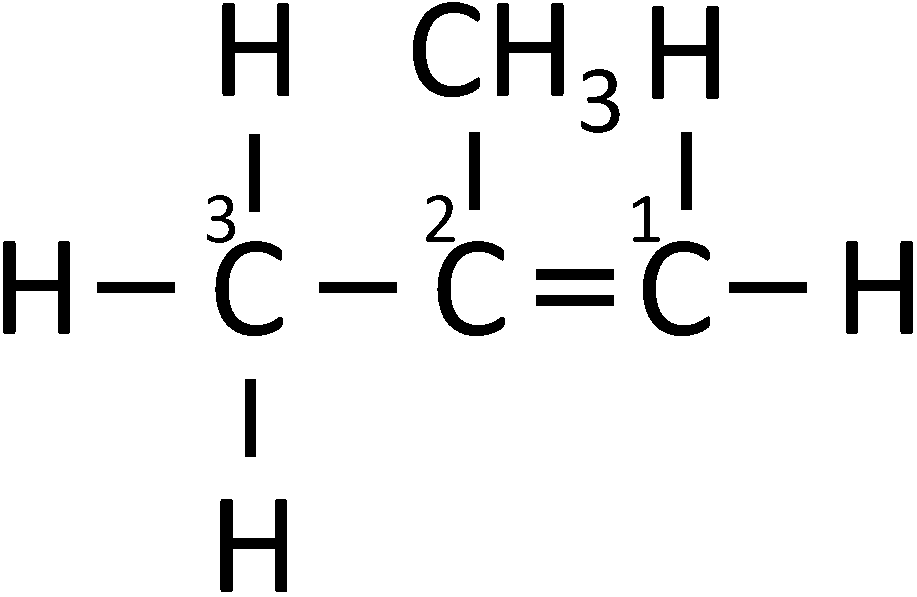
Draw the structural diagram for the following organic compounds. ICSE 2026 Improvement Chemistry Solved Question Paper. Draw the structural diagram for the following organic compounds. ICSE 2026 Improvement Chemistry Solved Question Paper.
Show SolutionHide Solution↓

(a) Structural diagrams:

1. ethanal (CH3CHO)

Draw the structural diagram for the following organic compounds. ICSE 2026 Improvement Chemistry Solved Question Paper.

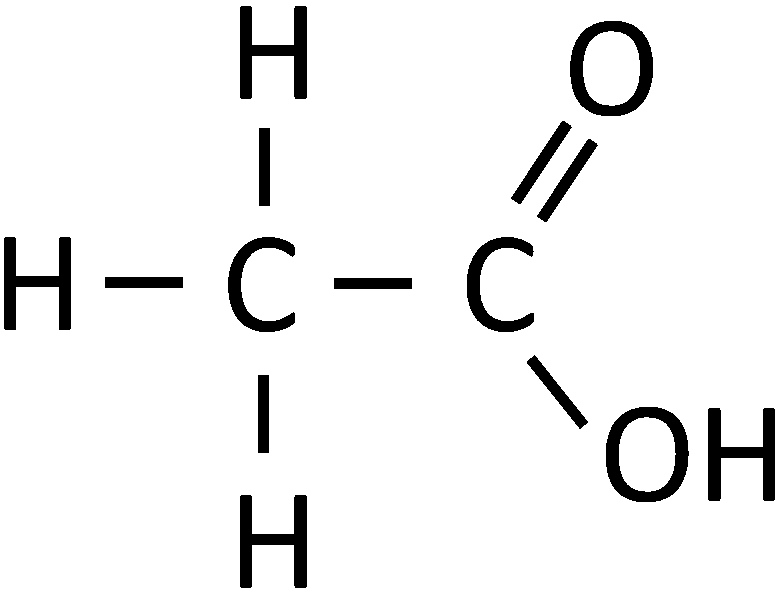
2. acetic acid (CH3COOH)

Write structural formula of acetic acid. Organic Chemistry, Concise Chemistry Solutions ICSE Class 10.

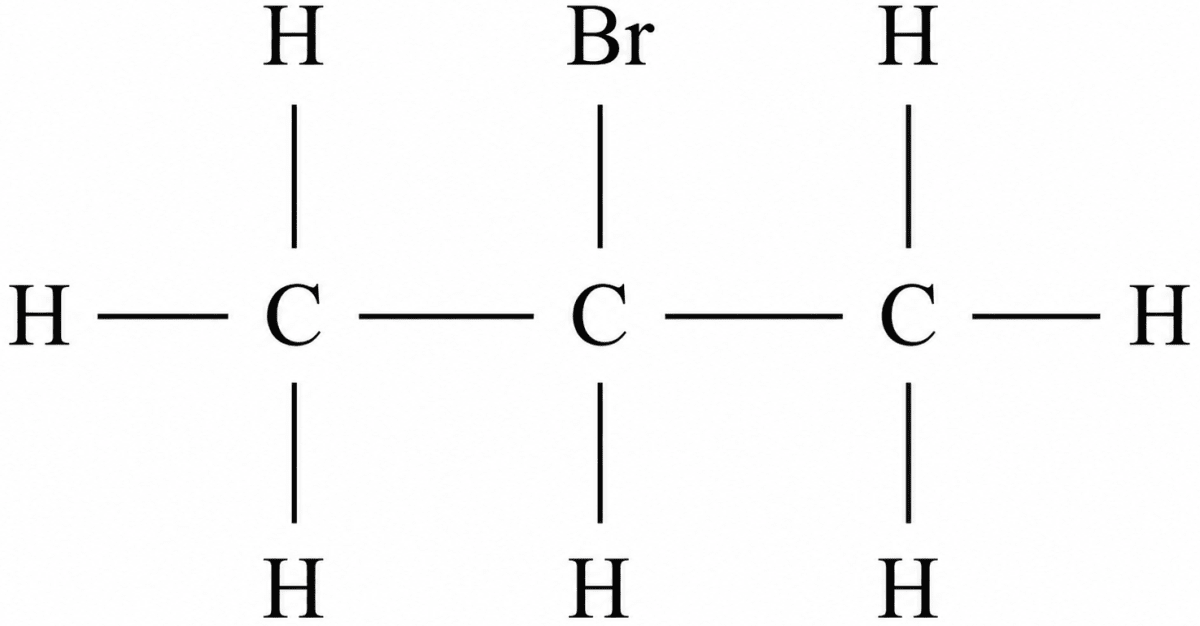
3. 2-bromopropane (CH3CHBrCH3)

Draw the structural diagram for the following organic compounds. ICSE 2026 Improvement Chemistry Solved Question Paper.

(b) IUPAC names:

  1. 2-methylbutane
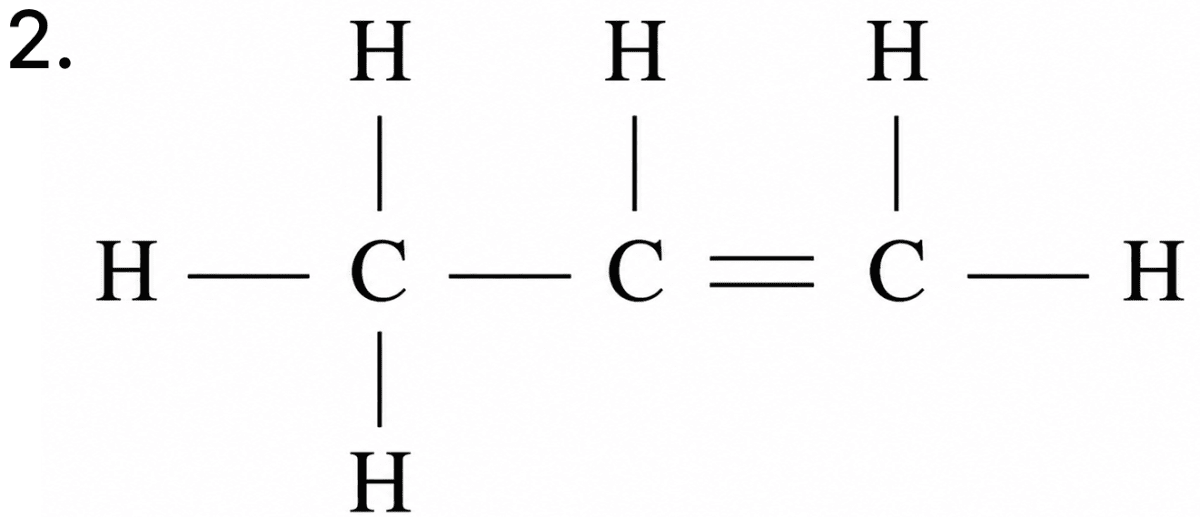
  2. Prop-1-ene (propene)
3(i)Written · 2026 · Section B · 2026 ImprovementFull page

Elements A, B, C & D have the following electronic configurations:

[A = 2, 8, 7    B = 1    C = 2, 5    D = 2, 8, 1]

Answer the following questions:

(a) Identify the element that will form an alkali when reacted with water.

(b) State the formula of the compound formed when D reacts with C.

Show SolutionHide Solution↓

(a) Element D (configuration 2, 8, 1) is an alkali metal (sodium). It reacts with water to form an alkali (sodium hydroxide).

(b) D has a valency of 1 (forms D+) and C has a valency of 3 (forms C3-). Therefore the formula of the compound is D3C.

3(ii)Written · 2026 · Section B · 2026 ImprovementFull page

The reactions of four different oxides W, X, Y and Z are given below:

  • W reacts with hydrochloric acid, but not with sodium hydroxide.
  • X reacts with both hydrochloric acid and sodium hydroxide.
  • Y does not react with either hydrochloric acid or sodium hydroxide.
  • Z reacts with sodium hydroxide, but not with hydrochloric acid.

From the information provided above, identify the oxide which is:

(a) amphoteric

(b) acidic

Show SolutionHide Solution↓

(a) X — It reacts with both an acid (HCl) and a base (NaOH), which is the property of an amphoteric oxide.

(b) Z — It reacts with a base (NaOH) but not with an acid, which is the property of an acidic oxide.

3(iii)Written · 2026 · Section B · 2026 ImprovementFull page

20.2 g of potassium nitrate is decomposed by heating according to the equation given below:

2KNO3 ⟶ 2KNO2 + O2

Calculate the following:

(a) Volume of oxygen gas obtained at STP.

(b) Mass of KNO2 formed.

[At. wt. of K = 39, N=14, O=16]

Show SolutionHide Solution↓

$$\begin{matrix} 2\text{KNO}_3 & \longrightarrow & 2\text{KNO}_2 & + & \text{O}_2 \\ 2 \text{ moles} && 2 \text{ moles} && 1 \text{ mole} \\ 2[39 + 14 + 3(16)] && 2[39 + 14 + 2(16)] && 2(16) \\ = 202 \text{ g} && = 170 \text{ g} && = 32 \text{ g} \\ \end{matrix}$$

(a) From the equation, 202 g of KNO3 gives 22.4 L of O2 at STP.

∴ 20.2 g of KNO3 gives $\frac{22.4}{202}$ × 20.2 = 2.24 L of O2 at STP.

(b) From the equation, 202 g of KNO3 gives 170 g of KNO2.

∴ 20.2 g of KNO3 gives $\frac{170}{202}$ × 20.2 = 17 g of KNO2.

Hence, 2.24 L of oxygen is obtained at STP and 17 g of KNO2 is formed.

3(iv)Written · 2026 · Section B · 2026 ImprovementFull page

A student wanted to electroplate a spoon with silver. He tried four different set-ups to electroplate the spoon as depicted in the diagrams given below.

A student wanted to electroplate a spoon with silver. He tried four different set-ups to electroplate the spoon as depicted in the diagrams given below. ICSE 2026 Improvement Chemistry Solved Question Paper.

Answer the following questions based on the above diagrams:

(a) Identify the set-up made by the student which would result in the uniform and smooth electroplating of the spoon with silver.

(b) In which set up will the coating on the spoon be uneven?

(c) Write the reaction taking place at the anode for the correct set-up.

Show SolutionHide Solution↓

(a) Set-up Q — It uses sodium argentocyanide as the electrolyte, which releases silver ions slowly and gives a uniform, smooth and adherent coating of silver on the spoon (cathode).

(b) Set-up P — It uses silver nitrate solution, which ionises readily and releases a high concentration of silver ions, so silver is deposited too quickly, giving an uneven and rough coating.

(c) At the anode, the silver plate dissolves into the electrolyte:

Ag - e- ⟶ Ag+

4(i)Written · 2026 · Section B · 2026 ImprovementFull page

Select the compound / element from the box given below for each of the following statements:

H2NO2NOO2

(a) The colourless gas obtained when a metallic nitrate undergoes thermal decomposition.

(b) The gas which on oxidation produces a coloured gas.

Show SolutionHide Solution↓

(a) O2 — Oxygen is a colourless gas evolved during the thermal decomposition of metallic nitrates.

(b) NO — Nitric oxide (colourless) on oxidation gives the reddish-brown gas nitrogen dioxide.

2NO + O2 ⟶ 2NO2

4(ii)Written · 2026 · Section B · 2026 ImprovementFull page

Distinguish between the following:

(a) Hydronium ion and ammonium ion based on their lone pair of electrons.

(b) Solutions of calcium chloride and calcium nitrate using aqueous silver nitrate.

Show SolutionHide Solution↓

(a)

Hydronium ion (H3O+)Ammonium ion (NH4+)
It has one lone pair of electrons (on the oxygen atom).It has no lone pair of electrons; all four electron pairs are bonded.

(b)

Calcium chlorideCalcium nitrate
On adding silver nitrate solution, a white precipitate of silver chloride is formed.On adding silver nitrate solution, no precipitate is formed (no visible change).

CaCl2 + 2AgNO3 ⟶ 2AgCl ↓ [white ppt.] + Ca(NO3)2

4(iii)Written · 2026 · Section B · 2026 ImprovementFull page

You are given the following molecular formulae of some hydrocarbons:

C5H8   C5H10   C8H14   C7H14   C6H6   C6H12

(a) Which two compounds represent unsaturated hydrocarbons having triple bonds?

(b) Identify the formula which represents a cyclic compound.

Show SolutionHide Solution↓

(a) C5H8 and C8H14 — Both follow the general formula of alkynes, CnH2n-2, which contain a carbon–carbon triple bond.

(b) C6H6 — It represents benzene, a cyclic (aromatic) hydrocarbon.

4(iv)Written · 2026 · Section B · 2026 ImprovementFull page

Choose the answer from the list of compounds given below:

sodium bisulphite, ferric oxide, iron (II) chloride, sodium sulphate, aluminium oxide

(a) A compound which is a major constituent of bauxite.

(b) The compound which will form a dirty green precipitate with NaOH.

(c) An acid salt.

Show SolutionHide Solution↓

(a) Aluminium oxide — Bauxite is hydrated aluminium oxide, Al2O3·2H2O.

(b) Iron(II) chloride — Fe2+ ions form a dirty green precipitate of iron(II) hydroxide with NaOH.

(c) Sodium bisulphite — Sodium hydrogen sulphite (NaHSO3) still has a replaceable hydrogen ion, so it is an acid salt.

5(i)Written · 2026 · Section B · 2026 ImprovementFull page

The compound ‘A’ has the following percentage composition by mass, carbon 26.7%, oxygen 71.1%, hydrogen 2.2%. Determine the empirical formula of ‘A’. If the relative molecular mass of ‘A’ is 90, what is the molecular formula of ‘A’?

[At. wt. C=12, H=1, O=16]

Show SolutionHide Solution↓
Element% compositionAt. wt.Relative no. of atomsSimplest ratio
Carbon26.712$\frac{26.7}{12}$ = 2.225$\frac{2.225}{2.2}$ = 1
Hydrogen2.21$\frac{2.2}{1}$ = 2.2$\frac{2.2}{2.2}$ = 1
Oxygen71.116$\frac{71.1}{16}$ = 4.44$\frac{4.44}{2.2}$ = 2

Simplest ratio C : H : O = 1 : 1 : 2

Hence, empirical formula is CHO2.

Empirical formula weight = 12 + 1 + 2(16) = 45

n = $\frac{\text{Relative molecular mass}}{\text{Empirical formula weight}}$ = $\frac{90}{45}$ = 2

Molecular formula = 2 × (CHO2) = C2H2O4

5(ii)Written · 2026 · Section B · 2026 ImprovementFull page

What would you say about the pH of a solution-

(a) in which the concentration of H+ ions is equal to concentration of OH- ions?

(b) which evolves hydrogen sulphide when added to ferrous sulphide?

(c) which produces a pungent smelling gas when heated with an ammonium salt?

Show SolutionHide Solution↓

(a) The solution is neutral, so its pH = 7.

(b) The solution is an acid (an acid reacts with ferrous sulphide to give hydrogen sulphide), so its pH is less than 7.

(c) The solution is an alkali (an alkali on heating with an ammonium salt gives pungent-smelling ammonia gas), so its pH is greater than 7.

5(iii)Written · 2026 · Section B · 2026 ImprovementFull page

Answer the following questions based on the information provided for the elements P, Q and R.

  • P : atomic number = 19
  • Q : electronic configuration = 2, 6
  • R : has a tendency to gain one electron

(a) Write the electronic configuration of element P.

(b) What is the valency of element Q?

(c) Is element R a metal or a non-metal?

(d) Which period does P belong to?

Show SolutionHide Solution↓

(a) Electronic configuration of P (atomic number 19) = 2, 8, 8, 1

(b) Q has 6 valence electrons and gains 2 electrons to complete its octet, so its valency is 2.

(c) Element R has a tendency to gain one electron, so it is a non-metal.

(d) P has 4 electron shells (2, 8, 8, 1), so it belongs to Period 4.

6(i)Written · 2026 · Section B · 2026 ImprovementFull page

State true or false for the following statements:

(a) Brass is an alloy which contains a non-metal as one of its constituents.

(b) Duralumin contains copper.

(c) Vapour density of gas is twice its molecular mass.

Show SolutionHide Solution↓

(a) False — Brass is an alloy of copper and zinc, both of which are metals; it does not contain a non-metal.

(b) True — Duralumin is an alloy of aluminium, copper, magnesium and manganese, so it contains copper.

(c) False — Vapour density is half the molecular mass (Molecular mass = 2 × Vapour density), not twice it.

6(ii)Written · 2026 · Section B · 2026 ImprovementFull page

Deepak spilled some concentrated nitric acid accidentally in the laboratory. To neutralize it, he sprinkled sodium carbonate powder on it.

(a) Write the equation for the reaction that took place when he sprinkled sodium carbonate on nitric acid.

(b) Name the gas evolved in the reaction above.

(c) Write the equation for the reaction that would take place if Deepak had sprinkled carbon over concentrated nitric acid.

Show SolutionHide Solution↓

(a) Na2CO3 + 2HNO3 ⟶ 2NaNO3 + H2O + CO2

(b) Carbon dioxide (CO2)

(c) C + 4HNO3 [conc.] ⟶ CO2 + 2H2O + 4NO2

6(iii)Written · 2026 · Section B · 2026 ImprovementFull page

The following sketch illustrates the process of conversion of Alumina to Aluminum. Study the diagram and answer the following:

The following sketch illustrates the process of conversion of Alumina to Aluminum. Study the diagram and answer the following: The gas evolved is: ICSE 2026 Improvement Chemistry Solved Question Paper.

(a) Name the constituent of the electrolyte mixture which has a divalent metal in it.

(b) Write the reactions taking place at the electrodes:

(c) Give one use of sprinkling coke on the electrolyte.

Show SolutionHide Solution↓

(a) Fluorspar (calcium fluoride, CaF2) — it contains the divalent metal calcium.

(b)

  1. Y (anode): 2O2- - 4e- ⟶ O2
  2. Z (cathode): Al3+ + 3e- ⟶ Al

(c) The powdered coke sprinkled over the electrolyte prevents the carbon anodes from burning in air.

7(i)Written · 2026 · Section B · 2026 ImprovementFull page

Which property of concentrated H2SO4 is used in each of the following cases?

(a) For the production of HCl gas when it reacts with a metal chloride.

(b) For the conversion of blue copper sulphate crystals to white anhydrous copper sulphate.

Show SolutionHide Solution↓

(a) Non-volatile nature — being a non-volatile (less volatile) acid, it displaces the more volatile hydrogen chloride from a metal chloride.

(b) Dehydrating property — it removes the water of crystallisation from blue copper sulphate crystals, leaving behind white anhydrous copper sulphate.

7(ii)Written · 2026 · Section B · 2026 ImprovementFull page

Identify the anion present in the following compounds:

(a) Compound ‘C’ on heating with dilute hydrochloric acid liberates a gas which turns lime water milky but has no effect on potassium dichromate solution.

(b) Compound ‘D’ on heating with concentrated sulphuric acid liberates a gas which when passed through silver nitrate solution gave a white precipitate, insoluble in dilute nitric acid.

Show SolutionHide Solution↓

(a) Carbonate ion (CO32-) — the gas evolved is carbon dioxide, which turns lime water milky but has no effect on potassium dichromate.

(b) Chloride ion (Cl-) — the gas evolved is hydrogen chloride, which gives a white precipitate of silver chloride (insoluble in dilute nitric acid) with silver nitrate.

7(iii)Written · 2026 · Section B · 2026 ImprovementFull page

From the list given, choose the method which is most suitable for the preparation of the following salts?

  • E - Neutralization by titration
  • F - Precipitation
  • G - Simple displacement
  • H - Direct combination

(a) Zinc sulphate

(b) Silver chloride

(c) Ammonium nitrate

Show SolutionHide Solution↓

(a) Zinc sulphate — G: Simple displacement (zinc, being above hydrogen, displaces hydrogen from dilute sulphuric acid).

(b) Silver chloride — F: Precipitation (silver chloride is an insoluble salt).

(c) Ammonium nitrate — E: Neutralization by titration (a soluble salt of the alkali ammonium hydroxide with nitric acid).

7(iv)Written · 2026 · Section B · 2026 ImprovementFull page

Metal X is low in the reactivity series and it is obtained by the electrolysis of its bromide.

Complete the following blanks by choosing the correct word from the options given in the brackets:

(a) Metal X is ............... (lead / sodium)

(b) The bromide is in the ............... state. (solution / molten)

(c) The sulphate of metal X will have the formula ............... (X2SO4 / XSO4)

Show SolutionHide Solution↓

(a) Metal X is lead.

(b) The bromide is in the molten state.

(c) The sulphate of metal X will have the formula XSO4.

8(i)Written · 2026 · Section B · 2026 ImprovementFull page

Arrange the following as per the instructions given in the bracket.

(a) Na, Al, P, Si, Mg (increasing order of metallic character)

(b) Cl, F, Br, I (increasing order of electronegativity)

(c) He, Ar, Ne, Ca (increasing order of the number of shells)

Show SolutionHide Solution↓

(a) P, Si, Al, Mg, Na

(b) I, Br, Cl, F

(c) He, Ne, Ar, Ca

8(ii)Written · 2026 · Section B · 2026 ImprovementFull page

Study the part of the Periodic Table given below and answer the questions that follow: (Do not identify the elements)

12131415161718
     J Q
 L      
M  O  P 
N      G

(a) Draw the dot (.) and cross (×) structure of the compound formed between elements L and P.

(b) Which element has the highest ionization potential?

(c) Element N is more reactive than M. Justify.

Show SolutionHide Solution↓

(a) L belongs to Group 2 (valency 2, forms L2+) and P belongs to Group 17 (valency 1, forms P-). One atom of L transfers one electron each to two atoms of P, forming the electrovalent compound LP2.

Study the part of the Periodic Table given below and answer the questions that follow: (Do not identify the elements) ICSE 2026 Improvement Chemistry Solved Question Paper.

(b) Q — It is a noble gas placed at the top of Group 18 (rightmost and highest in the table), where the atomic size is smallest and the outermost electrons are most tightly held, giving it the highest ionization potential.

(c) Both M and N belong to Group 1. Going down the group, the atomic size increases and the outermost electron is held less tightly by the nucleus, so it is lost more easily. Since N lies below M in the group, N loses its valence electron more readily and is therefore more reactive than M.

8(iii)Written · 2026 · Section B · 2026 ImprovementFull page

The following diagram shows the laboratory preparation of a gaseous hydrocarbon (P) containing two carbon atoms.

The following diagram shows the laboratory preparation of a gaseous hydrocarbon (P) containing two carbon atoms. ICSE 2026 Improvement Chemistry Solved Question Paper.

(a) Identify the gaseous product P.

(b) Give the general formula of the homologous series which P belongs to.

(c) Write a balanced equation for the reaction that takes place.

(d) State the type of reaction that P undergoes when it reacts with hydrogen.

Show SolutionHide Solution↓

(a) P is ethyne (acetylene), C2H2.

(b) The general formula of the homologous series (alkynes) is CnH2n-2.

(c) CaC2 + 2H2O ⟶ Ca(OH)2 + C2H2

(d) It undergoes an addition reaction with hydrogen.

1(i)1 Mark · 2026 · Section A · 2026 SpecimenFull page

Which of the following will dissociate in aqueous solution, to give a positive ion other than hydronium ion, and a negative ion other than hydroxyl ion?

Show SolutionHide Solution↓

NaCl

Reason — NaCl dissociates in water into positive ion Na+ other than hydronium ion, and a negative ion Cl- other than hydroxyl ion. Whereas, KOH gives hydroxyl ion and HCl and CH3COOH gives hydronium ion in water.

1(ii)1 Mark · 2026 · Section A · 2026 Specimen · 🔁 also 2024 & 2025Full page

A compound P is heated in a test tube with sodium hydroxide solution. A red litmus paper held at the mouth of the test tube turns blue. Which of the following could compound P be?

Show SolutionHide Solution↓

Ammonium sulphate

Reason — Ammonium sulphate reacts with sodium hydroxide to produce sodium sulphate, ammonia gas, and water. The red litmus turns blue due to the basic ammonia gas.

1(iii)1 Mark · 2026 · Section A · 2026 SpecimenFull page

Assertion (A): Aqueous solution of potassium chloride can conduct electricity.

Reason (B): Conduction of electric current is due to the presence of free ions.

Show SolutionHide Solution↓

Both (A) and (R) are true and (R) is the correct explanation of (A).

Reason — KCl is an ionic compound. In water, it dissociates completely into K+ and Cl- ions. These free moving ions carry electric current. Hence, the assertion (A) is true. The principle behind electrolytic conduction in solutions is the presence of free ions. Aqueous solution of KCl conduct electricity due to the presence of free ions. Hence, the reason (R) is true and it correctly explains assertion (A).

1(iv)1 Mark · 2026 · Section A · 2026 SpecimenFull page

Identify the ion that contain one lone pair of electrons.

Show SolutionHide Solution↓

H3O+

Reason — The pair of electrons not shared by any other atom are called lone pair of electrons. H3O+ has only one lone pair of electrons. Whereas, OH1- contains three lone pair of electrons and NH4+ and H+ contains no lone pair of electrons.

1(v)1 Mark · 2026 · Section A · 2026 SpecimenFull page

Four reactions are shown below in the diagram:

Four reactions are shown below in the diagram: ICSE 2026 Specimen Chemistry Solved Question Paper.

Which reactions produce water?

Show SolutionHide Solution↓

3 and 4

Reason — Reaction 3 shows burning of ethanol, which is an example of combustion and combustion produces water and carbon dioxide. Reaction 4 has dilute sulphuric acid and magnesium carbonate, a reaction of acid and carbonate produces salt, water and carbon dioxide. Hence, reaction 3 and reaction 4 produces water.

1(vi)1 Mark · 2026 · Section A · 2026 SpecimenFull page

When compound X reacts with dilute sulphuric acid, it releases a gas that turns acidified potassium dichromate solution from orange to green. Which of the following could be compound X?

Show SolutionHide Solution↓

Potassium sulphite

Reason — Potassium sulphite reacts with dilute sulphuric acid, to release sulphur dioxide. SO2 is a reducing gas, that turns acidified potassium dichromate solution from orange to green.

K2SO3 + H2SO4 ⟶ SO2 ↑ + H2O + K2SO4

1(vii)1 Mark · 2026 · Section A · 2026 SpecimenFull page

The volume occupied by 2 moles of a gas at STP is:

Show SolutionHide Solution↓

44.8L

Reason — One mole of gas occupies 22.4 L of volume at STP

∴ Volume occupied by 2 moles of gas = 2 x 22.4 L = 44.8 L

1(viii)1 Mark · 2026 · Section A · 2026 SpecimenFull page

Identify from the following metal oxide which can react with an acid as well as an alkali.

Show SolutionHide Solution↓

Aluminium oxide

Reason — Amphoteric oxides like aluminium oxide react with acids as well as alkalis giving salt and water.

1(ix)1 Mark · 2026 · Section A · 2026 SpecimenFull page

The structures of four hydrocarbons are shown below:

The structures of four hydrocarbons are shown below: ICSE 2026 Specimen Chemistry Solved Question Paper.

How many isomers of butene are shown in the above structures?

Show SolutionHide Solution↓

2

Reason — Among the four hydrocarbon structure show, structure 3 and 4 are isomers of butene. Structure 3 is But-1-ene and structure 4 is 2-methyl propene.

1(x)1 Mark · 2026 · Section A · 2026 SpecimenFull page

Which element amongst the following has the largest atomic radius?

Show SolutionHide Solution↓

Na

Reason — Aluminium (Al), Sulphur (S), Magnesium (Mg) and Sodium (Na) belong to third period. Atomic size decreases on moving across the period as new electrons are added to the same shell. Sodium is the first member of period 3, hence sodium has the largest atomic radius of the given elements.

1(xi)1 Mark · 2026 · Section A · 2026 SpecimenFull page

For which pH change is there the maximum increase in acidity?

 Initial pHFinal pH
1.13
2.26
3.31
4.62
Show SolutionHide Solution↓
4.62

Reason — According to the pH scale, lesser the pH more is the acidity. When pH decreases from 6 to 2, the amount of H+ increases 10,000 times.

pH= −log10 [H+ ] ⟶ [H+ ] = 10-pH ​

Initial [H+] = 10-6 = 0.000001 mol/L
Final [H+] = 10-2 = 0.01 mol/L

Change: $\frac{0.01}{0.000001}$ = 10,000 times more acidic

1(xii)1 Mark · 2026 · Section A · 2026 Specimen · 🔁 also 2025Full page

The equation below shows the reaction between element ‘X’ and dilute sulphuric acid.

X(s) + H2SO4 (aq.) ⟶ XSO4 (aq.) + H2 (g)

Which particles are responsible for conducting electricity in dilute sulphuric acid and compound XSO4?

Show SolutionHide Solution↓

Both positive and negative ions

Reason — Sulphuric acid will dissociate into H+ and SO42-. Also, in aqueous solution, the compound XSO4 would dissociate into X+ and SO42-. In both cases, both positive and negative ions are responsible for conducting electricity.

1(xiii)1 Mark · 2026 · Section A · 2026 SpecimenFull page

Methanol and ethanol belong to the same homologous series. What does this statement mean?

Show SolutionHide Solution↓

They have the same functional group.

Reason — Methanol and ethanol belong to the same homologous series. They share the general formula and same functional group. Ethanol differs methanol by CH2 group. Relative molecular mass and number of carbon atoms in successive members of homologous series increases.

1(xiv)1 Mark · 2026 · Section A · 2026 SpecimenFull page

The ratio between the volumes occupied by 22 grams of carbon dioxide and 10 grams of hydrogen gas is:

Show SolutionHide Solution↓

1:10

Reason — Molar mass of CO2 = 12 + 2 x 16 = 44 g/mole

∴ Moles of 22g CO2 = $\frac{22}{44}$ = 0.5

Molar mass of H2 = 2 x 1 = 2 g/mole

∴ Moles of 10g H2 = $\frac{10}{2}$ = 5

Under the same conditions of temperature and pressure, the volume of a gas is directly proportional to the number of moles. Therefore, the volume ratio will be the same as the mole ratio.

Volume ratio = $\frac{\text{Vol. of CO}_2}{\text{Vol. of H}_2}$ = $\frac{0.5}{5}$ = 1 : 10

1(xv)1 Mark · 2026 · Section A · 2026 SpecimenFull page

In the process of Electrorefining of Copper shown in the diagram below, which of the following statements is correct?

In the process of Electrorefining of Copper shown in the diagram below, which of the following statements is correct? ICSE 2026 Specimen Chemistry Solved Question Paper.
Show SolutionHide Solution↓

Copper ions from the anode move to the cathode and get deposited as pure Copper.

Reason — At the anode, impure copper dissolves into the solution as Cu2+ ions. These Cu2+ ions migrate through the solution to the cathode, where they gain electrons and are deposited as pure copper.

2(ii)1 Mark · 2026 · Section A · 2026 SpecimenFull page

Identify the following:

(a) A bond formed between two atoms by sharing of a pair of electrons, with both electrons being provided by the same atom.

(b) A salt formed by the complete neutralisation of an acid by a base.

(c) A reaction in which the hydrogen of an alkane is replaced by a halogen.

(d) The energy required to remove an electron from a neutral gaseous atom.

(e) A homogenous mixture of two or more metals or a metal and a non- metal in a definite proportion in their molten state.

Show SolutionHide Solution↓

(a) Coordinate bond

(b) Normal salt

(c) Substitution/ Halogenation

(d) Ionisation potential

(e) Alloy

2(iii)1 Mark · 2026 · Section A · 2026 SpecimenFull page

Complete the following by choosing the correct answers from the bracket:

(a) When dilute sulphuric acid reacts with zinc granules, the gas evolved is ............... (hydrogen / carbon dioxide), which can be tested using a burning splint.

(b) A solution of copper(II) sulphate in sodium hydroxide solution forms a ............... (pale blue / green) precipitate.

(c) In methane, each hydrogen atom share(s) ............... (one / two) electron(s) with the central carbon atom to complete its valence shell.

(d) The electron affinity of element X is greater than that of element Y. The oxidising power of X is likely to be ............... (more / less) than that of element Y.

(e) The naturally occurring compound of a metal from which the metal can be extracted is called its ............... (ore / mineral).

Show SolutionHide Solution↓

(a) When dilute sulphuric acid reacts with zinc granules, the gas evolved is hydrogen, which can be tested using a burning splint.

(b) A solution of copper(II) sulphate in sodium hydroxide solution forms a pale blue precipitate.

(c) In methane, each hydrogen atom share one electron with the central carbon atom to complete its valence shell.

(d) The electron affinity of element X is greater than that of element Y.The oxidising power of X is likely to be more than that of element Y.

(e) The naturally occurring compound of a metal from which the metal can be extracted is called its ore.

2(iv)1 Mark · 2026 · Section A · 2026 SpecimenFull page

Match Column A with Column B.

Column AColumn B
(a) Aluminium1. Covalent compound
(b) Sulphuric acid2. Carbonate ore
(c) Calcination3. Hall Heroults process
(d) Calcium chloride4. Contact process
(e) Carbon tetrachloride5. Electrovalent compound
Show SolutionHide Solution↓
Column AColumn B
(a) Aluminium3. Hall Heroults process
(b) Sulphuric acid4. Contact process
(c) Calcination2. Carbonate ore
(d) Calcium chloride5. Electrovalent compound
(e) Carbon tetrachloride1. Covalent compound
2(v)1 Mark · 2026 · Section A · 2026 Specimen · 🔁 also 2027Full page

(a) Give the IUPAC name of the following organic compounds:

(a) Give the IUPAC name of the following organic compounds: ICSE 2026 Specimen Chemistry Solved Question Paper.

(b) Draw the structural diagram for the following compounds:

Show SolutionHide Solution↓

(a) IUPAC name of the following organic compounds are :

  1. propanol
  2. pentene

(b) Structural formula

1. But-2-yne

Draw the structural formula of But-2-yne. ICSE 2026 Specimen Chemistry Solved Question Paper.

2. 1, 1, 1, trichloro methane

The structures of four hydrocarbons are shown below: ICSE 2026 Specimen Chemistry Solved Question Paper.

3. Pentan-2-ol

Draw the structural diagram for the following compounds: ICSE 2026 Specimen Chemistry Solved Question Paper.
3(i)Written · 2026 · Section B · 2026 Specimen · 🔁 also 2027Full page

Give one significant observation when:

(a) Excess of chlorine gas reacts with ammonia.

(b) Zinc nitrate is strongly heated in a test tube.

Show SolutionHide Solution↓

(a) Colourless ammonia gas reacts with greenish yellow excess chlorine giving a yellow explosive liquid (Nitrogen trichloride).
NH3 + 3Cl2 [excess] ⟶ 3HCl + NCl3

(b) Reddish brown nitrogen dioxide gas is evolved on heating zinc nitrate crystals.
$2\text{Zn(NO}_3)_2 \xrightarrow{\Delta} 2\text{ZnO} + \text{O}_2 + 4\text{NO}_2$

3(ii)Written · 2026 · Section B · 2026 SpecimenFull page

Give reasons:

(a) When ammonia gas is passed over black copper oxide in a combustion tube a reddish-brown substance is left behind.

(b) Quick lime is not used to dry hydrogen chloride gas.

Show SolutionHide Solution↓

(a) When ammonia gas is passed over black copper oxide in a combustion tube a reddish-brown substance is left behind because ammonia gas reduces black copper [II] oxide to brown Copper.
2NH3 + 3CuO ⟶ 3Cu + 3H2O + N2 ↑

(b) Quick lime is not used to dry hydrogen chloride gas because quick lime reacts with hydrogen chloride gas

3(iii)Written · 2026 · Section B · 2026 Specimen · 🔁 also 2024 & 2025Full page

The electron affinity of an element X is greater than that of element Y.

(a) How is the oxidising power of X likely to compare with that of Y?

(b) How is the electronegativity of X likely to compare with that of Y?

(c) State whether X is likely to be placed to the left or to the right of Y in the periodic table?

Show SolutionHide Solution↓

(a) Oxidising power of X > Y. Elements with high electron affinity accept electrons more easily hence have greater oxidising power.

(b) Electronegativity of X > Y. Element with high electron affinity has high electronegativity.

(c) X is to the right side of Y as electron affinity increases from left to right in a period.

3(iv)Written · 2026 · Section B · 2026 SpecimenFull page

Write balanced chemical equations for the following reactions:

(a) Ammonium chloride reacts with calcium hydroxide.

(b) Nitric acid reacts with zinc carbonate.

(c) Concentrated sulphuric acid is added to hydrated copper sulphate.

Show SolutionHide Solution↓

(a) 2NH4Cl + Ca(OH)2 ⟶ CaCl2 + 2H2O + 2NH3

(b) 2HNO3 + ZnCO3 ⟶ Zn(NO3)2 + H2O + CO2

(c) H2SO4 + CuSO4. 5H2O ⟶ CuSO4 + 5H2O + H2SO4

4(i)Written · 2026 · Section B · 2026 SpecimenFull page

Name the main metal present in the following alloys:

(a) Duralumin

(b) Brass

Show SolutionHide Solution↓

(a) Aluminium

(b) Copper

4(ii)Written · 2026 · Section B · 2026 SpecimenFull page

Write balanced chemical equations for the following:

(a) Laboratory preparation of hydrochloric acid from a less volatile acid.

(b) Bromine gas is passed over ethene in the presence of carbon tetrachloride.

Show SolutionHide Solution↓

(a) NaCl + conc. H2SO4 ⟶ NaHSO4 + HCl

(b) C2H4 + Br2 ⟶ C2H4Br2

4(iii)Written · 2026 · Section B · 2026 SpecimenFull page

Abhishek was given a salt ‘X’ for analysis which was white in colour. On strong heating it produced a yellow residue, a colourless gas, and also a reddish-brown gas. The solution of the salt ‘X’ when tested with excess of ammonium hydroxide produced a chalky white insoluble precipitate.

(a) Name the coloured gas evolved when Abhishek heated the salt strongly.

(b) Which cation was present in the sample given to Abhishek?

(c) Identify the salt given to Abhishek for analysis.

Show SolutionHide Solution↓

(a) Nitrogen dioxide
Reason — The reddish-brown colour indicates that the gas is Nitrogen dioxide.

(b) Lead ion (Pb2+)
Reason — The chalky white insoluble precipitate with excess of ammonium hydroxide indicates that the cation present is Pb2+.

(c) Lead nitrate[Pb(NO3)2]
Reason — The given salt is a nitrate salt as nitrogen dioxide (NO2), is a common product obtained from heating nitrates. As the cation is lead, hence the salt is Lead nitrate.

4(iv)Written · 2026 · Section B · 2026 SpecimenFull page

In a round bottom flask, a mixture of ethanol, acetic acid and concentrated sulphuric acid was heated:

(a) Name the type of reaction occurring in the above set up.

(b) What is the role of sulphuric acid in this reaction?

(c) State one observation that takes place during the reaction.

Show SolutionHide Solution↓

(a) Esterification reaction

$\underset{\text{ethyl alcohol}}{\text{C}_2\text{H}_5\text{OH}} + \text{CH}_3\text{COOH} \xrightarrow{\text{conc. H}_2\text{SO}_4} \underset{\text{ethyl acetate}}{{\text{CH}_3\text{COOC}_2\text{H}_5}} + \text{H}_2\text{O}$

(b) Dehydrating agent

(c) Fruity smell is observed due to the formation of ester by the reaction of ethanol and acetic acid.

5(i)Written · 2026 · Section B · 2026 SpecimenFull page

Identify the reactant and write the balanced equation for the following:

Nitric acid reacts with compound Q to give a salt Calcium nitrate, water and carbon dioxide.

Show SolutionHide Solution↓

Q is Calcium carbonate or Calcium bicarbonate

CaCO3 + 2HNO3 ⟶ Ca(NO3)2 + H2O + CO2

or

Ca(HCO3)2 + 2HNO3 ⟶ Ca(NO3)2 + 2H2O + 2CO2

5(ii)Written · 2026 · Section B · 2026 SpecimenFull page

What will be the mass of carbon dioxide that will contain the same number of molecules as present in 3.2g of oxygen gas? [At. Wt: O=16, C=12]

Show SolutionHide Solution↓

Molecular mass of O2 = 2 × 16 = 32 g/mol

Given mass = 3.2 g of Oxygen

Moles of O2 = $\frac{\text{Mass}}{\text{Molar mass}}$ = $\frac{3.2}{32}$ = 0.1 mol

∴ 0.1 mol of O2 contain = 0.1 x 6.023 × 1023 of molecules.

We need the same number of molecules of CO2

∴ Moles of CO2 will also be 0.1 mol

Molar mass of CO2 = 12 + 2(16) = 12 + 32 = 44 g/mol

Mass = moles x molar mass

Mass of CO2 = 0.1 x 44 = 4.4 g.

∴ Mass of CO2 = 4.4 g

5(iii)Written · 2026 · Section B · 2026 SpecimenFull page

State the property exhibited by sulphuric acid in each of the following reactions:

(a) Sulphur with concentrated sulphuric acid.

(b) Conversion of ferrous sulphide to hydrogen sulphide gas using sulphuric acid.

(c) Ethanol with concentrated sulphuric acid.

Show SolutionHide Solution↓

(a) Oxidising property

(b) Acidic property

(c) Dehydrating property

5(iv)Written · 2026 · Section B · 2026 Specimen · 🔁 also 2024 & 2025Full page

Give balanced equations for the following:

(a) Laboratory preparation of ethyne from calcium carbide.

(b) Conversion of acetic acid to ethyl acetate.

(c) Laboratory preparation of nitric acid.

Show SolutionHide Solution↓

(a) CaC2 + 2H2O ⟶ Ca(OH)2 + C2H2

(b) CH3COOH + C2H5OH ⟶ CH3COOC2H5 + H2O

(C) NaNO3 + conc. H2SO4 ⟶ NaHSO4 + 2HNO3

6(i)Written · 2026 · Section B · 2026 Specimen · 🔁 also 2025Full page

A student was asked to perform two experiments in the laboratory based on the instructions given: Observe the picture given below and state one observation for each of the Experiments 1 and 2 that you would notice on mixing the given solutions.

(a) Experiment 1

A student was asked to perform two experiments in the laboratory based on the instructions given: Observe the picture given below and state one observation for each of the Experiments 1 and 2 that you would notice on mixing the given solutions. ICSE 2026 Specimen Chemistry Solved Question Paper.

(b) Experiment 2

A student was asked to perform two experiments in the laboratory based on the instructions given: Observe the picture given below and state one observation for each of the Experiments 1 and 2 that you would notice on mixing the given solutions. ICSE 2026 Specimen Chemistry Solved Question Paper.
Show SolutionHide Solution↓

(a) White precipitate of barium sulphate is formed.

Reason — When a solution of zinc sulphate is added to a solution of barium chloride, a double displacement reaction occurs. This reaction involves the exchange of ions between the two compounds and a white precipitate of barium sulphate is formed.
ZnSO4 (aq) + BaCl2 (aq) ⟶ BaSO4 (s) + ZnCl2 (aq).

(b) Blue precipitate dissolves to form an inky blue/deep blue solution.

Reason — The light blue precipitate of copper(II) hydroxide (Cu(OH)2) dissolves in excess of ammonium hydroxide due to the formation of a deep blue complex, tetraamminecopper(II) ([Cu(NH3)4]2+), making it soluble.

6(ii)Written · 2026 · Section B · 2026 SpecimenFull page

You are provided with the list of chemicals mentioned below in the box:

Sodium hydroxide solution, copper carbonate, zinc, hydrochloric acid, copper, dilute sulphuric acid

Using suitable chemicals from the list given, write balanced chemical equation for the preparation of the salts mentioned below:

(a) copper sulphate

(b) sodium zincate

Show SolutionHide Solution↓

(a) CuCO3 + H2SO4 ⟶ CuSO4 + H2O + CO2

(b) Zn + 2NaOH ⟶ Na2ZnO2 + H2

6(iii)Written · 2026 · Section B · 2026 Specimen · 🔁 also 2027Full page

Solid ammonium dichromate decomposes as under:

(NH4)2Cr2O7 ⟶ N2 + Cr2O3 + 4H2O

If 126 g of ammonium dichromate decomposes, calculate:

(a) the number of moles of ammonium dichromate that undergoes decomposition.

(b) the mass of chromic oxide formed at the same time.

(c) the volume of nitrogen gas evolved at STP.

[At. Wt: N=14, Cr =52, O=16, H=1]

Show SolutionHide Solution↓

$$\begin{matrix} (\text{NH}_4)_2\text{Cr}_2\text{O}_7 & \xrightarrow{\Delta} & \text{N}_2 & + & 4\text{H}_2\text{O} & + & \text{Cr}_2\text{O}_3 \\ 2[14 + 4(1)] & & & & & & 2(52) \\ + 2(52) + 7(16) & & & & & & + 3(16) \\ = 36 + 104 & & & & & & = 104 + 48 \\ + 112 = 252 \text{ g} & & & & & & = 152 \text{ g} \\ \end{matrix}$$

(a) 252 g of (NH4)2Cr2O7 = 1 mole

∴ 126 g of (NH4)2Cr2O7 = $\frac{1}{252}$ x 126 = 0.5 moles

Hence, no. of moles = 0.5 moles

(b) 252 g of (NH4)2Cr2O7 gives 152 g of Cr2O7

126 g of (NH4)2Cr2O7 will give $\frac{152 \times 126}{252}$ = 76 g of Cr2O7

Hence, mass in gms of Cr2O7 formed = 76 g.

(c) 252 g of (NH4)2Cr2O7 produces 22.4 lit of N2

126 g of (NH4)2Cr2O7 will produce $\frac{22.4 \times 126}{252}$ = 11.2 lit of N2

Hence, volume of N₂ evolved at s.t.p = 11.2 lit.

6(iv)Written · 2026 · Section B · 2026 SpecimenFull page

Identify the reactants P, Q and R in the following reactions:

(a) Copper oxide + P ⟶ Copper + water

(b) Iron pyrite + Q ⟶ Iron oxide + Sulphur dioxide

(c) Sodium chloride + R ⟶ Sodium nitrate + Silver chloride

Show SolutionHide Solution↓

(a) Hydrogen

(b) Oxygen

(c) Silver Nitrate

7(i)Written · 2026 · Section B · 2026 SpecimenFull page

Give reasons for the following:

(a) Nitric acid does not normally liberate hydrogen gas when it reacts with active metals.

(b) Silver-plated cutlery is not considered as pure silver.

Show SolutionHide Solution↓

(a) Nitric Acid is a very strong oxidising agent and hence oxidises hydrogen to water. So, it is not used for obtaining hydrogen from metals.

(b) Silver plated cutlery is not considered as pure silver because it is not made fully of silver only its top coating is of silver.

7(ii)Written · 2026 · Section B · 2026 SpecimenFull page

The following questions relate to the extraction of Aluminium by electrolysis.

(a) Name the other compound which contains aluminium added to alumina.

(b) Give a balanced equation for the reaction that takes place at the cathode.

Show SolutionHide Solution↓

(a) Cryolite

(b) 2Al3+ + 6e- ⟶ 2Al

7(iii)Written · 2026 · Section B · 2026 Specimen · 🔁 also 2025Full page

Give balanced equations for each of the following:

(a) Action of warm water on aluminium nitride.

(b) Oxidation of carbon with conc. nitric acid.

(c) Laboratory preparation of ethanol by using chloroethane and aqueous sodium hydroxide.

Show SolutionHide Solution↓

(a) AlN + 3H2O ⟶ Al(OH)3 + NH3

(b) C + 4HNO3 ⟶ CO2 + 2H2O + 4NO2

(c) C2H5Cl + aq. NaOH ⟶ C2H5OH + NaCl

7(iv)Written · 2026 · Section B · 2026 Specimen · 🔁 also 2025Full page

Rohit has solution X, Y and Z that has pH 2, 7 and 13 respectively. Which solution:

(a) will liberate sulphur dioxide gas when heated with sodium sulphite?

(b) will liberate ammonia gas when reacted with ammonium chloride?

(c) will not have any effect on litmus paper?

Show SolutionHide Solution↓

(a) X

Reason — Sodium sulphite can react with acids to liberate sulphur dioxide gas. So, the solution X with pH 2 (acidic) will react with sodium sulphite to liberate sulphur dioxide gas. Na2SO3 + 2H- ⟶ SO 2+ H2O + 2Na+

(b) Z

Reason — Ammonium chloride is a salt that, in the presence of a base, will release ammonia gas. Therefore, a basic solution (with a high pH) will react with ammonium chloride to liberate ammonia gas. Thus, the solution Z with pH 13 (basic) will liberate ammonia gas when reacted with ammonium chloride. NH4Cl + OH- ⟶ NH3 + H3O + Cl-

(c) Y

Reason — The solution Y with pH 7 will not have any effect on litmus paper as it is neither acidic nor basic.

8(i)Written · 2026 · Section B · 2026 SpecimenFull page

State giving reasons if:

(a) zinc metal and aluminium metal can be distinguished by heating the metal powders separately in two different test tubes with concentrated sodium hydroxide solution.

(b) calcium nitrate and lead nitrate can be distinguished by adding ammonium hydroxide solution to the salt solution.

Show SolutionHide Solution↓

(a) Zinc and aluminium cannot be distinguished by heating the metal powder with concentrated sodium hydroxide solution as they both react with conc. alkalis to form soluble sodium salts and hydrogen gas.

Zinc reacts to form sodium zincate

Zn + 2NaOH ⟶ H2 + Na2ZnO2 [sodium zincate]

Aluminium reacts to form sodium aluminate

2Al + 2NaOH + 2H2O ⟶ 3H2 + 2NaAlO2 [sodium aluminate]

(b) Yes, calcium nitrate and lead nitrate can be distinguished using ammonium hydroxide solution. Ammonium hydroxide on reaction with lead nitrate gives chalky white precipitate of Pb(OH)2. No precipitation occurs on adding Ammonium hydroxide to calcium nitrate even when it is added in excess.

Pb(NO3)2 + 2NH4OH ⟶ Pb(OH)2 + 2NH4NO3

8(ii)Written · 2026 · Section B · 2026 SpecimenFull page

Draw the electron dot diagram of ammonium ion. [Atomic No.: N = 7, H = 1]

Show SolutionHide Solution↓

Electron dot diagram of ammonium ion is shown below:

Draw the electron dot structure of ammonium ion. Specimen Paper Chemistry 2026 Solutions ICSE Class 10
8(iii)Written · 2026 · Section B · 2026 SpecimenFull page

Write balanced chemical equation for the following conversions (A to C):

Write balanced chemical equation for the following conversions (A to C): ICSE 2026 Specimen Chemistry Solved Question Paper.
Show SolutionHide Solution↓

A = Zn + H2SO4 ⟶ ZnSO4 + H2

B = Zn + S ⟶ ZnS

C = ZnSO4 + 2NaOH ⟶ Zn(OH)2 + Na2SO4

8(iv)Written · 2026 · Section B · 2026 SpecimenFull page

L, M and N are three elements with atomic numbers 13, 7 and 10 respectively. Answer the following questions using only the alphabets given. Do not identify the elements.

Which element:

(a) can combine with hydrogen to form a gas which produces dense white fumes with concentrated HCl?

(b) has zero electron affinity?

(c) can form an ionic compound with oxygen?

Show SolutionHide Solution↓

(a) M
Reason — Atomic number of element M is 7 so its electronic configuration is 2,5.Hence, it is a non-metal with 5 valence electrons. It combines with hydrogen to form a covalent hydride, MH3, which is a basic gas. MH3 reacts with concentrated HCl to give dense white fumes of ammonium salt.

(b) N
Reason — Atomic number of element N is 10 so its electronic configuration is 2, 8. It has electron affinity zero as it's octet is complete and it is a stable element.

(c) L
Reason — Atomic number of element L is 7 so its electronic configuration is 2, 8, 3. Hence, it is a metal with 3 valence electrons. Metals tend to lose electrons, and non-metals like oxygen tend to gain electrons, so L can transfer its 3 valence electrons to oxygen. This forms L3+ ions and O2- ions, giving an ionic compound with oxygen, generally of the form L2O3. So, L is the element that can form an ionic compound with oxygen.

1(i)1 Mark · 2025 · Section A · 2025 PaperFull page

Which gas decolourises potassium permanganate (KMnO4) solution?

Show SolutionHide Solution↓

Sulphur dioxide

Reason — Sulphur dioxide gas turns acidified potassium permanganate from pink to clear colourless.

2KMnO4 + 2H2O + 5SO4 ⟶ K2SO4 + MnSO4 + H2SO4

1(ii)1 Mark · 2025 · Section A · 2025 PaperFull page

Which formula represents a saturated hydrocarbon?

Show SolutionHide Solution↓

C5H12

Reason — C5H12 is an alkane that represents a saturated hydrocarbon. It is a simplest open chain hydrocarbon represented by the formula CnH2n+2.

1(iii)1 Mark · 2025 · Section A · 2025 PaperFull page

The metal whose oxide can be reduced by common reducing agents:

Show SolutionHide Solution↓

Copper

Reason — Copper lies below hydrogen in the reactivity (activity) series, so its oxide is not very stable. Therefore, common chemical reducing agents such as carbon, carbon monoxide, or hydrogen can readily reduce copper(II) oxide to metallic copper, e.g.

CuO + H2 → Cu + H2O

In contrast, the oxides of sodium, aluminium and potassium are extremely stable because those metals are highly reactive and have a very strong affinity for oxygen. Their oxides can be reduced only by electrolysis and not by ordinary chemical reducing agents.

1(iv)1 Mark · 2025 · Section A · 2025 PaperFull page

An organic compound has a vapour density of 22. The molecular formula of the organic compound is: [Atomic weight: C = 12, H = 1]

Show SolutionHide Solution↓

C3H8

Reason

Given,

Vapour density of organic compound = 22

Molecular weight = 2 x V.D. = 2 x 22 = 44

CompoundMolecular mass
1. CH416
2. C2H428
3. C2H630
4. C3H844

Hence, C3H8 is a organic compound that has the molecular mass of 44.

1(v)1 Mark · 2025 · Section A · 2025 PaperFull page

In the reaction given below sulphuric acid acts as a/an:

S + 2H2SO4 ⟶ 3SO2 + 2H2O

Show SolutionHide Solution↓

Oxidising agent

Reason — Oxidising agents are substances which add oxygen atoms to others compounds or remove hydrogen atoms from others compounds. Sulphuric acid accepts electrons and donates oxygen atoms to sulphur, leading to the formation of SO2 and water (H2O). Thus, sulphuric acid acts as an oxidising agent.

1(vi)1 Mark · 2025 · Section A · 2025 PaperFull page

Assertion (A): The tendency of losing electrons increases down the Group.

Reason (R): The most reactive metal is placed at the top of Group 1.

Show SolutionHide Solution↓

(A) is true but (R) is false.

Reason — As we move down any group in the periodic table, atomic size increases and the outermost electron is held less tightly by the nucleus. Therefore the loss of this electron becomes easier, so the tendency to lose electrons increases; Assertion (A) is true. In group 1 the reactivity of metals increases down the group for the same reason. Consequently, the most reactive metal is found at the bottom, not at the top; Reason (R) is false.

1(vii)1 Mark · 2025 · Section A · 2025 PaperFull page

The ore that can be concentrated by using magnetic separation:

Show SolutionHide Solution↓

Haematite

Reason — Magnetic separation works when either the ore or the gangue shows magnetic behaviour. Haematite, an iron ore, is weakly magnetic, whereas its common impurity (silica) is non-magnetic. When the crushed mixture is passed over a high-intensity magnetic separator, the haematite particles are attracted and collected separately from the non-magnetic gangue, concentrating the ore.

1(viii)1 Mark · 2025 · Section A · 2025 PaperFull page

The diagram given below shows the bonding in the covalent molecule AB2.

The diagram given below shows the bonding in the covalent molecule AB ICSE 2025 Chemistry Solved Question Paper.

Which option represents the correct electronic configuration of atoms A and B before combining together to form the above molecule?

 AB
12, 42, 8, 6
22, 42, 8, 7
32, 82, 8, 8
42, 62, 8, 7
Show SolutionHide Solution↓
42, 62, 8, 7

Reason

  • Atom A has six valence electrons (configuration 2, 6) and therefore needs two more electrons to complete its octet.
  • Each atom B has seven valence electrons (configuration 2, 8, 7) and needs one additional electron to attain a stable, noble-gas configuration.
  • In the AB2 molecule, atom A forms a single covalent bond with each of two B atoms. Through this sharing, atom A gains two electrons (one from each B), while each B gains one electron from A, so all three atoms achieve an octet.
1(ix)1 Mark · 2025 · Section A · 2025 PaperFull page

Which of the following options has all the compounds which are members of the same homologous series?

Show SolutionHide Solution↓

CH4, C2H6, C3H8

Reason — These three molecules are consecutive members of the alkane series, which has the general formula CnH2n+2. Each successive member differs from the previous one by a CH2 group, satisfying the defining characteristic of a homologous series.

1(x)1 Mark · 2025 · Section A · 2025 PaperFull page

Assertion (A): In the Contact Process SO3 gas is not directly dissolved in water to obtain sulphuric acid.

Reason (R): Dense fog or misty droplets of sulphuric acid are formed which is difficult to condense.

Show SolutionHide Solution↓

Both (A) and (R) are true, and (R) is the correct explanation of (A).

Reason — When sulphur trioxide is brought into direct contact with water,

SO3(g) + H2O(l) ⟶ H2SO4(l)

the reaction is highly exothermic. The heat released vaporises some of the acid and produces a dense fog of minute H2SO4 droplets, which are difficult to condense and collect. Therefore, in the Contact Process the SO3 is first absorbed in concentrated sulphuric acid to form oleum, which is later diluted with water to give the required concentration of H2SO4.

1(xi)1 Mark · 2025 · Section A · 2025 PaperFull page

Given below are four ions:

Cl-, Li+, Al3+, K+

Identify the pair of ions which have the same electronic configuration.
[Atomic number: Cl = 17, Li = 3, Al = 13, K = 19]

Show SolutionHide Solution↓

Cl- & K+

Reason

  • Chlorine has atomic number 17. Its neutral atom contains 17 electrons with the configuration 2, 8, 7. When it gains one electron to form Cl⁻, it has 18 electrons, giving the configuration 2, 8, 8 (the same as argon).
  • Potassium has atomic number 19. A neutral K atom has the configuration 2, 8, 8, 1. When it loses one electron to form K⁺, it is left with 18 electrons, also giving the configuration 2, 8, 8.

Because both Cl⁻ and K⁺ possess 18 electrons and share the electron configuration 2, 8, 8, they form the required pair with identical electronic configurations.

1(xii)1 Mark · 2025 · Section A · 2025 PaperFull page

Which pair of reactants can be best used to produce lead (II) sulphate?

Show SolutionHide Solution↓

Sodium sulphate + Lead nitrate

Reason — Both sodium sulphate (Na2SO4) and lead(II) nitrate [Pb(NO3)2] are readily soluble in water. When their aqueous solutions are mixed, a double-decomposition reaction occurs, forming insoluble lead(II) sulphate (PbSO4) as a white precipitate:

Pb(NO3)2(aq) + Na2SO4(aq) ⟶ PbSO4(s) ↓ + 2NaNO3(aq)

Because the desired product precipitates out directly and the by-product (sodium nitrate) remains in solution, this pair of reactants is the most convenient for preparing pure lead(II) sulphate.

1(xiii)1 Mark · 2025 · Section A · 2025 PaperFull page

Aqueous copper (II) sulphate is electrolysed using copper electrodes. Which statement about the electrolysis is not correct?

Show SolutionHide Solution↓

The number of copper (II) ions in the electrolyte decreases.

Reason — Cu2+ ions deposited at the cathode are replaced by Cu2+ ions produced at the anode, so the overall Cu2+ concentration stays constant.

1(xiv)1 Mark · 2025 · Section A · 2025 PaperFull page

X, Y & Z are three metallic atoms in successive order belonging to the same group such that atomic radii of ‘X’ is the smallest. Which of the three atoms is the best reducing agent?

Show SolutionHide Solution↓

Z

Reason — The greater the tendency to lose electrons, the greater the metallic character and the stronger the reducing power of a metal. As we move down a group, atomic size increases and ionisation energy decreases, so the tendency to lose electrons and thus the reducing power also increases. Therefore, of the three atoms, Z (the lowest member of the group) is the best reducing agent.

1(xv)1 Mark · 2025 · Section A · 2025 PaperFull page

40 cm3 of methane (CH4) is reacted with 60 cm3 of oxygen. The equation for the reaction is given below:

CH4 + 2O2 ⟶ CO2 + 2H2O

All volumes are measured at room temperature. What is the total volume of the gases remaining at the end of the reaction?

Show SolutionHide Solution↓

40 cm3

Reason — From the equation :

CH4 + 2O2 ⟶ CO2 + 2H2O

1 volume of CH4 reacts with 2 volumes of O2

For 40 cm3 of CH4 the required O2 is 40 cm3 x 2 = 80 cm3

Since only 60 cm3 of O2 is available.

The amount of CH4 that reacts with 60 cm3 of O2 is = $\frac{60}{2}$ = 30 cm3

∴ The excess CH4 remaining is 40 cm3 - 30 cm3 = 10 cm3

From the balanced equation, 2 volumes of O2 produce 1 volume of CO2.

∴ The volume of CO2 produced from 60 cm of O2 is $\frac{60}{2}$ = 30 cm3

The remaining gases are excess CH4 and produced CO2.

∴ Total volume = 10 cm3 (excess CH4) + 30 cm3 (CO2) = 40 cm3

2(i)1 Mark · 2025 · Section A · 2025 PaperFull page

A student was instructed by the teacher to prepare and collect ammonia gas in the laboratory by using aluminium nitride. The student had set up the apparatus as shown in the diagram below. Study the given diagram and answer the following questions:

A student was instructed by the teacher to prepare and collect ammonia gas in the laboratory by using aluminium nitride. The student had set up the apparatus as shown in the diagram below. Study the given diagram and answer the following questions. ICSE 2025 Chemistry Solved Question Paper.

(a) Name the substance X added through the thistle funnel by the student.

(b) Write a balanced equation for the reaction occurring between Aluminium nitride and substance X.

(c) Identify the substance Y.

(d) State the function of Y.

(e) Why could the student not collect ammonia gas at the end of the experiment?

Show SolutionHide Solution↓

(a) X — Water

(b) AlN + 3H2O ⟶ Al(OH)3 + NH3↑

(c) Y — Quicklime (CaO)

(d) Substance Y — Quicklime (CaO) is used as a drying agent

(e) Ammonia gas is highly soluble in water so it cannot be collected over water hence it is collected by the downward displacement of air.

2(ii)1 Mark · 2025 · Section A · 2025 PaperFull page

State the terms for the following:

(a) Undistilled alcohol containing a large amount of methanol.

(b) A salt formed by the partial replacement of the hydroxyl group of a di-acidic or a tri-acidic base by an acid radical.

(c) Organic compounds having the same molecular formula but different structural formula.

(d) The tendency of an atom to attract the shared pair of electrons towards itself when combined in a compound.

(e) The type of covalent bond in which electrons are shared unequally between the combining atoms.

Show SolutionHide Solution↓

(a) Spurious alcohol

(b) Basic salt

(c) Isomers

(d) Electronegativity

(e) Polar covalent bond.

2(iii)1 Mark · 2025 · Section A · 2025 PaperFull page

Complete the following sentences by choosing the correct word(s) from the brackets:

(a) ............... solution forms a coloured precipitate with ammonium hydroxide which is soluble in excess of ammonium hydroxide. [Ferrous chloride / Copper nitrate]

(b) Zinc blende is converted to zinc oxide by ................ [Calcination / Roasting]

(c) ............... conducts electricity by the movement of ions. [Molten iron / Molten sodium chloride]

(d) The reaction that takes place at the anode during the electrolysis of aqueous Sodium argentocyanide with silver electrodes is ................ [Ag ⟶ Ag+ + e-/ Ag+ + e- ⟶ Ag]

(e) The salt formed when ZnO reacts with hot concentrated NaOH is ............... . [sodium zincate / zinc hydroxide]

Show SolutionHide Solution↓

(a) Copper nitrate solution forms a coloured precipitate with ammonium hydroxide which is soluble in excess of ammonium hydroxide.

(b) Zinc blende is converted to zinc oxide by roasting.

(c) Molten sodium chloride conducts electricity by the movement of ions.

(d) The reaction that takes place at the anode during the electrolysis of aqueous Sodium argentocyanide with silver electrodes is Ag ⟶ Ag+ + e-

(e) The salt formed when ZnO reacts with hot concentrated NaOH is sodium zincate.

2(iv)1 Mark · 2025 · Section A · 2025 PaperFull page

Match the Column A with Column B:

Column AColumn B
(a) N2 + 3H2 ⇌ 2NH31. Vanadium Pentoxide
(b) 4NH3 + 5O2 ⟶ 4NO + 6H2O2. Nickel
(c) 2SO2 + O2 ⇌ 2SO33. Iron
(d) C2H4 + H2 ⟶ C2H64. Concentrated Sulphuric acid
(e) CuSO4.5H2O ⟶ CuSO4 + 5H2O5. Platinum
Show SolutionHide Solution↓
Column AColumn B
(a) N2 + 3H2 ⇌ 2NH33. Iron
(b) 4NH3 + 5O2 ⟶ 4NO + 6H2O5. Platinum
(c) 2SO2 + O2 ⇌ 2SO31. Vanadium Pentoxide
(d) C2H4 + H2 ⟶ C2H62. Nickel
(e) CuSO4.5H2O ⟶ CuSO4 + 5H2O4. Concentrated Sulphuric acid
2(v)1 Mark · 2025 · Section A · 2025 Paper · 🔁 also 2026Full page

(a) Draw the structural diagram for the following organic compounds:

(b) Give IUPAC name for the following organic compounds:

Draw the structural diagram for the following organic compounds: ICSE 2025 Chemistry Solved Question Paper.
Show SolutionHide Solution↓

(a)

  1. 2-methyl propene
Write the structure of 2-methylprop-1-ene. Organic Chemistry, Concise Chemistry Solutions ICSE Class 10
  1. butanal
Give IUPAC name for the following organic compounds: ICSE 2025 Chemistry Solved Question Paper.

(b) IUPAC names

  1. 1,1,2,2-Tetrachloroethane
  2. Butanoic acid
  3. Pent-2-ene
3(i)Written · 2025 · Section B · 2025 PaperFull page

The atomic number of two atoms ‘X’ and ‘Y’ are 14 and 8 respectively.

State:

(a) the period to which ‘X’ belongs.

(b) the formula of the compound formed between ‘X’ and ‘Y’.
(Do not identify X and Y)

Show SolutionHide Solution↓

(a) The atomic number of X is 14
Electronic configuration ⟶ 2, 8, 4

Number of electron shells = 3, hence X belongs to period 3

(b) The atomic number of Y is 8
Electronic configuration ⟶ 2, 6

X has a valency of 4 and Y has valency of 2

$$\begin{aligned}\overset{\phantom{4}{4}}{\text{X}} \space {\swarrow}\mathllap{\searrow} \space \overset{2}{\text{Y}} \Rightarrow \underset{\phantom{2}{2}}{\text{X}} \space {\swarrow}\mathllap{\searrow} \underset{\phantom{4}{4}}{\text{Y}} \\[1em] \text{X}_2\text{Y}_4\end{aligned}$$

∴ Simplified formula of the compound is XY2

3(ii)Written · 2025 · Section B · 2025 PaperFull page

Justify the following statements:

(a) Anode is known as the oxidizing electrode.

(b) Graphite electrodes are preferred in the electrolysis of molten lead bromide.

Show SolutionHide Solution↓

(a) Oxidation is the loss of electrons. In an electrolytic cell the anode is the positive electrode that attracts anions. These anions give up electrons to the anode, so oxidation takes place there. Because the anode accepts electrons and thereby causes the ions to be oxidised, it is called the oxidising electrode.

(b) As graphite is unaffected by the reactive bromine vapours released at the anode hence, a graphite anode is preferred to other inert electrodes like platinum during the electrolysis of molten lead bromide.

3(iii)Written · 2025 · Section B · 2025 PaperFull page

The reaction between concentrated sulphuric acid and magnesium can be represented by the equation given below:

Mg + 2H2SO4 ⟶ MgSO4 + 2H2O + SO2

If 60 g of magnesium is used in the reaction, calculate the following:

(a) The mass of sulphuric acid needed for the reaction.

(b) The volume of sulphur dioxide gas liberated at S.T.P.
[Atomic weight: Mg=24, H=1, S=32, O=16]

Show SolutionHide Solution↓

$$\begin{matrix} \text{Mg} & + & 2\text{H}_2 \text{SO}_4 & \longrightarrow & \text{MgSO}_4 & + & 2\text{H}_2\text{O} & + & \text{SO}_2 \\ 1 \text{ mole} && 2 \text{ mole} && 1\text{ mole}&&&& 1\text{ mole} \\ 24 && 2[2(1) + 32 + 4(16)] & & 24 + 32 + 4(16) & & 2[2(1) + 16] && 32 + 2(16) \\ = 24 \text{ g} & & = 196 \text{ g} & & = 120 \text{ g} & & 36 \text{ g} & & = 64\text{ g} \\ \end{matrix}$$

(a) 24 g of Mg reacts with 196 g of H2SO4

∴ 60 g of Mg reacts with $\frac{196}{24}$ x 60 = 490 g of H2SO4

Hence, 490 g of H2SO4 is required.

(b) 24 g of Mg gives 22.4 L volume of SO2

∴ 60 g of Mg gives $\frac{22.4}{24}$ x 60 = 56 L

Hence, the volume of sulphur dioxide gas liberated at S.T.P. is 56 L.

Thus, 490 g of sulphuric acid are needed and 56 L of SO2 will be liberated at S.T.P.

3(iv)Written · 2025 · Section B · 2025 PaperFull page

Give one significant observation when:

(a) a solution of barium chloride is added to zinc sulphate solution.

(b) lead nitrate is heated in a test tube.

(c) chlorine gas is passed over moist starch iodide paper.

Show SolutionHide Solution↓

(a) When barium chloride solution is added to a solution of Zinc sulphate, white ppt. of barium sulphate is obtained which is insoluble in dil. HCl or nitric acid.

ZnSO4 + BaCl2 ⟶ BaSO4 ↓ [white ppt.] + ZnCl2

(b) When lead nitrate is heated in a test tube, brown fumes of nitrogen dioxide (NO2) are evolved and a yellow residue of lead(II) oxide remains.

2Pb(NO3)2 $\xrightarrow{\Delta}$ 2PbO + 4NO2 + O2

(c) The moist starch-iodide paper turns blue-black because chlorine liberates iodine from iodide.

Cl2 + 2KI ⟶ 2KCl + I2

4(i)Written · 2025 · Section B · 2025 PaperFull page

A gas cylinder can hold 150 g of hydrogen under certain conditions of temperature and pressure. If an identical cylinder with the same capacity can hold 450 g of gas ‘G’ under the same conditions of temperature and pressure, find:

(a) the vapour density of the gas ‘G’.

(b) the molecular weight of gas ‘G’.

Show SolutionHide Solution↓

(a ) V.D. = $\frac{\text{mass of certain vol. of gas under similar conditions}}{\text{mass of equal vol. of H}_2\text{ under similar conditions}}$ = $\frac{450}{150}$ = 3

(b) Molecular weight = 2 x V.D. = 2 x 3 = 6 a.m.u.

4(ii)Written · 2025 · Section B · 2025 PaperFull page

Complete and balance the following equations:

(a) CH3COONa + NaOH $\xrightarrow{\text{CaO, heat}}$

(b) CH3COOH + Mg ⟶

Show SolutionHide Solution↓

(a) CH3COONa + NaOH $\xrightarrow{\text{CaO, heat}}$ CH4 + Na2CO3

(b) 2CH3COOH + Mg ⟶ (CH3COO)2Mg + H2 ↑

4(iii)Written · 2025 · Section B · 2025 PaperFull page

Name the gas produced during each of the following reactions:

(a) When copper is treated with hot, concentrated nitric acid.

(b) When ammonia is burnt in an atmosphere of oxygen.

(c) When ferrous sulphide reacts with dilute hydrochloric acid.

Show SolutionHide Solution↓

(a) Nitrogen dioxide (NO2)

(b) Nitrogen (N2)

(c) Hydrogen sulphide (H2S)

4(iv)Written · 2025 · Section B · 2025 PaperFull page

Study the table given below. Use only the letters given in the table to answer the questions. Do not identify the elements.

IAIIAIIIAIVAVAVIAVIIA0
   E J Q
 L  G   
 MD   P 
 N      

(a) State the valency of element ‘G’.

(b) Which element can exhibit catenation?

(c) Write the formula of the compound formed between ‘M’ and ‘P’.

Show SolutionHide Solution↓

(a) Element G

Reason — Element G belongs to group VA (group 15). Group 15 elements have 5 valence electrons in their outermost shell they can gain 3 electrons to complete the octet hence, the valency will be 3.

(b) Element E

Reason — Catenation (ability to form long chains of its own atoms) is strongest in the group IVA (14) element shown, i.e., E.

(c) Element m

Reason — M is in group IIA they have 2 valence electrons and forms M2+ and P is in group VIIA have 7 valence electrons and forms P-, so one molecule of M combines with two molecules of P. Hence, the neutral formula is MP2.

$$\begin{aligned}\text{M}^{2+} \space \text{P}^{1-} \\[1em] \overset{\phantom{2}{2}}{\text{M}} \space {\swarrow}\mathllap{\searrow} \space \overset{1}{\text{P}} \Rightarrow \underset{\phantom{1}{1}}{\text{M}} \space {\swarrow}\mathllap{\searrow} \underset{\phantom{2}{2}}{\text{P}} \\[1em] \text{M}\text{P}_2\end{aligned}$$

5(i)Written · 2025 · Section B · 2025 PaperFull page

Given below are two sets of elements from two different periods. Name the element with the highest ionisation potential in each of the following sets.

(a) Al, Cl, Mg

(b) Ne, O, F

Show SolutionHide Solution↓

(a) Cl

(b) Ne

Reason

(a) Cl — Among the three elements, Cl is the rightmost in period 3. As ionisation energy increases when moving across a period from left to right hence ionisation energy is highest for Cl.

(b) Ne — It is the rightmost element in period 2 and an inert gas. Hence it has the highest ionisation potential.

5(ii)Written · 2025 · Section B · 2025 PaperFull page

Ammonia gas is passed over heated copper (II) oxide in a combustion tube:

(a) Name the gas evolved.

(b) What will be the colour of the residue that is left in the combustion tube at the end of the reaction?

Show SolutionHide Solution↓

(a) Nitrogen (N2)

(b) Reddish-brown

Reason

(a) When ammonia gas is passed over heated copper (II) oxide in a combustion tube nitrogen gas is evolved.

2NH3 + 3CuO ⟶ 3Cu + 3H2O + N2 [g]

(b) The residue is reddish-brown copper metal.

5(iii)Written · 2025 · Section B · 2025 PaperFull page

Give balanced equations for the following:

(a) Action of dilute hydrochloric acid on ammonium carbonate.

(b) Oxidation of sulphur with hot concentrated nitric acid.

(c) Reaction of concentrated sulphuric acid with carbon.

Show SolutionHide Solution↓

​(a) (NH4)2CO3 + 2HCl ⟶ 2NH4Cl + H2O + CO2

(b) S + 6HNO3(conc, hot) ⟶ H2SO4 + 6NO2 + 2H2O

(c) C + 2H2SO4 [conc.] ⟶ CO2 + 2H2O + 2SO2

5(iv)Written · 2025 · Section B · 2025 PaperFull page

Rohit took two different salt solutions in test tubes C and D as shown in the figure below. He added dilute HCl to each of the two test tubes. The products formed in the test tubes C and D are silver chloride and lead chloride respectively.

Rohit took two different salt solutions in test tubes C and D as shown in the figure below. He added dilute HCl to each of the two test tubes. The products formed in the test tubes C and D are silver chloride and lead chloride respectively. ICSE 2025 Chemistry Solved Question Paper.

State:

(a) one common observation made by Rohit in both the reactions.

(b) the observations made by him on addition of excess of ammonium hydroxide to the products formed in:

Show SolutionHide Solution↓

(a) In each test tube a white precipitate is formed.

(b)

  1. In test tube C, the white precipitate of silver chloride dissolves in excess ammonium hydroxide, giving a clear solution.
  2. In test tube D, the white precipitate of lead(II) chloride does not dissolve in excess ammonium hydroxide and remains unchanged.

Reason

(a) When dilute hydrochloric acid is added to silver nitrate (AgNO3) solution in test tube C, silver chloride (AgCl) is formed, which is a white precipitate. Similarly, when dilute HCl is added to lead(II) nitrate (Pb(NO3)2)solution in test tube D, lead(II) chloride (PbCl2) is formed, which is also a white precipitate. Therefore, a common observation is the formation of a white precipitate in both test tubes.

(b) In test tube C, the white precipitate of silver chloride dissolves in excess ammonium hydroxide whereas, in test tube D, the white precipitate of lead chloride does not dissolve in excess ammonium hydroxide.

6(i)Written · 2025 · Section B · 2025 PaperFull page

Given below is a diagram showing the placement of five different oxides. With respect to the given diagram answer the following questions:

Given below is a diagram showing the placement of five different oxides. With respect to the given diagram answer the following questions: ICSE 2025 Chemistry Solved Question Paper.

(a) Name the type of oxide represented in region X in the diagram.

(b) Identify the oxide which has been incorrectly placed in the above diagram.

(c) Name the oxide from the above diagram which will form an alkali when dissolved in water.

Show SolutionHide Solution↓

(a) Amphoteric oxides

(b) Copper(II) oxide is placed incorrectly. It is a basic oxide, but it is shown under acidic categories.

(c) Sodium oxide (Na2O) is the oxide that will form an alkali when dissolved in water:
Na2O + H2O ⟶ 2NaOH

6(ii)Written · 2025 · Section B · 2025 PaperFull page

Given below are organic compounds labelled A to F. Answer the questions that follow:

Given below are organic compounds labelled A to F. Answer the questions that follow: ICSE 2025 Chemistry Solved Question Paper.

(a) Which compound forms a single product with bromine?

(b) Which two compounds have the same molecular formula?

(c) Which two compounds will react together in the presence of concentrated H2SO4 to form a product with a fruity smell?

Show SolutionHide Solution↓

(a) C

(b) D and F

(c) A and B

Reason

(a) C reacts with bromine to give a single product 1,2-dibromoethane

$\underset{\text{ ethene}}{\text{C}_2\text{H}_4} + \text{Br}_2 \xrightarrow[\text{[inert solvent]}]{\text{CCl}_4} \underset{\text{1,2, dibromooethane [ethylene bromide]}}{\text{C}_2\text{H}_4\text{Br}_2}$

(b) D is a straight-chain butane and F is a branched isobutane or 2-methylpropane, they have the same molecular formula C4H10 and are structural isomers of each other.

(c) A is a carboxylic acid (CH3COOH) and B is an alcohol (CH3CH2OH). In presence of concentrated H2SO4 they undergo esterification to give ethyl ethanoate (ethyl acetate), which has a fruity smell.

$\underset{\text{ethyl alcohol}}{\text{C}_2\text{H}_5\text{OH}} + \text{CH}_3\text{COOH} \xrightarrow{\text{conc. H}_2\text{SO}_4} \underset{\text{ethyl acetate}}{{\text{CH}_3\text{COOC}_2\text{H}_5}} + \text{H}_2\text{O}$

6(iii)Written · 2025 · Section B · 2025 PaperFull page

An organic compound ‘X’ contains carbon, oxygen and hydrogen only. The percentage of carbon and hydrogen are 47.4% and 10.5% respectively. The relative molecular mass of ‘X’ is 76. Find the empirical formula and the molecular formula of ‘X’.
[Atomic weight: C = 12, O = 16, H = 1]

Show SolutionHide Solution↓
Element% compositionAt. wt.Relative no. of atomsSimplest ratio
Carbon47.412$\frac{47.4 }{12}$ = 3.95$\frac{3.95}{2.63 }$ = $\frac{3 }{2}$
Hydrogen10.51$\frac{10.5}{1}$ = 10.5$\frac{10.5}{2.63 }$ = 4
Oxygen42.116$\frac{42.1}{16}$ = 2.63$\frac{2.63}{2.63 }$ = 1

Simplest ratio of whole numbers = C : H : O = $\frac{3}{2}$ : 4 : 1 = 3 : 8 : 2

Hence, empirical formula is C3H8O2

Empirical formula weight = (3 x 12) + (8 x 1) + (2 x 16)= 36 + 8 + 32 = 76

Empirical formula weight = Relative molecular mass = 76

So, molecular formula = C3H8O2

7(i)Written · 2025 · Section B · 2025 PaperFull page

Seema added a few pieces of copper turnings to a test tube containing concentrated acid P and she noticed that a reddish-brown gas evolved.

(a) Name the acid P used by Seema.

(b) Write a balanced chemical equation for the reaction that took place.

Show SolutionHide Solution↓

(a) The acid P is concentrated nitric acid (HNO3).

(b) Cu + 4HNO3 ⟶ Cu(NO3)2 + 2H2O + 2NO2

7(ii)Written · 2025 · Section B · 2025 PaperFull page

Answer the following questions with reference to the concentration of bauxite ore.

(a) Name the process used to concentrate the ore.

(b) Give a balanced chemical equation for the conversion of aluminium hydroxide to pure alumina.

Show SolutionHide Solution↓

(a) Bayer's process is used to concentrate bauxite ore to alumina.

(b)

$2\text{Al(OH)}_3 \xrightarrow{1000 ^{\circ}\text{C}} \text{Al}_2\text{O}_3 + 3\text{H}_2\text{O}$

7(iii)Written · 2025 · Section B · 2025 PaperFull page

Draw the dot and cross structure of the following:

(a) An ionic compound formed when Mg reacts with the dilute HCl.

(b) A covalent compound formed when H2 reacts with Cl2.

(c) The positive ion produced when ammonia gas is dissolved in water.
[Atomic number: Mg = 12, Cl = 17, H = 1, N = 7]

Show SolutionHide Solution↓

(a) When Mg reacts with the dilute HCl, MgCl2 formed.

Draw an electron dot diagram to show the formation of Magnesium chloride. Chemical Bonding, Simplified Chemistry Dalal Solutions ICSE Class 10

(b) Covalent compound formed when H2 reacts with Cl2 is HCl.

$$\begin{aligned}\overset{\phantom{2}{2}}{\text{H}} \space {\swarrow}\mathllap{\searrow} \space \overset{2}{\text{Cl}} \Rightarrow \underset{\phantom{2}{2}}{\text{H}} \space {\swarrow}\mathllap{\searrow} \underset{\phantom{2}{2}}{\text{Cl}} \\[1em] \text{H}_2\text{Cl}_2 \Rightarrow \text{HCl}\end{aligned}$$

Give reasons - Hydrogen chloride can be termed as a polar covalent compound. Chemical Bonding, Simplified Chemistry Dalal Solutions ICSE Class 10

(c) The positive ion produced when ammonia gas is dissolved in water is ammonium ion.

Draw an electron dot diagram to show the formation of ammonium ion [N = 7, H = 1]. Chemical Bonding, Simplified Chemistry Dalal Solutions ICSE Class 10
7(iv)Written · 2025 · Section B · 2025 PaperFull page

Acidulated water is electrolysed using platinum electrodes. Answer the following questions:

(a) Why is dilute sulphuric acid added to water?

(b) Write the reaction taking place at the cathode.

(c) What is the observation at the anode?

Show SolutionHide Solution↓

(a) Water in pure state consists almost entirely of molecules. It is a polar covalent compound and can form ions when traces of dilute sulphuric acid is added.

(b) 4H+ + 4e- ⟶ 4H
2H + 2H ⟶ 2H2

(c) At the anode (positive electrode) hydroxide ions are preferentially discharged, producing oxygen gas:

4OH- - 4e- ⟶ 4OH
4OH ⟶ 2H2O + O2

8(i)Written · 2025 · Section B · 2025 PaperFull page

(a) State Avogadro’s Law.

(b) Define Co-ordinate bond.

Show SolutionHide Solution↓

(a) Avogadro’s Law — Under the same conditions of temperature and pressure equal volumes of all gases contain the same number of molecules.

(b) Co-ordinate bond — The bond formed between two atoms by sharing a pair of electrons, provided entirely by one of the combining atoms but shared by both is called a coordinate bond.

8(ii)Written · 2025 · Section B · 2025 PaperFull page

Differentiate between the following pairs of compounds using the reagent given in the bracket:

(a) Ammonium chloride and Sodium chloride (using an alkali)

(b) Zinc Nitrate solution and Calcium Nitrate solution (using excess sodium hydroxide solution)

Show SolutionHide Solution↓

(a) When ammonium chloride is reacted with an alkali like NaOH, the colourless gas ammonia having a sharp pungent characteristic smell is evolved. Whereas, sodium chloride (NaCl) does not show any reaction with alkali.

NH4Cl + NaOH ⟶ NH3 ↑ + NaCl + H2O

NaCl + NaOH ⟶ No reaction

(b) Add sodium hydroxide (NaOH) solution first drop by drop and then in excess.

  • Zinc Nitrate solution: A white gelatinous precipitate of zinc hydroxide forms, which dissolves in excess NaOH to give a clear solution.
  • Calcium Nitrate solution: A white precipitate of calcium hydroxide forms and remains insoluble even in excess NaOH.
8(iii)Written · 2025 · Section B · 2025 PaperFull page

You are provided with some compounds in the box.

PbO CH4 PbO2 CO2
 HCl NCl3 SO2 

Choose the most appropriate compound which fits the descriptions (a) to (c) given below:

(a) A colourless gas which turns acidified K2Cr2O7 from orange to green.

(b) A yellow explosive oily liquid formed when excess chlorine gas reacts with ammonia gas.

(c) A yellow metallic oxide formed on thermal decomposition of PbCO3.

Show SolutionHide Solution↓

(a) SO2

Reason — Sulphur dioxide is a colourless gas. It is a reducing agent and turns acidified potassium dichromate solution from orange to green.

(b) NCl3

Reason — Nitrogen trichloride is a yellow explosive oily liquid formed when excess chlorine reacts with ammonia.

NH3 + 3Cl2 ​⟶ NCl3 + 3HCl

(c) PbO

Reason — Lead(II) oxide is yellow and is produced when lead carbonate (PbCO3) undergoes thermal decomposition.

PbCO3 ⟶ PbO + CO2

8(iv)Written · 2025 · Section B · 2025 PaperFull page

P, Q, R and S are the different methods of preparation of salts.

P – Simple displacement
Q – Neutralisation by titration
R – Precipitation
S – Direct combination

Choose the most appropriate method to prepare the following salts:

(a) PbCl2

(b) FeCl3

(c) Na2SO4

Show SolutionHide Solution↓

(a) PbCl2 — R: Precipitation

(b) FeCl3 — S: Direct combination

(c) Na2SO4 — Q: Neutralisation by titration

1(i)1 Mark · 2025 · Section A · 2025 ImprovementFull page

Read the statements given below:

I — Copper is a component in the alloy that is used to make medals.
II — Aluminium is used in making the alloy stainless steel.
III — Copper is a common component of both duralumin and brass.

Which of the statements are correct?

Show SolutionHide Solution↓

I & III

Reason — Copper is a main component of alloy bronze that is used to make medals and copper is also a main component of brass and duralumin whereas aluminium is not a part of stainless steel.

1(ii)1 Mark · 2025 · Section A · 2025 ImprovementFull page

Sodium hydroxide can react with ............... acid to form an acid salt.

Show SolutionHide Solution↓

Sulphuric acid

Reason — An acid salt is formed when a dibasic or tribasic acid is only partially neutralised by a base.

  • Nitric acid (HNO3) and hydrochloric acid (HCl) are monobasic acids → they can form only normal salts, not acid salts.
  • Acetic acid (CH3COOH) is also monobasic → only forms sodium acetate.
  • Sulphuric acid (H2SO4) is dibasic → with sodium hydroxide (NaOH), it can form an acid salt, sodium hydrogen sulphate (NaHSO₄), on partial neutralisation.

So, sodium hydroxide reacts with sulphuric acid to form an acid salt.

NaOH + H2SO4 ⟶ NaHSO4 + H2O

1(iii)1 Mark · 2025 · Section A · 2025 ImprovementFull page

How many moles are present in 10g of CaCO3? [Atomic weight: Ca = 40, C = 12, O = 16]

Show SolutionHide Solution↓

0.1 mole

Reason — Number of moles present in 10g of CaCO3

Molar mass of CaCO3 = 40 + 12 + 3(16) = 40 + 12 + 48 = 100 g

100 g of CaCO3 = 1 mole

∴ 10 g of CaCO3 = $\frac{10}{100}$

= 0.1 mole

1(iv)1 Mark · 2025 · Section A · 2025 ImprovementFull page

A white precipitate is formed when dilute hydrochloric acid reacts with ‘X’. The white precipitate is soluble in excess of NH4OH and insoluble in dilute HNO3. Identify ‘X’.

Show SolutionHide Solution↓

AgNO3

Reason — A white precipitate of AgCl is formed when dilute hydrochloric acid reacts with AgNO3. Silver chloride is a white precipitate that is soluble in excess of Ammonium hydroxide solution and insoluble in dilute HNO3.

AgNO3 + HCl ⟶ AgCl + HNO3

1(v)1 Mark · 2025 · Section A · 2025 ImprovementFull page

Assertion (A): In a solution containing equal concentration of Cu2+ ions and Ca2+ ions, Cu2+ ions will be discharged in preference to Ca2+ ions.

Reason (R): Ca2+ ions are placed above Cu2+ ions in the electrochemical series.

Show SolutionHide Solution↓

Both (A) and (R) are true, and (R) is the correct explanation of (A).

Reason — Cu2+ ions will be discharged in preference to Ca2+ ions because Cu2+ ions are present lower than Ca2+ ions in the electrochemical series.
Elements lower in the series get discharged more easily at the cathode during electrolysis because their cations can easily gain electrons. Hence, the assertion (A) is true.
The Cu2+ ions will be discharged in preference to Ca2+ ions because Ca2+ ions are placed above Cu2+ ions in the electrochemical series. Hence, the reason (R) is true and it correctly explains assertion (A).

1(vi)1 Mark · 2025 · Section A · 2025 ImprovementFull page

Assertion (A): Hydraulic washing is a method to separate impurities from the ore.

Reason (R): In Hydraulic washing, denser particles float and lighter particles settle down.

Show SolutionHide Solution↓

(A) is true but (R) is false.

Reason — Hydraulic washing (gravity separation) is a method to separate impurities (gangue) from the ore. Hence, the assertion (A) is true.
During the hydraulic washing, denser particles settle at the bottom whereas lighter particles float on the surface. Hence, the reason (R) is false.

1(vii)1 Mark · 2025 · Section A · 2025 ImprovementFull page

The oxide which reacts with both dilute hydrochloric acid and sodium hydroxide solution to form salt and water is:

Show SolutionHide Solution↓

Amphoteric oxide

Reason — Amphoteric oxides can react with both acids and bases to form salt and water. For example: Al2O3

1(viii)1 Mark · 2025 · Section A · 2025 ImprovementFull page

Which of the following will occupy the volume 2.8 litres at S.T.P.?
(Atomic weight: C = 12, O = 16, Cl = 35.5, S = 32)

Show SolutionHide Solution↓

8 g of sulphur dioxide

Reason — One mole of any gas occupies 22.4 litres of volume at S.T.P.

The required moles of gas at S.T.P = $\frac{2.8}{22.4}$ = 0.125 mol

SubstanceMolar mass(g)Given mass (moles/g)No. of molesVolume at STP (L)
2 moles of carbon dioxide442 mol244.8
7.1 g of chlorine717.1 g0.102.24
8 g of sulphur dioxide648g0.1252.8
56 g of carbon monoxide2856g2.0044.8

∴ 8 g of sulphur dioxide will occupy the volume 2.8 litres at S.T.P.

1(ix)1 Mark · 2025 · Section A · 2025 ImprovementFull page

A salt solution which gives a reddish-brown precipitate with NaOH and a white precipitate with BaCl2 solution is:

Show SolutionHide Solution↓

Fe2(SO4)3

Reason —

Reddish-brown ppt with NaOH indicates Fe3+ ions.
$\text{Fe}^{3+} + 3\text{OH}^- \rightarrow \text{Fe(OH)}_3 \downarrow \space (\text{reddish-brown})$

White ppt with BaCl2 indicates SO42- ions (forms insoluble BaSO4)
$\text{Ba}^{2+} + \text{SO}_4^{2-} \rightarrow \text{BaSO}_4 \downarrow \space (\text{white})$

So the salt must contain Fe3+ and SO42-, which is Fe2(SO4)3.

1(x)1 Mark · 2025 · Section A · 2025 ImprovementFull page

An alkane with molecular mass 44 is:

Show SolutionHide Solution↓

C3H8

Reason — Let's check the molecular masses:

  • CH4 → 12 + 4×1 = 16
  • C2H6 → 2×12 + 6×1 = 24 + 6 = 30
  • C3H8 → 3×12 + 8×1 = 36 + 8 = 44
  • C4H10 → 4×12 + 10×1 = 48 + 10 = 58

So, the alkane with molecular mass 44 is C3H8 (propane).

1(xi)1 Mark · 2025 · Section A · 2025 ImprovementFull page

The gas evolved in the diagrammatic set up given below turns calcium hydroxide solution milky. The gas evolved is:

The gas evolved in the diagrammatic set up given below turns calcium hydroxide solution milky. The gas evolved is: ICSE 2025 Improvement Chemistry Solved Question Paper.
Show SolutionHide Solution↓

CO2

Reason — The setup shows ethanoic acid reacting with sodium carbonate. This reaction produces carbon dioxide gas, which when passed through calcium hydroxide solution [lime water] turns it milky due to the formation of insoluble calcium carbonate:

$$\begin{aligned}\text{2CH₃COOH} + \text{Na₂CO₃} \rightarrow 2\text{CH₃COONa} + \text{H₂O} + \text{CO₂} \uparrow \\[1em] \text{CO₂} + \text{Ca(OH)₂} \rightarrow \text{CaCO₃} \downarrow + \text{H₂O}\end{aligned}$$

Hence, the gas evolved is carbon dioxide (CO₂).

1(xii)1 Mark · 2025 · Section A · 2025 ImprovementFull page

Which gas is evolved when ammonia gas is passed over buff yellow PbO?

Show SolutionHide Solution↓

N2

Reason — When ammonia gas is passed over buff yellow PbO, ammonia reduces heated lead monoxide to greyish metallic lead with the liberation of nitrogen gas.

2NH3 + 3PbO ⟶ 3Pb + 3H2O + N2 ↑

1(xiii)1 Mark · 2025 · Section A · 2025 ImprovementFull page

Three different solutions X (sodium chloride solution), Y (acetic acid) and Z (sugar solution) were used for electrolysis by a student. When the circuit was completed, he noticed that the bulb glowed in the electrolytic cell containing:

Show SolutionHide Solution↓

X & Y

Reason — X (NaCl solution) is an electrolyte, it contains free Na+ and Cl- ions, so it conducts electricity well.

Y (acetic acid) is a weak electrolyte, it partially ionises to give H+ and CH3COO- , so it can conduct where the bulb may glow dimmer than with a strong electrolyte. Whereas, Z (sugar solution) contains molecular sucrose which does not dissociate into ions.

1(xiv)1 Mark · 2025 · Section A · 2025 ImprovementFull page

An element X has an electronic configuration 2, 2. The compound formed when X combines with oxygen is most likely to be:

Show SolutionHide Solution↓

an ionic solid.

Reason — Electronic configuration 2, 2 means the atom has 2 electrons in its outer shell. Hence, it belongs to Group 2, it is a metal with valency 2 (it tends to lose 2 electrons to form X2+).
Oxygen is a non-metal with valency 2 (it tends to gain 2 electrons to form O2-).
So, when X combines with oxygen, the compound formed will be of the type X2+ O2-, i.e. metal + non-metal. This is ionic in nature and will exist as an ionic solid with high melting point, conducting electricity only in molten/solution state.

1(xv)1 Mark · 2025 · Section A · 2025 ImprovementFull page

If an element has a low ionisation potential, it is most likely to be a:

Show SolutionHide Solution↓

Metal

Reason — The amount of energy required to remove a loosely bound electron from the outermost shell of an atom is known as ionisation potential. Metals have loosely held outer electrons and tend to lose electrons easily. Hence, they have low ionisation potential.

2(i)1 Mark · 2025 · Section A · 2025 ImprovementFull page
Balance the chemical equation given below: ICSE 2025 Improvement Chemistry Solved Question Paper.

(a) Balance the chemical equation given below:
FeS2 + O2 ⟶ Fe2O3 + SO2

(b) Write balanced chemical equation for formation of ‘B’.

(c) Why is it necessary to convert ‘B’ to Oleum?

(d) Identify ‘C’.

(e) Write an equation for the reaction between Oleum and ‘C’.

Show SolutionHide Solution↓

(a) 4FeS2 + 11O2 ⟶ 2Fe2O3 + 8SO2

(b) Balanced chemical equation for formation of ‘B’

$2\text{SO}_2 + \text{O}_2 \xrightleftharpoons [450-500\text{^{\circ} C }/1 - 2 \text{ atmos}]{\text{V}_2\text{O}_5} 2\text{SO}_3 + \text{45 K cals}$

(c) Sulphuric acid is not obtained by directly reacting SO3 with water since sulphur trioxide does not dissolve in water satisfactorily and it gives a lot of heat and forms misty droplets of sulphuric acid. Hence, it is converted to oleum.

SO3 + H2SO4 (conc.) ⟶ H2S2O7 (oleum)

(d) C — Water (H2O)

(e) H2S2O7 + H2O ⟶ 2H2SO4

2(ii)1 Mark · 2025 · Section A · 2025 ImprovementFull page

Ammonium hydroxide solution is added to the solution containing the ions mentioned in List X. List Y gives the details of the precipitate. Match the ions with their coloured precipitates.

List XList Y
(a) Zn2+1. No visible reaction
(b) Fe2+2. White precipitate insoluble in excess
(c) Pb2+3. Gelatinous white precipitate soluble in excess
(d) Fe3+4. Blue precipitate soluble in excess
(e) Ca2+5. Dirty green precipitate insoluble in excess
 6. Reddish brown precipitate insoluble in excess
Show SolutionHide Solution↓
List XList Y
(a) Zn2+3. Gelatinous white precipitate soluble in excess
(b) Fe2+5. Dirty green precipitate insoluble in excess
(c) Pb2+2. White precipitate insoluble in excess
(d) Fe3+6. Reddish brown precipitate insoluble in excess
(e) Ca2+1. No visible reaction
2(iii)1 Mark · 2025 · Section A · 2025 ImprovementFull page

Complete the following sentences by choosing the correct answer from the brackets:

(a) The metal to be refined is kept at the ............... during the process of electro-refining. [cathode / anode]

(b) Dilute HCl and dilute H2SO4 can be distinguished by adding ............... solution. [NaNO3 / BaCl2]

(c) Ammonia gas is collected by ............... displacement of air. [upward / downward]

(d) The gas formed when copper carbonate is heated is ............... [O2 / CO2]

(e) Excess ammonia reacts with chlorine to form ............... [nitrogen / nitrogen trichloride]

Show SolutionHide Solution↓

(a) The metal to be refined is kept at the anode during the process of electro-refining.

(b) Dilute HCl and dilute H2SO4 can be distinguished by adding BaCl2 solution.

(c) Ammonia gas is collected by downward displacement of air.

(d) The gas formed when copper carbonate is heated is CO2.

(e) Excess ammonia reacts with chlorine to form nitrogen.

2(iv)1 Mark · 2025 · Section A · 2025 ImprovementFull page

State the terms for the following:

(a) A substance which when dissolved in water forms hydronium ion as the only positive ion.

(b) A type of covalent bond in which electrons are shared equally between the combining atoms.

(c) The process by which a base metal is coated with another metal, either to protect the metal or to give it an attractive appearance.

(d) The type of reaction characteristic for alkanes.

(e) The substance which oxidises the other substance and itself gets reduced.

Show SolutionHide Solution↓

(a) Acid

(b) Non-polar covalent bond

(c) Electroplating

(d) Substitution reaction

(e) Oxidising agent

2(v)1 Mark · 2025 · Section A · 2025 Improvement · 🔁 also 2026Full page

(a) Draw the structural diagram for the following organic compounds:

(b) Give IUPAC name for the following organic compounds:

Draw the structural diagram for the following organic compounds: ICSE 2025 Improvement Chemistry Solved Question Paper.
Show SolutionHide Solution↓

(a) Structural diagrams

1.

Draw the structural diagram for the following organic compounds: ICSE 2025 Improvement Chemistry Solved Question Paper.

2. Structural formula of methanal is shown below:

Draw the structural formula of metanal., ICSE 2025 IMPROVEMENT-522-SCI2

3. Structural formula of But-2-yne is shown below:

Draw the structural formula of But-2-yne. ICSE 2025 IMPROVEMENT-522-SCI2

(b) IUPAC names

  1. 2,2-dimethylpropane
  2. Tetrachloromethane
3(i)Written · 2025 · Section B · 2025 ImprovementFull page

In the given equation

Zn + Pb2+ ⟶ Zn2+ + Pb

(a) ............... undergoes oxidation.

(b) ............... undergoes reduction.

Show SolutionHide Solution↓

(a) Zn undergoes oxidation.

Zn ⟶ Zn2+

(b) Pb2+ undergoes reduction.

Pb2+ ⟶ Pb

3(ii)Written · 2025 · Section B · 2025 ImprovementFull page

Justify the following statements:

(a) As one moves down a group, the reducing property of elements increases.

(b) Aluminium oxide cannot be reduced by carbon monoxide.

Show SolutionHide Solution↓

(a) Reducing property means the tendency to lose electrons, On moving down a group atomic size increases. Outer electrons are farther from the nucleus and less strongly attracted. Hence, as we move down the group elements lose electrons more readily, making them stronger reducing agents.

(b) Aluminium oxide is highly stable and aluminium has a greater affinity for oxygen than carbon, so CO is not strong enough to reduce Al2O3.

3(iii)Written · 2025 · Section B · 2025 ImprovementFull page

Arrange the following as per the instructions given in the brackets:

(a) Mg, S, Si, P [decreasing order of atomic size]

(b) Cl, I, Br, F [increasing electronegativity]

(c) K, Na, Rb, Li [decreasing metallic character]

Show SolutionHide Solution↓

(a) Mg > Si > P > S.

(b) I < Br < Cl < F

(c) Rb > K > Na > Li

3(iv)Written · 2025 · Section B · 2025 ImprovementFull page

Harsh performed the following experiments in the laboratory. State one significant observation made by Harsh when:

(a) he added concentrated sulphuric acid to blue vitriol.

(b) he passed ammonia gas over heated PbO.

(c) sodium hydroxide solution was added to CuSO4 solution by him.

Show SolutionHide Solution↓

(a) When Harsh added concentrated sulphuric acid to blue vitriol (CuSO4.5H2O), the blue colour crystals lose their blue colour and become white (anhydrous copper sulphate) this is because of loss of water molecules.

$\text{CuSO}_4.5\text{H}_2\text{O} \xrightarrow{\text{Conc. H}_2 \text{SO}_4} \text{CuSO}_4 + 5\text{H}_2\text{O}$

(b) When he passed ammonia gas over heated PbO, ammonia reduces heated yellow lead monoxide to greyish metallic lead.

2NH3 + 3PbO ⟶ 3Pb + 3H2O + N2 [g]

(c) On adding sodium hydroxide solution to CuSO4 solution, Harsh obtained a pale blue precipitate of Cu(OH)2 which was insoluble in excess of sodium hydroxide.

CuSO4 + 2NaOH ⟶ Cu(OH)2 + Na2SO4

4(i)Written · 2025 · Section B · 2025 ImprovementFull page

Choose the letters L, M, N, O & P to match the description (a) to (c) given below:

[L – Ammonia, M – Nitrogen, N – Hydrogen sulphide, O – Hydrogen chloride gas, P – Nitrogen dioxide]

(a) When this gas comes in contact with ammonia dense white fumes are seen.

(b) The gas that turns moist lead acetate paper silvery black.

(c) The gas produced on heating lead nitrate.

Show SolutionHide Solution↓

(a) O — Hydrogen chloride gas

Reason — When HCl is brought near ammonia gas, dense white fumes of ammonium chloride are formed.

HCl + NH3 ⟶ NH4Cl

(b) N — Hydrogen sulphide

Reason — Hydrogen sulphide(H2S) gas turns the moist lead acetate paper black

(CH3COO)2Pb + H2S ⟶ PbS + CH3COOH

(c) P — Nitrogen dioxide

Reason — When lead nitrate is heated nitrogen dioxide gas is evolved.

2Pb(NO3)2 $\xrightarrow{\Delta}$ 2PbO + O2 + 4NO2

4(ii)Written · 2025 · Section B · 2025 ImprovementFull page

Smith wrote the following statements incorrectly. Insert a word to correct the statements.

(a) Lead bromide conducts electricity.

(b) Copper reacts with nitric acid to form nitrogen dioxide gas.

(c) Bromoethane reacts with sodium hydroxide to produce ethanol and sodium bromide.

Show SolutionHide Solution↓

(a) Molten lead bromide conducts electricity.

Reason — Solid lead bromide is a non-conductor of electricity since it's ions are not free but held together by an electrostatic force of attraction. In molten state the ions become free and hence conduct electricity.

(b) Copper reacts with concentrated nitric acid to form nitrogen dioxide gas.

Reason — When copper reacts with dilute nitric acid it will form nitric oxide(NO) not nitrogen dioxide.

(c) Bromoethane reacts with aqueous sodium hydroxide to produce ethanol and sodium bromide.

Reason — Alcohol is prepared by the hydrolysis of alkyl halides (haloalkanes) on reaction with aqueous NaOH. Hydrolysis of bromoethane occurs with aqueous NaOH, not anhydrous/alcoholic NaOH.

4(iii)Written · 2025 · Section B · 2025 ImprovementFull page

Match the Column A (showing the properties of H2SO4) with Column B (showing the reaction of H2SO4)

Column A
Properties of H2SO4
Column B
Reaction of H2SO4
(a) Acidic property1. C12H22O11 + nH2SO4 ⟶ 12C + 11H2O + nH2SO4
(b) Dehydrating property2. S + 2H2SO4 ⟶ 3SO2 + 2H2O
(c) Non-volatile acid3. CaO + H2SO4 ⟶ CaSO4 + H2O
(d) Oxidizing agent4. NaCl + H2SO4 ⟶ NaHSO4 + HCl
Show SolutionHide Solution↓
Column A
Properties of H2SO4
Column B
Reaction of H2SO4
(a) Acidic property3. CaO + H2SO4 ⟶ CaSO4 + H2O
(b) Dehydrating property1. C12H22O11 + nH2SO4 ⟶ 12C + 11H2O + nH2SO4
(c) Non-volatile acid4. NaCl + H2SO4 ⟶ NaHSO4 + HCl
(d) Oxidizing agent2. S + H2SO4 ⟶ 3SO2 + 2H2O
5(i)Written · 2025 · Section B · 2025 ImprovementFull page

Calcium oxide is a drying agent which removes water vapour. A student wanted to collect a dry sample of the hydrogen chloride gas produced. The student set up the apparatus as shown below but was unsuccessful in collecting any gas.

Calcium oxide is a drying agent which removes water vapour. A student wanted to collect a dry sample of the hydrogen chloride gas produced. The student set up the apparatus as shown below but was unsuccessful in collecting any gas. ICSE 2025 Improvement Chemistry Solved Question Paper.

(a) What mistake did the student make?

(b) What change should be made by the student in order to collect the dry HCl gas?

Show SolutionHide Solution↓

(a) The student was unsuccessful in collecting any gas because calcium oxide (quick lime) react with hydrogen chloride.

CaO + 2HCl ⟶ CaCl2 + H2O

(b) The student can use conc. sulphuric acid as a drying agent. Conc. H2SO4 absorbs water vapour but does not react with HCl gas.

5(ii)Written · 2025 · Section B · 2025 ImprovementFull page

Select the correct answer from the options given in the brackets:

(a) The ion which is discharged at the cathode during the electrolysis of CuSO4 solution using copper electrodes. [Cu2+, OH-, SO42-, H+]

(b) During electroplating of an article with Ag using sodium argentocyanide as an electrolyte, the anode is made of. [Cu, Ag, Pt, Na]

Show SolutionHide Solution↓

(a) Cu2+
Reason — During the electrolysis of CuSO4 solution using copper electrodes. Both Cu2+ and H+ ions migrate to the cathode, Cu2+ ions discharged as neutral copper atoms.

(b) Ag
Reason — During electroplating of an article with Ag using sodium argentocyanide as an electrolyte, the anode is the plate of pure clean silver.

5(iii)Written · 2025 · Section B · 2025 ImprovementFull page

Ethane C2H6 burns in oxygen to produce carbon dioxide and water as shown in the equation given below:

2C2H6 + 7O2 ⟶ 4CO2 + 6H2O

Calculate the composition of the resulting gaseous mixture at room temperature when 60 c.c. of ethane burns in 250 c.c. of oxygen.

Show SolutionHide Solution↓

$$\begin{matrix} 2\text{C}_2\text{H}_6 & + & 7\text{O}_2 & \longrightarrow & 4\text{CO}_2 & + & 6\text{H}_2\text{O} \\ 2 \text{ vol.} & : & 7 \text{ vol.} & \longrightarrow & 4 \text{ vol.} & \\ \end{matrix}$$

[By Gay Lussac's law]

2 Vol. of C2H6 requires 7 Vol. of oxygen

∴ 60 cc C2H6 will require $\frac{7}{2}$ x 60

= 210 cc of Oxygen

Hence, unused oxygen = 250 - 210 = 40 cc

Similarly,

2 Vol. of C2H6 produces 4 Vol. of carbon dioxide

∴ 60 cc C2H6 produces $\frac{4}{2}$ x 60

= 120 cc of Carbon dioxide

Hence, carbon dioxide produced = 120 cc.

The gaseous mixture at room temperature (assuming water condenses) contains 120 cc CO2 and 40 cc O2.

5(iv)Written · 2025 · Section B · 2025 ImprovementFull page

Match the uses of alloys in List 1 with the appropriate answer from List 2.

List 1List 2
(a) Used in making decorative articles.1. Stainless steel
(b) An alloy used in making aircraft and light tools.2. Brass
(c) Used in making surgical Instruments.3. Duralumin
Show SolutionHide Solution↓
List 1List 2
(a) Used in making decorative articles.2. Brass
(b) An alloy used in making aircraft and light tools.3. Duralumin
(c) Used in making surgical Instruments.1. Stainless steel
6(i)Written · 2025 · Section B · 2025 ImprovementFull page

You are provided with some compounds in the box.

[SO2, PbO, CO, K2SO4, H2SO4, CH3COOH, NaHSO4, KCl]

Choose the compound from the above box that fits the descriptions from (a) to (c).

(a) An acid present in vinegar.

(b) An oxide which dissolves in water forming an acid.

(c) A salt formed by the incomplete neutralization of an acid by a base.

Show SolutionHide Solution↓

(a) CH3COOH

(b) SO2

(c) NaHSO4

6(ii)Written · 2025 · Section B · 2025 ImprovementFull page

Draw the dot and cross structure of the following:

(a) Hydronium ion

(b) Oxygen molecule

(c) Calcium oxide

[Atomic number: H = 1, O = 8, Ca = 20]

Show SolutionHide Solution↓

(a) Electron dot diagram of hydronium ion is shown below:

Draw an electron dot diagram for the formation of hydronium ion. ICSE 2025 IMPROVEMENT-522-SCI2

(b) Electron dot diagram of oxygen molecule is shown below:

Electron dot diagram of oxygen molecule. ICSE 2025 IMPROVEMENT-522-SCI2

(c) Electron dot diagram of Calcium oxide is shown below:

Draw the electron dot structure of Calcium oxide. ICSE 2025 IMPROVEMENT-522-SCI2
6(iii)Written · 2025 · Section B · 2025 ImprovementFull page

Given below is the diagram for the laboratory preparation of Nitric Acid.

Given below is the diagram for the laboratory preparation of Nitric Acid. ICSE 2025 Improvement Chemistry Solved Question Paper.

(a) Name the reactant labelled Y.

(b) Write a balanced equation for the reaction between Y and KNO3.

(c) The complete apparatus is made up of glass. Why?

(d) State why concentrated HNO3 appears slightly yellowish in colour when left standing in a glass bottle for a long time.

Show SolutionHide Solution↓

(a) Conc. sulphuric acid

(b)

$\underset{[conc.]}{\text{KNO}_3} + \underset{[conc.]}{\text{H}_2\text{SO}_4} \xrightarrow{\lt 200 ^{\circ}\text{C}} \underset{[acid \space salt]}{\text{KHSO}_4} + \text{HNO}_3$

(c) The complete apparatus is made up of glass because nitric acid vapours attack rubber and cork.

(d) Pure acid is colourless but the acid obtained in the laboratory is slightly yellow. The yellow colour is due to dissolution of reddish brown coloured nitrogen dioxide gas in the acid. This gas is produced due to the thermal decomposition of a portion of nitric acid.
4HNO3 ⟶ 2H2O + 4NO2 + O2

7(ii)Written · 2025 · Section B · 2025 ImprovementFull page

Give the chemical formula of the following ores:

(a) Cryolite

(b) Haemetite

Show SolutionHide Solution↓

(a) Cryolite — Na3AlF6

(b) Haemetite — Fe2O3

7(iii)Written · 2025 · Section B · 2025 ImprovementFull page

Write the balanced equations for the following reactions:

(a) Potassium bicarbonate reacts with dilute HCl.

(b) Laboratory preparation of ethane using soda lime.

(c) Warm water is added to Aluminium nitride.

Show SolutionHide Solution↓

(a) KHCO3 ​+ HCl ⟶ KCl + H2​O + CO2 ​↑

(b)

$\underset{\text{sodium propionate}}{\text{C}_2\text{H}_5\text{COONa}} + \underset{\text{sodalime}}{\text{NaOH}} \xrightarrow[300^{\circ}\text{C}]{\text{CaO}} \underset{\text{ethane}}{\text{C}_2\text{H}_6} \uparrow + \text{Na}_2\text{CO}_3$

(c) AlN + 3H2​O ⟶ Al(OH)3​ + NH3​ ↑

7(iv)Written · 2025 · Section B · 2025 ImprovementFull page

Nitrogen and hydrogen combine in the presence of a catalyst to give ammonia gas. With reference to the above reaction:

(a) Name the catalyst used.

(b) At what temperature does the above reaction occur?

(c) What optimum pressure should be maintained during the reaction?

Show SolutionHide Solution↓

(a) Catalyst — Finely divided iron [Fe]

(b) Temperature — 450-500°C [Optimum temperature]

(c) Pressure — 200 to 900 atmospheres [Optimum pressure]

8(i)Written · 2025 · Section B · 2025 ImprovementFull page

1 mole of CO2 occupies 24 dm3 at room temperature and pressure. Calculate the following:

(a) The mass of 6 litres of CO2.

(b) The volume occupied by 60 g of CO2.

[Atomic weight: C=12, O=16]

Show SolutionHide Solution↓

Given:
1 mole of CO2 occupies 24 dm3 (24 L) at room temperature and pressure

Gram molecular mass of CO2 = 12 + 2 x 16 = 44 g

(a) 24 litres of CO2 weighs = 44 g (at room temperature & pressure)

∴ Mass of 6 litres of CO2 = $\frac{44}{24}$ x 6 = 11 g (at room temperature & pressure)

Hence, mass of 6 litres of CO2 at room temperature & pressure is 11 g.

(b) Volume occupied by 44 g of CO2 = 24 litres (at room temperature & pressure)

∴ Volume occupied by 60 g of CO2 = $\frac{24}{44}$ x 60 ≈ 32.72 litres (at room temperature & pressure)

Hence, volume occupied by 60 g of CO2 ≈ 32.72 litres (at room temperature & pressure)

8(ii)Written · 2025 · Section B · 2025 ImprovementFull page

Define:

(a) Electrolyte

(b) Catenation

Show SolutionHide Solution↓

(a) Electrolyte is a compound which either in aqueous solution or in molten state allow electric current to pass through it.

(b) The property of self linking of atoms of an element through covalent bonds in order to form straight chains, branched chains and cyclic chains of different sizes is known as catenation.

8(iii)Written · 2025 · Section B · 2025 ImprovementFull page

Name the most appropriate method of preparation of the following salts:

(a) Copper carbonate

(b) Sodium sulphate

(c) Ferric chloride

Show SolutionHide Solution↓

(a) Copper carbonate — Double Decomposition (Precipitation)

(b) Sodium sulphate — Neutralisation

(c) Ferric chloride — Direct combination

8(iv)Written · 2025 · Section B · 2025 ImprovementFull page

Complete and balance the following equation:

(a) C2H5Br + KOH (alcoholic) ⟶

(b) C2H5OH $\xrightarrow[170^{\circ}\text{C}]{\text{conc. H}_2\text{SO}_4}$

(c) CH4 + Cl2 ⟶

Show SolutionHide Solution↓

(a) C2H5Br + KOH (alcoholic) ⟶ C2H4 + KBr + H2O

(b) 2C2H5OH $\xrightarrow[170^{\circ}\text{C}]{\text{H}_2\text{SO}_4}$ C2H5 — O — C2H5 + H2O

(c) CH4 + Cl2 ⟶ CH3Cl + HCl

1(i)1 Mark · 2025 · Section A · 2025 Specimen · 🔁 also 2024Full page

An aqueous solution of copper sulphate turns colourless on electrolysis.

Which of the following could be the electrodes?

P. anode: copper; cathode: copper

Q. anode: platinum; cathode: copper

R. anode: copper; cathode: platinum

Show SolutionHide Solution↓

only Q

Reason — If platinum anode is used the blue colour of CuSO4 solution fades since the blue Cu2+ ions which are discharged at the cathode are not replaced at the anode.

1(ii)1 Mark · 2025 · Section A · 2025 Specimen · 🔁 also 2024 & 2026Full page

A compound P is heated in a test tube with sodium hydroxide solution. A red litmus paper held at the mouth of the test tube turns blue. Which of the following could compound P be?

Show SolutionHide Solution↓

ammonium sulphate

Reason — Ammonium sulphate reacts with sodium hydroxide to produce sodium sulphate, ammonia gas, and water. The red litmus turns blue due to the basic ammonia gas. The reaction is:

(NH4)2SO4 + 2NaOH ⟶ 2NH3(g) + Na2SO4 +2H2O

1(iii)1 Mark · 2025 · Section A · 2025 SpecimenFull page

Which of the following would weigh the least?
(Atomic masses C=12, O=16, Na=23)

Show SolutionHide Solution↓

6.023 x 10²² atoms of carbon

Reason — To determine which of the options weighs the least, let's calculate the mass of each:

  1. 2 gram atoms of oxygen:
    • A gram atom of oxygen refers to 1 mole of oxygen atoms, which has a mass of its atomic mass in grams.
    • Oxygen has an atomic mass of 16 g/mol.
    • Therefore, 2 gram atoms of oxygen would weigh 2 x 16 g = 32 grams.
  2. One mole of sodium:
    • The atomic mass of sodium is 23 g/mol.
    • Thus, one mole of sodium weighs 23 grams.
  3. 22.4 litres of carbon dioxide at STP:
    • At Standard Temperature and Pressure (STP), 1 mole of any gas occupies 22.4 liters.
    • The molecular formula for carbon dioxide is CO2.
    • The molar mass of CO2 is 12 (for C) + 2 x 16 (for O) = 44 grams/mol.
    • Therefore, 22.4 litres of carbon dioxide weighs 44 grams.
  4. 6.023 x 10²² atoms of carbon:
    • Avogadro's number is 6.023 x 10²³, which is the number of atoms in 1 mole.
    • Therefore, 6.023 x 10²² atoms of carbon is $\frac{1}{10}$ of a mole of carbon.
    • The atomic mass of carbon is 12 g/mol.
    • Therefore, $\frac{1}{10}$ mole of carbon has a mass of $\frac{12}{10}$ = 1.2 grams.

Comparing the masses:

  1. 2 gram atoms of oxygen = 32 grams
  2. One mole of sodium = 23 grams
  3. 22.4 litres of carbon dioxide at STP = 44 grams
  4. 6.023 x 10²² atoms of carbon = 1.2 grams

Hence, out of the given options, 6.023 x 10²² atoms of carbon will weigh the least.

1(iv)1 Mark · 2025 · Section A · 2025 Specimen · 🔁 also 2026Full page

The equation below shows the reaction between element 'X' and dilute sulphuric acid.

X(s) + H2SO4 (aq.) ⟶ XSO4 (aq.) + H2 (g)

Which particles are responsible for conducting electricity in dilute sulphuric acid and compound XSO4?

Show SolutionHide Solution↓

Both positive and negative ions

Reason — Sulphuric acid will dissociate into H+ and SO42-. Also, in aqueous solution, the compound XSO4 would dissociate into X+ and SO42-. In both cases, both positive and negative ions are responsible for conducting electricity.

1(v)1 Mark · 2025 · Section A · 2025 SpecimenFull page

Assertion (A): Dry hydrogen chloride gas is collected by the upward displacement of air.

Reason (R): Hydrogen chloride gas is lighter than air.

Show SolutionHide Solution↓

A is true but R is false

Reason — Dry hydrogen chloride gas is collected by the upward displacement of air as it is heavier than air.

1(vi)1 Mark · 2025 · Section A · 2025 SpecimenFull page

The structures of four hydrocarbons are shown below:

The structures of four hydrocarbons are shown below: ICSE 2025 Chemistry Solved Question Paper.

How many isomers of butene are there?

Show SolutionHide Solution↓

2

Reason — 2-methyl propene and But-1-ene are two isomers of butene present in the four hydrocarbons shown above.

The structures of four hydrocarbons are shown below: ICSE 2025 Chemistry Solved Question Paper. The structures of four hydrocarbons are shown below: ICSE 2025 Chemistry Solved Question Paper.
1(vii)1 Mark · 2025 · Section A · 2025 SpecimenFull page

Element 'P' has electronic configuration 2,8,8,1. The number of chlorine atoms present in the chloride of 'P' is:

Show SolutionHide Solution↓

1

Reason — P has 1 electron in its outermost shell. Since each chlorine atom can accept one electron, the chloride of P will have one chlorine atom for one electron lost by P. Therefore, the number of chlorine atoms in the chloride of 'P' will be 1.

1(viii)1 Mark · 2025 · Section A · 2025 SpecimenFull page

1H2 is an isotope of hydrogen. In the modern Periodic Table it will:

Show SolutionHide Solution↓

be placed at the same position as hydrogen

Reason — The position of an element in the Periodic Table is determined by its atomic number. Therefore, isotopes of an element are not listed separately; instead, they are all represented under the same element symbol.

1(ix)1 Mark · 2025 · Section A · 2025 SpecimenFull page

A nitrate which forms a precipitate with ammonium hydroxide and is also soluble in excess of it:

Show SolutionHide Solution↓

copper nitrate

Reason — When copper nitrate reacts with ammonium hydroxide NH4OH, it initially forms a light blue precipitate of copper(II) hydroxide (Cu(OH)2).
This precipitate is soluble in excess ammonium hydroxide due to the formation of a deep blue complex, tetraamminecopper(II) ([Cu(NH3)4]2+), making it soluble.

1(x)1 Mark · 2025 · Section A · 2025 SpecimenFull page

Which of the following electronic configuration represents the most electropositive element?

Show SolutionHide Solution↓

2, 8, 1

Reason — Electropositivity increases while traversing down a group and decreases from left to right in period. 2, 1 and 2, 2 belong to period 2 as they have 2 shells whereas 2, 8, 1 and 2, 8, 2 belong to period 3. Between 2, 8, 1 and 2, 8, 2, element with electronic configuration 2, 8, 1 will be more electropositive as it lies to the left of 2, 8, 2 in period 3.

1(xi)1 Mark · 2025 · Section A · 2025 SpecimenFull page

Assertion (A): Alkali metals do not form dipositive ions.

Reason (R): After loss of one electron alkali metals achieve stable electronic configuration of noble gases.

Show SolutionHide Solution↓

Both A and R are true and R is the correct explanation of A

Reason — Alkali metals (such as lithium, sodium, and potassium) do not form dipositive ions. Instead, they form monovalent cations by losing one electron. This is because they have a single electron in their outermost shell, and losing this one electron achieves the stable noble gas configuration.

1(xii)1 Mark · 2025 · Section A · 2025 SpecimenFull page

The ratio between the volumes occupied by 4.4 grams of carbon dioxide and 2 grams of hydrogen gas is:

Show SolutionHide Solution↓

1 : 10

Reason —

Molar mass of CO2 = 12 + 2 x 16 = 44 g/mole

∴ Moles of 4.4g CO2 = 0.1

Molar mass of H2 = 2 x 1 = 2 g/mole

∴ Moles of 2g H2 = 1

Under the same conditions of temperature and pressure, the volume of a gas is directly proportional to the number of moles. Therefore, the volume ratio will be the same as the mole ratio.

Volume ratio = $\frac{\text{Vol. of CO}_2}{\text{Vol. of H}_2}$ = $\frac{0.1}{1}$ = 1 : 10

1(xiii)1 Mark · 2025 · Section A · 2025 SpecimenFull page

Aqueous lead (II) nitrate can be distinguished from aqueous zinc nitrate by adding any of the following solution in excess, except:

Show SolutionHide Solution↓

sodium hydroxide solution

Reason — Let's analyze each option:

  1. Aqueous potassium chloride: This will precipitate lead(II) chloride (PbCl₂) from lead (II) nitrate, whereas zinc chloride is soluble. Thus, this can distinguish between them, as lead will form a precipitate while zinc will not.

  2. Aqueous sodium sulphate: This will precipitate lead (II) sulphate (PbSO₄) from lead (II) nitrate since PbSO₄ is poorly soluble, while zinc sulphate is soluble. Thus, this can also distinguish between them.

  3. Dilute sulphuric acid: Similar to aqueous sodium sulphate, adding dilute H₂SO₄ will precipitate lead (II) sulphate from lead (II) nitrate but not zinc sulphate from zinc nitrate. So, this can distinguish between them.

  4. Sodium hydroxide solution: When added to both solutions in excess, this will not distinguish them because both lead (II) hydroxide and zinc hydroxide will initially precipitate but then both dissolve upon further addition of NaOH. Lead hydroxide forms a plumbate ion, and zinc hydroxide forms a zincate ion, both of which are soluble.

1(xiv)1 Mark · 2025 · Section A · 2025 SpecimenFull page

Which of the following about oxides is correct?

Show SolutionHide Solution↓

Amphoteric oxides contain a metal

Reason — Let's analyze each option:

  1. A basic oxide is an oxide of a non-metal: This is incorrect. Basic oxides are typically oxides of metals. For example, calcium oxide (CaO) and magnesium oxide (MgO) are basic oxides, and both contain metals.

  2. Acidic oxides contain ionic bonds: This is incorrect. Acidic oxides are usually covalent compounds. They are generally formed by non-metals, such as sulphur dioxide (SO₂) and carbon dioxide (CO₂), and tend to form acids when dissolved in water.

  3. Amphoteric oxides contain a metal: This is correct. Amphoteric oxides, such as aluminum oxide (Al₂O₃) and zinc oxide (ZnO), contain metals and can react both as acids and bases.

  4. Basic oxides are always gases: This is incorrect. Basic oxides are typically solid at room temperature. For example, calcium oxide (CaO) and magnesium oxide (MgO) are solid basic oxides.

1(xv)1 Mark · 2025 · Section A · 2025 SpecimenFull page

A student takes Cu, Al, Fe and Zn strips, separately in four test tubes labeled as I, II, III and IV respectively. He adds 10 ml of freshly prepared ferrous sulphate solution to each test tube and observes the colour of the metal residue in each case.

A student takes Cu, Al, Fe and Zn strips, separately in four test tubes labeled as I, II, III and IV respectively. He adds 10 ml of freshly prepared ferrous sulphate solution to each test tube and observes the colour of the metal residue in each case. ICSE 2025 Specimen Chemistry Solved Question Paper.

He would observe a black residue in the test tubes:

Show SolutionHide Solution↓

(II) and (IV)

Reason — Metals more reactive than iron (Al and Zn) displace Fe from FeSO4, depositing black iron residue, while Cu and Fe do not react.

2(ii)1 Mark · 2025 · Section A · 2025 SpecimenFull page

Match the following Column A with Column B.

Column AColumn B
AluminiumCovalent compound
Sulphuric acidCarbonate ore
CalcinationHall Heroult’s process
Calcium ChlorideContact Process
Carbon tetrachlorideElectrovalent compound
Show SolutionHide Solution↓

The matched columns are shown below:

Column AColumn B
AluminiumHall Heroult’s process
Sulphuric acidContact Process
CalcinationCarbonate ore
Calcium ChlorideElectrovalent compound
Carbon tetrachlorideCovalent compound
2(iii)1 Mark · 2025 · Section A · 2025 SpecimenFull page

Complete the following by choosing the correct answers from the bracket:

(a) If an element has one electron in the outermost shell, then it is likely to have the ............... [smallest/largest] atomic size amongst all the elements in the same period.

(b) ............... [sulphuric acid/hydrochloric acid] does not form an acid salt.

(c) A ............... [reddish brown/dirty green] coloured precipitate is formed when ammonium hydroxide is added to a solution of ferrous chloride.

(d) Alkynes undergo ............... [addition/substitution] reactions.

(e) An ............... [alkaline/acidic] solution will turn methyl orange solution pink or red.

Show SolutionHide Solution↓

(a) If an element has one electron in the outermost shell, then it is likely to have the largest atomic size amongst all the elements in the same period.

(b) Hydrochloric acid does not form an acid salt.

(c) A dirty green coloured precipitate is formed when ammonium hydroxide is added to a solution of ferrous chloride.

(d) Alkynes undergo addition reactions.

(e) An acidic solution will turn methyl orange solution pink or red.

2(iv)1 Mark · 2025 · Section A · 2025 Specimen · 🔁 also 2024Full page

Identify the following:

(a) A bond formed between two atoms by sharing of a pair of electrons, with both electrons being provided by the same atom.

(b) A salt formed by the complete neutralization of an acid by a base.

(c) A reaction in which the hydrogen of an alkane is replaced by a halogen.

(d) The energy required to remove an electron from a neutral gaseous atom.

(e) A homogenous mixture of two or more metals or a metal and a non-metal in a definite proportion in their molten state.

Show SolutionHide Solution↓

(a) Coordinate bond

(b) Normal salt

(c) Substitution

(d) Ionization potential

(e) Alloy

2(v)1 Mark · 2025 · Section A · 2025 Specimen · 🔁 also 2024Full page

(a) Draw the structural diagram for the following compounds:

(b) Give the IUPAC name of the following organic compounds:

Draw the structural diagram for the following compounds: ICSE 2025 Chemistry Solved Question Paper.
Show SolutionHide Solution↓

(a) Structural Diagram:

1. Propanoic acid :

Draw the structural formula for Propanoic acid. ICSE 2025 Specimen Chemistry Solved Question Paper.

2. Pentan-2-ol

Draw the structural diagram for the following compounds: ICSE 2025 Chemistry Solved Question Paper.

3. 2,2 dibromo butane

Draw the structural diagram for the following compounds: ICSE 2025 Chemistry Solved Question Paper.

(b) IUPAC names are:

  1. 1-propanol

  2. pent-1-ene

3(i)Written · 2025 · Section B · 2025 Specimen · 🔁 also 2024Full page

Identify the reactant and write the balanced equation for the following:

Nitric acid reacts with compound Q to give a salt Ca(NO3)2, water and carbon dioxide.

Show SolutionHide Solution↓

The compound 'Q' in this reaction is calcium carbonate or calcium bicarbonate.

When nitric acid reacts with calcium carbonate, it produces calcium nitrate, water and carbon dioxide.

CaCO3 + 2HNO3 ⟶ Ca(NO3)2 + H2O + CO2

OR

Ca(HCO3)2 + 2HNO3 ⟶ Ca(NO3)2 + 2H2O + CO2

3(ii)Written · 2025 · Section B · 2025 SpecimenFull page

What property of Sulphuric acid is exhibited in each of the following cases:

(a) In the preparation of HCl gas when it reacts with Sodium chloride.

(b) When concentrated Sulphuric acid reacts with Copper to produce Sulphur dioxide gas.

Show SolutionHide Solution↓

(a) Non-volatile nature
Reason — Concentrated sulphuric acid has a high boiling point (338°C) and so it is considered to be a non-volatile acid. It is, therefore, used for preparing volatile acids like HCl.

(b) Oxidising property
Reason — The oxidising property of concentrated sulphuric acid is due to the fact that on thermal decomposition, it yields nascent oxygen which oxidises metals.

3(iii)Written · 2025 · Section B · 2025 Specimen · 🔁 also 2024 & 2026Full page

The electron affinity of an element X is greater than that of element Y.

(a) How is the oxidising power of X likely to compare with that of Y?

(b) How is the electronegativity of X likely to compare with that of Y?

(c) State whether X is likely to be placed to the left or to the right of Y in the periodic table?

Show SolutionHide Solution↓

(a) X has more oxidising power compared to Y.
Reason — Oxidising Power refers to an element's ability to gain electrons and thus oxidize other substances. Given that element X has a greater electron affinity than element Y, X is more eager to accept electrons. This suggests that X has a stronger tendency to act as an oxidizing agent compared to Y.

(b) X will be more electronegative than Y.
Reason — A higher electron affinity correlates with higher electronegativity because both properties reflect an element's tendency to attract electrons. Since X has a greater electron affinity than Y, X is likely to have a higher electronegativity compared to Y.

(c) X will be placed to the right of Y.
Reason — Elements with higher electron affinities are generally found in the upper right part of the periodic table. Thus, if X has a greater electron affinity than Y, X is likely to be positioned further to the right compared to Y in the periodic table.

3(iv)Written · 2025 · Section B · 2025 SpecimenFull page

You are provided with the list of chemicals mentioned below in the box:

Sodium hydroxide solution, copper carbonate, zinc, hydrochloric acid, copper, dilute sulphuric acid, chlorine, iron

Using suitable chemicals from the list given, write balanced chemical equation for the preparation of the salts mentioned below:

(a) copper sulphate

(b) sodium zincate

(c) ferric chloride

Show SolutionHide Solution↓

(a) CuCO3 + H2SO4 ⟶ CuSO4 + H2O + CO2

(b) Zn + 2NaOH ⟶ Na2ZnO2 + H2

(c) 2Fe + 3Cl2 ⟶ 2FeCl3

4(i)Written · 2025 · Section B · 2025 SpecimenFull page

The following questions relate to the extraction of Aluminium by electrolysis.

(a) Name the other aluminium containing compound added to alumina.

(b) Give a balanced equation for the reaction that takes place at the cathode.

Show SolutionHide Solution↓

(a) Cryolite.

(b) Al3+ + 3e- ⟶ Al

4(ii)Written · 2025 · Section B · 2025 SpecimenFull page

Pratik heated 11.2 grams of element ‘M’ (atomic weight 56) with 4.8 grams of element ‘N’ (atomic weight 16) to form a compound. Find the empirical formula of the compound obtained by Pratik.

Show SolutionHide Solution↓

Gram atom = $\frac{\text{Mass of element}}{\text{Atomic mass}}$

∴ g atom of M = $\frac{11.2}{56}$ = 0.2

and, g atom of N = $\frac{4.8}{16}$ = 0.3

simple ratio of gram-atoms of M to gram-atoms of N

= $\frac{0.2}{0.3}$ = $\frac{2}{3}$ = M : N

So, the formula is M2N3

4(iii)Written · 2025 · Section B · 2025 Specimen · 🔁 also 2026Full page

Give balanced equations for each of the following:

(a) Action of warm water on Aluminium nitride.

(b) Oxidation of carbon with conc. Nitric acid.

(c) Laboratory preparation of ethanol by using chloroethane and aqueous sodium hydroxide.

Show SolutionHide Solution↓

(a) AlN + 3H2O ⟶ Al(OH)3 + NH3

(b) C + 4HNO3 ⟶ CO2 + 2H2O + 4NO2

(c) C2H5Cl + aq. NaOH ⟶ C2H5OH + NaCl

4(iv)Written · 2025 · Section B · 2025 SpecimenFull page

The diagram given below is a representation of the Industrial preparation of Nitric acid by Ostwald’s process. With respect to the process answer the following questions:

The diagram given below is a representation of the Industrial preparation of Nitric acid by Ostwald’s process. With respect to the process answer the following questions: ICSE 2025 Chemistry Solved Question Paper.

(a) Write the temperature and the catalyst required during the catalytic oxidation of ammonia.

(b) Give balanced chemical equation for the reaction occurring during the conversion of nitrogen dioxide to nitric acid.

Show SolutionHide Solution↓

(a) 800°C, Platinum

(b) 4NO2 + 2H2O + O2 ⟶ 4HNO2

5(i)Written · 2025 · Section B · 2025 Specimen · 🔁 also 2024Full page

(a) Ranjana wants to prove that ammonia is a reducing agent. To demonstrate this, she passes ammonia gas over heated copper oxide. What will she observe?

(b) Write a balanced chemical equation for the above reaction.

Show SolutionHide Solution↓

(a) The black copper oxide (CuO) will change to reddish-brown copper metal (Cu).
Reason — On passing ammonia gas over heated copper oxide, Ammonia acts as a reducing agent and reduces copper oxide (CuO) to copper metal (Cu). During this process, ammonia is oxidized to nitrogen gas and water.

(b) 3CuO + 2NH3 ⟶ 3Cu + 3H2O +N2↑

5(ii)Written · 2025 · Section B · 2025 Specimen · 🔁 also 2024Full page

Name the alloy which is made up of:

(a) Copper, Zinc and Tin

(b) Lead and Tin

Show SolutionHide Solution↓

(a) Bronze

(b) Solder

5(iii)Written · 2025 · Section B · 2025 SpecimenFull page

Abhishek was given a salt 'X' which was white in colour for analysis. On strong heating it produced a yellow residue, a colourless gas and also a reddish-brown gas. The solution of the salt ‘X’ when tested with excess of ammonium hydroxide produced a chalky white insoluble precipitate.

(a) Name the coloured gas evolved when Abhishek heated the salt strongly.

(b) Which cation was present in the sample given to Abhishek?

(c) Identify the salt given to Abhishek for analysis.

Show SolutionHide Solution↓

(a) Nitrogen dioxide
Reason — The reddish-brown colour indicates that the gas is Nitrogen dioxide.

(b) Pb2+ (Lead)
Reason — The chalky white insoluble precipitate with excess of ammonium hydroxide indicates that the cation present is Pb2+.

(c) Lead nitrate [Pb(NO3)2].
Reason — The given salt is a nitrate salt as nitrogen dioxide (NO₂), is a common product obtained from heating nitrates. As the cation is lead, hence the salt is Lead nitrate.

5(iv)Written · 2025 · Section B · 2025 SpecimenFull page

Given below in column A is a schematic diagram of the electrolytic reduction of alumina. Identify the parts labelled as A, B and C with the correct options from the Column B.

Given below in column A is a schematic diagram of the electrolytic reduction of alumina. Identify the parts labelled as A, B and C with the correct options from the Column B. ICSE 2025 Chemistry Solved Question Paper.
Show SolutionHide Solution↓

A → Cathode
B → Anode
C → Electrolytic mixture

6(i)Written · 2025 · Section B · 2025 SpecimenFull page

Element 'X' forms an oxide with the formula X2O3 which is a solid with high melting point. 'X' would most likely be placed in the group of the Periodic Table as:

Show SolutionHide Solution↓
  1. (c) Al

  2. The formula X2O3 indicates that the element 'X' forms a trivalent oxide. Thus, 'X' has a valency of 3 like that of Al (Valency of Na, Mg and Si are 1, 2 and 4, respectively). In Group 13, the elements typically form oxides with the general formula X2O3, where 'X' represents the element. The oxides of Group 13 elements, such as Al2O3 (aluminum oxide), have high melting points due to the strong ionic bonds between the metal cations and the oxide anions.

6(ii)Written · 2025 · Section B · 2025 Specimen · 🔁 also 2026Full page

A student was asked to perform two experiments in the laboratory based on the instructions given:

Observe the picture given below and state one observation for each of the Experiments 1 and 2 that you would notice on mixing the given solutions.

(a) Experiment 1

A student was asked to perform two experiments in the laboratory based on the instructions given: Observe the picture given below and state one observation for each of the Experiments 1 and 2 that you would notice on mixing the given solutions. ICSE 2026 Specimen Chemistry Solved Question Paper.

(b) Experiment 2

A student was asked to perform two experiments in the laboratory based on the instructions given: Observe the picture given below and state one observation for each of the Experiments 1 and 2 that you would notice on mixing the given solutions. ICSE 2026 Specimen Chemistry Solved Question Paper.
Show SolutionHide Solution↓

(a) White precipitate of barium sulphate is formed.
Reason — When a solution of zinc sulphate is added to a solution of barium chloride, a double displacement reaction occurs. This reaction involves the exchange of ions between the two compounds and a white precipitate of barium sulphate is formed.
ZnSO4 (aq) + BaCl2 (aq) ⟶ BaSO4 (s) + ZnCl2 (aq).

(b) Blue precipitate dissolves to form an inky blue/deep blue solution.
Reason — The light blue precipitate of copper(II) hydroxide (Cu(OH)2) dissolves in excess of ammonium hydroxide due to the formation of a deep blue complex, tetraamminecopper(II) ([Cu(NH3)4]2+), making it soluble.

6(iii)Written · 2025 · Section B · 2025 Specimen · 🔁 also 2024Full page

Copper sulphate solution is electrolysed using copper electrodes.

(a) Which electrode [cathode or anode] is the oxidizing electrode? Why?

(b) Write the equation for the reaction occurring at the above electrode.

Show SolutionHide Solution↓

(a) In the electrolysis of copper sulphate solution using copper electrodes the anode is the oxidizing electrode. Copper atoms lose electrons at the anode and go into the solution as copper ions. Thus, the anode causes oxidation, making it the oxidizing electrode.

(b) Cu ⟶ Cu+2 + 2e-

6(iv)Written · 2025 · Section B · 2025 Specimen · 🔁 also 2024Full page

X [2, 8, 7] and Y [2, 8, 2] are two elements. Using this information complete the following:

(a) ............... is the metallic element.

(b) Metal atoms tend to have a maximum of ............... electrons in the outermost shell.

(c) ............... is the reducing agent.

Show SolutionHide Solution↓

(a) Y is the metallic element.

(b) Metal atoms tend to have a maximum of 3 electrons in the outermost shell.

(c) Y is the reducing agent.

Reason

(a) As Y has two valence electrons, hence it is a metallic element.

(b) Metal atoms tend to have a maximum of 3 electrons in the outermost shell.

(c) The reducing agent is Y because it can easily lose its two valence electrons to form a stable ion, thus reducing other substances by donating electrons.

7(i)Written · 2025 · Section B · 2025 SpecimenFull page

One variety of household fuel is a mixture of propane (60%) and butane (40%). If 20 litres of this mixture is burnt, find the total volume of carbon dioxide added to the atmosphere. The combination reactions can be represented as:

C3H8 + 5O2 ⟶ 3CO2 + 4H2O

2C4H10 + 13O2 ⟶ 8CO2 + 10H2O

Show SolutionHide Solution↓

Given, 20 litres of this mixture contains 60% propane and 40% butane. Hence, propane is 12 litres and butane is 8 litres

$$\begin{matrix} \text{C}_3\text{H}_8 & + & 5\text{O}_2 & \longrightarrow & 3\text{CO}_2 & + & 4\text{H}_2\text{O} \\ 1 \text{ vol.} & : & 5 \text{ vol.} & \longrightarrow & 3\text{ vol.} \\ 2\text{C}_4\text{H}_{10} & + & 13\text{O}_2 & \longrightarrow & 8\text{CO}_2 & + & 10\text{H}_2\text{O} \\ 2 \text{ vol.} & : & 13 \text{ vol.} & \longrightarrow & 8\text{ vol.} \\ \end{matrix}$$

1 Vol. C3H8 produces carbon dioxide = 3 Vol

So, 12 litres C3H8 will produce carbon dioxide = 3 x 12 = 36 litres

2 Vol. C4H10 produces carbon dioxide = 8 Vol

So, 8 litres C4H10 will produce carbon dioxide = $\frac{8}{2}$ x 8 = 32 litres

Hence, 68 (i.e., 36 + 32) litres of CO2 is produced.

7(ii)Written · 2025 · Section B · 2025 Specimen · 🔁 also 2026Full page

Rohit has solution X, Y and Z that has pH 2, 7 and 13 respectively.
Which solution:

(a) will liberate sulphur dioxide gas when heated with sodium sulphite

(b) will liberate ammonia gas when reacted with ammonium chloride

(c) will not have any effect on litmus paper?

Show SolutionHide Solution↓

(a) X
Reason — Sodium sulphite can react with acids to liberate sulphur dioxide gas. So, the solution X with pH 2 (acidic) will react with sodium sulphite to liberate sulphur dioxide gas.
Na2SO3 + 2H- ⟶ SO2 + H2O + 2Na+

(b) Z
Reason — Ammonium chloride is a salt that, in the presence of a base, will release ammonia gas. Therefore, a basic solution (with a high pH) will react with ammonium chloride to liberate ammonia gas. Thus, the solution Z with pH 13 (basic) will liberate ammonia gas when reacted with ammonium chloride.
NH4Cl + OH- ⟶ NH3 + H2O + Cl-

(c) Y
Reason — The solution Y with pH 7 will not have any effect on litmus paper as it is neither acidic nor basic.

7(iii)Written · 2025 · Section B · 2025 Specimen · 🔁 also 2024Full page

8.2 grams of calcium nitrate is decomposed by heating according to the equation

2Ca (NO3)2 ⟶ 2CaO +4NO2 + O2

Calculate the following:

(a) Volume of nitrogen dioxide obtained at STP

(b) Mass of CaO formed

(Atomic weights : Ca- 40, N-14, O-16)

Show SolutionHide Solution↓

$$\begin{matrix} \text{2Ca}(\text{NO}_3)_2 & \longrightarrow & 2\text{CaO}& +&4\text{NO}_2 & +& \text{O}_2 \\ 2[(40) + 2(14) +6(16)] & & 2(40 + 16) & & 4(14)+8(16) & & 1 \text{mole} \\ = 328 \text{g} & & = 112\text{g} & & =184 & & =32 \text{g} \\ \end{matrix}$$

(a) 328 g of calcium nitrate liberated 4 x 22.4 lit of NO2

∴ 8.2 g of calcium nitrate liberated 4 x 22.4 x $\frac{8.2}{328}$ = 2.24 lit of NO2

(b) 328 g of calcium nitrate produces 2 x 56 g of CaO

∴ 8.2 g of calcium nitrate will produce 2 x 56 x $\frac{8.2}{328}$ = 2.8 g of CaO.

8(i)Written · 2025 · Section B · 2025 Specimen · 🔁 also 2024Full page

State giving reasons if:

(a) zinc and aluminium can be distinguished by heating the metal powder with concentrated sodium hydroxide solution.

(b) calcium nitrate and lead nitrate can be distinguished by adding ammonium hydroxide solution to the salt solution.

Show SolutionHide Solution↓

(a) No, zinc and aluminium cannot be distinguished by heating the metal powder with concentrated sodium hydroxide solution because both will form a white precipitate which is soluble in excess of sodium hydroxide.

(b) Yes, calcium nitrate and lead nitrate can be distinguished by adding ammonium hydroxide solution to the salt solution because white precipitate will be formed with lead nitrate but no precipitate is formed with calcium nitrate.

8(ii)Written · 2025 · Section B · 2025 SpecimenFull page

Draw the electron dot diagram of ammonium ion.

Show SolutionHide Solution↓

Electron dot diagram of ammonium ion is shown below:

Draw the electron dot structure of ammonium ion. ICSE 2025 Specimen Chemistry Solved Question Paper
8(iii)Written · 2025 · Section B · 2025 Specimen · 🔁 also 2024 & 2026Full page

Give balanced equations for the following:

(a) Laboratory preparation of ethyne from calcium carbide.

(b) Conversion of acetic acid to ethyl acetate.

(c) Laboratory preparation of nitric acid.

Show SolutionHide Solution↓

(a) CaC2 + 2H2O ⟶ Ca(OH)2 + C2H2

(b) CH3COOH + C2H5OH ⟶ CH3COOC2H5 + H2O

(C) NaNO3 + conc. H2SO4 ⟶ NaHSO4 + 2HNO3

8(iv)Written · 2025 · Section B · 2025 SpecimenFull page

The structures of six organic compounds are shown:

The structures of six organic compounds are shown: ICSE 2025 Chemistry Solved Question Paper.

(a) Identify two of the compounds that are members of the same homologous series but are not isomers.

(b) Which two compounds are isomers of each other?

(c) F can be prepared from D. Give a chemical equation for the reaction.

Show SolutionHide Solution↓

(a) A and F

(b) C and E

(c) C2H5OH $\xrightarrow[170^{\circ}\text{C}]{\text{Conc. H}_2\text{SO}_4}$ C2H4 ↑ + H2O

Reason

(a) Butene (C4H8) and Ethene (C2H4) are members of homologous series of alkenes and are not isomers.

(b) Both C and E have the same molecular formula (C4H10) but different structure. C is n-butane and E is iso-butane.

(c) Ethene (C2H4) can be prepared by the dehydration of ethyl alcohol (C2H5OH).

1(i)1 Mark · 2024 · Section A · 2024 PaperFull page

Unsaturated hydrocarbons undergo:

Show SolutionHide Solution↓

Addition reaction

Reason — The availability of electrons in the double or triple bonded unsaturated hydrocarbons makes them more reactive and they therefore undergo characteristic addition reactions only.

1(ii)1 Mark · 2024 · Section A · 2024 PaperFull page

In the 2nd period Neon has maximum Ionization Potential because:

Show SolutionHide Solution↓

The outer most shell is completely filled.

Reason — The outer most shell is completely filled making it extremely stable and requiring more energy to remove an electron. Therefore, Neon has maximum Ionization Potential in the 2nd period.

1(iii)1 Mark · 2024 · Section A · 2024 PaperFull page

Copper, Zinc and Tin are the metals alloyed to form:

Show SolutionHide Solution↓

Bronze

Reason — Bronze is an alloy of 80% copper, 2% Zinc and 18% Tin.

1(iv)1 Mark · 2024 · Section A · 2024 PaperFull page

The metal hydroxide which reacts with both acids and alkalis to form salt and water is:

Show SolutionHide Solution↓

Aluminium hydroxide

Reason — As Al(OH)3 is amphoteric in nature, it can generate salt and water as well as behave as a base with a strong acid.

1(v)1 Mark · 2024 · Section A · 2024 PaperFull page

Reaction of an alcohol with a carboxylic acid in the presence of concentrated H2SO4 is termed as:

Show SolutionHide Solution↓

Esterification

Reason — The reaction of an alcohol with a Carboxylic acid in the presence of conc. H2SO4 forms an ester. This is called an esterification reaction.

1(vi)1 Mark · 2024 · Section A · 2024 PaperFull page

Conversion of Ethanol to Ethene by the action of concentrated sulphuric acid involves:

Show SolutionHide Solution↓

Dehydration

Reason — Dehydration involves elimination of elements of water from alcohol. Conc. sulphuric acid act as dehydrating agent.

$\underset{\text{ ethyl alcohol}}{\text{C}_2\text{H}_5\text{OH}} \xrightarrow[170^{\circ}\text{C}]{\text{Conc. H}_2\text{SO}_4\text{[excess]}} \underset{ \text{ethene}}{\text{C}_2\text{H}_4} + \text{H}_2\text{O}\$

The products formed are ethene and water.

1(vii)1 Mark · 2024 · Section A · 2024 PaperFull page

The oxidizing agent in the equation S + 2H2SO4 ⟶ 3SO2 + 2H2O is:

Show SolutionHide Solution↓

Sulphuric acid

Reason — Sulphuric acid donates oxygen atoms to sulphur, leading to the formation of SO2 and water (H2O). Thus, sulphuric acid acts as an oxidizing agent.

1(viii)1 Mark · 2024 · Section A · 2024 PaperFull page

Electron Affinity is maximum in:

Show SolutionHide Solution↓

Br

Reason — Electron affinity tends to be highest for elements on the right side of the periodic table. Therefore, Bromine (Br) is likely to have the highest electron affinity.

1(ix)1 Mark · 2024 · Section A · 2024 PaperFull page

The compound that is not a constituent of the electrolytic mixture used in the Hall-Heroult's process is:

Show SolutionHide Solution↓

NaAlO2

Reason — In the standard Hall-Heroult process, the electrolytic mixture consists of 20% alumina (Al2O3), 60% cryolite (Na3AlF6) and 20% fluorspar (CaF2). Hence, NaAlO2 is not a part of the electrolytic mixture.

1(x)1 Mark · 2024 · Section A · 2024 PaperFull page

On passing ammonia gas over heated copper oxide for some time, a reddish-brown residue is left behind. What property of ammonia is demonstrated here?

Show SolutionHide Solution↓

Reducing property

Reason — Ammonia reduces Black Copper [II] oxide to reddish brown copper as shown in the below equation:

2NH3 + 3CuO ⟶ 3Cu + 3H2O + N2↑

1(xi)1 Mark · 2024 · Section A · 2024 PaperFull page

Rotten egg smell is due to the liberation of:

Show SolutionHide Solution↓

H2S gas

Reason — The rotten egg smell is commonly associated with Hydrogen sulphide (H2S) gas. H2S is a colourless gas and is known for its strong, unpleasant odour, similar to that of rotten eggs.

1(xii)1 Mark · 2024 · Section A · 2024 PaperFull page

Ammonia gas is collected by downward displacement of air since ammonia is:

Show SolutionHide Solution↓

lighter than air

Reason — Ammonia gas is lighter than air and hence collected by the downward displacement of air. Ammonia is not collected over water since it is highly soluble in water.

1(xiii)1 Mark · 2024 · Section A · 2024 PaperFull page

Which of the following would occupy 22.4 litres at S.T.P.?

(1) 32g of oxygen gas

(2) 2 moles of hydrogen gas

(3) 6.022 x 10²³ molecules of ammonia

Show SolutionHide Solution↓

1 & 3

Reason — (1) The molar mass of O2 = 2 × atomic mass of oxygen ≈ 32 g/mol.
So, 32 grams of O2 is equivalent to 1 mole of O2. 1 mole of any gas at S.T.P. occupies 22.4 liters.

(2) 2 moles of hydrogen gas will occupy 2 x 22.4 = 44.8 litres

(3) 1 mole of NH3 contains 6.022 × 10²³ molecules and occupies 22.4 liters at S.T.P. Therefore, 6.022 × 10²³ molecules of NH3 will also occupy 22.4 liters at S.T.P.

1(xiv)1 Mark · 2024 · Section A · 2024 PaperFull page

In the molecule of water, oxygen atom has:

Show SolutionHide Solution↓

Two lone pairs of electrons

Reason — Water contains two hydrogen atoms and one oxygen atom. The hydrogen atom [1] has one electron in it's valence shell while the oxygen atom [2, 6] has 6 electrons in it's valence shell. Two hydrogen atom share one electron each and two unshared pairs of electrons are left as lone pairs as shown in the diagram below :

State why water has two lone pairs of electrons in it's covalent molecule while ammonia has one lone pair. Chemical Bonding, Simplified Chemistry Dalal Solutions ICSE Class 9
1(xv)1 Mark · 2024 · Section A · 2024 PaperFull page

A mineral from which the metal can be extracted economically and conveniently is known as:

Show SolutionHide Solution↓

Ore

Reason — Ore is the mineral that contains a high enough concentration of the desired metal. Ores can be economically and conveniently processed to obtain the metal.

2(i)1 Mark · 2024 · Section A · 2024 PaperFull page

The following sketch represents the electroplating of an Iron cup with Nickel metal. Study the diagram and answer the following questions:

The following sketch represents the electroplating of an Iron cup with Nickel metal. Study the diagram and answer the following questions: ICSE 2024 Chemistry Solved Question Paper.

(a) During electroplating the iron cup is placed at the cathode. Why?

(b) Name the ion that must be present in the electrolyte.

(c) State one condition that is necessary to ensure that the deposit is smooth, firm and even.

(d) Write the reaction taking place at the cathode.

(e) What change would you observe at the anode?

Show SolutionHide Solution↓

(a) In electroplating, the cathode is the electrode where reduction (gain of electrons) occurs. The iron cup is placed at the cathode because the metal ions from the electrolyte will be reduced and deposit onto the iron cup. This process coats the iron cup with a layer of metal, achieving the plating effect.

(b) Ni2+ must be present in the electrolyte.

(c) A low current for a longer time should be used as longer time and low current initiates a thicker, uniform deposit.

(d) Ni2+ + 2e- → Ni

(e) The Nickel plate is gradually dissolved as ions in solution.

2(ii)1 Mark · 2024 · Section A · 2024 PaperFull page

Match the Column A with Column B:

Column AColumn B
(a) Water1. Lithium
(b) Alkali metal2. Iodine
(c) Halogen3. Covalent compound
(d) Calcium oxide4. Acetic acid
(e) Weak acid5. Ionic compound
 6. Sulphuric acid
Show SolutionHide Solution↓
Column AColumn B
(a) Water3. Covalent compound
(b) Alkali metal1. Lithium
(c) Halogen2. Iodine
(d) Calcium oxide5. Ionic compound
(e) Weak acid4. Acetic acid
2(iii)1 Mark · 2024 · Section A · 2024 PaperFull page

Complete the following sentences by choosing the correct answer from the brackets:

(a) The salt that can be prepared by Direct Combination is ............... . [FeCl3 / FeCl2]

(b) The metallic oxide which can be reduced by using common reducing agents is ............... . [Fe2O3 / Al2O3]

(c) The metal nitrate which on thermal decomposition forms a black residue is ............... . [zinc nitrate / copper nitrate]

(d) During the electrolysis of copper sulphate solution, if ............... is used as electrodes, the colour of the electrolyte does not fade. [copper / platinum]

(e) The process of heating the concentrated ore in a limited supply or absence of air is ............... . [roasting / calcination]

Show SolutionHide Solution↓

(a) The salt that can be prepared by Direct Combination is FeCl3 .

(b) The metallic oxide which can be reduced by using common reducing agents is Fe2O3 .

(c) The metal nitrate which on thermal decomposition forms a black residue is copper nitrate .

(d) During the electrolysis of copper sulphate solution, if copper is used as electrodes, the colour of the electrolyte does not fade.

(e) The process of heating the concentrated ore in a limited supply or absence of air is calcination .

2(iv)1 Mark · 2024 · Section A · 2024 PaperFull page

State the terms for the following:

(a) The group obtained by removing one hydrogen atom from the parent alkane.

(b) Two metal plates or wires through which the current enters and leaves the electrolytic cell.

(c) The amount of substance which contains the same number of units as the number of atoms in carbon-12.

(d) The tendency of an atom to pull a shared pair of electrons towards itself in a compound.

(e) The formula which represents the simplest ratio between the atoms of elements present in a compound.

Show SolutionHide Solution↓

(a) Alkyl group

(b) Electrodes

(c) Mole

(d) Electronegativity

(e) Empirical formula

2(v)1 Mark · 2024 · Section A · 2024 PaperFull page

(a) Give the IUPAC names of the organic compounds represented by the structural formulae given below:

Give the IUPAC names of the organic compounds represented by the structural formulae given below: ICSE 2024 Chemistry Solved Question Paper.

(b) Draw the structural diagram for the following organic compounds:

Show SolutionHide Solution↓

(a) IUPAC names are:

  1. 2,3-Dichloropentane
  2. 1-Propanoic acid

(b) Structural formula

1. 3-methyl pentane

Draw the structural formula of 3-methyl pentane. ICSE 2024 Chemistry Solved Question Paper.

2. Propyne

Give the IUPAC names of the organic compounds represented by the structural formulae given below: ICSE 2024 Chemistry Solved Question Paper.

3. Methanal

Draw the structural formula of Methanal. ICSE 2024 Chemistry Solved Question Paper.
3(i)Written · 2024 · Section B · 2024 PaperFull page

Rewrite the following statements by adding the correct word as shown in the example:

Example:

Given Statement: Ammonia changes moist red litmus to blue.

Correct Statement: Aqueous ammonia changes moist red litmus to blue.

(a) Sulphuric acid acts as a dehydrating agent.

(b) Ammonia reacts with chlorine to give ammonium chloride and nitrogen.

Show SolutionHide Solution↓

(a) Concentrated sulphuric acid acts as a dehydrating agent.

(b) Excess of ammonia reacts with chlorine to give ammonium chloride and nitrogen.

3(ii)Written · 2024 · Section B · 2024 PaperFull page

Identify only the anion present in the following compound:

(a) The compound on heating produces a colourless, odourless gas which turns lime water milky and has no effect on acidified potassium dichromate solution.

(b) The solution of the compound which on treating with concentrated sulphuric acid and freshly prepared ferrous sulphate solution produces a brown ring.

Show SolutionHide Solution↓

(a) The gas that turns lime water milky is carbon dioxide. Since the gas produced is CO2, the anion in the compound is carbonate (CO32-).

(b) The brown ring test indicates the presence of nitrate ions (NO3-).

3(iii)Written · 2024 · Section B · 2024 PaperFull page

Mohan has three solutions P, Q and R having a pH of 13, 5 and 2 respectively. Which of the above solutions P, Q or R:

(a) will react with Magnesium to liberate hydrogen gas?

(b) will liberate ammonia gas when it reacts with ammonium chloride?

(c) will contain molecules as well as ions?

Show SolutionHide Solution↓

(a) Magnesium reacts with acids to liberate hydrogen gas. Therefore, Solutions Q (pH 5) and R (pH 2) will react with magnesium to liberate hydrogen gas.

(b) Ammonium chloride reacts with strong bases to release ammonia gas. A solution with a high pH (basic nature) is required for this reaction to take place. Solution P, with a pH of 13, is strongly basic and will liberate ammonia gas when it reacts with ammonium chloride.

(c) Solution Q (pH 5) will contain both molecules (of the weak acid) and ions (hydrogen ions), as it is a moderately acidic solution where some acid will be in molecular form and some in ionic form.

4(i)Written · 2024 · Section B · 2024 PaperFull page

Define the following terms:

(a) Molar volume

(b) Normal salt

Show SolutionHide Solution↓

(a) Molar volume — The molar volume of a gas is the volume occupied by one gram-molecular mass or by one mole of the gas at S.T.P. It is equal to 22.4 dm3.

(b) Normal salt — Normal salt is formed by complete replacement of the replaceable hydrogen ion of an acid molecule by a basic radical [metallic or ammonium ion].

4(ii)Written · 2024 · Section B · 2024 PaperFull page

Draw the electron dot structure of:

(a) Methane molecule

(b) Nitrogen molecule

[Atomic number: N = 7, C = 6, H = 1]

Show SolutionHide Solution↓

(a) Electron dot structure of Methane molecule is shown below:

Draw the electron dot structure of Methane molecule. ICSE 2024 Chemistry Solved Question Paper.

(b) Electron dot structure of Nitrogen molecule is shown below:

Draw the electron dot structure of Nitrogen molecule. ICSE 2024 Chemistry Solved Question Paper.
4(iii)Written · 2024 · Section B · 2024 PaperFull page

Complete and balance the following equations:

(a) Al2O3 + 2NaOH ⟶

(b) C2H5COONa + NaOH $\overset{\text{Δ}}{\underset{\text{Cao}}{\longrightarrow}}$

(c) C2H4Br2 + alcoholic KOH $\overset{\text{Δ}}{\longrightarrow}$

Show SolutionHide Solution↓

(a) Al2O3 + 2NaOH ⟶ 2NaAlO2 + H2O

(b) C2H5COONa + NaOH $\overset{\text{Δ}}{\underset{\text{Cao}}{\longrightarrow}}$ C2H6 + Na2CO3

(c) C2H4Br2 + 2KOH (alcoholic) $\overset{\text{Δ}}{\longrightarrow}$ C2H2 + 2KBr + 2H2O

4(iv)Written · 2024 · Section B · 2024 PaperFull page

Choose the organic compound from the list given below to answer the following questions:

$\boxed{\text{Ethene, Ethanoic acid, Ethanol, Methanal}}$

(a) The compound which does not have a double bond in its structure.

(b) The compound which in its pure form turns into an ice like solid on cooling.

(c) The compound which is used for artificial ripening of fruits.

Show SolutionHide Solution↓

(a) Ethanol

(b) Ethanoic acid

(c) Ethene

5(i)Written · 2024 · Section B · 2024 PaperFull page

Name the main metal used in making of the alloys given below:

(a) Duralumin

(b) Stainless steel

Show SolutionHide Solution↓

(a) Aluminium

(b) Iron

5(ii)Written · 2024 · Section B · 2024 PaperFull page

Differentiate between the following pairs based on the criteria given:

(a) Sulphuric acid and Nitric acid (using barium chloride solution)

(b) Unsaturated and Saturated hydrocarbons (type of bond present)

Show SolutionHide Solution↓

(a) When sulphuric acid is added to a solution of barium chloride it reacts with barium chloride to form barium sulphate which is a white precipitate.

H2SO4 + BaCl2 ⟶ BaSO4↓ + 2HCl

When nitric acid is added to barium chloride, there is no reaction to form a precipitate because nitric acid does not contain sulphate ions. The solution remains clear.

(b) Unsaturated Hydrocarbons contain one or more double or triple bonds between carbon atoms. Examples include alkenes (with double bonds) and alkynes (with triple bonds). Saturated Hydrocarbons only have single bonds between carbon atoms.

5(iii)Written · 2024 · Section B · 2024 PaperFull page

Calcium carbonate reacts with dilute hydrochloric acid as given below:

CaCO3 + 2HCl ⟶ CaCl2 + H2O + CO2

(a) What is the mass of 5 moles of calcium carbonate? (Relative molecular mass of calcium carbonate is 100)

(b) How many moles of HCl will react with 5 moles of calcium carbonate?

(c) What is the volume of carbon dioxide liberated at S.T.P. at the same time?

Show SolutionHide Solution↓

(a) Given,

1 mole of CaCO3 = molecular mass of CaCO3 = 100 g

∴ 5 moles of CaCO3 weighs = 100 x 5 = 500 g

(b) 1 mole of CaCO3 requires 2 moles of HCl.

∴ 5 moles of CaCO3 will require 2 x 5 = 10 moles of HCl

(c) 1 mole of CaCO3 produces 1 mole of CO2 and 1 mole occupies 22.4 l of volume.

∴ 5 moles of CaCO3 will produce 5 moles of CO2 and 5 moles will occupy 22.4 x 5 = 112 L

5(iv)Written · 2024 · Section B · 2024 PaperFull page

Identify the gas evolved in each of the following reactions:

(a) Methane undergoes complete combustion.

(b) Copper carbonate is heated.

(c) MnO2 reacts with concentrated HCl.

Show SolutionHide Solution↓

(a) Carbon dioxide
CH4 + 2O2 ⟶ CO2 + 2H2O

(b) Carbon dioxide
CuCO3 ⟶ CuO + CO2

(c) Chlorine
MnO2 + 4HCl ⟶ MnCl2 + 2H2O + Cl2

6(i)Written · 2024 · Section B · 2024 PaperFull page

X - HCl ⇋ H1+ + Cl- (in solution state)

Y - PbBr2 ⇋ Pb2+ + 2Br1- (in molten state)

From the above reactions X or Y, identify the reaction which exhibits:

(a) electrolytic dissociation

(b) ionization

Show SolutionHide Solution↓

(a) Y is electrolytic dissociation.

Reason — PbBr2 is an electrovalent compound and its contains lead [Pb2+] and bromide [Br1-] ions that are held together by an electrostatic force of attraction. Melting causes the separation of these ions. Hence, it exhibits electrolytic dissociation.

(b) X is ionization.

Reason — HCl is a polar covalent compound. In gaseous state or pure liquid state, it does not conduct an electric current. When HCl is added to water, formation of Hydronium [(H3O)+] and Chloride [Cl-] ions takes place. Hence, it exhibits ionization.

6(ii)Written · 2024 · Section B · 2024 PaperFull page

Give reasons for the following:

(a) Inert gases do not form ions.

(b) Covalent compounds have a low melting and boiling point.

Show SolutionHide Solution↓

(a) Inert gases have completely filled octet which makes them extremely stable. They neither lose, nor gain electrons. Hence, they do not form ions.

(b) Covalent compounds have low melting and boiling points because they have weak forces of attraction between the binding molecules, thus less energy is required to break the force of bonding.

6(iii)Written · 2024 · Section B · 2024 PaperFull page

Arrange the following as per the instructions given in the brackets:

(a) Carbon, Fluorine, Beryllium (decreasing order of atomic size)

(b) Sulphuric acid, Phosphoric acid, Acetic acid (increasing order of number of replaceable H atoms per molecule)

(c) Potassium, Lithium, Sodium (increasing order of ionization potential)

Show SolutionHide Solution↓

(a) Beryllium > Carbon > Fluorine

(b) Acetic acid < Sulphuric acid < Phosphoric acid

(c) Potassium < Sodium < Lithium

6(iv)Written · 2024 · Section B · 2024 PaperFull page

Identify the following:

(a) An element in period 1 which can be placed in both group 1 and group 17 of the Periodic Table.

(b) The element having electronic configuration 2, 8, 6.

(c) The most electronegative element of period 3.

Show SolutionHide Solution↓

(a) Hydrogen

(b) Sulphur

(c) Chlorine

Rita was given an unknown salt for identification. She prepared a solution of the salt and divided it into two parts.

  • To the first part of the salt solution, she added a few drops of ammonium hydroxide and obtained a reddish-brown precipitate.
  • To the second part of the salt solution, she added a few drops of silver nitrate solution and obtained a white precipitate.

Name:

(a) the cation present and

(b) the anion present in the salt given for identification.

(a) The cation present is Ferric (Fe3+).

Reason — A reddish-brown precipitate with ammonium hydroxide indicates the presence of Ferric ions. When ammonium hydroxide is added to a solution containing Fe3+ ions, a reddish-brown precipitate of Ferric hydroxide forms.

(b) The anion present is Chloride (Cl-).

Reason — A white precipitate with silver nitrate suggests the presence of Chloride ions (Cl-). Silver nitrate reacts with chloride ions to form a white precipitate of silver chloride (AgCl).

Fill in the blanks by choosing the correct answer from the bracket

(a) Carbon tetrachloride is a ............... [polar / non-polar] covalent molecule.

(b) During electrolysis of acidulated water, the gas liberated at the anode is ............... [oxygen / hydrogen].

(a) Carbon tetrachloride is a non-polar covalent molecule.

(b) During electrolysis of acidulated water, the gas liberated at the anode is oxygen .

7(iii)Written · 2024 · Section B · 2024 PaperFull page

Ammonia burns in oxygen as shown below.

4NH3 + 3O2 ⟶ 2N2 + 6H2O

If 240 cc of ammonia is burnt in 300 cc of oxygen, find out the composition of the resultant gaseous mixture at room temperature.

Show SolutionHide Solution↓

According to the given equation:

For N2

4 vol. of NH3 produce 2 vol. of N2

∴ 240 cc of NH3 will produce = $\frac{2 \times 240}{4}$ = 120 cc of N2

For O2

4 vol. of NH3 reacts with 3 vol. of O2

∴ 240 cc of NH3 will react with = $\frac{3 \times 240}{4}$ = 180 cc of O2.

Amount of unused Oxygen = 300 cc - 180 cc = 120 cc

Hence, composition of the resultant gaseous mixture at room temperature is 120 cc of O2 + 120 cc of N2

7(iv)Written · 2024 · Section B · 2024 PaperFull page

The following table shows the electronic configuration of the atoms A, B, C and D.

ElementABCD
Electronic configuration2, 8, 8, 22, 62, 8, 72, 4

(a) Write the formula of the compound formed between:

(b) Which of the above elements will exhibit catenation?

Show SolutionHide Solution↓

(a)

  1. AB is the formula of the compound formed between A and B.
    Reason — A has 2 electrons in its outermost shell. B has 6 electrons in its outermost shell. To form a compound between A and B, A will donate its 2 outermost electrons to B. Hence, the formula of the compound is AB as both have 2 as valency.

  2. DC4 is the formula of the compound formed between D and C.
    Reason — D has 4 electrons in its outermost shell. C has 7 electrons in its outermost shell. Therefore, their valency is 4 and 1 respectively. So, 4 atoms of C will share their one electron each with one atom of D to form a compound. Hence, the formula of the compound is DC4.

(b) D will exhibit catenation.
Reason — Electronic configuration of D (2, 4) suggests that it is Carbon. Carbon exhibits catenation to the maximum extent due to tetra-covalency of carbon and greater strength of carbon-carbon bond.

8(i)Written · 2024 · Section B · 2024 PaperFull page

Choose the correct answer from the list given below:

$\boxed{\text{zinc blende}, \text{C}_2\text{H}_2, \text{calamine, CH, haematite}}$

(a) The ore which can be concentrated by magnetic separation.

(b) Empirical formula of Ethyne.

Show SolutionHide Solution↓

(a) Haematite
Reason — Haematite is an iron ore that can be concentrated by magnetic separation because it contains iron, which is magnetic.

(b) Molecular formula of Ethyne is C2H2. The simplest whole-number ratio of carbon to hydrogen in Ethyne is 1:1. Therefore, the empirical formula of Ethyne is CH.

8(ii)Written · 2024 · Section B · 2024 PaperFull page

Give balanced equation for the following reactions:

(a) Copper reacts with concentrated Nitric acid.

(b) Aluminium nitride is treated with warm water.

Show SolutionHide Solution↓

(a) Cu + 4HNO3 (conc.) ⟶ Cu(NO3)2 + 2NO2 + 2H2O

(b) AlN + 3H2O ⟶ Al(OH)3 + NH3

8(iii)Written · 2024 · Section B · 2024 PaperFull page

Match the salts underlined in Column A with the most suitable method of preparation given in Column B.

Column AColumn B
(a) ZnCl2 from Zn1. Precipitation
(b) KNO3 from KOH2. Direct combination
(c) CaCO3 from CaCl23. Displacement reaction
 4. Neutralization
Show SolutionHide Solution↓
Column AColumn B
(a) ZnCl2 from Zn3.) Displacement reaction
(b) KNO3 from KOH4.) Neutralization
(c) CaCO3 from CaCl21.) Precipitation
8(iv)Written · 2024 · Section B · 2024 PaperFull page

Hydrogen chloride gas is prepared in the laboratory by the action of concentrated sulphuric acid on sodium chloride.

(a) Give balanced chemical equation for the above reaction.

(b) State the method of collection of the gas formed above.

(c) What is the property of sulphuric acid that makes it a suitable reagent for the reaction?

Show SolutionHide Solution↓

(a) NaCl + H2SO4 $\xrightarrow{\text{\textless 200°C}}$ NaHSO4 + HCl↑

(b) HCl gas formed is collected by upward displacement of air method.

(c) As conc. H2SO4 is non-volatile and has a high boiling point, therefore, it displaces the volatile hydrogen chloride from the salt sodium chloride. Hence, conc. H2SO4 is used as a reactant in the laboratory preparation of HCl from sodium chloride.
Conc. nitric acid cannot be used in place of conc. H2SO4 since it is volatile and may volatize out along with the hydrogen chloride.

1(i)1 Mark · 2024 · Section A · 2024 Specimen · 🔁 also 2025Full page

An aqueous solution of copper sulphate turns colourless on electrolysis. Which of the following could be the electrodes?

P. anode: copper; cathode: copper

Q. anode: platinum; cathode: copper

R. anode: copper; cathode: platinum

Show SolutionHide Solution↓

only Q

Reason — If platinum anode is used the blue colour of CuSO4 solution fades since the blue Cu2+ ions which are discharged at the cathode are not replaced at the anode.

1(ii)1 Mark · 2024 · Section A · 2024 Specimen · 🔁 also 2025 & 2026Full page

A compound P is heated in a test tube with sodium hydroxide solution. A red litmus paper held at the mouth of the test tube turns blue. Which of the following could compound P be?

Show SolutionHide Solution↓

ammonium sulphate

Reason — Ammonium sulphate reacts with sodium hydroxide to produce sodium sulphate, ammonia gas, and water. The red litmus turns blue due to the basic ammonia gas.

1(iii)1 Mark · 2024 · Section A · 2024 SpecimenFull page

The atomic masses of sulphur (S), oxygen (O), and helium (He) are approximately 32, 16, and 4 respectively.
Which of the following statements regarding the number of atoms in 32 g of sulphur, 16 g of oxygen, and 4 g of helium is correct?

P. 16 g of oxygen contains four times the number of atoms as 4 g of helium.

Q. 16 g of oxygen contains half the number of atoms as 32 g of sulphur.

Show SolutionHide Solution↓

neither P nor Q

Reason —

Number of atoms = $\frac{\text{Mass}}{\text{Molecular Mass}}$ x NA

where NA is the Avogadro's number = 6.023 x 10²³

Number of atoms in 32 g of sulphur (s) = $\frac{32}{32}$ x NA = NA

Number of atoms in 16 g of oxygen (O) = $\frac{16}{16}$ x NA = NA

Number of atoms in 4 g of helium (He) = $\frac{4}{4}$ x NA = NA

Hence, all have same number of atoms which is = 6.023 x 10²³

1(iv)1 Mark · 2024 · Section A · 2024 SpecimenFull page

Ammonia gas is passed through quicklime and then collected in a jar. Red and blue litmus papers are placed in the jar. W, X, Y and Z are the four observations. Which of the above observations correctly shows the reaction of the litmus papers to ammonia?

 Red litmus paperBlue litmus paper
Wturns blueremains blue
Xremains redremains blue
Yremains redturns red
Zturns blueturns red
Show SolutionHide Solution↓

W

Reason — Quick lime (CaO) is a drying agent and absorbs the moisture from ammonia gas without reacting with it, hence red litmus turns blue as ammonia gas is basic in nature.

1(v)1 Mark · 2024 · Section A · 2024 SpecimenFull page

Glucose reacts with concentrated sulphuric acid to give a very pure form of carbon called sugar charcoal.

The reaction taking place is:

Show SolutionHide Solution↓

dehydration

Reason — Concentrated sulphuric acid is a strong dehydrating agent due to its strong affinity for water, hence, the reaction taking place is a dehydration reaction.

C6H12O6 $\xrightarrow {\text{Conc. H}_2\text{SO}_4}$ 6C + 6H2O

1(vi)1 Mark · 2024 · Section A · 2024 SpecimenFull page

In which of the following electrolytic cells [P, Q, R or S] will silver plating be done on the spoon?

In which of the following electrolytic cells [P, Q, R or S] will silver plating be done on the spoon? ICSE 2024 Specimen Chemistry Solved Question Paper.
Show SolutionHide Solution↓

Q

Reason — Anode should be the plate of silver and cathode should be the spoon to be electroplated. Electrolyte used should be silver nitrate.

1(vii)1 Mark · 2024 · Section A · 2024 SpecimenFull page

The basicity of acetic acid is:

Show SolutionHide Solution↓

1

Reason — Acetic acid has four hydrogen atoms in it but it ionises in aqueous solution to produce one hydrogen ion per molecule of the acid. Hence, basicity of acetic acid is 1.

1(viii)1 Mark · 2024 · Section A · 2024 SpecimenFull page

A ⟶ A+3; B ⟶ B-1
Number of electrons present in the outermost shell of atoms A and B respectively are:

Show SolutionHide Solution↓

3, 7

Reason — A has donated three electrons from its outer most shell and has +3 charge. B had 7 electrons and has taken one electrons and has -1 charge.

1(ix)1 Mark · 2024 · Section A · 2024 SpecimenFull page

A ............... solution is observed after placing Magnesium metal in a solution of Copper sulphate for half an hour.

Show SolutionHide Solution↓

Colourless

Reason — According to the reactivity series of metals, magnesium is more reactive compared to copper. Hence, it replaces copper from CuSO4 and the blue colour fades as colourless magnesium sulphate is formed and brown bits of copper metal form a precipitate:

Mg + CuSO4 ⟶ MgSO4 + Cu

1(x)1 Mark · 2024 · Section A · 2024 SpecimenFull page

An element with atomic no. ............... will form an acidic oxide.

Show SolutionHide Solution↓

17

Reason — Element with atomic number 17 has electronic configuration [2, 8, 7] and hence has 7 electrons in the valence shell. It is a non-metal and will form an acidic oxide.

1(xi)1 Mark · 2024 · Section A · 2024 SpecimenFull page

Which of the following is NOT true with respect to nitric acid?

Show SolutionHide Solution↓

It is a strong reducing agent

Reason — Nitric acid is a strong oxidizing agent and not reducing agent.

1(xii)1 Mark · 2024 · Section A · 2024 SpecimenFull page

................ is the functional group in methanol.

Show SolutionHide Solution↓

-OH is the functional group in methanol

Reason — The functional group present in methanol [CH3OH] is alcohol [-OH].

1(xiii)1 Mark · 2024 · Section A · 2024 SpecimenFull page

The process of electrolysis is an example of:

Show SolutionHide Solution↓

Redox reaction

Reason — During electrolysis, the reaction at the cathode involves reduction of cations as they gain electrons to become neutral atoms while that at anode involves oxidation of anions as they lose electrons to become neutral. As redox reactions are reactions where oxidation and reduction takes place simultaneously. Hence, electrolysis is an example of redox reaction.

1(xiv)1 Mark · 2024 · Section A · 2024 SpecimenFull page

The catalyst used in Ostwald’s process is ............... .

Show SolutionHide Solution↓

The catalyst used in Ostwald’s process is platinum.

Reason — Ostwald’s process :

$4\text{NH}_3 + 5\text{O}_2 \xrightarrow[700-800 ^{\circ}\text{C}]{\text{Pt}} 4\text{NO} + 6\text{H}_2\text{O} + 21.5 \text{K cals}$

1(xv)1 Mark · 2024 · Section A · 2024 SpecimenFull page

An element belongs to third period and sixteenth group. It will have ............... electrons in its valence shell.

Show SolutionHide Solution↓

6

Reason — The element in third period and sixteenth group will have atomic number 16 and electronic configuration 2, 8, 6. Hence, it has 6 valence electrons.

2(i)1 Mark · 2024 · Section A · 2024 SpecimenFull page

The setup shown below is that of the fountain experiment with hydrogen chloride gas in the flask.

The setup shown is that of the fountain experiment with hydrogen chloride gas in the flask. Instead of the drops of water, Pooja started the fountain by introducing a few drops of Sodium hydroxide into the flask. ICSE 2024 Specimen Chemistry Solved Question Paper.

The fountain starts when a few drops of water from the dropper are introduced into the flask. Instead of the drops of water, Pooja started the fountain by introducing a few drops of Sodium hydroxide into the flask.

(a) Explain why the litmus solution gets sucked up when Sodium hydroxide is used.

(b) What will be the colour of the fountain when Sodium hydroxide is used? Justify your answer.

(c) If instead of HCl gas, ammonia gas is filled in the flask and water is introduced from the dropper, will there be a different observation? Justify your answer.

Show SolutionHide Solution↓

When sodium hydroxide is introduced into the flask, it undergoes a neutralization reaction with HCl to form salt and water:

HCl + NaOH ⟶ H2O + NaCl

As HCl is used up in the reaction, this lowers the pressure inside the flask. The outside pressure being higher pushes the litmus solution inside, through the jet tube.

(b) The colour of the litmus solution will remain unchanged so the fountain will be blue in colour.
HCl and sodium hydroxide undergo neutralization reaction to form salt and water which are neutral products. Hence, colour of litmus solution will not change.

(c) No the observation will be the same. Ammonia gas and water produce ammonium hydroxide which is basic in nature, hence again a blue colour fountain will be seen.

2(ii)1 Mark · 2024 · Section A · 2024 SpecimenFull page

Match the following Column A with Column B.

Column AColumn B
(a) Aluminium1. Covalent compound
(b) Sulphuric acid2. Carbonate ore
(c) Calcination3. Hall Heroult's process
(d) Calcium Chloride4. Contact Process
(e) Carbon tetrachloride5. Electrovalent compound
Show SolutionHide Solution↓
Column AColumn B
(a) Aluminium3. Hall Heroult's process
(b) Sulphuric acid4. Contact Process
(c) Calcination2. Carbonate ore
(d) Calcium Chloride5. Electrovalent compound
(e) Carbon tetrachloride1. Covalent compound
2(iii)1 Mark · 2024 · Section A · 2024 SpecimenFull page

Complete the following by choosing the correct answers from the bracket:

(a) If an element has one electron in the outermost shell then it is likely to have the ................ [smallest/ largest] atomic size amongst all the elements in the same period.

(b) ................ [sulphuric acid/ hydrochloric acid] does not form an acid salt.

(c) A ................ [reddish brown/ dirty green] coloured precipitate is formed when ammonium hydroxide is added to a solution of ferric chloride.

(d) Alkanes undergo ................ [addition/ substitution] reactions.

(e) An ................ [alkaline/acidic] solution will turn methyl orange solution pink.

Show SolutionHide Solution↓

(a) If an element has one electron in the outermost shell then it is likely to have the largest atomic size amongst all the elements in the same period.

(b) Hydrochloric acid does not form an acid salt.

(c) A reddish brown coloured precipitate is formed when ammonium hydroxide is added to a solution of ferric chloride.

(d) Alkanes undergo substitution reactions.

(e) An acidic solution will turn methyl orange solution pink.

2(iv)1 Mark · 2024 · Section A · 2024 Specimen · 🔁 also 2025Full page

Identify the following:

(a) A bond formed between two atoms by sharing of a pair of electrons, with both electrons being provided by the same atom.

(b) A salt formed by the complete neutralization of an acid by a base.

(c) A reaction in which the hydrogen of an alkane is replaced by a halogen.

(d) The energy required to remove an electron from a neutral gaseous atom.

(e) A homogenous mixture of two or more metals or a metal and a non-metal in a definite proportion in their molten state.

Show SolutionHide Solution↓

(a) Co-ordinate bond

(b) Normal salt

(c) Halogenation

(d) Ionisation energy

(e) Alloy

2(v)1 Mark · 2024 · Section A · 2024 Specimen · 🔁 also 2025Full page

(a) Draw the structural diagram for the following compounds:

(b) Give the IUPAC name of the following organic compounds:

Give the IUPAC name of these organic compounds. 1-propanol. 1-pentene. ICSE 2024 Specimen Chemistry Solved Question Paper.
Show SolutionHide Solution↓

(a) Structural diagrams are as follows:

1. 1- propanal

Write structural formula of 1-propanal. ICSE 2024 Specimen Chemistry Solved Question Paper.

2. 1, 2 dichloro ethane

Write structural formula of 1, 2, dichloroethane. ICSE 2024 Specimen Chemistry Solved Question Paper.

3. But-2-ene

Draw the structural diagram for But-2-ene. ICSE 2024 Specimen Chemistry Solved Question Paper.

(b) IUPAC name are as follows:

  1. 1-propanol

  2. 1-pentene

3(i)Written · 2024 · Section B · 2024 Specimen · 🔁 also 2025Full page

Identify the reactant and write the balanced equation for the following:

Nitric acid reacts with compound Q to give a salt Ca(NO3)2, water and carbon dioxide.

Show SolutionHide Solution↓

Calcium carbonate

CaCO3 + 2HNO3 [dil.] ⟶ Ca(NO3)2 + H2O + CO2↑

3(ii)Written · 2024 · Section B · 2024 SpecimenFull page

What property of Sulphuric acid is exhibited in each of the following cases:

(a) In the preparation of HCl gas when it reacts with Sodium chloride.

(b) When conc. Sulphuric acid reacts with Copper to produce Sulphur dioxide gas.

Show SolutionHide Solution↓

(a) Non-volatile nature of Sulphuric acid.

(b) Oxidising property of concentrated Sulphuric acid.

3(iii)Written · 2024 · Section B · 2024 Specimen · 🔁 also 2025 & 2026Full page

The electron affinity of an element X is greater than that of element Y.

(a) How is the oxidising power of X likely to compare with that of Y?

(b) How is the electronegativity of X likely to compare with that of Y?

(c) State whether X is likely to be placed to the left or to the right of Y in the periodic table?

Show SolutionHide Solution↓

(a) Oxidising power of X > Y. Elements with high electron affinity accept electrons more easily hence have greater oxidising power.

(b) Electronegativity of X > Y. Element with high electron affinity has high electronegativity.

(c) X is to the right side of Y as electron affinity increases from left to right in a period.

3(iv)Written · 2024 · Section B · 2024 SpecimenFull page

(a) State wether the following statements are TRUE or FALSE. Justify your answer.

(b) Calculate the number of moles in 22 grams of carbon dioxide.

Show SolutionHide Solution↓

(a)

  1. False
    In an electrovalent compound, the cation attains the electronic configuration of the noble gas that comes before it in the periodic table.
  2. True
    In the formation of a compound PQ2, atom P gives one electron to each atom of Q. The compound PQ2 is a good conductor of electricity in molten or aqueous solution state.

(b) Gram molecular mass of CO2 = 12 + 2(16)
= 12 + 32 = 44 g

As,

44 g of CO2 = 1 mole
∴ 22 g of CO2 = $\frac{1}{44}$ x 22 = 0.5 moles

Hence, number of moles in 22 grams of carbon dioxide = 0.5

4(i)Written · 2024 · Section B · 2024 SpecimenFull page

The following questions relate to the extraction of Aluminium by electrolysis.

(a) Name the other aluminum containing compound added to alumina.

(b) Give a balanced equation for the reaction that takes place at the cathode.

Show SolutionHide Solution↓

(a) The compound is cryolite [Na3AlF6].

(b) 2Al3+ + 6e- ⟶ 2Al

4(ii)Written · 2024 · Section B · 2024 SpecimenFull page

A gas cylinder of capacity 40 dm3 is filled with gas X the mass of which is 20 g. When the same cylinder is filled with hydrogen gas at the same temperature and pressure the mass of hydrogen is 2 g. Find the relative molecular mass of the gas.

Show SolutionHide Solution↓

Vapour density of gas =

$$\begin{aligned}\frac{\text{Wt. of certain volume of gas }}{\text {Wt. of same volume of H}_2} \\[0.5em] = \frac{20}{2} \\[0.5em] = 10 \text{ g}\end{aligned}$$

Molecular weight = 2 x Vapour density
= 2 x 10 = 20 g

Hence, relative molecular mass of gas is 20 g

4(iii)Written · 2024 · Section B · 2024 SpecimenFull page

Give balanced equations for each of the following:

(a) Action of warm water on Aluminium nitride.

(b) Oxidation of carbon with conc. Nitric acid.

(c) Dehydration of ethanol by conc. Sulphuric acid at a temperature of 170°C.

Show SolutionHide Solution↓

(a) AlN + 3H2O ⟶ Al(OH)3 + NH3 [g]

(b) C + 4HNO3 ⟶ CO2 + 2H2O + 4NO2

(c) C2H5OH $\xrightarrow[170^{\circ}\text{C}]{\text{Conc. H}_2\text{SO}_4}$ C2H4↑ + H2O

4(iv)Written · 2024 · Section B · 2024 SpecimenFull page

With respect to Haber’s process answer the following:

(a) Temperature of the reaction

(b) Catalyst used

(c) Balanced equation for the reaction occurring

Show SolutionHide Solution↓

(a) Temperature : 450-500°C [Optimum temperature]

(b) Catalyst : Finely divided iron [Fe]

(c) N2 + 3H2 ⇌ 2NH3 + Δ

5(i)Written · 2024 · Section B · 2024 Specimen · 🔁 also 2025Full page

(a) Ranjana wants to prove that ammonia is a reducing agent. To demonstrate this, she passes ammonia gas over heated copper oxide. What will she observe?

(b) Write a balanced chemical equation for the above reaction.

Show SolutionHide Solution↓

(a) Black Copper [II] oxide is reduced to reddish brown copper by Ammonia.

(b) 2NH3 + 3CuO ⟶ 3Cu + 3H2O + N2↑

5(ii)Written · 2024 · Section B · 2024 Specimen · 🔁 also 2025Full page

Name the alloy which is made up of:

(a) Copper, Zinc and Tin

(b) Lead and Tin

Show SolutionHide Solution↓

(a) Bronze

(b) Solder

5(iii)Written · 2024 · Section B · 2024 SpecimenFull page

Seema takes a blue crystalline salt P in a test tube. On heating it produces a white anhydrous powder. P is dissolved in water. Zinc is added to one part of the solution and to another part of the solution Barium chloride is added.

(a) Name the compound P.

(b) Mention one observation when zinc is added to the solution of P.

(c) State the colour of the precipitate formed when barium chloride is added to the solution of P.

Show SolutionHide Solution↓

(a) P is blue vitriol [CuSO4.5H2O]

(b) Blue colour slowly fades as ZnSO4 is formed.

(c) White ppt. of BaSO4 is obtained.
CuSO4 + BaCl2 ⟶ BaSO4 ↓ + CuCl2

5(iv)Written · 2024 · Section B · 2024 SpecimenFull page

Give reasons:

(a) Ethene undergoes addition reaction.

(b) Hydrocarbons can be used as fuels.

(c) Hydrogen chloride gas cannot be collected over water.

Show SolutionHide Solution↓

(a) In case of ethene, the valencies of atleast 2 carbon atoms are not fully satisfied by hydrogen atoms. The availability of electrons in the double bond makes them more reactive and hence they undergo addition reactions only.

(b) Hydrocarbons are highly combustible and they produce good amount of heat hence they are used as a fuel.

(c) Hydrogen chloride gas is not collected over water since it is highly soluble in water.

6(i)Written · 2024 · Section B · 2024 SpecimenFull page

Name the following:

(a) The ore of Zinc containing its sulphide.

(b) The most commonly used oxide ore of Aluminium.

Show SolutionHide Solution↓

(a) Zinc blende [ZnS]

(b) Bauxite [Al2O3]

6(ii)Written · 2024 · Section B · 2024 SpecimenFull page

State one observation in the following cases:

(a) Sodium chloride solution is added to a solution of lead nitrate.

(b) Barium chloride solution is added to a solution of Zinc sulphate.

Show SolutionHide Solution↓

(a) When sodium chloride is added to a solution of lead nitrate, an insoluble white precipitate of lead chloride is formed.

2NaCl + Pb(NO3)2 ⟶ 2NaNO3 + PbCl2 ↓

(b) When barium chloride solution is added to a solution of Zinc sulphate, white ppt. of barium sulphate is obtained which is insoluble in dil. HCl or nitric acid.

ZnSO4 + BaCl2 ⟶ BaSO4 ↓ [white ppt.] + ZnCl2

6(iii)Written · 2024 · Section B · 2024 Specimen · 🔁 also 2025Full page

Copper sulphate solution is electrolysed using copper electrodes.

(a) Which electrode [cathode or anode] is the oxidizing electrode? Why?

(b) Write the equation for the reaction occurring at the above electrode.

Show SolutionHide Solution↓

(a) Anode is the oxidizing electrode. At anode, anions lose electrons and are oxidized.

(b) Cu - 2e- ⟶ Cu2+

6(iv)Written · 2024 · Section B · 2024 Specimen · 🔁 also 2025Full page

X [2, 8, 7] and Y [2, 8, 2] are two elements. Using this information complete the following:

(a) ............... is the metallic element.

(b) Metal atoms tend to have a maximum of ............... electrons in the outermost shell.

(c) ............... is the reducing agent.

Show SolutionHide Solution↓

(a) Y is the metallic element.

(b) Metal atoms tend to have a maximum of three electrons in the outermost shell.

(c) Y is the reducing agent.

7(i)Written · 2024 · Section B · 2024 SpecimenFull page

The empirical formula of an organic compound is C3H4N. Its molecular weight is 108. Find the amount of carbon in one mole of the compound. Show all the steps involved.

(Atomic weights: C- 12; H- 1; N- 14)

Show SolutionHide Solution↓

Empirical formula is C3H4N

Empirical formula weight = (3 x 12) + (4 x 1) + (1 x 14)
= 36 + 4 + 14
= 54

Molecular weight = 108

Multiplying Factor (n) = $\frac{\text{Molecular weight}}{\text{Empirical formula weight}}$

n = $\frac{108}{54} = 2$

∴ Molecular formula = (C3H4N) x 2 = C6H8N2

No. of carbon atoms in 1 mole of C6H8N2 = 6

∴ Mass of carbon in one mole of the compound (C6H8N2) = 6 x 12 = 72 g

Hence, in 1 mole of the compound (C6H8N2), there is 72 grams of carbon.

7(ii)Written · 2024 · Section B · 2024 SpecimenFull page

(a) Mahesh prepared a basic solution X that has a pH 7. How will the pH of the solution X change on addition of the following:

(b) The atomic number of an element is 15. To which group will this element belong to?

Show SolutionHide Solution↓

(a) 1. On adding the acid, pH value will decrease.

  1. On adding the solution of a base, pH value will increase.

(b) As the atomic number is 15, so the electronic configuration will be 2, 8, 5. Hence, it will belong to VA group.

7(iii)Written · 2024 · Section B · 2024 Specimen · 🔁 also 2025Full page

8.2 grams of calcium nitrate is decomposed by heating according to the equation

2Ca(NO3)2 ⟶ 2CaO + 4NO2 + O2

Calculate the following:

(a) Volume of nitrogen dioxide obtained at STP

(b) Mass of CaO formed

[Atomic weights: Ca –40 , N—14, O—16]

Show SolutionHide Solution↓

$$\begin{matrix} 2\text{Ca}(\text{NO}_3)_2 & \longrightarrow & 2\text{CaO} & + & 4\text{NO}_2 & + & \text{O}_2 \\ 2[(40) + & & 2(40 & & 4[22.4] \\ 2(14 +3(16))] & & + 16) & & \text{ lit.} \\ = 328 \text{ g} & & = 112 \text{g} \\ \end{matrix}$$

(i) 328 g of Ca(NO3)2 produces 4(22.4) lit of nitrogen dioxide.

∴ 8.2 g of Ca(NO3)2 will produce $\frac{4 \times 22.4}{328}$ x 8.2 = 2.24 lit of nitrogen dioxide.

Hence, vol of nitrogen dioxide evolved = 2.24 lit.

(ii) 328 g of Ca(NO3)2 produces 112 g of calcium oxide.

∴ 8.2 g of Ca(NO3)2 will produce $\frac{112}{328}$ x 8.2 = 2.8 g of calcium oxide.

Hence, 2.8 g of calcium oxide is produced.

8(i)Written · 2024 · Section B · 2024 Specimen · 🔁 also 2025Full page

State giving reasons if:

(a) zinc and aluminium can be distinguished by heating the metal powder with concentrated sodium hydroxide solution.

(b) calcium nitrate and lead nitrate can be distinguished by adding ammonium hydroxide solution to the salt solution.

Show SolutionHide Solution↓

(a) Zinc and aluminium cannot be distinguished by heating the metal powder with concentrated sodium hydroxide solution as they both react with conc. alkalis to form soluble sodium salts and hydrogen gas.

Zinc reacts to form sodium zincate

Zn + 2NaOH ⟶ H2 + Na2ZnO2 [sodium zincate]

Aluminium reacts to form sodium aluminate

2Al + 2NaOH + 2H2O ⟶ 3H2 + 2NaAlO2 [sodium aluminate]

(b) Yes, calcium nitrate and lead nitrate can be distinguished using ammonium hydroxide solution. Ammonium hydroxide on reaction with lead nitrate gives chalky white precipitate of Pb(OH)2. No precipitation occurs on adding Ammonium hydroxide to calcium nitrate even when it is added in excess.

Pb(NO3)2 + 2NH4OH ⟶ Pb(OH)2 + 2NH4NO3

8(ii)Written · 2024 · Section B · 2024 SpecimenFull page

Draw the electron dot diagram of Hydronium ion.

Show SolutionHide Solution↓

Electron dot diagram showing the structure of Hydronium ion is given below:

Draw an electron dot diagram of the structure of hydronium ion. State the type of bonding present in it. Chemical Bonding, Concise Chemistry Solutions ICSE Class 10
8(iii)Written · 2024 · Section B · 2024 Specimen · 🔁 also 2025 & 2026Full page

Give balanced equations for the following:

(a) Laboratory preparation of ethyne from calcium carbide.

(b) Conversion of acetic acid to ethyl acetate.

(c) Laboratory preparation of nitric acid.

Show SolutionHide Solution↓

(a) $\underset{\text{calcium carbide}}{\text{CaC}_2} + \underset{\text{water}}{2\text{H}_2\text{O}} \longrightarrow \underset{\text{ethyne}}{\text{C}_2\text{H}_2} + \underset{\text{calcium hydroxide}}{\text{Ca(OH)}_2}$

(b) $\underset{\text{ethanol}}{\text{C}_2\text{H}_5\text{OH}} + \underset{\text{acetic acid}}{\text{CH}_3\text{COOH}} \xrightarrow[\Delta]{\text{Conc. H}_2\text{SO}_4} \underset{\text{ethyl acetate}}{\text{CH}_3-\text{COO}-\text{C}_2\text{H}_5} + \text{H}_2\text{O}$

(c) $\underset{[\text{conc.}]}{\text{KNO}_3} + \underset{[\text{conc.}]}{\text{H}_2\text{SO}_4} \xrightarrow{\lt 200 ^{\circ}\text{C}} \underset{[\text{acid salt}]}{\text{KHSO}_4} + \text{HNO}_3$

8(iv)Written · 2024 · Section B · 2024 SpecimenFull page

Identify the following substances:

(a) An alkaline gas which produces dense white fumes when reacted with HCl gas.

(b) The anion present in the salt, which produces a gas with the smell of rotten eggs when reacted with dil. HCl.

(c) The particles present in strong electrolytes.

Show SolutionHide Solution↓

(a) Ammonia

(b) Sulphide [S2-]

(c) Mainly ions.

1(i)1 Mark · 2023 · Section A · 2023 PaperFull page

An element in period 3, whose electron affinity is zero:

Show SolutionHide Solution↓

Argon

Reason — Argon belongs to period 3. It is an inert element and its octet is complete hence, it's electron affinity is zero.

1(ii)1 Mark · 2023 · Section A · 2023 PaperFull page

An element with the largest atomic radius among the following is:

Show SolutionHide Solution↓

Lithium

Reason — The given elements belong to the second period and Lithium is the first element of second period. Atomic size decreases from left to right in a period hence, Lithium will have the largest atomic radius.

1(iii)1 Mark · 2023 · Section A · 2023 PaperFull page

The compound that is not an ore of aluminium:

Show SolutionHide Solution↓

Fluorspar

Reason — Fluorspar is calcium fluoride [CaF2] whereas Bauxite [Al2O3.2H2O], Corundum [Al2O3] and Cryolite [Na3AlF6] are ores of aluminium.

1(iv)1 Mark · 2023 · Section A · 2023 PaperFull page

The vapour density of CH3OH is ............... (At. Wt. C=12, H=1, O=16)

Show SolutionHide Solution↓

16

Reason —

Molecular mass of methyl alcohol [CH3OH] = 12 + 3(1) + 16 + 1 = 32

Vapour density = $\frac{\text{molecular mass}}{2}$ = $\frac{32}{2}$ = 16

1(v)1 Mark · 2023 · Section A · 2023 PaperFull page

Which of the following reactions takes place at the anode during the electroplating of an article with silver?

Show SolutionHide Solution↓

Ag - 1e- ⟶ Ag1+

Reason — During electroplating of an article with silver, the silver anode loses electrons to give Ag1+ ions in the solution.

1(vi)1 Mark · 2023 · Section A · 2023 PaperFull page

The metallic hydroxide which forms a deep inky blue solution with excess ammonium hydroxide solution is:

Show SolutionHide Solution↓

Cu(OH)2

Reason — Cu(OH)2 reacts with a solution of excess ammonium hydroxide to form a deep blue solution of tetrammine copper [II] sulphate.

Cu(OH)2 + (NH4)2SO4 + 2NH4OH ⟶ [Cu(NH3)4]SO4 + 4H2O

1(vii)1 Mark · 2023 · Section A · 2023 PaperFull page

An example of a cyclic organic compound is:

Show SolutionHide Solution↓

Benzene

Reason — In benzene, six carbon atoms form a ring structure and there are three single and three double bonds between the carbon atoms. Hence, benzene is a cyclic compound.

1(viii)1 Mark · 2023 · Section A · 2023 PaperFull page

In the laboratory preparation, HCl gas is dried by passing through:

Show SolutionHide Solution↓

concentrated sulphuric acid

Reason — Concentrated Sulphuric acid only removes the moisture content of HCl gas but does not react with it. Hence, it is used as a drying agent for HCl gas.

1(ix)1 Mark · 2023 · Section A · 2023 PaperFull page

The nitrate which on thermal decomposition leaves behind a residue which is yellow when hot and white when cold:

Show SolutionHide Solution↓

Zinc nitrate

Reason —

$$\begin{matrix} 2\text{Zn(NO}_3)_2 &\longrightarrow & \text{2ZnO} & + & 4\text{NO}_2 &+ & \text{O}_2 \\ \text{[Zinc} & & \text{[Zinc nitrate - white]} & & \text{[Carbon} \\ \text{carbonate]} & & \text{[yellow - hot]} & & \text{dioxide]} \\ \text{[white]} & & \text{[white - cold]} \end{matrix}$$

Zinc nitrate decomposes to produces zinc oxide, which is yellow when hot and white when cold

1(x)1 Mark · 2023 · Section A · 2023 PaperFull page

The salt formed when concentrated sulphuric acid reacts with KNO3 above 200°C:

Show SolutionHide Solution↓

K2SO4

Reason —

$\text{KNO}_3 + \text{H}_2\text{SO}_4 [\text{conc.}]\xrightarrow{\gt 200 ^{\circ}\text{C}} \text{K}_2\text{SO}_\text{4} + \text{HNO}_3$

1(xi)1 Mark · 2023 · Section A · 2023 PaperFull page

The property exhibited by concentrated sulphuric acid when it is used to prepare hydrogen chloride gas from potassium chloride:

Show SolutionHide Solution↓

Non-volatile acid property

Reason — Concentrated sulphuric acid has a high boiling point, hence it is used to prepare hydrogen chloride gas from potassium chloride.

1(xii)1 Mark · 2023 · Section A · 2023 PaperFull page

The hydrocarbon formed when sodium propanoate and soda lime are heated together:

Show SolutionHide Solution↓

Ethane

Reason —

$\underset{\text{sodium propionate}}{\text{C}\text{H}_3\text{-C}\text{H}_2\text{.COONa}} + \underset{\text{sodalime}}{\text{NaOH}} \xrightarrow[\Delta]{\text{CaO}} \underset{\text{ethane}}{\text{C}_2\text{H}_6} + \text{Na}_2\text{CO}_3$

1(xiii)1 Mark · 2023 · Section A · 2023 PaperFull page

The acid which does not form acid salt by a basic radical:

Show SolutionHide Solution↓

CH3COOH

Reason — Acetic acid is a weak acid which does not dissociate completely in water, so it does not form acid salt but forms a normal salt.

1(xiv)1 Mark · 2023 · Section A · 2023 PaperFull page

The general formula of hydrocarbons with single covalent bonds is:

Show SolutionHide Solution↓

CnH2n+2

Reason — The general formula of hydrocarbons with single covalent bonds is CnH2n+2

1(xv)1 Mark · 2023 · Section A · 2023 PaperFull page

The indicator which changes to pink colour in an alkaline solution is:

Show SolutionHide Solution↓

Phenolphthalein

Reason — Colourless phenolphthalein changes to pink colour in an alkaline solution.

2(i)1 Mark · 2023 · Section A · 2023 PaperFull page

Match the Column A with Column B:

Column AColumn B
(a) Sodium Chloride1. has two shared pair of electrons
(b) Methane2. has high melting and boiling points
(c) Hydrogen chloride gas3. a greenhouse gas
(d) Oxidation reaction4. has low melting and boiling points
(e) Water5. Zn - 2e- ⟶ Zn2+
 6. S + 2e- ⟶ S2-
Show SolutionHide Solution↓
Column AColumn B
(a) Sodium Chloride2. has high melting and boiling points
(b) Methane3. a greenhouse gas
(c) Hydrogen chloride gas4. has low melting and boiling points
(d) Oxidation reaction5. Zn - 2e- ⟶ Zn2+
(e) Water1. has two shared pair of electrons
2(ii)1 Mark · 2023 · Section A · 2023 PaperFull page

The following sketch illustrates the process of conversion of Alumina to Aluminium:

Study the diagram and answer the following:

The sketch illustrates the process of conversion of Alumina to Aluminium. Name the constituent of the electrolyte mixture which has a divalent metal in it. Name the powdered substance X sprinkled on the surface of the electrolyte mixture. ICSE 2023 Chemistry Solved Question Paper.

(a) Name the constituent of the electrolyte mixture which has a divalent metal in it.

(b) Name the powdered substance 'X' sprinkled on the surface of the electrolyte mixture.

(c) What is the name of the process?

(d) Write the reactions taking place at the electrodes 'Y' (anode) and 'Z' (cathode) respectively.

Show SolutionHide Solution↓

(a) Fluorspar [CaF2]

(b) Powdered coke

(c) Hall-Heroult's process

(d) Reactions taking place at the electrodes 'Y' (anode) and 'Z' (cathode):

At anode:
6O2- - 12e- ⟶ 6[O]
3O + 3O ⟶ 3O2

At cathode:
4Al3+ + 12e- ⟶ 4Al

2(iii)1 Mark · 2023 · Section A · 2023 PaperFull page

Fill in the blanks with the choices given in the brackets:

(a) Metals are good ............... [oxidizing agents /reducing agents]

(b) Non-polar covalent compounds are ............... [good / bad] conductors of heat and electricity.

(c) Higher the pH value of a solution, the more is ............... [acidic / alkaline] it is.

(d) ............... [Silver chloride / Lead chloride] is a white precipitate that is soluble in excess of Ammonium hydroxide solution.

(e) Conversion of ethene to ethane is an example of ............... . [hydration / hydrogenation]

Show SolutionHide Solution↓

(a) Metals are good reducing agents

(b) Non-polar covalent compounds are bad conductors of heat and electricity.

(c) Higher the pH value of a solution, the more alkaline it is.

(d) Silver chloride is a white precipitate that is soluble in excess of Ammonium hydroxide solution.

(e) Conversion of ethene to ethane is an example of hydrogenation.

2(iv)1 Mark · 2023 · Section A · 2023 PaperFull page

State the terms/process for the following:

(a) The energy released when an atom in the gaseous state accepts an electron to form an anion.

(b) Tendency of an element to form chains of identical atoms.

(c) The name of the process by which Ammonia is manufactured on a large scale.

(d) A type of salt formed by partial replacement of hydroxyl radicals with an acid radical.

(e) The ratio of the mass of a certain volume of gas to the same volume of hydrogen measured under the same conditions of temperature and pressure.

Show SolutionHide Solution↓

(a) Electron affinity

(b) Catenation

(c) Haber’s process

(d) Basic salt

(e) Vapour Density

2(v)1 Mark · 2023 · Section A · 2023 PaperFull page

(a) Give the structural formula of the following organic compounds:

(b) Give the IUPAC name of the following organic compounds:

Give the IUPAC name of these organic compounds. Ethanoic acid. Butan-2-ol. ICSE 2023 Chemistry Solved Question Paper.
Show SolutionHide Solution↓

(a) Structural formula

1. 2-chlorobutane

Draw the structural formula of 2-chlorobutane. ICSE 2023 Chemistry Solved Question Paper.

2. Methanal

Draw the structural formula of Methanal. ICSE 2023 Chemistry Solved Question Paper.

3. But-2-yne

Draw the structural formula of But-2-yne. ICSE 2023 Chemistry Solved Question Paper.

(b) IUPAC names are:

  1. Ethanoic acid
  2. Butan-2-ol
3(i)Written · 2023 · Section B · 2023 PaperFull page

Identify the cation in each of the following cases:

(a) Ammonium hydroxide solution when added to Solution B gives a white precipitate which does not dissolve in excess of ammonium hydroxide solution.

(b) Sodium hydroxide solution when added to Solution C gives a white precipitate which is insoluble in excess of sodium hydroxide solution.

Show SolutionHide Solution↓

(a) Pb2+

Reason — When ammonium hydroxide solution is added to lead nitrate, it forms a chalky white precipitate of lead hydroxide [Pb(OH)2] which is insoluble in excess of ammonium hydroxide.

Pb(NO3)2 + 2NH4OH ⟶ 2NH4NO3 + Pb(OH)2

(b) Ca2+

Reason — When sodium hydroxide solution is added to calcium nitrate, a white precipitate of calcium hydroxide is obtained which is insoluble in excess of sodium hydroxide solution.

Ca(NO3)2 + 2NaOH ⟶ Ca(OH)2 ↓ + 2NaNO3

3(ii)Written · 2023 · Section B · 2023 PaperFull page

Fill in the blanks by choosing the correct answer from the brackets:

(a) During electrolysis, the compound ............... in its molten state liberates reddish brown fumes at the anode. [NaCl/PbBr2]

(b) The ion which could be discharged most readily during electrolysis is ............... [Fe2+/Cu2+]

Show SolutionHide Solution↓

(a) During electrolysis, the compound PbBr2 in its molten state liberates reddish brown fumes at the anode.

(b) The ion which could be discharged most readily during electrolysis is Cu2+

3(iii)Written · 2023 · Section B · 2023 PaperFull page

Arrange the following as per the instruction given in the brackets:

(a) Al, K, Mg, Ca (decreasing order of its reactivity)

(b) N, Be, O, C (increasing order of non-metallic character)

(c) P, Si, F, Be (decreasing order of valence electrons)

Show SolutionHide Solution↓

(a) K > Ca > Mg > Al
Reason — According to the electrochemical series metals at the top of the series are most reactive and the reactivity decreases down the group.

(b) Be < C < N < O
Reason — Across a period, left to right in a periodic table, the non-metallic character increases.

(c) F > P > Si > Be
Reason — The valence electrons decreases from right to left in the periodic table.

3(iv)Written · 2023 · Section B · 2023 PaperFull page

Complete and balance the following equations:

(a) NH4Cl + Ca(OH)2 ⟶

(b) CuSO4 + NH4OH ⟶

(c) Cu + Conc. HNO3 ⟶

Show SolutionHide Solution↓

(a) 2NH4Cl + Ca(OH)2 ⟶ CaCl2 + 2NH3 + 2H2O

(b) CuSO4 + 2NH4OH ⟶ (NH4)2SO4 + Cu(OH)2↓

(c) Cu + 4HNO3 (conc.) ⟶ Cu(NO3 )2 + 2NO2 + 2H2O

4(i)Written · 2023 · Section B · 2023 PaperFull page

State a relevant reason for the following:

(a) Hydrogen chloride gas cannot be dried over quick lime.

(b) Ammonia gas is not collected over water.

Show SolutionHide Solution↓

(a) Quicklime [CaO] is alkaline in nature and it reacts with HCl forming the respective chloride. Hence, it can't be used as a drying agent for Hydrogen chloride gas.

CaO + 2HCl ⟶ CaCl2 + H2O

(b) As ammonia gas is highly soluble in water, therefore, it is not collected over water.

4(ii)Written · 2023 · Section B · 2023 PaperFull page

Identify the alloy in each case from the given composition:

(a) aluminium, magnesium, manganese, copper

(b) iron, nickel, chromium, carbon

Show SolutionHide Solution↓

(a) Duralumin

(b) Stainless steel

4(iii)Written · 2023 · Section B · 2023 PaperFull page

Solve the following numerical problem.

Ethane burns in oxygen according to the chemical equation:

2C2H6 + 7O2 ⟶ 4CO2 + 6H2O

If 80 ml of ethane is burnt in 300 ml of oxygen, find the composition of the resultant gaseous mixture when measured at room temperature.

Show SolutionHide Solution↓

[By Lussac's law]

$$\begin{matrix} 2\text{C}_2\text{H}_6 & + & 7\text{O}_2 &\longrightarrow & 4\text{CO}_2 & + & 6\text{H}_2\text{O} \\ 2\text{ vol.} & : & 7 \text{ vol.} & \longrightarrow & 4\text{ vol.} \end{matrix}$$

(i) To calculate the volume of CO2 formed :

$$\begin{matrix}\text{C}_2\text{H}_6 & : & \text{CO}_2 \\ 2 \text{ vol.} & : & 4 \text{ vol.} \\ 80 \text{ ml} & : & \text{x} \end{matrix}$$

$\therefore x = \frac{4}{2} \times 80 = 160 \text{ ml}$

Hence, volume of carbon dioxide formed = 160 ml

(ii) To calculate the volume of unused O2 :

$$\begin{matrix}\text{C}_2\text{H}_6 & : & \text{O}_2 \\ 2 \text{ vol.} & : & 7 \text{ vol.} \\ 80 \text{ ml} & : & \text{x} \end{matrix}$$

$\therefore x = \frac{7}{2} \times 80 = 280 \text{ ml}$

Unused oxygen = 300 - 280 = 20 ml.

Hence, volume of unused oxygen = 20 ml

Therefore, the resultant gaseous mixture consists of 160 ml of carbon dioxide and 20 ml of unused oxygen.

4(iv)Written · 2023 · Section B · 2023 PaperFull page

The following questions are pertaining to the laboratory preparation of Ammonia gas from Magnesium nitride:

(a) Write a balanced chemical equation for its preparation.

(b) Why is this method seldom used?

(c) How do you identify the gas formed?

Show SolutionHide Solution↓

(a) Mg3N2 + 6H2O ⟶ 3Mg(OH)2 + 2NH3

(b) As nitrides are expensive, hence the method is seldom used.

(c) Ways in which ammonia gas can be identified is:

  1. It has a sharp characteristic odour.
  2. It turns:
    1. moist red litmus blue,
    2. moist turmeric paper brown,
    3. phenolphthalein solution pink.
  3. When a glass rod dipped in conc. HCl is brought near the mouth of the jar containing NH3, dense white fumes of ammonium chloride are formed.
    NH3 + HCl ⟶ NH4Cl
5(i)Written · 2023 · Section B · 2023 PaperFull page

Write one use of the following alloys:

(a) Bronze

(b) Fuse metal

Show SolutionHide Solution↓

(a) Bronze is used in making statues, medals, coins

(b) Fuse metal is used for electrical fuse, soldering purposes.

5(ii)Written · 2023 · Section B · 2023 PaperFull page

Draw the electron dot structure for the following:

(a) Ammonium ion

(b) A molecule of nitrogen

[At. No.: N=7, H=1]

Show SolutionHide Solution↓

(a) Ammonium ion

Draw the electron dot structure of ammonium ion. ICSE 2023 Chemistry Solved Question Paper

(b) A molecule of nitrogen

Draw the electron dot structure of Nitrogen molecule. ICSE 2023 Chemistry Solved Question Paper
5(iii)Written · 2023 · Section B · 2023 PaperFull page

Give a balanced chemical equation for the following conversions with conditions:

(a) Ethene from ethanol

(b) Ethyne from calcium carbide

(c) Monochloromethane from methane

Show SolutionHide Solution↓

(a) Ethene from ethanol

$\underset{\text{ ethyl alcohol}}{\text{C}_2\text{H}_5\text{OH}} \xrightarrow[170^{\circ}\text{C}]{\text{Conc. H}_2\text{SO}_4\text{[excess]}} \underset{ \text{ethene}}{\text{C}_2\text{H}_4} + \text{H}_2\text{O}\$

(b) Ethyne from calcium carbide

$\underset{\text{calcium carbide}}{\text{CaC}_2} + \underset{\text{water}}{2\text{H}_2\text{O}} \longrightarrow \underset{\text{ethyne}}{\text{C}_2\text{H}_2} + \underset{\text{calcium hydroxide}}{\text{Ca(OH)}_2}$

(c) Monochloromethane from methane

$\underset{\text{ methane} }{\text{CH}_4} + \text{Cl}_2 \xrightarrow[\Delta]{\text{diffused sunlight}} \underset{\text{monochloromethane}}{\text{CH}_3\text{Cl}} + \text{HCl}$

5(iv)Written · 2023 · Section B · 2023 PaperFull page

Study the following observations and name the anions present in each of the reactions.

(a) When a crystalline solid 'P' is warmed with concentrated H2SO4 and copper turnings a reddish brown gas is released.

(b) When few drops of dilute sulphuric acid is added to Salt 'R' and heated, a colourless gas is released which turns moist lead acetate paper silvery black.

(c) When few drops of barium nitrate solution is added to the salt solution 'Q', a white precipitate is formed which is insoluble in HCl.

Show SolutionHide Solution↓

(a) Nitrate [NO3-]

(b) Sulphide [S2-]

(c) Sulphate [SO42-]

6(i)Written · 2023 · Section B · 2023 PaperFull page

Define / State:

(a) Electronegativity

(b) Gay-Lussac's Law of combining volumes

Show SolutionHide Solution↓

(a) Electronegativity — The tendency of an atom in a molecule to attract the shared pair of electrons towards itself is called its electronegativity.

(b) Gay-Lussac's Law of combining volumes — When gases react, they do so in volumes which bear a simple ratio to one another, and to the volume of the gaseous product, provided that all the volumes are measured at the same temperature and pressure.

6(ii)Written · 2023 · Section B · 2023 PaperFull page

The Empirical formula of an organic compound is CHCl2.

If its relative molecular mass is 168, what is its molecular formula?

[At. Wt. C = 12, H = 1, Cl = 35.5]

Show SolutionHide Solution↓

Empirical formula is CHCl2

Empirical formula weight = 12 + 1 + 2[35.5] = 12 + 1 + 71 = 84

Molecular weight = 168

$$\begin{aligned}\text{n} = \frac{\text{Molecular weight}}{\text{Empirical formula weight}} \\[0.5em] = \frac{168}{84} = 2\end{aligned}$$

So, molecular formula = 2(CHCl2) = C2H2Cl4

6(iii)Written · 2023 · Section B · 2023 PaperFull page

Choose the substances given in the box below to answer the following questions:

IronMagnesium sulphiteZincSodium sulphide
LeadFerric chlorideCopperFerrous sulphate

(a) The metal that will not produce hydrogen gas when reacted with dilute acids.

(b) The compound that will produce sulphur dioxide gas when reacted with dilute HCl.

(c) The solution of this compound produces dirty green precipitate with NaOH.

Show SolutionHide Solution↓

(a) Copper

(b) Magnesium Sulphite

(c) Ferrous Sulphate

Explanation

(a) Copper (Cu) is less reactive and lies below hydrogen in the reactivity series, so it cannot displace hydrogen from dilute acids and therefore does not produce hydrogen gas.

(b) Magnesium sulphite reacts with dilute hydrochloric acid to give magnesium chloride, sulphur dioxide gas, and water. Brisk effervescence due to SO₂ (pungent, choking smell).

$\text{MgSO}_3(s) + 2\text{HCl}(aq) \rightarrow \text{MgCl}_2(aq) + \text{SO}_2(g)\uparrow + \text{ H}_2\text{O}(l)$

(c) Ferrous sulphate solution contains Fe2+ ions. On adding NaOH, these ions react with hydroxide ions to form ferrous hydroxide, which is a dirty green precipitate.

$\text{FeSO}_4(aq) + 2\text{NaOH}(aq) \rightarrow \text{Fe(OH)}_2(s)\downarrow + \text{Na}_2\text{SO}_4(aq)$

6(iv)Written · 2023 · Section B · 2023 PaperFull page

State one relevant observation for each of the following:

(a) To the copper nitrate solution, initially few drops of sodium hydroxide solution is added and then added in excess.

(b) Burning of ammonia in excess of oxygen.

(c) Dry ammonia gas is passed over heated PbO.

Show SolutionHide Solution↓

(a) When a few drops of sodium hydroxide solution are added to the copper nitrate solution, light blue coloured ppt. of Cu(OH)2 is obtained which is insoluble with excess NaOH.

(b) Ammonia burns in the atmosphere of excess oxygen with a greenish yellow flame, forming nitrogen and water vapour.

(c) Buff yellow PbO is reduced to greyish metallic lead.

7(i)Written · 2023 · Section B · 2023 PaperFull page

Name the following:

(a) Organic compounds with same molecular formula but different structural formula.

(b) Group of organic compounds where the successive members follow a regular structural pattern, successive compounds differ by a 'CH2' group.

Show SolutionHide Solution↓

(a) Isomers

(b) Homologous series

7(ii)Written · 2023 · Section B · 2023 PaperFull page

Give reason for the following:

(a) Ionisation potential decreases down a group.

(b) Ionic compounds do not conduct electricity in solid state.

Show SolutionHide Solution↓

(a) On moving down the group, atomic size, as well as, nuclear charge increases. However, the effect of increase in atomic size dominates over the effect of increase in nuclear charge. Hence, ionization potential decreases down the group.

(b) There is a strong electrostatic force of attraction between the oppositely charged ions of the ionic compounds that keeps ions in fixed position in solid state. Due to this immobility of ions, ionic compounds do not conduct electricity in solid state.

7(iii)Written · 2023 · Section B · 2023 PaperFull page

Calculate:

(a) The percentage of phosphorus in the fertilizer super phosphate Ca(H2PO4)2 correct to 1 decimal point.

[At. Wt. H=1, P=31, O=16, Ca=40]

(b) Write the empirical formula of C8H18

Show SolutionHide Solution↓

(a) Molecular weight of Ca(H2PO4)2
= 40 + 2[2(1) + 31 + 4(16)]
= 40 + 2[2 + 31 + 64]
= 40 + 2[97]
= 40 + 194
= 234 g

234 g of Ca(H2PO4)2 contains 62 g of P

∴ 100 g of Ca(H2PO4)2 will contain = $\frac{62}{234}$ x 100 = 26.49% = 26.5%

Hence, 26.5% phosphorous is present in superphosphate Ca(H2PO4)2

(b) Given,

Molecular Formula = C8H18 = (C4H9)2

Molecular formula = n[Empirical formula]

∴ n = 2

Hence, Empirical formula = C4H9

7(iv)Written · 2023 · Section B · 2023 PaperFull page

Answer the following questions with reference to electrorefining of copper:

(a) What is the anode made of?

(b) What do you observe at the cathode?

(c) Write the reaction taking place at the cathode.

Show SolutionHide Solution↓

(a) Impure block of copper.

(b) Pure copper is deposited on the thin sheet of pure copper placed at the cathode.

(c) Cu2+ + 2e- ⟶ Cu

8(i)Written · 2023 · Section B · 2023 PaperFull page

Arrange the following according to the instructions given in brackets:

(a) C2H2, C3H6, CH4, C2H4 (In the increasing order of the molecular weight)

(b) Cu2+, Na+, Zn2+, Ag+ (The order of Preferential discharge at the cathode)

Show SolutionHide Solution↓

(a) Molecular weight of C2H2 = 2[12] + 2[1] = 26

Molecular weight of C3H6 = 3[12] + 6[1] = 42

Molecular weight of CH4 = 12 + 4[1] = 16

Molecular weight of C2H4 = 2[12] + 4[1] = 28

Hence, increasing order of molecular weights is :

CH4 < C2H2 < C2H4 < C3H6

(b) Ag+, Cu2+, Zn2+, Na+

8(ii)Written · 2023 · Section B · 2023 PaperFull page

Differentiate between the following pairs based on the criteria given in the brackets:

(a) Cane sugar and hydrated copper sulphate [using concentrated H2SO4]

(b) Sulphuric acid and hydrochloric acid [type of salts formed]

Show SolutionHide Solution↓

(a) Conc. H2SO4 dehydrates sucrose to a black spongy charged mass of carbon sugar charcoal.

$\text{C}_{12}\text{H}_{22}\text{O}_{11}\xrightarrow{\text{Conc. H}_2\text{SO}_4} \underset{\text{sugar charcoal}}{12\text{C}} + \text{11H}_2\text{O}$

The blue coloured hydrous copper sulphate changes to white anhydrous copper sulphate as the water of crystallization is removed.

$\text{CuSO}_4\text{.5H}_2\text{O} \xrightarrow{\text{Conc. H}_2\text{SO}_4} \underset{\text{[White Anhydrous]}}{\text{CuSO}_4} + 5\text{H}_2\text{O}$

(b) Sulphuric acid forms sulphate salts whereas hydrochloric acid forms chloride salts.

8(iii)Written · 2023 · Section B · 2023 PaperFull page

Convert the following reactions into a balanced chemical equation:

(a) Ammonia to nitric oxide using oxygen and platinum catalyst.

(b) Sodium hydroxide to sodium sulphate using sulphuric acid.

(c) Ferrous sulphide to hydrogen sulphide using hydrochloric acid.

Show SolutionHide Solution↓

(a) Ammonia to nitric oxide using oxygen and platinum catalyst.

$4\text{NH}_3 + 5\text{O}_2 \xrightarrow[800 ^{\circ} \text{C}]{\text{Pt}.} 4\text{NO} + 6\text{H}_2\text{O} + \Delta$

(b) Sodium hydroxide to sodium sulphate using sulphuric acid.

2NaOH + H2SO4 ⟶ Na2SO4 + 2H2O

(c) Ferrous sulphide to hydrogen sulphide using hydrochloric acid

FeS + 2HCl ⟶ FeCl2 + H2S

8(iv)Written · 2023 · Section B · 2023 PaperFull page

Choose the answer from the list which fits in the description:

[CCl4, PbO, NaCl, CuO, NH4Cl]

(a) A compound which undergoes thermal dissociation.

(b) An amphoteric oxide.

(c) A compound which is a non-electrolyte.

Show SolutionHide Solution↓

(a) NH4Cl

(b) PbO

(c) CCl4

1(i)1 Mark · 2022 · Section A · 2022 Semester 2Full page

The ore of Aluminium is:

Show SolutionHide Solution↓

Cryolite

Reason — Cryolite [Na3AlF6] is an ore of aluminium. Calamine [ZnCO3], Haematite [Fe2O3], Magnetite [Fe3O4] are not ores of aluminium.

1(ii)1 Mark · 2022 · Section A · 2022 Semester 2Full page

Hydrogen chloride gas is not collected over water, as:

Show SolutionHide Solution↓

It is highly soluble in water

Reason — Hydrogen chloride gas is not collected over water since it is highly soluble in water.

1(iii)1 Mark · 2022 · Section A · 2022 Semester 2Full page

An aqueous solution of ammonia is:

Show SolutionHide Solution↓

Basic

Reason — The aq. soln. of ammonia [NH4OH] is basic in nature.

1(iv)1 Mark · 2022 · Section A · 2022 Semester 2Full page

The acid which is least volatile is:

Show SolutionHide Solution↓

Concentrated Sulphuric acid

Reason — Concentrated sulphuric acid has a high boiling point so it considered to be a non-volatile acid.

1(v)1 Mark · 2022 · Section A · 2022 Semester 2Full page

The gas formed, when calcium bisulphite reacts with dilute HNO3:

Show SolutionHide Solution↓

Sulphur dioxide

Reason — Ca(HSO3)2 + 2HNO3 [dil.] ⟶ Ca(NO3)2 + 2H2O + 2SO2

1(vi)1 Mark · 2022 · Section A · 2022 Semester 2Full page

The IUPAC name of formic acid:

Show SolutionHide Solution↓

Methanoic acid

Reason — The IUPAC name of formic acid [HCOOH] is methanoic acid.

1(vii)1 Mark · 2022 · Section A · 2022 Semester 2Full page

The metallic oxide which when reacts with HCl forms salt and water:

Show SolutionHide Solution↓

Sodium oxide

Reason — Sodium oxide reacts with HCl and forms the salt sodium chloride and water

2HCl + Na2O ⟶ 2NaCl + H2O

1(viii)1 Mark · 2022 · Section A · 2022 Semester 2Full page

Vanadium pentoxide is used as a catalyst in the preparation of:

Show SolutionHide Solution↓

Sulphur trioxide gas

Reason — Vanadium pentoxide is used during contact process for the preparation of sulphur trioxide gas.

$2\text{SO}_2 + \text{O}_2 \xrightleftharpoons [450-500\text{^{\circ} C }/1 - 2 \text{ atmos}]{\text{V}_2\text{O}_5} 2\text{SO}_3 + \text{45 K cals}$

1(ix)1 Mark · 2022 · Section A · 2022 Semester 2Full page

The catalyst used for the conversion of ethene to ethane:

Show SolutionHide Solution↓

Nickel

Reason — The catalyst used for conversion of ethene to ethane is commonly nickel.

$\underset{\text{ ethene}}{\text{C}_2\text{H}_4} + \text{H}_2 \xrightarrow[300^{\circ}\text{C}]{\text{Nickle}} \underset{\text{ethane}}{\text{C}_2\text{H}_6}$

1(x)1 Mark · 2022 · Section A · 2022 Semester 2Full page

Substance which helps to lower the fusion point of the mixture in Hall Heroult Process:

Show SolutionHide Solution↓

Fluorspar

Reason — Fluorspar lowers the fusion point of the mixture in Hall Heroult Process and the mixture fuses at 950° C instead of 2050° C.

2(i)Written · 2022 · Section B · 2022 Semester 2Full page

Define:

(a) Isomerism

(b) Ores

Show SolutionHide Solution↓

(a) Isomerism — Isomerism is the phenomenon due to which two or more compounds have the same molecular formula but differ in molecular arrangement or in structural formula.

(b) Ores — Ores are minerals from which metals are extracted commercially at a comparatively lower cost and with minimum effort.

2(ii)Written · 2022 · Section B · 2022 Semester 2Full page

Name the following:

(a) The property by which carbon links with itself to form a long chain.

(b) The saturated hydrocarbons having general formula CnH2n-2.

Show SolutionHide Solution↓

(a) Catenation

(b) Alkyne

2(iii)Written · 2022 · Section B · 2022 Semester 2Full page

Draw the structural diagram of:

(a) pentanal

(b) propanol

(c) 2-butene

Show SolutionHide Solution↓

(a) pentanal

Draw the structural formula of pentanal. ICSE 2022 Chemistry Solved Question Paper.

(b) propanol

Draw the structural formula of propanol. ICSE 2022 Chemistry Solved Question Paper.

(c) 2-butene

Draw the structural diagram for 2-butene. ICSE 2022 Specimen Chemistry Solved Question Paper.
2(iv)Written · 2022 · Section B · 2022 Semester 2Full page

Complete and balance the following chemical equations:

(a) H2C = CH2 + Cl2 ⟶

(b) C2H6 + O2 [excess] ⟶

(c) CH4 + O2 [excess] ⟶

Show SolutionHide Solution↓

(a) H2C = CH2 + Cl2 ⟶ CH2Cl – CH2Cl

(b) 2C2H6 + 7O2 [excess] ⟶ 4CO2 + 6H2O

(c) CH4 + 2O2 [excess] ⟶ CO2 + 2H2O

3(i)Written · 2022 · Section B · 2022 Semester 2Full page

State the following:

(a) A compound formed when excess ammonia gas reacts with chlorine.

(b) A substance added to water, to manufacture sulphuric acid in Contact process.

Show SolutionHide Solution↓

(a) Ammonium chloride [NH4Cl]

(b) Oleum

3(ii)Written · 2022 · Section B · 2022 Semester 2Full page

Identify the gas P and Q in the reactions given below:

(a) A compound reacts with an acid to form gas P which has no effect on acidified K2Cr2O7 solution but turns lime water milky.

(b) A metallic nitrate reacts on heating gives oxygen gas along with a coloured gas Q.

Show SolutionHide Solution↓

(a) Carbon dioxide [CO2]

(b) Nitrogen dioxide [NO2]

3(iii)Written · 2022 · Section B · 2022 Semester 2Full page

State the observation for the following:

(a) Dry ammonia gas reacts with oxygen in the presence of a catalyst.

(b) Excess chlorine gas reacts with ammonia gas.

(c) Carbon reacts with hot concentrated nitric acid.

Show SolutionHide Solution↓

(a) Dry ammonia gas reacts with oxygen in the presence of platinum (catalyst) to produce nitric oxide (NO), water and heat. Nitric oxide (NO) produced is oxidised to nitrogen dioxide (NO2) and reddish brown vapours are seen in the flask. As the reaction is exothermic, so the platinum (catalyst) continues to glow even after the heating is discontinued.
4NH3 + 5O2 $\xrightarrow[800 ^{\circ} \text{C}]{\text{Pt.}}$ 6H2O + 4NO↑ + Δ
2NO + O2 ⟶ 2NO2

(b) Colourless ammonia gas reacts with greenish yellow chlorine gas in excess producing hydrogen chloride and a yellow explosive liquid (nitrogen trichloride).
NH3 + 3Cl2 [excess] ⟶ 3HCl + NCl3

(c) Carbon reacts with hot concentrated nitric acid producing carbon dioxide, water and reddish brown fumes of nitrogen dioxide are evolved.
C + 4HNO3 ⟶ CO2 + 2H2O + 4NO2

3(iv)Written · 2022 · Section B · 2022 Semester 2Full page

Write balanced equation for the following conversions:

(a) Carbon from cane sugar and concentrated sulphuric acid.

(b) Ferric nitrate from ferric hydroxide and nitric acid.

(c) Ammonium sulphate from ammonium hydroxide and sulphuric acid.

Show SolutionHide Solution↓

(a) C12H22O11 $\xrightarrow{\text{Conc. H}_2\text{SO}_4}$ 12C (sugar charcoal) + 11H2O

(b) Fe(OH)3 + 3HNO3 [dil.] ⟶ Fe(NO3)3 + 3H2O

(c) 2NH4OH + H2SO4 ⟶ (NH4)2SO4 + 2H2O

4(i)Written · 2022 · Section B · 2022 Semester 2Full page

State the relevant reason for the following:

(a) Concentrated alkali is used for the concentration of bauxite ore.

(b) Fused alumina is reduced to aluminium by electrolysis.

Show SolutionHide Solution↓

(a) Bauxite is heated under pressure with conc. caustic soda (NaOH) for 2 to 8 hours. Bauxite dissolves and forms sodium meta aluminate because of the amphoteric nature of aluminium, leaving behind insoluble impurities called red mud. Red mud consists of ferric oxide, sand, etc. which are removed by filtration.

(b) Aluminium oxide due to its great affinity for oxygen is a very stable compound. It is not reduced easily by common reducing agents like carbon, carbon monoxide and hydrogen. Hence, fused alumina can be reduced to aluminium only by electrolysis.

4(ii)Written · 2022 · Section B · 2022 Semester 2Full page

State one use of the given alloys:

(a) Magnalium

(b) Duralumin

Show SolutionHide Solution↓

(a) Magnalium is used for making aircraft parts and scientific instruments.

(b) Duralumin is used for making light tools and pressure cooker.

4(iii)Written · 2022 · Section B · 2022 Semester 2Full page

Complete the table given below which refers to the Laboratory preparation of Ammonia gas:

Laboratory preparationReactants usedProducts formedDrying agentMethod of collection
Ammonia gas(a) ...............Calcium chloride + water + ammonia(b) ...............(c) ...............
Show SolutionHide Solution↓
Laboratory preparationReactants usedProducts formedDrying agentMethod of collection
Ammonia gas(a) ammonium chloride [NH4Cl] and calcium hydroxide [Ca(OH)2)]Calcium chloride + water + ammonia(b) quicklime [CaO](c) downward displacement of air
4(iv)Written · 2022 · Section B · 2022 Semester 2Full page

Identify the terms for the following:

(a) The process used to purify Alumina by electrolytic reduction.

(b) The experiment used to demonstrate the high solubility of HCl gas.

(c) The chemical property of sulphuric acid to form two types of salts with an alkali.

Show SolutionHide Solution↓

(a) Hall-Heroult's process

(b) Fountain experiment

(c) Dibasic property of sulphuric acid.

5(i)Written · 2022 · Section B · 2022 Semester 2Full page

Write the balanced chemical equation for the following:

(a) Action of heat on manganese dioxide and concentrated hydrochloric acid.

(b) Zinc reacts with dilute hydrochloric acid to form zinc chloride.

Show SolutionHide Solution↓

(a) MnO2 + 4HCl ⟶ MnCl2 + 2H2O + Cl2↑

(b) Zn + 2HCl ⟶ ZnCl2 + H2↑

5(ii)Written · 2022 · Section B · 2022 Semester 2Full page

Select the right answer from the brackets and complete the statements:

In electrolysis of fused Alumina, the anode is made of (a) ............... [gas carbon/graphite] and the product formed at cathode is (b) ............... [oxygen/aluminium].

Show SolutionHide Solution↓

In electrolysis of fused Alumina, the anode is made of (a) graphite and the product formed at cathode is (b) aluminium

5(iii)Written · 2022 · Section B · 2022 Semester 2Full page

Give the IUPAC name for the following:

Give the IUPAC name of these organic compounds. Ethene Propanaldehyde 3-methyl Pentane. Butan-2-ol. ICSE 2023 Chemistry Solved Question Paper.
Show SolutionHide Solution↓

(a) Ethene

(b) Propanaldehyde

(c) 3-methyl Pentane

5(iv)Written · 2022 · Section B · 2022 Semester 2Full page

Study the diagram, which shows the Brown Ring Test and answer the questions given below:

Study the diagram, which shows the Brown Ring Test and answer the questions. Which ion is determined by Brown Ring Test? Why is freshly prepared iron[II] sulphate used in the test? Name the substance Z. ICSE 2022 Chemistry Solved Question Paper.

(a) Which ion is determined by Brown Ring Test?

(b) Why is freshly prepared iron[II] sulphate used in the test?

(c) Name the substance Z.

Show SolutionHide Solution↓

(a) Nitrate ion [NO31-]

(b) As iron [II] sulphate on exposure to the atmosphere is oxidised to iron [III] sulphate and the test will not answer with iron [III] sulphate, hence, freshly prepared iron[II] sulphate used in the test.

(c) Concentrated Sulphuric Acid.

6(i)Written · 2022 · Section B · 2022 Semester 2Full page

Distinguish between the following as directed:

(a) Sodium sulphite solution and sodium sulphate solution. [using dilute H2SO4]

(b) Lead salt solution and zinc salt solution. [using NH4OH solution in excess]

Show SolutionHide Solution↓

(a) On adding dilute sulphuric acid to sodium sulphite solution and warming, a colourless gas with suffocating smell of burning sulphur is evolved. The evolved gas turns lime water milky and changes the colour of acidified K2Cr2O7 solution from orange to green suggesting that it is SO2.

Na2SO3 + H2SO4 (dil.) ⟶ Na2SO4 + H2O + SO2↑

Sodium sulphate does not react with dilute sulphuric acid as an acid does not react with its own salt due to the presence of same anion.

(b) A lead salt gives a chalky white ppt. on reaction with ammonium hydroxide that is insoluble in excess of ammonium hydroxide. For example:

Pb(NO3)2 + 2NH4OH ⟶ 2NH4NO3 + Pb(OH)2 ↓

On the other hand, zinc salt forms a white gelatinous ppt. which dissolves when excess of ammonium hydroxide is added. Hence, the two can be distinguished.

ZnSO4 + 2NH4OH ⟶ (NH4)2SO4 + Zn(OH)2 ↓

Zn(OH)2 + (NH4)2SO4 + 2NH4OH ⟶ [Zn(NH3)4]SO4 + 4H2O

6(ii)Written · 2022 · Section B · 2022 Semester 2Full page

Give one word for the following statements:

(a) The compounds of various metals found in nature with earthly impurities.

(b) A homogeneous mixture of two or more metals or a metal and a non-metal in specific ratios.

Show SolutionHide Solution↓

(a) Minerals

(b) Alloys

6(iii)Written · 2022 · Section B · 2022 Semester 2Full page

Identify the acid in each case:

(a) The acid formed when sulphur reacts with concentrated nitric acid.

(b) An acid, which on adding to lead nitrate solution produces a white precipitate which is soluble on heating.

(c) The acid formed when potassium nitrate reacts with a least volatile acid.

Show SolutionHide Solution↓

(a) Sulphuric acid.

(b) Hydrochloric acid

(c) Nitric acid

6(iv)Written · 2022 · Section B · 2022 Semester 2Full page

Match column A with column B:

Name (A)Functional group (B)
1. Aldehyde(a) —OH
2. Carboxylic acids(b) —CHO
3. Alcohol(c) —COOH
Show SolutionHide Solution↓
Name (A)Functional group (B)
1. Aldehyde(b) —CHO
2. Carboxylic acids(c) —COOH
3. Alcohol(a) —OH
1(i)Written · 2020 · Section I · 2020 PaperFull page

The element with highest ionization potential, is:

Show SolutionHide Solution↓

Helium

Reason — As ionization potential decreases down the group and increases on moving from left to right in a periodic table, hence, helium, the element on the top right most corner of the periodic table has highest ionization potential.

1(ii)Written · 2020 · Section I · 2020 PaperFull page

The inert electrode used in the electrolysis of acidified water, is:

Show SolutionHide Solution↓

Platinum

Reason — The inert electrode used in the electrolysis of acidified water is Platinum.

1(iii)Written · 2020 · Section I · 2020 PaperFull page

A compound with low boiling point, is:

Show SolutionHide Solution↓

Carbon tetrachloride

Reason — Carbon tetrachloride is a covalent compound and covalent compounds have low boiling point.

1(iv)Written · 2020 · Section I · 2020 PaperFull page

The acid which can produce carbon from cane sugar, is:

Show SolutionHide Solution↓

Concentrated Sulphuric acid

Reason — Concentrated Sulphuric acid acts as a dehydrating agent as it has great affinity for water. It immediately reacts with cane sugar, removes water from it and a black spongy mass of carbon rises up.

C12H22O11 (s) $\xrightarrow{\text{Conc. H}_2\text{SO}_4}$ 12C (s) + 11H2O

1(v)Written · 2020 · Section I · 2020 PaperFull page

The organic compound having a triple carbon-carbon covalent bond, is:

Show SolutionHide Solution↓

C3H4

Reason — C3H4 is an Alkyne as it follows the general formula CnH2n-2 and Alkynes contain a triple carbon-carbon covalent bond.

Structural formula for Propyne. Organic Chemistry, ICSE 2020 Chemistry Solved Question Paper.
1(b)Written · 2020 · Section I · 2020 PaperFull page

State one relevant observation for each of the following reactions:

(i) Action of concentrated nitric acid on copper.

(ii) Addition of excess ammonium hydroxide into copper sulphate solution.

(iii) A piece of sodium metal is put into ethanol at room temperature.

(iv) Zinc carbonate is heated strongly.

(v) Sulphide ore is added to a tank containing oil and water, and then stirred or agitated with air.

Show SolutionHide Solution↓

(i) Reddish brown fumes of nitrogen dioxide gas are liberated when copper reacts with conc. nitric acid.

(ii) Deep blue or inky blue solution is formed when excess of ammonium hydroxide is added to copper sulphate solution.

(iii) Effervescence of a gas is seen when a piece of sodium metal is put into ethanol at room temperature. The gas extinguishes a burning splint with a pop sound which confirms that the gas is hydrogen.

(iv) A residue which is yellow when hot and white when cold is formed.

(v) The ore is wetted by the oil and gets separated from the gangue in the form of froth. The impurities gets wetted by water and remain behind in the sink. Since the ore is lighter, it comes on the surface with the froth and impurities are left behind.

1(c)Written · 2020 · Section I · 2020 PaperFull page

Write a balanced chemical equation for each of the following:

(i) Reaction of carbon powder and concentrated nitric acid.

(ii) Reaction of excess ammonia with chlorine.

(iii) Reaction of lead nitrate solution with ammonium hydroxide.

(iv) Producing ethane from bromo ethane using Zn/Cu couple in alcohol.

(v) Complete combustion of ethane.

Show SolutionHide Solution↓

(i) C + 4HNO3 [conc.]⟶ CO2 + 2H2O + 4NO2

(ii) 8NH3 [excess] + 3Cl2 ⟶ 6NH4Cl + N2

(iii) Pb(NO3)2 + 2NH4OH ⟶ 2NH4NO3 + Pb(OH)2 ↓

(iv) $\underset{\text{bromoethane}}{\text{C}_2\text{H}_5\text{Br}} + \underset{\text{nascent hydrogen}}{2\text{[H]}} \xrightarrow[\text{alcohol}]{\text{Zn/Cu couple}} \underset{\text{ethane}}{\text{C}_2\text{H}_6} +\text{HBr}$

(v) 2C2H6 + 7O2 [excess] ⟶ 4CO2 + 6H2O + Δ

1(d)Written · 2020 · Section I · 2020 PaperFull page

(i) Draw the structural formula for each of the following:

  1. 2,2 dimethyl pentane
  2. methanol

(ii) Write the IUPAC name for the following compounds:

Show SolutionHide Solution↓

(i)

1. 2,2 dimethyl pentane

Draw the structural formula of 2,2 dimethyl pentane. Organic Chemistry, Simplified Chemistry Dalal Solutions ICSE Class 10

2. Methanol

Draw the structural formula of methanol. Organic Chemistry, Simplified Chemistry Dalal Solutions ICSE Class 10

(ii)

  1. IUPAC name of acetaldehyde is Ethanal.
  2. IUPAC name of acetylene is Ethyne.
1(e)Written · 2020 · Section I · 2020 PaperFull page

State one relevant reason for each of the following:

(i) Graphite anode is preferred to platinum in the electrolysis of molten lead bromide.

(ii) Soda lime is preferred to sodium hydroxide in the laboratory preparation of methane.

(iii) Hydrated copper sulphate crystals turn white on heating.

(iv) Concentrated nitric acid appears yellow, when it is left for a while in a glass bottle.

(v) Hydrogen chloride gas fumes in moist air.

Show SolutionHide Solution↓

(i) As graphite is unaffected by the reactive bromine vapours released at the anode hence, a graphite anode is preferred to platinum in the electrolysis of molten lead bromide.

(ii) Sodalime is preferred to sodium hydroxide in the laboratory preparation of methane since it is not deliquescent and does not attack glass.

(iii) The blue coloured hydrous copper sulphate changes to white anhydrous copper sulphate as the water of crystallization is removed on heating.

CuSO4.5H2O ⟶ CuSO4 + 5H2O

(iv) Pure nitric acid [HNO3] is colourless and unstable and decomposes slightly even at ordinary temperatures and in the presence of sunlight.

The decomposition results in formation of reddish brown nitrogen dioxide [NO2] which remains dissolved in the acid thus imparting a slight yellowish brown colour.

(v) Due to the high solubility of HCl gas, it fumes in moist air and forms a mist of droplets of HCl acid.

1(f)Written · 2020 · Section I · 2020 PaperFull page

Calculate:

(i) The amount of each reactant required to produce 750 ml of carbon dioxide, when two volumes of carbon monoxide combine with one volume of oxygen to produce two volumes of carbon dioxide.

2CO + O2 ⟶ 2CO2

(ii) The volume occupied by 80 g of carbon dioxide at STP.

(iii) Calculate the number of molecules in 4.4 gm of CO2.

[Atomic mass of C= 12, O=16]

(iv) State the law associated in question no. (f)(i) above.

Show SolutionHide Solution↓

(i) [By Lussac's law]

$$\begin{matrix} 2\text{CO}& + & \text{O}_2 &\longrightarrow & 2\text{CO}_2 \\ 2 \text{ vol.} & : & 1 \text{ vol.} & \longrightarrow & 2\text{ vol.} \end{matrix}$$

To calculate the amount of CO required :

$$\begin{matrix}\text{CO}_2 & : & \text{CO} & \\ 2 \text{ vol.} & : & 2 \text{ vol.} \\ 750 \text{ ml} & : & \text{x} \end{matrix}$$

$\therefore x = \frac{2}{2} \times 750 = 750 \text{ ml}$

To calculate the amount of O2 required :

$$\begin{matrix}\text{CO}_2 & : & \text{O}_2 & \\ \text{ 2 vol.} & : & 1 \text{ vol.} \\ 750 \text{ cm.}^3 & : & \text{x} \end{matrix}$$

$\therefore x = \frac{1}{2} \times 750 = 375 \text{ ml}$

Hence, CO required is 750 ml and O2 required = 375 ml

(ii) Gram molecular mass of CO2 = 12 + 32 = 44 g and occupies 22.4 lit. vol.

∴ 80 g. will occupy = $\frac{22.4}{44}$ x 80 = 40.73 lit.

Hence, volume occupied = 40.73 lits.

(iii) Gram molecular mass of CO2 = 12 + 32 = 44 g and contains 6.023 x 10²³ molecules.

∴ 4.4 gm. of CO2 will contain = $\frac{6.023 \times 10^{23}}{44}$ x 4.4 = 6.023 x 10²² molecules.

Hence, number of molecules = 6.023 x 10²² molecules.

(iv) Gay Lussac's law is associated in the question.

1(g)Written · 2020 · Section I · 2020 PaperFull page

Give one word or a phrase for the following statements:

(i) The chemical bond formed by a shared pair of electrons, each bonding atom contributing one electron to the pair.

(ii) Electrode used as cathode in electrorefining of impure copper.

(iii) The substance prepared by adding other metals to a base metal in appropriate proportions to obtain certain desirable properties.

(iv) The tendency of an atom to attract electrons to itself when combined in a compound.

(v) The reaction in which carboxylic acid reacts with alcohol in the presence of conc. H2SO4 to form a substance having a fruity smell.

Show SolutionHide Solution↓

(i) Single Covalent bond

(ii) Pure thin sheet of copper is used as cathode.

(iii) Alloy

(iv) Electronegativity.

(v) Esterification

1(h)Written · 2020 · Section I · 2020 PaperFull page

Fill in the blanks from the choices given in brackets:

(i) The polar covalent compound in gaseous state that does not conduct electricity is ...............

(carbon tetra chloride, ammonia, methane)

(ii) A salt prepared by displacement reaction is ...............

(ferric chloride, ferrous chloride, silver chloride)

(iii) The number of moles in 11gm of nitrogen gas is ...............

(0.39, 0.49, 0.29) [atomic mass of N=14]

(iv) An alkali which completely dissociates into ions is ...............

(ammonium hydroxide, calcium hydroxide, lithium hydroxide)

(v) An alloy used to make statues is ...............

(bronze, brass, fuse metal)

Show SolutionHide Solution↓

(i) The polar covalent compound in gaseous state that does not conduct electricity is ammonia

(ii) A salt prepared by displacement reaction is Ferrous chloride

(iii) The number of moles in 11gm of nitrogen gas is 0.39

Gram molecular mass of nitrogen gas (N2) = 2(14) = 28

28 g of nitrogen gas = 1 mole

∴ 11 g of nitrogen gas = $\frac{1}{28}$ x 11 = 0.39

(iv) An alkali which completely dissociates into ions is lithium hydroxide

(v) An alloy used to make statues is bronze

2(a)Written · 2020 · Section II · 2020 PaperFull page

The following table represent the elements and the atomic number.

With reference to this, answer the following using only the alphabets given in the table.

ElementAtomic number
P13
Q7
R10

(i) Which element combines with hydrogen to form a basic gas?

(ii) Which element has an electron affinity zero?

(iii) Name the element, which forms an ionic compound with chlorine.

Show SolutionHide Solution↓

(i) Q combines with hydrogen to form a basic gas.

(ii) R has electron affinity zero as it's octet is complete and it is a stable element.

(iii) P forms an ionic compound with chlorine as it has +3 valency.

2(b)Written · 2020 · Section II · 2020 PaperFull page

Draw the electron dot diagram for the compounds given below. Represent the electrons by (.) and (x) in the diagram.

[Atomic No.: Ca = 20, O = 8, Cl = 17, H = 1]

(i) Calcium oxide

(ii) Chlorine molecule

(iii) Water molecule

Show SolutionHide Solution↓

(i) Electron dot diagram of Calcium oxide is shown below:

Draw the electron dot structure of Calcium oxide. Chemical Bonding, Simplified Chemistry Dalal Solutions ICSE Class 10

(ii) Electron dot diagram of Chlorine molecule is shown below:

Draw the electron dot diagram of Chlorine molecule. Chemical Bonding, Simplified Chemistry Dalal Solutions ICSE Class 10

(iii) Electron dot diagram of Water molecule is shown below:

Draw the electron dot diagram of Water molecule. Chemical Bonding, Simplified Chemistry Dalal Solutions ICSE Class 10
2(c)Written · 2020 · Section II · 2020 PaperFull page

Choose the correct word which refers to the process of electrolysis from A to E, to match the description (i) to (iv):

A: Oxidation B: Cathode C: Anode D: An electrolyte E: Reduction

(i) Conducts electricity in aqueous or in molten state.

(ii) Loss of electron takes place at anode.

(iii) A reducing electrode.

(iv) Electrode connected to the positive end or terminal of the battery.

Show SolutionHide Solution↓

(i) Conducts electricity in aqueous or in molten state — D: An electrolyte

(ii) Loss of electrons takes place at anode — A: oxidation

(iii) A reducing electrode — B: Cathode

(iv) Electrode connected to positive end or terminal of the battery. — C: Anode

3(a)Written · 2020 · Section II · 2020 PaperFull page

Baeyer's process is used to concentrate bauxite ore to alumina.

Give balanced chemical equations for the reaction taking place for its conversion from bauxite to alumina.

Show SolutionHide Solution↓

Conversion of impure bauxite to sodium aluminate:

$\underset{\text{Amphoteric oxide}}{\underset{\text{[Impure bauxite]}}{\text{Al}_2\text{O}_3.2\text{H}_2\text{O }}} + \underset{\text{Base}}{\underset{\text{[conc. soln]}}{2\text{NaOH }}} \xrightarrow{150 - 200 ^{\circ}\text{C}} \underset{\text{Salt}}{\underset{\text{[sodium aluminate]}}{2\text{NaAlO}_2}} + \underset{\text{Water}}{ \text{3H}_2\text{O}}$

Conversion of sodium aluminate to aluminium hydroxide:

$\underset{\text{[sodium aluminate]}}{\text{NaAlO}_2} + 2\text{H}_2\text{O} \xrightarrow{50 - 60 ^{\circ}\text{C}} \underset{\text{[sodium hydroxide]}}{\text{NaOH}} + \underset{\text{[aluminium hydroxide]}}{\text{Al(OH)}_3}$

Conversion of Al(OH)3 - to pure alumina - heat on Al(OH)3:

$\underset{\text{[aluminium hydroxide]}}{\text{2Al(OH)}_3} \xrightarrow{1100^{\circ}\text{C}} \underset{\text{[pure alumina]}}{\text{Al}_2\text{O}_3} + \text{3H}_2\text{O}$

Precipitated Al(OH)3 is ignited to give pure alumina [Al2O3]

3(b)Written · 2020 · Section II · 2020 PaperFull page

Complete the following by selecting the correct option from the choices given:

(i) pH of acetic acid is greater than dilute sulphuric acid. So acetic acid contains ............... concentration of H+ ions. (greater, same, low)

(ii) The indicator which does not change colour on passage of HCl gas is ................ (methyl orange, moist blue litmus, phenolphthalein)

(iii) The acid which cannot act as an oxidizing agent is ................ (conc. H2SO4, conc. HNO3, conc. HCl)

Show SolutionHide Solution↓

(i) pH of acetic acid is greater than dilute sulphuric acid. So, acetic acid contains low concentration of H+ ions.

(ii) The indicator which does not change colour on passage of HCl gas is phenolphthalein.

(iii) The acid which cannot act as an oxidizing agent is conc. HCl

3(c)Written · 2020 · Section II · 2020 PaperFull page

Match the gases given in column I to the identification of the gases mentioned in column II:

Column IColumn II
(i) Hydrogen sulphideA. Turns acidified potassium dichromate solution green.
(ii) Nitric oxideB. Turns lime water milky.
(iii) Carbon dioxideC. Turns reddish brown when it reacts with oxygen.
(iv) Sulphur dioxideD. Turns moist lead acetate paper silvery black.
Show SolutionHide Solution↓
Column IColumn II
(i) Hydrogen sulphideD. Turns moist lead acetate paper silvery black.
(ii) Nitric oxideC. Turns reddish brown when it reacts with oxygen.
(iii) Carbon dioxideB. Turns lime water milky.
(iv) Sulphur dioxideA. Turns acidified potassium dichromate solution green.
4(a)Written · 2020 · Section II · 2020 PaperFull page

Differentiate between the following pairs based on the information given in the brackets.

(i) Conductor and electrolyte (conducting particles)

(ii) Cations and anions (formation from an atom)

(iii) Acid and Alkali (formation of type of ions)

Show SolutionHide Solution↓

(i) Difference between Conductor and electrolyte (conducting particles):

ConductorElectrolyte
The flow of electricity takes place by flow of electrons which have negligible mass.The flow of electricity takes place by flow of ions which are denser compared to electrons.

(ii) Difference between Cations and anions (formation from an atom):

CationsAnions
Metallic atoms having 1, 2, 3 valence electrons tend to donate the valence electron on ionization and become positive ions called cations.Non-metallic atoms having 4, 5, 6 or 7 valence electrons tend to accept electrons on ionization and become negative ions called anions.

(iii) Difference between Acid and Alkali (formation of type of ions):

AcidAlkali
An acid is a compound which when dissolved in water yields hydronium ions [H3O+] as the only positively charged ion.An alkali is a compound which when dissolved in water yields hydroxyl ions [OH-] as the only negatively charged ions.
4(b)Written · 2020 · Section II · 2020 PaperFull page

Draw the structures of isomers of pentane.

Show SolutionHide Solution↓

The structures of isomers of pentane are shown below:

Pentane [n-pentane]

Draw the structures of isomers of pentane. Organic Chemistry, Simplified Chemistry Dalal Solutions ICSE Class 10

2-Methyl butane [iso-pentane]

Draw the structures of isomers of pentane. Organic Chemistry, Simplified Chemistry Dalal Solutions ICSE Class 10

2,2 Dimethyl Propane [neo-pentane]

Draw the structures of isomers of pentane. Organic Chemistry, Simplified Chemistry Dalal Solutions ICSE Class 10
4(c)Written · 2020 · Section II · 2020 PaperFull page

Hydrogen chloride gas is prepared in the laboratory using concentrated sulphuric acid and sodium chloride. Answer the questions that follow based on this reaction:

(i) Give the balanced chemical equation for the reaction with suitable condition(s) if any.

(ii) Why is concentrated sulphuric acid used instead of concentrated nitric acid?

(iii) How is the gas collected?

(iv) Name the drying agent not used for drying the gas.

Show SolutionHide Solution↓

(i) Balanced chemical equation for the reaction are :

$\text{NaCl} + \text{H}_2\text{SO}_4 \xrightarrow{\lt 200 ^{\circ}\text{C}} \text{NaHSO}_4 + \text{HCl [g.]}$

(ii) As conc. H2SO4 is non-volatile and has a high boiling point, therefore, it displaces the volatile hydrogen chloride from the salt sodium chloride. Hence, conc. H2SO4 is used as a reactant in the laboratory preparation of HCl from sodium chloride.
Conc. nitric acid cannot be used in place of conc. H2SO4 since it is volatile and may volatize out along with the hydrogen chloride.

(iii) The gas is collected by upward displacement of air method.

(iv) Quicklime (CaO) and phosphorous pentoxide [P2O5] are not used as drying agent, since they react with HCl forming their respective chlorides.

5(a)Written · 2020 · Section II · 2020 PaperFull page

Distinguish between the following pairs of compounds using a reagent as a chemical test:

(i) Calcium nitrate and Zinc nitrate solution.

(ii) Ammonium sulphate crystals and Sodium sulphate crystals.

(iii) Magnesium chloride and Magnesium nitrate solution.

Show SolutionHide Solution↓

(i) When ammonium hydroxide (NH4OH) is added to zinc nitrate solution [Zn(NO3)2], a gelatinous white ppt of zinc hydroxide [Zn(OH)2] is obtained which is soluble in excess of NH4OH.

$\underset{\text{colourless solution}}{{\text{ZnSO}_4}} + 2\text{NH}_4\text{OH} \longrightarrow \underset{\text{white gelatinous ppt}}{\text{Zn(OH)}_2↓} + \underset{\text{colourless in solution}}{(\text{NH}_4)_2\text{SO}_4}$

(With excess NH4OH ppt. dissolves)

$\text{Zn(OH)}_2 + (\text{NH}_4)_2\text{SO}_4 + 2\text{NH}_4\text{OH} \longrightarrow \underset{\underset{\text{zinc (II) sulphate}}{\text{Tetraammine}}}{[(\text{Zn(NH}_3)_4]\text{SO}_4} + 4\text{H}_2\text{O}$

On the other hand, calcium nitrate solution [Ca(NO3)2] does not give any ppt. even when excess of ammonium hydroxide is added.

(ii) Ammonium salts react with alkalis on heating to liberate Ammonia gas. Hence, we can use NaOH as reagent to distinguish between Ammonium Sulphate crystals and Sodium Sulphate crystals. Below is the reaction for the same:

(NH4)2SO4 + 2NaOH ⟶ Na2SO4 + 2H2O + 2NH3 [g]

(iii) Add silver nitrate soln. to the given solns., Magnesium chloride reacts to form a white ppt. which is soluble in NH4OH and insoluble in dil. HNO3. The other solution is Magnesium nitrate.

MgCl2 + 2AgNO3 ⟶ 2AgCl ↓ [white ppt.] + Mg(NO3)2

Mg(NO3)2 + AgNO3 ⟶ no white ppt.

5(b)Written · 2020 · Section II · 2020 PaperFull page

Calculate the percentage of:

(i) Fluorine

(ii) Sodium and

(iii) Aluminium in sodium aluminium fluoride [Na3AlF6], to the nearest whole number.

[Atomic Mass: Na = 23, Al= 27, F= 19]

Show SolutionHide Solution↓

(i) Molecular weight of sodium aluminium fluoride (Na3AlF6)
= 3(23) + 27 + 6(19)
= 69 + 27 + 114
= 210 g

210 g of sodium aluminium fluoride contains 114 g of fluorine

∴ 100 g of sodium aluminium fluoride will contain = $\frac{114}{210}$ x 100 = 54.28% = 54%

(ii) 210 g of sodium aluminium fluoride contains 69 g of sodium

∴ 100 g of sodium aluminium fluoride will contain = $\frac{69}{210}$ x 100 = 32.85% = 33%

(iii) 210 g of sodium aluminium fluoride contains 27 g of aluminium

∴ 100 g of sodium aluminium fluoride will contain = $\frac{27}{210}$ x 100 = 12.85% = 13%

Hence, percentage of F = 54%, Na = 33%, Al = 13%

5(c)Written · 2020 · Section II · 2020 PaperFull page

(i) State the volume occupied by 40 gm of methane at STP, if its vapour density (V.D.) is 8.

(ii) Calculate the number of moles present in 160 gm of NaOH.

[Atomic Mass: Na = 23, H= 1, O= 16]

Show SolutionHide Solution↓

(i) Gram molecular mass of methane = V.D. x 2 = 8 x 2 = 16 g

16 g of methane occupies 22.4 lit.

∴ 40 g of methane will occupy = $\frac{22.4}{16}$ x 40 = 56 lits.

(ii) Gram molecular mass of NaOH = 23 + 16 + 1 = 40 g

40 g of NaOH = 1 mole

∴ 160 g of NaOH = $\frac{160}{40}$ = 4 moles.

6(a)Written · 2020 · Section II · 2020 PaperFull page

Identify the salts P, Q, R from the following observations:

(i) Salt P has light bluish green colour. On heating, it produces a black coloured residue. Salt P produces brisk effervescence with dil. HCl and the gas evolved turns lime water milky, but no action with acidified potassium dichromate solution.

(ii) Salt Q is white in colour. On strong heating, it produces buff yellow residue and liberates reddish brown gas. Solution of salt Q produces chalky white insoluble precipitate with excess of ammonium hydroxide.

(iii) Salt R is black in colour. On reacting with concentrated HCl, it liberates a pungent greenish yellow gas which turns moist starch iodide paper blue black.

Show SolutionHide Solution↓

(i) Copper carbonate

(ii) Lead nitrate

(iii) Manganese dioxide

6(b)Written · 2020 · Section II · 2020 PaperFull page

Identify the substance underlined in each of the following:

(i) The electrode that increases in mass during the electro-refining of silver.

(ii) The acid that is a dehydrating as well as a drying agent.

(iii) The catalyst used to oxidize ammonia into nitric oxide.

Show SolutionHide Solution↓

(i) Cathode

Reason — Pure copper is deposited on the thin sheet of pure copper placed at the cathode

(ii) Sulphuric acid

Reason — Being hygroscopic sulphuric acid absorbs moisture but not enough to form a solution. Hence, it is a drying agent.

Sulphuric acid is a dehydrating agent as it can remove chemically combined water molecules from blue vitriol.

CuSO4.5H2O + H2SO4 ⇌ CuSO4 + 5H2O

(iii) Platinum

$4\text{NH}_3 + 5\text{O}_2 \xrightarrow[800 ^{\circ} \text{C}]{\text{Pt.}} \text{4NO} + \text{6H}_\text{2}\text{O} + \Delta$

6(c)Written · 2020 · Section II · 2020 PaperFull page

Copy and complete the following paragraph using the options given in
brackets:

Alkenes are a homologous series of (i) ............... (saturated / unsaturated) hydrocarbons characterized by the general formula (ii) ............... (CnH2n/CnH2n). Alkenes undergo (iii)............... (addition / substitution) reactions and also undergo (iv) ............... (hydrogenation / dehydrogenation) to form alkanes.

Show SolutionHide Solution↓

Alkenes are a homologous series of unsaturated hydrocarbons characterized by the general formula CnH2n. Alkenes undergo addition reactions and also undergo hydrogentaion to form alkanes.

7(a)Written · 2020 · Section II · 2020 PaperFull page

Write balanced chemical equations, for the preparation of the given salts.

(i) to (iii) by using the methods A to C respectively:

A: Neutralization B: Precipitation C: Titration

(i) Copper sulphate

(ii) Zinc carbonate

(iii) Ammonium sulphate

Show SolutionHide Solution↓
  1. Preparation of copper sulphate by neutralization
    CuO + H2SO4 ⟶ CuSO4 + H2O

  2. Preparation of zinc carbonate by precipitation
    Zn(NO3)2 + Na2CO3 ⟶ 2NaNO3 + ZnCO3

  3. Preparation of ammonium sulphate by titration
    2NH4OH + H2SO4 ⟶ (NH4)2SO4 + 2H2O

7(b)Written · 2020 · Section II · 2020 PaperFull page

Name the following elements:

(i) An alkaline earth metal present in group 2 and period 3.

(ii) A trivalent metal used to make light tools.

(iii) A monovalent non-metal present in fluorspar.

Show SolutionHide Solution↓

(i) Magnesium

(ii) Aluminium

(iii) Fluorine

7(c)Written · 2020 · Section II · 2020 PaperFull page

An aqueous solution of nickel (II) sulphate was electrolyzed using nickel electrodes.

Observe the diagram and answer the questions that follow:

An aqueous solution of nickle [II] sulphate was electrolyzed using nickle electrodes. What do you observe at the cathode and anode respectively. Name the cation that remains as a spectator ion in the solution. Which equation for the reaction at the anode is correct. Electrolysis, Simplified Chemistry Dalal Solutions ICSE Class 10.

(i) What do you observe at the cathode and anode respectively?

(ii) Name the cation that remains as a spectator ion in the solution.

(iii) Which equation for the reaction at the anode is correct?

Show SolutionHide Solution↓

(i) The observations at cathode and anode are:
At cathode: Ni2+ ions move towards cathode and are discharged as neutral Ni atoms by gain of electrons. Thus, Ni is deposited at cathode.
At anode: Diminishes in mass. Ni2+ ions are formed.

(ii) H+ ions.

(iii) Ni ⟶ Ni2+ + 2e-

1(i)Written · 2019 · Section I · 2019 PaperFull page

An electrolyte which completely dissociates into ions is:

Show SolutionHide Solution↓

Sodium hydroxide

Reason — Sodium hydroxide is a strong electrolyte hence, it completely dissociates into ions.

1(ii)Written · 2019 · Section I · 2019 PaperFull page

The most electronegative element from the following elements is:

Show SolutionHide Solution↓

Chlorine

Reason — Chlorine is the most electronegative element among the given options because electronegativity increases left to right in a period.

1(iii)Written · 2019 · Section I · 2019 PaperFull page

The reason for using Aluminium in the alloy duralumin is:

Show SolutionHide Solution↓

Aluminium brings lightness.

Reason — As aluminum gives strength and brings lightness, hence, it is used in the alloy duralumin.

1(iv)Written · 2019 · Section I · 2019 PaperFull page

The drying agent used to dry HCl gas is:

Show SolutionHide Solution↓

Conc. H2SO4

Reason — Drying agent used for drying should only remove the moisture and not react with it, hence, conc. sulphuric acid is used as the drying agent.

1(v)Written · 2019 · Section I · 2019 PaperFull page

A hydrocarbon which is a greenhouse gas is:

Show SolutionHide Solution↓

Methane

Reason — Methane is a green house gas.

1(b)Written · 2019 · Section I · 2019 PaperFull page

Fill in the blanks with the choices given in brackets:

(i) Conversion of ethanol to ethene by the action of concentrated sulphuric acid is an example of ............... (dehydration/dehydrogenation/dehydrohalogenation)

(ii) When sodium chloride is heated with concentrated sulphuric acid below 200°C, one of the products formed is ............... (sodium hydrogen sulphate / sodium sulphate / chlorine)

(iii) Ammonia reacts with excess chlorine to form ............... (nitrogen / nitrogen trichloride / ammonium chloride)

(iv) Substitution reactions are characteristic reactions of ............... (alkynes / alkenes / alkanes)

(v) In Period 3, the most metallic element is ............... (sodium / magnesium / aluminium)

Show SolutionHide Solution↓

(i) Conversion of ethanol to ethene by the action of concentrated sulphuric acid is an example of dehydration

(ii) When sodium chloride is heated with concentrated sulphuric acid below 200°C, one of the products formed is sodium hydrogen sulphate (sodium hydrogen sulphate / sodium sulphate / chlorine)

(iii) Ammonia reacts with excess chlorine to form nitrogen trichloride

(iv) Substitution reactions are characteristic reactions of alkanes

(v) In Period 3, the most metallic element is sodium.

1(c)Written · 2019 · Section I · 2019 PaperFull page

Write a balanced chemical equation for each of the following reactions:

(i) Reduction of copper (II) oxide by hydrogen.

(ii) Action of dilute sulphuric acid on sodium hydroxide.

(iii) Action of dilute sulphuric acid on zinc sulphide.

(iv) Ammonium hydroxide is added to ferrous sulphate solution.

(v) Chlorine gas is reacted with ethene.

Show SolutionHide Solution↓

(i) Reduction of copper (II) oxide by hydrogen.

$\text{CuO} + \text{H}_2 \xrightarrow{\Delta} \text{Cu} + \text{H}_2\text{O} [\text{g}]$

(ii) Action of dilute sulphuric acid on sodium hydroxide.

2NaOH + H2SO4 ⟶ Na2SO4 + 2H2O

(iii) Action of dilute sulphuric acid on zinc sulphide.

ZnS + H2SO4 (dil.) ⟶ ZnSO4 + H2S

(iv) Ammonium hydroxide is added to ferrous sulphate solution.

2NH4OH + FeSO4 ⟶ (NH4)2SO4 + Fe(OH)2

(v) Chlorine gas is reacted with ethene.

Give chemical equation for the reaction of one mole of ethene with one mole of chlorine gas. Organic Chemistry, Simplified Chemistry Dalal Solutions ICSE Class 10
1(d)Written · 2019 · Section I · 2019 PaperFull page

State one observation for each of the following:

(i) Concentrated nitric acid is reacted with sulphur.

(ii) Ammonia gas is passed over heated copper (II) oxide.

(iii) Copper sulphate solution is electrolysed using copper electrodes.

(iv) A small piece of zinc is added to dilute hydrochloric acid.

(v) Lead nitrate is heated strongly in a test tube.

Show SolutionHide Solution↓

(i) Reddish brown nitrogen dioxide gas is evolved.

S + 6HNO3 [conc.] ⟶ H2SO4 + 2H2O + 6NO2

(ii) Black copper [II] oxide is reduced to brown copper.

2NH3 + 3CuO ⟶ 3Cu + 3H2O + N2 [g]

(iii) A brownish pink deposit of copper metal is seen at the cathode when copper solution is electrolyzed using copper electrodes. The blue colour of Copper Sulphate solution does not fade and Copper anode diminishes in mass.

(iv) Effervescence of H2 gas can be seen.

Zn + 2HCl ⟶ ZnCl2 + H2

(v) White precipitate of PbCl2 is formed which is soluble in hot water.

Pb(NO3)2 + 2HCl ⟶ PbCl2 + 2HNO3

1(e)Written · 2019 · Section I · 2019 PaperFull page

(i) Calculate:

[C = 12, Avogadro’s No. = 6 x 10²³]

(ii) Molecular formula of a compound is C6H18O3. Find its empirical formula.

Show SolutionHide Solution↓

(i) Gram molecular mass of oxygen = 32 g = 1 mole

32 g = 1 mole

∴ 12 g = $\frac{1}{32}$ x 12 = 0.375 moles.

6 x 10²³ atoms of carbon weigh = 12 g

∴ 1022 atoms of carbon will weigh = $\frac{12}{ 6\times 10^{23}}$ x 1022 = 0.2 g.

Hence, number of moles = 0.375 moles and weight of 1022 atoms of carbon = 0.2 g.

(ii) Molecular formula of the compound is C6H18O3

Molecular formula = n x (Empirical Formula)

C6H18O3 can be written as 3(C2H6O)

∴ Molecular formula = 3 x (C2H6O)

∴ Empirical Formula of the compound is C2H6O

1(f)Written · 2019 · Section I · 2019 PaperFull page

(i) Give the IUPAC name of the following organic compounds:

Give the IUPAC name of the following organic compounds. Organic Chemistry, Simplified Chemistry Dalal Solutions ICSE Class 10

(ii) What is the special feature of the structure of ethyne

(iii) Name the saturated hydrocarbon containing two carbon atoms.

(iv) Give the structural formula of acetic acid.

Show SolutionHide Solution↓

(i) The IUPAC names are:
     A: Propyne
     B: Ethanal

(ii) The special feature of the structure of ethyne is that the two carbon atoms are linked by triple covalent bond formed by sharing three pairs of electrons between the two carbon atoms. The availability of electrons on the triple bond makes ethyne more reactive and hence it undergoes characteristics addition reactions only.

(iii) Ethane [C2H6]

(iv) Structural formula of acetic acid is shown below:

Write structural formula of ethanoic acid. Organic Chemistry, Simplified Chemistry Dalal Solutions ICSE Class 10.
1(g)Written · 2019 · Section I · 2019 PaperFull page

Give the appropriate term defined by the statements given below:

(i) The formula that represents the simplest ratio of the various elements present in one molecule of the compound.

(ii) The substance that releases hydronium ion as the only positive ion when dissolved in water.

(iii) The tendency of an atom to attract electrons towards itself when combined in a covalent compound.

(iv) The process by which certain ores, specially carbonates, are converted to oxides in the absence of air.

(v) The covalent bond in which the electrons are shared equally between the combining atoms.

Show SolutionHide Solution↓

(i) Empirical formula

(ii) Acid

(iii) Electronegativity

(iv) Calcination

(v) Non-polar covalent bond

1(h)Written · 2019 · Section I · 2019 PaperFull page

Arrange the following according to the instructions given in brackets:

(i) K, Pb, Ca, Zn. (In the increasing order of the reactivity)

(ii) Mg2+, Cu2+, Na1+, H1+ (In the order of preferential discharge at the cathode)

(iii) Li, K, Na, H (In the decreasing order of their ionization potential)

(iv) F, B, N, O (In the increasing order of electron affinity)

(v) Ethane, methane, ethene, ethyne. (In the increasing order of the molecular weight) [H = 1, C = 12]

Show SolutionHide Solution↓

(i) Pb < Zn < Ca < K

(ii) Cu2+, H1+, Mg2+, Na1+

Lower the position of the ion, greater the tendency to be liberated at the cathode (or respective electrode).

(iii) H > Li > Na > K

Ionization Potential decreases as we move down the group.

(iv) B < N < O < F

Electron Affinity increases from left to right across a period.

(v) Methane < Ethyne < Ethene < Ethane

Ethane [C2H6] : M.W. = 2[12] + 6[1] = 30

Methane [CH4] : M.W. = 12 + 4[1] = 16

Ethene [C2H4] : M.W. = 2[12] + 4[1] = 28

Ethyne [C2H2] : M.W. = 2[12] + 2[1] = 26

Hence, increasing order of molecular weight : Methane < Ethyne < Ethene < Ethane

2(a)Written · 2019 · Section II · 2019 PaperFull page

Draw the electron dot structure of:

(i) Nitrogen molecule [N = 7]

(ii) Sodium chloride [Na = 11, Cl = 17]

(iii) Ammonium ion [N = 7, H = 1]

Show SolutionHide Solution↓

(i) Electron dot structure of Nitrogen molecule is shown below:

Draw the electron dot structure of Nitrogen molecule. Chemical Bonding, Simplified Chemistry Dalal Solutions ICSE Class 10

(ii) Electron dot structure of Sodium chloride is shown below:

Draw the electron dot structure of Sodium chloride. Chemical Bonding, Simplified Chemistry Dalal Solutions ICSE Class 10

(iii) Electron dot structure of Ammonium ion is shown below:

Draw the electron dot structure of ammonium ion. Chemical Bonding, Simplified Chemistry Dalal Solutions ICSE Class 10
2(b)Written · 2019 · Section II · 2019 PaperFull page

The pH values of three solutions A, B and C are given in the table. Answer the following questions:

SolutionpH value
A12
B2
C7

(i) Which solution will have no effect on litmus solution?

(ii) Which solution will liberate CO2 when reacted with sodium carbonate?

(iii) Which solution will turn red litmus solution blue?

Show SolutionHide Solution↓

(i) Solution C : pH value 7

(ii) Solution B : pH value 2

(iii) Solution A : pH value 12

2(c)Written · 2019 · Section II · 2019 PaperFull page

Study the extract of the Periodic Table given below and answer the questions that follow.

Give the alphabet corresponding to the element in question. DO NOT repeat an element.
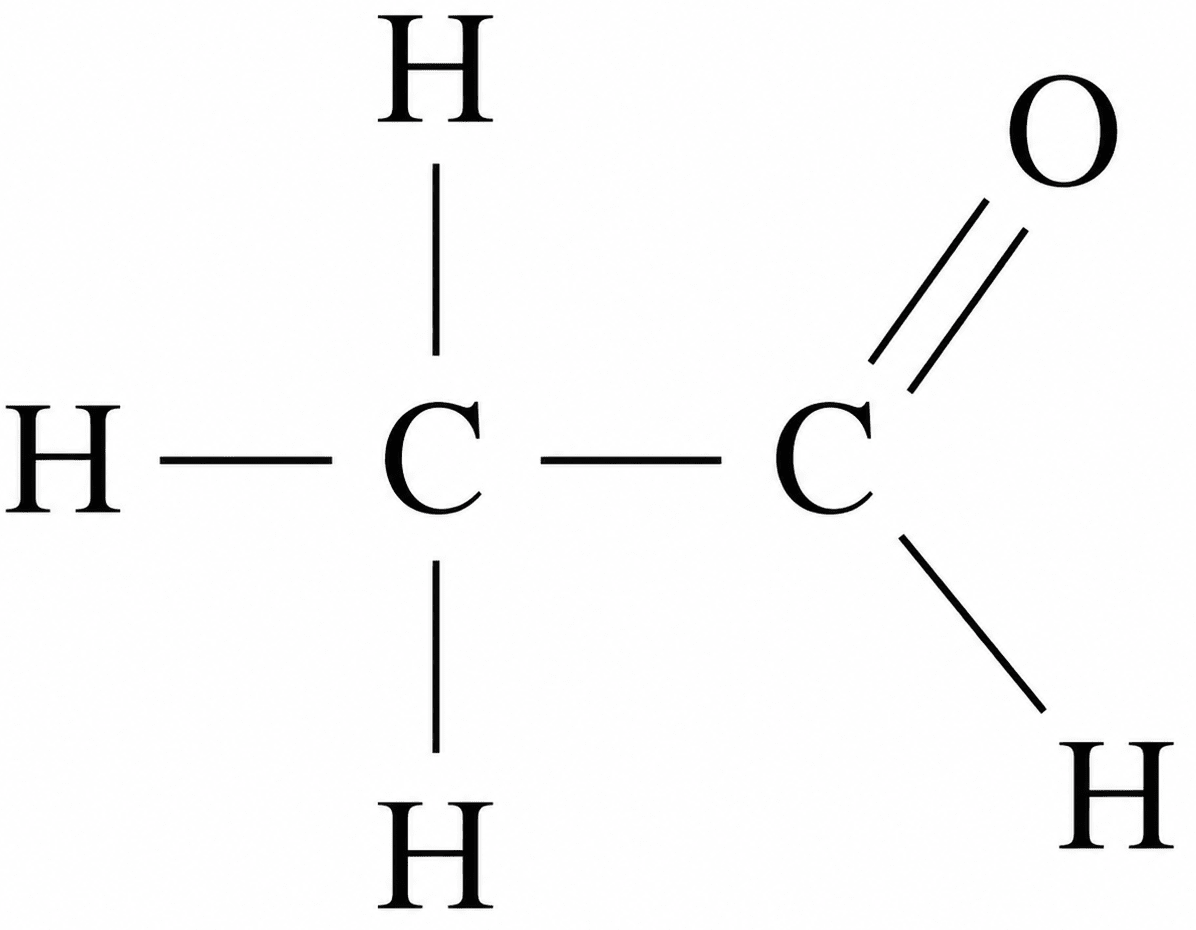
A        
  C DE
 B     GF
         

(i) Which element forms electrovalent compound with G?

(ii) The ion of which element will migrate towards the cathode during electrolysis?

(iii) Which non-metallic element has the valency of 2?

(iv) Which is an inert gas?

Show SolutionHide Solution↓

(i) B forms an electrovalent compound with G.

(ii) A has positive ions which migrate towards cathode.

(iii) E is non-metallic and has a valency of 2 as it belongs to group 16.

(iv) F is an inert gas as it belongs to the zero group.

3(a)Written · 2019 · Section II · 2019 PaperFull page

Name the particles present in:

(i) Strong electrolyte

(ii) Non- electrolyte

(iii) Weak electrolyte

Show SolutionHide Solution↓

(i) Ions only

(ii) Molecules only

(iii) Ions and Molecules

3(b)Written · 2019 · Section II · 2019 PaperFull page

Distinguish between the following pairs of compounds using the reagent given in the bracket.

(i) Manganese dioxide and copper (II) oxide. (using concentrated HCl)

(ii) Ferrous sulphate solution and ferric sulphate solution. (using sodium hydroxide solution)
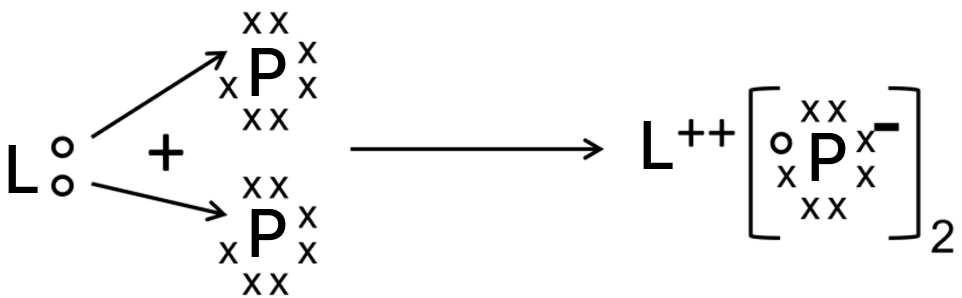
(iii) Dilute hydrochloric acid and dilute sulphuric acid. (using lead nitrate solution)

Show SolutionHide Solution↓

(i) When each of the compound is heated with conc. hydrochloric acid, greenish yellow (chlorine) gas is evolved in case of manganese dioxide and filtrate is brownish in colour whereas, no chlorine gas is evolved in case of copper (II) oxide and filtrate is bluish in colour.

MnO2 + 4HCl ⟶ MnCl2 + 2H2O + Cl2

CuO + 2HCl ⟶ CuCl2 + H2O

(ii) When sodium hydroxide is added to the two solns., ferrous sulphate solution gives a dirty green ppt. of Fe(OH)2 whereas, ferric sulphate solution forms a reddish brown ppt. of Fe(OH)3. Hence, the two compounds can be distinguished.

(iii) Sulphuric acid forms a white precipitate with lead nitrate solution. This precipitate does not dissolve on warming the reaction mixture.
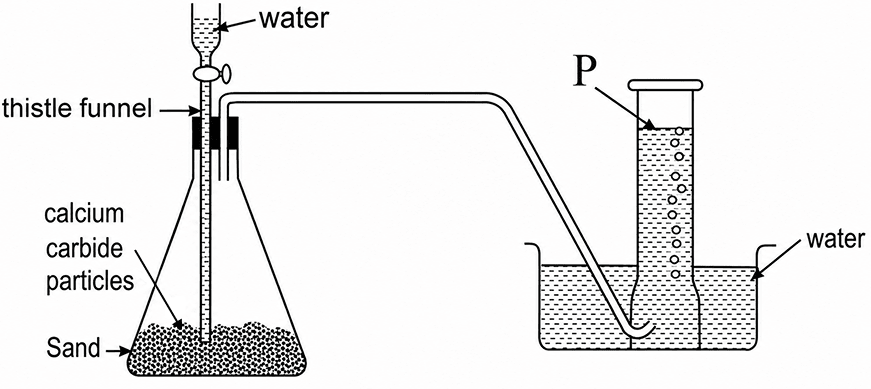
H2SO4 (dil.) + Pb(NO3)2 ⟶ 2HNO3 + PbSO4 ↓ [white ppt. formed which does not dissolve on warming the mixture].

Hydrochloric acid forms a white precipitate with lead nitrate solution. This precipitate dissolves on warming the reaction mixture so as to form clear solution.
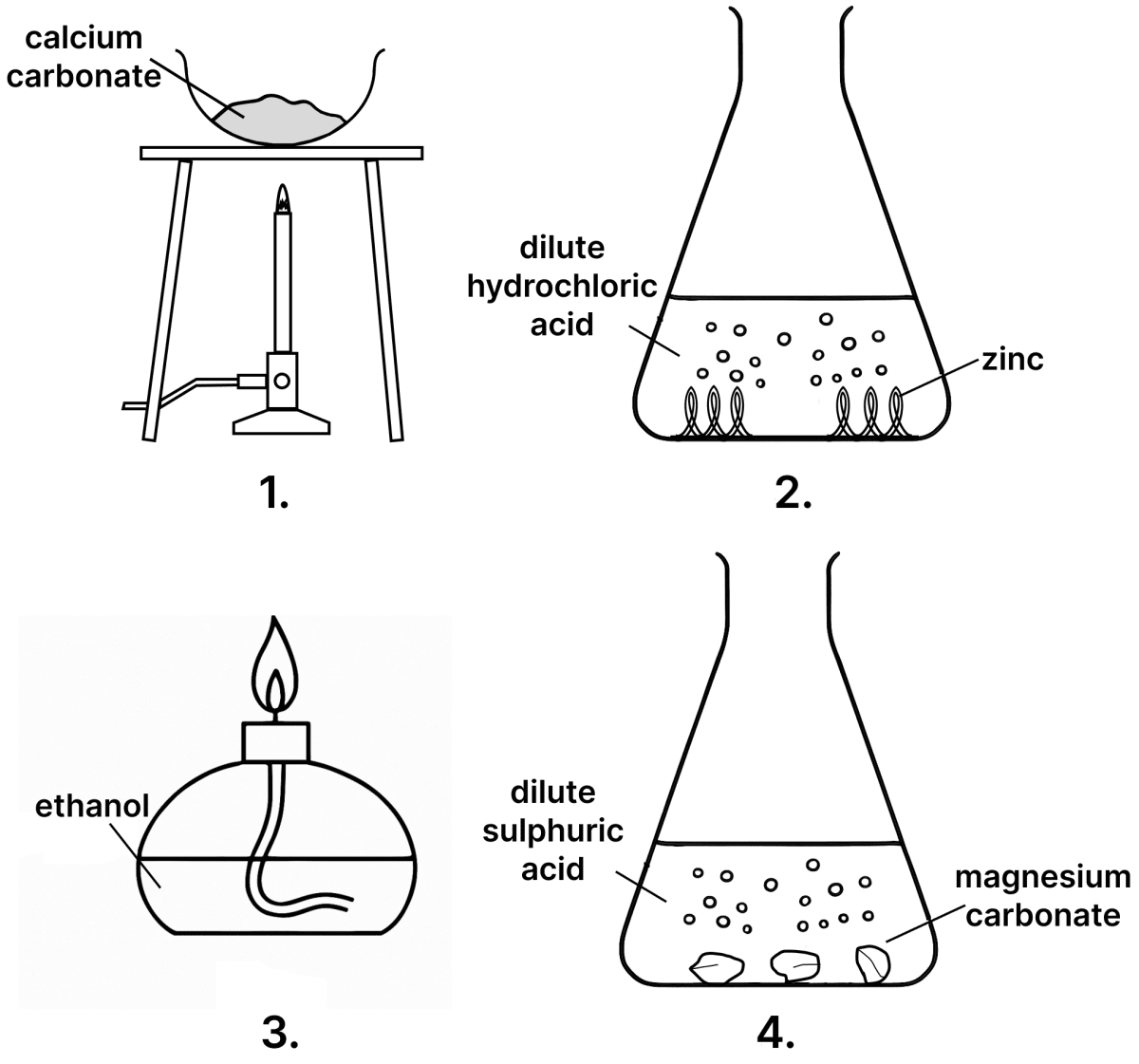
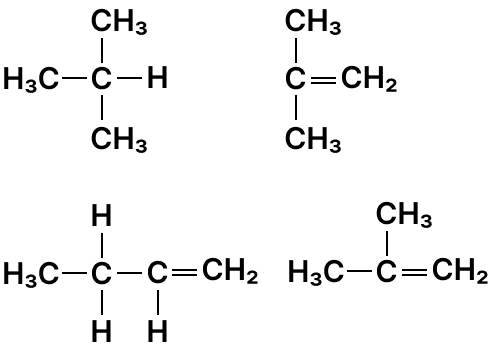
2HCl (dil.) + Pb(NO3)2 ⟶ 2HNO3 + PbCl2 ↓ [white ppt. formed which dissolves on warming the mixture].
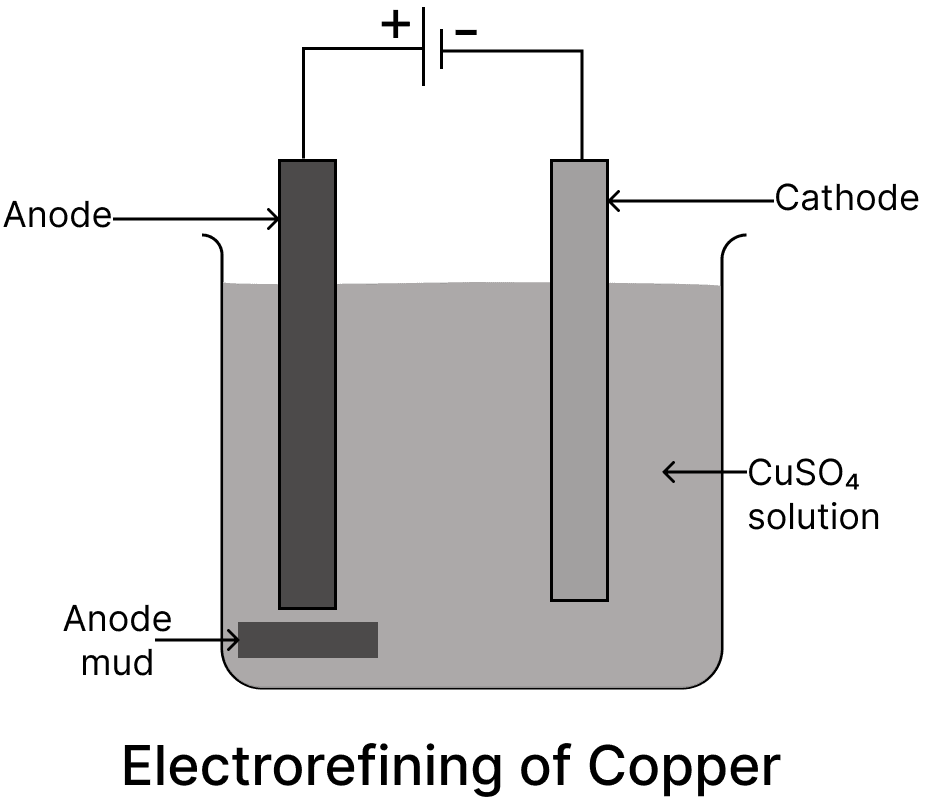
Hence, dilute hydrochloric acid and dilute sulphuric acid can be distinguished using lead nitrate solution.
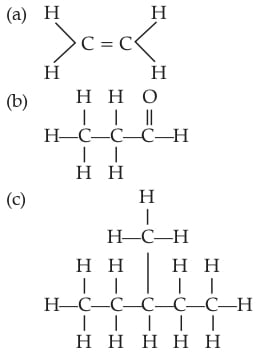
3(c)Written · 2019 · Section II · 2019 PaperFull page

Choose the method of preparation of the following salts, from the methods given in the list:

[List:
A. Neutralization
B. Precipitation
C. Direct combination
D. Substitution]

(i) Lead chloride

(ii) Iron (II) sulphate

(iii) Sodium nitrate

(iv) Iron (III) chloride

Show SolutionHide Solution↓

(i) Lead chloride — B: Precipitation

(ii) Iron [II] Sulphate — D: Substitution

(iii) Sodium nitrate — A: Neutralization

(iv) Iron [III] chloride — C: Direct combination

4(a)Written · 2019 · Section II · 2019 PaperFull page

Complete the following equations:

(i) S + Conc. HNO3 ⟶

(ii) C + conc. H2SO4 ⟶

(iii) Cu + dil. HNO3 ⟶

Show SolutionHide Solution↓

(i) S + 6HNO3 [conc.] ⟶ H2SO4 + 2H2O + 6NO2

(ii) C + 2H2SO4 (conc.) ⟶ CO2 + 2SO2 + 2H2O

(iii) 3Cu + 8HNO3 [dil.] ⟶ 3Cu(NO3)2 + 2NO (g) + 4H2O

4(b)Written · 2019 · Section II · 2019 PaperFull page

Write a balanced chemical equation for the preparation of:

(i) Ethene from bromoethane

(ii) Ethyne using calcium carbide

(iii) Methane from sodium acetate.

Show SolutionHide Solution↓

(i) Ethene from bromoethane

$\underset{\text{ Bromoethane [ethyl bromide]}}{\text{C}_2\text{H}_5\text{-Br}} + \underset{\text{ alcoholic KOH}}{\text{KOH}} \xrightarrow{\text{boil}} \underset{ \text{ ethene [ethylene]} } {\text{H}_2\text{C}=\text{C}\text{H}_2} + \text{KBr} + \text{H}_2\text{O}$

(ii) Ethyne from calcium carbide

$\underset{\text{calcium carbide}}{\text{CaC}_2} + \underset{\text{cold water}}{2\text{H}_2\text{O}} \longrightarrow \underset{\text{ethyne [acetylene]}}{\text{C}_2\text{H}_2} + \text{Ca(OH)}_2$

(iii)

$\underset{\text{ sodium acetate}}{\text{CH}_3\text{.COONa}} + \underset{\text{sodalime}}{\text{NaOH}} \underset{\Delta}{\xrightarrow{\text{CaO}}} \underset{\text{methane}}{\text{C}\text{H}_4} + \text{Na}_2\text{CO}_3$

4(c)Written · 2019 · Section II · 2019 PaperFull page

Name the following organic compounds:

(i) The compound with 3 carbon atoms whose functional group is a carboxyl.

(ii) The first homologue whose general formula is CnH2n

(iii) The compound that reacts with acetic acid to form ethyl ethanoate.

(iv) The compound formed by complete chlorination of ethyne.

Show SolutionHide Solution↓

(i) Propanoic acid [C3H7CHO]

(ii) Ethene [C2H4]

(iii) Ethyl alcohol

$\underset{\text{ethyl alcohol}}{\text{C}_2\text{H}_5\text{OH}} + \underset{\text{acetic acid}}{\text{CH}_3\text{COOH}} \xrightarrow{\text{Conc. H}_2\text{SO}_4} \underset{\text{ethyl ethanoate}}{\text{CH}_3-\text{COO}-\text{C}_2\text{H}_5} + \text{H}_2\text{O}$

(iv) 1,1,2,2 tetrachloroethane

1,1,2,2 tetrachloroethane. Organic Chemistry, Simplified Chemistry Dalal Solutions ICSE Class 10
5(a)Written · 2019 · Section II · 2019 PaperFull page

Give the chemical formula of:

(i) Bauxite

(ii) Cryolite

(iii) Sodium aluminate

Show SolutionHide Solution↓

(i) Al2O3.2H2O — Bauxite

(ii) Na3AlF6 — Cryolite

(iii) NaAlO2 — Sodium aluminate

5(b)Written · 2019 · Section II · 2019 PaperFull page

Answer the following questions based on the extraction of aluminium from alumina by Hall-Heroult's Process.:

(i) What is the function of cryolite used along with alumina as the electrolyte?

(ii) Why is powdered coke sprinkled on top of the electrolyte?

(iii) Name the electrode, from which aluminium is collected.

Show SolutionHide Solution↓

(i) Addition of cryolite —

  1. lowers the fusion point of the mixture i.e., mixture fuses around 950°C instead of 2050°C.
  2. enhances the mobility of the fused mixture by acting as a solvent for the electrolytic mixture.
  3. enhances the conductivity of the mixture since, pure alumina is almost a non-conductor of electricity.

(ii) The layer of powdered coke is sprinkled over the electrolytic mixture as :

  1. it prevents burning of carbon electrodes in air at the emergence point from the bath.
  2. it minimizes or prevents heat loss by radiation.
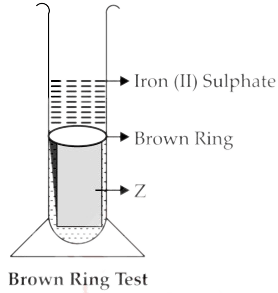
(iii) Cathode

5(c)Written · 2019 · Section II · 2019 PaperFull page

Match the alloys given in column I to the uses given in column II:

Column IColumn II
(i) DuraluminA: Electrical fuse
(ii) SolderB: Surgical instruments
(iii) BrassC: Aircraft body
(iv) Stainless steelD: Decorative articles
Show SolutionHide Solution↓
Column IColumn II
(i) DuraluminC: Aircraft body
(ii) SolderA: Electrical fuse
(iii) BrassD: Decorative articles
(iv) Stainless steelB: Surgical instruments
6(a)Written · 2019 · Section II · 2019 PaperFull page

Identify the substances underlined :

(i) The catalyst used to oxidise ammonia.

(ii) The organic compound which when solidified, forms an ice like mass.

(iii) The dilute acid which is an oxidizing agent.

Show SolutionHide Solution↓

(i) Platinum

$4\text{NH}_3 + 5\text{O}_2 \xrightarrow[800 ^{\circ} \text{C}]{\text{Pt.}} \text{4NO} + \text{6H}_\text{2}\text{O} + \Delta$

(ii) Glacial acetic acid

(iii) Nitric acid

6(b)Written · 2019 · Section II · 2019 PaperFull page

Copper sulphate solution reacts with sodium hydroxide solution to form a precipitate of copper hydroxide according to the equation:

2NaOH + CuSO4 ⟶ Na2SO4 + Cu(OH)2↓

(i) What mass of copper hydroxide is precipitated by using 200 g of sodium hydroxide.

[H = 1, O = 16, Na = 23, S = 32, Cu = 64]

(ii) What is the colour of the precipitate formed.

Show SolutionHide Solution↓

(i)

$$\begin{matrix} 2\text{NaOH} & + & \text{CuSO}_4 & \longrightarrow & \text{Na}_2\text{SO}_4 & + & \text{Cu(OH)}_2\downarrow \\ 2[23 + 16 & & & & & & 64 + 2[40] \\ + 1] & & & & & & = 98 \text{g} \\ = 80 \text{ g} & & & & & & \\ \end{matrix}$$

80 g of sodium hydroxide precipitates 98 g of copper hydroxide.

∴ 200 g of sodium hydroxide will precipitate $\frac{98}{80}$ x 200 = 245 g of copper hydroxide.

Hence, 245 g. of copper hydroxide is precipitated.

(ii) Pale blue precipitate is formed.

6(c)Written · 2019 · Section II · 2019 PaperFull page

Find the empirical formula and the molecular formula of an organic compound from the data given below:

C = 75.92%, H = 6.32% and N = 17.76%

The vapour density of the compound is 39.5.

[C = 12, H = 1, N = 14]

Show SolutionHide Solution↓
Element% compositionAt. wt.Relative no. of atomsSimplest ratio
Carbon75.9212$\frac{75.92}{12}$ = 6.32$\frac{ 6.32 }{ 1.26}$ = 5
Hydrogen6.321$\frac{6.32}{1}$ = 6.32$\frac{6.32 }{ 1.26}$ = 5
Nitrogen17.7614$\frac{ 17.76}{14}$ = 1.26$\frac{ 1.26}{ 1.26}$ = 1

Simplest ratio of whole numbers = C : H : N = 5 : 5 : 1

Hence, empirical formula is C5H5N

Empirical formula weight = 5(12) + 5(1) + 14 = 79

V.D. = 39.5

Molecular weight = 2 x V.D. = 2 x 39.5 = 79

$$\begin{aligned}\text{n} = \frac{\text{Molecular weight}}{\text{Empirical formula weight}} \\[0.5em] = \frac{79}{79} = 1\end{aligned}$$

∴ Molecular formula = n[E.F.] = 1[C5H5N] = C5H5N

7(a)Written · 2019 · Section II · 2019 PaperFull page

Name the gas evolved in each of the following cases:

(i) Alumina undergoes electrolytic reduction.
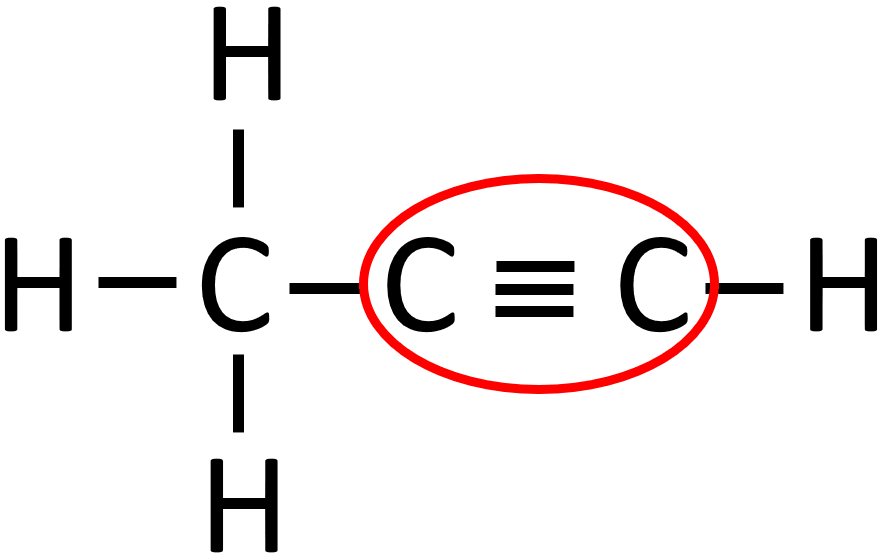
(ii) Ethene undergoes hydrogenation reaction.
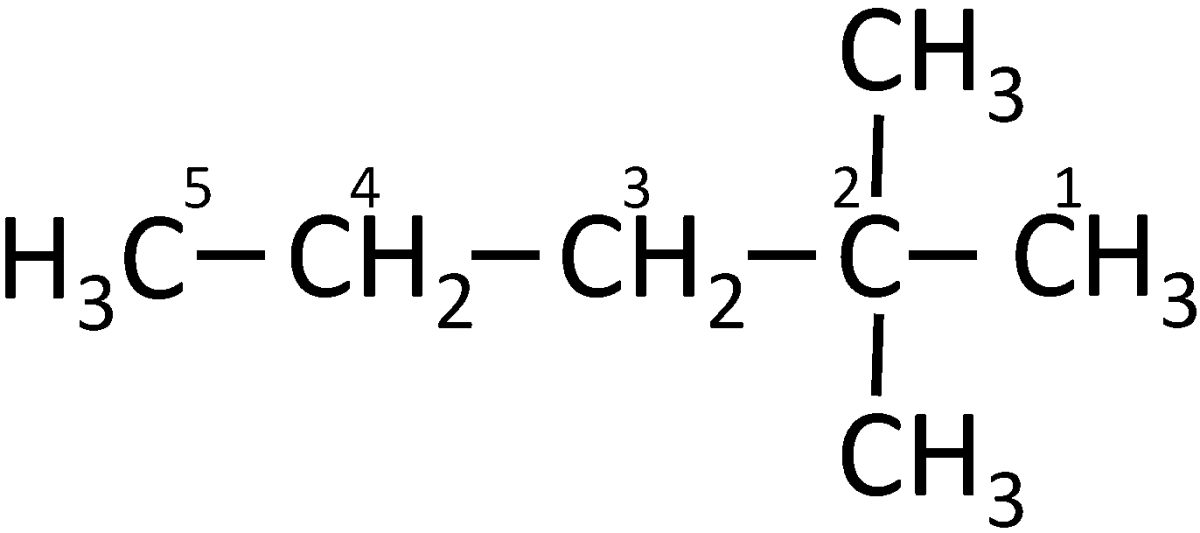
(iii) Ammonia reacts with heated copper oxide.
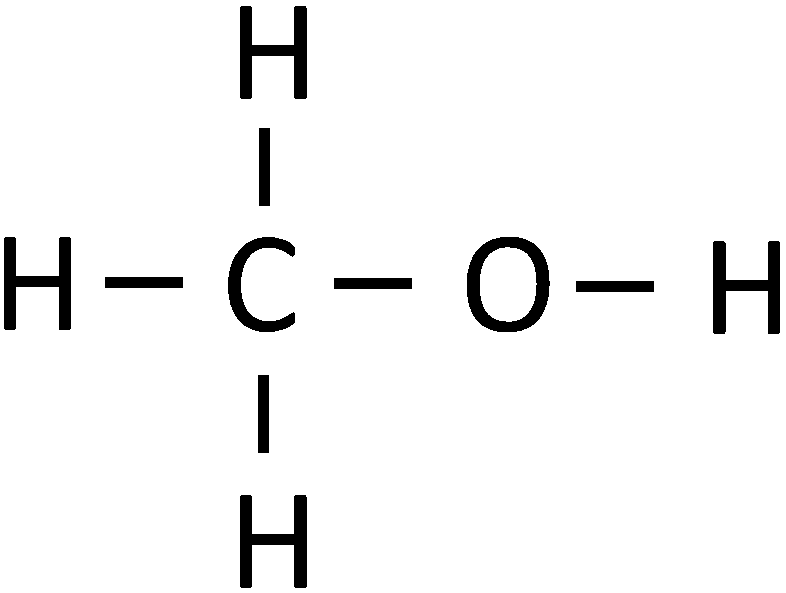
Show SolutionHide Solution↓

(i) Oxygen gas

(ii) Ethane gas

(iii) Nitrogen gas

7(b)Written · 2019 · Section II · 2019 PaperFull page

Study the flow chart given and give balanced equations to represent the reactions A, B and C:

$\text{Mg}_3\text{N}_2 \xrightarrow{\text{A}} \text{NH}_3 \xtofrom[\text{C}]{\text{B}} \text{NH}_4\text{Cl}$

Show SolutionHide Solution↓

A : Mg3N2 + 6H2O ⟶ 3Mg(OH)2 + 2NH3 [g]

B : NH3 + HCl ⟶ NH4Cl

C: NH4Cl + NaOH ⟶ NaCl + H2O + NH3 [g]

7(c)Written · 2019 · Section II · 2019 PaperFull page

Copy and complete the following table which refers to the industrial method for preparation of ammonia and sulphuric acid.

Name of the compoundName of the processCatalytic equation
[with the catalyst]
Ammonia(i)(ii)
Sulphuric acid(iii)(iv)
Show SolutionHide Solution↓

(i) Haber's process

(ii) $\text{N}_2 + 3\text{H}_2 \xrightleftharpoons[\text{450-500 ^{\circ} C}]{\text{Fe}} \text{2NH}_3 + \Delta$

(iii) Contact Process

(iv) $2\text{SO}_2 + \text{O}_2 \xrightleftharpoons [450-500\text{^{\circ} C }/1 - 2 \text{ atmos}]{\text{V}_2\text{O}_5} 2\text{SO}_3 + \text{45 K cals}$

1(a-i)Written · 2018 · Section I · 2018 PaperFull page

The salt solution which does not react with ammonium hydroxide is:

Show SolutionHide Solution↓

Calcium Nitrate

Reason — No ppt. occurs even with addition of excess of ammonium hydroxide as the concentration of OH- ions from the ionization of of NH4OH is so low that it cannot precipitate the hydroxide of calcium.

1(a-ii)Written · 2018 · Section I · 2018 Paper · 🔁 also 2026Full page

The organic compound which undergoes substitution reaction is:

Show SolutionHide Solution↓

C2H6

Reason — C2H6 will undergo substitution reaction as it is a saturated hydrocarbon and substitution reaction is a characteristic of saturated hydrocarbons.

1(a-iii)Written · 2018 · Section I · 2018 PaperFull page

The electrolysis of acidified water is an example of:

Show SolutionHide Solution↓

Redox reaction

Reason — At cathode, H+ ions gain electron and become neutral hydrogen atoms. Therefore, reduction takes place at cathode.
At anode, OH- ions lose electron and becomes neutral OH atoms. Therefore, oxidation takes place at anode.
Hence, electrolysis of acidified water is an example of redox reaction.

1(a-iv)Written · 2018 · Section I · 2018 PaperFull page

The IUPAC name of dimethyl ether is:

Show SolutionHide Solution↓

Methoxy methane

Reason — The IUPAC name of dimethyl ether is Methoxy methane.

1(a-v)Written · 2018 · Section I · 2018 PaperFull page

The catalyst used in the Contact Process is:

Show SolutionHide Solution↓

Vanadium pentoxide

Reason — The catalyst used in the Contact Process is Vanadium pentoxide.

1(b)Written · 2018 · Section I · 2018 PaperFull page

Give one word or a phrase for the following statements:

(i) The energy released when an electron is added to a neutral gaseous isolated atom to form a negatively charged ion.

(ii) Process of formation of ions from molecules which are not in ionic state.

(iii) The tendency of an element to form chains of identical atoms.

(iv) The property by which certain hydrated salts, when left exposed to atmosphere, lose their water of crystallization and crumble into powder.

(v) The process by which sulphide ore is concentrated.

Show SolutionHide Solution↓

(i) Electron affinity

(ii) Ionization

(iii) Catenation

(iv) Efflorescence

(v) Froth flotation process

1(c)Written · 2018 · Section I · 2018 PaperFull page

Write a balanced chemical equation for each of the following:

(i) Action of concentrated sulphuric acid on carbon.

(ii) Reaction of sodium hydroxide solution with iron (III) chloride solution.

(iii) Action of heat on aluminum hydroxide.

(iv) Reaction of zinc with potassium hydroxide solution.

(v) Action of dilute hydrochloric acid on magnesium sulphite.

Show SolutionHide Solution↓

(i) C + 2H2SO4 [conc.] ⟶ CO2 + 2H2O + 2SO2

(ii) FeCl3 + 3NaOH ⟶ 3NaCl + Fe(OH)3

(iii) 2Al(OH)3 $\xrightarrow{1100^{\circ}\text{C}}$ Al2O3 + 3H2O

(iv) Zn + 2KOH ⟶ K2ZnO2 + H2

(v) MgSO3 + 2HCl ⟶ MgCl2 + H2O + SO2 [g]

1(d)Written · 2018 · Section I · 2018 PaperFull page

(i) Give the IUPAC name for each of the following:

Give the IUPAC name for. Organic Chemistry, Simplified Chemistry Dalal Solutions ICSE Class 10

(ii) Write the structural formula of the two isomers of butane.

Show SolutionHide Solution↓
  1. Methanal
  2. 1-Propanol
  3. 2-Butene

(ii) Structural formula of the two isomers of butane are given below:

  1. Butane [n-butane]
Give the structural formulae of n-butane. Organic Chemistry, Simplified Chemistry Dalal Solutions ICSE Class 10
  1. 2-Methyl propane [iso-butane]
Give the structural formulae of 2-methyl propane. Organic Chemistry, Simplified Chemistry Dalal Solutions ICSE Class 10
1(e)Written · 2018 · Section I · 2018 PaperFull page

State one relevant observation for each of the following:

(i) Lead nitrate solution is treated with sodium hydroxide solution drop wise till it is in excess.

(ii) At the anode, when molten lead bromide is electrolyzed using graphite electrodes.

(iii) Lead nitrate solution is mixed with dilute hydrochloric acid and heated.

(iv) Anhydrous calcium chloride is exposed to air for some time.

(v) Barium chloride solution is slowly added to sodium sulphate solution.

Show SolutionHide Solution↓

(i) Chalky white precipitate is formed which is soluble in excess of sodium hydroxide and forms a colourless solution.

(ii) At the anode, brown fumes of bromine vapours are observed.

(iii) White precipitate of PbCl2 is formed which is soluble in hot water.
Pb(NO3)2 + 2HCl ⟶ PbCl2 + 2HNO3

(iv) It absorbs moisture from the atmosphere, dissolve in the same and change into a solution. This property is known as deliquescence

(v) A white ppt. is obtained which is insoluble in dil. HCl or dil. HNO3
Na2SO4 + BaCl2 ⟶ BaSO4 ↓ [white ppt.] + 2NaCl

1(f)Written · 2018 · Section I · 2018 PaperFull page

Give a reason for each of the following:

(i) Ionic compounds have a high melting point.

(ii) Inert gases do not form ions.

(iii) Ionisation potential increases across a period, from left to right.

(iv) Alkali metals are good reducing agents.

(v) Conductivity of dilute hydrochloric acid is greater than that of acetic acid.

Show SolutionHide Solution↓

(i) Ionic compounds have ionic bonds so there exists a strong force of attraction between the oppositely charged ions, so a large amount of energy is required to break the strong bonding between the ions. Hence, ionic compounds have a high melting point.

(ii) Inert gases have completely filled octet which makes them extremely stable. They neither lose, nor gain electrons. Hence, they do not form ions.

(iii) The ionisation potential of an element increases across a period because the atomic size decreases due to an increase in nuclear charge and electrons in the outermost shell are more strongly held because of which greater energy is required to remove the electron.

(iv) Alkali metals have one electron in the outermost shell and hence during reactions they readily give the valence electron and get themselves oxidised. Hence, they are good reducing agents.

(v) Dil. H2SO4 is a strong electrolyte and acetic acid is a weak electrolyte. Therefore, dil. H2SO4 allows large amount of electricity to flow through it and is a good conductor of electricity whereas acetic acid allows small amount of electricity to flow through it and is a poor conductor of electricity. Hence, electrical conductivity of dilute hydrochloric acid is greater than that of acetic acid.

1(g)Written · 2018 · Section I · 2018 PaperFull page

Name the gas that is produced in each of the following cases:

(i) Sulphur is oxidized by concentrated nitric acid.

(ii) Action of dilute hydrochloric acid on sodium sulphide.

(iii) Action of cold and dilute nitric acid on copper.

(iv) At the anode during the electrolysis of acidified water.

(v) Reaction of ethanol and sodium.

Show SolutionHide Solution↓

(i) Nitrogen dioxide gas

(ii) Hydrogen sulphide gas

(iii) Nitric oxide gas

(iv) Oxygen gas

(v) Hydrogen gas

1(h)Written · 2018 · Section I · 2018 PaperFull page

Fill up the blanks with the correct choice given in brackets.

(i) Ionic or electrovalent compounds do not conduct electricity in their ............... state. (fused / solid)

(ii) Electrolysis of aqueous sodium chloride solution will form ............... at the cathode. (hydrogen gas / sodium metal)

(iii) Dry hydrogen chloride gas can be collected by............... displacement of air. (downward / upward)

(iv) The most common ore of iron is ............... (calamine / haematite)

(v) The salt prepared by the method of direct combination is ............... (iron (II) chloride / iron (III) chloride)

Show SolutionHide Solution↓

(i) Ionic or electrovalent compounds do not conduct electricity in their solid state.

(ii) Electrolysis of aqueous sodium chloride solution will form hydrogen gas at the cathode.

(iii) Dry hydrogen chloride gas can be collected by upward displacement of air.

(iv) The most common ore of iron is haematite

(v) The salt prepared by the method of direct combination is iron (III) chloride.

2(a)Written · 2018 · Section II · 2018 PaperFull page

(i) What do you understand by a lone pair of electrons?

(ii) Draw the electron dot diagram of Hydronium ion. (H=1; O=8)

Show SolutionHide Solution↓

(i) Lone pair of electrons are valence electrons that in a covalent bond are not shared with another atom.

(ii) Electron dot diagram of Hydronium ion is shown below:

Draw an electron dot diagram of the structure of hydronium ion. Chemical Bonding, Simplified Chemistry Dalal Solutions ICSE Class 10
2(b)Written · 2018 · Section II · 2018 PaperFull page

In Period 3 of the Periodic Table, element B is placed to the left of element A.

On the basis of this information, choose the correct word from the brackets to complete the following statements:

(i) The element B would have (lower / higher) metallic character than A.

(ii) The element A would probably have (lesser / higher) electron affinity than B.

(iii) The element A would have (greater / smaller) atomic size than B.

Show SolutionHide Solution↓

If the element are placed as B and then A in the 3rd period of the periodic table then

(i) The element B would have higher metallic character than A as metallic character decreases across a period.

(ii) The element A would probably have higher electron affinity than B as electron affinity increases across a period.

(iii) The element A would have smaller atomic size than B as atomic size decreases across a period.

2(c)Written · 2018 · Section II · 2018 PaperFull page

Copy and complete the following table which refers to the conversion of ions to neutral particles.

ConversionIonic equationOxidation/Reduction
Chloride ion to chlorine molecule
Lead [II] ion to lead
Show SolutionHide Solution↓
ConversionIonic equationOxidation/Reduction
Chloride ion to chlorine moleculeCl1- - 1e- ⟶ Cl [Cl2]
Cl + Cl ⟶ Cl2
Oxidation
Lead [II] ion to leadPb2+ + 2e- ⟶ PbReduction
3(a)Written · 2018 · Section II · 2018 PaperFull page

(i) Write the balanced chemical equation to prepare ammonia gas in the laboratory by using an alkali.

(ii) State why concentrated sulphuric acid is not used for drying ammonia gas.

(iii) Why is ammonia gas not collected over water?

Show SolutionHide Solution↓

(i) 2NH4Cl + Ca(OH)2 ⟶ CaCl2 + 2H2O + 2NH3 [g]

(ii) As sulphuric acid reacts chemically with ammonia to form ammonium sulphate hence, it is not used as a drying agent for drying ammonia.

2NH3 + H2SO4 ⟶ (NH4)2SO4

(iii) As ammonia gas is highly soluble in water hence, it is not collected over water.

3(b)Written · 2018 · Section II · 2018 PaperFull page

(i) Name the acid used for the preparation of hydrogen chloride gas in the laboratory. Why is this particular acid preferred to other acids?

(ii) Write the balanced chemical equation for the laboratory preparation of hydrogen chloride gas.

Show SolutionHide Solution↓

(i) Conc. H2SO4 is used for the preparation of hydrogen chloride gas in the laboratory.

As conc. H2SO4 is non-volatile and has a high boiling point, therefore, it displaces the volatile hydrogen chloride from the salt sodium chloride. Hence, conc. H2SO4 is used as a reactant in the laboratory preparation of HCl from sodium chloride.

(ii) $\text{NaCl} + \text{H}_2\text{SO}_4 \xrightarrow{\lt 200 ^{\circ}\text{C}} \text{NaHSO}_4 + \text{HCl [g.]}$

3(c)Written · 2018 · Section II · 2018 PaperFull page

For the preparation of hydrochloric acid in the laboratory:

(i) Why is direct absorption of hydrogen chloride gas in water not feasible?

(ii) What arrangement is done to dissolve hydrogen chloride gas in water?

Show SolutionHide Solution↓

(i) Hydrogen chloride gas is sufficiently soluble, so, it is absorbed more quickly than it is being generated in the flask. This causes back-suction due to partial vacuum created in the tube. Hence, direct absorption of hydrogen chloride gas in water is not feasible.

(ii) A special funnel arrangement is done in which an inverted funnel, connected to the hydrogen chloride gas supply is placed in the beaker in such a way that it just touches the water taken in the trough. This arrangement minimizes back suction.

3(d)Written · 2018 · Section II · 2018 PaperFull page

For the electro-refining of copper:

(i) What is the cathode made up of?

(ii) Write the reaction that takes place at the anode.

Show SolutionHide Solution↓

(i) Pure thin sheet of copper.

(ii) Cu - 2e- ⟶ Cu2+

4(a)Written · 2018 · Section II · 2018 PaperFull page

The percentage composition of a gas is:

Nitrogen 82.35%, Hydrogen 17.64%.

Find the empirical formula of the gas. [N = 14, H = 1]

Show SolutionHide Solution↓
Element% compositionAt. wt.Relative no. of atomsSimplest ratio
Nitrogen82.3514$\frac{82.35 }{14}$ = 5.88$\frac{5.88}{5.88}$ = 1
Hydrogen17.641$\frac{17.64}{1}$ = 17.64$\frac{17.64}{5.88}$ = 3

Simplest ratio of whole numbers = N : H = 1 : 3

Hence, empirical formula is NH3

4(b)Written · 2018 · Section II · 2018 PaperFull page

Aluminum carbide reacts with water according to the following equation:

Al4C3 + 12H2O ⟶ 4Al(OH)3 + 3CH4

(i) What mass of aluminum hydroxide is formed from 12g of aluminum carbide?

(ii) What volume of methane at s.t.p. is obtained from 12g of aluminum carbide?

[Relative molecular weight of Al4C3 = 144; Al(OH)3 = 78]

Show SolutionHide Solution↓

$$\begin{matrix} \text{Al}_4\text{C}_3 & + & 12\text{H}_2\text{O} & \longrightarrow & 4\text{Al(OH)}_3 & + & 3\text{CH}_4 \\ 144 \text{ g} & & & & 4(78) & & 3(22.4) \\ & & & & = 312 \text{ g} & & = 67.2 \text{ lit.} \\ \end{matrix}$$

144 g of aluminium carbide forms 312 g of aluminium hydroxide.

∴ 12 g of aluminium carbide will form $\frac{312}{144}$ x 12 = 26 g of aluminium hydroxide

Hence, 26 g of aluminium hydroxide is formed.

(ii) 144 g of aluminium carbide forms 67.2 lit of methane.

∴ 12 g of aluminium carbide will form $\frac{67.2}{144}$ x 12 = 5.6 lit.

Hence, vol. of methane obtained at s.t.p. = 5.6 lit.

4(c)Written · 2018 · Section II · 2018 PaperFull page

(i) If 150 cc of gas A contains X molecules, how many molecules of gas B will be present in 75 cc of B?

The gases A and B are under the same conditions of temperature and pressure.

(ii) Name the law on which the above problem is based.

Show SolutionHide Solution↓

(i) According to Avogadro’s law : equal volumes of all gases under similar conditions of temperature and pressure contain equal number of molecules.

Given,

150 cc of a gas A contains X molecules

Therefore, 150 cc of B will also contain X molecule.

Hence, 75 cc of B will contain X/2 molecules.

(ii) The problem is based on Avogadro's law.

4(d)Written · 2018 · Section II · 2018 PaperFull page

Name the main component of the following alloys:

(i) Brass

(ii) Duralumin

Show SolutionHide Solution↓

(i) Copper

(ii) Aluminium

5(a)Written · 2018 · Section II · 2018 PaperFull page

Complete the following table which relates to the homologous series of hydrocarbons.

General formulaIUPAC name of the homologous seriesCharacteristic bond typeIUPAC name of the first member of the series
CnH2n-2(A) ...............(B) ...............(C)...............
CnH2n+2(D)...............(E) ...............(F)...............
Show SolutionHide Solution↓
General formulaIUPAC name of the homologous seriesCharacteristic bond typeIUPAC name of the first member of the series
CnH2n-2(A) Alkynes(B) Triple covalent bond(C) Ethyne
CnH2n+2(D) Alkanes(E) Single covalent bond(F) Methane
5(b)Written · 2018 · Section II · 2018 PaperFull page

(i) Name the most common ore of the metal aluminum from which the metal
is extracted. Write the chemical formula of the ore.

(ii) Name the process by which impure ore of aluminum gets purified by using concentrated solution of an alkali.

(iii) Write the equation for the formation of aluminum at the cathode during the electrolysis of alumina.

Show SolutionHide Solution↓

(i) Bauxite [Al2O3.2H2O]

(ii) Bayer's Process

(iii) 2Al3+ + 6e- ⟶ 2Al

6(a)Written · 2018 · Section II · 2018 PaperFull page

A compound X (having vinegar like smell) when treated with ethanol in the presence of the acid Z, gives a compound Y which has a fruity smell.

The reaction is:

$\text{C}_2\text{H}_5\text{OH} + \text{X} \xrightarrow{\text{Z}} \text{Y} + \text{H}_2\text{O}$

(i) Identify Y and Z.

(ii) Write the structural formula of X.

(iii) Name the above reaction.

Show SolutionHide Solution↓

$\underset{\text{ethyl alcohol}}{\text{C}_2\text{H}_5\text{OH}} + \underset{\text{acetic acid}}{\text{CH}_3\text{COOH}} \xrightarrow{\text{Conc. H}_2\text{SO}_4} \underset{\text{ethyl ethanoate}}{\text{CH}_3-\text{COO}-\text{C}_2\text{H}_5} + \text{H}_2\text{O}$

(i) Y is ethyl acetate and Z is conc. sulphuric acid

(ii) Structural formula of X (ethanoic acid) is shown below:

Write structural formula of ethanoic acid. Organic Chemistry, Simplified Chemistry Dalal Solutions ICSE Class 10.

(iii) Esterification reaction

6(b)Written · 2018 · Section II · 2018 PaperFull page

Ethane burns in oxygen to form CO2 and H2O according to the equation:

2C2H6 + 7O2 ⟶ 4CO2 + 6H2O.

If 1250 cc of oxygen is burnt with 300 cc of ethane.

Calculate:

(i) the volume of CO2 formed.

(ii) the volume of unused O2.

Show SolutionHide Solution↓

[By Lussac's law]

$$\begin{matrix} 2\text{C}_2\text{H}_6 & + & 7\text{O}_2 &\longrightarrow & 4\text{CO}_2 & + & 6\text{H}_2\text{O} \\ 2\text{ vol.} & : & 7 \text{ vol.} & \longrightarrow & 4\text{ vol.} \end{matrix}$$

(i) To calculate the volume of CO2 formed :

$$\begin{matrix}\text{C}_2\text{H}_6 & : & \text{CO}_2 \\ 2 \text{ vol.} & : & 4 \text{ vol.} \\ 300 \text{ cc} & : & \text{x} \end{matrix}$$

∴

$x = \frac{4}{2} \times 300 = 600 \text{ cc}$

Hence, volume of carbon dioxide formed = 600 cc

(ii) To calculate the volume of unused O2 :

$$\begin{matrix}\text{C}_2\text{H}_6 & : & \text{O}_2 \\ 2 \text{ vol.} & : & 7 \text{ vol.} \\ 300 \text{ cc} & : & \text{x} \end{matrix}$$

∴

$x = \frac{7}{2} \times 300 = 1050 \text{ cc}$

Unused oxygen = 1250 - 1050 = 200 cc.

Hence, volume of unused oxygen = 200 cc

6(c)Written · 2018 · Section II · 2018 PaperFull page

Three solutions P, Q and R have pH value of 3.5, 5.2 and 12.2 respectively.

Which one of these is a:

(i) Weak acid?

(ii) Strong alkali?

Show SolutionHide Solution↓

(i) Q
Reason — On a pH scale, acids have pH less than 7 whereas weak acids have pH towards 7. Hence, Q will be a weak acid with pH 5.2 .

(ii) R
Reason — On a pH scale, alkali have pH more than 7 and alkalinity increases as the pH value moves away from 7. Hence, R will be a strong alkali with pH 12.2 .

7(a)Written · 2018 · Section II · 2018 PaperFull page

Give a chemical test to distinguish between the following pairs of chemicals:

(i) Lead nitrate solution and Zinc nitrate solution

(ii) Sodium chloride solution and Sodium nitrate solution

Show SolutionHide Solution↓

(i) When NaOH is added to each of the compounds, lead nitrate forms a chalky white precipitate of lead hydroxide [Pb(OH)2] whereas a gelatinous white precipitate of zinc hydroxide [Zn(OH)2] is formed in case of zinc nitrate.

(ii) Add silver nitrate soln. to the given solns., sodium chloride reacts to form a white ppt. which is soluble in NH4OH and insoluble in dil. HNO3. The other soln. is sodium nitrate.

NaCl + AgNO3 ⟶ AgCl + NaNO3

NaNO3 + AgNO3 ⟶ no white ppt.

7(b)Written · 2018 · Section II · 2018 PaperFull page

Write a balanced equation for the preparation of each of the following salts:

(i) Copper sulphate from Copper carbonate.

(ii) Zinc carbonate from Zinc sulphate.

Show SolutionHide Solution↓

(i) CuCO3 + H2SO4 ⟶ CuSO4 + H2O + CO2

(ii) ZnSO4 + (NH4)2CO3 ⟶ (NH4)2SO4 + ZnCO3

7(c)Written · 2018 · Section II · 2018 PaperFull page

(i) What is the type of salt formed when the reactants are heated at a suitable temperature for the preparation of Nitric acid?

(ii) State why for the preparation of Nitric acid, the complete apparatus is made up of glass.

Show SolutionHide Solution↓

(i) Acid salt

(ii) The vapours of nitric acid are highly corrosive and attack rubber, cork. etc. For this reason, all glass apparatus is used in the laboratory preparation of nitric acid.

7(d)Written · 2018 · Section II · 2018 PaperFull page

Which property of sulphuric acid is shown by the reaction of concentrated sulphuric acid with:

(i) Ethanol?

(ii) Carbon?

Show SolutionHide Solution↓

(i) Dehydrating property

$\text{C}_{2}\text{H}_{5}\text{OH}\xrightarrow{\text{Conc. H}_2\text{SO}_4} \text{C}_{2}\text{H}_{4} \small{\space[ethene-ethylene]} + \text{H}_2\text{O}$

(ii) Oxidizing property

C + 2H2SO4 (conc.) ⟶ CO2 + 2SO2 + 2H2O

1(a)Written · 2017 · Section I · 2017 PaperFull page

Fill in the blanks from the choices given in brackets:

(i) The energy required to remove an electron from a neutral isolated gaseous atom and convert it into a positively charged gaseous ion is called .............. (electron affinity, ionisation potential, electronegativity)

(ii) The compound that does not have a lone pair of electrons is .............. (water, ammonia, carbon tetra chloride)

(iii) When a metallic oxide is dissolved in water, the solution formed has a high concentration of .............. ions. (H+, H3O+, OH-)

(iv) Potassium sulphite on reacting with hydrochloric acid releases .............. gas. (Cl2, SO2, H2S)

(v) The compound formed when ethene reacts with Hydrogen is .............. (CH4, C2H6, C3H8)

Show SolutionHide Solution↓

(i) The energy required to remove an electron from a neutral isolated gaseous atom and convert it into a positively charged gaseous ion is called Ionization Potential

(ii) The compound that does not have a lone pair of electrons is carbon tetrachloride.

(iii) When a metallic oxide is dissolved in water, the solution formed has a high concentration of OH- ions.

(iv) Potassium sulphite on reacting with hydrochloric acid releases SO2 gas.

(v) The compound formed when ethene reacts with Hydrogen is C2H6.

1(b-i)Written · 2017 · Section I · 2017 PaperFull page

A chloride which forms a precipitate that is soluble in excess of ammonium hydroxide, is:

Show SolutionHide Solution↓

Copper chloride.

Reason — Copper chloride forms a precipitate that is soluble in excess of ammonium hydroxide.

1(b-ii)Written · 2017 · Section I · 2017 PaperFull page

If the molecular formula of an organic compound is C10H18 it is:

Show SolutionHide Solution↓

Alkyne

Reason — As the general formula for alkyne is CnH2n-2. Hence, when C is 10 then H is 18.

1(b-iii)Written · 2017 · Section I · 2017 PaperFull page

Which of the following is a common characteristic of a covalent compound?

Show SolutionHide Solution↓

Consists of molecules

Reason — In covalent compound, valence shell electrons are mutually shared by atom of each element to achieve a stable electronic configuration. As there is no transfer of electrons between the atoms so the atoms remain electrically neutral. Hence they don't form ions and covalent compounds consists of molecules.

1(b-iv)Written · 2017 · Section I · 2017 PaperFull page

To increase the pH value of a neutral solution, we should add:

Show SolutionHide Solution↓

An alkali

Reason — The pH of alkali solutions is more than 7 therefore in order to increase the pH value of a neutral solution, an alkali should be added.

1(b-v)Written · 2017 · Section I · 2017 PaperFull page

Anhydrous iron (III) chloride is prepared by:

Show SolutionHide Solution↓

direct combination

Reason — Anhydrous iron [III] chloride is prepared by direct combination of iron and chloride as follows:
2Fe + 3Cl2 ⟶ 2FeCl3

1(c)Written · 2017 · Section I · 2017 PaperFull page

Identify the substance underlined, in each of the following cases:

(i) Cation that does not form a precipitate with ammonium hydroxide but forms one with sodium hydroxide.

(ii) The electrolyte used for electroplating an article with silver.

(iii) The particles present in a liquid such as kerosene, that is a non electrolyte.

(iv) An organic compound containing -- COOH functional group.

(v) A solid formed by reaction of two gases, one of which is acidic and the other basic in nature.

Show SolutionHide Solution↓

(i) Calcium [Ca2+] ions

(ii) sodium argentocyanide solution

(iii) Molecules only

(iv) Carboxylic acids

(v) Ammonium chloride.

1(d)Written · 2017 · Section I · 2017 PaperFull page

Write a balanced chemical equation for each of the following:

(i) Action of cold and dilute Nitric acid on Copper.

(ii) Reaction of Ammonia with heated copper oxide.

(iii) Preparation of methane from iodomethane.

(iv) Action of concentrated sulphuric acid on Sulphur.

(v) Laboratory preparation of ammonia from ammonium chloride.

Show SolutionHide Solution↓

(i) 3Cu + 8HNO3 [dil.] ⟶ 3Cu(NO3)2 + 4H2O + 2NO [g]

(ii) 2NH3 + 3CuO ⟶ 3Cu + 3H2O + N2 [g]

(iii)
$\underset{\text{methyl iodide}}{\text{CH}_3\text{I}} + \underset{\text{nascent hydrogen}}{2\text{[H]}} \xrightarrow[\text{alcohol}]{\text{Zn/Cu couple}} \underset{\text{methane}}{\text{CH}_4} +\text{HI}$

(iv) S + 2H2SO4 (conc.) ⟶ 3SO2 + 2H2O

(v) 2NH4Cl + Ca(OH)2 ⟶ CaCl2 + 2H2O + 2NH3

1(e)Written · 2017 · Section I · 2017 PaperFull page

State one relevant observation for each of the following reactions:

(i) Addition of ethyl alcohol to acetic acid in the presence of concentrated Sulphuric acid.

(ii) Action of dilute Hydrochloric acid on iron (II) sulphide.

(iii) Action of Sodium hydroxide solution on ferrous sulphate solution.

(iv) Burning of ammonia in air.

(v) Action of concentrated Sulphuric acid on hydrated copper sulphate.

Show SolutionHide Solution↓

(i) On warming, the mixture gives fruity smell. Acetic acid on heating with an alcohol and a dehydrating agent [conc. H2SO4] forms an ester — ethyl acetate.

$\underset{\text{ethyl alcohol}}{\text{C}_2\text{H}_5\text{OH}} + \underset{\text{acetic acid}}{\text{CH}_3\text{COOH}} \xrightarrow{\text{Conc. H}_2\text{SO}_4} \underset{\text{ethyl ethanoate}}{\text{CH}_3-\text{COO}-\text{C}_2\text{H}_5} + \text{H}_2\text{O}$

(ii) H2S gas is evolved. It has a foul smell like rotten eggs.
FeS + 2HCl [g] ⟶ FeCl2 + H2S

(iii) A dirty green precipitate is formed which is insoluble in excess of sodium hydroxide solution.
FeSO4 + 2NaOH ⟶ Fe(OH)2↓ (dirty green ppt.) + Na2SO4

(iv) Ammonia burns in the atmosphere of excess oxygen with a green or greenish yellow flame, forming nitrogen and water vapour.
4NH3 + 3O2 ⟶ 2N2 + 6H2O

(v) The blue coloured hydrous copper sulphate changes to white anhydrous copper sulphate as the water of crystallization is removed.

$\text{CuSO}_4\text{.5H}_2\text{O} \xrightarrow{\text{Conc. H}_2\text{SO}_4} \text{CuSO}_4 \text{ [White Anhydrous]} + 5\text{H}_2\text{O}$

1(f)Written · 2017 · Section I · 2017 PaperFull page

(i) Draw the structural formula for each of the following:

  1. 2, 3 – dimethyl butane
  2. Diethyl ether
  3. Propanoic acid

(ii) From the list of terms given, choose the most appropriate term to match the given description.

(calcination, roasting, pulverisation, smelting)

Show SolutionHide Solution↓

1. 2, 3 – dimethyl butane :

Draw the structural formula for 2, 3 – dimethyl butane. Organic Chemistry, Simplified Chemistry Dalal Solutions ICSE Class 10

2. Diethyl ether :

Draw the structural formula for Diethyl ether. Organic Chemistry, Simplified Chemistry Dalal Solutions ICSE Class 10

3. Propanoic acid :

Draw the structural formula for Propanoic acid. Organic Chemistry, Simplified Chemistry Dalal Solutions ICSE Class 10

(ii) The matching terms are:

  1. Crushing of the ore into a fine powder — Pulverisation
  2. Heating of the ore in the absence of air to a high temperature — Calcination
1(g)5 Marks · 2017 · Section I · 2017 PaperFull page

(i) Calculate the number of gram atoms in 4.6 grams of sodium (Na = 23).

(ii) Calculate the percentage of water of crystallization in CuSO4.5H2O (H = 1, O = 16, S = 32, Cu = 64)

(iii) A compound of X and Y has the empirical formula XY2. Its vapour density is equal to its empirical formula weight. Determine its molecular formula.

Show SolutionHide Solution↓

(i) 23 g of Na = 1 g. atom

∴ 4.6 g. of Na = $\frac{1}{23}$ x 4.6 = 0.2 g

Hence, 0.2 g. atoms

(ii) Molecular weight of hydrated copper sulphate CuSO4.5H2O = 64 + 32 + 4(16) + 5[2(1) + 16]

= 64 + 32 + 64 + 5[18]

= 64 + 32 + 64 + 90

= 250 g

250 g of CuSO4.5H2O contains 90 g of water of crystallization.

∴ Percentage of water of crystallization = $\frac{90}{250}$ x 100 = 36%

Hence, percentage of water of crystallization is 36%

(iii) Empirical formula = XY2

Empirical formula weight = V.D.

Molecular weight = 2 x V.D.

$$\begin{aligned}\text{n} = \frac{\text{Molecular weight}}{\text{Empirical formula weight}} \\[0.5em] \text{n} = \frac{\text{2 x V.D.}}{\text{V.D.}} \\[0.5em] \text{n} = 2\end{aligned}$$

∴ Molecular formula = n[E.F.] = 2[XY2] = X2Y4

1(h)Written · 2017 · Section I · 2017 PaperFull page

Match the atomic number 2, 4, 8, 15, and 19 with each of the following:

(i) A solid non metal belonging to the third period.

(ii) A metal of valency 1.

(iii) A gaseous element with valency 2.

(iv) An element belonging to Group 2.

(v) A rare gas.

Show SolutionHide Solution↓

(i) 15

(ii) 19

(iii) 8

(iv) 4

(v) 2

2(a)Written · 2017 · Section II · 2017 PaperFull page

Arrange the following as per the instruction given in the brackets:

(i) He, Ar, Ne (Increasing order of the number of electron shells)

(ii) Na, Li, K (Increasing Ionisation Energy)

(iii) F, Cl, Br (Increasing electronegativity)

(iv) Na, K, Li (Increasing atomic size)

Show SolutionHide Solution↓

(i) He < Ne < Ar
Reason — Number of electron shells increases as we move down the group.

(ii) K < Na < Li
Reason — Ionization Potential decreases as we move down the group.

(iii) Br < Cl < F
Reason — Electronegativity decreases as we move down the group.

(iv) Li < Na < K
Reason — Atomic Size increases as we move down the group.

2(b)Written · 2017 · Section II · 2017 PaperFull page

State the type of Bonding in the following molecules:

(i) Water

(ii) Calcium oxide

Show SolutionHide Solution↓

(i) Covalent bonding
Reason — The valency of hydrogen element is 1 and that of oxygen is 2. Hydrogen needs one electrons to attain stable duplet structure of nearest noble gas - He [2] and oxygen needs two electrons to attain stable octet structure of nearest noble gas - Ne [2,8]
Each of the two hydrogen atoms shares an electron pair with the oxygen atom such that hydrogen acquires a duplet configuration and oxygen an octet configuration resulting in the formation of two single covalent bonds [H-O-H] in the molecule of water.

State the type of bonding in water molecules. Chemical Bonding, Simplified Chemistry Dalal Solutions ICSE Class 10

(ii) Electrovalent bonding
Reason — The valency of calcium (2,8,8,2) element and that of oxygen (2,6) is 2. Calcium donates two electrons and oxygen takes up those two electrons and electrovalent bond is formed.

2(c)Written · 2017 · Section II · 2017 PaperFull page

Answer the following questions:

(i) How will you distinguish between Ammonium hydroxide and Sodium hydroxide using copper sulphate solution?

(ii) How will you distinguish between dilute hydrochloric acid and dilute sulphuric acid using lead nitrate solution?

Show SolutionHide Solution↓

(i) With Sodium hydroxide, copper sulphate (CuSO4) solution forms a pale blue precipitate which is insoluble in excess of sodium hydroxide and with ammonium hydroxide it forms a pale blue precipitate which dissolves in excess of ammonium hydroxide and forms a deep/inky blue solution.

(ii) Sulphuric acid forms a white precipitate with lead nitrate solution. This precipitate does not dissolve on warming the reaction mixture.

H2SO4 (dil.) + Pb(NO3)2 ⟶ 2HNO3 + PbSO4 ↓ [white ppt. formed which does not dissolve on warming the mixture].

Hydrochloric acid forms a white precipitate with lead nitrate solution. This precipitate dissolves on warming the reaction mixture so as to form clear solution.

2HCl (dil.) + Pb(NO3)2 ⟶ 2HNO3 + PbCl2 ↓ [white ppt. formed which dissolves on warming the mixture].

Hence, dilute hydrochloric acid and dilute sulphuric acid can be distinguished using lead nitrate solution.

2(d)Written · 2017 · Section II · 2017 PaperFull page

Identify the salts P and Q from the observations given below:

(i) On performing the flame test salt P produces a lilac coloured flame and its solution gives a white precipitate with silver nitrate solution, which is soluble in Ammonium hydroxide solution.

(ii) When dilute HCl is added to a salt Q, a brisk effervescence is produced and the gas turns lime water milky. When NH4OH solution is added to the above mixture (after adding dilute HCl), it produces a white precipitate which is soluble in excess NH4OH solution.

Show SolutionHide Solution↓

(i) P is potassium chloride.

Reason — K+ ions produces lilac coloured flame and Cl- ions react with silver nitrate to form silver chloride ppt. (soluble in excess of ammonium hydroxide).

(ii) Q is zinc carbonate.

Reason — CO32- ions produces carbon dioxide with HCl. Zinc chloride forms white ppt. with ammonium hydroxide ( soluble in excess of ammonium hydroxide).

3(a)Written · 2017 · Section II · 2017 PaperFull page

Draw an electron dot diagram to show the formation of each of the following compounds:

(i) Methane

(ii) Magnesium Chloride

[H = 1, C = 6, Mg = 12, Cl = 17]

Show SolutionHide Solution↓

(i) Electron dot diagram showing the formation of Methane is given below:

Draw an electron dot diagram to show the formation of Methane. Chemical Bonding, Simplified Chemistry Dalal Solutions ICSE Class 10

(ii) Electron dot diagram showing the formation of Magnesium chloride is given below:

Draw an electron dot diagram to show the formation of Magnesium chloride. Chemical Bonding, Simplified Chemistry Dalal Solutions ICSE Class 10
3(b)Written · 2017 · Section II · 2017 PaperFull page

State the observations at the anode and at the cathode during the electrolysis of :

(i) fused lead bromide using graphite electrodes.

(ii) copper sulphate solution using copper electrodes.

Show SolutionHide Solution↓

(i) The observations at the anode & at the cathode are:
At cathode — silvery grey deposit of lead metal.
At anode — reddish brown fumes of bromine vapours.

(ii) The observations at the anode & at the cathode are:
At cathode — Brownish pink copper metal is deposited at cathode during electrolysis of copper sulphate.
At anode — Copper ions are formed. Copper anode diminishes in mass.

Blue colour of CuSO4 remains unchanged.

3(c)Written · 2017 · Section II · 2017 PaperFull page

Select the ion in each case, that would get selectively discharged from the aqueous mixture of the ions listed below:

(i) SO42-, NO3- and OH- ;

(ii) Pb2+, Ag+ and Cu2+.

Show SolutionHide Solution↓

(i) OH- ion will get discharged in preference to SO42- or NO3- ions.

(ii) Ag+ ions will get discharged in preference to Pb2+ or Cu2+ ions.

4(a)Written · 2017 · Section II · 2017 PaperFull page

Certain blank spaces are left in the following table and these are labelled as A, B, C, D and E. Identify each of them.

Lab preparation ofReactants usedProducts formedDrying agentMethod of collection
HCl gasNaCl + H2SO4AConc. H2SO4B
NH3 gasCMg(OH)2, NH3DE
Show SolutionHide Solution↓

A : Sodium hydrogen sulphate (NaHSO4) and HCl gas.

B : Upward displacement of air.

C : Magnesium nitride (Mg3N2) and water (H2O).

D : Quick lime [CaO]

E : Downward displacement of air.

4(b)Written · 2017 · Section II · 2017 PaperFull page

Write balanced chemical equations to show:

(i) The oxidizing action of conc. Sulphuric acid on Carbon.

(ii) The behavior of H2SO4 as an acid when it reacts with Magnesium.

(iii) The dehydrating property of conc. Sulphuric acid with sugar.

Show SolutionHide Solution↓

(i) C + 2H2SO4 (conc.) ⟶ CO2 + 2SO2 + 2H2O

(ii) Mg + H2SO4 (dil.) ⟶ MgSO4 + H2 (g)

(iii) $\text{C}_{12}\text{H}_{22}\text{O}_{11}\xrightarrow{\text{Conc. H}_2\text{SO}_4} \text{12C} \small{\space[sugar\space charcoal]} + \text{11H}_2\text{O}$

4(c)Written · 2017 · Section II · 2017 PaperFull page

Write balanced chemical equations to show how SO3 is converted to Sulphuric acid in the contact process.

Show SolutionHide Solution↓

SO3 + H2SO4 (conc.) ⟶ H2S2O7 (oleum)
H2S2O7 + H2O ⟶ 2H2SO4 (conc.)

5(a)Written · 2017 · Section II · 2017 PaperFull page

(i) Propane burns in air according to the following equation :

C3H8 + 5O2 ⟶ 3CO2 + 4H2O.

What volume of propane is consumed on using 1000 cm3 of air, considering only 20% of air contains oxygen.

(ii) The mass of 11.2 litres of a certain gas at s.t.p. is 24 g. Find the gram molecular mass of the gas.

Show SolutionHide Solution↓

(i) Given, 20% of air contains oxygen

∴ 20% of 1000 cm3 = $\frac{20}{100}$ x 1000 = 200 cm3

[By Lussac's law]

$$\begin{matrix} \text{C}_3\text{H}_8 & + & 5\text{O}_2 &\longrightarrow & 3\text{CO}_2 & + & 4\text{H}_2\text{O} \\ 1 \text{ vol.} & : & 5 \text{ vol.} & \longrightarrow & 3\text{ vol.} & : & 4\text{ vol.} \end{matrix}$$

To calculate the volume of propane consumed :

$$\begin{matrix}\text{O}_2 & : & \text{C}_3\text{H}_8 \\ 5 \text{ vol.} & : & 1 \text{ vol.} \\ 200 \text{ cm.}^3 & : & \text{x} \end{matrix}$$

$\therefore x = \frac{1}{5} \times 200 = 40 \text{ cm.}^3$

Hence, volume of propane is consumed is 40 cm3

(ii) 11.2 lit. weighs 24 g

∴ 22.4 lit. will weigh = $\frac{24}{11.2}$ x 22.4 = 48 g

Hence, gram molecular mass of the gas = 48 g.

5(b)Written · 2017 · Section II · 2017 PaperFull page

A gas cylinder can hold 1 kg of hydrogen at room temperature and pressure:

(i) Find the number of moles of hydrogen present.

(ii) What weight of CO2 can the cylinder hold under similar conditions of temperature and pressure? (H= 1, C = 12, O = 16)

(iii) If the number of molecules of hydrogen in the cylinder is X, calculate the number of CO2 molecules in the cylinder under the same conditions of temperature and pressure.

(iv) State the law that helped you to arrive at the above result.

Show SolutionHide Solution↓

(i) 2 g of hydrogen gas = 1 mole

∴ 1000 g of hydrogen gas = $\frac{1000}{2}$ = 500 moles.

(ii) Molar mass of CO2 = C + 2(O) = 12 + 2(16) = 44 g

1 mole of carbon dioxide = 44 g

∴ 500 moles of carbon dioxide = 44 x 500 = 22,000 g = 22 kg.

Hence, Weight of carbon dioxide in cylinder = 22 kg

(iii) According to Avogadro's law — Equal volumes of all gases under similar conditions of temperature and pressure contain equal number of molecules.

∴ molecules in the cylinder of carbon dioxide = X.

(iv) Avogadro's law — Equal volume of all gases under similar conditions of temperature and pressure contain equal number of molecules.

5(c)Written · 2017 · Section II · 2017 PaperFull page

Write a balanced chemical equation for the preparation of each of the following salts:

(i) Copper carbonate

(ii) Ammonium sulphate crystals

Show SolutionHide Solution↓

(i) CuSO4 + Na2CO3 ⟶ Na2SO4 + CuCO3

(ii) 2NH4OH + H2SO4 ⟶ (NH4)2SO4 + 2H2O

6(a)Written · 2017 · Section II · 2017 PaperFull page

Give a balanced chemical equation for each of the following:

(i) Action of conc. Nitric acid on Sulphur.

(ii) Catalytic oxidation of Ammonia.

(iii) Laboratory preparation of Nitric acid.

(iv) Reaction of Ammonia with Nitric acid.

Show SolutionHide Solution↓

(i) S + 6HNO3 [conc.] ⟶ H2SO4 + 2H2O + 6NO2

(ii) $4\text{NH}_3 + 5\text{O}_2 \xrightarrow[800 ^{\circ} \text{C}]{\text{Pt.}} \text{4NO} + \text{6H}_\text{2}\text{O} + \Delta$

(iii) KNO3 + H2SO4 [conc.] $\xrightarrow{\lt 200 ^{\circ}\text{C}}$ KHSO4 + HNO3

(iv) NH3 + HNO3 ⟶ NH4NO3

6(b)Written · 2017 · Section II · 2017 PaperFull page

Identify the term or substance based on the descriptions given below:

(i) Ice like crystals formed on cooling an organic acid sufficiently.

(ii) Hydrocarbon containing a triple bond used for welding purposes.

(iii) The property by virtue of which the compound has the same molecular formula but different structural formulae.

(iv) The compound formed where two alkyl groups are linked by $\overset{\underset{\text{||}}{\text{O}}}{\text{-C-}}$ group.

Show SolutionHide Solution↓

(i) Glacial acetic acid

(ii) Ethyne or acetylene

(iii) Isomerism

(iv) Ketone or Alkanone

6(c)Written · 2017 · Section II · 2017 PaperFull page

Give a balanced chemical equation for each of the following:

(i) Preparation of ethane from Sodium propionate

(ii) Action of alcoholic KOH on bromoethane.

Show SolutionHide Solution↓

(i) Preparation of ethane from Sodium propionate:

$\underset{\text{sodium propionate}}{\text{C}_2\text{H}_5\text{COONa}} + \underset{\text{sodalime}}{\text{NaOH}} \xrightarrow[\Delta]{\text{CaO}} \underset{\text{ethane}}{\text{C}_2\text{H}_6} + \text{Na}_2\text{CO}_3$

(ii) Action of alcoholic KOH on bromoethane:

$\underset{\text{ Bromoethane [ethyl bromide]}}{\text{C}_2\text{H}_5\text{-Br}} + \underset{\text{ alcoholic KOH}}{\text{KOH [aq.]}} \xrightarrow{\text{boil}} \underset{ \text{ ethyl alcohol}} {\text{C}_2\text{H}_5\text{OH}} + \text{KBr}$

7(a)Written · 2017 · Section II · 2017 PaperFull page

Name the following:

(i) The process of coating of iron with zinc.

(ii) An alloy of lead and tin that is used in electrical circuits.

(iii) An ore of zinc containing its sulphide.

(iv) A metal oxide that can be reduced by hydrogen.

Show SolutionHide Solution↓

(i) Galvanization

(ii) Solder [fuse metal]

(iii) Zinc blende [ZnS]

(iv) Copper oxide [CuO]

7(b)Written · 2017 · Section II · 2017 PaperFull page

Answer the following questions with respect to the electrolytic process in the extraction of aluminum:

(i) Identify the components of the electrolyte other than pure alumina and the role played by each.

(ii) Explain why powdered coke is sprinkled over the electrolytic mixture.

Show SolutionHide Solution↓

(i) Cryolite and fluorspar are components of the electrolyte. Addition of cryolite enhances the conductivity of the mixture since, pure alumina is almost a non-conductor of electricity. Addition of both cryolite & fluorspar lowers the fusion point of the mixture i.e., mixture fuses around 950°C instead of 2050°C.

(ii) The layer of powdered coke is sprinkled over the electrolytic mixture as :

  1. it prevents burning of carbon electrodes in air at the emergence point from the bath.
  2. it minimizes or prevents heat loss by radiation.
7(c)Written · 2017 · Section II · 2017 PaperFull page

Complete the following by selecting the correct option from the choices given:

(i) The metal which does not react with water or dilute H2SO4 but reacts with concentrated H2SO4 is ............... (Al/Cu/Zn/Fe)

(ii) The metal whose oxide, which is amphoteric, is reduced to metal by carbon reduction ............... (Fe/Mg/Pb/Al)

(iii) The divalent metal whose oxide is reduced to metal by electrolysis of its fused salt is ............... (Al/Na/Mg/K)

Show SolutionHide Solution↓

(i) The metal which does not react with water or dilute H2SO4 but reacts with concentrated H2SO4 is Cu.

(ii) The metal whose oxide, which is amphoteric, is reduced to metal by carbon reduction — Pb.

(iii) The divalent metal whose oxide is reduced to metal by electrolysis of it's fused salt is — Mg.

1(a)Written · 2016 · Section I · 2016 PaperFull page

Fill in the blanks with the choices given in brackets.

(i) Metals are good ............... (oxidizing agents / reducing agents) because they are electron ............... (acceptors/ donors).

(ii) Electrovalent compounds have ............... (high/low) melting points.

(iii) Higher the pH value of a solution, the more ...............(acidic/alkaline) it is.

(iv) ............... (AgCl / PbCl2), a white precipitate is soluble in excess NH4OH.

(v) Conversion of ethene to ethane is an example of ...............(hydration/hydrogenation).

Show SolutionHide Solution↓

(i) Metals are good reducing agents because they are electron donors.

(ii) Electrovalent compounds have high melting points.

(iii) Higher the pH value of a solution, the more alkaline it is.

(iv) AgCl, a white precipitate is soluble in excess NH4OH.

(v) Conversion of ethene to ethane is an example of hydrogenation.

1(b-i)Written · 2016 · Section I · 2016 PaperFull page

An element with the atomic number 19 will most likely combine chemically with the element whose atomic number is:

Show SolutionHide Solution↓

17

Reason — The element with atomic number 19 has electronic configuration of (2, 8, 8, 1) and that with atomic number 17 has electronic configuration of (2, 8, 7). This element with atomic number 17 needs 1 electron to complete its octet whereas element with atomic number 19 has an extra electron. Hence, an element with atomic number 19 is most likely to combine with the element with atomic number 17.

1(b-ii)Written · 2016 · Section I · 2016 PaperFull page

The ratio between the number of molecules in 2g of hydrogen and 32g of oxygen is:

[Given that H=1, O=16]

Show SolutionHide Solution↓

1:1

Reason — 1 mole of any substance contains same (Avogardo No.) of molecules. Hence, ratio is same.

1(b-iii)Written · 2016 · Section I · 2016 PaperFull page

The two main metals in Bronze are:

Show SolutionHide Solution↓

Copper and tin

Reason — The two main metals in Bronze are Copper and tin .

1(b-iv)Written · 2016 · Section I · 2016 PaperFull page

The particles present in strong electrolytes are:

Show SolutionHide Solution↓

mainly ions

Reason — The particles present in strong electrolytes are mainly ions.

1(b-v)Written · 2016 · Section I · 2016 PaperFull page

The aim of the Fountain Experiment is to prove that:

Show SolutionHide Solution↓

HCl is highly soluble in water

Reason — The aim of the Fountain Experiment is to prove that HCl is highly soluble in water.

1(c)Written · 2016 · Section I · 2016 PaperFull page

Write balanced chemical equations for each of the following:

(i) Action of warm water on AlN.

(ii) Action of hot and concentrated Nitric acid on copper.

(iii) Action of Hydrochloric acid on sodium bicarbonate.

(iv) Action of dilute Sulphuric acid on Sodium Sulphite.

(v) Preparation of ethanol from Ethyl Chloride.

Show SolutionHide Solution↓

(i) AlN + 3H2O ⟶ Al(OH)3 + NH3 [g]

(ii) Cu + 4HNO3 ⟶ Cu(NO3)2 + 2H2O + 2NO2

(iii) NaHCO3 + HCl ⟶ NaCl + H2O + CO2 ↑

(iv) Na2SO3 + H2SO4 (dil) ⟶ Na2SO4 + H2O + SO2

(v) $\underset{\text{ Chloroethane [ethyl chloride]}}{\text{C}_2\text{H}_5\text{-Cl}} + \text{NaOH [aq.]} \xrightarrow{\text{boil}} \underset{\text{ Ethanol [ethyl alcohol]}}{\text{C}_2\text{H}_5\text{-OH}} + \text{NaCl}$

1(d)Written · 2016 · Section I · 2016 PaperFull page

State your observations when:

(i) Dilute Hydrochloric acid is added to Lead nitrate solution and the mixture is heated.

(ii) Barium chloride solution is mixed with Sodium Sulphate Solution.

(iii) Concentrated Sulphuric acid is added to Sugar Crystals.

(iv) Dilute Hydrochloric acid is added to Copper carbonate.

(v) Dilute Hydrochloric acid is added to Sodium thiosulphate.

Show SolutionHide Solution↓

(i) White precipitate of PbCl2 is formed which is soluble in hot water.
Pb(NO3)2 + 2HCl ⟶ PbCl2 ↓ + 2HNO3

(ii) White coloured precipitate of barium sulphate is formed when sodium sulphate is mixed with barium chloride.
Na2SO4 (dil.) + BaCl2 (aq.) ⟶ 2NaCl + BaSO4 ↓ [white ppt. formed]

(iii) Black spongy charred mass of carbon is formed. Steam is seen to be evolved.

$\text{C}_{12}\text{H}_{22}\text{O}_{11}\xrightarrow{\text{Conc. H}_2\text{SO}_4} \text{12C} \small{\space[sugar\space charcoal]} + \text{11H}_2\text{O}$

(iv) Effervescence of CO2 seen which turns lime water milky.
CuCO3 + 2HCl ⟶ CuCl2 + H2O + CO2

(v) Yellow particles of S precipitate.
Na2S2O3 + 2HCl ⟶ 2NaCl + SO2 + S + H2O

1(e)Written · 2016 · Section I · 2016 PaperFull page

Identify the term/substance in each of the following:

(i) The tendency of an atom to attract electrons to itself when combined in a compound.

(ii) The method used to separate ore from gangue by preferential wetting.

(iii) The catalyst used in the conversion of ethyne to ethane.

(iv) The type of reactions alkenes undergo

(v) The electrons present in the outermost shell of an atom.

Show SolutionHide Solution↓

(i) Electronegativity

(ii) Froth flotation process

(iii) Nickel or platinum or palladium.

(iv) Addition reaction

(v) Valence Electrons

1(f)Written · 2016 · Section I · 2016 PaperFull page

(i) A gas of mass 32 gms has a volume of 20 litres at S.T.P. Calculate the gram molecular weight of the gas.

(ii) How much Calcium oxide is formed when 82 g of calcium nitrate is heated? Also find the volume of nitrogen dioxide evolved:

2Ca(NO3)2 ⟶ 2CaO + 4NO2 + O2

[Ca = 40, N = 14, O = 16]

Show SolutionHide Solution↓

(i) 20 lit. of gas weighs = 32 g.

1 mole = 22.4 lit. of gas will weigh = $\frac{32}{20}$ x 22.4 = 35.84 g.

Hence, gram mol. weight of the gas = 35.84 g.

(ii)

$$\begin{matrix} 2\text{Ca}(\text{NO}_3)_2 & \longrightarrow & 2\text{CaO} & + & 4\text{NO}_2 & + & \text{O}_2 \\ 2[(40) + & & 2(40 & & 4[22.4] \\ 2(14 +3(16))] & & + 16) & & \text{ lit.} \\ = 328 \text{ g} & & 112 \text{g} \\ \end{matrix}$$

(a) 328 g of Ca(NO3)2 produces 112 g of calcium oxide.

∴ 82 g of Ca(NO3)2 will produce = $\frac{112}{328}$ x 82 = 27.99 g = 28 g

Hence, 28 g of calcium oxide is produced.

(b) 328 g of Ca(NO3)2 produces 4(22.4) lit of nitrogen dioxide.

∴ 82 g of Ca(NO3)2 will produce = $\frac{4 \times 22.4}{328}$ x 82 = 22.4 lit.

Hence, vol of nitrogen dioxide evolved = 22.4 lit.

1(g)Written · 2016 · Section I · 2016 PaperFull page

Match the salts given in Column I with their method of preparation given in Column II:

Column IColumn II
(i) Pb(NO3)2 from PbO(A) Simple displacement
(ii) MgCl2 from Mg(B) Titration
(iii) FeCl3 from Fe(C) Neutralization
(iv) NaNO3 from NaOH(D) Precipitation
(v) ZnCO3 from ZnSO4(E) Combination
Show SolutionHide Solution↓
Column IColumn II
(i) Pb(NO3)2 from PbO(C) Neutralization
(ii) MgCl2 from Mg(A) Simple displacement (B) Titration
(iii) FeCl3 from Fe(E) Combination
(iv) NaNO3 from NaOH(B) Titration
(v) ZnCO3 from ZnSO4(D) Precipitation
1(h)Written · 2016 · Section I · 2016 PaperFull page

(i) Write the IUPAC names of each of the following:

Write the IUPAC names. Organic Chemistry, Simplified Chemistry Dalal Solutions ICSE Class 10.

(ii) Rewrite the following sentences by using the correct symbol > (greater than) or < (less than) in the blanks given:

Show SolutionHide Solution↓

(i) 1. Propene

  1. 2-butyne

  2. ethanal

(ii) 1. The ionization potential of potassium is < (less than) that of Sodium.

  1. The electronegativity of iodine is < (less than) that of chlorine.
2(a)Written · 2016 · Section II · 2016 PaperFull page

Use the letters only written in the Periodic Table given below to answer the questions that follow:

 IIIIIIIVVVIVIIO
1       L
2Q EGJZM 
3R       
4T       

(i) State the number of valence electrons in atom J.

(ii) Which element shown forms ions with a single negative charge?

(iii) Which metallic element is more reactive than R?

(iv) Which element has its electrons arranged in four shells?

Show SolutionHide Solution↓

(i) Atom J has 5 valence electrons as it belongs to the fifth group in the periodic table.

(ii) M forms ions with a single negative charge as it has 7 electrons in the valence shell and obtaining one more electron completes it's octet.

(iii) Metal T is more reactive than R because elements at the bottom of the group are more reactive.

(iv) T has it's electrons arranged in 4 shells as it belongs to 4th period.

2(b)Written · 2016 · Section II · 2016 PaperFull page

Fill in the blanks by selecting the correct word from the brackets:

(i) If an element has a low ionization energy then it is likely to be ............... (metallic/non metallic).

(ii) If an element has seven electrons in its outermost shell then it is likely to have the ............... (largest / smallest) atomic size among all the elements in the same period.

Show SolutionHide Solution↓

(i) If an element has a low ionization energy then it is likely to be metallic.

(ii) If an element has seven electrons in it's outermost shell then it is likely to have the smallest atomic size among all the elements in the same period.

2(c)Written · 2016 · Section II · 2016 PaperFull page

The following table shows the electronic configuration of the elements W, X, Y, Z:

ElementWXYZ
Electronic configurations2,8,12,8,72,51

(i) What type of bond is formed between:

     1. W and X
     2. Y and Z

(ii) What is the formula of the compound formed between :
     1. X and Z
     2. W and X

Show SolutionHide Solution↓

(i) Type of bond formed

(a) W (2,8,1) and X (2,8,7) — Electrovalent bond is formed as W donates 1 electron and X takes up that electron and both attain a stable octet.

(b) Y (2, 5) and Z (1) — Covalent bond as electron sharing takes place between the two elements. The valency of Z element is 1 and that of Y is 3. Z needs one electrons to attain stable duplet structure of nearest noble gas - He [2] and Y needs three electrons to attain stable octet structure of nearest noble gas - Ne [2,8]
One Y atom shares three electron pairs one with each of the three atoms of Z such that Z acquires a duplet configuration and Y attain a stable octet configuration resulting in the formation of three single covalent bonds.

(ii) Formula of the compound formed

(a) X (2,8,7) and Z (1) — XZ as X needs one 1 electron to complete it's octet and Z needs needs one electron to complete it's duplet hence, they both share one electron pair and forms ZX compound.

(b) W (2,8,1) and X (2,8,7) — WX as W has the tendency to donate one electron and gain stability whereas X has the tendency to gain one electron to be stable. Hence, W donates one electron and X takes it and form WX compound.

3(a)Written · 2016 · Section II · 2016 PaperFull page

Write a balanced chemical equation for each of the following:

(i) Burning of ethane in plentiful supply of air.

(ii) Action of water on Calcium carbide.

(iii) Heating of Ethanol at 170°C in the presence of conc. Sulphuric acid.

Show SolutionHide Solution↓

(i) Carbon dioxide and water are produced:

$2\text{C}_2\text{H}_6 + 7\text{O}_2[\text{excess}] \longrightarrow 4\text{CO}_2 + 6\text{H}_2\text{O} + \Delta$

(ii) Calcium hydroxide and ethyne are produced

$\underset{\text{calcium carbide}}{\text{CaC}_2} + \underset{\text{water}}{2\text{H}_2\text{O}} \longrightarrow \underset{\text{ethyne [acetylene]}}{\text{C}_2\text{H}_2} + \text{Ca(OH)}_2$

(iii) Ethene and water are produced

$\underset{\text{ ethyl alcohol}}{\text{C}_2\text{H}_5\text{OH}} \xrightarrow[170^{\circ}\text{C}]{\text{Conc. H}_2\text{SO}_4\text{[excess]}} \underset{ \text{ethene}}{\text{C}_2\text{H}_4} + \text{H}_2\text{O}\$

3(b)Written · 2016 · Section II · 2016 PaperFull page

Give the structural formulae of each of the following :

(i) 2-methyl propane

(ii) Ethanoic acid

(iii) Butan-2-ol

Show SolutionHide Solution↓

(i) 2-methyl propane :

Give the structural formulae of 2-methyl propane. Organic Chemistry, Simplified Chemistry Dalal Solutions ICSE Class 10

(ii) Ethanoic acid :

Write structural formula of ethanoic acid. Organic Chemistry, Simplified Chemistry Dalal Solutions ICSE Class 10.

(iii) Butan – 2 – ol :

Write structural formula of Butan–2–ol. Organic Chemistry, Simplified Chemistry Dalal Solutions ICSE Class 10.
3(c)Written · 2016 · Section II · 2016 PaperFull page

Equation for the reaction when compound A is bubbled through bromine dissolved in carbon tetrachloride is as follows:

Compound A is bubbled through bromine dissolved in carbon tetrachioride as follows. (i) Draw the structure of A. (ii) State your observation during this reaction. Organic Chemistry, Simplified Chemistry Dalal Solutions ICSE Class 10.

(i) Draw the structure of A.

(ii) State your observation during this reaction.

Show SolutionHide Solution↓

(i) Compound A is Ethene. Its structure is shown below:

Ethene structure. Organic Chemistry, Simplified Chemistry Dalal Solutions ICSE Class 10.

(ii) Brown colour of bromine is discharged.

3(d)Written · 2016 · Section II · 2016 PaperFull page

Fill in the blanks using the appropriate words given below:

(Sulphur dioxide, Nitrogen dioxide, Nitric oxide, Sulphuric acid)

(i) Cold, dilute nitric acid reacts with copper to give ...............

(ii) Hot, concentrated nitric acid reacts with sulphur to form ...............

Show SolutionHide Solution↓

(i) Cold, dilute nitric acid reacts with copper to given nitric oxide.

(ii) Hot, concentrated nitric acid reacts with sulphur to form nitrogen dioxide.

4(a)Written · 2016 · Section II · 2016 PaperFull page

Identify the gas evolved and give the chemical test in each of the following cases:

(i) Dilute hydrochloric acid reacts with sodium sulphite.

(ii) Dilute hydrochloric acid reacts with iron (II) sulphide.

Show SolutionHide Solution↓

(i) SO2 is evolved when dilute hydrochloric acid reacts with sodium sulphite.

Na2SO3 + 2HCl ⟶ 2NaCl + H2O + SO2 [g]

(ii) H2S gas is evolved when dilute hydrochloric acid reacts with Iron [II] sulphide.

FeS + 2HCl ⟶ FeCl2 + H2S

4(b)Written · 2016 · Section II · 2016 PaperFull page

State your observations when ammonium hydroxide solution is added drop by drop and then in excess to each of the following solutions:

(i) copper sulphate solution

(ii) zinc sulphate solution.

Show SolutionHide Solution↓

(i) Pale blue precipitate of Cu(OH)2 is formed, which becomes deep blue when excess of ammonium hydroxide is added.

CuSO4 + 2NH4OH ⟶ (NH4)2SO4 + Cu(OH)2 ↓

Cu(OH)2 + (NH4)2SO4 + 2NH4OH [in excess] ⟶ 4H2O + [Cu(NH3)4]SO4

(ii) Gelatinous white precipitate of zinc hydroxide is formed which becomes colourless solution on adding excess of ammonium hydroxide.

ZnSO4 + 2NH4OH ⟶ (NH4)2SO4 + Zn(OH)2 ↓

Zn(OH)2 +(NH4)2SO4 + 2NH4OH [in excess] ⟶ 4H2O + [Zn(NH3)4]SO4

4(c)Written · 2016 · Section II · 2016 PaperFull page

Write equations for the reactions taking place at the two electrodes (mentioning clearly the name of the electrode) during the electrolysis of:

(i) Acidified copper sulphate solution with copper electrodes.

(ii) Molten lead bromide with inert electrodes.

Show SolutionHide Solution↓

(i) Electrode — Cathode : Copper, Anode : Copper

Dissociation of aq. CuSO4 :

CuSO4 ⇌ Cu2+ + SO42-

H2O ⇌ H1+ + OH1-

H2SO4 ⇌ 2H1+ + SO42-

Reaction at cathode [pure thin sheet of Cu]:
Cu2+ + 2e- ⟶ Cu [Cu deposited on thin sheet]

Reaction at anode [impure block of active Cu]:
Cu - 2e- ⟶ Cu2+ [product nil - Cu2+ ions]

(ii) Electrode — Cathode : Iron or Graphite, Anode : Graphite

Dissociation of molten PbBr2 : PbBr2 ⇌ Pb2+ (cathode) + 2Br1- (anode)

Reaction at cathode:
Pb2+ + 2e- ⟶ Pb [product lead metal]

Reaction at anode:
Br1- - 1e-⟶ Br
Br + Br ⟶ Br2

4(d)Written · 2016 · Section II · 2016 PaperFull page

(i) Name the product formed at the anode during the electrolysis of acidified water using platinum electrodes.

(ii) Name the metallic ions that should be present in the electrolyte when an article made of copper is to be electroplated with silver.

Show SolutionHide Solution↓

(i) Oxygen

(ii) Silver ions

5(a)Written · 2016 · Section II · 2016 PaperFull page

A gas cylinder contains 12 x 1024 molecules of oxygen gas.
If Avogadro's number is 6 x 10²³; Calculate:

(i) the mass of oxygen present in the cylinder.

(ii) the volume of oxygen at S.T.P. present in the cylinder. [O=16]

Show SolutionHide Solution↓

Gram molecular mass of oxygen = 32 g = 1 mole and contains 6 x 10²³ molecules i.e., 6 x 10²³ molecules weigh 32 g

∴ 12 x 1024 molecules will weigh = $\frac{32}{ 6\times 10^{23}}$ x 12 x 1024 = 640 g

(ii) 6 x 10²³ molecules occupy 22.4 lit. of vol.

∴ 12 x 1024 molecules will occupy = $\frac{22.4}{ 6\times 10^{23}}$ x 12 x 1024 = 448 lit.

Hence, mass of O2 present in the cylinder = 640 g and volume of O2 at S.T.P. present in the cylinder = 448 lit.

5(b)Written · 2016 · Section II · 2016 PaperFull page

A gaseous hydrocarbon contains 82.76% of carbon. Given that its vapour density is 29, find its molecular formula.

[C=12, H=1]

Show SolutionHide Solution↓
Element% compositionAt. wt.Relative no. of atomsSimplest ratio
Carbon82.7612$\frac{82.76}{12}$ = 6.89$\frac{6.89}{6.89}$ = 1
Hydrogen17.241$\frac{17.24}{1}$ = 17.24$\frac{17.24}{6.89}$ = 2.5

Simplest ratio of whole numbers = C : H = 1 : 2.5 = 2 : 5

Hence, empirical formula is C2H5

Empirical formula weight = 2(12) + 5(1) = 29

V.D. = 29

Molecular weight = 2 x V.D. = 2 x 29

$$\begin{aligned}\text{n} = \frac{\text{Molecular weight}}{\text{Empirical formula weight}} \\[0.5em] = \frac{2 \times 29}{29} =2\end{aligned}$$

∴ Molecular formula = n[E.F.] = 2[C2H5] = C4H10

5(c)Written · 2016 · Section II · 2016 PaperFull page

The equation :

4NH3 + 5O2 ⟶ 4NO + 6H2O,

represents the catalytic oxidation of ammonia. If 100 cm3 of ammonia is used calculate the volume of oxygen required to oxidize the ammonia completely.

Show SolutionHide Solution↓

[By Lussac's law]

$$\begin{matrix} 4\text{NH}_3 & + & 5\text{O}_2 &\longrightarrow & 4\text{NO} & + & 6\text{H}_2\text{O} \\ 4 \text{ vol.} & : & 5 \text{ vol.} & \longrightarrow & 4\text{ vol.} \end{matrix}$$

To calculate the volume of oxygen required :

$$\begin{matrix}\text{NH}_3 & : & \text{O}_2 \\ 4 \text{ vol.} & : & 5 \text{ vol.} \\ 100 \text{ cm.}^3 & : & \text{x} \end{matrix}$$

$\therefore x = \frac{5}{4} \times 100 = 125 \text{ cm.}^3$

Hence, volume of oxygen required = 125 cm3

5(d)Written · 2016 · Section II · 2016 PaperFull page

By drawing an electron dot diagram show the formation of ammonium ion [N = 7, H = 1]

Show SolutionHide Solution↓

Electron dot diagram showing the formation of ammonium ion is given below:

Draw an electron dot diagram to show the formation of ammonium ion [N = 7, H = 1]. Chemical Bonding, Simplified Chemistry Dalal Solutions ICSE Class 10
6(a)Written · 2016 · Section II · 2016 PaperFull page

Name the gas evolved when the following mixtures are heated:

(i) Calcium hydroxide and Ammonium Chloride

(ii) Sodium Nitrite and Ammonium Chloride

Show SolutionHide Solution↓

(i) Ammonia gas

2NH4Cl + Ca(OH)2 ⟶ CaCl2 + 2H2O + 2NH3

(ii) Nitrogen gas

NH4Cl + NaNO2 ⟶ NaCl + NH4NO2

NH4NO2 ⟶ 2H2O + N2

6(b)Written · 2016 · Section II · 2016 PaperFull page

Write balanced chemical equations for each of the following:

(i) When excess of ammonia is treated with chlorine.

(ii) An equation to illustrate the reducing nature of ammonia.

Show SolutionHide Solution↓

(i) 8NH3 [excess] + 3Cl2 ⟶ 6NH4Cl + N2

(ii) 2NH3 + 3CuO ⟶ 3Cu + 3H2O + N2 [g]

6(c)Written · 2016 · Section II · 2016 PaperFull page

A, B, C and D summarize the properties of sulphuric acid depending on whether it is dilute or concentrated.

A: Typical acid property

B: Non-volatile acid

C: Oxidizing agent

D: Dehydrating agent

Choose the property [A, B, C or D] depending on which is relevant to each of the following:

(i) Preparation of hydrogen chloride gas.

(ii) Preparation of copper sulphate from copper oxide.

(iii) Action of conc. sulphuric acid on sulphur.

Show SolutionHide Solution↓

(i) B: Non-volatile acid

$\text{NaCl} + \text{H}_2\text{SO}_4 [\text{conc.}]\xrightarrow{\lt 200 ^{\circ}\text{C}} \text{NaHSO}_\text{4} + \text{HCl}$

(ii) A: Typical acid property

CuO + H2SO4 (conc.) ⟶ CuSO4 + H2O

(iii) C: Oxidizing agent

S + 2H2SO4 (conc.) ⟶ 3SO2 + 2H2O

6(d)Written · 2016 · Section II · 2016 PaperFull page

Give reasons why:

(i) Sodium Chloride will conduct electricity only in fused or aqueous solution state.

(ii) In the electroplating of an article with silver, the electrolyte sodium argento-cyanide solution is preferred over silver nitrate solution.

(iii) Although copper is a good conductor of electricity, it is a non-electrolyte.

Show SolutionHide Solution↓

(i) The ions Na+ and Cl– are not free but held together by strong electrostatic force of attraction. In fused or molten state the ions break free and move. Hence, NaCl will conduct electricity only in fused state or aq. soln. state.

(ii) Migration of Ag1+ ions from sodium argentocyanide solution is slow compared to that from silver nitrate. Hence, an even deposition of metal silver is obtained on the article. Therefore, the electrolyte sodium argentocyanide soln. is preferred over silver nitrate solution.

(iii) Copper does not undergo chemical decomposition due to flow of electric current through it. Hence, copper is a good conductor of electricity but it is a non-electrolyte.

7(a)Written · 2016 · Section II · 2016 PaperFull page

(i) Name the solution used to react with Bauxite as a first step in obtaining pure aluminium oxide, in the Baeyer's process.

(ii) Write the equation for the reaction where the aluminium oxide for the electrolytic extraction of aluminium is obtained by heating aluminium hydroxide.

(iii) Name the compound added to pure alumina to lower the fusion temperature during the electrolytic reduction of alumina.

(iv) Write the equation for the reaction that occurs at the cathode during the extraction of aluminium by electrolysis.

(v) Explain why it is preferable to use a number of graphite electrodes as anode instead of a single electrode, during the above electrolysis.

Show SolutionHide Solution↓

(i) Sodium hydroxide

(ii) Conversion of Al(OH)3 - to pure alumina - heat on Al(OH)3

$\underset{\text{[aluminium hydroxide]}}{\text{2Al(OH)}_3} \xrightarrow{1100^{\circ}\text{C}} \underset{\text{[pure alumina]}}{\text{Al}_2\text{O}_3} + \text{3H}_2\text{O}$

(iii) Cryolite (Na3AlF6)

(iv) 2Al3+ + 6e- ⟶ 2Al

(v) The oxygen evolved at the anode escapes as a gas or reacts with the carbon anode. The carbon anode is thus oxidized to carbon monoxide which either burns giving carbon dioxide or escapes out through an outlet. [2C + O2 ⟶ 2CO; 2CO + O2 ⟶ 2CO2] The carbon anode is hence consumed and renewed periodically after a certain period of usage. It is therefore preferable to use a number of graphite electrodes as anode instead of a single electrode.

7(b)Written · 2016 · Section II · 2016 PaperFull page

State what would you observe when:

(i) Washing Soda Crystals are exposed to the atmosphere.

(ii) The salt ferric chloride is exposed to the atmosphere.

Show SolutionHide Solution↓

(i) When crystals of washing soda are exposed to air, it loses its water of crystallisation due to efflorescence.

(ii) When ferric chloride is exposed to the atmosphere, it absorbs moisture from the atmospheric air to become moist and ultimately dissolves in the absorbed water, forming a saturated solution.

7(c)Written · 2016 · Section II · 2016 PaperFull page

Identify the cations in each of the following case:

(i) NaOH solution when added to the solution 'A' gives a reddish brown precipitate.

(ii) NH4OH solution when added to the solution 'B' gives a white ppt which does not dissolve in excess.

(iii) NaOH solution when added to the solution 'C' gives a white ppt which is insoluble in excess.

Show SolutionHide Solution↓

(i) Ferric (Fe3+) ion

(ii) Lead (Pb2+) ion

(iii) Calcium (Ca2+) ion

Use ↑ ↓ to move between questions. Press ↓ once to reveal a solution.

Free sample bank