Specimen Paper2025

ICSE Class 10 Chemistry — 2025 Specimen

42 solved questions from Solved 2025 Specimen Paper ICSE Class 10 Chemistry. Every answer follows the ICSE marking scheme.

Section
Marks
Insight
1(i)1 Mark · 2025 · Section A · 2025 Specimen · 🔁 also 2024Full page

An aqueous solution of copper sulphate turns colourless on electrolysis.

Which of the following could be the electrodes?

P. anode: copper; cathode: copper

Q. anode: platinum; cathode: copper

R. anode: copper; cathode: platinum

Show SolutionHide Solution↓

only Q

Reason — If platinum anode is used the blue colour of CuSO4 solution fades since the blue Cu2+ ions which are discharged at the cathode are not replaced at the anode.
1(ii)1 Mark · 2025 · Section A · 2025 Specimen · 🔁 also 2024 & 2026Full page

A compound P is heated in a test tube with sodium hydroxide solution. A red litmus paper held at the mouth of the test tube turns blue. Which of the following could compound P be?

Show SolutionHide Solution↓

ammonium sulphate

Reason — Ammonium sulphate reacts with sodium hydroxide to produce sodium sulphate, ammonia gas, and water. The red litmus turns blue due to the basic ammonia gas. The reaction is:

(NH4)2SO4 + 2NaOH ⟶ 2NH3(g) + Na2SO4 +2H2O

1(iii)1 Mark · 2025 · Section A · 2025 SpecimenFull page

Which of the following would weigh the least?
(Atomic masses C=12, O=16, Na=23)

Show SolutionHide Solution↓

6.023 x 10²² atoms of carbon

Reason — To determine which of the options weighs the least, let's calculate the mass of each:

  1. 2 gram atoms of oxygen:
    • A gram atom of oxygen refers to 1 mole of oxygen atoms, which has a mass of its atomic mass in grams.
    • Oxygen has an atomic mass of 16 g/mol.
    • Therefore, 2 gram atoms of oxygen would weigh 2 x 16 g = 32 grams.
  2. One mole of sodium:
    • The atomic mass of sodium is 23 g/mol.
    • Thus, one mole of sodium weighs 23 grams.
  3. 22.4 litres of carbon dioxide at STP:
    • At Standard Temperature and Pressure (STP), 1 mole of any gas occupies 22.4 liters.
    • The molecular formula for carbon dioxide is CO2.
    • The molar mass of CO2 is 12 (for C) + 2 x 16 (for O) = 44 grams/mol.
    • Therefore, 22.4 litres of carbon dioxide weighs 44 grams.
  4. 6.023 x 10²² atoms of carbon:
    • Avogadro's number is 6.023 x 10²³, which is the number of atoms in 1 mole.
    • Therefore, 6.023 x 10²² atoms of carbon is $\frac{1}{10}$ of a mole of carbon.
    • The atomic mass of carbon is 12 g/mol.
    • Therefore, $\frac{1}{10}$ mole of carbon has a mass of $\frac{12}{10}$ = 1.2 grams.

Comparing the masses:

  1. 2 gram atoms of oxygen = 32 grams
  2. One mole of sodium = 23 grams
  3. 22.4 litres of carbon dioxide at STP = 44 grams
  4. 6.023 x 10²² atoms of carbon = 1.2 grams

Hence, out of the given options, 6.023 x 10²² atoms of carbon will weigh the least.

1(iv)1 Mark · 2025 · Section A · 2025 Specimen · 🔁 also 2026Full page

The equation below shows the reaction between element 'X' and dilute sulphuric acid.

X(s) + H2SO4 (aq.) ⟶ XSO4 (aq.) + H2 (g)

Which particles are responsible for conducting electricity in dilute sulphuric acid and compound XSO4?

Show SolutionHide Solution↓

Both positive and negative ions

Reason — Sulphuric acid will dissociate into H+ and SO42-. Also, in aqueous solution, the compound XSO4 would dissociate into X+ and SO42-. In both cases, both positive and negative ions are responsible for conducting electricity.

1(v)1 Mark · 2025 · Section A · 2025 SpecimenFull page

Assertion (A): Dry hydrogen chloride gas is collected by the upward displacement of air.

Reason (R): Hydrogen chloride gas is lighter than air.

Show SolutionHide Solution↓

A is true but R is false

Reason — Dry hydrogen chloride gas is collected by the upward displacement of air as it is heavier than air.

1(vi)1 Mark · 2025 · Section A · 2025 SpecimenFull page

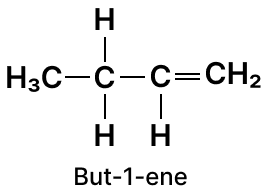
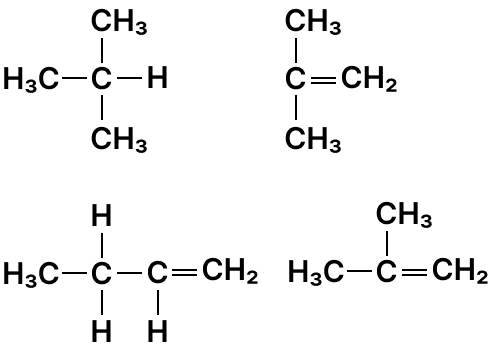
The structures of four hydrocarbons are shown below:

The structures of four hydrocarbons are shown below: ICSE 2025 Chemistry Solved Question Paper.

How many isomers of butene are there?

Show SolutionHide Solution↓

2

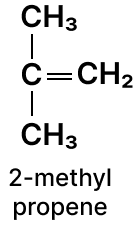
Reason — 2-methyl propene and But-1-ene are two isomers of butene present in the four hydrocarbons shown above.

The structures of four hydrocarbons are shown below: ICSE 2025 Chemistry Solved Question Paper. The structures of four hydrocarbons are shown below: ICSE 2025 Chemistry Solved Question Paper.
1(vii)1 Mark · 2025 · Section A · 2025 SpecimenFull page

Element 'P' has electronic configuration 2,8,8,1. The number of chlorine atoms present in the chloride of 'P' is:

Show SolutionHide Solution↓

1

Reason — P has 1 electron in its outermost shell. Since each chlorine atom can accept one electron, the chloride of P will have one chlorine atom for one electron lost by P. Therefore, the number of chlorine atoms in the chloride of 'P' will be 1.

1(viii)1 Mark · 2025 · Section A · 2025 SpecimenFull page

1H2 is an isotope of hydrogen. In the modern Periodic Table it will:

Show SolutionHide Solution↓

be placed at the same position as hydrogen

Reason — The position of an element in the Periodic Table is determined by its atomic number. Therefore, isotopes of an element are not listed separately; instead, they are all represented under the same element symbol.

1(ix)1 Mark · 2025 · Section A · 2025 SpecimenFull page

A nitrate which forms a precipitate with ammonium hydroxide and is also soluble in excess of it:

Show SolutionHide Solution↓

copper nitrate

Reason — When copper nitrate reacts with ammonium hydroxide NH4OH, it initially forms a light blue precipitate of copper(II) hydroxide (Cu(OH)2).
This precipitate is soluble in excess ammonium hydroxide due to the formation of a deep blue complex, tetraamminecopper(II) ([Cu(NH3)4]2+), making it soluble.

1(x)1 Mark · 2025 · Section A · 2025 SpecimenFull page

Which of the following electronic configuration represents the most electropositive element?

Show SolutionHide Solution↓

2, 8, 1

Reason — Electropositivity increases while traversing down a group and decreases from left to right in period. 2, 1 and 2, 2 belong to period 2 as they have 2 shells whereas 2, 8, 1 and 2, 8, 2 belong to period 3. Between 2, 8, 1 and 2, 8, 2, element with electronic configuration 2, 8, 1 will be more electropositive as it lies to the left of 2, 8, 2 in period 3.

1(xi)1 Mark · 2025 · Section A · 2025 SpecimenFull page

Assertion (A): Alkali metals do not form dipositive ions.

Reason (R): After loss of one electron alkali metals achieve stable electronic configuration of noble gases.

Show SolutionHide Solution↓

Both A and R are true and R is the correct explanation of A

Reason — Alkali metals (such as lithium, sodium, and potassium) do not form dipositive ions. Instead, they form monovalent cations by losing one electron. This is because they have a single electron in their outermost shell, and losing this one electron achieves the stable noble gas configuration.

1(xii)1 Mark · 2025 · Section A · 2025 SpecimenFull page

The ratio between the volumes occupied by 4.4 grams of carbon dioxide and 2 grams of hydrogen gas is:

Show SolutionHide Solution↓

1 : 10

Reason —

Molar mass of CO2 = 12 + 2 x 16 = 44 g/mole

∴ Moles of 4.4g CO2 = 0.1

Molar mass of H2 = 2 x 1 = 2 g/mole

∴ Moles of 2g H2 = 1

Under the same conditions of temperature and pressure, the volume of a gas is directly proportional to the number of moles. Therefore, the volume ratio will be the same as the mole ratio.

Volume ratio = $\frac{\text{Vol. of CO}_2}{\text{Vol. of H}_2}$ = $\frac{0.1}{1}$ = 1 : 10

1(xiii)1 Mark · 2025 · Section A · 2025 SpecimenFull page

Aqueous lead (II) nitrate can be distinguished from aqueous zinc nitrate by adding any of the following solution in excess, except:

Show SolutionHide Solution↓

sodium hydroxide solution

Reason — Let's analyze each option:

  1. Aqueous potassium chloride: This will precipitate lead(II) chloride (PbCl₂) from lead (II) nitrate, whereas zinc chloride is soluble. Thus, this can distinguish between them, as lead will form a precipitate while zinc will not.

  2. Aqueous sodium sulphate: This will precipitate lead (II) sulphate (PbSO₄) from lead (II) nitrate since PbSO₄ is poorly soluble, while zinc sulphate is soluble. Thus, this can also distinguish between them.

  3. Dilute sulphuric acid: Similar to aqueous sodium sulphate, adding dilute H₂SO₄ will precipitate lead (II) sulphate from lead (II) nitrate but not zinc sulphate from zinc nitrate. So, this can distinguish between them.

  4. Sodium hydroxide solution: When added to both solutions in excess, this will not distinguish them because both lead (II) hydroxide and zinc hydroxide will initially precipitate but then both dissolve upon further addition of NaOH. Lead hydroxide forms a plumbate ion, and zinc hydroxide forms a zincate ion, both of which are soluble.

1(xiv)1 Mark · 2025 · Section A · 2025 SpecimenFull page

Which of the following about oxides is correct?

Show SolutionHide Solution↓

Amphoteric oxides contain a metal

Reason — Let's analyze each option:

  1. A basic oxide is an oxide of a non-metal: This is incorrect. Basic oxides are typically oxides of metals. For example, calcium oxide (CaO) and magnesium oxide (MgO) are basic oxides, and both contain metals.

  2. Acidic oxides contain ionic bonds: This is incorrect. Acidic oxides are usually covalent compounds. They are generally formed by non-metals, such as sulphur dioxide (SO₂) and carbon dioxide (CO₂), and tend to form acids when dissolved in water.

  3. Amphoteric oxides contain a metal: This is correct. Amphoteric oxides, such as aluminum oxide (Al₂O₃) and zinc oxide (ZnO), contain metals and can react both as acids and bases.

  4. Basic oxides are always gases: This is incorrect. Basic oxides are typically solid at room temperature. For example, calcium oxide (CaO) and magnesium oxide (MgO) are solid basic oxides.

1(xv)1 Mark · 2025 · Section A · 2025 SpecimenFull page

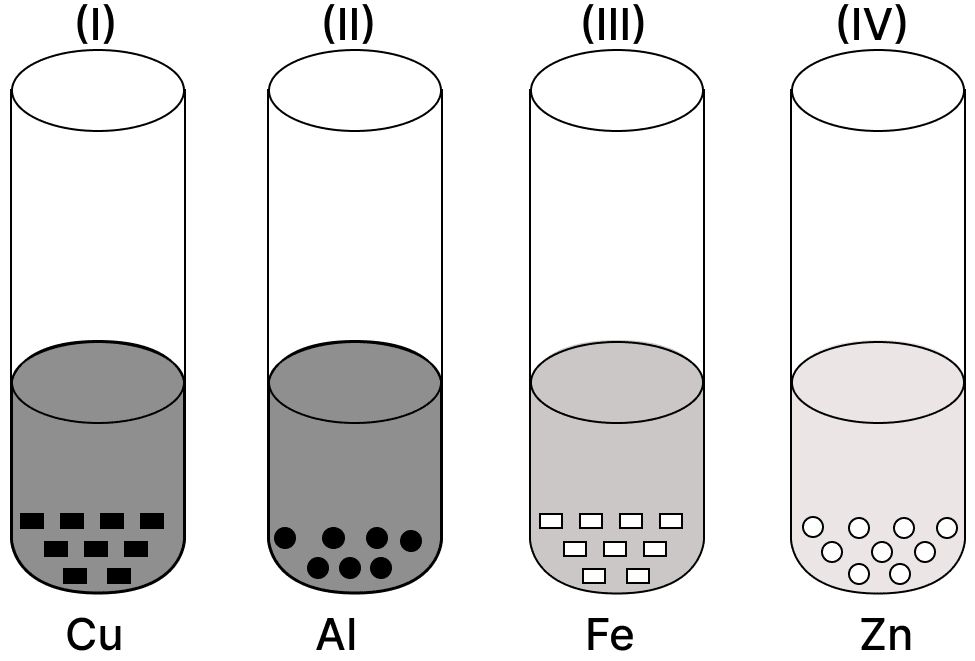
A student takes Cu, Al, Fe and Zn strips, separately in four test tubes labeled as I, II, III and IV respectively. He adds 10 ml of freshly prepared ferrous sulphate solution to each test tube and observes the colour of the metal residue in each case.

A student takes Cu, Al, Fe and Zn strips, separately in four test tubes labeled as I, II, III and IV respectively. He adds 10 ml of freshly prepared ferrous sulphate solution to each test tube and observes the colour of the metal residue in each case. ICSE 2025 Specimen Chemistry Solved Question Paper.

He would observe a black residue in the test tubes:

Show SolutionHide Solution↓

(II) and (IV)

Reason — Metals more reactive than iron (Al and Zn) displace Fe from FeSO4, depositing black iron residue, while Cu and Fe do not react.

2(ii)1 Mark · 2025 · Section A · 2025 SpecimenFull page

Match the following Column A with Column B.

Column AColumn B
AluminiumCovalent compound
Sulphuric acidCarbonate ore
CalcinationHall Heroult’s process
Calcium ChlorideContact Process
Carbon tetrachlorideElectrovalent compound
Show SolutionHide Solution↓

The matched columns are shown below:

Column AColumn B
AluminiumHall Heroult’s process
Sulphuric acidContact Process
CalcinationCarbonate ore
Calcium ChlorideElectrovalent compound
Carbon tetrachlorideCovalent compound
2(iii)1 Mark · 2025 · Section A · 2025 SpecimenFull page

Complete the following by choosing the correct answers from the bracket:

(a) If an element has one electron in the outermost shell, then it is likely to have the ............... [smallest/largest] atomic size amongst all the elements in the same period.

(b) ............... [sulphuric acid/hydrochloric acid] does not form an acid salt.

(c) A ............... [reddish brown/dirty green] coloured precipitate is formed when ammonium hydroxide is added to a solution of ferrous chloride.

(d) Alkynes undergo ............... [addition/substitution] reactions.

(e) An ............... [alkaline/acidic] solution will turn methyl orange solution pink or red.

Show SolutionHide Solution↓

(a) If an element has one electron in the outermost shell, then it is likely to have the largest atomic size amongst all the elements in the same period.

(b) Hydrochloric acid does not form an acid salt.

(c) A dirty green coloured precipitate is formed when ammonium hydroxide is added to a solution of ferrous chloride.

(d) Alkynes undergo addition reactions.

(e) An acidic solution will turn methyl orange solution pink or red.

2(iv)1 Mark · 2025 · Section A · 2025 Specimen · 🔁 also 2024Full page

Identify the following:

(a) A bond formed between two atoms by sharing of a pair of electrons, with both electrons being provided by the same atom.

(b) A salt formed by the complete neutralization of an acid by a base.

(c) A reaction in which the hydrogen of an alkane is replaced by a halogen.

(d) The energy required to remove an electron from a neutral gaseous atom.

(e) A homogenous mixture of two or more metals or a metal and a non-metal in a definite proportion in their molten state.

Show SolutionHide Solution↓

(a) Coordinate bond

(b) Normal salt

(c) Substitution

(d) Ionization potential

(e) Alloy

2(v)1 Mark · 2025 · Section A · 2025 Specimen · 🔁 also 2024Full page

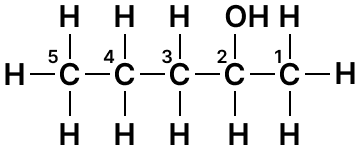
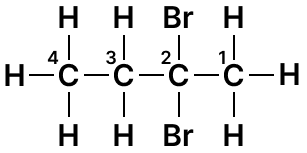
(a) Draw the structural diagram for the following compounds:

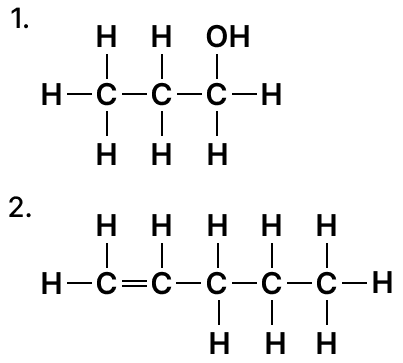
(b) Give the IUPAC name of the following organic compounds:

Draw the structural diagram for the following compounds: ICSE 2025 Chemistry Solved Question Paper.
Show SolutionHide Solution↓

(a) Structural Diagram:

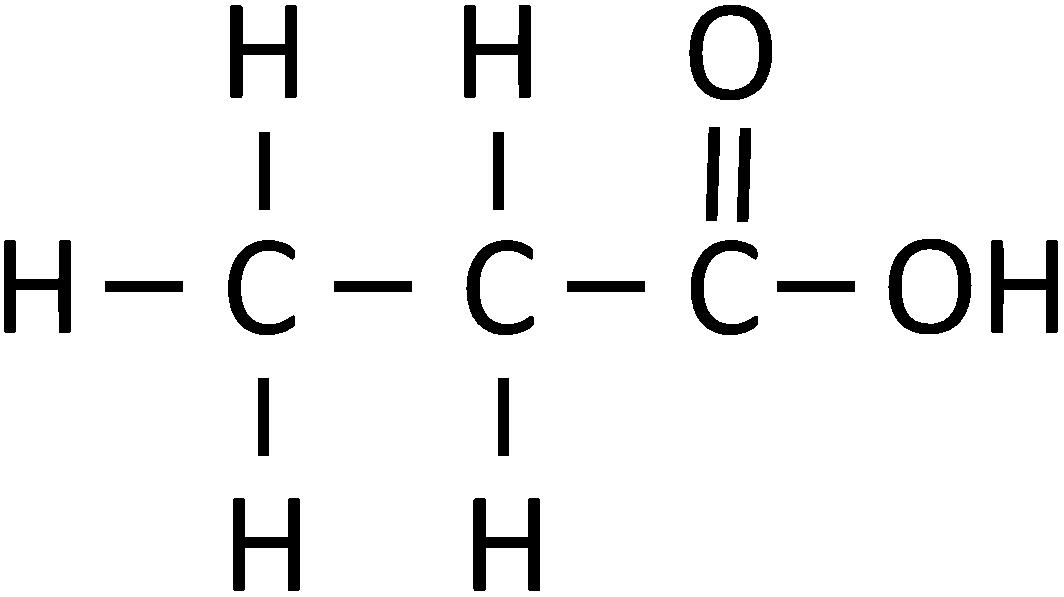
1. Propanoic acid :

Draw the structural formula for Propanoic acid. ICSE 2025 Specimen Chemistry Solved Question Paper.

2. Pentan-2-ol

Draw the structural diagram for the following compounds: ICSE 2025 Chemistry Solved Question Paper.

3. 2,2 dibromo butane

Draw the structural diagram for the following compounds: ICSE 2025 Chemistry Solved Question Paper.

(b) IUPAC names are:

  1. 1-propanol

  2. pent-1-ene

3(i)Written · 2025 · Section B · 2025 Specimen · 🔁 also 2024Full page

Identify the reactant and write the balanced equation for the following:

Nitric acid reacts with compound Q to give a salt Ca(NO3)2, water and carbon dioxide.

Show SolutionHide Solution↓

The compound 'Q' in this reaction is calcium carbonate or calcium bicarbonate.

When nitric acid reacts with calcium carbonate, it produces calcium nitrate, water and carbon dioxide.

CaCO3 + 2HNO3 ⟶ Ca(NO3)2 + H2O + CO2

OR

Ca(HCO3)2 + 2HNO3 ⟶ Ca(NO3)2 + 2H2O + CO2

3(ii)Written · 2025 · Section B · 2025 SpecimenFull page

What property of Sulphuric acid is exhibited in each of the following cases:

(a) In the preparation of HCl gas when it reacts with Sodium chloride.

(b) When concentrated Sulphuric acid reacts with Copper to produce Sulphur dioxide gas.

Show SolutionHide Solution↓

(a) Non-volatile nature
Reason — Concentrated sulphuric acid has a high boiling point (338°C) and so it is considered to be a non-volatile acid. It is, therefore, used for preparing volatile acids like HCl.

(b) Oxidising property
Reason — The oxidising property of concentrated sulphuric acid is due to the fact that on thermal decomposition, it yields nascent oxygen which oxidises metals.

3(iii)Written · 2025 · Section B · 2025 Specimen · 🔁 also 2024 & 2026Full page

The electron affinity of an element X is greater than that of element Y.

(a) How is the oxidising power of X likely to compare with that of Y?

(b) How is the electronegativity of X likely to compare with that of Y?

(c) State whether X is likely to be placed to the left or to the right of Y in the periodic table?

Show SolutionHide Solution↓

(a) X has more oxidising power compared to Y.
Reason — Oxidising Power refers to an element's ability to gain electrons and thus oxidize other substances. Given that element X has a greater electron affinity than element Y, X is more eager to accept electrons. This suggests that X has a stronger tendency to act as an oxidizing agent compared to Y.

(b) X will be more electronegative than Y.
Reason — A higher electron affinity correlates with higher electronegativity because both properties reflect an element's tendency to attract electrons. Since X has a greater electron affinity than Y, X is likely to have a higher electronegativity compared to Y.

(c) X will be placed to the right of Y.
Reason — Elements with higher electron affinities are generally found in the upper right part of the periodic table. Thus, if X has a greater electron affinity than Y, X is likely to be positioned further to the right compared to Y in the periodic table.

3(iv)Written · 2025 · Section B · 2025 SpecimenFull page

You are provided with the list of chemicals mentioned below in the box:

Sodium hydroxide solution, copper carbonate, zinc, hydrochloric acid, copper, dilute sulphuric acid, chlorine, iron

Using suitable chemicals from the list given, write balanced chemical equation for the preparation of the salts mentioned below:

(a) copper sulphate

(b) sodium zincate

(c) ferric chloride

Show SolutionHide Solution↓

(a) CuCO3 + H2SO4 ⟶ CuSO4 + H2O + CO2

(b) Zn + 2NaOH ⟶ Na2ZnO2 + H2

(c) 2Fe + 3Cl2 ⟶ 2FeCl3

4(i)Written · 2025 · Section B · 2025 SpecimenFull page

The following questions relate to the extraction of Aluminium by electrolysis.

(a) Name the other aluminium containing compound added to alumina.

(b) Give a balanced equation for the reaction that takes place at the cathode.

Show SolutionHide Solution↓

(a) Cryolite.

(b) Al3+ + 3e- ⟶ Al

4(ii)Written · 2025 · Section B · 2025 SpecimenFull page

Pratik heated 11.2 grams of element ‘M’ (atomic weight 56) with 4.8 grams of element ‘N’ (atomic weight 16) to form a compound. Find the empirical formula of the compound obtained by Pratik.

Show SolutionHide Solution↓

Gram atom = $\frac{\text{Mass of element}}{\text{Atomic mass}}$

∴ g atom of M = $\frac{11.2}{56}$ = 0.2

and, g atom of N = $\frac{4.8}{16}$ = 0.3

simple ratio of gram-atoms of M to gram-atoms of N

= $\frac{0.2}{0.3}$ = $\frac{2}{3}$ = M : N

So, the formula is M2N3

4(iii)Written · 2025 · Section B · 2025 Specimen · 🔁 also 2026Full page

Give balanced equations for each of the following:

(a) Action of warm water on Aluminium nitride.

(b) Oxidation of carbon with conc. Nitric acid.

(c) Laboratory preparation of ethanol by using chloroethane and aqueous sodium hydroxide.

Show SolutionHide Solution↓

(a) AlN + 3H2O ⟶ Al(OH)3 + NH3

(b) C + 4HNO3 ⟶ CO2 + 2H2O + 4NO2

(c) C2H5Cl + aq. NaOH ⟶ C2H5OH + NaCl

4(iv)Written · 2025 · Section B · 2025 SpecimenFull page

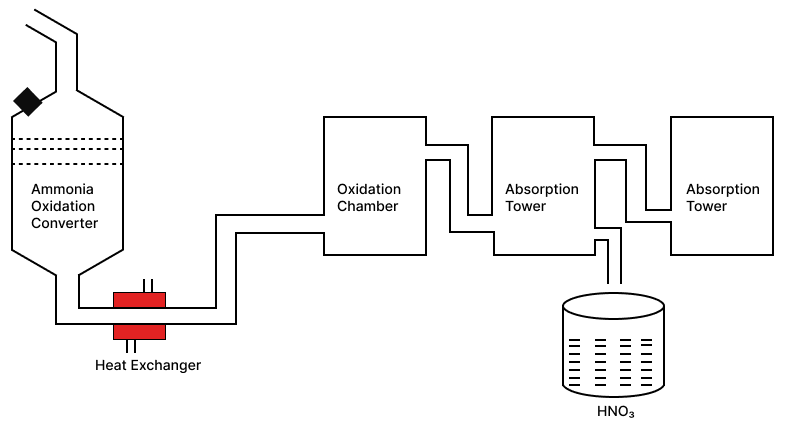
The diagram given below is a representation of the Industrial preparation of Nitric acid by Ostwald’s process. With respect to the process answer the following questions:

The diagram given below is a representation of the Industrial preparation of Nitric acid by Ostwald’s process. With respect to the process answer the following questions: ICSE 2025 Chemistry Solved Question Paper.

(a) Write the temperature and the catalyst required during the catalytic oxidation of ammonia.

(b) Give balanced chemical equation for the reaction occurring during the conversion of nitrogen dioxide to nitric acid.

Show SolutionHide Solution↓

(a) 800°C, Platinum

(b) 4NO2 + 2H2O + O2 ⟶ 4HNO2

5(i)Written · 2025 · Section B · 2025 Specimen · 🔁 also 2024Full page

(a) Ranjana wants to prove that ammonia is a reducing agent. To demonstrate this, she passes ammonia gas over heated copper oxide. What will she observe?

(b) Write a balanced chemical equation for the above reaction.

Show SolutionHide Solution↓

(a) The black copper oxide (CuO) will change to reddish-brown copper metal (Cu).
Reason — On passing ammonia gas over heated copper oxide, Ammonia acts as a reducing agent and reduces copper oxide (CuO) to copper metal (Cu). During this process, ammonia is oxidized to nitrogen gas and water.

(b) 3CuO + 2NH3 ⟶ 3Cu + 3H2O +N2↑

5(ii)Written · 2025 · Section B · 2025 Specimen · 🔁 also 2024Full page

Name the alloy which is made up of:

(a) Copper, Zinc and Tin

(b) Lead and Tin

Show SolutionHide Solution↓

(a) Bronze

(b) Solder

5(iii)Written · 2025 · Section B · 2025 SpecimenFull page

Abhishek was given a salt 'X' which was white in colour for analysis. On strong heating it produced a yellow residue, a colourless gas and also a reddish-brown gas. The solution of the salt ‘X’ when tested with excess of ammonium hydroxide produced a chalky white insoluble precipitate.

(a) Name the coloured gas evolved when Abhishek heated the salt strongly.

(b) Which cation was present in the sample given to Abhishek?

(c) Identify the salt given to Abhishek for analysis.

Show SolutionHide Solution↓

(a) Nitrogen dioxide
Reason — The reddish-brown colour indicates that the gas is Nitrogen dioxide.

(b) Pb2+ (Lead)
Reason — The chalky white insoluble precipitate with excess of ammonium hydroxide indicates that the cation present is Pb2+.

(c) Lead nitrate [Pb(NO3)2].
Reason — The given salt is a nitrate salt as nitrogen dioxide (NO₂), is a common product obtained from heating nitrates. As the cation is lead, hence the salt is Lead nitrate.

5(iv)Written · 2025 · Section B · 2025 SpecimenFull page

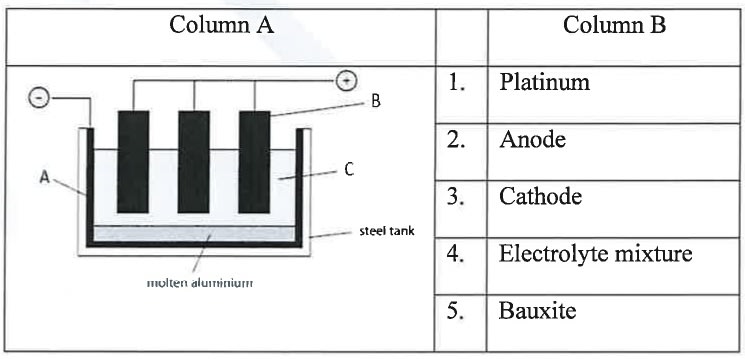
Given below in column A is a schematic diagram of the electrolytic reduction of alumina. Identify the parts labelled as A, B and C with the correct options from the Column B.

Given below in column A is a schematic diagram of the electrolytic reduction of alumina. Identify the parts labelled as A, B and C with the correct options from the Column B. ICSE 2025 Chemistry Solved Question Paper.
Show SolutionHide Solution↓

A → Cathode
B → Anode
C → Electrolytic mixture

6(i)Written · 2025 · Section B · 2025 SpecimenFull page

Element 'X' forms an oxide with the formula X2O3 which is a solid with high melting point. 'X' would most likely be placed in the group of the Periodic Table as:

Show SolutionHide Solution↓
  1. (c) Al

  2. The formula X2O3 indicates that the element 'X' forms a trivalent oxide. Thus, 'X' has a valency of 3 like that of Al (Valency of Na, Mg and Si are 1, 2 and 4, respectively). In Group 13, the elements typically form oxides with the general formula X2O3, where 'X' represents the element. The oxides of Group 13 elements, such as Al2O3 (aluminum oxide), have high melting points due to the strong ionic bonds between the metal cations and the oxide anions.

6(ii)Written · 2025 · Section B · 2025 Specimen · 🔁 also 2026Full page

A student was asked to perform two experiments in the laboratory based on the instructions given:

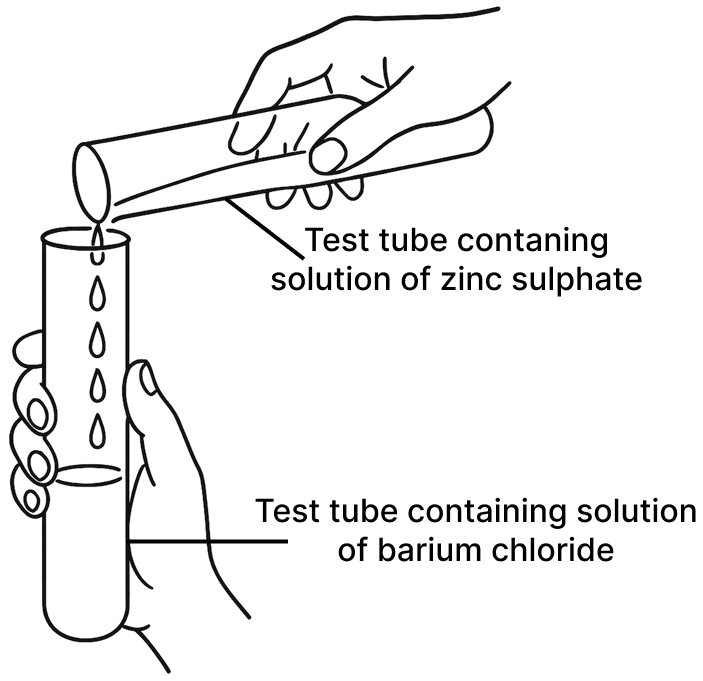
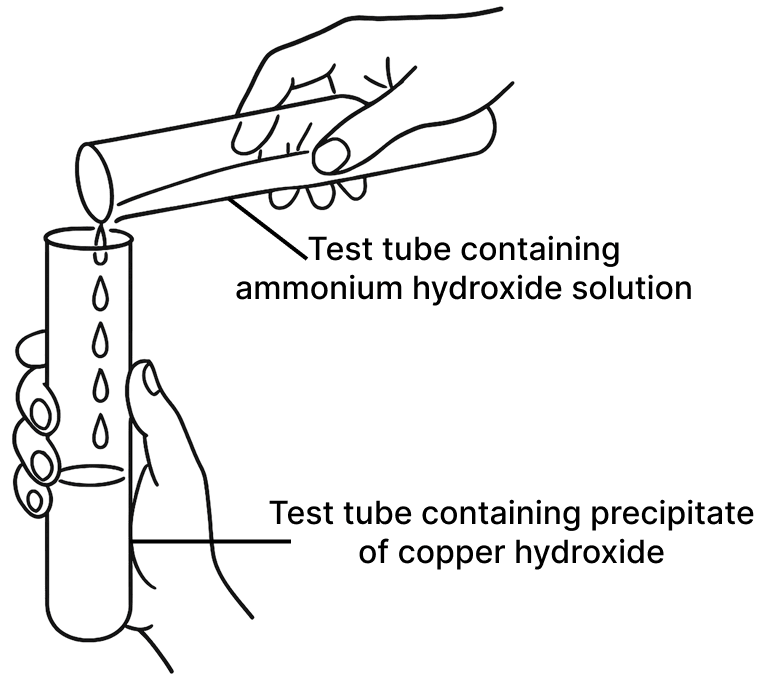
Observe the picture given below and state one observation for each of the Experiments 1 and 2 that you would notice on mixing the given solutions.

(a) Experiment 1

A student was asked to perform two experiments in the laboratory based on the instructions given: Observe the picture given below and state one observation for each of the Experiments 1 and 2 that you would notice on mixing the given solutions. ICSE 2026 Specimen Chemistry Solved Question Paper.

(b) Experiment 2

A student was asked to perform two experiments in the laboratory based on the instructions given: Observe the picture given below and state one observation for each of the Experiments 1 and 2 that you would notice on mixing the given solutions. ICSE 2026 Specimen Chemistry Solved Question Paper.
Show SolutionHide Solution↓

(a) White precipitate of barium sulphate is formed.
Reason — When a solution of zinc sulphate is added to a solution of barium chloride, a double displacement reaction occurs. This reaction involves the exchange of ions between the two compounds and a white precipitate of barium sulphate is formed.
ZnSO4 (aq) + BaCl2 (aq) ⟶ BaSO4 (s) + ZnCl2 (aq).

(b) Blue precipitate dissolves to form an inky blue/deep blue solution.
Reason — The light blue precipitate of copper(II) hydroxide (Cu(OH)2) dissolves in excess of ammonium hydroxide due to the formation of a deep blue complex, tetraamminecopper(II) ([Cu(NH3)4]2+), making it soluble.

6(iii)Written · 2025 · Section B · 2025 Specimen · 🔁 also 2024Full page

Copper sulphate solution is electrolysed using copper electrodes.

(a) Which electrode [cathode or anode] is the oxidizing electrode? Why?

(b) Write the equation for the reaction occurring at the above electrode.

Show SolutionHide Solution↓

(a) In the electrolysis of copper sulphate solution using copper electrodes the anode is the oxidizing electrode. Copper atoms lose electrons at the anode and go into the solution as copper ions. Thus, the anode causes oxidation, making it the oxidizing electrode.

(b) Cu ⟶ Cu+2 + 2e-

6(iv)Written · 2025 · Section B · 2025 Specimen · 🔁 also 2024Full page

X [2, 8, 7] and Y [2, 8, 2] are two elements. Using this information complete the following:

(a) ............... is the metallic element.

(b) Metal atoms tend to have a maximum of ............... electrons in the outermost shell.

(c) ............... is the reducing agent.

Show SolutionHide Solution↓

(a) Y is the metallic element.

(b) Metal atoms tend to have a maximum of 3 electrons in the outermost shell.

(c) Y is the reducing agent.

Reason

(a) As Y has two valence electrons, hence it is a metallic element.

(b) Metal atoms tend to have a maximum of 3 electrons in the outermost shell.

(c) The reducing agent is Y because it can easily lose its two valence electrons to form a stable ion, thus reducing other substances by donating electrons.

7(i)Written · 2025 · Section B · 2025 SpecimenFull page

One variety of household fuel is a mixture of propane (60%) and butane (40%). If 20 litres of this mixture is burnt, find the total volume of carbon dioxide added to the atmosphere. The combination reactions can be represented as:

C3H8 + 5O2 ⟶ 3CO2 + 4H2O

2C4H10 + 13O2 ⟶ 8CO2 + 10H2O

Show SolutionHide Solution↓

Given, 20 litres of this mixture contains 60% propane and 40% butane. Hence, propane is 12 litres and butane is 8 litres

$$\begin{matrix} \text{C}_3\text{H}_8 & + & 5\text{O}_2 & \longrightarrow & 3\text{CO}_2 & + & 4\text{H}_2\text{O} \\ 1 \text{ vol.} & : & 5 \text{ vol.} & \longrightarrow & 3\text{ vol.} \\ 2\text{C}_4\text{H}_{10} & + & 13\text{O}_2 & \longrightarrow & 8\text{CO}_2 & + & 10\text{H}_2\text{O} \\ 2 \text{ vol.} & : & 13 \text{ vol.} & \longrightarrow & 8\text{ vol.} \\ \end{matrix}$$

1 Vol. C3H8 produces carbon dioxide = 3 Vol

So, 12 litres C3H8 will produce carbon dioxide = 3 x 12 = 36 litres

2 Vol. C4H10 produces carbon dioxide = 8 Vol

So, 8 litres C4H10 will produce carbon dioxide = $\frac{8}{2}$ x 8 = 32 litres

Hence, 68 (i.e., 36 + 32) litres of CO2 is produced.

7(ii)Written · 2025 · Section B · 2025 Specimen · 🔁 also 2026Full page

Rohit has solution X, Y and Z that has pH 2, 7 and 13 respectively.
Which solution:

(a) will liberate sulphur dioxide gas when heated with sodium sulphite

(b) will liberate ammonia gas when reacted with ammonium chloride

(c) will not have any effect on litmus paper?

Show SolutionHide Solution↓

(a) X
Reason — Sodium sulphite can react with acids to liberate sulphur dioxide gas. So, the solution X with pH 2 (acidic) will react with sodium sulphite to liberate sulphur dioxide gas.
Na2SO3 + 2H- ⟶ SO2 + H2O + 2Na+

(b) Z
Reason — Ammonium chloride is a salt that, in the presence of a base, will release ammonia gas. Therefore, a basic solution (with a high pH) will react with ammonium chloride to liberate ammonia gas. Thus, the solution Z with pH 13 (basic) will liberate ammonia gas when reacted with ammonium chloride.
NH4Cl + OH- ⟶ NH3 + H2O + Cl-

(c) Y
Reason — The solution Y with pH 7 will not have any effect on litmus paper as it is neither acidic nor basic.

7(iii)Written · 2025 · Section B · 2025 Specimen · 🔁 also 2024Full page

8.2 grams of calcium nitrate is decomposed by heating according to the equation

2Ca (NO3)2 ⟶ 2CaO +4NO2 + O2

Calculate the following:

(a) Volume of nitrogen dioxide obtained at STP

(b) Mass of CaO formed

(Atomic weights : Ca- 40, N-14, O-16)

Show SolutionHide Solution↓

$$\begin{matrix} \text{2Ca}(\text{NO}_3)_2 & \longrightarrow & 2\text{CaO}& +&4\text{NO}_2 & +& \text{O}_2 \\ 2[(40) + 2(14) +6(16)] & & 2(40 + 16) & & 4(14)+8(16) & & 1 \text{mole} \\ = 328 \text{g} & & = 112\text{g} & & =184 & & =32 \text{g} \\ \end{matrix}$$

(a) 328 g of calcium nitrate liberated 4 x 22.4 lit of NO2

∴ 8.2 g of calcium nitrate liberated 4 x 22.4 x $\frac{8.2}{328}$ = 2.24 lit of NO2

(b) 328 g of calcium nitrate produces 2 x 56 g of CaO

∴ 8.2 g of calcium nitrate will produce 2 x 56 x $\frac{8.2}{328}$ = 2.8 g of CaO.

8(i)Written · 2025 · Section B · 2025 Specimen · 🔁 also 2024Full page

State giving reasons if:

(a) zinc and aluminium can be distinguished by heating the metal powder with concentrated sodium hydroxide solution.

(b) calcium nitrate and lead nitrate can be distinguished by adding ammonium hydroxide solution to the salt solution.

Show SolutionHide Solution↓

(a) No, zinc and aluminium cannot be distinguished by heating the metal powder with concentrated sodium hydroxide solution because both will form a white precipitate which is soluble in excess of sodium hydroxide.

(b) Yes, calcium nitrate and lead nitrate can be distinguished by adding ammonium hydroxide solution to the salt solution because white precipitate will be formed with lead nitrate but no precipitate is formed with calcium nitrate.

8(ii)Written · 2025 · Section B · 2025 SpecimenFull page

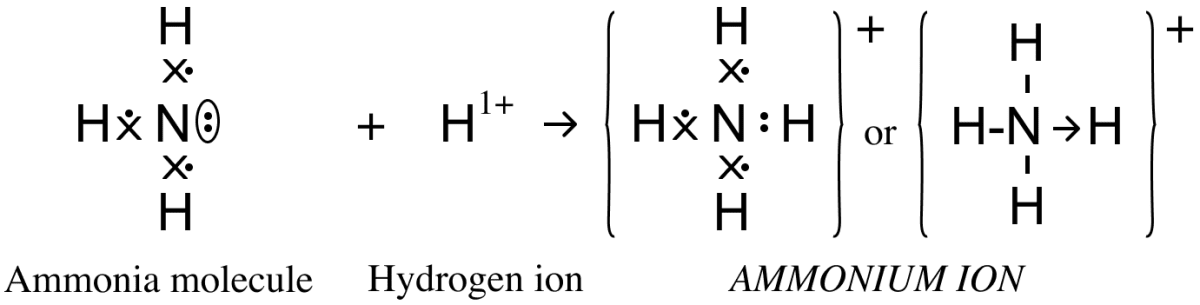
Draw the electron dot diagram of ammonium ion.

Show SolutionHide Solution↓

Electron dot diagram of ammonium ion is shown below:

Draw the electron dot structure of ammonium ion. ICSE 2025 Specimen Chemistry Solved Question Paper
8(iii)Written · 2025 · Section B · 2025 Specimen · 🔁 also 2024 & 2026Full page

Give balanced equations for the following:

(a) Laboratory preparation of ethyne from calcium carbide.

(b) Conversion of acetic acid to ethyl acetate.

(c) Laboratory preparation of nitric acid.

Show SolutionHide Solution↓

(a) CaC2 + 2H2O ⟶ Ca(OH)2 + C2H2

(b) CH3COOH + C2H5OH ⟶ CH3COOC2H5 + H2O

(C) NaNO3 + conc. H2SO4 ⟶ NaHSO4 + 2HNO3

8(iv)Written · 2025 · Section B · 2025 SpecimenFull page

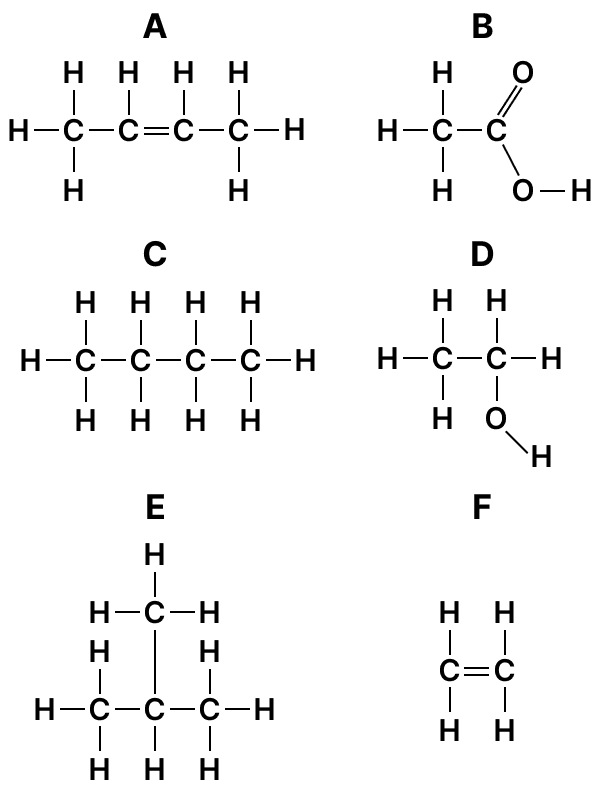
The structures of six organic compounds are shown:

The structures of six organic compounds are shown: ICSE 2025 Chemistry Solved Question Paper.

(a) Identify two of the compounds that are members of the same homologous series but are not isomers.

(b) Which two compounds are isomers of each other?

(c) F can be prepared from D. Give a chemical equation for the reaction.

Show SolutionHide Solution↓

(a) A and F

(b) C and E

(c) C2H5OH $\xrightarrow[170^{\circ}\text{C}]{\text{Conc. H}_2\text{SO}_4}$ C2H4 ↑ + H2O

Reason

(a) Butene (C4H8) and Ethene (C2H4) are members of homologous series of alkenes and are not isomers.

(b) Both C and E have the same molecular formula (C4H10) but different structure. C is n-butane and E is iso-butane.

(c) Ethene (C2H4) can be prepared by the dehydration of ethyl alcohol (C2H5OH).

Press ↓ to reveal a solution and move to the next question. Browse the free sample bank.

All 611 Chemistry questions