Question Paper2018

ICSE Class 10 Chemistry — 2018 Paper

32 solved questions from Solved 2018 Question Paper ICSE Class 10 Chemistry. Every answer follows the ICSE marking scheme.

Section
Insight
1(a-i)Written · 2018 · Section I · 2018 PaperFull page

The salt solution which does not react with ammonium hydroxide is:

Show SolutionHide Solution↓

Calcium Nitrate

Reason — No ppt. occurs even with addition of excess of ammonium hydroxide as the concentration of OH- ions from the ionization of of NH4OH is so low that it cannot precipitate the hydroxide of calcium.

1(a-ii)Written · 2018 · Section I · 2018 Paper · 🔁 also 2026Full page

The organic compound which undergoes substitution reaction is:

Show SolutionHide Solution↓

C2H6

Reason — C2H6 will undergo substitution reaction as it is a saturated hydrocarbon and substitution reaction is a characteristic of saturated hydrocarbons.

1(a-iii)Written · 2018 · Section I · 2018 PaperFull page

The electrolysis of acidified water is an example of:

Show SolutionHide Solution↓

Redox reaction

Reason — At cathode, H+ ions gain electron and become neutral hydrogen atoms. Therefore, reduction takes place at cathode.
At anode, OH- ions lose electron and becomes neutral OH atoms. Therefore, oxidation takes place at anode.
Hence, electrolysis of acidified water is an example of redox reaction.

1(a-iv)Written · 2018 · Section I · 2018 PaperFull page

The IUPAC name of dimethyl ether is:

Show SolutionHide Solution↓

Methoxy methane

Reason — The IUPAC name of dimethyl ether is Methoxy methane.

1(a-v)Written · 2018 · Section I · 2018 PaperFull page

The catalyst used in the Contact Process is:

Show SolutionHide Solution↓

Vanadium pentoxide

Reason — The catalyst used in the Contact Process is Vanadium pentoxide.

1(b)Written · 2018 · Section I · 2018 PaperFull page

Give one word or a phrase for the following statements:

(i) The energy released when an electron is added to a neutral gaseous isolated atom to form a negatively charged ion.

(ii) Process of formation of ions from molecules which are not in ionic state.

(iii) The tendency of an element to form chains of identical atoms.

(iv) The property by which certain hydrated salts, when left exposed to atmosphere, lose their water of crystallization and crumble into powder.

(v) The process by which sulphide ore is concentrated.

Show SolutionHide Solution↓

(i) Electron affinity

(ii) Ionization

(iii) Catenation

(iv) Efflorescence

(v) Froth flotation process

1(c)Written · 2018 · Section I · 2018 PaperFull page

Write a balanced chemical equation for each of the following:

(i) Action of concentrated sulphuric acid on carbon.

(ii) Reaction of sodium hydroxide solution with iron (III) chloride solution.

(iii) Action of heat on aluminum hydroxide.

(iv) Reaction of zinc with potassium hydroxide solution.

(v) Action of dilute hydrochloric acid on magnesium sulphite.

Show SolutionHide Solution↓

(i) C + 2H2SO4 [conc.] ⟶ CO2 + 2H2O + 2SO2

(ii) FeCl3 + 3NaOH ⟶ 3NaCl + Fe(OH)3

(iii) 2Al(OH)3 $\xrightarrow{1100^{\circ}\text{C}}$ Al2O3 + 3H2O

(iv) Zn + 2KOH ⟶ K2ZnO2 + H2

(v) MgSO3 + 2HCl ⟶ MgCl2 + H2O + SO2 [g]

1(d)Written · 2018 · Section I · 2018 PaperFull page

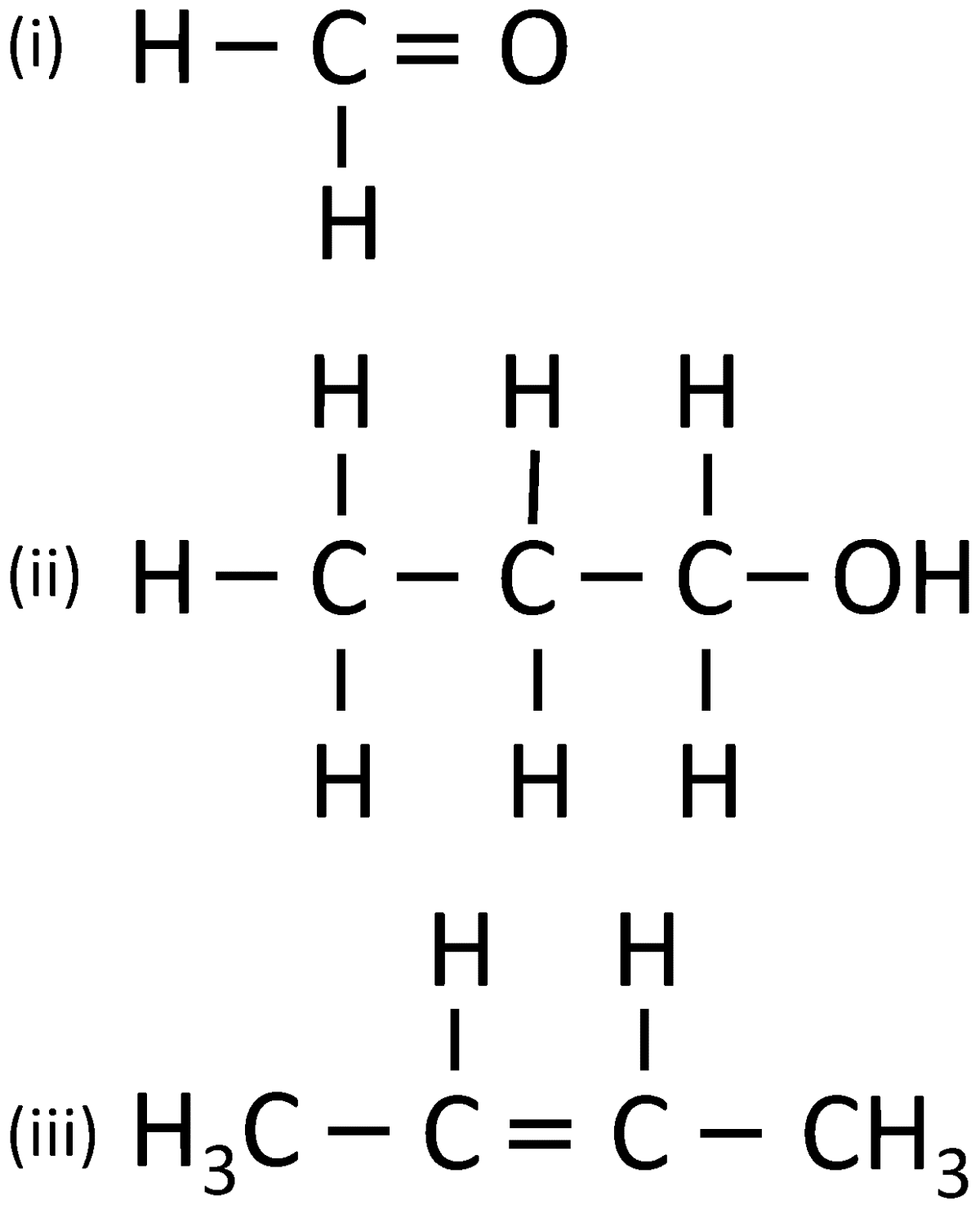
(i) Give the IUPAC name for each of the following:

Give the IUPAC name for. Organic Chemistry, Simplified Chemistry Dalal Solutions ICSE Class 10

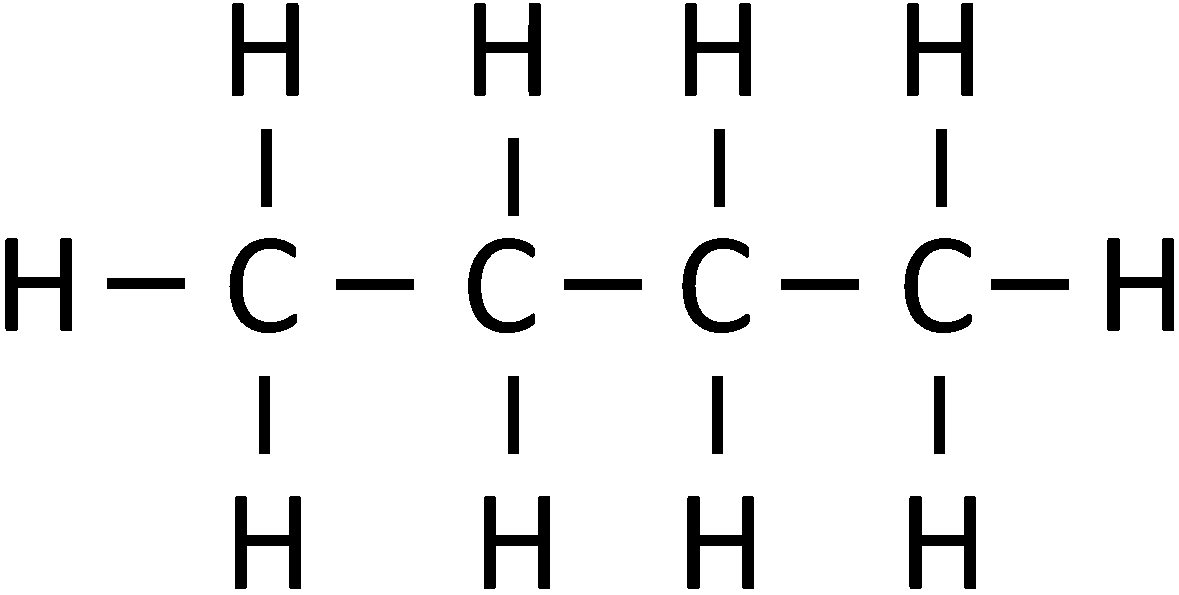
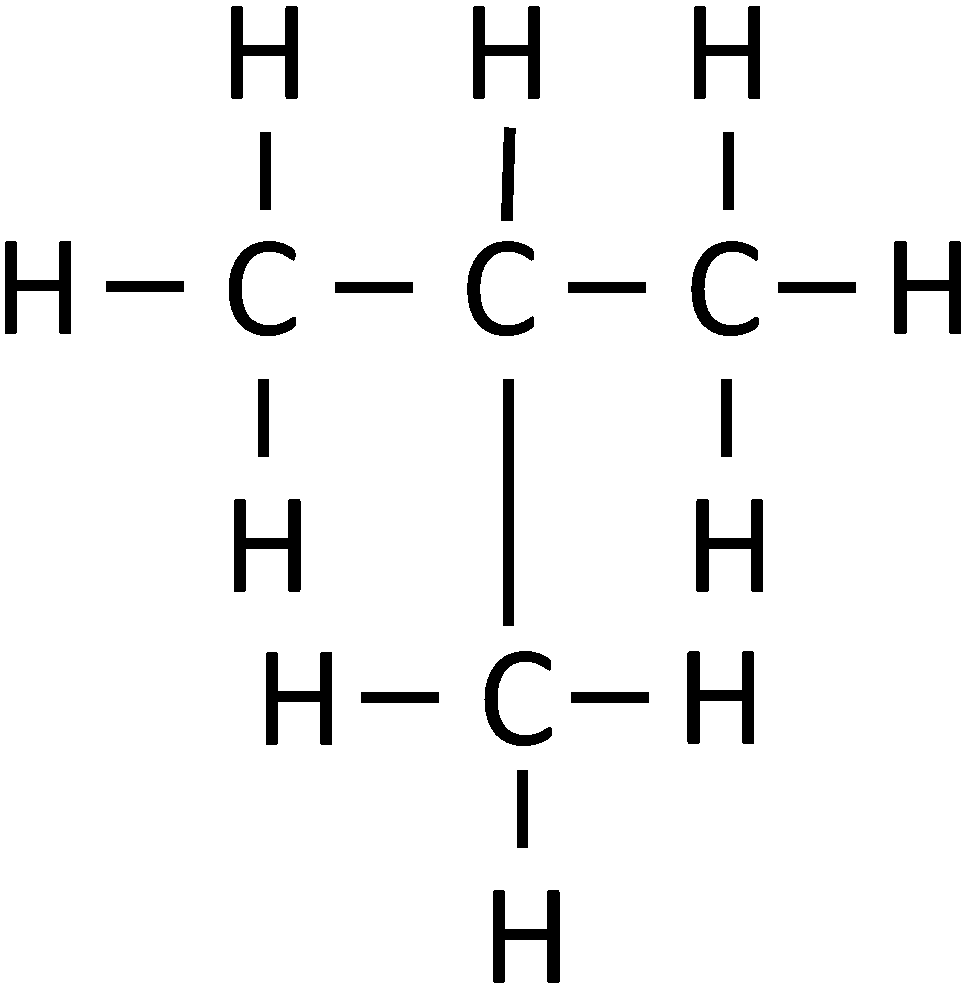
(ii) Write the structural formula of the two isomers of butane.

Show SolutionHide Solution↓
  1. Methanal
  2. 1-Propanol
  3. 2-Butene

(ii) Structural formula of the two isomers of butane are given below:

  1. Butane [n-butane]
Give the structural formulae of n-butane. Organic Chemistry, Simplified Chemistry Dalal Solutions ICSE Class 10
  1. 2-Methyl propane [iso-butane]
Give the structural formulae of 2-methyl propane. Organic Chemistry, Simplified Chemistry Dalal Solutions ICSE Class 10
1(e)Written · 2018 · Section I · 2018 PaperFull page

State one relevant observation for each of the following:

(i) Lead nitrate solution is treated with sodium hydroxide solution drop wise till it is in excess.

(ii) At the anode, when molten lead bromide is electrolyzed using graphite electrodes.

(iii) Lead nitrate solution is mixed with dilute hydrochloric acid and heated.

(iv) Anhydrous calcium chloride is exposed to air for some time.

(v) Barium chloride solution is slowly added to sodium sulphate solution.

Show SolutionHide Solution↓

(i) Chalky white precipitate is formed which is soluble in excess of sodium hydroxide and forms a colourless solution.

(ii) At the anode, brown fumes of bromine vapours are observed.

(iii) White precipitate of PbCl2 is formed which is soluble in hot water.
Pb(NO3)2 + 2HCl ⟶ PbCl2 + 2HNO3

(iv) It absorbs moisture from the atmosphere, dissolve in the same and change into a solution. This property is known as deliquescence

(v) A white ppt. is obtained which is insoluble in dil. HCl or dil. HNO3
Na2SO4 + BaCl2 ⟶ BaSO4 ↓ [white ppt.] + 2NaCl

1(f)Written · 2018 · Section I · 2018 PaperFull page

Give a reason for each of the following:

(i) Ionic compounds have a high melting point.

(ii) Inert gases do not form ions.

(iii) Ionisation potential increases across a period, from left to right.

(iv) Alkali metals are good reducing agents.

(v) Conductivity of dilute hydrochloric acid is greater than that of acetic acid.

Show SolutionHide Solution↓

(i) Ionic compounds have ionic bonds so there exists a strong force of attraction between the oppositely charged ions, so a large amount of energy is required to break the strong bonding between the ions. Hence, ionic compounds have a high melting point.

(ii) Inert gases have completely filled octet which makes them extremely stable. They neither lose, nor gain electrons. Hence, they do not form ions.

(iii) The ionisation potential of an element increases across a period because the atomic size decreases due to an increase in nuclear charge and electrons in the outermost shell are more strongly held because of which greater energy is required to remove the electron.

(iv) Alkali metals have one electron in the outermost shell and hence during reactions they readily give the valence electron and get themselves oxidised. Hence, they are good reducing agents.

(v) Dil. H2SO4 is a strong electrolyte and acetic acid is a weak electrolyte. Therefore, dil. H2SO4 allows large amount of electricity to flow through it and is a good conductor of electricity whereas acetic acid allows small amount of electricity to flow through it and is a poor conductor of electricity. Hence, electrical conductivity of dilute hydrochloric acid is greater than that of acetic acid.

1(g)Written · 2018 · Section I · 2018 PaperFull page

Name the gas that is produced in each of the following cases:

(i) Sulphur is oxidized by concentrated nitric acid.

(ii) Action of dilute hydrochloric acid on sodium sulphide.

(iii) Action of cold and dilute nitric acid on copper.

(iv) At the anode during the electrolysis of acidified water.

(v) Reaction of ethanol and sodium.

Show SolutionHide Solution↓

(i) Nitrogen dioxide gas

(ii) Hydrogen sulphide gas

(iii) Nitric oxide gas

(iv) Oxygen gas

(v) Hydrogen gas

1(h)Written · 2018 · Section I · 2018 PaperFull page

Fill up the blanks with the correct choice given in brackets.

(i) Ionic or electrovalent compounds do not conduct electricity in their ............... state. (fused / solid)

(ii) Electrolysis of aqueous sodium chloride solution will form ............... at the cathode. (hydrogen gas / sodium metal)

(iii) Dry hydrogen chloride gas can be collected by............... displacement of air. (downward / upward)

(iv) The most common ore of iron is ............... (calamine / haematite)

(v) The salt prepared by the method of direct combination is ............... (iron (II) chloride / iron (III) chloride)

Show SolutionHide Solution↓

(i) Ionic or electrovalent compounds do not conduct electricity in their solid state.

(ii) Electrolysis of aqueous sodium chloride solution will form hydrogen gas at the cathode.

(iii) Dry hydrogen chloride gas can be collected by upward displacement of air.

(iv) The most common ore of iron is haematite

(v) The salt prepared by the method of direct combination is iron (III) chloride.

2(a)Written · 2018 · Section II · 2018 PaperFull page

(i) What do you understand by a lone pair of electrons?

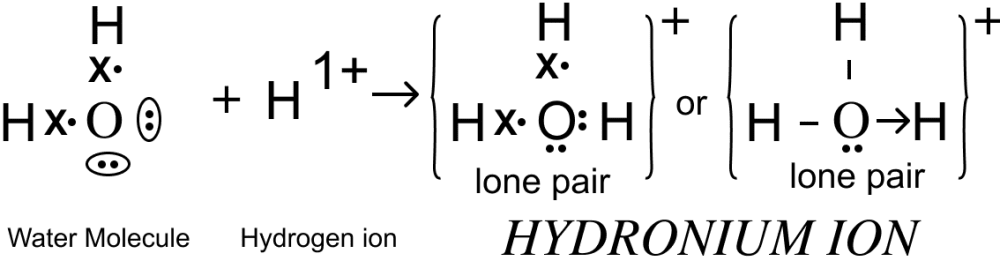
(ii) Draw the electron dot diagram of Hydronium ion. (H=1; O=8)

Show SolutionHide Solution↓

(i) Lone pair of electrons are valence electrons that in a covalent bond are not shared with another atom.

(ii) Electron dot diagram of Hydronium ion is shown below:

Draw an electron dot diagram of the structure of hydronium ion. Chemical Bonding, Simplified Chemistry Dalal Solutions ICSE Class 10
2(b)Written · 2018 · Section II · 2018 PaperFull page

In Period 3 of the Periodic Table, element B is placed to the left of element A.

On the basis of this information, choose the correct word from the brackets to complete the following statements:

(i) The element B would have (lower / higher) metallic character than A.

(ii) The element A would probably have (lesser / higher) electron affinity than B.

(iii) The element A would have (greater / smaller) atomic size than B.

Show SolutionHide Solution↓

If the element are placed as B and then A in the 3rd period of the periodic table then

(i) The element B would have higher metallic character than A as metallic character decreases across a period.

(ii) The element A would probably have higher electron affinity than B as electron affinity increases across a period.

(iii) The element A would have smaller atomic size than B as atomic size decreases across a period.

2(c)Written · 2018 · Section II · 2018 PaperFull page

Copy and complete the following table which refers to the conversion of ions to neutral particles.

ConversionIonic equationOxidation/Reduction
Chloride ion to chlorine molecule
Lead [II] ion to lead
Show SolutionHide Solution↓
ConversionIonic equationOxidation/Reduction
Chloride ion to chlorine moleculeCl1- - 1e- ⟶ Cl [Cl2]
Cl + Cl ⟶ Cl2
Oxidation
Lead [II] ion to leadPb2+ + 2e- ⟶ PbReduction
3(a)Written · 2018 · Section II · 2018 PaperFull page

(i) Write the balanced chemical equation to prepare ammonia gas in the laboratory by using an alkali.

(ii) State why concentrated sulphuric acid is not used for drying ammonia gas.

(iii) Why is ammonia gas not collected over water?

Show SolutionHide Solution↓

(i) 2NH4Cl + Ca(OH)2 ⟶ CaCl2 + 2H2O + 2NH3 [g]

(ii) As sulphuric acid reacts chemically with ammonia to form ammonium sulphate hence, it is not used as a drying agent for drying ammonia.

2NH3 + H2SO4 ⟶ (NH4)2SO4

(iii) As ammonia gas is highly soluble in water hence, it is not collected over water.

3(b)Written · 2018 · Section II · 2018 PaperFull page

(i) Name the acid used for the preparation of hydrogen chloride gas in the laboratory. Why is this particular acid preferred to other acids?

(ii) Write the balanced chemical equation for the laboratory preparation of hydrogen chloride gas.

Show SolutionHide Solution↓

(i) Conc. H2SO4 is used for the preparation of hydrogen chloride gas in the laboratory.

As conc. H2SO4 is non-volatile and has a high boiling point, therefore, it displaces the volatile hydrogen chloride from the salt sodium chloride. Hence, conc. H2SO4 is used as a reactant in the laboratory preparation of HCl from sodium chloride.

(ii) $\text{NaCl} + \text{H}_2\text{SO}_4 \xrightarrow{\lt 200 ^{\circ}\text{C}} \text{NaHSO}_4 + \text{HCl [g.]}$

3(c)Written · 2018 · Section II · 2018 PaperFull page

For the preparation of hydrochloric acid in the laboratory:

(i) Why is direct absorption of hydrogen chloride gas in water not feasible?

(ii) What arrangement is done to dissolve hydrogen chloride gas in water?

Show SolutionHide Solution↓

(i) Hydrogen chloride gas is sufficiently soluble, so, it is absorbed more quickly than it is being generated in the flask. This causes back-suction due to partial vacuum created in the tube. Hence, direct absorption of hydrogen chloride gas in water is not feasible.

(ii) A special funnel arrangement is done in which an inverted funnel, connected to the hydrogen chloride gas supply is placed in the beaker in such a way that it just touches the water taken in the trough. This arrangement minimizes back suction.

3(d)Written · 2018 · Section II · 2018 PaperFull page

For the electro-refining of copper:

(i) What is the cathode made up of?

(ii) Write the reaction that takes place at the anode.

Show SolutionHide Solution↓

(i) Pure thin sheet of copper.

(ii) Cu - 2e- ⟶ Cu2+

4(a)Written · 2018 · Section II · 2018 PaperFull page

The percentage composition of a gas is:

Nitrogen 82.35%, Hydrogen 17.64%.

Find the empirical formula of the gas. [N = 14, H = 1]

Show SolutionHide Solution↓
Element% compositionAt. wt.Relative no. of atomsSimplest ratio
Nitrogen82.3514$\frac{82.35 }{14}$ = 5.88$\frac{5.88}{5.88}$ = 1
Hydrogen17.641$\frac{17.64}{1}$ = 17.64$\frac{17.64}{5.88}$ = 3

Simplest ratio of whole numbers = N : H = 1 : 3

Hence, empirical formula is NH3

4(b)Written · 2018 · Section II · 2018 PaperFull page

Aluminum carbide reacts with water according to the following equation:

Al4C3 + 12H2O ⟶ 4Al(OH)3 + 3CH4

(i) What mass of aluminum hydroxide is formed from 12g of aluminum carbide?

(ii) What volume of methane at s.t.p. is obtained from 12g of aluminum carbide?

[Relative molecular weight of Al4C3 = 144; Al(OH)3 = 78]

Show SolutionHide Solution↓

$$\begin{matrix} \text{Al}_4\text{C}_3 & + & 12\text{H}_2\text{O} & \longrightarrow & 4\text{Al(OH)}_3 & + & 3\text{CH}_4 \\ 144 \text{ g} & & & & 4(78) & & 3(22.4) \\ & & & & = 312 \text{ g} & & = 67.2 \text{ lit.} \\ \end{matrix}$$

144 g of aluminium carbide forms 312 g of aluminium hydroxide.

∴ 12 g of aluminium carbide will form $\frac{312}{144}$ x 12 = 26 g of aluminium hydroxide

Hence, 26 g of aluminium hydroxide is formed.

(ii) 144 g of aluminium carbide forms 67.2 lit of methane.

∴ 12 g of aluminium carbide will form $\frac{67.2}{144}$ x 12 = 5.6 lit.

Hence, vol. of methane obtained at s.t.p. = 5.6 lit.

4(c)Written · 2018 · Section II · 2018 PaperFull page

(i) If 150 cc of gas A contains X molecules, how many molecules of gas B will be present in 75 cc of B?

The gases A and B are under the same conditions of temperature and pressure.

(ii) Name the law on which the above problem is based.

Show SolutionHide Solution↓

(i) According to Avogadro’s law : equal volumes of all gases under similar conditions of temperature and pressure contain equal number of molecules.

Given,

150 cc of a gas A contains X molecules

Therefore, 150 cc of B will also contain X molecule.

Hence, 75 cc of B will contain X/2 molecules.

(ii) The problem is based on Avogadro's law.

4(d)Written · 2018 · Section II · 2018 PaperFull page

Name the main component of the following alloys:

(i) Brass

(ii) Duralumin

Show SolutionHide Solution↓

(i) Copper

(ii) Aluminium

5(a)Written · 2018 · Section II · 2018 PaperFull page

Complete the following table which relates to the homologous series of hydrocarbons.

General formulaIUPAC name of the homologous seriesCharacteristic bond typeIUPAC name of the first member of the series
CnH2n-2(A) ...............(B) ...............(C)...............
CnH2n+2(D)...............(E) ...............(F)...............
Show SolutionHide Solution↓
General formulaIUPAC name of the homologous seriesCharacteristic bond typeIUPAC name of the first member of the series
CnH2n-2(A) Alkynes(B) Triple covalent bond(C) Ethyne
CnH2n+2(D) Alkanes(E) Single covalent bond(F) Methane
5(b)Written · 2018 · Section II · 2018 PaperFull page

(i) Name the most common ore of the metal aluminum from which the metal
is extracted. Write the chemical formula of the ore.

(ii) Name the process by which impure ore of aluminum gets purified by using concentrated solution of an alkali.

(iii) Write the equation for the formation of aluminum at the cathode during the electrolysis of alumina.

Show SolutionHide Solution↓

(i) Bauxite [Al2O3.2H2O]

(ii) Bayer's Process

(iii) 2Al3+ + 6e- ⟶ 2Al

6(a)Written · 2018 · Section II · 2018 PaperFull page

A compound X (having vinegar like smell) when treated with ethanol in the presence of the acid Z, gives a compound Y which has a fruity smell.

The reaction is:

$\text{C}_2\text{H}_5\text{OH} + \text{X} \xrightarrow{\text{Z}} \text{Y} + \text{H}_2\text{O}$

(i) Identify Y and Z.

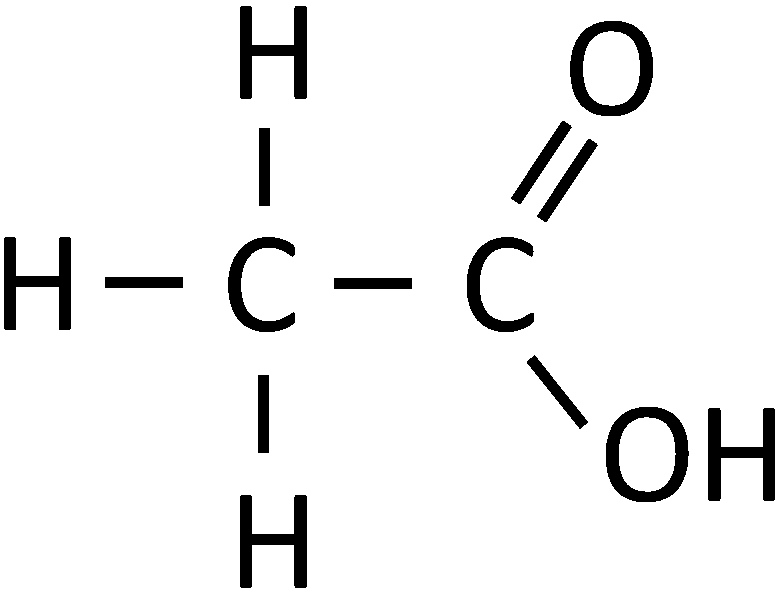
(ii) Write the structural formula of X.

(iii) Name the above reaction.

Show SolutionHide Solution↓

$\underset{\text{ethyl alcohol}}{\text{C}_2\text{H}_5\text{OH}} + \underset{\text{acetic acid}}{\text{CH}_3\text{COOH}} \xrightarrow{\text{Conc. H}_2\text{SO}_4} \underset{\text{ethyl ethanoate}}{\text{CH}_3-\text{COO}-\text{C}_2\text{H}_5} + \text{H}_2\text{O}$

(i) Y is ethyl acetate and Z is conc. sulphuric acid

(ii) Structural formula of X (ethanoic acid) is shown below:

Write structural formula of ethanoic acid. Organic Chemistry, Simplified Chemistry Dalal Solutions ICSE Class 10.

(iii) Esterification reaction

6(b)Written · 2018 · Section II · 2018 PaperFull page

Ethane burns in oxygen to form CO2 and H2O according to the equation:

2C2H6 + 7O2 ⟶ 4CO2 + 6H2O.

If 1250 cc of oxygen is burnt with 300 cc of ethane.

Calculate:

(i) the volume of CO2 formed.

(ii) the volume of unused O2.

Show SolutionHide Solution↓

[By Lussac's law]

$$\begin{matrix} 2\text{C}_2\text{H}_6 & + & 7\text{O}_2 &\longrightarrow & 4\text{CO}_2 & + & 6\text{H}_2\text{O} \\ 2\text{ vol.} & : & 7 \text{ vol.} & \longrightarrow & 4\text{ vol.} \end{matrix}$$

(i) To calculate the volume of CO2 formed :

$$\begin{matrix}\text{C}_2\text{H}_6 & : & \text{CO}_2 \\ 2 \text{ vol.} & : & 4 \text{ vol.} \\ 300 \text{ cc} & : & \text{x} \end{matrix}$$

∴

$x = \frac{4}{2} \times 300 = 600 \text{ cc}$

Hence, volume of carbon dioxide formed = 600 cc

(ii) To calculate the volume of unused O2 :

$$\begin{matrix}\text{C}_2\text{H}_6 & : & \text{O}_2 \\ 2 \text{ vol.} & : & 7 \text{ vol.} \\ 300 \text{ cc} & : & \text{x} \end{matrix}$$

∴

$x = \frac{7}{2} \times 300 = 1050 \text{ cc}$

Unused oxygen = 1250 - 1050 = 200 cc.

Hence, volume of unused oxygen = 200 cc
6(c)Written · 2018 · Section II · 2018 PaperFull page

Three solutions P, Q and R have pH value of 3.5, 5.2 and 12.2 respectively.

Which one of these is a:

(i) Weak acid?

(ii) Strong alkali?

Show SolutionHide Solution↓

(i) Q
Reason — On a pH scale, acids have pH less than 7 whereas weak acids have pH towards 7. Hence, Q will be a weak acid with pH 5.2 .

(ii) R
Reason — On a pH scale, alkali have pH more than 7 and alkalinity increases as the pH value moves away from 7. Hence, R will be a strong alkali with pH 12.2 .

7(a)Written · 2018 · Section II · 2018 PaperFull page

Give a chemical test to distinguish between the following pairs of chemicals:

(i) Lead nitrate solution and Zinc nitrate solution

(ii) Sodium chloride solution and Sodium nitrate solution

Show SolutionHide Solution↓

(i) When NaOH is added to each of the compounds, lead nitrate forms a chalky white precipitate of lead hydroxide [Pb(OH)2] whereas a gelatinous white precipitate of zinc hydroxide [Zn(OH)2] is formed in case of zinc nitrate.

(ii) Add silver nitrate soln. to the given solns., sodium chloride reacts to form a white ppt. which is soluble in NH4OH and insoluble in dil. HNO3. The other soln. is sodium nitrate.

NaCl + AgNO3 ⟶ AgCl + NaNO3

NaNO3 + AgNO3 ⟶ no white ppt.

7(b)Written · 2018 · Section II · 2018 PaperFull page

Write a balanced equation for the preparation of each of the following salts:

(i) Copper sulphate from Copper carbonate.

(ii) Zinc carbonate from Zinc sulphate.

Show SolutionHide Solution↓

(i) CuCO3 + H2SO4 ⟶ CuSO4 + H2O + CO2

(ii) ZnSO4 + (NH4)2CO3 ⟶ (NH4)2SO4 + ZnCO3

7(c)Written · 2018 · Section II · 2018 PaperFull page

(i) What is the type of salt formed when the reactants are heated at a suitable temperature for the preparation of Nitric acid?

(ii) State why for the preparation of Nitric acid, the complete apparatus is made up of glass.

Show SolutionHide Solution↓

(i) Acid salt

(ii) The vapours of nitric acid are highly corrosive and attack rubber, cork. etc. For this reason, all glass apparatus is used in the laboratory preparation of nitric acid.

7(d)Written · 2018 · Section II · 2018 PaperFull page

Which property of sulphuric acid is shown by the reaction of concentrated sulphuric acid with:

(i) Ethanol?

(ii) Carbon?

Show SolutionHide Solution↓

(i) Dehydrating property

$\text{C}_{2}\text{H}_{5}\text{OH}\xrightarrow{\text{Conc. H}_2\text{SO}_4} \text{C}_{2}\text{H}_{4} \small{\space[ethene-ethylene]} + \text{H}_2\text{O}$

(ii) Oxidizing property

C + 2H2SO4 (conc.) ⟶ CO2 + 2SO2 + 2H2O

Press ↓ to reveal a solution and move to the next question. Browse the free sample bank.

All 611 Chemistry questions