In India Intensive Commercial farming is practised because
(a)land holdings are very large
(b)most of the land is fallow
(c)due to population pressure which reduces the size of land holdings
(d)extensive farming is not possible as farmers cannot afford
Show SolutionHide Solution↓
due to population pressure which reduces the size of land holdings
51 Mark · Multiple Choice Questions
Organic farming is becoming popular as in this type of farming
(a)chemical fertilizers are used
(b)compost is used as fertilizer
(c)only one crop is grown
(d)it is expensive
Show SolutionHide Solution↓
compost is used as fertilizer
61 Mark · Multiple Choice Questions
In subsistence agriculture
(a)the farmer produces food to earn more money
(b)the farmer grows crop for his own consumption
(c)the farmer grows food crop to exchange for other amenities
(d)the farmer practices primitive agriculture
Show SolutionHide Solution↓
the farmer grows crop for his own consumption
71 Mark · Multiple Choice Questions
Mixed farming means
(a)farming of many crops on the same farm
(b)growing fodder crop along with other crop
(c)cultivation of crops and livestock rearing on the same farm
(d)to grow root crops like beet and turnip
Show SolutionHide Solution↓
cultivation of crops and livestock rearing on the same farm
81 Mark · Multiple Choice Questions
Green revolution was first confined to only
(a)Bihar
(b)Punjab
(c)Tamil Nadu
(d)Gujarat
Show SolutionHide Solution↓
Punjab
91 Mark · Multiple Choice Questions
In Zaid crop season farmers grow
(a)wheat
(b)fruits and vegetables
(c)cotton
(d)pulses
Show SolutionHide Solution↓
fruits and vegetables
101 Mark · Multiple Choice Questions
Pesticides and herbicides are used to
(a)grow the crop
(b)save the crops from the diseases
(c)increase fertility of the soil
(d)increase the production of the crops
Show SolutionHide Solution↓
save the crops from the diseases
1Answer the following questions
What do you mean by the term 'agriculture'?
Show SolutionHide Solution↓
The art and science of cultivating soil, growing crops, raising livestock etc. is called agriculture. It includes all the steps from preparation of soil to harvesting of crops and their marketing. Agriculture has many allied activities like animal husbandry, fisheries, poultry etc.
2Answer the following questions
What is meant by the term 'subsistence agriculture'?
Show SolutionHide Solution↓
The system of agriculture in which the farmer produces food exclusively for his own consumption is called subsistence agriculture. The farmer has no surplus production to sell in market. The land holding is very small.
3Answer the following questions
What is commercial farming?
Show SolutionHide Solution↓
Commercial farming is a system of agriculture in which food crops are produced specifically for sale in the market, by using improved variety of seeds and machinery on large land holdings. Commercial farming are of two types:
Intensive commercial farming
Extensive commercial farming
4Answer the following questions
What is mixed farming?
Show SolutionHide Solution↓
The farming system in which the cultivation of crops, horticulture and rearing of livestock is done together is called mixed farming.
5Answer the following questions
What is meant by the term 'plantation farming'? Give two examples.
Show SolutionHide Solution↓
The system of agriculture in which a single crop is grown on large scale is called plantation farming. It is labour intensive and huge capital is required. Two examples of plantation farming are tea and rubber.
6Answer the following questions
How important is agriculture to India?
Show SolutionHide Solution↓
The importance of agriculture to India can be summarized as follows:
Nearly 2⁄3rd of Indian population directly or indirectly depends on agriculture.
Agriculture forms the backbone of Indian economy.
Agriculture provides raw material for many key industries like sugar, textile and edible oil.
Agriculture also acts as a consumer for many industrial products like tractors, harvesters, chemical fertilizers, pesticides, etc. leading to the setting up of these industries.
India's undulating topography, varied climate with sufficient sunshine, ideal temperature and two main growing seasons provide conditions necessary for agriculture.
India exports many agricultural products like tea, tobacco, coffee, cotton and jute that bring in the much needed foreign exchange.
7Answer the following questions
Give a few important characteristics of Indian agriculture.
Show SolutionHide Solution↓
A few important characteristics of Indian agriculture are:
Dependence on Monsoons — The Indian agriculture depends upon arrival of monsoon which is highly unreliable and irregular. The large scale irrigation serves only one-third of crop area. The remaining has to suffer the vagaries of monsoon.
Variety of crops — India has variety of relief features and climatic conditions which enables cultivation of a variety of crops.
Preponderance of food crops — India has to feed a large population. Therefore, priority is give to the cultivation of food crops. More than 2/3rd of the total cropped area is taken up by cultivation of food crops.
Agricultural Pattern — India has three main crop seasons based on the changing climatic condition:
Kharif
Rabi
Zaid
8Answer the following questions
What are rabi and kharif crops? Give examples.
Show SolutionHide Solution↓
Rabi crops are the crops that are sown in October-November and are harvested in March. For example: wheat, barley, gram and oil seeds.
Kharif crops are the crops that are sown in June and harvested in November. For example: rice, maize, groundnut, cotton and jute.
9Answer the following questions
Give any three problems of Indian agriculture.
Show SolutionHide Solution↓
Three problems of Indian agriculture are:
Small and fragmented landholding — Intensive farming, increasing population and the practice of dividing and subdividing land for inheritance are some drawbacks of our agriculture. Carrying out farming practices becomes very difficult in small and dispersed land holdings.
Poor quality of Seeds — Good quality seeds are not available to all farmers. Poor farmers cannot afford treated and hybrid seeds.
Pest and Diseases — Pest and disease management practices are not followed by poor and uneducated farmers.
10Answer the following questions
What type of agriculture is practised in India?
Show SolutionHide Solution↓
Subsistence type of agriculture is mainly practised in India.
11Answer the following questions
How is ‘jhooming’ carried out?
Show SolutionHide Solution↓
Jhooming agriculture is also known as 'shifting' or 'Slash and burn' agriculture. This type of agriculture is mostly practised in North-East India. In Jhooming agriculture, a patch of forest land is cleared by burning and crops are grown. After 2-3 years, when the fertility of soil is exhausted, the land is abandoned. The farmers then clear another piece of land and process continues. After 10-15 years the farmer may return to the first piece of land.
12Answer the following questions
What is done in primitive type of agriculture?
Show SolutionHide Solution↓
The primitive agriculture is something which used to be practised in the past in backward equatorial areas. It involves the use of simple tools and primitive techniques. The farmer uses these old techniques to grow food for their own use.
13Answer the following questions
Where is intensive commercial farming done?
Show SolutionHide Solution↓
Intensive commercial farming is practised in countries where the population pressure reduces the size of land holdings. This type of agriculture is practised in monsoon lands of Asia including India (Punjab, Haryana, UP, West Bengal), China, Japan etc.
14Answer the following questions
What happens in extensive commercial farming?
Show SolutionHide Solution↓
Extensive commercial farming is a system of agriculture in which smaller amounts of capital or labour investment are applied to relatively large areas of land.
At times, the land is left fallow to regain its fertility.
It is mostly mechanized as labour is very expensive or may not be available at all.
It usually occurs at great distance from market or on poor land of limited potential.
15Answer the following questions
What is meant by monoculture?
Show SolutionHide Solution↓
Monoculture refers to growing of same crop year after year on a particular piece of land. It deteriorates the soil health.
11 Mark · Multiple Choice Questions
Rice crop requires an average temperature of 24°C with a range of
(a)10°C to 15°C
(b)16°C to 32°C
(c)21°C to 27°C
(d)24°C to 35°C
Show SolutionHide Solution↓
16°C to 32°C
21 Mark · Multiple Choice Questions
Gram can be best grown is
(a)red soil
(b)Loamy soil
(c)black soil
(d)laterite soil
Show SolutionHide Solution↓
Loamy soil
31 Mark · Multiple Choice Questions
Wheat is the staple food of
(a)North
(b)South
(c)East
(d)West
Show SolutionHide Solution↓
North
41 Mark · Multiple Choice Questions
In this method of cultivation the seeds are dropped at regular interval in the furrows made by the farmers with the help of a plough or dibber — It is
(a)Drilling method
(b)Broadcasting method
(c)Dibbling
(d)Transplantation
Show SolutionHide Solution↓
Dibbling
51 Mark · Multiple Choice Questions
Diseases damage the rice crop and can reduce yield. The most common diseases are
(a)Rust
(b)Loose smut
(c)Black point
(d)Stem rot
Show SolutionHide Solution↓
Stem rot
61 Mark · Multiple Choice Questions
Rice crop requires an average rainfall of
(a)100 cm to 150 cm
(b)150 cm to 200 cm
(c)50 cm to 100 cm
(d)50 cm to 150 cm
Show SolutionHide Solution↓
150 cm to 200 cm
71 Mark · Multiple Choice Questions
The largest producer of Jowar
(a)Punjab
(b)Maharashtra
(c)West Bengal
(d)Uttar Pradesh
Show SolutionHide Solution↓
Maharashtra
81 Mark · Multiple Choice Questions
Millets require temperature ranging from
(a)25°C to 35°C
(b)10°C to 15°C
(c)26°C to 33°C
(d)20°C to 27°C
Show SolutionHide Solution↓
26°C to 33°C
91 Mark · Multiple Choice Questions
Wheat grows well is
(a)Red soil
(b)Alluvial soil
(c)Black soil
(d)Laterite soil
Show SolutionHide Solution↓
Alluvial soil
101 Mark · Multiple Choice Questions
The crop is hardy and drought resistance
(a)Pulses
(b)Wheat
(c)Millets
(d)Rice
Show SolutionHide Solution↓
Millets
1Answer the following questions
What do you understand by the term 'cereals'?
Show SolutionHide Solution↓
Cereals are plants that are grown for their edible grain, which is used as a food for humans and animals. Some examples of cereal grains include wheat, rice, maize, barley, etc. Cereals form the staple food for a large proportion of the population worldwide.
2Answer the following questions
Name the different methods of sowing rice.
Show SolutionHide Solution↓
Following are the methods of sowing rice:
Broadcasting or scattering.
Dibbling.
Drilling.
Transplantation.
Japanese method of cultivation.
3Answer the following questions
Which is the best method of growing rice?
Show SolutionHide Solution↓
Japanese method of cultivation is the best method of growing rice as it ensures three times higher yield and less wastage of seeds.
4Answer the following questions
What kind of soil is best suited for growing rice?
Show SolutionHide Solution↓
Deep fertile clayey or friable loam and black lava soil are best suited for growing rice because of their high water holding capacity.
5Answer the following questions
Name the leading producer of rice in India.
Show SolutionHide Solution↓
West Bengal is the leading producer of rice in India.
6Answer the following questions
Name a state in India where rice is grown as a non-food crop.
Show SolutionHide Solution↓
Punjab is one state in India where rice is grown as a non-food crop.
7Answer the following questions
Name an area in India where rice is grown under 'Shifting Cultivation'.
Show SolutionHide Solution↓
Rice is grown under 'Shifting Cultivation' in North-East India.
8Answer the following questions
State the reasons for low yield of rice in India.
Show SolutionHide Solution↓
Reasons for low yield of rice in India are:
Poor farmers can not afford high-yielding variety of rice.
Pests and diseases decrease the yield of rice. Proper pests and disease management is not done by farmers.
Most of the parts of India depend on monsoon rains which are highly unreliable and erratic leading to loss of crop due to drought or flood.
Advanced cultivation methods are not being used by most of the farmers.
9Answer the following questions
What are the climatic conditions suitable for growing of wheat?
Show SolutionHide Solution↓
Climatic conditions suitable for growing of wheat are:
Wheat is a temperate crop which requires cool climate with moderate rainfall.
It needs an average temperature between 10°C to 15°C at the time of sowing and higher temperature between 20°C to 25°C is required at the time of ripening.
Wheat needs 50 to 100 cm rainfall.
10Answer the following questions
Is wheat a rabi or kharif crop?
Show SolutionHide Solution↓
Wheat is a rabi crop.
11Answer the following questions
Name the leading producer of wheat in India.
Show SolutionHide Solution↓
Uttar Pradesh is the leading producer of wheat in India.
12Answer the following questions
Give two natural and two man-made factors that help in the cultivation of wheat.
Show SolutionHide Solution↓
Two natural factors that help in the cultivation of wheat are:
Wheat is a temperate crop. In India, it is taken as Rabi crop. Winter temperature of North India provides most favourable conditions for wheat cultivation.
The fertile friable loamy alluvial soils of clayey composition of the flat and well-drained Indo-Gangetic plains is best suited for wheat cultivation.
Two man-made factors that help in the cultivation of wheat are:
Supply of high yielding variety (HYV) seeds with proper use of chemical fertilizers.
Excellent irrigation system provided by a close network of canals.
13Answer the following questions
Give a few important aspects of 'Green Revolution'.
Show SolutionHide Solution↓
A few important aspects of ‘Green Revolution’ were:
Introduction of new varieties in India.
Production of high-yielding varieties of wheat and rice in India.
Use of artificial fertilizers and irrigation facilities lead to increase in yield.
Use of pesticides and herbicides lead to increased yield by stopping wastage of crop and soil nutrition.
14Answer the following questions
In which season is wheat sown and why?
Show SolutionHide Solution↓
Wheat is sown in rabi season because it is a temperate crop which needs not more than 10°C to 15°C temperature at the time of sowing.
15Answer the following questions
Is maize a rabi or kharif crop? Name three leading producers of maize.
Show SolutionHide Solution↓
Maize is primarily a kharif crop but in some states like Tamil Nadu, it is grown as rabi crop. Three leading producers of maize are Karnataka, Maharashtra and Andhra Pradesh.
16Answer the following questions
Why are the millets called the dry crops?
Show SolutionHide Solution↓
Millets are hardy, drought and heat resistant plants and therefore mostly cultivated in the drier parts of the monsoon lands. Hence, they are called the dry crops.
17Answer the following questions
Why are millets so widely grown?
Show SolutionHide Solution↓
Millets are widely grown because they are hardy, drought and heat resistant plants that can be easily grown in areas of less rainfall. They can be grown in plains and on uplands up to 1200 meter in height. Millets do not have any special requirement as far as soil is concerned.
18Answer the following questions
Give two new uses of maize.
Show SolutionHide Solution↓
Two new uses of maize are:
It is used in confectionery as corn-flour and cereal as corn-flakes.
It is used in production of bio-fuel.
19Answer the following questions
What is the common feature of all millets?
Show SolutionHide Solution↓
All millets are kharif crops grown in warm weather. They are hardy, drought and heat resistant and can be grown in areas with less rainfall. They can grow in any kind of soil.
20Answer the following questions
Name the most important rotation crop. In what way does it help the soil?
Show SolutionHide Solution↓
Pulses are the most important rotation crop because they are leguminous plants with root-nodules, which can fix and utilize atmospheric nitrogen in the soil. It makes the soil rich in nitrogen and provides enough nitrogen to the next crop sown.
11 Mark · Multiple Choice Questions
Rabi crop is sown in
(a)June-July
(b)Oct-Nov
(c)Dec-Jan
(d)March-April
Show SolutionHide Solution↓
Oct-Nov
21 Mark · Multiple Choice Questions
Cotton requires
(a)21°- 27° C temp
(b)15°- 25° C temp
(c)10°- 5° C temp
(d)30° - 35° C temp
Show SolutionHide Solution↓
21°- 27° C temp
31 Mark · Multiple Choice Questions
Cultivation of sugarcane from the root stock of the cane which has been cut is called
(a)Ginning
(b)Ratooning
(c)Clone planting
(d)Retting
Show SolutionHide Solution↓
Ratooning
41 Mark · Multiple Choice Questions
Cotton plant is vulnerable to attack by diseases like
(a)green leaf hopper
(b)stripe rust
(c)boll worms
(d)rust
Show SolutionHide Solution↓
boll worms
51 Mark · Multiple Choice Questions
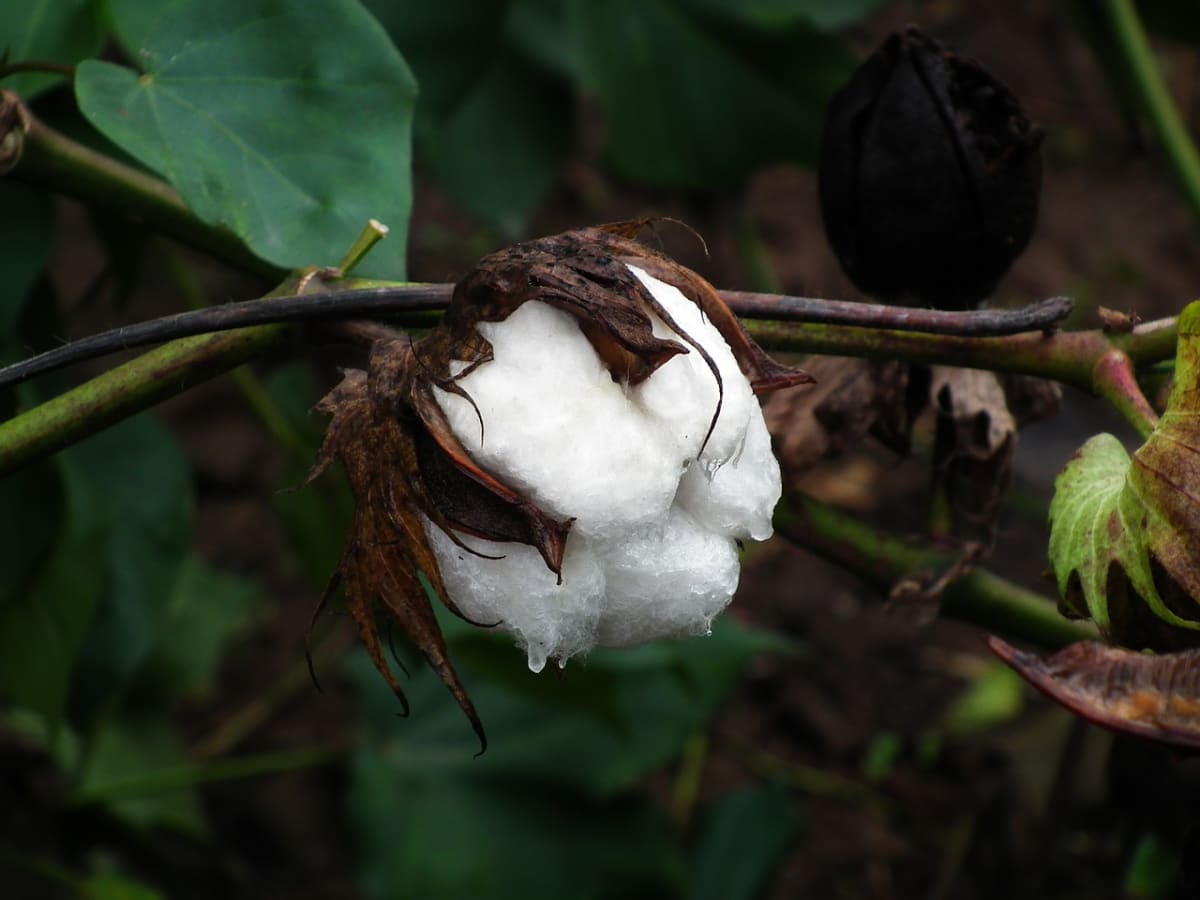
Study the picture given and answer the question — the largest producer of this crop is
(a)Gujarat
(b)Punjab
(c)Haryana
(d)Tamil Nadu
Show SolutionHide Solution↓
Gujarat
61 Mark · Multiple Choice Questions
The groundnut kernels contain
(a)40 - 50% oil
(b)no oil
(c)20 - 30% oil
(d)10 - 15% oil
Show SolutionHide Solution↓
40 - 50% oil
71 Mark · Multiple Choice Questions
Sugarcane can grow well in the alluvial soil. It should be rich in
(a)Nitrogen
(b)Calcium
(c)Phosphorus
(d)All the above
Show SolutionHide Solution↓
All the above
81 Mark · Multiple Choice Questions
The fine plucking is associated with
(a)coffee
(b)tea
(c)rubber
(d)cotton
Show SolutionHide Solution↓
tea
91 Mark · Multiple Choice Questions
Crop rotation is done to
(a)preserve the soil
(b)preserve minerals in the soil
(c)grow more crops
(d)none of the above
Show SolutionHide Solution↓
preserve minerals in the soil
101 Mark · Multiple Choice Questions
Winnowing is associated with
(a)rice crop
(b)cotton crop
(c)soya bean
(d)wheat crop
Show SolutionHide Solution↓
wheat crop (also done in Rice)
1Answer the following questions
What are the climatic conditions that favour the cultivation of cotton?
Show SolutionHide Solution↓
The climatic conditions that favour the cultivation of cotton are:
It needs mild, cool, preferably dry climate with 21°- 27° C temperature.
It needs plenty of sunshine.
Warm days and cool nights are good for the development of the boll and fibres in the first stage at the time of fruition.
Temperature should not fall below 20°C.
This crop requires 200 frost free days during growing period.
2Answer the following questions
Where in India does long staple cotton grow? What are its advantages?
Show SolutionHide Solution↓
In India, the long staple cotton grows in Punjab, Haryana, Maharashtra, Tamil Nadu, Andhra Pradesh and Telangana. The long staple cotton is used to make fine quality cotton cloth. It is stronger, softer and makes more durable fabric. Fabric made of long-staple cottons fray less, pill less, wrinkle less and even fade less.
3Answer the following questions
Is dry weather necessary at the time of harvest of cotton? Why?
Show SolutionHide Solution↓
Yes, dry weather is necessary at the time of harvest of cotton. Cotton requires dry weather at the time of harvest because dryness helps in ripening and bursting of the cotton bolls. Humidity results in infestation of pests and diseases. Rainfall at time of harvesting badly affects the quality of cotton.
4Answer the following questions
Why is jute called the 'brown paper' of the wholesale trade?
Show SolutionHide Solution↓
Jute is called the 'brown paper' of the wholesale trade as until recently its sacks were used for packing rice, wheat, sugar, pulses, cement and fertilizers.
5Answer the following questions
What are the geographical requirements for growing jute? Name the leading producer of jute.
Show SolutionHide Solution↓
The geographical requirements for the cultivation of Jute are:
Light sandy or clayey loams are best for growing jute.
It grows well in flood plains and river deltas rich in alluvium. Since jute rapidly exhausts the fertility of the soil, it is necessary that the soils are replenished annually by the silt-laden flood waters of the rivers.
It requires high temperature between 24°C to 35°C.
It needs high relative humidity of 80% to 90% at the time of growth.
Jute requires heavy rainfall of 170 cm to 200 cm.
6Answer the following questions
Name the two most important fibre crops of India.
Show SolutionHide Solution↓
The two most important crops of India area cotton and jute.
7Answer the following questions
Name the different varieties of tea in India.
Show SolutionHide Solution↓
The different varieties of tea in India are Black Tea, Green Tea and Oolong Tea.
8Answer the following questions
Why is tea generally grown on the hill slopes?
Show SolutionHide Solution↓
Tea is generally grown on the hill slopes because the hill slopes do not allow water logging and provide proper drainage. Stagnant water is injurious to the roots of tree plants. Hence, hill slopes are best suited for growing tea.
9Answer the following questions
Why are the tea plants pruned?
Show SolutionHide Solution↓
Tea plants are pruned at regular interval to maintain the height and diameter of the plant limited to one metre. Frequent pruning encourages the rapid production of fresh leaves and shoots.
10Answer the following questions
Name the leading producer of tea in India. What factors have helped it to become the leading state?
Show SolutionHide Solution↓
Assam is the leading producer of tea in India. The factors that helped it to become the leading state are:
It gets over 250 cm rainfall.
The temperature is above 20°C.
Morning fog helps and frost never occurs.
Labour is available in plenty.
11Answer the following questions
Why is the plucking of tea leaves entrusted generally to women?
Show SolutionHide Solution↓
Mostly women are entrusted to pluck tea leaves because tea plucking is a very skilled job requiring patience and judgement. Women are better pickers and can be employed at relatively cheaper rates.
12Answer the following questions
Name the different stages of tea processing before it is sent out to the market.
Show SolutionHide Solution↓
The different stages of tea processing before it is sent out to the market are:
Withering — It is done to remove the moisture from the leaves by spreading them over racks and passing air through them.
Rolling — It gives the twist to the leaves, breaks the leaf cells and the natural juice is exposed to the atmosphere for fermentation to set in.
Fermentation — Tea leaves are spread out in special trays on cement tables for fermentation which results in change of leaf colour to copper red.
Drying or fixing — After fermentation, leaves are put on conveyer belt and are passed through an oven at a very high temperature.
Sorting — The leaves are sorted out in various grades with the help of sifters with different size of meshes.
Blending — It gives a characteristic flavour to the brand.
Packing — It is done in plywood cases with a lining of aluminium foil.
13Answer the following questions
Name the two main centres where tea is auctioned.
Show SolutionHide Solution↓
Kolkata and Guwahati are the two main centres where tea is auctioned.
14Answer the following questions
Why is blending necessary for tea?
Show SolutionHide Solution↓
The tea plant is greatly affected by the type of climate it is grown in. Thus by blending, the tea planter prepares his own brand to supply his customers on the basis of its flavour, colour and texture. Each brand will have its own characteristic flavour and the blend is a closely guarded secret.
15Answer the following questions
Give two reasons stating the economic importance of the tea industry.
Show SolutionHide Solution↓
Two reasons stating the economic importance of the tea industry are:
It is a labour-intensive industry and provides employment to over a million workers.
It earns a lot of foreign exchange for the country.
16Answer the following questions
Name two important regions where tea is grown in south India.
Show SolutionHide Solution↓
Two important regions where tea is grown in south India are Nilgiri hills in Tamil Nadu and Annamalai hills in Karnataka.
17Answer the following questions
Name the two main varieties of coffee grown in India.
Show SolutionHide Solution↓
Two main varieties of coffee grown in India are:
Coffea arabica.
Coffea robust.
18Answer the following questions
Why are young coffee plants protected from heat?
Show SolutionHide Solution↓
Young coffee plants are protected from heat to prevent damage to their delicate leaves and branches, which can impede growth and reduce crop yields. High temperatures can cause wilting, dehydration, sunburn and in extreme cases death of the plant. It also helps to prevent infestations and outbreaks.
19Answer the following questions
State three factors which favour the cultivation of coffee in South India. Name the leading producer of coffee in India.
Show SolutionHide Solution↓
Three factors which favour the cultivation of coffee in South India are:
Altitude — Coffee is grown at an altitude of 800 to 1500 metres. South India has many high-altitude regions, such as the Western Ghats, which are ideal for growing coffee. Generally the slopes are protected from direct rain, direct sun rays and strong winds.
Climate — South India has a tropical climate that is well-suited to coffee cultivation, with moderate temperatures, abundant rainfall, and high humidity.
Soil — South India provides rich loamy laterite soil, rich in humus and iron oxide which favours coffee production.
Karnataka is the leading producer of coffee in India.
20Answer the following questions
State one climatic and one commercial problem that coffee cultivation in India faces.
Show SolutionHide Solution↓
Climatic problem — Dry weather, high temperature, long droughts and unseasonal rainfall.
Commercial problem — Low productivity and yields due to outdated farming practices, lack of access to modern technology and inputs, and a lack of investment in research and development. Due to this coffee cultivation in India faces tough competition from countries like Brazil, Vietnam and Indonesia.
21Answer the following questions
Name the different methods by which sugarcane can be propagated.
Show SolutionHide Solution↓
The different methods by which sugarcane can be propagated are:
Sett method — In this method, the pieces of sugarcane with one or two joint, called sett, is sown.
Ratooning — In this method, after the first crop, the sugarcane is cut leaving, the root intact in the soil. The stem begins to grow again.
22Answer the following questions
State the leading producer of sugarcane in India.
Show SolutionHide Solution↓
Uttar Pradesh is leading producer of sugarcane in India.
23Answer the following questions
What are the advantages of ‘Ratooning'?
Show SolutionHide Solution↓
The advantages of Ratooning are:
Crop need not be planted again.
Ratoons have relatively shorter maturation period.
The method does not involve any extra expenditure; hence is cheaper as compared to re-planting the crop.
24Answer the following questions
Give two problems the farmers of north India face during sugarcane cultivation.
Show SolutionHide Solution↓
Two problems the farmers of north India face during sugarcane cultivation are:
The hot dry winds known as 'loo' that blows in summers affects the normal growth of sugarcane.
Very low temperature in winters in northern plains also affects it growth.
25Answer the following questions
What advantage does the Deccan region have over the north with reference to sugarcane cultivation?
Show SolutionHide Solution↓
The Deccan region have following advantages over the north with reference to sugarcane cultivation:
In the south, the climate conditions are ideal with the absence of "Loo" during summer with reasonably high temperature and frost-free winters coupled with maritime winds in coastal areas.
The black lava soil with their high fertility and retentivity are most beneficial for the sugarcane crop.
Better methods, manures and fertilizers are used for cultivation in the south.
26Answer the following questions
Name a few diseases that sugarcane plant is susceptible to.
Show SolutionHide Solution↓
A few diseases that sugarcane plant is susceptible to are:
Fungal diseases like red rot, smut, rust.
Ratoon stunting.
27Answer the following questions
Name a few important oil-seeds grown in India.
Show SolutionHide Solution↓
A few important oil-seeds grown in India are:
Edible oilseeds — Groundnuts, sesame, rapeseed, mustard, sunflower and niger.
Non-edible oilseeds — Linseeds, Caster seeds, neem and mahua.
28Answer the following questions
State the economic importance of oilseeds.
Show SolutionHide Solution↓
The economic importance of oilseeds are:
India has the largest area in production of oilseeds.
The measure oilseeds occupy nearly 20% of the net sown area.
The oil extracted from oilseeds constitutes an important part of our diet as edible oils. It is also used as raw material for manufacturing various items of economic importance such as paints, varnishes, soaps, cosmetic items, medicinal items, lubricants, perfumes, etc.
The residue of edible oilseeds forms an important part of cattle feed and manure.
The oil industry offers employment to millions of people.
29Answer the following questions
What is an oil cake? How is it used?
Show SolutionHide Solution↓
The residue left of edible oilseed is known as oil cake. It is used as manure and cattle feed.
30Answer the following questions
Name the non-edible oilseeds. Why are they so called?
Show SolutionHide Solution↓
The non-edible oilseeds are Linseeds, neem, mahua and Caster seeds. They are called so because they cannot be used as part of our diet. They are used only for producing industrial and commercial products.
31Answer the following questions
Give the geographical conditions necessary for the growth of groundnuts. Name its leading producer.
Show SolutionHide Solution↓
The geographical conditions necessary for the growth of groundnuts are:
Well drained light sandy loams, red and black soils are well suited for its cultivation.
It grows well with temperature ranging between 20° C to 25° C.
Warm and dry weather is important at ripening stage.
It needs a rainfall of 50 to 70 cm.
Gujarat is the leading producer of Groundnut in India.
32Answer the following questions
Name the by-products of sugarcane. Give one important use of each.
Show SolutionHide Solution↓
The by-products of sugarcane and their uses are:
Molasses — It is used to produce industrial alcohol, fertilizers, rum, treacle and yeast.
Bagasse — It is used as fuel for mills and mainly used for paper, fibre board and synthetic fibres.
Press mud — It is used to make wax, shoe polish and carbon paper.
33Answer the following questions
Why are floods beneficial for better growth of jute?
Show SolutionHide Solution↓
Jute crop rapidly exhausts the fertility of soil. It is necessary to replenish the fertility of soil annually which is done by silt laden floodwaters of the rivers. Thus, the floods are beneficial for better growth of jute.
34Answer the following questions
Explain the following terms. With which crop do you associate them?
(a)Ginning
(b)Retting
(c)Clonal planting
(d)Ratooning
(e)Fine plucking
(f)Bud grafting
Show SolutionHide Solution↓
Ginning — It is the process in which fibre is separated from the seed/raw material. It is done by roller gins. Ginning is associated with cotton.
Retting — It is a microbiological process in which the jute bundles are submerged in soft clean water for 2-3 weeks. This helps to loosen the outer bark and helps in removal of the fibre from the stalk. This process is associated with Jute.
Clonal planting — It is the method where cutting are taken from good high yielding mpther plant rather than seeds. It is associated with Tea.
Ratooning — It is a method of Sugarcane cultivation in which the sugarcane is cut leaving the root intact in soil. It is associated with Sugarcane.
Fine plucking — Plucking of two youngest leaves with a bud is called fine plucking. It is done in Tea.
Bud grafting — In Bud grafting, a strip of bark of a good yielding plant containing a bud is inserted under the bark of a young seedling. It is done in rubber plant.
35Answer the following questions
Give reason —
(a)Tea is best grown on hill slopes.
(b)Pruning is essential for a tea plant.
(c)Honey bees are reared on coffee plants.
Show SolutionHide Solution↓
Tea is generally grown on the hill slopes because the hill slopes do not allow water logging and provide proper drainage. Stagnant water is injurious to the roots of tree plants. Hence, hill slopes are best suited for growing tea.
Tea plants are pruned at regular interval to maintain the height and diameter of the plant limited to one metre. Frequent pruning encourages the rapid production of fresh leaves and shoots.
Honey bees are reared on coffee plants as they help to pollinate the flowers.
36Answer the following questions
Answer in one word —
(a)Method in which coffee is obtained by pulping, fermenting, washing and drying.
(b)Method in which coffee berries are dried in the sun.
(c)Method in which seeds are dropped through bamboo shafts attached to a plough