Question Paper2016

ICSE Class 10 Chemistry — 2016 Paper

34 solved questions from Solved 2016 Question Paper ICSE Class 10 Chemistry. Every answer follows the ICSE marking scheme.

Section
Insight
1(a)Written · 2016 · Section I · 2016 PaperFull page

Fill in the blanks with the choices given in brackets.

(i) Metals are good ............... (oxidizing agents / reducing agents) because they are electron ............... (acceptors/ donors).

(ii) Electrovalent compounds have ............... (high/low) melting points.

(iii) Higher the pH value of a solution, the more ...............(acidic/alkaline) it is.

(iv) ............... (AgCl / PbCl2), a white precipitate is soluble in excess NH4OH.

(v) Conversion of ethene to ethane is an example of ...............(hydration/hydrogenation).

Show SolutionHide Solution↓

(i) Metals are good reducing agents because they are electron donors.

(ii) Electrovalent compounds have high melting points.

(iii) Higher the pH value of a solution, the more alkaline it is.

(iv) AgCl, a white precipitate is soluble in excess NH4OH.

(v) Conversion of ethene to ethane is an example of hydrogenation.
1(b-i)Written · 2016 · Section I · 2016 PaperFull page

An element with the atomic number 19 will most likely combine chemically with the element whose atomic number is:

Show SolutionHide Solution↓

17

Reason — The element with atomic number 19 has electronic configuration of (2, 8, 8, 1) and that with atomic number 17 has electronic configuration of (2, 8, 7). This element with atomic number 17 needs 1 electron to complete its octet whereas element with atomic number 19 has an extra electron. Hence, an element with atomic number 19 is most likely to combine with the element with atomic number 17.

1(b-ii)Written · 2016 · Section I · 2016 PaperFull page

The ratio between the number of molecules in 2g of hydrogen and 32g of oxygen is:

[Given that H=1, O=16]

Show SolutionHide Solution↓

1:1

Reason — 1 mole of any substance contains same (Avogardo No.) of molecules. Hence, ratio is same.

1(b-iii)Written · 2016 · Section I · 2016 PaperFull page

The two main metals in Bronze are:

Show SolutionHide Solution↓

Copper and tin

Reason — The two main metals in Bronze are Copper and tin .

1(b-iv)Written · 2016 · Section I · 2016 PaperFull page

The particles present in strong electrolytes are:

Show SolutionHide Solution↓

mainly ions

Reason — The particles present in strong electrolytes are mainly ions.

1(b-v)Written · 2016 · Section I · 2016 PaperFull page

The aim of the Fountain Experiment is to prove that:

Show SolutionHide Solution↓

HCl is highly soluble in water

Reason — The aim of the Fountain Experiment is to prove that HCl is highly soluble in water.

1(c)Written · 2016 · Section I · 2016 PaperFull page

Write balanced chemical equations for each of the following:

(i) Action of warm water on AlN.

(ii) Action of hot and concentrated Nitric acid on copper.

(iii) Action of Hydrochloric acid on sodium bicarbonate.

(iv) Action of dilute Sulphuric acid on Sodium Sulphite.

(v) Preparation of ethanol from Ethyl Chloride.

Show SolutionHide Solution↓

(i) AlN + 3H2O ⟶ Al(OH)3 + NH3 [g]

(ii) Cu + 4HNO3 ⟶ Cu(NO3)2 + 2H2O + 2NO2

(iii) NaHCO3 + HCl ⟶ NaCl + H2O + CO2 ↑

(iv) Na2SO3 + H2SO4 (dil) ⟶ Na2SO4 + H2O + SO2

(v) $\underset{\text{ Chloroethane [ethyl chloride]}}{\text{C}_2\text{H}_5\text{-Cl}} + \text{NaOH [aq.]} \xrightarrow{\text{boil}} \underset{\text{ Ethanol [ethyl alcohol]}}{\text{C}_2\text{H}_5\text{-OH}} + \text{NaCl}$

1(d)Written · 2016 · Section I · 2016 PaperFull page

State your observations when:

(i) Dilute Hydrochloric acid is added to Lead nitrate solution and the mixture is heated.

(ii) Barium chloride solution is mixed with Sodium Sulphate Solution.

(iii) Concentrated Sulphuric acid is added to Sugar Crystals.

(iv) Dilute Hydrochloric acid is added to Copper carbonate.

(v) Dilute Hydrochloric acid is added to Sodium thiosulphate.

Show SolutionHide Solution↓

(i) White precipitate of PbCl2 is formed which is soluble in hot water.
Pb(NO3)2 + 2HCl ⟶ PbCl2 ↓ + 2HNO3

(ii) White coloured precipitate of barium sulphate is formed when sodium sulphate is mixed with barium chloride.
Na2SO4 (dil.) + BaCl2 (aq.) ⟶ 2NaCl + BaSO4 ↓ [white ppt. formed]

(iii) Black spongy charred mass of carbon is formed. Steam is seen to be evolved.

$\text{C}_{12}\text{H}_{22}\text{O}_{11}\xrightarrow{\text{Conc. H}_2\text{SO}_4} \text{12C} \small{\space[sugar\space charcoal]} + \text{11H}_2\text{O}$

(iv) Effervescence of CO2 seen which turns lime water milky.
CuCO3 + 2HCl ⟶ CuCl2 + H2O + CO2

(v) Yellow particles of S precipitate.
Na2S2O3 + 2HCl ⟶ 2NaCl + SO2 + S + H2O

1(e)Written · 2016 · Section I · 2016 PaperFull page

Identify the term/substance in each of the following:

(i) The tendency of an atom to attract electrons to itself when combined in a compound.

(ii) The method used to separate ore from gangue by preferential wetting.

(iii) The catalyst used in the conversion of ethyne to ethane.

(iv) The type of reactions alkenes undergo

(v) The electrons present in the outermost shell of an atom.

Show SolutionHide Solution↓

(i) Electronegativity

(ii) Froth flotation process

(iii) Nickel or platinum or palladium.

(iv) Addition reaction

(v) Valence Electrons

1(f)Written · 2016 · Section I · 2016 PaperFull page

(i) A gas of mass 32 gms has a volume of 20 litres at S.T.P. Calculate the gram molecular weight of the gas.

(ii) How much Calcium oxide is formed when 82 g of calcium nitrate is heated? Also find the volume of nitrogen dioxide evolved:

2Ca(NO3)2 ⟶ 2CaO + 4NO2 + O2

[Ca = 40, N = 14, O = 16]

Show SolutionHide Solution↓

(i) 20 lit. of gas weighs = 32 g.

1 mole = 22.4 lit. of gas will weigh = $\frac{32}{20}$ x 22.4 = 35.84 g.

Hence, gram mol. weight of the gas = 35.84 g.

(ii)

$$\begin{matrix} 2\text{Ca}(\text{NO}_3)_2 & \longrightarrow & 2\text{CaO} & + & 4\text{NO}_2 & + & \text{O}_2 \\ 2[(40) + & & 2(40 & & 4[22.4] \\ 2(14 +3(16))] & & + 16) & & \text{ lit.} \\ = 328 \text{ g} & & 112 \text{g} \\ \end{matrix}$$

(a) 328 g of Ca(NO3)2 produces 112 g of calcium oxide.

∴ 82 g of Ca(NO3)2 will produce = $\frac{112}{328}$ x 82 = 27.99 g = 28 g

Hence, 28 g of calcium oxide is produced.

(b) 328 g of Ca(NO3)2 produces 4(22.4) lit of nitrogen dioxide.

∴ 82 g of Ca(NO3)2 will produce = $\frac{4 \times 22.4}{328}$ x 82 = 22.4 lit.

Hence, vol of nitrogen dioxide evolved = 22.4 lit.

1(g)Written · 2016 · Section I · 2016 PaperFull page

Match the salts given in Column I with their method of preparation given in Column II:

Column IColumn II
(i) Pb(NO3)2 from PbO(A) Simple displacement
(ii) MgCl2 from Mg(B) Titration
(iii) FeCl3 from Fe(C) Neutralization
(iv) NaNO3 from NaOH(D) Precipitation
(v) ZnCO3 from ZnSO4(E) Combination
Show SolutionHide Solution↓
Column IColumn II
(i) Pb(NO3)2 from PbO(C) Neutralization
(ii) MgCl2 from Mg(A) Simple displacement (B) Titration
(iii) FeCl3 from Fe(E) Combination
(iv) NaNO3 from NaOH(B) Titration
(v) ZnCO3 from ZnSO4(D) Precipitation
1(h)Written · 2016 · Section I · 2016 PaperFull page

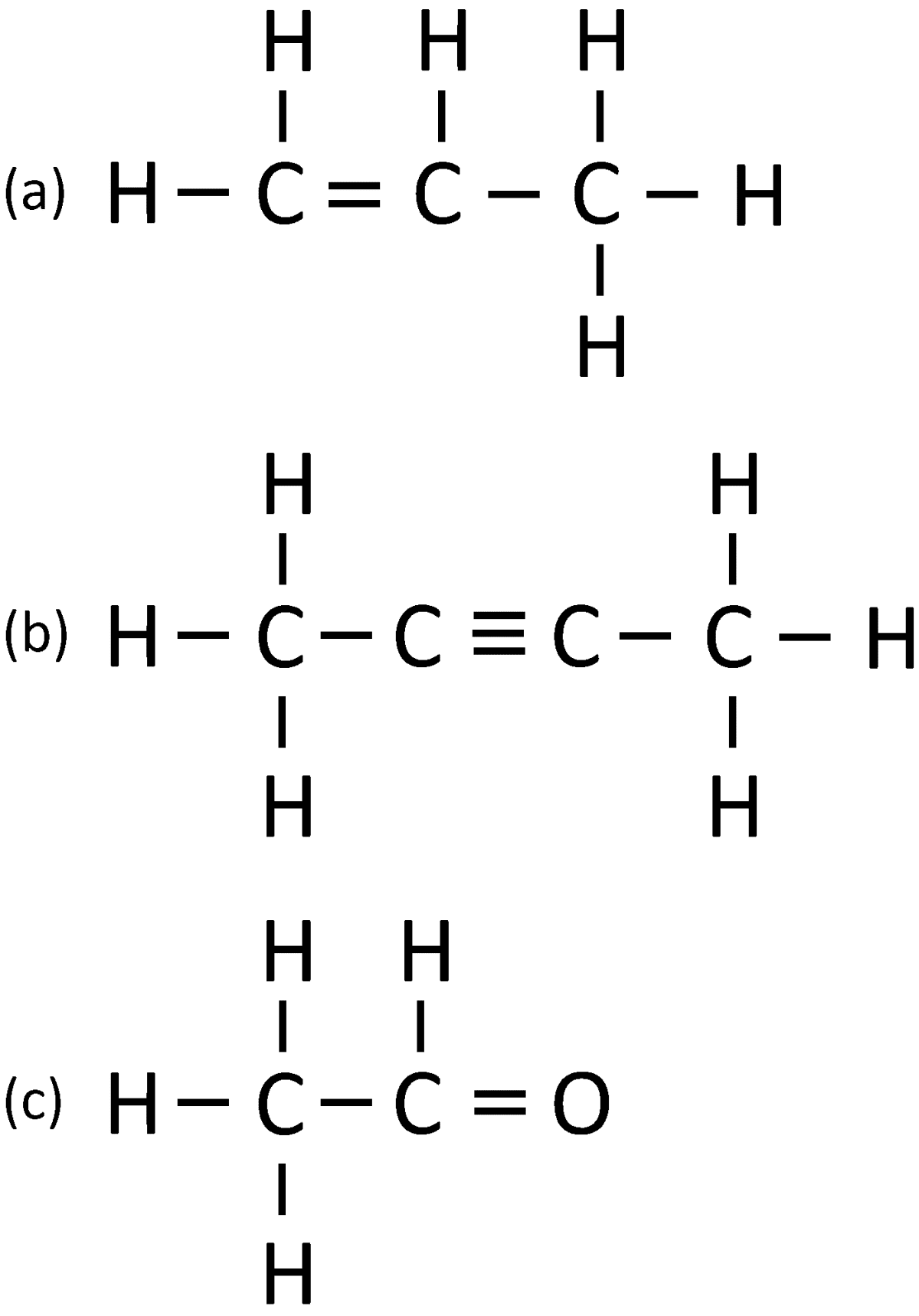
(i) Write the IUPAC names of each of the following:

Write the IUPAC names. Organic Chemistry, Simplified Chemistry Dalal Solutions ICSE Class 10.

(ii) Rewrite the following sentences by using the correct symbol > (greater than) or < (less than) in the blanks given:

Show SolutionHide Solution↓

(i) 1. Propene

  1. 2-butyne

  2. ethanal

(ii) 1. The ionization potential of potassium is < (less than) that of Sodium.

  1. The electronegativity of iodine is < (less than) that of chlorine.
2(a)Written · 2016 · Section II · 2016 PaperFull page

Use the letters only written in the Periodic Table given below to answer the questions that follow:

 IIIIIIIVVVIVIIO
1       L
2Q EGJZM 
3R       
4T       

(i) State the number of valence electrons in atom J.

(ii) Which element shown forms ions with a single negative charge?

(iii) Which metallic element is more reactive than R?

(iv) Which element has its electrons arranged in four shells?

Show SolutionHide Solution↓

(i) Atom J has 5 valence electrons as it belongs to the fifth group in the periodic table.

(ii) M forms ions with a single negative charge as it has 7 electrons in the valence shell and obtaining one more electron completes it's octet.

(iii) Metal T is more reactive than R because elements at the bottom of the group are more reactive.

(iv) T has it's electrons arranged in 4 shells as it belongs to 4th period.

2(b)Written · 2016 · Section II · 2016 PaperFull page

Fill in the blanks by selecting the correct word from the brackets:

(i) If an element has a low ionization energy then it is likely to be ............... (metallic/non metallic).

(ii) If an element has seven electrons in its outermost shell then it is likely to have the ............... (largest / smallest) atomic size among all the elements in the same period.

Show SolutionHide Solution↓

(i) If an element has a low ionization energy then it is likely to be metallic.

(ii) If an element has seven electrons in it's outermost shell then it is likely to have the smallest atomic size among all the elements in the same period.

2(c)Written · 2016 · Section II · 2016 PaperFull page

The following table shows the electronic configuration of the elements W, X, Y, Z:

ElementWXYZ
Electronic configurations2,8,12,8,72,51

(i) What type of bond is formed between:

     1. W and X
     2. Y and Z

(ii) What is the formula of the compound formed between :
     1. X and Z
     2. W and X

Show SolutionHide Solution↓

(i) Type of bond formed

(a) W (2,8,1) and X (2,8,7) — Electrovalent bond is formed as W donates 1 electron and X takes up that electron and both attain a stable octet.

(b) Y (2, 5) and Z (1) — Covalent bond as electron sharing takes place between the two elements. The valency of Z element is 1 and that of Y is 3. Z needs one electrons to attain stable duplet structure of nearest noble gas - He [2] and Y needs three electrons to attain stable octet structure of nearest noble gas - Ne [2,8]
One Y atom shares three electron pairs one with each of the three atoms of Z such that Z acquires a duplet configuration and Y attain a stable octet configuration resulting in the formation of three single covalent bonds.

(ii) Formula of the compound formed

(a) X (2,8,7) and Z (1) — XZ as X needs one 1 electron to complete it's octet and Z needs needs one electron to complete it's duplet hence, they both share one electron pair and forms ZX compound.

(b) W (2,8,1) and X (2,8,7) — WX as W has the tendency to donate one electron and gain stability whereas X has the tendency to gain one electron to be stable. Hence, W donates one electron and X takes it and form WX compound.

3(a)Written · 2016 · Section II · 2016 PaperFull page

Write a balanced chemical equation for each of the following:

(i) Burning of ethane in plentiful supply of air.

(ii) Action of water on Calcium carbide.

(iii) Heating of Ethanol at 170°C in the presence of conc. Sulphuric acid.

Show SolutionHide Solution↓

(i) Carbon dioxide and water are produced:

$2\text{C}_2\text{H}_6 + 7\text{O}_2[\text{excess}] \longrightarrow 4\text{CO}_2 + 6\text{H}_2\text{O} + \Delta$

(ii) Calcium hydroxide and ethyne are produced

$\underset{\text{calcium carbide}}{\text{CaC}_2} + \underset{\text{water}}{2\text{H}_2\text{O}} \longrightarrow \underset{\text{ethyne [acetylene]}}{\text{C}_2\text{H}_2} + \text{Ca(OH)}_2$

(iii) Ethene and water are produced

$\underset{\text{ ethyl alcohol}}{\text{C}_2\text{H}_5\text{OH}} \xrightarrow[170^{\circ}\text{C}]{\text{Conc. H}_2\text{SO}_4\text{[excess]}} \underset{ \text{ethene}}{\text{C}_2\text{H}_4} + \text{H}_2\text{O}\$

3(b)Written · 2016 · Section II · 2016 PaperFull page

Give the structural formulae of each of the following :

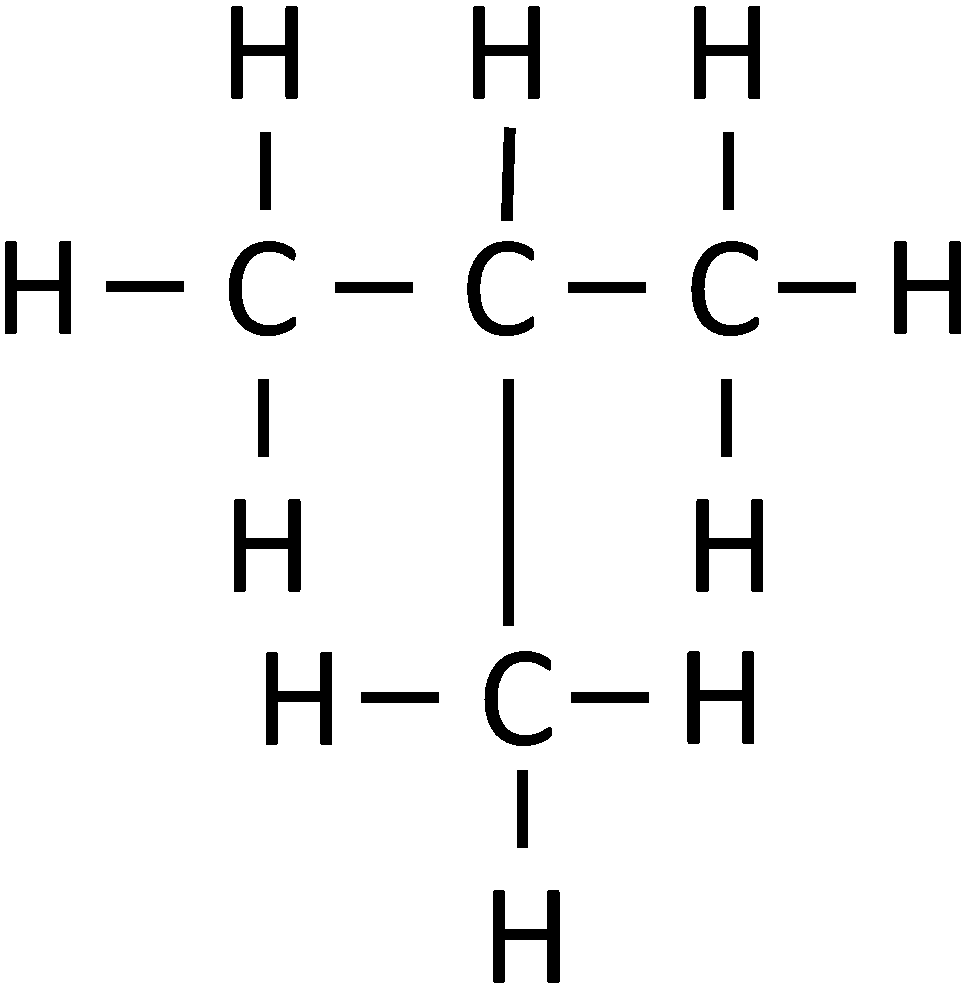
(i) 2-methyl propane

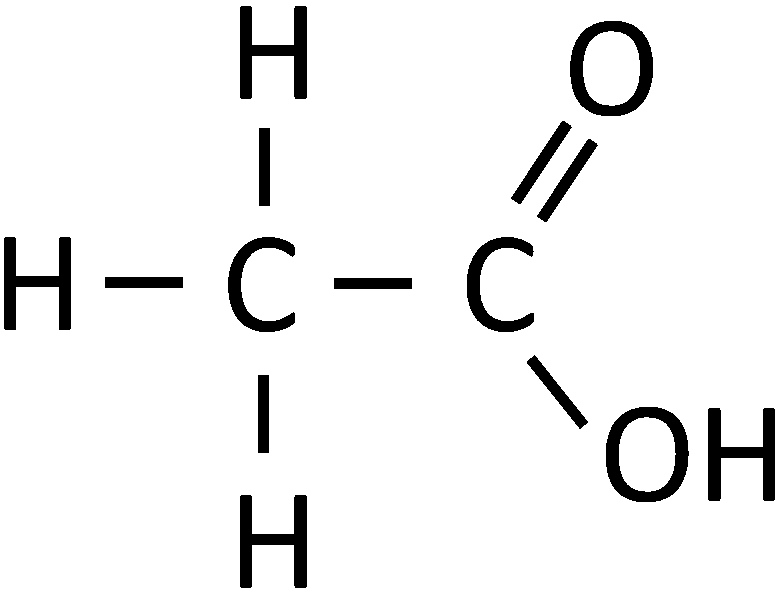
(ii) Ethanoic acid

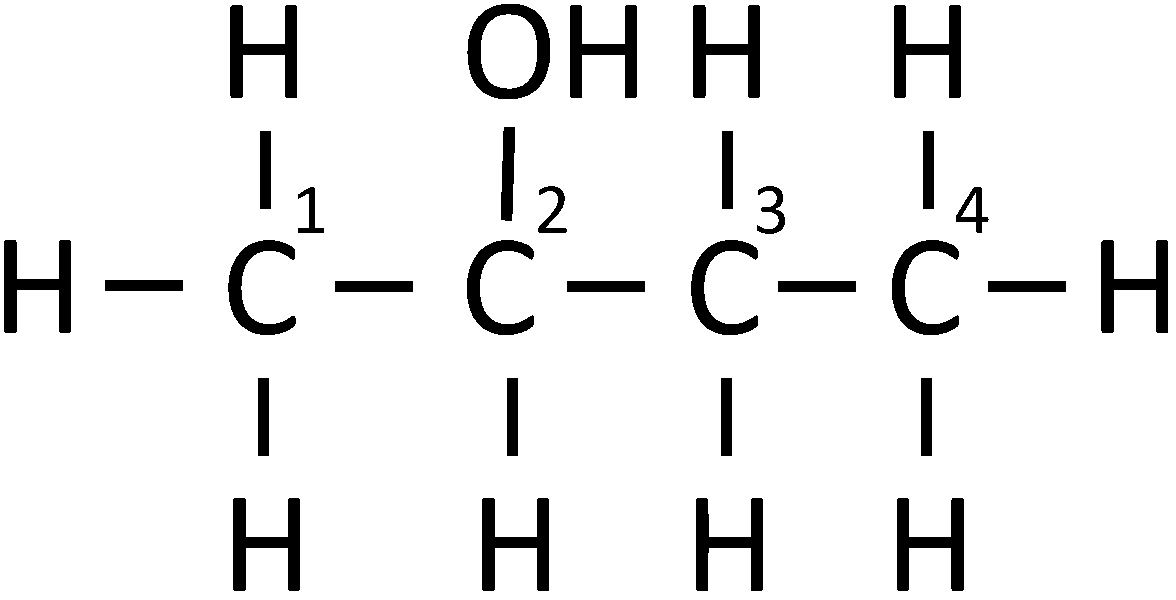
(iii) Butan-2-ol

Show SolutionHide Solution↓

(i) 2-methyl propane :

Give the structural formulae of 2-methyl propane. Organic Chemistry, Simplified Chemistry Dalal Solutions ICSE Class 10

(ii) Ethanoic acid :

Write structural formula of ethanoic acid. Organic Chemistry, Simplified Chemistry Dalal Solutions ICSE Class 10.

(iii) Butan – 2 – ol :

Write structural formula of Butan–2–ol. Organic Chemistry, Simplified Chemistry Dalal Solutions ICSE Class 10.
3(c)Written · 2016 · Section II · 2016 PaperFull page

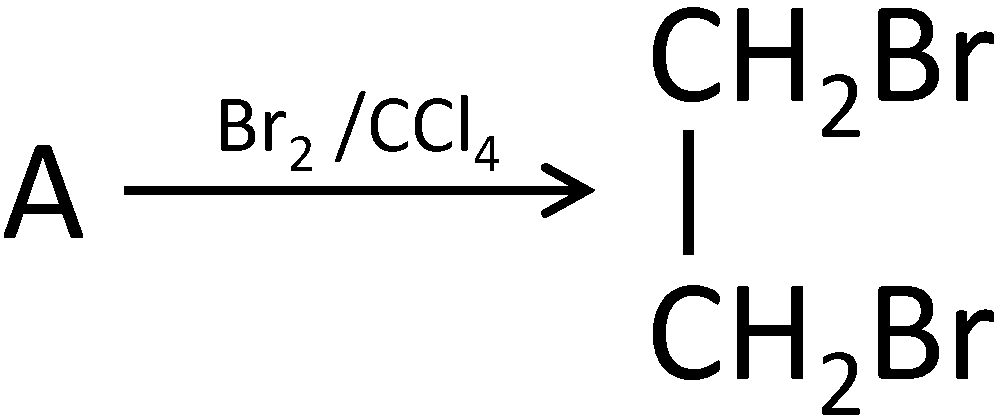
Equation for the reaction when compound A is bubbled through bromine dissolved in carbon tetrachloride is as follows:

Compound A is bubbled through bromine dissolved in carbon tetrachioride as follows. (i) Draw the structure of A. (ii) State your observation during this reaction. Organic Chemistry, Simplified Chemistry Dalal Solutions ICSE Class 10.

(i) Draw the structure of A.

(ii) State your observation during this reaction.

Show SolutionHide Solution↓

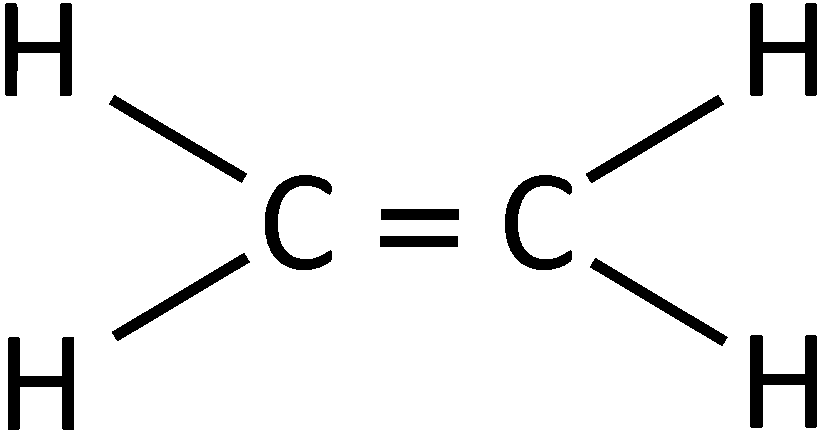
(i) Compound A is Ethene. Its structure is shown below:

Ethene structure. Organic Chemistry, Simplified Chemistry Dalal Solutions ICSE Class 10.

(ii) Brown colour of bromine is discharged.

3(d)Written · 2016 · Section II · 2016 PaperFull page

Fill in the blanks using the appropriate words given below:

(Sulphur dioxide, Nitrogen dioxide, Nitric oxide, Sulphuric acid)

(i) Cold, dilute nitric acid reacts with copper to give ...............

(ii) Hot, concentrated nitric acid reacts with sulphur to form ...............

Show SolutionHide Solution↓

(i) Cold, dilute nitric acid reacts with copper to given nitric oxide.

(ii) Hot, concentrated nitric acid reacts with sulphur to form nitrogen dioxide.

4(a)Written · 2016 · Section II · 2016 PaperFull page

Identify the gas evolved and give the chemical test in each of the following cases:

(i) Dilute hydrochloric acid reacts with sodium sulphite.

(ii) Dilute hydrochloric acid reacts with iron (II) sulphide.

Show SolutionHide Solution↓

(i) SO2 is evolved when dilute hydrochloric acid reacts with sodium sulphite.

Na2SO3 + 2HCl ⟶ 2NaCl + H2O + SO2 [g]

(ii) H2S gas is evolved when dilute hydrochloric acid reacts with Iron [II] sulphide.

FeS + 2HCl ⟶ FeCl2 + H2S

4(b)Written · 2016 · Section II · 2016 PaperFull page

State your observations when ammonium hydroxide solution is added drop by drop and then in excess to each of the following solutions:

(i) copper sulphate solution

(ii) zinc sulphate solution.

Show SolutionHide Solution↓

(i) Pale blue precipitate of Cu(OH)2 is formed, which becomes deep blue when excess of ammonium hydroxide is added.

CuSO4 + 2NH4OH ⟶ (NH4)2SO4 + Cu(OH)2 ↓

Cu(OH)2 + (NH4)2SO4 + 2NH4OH [in excess] ⟶ 4H2O + [Cu(NH3)4]SO4

(ii) Gelatinous white precipitate of zinc hydroxide is formed which becomes colourless solution on adding excess of ammonium hydroxide.

ZnSO4 + 2NH4OH ⟶ (NH4)2SO4 + Zn(OH)2 ↓

Zn(OH)2 +(NH4)2SO4 + 2NH4OH [in excess] ⟶ 4H2O + [Zn(NH3)4]SO4

4(c)Written · 2016 · Section II · 2016 PaperFull page

Write equations for the reactions taking place at the two electrodes (mentioning clearly the name of the electrode) during the electrolysis of:

(i) Acidified copper sulphate solution with copper electrodes.

(ii) Molten lead bromide with inert electrodes.

Show SolutionHide Solution↓

(i) Electrode — Cathode : Copper, Anode : Copper

Dissociation of aq. CuSO4 :

CuSO4 ⇌ Cu2+ + SO42-

H2O ⇌ H1+ + OH1-

H2SO4 ⇌ 2H1+ + SO42-

Reaction at cathode [pure thin sheet of Cu]:
Cu2+ + 2e- ⟶ Cu [Cu deposited on thin sheet]

Reaction at anode [impure block of active Cu]:
Cu - 2e- ⟶ Cu2+ [product nil - Cu2+ ions]

(ii) Electrode — Cathode : Iron or Graphite, Anode : Graphite

Dissociation of molten PbBr2 : PbBr2 ⇌ Pb2+ (cathode) + 2Br1- (anode)

Reaction at cathode:
Pb2+ + 2e- ⟶ Pb [product lead metal]

Reaction at anode:
Br1- - 1e-⟶ Br
Br + Br ⟶ Br2

4(d)Written · 2016 · Section II · 2016 PaperFull page

(i) Name the product formed at the anode during the electrolysis of acidified water using platinum electrodes.

(ii) Name the metallic ions that should be present in the electrolyte when an article made of copper is to be electroplated with silver.

Show SolutionHide Solution↓

(i) Oxygen

(ii) Silver ions

5(a)Written · 2016 · Section II · 2016 PaperFull page

A gas cylinder contains 12 x 1024 molecules of oxygen gas.
If Avogadro's number is 6 x 10²³; Calculate:

(i) the mass of oxygen present in the cylinder.

(ii) the volume of oxygen at S.T.P. present in the cylinder. [O=16]

Show SolutionHide Solution↓

Gram molecular mass of oxygen = 32 g = 1 mole and contains 6 x 10²³ molecules i.e., 6 x 10²³ molecules weigh 32 g

∴ 12 x 1024 molecules will weigh = $\frac{32}{ 6\times 10^{23}}$ x 12 x 1024 = 640 g

(ii) 6 x 10²³ molecules occupy 22.4 lit. of vol.

∴ 12 x 1024 molecules will occupy = $\frac{22.4}{ 6\times 10^{23}}$ x 12 x 1024 = 448 lit.

Hence, mass of O2 present in the cylinder = 640 g and volume of O2 at S.T.P. present in the cylinder = 448 lit.

5(b)Written · 2016 · Section II · 2016 PaperFull page

A gaseous hydrocarbon contains 82.76% of carbon. Given that its vapour density is 29, find its molecular formula.

[C=12, H=1]

Show SolutionHide Solution↓
Element% compositionAt. wt.Relative no. of atomsSimplest ratio
Carbon82.7612$\frac{82.76}{12}$ = 6.89$\frac{6.89}{6.89}$ = 1
Hydrogen17.241$\frac{17.24}{1}$ = 17.24$\frac{17.24}{6.89}$ = 2.5

Simplest ratio of whole numbers = C : H = 1 : 2.5 = 2 : 5

Hence, empirical formula is C2H5

Empirical formula weight = 2(12) + 5(1) = 29

V.D. = 29

Molecular weight = 2 x V.D. = 2 x 29

$$\begin{aligned}\text{n} = \frac{\text{Molecular weight}}{\text{Empirical formula weight}} \\[0.5em] = \frac{2 \times 29}{29} =2\end{aligned}$$

∴ Molecular formula = n[E.F.] = 2[C2H5] = C4H10

5(c)Written · 2016 · Section II · 2016 PaperFull page

The equation :

4NH3 + 5O2 ⟶ 4NO + 6H2O,

represents the catalytic oxidation of ammonia. If 100 cm3 of ammonia is used calculate the volume of oxygen required to oxidize the ammonia completely.

Show SolutionHide Solution↓

[By Lussac's law]

$$\begin{matrix} 4\text{NH}_3 & + & 5\text{O}_2 &\longrightarrow & 4\text{NO} & + & 6\text{H}_2\text{O} \\ 4 \text{ vol.} & : & 5 \text{ vol.} & \longrightarrow & 4\text{ vol.} \end{matrix}$$

To calculate the volume of oxygen required :

$$\begin{matrix}\text{NH}_3 & : & \text{O}_2 \\ 4 \text{ vol.} & : & 5 \text{ vol.} \\ 100 \text{ cm.}^3 & : & \text{x} \end{matrix}$$

$\therefore x = \frac{5}{4} \times 100 = 125 \text{ cm.}^3$

Hence, volume of oxygen required = 125 cm3

5(d)Written · 2016 · Section II · 2016 PaperFull page

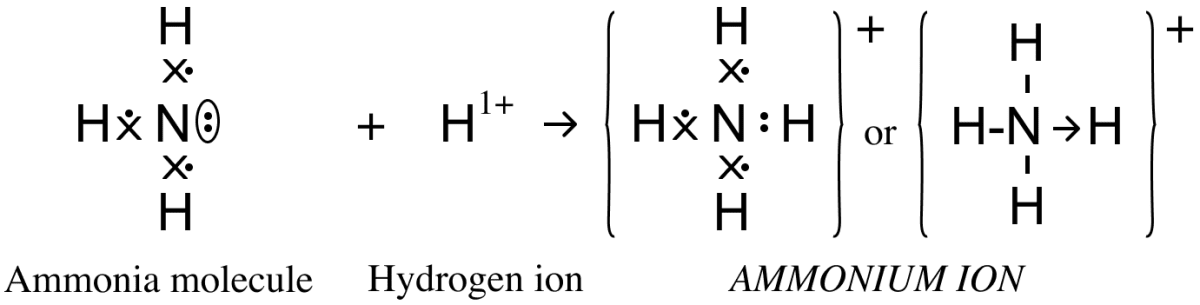
By drawing an electron dot diagram show the formation of ammonium ion [N = 7, H = 1]

Show SolutionHide Solution↓

Electron dot diagram showing the formation of ammonium ion is given below:

Draw an electron dot diagram to show the formation of ammonium ion [N = 7, H = 1]. Chemical Bonding, Simplified Chemistry Dalal Solutions ICSE Class 10
6(a)Written · 2016 · Section II · 2016 PaperFull page

Name the gas evolved when the following mixtures are heated:

(i) Calcium hydroxide and Ammonium Chloride

(ii) Sodium Nitrite and Ammonium Chloride

Show SolutionHide Solution↓

(i) Ammonia gas

2NH4Cl + Ca(OH)2 ⟶ CaCl2 + 2H2O + 2NH3

(ii) Nitrogen gas

NH4Cl + NaNO2 ⟶ NaCl + NH4NO2

NH4NO2 ⟶ 2H2O + N2

6(b)Written · 2016 · Section II · 2016 PaperFull page

Write balanced chemical equations for each of the following:

(i) When excess of ammonia is treated with chlorine.

(ii) An equation to illustrate the reducing nature of ammonia.

Show SolutionHide Solution↓

(i) 8NH3 [excess] + 3Cl2 ⟶ 6NH4Cl + N2

(ii) 2NH3 + 3CuO ⟶ 3Cu + 3H2O + N2 [g]

6(c)Written · 2016 · Section II · 2016 PaperFull page

A, B, C and D summarize the properties of sulphuric acid depending on whether it is dilute or concentrated.

A: Typical acid property

B: Non-volatile acid

C: Oxidizing agent

D: Dehydrating agent

Choose the property [A, B, C or D] depending on which is relevant to each of the following:

(i) Preparation of hydrogen chloride gas.

(ii) Preparation of copper sulphate from copper oxide.

(iii) Action of conc. sulphuric acid on sulphur.

Show SolutionHide Solution↓

(i) B: Non-volatile acid

$\text{NaCl} + \text{H}_2\text{SO}_4 [\text{conc.}]\xrightarrow{\lt 200 ^{\circ}\text{C}} \text{NaHSO}_\text{4} + \text{HCl}$

(ii) A: Typical acid property

CuO + H2SO4 (conc.) ⟶ CuSO4 + H2O

(iii) C: Oxidizing agent

S + 2H2SO4 (conc.) ⟶ 3SO2 + 2H2O

6(d)Written · 2016 · Section II · 2016 PaperFull page

Give reasons why:

(i) Sodium Chloride will conduct electricity only in fused or aqueous solution state.

(ii) In the electroplating of an article with silver, the electrolyte sodium argento-cyanide solution is preferred over silver nitrate solution.

(iii) Although copper is a good conductor of electricity, it is a non-electrolyte.

Show SolutionHide Solution↓

(i) The ions Na+ and Cl– are not free but held together by strong electrostatic force of attraction. In fused or molten state the ions break free and move. Hence, NaCl will conduct electricity only in fused state or aq. soln. state.

(ii) Migration of Ag1+ ions from sodium argentocyanide solution is slow compared to that from silver nitrate. Hence, an even deposition of metal silver is obtained on the article. Therefore, the electrolyte sodium argentocyanide soln. is preferred over silver nitrate solution.

(iii) Copper does not undergo chemical decomposition due to flow of electric current through it. Hence, copper is a good conductor of electricity but it is a non-electrolyte.

7(a)Written · 2016 · Section II · 2016 PaperFull page

(i) Name the solution used to react with Bauxite as a first step in obtaining pure aluminium oxide, in the Baeyer's process.

(ii) Write the equation for the reaction where the aluminium oxide for the electrolytic extraction of aluminium is obtained by heating aluminium hydroxide.

(iii) Name the compound added to pure alumina to lower the fusion temperature during the electrolytic reduction of alumina.

(iv) Write the equation for the reaction that occurs at the cathode during the extraction of aluminium by electrolysis.

(v) Explain why it is preferable to use a number of graphite electrodes as anode instead of a single electrode, during the above electrolysis.

Show SolutionHide Solution↓

(i) Sodium hydroxide

(ii) Conversion of Al(OH)3 - to pure alumina - heat on Al(OH)3

$\underset{\text{[aluminium hydroxide]}}{\text{2Al(OH)}_3} \xrightarrow{1100^{\circ}\text{C}} \underset{\text{[pure alumina]}}{\text{Al}_2\text{O}_3} + \text{3H}_2\text{O}$

(iii) Cryolite (Na3AlF6)

(iv) 2Al3+ + 6e- ⟶ 2Al

(v) The oxygen evolved at the anode escapes as a gas or reacts with the carbon anode. The carbon anode is thus oxidized to carbon monoxide which either burns giving carbon dioxide or escapes out through an outlet. [2C + O2 ⟶ 2CO; 2CO + O2 ⟶ 2CO2] The carbon anode is hence consumed and renewed periodically after a certain period of usage. It is therefore preferable to use a number of graphite electrodes as anode instead of a single electrode.

7(b)Written · 2016 · Section II · 2016 PaperFull page

State what would you observe when:

(i) Washing Soda Crystals are exposed to the atmosphere.

(ii) The salt ferric chloride is exposed to the atmosphere.

Show SolutionHide Solution↓

(i) When crystals of washing soda are exposed to air, it loses its water of crystallisation due to efflorescence.

(ii) When ferric chloride is exposed to the atmosphere, it absorbs moisture from the atmospheric air to become moist and ultimately dissolves in the absorbed water, forming a saturated solution.

7(c)Written · 2016 · Section II · 2016 PaperFull page

Identify the cations in each of the following case:

(i) NaOH solution when added to the solution 'A' gives a reddish brown precipitate.

(ii) NH4OH solution when added to the solution 'B' gives a white ppt which does not dissolve in excess.

(iii) NaOH solution when added to the solution 'C' gives a white ppt which is insoluble in excess.

Show SolutionHide Solution↓

(i) Ferric (Fe3+) ion

(ii) Lead (Pb2+) ion

(iii) Calcium (Ca2+) ion

Press ↓ to reveal a solution and move to the next question. Browse the free sample bank.

All 611 Chemistry questions