For work done to be maximum, the angle between the force and displacement should be :
(a)0°
(b)30°
(c)45°
(d)90°
Show SolutionHide Solution↓
0°
Reason — If the displacement is in the direction of force i.e., θ = 0°, then cos 0° = 1 and work done is maximum.
21 Mark · Exercise 2(A) — Multiple Choice Type
When a ball m is thrown upwards to a height h, the work done by the force of gravity is:
(a)mgh
(b)-mgh
(c)mg
(d)mgh2
Show SolutionHide Solution↓
-mgh
Reason — When a ball m is thrown upwards to a height h, the displacement h (upwards) is opposite to the direction of force of gravity mg (downwards), so the work done by the force of gravity mg in displacement h is W = -mgh i.e., negative.
31 Mark · Exercise 2(A) — Multiple Choice Type
Identify the incorrect statement :
No work is done by a force F on an object if :
(a)the object is stationary but the point of application of force moves on the object.
(b)the object moves in such a way that the point of application of force remains fixed.
(c)the force is always perpendicular to velocity.
(d)the force is always perpendicular to acceleration.
Show SolutionHide Solution↓
the force is always perpendicular to acceleration.
Reason — Work done by a force is given by,
Work done = F S Cos θ
So, no work is done when the force is perpendicular to the displacement of the point of application.
Let us check the given statements:
If the object is stationary, there is no displacement of the object as a whole, so work done is taken as zero.
If the point of application remains fixed, there is no displacement of that point, so no work is done.
If force is always perpendicular to velocity, it is perpendicular to displacement, so no work is done.
Force perpendicular to acceleration is not the condition for zero work. In fact, from Newton's second law, acceleration is generally in the direction of force.
Hence, incorrect statement is "the force is always perpendicular to acceleration".
41 Mark · Exercise 2(A) — Multiple Choice Type
A coolie A takes 1 minute to lift a load to the roof of a bus, whereas coolie B take 2 minutes to lift the same load to the roof of the same bus. The work done by B is:
(a)equal to work done by A
(b)greater than work done by A
(c)less than work done by A
(d)none of the above
Show SolutionHide Solution↓
equal to work done by A
Reason — From formula: ${\text W} = \vec{\text F}.\vec{\text S}$
Given that the distance lifted and the force applied are the same for both coolies, as they are lifting the same load to the same height (the roof of the bus) hence, the work done by both coolies is the same.
The time taken to do the work doesn't affect the amount of work done.
51 Mark · Exercise 2(A) — Multiple Choice Type
The energy of electron is 2.5 eV. When expressed in Joule, it is
(a)1.6 x 10⁻¹⁹ J
(b)4.0 x 10⁻¹⁹ J
(c)3.2 x 10⁻¹⁹ J
(d)0
Show SolutionHide Solution↓
4.0 x 10⁻¹⁹ J
Reason — Given, energy of electron = 2.5 eV
1 eV = 1.6 x 10⁻¹⁹ J
Hence,
2.5 eV = 2.5 x 1.6 x 10-19 = 4 x 10-19 J
61 Mark · Exercise 2(A) — Multiple Choice Type
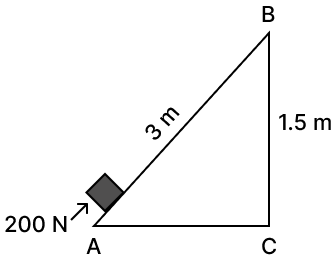
A block of mass 20 kg is pulled up a slope as shown in the figure given below with a constant speed by applying a force of 200 N parallel to the slope from the initial position A to the final position B. Work done in moving the block from A to B is:
(a)600 J
(b)500 J
(c)60 J
(d)200 J
Show SolutionHide Solution↓
600 J
Reason — Given,
Force = 200 N
Displacement = S = 3 m
As we know,
Work done = force × displacement in the direction of force
$$\begin{aligned}\text W = \text F \times \text S \\[1em] \text W = 200 \times 3 \\[1em] \text W = 600\ \text J\end{aligned}$$
Therefore, work done is 600J.
71 Mark · Exercise 2(A) — Multiple Choice Type
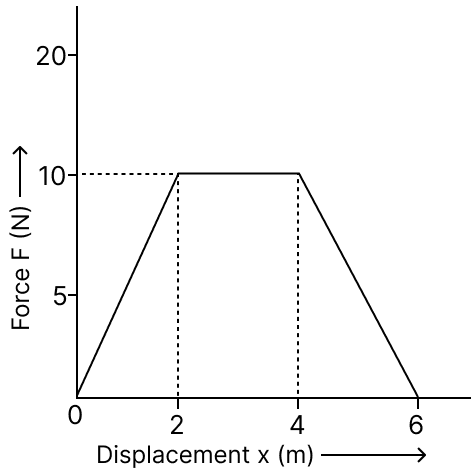
The graph given below shows a force-displacement graph. What is the total work done by force on the body in displacement from x = 0 to x = 6 m ?
(a)20 J
(b)40 J
(c)60 J
(d)80 J
Show SolutionHide Solution↓
40 J
Reason — The work done by a force can be determined from the area under the force–displacement graph.
From x = 0 m to x = 2 m, the graph forms a triangle rising from 0 to 10 N and its area is given by, Area = Work done = $\frac{1}{2}$ × 2 × 10 = 10 J.
From x = 2 m to x = 4 m, the force is constant at 10 N, forming a rectangle whose area is given by, Area = Work done = 2 × 10 = 20 J.
From x = 4 m to x = 6 m, the graph again forms a triangle decreasing from 10 N to 0 N and its area is given by, Area = Work done = $\frac{1}{2}$ × 2 × 10 = 10 J.
Adding these areas, the total work done is calculated :
Total work done = 10 + 20 + 10 = 40 J
Hence, 40 J is the total work done by the force on the body in displacement from x = 0 m to x = 6 m.
81 Mark · Exercise 2(A) — Multiple Choice Type
Assertion (A): When the displacement is normal to the direction of force, the work done is zero.
Reason (R): Work done depends on the angle between force and displacement.
(a)both A and R are true and R is the correct explanation of A
(b)both A and R are true but R is not the correct explanation of A
(c)assertion is false but reason is true
(d)assertion is true but reason is false
Show SolutionHide Solution↓
both A and R are true and R is the correct explanation of A.
Explanation
Assertion (A) is true.
As,
Work done (W) =$\vec{\text F}.\vec{\text d}$= Fdcosθ .............(i)
Where
F = magnitude of force
d = displacement
θ = angle between force and displacement
If displacement is normal (perpendicular) to the force, then 𝜃 = $90^o$
$\Rightarrow$ cos $90^o$ = 0 $\Rightarrow$ W = 0
Reason (R) is true.
From (i) it is clearly visible that work done depends upon angle between force vector and displacement vector.
Hence, R is the correct explanation of A.
91 Mark · Exercise 2(A) — Multiple Choice Type
Assertion (A): Work done by frictional force is negative.
Reason (R): This is because frictional force acts along the direction of motion.
(a)Both A and R are true and R is the correct explanation of A
(b)Both A and R are true and R is not the correct explanation of A
(c)Assertion is false but reason is true
(d)Assertion is true but reason is false
Show SolutionHide Solution↓
Assertion is true but reason is false
Explanation
Assertion (A) is true because friction acts opposite to the direction of displacement of the object. Since work depends on the angle between the force and the displacement and a force acting opposite to motion makes an angle of 180° which produces negative work.
Reason (R) is false because friction does not act along the direction of motion; it acts opposite to the direction of motion.
Hence, assertion is true but reason is false.
1Exercise 2(A) — Very Short Questions
A force F acts on a body and displaces it by a distance S in a direction at an angle θ with the direction of force.
(a) Write the expression for the work done by the force.
(b) What should be the angle between force and displacement so that the work done is (i) zero, (ii) maximum?
Show SolutionHide Solution↓
(a) When force acts at an angle θ to the direction of displacement then work done is
W = F × S Cos θ
(b)
(i) For work done to be zero the angle between force and displacement should be equal to 90° as cos 90° = 0
Therefore, product will also be zero.
W = F × S Cos 90° = 0
(ii) For work done to be maximum the angle between force and displacement should be equal to 0° as cos 0° = 1
Therefore, product will also be maximum.
W = F × S Cos 0° = F × S
2Exercise 2(A) — Very Short Questions
A body is moved in a direction opposite to the direction of force acting on it. State whether the work is done by the force or work is done against the force.
Show SolutionHide Solution↓
When a body is moved in a direction opposite to the direction of force then work is done against the force acting on the body.
When the displacement of the body due to application of force is in a direction opposite to the force then,
θ = 180°, and
cos 180° = -1
Therefore, Work done = (-) Force x displacement of the body.
3Exercise 2(A) — Very Short Questions
State whether work is done or not by writing yes or no, in the following cases?
(a) A man pushes a wall.
(b) A coolie stands with a box on his head for 15 min.
(c) A boy climbs up 20 stairs.
Show SolutionHide Solution↓
(a) No, work is not done by the man.
(b) No, work is not done by the coolie.
(c) Yes, work is done by the boy in climbing up the 20 stairs.
Explanation
(a) Work is not done by the man as on pushing the wall, it doesn't move hence, there is no displacement of the wall. Work is defined as the product of force and displacement in the direction of the force. Since there is no displacement, no work is done.
(b) Standing with a box on the head doesn't involve any displacement in the direction of the force of gravity acting on the box. The coolie is not moving the box, nor is there any vertical displacement. Therefore, no work is said to be done.
(c) When the boy climbs stairs, he exerts a force to lift his body against gravity. As he climbs, there is a vertical displacement as he moves from one step to the next. Since there is both force and displacement in the direction of the force (upward against gravity), work is done in this scenario.
4Exercise 2(A) — Very Short Questions
Give an example when work done by the force of gravity acting on a body is zero even though the body gets displaced from its initial position.
Show SolutionHide Solution↓
When a coolie carrying a load moves on a horizontal platform, the force of gravity acting on him is normal to the displacement of the load i.e. the angle between force and displacement of load is 90°.
Work done by Coolie = F × S cos 90° = F x S x 0 = 0.
Therefore, in this case work done by the force of gravity is zero even though the load gets displaced from its initial position.
5Exercise 2(A) — Very Short Questions
A boy of mass m climbs up a stairs of vertical height h.
(a) What is the work done by the boy against the force of gravity?
(b) What would have been the work done if he uses a lift in climbing the same vertical height?
Show SolutionHide Solution↓
When a boy of mass m climb up stairs of vertical height h then
(a) Work done by the boy against the force of gravity is
W = FS = mgh
(b) The work done when the boy uses a lift in climbing the same vertical height
W = FS = mgh
6Exercise 2(A) — Very Short Questions
What physical quantity does the electron volt (eV) measure? How is it related to the S.I. unit of that quantity?
Show SolutionHide Solution↓
The energy of atomic particles is measured in electron volt (eV)
1 eV = charge on an electron × 1 volt ⇒ 1 eV = 1.6 x 10⁻¹⁹ coulomb x 1 volt ⇒ 1 eV = 1.6 x 10⁻¹⁹ J
7Exercise 2(A) — Very Short Questions
Complete the following sentences :
(a) 1 J = ............... calorie.
(b) 1 kWh = ............... J.
Show SolutionHide Solution↓
(a) 1 J = 0.24 calorie.
(b) 1 kWh = 3.6 x 10⁶ J.
8Exercise 2(A) — Very Short Questions
Name the physical quantity which is measured in calorie. How is it related to the S.I unit of that quantity?
Show SolutionHide Solution↓
The physical quantity which is measured in calorie is heat energy.
1 calorie = 4.18 joule
9Exercise 2(A) — Very Short Questions
(a) Name the physical quantity measured in terms of horsepower.
(b) How is horsepower related to the S. I. unit of power?
Show SolutionHide Solution↓
(a) Power is the physical quantity measured in terms of horsepower.
(b) The relation between horsepower and S.I. unit of power is 1 horsepower = 746 watt.
10Exercise 2(A) — Very Short Questions
Name the quantity which is measured in
(a) kWh
(b) kW
(c) Wh
(d) eV
Show SolutionHide Solution↓
(a) Energy is measured in kWh
(b) Power is measured in kW
(c) Energy is measured in Wh
(d) Energy is measured in eV
11Exercise 2(A) — Very Short Questions
Is it possible that no transfer of energy takes place even when a force is applied to a body?
Show SolutionHide Solution↓
Yes there are cases when we will see no transfer of energy even on application of force.
Example - When a body moves in circular motion then force acts normal to the displacement of the body then there is no transfer of energy and work done is zero.
1Exercise 2(A) — Short Questions
Define work. When is work said to be done by a force?
Show SolutionHide Solution↓
The definition of work states that when force is applied on a body and the body moves then work is said to be done.
The condition for work done is displacement of the body when force is applied.
2Exercise 2(A) — Short Questions
How is the work done by a force measured when
(i) force is in the direction of displacement,
(ii) force is at an angle to the direction of displacement?
Show SolutionHide Solution↓
(i) When force is in direction of displacement then work done is given as —
Work done = Force x displacement of the point of application of force in the direction of force.
When,
W = work done
F = force applied
S = displacement of the body then we get,
W = F × S
(ii) When force acts at an angle to the direction of displacement then work done is given as —
Work done = Force x component of displacement in the direction of force.
When,
W = work done
F = force applied
S = displacement of the body then we get,
W = F × S cos θ
3Exercise 2(A) — Short Questions
A body is acted upon by a force. State two conditions when the work done is zero.
Show SolutionHide Solution↓
The two conditions for the work done to be zero are,
(i) When there is no displacement of the body on application of force i.e., S = 0 and
(ii) When displacement is normal to the direction of force i.e., θ = 90° as cos 90° = 0
4Exercise 2(A) — Short Questions
When a body moves in a circular path, how much work is done by the body? Give reason.
Show SolutionHide Solution↓
When a body moves in a circular path, no work is said to be done by the body as the force is directed towards the centre of circular path (the body is acted upon by the centripetal force).
At all points the displacement is along the tangent to the circular path, (i.e normal to the direction of the force).
5Exercise 2(A) — Short Questions
A satellite revolves around the earth in a circular orbit. What is the work done by the force of gravity on the satellite? Give reason.
Show SolutionHide Solution↓
When a satellite revolves around the earth in a circular orbit the work done is zero as force of gravity acting on satellite is perpendicular to its displacement.
6Exercise 2(A) — Short Questions
A coolie X carrying a load on his head climbs up a slope and another coolie Y carrying the identical load on his head move the same distance on a frictionless horizontal platform. Who does more work? Explain the reason.
Show SolutionHide Solution↓
Work done is given by the formula:
W = F × S cos θ
Coolie Y is moving the load on a frictionless horizontal platform. The force acting on the load is the force of gravity. In case of Coolie Y as the platform is horizontal so the angle between force and displacement is 90°.
Work done by Coolie Y = F × S cos 90° = F x S x 0 = 0.
Therefore Coolie Y does zero work.
Coolie X is moving the load on a slope. Assuming the angle of slope as θ:
Work done by Coolie X = F × S cos θ
Therefore, work done by coolie X is more than coolie Y.
7Exercise 2(A) — Short Questions
The work done by a fielder when he takes a catch in a cricket match is negative. Explain.
Show SolutionHide Solution↓
The work done by a fielder when he takes a catch is said to be negative as the force applied by him is in the direction opposite to the displacement of the ball.
8Exercise 2(A) — Short Questions
What are the S.I. and C.G.S. units of work? How are they related? Establish the relationship.
Show SolutionHide Solution↓
The S.I unit of work is Joule.
C.G.S unit of work is erg.
Relation between joule and erg:
1 joule = 1N × 1m
As we know, 1 N = 105 dyne and 1 m = 102 cm
Therefore,
1 joule = 105 dyne x 102 cm ⇒ 1 joule = 107 dyne cm
So, 1 joule = 107 erg.
9Exercise 2(A) — Short Questions
State and define the S.I. unit of work.
Show SolutionHide Solution↓
The S.I unit of work is Joule.
1 joule of work is said to be done when a force of 1 newton displaces a body through a distance of 1 metre in its own direction.
10Exercise 2(A) — Short Questions
Express joule in terms of erg.
Show SolutionHide Solution↓
1 joule = 1N × 1m
As we know, 1 N = 105 dyne and 1 m = 102 cm
Therefore,
1 joule = 105 dyne x 102 cm ⇒ 1 joule = 107 dyne cm
So, 1 joule = 107 erg.
11Exercise 2(A) — Short Questions
Define the term energy and state its S.I unit.
Show SolutionHide Solution↓
Energy is defined as the capacity to do work. The S.I unit of energy is Joule.
12Exercise 2(A) — Short Questions
Define kilowatt hour. How is it related to joule?
Show SolutionHide Solution↓
kilowatt-hour is the energy spent (or work done) by a source of power 1 kW in 1 hour.
1 kWh = 3.6 × 10⁶ joule.
13Exercise 2(A) — Short Questions
Define the term power. State its S.I. unit.
Show SolutionHide Solution↓
Power is defined as the rate of doing work. The S.I unit of power is watt (W)
14Exercise 2(A) — Short Questions
Differentiate between work and power.
Show SolutionHide Solution↓
Work
Power
Work done is the product of force and displacement produced due to the applied force.
Power is the rate of doing work.
Work done is independent of time.
Power spent depends on the time in which work is done.
S.I unit of work is joule (J)
S.I unit of power is watt (W)
15Exercise 2(A) — Short Questions
Differentiate between energy and power.
Show SolutionHide Solution↓
Energy
Power
Energy is defined as the capacity of a body to do work.
Power is the rate at which energy is supplied by a body.
Energy spent is independent of time.
Power depends on the time in which energy is spent.
S.I unit of energy is joule (J).
S.I unit of power is the watt (W).
16Exercise 2(A) — Short Questions
State and define the S.I unit of power.
Show SolutionHide Solution↓
The S.I unit of power is watt (W). The power spent is said to be 1 watt, if 1 joule of work is done in 1 second.
17Exercise 2(A) — Short Questions
Differentiate between watt and watt-hour.
Show SolutionHide Solution↓
The unit of power is watt (W) while the unit of work is watt-hour (Wh), since power × time = work or energy.
1Exercise 2(A) — Long Questions
State the condition when the work done by a force is (a) positive, (b) negative. Explain with the help of examples.
Show SolutionHide Solution↓
(a) When the displacement of the body is in the direction of force then the work done is said to be positive.
Therefore, W = F × S
Example - When a child pushes a toy table then the force applied by the child and the displacement of the table are in the same direction. So, work done is said to be positive.
(b) When the displacement of the body is in opposite direction to the force applied then the work done is negative.
Therefore, W = – F × S
Example - When a ball is thrown upwards with a force, the balls moves to a height (h).
However, the displacement is opposite to the direction of force of gravity.
W = -mgh
2Exercise 2(A) — Long Questions
A body of mass m falls through a height h. Obtain an expression for the work done by the force of gravity.
Show SolutionHide Solution↓
When body of mass m falls through a height (h) either vertically or on an inclined plane work is said to be done.
We know, work done is
W = F x S
However, the force of gravity on the body is F = mg acting vertically downwards and the vertical displacement in the direction of force is S = h.
Applying the values of F and S we get,
Work done by the force of gravity is
W = F x S = m x g x h
3Exercise 2(A) — Long Questions
State two factors on which power spent by a source depends. Explain your answer with examples.
Show SolutionHide Solution↓
The two factors on which the power spent by a source depends are :
The amount of work done by the source
The time taken by the source to do the said work.
For example:
Let us suppose a man X takes 5 minute to lift a load to the roof of a house and a man Y takes 10 minutes to lift the same load to the roof of the same house.
The work done by both the persons remain the same, but the power spent by the man X is twice the power spent by the man Y because man X does the work faster than man Y.
1Exercise 2(A) — Numericals
A body, when acted upon by a force of 20 kgf, gets displaced by 1 m. Calculate the work done by the force, when the displacement is
(i) in the direction of force,
(ii) at an angle of 60° with the force, and
(iii) normal to the force. (g = 10 N kg-1)
Show SolutionHide Solution↓
Given,
Force = 20 kgf and g = 10 N per kg
So,
Force = 20 x 10 = 200 N
Displacement = S = 1 m
As we know,
Work done = force × displacement in the direction of force
(i) When displacement is in the direction of force
$$\begin{aligned}\text W = \text F \times \text S \\[1em] \text W = 200 \times 1 \\[1em] \text W = 200\ \text J \\[1em]\end{aligned}$$
Therefore, work done is 200 J.
(ii) When displacement is at an angle of 60° with the force
$$\begin{aligned}\text W = \text F \times \text S \space \text {cos} \space \theta \\[1em] \text W = 200 \times 1 \space \text {cos} \space 60^{\circ} \\[1em] \text W = 200 \times 1 \times 0.5 \\[1em] \text W = 100\ \text J\end{aligned}$$
Therefore, work done is 100 J.
(iii) When displacement is normal to the force
$$\begin{aligned}\text W = \text F \times \text S \space \text {cos} \space \theta \\[0.5em] \text W = 200 \times 1 \space \text{cos} \space 90 ^{\circ}\\[0.5em] \text W = 200 \times 1 \times 0 \\[0.5em] \text W = 0\ \text J\end{aligned}$$
Therefore, work done is 0 J.
2Exercise 2(A) — Numericals
A boy of mass 40 kg climbs up the stairs and reaches the roof at a height 8 m in 5 s. Calculate:
(i) the force of gravity acting on the boy,
(ii) the work done by him against the force of gravity,
(iii) the power spent by the boy.
(Take g = 10 m s-2)
Show SolutionHide Solution↓
Given,
m = 40 kg
h = 8 m
t = 5 s
(i) Force of gravity acting on the boy
$$\begin{aligned}\text F = \text {mg} \\[1em] \text F = 40 \times 10 = 400\ \text N\end{aligned}$$
Hence, the force of gravity acting on the boy is 400 N.
(ii) Work done against gravity
$$\begin{aligned}\text W = \text F \times \text S \\[1em] \text W = 400 \times 8 = 3200\ \text J\end{aligned}$$
Hence, the work done by the boy against the force of gravity is 3200 J.
An ox can apply a maximum force of 1000 N. It is taking part in a cart race and is able to pull the cart at a constant speed of 30 m s-1 while making its best effort. Calculate the power developed by the ox.
Show SolutionHide Solution↓
Given,
Force = 1000 N
Velocity = 30 m/s
Power = force × velocity
= 1000 x 30 = 30,000 W
Therefore, power developed by the ox is 30 kW
8Exercise 2(A) — Numericals
The power of a motor is 40 kW. At what speed can the motor raise a load of 20,000 N?
It takes 20 s for a person A of mass 50 kg to climb up the stairs, while another person B of same mass does the same in 15 s.
Compare the
(i) work done, and
(ii) power developed by the persons A and B.
Show SolutionHide Solution↓
(i) We know that work done is a product of force and displacement and is independent of time. Hence both persons A and B will do the same amount of work.
Therefore, ratio of work done by A and B = 1:1
(ii) The power developed by the persons A and B :
We know that Power = work done / time
Work done is same by A and B
Time A took = 20 s
Time B took = 15 s
Therefore, more power is spent by B as B does the work at a faster rate.
Substituting the values in formula we get :
Power = 1 / time
$$\begin{aligned}{\text{Power spent by A}} : {\text{Power spent by B}} = \frac{15}{20} \\[1em] \Rightarrow {\text {Power spent by A}} : {\text {Power spent by B}} = 3 : 4\end{aligned}$$
12Exercise 2(A) — Numericals
A boy weighing 40 kgf climbs up a stair of 30 steps, each 20 cm high in 4 minutes and a girl weighing 30 kgf does the same in 3 minutes.
Compare :
(i) the work done by them, and
(ii) the power developed by them.
Show SolutionHide Solution↓
(i) We know that work done is a product of force and displacement
Therefore, work done by boy : work done by girl = 4 : 3.
(ii) The power developed —
We know that,
$$\begin{aligned}\text{Power} = \frac{\text{Work done}}{\text{Time}} \\[1em] \frac{\text{Power developed by boy}}{\text{Power developed by girl}} \\[1em] = \frac{\frac{\text{work done by boy}}{\text{time taken by boy}}}{\frac{\text{work done by girl}}{\text{time taken by girl}}} \\[1em] = \frac{\frac{40 \times 10 \times 6}{240}}{\frac{30 \times 10 \times 6}{180}} \\[1em] = \frac{\frac{2400}{240}}{\frac{1800}{180}} \\[1em] = \frac{10}{10} \\[1em] = \frac{1}{1}\end{aligned}$$
Therefore, Power developed by boy : Power developed by girl = 1:1
13Exercise 2(A) — Numericals
A man raises a box of mass 50 kg to a height of 2 m in 20 s, while another man raises the same box to the same height in 50 s.
(a) Compare : (i) the work done, and (ii) the power developed by them.
(b) Calculate : (i) the work done, and (ii) the power developed by each man.
Take g = 10 N kg-1.
Show SolutionHide Solution↓
(a)
(i) Work done = force x displacement
Hence, work done is same for both men as both carry 50 kg weight to a height of 2m.
Therefore, Work done by first man : Work done by second man = 1 : 1
(ii)
Let the work done by both men be W.
$$\begin{aligned}\text{Power} = \frac{\text{Work done}}{\text{Time}} \\[1em] \frac{\text{Power developed by Man A}}{\text{Power developed by Man B}} \\[1em] = \frac{\frac{\text{Work done by Man A}}{\text{Time taken by Man A}}}{\frac{\text{Work done by Man B}}{\text{Time taken by Man B}}} \\[1em] = \frac{\frac{\text W}{20}}{\frac{\text W}{50}} \\[1em] = \frac{5}{2}\end{aligned}$$
Therefore, Power developed by Man A : Power developed by Man B = 5 : 2
(b)
(i) As we know,
W = F x S = mgh
$$\begin{aligned}\text W = 50 \times 10 \times 2 = 1000\ \text J \\[1em] \Rightarrow \text W = 1000\ \text J\end{aligned}$$
Hence, the work done by each man is 1000 joules.
(ii) Power developed by Man A
$$\begin{aligned}\text P = \frac{1000}{20} \\[1em] \Rightarrow \text P = 50\ \text W\end{aligned}$$
Power developed by Man B
$$\begin{aligned}\text P = \frac{1000}{50} \\[1em] \Rightarrow \text P = 20\ \text W\end{aligned}$$
Hence, power developed by Man A is 50 W and power developed by Man B is 20 W.
14Exercise 2(A) — Numericals
A boy takes 3 minutes to lift a 20 litre water bucket from a 20 m deep well, while his father does it in 2 minutes.
(a) Compare:
(i) the work, and (ii) power developed by them.
(b) How much work each does?
Take density of water = 103kg m -3 and g = 9.8 N kg-1.
Show SolutionHide Solution↓
(a)
(i) Work done = force x displacement
Work done is same for boy and father as both lift 20 litre water from 20 m deep well.
Work done by boy : Work done by father = 1 : 1
(ii) Comparing Power developed:
$$\begin{aligned}\text{Power} = \frac{\text{Work done}}{\text{Time}} \\[1em] {\text {Power of boy}} : {\text {Power of father }} = \frac{\frac{\text W}{3}}{\frac{\text W}{2}} \\[1em] \Rightarrow {\text {Power developed by boy}} : {\text {Power developed by father}} = \frac{2}{3}\end{aligned}$$
Power developed by boy : Power developed by father = 2:3
Now, substituting the values in the formula for work done we get
W = 20 x 9.8 x 20 = 3.92 kJ
15Exercise 2(A) — Numericals
A body of mass 5 kg moves along a straight line under the action of a variable force. From x = 0 to x = 4 m, the force acts in the direction of displacement and increases linearly from 0 N to 20 N. From x = 4 m to x = 6 m, the motion of the body reverses while the force acts in forward direction. From x = 6 m to x = 10 m, the force becomes negative acting opposite to the original direction of motion. Calculate the net work done by the force on the body.
Show SolutionHide Solution↓
Work done by a variable force equals the area under the force–displacement (F–x) graph and its sign depends on the direction of displacement relative to the force.
From x = 0 m to x = 4 m:
The force increases linearly from 0 N to 20 N in the direction of displacement so, the graph forms a triangle and the work done is given by,
Area of the triangle formed = Work done = $\frac{1}{2}$ × 4 × 20 = +40 J [∵ Force acts along the direction of displacement]
From x = 4 m to x = 6 m:
The motion of the body reverses while the force still acts forward. Since displacement is opposite to the force, the work done is negative. Assuming the force remains 20 N, the area formed is a rectangle and the work done is given by,
Area of the rectangle formed = Work done = -20 × 2 = -40 J,
From x = 6 m to x = 10 m
The force becomes negative (opposite to the original direction) and since the displacement is also reversed so both force and displacement are in the same direction and the work done again becomes positive. The graph forms a rectangle and the work done is given by.
Area of the rectangle formed = Work done = 4 × 20 = 80 J
Net work done by the force = 40 + (-40) + 80 = 120 - 40 = 80 J
Hence, the net work done by the force on the body is 80 J.
11 Mark · Exercise 2(B) — Multiple Choice Type
According to the work energy theorem, the increase in the kinetic energy of a moving body is equal to ............... by a force acting in the direction of the moving body.
(a)displacement
(b)velocity
(c)acceleration
(d)work done
Show SolutionHide Solution↓
work done
Reason — According to the work energy theorem, the increase in the kinetic energy of a moving body is equal to work done by a force acting in the direction of the moving body.
21 Mark · Exercise 2(B) — Multiple Choice Type
A wire clamped at both ends is struck in the middle. It will possess :
(a)rotational kinetic energy
(b)translation kinetic energy
(c)vibrational kinetic energy
(d)none of these
Show SolutionHide Solution↓
vibrational kinetic energy
Reason — When a wire clamped at both ends is struck in the middle, it will vibrate back and forth. This motion results in vibrational kinetic energy, as the wire undergoes oscillations about its equilibrium position.
31 Mark · Exercise 2(B) — Multiple Choice Type
The velocity of a moving cart is reduced to $\frac{1}{3}$rd of the initial velocity. Its kinetic energy is reduced by :
(a)$\frac{1}{2}$
(b)$\frac{1}{3}$
(c)$\frac{1}{6}$
(d)$\frac{1}{9}$
Show SolutionHide Solution↓
$\frac{1}{9}$
Reason — Let initial velocity be v.
Kinetic Energy at v = $\frac{1}{2}$ x m x v2 = $\frac{\text{mv}^2}{2}$
Kinetic Energy at $\frac{\text{v}}{3}$ = $\frac{1}{2}$ x m x $(\frac{\text{v}}{3})^2$ = $\frac{1}{9}\Big(\frac{\text{mv}^2}{2}\Big)$
Hence, the kinetic energy is reduced by $\frac{\bold 1}{\bold 9}$.
41 Mark · Exercise 2(B) — Multiple Choice Type
A body of mass 10 kg is moving with a velocity of 20 m/s. The mass of the body is doubled and velocity is halved. Its initial kinetic energy is:
(a)200 J
(b)4000 J
(c)2000 J
(d)1000 J
Show SolutionHide Solution↓
2000 J
Reason — Given,
Initial velocity = 20 m/s.
Mass = 10 kg
Kinetic Energy = $\frac{\text{mv}^2}{2}$
Substituting we get,
Kinetic Energy = $\frac{\text{10 x (20) }^2}{2}$ = $\frac{\text{10 x 400}}{2}$ = 2000 J
51 Mark · Exercise 2(B) — Multiple Choice Type
On doubling the velocity of a moving body, the quantity which gets double is:
(a)acceleration
(b)momentum
(c)kinetic energy
(d)weight
Show SolutionHide Solution↓
momentum
Reason — The momentum of an object is given by the product of its mass (m) and velocity (v) represented by :
p = mv
If the velocity is doubled, then the new momentum (p') becomes:
p' = m x 2v = 2(mv) = 2p
So, the momentum gets doubled when the velocity is doubled.
61 Mark · Exercise 2(B) — Multiple Choice Type
In a photoelectric cell, the change in energy is from:
(a)electrical to mechanical
(b)light energy to electrical energy
(c)electrical energy to light energy
(d)chemical energy to light energy
Show SolutionHide Solution↓
light energy to electrical energy
Reason — A photoelectric cell, also known as solar cell, converts light energy (photons) into electrical energy (electrons). When light strikes the surface of the cell, it excites electrons, causing them to be ejected from the material (the photoelectric effect). These ejected electrons can then be collected and used as electric current.
71 Mark · Exercise 2(B) — Multiple Choice Type
In a petrol vehicle while in motion, the change in energy is from
(a)kinetic energy to potential energy
(b)chemical energy to kinetic energy
(c)potential energy to kinetic energy
(d)chemical energy to potential energy
Show SolutionHide Solution↓
chemical energy to kinetic energy
Reason — In a petrol vehicle, the chemical energy stored in the fuel (petrol) is converted into kinetic energy as the vehicle moves. This conversion of chemical energy into kinetic energy occurs through the process of combustion within the engine, where the chemical bonds in the fuel are broken, releasing energy that propels the vehicle forward.
81 Mark · Exercise 2(B) — Multiple Choice Type
In nuclear fission:
(a)chemical energy changes to electrical energy
(b)mechanical energy changes to chemical energy
(c)nuclear energy changes to electrical energy
(d)electric energy changes to nuclear energy
Show SolutionHide Solution↓
nuclear energy changes to electrical energy
Reason — Nuclear fission is a nuclear reaction in which the nucleus of an atom splits into smaller parts, releasing a significant amount of energy. This energy is in the form of nuclear energy and is used for constructive purposes to produce electrical energy.
91 Mark · Exercise 2(B) — Multiple Choice Type
Force F applied on a body moves it through a distance S along F. The energy spent is :
(a)F x S
(b)F/S
(c)FS2
(d)F/S2
Show SolutionHide Solution↓
F x S
Reason — When a force moves a body through a displacement in the same direction as the force, the energy spent by the force equals the work done.
Work done is defined as the product of the force and the displacement in the direction of the force. Therefore, if a force F moves a body through a distance S along its direction, the work done (and hence the energy spent) is given by,
W = F × S
101 Mark · Exercise 2(B) — Multiple Choice Type
In which case will the potential energy decrease ?
(a)Compressing a spring
(b)Stretching a spring
(c)Moving a body against gravitation
(d)A bus descending down a steep hill
Show SolutionHide Solution↓
A bus descending down a steep hill
Reason — Potential energy decreases when the height of a body decreases.
So,
Compressing or stretching a spring increases elastic potential energy, and
Moving a body against gravity increases gravitational potential energy.
When a bus descends a hill, its height decreases, so its potential energy decreases.
111 Mark · Exercise 2(B) — Multiple Choice Type
A light and a heavy body have equal K.E. Which body will have a greater momentum?
(a)heavy
(b)light
(c)both
(d)cannot say
Show SolutionHide Solution↓
heavy
Reason — Kinetic energy is given by K = $\frac{1}{2}$mv2 and momentum by p = mv. For the same kinetic energy, momentum can be written as p = $\sqrt {2\text {mK}}$ and since momentum depends on the square root of mass, the body with the greater mass will have greater momentum when kinetic energies are equal.
Hence, heavy body will have a greater momentum.
121 Mark · Exercise 2(B) — Multiple Choice Type
Assertion (A): If momentum of a body increases by 50 %, its kinetic energy will increase by 125 %.
Reason (R): Kinetic energy is proportional to the square of velocity.
(a)both A and R are true and R is the correct explanation of A
(b)both A and R are false and R is not the correct explanation of A
(c)assertion is false but reason is true
(d)assertion is true but reason is false
Show SolutionHide Solution↓
both A and R are true and R is the correct explanation of A.
Explanation
Assertion (A) is true. When the momentum of a body increases by 50%, its kinetic energy will increase by 125%.
Let initial momentum be p and kinetic energy be K
If p increases by 50%, the new momentum p' = p + $\frac{\text p}{2}$ = $\frac{3\text p}{2}$
Relation between kinetic energy and momentum is given by; K = $\frac{\text p^2}{2m}$
= $\frac{ \frac{9\text K - 4\text K}{4}}{\text K}$ x 100 %
= $\frac{ \frac{5\text K}{4}}{\text K}$ x 100 %
= $\frac{5}{4}$ x 100 = 125 %
Hence, kinetic energy will increase by 125 %.
Reason (R) is true. Kinetic energy is proportional to the square of velocity, according to the formula: KE = $\frac{1}{2}$mv2.
Hence, both A and R are true and R is the correct explanation of A.
131 Mark · Exercise 2(B) — Multiple Choice Type
Assertion (A): A spring has potential energy in both cases whether it is compressed or stretched.
Reason (R): This is because work is done on the spring against the restoring force.
(a)both A and R are true and R is the correct explanation of A
(b)both A and R are false and R is not the correct explanation of A
(c)assertion is false but reason is true
(d)assertion is true but reason is false
Show SolutionHide Solution↓
both A and R are true and R is the correct explanation of A.
Explanation
Assertion (A) is true because when a spring is either compressed or stretched from its natural length, energy is stored in it as elastic potential energy due to the change in its shape.
Reason (R) is true because to compress or stretch a spring, an external force must do work against the restoring force of the spring and this work gets stored in the spring as potential energy.
The reason justifies the assertion because when a spring is compressed or stretched, work is done against its restoring force which gets stored in the spring as elastic potential energy, so the spring has potential energy in both cases.
Hence, both A and R are true and R is the correct explanation of A.
1Exercise 2(B) — Very Short Questions
What are the two forms of mechanical energy?
Show SolutionHide Solution↓
The two forms of mechanical energy are
Kinetic energy
Potential energy
2Exercise 2(B) — Very Short Questions
Name the form of energy which a wound-up watch spring possesses.
Show SolutionHide Solution↓
Wound up watch spring possesses an elastic potential energy.
3Exercise 2(B) — Very Short Questions
Name the type of energy (kinetic energy K or potential energy U) possessed in the following cases:
(a) A moving cricket ball
(b) A compressed spring
(c) A moving bus
(d) A stretched wire
(e) An arrow shot out of a bow.
(f) A piece of stone placed on the roof.
Show SolutionHide Solution↓
(a) A moving cricket ball posses Kinetic energy — K.
(b) A compressed spring posses Potential energy — U.
(c) A moving bus posses Kinetic energy — K.
(d) A stretched wire posses Potential energy — U.
(e) An arrow shot out of a bow posses Kinetic energy — K.
(f) A piece of stone placed on the roof posses Potential energy — U.
4Exercise 2(B) — Very Short Questions
(a) A body of mass m is moving with a velocity v. Write the expression for its kinetic energy.
(b) Show that the quantity 2K/v2 has the unit of mass, where K is the kinetic energy of the body.
Show SolutionHide Solution↓
(a) The expression for a body of mass m moving with a velocity v is given by
Two bodies A and B of masses m and M (M ≫ m) have same kinetic energy. Which body will have more momentum?
Show SolutionHide Solution↓
Kinetic energy and momentum are related as
$\text p = \sqrt{2\text {mk}}$
Since,
the kinetic energy of both bodies are same, momentum is directly proportional to the square root of mass.
As we can see that mass of body B is greater than that a body A.
Therefore, body B will have more momentum than body A.
6Exercise 2(B) — Very Short Questions
Complete the following sentences
(a) The kinetic energy of a body is the energy by virtue of its ...............
(b) The potential energy of a body is the energy by virtue of its ...............
(c) The conversion of part of energy into an undesirable form is called ...............
Show SolutionHide Solution↓
(a) The kinetic energy of a body is the energy by virtue of its motion.
(b) The potential energy of a body is the energy by virtue of its position.
(c) The conversion of part of energy into an undesirable form is called degradation of energy.
7Exercise 2(B) — Very Short Questions
Energy can exist in several forms and may change from one form to another. For each of the following, state the energy changes that occur in:
(a) the unwinding of a watch spring
(b) a loaded truck when started and set in motion
(c) a car going uphill
(d) photosynthesis in green leaves
(e) charging of a battery
(f) respiration
(g) burning of a match stick
(h) explosion of crackers
Show SolutionHide Solution↓
(a) Potential energy of a watch spring converts into kinetic energy
(b) Chemical energy of diesel or petrol converts into mechanical energy
(c) Kinetic energy converts into potential energy
(d) Light energy converts into chemical energy
(e) Electrical energy converts into chemical energy
(f) Chemical energy converts into heat energy
(g) Chemical energy converts into heat and light energy
(h) Chemical energy converts into heat, light and sound energy
8Exercise 2(B) — Very Short Questions
State the energy changes in the following cases while in use:
(a) Loudspeaker
(b) A steam engine
(c) Microphone
(d) Washing machine
(e) A glowing electric bulb
(f) Burning coal
(g) A solar cell
(h) Bio-gas burner
(i) An electric cell in a circuit
(j) A petrol engine of a running car
(k) An electric iron
(l) A ceiling fan
(m) An electromagnet.
Show SolutionHide Solution↓
(a) Electrical energy changes into sound energy
(b) Heat energy changes into mechanical energy
(c) Sound energy changes into electrical energy
(d) Electrical energy changes into mechanical energy
(e) Electrical energy changes into light energy
(f) Chemical energy changes into heat energy
(g) Light energy changes into electrical energy
(h) Chemical energy changes into heat energy
(i) Chemical energy changes into electrical energy
(j) Chemical energy changes into mechanical energy
(k) Electrical energy changes into heat energy
(l) Electrical energy changes into mechanical energy
(m) Electrical energy changes into magnetic energy
9Exercise 2(B) — Very Short Questions
Name the process used for producing electricity from nuclear energy.
Show SolutionHide Solution↓
Nuclear fission is the process used for producing electricity from nuclear energy.
10Exercise 2(B) — Very Short Questions
Is it practically possible to convert a form of energy completely into the other useful form? Explain your answer.
Show SolutionHide Solution↓
It is not possible to completely convert one form of energy into other as a part of the energy is dissipated in the form of heat which is lost to the surroundings.
1Exercise 2(B) — Short Questions
Define the term potential energy of a body. Name its two forms and give one example of each.
Show SolutionHide Solution↓
The energy possessed by a body at rest due to its position or size and shape is called the potential energy.
Different forms of potential energy are as follows:
(i) Gravitational potential energy — It is the energy possessed by a body due to the force of attraction of the earth.
Example — A stone at a height has gravitational potential energy.
(ii) Elastic potential energy — It is the energy possessed by a body due to the deformed state because of change in its shape and size.
Example — When a spring is compressed it has elastic potential energy.
2Exercise 2(B) — Short Questions
Name the form of energy which a body may possess even when it is not in motion. Give an example to support your answer.
Show SolutionHide Solution↓
A body possesses potential energy even when it is not in motion.
For example — a stone raised at a height has gravitational potential energy.
3Exercise 2(B) — Short Questions
What do you understand by the kinetic energy of a body?
Show SolutionHide Solution↓
Kinetic Energy of a body is the energy possessed by a body in motion.
4Exercise 2(B) — Short Questions
State the work–energy theorem.
Show SolutionHide Solution↓
According to the work theorem,
The work done by a force in the same direction on a moving body is equal to the increase in its kinetic energy.
5Exercise 2(B) — Short Questions
A body of mass m is moving with a uniform velocity u. A force is applied on the body due to which its velocity increases from u to v. How much work is being done by the force?
$$\begin{aligned}\text W = \text m \times \text a \times (\frac{\text v^2 - \text u^2}{2\text a}) \\[1em] \text W = (\frac{1}{2} \times \text m \times \text v^2) - (\frac{1}{2} \times \text m \times \text u^2) \\[1em] \text W = (\frac{1}{2} \times \text m \times \text v^2) - (\frac{1}{2} \times \text m \times \text u^2) \\[1em] \text W = \frac{1}{2} \text m (\text v^2 - \text u^2) \\[1em] \text W = \text {KE}_\text f - \text {KE}_\text i\end{aligned}$$
6Exercise 2(B) — Short Questions
A light mass and a heavy mass have equal momentum. Which will have more kinetic energy? [Hint : kinetic energy K = p2/2m where p is the momentum]
Show SolutionHide Solution↓
Kinetic energy (KE) and momentum (p) are related as
$\text {KE} = \frac{\text p^2}{2\text m}$
As both masses have the same momentum p. The kinetic energy k is inversely proportional to the mass of the body.
Hence, a body of light mass has more kinetic energy as smaller the mass, larger is its kinetic energy.
7Exercise 2(B) — Short Questions
Name the three forms of kinetic energy and give one example of each.
Show SolutionHide Solution↓
The three forms of kinetic energy are:
(i) Vibrational kinetic energy
Example — A wire clamped at both the ends vibrates when struck.
(ii) Rotational kinetic energy
Example — A spinning top.
(iii) Translational kinetic energy
Example — A car moving in a straight path.
8Exercise 2(B) — Short Questions
State two differences between the potential energy and the kinetic energy.
Show SolutionHide Solution↓
Potential energy
Kinetic energy
It is the energy possessed by a body due to its changed position or change in shape or size.
It is the energy possessed by a body due to its state of motion.
It does not depend on the speed of the body.
It depends on the speed of the body.
9Exercise 2(B) — Short Questions
Name six different forms of energy?
Show SolutionHide Solution↓
The six different forms of energy are
(i) Heat energy
(ii) Solar energy
(iii) Nuclear energy
(iv) Hydro energy
(v) Light energy
(vi) Mechanical energy
10Exercise 2(B) — Short Questions
What is degraded energy?
Show SolutionHide Solution↓
While transforming energy from one from to another desired form, the entire energy does not change into the desired form. A part of energy changes either to some other undesirable form (usually heat due to friction) or a part is lost to the surroundings due to radiation and becomes useless. This conversion of energy to the undesirable form is called dissipation of energy.
Since, this part of energy is not available to us for any productive purpose so we call this part of energy as degraded energy.
11Exercise 2(B) — Short Questions
What do you mean by degradation of energy? Explain it by taking one example of your daily life.
Show SolutionHide Solution↓
While transforming energy from one from to another desired form, the entire energy does not change into the desired form. A part of energy changes either to some other undesirable form (usually heat due to friction) or a part is lost to the surroundings due to radiation and becomes useless. This conversion of energy to the undesirable form is called dissipation of energy or degradation of energy.
Since, this part of energy is not available to us for any productive purpose so we call this part of energy as degraded energy.
Example — When a vehicle is run by using the chemical energy of its fuel a major part is wasted as heat and sound. Only a part of it is changed into useful mechanical energy.
1Exercise 2(B) — Long Question
What is meant by gravitational potential energy? Derive an expression for it for a body placed at a height above the ground.
Show SolutionHide Solution↓
The potential energy possessed by a body due to the force of attraction of the earth on it, is called the gravitational potential energy.
When a body is placed at a height above the ground then the amount of work done in lifting the body to that height against the force of gravity is called the gravitational potential energy.
When we lift a body of mass m from the ground to a height h.Then, force of gravity (mg) acts on the body acting vertically downward which must be equal to the least upward force F required to lift the body.
Work done = force of gravity (mg) × displacement (h)
⇒ W = mgh
So, the work done on the body is stored in the form of its gravitational potential energy when it is at a height h.
Hence,
Gravitational potential energy (U) = mgh.
2Exercise 2(B) — Long Question
When an arrow is shot from a bow, it has kinetic energy in it. Explain briefly from where does it get its kinetic energy?
Show SolutionHide Solution↓
When the string of a bow is pulled, the work done is stored in the form of elastic potential energy.
When the string is released to shoot the arrow, the potential energy of the bow changes into the kinetic energy.
The kinetic energy is the same potential energy stored when the string was pulled.
3Exercise 2(B) — Long Question
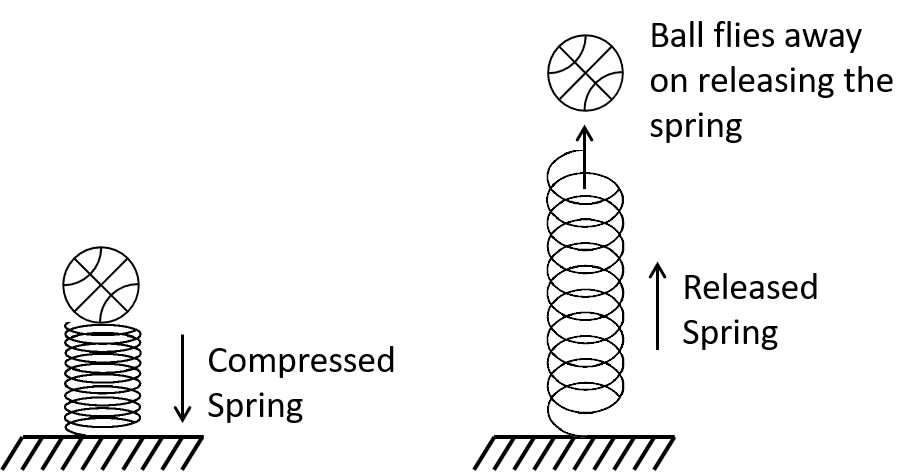
A ball is placed on a compressed spring. What form of energy does the spring possess? On releasing the spring, the ball flies away. Give a reason.
Show SolutionHide Solution↓
When the ball is placed on a compressed spring, the compressed spring has elastic potential energy.
The potential energy of the spring changes into kinetic energy when it is released and as a result it flies.
4Exercise 2(B) — Long Question
A pebble is thrown up. It goes to a height and then comes back on the ground. State the different changes in form of energy during its motion.
Show SolutionHide Solution↓
On being thrown upwards, the kinetic energy of the pebble changes to potential energy.
Its kinetic energy is completely converted into potential energy when the pebble reaches its maximum height.
The potential energy is then converted into kinetic energy while coming down and the potential energy is completely converted to kinetic energy when the pebble reaches the ground.
5Exercise 2(B) — Long Question
In what way does the temperature of water at the bottom of a waterfall differ from the temperature at the top? Explain the reason.
Show SolutionHide Solution↓
When the water falls from the height, the potential energy stored in water at a height changes into the kinetic energy.
On reaching the ground, a part of the kinetic energy of water changes into the heat energy which increases the temperature of the water.
1Exercise 2(B) — Numericals
Two bodies of equal masses are placed at heights h and 2h. Find the ratio of their gravitational potential energies.
Show SolutionHide Solution↓
Given,
Mass of body A and body B = m each
Height HA = h
Height HB = 2h
We know, Gravitational potential energy = mgh
Substituting the values we get,
$$\begin{aligned}\text {Ratio of gravitational P.E.} = \frac{\text {mgh}}{\text {mg2h}} \\[0.5em] \Rightarrow \text {Ratio of gravitational P.E.} = \frac{1}{2} \\[0.5em]\end{aligned}$$
Hence, ratio of gravitational potential energies of the two bodies is 1 : 2.
2Exercise 2(B) — Numericals
Find the gravitational potential energy of 1 kg mass kept at a height of 5 m above the ground. Calculate its kinetic energy when it falls and hits the ground. Take g = 10 m s-2.
$$\begin{aligned}\text h = \frac{1}{0.5 \times 10} \\[1em] \Rightarrow \text h = 0.2\ \text m\end{aligned}$$
5Exercise 2(B) — Numericals
A boy weighing 50 kgf climbs up from the first floor at a height of 3 m above the ground to the third floor at a height of 9 m above the ground. What will be the increase in his gravitational potential energy?
(Take g = 10 N kg-1).
Show SolutionHide Solution↓
Given,
m = 50 Kgf
h1 = 3 m
h2 = 9 m
Increase in gravitational potential energy = mg(h2 – h1)
= 50 x 10 x (9 - 3)
= 50 x 10 x 6
= 3000 J
6Exercise 2(B) — Numericals
A man of mass 50 kg climbs up a ladder of height 15m.
Calculate:
(i) the work done by the man, and
(ii) the increase in his potential energy.
(g = 9.8 m s-2).
Show SolutionHide Solution↓
Given,
Mass = 50 kg
h1 = 0 m
h2 = 15 m
(i) Work done by man = mgh2
Substituting the values we get,
W = 50 x 9.8 x 15 = 7350 J
(ii) Increase in his potential energy = Mg (h2 – h1)
= 50 x 9.8 x (15 - 0)
= 7350 J
7Exercise 2(B) — Numericals
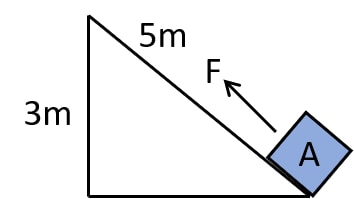
A block A, whose weight is 100N, is pulled up a slope of length 5 m by means of a constant force F (= 100 N) as illustrated.
(a) What is the work done by the force F in moving the block A, 5 m along the slope?
(b) What is the increase in potential energy of the block A?
(c) Account for the difference in the work done by the force and the increase in potential energy of the block.
Show SolutionHide Solution↓
Given,
F = 100 N
h = 3 m
Displacement = 5 m
We know,
(a) Work done = Force × displacement in the direction of the force
$$\begin{aligned}\text W = 100 \times 5 \\[1em] \Rightarrow \text W = 500\ \text J \\[1em]\end{aligned}$$
(b) The potential energy gained by the block U = mgh
$$\begin{aligned}\text{P.E.} = 100 \times 3 \\[1em] \Rightarrow \text { P.E. gained by the block}= 300\ \text J\end{aligned}$$
(c) The difference (200 J) energy is used in doing work against the force of friction between the block and the slope and it will appear as heat energy.
8Exercise 2(B) — Numericals
Find the kinetic energy of a body of mass 5 kg moving with a uniform velocity of 10 m s-1.
Show SolutionHide Solution↓
Given,
m = 5 kg
Velocity (v) = 10 m/s
Kinetic energy = $\frac{1}{2}$ × mass × (velocity)2
Substituting the values we get,
KE = $\frac{1}{2}$ x 5 x 102 = 250 J
9Exercise 2(B) — Numericals
If the speed of a car is halved, how does its kinetic energy change?
Show SolutionHide Solution↓
Let speed of car be v.
Kinetic Energy at speed v = $\frac{1}{2}$ x m x v2 = $\frac{\text{mv}^2}{2}$
Kinetic Energy at speed $\frac{\text{v}}{2}$ = $\frac{1}{2}$ x m x $(\frac{\text{v}}{2})^2$ = $\frac{\text{mv}^2}{8}$ = $\frac{1}{4}\Big(\frac{\text{mv}^2}{2}\Big)$
Hence, when the speed of the car is halved the kinetic energy becomes one-fourth.
10Exercise 2(B) — Numericals
Two bodies of equal masses are moving with uniform velocities v and 2v. Find the ratio of their kinetic energies.
Show SolutionHide Solution↓
Given,
Velocity of first body v1 = v
Velocity of second body, v2 = 2v
As the mass of the two bodies are same and as kinetic energy is directly proportional to the square of the velocity (K α v2)
Hence, the average retarding force offered by the target is 62500 N.
21Exercise 2(B) — Numericals
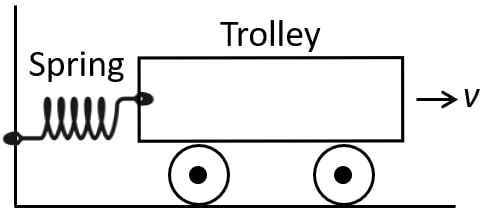
A spring is kept compressed by a small trolley of mass 0.5 kg lying on a smooth horizontal surface as shown. When the trolley is released, it is found to move at a speed of v = 2 m s-1. What potential energy did the spring possess when compressed?
Show SolutionHide Solution↓
Given,
Mass = 0.5 kg
Velocity = 2 m s-1
Potential Energy possessed by the spring is equal to the kinetic energy of moving trolley.
Natasha is being constantly scolded by her mother for being unfit. She decides to loose weight by lifting a mass of 10 kg by 0.5 m 100 times. Assuming that the potential energy lost each time during the lowering of mass is dissipated.
Calculate :
(a) work done by her against the gravitational force.
(b) If fat stored in her body supplies 3.8 x 10⁷ J of energy per kg, and is converted to mechanical energy with 20% efficiency, how much fat is used by Natasha
Show SolutionHide Solution↓
Given,
m = 10 kg
h = 0.5 m
Frequency = 100
When Natasha lifts the mass, she does work against the gravitational force which is equal to the gain in gravitational potential energy and is given by,
W = mgh
(a) Work done in one lift = mgh = 10 × 9.8 × 0.5 = 49 J
She lifts the mass 100 times, so total work done = 49 × 100 = 4900 J
Thus, the total work done is 4900 J.
(b) Given,
Energy supplied by 1 kg of fat = 3.8 x 10⁷ J
Efficiency = 20%
Only 20% of the chemical energy from fat is converted into mechanical work.
If E is the chemical energy used then
$$\begin{aligned}20% \text { of E} = 4900\ \text J \\[1em] \Rightarrow 0.20 \times \text E = 4900 \\[1em] \Rightarrow \text E = \frac {4900}{0.20} \\[1em] \Rightarrow \text E = \frac {4900}{\frac{2}{10}} \\[1em] \Rightarrow \text E = \frac {4900 \times 10}{2} \\[1em] \Rightarrow \text E = \frac {49000}{2} \\[1em] \Rightarrow \text E = 24500\ \text J \\[1em] \text {Fat used} = \frac{\text E}{\text {Energy supplied by 1 kg of fat}} \\[1em] = \frac {24500}{3.8\times 10^{7}} \\[1em] \approx 6.45 \times 10^{-4} \text { kg}\end{aligned}$$
Hence, 6.45 x 10⁻⁴ kg of fat is used by Natasha.
11 Mark · Exercise 2(C) — Multiple Choice Type
According to the principle of conservation of mechanical energy :
(a)Potential energy of a system is always greater than its kinetic energy
(b)Kinetic energy of a system is always greater than its potential energy
(c)Mechanical energy is always converted into heat energy
(d)Total mechanical energy of a system remains constant if no external force is worked on it.
Show SolutionHide Solution↓
Total mechanical energy of a system remains constant if no external force is worked on it.
Reason — The conservation of mechanical energy states that the total mechanical energy (sum of kinetic energy and potential energy) of a system remains constant if no external forces, such as friction or air resistance, are acting on it.
21 Mark · Exercise 2(C) — Multiple Choice Type
A skater is gliding on a smooth ice surface. What happens to his mechanical energy as he skates?
(a)It increases
(b)It decreases
(c)It becomes zero
(d)It remains constant
Show SolutionHide Solution↓
It remains constant
Reason — As the skater glides across the ice, he possess kinetic energy due to his movement. The potential energy remains constant as there is no significant change in height. Assuming a smooth ice surface with no friction or air resistance, the external forces are absent, hence, according to the principle of conservation of mechanical energy, the total mechanical energy (KE + PE) of the skater remains constant.
31 Mark · Exercise 2(C) — Multiple Choice Type
A spring is compressed, storing potential energy. When the spring is released, it propels an object forward. What change would you notice in the total mechanical energy of the system?
(a)It increases
(b)It decreases
(c)It becomes zero
(d)It remains constant
Show SolutionHide Solution↓
It remains constant
Reason — When the spring is compressed, it stores potential energy. Upon release, this potential energy is converted into kinetic energy as the spring propels an object forward. Assuming there are no significant external forces acting on the system (such as friction), the total mechanical energy of the system remains constant.
41 Mark · Exercise 2(C) — Multiple Choice Type
A a body is released from a height. During its motion in striking the ground, the quantity which does not change is:
(a)momentum
(b)kinetic energy
(c)potential energy
(d)mechanical energy
Show SolutionHide Solution↓
mechanical energy
Reason — Mechanical energy, which is the sum of kinetic and potential energy, remains constant during the motion of the body. Initially, when the body is released from a height, it has potential energy. As it falls, this potential energy decreases while its kinetic energy increases. However, the sum of kinetic and potential energy (mechanical energy) remains constant in the absence of external forces like air resistance.
51 Mark · Exercise 2(C) — Multiple Choice Type
A pendulum is oscillating on either side of its rest position. The correct statement is :
(a)It has only the kinetic energy at its each position.
(b)It has the maximum kinetic energy at its extreme position.
(c)It has the maximum potential energy at its mean position.
(d)The sum of its kinetic energy and potential energy remains constant throughout the motion.
Show SolutionHide Solution↓
The sum of its kinetic and potential energy remains constant throughout the motion.
Reason — The sum of kinetic and potential energy does not remain constant throughout the motion of a pendulum. It varies as the pendulum swings due to the interconversion of kinetic and potential energy. However, the sum of kinetic and potential energy is constant if we consider the entire system (kinetic energy + potential energy = mechanical energy), as long as there are no external forces like friction acting on the pendulum.
61 Mark · Exercise 2(C) — Multiple Choice Type
A simple pendulum while oscillating rises to a maximum vertical height of 7 cm from its rest position where it reaches its extreme position on one side. The mass of the bob of simple pendulum is 400 g and g = 10 m/s2. The total energy of the simple pendulum at any instant while oscillating is:
(a)0.28 J
(b)2.8 J
(c)28 J
(d)28000 J
Show SolutionHide Solution↓
0.28 J
Reason — Given,
m = 400 g = 0.4 kg
g = 10 m s-2
h = 7 cm = 0.07 m
The potential energy of the pendulum at its extreme position (maximum height) is mgh and kinetic energy at this point is zero.
Substituting we get,
Total energy = PE + KE = mgh + 0 = (0.4 x 10 x 0.07) + 0 = 0.28 J
71 Mark · Exercise 2(C) — Multiple Choice Type
A block slides down a frictionless incline. The sum of its P.E. and K.E. at every point :
(a)increases
(b)decreases
(c)remains constant
(d)first decreases and then increases
Show SolutionHide Solution↓
remains constant
Reason — When a block slides down a frictionless incline, no energy is lost due to friction. The gravitational potential energy decreases as the block moves downward, while its kinetic energy increases by the same amount. Therefore, the sum of potential energy and kinetic energy (mechanical energy) remains constant throughout the motion.
81 Mark · Exercise 2(C) — Multiple Choice Type
Which of the following is not an example of conservation of mechanical energy :
(a)free fall
(b)ideal pendulum
(c)block sliding down a rough surface
(d)satellite orbiting the earth
Show SolutionHide Solution↓
block sliding down a rough surface
Reason — Mechanical energy is conserved when only conservative forces act. In free fall, an ideal pendulum and a satellite orbiting the earth, kinetic and potential energy change into each other while total mechanical energy remains constant. However, when a block slides down a rough surface, friction converts some mechanical energy into heat, so mechanical energy is not conserved.
91 Mark · Exercise 2(C) — Multiple Choice Type
Assertion (A): When a hammer is made to fall on a nail fixed upright on a wooden piece, the nail begins to penetrate the wood.
Reason (R): As the hammer starts falling, its kinetic energy begins to change into potential energy.
(a)both A and R are true and R is the correct explanation of A
(b)both A and R are true and R is not the correct explanation of A
(c)assertion is false but reason is true
(d)assertion is true but reason is false
Show SolutionHide Solution↓
assertion is true but reason is false.
Explanation
Assertion (A) is true because when a hammer is made to fall on a nail fixed upright on a wooden piece, the nail begins to penetrate the wood due to the force applied by the falling hammer.
Reason (R) is false because the statement about the conversion of kinetic energy into potential energy as the hammer falls is incorrect. Potential energy is the energy that is stored in an object due to its position above the earth's surface. Hence, when a hammer is lifted it stores potential energy in it and when the hammer starts falling, this potential energy begins to change into kinetic energy and is used in driving a nail into the wood.
1Exercise 2(C) — Very Short Questions
A body is thrown vertically upwards. Its velocity keeps on decreasing. What happens to its kinetic energy as its velocity becomes zero?
Show SolutionHide Solution↓
When a body is thrown vertically upwards, its kinetic energy changes into potential energy and its velocity becomes zero.
2Exercise 2(C) — Very Short Questions
A body falls freely under gravity from rest. Name the kind of energy it will possess
(a) at the point from where it falls,
(b) while falling,
(c) on reaching the ground.
Show SolutionHide Solution↓
(a) The energy possessed at the point from where it falls is potential energy.
(b) Potential energy and kinetic energy, both are possessed at the time of fall.
(c) The energy possessed by the body on reaching the ground is kinetic.
1Exercise 2(C) — Short Questions
State the principle of conservation of energy.
Show SolutionHide Solution↓
The principle of conservation of energy states that energy can neither be created nor can be destroyed. It only changes from one form to other.
2Exercise 2(C) — Short Questions
What do you understand by the conservation of mechanical energy? State the condition under which the mechanical energy is conserved.
Show SolutionHide Solution↓
Whenever there is an interchange between the potential energy and kinetic energy, the total mechanical energy remains constant. This is principle of conservation of mechanical energy.
i.e K + U = constant provided there are no frictional forces.
The condition for mechanical energy to be conserved is that there should be no frictional forces. This condition is only applicable in vacuum.
3Exercise 2(C) — Short Questions
Name two examples in which the mechanical energy of a system remains constant.
Show SolutionHide Solution↓
Simple pendulum and
Motion of a freely falling body.
4Exercise 2(C) — Short Questions
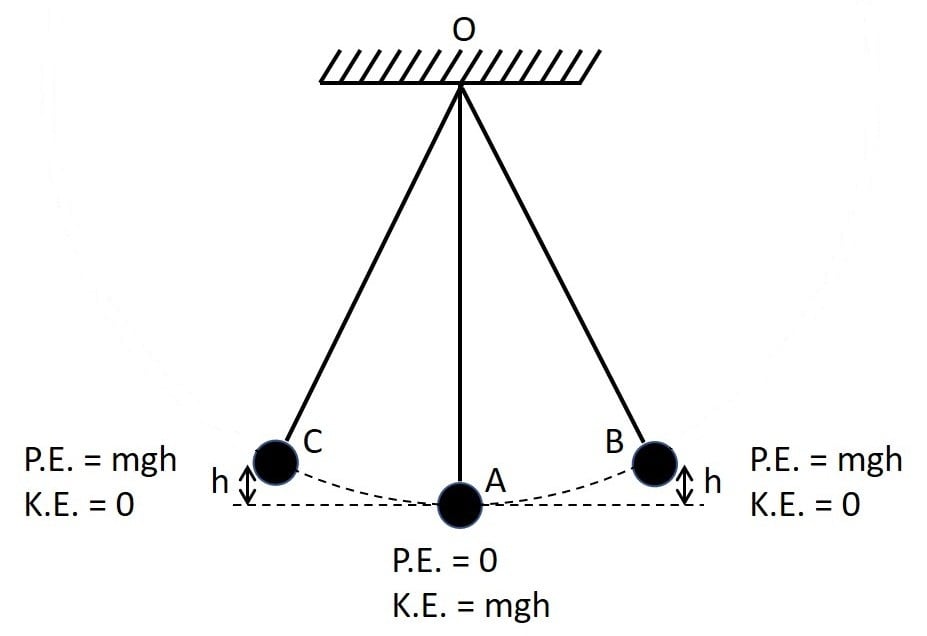
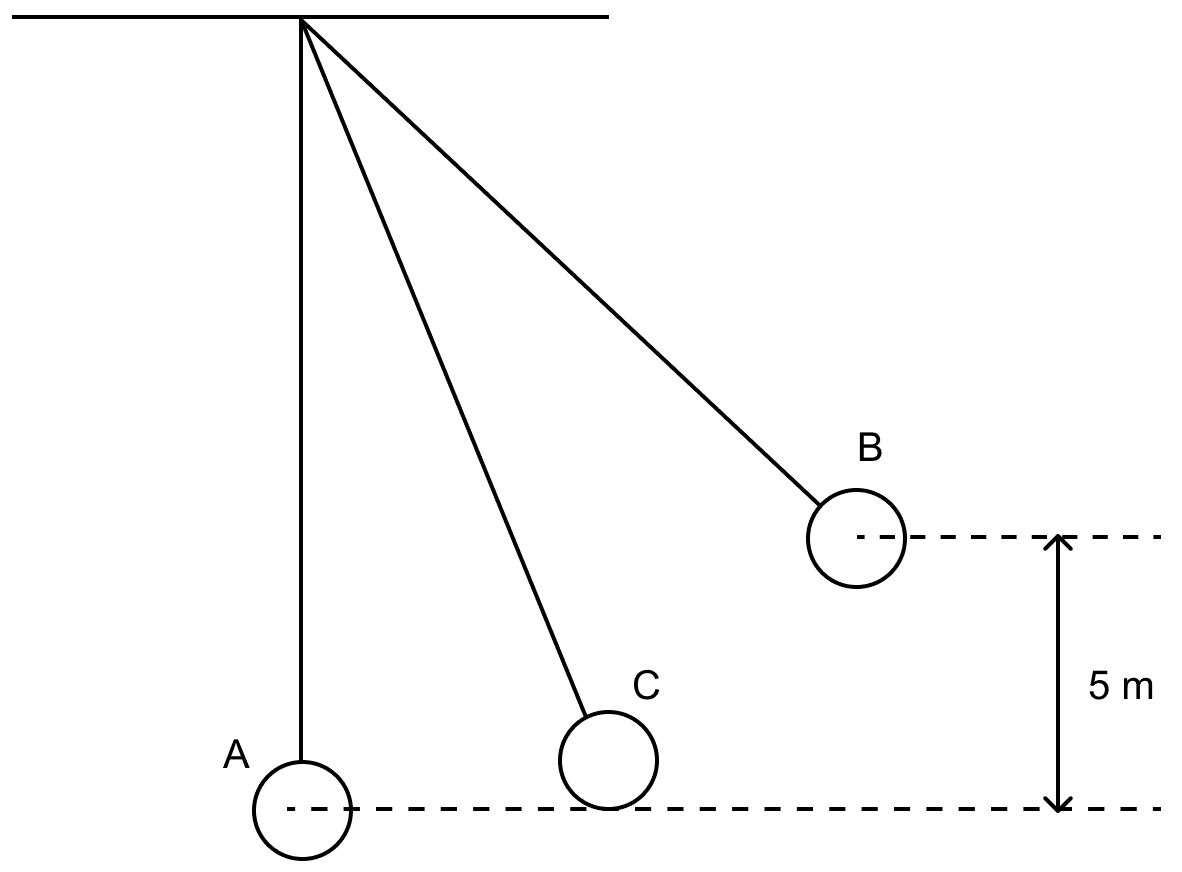
A pendulum with a bob of mass m is oscillating on either side from its resting position A between the extremes B and C at a vertical height h above A. What is the kinetic energy K and potential energy U when the pendulum is at positions
(i) A, (ii) B, and (iii) C?
Show SolutionHide Solution↓
(i) For position A,
Pendulum has the maximum kinetic energy and potential energy is zero at its resting position.
So, K = mgh and U = 0
(ii) For position B,
The kinetic energy starts decreasing and the potential energy starts increasing.
So, K = 0 and U = mgh
(iii) At position C,
Kinetic energy K = 0 and potential energy U = mgh.
5Exercise 2(C) — Short Questions
Name the type of energy possessed by the bob of a simple pendulum when it is at
(a) the extreme position,
(b) the mean position, and
(c) between the mean and extreme positions.
Show SolutionHide Solution↓
(a) When the bob is at extreme position the energy possessed is potential energy.
(b) When the bob is at mean position the energy possessed is kinetic energy.
(c) When the bob is in between mean position and extreme position the energy possessed by the bob are both kinetic energy and potential energy.
1Exercise 2(C) — Long Questions
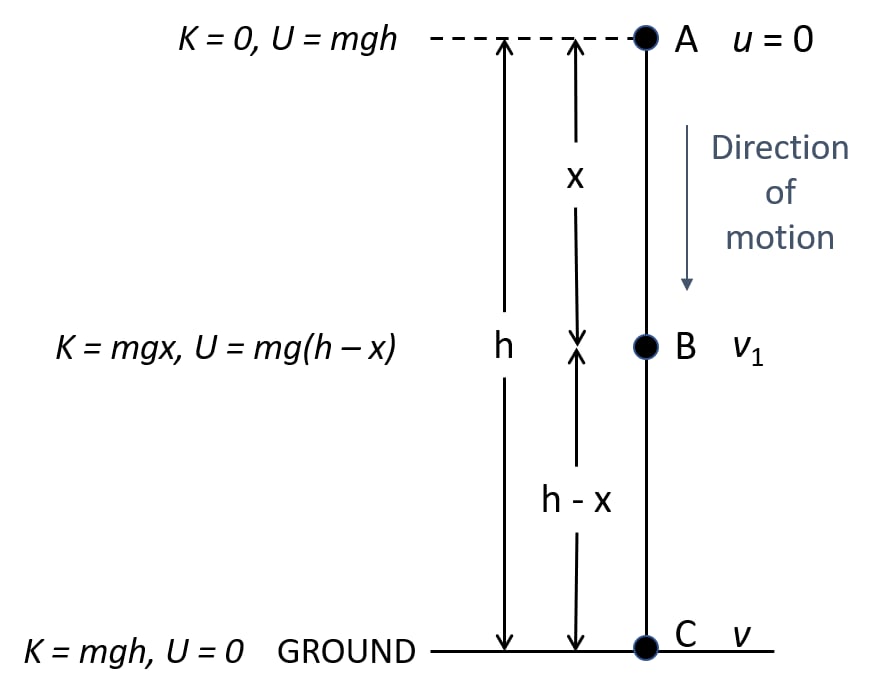
Show that the sum of kinetic energy and potential energy (i.e., total mechanical energy) is always conserved in the case of a freely falling body under gravity (with air resistance neglected) from a height h by finding it when
(i) the body is at the top,
(ii) the body has fallen a distance x,
(iii) the body has reached the ground.
Show SolutionHide Solution↓
We know that,
Kinetic energy + potential energy = constant
So, when a body falls from a height h under free fall
(i) At the position A — height h
Initial velocity = 0
Kinetic energy K = 0
Potential energy U = mgh
As, Total energy = KE + PE
Total energy = 0 + mgh
Total energy = mgh(1)
(ii) At the position B — when it has fallen a distance x.
Then, velocity at B = v1
Then u = 0, s = x, a = g
From equation of motion: v2 = u2 + 2aS v12 = 0 + 2gx = 2gx
$$\begin{aligned}\therefore \text {Kinetic energy K}= \frac{1}{2} \times \text m \times \text v_1^2 \\[1em] = \frac{1}{2} \times \text m \times 2\text {gx} \\[1em] = \text {mgx}\end{aligned}$$
∴ Potential energy U = mg (h – x)
Hence, total energy = K + U = mgx + mg (h – x) = mgh
Total energy = mgh(2)
(iii) At position C (on the ground) —
Let the velocity acquired by the body on reaching the ground be v2.
Then u = 0, s = h, a = g
We know, v2= u2 + 2aS v22 = 0 + 2gh v22 = 2gh
$$\begin{aligned}\therefore \text {Kinetic energy K}= \frac{1}{2} \times \text m \times \text v_2^2 \\[1em] = \frac{1}{2} \times \text m \times 2\text {gh} \\[1em] = \text {mgh}\end{aligned}$$
And potential energy U = 0 (at the ground when h = 0)
So, total energy = K + U = mgh + 0 = mgh
Total energy = mgh(3)
Thus, from equation (1), (2) and (3) we note that the total mechanical energy i.e. the sum of kinetic energy and potential energy always remain constant at each point of motion and it is equal to the initial potential energy at height h.
2Exercise 2(C) — Long Questions
A pendulum is oscillating on either side of its rest position. Explain the energy changes that take place in the oscillating pendulum. How does the mechanical energy remain constant in it? Draw the necessary diagram.
Show SolutionHide Solution↓
The kinetic energy decreases and the potential energy becomes maximum at B.
After a moment the the to and fro movement starts again.
So, from B to A, again the potential energy changes into kinetic energy and this process repeat again and again.
So, when the bob in its state of to and from movement it has potential energy at the extreme position B or C and kinetic energy at resting position A.
It has both the kinetic energy and potential energy at an intermediate position.
However, the sum of kinetic and potential energy remain same at every point of movement.
1Exercise 2(C) — Numericals
A ball of mass 0.20 kg is thrown vertically upwards with an initial velocity of 20 m s-1. Calculate the maximum potential energy it gains as it goes up.
Show SolutionHide Solution↓
Given,
Mass = 0.20 kg
Initial velocity = 20 m s-1
We know,
$\text {KE} = \frac{1}{2} \times \text m \times \text v^2$
Maximum potential energy at the maximum height = initial kinetic energy
∴ Potential energy at maximum height = Initial kinetic energy = 56.25J
(b) As we know that,
Kinetic energy on reaching the ground = potential energy at the greatest height
= 56.25 J
(c) Total energy at its halfway point = $\frac{1}{2}$ (K + U) = 56.25 J
3Exercise 2(C) — Numericals
A metal ball of mass 2 kg is allowed to fall freely from rest from a height of 5 m above the ground.
(a) Taking g = 10 m s-2, calculate:
(i) the potential energy possessed by the ball when it is initially at rest.
(ii) the kinetic energy of the ball just before it hits the ground?
(b) What happens to the mechanical energy after the ball hits the ground and comes to rest?
Show SolutionHide Solution↓
Given,
Mass = 2 kg
Height = 5m
(a)
(i) the potential energy possessed by the ball when it is initially at rest = mgh = 2 x 10 x 5 = 100 J
(ii) As we know that,
The kinetic energy of the ball just before hitting the ground = initial potential energy = mgh = 2 x 10 x 5 = 100 J
(b) Mechanical energy of the ball gets converted into heat and sound energy after the ball hits the ground and comes to rest.
4Exercise 2(C) — Numericals
A person swings on a rope from a cliff that is 20 m high. How fast is the person moving at the lowest point of the swing? (Take g = 10 m s-2)
Show SolutionHide Solution↓
As the person swings on a rope from a cliff of height h = 20 m then potential energy at the top gets converted into kinetic energy at the lowest point.
From conservation of energy,
Potential energy at top = Kinetic energy at lowest point
mgh = $\frac{1}{2}$mv2
gh = $\frac{1}{2}$v2
10 x 20 = $\frac{1}{2}$v2
400 = v2
$v=\sqrt{400}=20$ m/s
∴ The person is moving at a speed of 20 m/s at the lowest point of the swing.
5Exercise 2(C) — Numericals
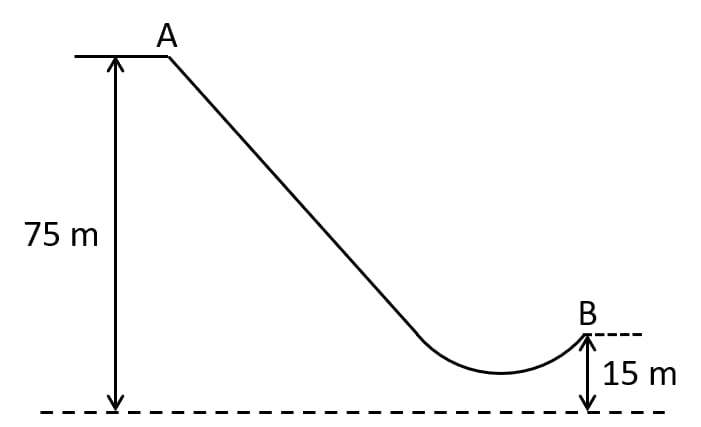
The diagram given below shows a ski jump. A skier weighing 60 kgf stands at A at the top of ski jump. He moves from A and takes off for his jump at B.
(a) Calculate the change in the gravitational potential energy of the skier between A and B.
(b) If 75 % of the energy in part (a) becomes the kinetic energy at B, calculate the speed at which the skier arrives at B.
∴ The speed at which the skier arrives at B is 30 m s-1.
6Exercise 2(C) — Numericals
A hydroelectric power station takes its water from a lake whose water level is 50 m above the turbine. Assuming an overall efficiency of 40 %, calculate the mass of water which must flow through the turbine each second to produce power output of 1 MW. (Take g = 10 m s-2).
$$\begin{aligned}\text{Power} = \frac{\text{Work done}}{\text{Time}} \\[1em] 1\text { MW} = 200 \times \text {Mass of water flowing per second} \\[1em] \Rightarrow 1 \times 10^6 = 200 \times \text m \\[1em] \Rightarrow \text m = \frac{1 \times 10^6 }{200} \\[1em] = 5000 \text { kg}\end{aligned}$$
Hence, the mass of water which must flow through the turbine is 5000 kg.
7Exercise 2(C) — Numericals
The bob of a simple pendulum is imparted a velocity of 5 m s-1 when it is at its mean position. To what maximum vertical height will it rise on reaching at its extreme position if 60 % of its energy is lost in overcoming the friction of air?
The figure alongside shows a simple pendulum of mass 200 g. It is displaced from the mean position A to the extreme position B. The potential energy at position A is zero. At position B the bob is raised by 5 m.
(a) What is the potential energy of the pendulum at position B?
(b) What is the total mechanical energy at point C?
(c) What is the speed of the bob at position A when released from position B? (Take g = 10 m s-2)
Show SolutionHide Solution↓
Given,
h = 5 m
m = 200 g = 0.2 kg
g = 10 m s-2
(a) Potential energy UB at B is given by
UB = m x g x h
Substituting the values we get,
$$\begin{aligned}\text U_\text B = 0.2 \times 10 \times 5 \\[0.5em] \Rightarrow \text U_\text B = 10\ \text J\end{aligned}$$
Hence, the potential energy of the pendulum at the position B is 10 J.
(b) Total mechanical energy at point C = 10 J
The total mechanical energy is same at all points of the path due to conservation of mechanical energy.
(c) At A, bob has only kinetic energy which is equal to potential energy at B,
Therefore,
$$\begin{aligned}\frac{1}{2} \times \text m \times (\text v_\text A)^{2} = \text U_\text B \\[1em] 0.5 \times 0.2 \times (\text v_\text A)^{2} = 10 \\[1em] (\text v_\text A)^{2} = \frac{10}{0.1} \\[1em] \Rightarrow \text v_\text A = \sqrt{100} \\[1em] \Rightarrow \text v_\text A = 10 \text{ m s}^{-1}\end{aligned}$$
Hence, the speed of the bob at position A is 10 m s-1.