The total number of protons in a neutral atom is equal to:
(a)atomic number
(b)neutrons
(c)electrons
(d)both atomic number and electrons
Show SolutionHide Solution↓
both atomic number and electrons
Reason — In a neutral atom, the number of protons is equal to the number of electrons to maintain electrical neutrality.
The total number of protons in a neutral atom is known as the atomic number.
21 Mark · Exercise 12(A) — Multiple Choice Type
If Z is the atomic number and A is the mass number of an atom, then which of the following relations is incorrect ?
(a)Number of electrons = Z
(b)Number of protons = A - Z
(c)Number of neutrons = A - Z
(d)Number of neutrons + number of protons = A
Show SolutionHide Solution↓
Number of protons = A - Z
Reason — The number of protons in an atom is equal to its atomic number (Z), not the difference between the mass number (A) and the atomic number (Z).
31 Mark · Exercise 12(A) — Multiple Choice Type
A certain nucleus P has a mass number 15 and atomic number 7. The number of neutrons is :
(a)7
(b)15
(c)8
(d)none of the above
Show SolutionHide Solution↓
8
Reason — The number of neutrons in a nucleus can be calculated using the formula:
Number of neutrons = Mass number (A) - Atomic number (Z)
Given,
Mass number (A) = 15
Atomic number (Z) = 7
So, number of neutrons = 15 - 7 = 8
41 Mark · Exercise 12(A) — Multiple Choice Type
The atoms of the same element, having the same atomic number Z but different mass number A are called :
(a)Isotopes
(b)Isobars
(c)Isotones
(d)None of the above
Show SolutionHide Solution↓
Isotopes
Reason — Isotopes are atoms of the same element that have the same atomic number (Z) but different mass numbers (A). They have the same number of protons but different numbers of neutrons.
51 Mark · Exercise 12(A) — Multiple Choice Type
Out of the following, which element has the largest number of isotopes ?
(a)Hydrogen
(b)Carbon
(c)Chlorine
(d)Tin
Show SolutionHide Solution↓
Tin
Reason — Tin has largest number of isotopes i.e., 10.
61 Mark · Exercise 12(A) — Multiple Choice Type
3919K and 4020Ca are :
(a)Isotopes
(b)Isobars
(c)Radioactive substances
(d)Isotones
Show SolutionHide Solution↓
Isotones
Reason — 3919K and 4020Ca are isotones as they both have the same number of neutrons in the nucleus (each having 20 neutrons in the nucleus).
71 Mark · Exercise 12(A) — Multiple Choice Type
Out of the following, radioactive substances are :
(a)Uranium
(b)Polonium
(c)Actinium
(d)All of the above
Show SolutionHide Solution↓
All of the above
Reason — All three elements listed—uranium, polonium, and actinium—are radioactive substances. They undergo radioactive decay, emitting radiation in the form of alpha particles, beta particles, or gamma rays.
81 Mark · Exercise 12(A) — Multiple Choice Type
The heaviest nuclear radiation is :
(a)X radiation
(b)α radiation
(c)γ radiation
(d)β radiation
Show SolutionHide Solution↓
α radiation
Reason — The mass of an alpha particle is roughly four times the mass of a proton i.e., 6.68 x 10⁻²⁷ kg and is the heaviest among the given options.
91 Mark · Exercise 12(A) — Multiple Choice Type
To study the age of excavated materials of archeological significance, we study the rate of decay of an isotope of :
(a)uranium
(b)cobalt
(c)carbon
(d)chlorine
Show SolutionHide Solution↓
carbon
Reason — To study the age of excavated materials of archeological significance, we study the rate of decay of an isotope of carbon. The process is known as carbon dating.
101 Mark · Exercise 12(A) — Multiple Choice Type
A radioactive nucleus emits a beta particle. The position of daughter nucleus in the periodic table as compared to the parent nucleus after emitting a beta particle is :
(a)at the same place
(b)one place higher
(c)one place lower
(d)two places lower
Show SolutionHide Solution↓
one place higher
Reason — By emission of a beta particle, the mass number A does not change but the atomic number is increased by one. It changes into a new nucleus of element with properties similar to those of an element one place higher in the periodic table.
This represents a gamma (γ) decay, where there is no change in mass number A and atomic number Z of the nucleus.
121 Mark · Exercise 12(A) — Multiple Choice Type
The number of beta particles emitted by a radioactive substance is twice the number of alpha particles emitted by it. The resulting daughter nucleus is :
(a)isotope of the parent
(b)isobar of the parent
(c)isotone of the parent
(d)None of the above
Show SolutionHide Solution↓
isotope of the parent
Reason — When an alpha particle is emitted, the mass number decreases by 4 and the atomic number decreases by 2 while each beta particle emission increases the atomic number by 1 without changing the mass number.
If the number of beta emissions is twice that of alpha emissions, then for one alpha decay (−2 in atomic number), two beta decays (+2 in atomic number) occur, resulting in no net change in atomic number.
However, the mass number still decreases due to alpha decay so, the daughter nucleus has the same atomic number but a different mass number, meaning it is an isotope of the parent.
Hence, the resulting daughter nucleus is an isotope of the parent atom.
131 Mark · Exercise 12(A) — Multiple Choice Type
The electron emitted in beta radiation originates from :
(a)outer orbit of the atom
(b)inner orbit of the atom
(c)free electron existing in the nucleus
(d)decay of the neutron in the nucleus
Show SolutionHide Solution↓
decay of the neutron in the nucleus
Reason — In beta radiation, the emitted electron does not come from the atomic orbits. Instead, it is produced inside the nucleus when a neutron undergoes decay, converting into a proton and emitting an electron (beta particle) along with an antineutrino.
Thus, the electron originates from a nuclear transformation, not from the electron shells of the atom.
141 Mark · Exercise 12(A) — Multiple Choice Type
Assertion (A): Out of α, β and γ radiation, α-particles have the maximum penetrating power.
Reason (R): The α-particles are the heaviest amongst the three.
(a)both A and R are true and R is the correct explanation of A
(b)both A and R are true and R is not the correct explanation of A
(c)assertion is false but reason is true
(d)assertion is true but reason is false
Show SolutionHide Solution↓
assertion is false but reason is true
Explanation
Assertion (A) is false. Out of α, β and γ radiation, γ-particles have maximum penetrating power as the penetrating power of a particle depends upon the energy carried by it, its mass and the charge carried by it. A particle with a greater energy can use it to force itself into another medium and thereby penetrate it. α-particles rapidly dissipates its energy as it moves through the medium and therefore its penetrating power is quite small.
Reason (R) is true. An α particle contains two protons and two neutrons, β particle has mass of an electron and γ particles are massless so an α particle is heavier than β and γ particles.
151 Mark · Exercise 12(A) — Multiple Choice Type
Assertion (A): 146C and 147N are isobars.
Reason (R):146C has 6 protons and 8 neutrons in its nucleus, whereas 147N has 7 protons and 7 neutrons in its nucleus.
(a)both A and R are true and R is the correct explanation of A
(b)both A and R are true and R is not the correct explanation of A
(c)assertion is false but reason is true
(d)assertion is true but reason is false
Show SolutionHide Solution↓
Both A and R are true and R is the correct explanation of A
Explanation
Assertion (A) is true. Isobars have the same mass number but different atomic numbers. Both 146C (carbon-14) and 147N (nitrogen-14) have a mass number of 14, making them isobars.
Reason (R) is true. 146C has 6 protons and 8 neutrons, while 147N has 7 protons and 7 neutrons both have mass number equal to 14, hence are isobars.
1Exercise 12(A) — Very Short Questions
What is the name given to elements with same mass number and different atomic number ?
Show SolutionHide Solution↓
The name given to elements with same mass number A, and different atomic number Z is isobars.
2Exercise 12(A) — Very Short Questions
Arrange the α, β and γ radiations in ascending order of their (i) ionizing power, and (ii) penetrating power.
Show SolutionHide Solution↓
(i) Ionizing power of α, β and γ radiations arranged in ascending order is as follows: γ < β < α
(ii) Penetrating power of α, β and γ radiations arranged in ascending order is as follows: α < β < γ
3Exercise 12(A) — Very Short Questions
State the speed of each of α, β and γ radiations.
Show SolutionHide Solution↓
The speeds are:
α Radiation — 107 m s-1
β Radiation — 2 x 10⁸ m s-1
γ Radiation — 3 x 10⁸ m s-1
4Exercise 12(A) — Very Short Questions
A certain radioactive nucleus emits a particle that leaves its mass number unchanged, but increases its atomic number by one. Identify the particle and write its symbol.
Show SolutionHide Solution↓
A β particle leaves it's mass number unchanged, but increases it's atomic number by one.
The symbol of β particle is given by $_{-1}^{ 0}\text{e}$ or $_{-1}^{0}\text{β}$.
5Exercise 12(A) — Very Short Questions
What happens to the (i) atomic number, (ii) mass number of the nucleus of an element when (a) an α-particle, (b) a β-particle, and (c) γ radiation, is emitted?
Show SolutionHide Solution↓
(i) Atomic number
When an α particle is emitted atomic number decreases by 2.
When a β particle is emitted atomic number increases by 1.
When γ radiation is emitted there is no change in atomic number.
(ii) Mass number
When an α particle is emitted mass number decreases by 4.
When a β particle is emitted there is no change in the mass number.
When a γ radiation is emitted there is no change in the mass number.
6Exercise 12(A) — Very Short Questions
State whether the following nuclear disintegrations are allowed or not (star indicate an excited state). Give reason if it is not allowed.
(b) Due to α emission, atomic number decreases by 2 and mass number decreases by 4. Also, an alpha particle is same as a Helium nucleus with 2 protons and 2 neutrons.
(d) When there is an α emission from $_{Z}^{A}\text{X}$ , then the atomic number decreases by 2 and mass number decreases by 4.
Hence, we get $\bold {_{Z - 2}^{A - 4}\text{X}_{1}}$
After the γ emission, there is no change in atomic number and mass number.
Hence, we get $\bold {_{Z - 2}^{A - 4}\text{X}_{2}}$
In the final step when there are two β emissions, the atomic number increases by 2 and the mass number is unchanged and we get $\bold {_{Z}^{A - 4}\text{X}_{3}}$.
(e) The daughter nucleus $_{\space \space 69}^{172}\text{X}_{3}$ is formed after α decay of $\text{X}_{2}$, so atomic number of $\text{X}_{2}$ will be 2 units more and its mass number will be 4 units more i.e., $_{\space \space 71}^{176}\text{X}_{2}$
The nucleus $_{\space \space 71}^{176}\text{X}_{2}$ is formed after α decay of $\text{X}_{1}$ so atomic number of $\text{X}_{1}$ will be 2 units more and it's mass number will be 4 units more i.e., $_{\space \space 73}^{180}\text{X}_{2}$
The nucleus $_{\space \space 73}^{180}\text{X}_{2}$ is formed after β decay of X, the atomic number will be one unit less and the mass number is unchanged i.e., $_{\space \space 72}^{180}\text{X}$
Why do we usually use isotopes emitting gamma radiations as radioactive tracers in medical science? [Hint : gamma radiations are most penetrating]
Show SolutionHide Solution↓
We usually use isotopes emitting γ radiations as radioactive tracers in medical science, because they are most penetrating and can easily pass through the human body.
10Exercise 12(A) — Very Short Questions
Which of the following is the radio isotope in each pair (a), (b) and (c) ?
(a) $_{6}^{12}\text{C}$, $_{6}^{14}\text{C}$
(b) $_{15}^{30}\text{P}$, $_{15}^{32}\text{P}$
(c) $_{19}^{39}\text{K}$, $_{19}^{40}\text{K}$
Give reason for your answer.
Show SolutionHide Solution↓
The following are radioisotope —
(a) $_{6}^{14}\text{C}$
(b) $_{15}^{32}\text{P}$
(c) $_{19}^{40}\text{K}$
The above mentioned elements are isotopes because the number of neutrons exceeds the number of protons.
1Exercise 12(A) — Short Questions
Name the three constituents of an atom and state mass and charge of each. How are they distributed in an atom?
Show SolutionHide Solution↓
The three constituents of an atom are electrons, protons and neutrons.
The mass of an electron is 9.1 × 10⁻³¹ kg and charge is -1.6 × 10⁻¹⁹ C.
The mass of a proton is 1.67 × 10⁻²⁷ kg and charge is +1.6 × 10⁻¹⁹ C.
The mass of a neutron is 1.67 × 10⁻²⁷ kg and charge is zero.
The protons and neutrons reside inside the nucleus of the atom which is at its centre, while the electrons revolve around the nucleus in some specific orbits.
2Exercise 12(A) — Short Questions
Define the following terms —
(a) atomic number, and (b) mass number.
Show SolutionHide Solution↓
(a) Atomic number (Z) — The atomic number of an atom is equal to the number of protons in it's nucleus (which is same as the number of electrons in a neutral atom). i.e., Z = number of protons in the nucleus of an atom.
(b) Mass number (A) — The mass number of an atom is equal to the total number of nucleons (i.e., the sum of the number of protons and the number of neutrons ) in it's nucleus. i.e., A = number of protons + number of neutrons in the nucleus of an atom.
3Exercise 12(A) — Short Questions
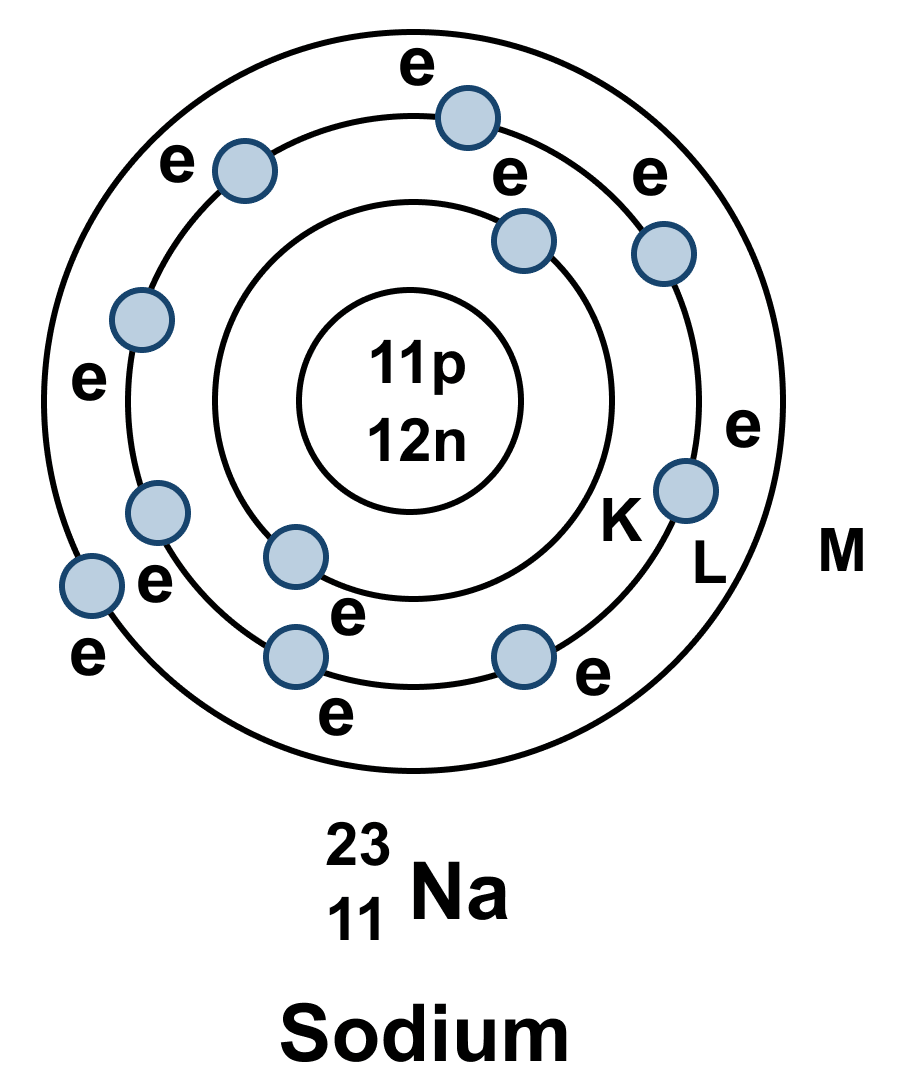
State the atomic number and mass number of $_{11}^{23}\text{Na}$ and draw its atomic model.
Show SolutionHide Solution↓
The Atomic Number (Z) of Na = 11
The Mass Number (A) of Na = 23
Number of Neutrons = A - Z = 23 - 11 = 12
Its atomic model is shown below:
4Exercise 12(A) — Short Questions
What are isotopes? Give one example.
Show SolutionHide Solution↓
The atoms of the same element, having same atomic number Z, but different mass number A, are called isotopes.
Example — Hydrogen has three isotopes namely protium $_{1}^{1}\text{H}$, deuterium $_{1}^{2}\text{H}$ and tritium $_{1}^{3}\text{H}$.
5Exercise 12(A) — Short Questions
What are isobars? Give one example.
Show SolutionHide Solution↓
The atoms of different elements which have the same mass number A, but different atomic number Z are called isobars.
Example — $_{11}^{23}\text{Na}$ and $_{12}^{23}\text{Mg}$ are isobars.
6Exercise 12(A) — Short Questions
Name the atoms of a substance having same atomic number, but different mass numbers. Give one example of such a substance. How do the structures of such atoms differ?
Show SolutionHide Solution↓
The atoms of a substance having same atomic number, but different mass number are known as isotopes.
Example — Hydrogen has three isotopes namely protium $_{1}^{1}\text{H}$, deuterium $_{1}^{2}\text{H}$ and tritium $_{1}^{3}\text{H}$.
Each isotope in its nucleus has one proton (Z = 1) but protium ($_{1}^{1}\text{H}$) has no neutron, deuterium ($_{1}^{2}\text{H}$) has one neutron and tritium ($_{1}^{3}\text{H}$) has two neutrons.
There is one electron outside the nucleus in the atom of each isotope. Thus, the structures of these isotopes differ by the number of neutrons in their nuclei.
7Exercise 12(A) — Short Questions
What is meant by radioactivity? Name two radioactive substances.
Show SolutionHide Solution↓
Radioactivity is a nuclear phenomenon. It is the process of spontaneous emission of α or β and γ radiations from the nucleus of atoms during their decay.
Uranium and Polonium are radioactive substances.
8Exercise 12(A) — Short Questions
A radioactive substance is oxidised. What changes would you expect to take place in the nature of radioactivity? Explain your answer.
Show SolutionHide Solution↓
There will be no change in the nature of radioactivity when a radioactive substance is oxidized because radioactivity is a nuclear phenomena.
9Exercise 12(A) — Short Questions
Explain why alpha and beta particles are deflected in an electric or a magnetic field, but gamma rays are not deflected in such a field. [Hint : alpha and beta particles are charged, but gamma rays are uncharged]
Show SolutionHide Solution↓
α and β radiations are charged particles (i.e., α radiation is positively charged and β radiation is negatively charged) therefore, they are deflected in an electric or magnetic field. γ radiations are uncharged particles hence, they do not show deflection in an electric or magnetic field.
10Exercise 12(A) — Short Questions
Is it possible to deflect γ radiations in a way similar to α and β-particles, using the electric or magnetic field? Give reasons.
Show SolutionHide Solution↓
No, it is not possible to deflect γ radiations as α and β particles, using the electric or magnetic field because α and β particles are charged particles and so they show deflection whereas γ radiations are uncharged particles hence, they do not deflect using electric or magnetic field.
11Exercise 12(A) — Short Questions
(a) What is the composition of α, β and γ radiations?
(b) Can a hydrogen ($_1^1\text{H}$) nucleus emit an alpha particle? Give a reason for your answer.
(c) Which one α, β and γ radiation has the least penetrating power?
Show SolutionHide Solution↓
(a) α radiation consists of two protons and two neutrons. β radiation is composed of fast moving electrons emitted from the nucleus of an atom while γ radiation is photon or electromagnetic waves like X-rays and light.
(b) No, hydrogen ($_1^1\text{H}$) nucleus cannot emit an alpha particle because an alpha particle consists of two protons and two neutrons whereas hydrogen ($_1^1\text{H}$) nucleus does not have two protons and two neutrons.
(c) α radiations have least penetrating power.
12Exercise 12(A) — Short Questions
An α particle captures (i) one electron, (ii) two electrons. In each case, what does it change to?
Show SolutionHide Solution↓
(i) When an α particle captures one electron it changes to a singly ionized helium He+.
(ii) When an α particle captures two electrons it changes to a neutral helium atom.
13Exercise 12(A) — Short Questions
'Radioactivity is a nuclear phenomenon'. Comment on this statement.
Show SolutionHide Solution↓
Any physical change (such as change in pressure and temperature) or chemical change (such as excessive heating, freezing, action of strong electric and magnetic fields, chemical treatment, oxidation etc.) does not change the rate of decay and the nature of radiation emitted by the substance.
This clearly shows that the phenomenon of radioactivity cannot be due to the orbital electrons which could easily be affected by such changes. Therefore the radioactivity should be the property of the nucleus. Thus, radioactivity is a nuclear phenomenon.
14Exercise 12(A) — Short Questions
What happens to the position of an element in the periodic table when its nucleus emits (a) an α-particle, (b) a β-particle and (c) γ radiation? Give reason for your answer.
Show SolutionHide Solution↓
(a) When the nucleus of an element emits an α particle, the position of the resultant element changes to two places earlier (i.e., to the left of the parent element in the periodic table).
This happens because the atomic number decreases by 2, hence the new element shifts two places to the left on emission of an α particle.
(b) When the nucleus of an element emits a β particle, the position of the resultant element changes to one place after (i.e., one place to the right ).
This happens because the atomic number increases by 1, hence the new element shifts one place to the right on emission of a β particle.
(c) When the nucleus of an element emits a γ radiation, there is **no change in the position of the element in the periodic table.
This happens because there is no change in the atomic number, hence there is no change in the position of the element on emission of γ radiations.
15Exercise 12(A) — Short Questions
What changes occur in the nucleus of a radioactive element when it emits (a) an alpha particle, (b) a beta particle, (c) gamma radiation? Give one example, in each case (a) and (b) in support of your answer.
Show SolutionHide Solution↓
(a) If the nucleus X of a radioactive element of mass number A and atomic number Z emits an α particle, the daughter nucleus Y of a new element has mass number equal to (A - 4) and atomic number equal to (Z - 2). Thus, atomic number decreases by 2 units and mass number decreases by 4 units.
Example — When a radioactive uranium nucleus $_{92}^{238}\text{U}$ emits an α particle, a new nucleus thorium $_{90}^{234}\text{Th}$ is formed and the change is represented as follows —
(b) In emitting a β particle, the number of nucleons in the nucleus remains same, but the number of neutrons is decreased by one and the number of protons is increased by one. If a radioactive nucleus P with mass number A and atomic number Z emits a β particle to form a daughter nucleus Q with mass number A and atomic number Z + 1, the change can be represented as follows:
Example — A radioactive carbon nucleus $_{6}^{14}\text{C}$, having 14 nucleons (6 protons and 8 neutrons) emits a β particle and changes to a new nucleus nitrogen $_{7}^{14}\text{N}$ having 14 nucleons (7 protons and 7 neutrons).
Here the star indicates the excited state of the nucleus. Thus in gamma emission, the excited nucleus comes to its ground state.
16Exercise 12(A) — Short Questions
A nucleus $_{Z}^{A}\text{X}$ emits 2 α particles and 1 β particle to form a $_{85}^{222}\text{R}$ nucleus. Find the atomic number and mass number of X.
Show SolutionHide Solution↓
$_{85}^{222}\text{R}$ before the emission of β particle, would have atomic number 84, and before 2 α emissions, atomic number would have been 88.
Hence, atomic number (Z) = 88
$_{85}^{222}\text{R}$ before the emission of β particle, would have mass number 222, and before 2 α emissions, mass number would have been 230.
Hence, mass number (A) = 230.
17Exercise 12(A) — Short Questions
What are radio isotopes? Give one example of a radio isotope. State one use of radio isotopes.
Show SolutionHide Solution↓
The isotopes of some elements with atomic number (Z) less than 82 are found to be radio active. They are called the radio isotopes.
One example of radio isotopes is Cobalt $_{27}^{60}\text{Co}$ (Z = 27 and A = 60).
Radio isotopes are used in the Medical field. Many diseases such as leukemia, cancer, etc. are cured by radio therapy with the help of radio isotopes.
18Exercise 12(A) — Short Questions
Why are the alpha particles not used in radio therapy? [Hint : alpha particles cannot penetrate the human skin]
Show SolutionHide Solution↓
The alpha particles are not used in radio therapy because they cannot penetrate the human skin.
19Exercise 12(A) — Short Questions
When does the nucleus of an atom tend to become radioactive?
Show SolutionHide Solution↓
The nucleus of an atom becomes radioactive when number of neutrons in the nucleus exceeds the number of protons in it.
20Exercise 12(A) — Short Questions
State the medical use of radioactivity.
Show SolutionHide Solution↓
Many diseases such as leukemia, cancer, etc., are cured by radiation therapy. γ radiations from cobalt-60 ($_{27}^{60}\text{Co}$) are used to treat cancer by killing the cells in the malignant tumor of the patient.
The salt of weak radioactive isotopes such as radio-sodium chloride, radio-iron and radio-iodine are used for diagnosis. Such radio isotopes are called the tracers. These tracers are used to detect the suspected brain tumors and blood clots before they become dangerous.
γ rays emitted by the radio isotopes are used to sterilize bandages, dressings, syringes and other equipments to make them free from germs.
21Exercise 12(A) — Short Questions
Arrange the α, β and γ radiation in ascending order of their biological damage. Give reason.
Show SolutionHide Solution↓
α < β < γ
An α-particle rapidly dissipates it's energy as it moves through a medium and therefore it's penetrating power is quite small. It can penetrate only through 3-8 cm in air. It can easily be stopped by a thin card sheet or a thick paper. As it is least penetrating so it causes least biological damage.
The penetrating power of β-particles is more than that of the α-particles but less than that of γ-particles. They can travel through nearly 5 m in air and pass through thin card sheet, and even through thin aluminium foil, but a 5 mm thick aluminium sheet can stop the beta particles. As the penetrating power is in between α and γ, hence the biological damage cause by β radiation is also in between α and γ.
The penetrating power of γ-rays is high. It is about (100,00) times that of α-particles and (100) times that of β-particles. They can pass through 500 m in air or through 30 cm thick sheet of iron. A thick sheet of lead is required to stop them. As penetrating power is most hence biological damage caused by γ-rays is most.
22Exercise 12(A) — Short Questions
Name two main sources of nuclear radiations. How are the nuclear radiations harmful?
Show SolutionHide Solution↓
Two main sources of nuclear radiations are:
Radioactive fall out from nuclear plants — The nuclear power plants are now a major source of electricity in the world. If somehow, there is an accident in the reactor of power plant, a large amount of radioactive material and radiations will escape out into the atmosphere. This will not only affect the population around the plant, but will also affect the life at far off places where they will reach due to air currents.
Nuclear waste — The nuclear waste are still very radioactive and are a source of harmful radiations therefore, they should not be dumped in the open garbage. They can contaminate water and soil and affect the human and living organisms.
The harmful biological effects of nuclear radiations are of three types:
Short term recoverable effects like diarrhea, sore throat, loss of hair, nausea, etc.
Long term irrecoverable effects like leukemia and cancer.
Genetic effects that appear in the later generations of the person exposed to the radiation as the genes in the living cell get modified.
23Exercise 12(A) — Short Questions
State two safety measures to be taken while establishing a nuclear power plant?
Show SolutionHide Solution↓
Two safety measures to be taken while establishing a nuclear power plant are:
The nuclear reactor of the power plant must be shielded with lead and steel walls so as to stop radiations from escaping out to the environment during it's normal operation.
The nuclear reactor must be housed in an air tight building of strong concrete structure which can withstand earthquakes, fires and explosion.
24Exercise 12(A) — Short Questions
What is meant by nuclear waste? State one way for the safe disposal of nuclear waste?
Show SolutionHide Solution↓
The fuel rods used in the nuclear power reactors are rejected when their activity decreases below a certain level. They then become a nuclear waste.
These rods are still quite radioactive and are the source of harmful radiations therefore they should not be dumped in open garbage. They can contaminate water and soil and affect the human and living organism.
25Exercise 12(A) — Short Questions
State three safety precautions that you would take while handling the radioactive substances.
Show SolutionHide Solution↓
Safety precautions that people should take while handling the radioactive substances are —
They should put on special lead lined aprons and lead gloves.
They should handle the radioactive materials with long lead tongs.
The radioactive substances must be kept in a thick lead container with a very narrow opening, so that the walls of the container absorb the radiations which strike on them from the inside and thus radiations only come out through the narrow opening.
26Exercise 12(A) — Short Questions
Why should a radioactive substance not be touched by hands?
Show SolutionHide Solution↓
Radioactive substance should not be touched by hands because these radiations are harmful and can damage the living tissues and cause radiation burns.
27Exercise 12(A) — Short Questions
What do you mean by background radiations? Name its two sources. Is it possible for us to keep ourselves away from it?
Show SolutionHide Solution↓
Background radiations are the radioactive radiations (such as α, β and γ) to which we all are exposed, even in the absence of an actual visible radioactive source.
The sources of background radiation are:
Internal source — the radioactive substances such as potassium (K-40), carbon (C-14) and radium are present inside our body.
External source — cosmic rays, naturally occurring radioactive elements such as radon-222 and solar radiation.
It is not possible for us to keep ourselves away from the background radiations.
28Exercise 12(A) — Short Questions
A radioactive nucleus ${}_{92}^{238}\text{U}$ continuously decays and changes into ${}_{82}^{206}\text{Pb}$. In this decay, how many α and β particles are emitted ?
Show SolutionHide Solution↓
To determine the number of α and β decays, compare the changes in mass number and atomic number.
Parent nucleus : ${}_{92}^{238}\text{U}$
Daughter nucleus : ${}_{82}^{206}\text{Pb}$
Change in mass number = 238 - 206 = 32
And
Change in atomic number = 92 - 82 = 10
Since each α-particle reduces the mass number by 4.
Then
Number of α particles = $\frac{32}{4}$ = 8
As each α decay reduces atomic number by 2 then,
Change in atomic number of parent nucleus = 92 - (8 x 2) = = 92 - 16 = 76
But final atomic number is 82, so we need an increase:
82 − 76 = 6
Since each β decay increases atomic number by 1, so :
Number of β particles emitted = 6
Hence, 8 α and 6 β particles are emitted.
1Exercise 12(A) — Long Questions
What is nucleus of an atom? Compare its size with that of the atom. Name its constituents. How is the number of these constituents determined by the atomic number and mass number of an atom?
Show SolutionHide Solution↓
The nucleus is at the centre of an atom whose size is of the order of 10-15 m to 10-14 m (i.e., 10-5 to 10-4 times the size of the atom). It consists of protons and neutrons.
If Z = atomic number and A = mass number of an atom, then the atom contains,
Number of protons = Z
Number of neutrons = A – Z
2Exercise 12(A) — Long Questions
A radioactive source emits three types of radiations.
(a) Name the three radiations.
(b) Name the radiations which are deflected by the electric field.
(c) Name the radiation which is most penetrating.
(d) Name the radiation which travels with the speed of light.
(e) Name the radiation which has the highest ionizing power.
(f) Name the radiation consisting of the same kind of particles as the cathode rays.
Show SolutionHide Solution↓
(a) The three types of radiations are α, β and γ.
(b) The radiations which are deflected by the electric field are α and β radiations.
(c) The most penetrating radiations is γ radiations.
(d) The radiation which travels with the speed of light is γ radiation.
(e) The radiation which has the highest ionizing power is α radiations.
(f) The radiations consisting of the same kind of particles as the cathode rays are β radiations.
3Exercise 12(A) — Long Questions
A radioactive source emits three type of radiations.
(a) Name the radiation of zero mass.
(b) Name the radiation which has the lowest ionising power.
(c) Name the radiation which has the lowest penetrating power.
(d) Give the charge and mass of particles composing the radiation in part (c).
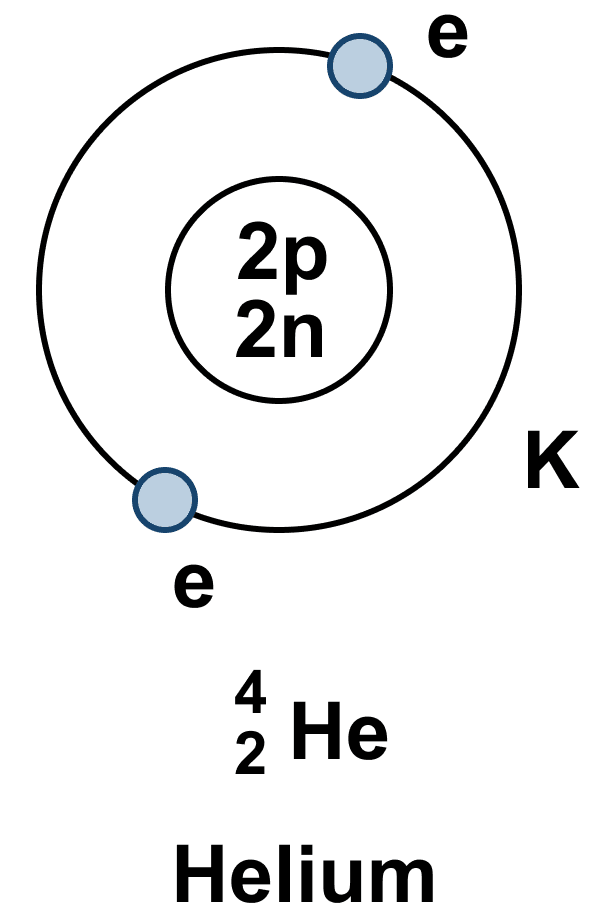
(e) When the particle referred to in part (c) becomes neutral, it is found to be the atom of a rare gas. Name this rare gas and draw a model of its neutral atom.
(f) From which part of the atom do these radiations come?
Show SolutionHide Solution↓
(a) The radiation of zero mass are γ radiation.
(b) The radiation which has the lowest ionising power is the γ radiation.
(c) The radiation which has the lowest penetrating power is the α radiation.
(d) α particles have a charge of +3.2 × 10⁻¹⁹ C (twice the charge of a proton) and rest mass of 6.68 × 10⁻²⁷ kg (four times the mass of proton).
(e) When α particles become neutral, it is found to be the atom of Helium gas. Below is the model of its neutral atom:
(f) The radiations come from the nucleus of the atom.
4Exercise 12(A) — Long Questions
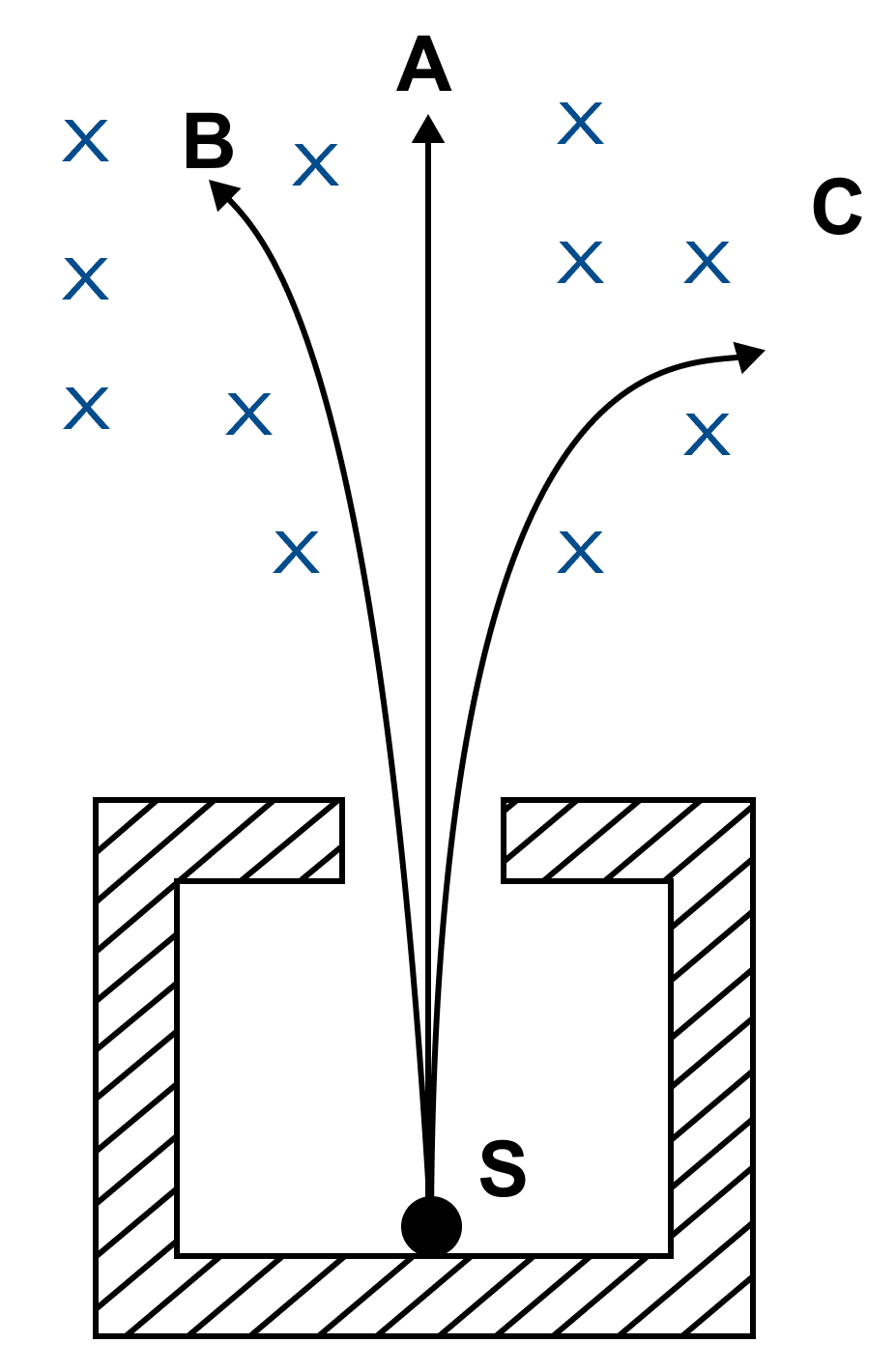
The diagram in below figure shows a radioactive source S placed in a thick lead walled container. The radiations given out are allowed to pass through a magnetic field. The magnetic field (shown as x) acts perpendicular to the plane of paper inwards. Arrows show the paths of the radiations A, B and C.
(a) Name the radiations labelled A, B and C.
(b) Explain clearly how you used the diagram to arrive at the answer in part (a).
Show SolutionHide Solution↓
(a) The radiations are —
A → γ radiation
B → α radiation
C → β radiation
(b) The radiation labelled as A pass undeviated which means that they are uncharged (or neutral) so they must be γ radiations.
The radiation labelled as B turn to the left which means that they are positively charged so they must be α radiations.
The radiation labelled as C turn to the right which means that they are negatively charged so they must be β radiations.
5Exercise 12(A) — Long Questions
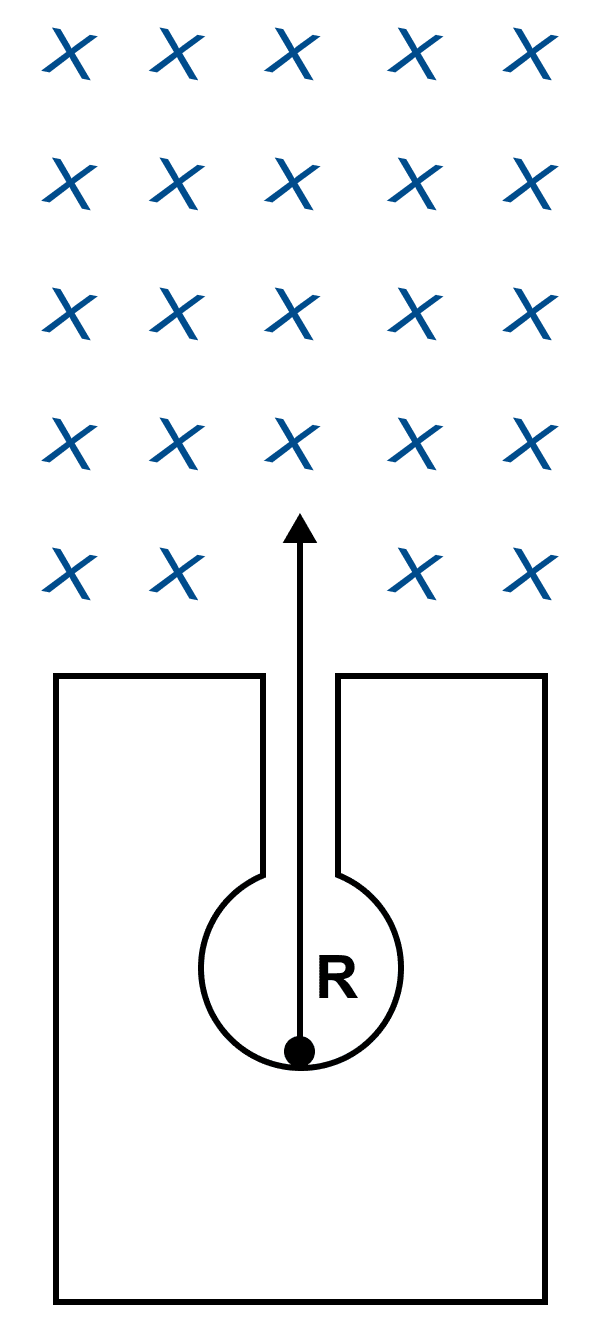
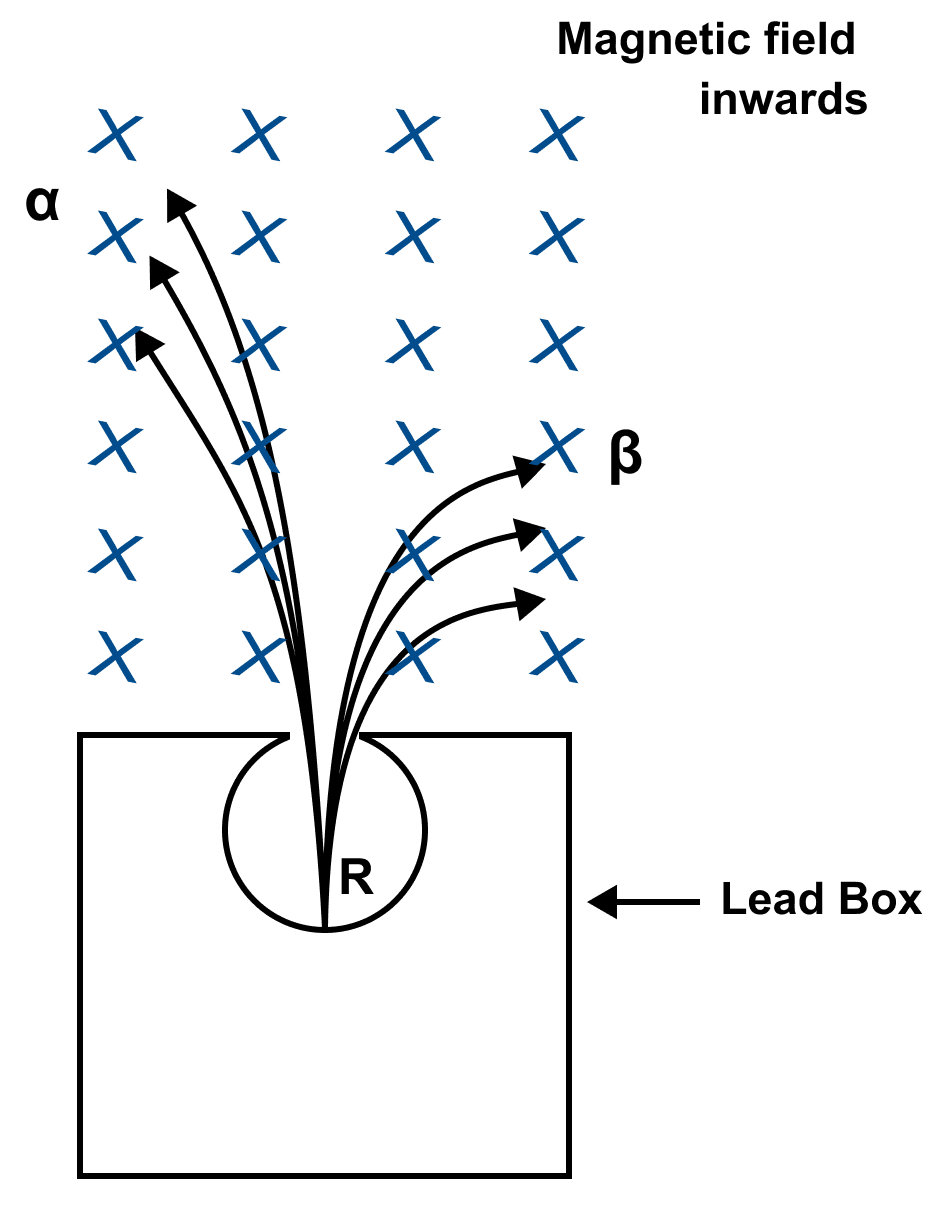
Below figure shows a mixed source R of alpha and beta particles in a thick lead walled container. The particles pass through a magnetic field in a direction perpendicular to the plane of paper inwards as shown by x.
(a) Show in the diagram how the particles get affected.
(b) Name the law used in part (a)
[Hint : alpha particles will deflect to the left while beta particles to the right]
Show SolutionHide Solution↓
(a) Below diagram shows the deflection of the radioactive particles in the magnetic field:
(b) The direction of deflection in a magnetic field is given by Fleming’s left hand rule.
6Exercise 12(A) — Long Questions
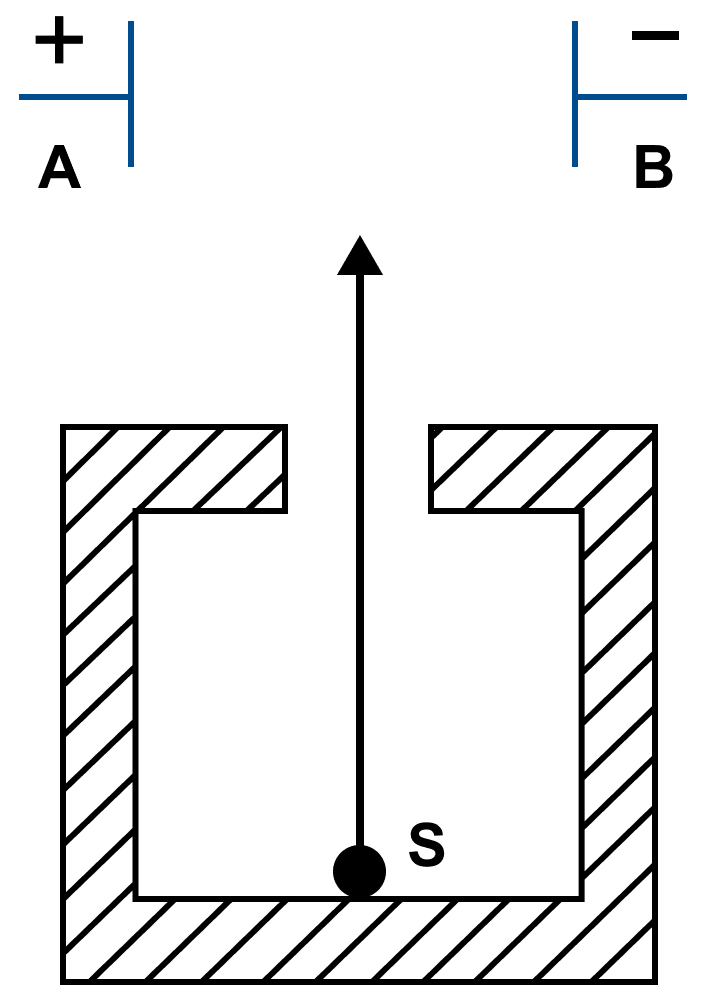
Below figure shows a radioactive source S in a thick lead walled container having a narrow opening. The radiations pass through an electric field between the plates A and B.
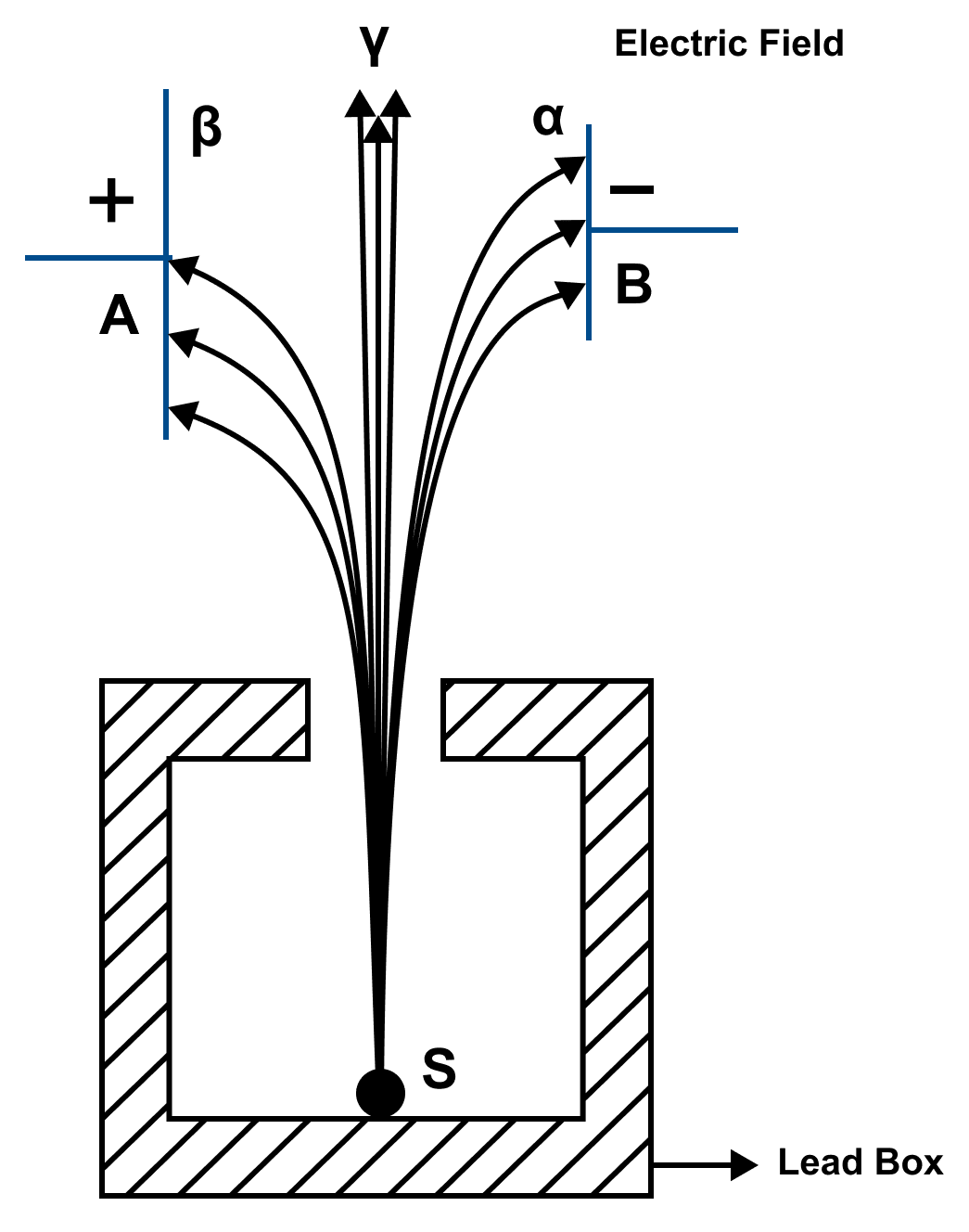
[Hint : α radiations will deflect toward the negative plate, β radiations towards the positive plate and γ radiations remain undeflected (c) γ radiation (d) beta, because of its low mass (e) alpha radiation]
(a) Complete the diagram to show the paths of α, β and γ radiations.
(b) Why is the source S kept in a thick lead walled container with a narrow opening?
(c) Name the radiation which is unaffected by the electrostatic field.
(d) Which radiation is deflected the most. Give reason.
(e) Which among the three radiations causes the least biological damage?
Show SolutionHide Solution↓
(a) Below diagram shows the paths of α, β and γ radiations:
(b) The source S is kept in a thick lead walled container with a narrow opening so that the walls of the container absorb the radiations which strike on them from the inside and thus radiations only come out through the narrow opening.
(c) γ radiation is unaffected by the electrostatic field.
(d) The β radiation is deflected the most. α particle is a helium nucleus consisting of two protons and two neutrons. Beta particles are fast-moving electrons with a very low mass. α particles are heavier than β particles so β particles have a high charge to mass density as compared to α particles. Due to this reason, β particles are deflected much more than the α particles.
(e) α radiation causes the least biological damage.
7Exercise 12(A) — Long Questions
State following four properties each of α, β and γ radiations : (a) nature, (b) charge, (c) mass, and (d) effect of electric field.
Show SolutionHide Solution↓
α Radiation
Nature — Stream of positively charged particles i.e., helium nucleus
Charge — Positive charge (two times that of a proton) = +3.2 × 10⁻¹⁹ C (or +2e)
Mass — Four times the mass of proton i.e., 6.68 × 10⁻²⁷ kg
Effect of Electric Field — Less deflected
β Radiation
Nature — Stream of negatively charged particles, i.e., energetic electrons
Charge — Negative charge = -1.6 × 10⁻¹⁹ C (or –e)
Mass — Equal to the mass of electron i.e., 9.1 × 10⁻³¹ kg
Effect of Electric Field — More deflected than α radiations, but in a direction opposite to those of α radiations
How are γ radiations produced? Mention two common properties of the gamma radiations and visible light.
Show SolutionHide Solution↓
γ radiations are produced when the daughter or the parent nucleus is in a state of excitation ( i.e., when it has an excess of energy). This extra energy is released in the form of γ radiation.
Two common properties of γ radiations and visible light are as follows —
(i) They both are not deflected by the electric and magnetic fields since they are uncharged particles.
(ii) Speed of γ radiations is same as the speed of light (i.e., 3 x 10⁸ m s-1)
9Exercise 12(A) — Long Questions
What kind of change takes place in a nucleus when a β-particle is emitted? Express it by an equation. State whether (a) atomic number, and (b) mass number are conserved in a radioactive β-decay?
Show SolutionHide Solution↓
(a) In emitting a β particle, the number of nucleons in the nucleus remains same, but the number of neutrons is decreased by one and the number of protons is increased by one.
If a radioactive nucleus P with mass number A and atomic number Z emits a β particle to form a daughter nucleus Q with mass number A and atomic number Z + 1, the change can be represented as follows —
(a) An atomic nucleus A is composed of 84 protons and 128 neutrons. The nucleus A emits an α-particle and is transformed into a nucleus B. What is the composition of B?
(b) The nucleus B emits a β-particle and is transformed into a nucleus C. What is the composition of C?
(c) What is the mass number of the nucleus A?
(d) Does the composition of nucleus C change if it emits the γ radiation?
Show SolutionHide Solution↓
(a) The composition of B is 82 protons and 126 neutrons.
Explanation: When the nucleus A emits an α-particle, the resulting nucleus B has 2 protons and 2 neutrons less than the original nucleus.
(b) The composition of C is 83 protons and 125 neutrons.
Explanation: When the nucleus B emits a β-particle, the resulting nucleus C has 1 proton more and 1 neutron less than the nucleus B.
(c) The mass number of nucleus A = number of protons + number of neutrons = 84 + 128 = 212
(d) No, the composition of nucleus C does not change on emitting γ radiations as there is no change in the mass number A and atomic number Z of the nucleus in gamma emission.
11Exercise 12(A) — Long Questions
A certain nucleus A (mass number 238 and atomic number 92) is radioactive and becomes a nucleus B (mass number 234 and atomic number 90) by the emission of a particle.
(a) Name the particle emitted.
(b) Explain how you arrived at your answer.
(c) State the change in the form of a reaction.
Show SolutionHide Solution↓
(a) The particle emitted is α-particle.
(b) As the atomic number is decreased by 2 and the mass number is decreased by 4 hence, we can say that an α-particle is emitted.
(c) This change can be expressed in the form of a reaction as follows:
(c) The product nucleus is called the isobar because they have same mass number and different atomic number.
13Exercise 12(A) — Long Questions
A nucleus of stable phosphorus has 15 protons and 16 neutrons.
(a) What is its atomic number and mass number?
(b) The nucleus of radio phosphorous has one neutron more than the stable nucleus. What will be its atomic number and mass number?
(c) What will be the atomic number and mass number of new nucleus formed by decay of a β-particle by the radio phosphorus in part (b)?
Show SolutionHide Solution↓
(a) Atomic number and mass number are as follows:
Atomic number = no. of protons = 15
Mass number = no. of protons + no. of neutrons = 15 + 16 = 31
(b) For radio phosphorous :
Atomic number = 15 and
Mass number = 15 + 17 = 32
(c) For daughter nucleus of radio phosphorous :
Atomic number = 16 and
Mass number = 32
Explanation: After emission of β-particle, number of neutrons is decreased by one and number of protons is increased by one. So, the mass number (A) does not change whereas the atomic number (Z) increases by one.
14Exercise 12(A) — Long Questions
An element P disintegrates by α emission and the new element suffers two further disintegrations, both by β emission, to form an element Q. Explain the fact that P and Q are the isotopes.
Show SolutionHide Solution↓
As we know, the atoms of same element, having same atomic number Z, but different mass number A, are called isotopes.
When the element P disintegrates by α emission, atomic number of P decreases by 2 and mass no. decreases by 4 then the atomic number increases by 1 due to first β emission and again increases by 1 due to second β emission and we get Q. We observe that atomic number of Q becomes the same as it was before the emission (i.e. P). Hence, P and Q are the isotopes.
11 Mark · Exercise 12(B) — Multiple Choice Type
According to the mass energy equivalence :
(a)E = Δmc2
(b)E = mc
(c)E = Δm/c2
(d)E = m/c2
Show SolutionHide Solution↓
E = Δmc2
Reason — According to the mass energy equivalence :
E = Δmc2
Here,
Δm is the loss in mass in kg,
c is the speed of light (= 3 x 10⁸ m s-1) and
E is the energy in joule (J).
21 Mark · Exercise 12(B) — Multiple Choice Type
In each fission reaction, the ............... remains conserved.
(a)mass number
(b)atomic number
(c)mass
(d)both mass number and atomic number
Show SolutionHide Solution↓
both mass number and atomic number
Reason — In each fission reaction, the atomic number and mass number remains conserved.
31 Mark · Exercise 12(B) — Multiple Choice Type
Which of the following is used as moderator(s) in a nuclear reactor ?
(a)Cadmium rods
(b)Graphite
(c)Heavy Water
(d)Both graphite and heavy water
Show SolutionHide Solution↓
Both graphite and heavy water
Reason — The chain reaction is a nuclear reactor are controlled by absorbing some of the neutrons emitted in the fission process by means of the cadmium rods and then making them slow by the moderators (such as graphite, heavy water, etc). This way, the energy obtained in fission reaction can be controlled and utilised for constructive purposes.
41 Mark · Exercise 12(B) — Multiple Choice Type
The source of energy of the sun and stars is obtained from the nuclear fusion of :
(a)uranium
(b)thorium
(c)hydrogen
(d)23592U
Show SolutionHide Solution↓
hydrogen
Reason — The source of energy in the Sun and stars is obtained from the process of nuclear fusion, specifically the fusion of hydrogen nuclei (protons) into helium nuclei. This process releases a tremendous amount of energy.
51 Mark · Exercise 12(B) — Multiple Choice Type
In a nuclear reactor :
(a)moderator is used to control the number of neutrons.
(b)controlling rods are used to slow down the neutrons.
(c)moderator is used to slow down the neutrons.
(d)coolant is used to slow down the neutrons.
Show SolutionHide Solution↓
moderator is used to slow down the neutrons.
Reason — In a nuclear reactor, different components perform specific roles.
The moderator (such as graphite or heavy water) is used to slow down fast-moving neutrons so that they can effectively cause further fission reactions.
Control rods (made of materials like cadmium) are used to absorb excess neutrons and regulate the chain reaction, not to slow them down.
The coolant is used to remove heat from the reactor core, not to affect neutron speed.
Therefore, correct statement is : the moderator is used to slow down the neutrons.
61 Mark · Exercise 12(B) — Multiple Choice Type
The mass of proton is nearly :
(a)0.51 eV
(b)200 eV
(c)931 eV
(d)931 MeV
Show SolutionHide Solution↓
931 MeV
Reason — The mass of a proton is approximately 938 MeV, which is very close to 931 MeV (the energy equivalent of 1 atomic mass unit).
The other options are too small to represent the mass of a proton.
Hence, 931 MeV is the closest correct value.
71 Mark · Exercise 12(B) — Multiple Choice Type
Fusion processes like combining two deuterium nuclei to form a He nucleus are impossible at ordinary temperatures and pressures. The reason is:
(i) Nuclear forces are short range.
(ii) Original nuclei must first break before combining with other nuclei.
(iii) Nuclei is negatively charged.
(iv) Nuclei is positively charged.
(a)only (i)
(b)(i) and (ii)
(c)(ii) and (iv)
(d)(i) and (iv)
Show SolutionHide Solution↓
(i) and (iv)
Reason — Fusion between nuclei requires them to come extremely close so that the strong nuclear force, which is short-ranged, can act.
However, nuclei are positively charged, so they repel each other due to electrostatic force.
At ordinary temperatures and pressures, the particles do not have enough kinetic energy to overcome this repulsion and get close enough for fusion.
Therefore, both the short range of nuclear forces and the positive charge of nuclei make fusion difficult under normal conditions.
81 Mark · Exercise 12(B) — Multiple Choice Type
In the nuclear decay given below :
ZXA ⟶ Z+1YA ⟶ Z-1BA-4 ⟶ Z-1BA-4
The particles emitted in the sequence are :
(a)α, β, γ
(b)β, α, γ
(c)γ, β, α
(d)β, γ, α
Show SolutionHide Solution↓
β, α, γ
Reason —
In the first step, the atomic number increases from Z to Z + 1 while the mass number remains the same, which indicates β decay.
In the second step, the atomic number decreases from Z+1 to Z−1 and the mass number decreases by 4, which corresponds to α decay.
The final step shows no change in either atomic or mass number, indicating emission of γ radiation.
Therefore, the sequence of emitted particles is β, α, γ.
What do you mean by nuclear energy? What is responsible for its release?
Show SolutionHide Solution↓
In a nuclear change due to a radioactive phenomenon (such as decay, fission or fusion), the total sum of masses of product nuclei is always less than the total sum of the masses of reactant nuclei. Thus, there ia a loss of mass, due to which the energy is released. The energy so obtained is called the nuclear energy.
The radioactive phenomenon responsible for the release of nuclear energy are fission and fusion.
2Exercise 12(B) — Short Questions
Write down the Einstein’s mass-energy equivalence relation, explaining the meaning of each symbol used in it.
Show SolutionHide Solution↓
Einstein’s mass-energy equivalence relation is E = (∆m)c2.
Here,
∆m is the loss in mass in kg,
c is the speed of light (= 3 × 10⁸ m s-1) and
E is the energy in joule (J).
3Exercise 12(B) — Short Questions
(a) What is a.m.u? Express 1 a.m.u. in MeV.
(b) Write the approximate mass of a proton, neutron and electron in a.m.u.
Show SolutionHide Solution↓
The mass of atomic particles is expressed in atomic mass unit (a.m.u).
1 a.m.u. = 931 MeV
The mass of a proton = 1.00727 a.m.u. The mass of a neutron = 1.00865 a.m.u. The mass of an electron = 0.00055 a.m.u.
4Exercise 12(B) — Short Questions
What is nuclear fission? Name the substance used for it. Write one fission reaction.
Show SolutionHide Solution↓
Nuclear fission is the process in which a heavy nucleus splits into two lighter nuclei of nearly the same size, when bombarded with slow neutrons. In each fission reaction, a tremendous amount of energy is released.
Uranium is one substance that can be used for nuclear fission.
Write the approximate value of the energy released in the fission of one nucleus of $_{92}^{235}\text{U}$. What is the reason for it?
Show SolutionHide Solution↓
Approximately 190 MeV energy is released in the fission of one nucleus.
The reason for the energy release is the loss in mass. In a nuclear change due to a radioactive phenomenon (such as decay, fission or fusion), the total sum of masses of product nuclei is always less than the total sum of the masses of reactant nuclei. Thus, there ia a loss of mass, due to which the energy is released.
6Exercise 12(B) — Short Questions
What do you mean by the chain reaction in nuclear fission? How is it controlled?
Show SolutionHide Solution↓
When slow neutrons are bombarded on uranium-235 ($_{92}^{235}\text{U}$), each uranium nucleus splits into two nearly equal fragments ($_{56}^{144}\text{Ba}$ and $_{36}^{89}\text{Kr}$) with the release of three neutrons and tremendous amount of energy (nearly 190 MeV). These new neutrons can cause fission in the other uranium nuclei under the suitable conditions. Thus, a chain of fission of nuclei is formed which once started, continues till the entire uranium is consumed.
The chain reaction is controlled by absorbing some of the neutrons emitted in the fission process by means of the cadmium rods and then making them slow by the moderators (such as graphite, heavy water, etc). This way, the energy obtained in fission reaction can be controlled and utilised for the constructive purposes.
7Exercise 12(B) — Short Questions
State two uses of nuclear fission?
Show SolutionHide Solution↓
For destructive use — Nuclear fission is used in nuclear bomb. The energy released is fast and uncontrolled.
For constructive use — The fission process is used in a nuclear reactor, where the rate of release of energy is slow and controlled. This energy is used to generate the electric power.
8Exercise 12(B) — Short Questions
Give two differences between the radioactive decay and nuclear fission.
Show SolutionHide Solution↓
Radioactive decay
Nuclear fission
It is a spontaneous process.
It does not occur by itself. It is initiated when, neutrons are bombarded on a heavy nucleus.
The rate of radioactive decay cannot be controlled.
The rate of nuclear fission can be controlled.
9Exercise 12(B) — Short Questions
(a) What is nuclear fusion? Give one example and write its nuclear reaction.
(b) What other name is given to nuclear fusion? Give reason.
Show SolutionHide Solution↓
(a) Nuclear fusion is the process in which two light nuclei combine to form a heavy nucleus. In this process, huge amount of energy is released.
Example —
When two deuterium nuclei ($_{1}^{2}\text{H}$) fuse, 3.3 MeV energy is released and the nucleus of helium isotope ($_{2}^{3}\text{He}$) is formed. This helium isotope again gets fused with one deuterium nucleus to form a helium nucleus ($_{2}^{4}\text{He}$) and 18.3 MeV energy is released in this process. The nuclear reaction are —
Thus in all, three deuterium nuclei fuse to form a helium nucleus with a release of 21.6 MeV energy.
(b) Nuclear fusion is also called as thermo-nuclear reaction because nuclear fusion takes place at very high temperature.
10Exercise 12(B) — Short Questions
Why is a very high temperature required for the process of nuclear fusion? State the approximate temperature required.
Show SolutionHide Solution↓
Nuclear fusion is not possible at ordinary temperature and ordinary pressure because when two nuclei approach each other, due to their positive charge, the electrostatic force of repulsion becomes too strong between them that they do not fuse. Hence, to make the fusion possible, a high temperature of (≈ 107 K) and high pressure is required. Due to thermal agitations both nuclei acquire sufficient kinetic energy at such a high temperature so as to overcome the force of repulsion between them when they approach each other and so they get fused. That is why the fusion reaction is also called the thermo nuclear reaction.
The temperature required is ≈ 107 K.
11Exercise 12(B) — Short Questions
(a) Write one nuclear fusion reaction.
(b) State the approximate value of energy released in the reaction mentioned in part (a).
(c) Give reason for the release of energy stated in part (b).
In this reaction, three deuterium nuclei fuse to form a helium nucleus.
(b) Approximately, 21.6 MeV energy is released in the reaction.
(c) When two deuterium nuclei fuse, 3.3 MeV energy is released and the nucleus of helium isotope ($_{2}^{3}\text{He}$ ) is formed. This helium again gets fused with one deuterium nucleus to form a helium nucleus ($_{2}^{4}\text{He}$) and 18.3 MeV is released.
12Exercise 12(B) — Short Questions
(a) State one similarity in the process of nuclear fission and fusion.
(b) State two differences between the process of nuclear fission and fusion.
Show SolutionHide Solution↓
(a) In both the process nuclear fission and fusion, the similarity is the release of energy due to loss in mass.
(b) Differences between nuclear fission and fusion are as follows —
Nuclear Fission
Nuclear Fusion
In fission when neutrons are bombarded on a heavy nucleus, it splits in two nearly equal light fragments.
In fusion, at a very high temperature and high pressure two light nuclei combine to form a heavy nucleus.
This reaction is possible at ordinary temperature and ordinary pressure.
This reaction is possible only at a very high temperature (≈ 107 K) and a very pressure.
(a) Name two isotopes of uranium which are fissionable.
(b) Which of the isotope mentioned in part (a) above is easily fissionable? Give reason.
(c) State whether the neutron needed for fission reaction of the isotope mentioned in part (b) above, is slow or fast?
Show SolutionHide Solution↓
(a) The ore of uranium found in nature contains two isotopes ($_{92}^{238}\text{U}$ and $_{92}^{235}\text{U}$). Both are fissionable.
(b) Although both the isotopes are fissionable, but experimentally it is found that the isotope $_{92}^{235}\text{U}$ is more fissionable than the isotope $_{92}^{238}\text{U}$. The reason is that the fission of $_{92}^{238}\text{U}$ nucleus is possible only by fast neutron, while the fission of $_{92}^{235}\text{U}$ nucleus can occur even by the slow neutrons.
(c) Either of slow or fast neutron can be used for the fission reaction of $_{92}^{235}\text{U}$.
1Exercise 12(B) — Numericals
In fission of one uranium-235 nucleus, the loss in mass is 0.2 a.m.u. Calculate the energy released.
Show SolutionHide Solution↓
Given,
Loss in mass (∆m) = 0.2 a.m.u.
We know that,
1 a.m.u = 931 MeV
Therefore,
E = 0.2 × 931 = 186.2 MeV
Hence, the energy released = 186.2 MeV
2Exercise 12(B) — Numericals
When four hydrogen nuclei combine to form a helium nucleus in the interior of sun, the loss in mass is 0.0265 a.m.u. How much energy is released?