1
At the generating station, power is generated at :
- (a)33 kV
- (b)132 kV
- (c)11 kV
- (d)none of the above
Show SolutionHide Solution↓
11 kV
Reason — At the generating station, power is generated at 11 kV.
ICSE Class 10 Physics · Selina Concise Physics · 73 solved questions
At the generating station, power is generated at :
11 kV
Reason — At the generating station, power is generated at 11 kV.
The electric power is generated at 11 kV because :
Both high voltage causes insulation challenges and low voltage leads to excessive current
Reason — The electric power is generated at 11 kV because :
The power generated at the generating station is transmitted to the main sub station at voltage :
132 kV
Reason — The power generated at generating stations is transmitted at high voltages of 132 kV in order to reduce the loss of energy in the form of heat in the transmission line wires.
The neutral and the earth wires are connected at the local sub station so that :
the neutral and earth wires are at the same potential
Reason — When the neutral and earth wires are at the same potential, it helps to stabilize the electrical system and ensures that any fault currents are safely redirected to the ground, minimizing the risk of electric shocks and other hazards to people and equipment.
The main switch is a:
double pole switch
Reason — A double pole switch is a type of electrical switch that has two separate sets of contacts that can control two separate circuits simultaneously. It disconnects both the live and neutral wires when it is turned off, providing additional safety by ensuring complete isolation from the power source.
The main fuse is connected in :
live wire
Reason — The main fuse is connected in the live wire so that if the current exceeds it's rating, the fuse melts and breaks the circuit; thus, preventing the excessive current from flowing into the circuit.
The electrical appliances in a house are connected in :
parallel
Reason — The electrical appliances in a house are connected in parallel so that each appliances gets full voltage for it's normal working. Each appliance operates independently without being affected by the working of other appliances.
The electrical meter in a house records the consumption of —
energy
Reason — The electrical meter in a house records the consumption of energy.
A person connects his household appliances in series. Which of the following is true ?
Both the current decreases due to increased total resistance and the appliances do not receive their rated voltage
Reason — When a person connects his household appliances in series:
At what voltage and frequency is the electric power generated at the power generating station?
At the power generating station, the electric power is generated at a voltage of 11 kV and frequency of 50 Hz.
At what (i) voltage and (ii) frequency is the a.c. supplied to our houses?
The alternating current (a.c.) supplied to our houses is at 220 V of voltage and 50 Hz of frequency.
Name the device used to (a) increase the voltage at the generating station, and (b) decrease the voltage at the sub station for its supply.
(a) In order to increase the voltage at the generating station a step up transformer is used.
(b) In order to decrease the voltage at the sub station a step down transformer is used.
In what unit does the electric meter in a house measure the electrical energy consumed? What is its value in S.I. unit?
kWh is the unit in which the electric meter in a house measures the electrical energy consumed.
S.I. unit is joule (J).
1 kWh = 3.6 × 10⁶ J
Where is the main fuse connected in a house circuit?
The main fuse is connected in live wire before the ring system.
How should the several electric lamps be connected with the mains so that the switching on or off a lamp has no effect on the operation of other lamps?
Several electric lamps should be connected in parallel with the mains so that the switching on or off a lamp has no effect on the operation of other lamps.
(a) At what voltage is the electric power from the generating station transmitted? Give reason to your answer.
(b) What is the nature of current transmitted from the power station?
(a) Electric power from the generating station is transmitted at 132 kV to reduce the loss of energy in the form of heat in the transmission line wires.
(b) The nature of current transmitted from the power station is alternating current (a.c.).
In the transmission of power the voltage of power generated at the generating station is stepped up from 11 kV to 132 kV before it is transmitted. Why ?
The power generated at the generating station is not directly transmitted to the consumers at 11 kV, but before it's transmission, it's voltage is raised to 132 kV to reduce the loss of energy in the form off heat in the transmission line wires.
From relation, P = VI, for a given power P, current I = $\frac{\text P}{\text V}$ i.e., higher the voltage, lower is the current. Thus, by supplying a given electric power at a high voltage, the current becomes low and therefore the loss of energy due to heating (= I2Rt) in the line wires becomes less.
(a) Name the three connecting wires used in a household circuit.
(b) Which of the two wires mentioned in part (a) are at the same potential?
(c) In which of the wire stated in part (a) the switch is connected?
(a) The three connecting wires used in a household circuit are:
(b) The neutral and earth wires are at the same potential.
(c) The switch is connected to the live wire.
What is the pole fuse? Write down its current rating.
Before connecting the cable from pole to the meter in a house, first a fuse of high rating is connected in the live wire at the pole (or just before the meter). This fuse is called the pole fuse or company fuse.
The rating of fuse depends on the load for which the connection is taken from the company (e.g., rating is 50 A for connection of load 10kW).
State the function of each of the following in a house circuiting :
(a) kWh meter, (b) main fuse, and (c) main switch.
(a) kWh meter — After the company fuse, the cable is connected to a kWh meter. The kWh meter is usually mounted on the front (or outside) wall of the house. The function of kWh meter is to measure the amount of electric energy consumed in kWh so that the electricity bill could be generated accordingly.
(b) Main fuse — It is connected only in the live wire. The main fuse melts in case of heavy electric current and the circuit is broken and thus the appliance is protected and safety is maintained.
(c) Main switch — It is connected in both the live and neutral wires. It is used to break the connections of the live as well as the neutral wires simultaneously from the main supply. This protects the electrical appliances from accidental damage due to electrical faults.
State one advantage of using the main switch in house wiring.
The advantage of using the main switch is that it breaks the connections of the live as well as the neutral wires simultaneously from the main supply. This protects the electrical appliances from accidental damage due to electrical faults.
Two sets A and B each of four bulbs are glowing in two separate rooms. When one of the bulbs in set A is fused, the other three bulbs also cease to glow. But in set B, when one bulb fuses, the other bulbs continue to glow.
(i) Explain the difference in the two sets,
(ii) Which set of arrangement is preferred in housing circuit and why?
[Hint : In set A, the bulbs are in series; while in set B,the bulbs are in parallel ].
(i) In set A, the bulbs are in series connection. None of the bulb can be operated independently and thus when one bulb fuses the other two bulbs also ceases to glow. In set B, the bulbs are in parallel connection. Hence, when one of the bulbs fuses, the other bulbs continue to glow. Therefore, each bulb operates independently.
(ii) In housing arrangement, parallel connection is preferred. Each appliance has a separate fuse. Therefore, if due to some fault, the fuse of one appliance burns, it does not affect the operation of the other appliances.
Explain with the aid of a simple diagram, the transmission of electric power from the generating station to your house.
The transmission of electric power from the generating station to our house is explained in the below diagram:
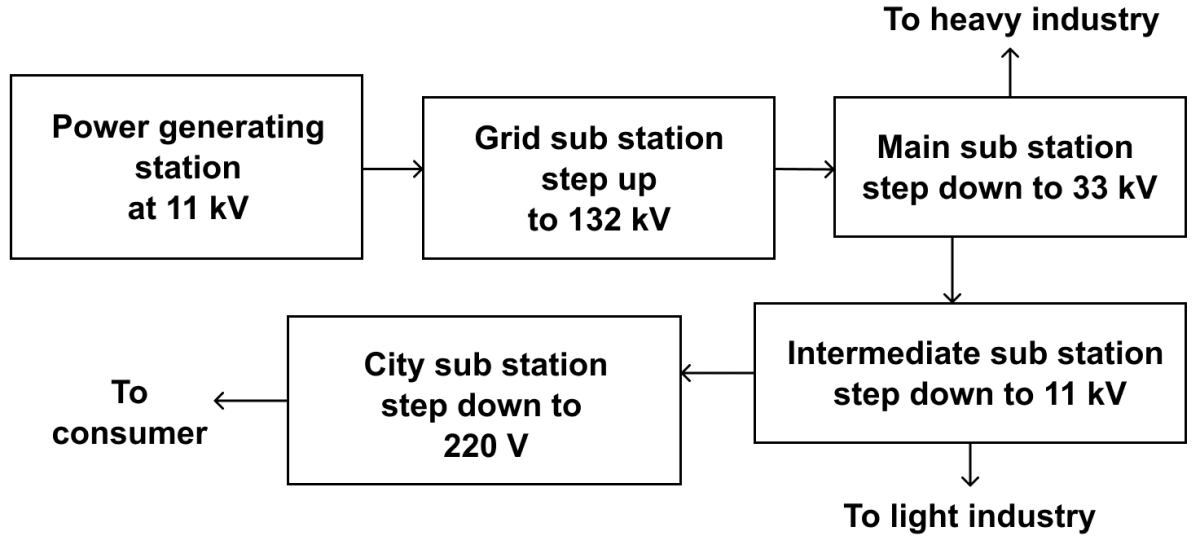
The alternating voltage generated is first stepped up from 11 kV to 132 kV at the generating station (also called the grid sub station) using the step up transformer. It is then transmitted to the main sub station. At the main sub-station, the voltage is stepped down from 132 kV to 33 kV using a step-down transformer and is then transmitted to the heavy industries and intermediate sub stations. At the intermediate sub station, the voltage is again stepped down from 33 kV to 11 kV using the step-down transformer and from here it is transmitted to the light industries and city sub station. At the city sub station, it is further stepped down from 11 kV to 220 V using the step down transformer to supply it to the domestic consumers.
Draw a circuit diagram to explain the ring system of house wiring. State two advantages of it.
Circuit diagram of ring system of house wiring is shown below:
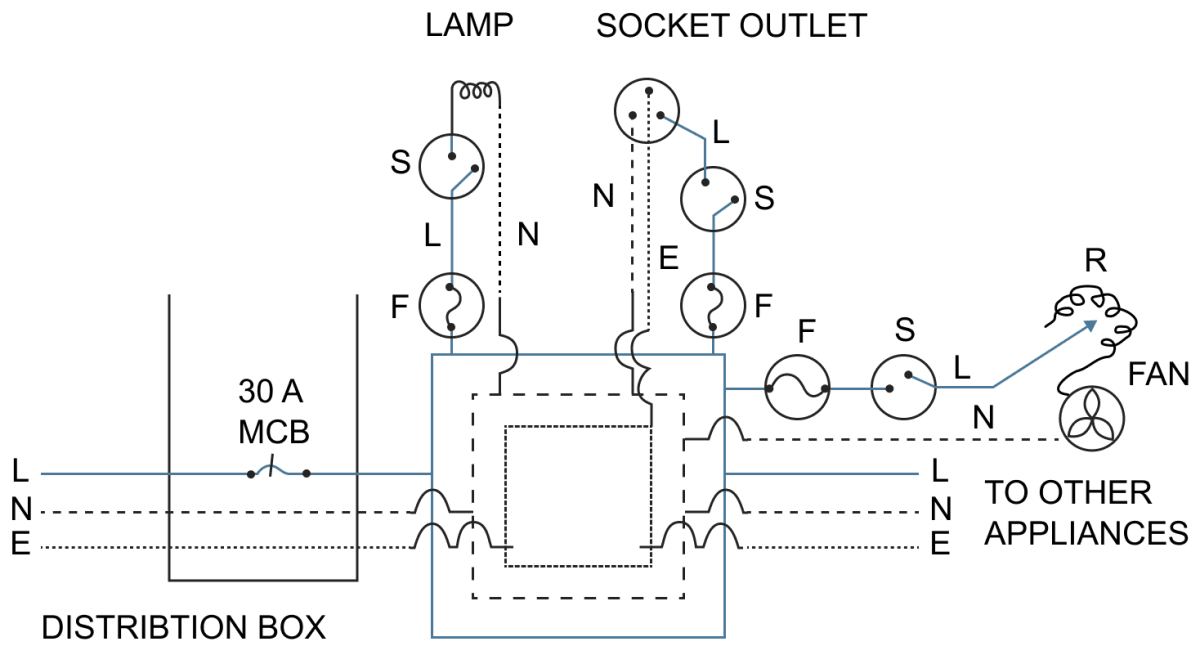
Advantages of a ring system are —
Draw a labelled diagram with the necessary switch, regulator, etc. to connect a bulb and a fan with the mains. In what arrangement will they be connected to the mains : series or parallel?
Circuit diagram to connect a bulb and a fan with the mains is shown below:
The appliances are connected in a parallel arrangement to the mains.
Below figure shows three bulbs A, B and C each of rating 100 W, 220 V connected to the mains of 220 V. Answer the following:
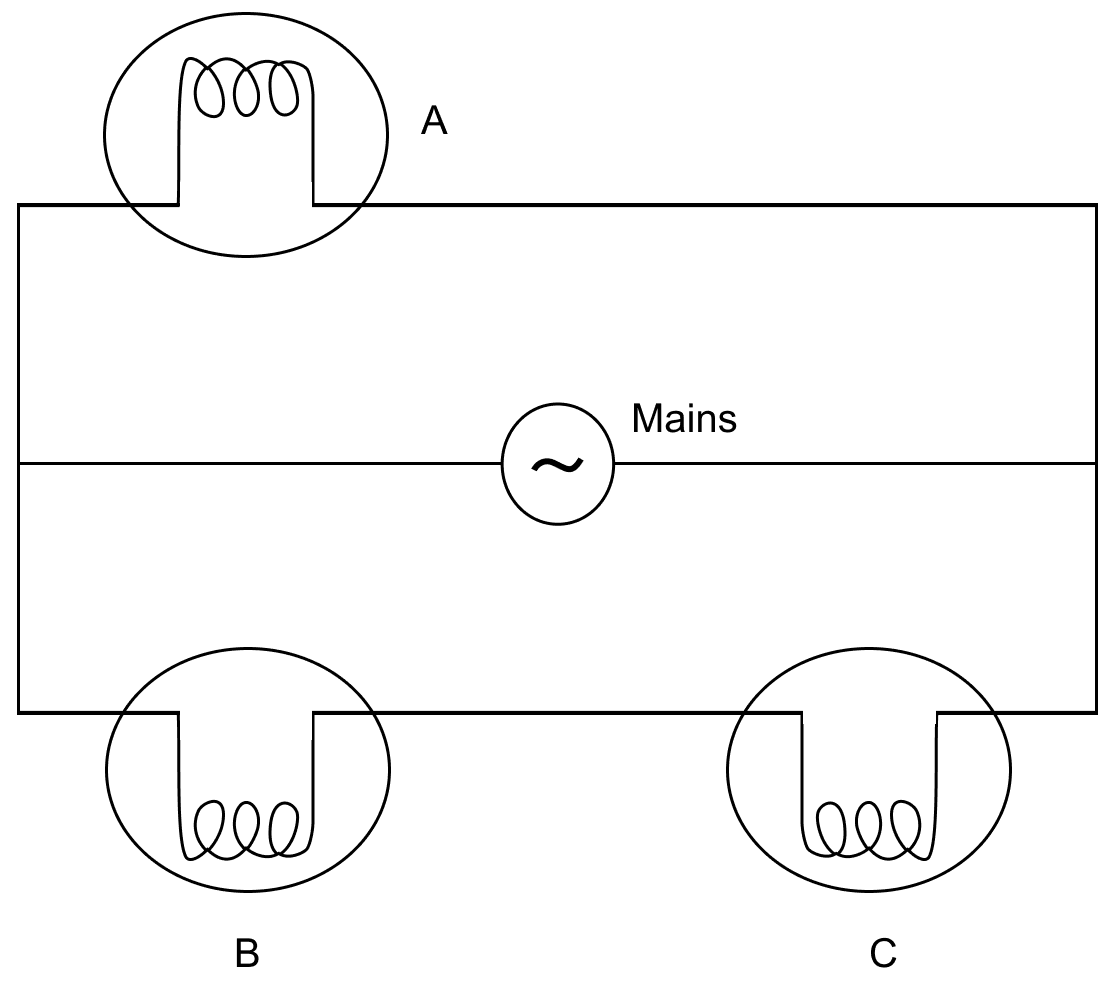
(a) How is the bulb A connected with the mains? At what voltage does it glow?
(b) How are the bulbs B and C connected with the mains? At what voltage does the bulb B glow?
(c) How is the glow of bulbs A and C affected if bulb B gets fused?
(d) How is the glow of bulbs B and C affected if bulb A gets fused?
(a) Bulb A is connected with the mains in parallel connection. It glows at a voltage of 220 V.
(b) Bulbs B and C are connected in series with the mains.
As we know, the voltage of the source gets divided in all the appliances connected in series in ratio of their resistances.
Hence, the voltage across the two bulbs B and C will be divided equally as both have same rating.
Therefore, we get,
$$\begin{aligned}\text V_\text B = \frac{220}{2} \\[1em] = 110\ \text V\end{aligned}$$
Hence, the bulb B will glow at a voltage of 110 V.
(c) If bulb B gets fused then there will be no effect on bulb A, as the two are connected in parallel. However, bulb C will not glow because it is connected in series with the bulb B.
(d) There is no effect on the glow of bulbs B and C if the bulb A gets fused as bulb A is connected in parallel with the bulbs B and C.
In a three pin plug, the longest pin is :
earth pin
Reason — The earth pin is used for grounding purposes, providing a path for fault currents to safely dissipate into the ground. It is usually longer than the live and neutral pins to ensure it makes contact first when the plug is inserted into an outlet, thereby providing an additional safety measure.
The purpose of earthing in a household circuit is to :
prevent electric shock
Reason — Earthing in a household circuit involves connecting the metal parts of electrical appliances and installations to the ground (earth) through a conductor. This ensures that in the event of a fault, such as a short circuit, any excess current flows safely to the ground rather than through a person touching the appliance or installation.
An alloy of lead and tin is used as the material of the fuse wire because its melting point is ............... and specific resistance is ............... .
low, high
Reason — An alloy of lead and tin is used as the material of the fuse wire because its melting point is low, so that it may easily melt due to overheating when current in excess to the prescribed limit passes through it and specific resistance is high so that sufficient heat is required to melt it.
The rating of a fuse connected in the lighting circuit is:
5 A
Reason — In electric wiring for light and fan circuits a thin fuse wire of low current rating i.e., 5 A is used because the line wire has a current carrying capacity of 5 A.
The use of MCB is more convenient than a fuse because :
both it eliminates the need to replace fuse wire and provides a quicker and safer response
Reason — The use of MCB is more convenient than a fuse because :
A switch in a table lamp is connected in the neutral wire. The lamp works fine. Identify the correct statement :
It is unsafe as lamp body is connected to the live wire.
Reason — When the switch is placed in the neutral wire, switching it off only breaks the neutral connection, while the live wire remains connected to the lamp.
As a result, the lamp parts can still be at live potential, posing a risk of electric shock even when the lamp appears to be off.
Out of the two given cases of wiring of a house, which one is relatively safer ?
(a) House A ⟶ Switch in neutral with earth connected.
(b) House B ⟶ Switch in live with no earth connected.
House B is safer.
Reason — A switch must always be connected in the live wire so that switching it off completely disconnects the appliance from the supply.
In House A, the switch is in the neutral wire, so the appliance remains connected to the live wire even when switched off, which is unsafe. Although earthing is important, proper placement of the switch in the live wire is more critical for preventing electric shock in this case.
Hence, House B is relatively safer than House A.
Assertion (A): A fuse wire must have a high resistance and low melting point.
Reason (R): A fuse is only used for a small current flow.
assertion is true but reason is false
Explanation
Assertion (A) is true. A fuse wire must have a high resistance to generate enough heat when a high current flows through it, causing it to melt and break the circuit.
Reason (R) is false. While fuses are used for protecting electrical circuits, they are not specifically used only for small current flow. Fuses are designed to handle normal operating currents but melt and break the circuit when the current exceeds a safe level, regardless of whether it is small or large.
Assertion (A): Same current flows through the live wires and the filament of a bulb, but the heat produced in the filament is much higher.
Reason (R): The filament of a bulb is made of low resistance and high melting point.
assertion is true but reason is false
Explanation
Assertion (A) is true. Same current flows through the live wires and the filament of a bulb, but the heat produced in the filament is much higher. This is due to the higher resistance of the filament compared to the live wires, leading to greater heat generation in the filament.
Reason (R) is false. The filament of a bulb is not made of a material with low resistance. In fact, the filament is specifically designed to have a relatively high resistance. This high resistance allows it to produce light efficiently by converting electrical energy into heat and then into light.
Assertion (A): A domestic electrical appliance working on a three point socket will continue working even if the top pin is removed.
Reason (R): The third pin is used only as a safety device.
both A and R are true and R is the correct explanation of A
Explanation
Assertion (A) is true because when domestic appliance are connected to a three-pin socket, the current flows through only the live and neutral wires, which are sufficient for its functioning while third pin is for earthing which is essential for safety but is not essential for working of an appliance.
Reason (R) is true because the third (top) pin is the earth wire, which does not participate in normal current flow and it is used purely as a safety measure to prevent electric shock by providing a low-resistance path for leakage current.
Here, the Reason (R) justifies the Assertion (A) because the appliance works using only the live and neutral wires and the third pin (earth) is only for safety and not required for normal operation. Therefore, even if it is removed, the appliance still works.
Hence, both A and R are true and R is the correct explanation of A.
Complete the following sentences —
(a) A fuse is a short piece of wire of high ............... and of material low ............... .
(b) A fuse wire is made of an alloy of ............... and ............... . If the current in a circuit exceeds the current rating of the fuse wire, it ............... .
(c) A fuse is connected in ............... with the ............... wire.
(d) Higher the current rating, ............... is the fuse wire.
(e) Live wire is also called ............... wire.
(a) A fuse is a short piece of wire of high resistance and of material low melting point.
(b) A fuse wire is made of an alloy of lead and tin. If the current in a circuit exceeds the current rating of the fuse wire it melts.
(c) A fuse is connected in series with the live wire.
(d) Higher the current rating, thicker is the fuse wire.
(e) Live wire is also called phase wire.
Why is the fuse wire fitted in a porcelain casing?
The fuse wire is fitted in a porcelain casing because it is an insulator of electricity.
Two fuse wires are rated 5 A and 20 A. Which of the two is (i) thicker, (ii) longer?
(i) The current rating of the fuse wire is directly proportional to the thickness of the fuse wire. Higher the thickness of fuse wire, higher will be the current rating.
Hence, 20 A wire will be thicker than the 5 A wire.
(ii) The current rating of the fuse wire is independent of it's length. Hence, both fuse wires may be of same length.
(a) 'A fuse is rated 8 A'. Can it be used with an electrical appliance of rating 5 kW, 200 V?
(b) Name two safety devices which are connected to the live wire of a household electric circuit.
From relation
$\text I = \frac{\text P}{\text V}$
Substituting the values we get,
$$\begin{aligned}\text I = \frac{5000}{200} \\[1em] = 25\ \text A\end{aligned}$$
Current that will flow through the electrical appliance is 25 A. However, the fuse is rated 8 A.
Hence, such fuse cannot be used with this electrical appliance.
(b) The two safety devices which are connected to the live wire of a household electric circuit are switch and fuse.
What is the colour code for the insulation on (a) live, (b) neutral, and (c) earth wire?
Colour coding of wires in a cable
| Wire | Colour (Old Convention) | Colour (New Convention) |
|---|---|---|
| Live | Red | Brown |
| Neutral | Black | Light blue |
| Earth | Green | Green or Yellow |
Name the colour code of the wire which is connected to (i) metallic body of an appliance, (ii) switch for the appliance.
(i) The green or yellow colour (i.e., earthing wire) is connected to metallic body of an appliance. The old colour convention is green for earth wire.
(ii) Brown or red (i.e., live wire) is connected to switch of the appliance.
What is a fuse? Name the material of fuse. State one characteristic of the material used for fuse.
An electric fuse is a safety device which is used to limit the current in an electric circuit. The use of a fuse safeguards the circuit and the appliances connected in that circuit from being damaged.
An alloy of lead and tin is used as the material of the fuse wire because it's melting point is low (approx 250 °C) and specific resistance is high (more than that of Copper, Aluminium, etc.)
The characteristics of the material used for the fuse wire is that it should have low melting point so that it may easily melt due to overheating when current in excess to the prescribed limit passes through it.
Name the device used to protect the electric circuits from over loading and short circuit. On what effect of current does it work?
The device used to protect the electric circuits from overloading and short circuit is a fuse.
It works on the heating effect of current. A material of low melting point is used so that it may easily melt due to overheating when current in excess to the prescribed limit passes through it.
How is a fuse put in an electric circuit? State the purpose of using a fuse in a circuit.
The fuse wire is stretched between the two metallic terminals T1 and T2 in a porcelain holder (since porcelain is an insulator of electricity). This holder fits into a porcelain socket having two metallic terminals to each of which the live wire of the circuit is connected. Thus the fuse wire gets connected in the live wire. The below diagram shows the fuse arrangement:
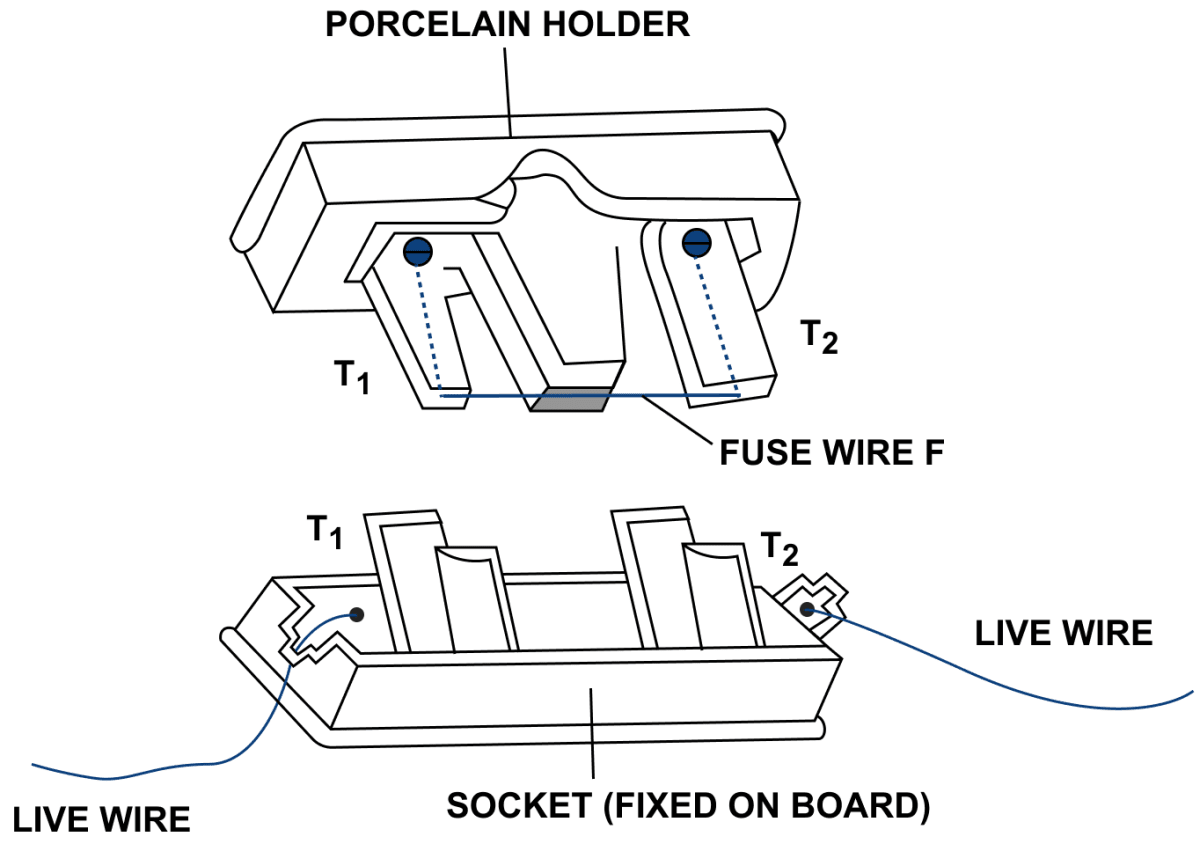
The use of fuse is to safeguard the circuit and the appliances connected in that circuit from being damaged. It works on the heating effect of current. A material of low melting point is used so that it may easily melt due to overheating when current in excess to the prescribed limit passes through it.
A fuse is always connected in the live wire of the circuit. Explain the reason.
A fuse is always connected in the live wire of the circuit before the appliance, so that as the current in circuit exceeds the rating of fuse, it melts and breaks the circuit first, before the current reaches the appliance. Thus, no current flows in the appliance.
In case the fuse is connected in the neutral wire and due to some defect in the appliance an excessive current flows in the circuit, the fuse blows off and the current stops flowing in the circuit, but the appliance still remains connected to the high potential point of the supply through the live wire . Now if a person touches the faulty appliance, he gets an electric shock because the person comes in direct contact of the mains through the live wire. Thus, it is highly unsafe to use fuse in the neutral wire.
How does the (i) thickness and (ii) length of a fuse wire depend on its current rating?
(i) Thickness of the fuse wire — The current rating of the fuse wire is directly proportional to the thickness of the fuse wire. Higher the thickness of fuse wire, higher will be the current rating.
(ii) Length of the fuse wire — The current rating of the fuse wire is independent of it's length.
Explain the meaning of the statement ‘the current rating of a fuse is 5 A’.
The statement 'current rating of a fuse is 5 A' means that the fuse wire will melt if current exceeds 5 A in the circuit.
Why is it not advisable to use a piece of copper wire as fuse wire in an electric circuit?
It is not advisable to use a piece of copper wire as fuse wire in an electric circuit because it is very thick so it will not melt even if the current exceeds its safe limit.
An electrical kettle is rated 3 kW, 250 V. Give reason whether this kettle can be used in a circuit which contains a fuse of current rating 13 A.
From relation
$\text I = \frac{\text P}{\text V}$
Substituting the values we get,
$$\begin{aligned}\text I = \frac{3000}{250} \\[1em] = 12 \text{ A}\end{aligned}$$
Hence, the safe limit of current for kettle is 12 A.
Therefore, yes, this kettle can be used in a circuit which contains a fuse of current rating 13 A as the safe limit of current for kettle is 12 A.
(a) A switch is not touched with wet hands while putting it on or off. Give a reason for your answer.
(b) Name the wire to which a switch is connected.
(a) A switch should never be touched with wet hands. If water reaches the live wire, it forms a conducting layer between the hand and the live wire of the switch due to which a current passes to the hand through it and the person may get a fatal shock.
(b) The switch is connected to the live wire.
It is dangerous to connect the switch in the neutral wire. Explain your answer.
It is dangerous to connect the switch in the neutral wire because in the 'off' position of the switch the appliance remains connected to the high potential terminal through the live wire, although no current flows through the appliance because the return path is incomplete. However, it is not safe to carry out repair work in this condition because on touching the live wire in the appliance the current will pass through the body of the person and he may get a fatal shock.
Further, due to some fault if the live wire touches the metallic body of the appliance, then it is not safe to touch the appliance even from outside.
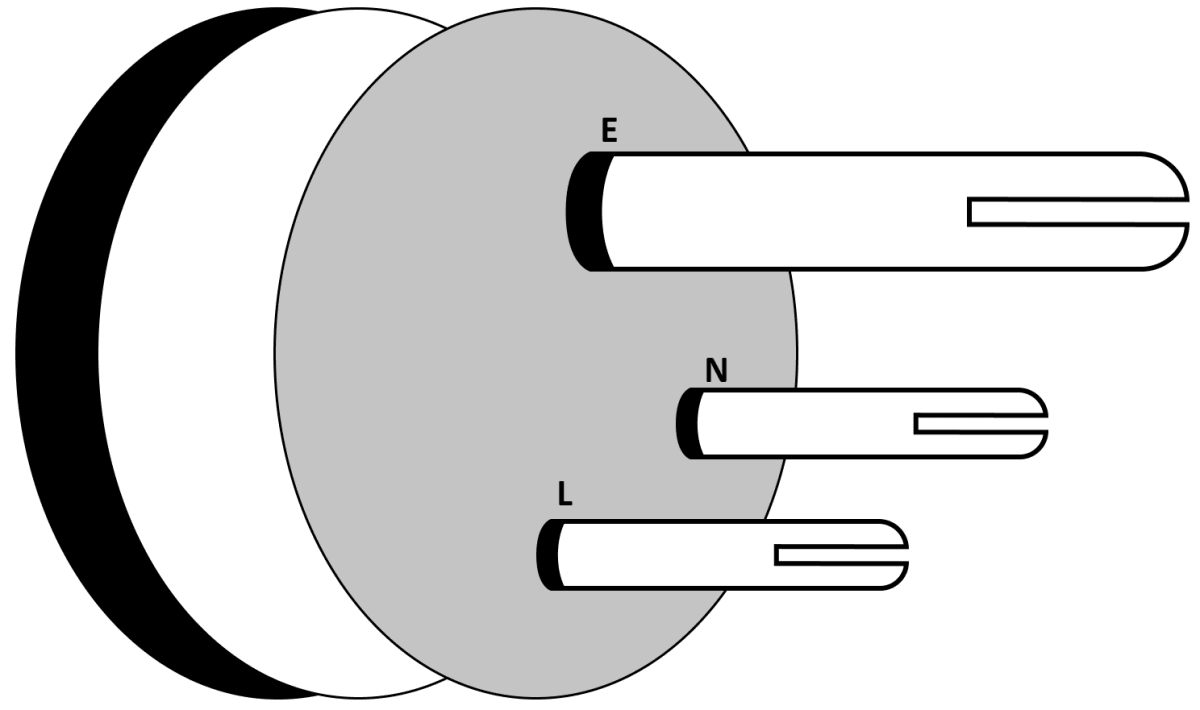
The diagram in below figure shows a three pin plug. Label the three pins.
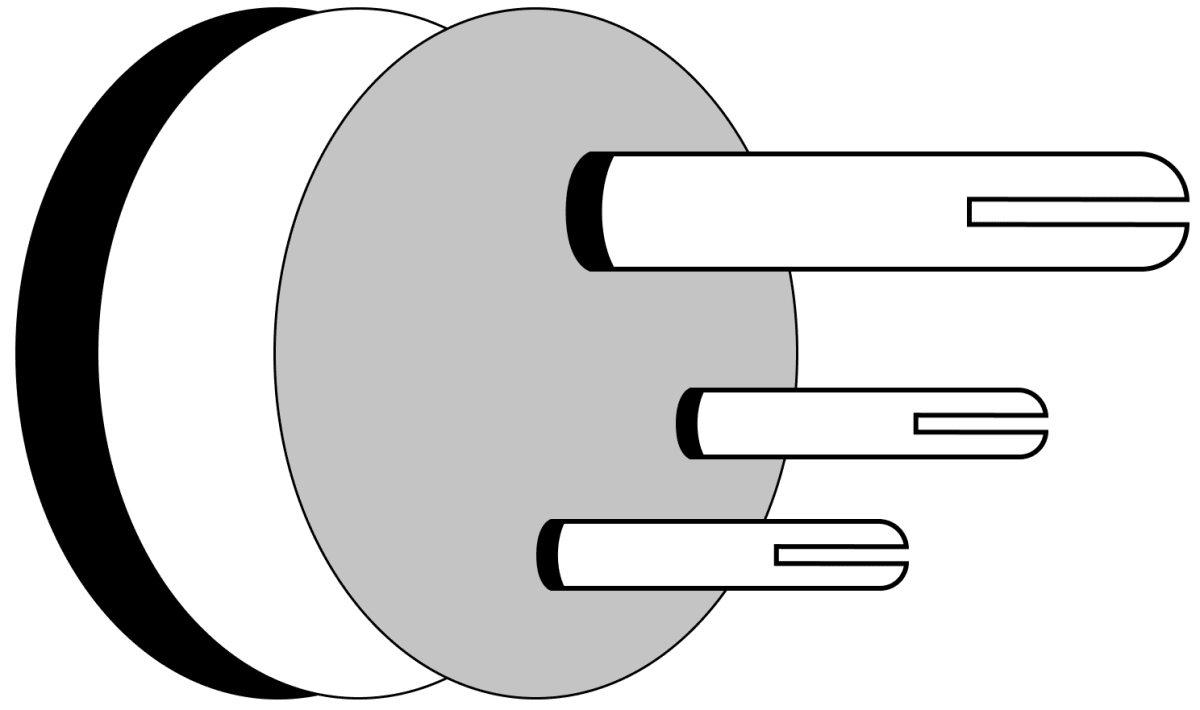
(a) Why is top pin thicker and longer than the other two?
(b) Why are the pins splitted at the ends?
In a three pin plug, the top pin is for earthing, the pin on the left is for live and the pin on the right is for neutral. In the good quality plugs, these are marked as E, L and N respectively.
(a) The earth pin is thicker and longer than the other two. The earth pin is made long so that the earth connection is made first. This ensures the safety of the user because if the appliance is defective, then as soon as the live pin gets connected, the current passes to the earth and the fuse blows off.
Further, the pin is made thicker so that even by mistake it cannot be inserted into the hole of live or neutral connection.
(b) The pins are splitted at the ends to provide a spring action so that they fit in the socket holes tightly.
To which wire is the metallic case of an electric appliance connected? Give the reason?
The metallic case of the appliance should be properly earthed by connecting it to the earth wire.
When the live wire of a faulty appliance comes in direct contact with it's metallic case due to break of insulation after it's constant use (or otherwise), the appliance acquires the high potential of the live wire.
A person touching the appliance will get a fatal shock because current flows through his body to the earth. But if the metallic case of the appliance is properly earthed, then as soon as the live wire comes in contact with the metallic case, a heavy current flows to the earth through the case of the appliance (since the metallic case has almost zero resistance) and the fuse connected in the circuit of appliance blows off, and the appliance gets disconnected from the mains supply.
Thus the person touching the appliance does not get any shock and the appliance is also saved from being damaged.
(a) The earthing of an electric appliance is useful only if the fuse is in the live wire. Given the reason.
(b) Name the part of the appliance which is earthed.
(a) The earthing of an electric appliance is useful only if the fuse is in the live wire because in case the current in the circuit exceeds the rating of the fuse, it may melt and break the circuit first, before the current reaches the appliance.
It is unsafe to connect the fuse in the neutral wire because if due to some defect in the appliance an excessive current flows in the circuit, but appliance still remains connected to the high potential point of supply through the live wire. Now if a person touches the faulty appliance, he gets an electric shock because the person comes in direct contact of the mains through the live wire. Thus, it is highly unsafe to use fuse in the neutral wire.
(b) The metallic case of the appliance should be properly earthed.
For earthing an electrical appliance, one has to remove the paint from the metallic body of the appliance where the electrical contact is made. Explain the reason.
The paint provides an insulating layer on the metal body of the appliance. Therefore, in order to make the earth connection, it is necessary to remove paint from the body part where connection is to be made.
How does the colour code of wires in a cable help in house wiring?
The colour coding of wires help us to connect the switch, fuse, sockets, etc. through proper wire in the circuit of house wiring.
Why is it necessary to have an earth wire installed in a power circuit, but not in a lighting circuit?
The appliances connected to the power circuit like air conditioner, geyser, washing machine, etc. consume heavy current. If due to some reason such as short circuiting, an excessive current flows through the power circuit, not only the appliance will get damaged but due to the excessive heat produced by such high current, the wires may get overheated causing a fire. If the earth wire is installed, it conducts the excessive current to the earth thus avoiding the fire.
The current carrying capacity of lighting circuit is low (less than 5A). In case of a short circuit, the chances of fire due to overheating of wires are little. Hence, generally earth wire is not installed in a lighting circuit.
Give two characteristics of a high tension wire.
A high tension wire has low resistance and large surface area. The resistance is kept low so as to allow a heavy current to pass through it.
The surface area is made large so that it radiates the heat produced more quickly to the surrounding.
Which of the cables, one rated 5 A and the other rated 15 A will be of thicker wire? Give a reason for your answer.
[Hint : To carry heavy current, the resistance of wire should be low, so its area of cross section should be large].
The thicker wire is the one which is rated 15 A.
In order to carry heavy current, the resistance of wire should be low, so it's area of cross section should be large. Therefore, as large current is passing through the second wire hence, it will be thicker.
The diagram in below figure shows three lamps and three switches 1, 2 and 3 connected with two cells.
(a) Name the switch/switches to be closed so as to light all the three lamps.
(b) How are then the lamps connected : in series or in parallel?
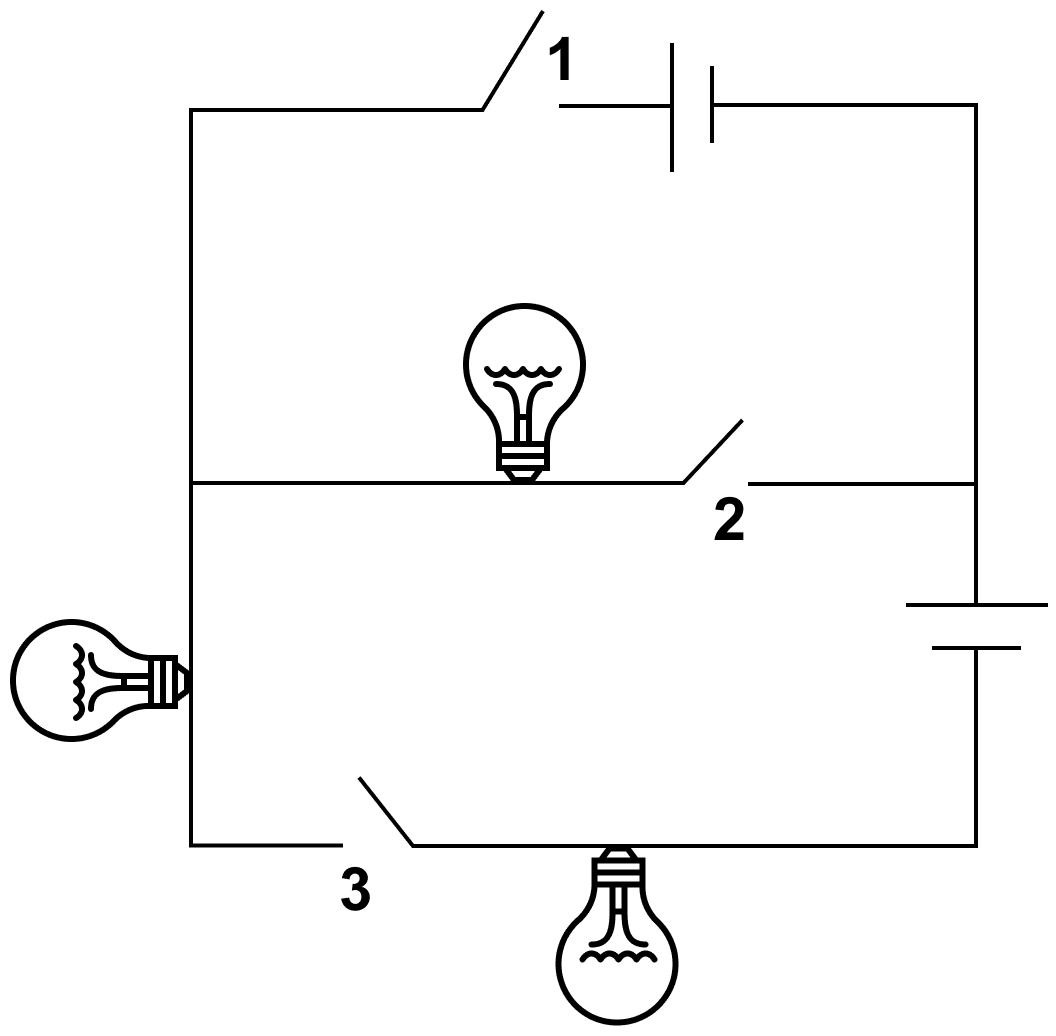
(a) In order to light all the three lamps switch 2 and 3 should be closed.
(b) The lamps are then connected in series.
Describe with the aid of a diagram some form of a fuse which is used in the electric lighting circuit of a house. Give two reasons why a fuse must not be replaced by an ordinary copper wire.
The figure below shows one of the most common fuse arrangement in which the the fuse wire F is stretched between the two metallic terminals T1 and T2 in a porcelain holder (since porcelain is an insulator of electricity). This holder fits into a porcelain socket having two metallic terminals to each of which the live wire of the circuit is connected. Thus, fuse wire gets connected in the live wire.
A copper wire is unsuitable for use as the fuse wire because:
(a) What is the purpose of a switch in a circuit?
(b) Why is the switch put in the live wire?
(c) What precaution do you take while handling a switch?
(a) A switch is an on-off device for current in a circuit (or in an appliance). It is connected in the live wire.
(b) The switch is put in the live wire because when the switch is in 'on' position, the appliance gets connected to the high potential point through the live wire and current flows in the appliance, the circuit is complete and the neutral wire provides the return path for the current. In the off position of the switch, the circuit is incomplete and no current reaches the appliance through the live wire. It is now safe to carry out repairs in the appliance, if required.
On the other hand, it is unsafe to connect a switch in the neutral wire. In the 'off' position of the switch the appliance remains connected to the high potential terminal through the live wire, although no current flows through the appliance because the return path is incomplete. However, it is not safe to carry out repair work in this condition because on touching the live wire in the appliance the current will pass through the body of the person and he may get a fatal shock. Moreover, if due to some fault, live wire touches the metallic body of the appliance then on touching the appliance the person may get a fatal shock.
(c) A switch should never be touched with wet hands. If water reaches the live wire, it forms a conducting layer between the hand and the live wire of the switch due to which a current passes to the hand through it and the person may get a fatal shock.
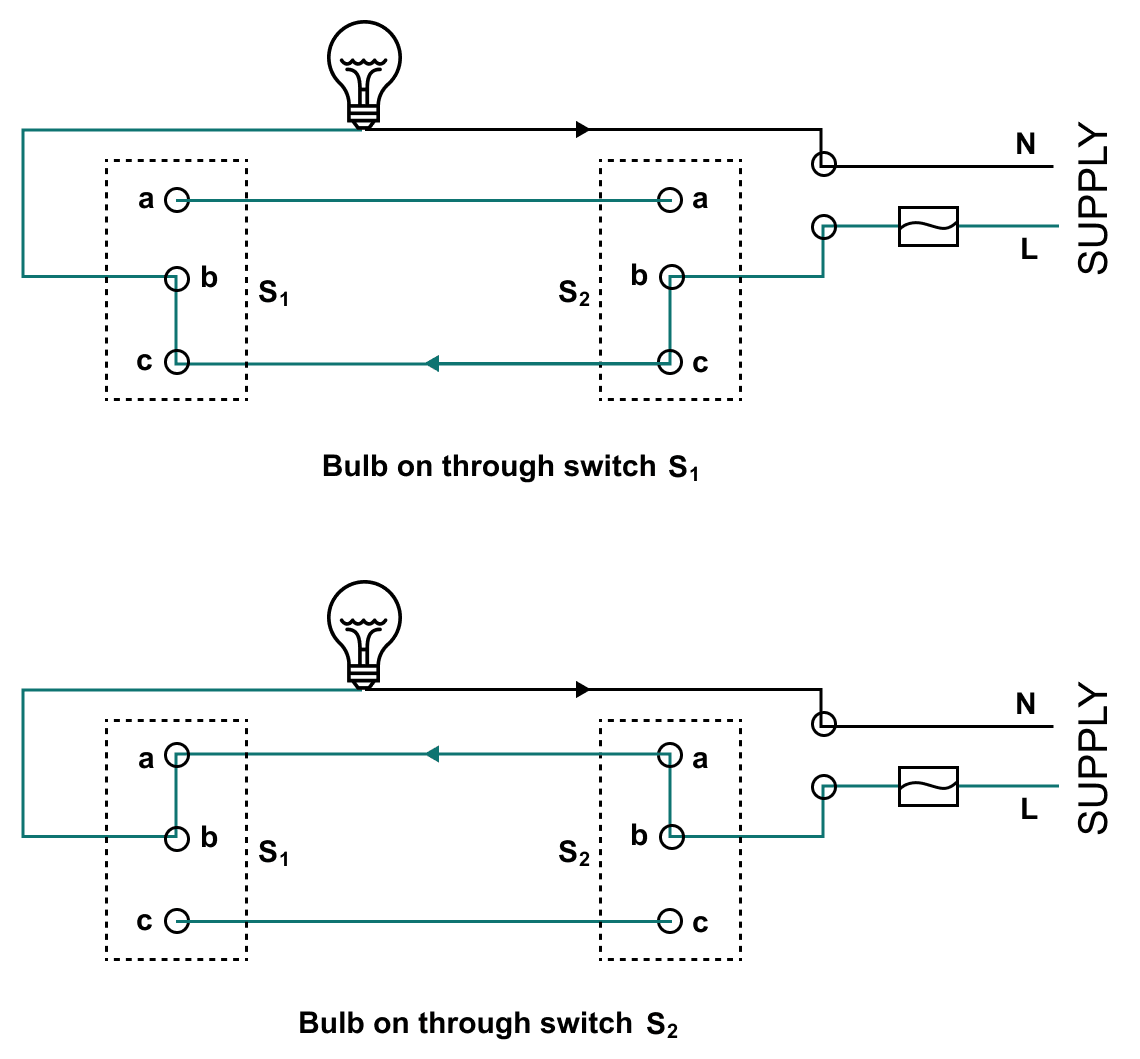
Draw a diagram of a dual control switch when the appliance is switched 'ON'.
Below circuit diagrams show an appliance switched 'ON' through dual control switch:
Draw a circuit diagram using the dual control switches to light a staircase electric light and explain its working.
Below circuit diagram shows the use of dual control switches to light a staircase electric light:
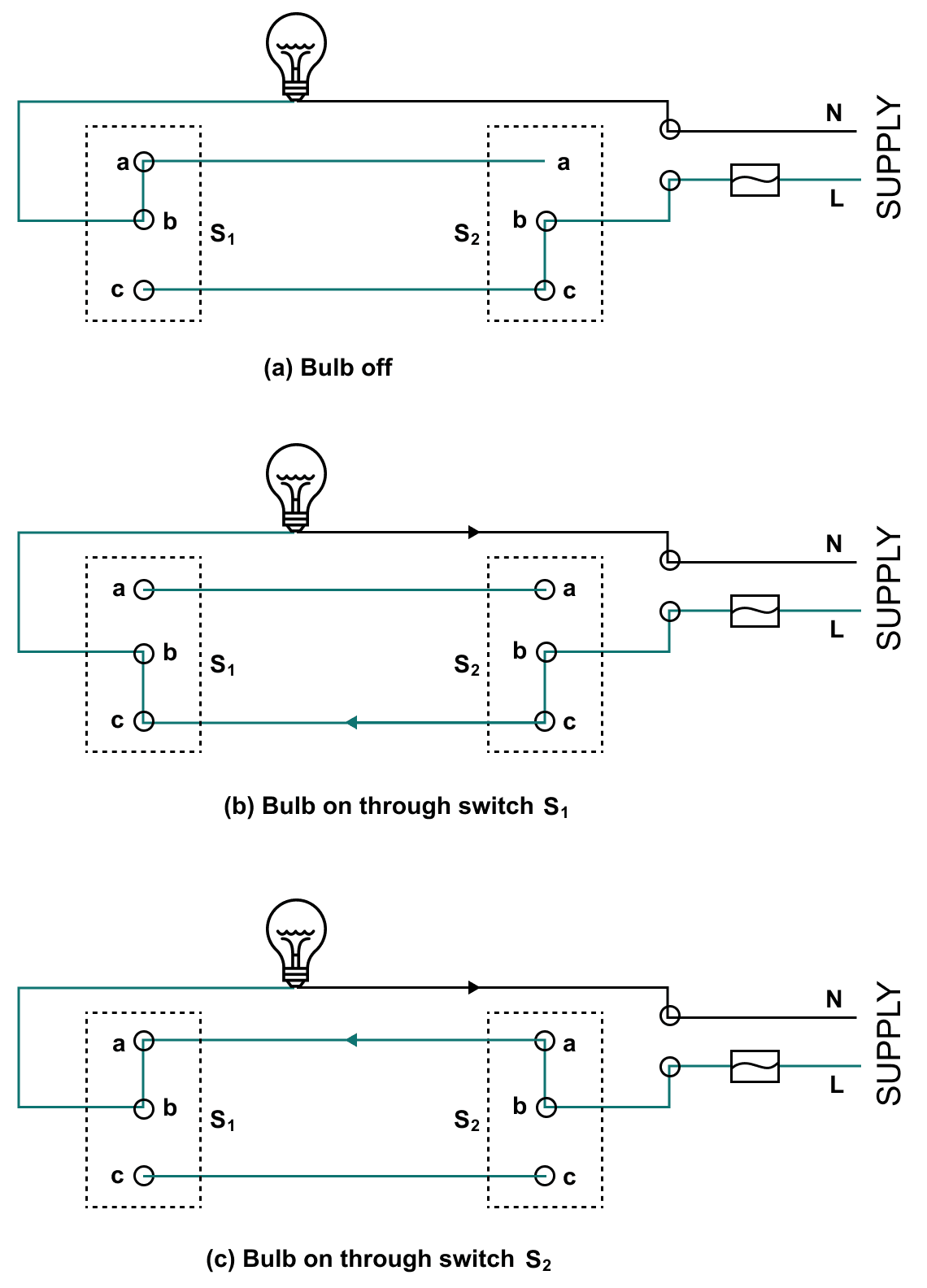
Two switches S1 and S2 are used. The switch S1 is fitted at the bottom and the switch S2 at the top of the staircase. Figure (a) shows the off position of the bulb.
The bulb can now be switched 'on' independently by either the switch S1 or the switch S2. If the switch S1 is operated, the connection 'ba' is changed to 'bc', which completes the circuit and the bulb lights up [figure. (b)]
Similarly, on operating the switch S2 from the position shown in figure (a), the connection 'bc' changes to 'ba' which again completes the circuit figure (c) and the bulb lights up.
Similarly, if the bulb is in 'on' position as shown in figure.(b) one can switch 'off' the bulb by changing the connections 'bc' to 'ba' either by operating the switch S1 or the switch S2. But, if the bulb is in 'on' position as shown in figure (c), it can be switched 'off' by changing the connections 'ba' to 'bc' either by the switch S1 or by the switch S2.
What purpose is served by the terminals of a three way pin plug? Draw a diagram and name the pins.
In a three pin plug, the top pin is for earthing, the pin on the left is for live and the pin on the right is for neutral. In the good quality plugs, these are marked as E, L and N respectively.
The earth pin is thicker and longer than the other two. The earth pin is made so long so that the earth connection is made first. This ensures the safety of the user because if the appliance is defective, then as soon as the live pin gets connected, the current passes to the earth and the fuse blows off.
Further, the pin is made thicker so that even by mistake it cannot be inserted into the hole of live or neutral connection.
The diagram of a three way pin plug with its pins labelled is shown below:
Draw a labelled diagram of a three pin socket.
Labelled diagram of a three pin socket is shown below:
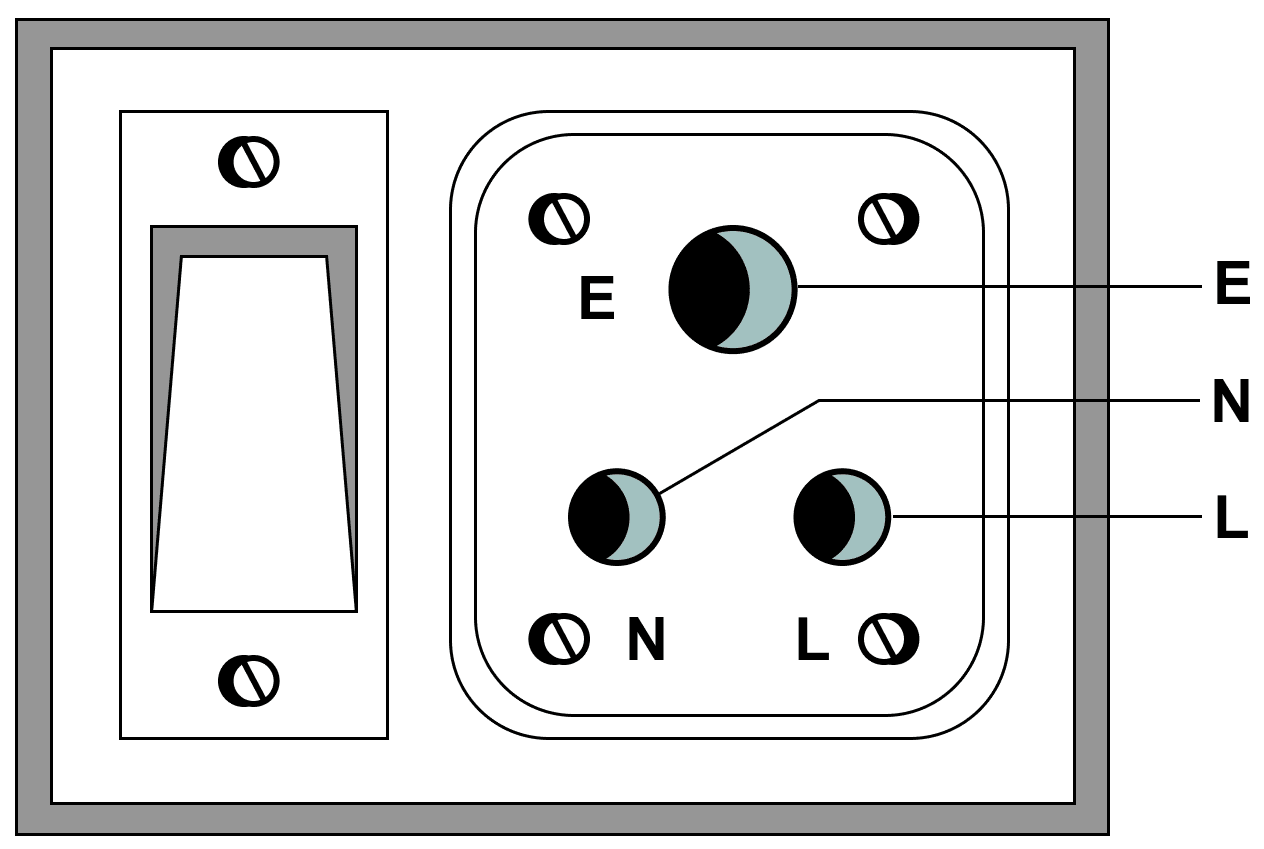
It is a fixture in an electric circuit in which the plug is inserted. The socket has three holes. The upper bigger hole is for earth connection, while the hole on the right side is for connection to the live wire and the hole on the left side is for connection to the neutral wire of electric supply.
The diagram in below figure shows a three-pin socket marked as 1, 2 and 3.
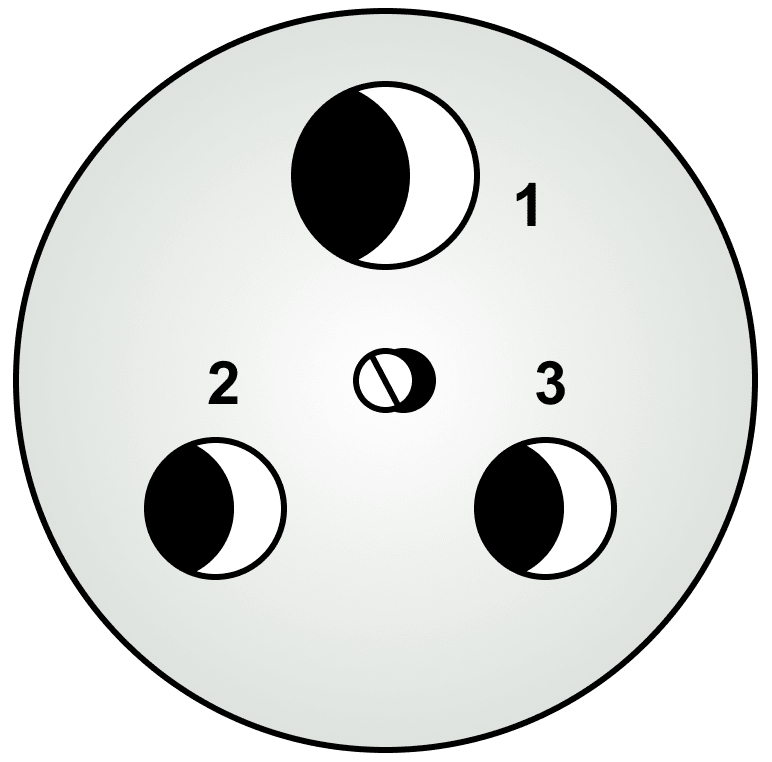
(a) Identify and write live (L), neutral (N) and earth (E) against the correct number.
(b) To which part of the appliance is the terminal 1 connected?
(c) To which wire joined to 2 or 3, is the fuse connected?
(a) The points are labelled as follows:
(b) Terminal 1 is connected to the metal body of the appliance.
(c) The fuse is connected to the live wire (numbered 3 in the diagram). It is so because if in case there is excessive flow of current, the fuse melts first and breaks down the circuit to protect appliances.
What do you mean by the term local earthing? Explain how it is done.
Local earthing is done in the house near the kWh meter.
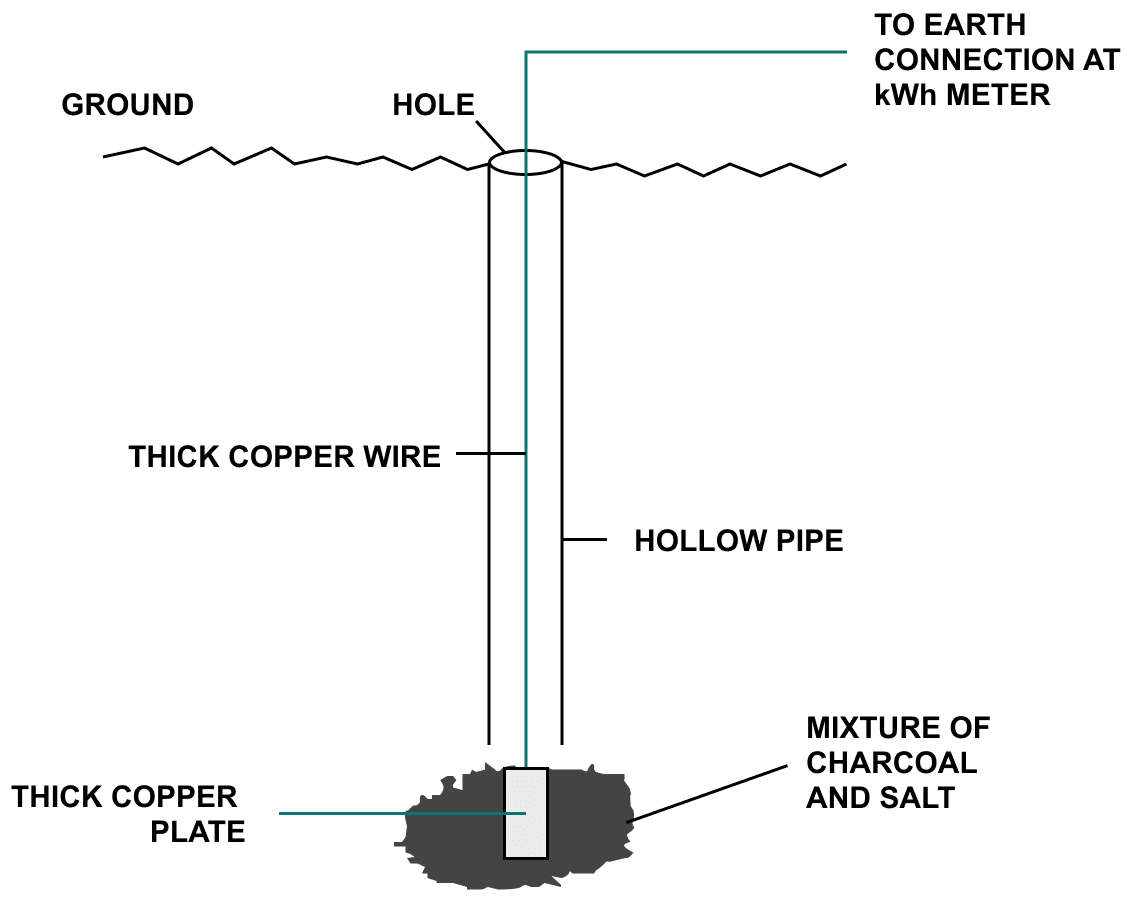
For this purpose, a hole nearly 2–3 metre deep is dug in the ground. A copper rod (or a thick copper wire) covered by a hollow insulating pipe, is inserted in the hole. A thick copper plate of dimensions 50 cm × 50 cm is welded at the lower end of the copper rod and it is buried inside the ground.
The plate is surrounded by a mixture of charcoal and salt to make a good contact between the plate and the earth. To keep the ground damp, water is poured through the pipe from time to time. This forms a conducting layer between the plate and the ground. The upper end of the copper rod is joined to the earth connection at the kWh meter.
A power circuit uses a cable having three different wires.
(a) Name the three wires of the cable.
(b) Between which of the two wires should the heating element of an electric geyser be connected?
(c) To which wire should the metallic case of the geyser be connected?
(d) To which wire should the switch and fuse be connected?
(a) The three wires of the cable are live wire, earth wire and neutral wire.
(b) The heating element of an electric geyser should be connected between the live wire and neutral wire.
(c) The metal case of the geyser should be connected to the earth wire.
(d) The switch and fuse should be connected to the live wire.
State two circumstances when one may get an electric shock from an electric gadget. What preventive measures must be provided with the gadget to avoid it?
An electric shock may be caused from an electrical gadget due to —
(a) poor insulation of wires,
(b) touching the appliance with wet hands.
To avoid such incidents —
(i) The insulation of wires must be of good quality and it should be checked from time to time because with long use, the insulation over the wire becomes brittle and crakes off leaving the wire naked.
(ii) The appliance should never be operated with wet hands.
The figure below shows a dual control switch circuit use to light a bulb.
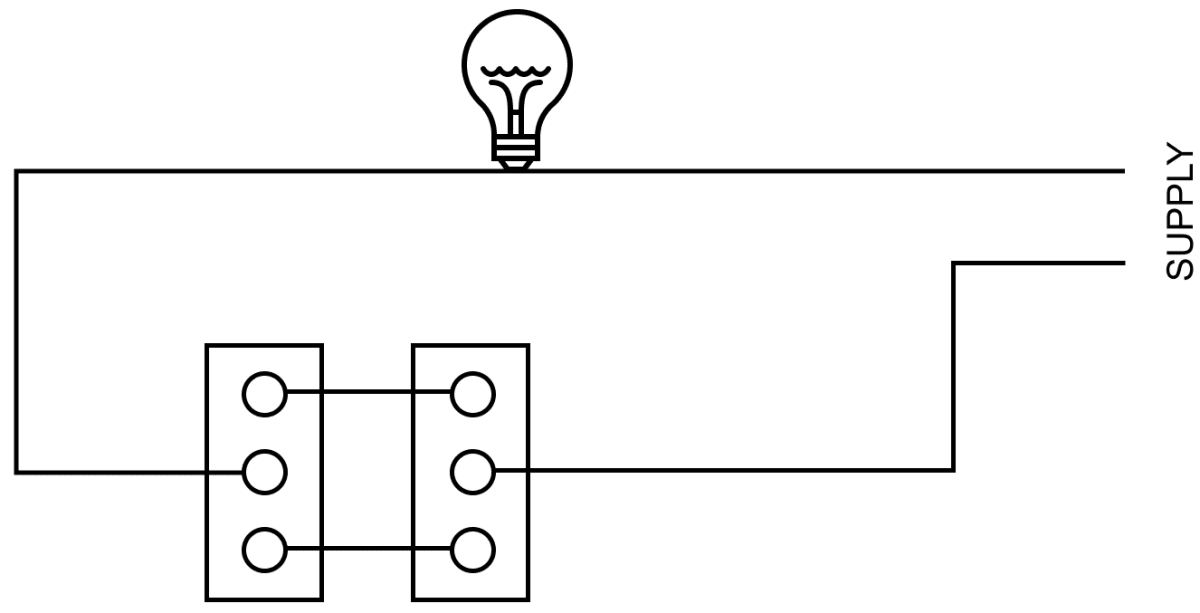
(a) Complete the circuit so that bulb is switched on.
(b) Mark the supply terminals with L and N to indicate live and neutral wires.
The complete circuit diagram with the bulb switched on is shown below:
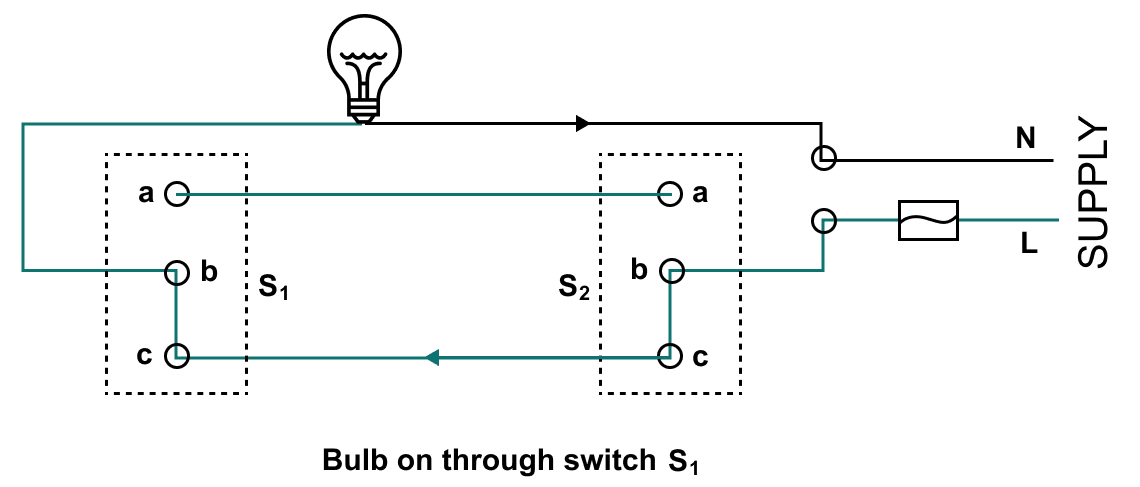
Figure below shows two bulbs with switches and fuse connected to the mains through a three pin socket by means of a three wires cable.
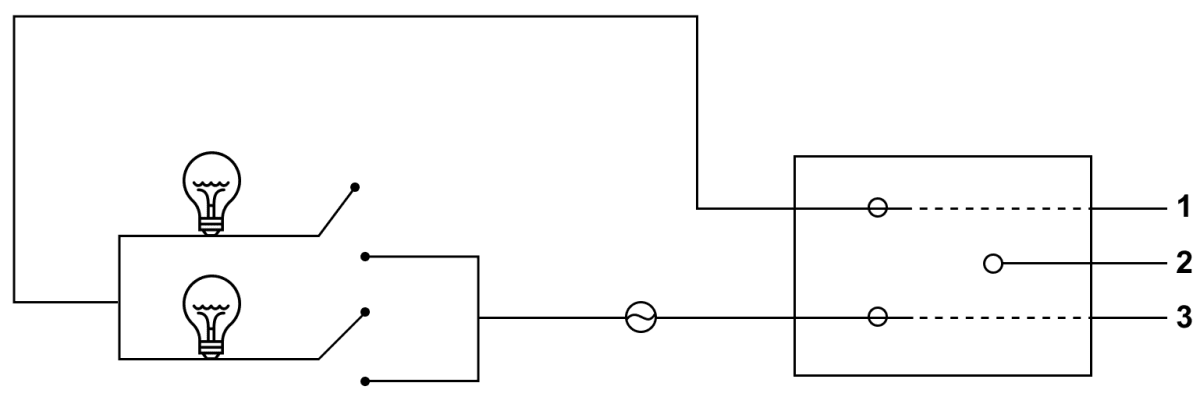
(a) Label each component — bulb, switch, fuse and socket.
(b) Name and state the colour of insulation of each wire 1, 2 and 3.
(c) How are the two bulbs joined : in series or in parallel?
(a) Labelled diagram is shown below:
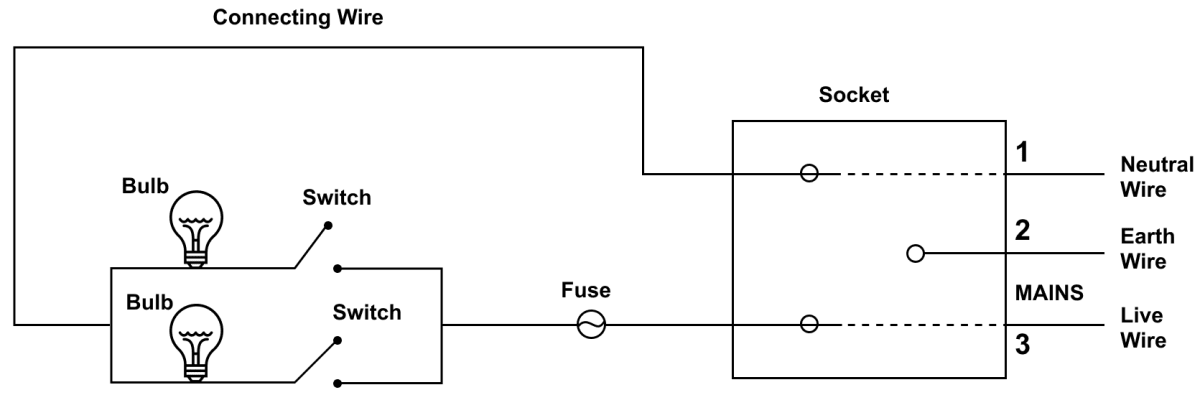
(b) The name and colour of wires are as follows:
(c) The two bulbs are joined in parallel.
Press ↓ to reveal a solution and move to the next question. Back to Selina Concise Physics.