The below diagram shows the part of a complete circuit. The ammeter reads 1A.
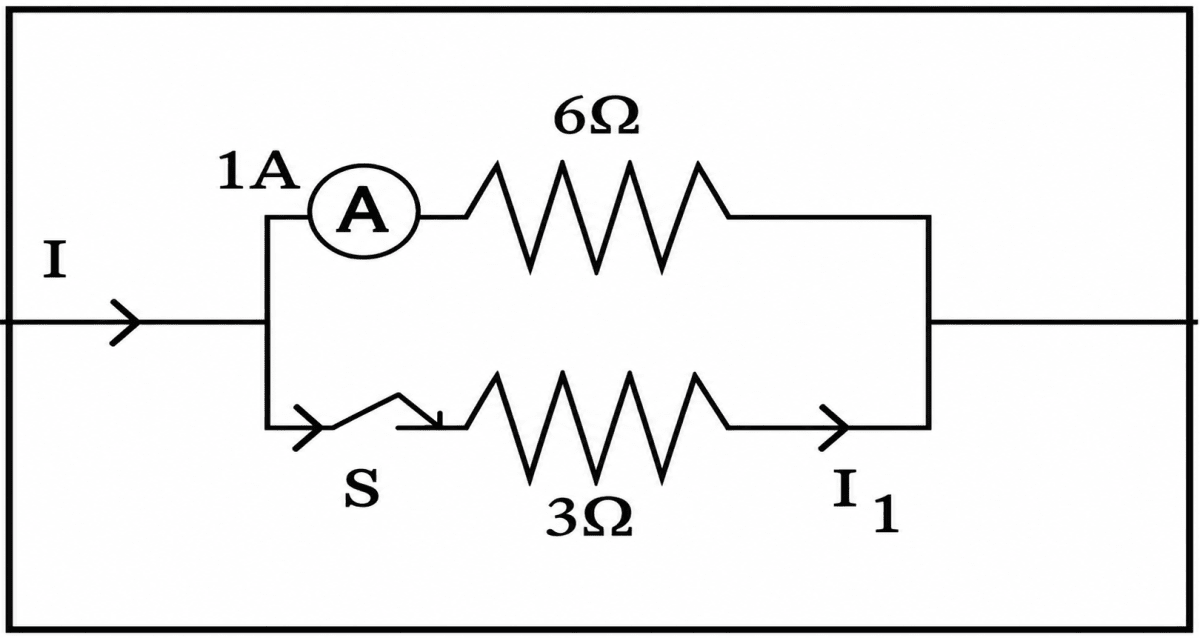
Calculate:
(a) the current I1 through the 3Ω resistor.
(b) the total current I in the circuit.
(c) State True or False: When the switch (S) is opened and the entire current flows through the 6Ω resistor, the ammeter reading will be (1+I1).
Show SolutionHide Solution↓
Given,
- Current through the 6Ω resistor = ammeter reading = 1 A
(a) The 6Ω and 3Ω resistors are joined in parallel, so the potential difference across both of them is the same.
$$\begin{aligned}1 \times 6 = \text I_1 \times 3 \\[1em] \Rightarrow \text I_1 = \frac{6}{3} = 2 \text { A}\end{aligned}$$
Hence, the current through the 3Ω resistor is 2 A.
(b) In a parallel combination the main current is the sum of the currents in the branches.
I = 1 + I1 = 1 + 2 = 3 A
Hence, the total current in the circuit is 3 A.
(c) False.
Reason — When the switch S is opened, the 3Ω branch is broken and only the 6Ω resistor is left in the circuit. The resistance of the parallel combination was
$\text R_\text p = \frac{6 \times 3}{6 + 3} = 2\ \Omega$
which now rises to 6 Ω. For the same supply voltage, an increase in resistance decreases the current.
Hence, the ammeter reading will become less than 1 A, and not (1 + I1) = 3 A.