A metal rod AB of length 80 cm is balanced at 45 cm from the end A with 100 gf weights suspended from the two ends.
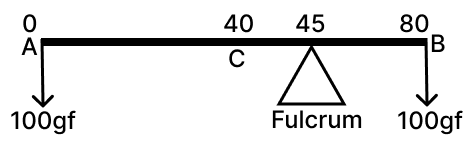
(a) If this rod is cut at the centre C, then compare the weight of AC to the weight of BC.
(b) Give a reason for your answer in (a)
Show SolutionHide Solution↓
Given,
Weight at the end A (WA) = 100 gf
Weight at the end B (WB) = 100 gf
Length of the rod (L) = 80 cm
Distance of A from the fulcrum (lA) = 45 cm
Distance of B from the fulcrum (lB) = 80 cm - 45 cm = 35 cm
Let,
Weight of the rod AC is (WAC) and distance of centre of gravity of the rod AC from the fulcrum is (lAC).
And
Weight of the rod BC is (WBC) and distance of centre of gravity of the rod BC from the fulcrum is (lBC).
Here,
(lAC) = 45 - 20 = 25 cm,
(lBC) = 60 - 45 = 15 cm,
Now,
Anticlockwise moment (due to weight of 100 gf at end A and weight of rod AC) = lA x WA + lAC x WAC = 45 x 100 + 25 x WAC
Clockwise moment (due to weight of 100 gf at end B and weight of rod BC) = lB x WB + lBC x WBC = 35 x 100 + 15 x WBC
As system is balanced then for equilibrium,
Anticlockwise moment of force about the fulcrum = Clockwise moment of force about the fulcrum
45 x 100 + 25 x WAC = 35 x 100 + 15 x WBC
⇒ 4500 + 25WAC = 3500 + 15WBC
⇒ 15WBC - 25WAC = 4500 - 3500 = 1000
⇒ 3WBC - 5WAC = 200
⇒ 3WBC - 5WAC > 0
⇒ 3WBC > 5WAC
$\Rightarrow \frac{\text W_\text {BC}}{\text W_\text {AC}} \gt \frac{5}{3} \gt 1$
⇒ WBC > WAC
Hence, weight of AC < weight of BC.
(b) Even though the weights present are the same at both ends and the torque arm of B is less than the torque arm of A. This means the moment of the weight of the rod acts from side B and the C.G. lies beyond 45. Thus, more weight is concentrated between C to B.