Cylinder, Cone & Sphere (Surface Area & Volume)

ICSE Class 10 Mathematics · Selina Concise Mathematics · 131 solved questions

Exercise
1(a)Exercise 20(A)

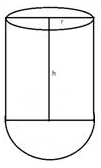
An open hollow cylindrical container, made of very thin metal sheet, has radius r cm and height h cm, its total surface area (in cm2) is :

Show SolutionHide Solution↓

Given,

It is an open hollow cylindrical container.

∴ It will be open at one end and closed at the other end.

Since, hollow cylindrical container is made up of very thin metal sheet.

∴ External radius = Internal radius = r cm.

Given,

Height = h cm.

Total surface area of hollow cylinder = External curved surface area + Internal curved surface area + Area of cross section (lower end)

= 2πrh + 2πrh + πr2

= 4πrh + πr2.

Hence, Option 2 is the correct option.

1(b)Exercise 20(A)

The curved area of a solid cylinder is S cm2 and the circumference of its base is C cm; the height of the cylinder is :

Show SolutionHide Solution↓

Let height of cylinder be h cm and radius be r cm.

Given,

The curved area of a solid cylinder is S cm2.

By formula,

Circumference of base = 2πr

Curved surface area = 2πrh

⇒ S = 2πrh

⇒ S = C.h

⇒ h = $\frac{S}{C}$ = S ÷ C.

Hence, Option 3 is the correct option.

1(c)Exercise 20(A)

A cylindrical container has sufficient water to submerge a solid cubical object of its each edge a cm. If the radius of the container is r cm, the rise in level (h cm) of water in the container is :

A cylindrical container has sufficient water to submerge a solid cubical object of its each edge a cm. If the radius of the container is r cm, the rise in level (h cm) of water in the container is : Cylinder, Cone, Sphere, Concise Mathematics Solutions ICSE Class 10.
Show SolutionHide Solution↓

Suppose rise in level of water be h cm.

Increase in volume of cylinder = πr2h.

Given,

Edge of cubical solid submerged = a cm.

Volume of cubical solid submerged = a3

We know that,

Volume of cubical solid submerged = Increase in volume of cylinder

⇒ a3 = πr2h

⇒ h = $\frac{a^3}{πr^2}$.

Hence, Option 3 is the correct option.

1(d)Exercise 20(A)

A solid cylinder of radius R cm and height H cm is melted and recast into smaller identical solid cylinders of height h cm and radius r cm. The number of smaller solid cylinders obtained is :

Show SolutionHide Solution↓

Given,

A solid cylinder of radius R cm and height H cm is melted and recast into smaller identical solid cylinders of height h cm and radius r cm.

Let no. of smaller cylinders formed be n.

∴ Volume of larger cylinder = n × Volume of one smaller cylinder

⇒ πR2H = n × πr2h

⇒ n = $\frac{πR^2H}{πr^2h} = \frac{R^2H}{r^2h}$

Hence, Option 2 is the correct option.

1(e)Exercise 20(A)

The total surface area of an open pipe of length H cm, external radius R cm and internal radius r cm, is :

Show SolutionHide Solution↓

Given,

External radius = R cm,

Internal radius = r cm,

Height = H cm.

Total surface area of hollow cylinder = External curved surface area + Internal curved surface area + 2(Area of cross section)

= 2πRH + 2πrH + 2(πR2 - πr2).

Hence, Option 4 is the correct option.

2Exercise 20(A)

The inner radius of a pipe is 2.1 cm. How much water can 12 m of this pipe hold ?

Show SolutionHide Solution↓

By formula,

Volume of cylinder = πr2h

Since, pipe is in the form of cylinder.

Given, radius (r) = 2.1 cm and height (h) = 12 m = 1200 cm.

Volume of water inside pipe = $\frac{22}{7} \times (2.1)^2 \times 1200$

= 22 × 0.3 × 2.1 × 1200

= 16632 cm3.

Hence, pipe can hold 16632 cm3 of water.

3Exercise 20(A)

How many cubic meters of earth must be dug out to make a well 28 m deep and 2.8 m in diameter ? Also, find the cost of plastering its inner surface at ₹ 4.50 per sq meter.

Show SolutionHide Solution↓

Given,

Diameter of well = 2.8 m

Radius of the well = $\frac{2.8}{2}$ = 1.4 m

Depth of the well = 28 m.

Volume of earth dug out = Volume of well = πr2h

= $\frac{22}{7}$ x 1.4 x 1.4 x 28

= 172.48 m3.

Area of curved surface = 2πrh

= 2 x $\frac{22}{7}$ x 1.4 x 28

= 2 x 22 x 0.2 x 28

= 246.4 m2.

Given, the cost of plastering at the rate of ₹ 4.50 per sq meter.

∴ Cost of plastering inner surface = ₹ 246.40 x 4.50

= ₹ 1108.80.

Hence, volume of earth to be dug out = 172.48 m3 and cost of plastering inner surface = ₹ 1108.80.

4Exercise 20(A)

What length of solid cylinder 2 cm in diameter must be taken to recast into a hollow cylinder of external diameter 20 cm, 0.25 cm thick and 15 cm long?

Show SolutionHide Solution↓

Given,

External diameter of hollow cylinder = 20 cm

So, external radius (R) = $\frac{20}{2}$ = 10 cm.

Thickness = 0.25 cm

Hence, the internal radius (r) = (10 - 0.25) = 9.75 cm.

Length of cylinder (h) = 15 cm

By formula,

$$\begin{aligned}\text{Volume of material} = πh(R^2 - r^2) \\[1em] = π \times 15 \times [10^2 - (9.75)^2] \\[1em] = π \times 15 \times [100 - 95.0625] \\[1em] = π \times 15 \times 4.9375.\end{aligned}$$

Given,

Diameter of the solid cylinder = 2 cm

so, radius (a) = $\frac{2}{2}$ = 1 cm

Let h be the length of the solid cylinder,

Volume = πa2h = π(1)2h = πh cm3.

In order for recasting, volume of solid cylinder must be equal to volume of material of hollow cylinder .

∴ πh = 15 π x 4.9375

⇒ h = 15 x 4.9375

⇒ h = 74.0625 cm.

Hence, the length of solid cylinder = 74.06 cm.

5Exercise 20(A)

A cylinder has a diameter of 20 cm. The area of curved surface is 100 cm2. Find :

(i) the height of the cylinder correct to one decimal place.

(ii) the volume of the cylinder correct to one decimal place.

Show SolutionHide Solution↓

Given,

The diameter of the cylinder = 20 cm

So, the radius (r) = $\frac{20}{2}$ = 10 cm

Given, the curved surface area = 100 cm2.

Let height = h cm

(i) By formula,

Curved surface area of cylinder = 2πrh

∴ 2πrh = 100

⇒ 2 x $\frac{22}{7}$ x 10 x h = 100

⇒ h = $\frac{100 \times 7}{22 \times 10 \times 2}$

⇒ h = $\frac{700}{440}$ = 1.6 cm.

Hence, the height of cylinder = 1.6 cm.

(ii) By formula,

Volume of the cylinder = πr2h

= $\frac{22}{7}$ x 10 x 10 x 1.6

= 502.9 cm3.

Hence, the volume of cylinder = 502.9 cm3.

6Exercise 20(A)

A metal pipe has a bore (inner diameter) of 5 cm. The pipe is 5 mm thick all round. Find the weight, in kilogram, of 2 metres of the pipe if 1 cm3 of the metal weights 7.7 g.

Show SolutionHide Solution↓

Given,

Inner diameter = 5 cm and thickness of pipe = 5 mm = 0.5 cm.

Inner radius of the pipe (r) = $\frac{5}{2}$ = 2.5 cm.

External radius of the pipe (R) = Inner radius of the pipe + Thickness of the pipe

= 2.5 cm + 0.5 cm = 3 cm

Length of the pipe (h) = 2 m = 200 cm.

Volume of the pipe = External Volume - Internal Volume

= πR2h - πr2h

= π(R2 - r2)h

= π(R + r)(R - r) h

= $\frac{22}{7}$(3 + 2.5)(3 - 2.5) x 200

= $\frac{22}{7} \times$(5.5) x (0.5) x 200 = 1728.6 cm3.

Given, 1 cm3 of the metal weight 7.7 g,

∴ Weight of the pipe = (1728.6 x 7.7) g = $\frac{(1728.6 \times 7.7)}{1000}$ kg = 13.31 kg.

Hence, weight of the pipe = 13.31 kg.

7Exercise 20(A)

A cylindrical container with diameter of base 42 cm contains sufficient water to submerge a rectangular solid of iron with dimensions 22 cm x 14 cm x 10.5 cm. Find the rise in the level of the water when the solid is submerged.

Show SolutionHide Solution↓

Given,

Diameter of base = 42 cm and radius = $\frac{42}{2}$ = 21 cm.

Let rise in level of water be h cm.

Since, water rises on submerging of a rectangular solid.

So, the increase in volume of water = volume of rectangular solid.

∴ πr2h = 22 x 14 x 10.5

$\frac{22}{7} \times 21^2 \times h$ = 3234

h = $\frac{3234 \times 7}{22 \times 21^2} = \frac{22638}{9702} = 2\frac{1}{3}$ cm

Hence, the water level will be raised to a level of $2\frac{1}{3}$ cm when the solid is submerged.

8Exercise 20(A)

A cylindrical container with internal radius of its base 10 cm, contains water up to a height of 7 cm. Find the area of wet surface of the cylinder.

Show SolutionHide Solution↓

Given,

Internal radius of the cylindrical container (r) = 10 cm

Height of water (h) = 7 cm

So, the surface area of the wet surface = 2πrh + πr2 = πr(2h + r)

= $\frac{22}{7}$ x 10 x (2 x 7 + 10)

= $\frac{220}{7}$ x 24

= 754.29 cm2.

Hence, the area of wet surface of cylinder = 754.29 cm2.

9Exercise 20(A)

Find the total surface area of an open pipe of length 50 cm, external diameter 20 cm and internal diameter 6 cm.

Show SolutionHide Solution↓

Given,

Length of the open pipe = 50 cm

External diameter = 20 cm

External radius (R) = $\frac{20}{2}$ = 10 cm

Internal diameter = 6 cm

Internal radius (r) = $\frac{6}{2}$ = 3 cm

Surface area of pipe open from both sides = 2πRh + 2πrh = 2πh(R + r)

= 2 x $\frac{22}{7}$ x 50 x (10 + 3)

= 4085.71 cm2

Area of upper and lower part = 2πR2 - 2πr2

= 2 x $\frac{22}{7}$ x (102 - 32)

= 2 x $\frac{22}{7}$ x 91

= 572 cm2.

Total surface area = 4085.71 + 572 = 4657.71 cm2.

Hence, total surface area of open pipe = 4657.71 cm2.

10Exercise 20(A)

The height and the radius of the base of a cylinder are in the ratio 3 : 1. If its volume is 1029 π cm3; find its total surface area.

Show SolutionHide Solution↓

Given,

The ratio between height and radius of a cylinder = 3 : 1

Volume = 1029π cm3 ..............(1)

Let the radius of the base = r

Then, it’s height will be = 3r.

By formula,

Volume = πr2h ............. (2)

From (1) and (2), we get

⇒ πr2h = 1029π

⇒ r2 × 3r = 1029

⇒ r3 = $\frac{1029}{3}$

⇒ r3 = 343

⇒ r = $\sqrt[3]{343}$

⇒ r = 7 cm.

Thus, radius = r = 7 cm and height = 3r = 3 x 7 = 21 cm.

By formula,

Total surface area = 2πr(h + r)

= 2 x $\frac{22}{7}$ x 7 x (21 + 7)

= 2 x 22 x 28

= 1232 cm2.

Hence, total surface area of cylinder = 1232 cm2.

11Exercise 20(A)

The radius of a solid right circular cylinder decreases by 20% and its height increases by 10%. Find the percentage change in its:

(i) volume (ii) curved surface area

Show SolutionHide Solution↓

Let the original dimensions of the solid right circular cylinder be

radius = r cm and height = h cm.

Volume = πr2h.

Curved surface area = 2πrh

Now, after the changes the new dimensions are:

Radius (r') = r - $\frac{20}{100} \times r$ = r - 0.2r = 0.8r

Height (h') = h + $\frac{10}{100} \times h$ = h + 0.1h = 1.1h

So,

New volume = πr'2h'

= π(0.8r)2(1.1h)

= 0.704 πr2h.

New curved surface area = 2πr'h' = 2π(0.8r)(1.1h)

= 1.76πrh

(i) Decrease in volume = Original volume - New volume

= πr2h - 0.704 πr2h

= 0.296 πr2h

Percentage change in its volume = $\frac{\text{Decrease in volume}}{\text{Original volume}}$ x 100 %

= $\frac{0.296πr^2h}{πr^2h}$ x 100 %

= 0.296 x 100 % = 29.6 %.

Hence, decrease in volume = 29.6 %.

(ii) Decrease in curved surface area = Original curved surface area - New curved surface area

= 2πrh - 1.76πrh

= 0.24πrh.

Percentage change in its curved surface area = $\frac{\text{Decreased CSA}}{\text{Original CSA}}$ x 100 %

= $\frac{0.24πrh}{2πrh}$ x 100 %

= 0.12 x 100 %

= 12 %.

Hence, decrease in volume = 12 %.

12Exercise 20(A)

Find the minimum length in cm and correct to nearest whole number of the thin metal sheet required to make a hollow and closed cylindrical box of diameter 20 cm and height 35 cm. Given that the width of the metal sheet is 1 m. Also, find the cost of the sheet at the rate of Rs. 56 per m.

Find the area of metal sheet required, if 10% of it is wasted in cutting, overlapping, etc.

Show SolutionHide Solution↓

Given,

Height of the cylinder box (h) = 35 cm

Base radius of the cylinder box (r) = $\frac{20}{2}$ = 10 cm

Width of metal sheet = 1m = 100 cm

Area of metal sheet required = Total surface area of the box

⇒ Length x width = 2πr(r + h)

⇒ Length x 100 = 2 x $\frac{22}{7}$ x 10(10 + 35)

⇒ Length x 100 = 2 x $\frac{22}{7}$ x 10 x 45

⇒ Length = $\frac{2 \times 22 \times 10 \times 45}{7 \times 100}$ = 28.28 cm ≈ 28 cm (correcting to the nearest whole number)

Thus,

Area of metal sheet = length x width = 28 x 100 = 2800 cm2 = $\frac{2800}{100 \times 100}$ = 0.28 m2.

So, the cost of the sheet at the rate of ₹ 56 per m2 = ₹ (56 x 0.28) = ₹ 15.68

Let the total sheet required be x.

Then, x - 10 % of x = 2800 cm

⇒ $x - \frac{10}{100} \times x$ = 2800

⇒ $\frac{100x - 10x}{100}$ = 2800

⇒ $\frac{90x}{100}$ = 2800

⇒ $\frac{9x}{10}$ = 2800

⇒ $x = \frac{2800 \times 10}{9}$

⇒ x = 3111.11 cm2 ≈ 3111 cm2 (correcting to the nearest whole number)

Hence, length = 28 cm, cost of sheet = ₹15.68 and area of sheet required = 3111 cm2.

13Exercise 20(A)

3080 cm3 of water is required to fill a cylindrical vessel completely and 2310 cm3 of water is required to fill it upto 5 cm below the top. Find :

(i) radius of the vessel.

(ii) height of the vessel.

(iii) wetted surface area of the vessel when it is half-filled with water.

Show SolutionHide Solution↓

Let radius of vessel be r cm and height be h cm.

Given,

Volume of cylindrical vessel = 3080 cm3

∴ πr2h = 3080 ...........(1)

Given,

It takes 2310 cm3 of water to fill cylinder upto 5 cm below the top.

∴ πr2(h - 5) = 2310 ...........(2)

Dividing (1) by (2) we get,

$$\begin{aligned}\Rightarrow \frac{πr^2h}{πr^2(h - 5)} = \frac{3080}{2310} \\[1em] \Rightarrow \frac{h}{h - 5} = \frac{308}{231} \\[1em] \Rightarrow 231h = 308(h - 5) \\[1em] \Rightarrow 231h = 308h - 1540 \\[1em] \Rightarrow 308h - 231h = 1540 \\[1em] \Rightarrow 77h = 1540 \\[1em] \Rightarrow h = \frac{1540}{77} \\[1em] \Rightarrow h = 20 \text{ cm}\end{aligned}$$

(i) Substituting value of h in equation (1), we get :

$$\begin{aligned}\Rightarrow πr^2 \times 20 = 3080 \\[1em] \Rightarrow \frac{22}{7} \times r^2 \times 20 = 3080 \\[1em] \Rightarrow r^2 = \frac{3080 \times 7}{20 \times 22} \\[1em] \Rightarrow r^2 = 49 \\[1em] \Rightarrow r = 7 \text{ cm}.\end{aligned}$$

Hence, radius of vessel = 7 cm.

(ii) From above,

h = 20 cm.

Hence, height of vessel = 20 cm.

(iii) When vessel is half-filled, water will be filled upto $\frac{20}{2}$ = 10 cm.

Wetted surface area = 2πrh + πr2

= πr(2h + r)

= $\frac{22}{7} \times 7 \times (2 \times 10 + 7)$

= $22 \times 27$

= 594 cm2.

Hence, wetted surface area = 594 cm2.

14Exercise 20(A)

Find the volume of the largest cylinder formed when a rectangular piece of paper 44 cm by 33 cm is rolled along its :

(i) shorter side

(ii) longer side.

Show SolutionHide Solution↓

(i) When paper is rolled along shorter side then height = 44 cm and circumference = 33 cm.

⇒ Circumference = 33 cm

⇒ 2πr = 33

⇒ $2 \times \frac{22}{7} \times r = 33$

⇒ r = $\frac{33 \times 7}{2 \times 22}$ = 5.25 cm.

Volume = πr2h

= $\frac{22}{7} \times (5.25)^2 \times 44$

= $\frac{22}{7} \times 27.56 \times 44$

= $\frac{26680.5}{7}$ = 3811.5 cm3.

Hence, volume of cylinder = 3811.5 cm3.

(ii) When paper is rolled along longer side then height = 33 cm and circumference = 44 cm.

⇒ Circumference = 44 cm

⇒ 2πr = 44

⇒ $2 \times \frac{22}{7} \times r = 44$

⇒ r = $\frac{44 \times 7}{2 \times 22}$ = 7 cm.

Volume = πr2h

= $\frac{22}{7} \times (7)^2 \times 33$

= $\frac{22}{7} \times 49 \times 33$

= 5082 cm3.

Hence, volume of cylinder = 5082 cm3.

15Exercise 20(A)

A metal cube of side 11 cm is completely submerged in water contained in a cylindrical vessel with diameter 28 cm. Find the rise in the level of water.

Show SolutionHide Solution↓

Given,

⇒ Diameter = 28 cm

⇒ Radius (r) = 14 cm

⇒ Side of cube (a) = 11 cm.

Let the rise in level of water be h cm.

So, the volume of water risen = volume of cube

∴ πr2h = a3

$$\begin{aligned}\Rightarrow \frac{22}{7} \times (14)^2 \times h = (11)^3 \\[1em] \Rightarrow h = \frac{11 \times 11 \times 11 \times 7}{22 \times 14 \times 14} \\[1em] \Rightarrow h = \frac{9317}{4312} \\[1em] \Rightarrow h = 2.16 \text{ cm}.\end{aligned}$$

Hence, rise in level of water = 2.16 cm.

16Exercise 20(A)

A circular tank of diameter 2 m is dug and the earth removed is spread uniformly all around the tank to form an embarkment 2 m in width and 1.6 m in height. Find the depth of the circular tank.

Show SolutionHide Solution↓

Given,

Tank's diameter = 2 m

Tank's radius (r) = $\frac{2}{2}$ = 1 m

Width of embarkment (w) = 2 m

External radius (R) = r + w = 1 + 2 = 3 m.

Height of embarkment (h) = 1.6 m

Let depth of tank be h' meters.

Volume of earth removed = Volume of embarkment formed

⇒ πr2h' = π(R2 - r2)h

⇒ 12h' = (32 - 12) × 1.6

⇒ h' = (9 - 1) × 1.6 m

⇒ h' = 12.8 m

Hence, depth of circular tank = 12.8 m.

17Exercise 20(A)

The sum of the height and the radius of a solid cylinder is 35 cm and its total surface area is 3080 cm2; find the volume of the cylinder.

Show SolutionHide Solution↓

According to question,

h + r = 35 .........(1)

Total surface area = 3080

⇒ 2πr(h + r) = 3080

⇒ 2πr × 35 = 3080

⇒ $70 \times \frac{22}{7} \times r$ = 3080

⇒ 220r = 3080

⇒ r = $\frac{3080}{220}$

⇒ r = 14 cm.

⇒ h + r = 35

⇒ h + 14 = 35

⇒ h = 35 - 14

⇒ h = 21 cm.

Volume of cylinder = πr2h

= $\frac{22}{7} \times (14)^2 \times 21$

= 22 × 2 × 14 × 21

= 12936 cm3.

Hence, volume of cylinder = 12936 cm3.

18Exercise 20(A)

The total surface area of a solid cylinder is 616 cm2. If the ratio between its curved surface area and total surface area is 1 : 2; find the volume of the cylinder.

Show SolutionHide Solution↓

Given,

Total surface area = 616 cm2

⇒ 2πr(h + r) = 616

⇒ πr(h + r) = $\frac{616}{2}$

⇒ πr(h + r) = 308 ..........(1)

Ratio between its curved surface area and total surface area = 1 : 2

$$\begin{aligned}\Rightarrow \frac{\text{Curved surface area}}{\text{Total surface area}} = \frac{1}{2} \\[1em] \Rightarrow \frac{2πrh}{2πr(h + r)} = \frac{1}{2} \\[1em] \Rightarrow \frac{h}{h + r} = \frac{1}{2} \\[1em] \Rightarrow 2h = h + r \\[1em] \Rightarrow 2h - h = r \\[1em] \Rightarrow h = r.\end{aligned}$$

Substituting value of h in equation (1), we get :

⇒ πr(r + r) = 308

⇒ πr.2r = 308

⇒ 2πr2 = 308

⇒ πr2 = 154

⇒ $\frac{22}{7} \times r^2$ = 154

⇒ r2 = $\frac{154 \times 7}{22}$

⇒ r2 = 49

⇒ r = $\sqrt{49}$

⇒ r = 7 cm

⇒ h = 7 cm.

Volume of cylinder = πr2h

= $\frac{22}{7} \times (7)^2 \times 7$

= 22 × 49

= 1078 cm3.

Hence, volume of cylinder = 1078 cm3.

19Exercise 20(A)

A cylindrical vessel of height 24 cm and diameter 40 cm is full of water. Find the exact number of small cylindrical bottles, each of height 10 cm and diameter 8 cm, which can be filled with this water.

Show SolutionHide Solution↓

Given,

Height of large cylindrical vessel (h1) = 24 cm

Diameter of large cylindrical vessel = 40 cm

Radius of large cylindrical vessel (r1) = $\frac{40}{2}$ = 20 cm.

Height of small cylindrical vessel (h2) = 10 cm

Diameter of small cylindrical vessel = 8 cm

Radius of small cylindrical vessel (r2) = $\frac{8}{2}$ = 4 cm.

Let no. of small cylindrical bottles which can be filled be n.

Volume of large cylindrical vessel = n × Volume of small cylindrical vessel

$$\begin{aligned}\therefore \frac{1}{3}πr_1^2h_1 = n \times \frac{1}{3}πr_2^2h_2 \\[1em] \Rightarrow n = \frac{r_1^2h_1}{r_2^2h_2} \\[1em] \Rightarrow n = \frac{20^2 \times 24}{4^2 \times 10} \\[1em] \Rightarrow n = \frac{400 \times 24}{16 \times 10} \\[1em] \Rightarrow n = 60.\end{aligned}$$

Hence, no. of small cylindrical bottles which an be filled = 60.

20Exercise 20(A)

Two solid cylinders, one with diameter 60 cm and height 30 cm and the other with radius 30 cm and height 60 cm, are melted and recasted into a third solid cylinder of height 10 cm. Find the diameter of the cylinder formed.

Show SolutionHide Solution↓

For new cylinder formed,

Let Radius = r

and

Volume = V

Height (h) = 10 cm (Given)

For 1st cylinder melted,

Diameter (d) = 60 cm

Radius (r1) = 30 cm

Height (h1) = 30 cm

Volume = V1

For 2nd cylinder melted,

Radius (r2) = 30 cm

Height (h2) = 60 cm

Volume = V2

Volume of new cylinder formed will be equal to the sum of two cylinders melted,

V = V1 + V2

$$\begin{aligned}\Rightarrow \frac{1}{3}πr^2h = \frac{1}{3}πr_1^2h_1 + \frac{1}{3}πr_2^2h_2 \\[1em] \Rightarrow r^2h = r_1^2h_1 + r_2^2h_2 \\[1em] \Rightarrow r^2 \times 10 = (30)^2 \times 30 + (30)^2 \times 60 \\[1em] \Rightarrow r^2 \times 10 = 27000 + 54000 \\[1em] \Rightarrow r^2 = \frac{81000}{10} \\[1em] \Rightarrow r^2 = 8100 \\[1em] \Rightarrow r = \sqrt{8100} = 90 \text{ cm.}\end{aligned}$$

Diameter = 2r = 2 x 90 = 180 cm.

Hence, diameter of new cylinder = 180 cm.

21Exercise 20(A)

The total surface area of a hollow cylinder, which is open from both the sides, is 3575 cm2; area of its base ring is 357.5 cm2 and its height is 14 cm. Find the thickness of the cylinder.

Show SolutionHide Solution↓

Let external radius be R cm and internal radius be r cm.

Given,

Area of base of ring = 357.5 cm2

∴ π(R2 - r2) = 357.5

$$\begin{aligned}\Rightarrow \frac{22}{7} \times (R^2 - r^2) = 357.5 \\[1em] \Rightarrow (R^2 - r^2) = \frac{357.5 \times 7}{22} \\[1em] \Rightarrow (R^2 - r^2) = 113.75 \space ..........(1)\end{aligned}$$

Given,

Total surface area of hollow cylinder = 3575 cm2.

$$\begin{aligned}\Rightarrow 2πRh + 2πrh + 2π(R^2 - r^2) = 3575 \\[1em] \Rightarrow 2πh(R + r) + 2π \times 113.75 = 3575 \space ..........\text{[From (1)]} \\[1em] \Rightarrow 2 \times \frac{22}{7} \times 14 (R + r) + 2 \times \frac{22}{7} \times 113.75 = 3575 \\[1em] \Rightarrow 88(R + r) + 715 = 3575 \\[1em] \Rightarrow 88(R + r) = 3575 - 715 \\[1em] \Rightarrow 88(R + r) = 2860 \\[1em] \Rightarrow (R + r) = \frac{2860}{88} \\[1em] \Rightarrow (R + r) = 32.5 \space ..........(2)\end{aligned}$$

Dividing (1) by (2), we get :

$$\begin{aligned}\Rightarrow \frac{R^2 - r^2}{R + r} = \frac{113.75}{32.5} \\[1em] \Rightarrow \frac{(R - r)(R + r)}{(R + r)} = 3.5 \\[1em] \Rightarrow (R - r) = 3.5 \text{ cm}.\end{aligned}$$

Hence, thickness of hollow cylinder = 3.5 cm.

22Exercise 20(A)

Two right circular solid cylinders have radii in the ratio 3 : 5 and heights in the ratio 2 : 3. Find the ratio between their :

(i) curved surface areas.

(ii) volumes.

Show SolutionHide Solution↓

(i) According to question,

r1 : r2 = 3 : 5

Let, r1 = 3x and r2 = 5x.

h1 : h2 = 2 : 3

Let, h1 = 2y and h2 = 3y.

$$\begin{aligned}\frac{\text{CSA of 1st cylinder}}{\text{CSA of 2nd cylinder}} = \frac{2πr_1h_1}{2πr_2h_2} \\[1em] = \frac{r_1h_1}{r_2h_2} \\[1em] = \frac{3x \times 2y}{5x \times 3y} \\[1em] = \frac{6xy}{15xy} \\[1em] = \frac{2}{5} \\[1em] = 2 : 5.\end{aligned}$$

Hence, ratio between curved surface area = 2 : 5.

(ii)

$$\begin{aligned}\frac{\text{Vol. of 1st cylinder}}{\text{Vol. of 2nd cylinder}} = \frac{πr_1^2h_1}{πr_2^2h_2} \\[1em] = \frac{r_1^2h_1}{r_2^2h_2} \\[1em] = \frac{(3x)^2 \times 2y}{(5x)^2 \times 3y} \\[1em] = \frac{18x^2y}{75x^2y} \\[1em] = 6 : 25.\end{aligned}$$

Hence, ratio between volume = 6 : 25.

23Exercise 20(A)

A closed cylindrical tank, made of thin iron-sheet, has diameter = 8.4 m and height 5.4 m. How much metal sheet, to the nearest m2, is used in making this tank, if $\frac{1}{15}$ of the sheet actually used was wasted in making the tank ?

Show SolutionHide Solution↓

Radius of cylindrical tank = $\frac{8.4}{2}$ = 4.2 m.

Total surface area of cylindrical tank = 2πr(h + r)

= 2 × $\frac{22}{7}$ × 4.2 × (5.4 + 4.2)

= 2 × 22 × 0.6 × 9.6

= 253.44 m2.

Given,

$\frac{1}{15}$ of the sheet actually used was wasted in making the tank.

∴ Fraction of sheet used in making the tank = $1 - \frac{1}{15}$

$$\begin{aligned}= \frac{15 - 1}{15} \\[1em] = \frac{14}{15}\end{aligned}$$

Let metal sheet used be $x$ m2

$\frac{14}{15}$ of $x$ = TSA of Cylindrical tank

$$\begin{aligned}\Rightarrow \frac{14}{15} \times x = 253.44 \\[1em] \Rightarrow x = \frac{253.44}{\frac{14}{15}} \\[1em] \Rightarrow x = 253.44 \times \frac{15}{14} \\[1em] \Rightarrow x \approx 271.54 \text{m}^2\end{aligned}$$

Area of metal sheet in nearest m2 = 272 m2

Hence, total metal (iron) sheet used in nearest m2 is 272 m2.

1(a)Exercise 20(B)

The radius and height of a solid metallic cone are r cm each. The volume of the cone is :

Show SolutionHide Solution↓

By formula,

Volume of cone = $\frac{1}{3}π$ × (radius)2 × height

Given,

Radius and Height of a solid metallic cone are r cm each.

Volume of cone = $\frac{1}{3}π \times r^2 \times r = \frac{1}{3}πr^3$.

Hence, Option 3 is the correct option.

1(b)Exercise 20(B)

The radius of the base of a solid cone is r cm and its height is h cm; its curved surface area is :

Show SolutionHide Solution↓

By formula,

Curved surface area = πrl

= $πr\sqrt{h^2 + r^2}$.

Hence, Option 2 is the correct option.

1(c)Exercise 20(B)

A conical toy tent-house, 28 cm in radius and 21 cm in slant height, is made from a rectangular sheet of paper 22 cm wide. The smallest length of the paper sheet required is :

Show SolutionHide Solution↓

Since, conical toy is made from the rectangular sheet.

∴ Curved surface area of cone = Area of rectangular sheet.

Let smallest length of the paper sheet required be a cm.

∴ πrl = length × breadth

$$\begin{aligned}\Rightarrow \frac{22}{7} \times 28 \times 21 = a \times 22 \\[1em] \Rightarrow 22 \times 4 \times 21 = a \times 22 \\[1em] \Rightarrow 88 \times 21 = a \times 22 \\[1em] \Rightarrow 1848 = a \times 22 \\[1em] \Rightarrow a = \frac{1848}{22} \\[1em] \Rightarrow a = 84 \text{ cm}.\end{aligned}$$

Hence, Option 1 is the correct option.

1(d)Exercise 20(B)

For a cone, the ratio between the volume and area of its base is 11 : 6. The height of the cone is :

Show SolutionHide Solution↓

Let radius of cone be r cm and height be h cm.

Given,

For a cone, the ratio between the volume and area of its base is 11 : 6.

$$\begin{aligned}\Rightarrow \frac{\text{Volume of cone}}{\text{Area of base}} = \frac{11}{6} \\[1em] \Rightarrow \frac{\frac{1}{3}πr^2h}{πr^2} = \frac{11}{6} \\[1em] \Rightarrow \frac{h}{3} = \frac{11}{6} \\[1em] \Rightarrow h = \frac{11}{6} \times 3 \\[1em] \Rightarrow h = \frac{11}{2} = 5.5 \text{ units}.\end{aligned}$$

Hence, Option 2 is the correct option.

1(e)Exercise 20(B)

The radii of two solid cones are equal and their slant heights are in the ratio 7 : 4. The ratio between their curved surface areas is :

Show SolutionHide Solution↓

Let radii of both the cones be r units each.

Let slant height of two cones be l1 and l2.

Curved surface area of first cone = πrl1

Curved surface area of second cone = πrl2

$\frac{\text{CSA of 1st cone}}{\text{CSA of 2nd cone}} = \frac{πrl_1}{πrl_2} = \frac{l_1}{l_2} = \frac{7}{4}$ = 7 : 4.

Hence, Option 2 is the correct option.

2Exercise 20(B)

Find the volume of a cone whose slant height is 17 cm and radius of base is 8 cm.

Show SolutionHide Solution↓

Given,

Slant height (l) = 17 cm

Radius (r) = 8 cm

Let height of cone be h cm.

We know that,

⇒ l2 = h2 + r2

⇒ 172 = h2 + 82

⇒ 289 = h2 + 64

⇒ h2 = 225

⇒ h = $\sqrt{225}$ = 15 cm.

By formula,

Volume of cone = $\frac{1}{3}πr^2h$

$$\begin{aligned}= \frac{1}{3} \times \frac{22}{7} \times 8^2 \times 15 \\[1em] = \frac{22 \times 64 \times 5}{7} \\[1em] = \frac{7040}{7} \\[1em] = 1005.71 \text{ cm}^3.\end{aligned}$$

Hence, volume of cone = 1005.71 cm3.

3Exercise 20(B)

The curved surface area of a cone is 12320 cm2. If the radius of its base is 56 cm, find its height.

Show SolutionHide Solution↓

By formula,

Curved surface area = πrl

$$\begin{aligned}\therefore 12320 = \frac{22}{7} \times 56 \times l \\[1em] \Rightarrow l = \frac{12320 \times 7}{22 \times 56} \\[1em] \Rightarrow l = \frac{86240}{1232} = 70.\end{aligned}$$

We know that,

⇒ l2 = h2 + r2

⇒ 702 = h2 + 562

⇒ 4900 = h2 + 3136

⇒ h2 = 4900 - 3136

⇒ h2 = 1764

⇒ h = $\sqrt{1764}$ = 42 cm.

Hence, height of cone = 42 cm.

4Exercise 20(B)

The circumference of the base of a 12 m high conical tent is 66 m. Find the volume of the air contained in it.

Show SolutionHide Solution↓

Given,

Circumference of base = 66 m

⇒ 2πr = 66

⇒ $2 \times \frac{22}{7} \times r = 66$

⇒ r = $\frac{66 \times 7}{2 \times 22} = \frac{21}{2}$ = 10.5 cm

By formula,

Volume of cone = $\frac{1}{3}πr^2h$

$$\begin{aligned}= \frac{1}{3} \times \frac{22}{7} \times (10.5)^2 \times 12 \\[1em] = \frac{22 \times 110.25 \times 4}{7} \\[1em] = \frac{9702}{7} \\[1em] = 1386 \text{ m}^3.\end{aligned}$$

Hence, volume of air contained in cone = 1386 m3.

5Exercise 20(B)

The radius and the height of a right circular cone are in the ratio 5 : 12 and its volume is 2512 cubic cm. Find the radius and slant height of the cone. (Take π = 3.14)

Show SolutionHide Solution↓

Given,

Radius : Height = 5 : 12

Let radius (r) = 5x and height (h) = 12x.

The radius and the height of a right circular cone are in the ratio 5 : 12 and its volume is 2512 cubic cm. Find the radius and slant height of the cone. (Take π = 3.14) Cylinder, Cone, Sphere, Concise Mathematics Solutions ICSE Class 10.

By formula,

Volume of cone = $\frac{1}{3}πr^2h$

$$\begin{aligned}\Rightarrow 2512 = \frac{1}{3} \times 3.14 \times (5x)^2 \times (12x) \\[1em] \Rightarrow 2512 = \frac{1}{3} \times 3.14 \times 300x^3 \\[1em] \Rightarrow x^3 = \frac{2512 \times 3}{3.14 \times 300} \\[1em] \Rightarrow x^3 = \frac{7536}{942} \\[1em] \Rightarrow x^3 = 8 \\[1em] \Rightarrow x^3 = 2^3 \\[1em] \Rightarrow x = 2 \text{ cm}.\end{aligned}$$

Radius (r) = 5x = 5(2) = 10 cm and Height (h) = 12x = 12(2) = 24 cm.

By formula,

⇒ l2 = h2 + r2

⇒ l2 = (24)2 + (10)2

⇒ l2 = 576 + 100

⇒ l2 = 676

⇒ l = $\sqrt{676}$ = 26 cm.

Hence, radius = 10 cm and slant height = 26 cm.

6Exercise 20(B)

The diameters of two cones are equal. If their slant heights are in the ratio 5 : 4, find the ratio of their curved surface areas.

Show SolutionHide Solution↓

Given, ratio of slant height = 5 : 4

Let slant height of 1st cone be 5x cm and 2nd cone be 4x cm.

For 1st cone,

⇒ Diameter = d1

⇒ Radius = r1

⇒ Slant height (l1) = 5x

For 2nd cone,

⇒ Diameter = d2

⇒ Radius = r2

⇒ Slant height (l2) = 4x

Given,

⇒ d1 = d2

∴ r1 = r2.

$$\begin{aligned}\Rightarrow \frac{\text{CSA of 1st cone}}{\text{CSA of 2nd cone}} = \frac{πr_1l_1}{πr_2l_2} \\[1em] = \frac{l_1}{l_2} = \frac{5x}{4x} \\[1em] = \frac{5}{4} = 5 : 4.\end{aligned}$$

Hence, ratio of curved surface areas = 5 : 4.

7Exercise 20(B)

There are two cones. The curved surface area of one is twice that of the other. The slant height of the latter is twice that of the former. Find the ratio of their radii.

Show SolutionHide Solution↓

Let curved surface area of 1st cone be twice than that of 2nd cone.

For 1st cone,

⇒ Slant height (l1) = l

⇒ Radius = r1

⇒ Curved surface area (C1) = 2C .........(1)

For 2nd cone,

⇒ Slant height (l2) = 2l

⇒ Radius = r2

⇒ Curved surface area (C2) = C .........(2)

Dividing equation (1) by (2), we get :

$$\begin{aligned}\Rightarrow \frac{\text{CSA of 1st cone}}{\text{CSA of 2nd cone}} = \frac{2C}{C} \\[1em] \Rightarrow \frac{πr_1l_1}{πr_2l_2} = \frac{2C}{C} \\[1em] \Rightarrow \frac{πr_1.l}{πr_2.2l} = 2 \\[1em] \Rightarrow \frac{r_1}{2r_2} = 2 \\[1em] \Rightarrow \frac{r_1}{r_2} = \frac{4}{1}.\end{aligned}$$

⇒ r1 : r2 = 4 : 1.

Hence, ratio of radii = 4 : 1.

8Exercise 20(B)

A heap of wheat is in the form of a cone of diameter 16.8 m and height 3.5 m. Find its volume. How much cloth is required to just cover the heap?

Show SolutionHide Solution↓

Given,

Diameter of heap of cone = 16.8 m

Radius of heap of cone (r) = $\frac{16.8}{2}$ = 8.4 m

Height (h) = 3.5 m

Volume of cone = $\frac{1}{3}πr^2h$

$$\begin{aligned}= \frac{1}{3} \times \frac{22}{7} \times (8.4)^2 \times 3.5 \\[1em] = \frac{22}{21} \times 246.96 \\[1em] = \frac{5433.12}{21} \\[1em] = 258.72 \text{ m}^3.\end{aligned}$$

We know that,

⇒ l2 = r2 + h2

⇒ l2 = (8.4)2 + (3.5)2

⇒ l2 = 70.56 + 12.25

⇒ l2 = 82.81

⇒ l = $\sqrt{82.81}$ = 9.1 cm.

Cloth required to cover the heap = Curved surface area of heap = πrl

= $\frac{22}{7} \times 8.4 \times 9.1$

= 240.24 m2.

Hence, volume = 258.72 m3 and cloth required to cover the heap = 240.24 m2.

9Exercise 20(B)

If you are given a rectangular canvas of 1.5 m in width, what length of this canvas would you require to make a conical tent that is 48 m in diameter and 7 m in height? Note that 10% of the canvas is used (wasted) in folds and stitching.

Also, find the cost of the canvas at the rate of ₹ 24 per meter.

Show SolutionHide Solution↓

Given,

Diameter of conical tent = 48 m

Radius of conical tent (r) = $\frac{48}{2}$ = 24 m

Height of conical tent (h) = 7 m

Let l be the slant height of the conical tent.

By formula,

$$\begin{aligned}\Rightarrow l = \sqrt{r^2 + h^2} \\[1em] \Rightarrow l = \sqrt{(24)^2 + 7^2} \\[1em] \Rightarrow l = \sqrt{576 + 49} \\[1em] \Rightarrow l = \sqrt{625} \\[1em] \Rightarrow l = 25 \text{ m}.\end{aligned}$$

By formula,

Surface area of conical tent (S) = πrl

$$\begin{aligned}S = \frac{22}{7} \times 24 \times 25 \\[1em] = \frac{13200}{7} \text{ m}^2.\end{aligned}$$

Given,

10% of the canvas is used in folds and stitching.

Thus, 90% of the total canvas area is used for making the tent.

$$\begin{aligned}\Rightarrow \frac{90}{100} \times \text{ Total canvas area} = \text{Surface area of conical tent} \\[1em] \Rightarrow \frac{90}{100} \times \text{ Total canvas area} = \frac{13200}{7} \\[1em] \Rightarrow \text{ Total canvas area} = \frac{13200}{7} \times \frac{100}{90} \\[1em] \Rightarrow \text{ Total canvas area} = \frac{132000}{63} \text{ m}^2.\end{aligned}$$

Thus,

⇒ Total canvas area = Length of canvas × Width of canvas

⇒ $\frac{132000}{63}$ = Length of canvas × 1.5

⇒ Length of canvas = $\frac{132000}{63 \times 1.5} = \frac{132000}{94.5}$ = 1396.83 m

Cost of canvas = Rate per m × Length

= 24 × 1396.83

= ₹ 33,523.92

Hence, length of canvas required = 1396.83 m and cost of canvas = ₹ 33,523.92

10Exercise 20(B)

A solid cone of height 8 cm and base radius 6 cm is melted and recast into identical cones, each of height 2 cm and diameter 1 cm. Find the number of cones formed.

Show SolutionHide Solution↓

For larger cone,

Height (h1) = 8 cm

Radius (r1) = 6 cm

For smaller cones,

Height (h2) = 2 cm

Radius (r2) = $\frac{1}{2}$ = 0.5 cm

Let no. of smaller cones be n.

Volume of larger cone = n × Volume of smaller cones

$$\begin{aligned}\Rightarrow \frac{1}{3}πr_1^2h_1 = n \times \frac{1}{3}πr_2^2h_2 \\[1em] \Rightarrow r_1^2h_1 = n \times r_2^2h_2 \\[1em] \Rightarrow n = \frac{r_1^2h_1}{r_2^2h_2} \\[1em] \Rightarrow n = \frac{6^2 \times 8}{(0.5)^2 \times 2} \\[1em] \Rightarrow n = \frac{288}{0.5} \\[1em] \Rightarrow n = 576.\end{aligned}$$

Hence, no. of cones formed = 576.

11Exercise 20(B)

The total surface area of a right circular cone of slant height 13 cm is 90π cm2. Calculate :

(i) its radius in cm

(ii) its volume in cm3.

[Take π = 3.14]

Show SolutionHide Solution↓

(i) Given,

Total surface area = 90π

∴ πrl + πr2 = 90π

⇒ πr(l + r) = 90π

⇒ r(l + r) = 90

⇒ r(13 + r) = 90

⇒ r2 + 13r - 90 = 0

⇒ r2 + 18r - 5r - 90 = 0

⇒ r(r + 18) - 5(r + 18) = 0

⇒ (r - 5)(r + 18) = 0

⇒ (r - 5) = 0 or (r + 18) = 0

⇒ r = 5 or r = -18.

Since, radius cannot be negative.

∴ radius = 5 cm.

Hence, radius = 5 cm.

(ii) By formula,

⇒ l2 = r2 + h2

⇒ 132 = 52 + h2

⇒ h2 = 169 - 25

⇒ h2 = 144

⇒ h = $\sqrt{144}$

⇒ h = 12 cm.

Volume = $\frac{1}{3}πr^2h$

= $\frac{1}{3} \times 3.14 \times (5)^2 \times 12$

= $\frac{942}{3}$

= 314 cm3.

Hence, volume of circular cone = 314 cm3.

12Exercise 20(B)

The area of the base of a conical solid is 38.5 cm2 and its volume is 154 cm3. Find the curved surface area of the solid.

Show SolutionHide Solution↓

Given,

Area of the base of conical solid = 38.5 cm2

⇒ πr2 = 38.5 ............(1)

⇒ $\frac{22}{7}r^2$ = 38.5

⇒ r2 = $\frac{38.5 \times 7}{22}$ = 12.25

⇒ r = $\sqrt{12.25}$ = 3.5 cm

Given,

$$\begin{aligned}\Rightarrow \text{Volume } = 154 \\[1em] \Rightarrow \frac{1}{3}πr^2h = 154 \\[1em] \Rightarrow \frac{1}{3} \times 38.5 \times h = 154 \quad [\text{From (1)}] \\[1em] \Rightarrow h = \frac{154 \times 3}{38.5} \\[1em] \Rightarrow h = 12 \text{ cm}.\end{aligned}$$

By formula,

⇒ l2 = r2 + h2

⇒ l2 = (3.5)2 + (12)2

⇒ l2 = 12.25 + 144

⇒ l2 = 156.25

⇒ l = $\sqrt{156.25}$ = 12.5 cm.

Curved surface area = πrl

= $\frac{22}{7} \times 3.5 \times 12.5$

= 137.5 cm2.

Hence, curved surface area = 137.5 cm2.

13Exercise 20(B)

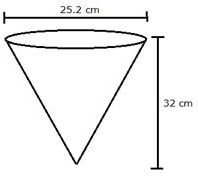
A vessel, in the form of an inverted cone, is filled with water to the brim. Its height is 32 cm and diameter of the base is 25.2 cm. Six equal solid cones are dropped in it, so that they are fully submerged. As a result one-fourth of water in the original cone overflows. What is the volume of each of the solid cones submerged?

Show SolutionHide Solution↓
A vessel, in the form of an inverted cone, is filled with water to the brim. Its height is 32 cm and diameter of the base is 25.2 cm. Six equal solid cones are dropped in it, so that they are fully submerged. As a result one-fourth of water in the original cone overflows. What is the volume of each of the solid cones submerged? Cylinder, Cone, Sphere, Concise Mathematics Solutions ICSE Class 10.

Radius of vessel (R) = $\frac{25.2}{2}$ = 12.6 cm.

Total volume of water in vessel = $\frac{1}{3}πR^2H$

On submerging six equal cones in vessel, one-fourth of water in the original cone overflows.

Let radius of small cones be r and height be h,

$$\begin{aligned}\therefore 6 \times \text{Vol. of each cone} = \frac{1}{4} \times \frac{1}{3}πR^2H \\[1em] \Rightarrow \text{Vol. of each cone} = \frac{1}{72}πR^2H \\[1em] \Rightarrow \text{Vol. of each cone} = \frac{1}{72} \times \frac{22}{7} \times (12.6)^2 \times 32 \\[1em] \Rightarrow \text{Vol. of each cone} = 221.76 \text{ cm}^3.\end{aligned}$$

Hence, volume of each cone = 221.76 cm3.

14Exercise 20(B)

The volume of a conical tent is 1232 m3 and the area of the base floor is 154 m2. Calculate the :

(i) radius of the floor,

(ii) height of the tent,

(iii) length of the canvas required to cover this conical tent if its width is 2 m.

Show SolutionHide Solution↓

(i) Given,

Area of base floor = 154 m2

$$\begin{aligned}\Rightarrow πr^2 = 154 \\[1em] \Rightarrow \frac{22}{7} \times r^2 = 154 \\[1em] \Rightarrow r^2 = \frac{154 \times 7}{22} \\[1em] \Rightarrow r^2 = 7 \times 7 \\[1em] \Rightarrow r = 7 \text{ m}.\end{aligned}$$

Hence, radius of the floor = 7 m.

(ii) Given,

Volume of tent = 1232 m3

$$\begin{aligned}\Rightarrow \frac{1}{3}πr^2h = 1232 \\[1em] \Rightarrow \frac{1}{3} \times \frac{22}{7} \times (7)^2 \times h = 1232 \\[1em] \Rightarrow \frac{154}{3} \times h = 1232 \\[1em] \Rightarrow h = \frac{1232 \times 3}{154} \\[1em] \Rightarrow h = 24 \text{ m}.\end{aligned}$$

Hence, height of tent = 24 m.

(iii) By formula,

⇒ l2 = r2 + h2

⇒ l2 = (7)2 + (24)2

⇒ l2 = 49 + 576

⇒ l2 = 625

⇒ l = $\sqrt{625}$

⇒ l = 25 m.

Curved surface area of cone = πrl

= $\frac{22}{7} \times 7 \times 25$

= 550 m2.

Let length of canvas be l.

Area of canvas = Curved surface area of cone

⇒ l × b = 550

⇒ l × 2 = 550

⇒ l = $\frac{550}{2}$

⇒ l = 275 m.

Hence, length of canvas required = 275 m.

1(a)Exercise 20(C)

A solid metallic sphere of radius 16 cm is melted to form small identical spheres each of diameter 4 cm. The number of spheres formed is :

Show SolutionHide Solution↓

Given,

A solid metallic sphere of radius 16 cm is melted to form small identical spheres each of diameter 4 cm.

Larger metallic ball sphere radius (R) = 16 cm

Radius of smaller metallic sphere (r) = $\frac{4}{2}$ = 2 cm

Let no. of smaller spheres formed be n.

∴ Volume of larger metallic ball = n × Volume of smaller metallic ball

$$\begin{aligned}\Rightarrow \frac{4}{3}πR^3 = n \times \frac{4}{3}πr^3 \\[1em] \Rightarrow n = \frac{\frac{4}{3}πR^3}{\frac{4}{3}πr^3} \\[1em] \Rightarrow n = \frac{R^3}{r^3} \\[1em] \Rightarrow n = \frac{16^3}{2^3} \\[1em] \Rightarrow n = \frac{4096}{8} = 512.\end{aligned}$$

Hence, Option 3 is the correct option.

1(b)Exercise 20(C)

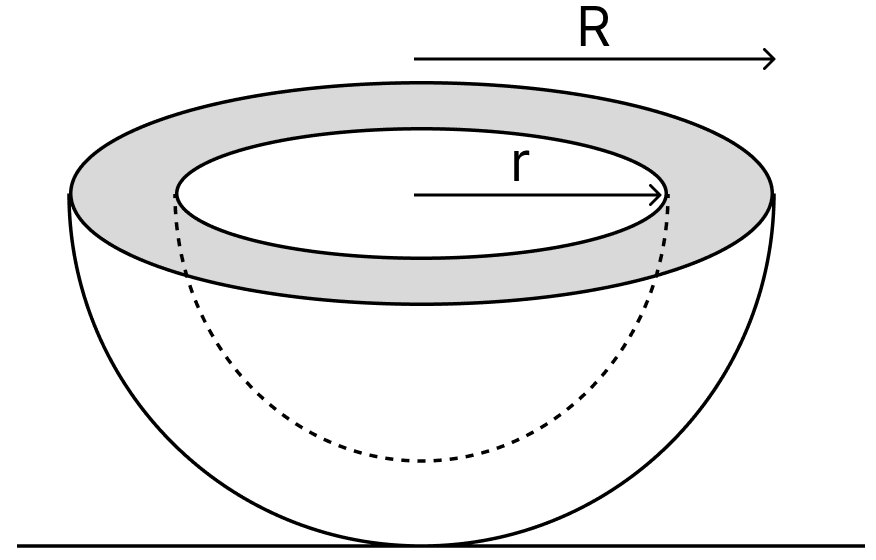
A hemi-spherical bowl (as shown) has external radius R and internal radius r, the outer surface area of the bowl is :

A hemi-spherical bowl (as shown) has external radius R and internal radius r, the outer surface area of the bowl is : Cylinder, Cone, Sphere, Concise Mathematics Solutions ICSE Class 10.
Show SolutionHide Solution↓

Outer surface area of the hemi-spherical bowl = Surface area of outer hemisphere + Area of outer cross-section - Area of inner cross-section

= 2πR2 + πR2 - πr2

= 3πR2 - πr2.

Hence, Option 2 is the correct option.

1(c)Exercise 20(C)

The ratio between the volumes of two spherical solids is 27 : 8. The ratio between their curved surface areas is :

Show SolutionHide Solution↓

Let radius of two spherical solids be R and r.

Given,

The ratio between the volumes of two spherical solids is 27 : 8.

$$\begin{aligned}\Rightarrow \frac{\text{Vol. of 1st spherical solid}}{\text{Vol. of 2nd spherical solid}} = \frac{27}{8} \\[1em] \Rightarrow \frac{\frac{4}{3}πR^3}{\frac{4}{3}πr^3} = \frac{27}{8} \\[1em] \Rightarrow \frac{R^3}{r^3} = \frac{27}{8} \\[1em] \Rightarrow \Big(\frac{R}{r}\Big)^3 = \Big(\frac{3}{2}\Big)^3 \\[1em] \Rightarrow \frac{R}{r} = \frac{3}{2} \text{ .........(1)}\end{aligned}$$

The ratio between the curved surface area of two spherical solids :

$$\begin{aligned}\Rightarrow \frac{\text{CSA of 1st spherical solid}}{\text{CSA of 2nd spherical solid}} = \frac{4πR^2}{4πr^2} \\[1em] = \frac{R^2}{r^2} \\[1em] = \Big(\frac{R}{r}\Big)^2 \\[1em] = \Big(\frac{3}{2}\Big)^2 \\[1em] = \frac{9}{4} \\[1em] = 9 : 4.\end{aligned}$$

Hence, Option 4 is the correct option.

1(d)Exercise 20(C)

A solid metallic sphere of radius 8 cm is melted and recast into 64 identical solid spheres. The diameter of each smaller sphere formed is :

Show SolutionHide Solution↓

Given,

Radius of larger metallic sphere (R) = 8 cm

Let radius of each smaller sphere be r cm.

Given,

A solid metallic sphere of radius 8 cm is melted and recast into 64 identical solid spheres.

∴ Volume of larger metallic sphere = 64 × Volume of smaller metallic sphere

$$\begin{aligned}\Rightarrow \frac{4}{3}πR^3 = 64 \times \frac{4}{3}πr^3 \\[1em] \Rightarrow 64 = \frac{\frac{4}{3}πR^3}{\frac{4}{3}πr^3} \\[1em] \Rightarrow 64 = \frac{R^3}{r^3} \\[1em] \Rightarrow 64 = \frac{8^3}{r^3} \\[1em] \Rightarrow r^3 = \frac{8^3}{64} \\[1em] \Rightarrow r^3 = \frac{512}{64} \\[1em] \Rightarrow r^3 = 8 \\[1em] \Rightarrow r = \sqrt[3]{8} = 2 \text{ cm}.\end{aligned}$$

Diameter of smaller sphere = 2 × 2 = 4 cm.

Hence, Option 1 is the correct option.

1(e)Exercise 20(C)

r1, r2 and r3 are the radii of three metallic spheres. If these spheres are melted to form a single solid sphere, the radius of sphere formed is :

Show SolutionHide Solution↓

Given,

r1, r2 and r3 are the radii of three metallic spheres. These spheres are melted to form a single solid sphere.

Let the radius of sphere formed be R.

∴ Volume of sphere formed = Sum of volume of three smaller spheres

$$\begin{aligned}\Rightarrow \frac{4}{3}πR^3 = \frac{4}{3}πr_1^3 + \frac{4}{3}πr_2^3 + \frac{4}{3}πr_3^3 \\[1em] \Rightarrow \frac{4}{3}πR^3 = \frac{4}{3}π(r_1^3 + r_2^3 + r_3^3) \\[1em] \Rightarrow R^3 = r_1^3 + r_2^3 + r_3^3 \\[1em] \Rightarrow R = \sqrt[3]{r_1^3 + r_2^3 + r_3^3}.\end{aligned}$$

Hence, Option 4 is the correct option.

2Exercise 20(C)

The volume of a sphere is 38808 cm3; find its diameter and the surface area.

Show SolutionHide Solution↓

Given,

Volume of the sphere = 38808 cm3

Let the radius of the sphere = r

By formula,

Volume of sphere = $\frac{4}{3}πr^3$

$$\begin{aligned}\Rightarrow \frac{4}{3} πr^3 = 38808 \\[1em] \Rightarrow \frac{4}{3} \times \frac{22}{7} \times r^3 = 38808 \\[1em] \Rightarrow r^3 = \frac{(38808 \times 7 \times 3)}{(4 \times 22)} \\[1em] \Rightarrow r^3 = \frac{814968}{88} \\[1em] \Rightarrow r^3 = 9261 \\[1em] \Rightarrow r = \sqrt[3]{9261} \\[1em] \Rightarrow r = 21 \text{ cm}.\end{aligned}$$

∴ Diameter = 2r = 21 x 2 = 42 cm.

Surface area = 4πr2 = $4 \times \frac{22}{7} \times 21 \times 21$

= 5544 cm2.

Hence, diameter of ball = 42 cm and surface area = 5544 cm2.

3Exercise 20(C)

A spherical ball of lead has been melted and made into identical smaller balls with radius equal to half the radius of the original one. How many such balls can be made?

Show SolutionHide Solution↓

Let the radius of the spherical ball be r cm.

So, the volume = $\frac{4}{3} πr^3$

Radius of smaller ball = $\frac{r}{2}$ cm

According to question,

The volume of large spherical balls = Volume of all small balls

Let no. of small spherical balls that can be made be n.

$$\begin{aligned}\therefore \frac{4}{3}πr^3 = n \times \frac{4}{3}π\Big(\frac{r}{2}\Big)^3 \\[1em] \Rightarrow n = \frac{\frac{4}{3}πr^3}{\frac{4}{3}π\Big(\frac{r}{2}\Big)^3} \\[1em] \Rightarrow n = \frac{\frac{4}{3}πr^3 \times 2^3}{\frac{4}{3}πr^3} \\[1em] \Rightarrow n = 2^3 = 8.\end{aligned}$$

Hence, 8 balls can be made.

4Exercise 20(C)

How many balls each of radius 1 cm can be made by melting a bigger ball whose diameter is 8 cm ?.

Show SolutionHide Solution↓

Given,

Diameter of bigger ball = 8 cm

So, radius of bigger ball (R) = $\frac{8}{2}$ = 4 cm.

Volume of bigger ball = $\frac{4}{3}πR^3$

= $\frac{4}{3} \times π (4)^3$

= $\frac{4}{3} \times π \times 64 = \frac{256π}{3} \text{ cm}^3$.

Radius of small ball (r) = 1 cm

Volume of each smaller ball = $\frac{4}{3}πr^3$

= $\frac{4}{3} \times π \times (1)^3 = \frac{4}{3}π \text{ cm}^3.$

Let n smaller balls can be made by, melting bigger ball.

Volume of bigger ball = n × Volume of each smaller ball

$$\begin{aligned}\Rightarrow \frac{256π}{3} = n \times \frac{4}{3}π \\[1em] \Rightarrow n = \frac{\frac{256π}{3}}{\frac{4}{3}π} \\[1em] \Rightarrow n = \frac{256 \times π \times 3}{4 \times 3 \times π} \\[1em] \Rightarrow n = 64.\end{aligned}$$

Hence, 64 balls can be made.

5Exercise 20(C)

The volume of one sphere is 27 times that of another sphere. Calculate the ratio of their:

(i) radii

(ii) surface areas

Show SolutionHide Solution↓

Given,

Volume of first sphere = 27 x volume of second sphere

Let the radius of the first sphere = r1 and, radius of second sphere = r2

(i) According to the question, we have :

$$\begin{aligned}\Rightarrow \frac{4}{3} πr_1^3 = 27 \times \frac{4}{3} πr_2^3 \\[1em] \Rightarrow r_1^3 = 27 \times r_2^3 \\[1em] \Rightarrow \frac{r_1^3}{r_2^3} = \frac{27}{1} \\[1em] \Rightarrow \Big(\frac{r_1}{r_2}\Big)^3 = \Big(\frac{3}{1}\Big)^3 \\[1em] \Rightarrow \frac{r_1}{r_2} = \frac{3}{1}.\end{aligned}$$

Hence, r1 : r2 = 3 : 1.

(ii) Surface area of the first sphere = 4π(r1)2

Surface area of second sphere = 4π(r2)2

$$\begin{aligned}\text{Ratio of surface areas} = \frac{4πr_1^2}{4πr_2^2} \\[1em] = \frac{r_1^2}{r_2^2} = \Big(\frac{3}{1}\Big)^2 \\[1em] = \frac{9}{1}.\end{aligned}$$

Hence, the ratio of surface areas = 9 : 1.

6Exercise 20(C)

If the number of square centimeters on the surface of a sphere is equal to the number of cubic centimeters in its volume, what is the diameter of the sphere ?

Show SolutionHide Solution↓

Let r be the radius of the sphere.

According to question,

Surface area of sphere = Volume of sphere

$$\begin{aligned}\Rightarrow 4πr^2 = \frac{4}{3}πr^3 \\[1em] \Rightarrow r^2 = \frac{r^3}{3} \\[1em] \Rightarrow \frac{r^3}{r^2} = 3 \\[1em] \Rightarrow r = 3\text{ cm}.\end{aligned}$$

Diameter of sphere = 2r = 2 × 3 = 6 cm.

Hence, diameter of sphere = 6 cm.

7Exercise 20(C)

A solid metal sphere is cut through its center into 2 equal parts. If the diameter of the sphere is $3\frac{1}{2}$ cm, find the total surface area of each part correct to two decimal places.

Show SolutionHide Solution↓

Diameter of sphere = $3\frac{1}{2} = \frac{7}{2}$ cm.

Radius of sphere (r) = $\frac{\frac{7}{2}}{2} = \frac{7}{4}$ cm.

Total surface area of each hemisphere = $\frac{1}{2}$ Curved surface area of sphere + Area of circular base

= $\frac{1}{2} \times 4πr^2 + πr^2$

= 2πr2 + πr2

= 3πr2

$$\begin{aligned}= 3 \times \frac{22}{7} \times \frac{7}{4} \times \frac{7}{4} \\[1em] = 3 \times \frac{22 \times 7}{16} \\[1em] = 3 \times \frac{77}{8} \\[1em] = 28.88 \text{ cm}^2.\end{aligned}$$

Hence, total surface area of each hemisphere 28.88 cm2.

8Exercise 20(C)

The internal and external diameters of a hollow hemispherical vessel are 21 cm and 28 cm respectively. Find :

(i) internal curved surface area,

(ii) external curved surface area,

(iii) total surface area,

(iv) volume of material of the vessel.

Show SolutionHide Solution↓

(i) Given,

Internal diameter = 21 cm

Internal radius (r) = $\frac{21}{2}$ cm.

By formula,

Internal curved surface area = 2πr2.

$$\begin{aligned}= 2 \times \frac{22}{7} \times \frac{21}{2} \times \frac{21}{2} \\[1em] = \frac{19404}{28} \\[1em] = 693 \text{ cm}^2.\end{aligned}$$

Hence, internal curved surface area = 693 cm2.

(ii) Given,

Internal diameter = 28 cm

Internal radius (R) = $\frac{28}{2}$ = 14 cm.

By formula,

External curved surface area = 2πR2.

$$\begin{aligned}= 2 \times \frac{22}{7} \times 14 \times 14 \\[1em] = 1232 \text{ cm}^2.\end{aligned}$$

Hence, external curved surface area = 1232 cm2.

(iii) By formula,

Total surface area of hemisphere = 2πr2 + 2πR2 + π(R2 - r2)

$$\begin{aligned}= 693 + 1232 + \frac{22}{7} \times \Big[(14)^2 - \Big(\frac{21}{2}\Big)^2\Big] \\[1em] = 1925 + \frac{22}{7} \times \Big[196 - \frac{441}{4}\Big] \\[1em] = 1925 + \frac{22}{7} \times \frac{784 - 441}{4} \\[1em] = 1925 + \frac{22}{7} \times \frac{343}{4} \\[1em] = 1925 + \frac{11 \times 49}{2} \\[1em] = 1925 + \frac{539}{2} \\[1em] = 1925 + 269.5 \\[1em] = 2194.5 \text{ cm}^2.\end{aligned}$$

Hence, total surface area of hemisphere = 2194.5 cm2.

(iv) By formula,

Volume of hemispherical vessel = $\frac{2}{3}π(R^3 - r^3)$

$$\begin{aligned}= \frac{2}{3} \times \frac{22}{7} \times [(14)^3 - \Big(\frac{21}{2}\Big)^3] \\[1em] = \frac{2}{3} \times \frac{22}{7} \times [2744 - 1157.625] \\[1em] = \frac{2}{3} \times \frac{22}{7} \times 1586.375 \\[1em] = \frac{44}{21} \times 1586.375 \\[1em] = 3323.83 \text{ cm}^3.\end{aligned}$$

Hence, volume of vessel = 3323.83 cm3.

9Exercise 20(C)

A solid sphere and a solid hemi-sphere have the same total surface area. Find the ratio between their volumes.

Show SolutionHide Solution↓

Let radius of sphere be R cm and hemi-sphere be r cm.

Given,

Solid sphere and a solid hemi-sphere have the same total surface area.

$$\begin{aligned}\therefore 4πR^2 = 3πr^2 \\[1em] \Rightarrow \frac{R^2}{r^2} = \frac{3π}{4π} \\[1em] \Rightarrow \frac{R^2}{r^2} = \frac{3}{4} \\[1em] \Rightarrow \frac{R}{r} = \sqrt{\frac{3}{4}} \\[1em] \Rightarrow \frac{R}{r} = \frac{\sqrt{3}}{2}.\end{aligned}$$

Calculating ratio between volumes,

$$\begin{aligned}\frac{\text{Vol. of sphere}}{\text{Vol. of hemi-sphere}} = \frac{\frac{4}{3}πR^3}{\frac{2}{3}πr^3} \\[1em] = \frac{4πR^3 \times 3}{2πr^3 \times 3} \\[1em] = 2 \times \frac{R^3}{r^3} \\[1em] = 2 \times \Big(\frac{\sqrt{3}}{2}\Big)^3 \\[1em] = 2 \times \frac{3\sqrt{3}}{8} \\[1em] = \frac{3\sqrt{3}}{4}.\end{aligned}$$

Hence, ratio between volumes = $3\sqrt{3} : 4$.

10Exercise 20(C)

Metallic spheres of radii 6 cm, 8 cm and 10 cm respectively are melted and recasted into a single solid sphere. Taking π = 3.1, find the surface area of the solid sphere formed.

Show SolutionHide Solution↓

Let radius of spheres be r1, r2 and r3 cm respectively.

Let r be the radius of new sphere formed.

Volume of new sphere formed = Total volume of the three spheres melted

$$\begin{aligned}\Rightarrow \frac{4}{3}πr^3 = \frac{4}{3}π(r_1)^3 + \frac{4}{3}π(r_2)^3 + \frac{4}{3}π(r_3)^3 \\[1em] \Rightarrow \frac{4}{3}πr^3 = \frac{4}{3}π(r_1^3 + r_2^3 + r_3^3) \\[1em] \Rightarrow r^3 = r_1^3 + r_2^3 + r_3^3 \\[1em] \Rightarrow r^3 = (6)^3 + (8)^3 + (10)^3 \\[1em] \Rightarrow r^3 = 216 + 512 + 1000 \\[1em] \Rightarrow r^3 = 1728 \\[1em] \Rightarrow r^3 = (12)^3 \\[1em] \Rightarrow r = 12 \text{ cm.}\end{aligned}$$

By formula,

Surface area of sphere = 4πr2

= 4 × 3.1 × 122

= 1785.6 cm2.

1(a)Exercise 20(D)

A cone and a sphere have equal volumes. Their radii are also equal each being 10 cm; the height of the cone is :

Show SolutionHide Solution↓

Let radius of cone and sphere be r cm and height of cone be h cm.

Given,

A cone and a sphere have equal volumes and their radius are equal.

∴ Volume of cone = Volume of sphere

$$\begin{aligned}\Rightarrow \frac{1}{3}πr^2h = \frac{4}{3}πr^3 \\[1em] \Rightarrow h = \frac{4 \times 3πr^3}{3πr^2} \\[1em] \Rightarrow h = 4r \\[1em] \Rightarrow h = 4 \times 10 = 40 \text{ cm}.\end{aligned}$$

Hence, Option 2 is the correct option.

1(b)Exercise 20(D)

A sphere and a cone have equal volumes and equal radii. The ratio between the radius and height of the cone is :

Show SolutionHide Solution↓

Let radius of cone and sphere be r cm and height of cone be h cm.

Given,

A cone and a sphere have equal volumes and their radius are equal.

∴ Volume of cone = Volume of sphere

$$\begin{aligned}\Rightarrow \frac{1}{3}πr^2h = \frac{4}{3}πr^3 \\[1em] \Rightarrow h = \frac{4 \times 3πr^3}{3πr^2} \\[1em] \Rightarrow h = 4r \\[1em] \Rightarrow \frac{r}{h} = \frac{1}{4} \\[1em] \Rightarrow r : h = 1 : 4.\end{aligned}$$

Hence, Option 4 is the correct option.

1(c)Exercise 20(D)

The radius and the height of a cone are in the ratio 2 : 1. The ratio between the volumes of a sphere and this cone (both having equal radii) is :

Show SolutionHide Solution↓

Given,

The radius and the height of a cone are in the ratio 2 : 1.

Let radius of cone be 2x and height of cone be x.

Let radius f sphere be r.

Given,

Radius of cone and sphere are equal.

∴ r = 2x.

$$\begin{aligned}\Rightarrow \frac{\text{Vol. of sphere}}{\text{Vol. of cone}} = \frac{\frac{4}{3}πr^3}{\frac{1}{3}πr^2h} \\[1em] \Rightarrow \frac{\text{Vol. of sphere}}{\text{Vol. of cone}} = \frac{4 \times 3 \times πr^3}{3 \times πr^2h} \\[1em] \Rightarrow \frac{\text{Vol. of sphere}}{\text{Vol. of cone}} = \frac{4r}{h} \\[1em] \Rightarrow \frac{\text{Vol. of sphere}}{\text{Vol. of cone}} = \frac{4 \times 2x}{x} \\[1em] \Rightarrow \frac{\text{Vol. of sphere}}{\text{Vol. of cone}} = \frac{8x}{x} \\[1em] \Rightarrow \frac{\text{Vol. of sphere}}{\text{Vol. of cone}} = \frac{8}{1} = 8 : 1.\end{aligned}$$

Hence, Option 3 is the correct option.

1(d)Exercise 20(D)

A solid metallic cylinder is melted and formed into identical solid cones each having same radius and same height as that of the cylinder. The number of cones formed is :

Show SolutionHide Solution↓

Given,

A solid metallic cylinder is melted and formed into identical solid cones.

Let no. of cones formed be n.

As, radius and height of cones formed is equal to the cylinder.

Let radius of cylinder and cone be r units, height of cylinder and cone be h units.

∴ Volume of cylinder = n × Volume of each cone

⇒ πr2h = n × $\frac{1}{3}πr^2h$

⇒ n = $\frac{3πr^2h}{πr^2h}$ = 3.

Hence, Option 1 is the correct option.

1(e)Exercise 20(D)

A solid metallic cone of radius 10 cm and height 12 cm is melted to form a wire of uniform cross-section 1 cm2. The length of wire formed is :

Show SolutionHide Solution↓

Given,

A solid metallic cone of radius (r) 10 cm and height (h) 12 cm is melted to form a wire of uniform cross-section 1 cm2.

Let length of wire formed be l cm.

∴ Volume of cone = Volume of wire

$$\begin{aligned}\Rightarrow \frac{1}{3}πr^2h = \text{Area of cross-section × length} \\[1em] \Rightarrow \frac{1}{3}π \times 10^2 \times 12 = 1 \times l \\[1em] \Rightarrow l = 4 \times π \times 10^2 \\[1em] \Rightarrow l = 400 π \text{ cm} \\[1em] \Rightarrow l = \frac{400π}{100} \text{ m} \\[1em] \Rightarrow l = 4 × π \text{ m}.\end{aligned}$$

Hence, Option 2 is the correct option.

2Exercise 20(D)

A solid sphere of radius 15 cm is melted and recast into solid right circular cones of radius 2.5 cm and height 8 cm. Calculate the number of cones recast.

Show SolutionHide Solution↓

Given,

Radius of the sphere (R) = 15 cm

So, the volume of sphere melted = $\frac{4}{3}πR^3 = \frac{4}{3} \times π \times 15 \times 15 \times 15$

= 4500π cm3.

Radius of each cone formed (r) = 2.5 cm

Height of each cone (h) = 8 cm

So, volume of each cone = $\frac{1}{3}πr^2h = \frac{1}{3} \times π \times 2.5 \times 2.5 \times 8$

= $\frac{1}{3} \times 50π = \frac{50}{3}π.$

Let no. of cones formed be n.

Volume of sphere = n × Volume of cone

$$\begin{aligned}\Rightarrow 4500π = n \times \frac{50}{3}π \\[1em] \Rightarrow n = \frac{4500π \times 3}{50π} \\[1em] \Rightarrow n = 270.\end{aligned}$$

Hence, no. of cones formed = 270.

3Exercise 20(D)

A hollow sphere of internal and external diameters 4 cm and 8 cm, respectively is melted into a cone of base diameter 8 cm. Find the height of the cone.

Show SolutionHide Solution↓

Given,

External diameter of the hollow sphere = 8 cm

So, external radius (R) = $\frac{8}{2}$ = 4 cm

Internal diameter of the hollow sphere = 4 cm

So, internal radius (r) = $\frac{4}{2}$ = 2 cm

Diameter of cone = 8 cm

Radius of cone (r1) = 4 cm

Let height of the cone = h cm.

Since, hollow sphere is melted and recasted into cone.

∴ Volume of sphere = Volume of cone

$$\begin{aligned}\Rightarrow \frac{4}{3}π(R^3 - r^3) = \frac{1}{3}π(r_1)^2h \\[1em] \Rightarrow 4(R^3 - r^3) = r_1^2h \\[1em] \Rightarrow 4 \times [(4)^3 - (2)^3] = (4)^2 \times h \\[1em] \Rightarrow 4 \times [64 - 8] = 16h \\[1em] \Rightarrow h = \frac{4 \times 56}{16} \\[1em] \Rightarrow h = 14 \text{ cm}.\end{aligned}$$

Hence, the height of the cone = 14 cm.

4Exercise 20(D)

The radii of the internal and external surfaces of a metallic spherical shell are 3 cm and 5 cm respectively. It is melted and recast into a solid right circular cone of height 32 cm. Find the diameter of the base of the cone.

Show SolutionHide Solution↓

Given,

Height of the solid right circular cone (h) = 32 cm

Internal radius of metallic spherical shell (r) = 3 cm

External radius of metallic spherical shell (R) = 5 cm

Let radius of cone be r1 cm.

As, metallic spherical shell is recasted into right circular cone.

∴ Volume of spherical shell = Volume of cone.

$$\begin{aligned}\Rightarrow \frac{4}{3}π(R^3 - r^3) = \frac{1}{3}πr_1^2h \\[1em] \Rightarrow 4(R^3 - r^3) = r_1^2h \\[1em] \Rightarrow r_1^2 = \frac{4(R^3 - r^3)}{h} \\[1em] \Rightarrow r_1^2 = \frac{4 \times (5^3 - 3^3)}{32} \\[1em] \Rightarrow r_1^2 = \frac{4 \times (125 - 27)}{32} \\[1em] \Rightarrow r_1^2 = \frac{4 \times 98}{32} \\[1em] \Rightarrow r_1^2 = \frac{49}{4} \\[1em] \Rightarrow r_1 = \sqrt{\frac{49}{4}} \\[1em] \Rightarrow r_1 = \frac{7}{2}.\end{aligned}$$

Diameter = 2r = $2 \times \frac{7}{2}$ = 7 cm.

Hence, diameter = 7 cm.

5Exercise 20(D)

Total volume of three identical cones is the same as that of a bigger cone whose height is 9 cm and diameter 40 cm. Find the radius of the base of each smaller cone, if height of each is 108 cm.

Show SolutionHide Solution↓

Let the radius of the smaller cone be r cm.

Given,

Height of smaller cone (h) = 108 cm

Diameter of bigger cone = 40 cm

So, radius (R) = $\frac{40}{2}$ = 20 cm

Height of bigger cone (H) = 9 cm.

According to question,

Volume of big cone = 3 × Volume of each smaller cone.

$$\begin{aligned}\Rightarrow \frac{1}{3}πR^2H = 3 \times \frac{1}{3}πr^2h \\[1em] \Rightarrow R^2H = 3 \times r^2h \\[1em] \Rightarrow (20)^2 \times 9 = 3 \times r^2 \times 108 \\[1em] \Rightarrow r^2 = \frac{20^2 \times 9}{3 \times 108} \\[1em] \Rightarrow r^2 = \frac{3600}{324} \\[1em] \Rightarrow r^2 = \frac{100}{9} \\[1em] \Rightarrow r = \sqrt{\frac{100}{9}} \\[1em] \Rightarrow r = \frac{10}{3} = 3\frac{1}{3}\text{ cm}.\end{aligned}$$

Hence, radius of base of each cone = $3\frac{1}{3}$ cm.

6Exercise 20(D)

A solid rectangular block of metal 49 cm by 44 cm by 18 cm is melted and formed into a solid sphere. Calculate the radius of the sphere.

Show SolutionHide Solution↓

Let radius of sphere be r cm.

Since,

A solid rectangular block of metal is melted and formed into a solid sphere.

∴ Volume of rectangular block = Volume of sphere

$$\begin{aligned}\Rightarrow 49 \times 44 \times 18 = \frac{4}{3}πr^3 \\[1em] \Rightarrow 38808 = \frac{4}{3} \times \frac{22}{7} \times r^3 \\[1em] \Rightarrow r^3 = \frac{38808 \times 21}{4 \times 22} \\[1em] \Rightarrow r^3 = 9261 \\[1em] \Rightarrow r^3 = (21)^3 \\[1em] \Rightarrow r = 21 \text{ cm}.\end{aligned}$$

Hence, the radius of sphere = 21 cm.

7Exercise 20(D)

A hemispherical bowl of internal radius 9 cm is full of liquid. This liquid is to be filled into conical shaped small containers each of diameter 3 cm and height 4 cm. How many containers are necessary to empty the bowl?

Show SolutionHide Solution↓

Given,

Internal radius of hemispherical bowl (R) = 9 cm

Diameter of each conical container = 3 cm

So, radius (r) = $\frac{3}{2}$ = 1.5 cm and height of conical container(h) = 4 cm

Let no. of conical containers needed be n.

∴ Volume of hemispherical bowl = n × Volume of each conical shaped container

$$\begin{aligned}\Rightarrow \frac{2}{3}πR^3 = n \times \frac{1}{3}πr^2h \\[1em] \Rightarrow n = \frac{\frac{2}{3}πR^3}{\frac{1}{3}πr^2h} \\[1em] \Rightarrow n = \frac{2 \times (9)^3 \times 3}{1 \times (1.5)^2 \times 4 \times 3} \\[1em] \Rightarrow n = \frac{2 \times 729 \times 3}{2.25 \times 4 \times 3} \\[1em] \Rightarrow n = 162.\end{aligned}$$

Hence, 162 containers are necessary to empty the bowl.

8Exercise 20(D)

The total area of a solid metallic sphere is 1256 cm2. It is melted and recast into solid right circular cones of radius 2.5 cm and height 8 cm. Calculate :

(i) the radius of the solid sphere,

(ii) the number of cones recast.

[Take π = 3.14]

Show SolutionHide Solution↓

(i) Given,

Total area of solid metallic sphere = 1256 cm2

Let R be the radius of metallic sphere.

By formula,

Total area of solid metallic sphere = 4πR2

∴ 4πR2 = 1256

$$\begin{aligned}\Rightarrow 4 \times 3.14 \times R^2 = 1256 \\[1em] \Rightarrow R^2 = \frac{1256}{4 \times 3.14} \\[1em] \Rightarrow R^2 = \frac{1256}{12.56} \\[1em] \Rightarrow R^2 = 100 \\[1em] \Rightarrow R = \sqrt{100} = 10 \text{ cm}.\end{aligned}$$

Hence, radius of sphere = 10 cm.

(ii) Given,

Radius of cone (r) = 2.5 cm

Height of cone (h) = 8 cm.

Let no. of cones formed be n.

Since, sphere is recasted into n cones.

∴ Volume of sphere = n × Volume of cones

$$\begin{aligned}\Rightarrow \frac{4}{3}πR^3 = n \times \frac{1}{3}πr^2h \\[1em] \Rightarrow 4R^3 = n \times r^2h \\[1em] \Rightarrow n = \frac{4R^3}{r^2h} \\[1em] \Rightarrow n = \frac{4 \times 10^3}{(2.5)^2 \times 8} \\[1em] \Rightarrow n = \frac{4 \times 1000}{6.25 \times 8} \\[1em] \Rightarrow n = \frac{4000}{50} \\[1em] \Rightarrow n = 80.\end{aligned}$$

Hence, no. of cones formed = 80.

9Exercise 20(D)

The surface area of a solid metallic sphere is 2464 cm2. It is melted and recast into solid right circular cones of radius 3.5 cm and height 7 cm. Calculate :

(i) the radius of the sphere.

(ii) the number of cones recast.

Show SolutionHide Solution↓

(i) Given,

Surface area of solid metallic sphere = 2464

Let radius of solid metallic sphere be R cm.

By formula,

Surface area of solid metallic sphere = 4πR2

∴ 4πR2 = 2464

⇒ $4 \times \frac{22}{7} \times R^2 = 2464$

⇒ $R^2 = \frac{2464 \times 7}{22 \times 4}$

⇒ $R^2 = \frac{17248}{88}$

⇒ R2 = 196

⇒ R = $\sqrt{196}$

⇒ R = 14 cm.

Hence, the radius of sphere = 14 cm.

(ii) Given,

Radius of cones (r) = 3.5 cm

Height of cones (h) = 7 cm.

Let no. of cones formed be n.

Since,

Sphere is melted and recasted into cones.

∴ Volume of sphere = n × Volume of cone

$$\begin{aligned}\Rightarrow \frac{4}{3}πR^3 = \frac{1}{3}πr^2h \\[1em] \Rightarrow 4R^3 = n \times r^2h \\[1em] \Rightarrow n = \frac{4R^3}{r^2h} \\[1em] \Rightarrow n = \frac{4 \times (14)^3}{(3.5)^2 \times 7} \\[1em] \Rightarrow n = \frac{4 \times 2744}{12.25 \times 7} \\[1em] \Rightarrow n = \frac{10976}{85.75} \\[1em] \Rightarrow n = 128.\end{aligned}$$

Hence, no. of cones formed = 128.

1(a)Exercise 20(E)

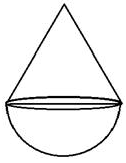
In the given figure, the radius of the cone is same as its height equal to 2 cm each. The volume of the whole body is :

In the given figure, the radius of the cone is same as its height equal to 2 cm each. The volume of the whole body is : Cylinder, Cone, Sphere, Concise Mathematics Solutions ICSE Class 10.
Show SolutionHide Solution↓

Given,

Radius of cone (r) = 2 cm

Height of cone (h) = 2 cm

From figure,

Radius of hemisphere = Radius of cone = 2 cm.

⇒ Volume of body = Volume of cone + Volume of hemisphere

⇒ Volume of body = $\frac{1}{3}πr^2h + \frac{2}{3}πr^3$

$$\begin{aligned}= \frac{πr^2}{3}(h + 2r) \\[1em] = \frac{π \times 2^2}{3} \times (2 + 2 × 2) \\[1em] = \frac{4π}{3} \times (2 + 4) \\[1em] = \frac{4π}{3} \times 6 \\[1em] = \frac{24π}{3} \\[1em] = 8π \text{ cm}^3.\end{aligned}$$

Hence, Option 1 is the correct option.

1(b)Exercise 20(E)

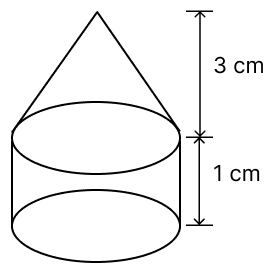
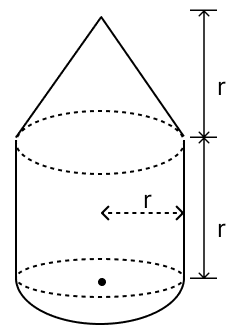
In the given figure, height of the conical part is 3 cm. The radius and the height of the cylindrical part are 1 cm each. The total volume of the body is :

In the given figure, height of the conical part is 3 cm. The radius and the height of the cylindrical part are 1 cm each. The total volume of the body is : Cylinder, Cone, Sphere, Concise Mathematics Solutions ICSE Class 10.
Show SolutionHide Solution↓

Given,

Radius of cylindrical part (r) = 1 cm

Height of cylindrical part (h) = 1 cm

Height of conical part (H) = 3 cm

From figure,

Radius of conical part = Radius of cylindrical part (r) = 1 cm

Volume of body = Volume of conical part + Volume of cylindrical part

$$\begin{aligned}= \frac{1}{3}πr^2H + πr^2h \\[1em] = \frac{1}{3}π \times 1^2 \times 3 + π \times 1^2 \times 1 \\[1em] = π + π \\[1em] = 2π \text{ cm}^3.\end{aligned}$$

Hence, Option 3 is the correct option.

1(c)Exercise 20(E)

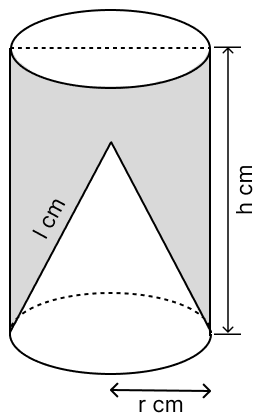
The given figure shows a solid cylinder of height h cm and radius r cm. If the slant height of the conical cavity is l cm, the total surface area of the remaining solid is :

The given figure shows a solid cylinder of height h cm and radius r cm. If the slant height of the conical cavity is l cm, the total surface area of the remaining solid is : Cylinder, Cone, Sphere, Concise Mathematics Solutions ICSE Class 10.
Show SolutionHide Solution↓

From figure,

Total surface area of remaining solid = Curved surface area of cylinder + Area of upper surface of cylinder + Curved surface area of cone

= 2πrh + πr2 + πrl.

Hence, Option 2 is the correct option.

1(d)Exercise 20(E)

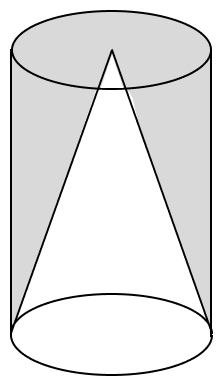
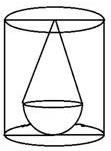
In the given figure, a solid cone is kept inverted in a closed cylindrical container such that the height of cone = height of cylinder = h, radius of cone = radius of cylinder = r and slant height of cone = l. If the remaining of cylinder is completely filled with water, the wetted surface area of the whole body is :

In the given figure, a solid cone is kept inverted in a closed cylindrical container such that the height of cone = height of cylinder = h, radius of cone = radius of cylinder = r and slant height of cone = l. If the remaining of cylinder is completely filled with water, the wetted surface area of the whole body is : Cylinder, Cone, Sphere, Concise Mathematics Solutions ICSE Class 10.
Show SolutionHide Solution↓

From figure,

Total wetted surface area of body = Curved surface area of cylinder + Area of upper surface of cylinder + Curved surface area of cone

= 2πrh + πr2 + πrl.

Hence, Option 1 is the correct option.

1(e)Exercise 20(E)

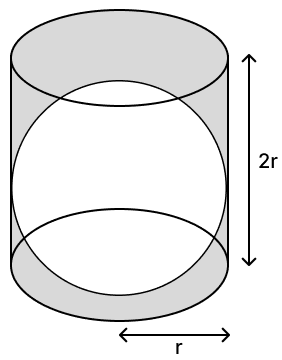
The given figure shows a solid sphere and a closed cylindrical container, both having the same height and same radii. The volume of air left in the cylinder is :

The given figure shows a solid sphere and a closed cylindrical container, both having the same height and same radii. The volume of air left in the cylinder is : Cylinder, Cone, Sphere, Concise Mathematics Solutions ICSE Class 10.
Show SolutionHide Solution↓

From figure,

Radius of sphere = Radius of cylinder = r

Height of cylinder (h) = 2r

Volume of air left = Volume of cylinder - Volume of sphere

$$\begin{aligned}= πr^2h - \frac{4}{3}πr^3 \\[1em] = πr^2.2r - \frac{4}{3}πr^3 \\[1em] = 2πr^3 - \frac{4}{3}πr^3 \\[1em] = \frac{6πr^3 - 4πr^3}{3} \\[1em] = \frac{2πr^3}{3} \\[1em] = \frac{2}{3}πr^3.\end{aligned}$$

Hence, Option 3 is the correct option.

2Exercise 20(E)

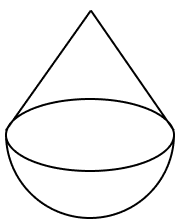
A cone of height 15 cm and diameter 7 cm is mounted on a hemisphere of same diameter. Determine the volume of the solid thus formed.

Show SolutionHide Solution↓

Given,

Height of the cone (h) = 15 cm

Diameter of the cone = 7 cm

A cone of height 15 cm and diameter 7 cm is mounted on a hemisphere of same diameter. Determine the volume of the solid thus formed. Cylinder, Cone, Sphere, Concise Mathematics Solutions ICSE Class 10.

Radius of cone (r) = $\frac{7}{2}$ = 3.5 cm

So, radius of the hemisphere (R) = 3.5 cm

From figure,

Volume of the solid (V) = Volume of the cone + Volume of the hemisphere

$$\begin{aligned}V = \frac{1}{3}πr^2h + \frac{2}{3}πR^3 \\[1em] = \frac{1}{3} \times \frac{22}{7} \times (3.5)^2 \times 15 + \frac{2}{3} \times \frac{22}{7} \times (3.5)^3 \\[1em] = \frac{1}{3} \times \frac{22}{7} \times 12.25 \times 15 + \frac{2}{3} \times \frac{22}{7} \times 42.875 \\[1em] = 22 \times 1.75 \times 5 + \frac{1886.5}{21} \\[1em] = 192.5 + 89.833 \\[1em] = 282.33\text{ cm}^3.\end{aligned}$$

Hence, volume of solid formed = 282.33 cm3.

3Exercise 20(E)

A buoy is made in the form of a hemisphere surmounted by a right cone whose circular base coincides with the plane surface of the hemisphere. The radius of the base of the cone is 3.5 metres and its volume is two-third of the hemisphere. Calculate the height of the cone and the surface area of the buoy, correct to two places of decimal.

Show SolutionHide Solution↓

From figure,

Radius of hemisphere (r) = Radius of cone (R) = 3.5 m.

Volume of hemisphere = $\frac{2}{3}πr^3$

= $\frac{2}{3} \times \frac{22}{7} \times (3.5)^3$

= $\frac{2}{3} \times 22 \times 0.5 \times 3.5 \times 3.5$

= $\frac{269.5}{3}$ m3.

Let height of the cone = h.

By formula,

Volume of conical part = $\frac{1}{3}πR^2h$ ........(1)

Given,

Volume of cone = $\frac{2}{3}$ Volume of hemisphere

= $\frac{2}{3} \times \frac{269.5}{3} = \frac{539}{9}$ m3 ...........(2)

From (1) and (2), we get :

$$\begin{aligned}\Rightarrow \frac{1}{3}πR^2h = \frac{539}{9} \\[1em] \Rightarrow \frac{1}{3} \times \frac{22}{7} \times (3.5)^2 \times h = \frac{539}{9} \\[1em] \Rightarrow h = \frac{539 \times 7 \times 3}{9 \times (3.5)^2 \times 22} \\[1em] \Rightarrow h = \frac{11319}{2425.5} \\[1em] \Rightarrow h = 4.67 \text{ m}.\end{aligned}$$

By formula,

⇒ l2 = R2 + h2

⇒ l2 = (3.5)2 + (4.67)2

⇒ l2 = 12.25 + 21.81

⇒ l2 = 34.06

⇒ l = $\sqrt{34.06}$

⇒ l = 5.83 cm.

Surface area of buoy = Surface area of hemisphere + Surface area of cone = 2πr2 + πRl

$$\begin{aligned}= 2 \times \frac{22}{7} \times (3.5)^2 + \frac{22}{7} \times 3.5 \times 5.83 \\[1em] = 2 \times 22 \times 0.5 \times 3.5 + 22 \times 0.5 \times 5.83 \\[1em] = 77 + 64.13 \\[1em] = 141.13 \text{ m}^2.\end{aligned}$$

Hence, height = 4.67 and surface area of buoy = 141.13 m2.

4Exercise 20(E)

From a rectangular solid of metal 42 cm by 30 cm by 20 cm, a conical cavity of diameter 14 cm and depth 24 cm is drilled out. Find:

(i) the surface area of the remaining solid

(ii) the volume of remaining solid

(iii) the weight of the material drilled out if it weighs 7 gm per cm3.

Show SolutionHide Solution↓

Given,

Dimensions of rectangular solid are:

l = 42 cm, b = 30 cm and h = 20 cm.

Conical cavity’s diameter = 14 cm

So, its radius (r) = 7 cm

Depth (h) = 24 cm

From a rectangular solid of metal 42 cm by 30 cm by 20 cm, a conical cavity of diameter 14 cm and depth 24 cm is drilled out. Find: (i) the surface area of the remaining solid (ii) the volume of remaining solid (iii) the weight of the material drilled out if it weighs 7 gm per cm<sup>3</sup>. Cylinder, Cone, Sphere, Concise Mathematics Solutions ICSE Class 10.

(i) Total surface area of cuboid = 2(lb + bh + lh)

= 2 (42 x 30 + 30 x 20 + 20 x 42)

= 2 (1260 + 600 + 840)

= 2 (2700)

= 5400 cm2

Area of circular base of conical cavity = πr2 = $\frac{22}{7}$ x 7 x 7 = 154 cm2.

By formula,

⇒ l2 = r2 + h2

⇒ l2 = (7)2 + (24)2

⇒ l2 = 49 + 576

⇒ l2 = 625

⇒ l = $\sqrt{625}$

⇒ l = 25 cm.

Area of curved surface area of cone = πrl

= $\frac{22}{7} \times 7 \times 25$ = 22 x 25 = 550 cm2

Surface area of remaining part = Surface area of rectangular solid + Surface area of cone - Area of base of conical cavity

= 5400 + 550 - 154

= 5796 cm2.

Hence, surface area of remaining part = 5796 cm2.

(ii) Volume of the rectangular solid = lbh

= (42 x 30 x 20) cm3

= 25200 cm3

Radius of conical cavity (r) = 7 cm

Depth (h) = 24 cm

Volume of cone = $\frac{1}{3}πr^2h$

= $\frac{1}{3} \times \frac{22}{7} \times 7 \times 7 \times 24$

= 22 × 7 × 8

= 1232 cm3.

Volume of remaining solid = Volume of rectangular solid - Volume of cone

= 25200 - 1232

= 23968 cm3.

Hence, volume of remaining solid = 23968 cm3.

(iii) Volume of material drilled out = Volume of cone = 1232 cm3.

Weight of material drilled out = 1232 × 7 = 8624 g = 8.624 kg.

Hence, weight of material drilled out = 8.624 kg.

5Exercise 20(E)

The cubical block of side 7 cm is surmounted by a hemisphere of the largest size. Find the surface area of the resulting solid.

Show SolutionHide Solution↓

It’s known that, the diameter of the largest hemisphere that can be placed on the face of a cube of side 7 cm will be 7 cm.

So, it’s radius (r) = $\frac{7}{2}$ = 3.5 cm

Curved surface area = 2πr2

= $2 \times \frac{22}{7} \times (3.5)^2$ = 77 cm2.

Area of base of hemisphere = πr2

= $\frac{22}{7} \times (3.5)^2$

= 38.5 cm2.

From figure,

Surface area of the resulting solid = Surface area of the cube – Area of the base of the hemisphere + Curved surface area of hemisphere

= 6(side)2 - 38.5 + 77

= 6(7)2 + 38.5

= 294 + 38.5

= 332.5 cm2.

Hence, surface area of resulting solid = 332.5 cm3.

6Exercise 20(E)

A vessel is in the form of an inverted cone. Its height is 8 cm and the radius of the top which is open is 5 cm. It is filled with water up to the rim. When lead shots, each of which is a sphere of radius 0.5 cm, are dropped into the vessel, one-fourth of the water flows out. Find the number of lead shots dropped in the vessel.

Show SolutionHide Solution↓

Given,

Height of cone (H) = 8 cm

Radius of cone (R) = 5 cm

Radius of sphere (r) = 0.5 cm.

A vessel is in the form of an inverted cone. Its height is 8 cm and the radius of the top which is open is 5 cm. It is filled with water up to the rim. When lead shots, each of which is a sphere of radius 0.5 cm, are dropped into the vessel, one-fourth of the water flows out. Find the number of lead shots dropped in the vessel. Cylinder, Cone, Sphere, Concise Mathematics Solutions ICSE Class 10.

Let no. of lead shots dropped in vessel be n.

According to question,

One-fourth of the water flows out after dropping lead shots.

∴ $\frac{1}{4}$ x Volume of cone = n × Volume of each sphere

$$\begin{aligned}\Rightarrow \frac{1}{4} \times \frac{1}{3}πR^2H = n \times \frac{4}{3}πr^3 \\[1em] \Rightarrow \frac{R^2H}{4} = n \times 4r^3 \\[1em] \Rightarrow n = \frac{R^2H}{16r^3} \\[1em] \Rightarrow n = \frac{5^2 \times 8}{16 \times (0.5)^3} \\[1em] \Rightarrow n = \frac{25 \times 8}{16 \times 0.125} \\[1em] \Rightarrow n = \frac{200}{2} \\[1em] \Rightarrow n = 100.\end{aligned}$$

Hence, no. of shots dropped = 100.

7Exercise 20(E)

A hemi-spherical bowl has negligible thickness and the length of its circumference is 198 cm. Find the capacity of the bowl.

Show SolutionHide Solution↓

Given,

Circumference = 198 cm

∴ 2πr = 198

⇒ r = $\frac{198}{2π} = \frac{198}{2 \times \frac{22}{7}} = \frac{198 \times 7}{44} = \frac{1386}{44}$ = 31.5 cm.

By formula,

$$\begin{aligned}\text{Capacity of bowl} = \frac{2}{3}πr^3 \\[1em] = \frac{2}{3} \times \frac{22}{7} \times (31.5)^3 \\[1em] = \frac{2 \times 22 \times 31255.875}{21} \\[1em] = \frac{1375258.5}{21} \\[1em] = 65488.5 \text{ cm}^3.\end{aligned}$$

Hence, capacity of bowl = 65488.5 cm3.

8Exercise 20(E)

Find the maximum volume of a cone that can be carved out of a solid hemisphere of radius r cm.

Show SolutionHide Solution↓

The max height and radius of cone, inside a hemisphere of radius r cm can be r cm.

A vessel is in the form of an inverted cone. Its height is 8 cm and the radius of the top which is open is 5 cm. It is filled with water up to the rim. When lead shots, each of which is a sphere of radius 0.5 cm, are dropped into the vessel, one-fourth of the water flows out. Find the number of lead shots dropped in the vessel. Cylinder, Cone, Sphere, Concise Mathematics Solutions ICSE Class 10.

Volume of cone = $\frac{1}{3}πr^2h$

= $\frac{1}{3} \times π \times r^2 \times r$

= $\frac{1}{3}πr^3 \text{ cm}^3.$

Hence, maximum volume of cone that can be carved out of solid hemisphere of radius r cm = $\frac{1}{3}πr^3$ cm3.

9Exercise 20(E)

The radii of the bases of two right circular cones of same height are r1 and r2 respectively. The cones are melted and recast into a solid sphere of radius R. Find the height of each cone in terms of r1, r2 and R.

Show SolutionHide Solution↓

Let height of each cone be h cm.

Given,

Cones are melted and recasted into a sphere.

∴ Volume of cone with radii r1 + Volume of cone with radii r2 = Volume of sphere

$$\begin{aligned}\Rightarrow \frac{1}{3}πr_1^2h + \frac{1}{3}πr_2^2h = \frac{4}{3}πR^3 \\[1em] \Rightarrow \frac{πh}{3}(r_1^2 + r_2^2) = \frac{π}{3} \times 4R^3 \\[1em] \Rightarrow h(r_1^2 + r_2^2) = 4R^3 \\[1em] \Rightarrow h = \frac{4R^3}{r_1^2 + r_2^2}.\end{aligned}$$

Hence, h = $\frac{4R^3}{r_1^2 + r_2^2}.$

10Exercise 20(E)

A cone and a hemisphere have the same base and the same height. Find the ratio between their volumes.

Show SolutionHide Solution↓

Let radius and height of cone and hemisphere be a cm.

Volume of cone = $\frac{1}{3}π(\text{radius})^2\text{height} = \frac{1}{3}πa^3.$

Volume of hemisphere = $\frac{2}{3}π(\text{radius})^3 = \frac{4}{3}πa^3.$

$$\begin{aligned}\text{Ratio} = \frac{\text{Vol. of cone}}{\text{Vol. of hemisphere}} \\[1em] = \frac{\frac{1}{3}πa^3}{\frac{2}{3}πa^3} \\[1em] = \frac{1}{2} \\[1em] = 1 : 2.\end{aligned}$$

Hence, ratio between volumes = 1 : 2.

1(a)Exercise 20(F)

The volume of a solid cylinder and a solid cone are same. If their radii are also same, the ratio between the heights of cylinder and cone is :

Show SolutionHide Solution↓

Radii of cylinder = Radii of cone = r (let)

Let height of cylinder be h1 and height of cone be h2.

Given,

Volume of a solid cylinder and a solid cone are same.

⇒ πr2h1 = $\frac{1}{3}$ πr2h2

⇒ h1 = $\frac{1}{3}$ h2

⇒ $\frac{h_1}{h_2} = \frac{1}{3}$

⇒ h1 : h2 = 1 : 3.

Hence, Option 3 is the correct option.

1(b)Exercise 20(F)

The volume of the given solid is :

The volume of the given solid is : Cylinder, Cone, Sphere, Concise Mathematics Solutions ICSE Class 10.
Show SolutionHide Solution↓

From figure,

Height of cone (h) = r

Height of cylinder (H) = r

Radius of hemispherical portion = Radius of cylindrical portion = Radius of conical portion = r.

From figure,

Volume of body = Volume of conical portion + Volume of cylindrical portion + Volume of hemispherical portion

$$\begin{aligned}= \frac{1}{3}πr^2h + πr^2H + \frac{2}{3}πr^3 \\[1em] = \frac{1}{3}πr^2.r + πr^2.r + \frac{2}{3}πr^3 \\[1em] = \frac{1}{3}πr^3 + πr^3 + \frac{2}{3}πr^3 \\[1em] = \frac{πr^3 + 3πr^3 + 2πr^3}{3} \\[1em] = \frac{6πr^3}{3}\\[1em] = 2πr^3.\end{aligned}$$

Hence, Option 3 is the correct option.

1(c)Exercise 20(F)

Eight identical metallic spheres, each of radius 1 cm are melted and recast into a solid sphere. The radius of the solid sphere formed is :

Show SolutionHide Solution↓

Given,

Radius of small metallic sphere (r) = 1 cm

Eight identical metallic spheres, each of radius 1 cm are melted and recast into a solid sphere.

Let radius of solid sphere formed be R.

∴ Volume of large metallic sphere = 8 × Volume of each smaller sphere

$$\begin{aligned}\Rightarrow \frac{4}{3}πR^3 = 8 \times \frac{4}{3}πr^3 \\[1em] \Rightarrow R^3 = 8r^3 \\[1em] \Rightarrow R^3 = 8 \times 1^3 \\[1em] \Rightarrow R^3 = 8 \\[1em] \Rightarrow R^3 = 2^3 \\[1em] \Rightarrow R = 2 \text{ cm}.\end{aligned}$$

Hence, Option 2 is the correct option.

1(d)Exercise 20(F)

The ratio between the heights of two solid cones is 2 : 3 and ratio between their radii is 9 : 8. The ratio between their volumes is :

Show SolutionHide Solution↓

Given,

Ratio between the heights of two solid cones is 2 : 3.

Let height of first (h1) and second cone (h2) be 2a and 3a.

Ratio between the radii of two solid cones is 9 : 8.

Let radii of first (r1) and second cone (r2) be 9x and 8x.

$$\begin{aligned}\frac{\text{Vol. of 1st cone}}{\text{Vol. of 2nd cone}} = \frac{\frac{1}{3}πr_1^2h_1}{\frac{1}{3}πr_2^2h_2} \\[1em] = \frac{r_1^2h_1}{r_2^2h_2} \\[1em] = \frac{(9x)^2 \times 2a}{(8x)^2 \times 3a} \\[1em] = \frac{81x^2 \times 2a}{64x^2 \times 3a} \\[1em] = \frac{162x^2a}{192x^2a} \\[1em] = \frac{27}{32} \\[1em] = 27 : 32.\end{aligned}$$

Hence, Option 1 is the correct option.

1(e)Exercise 20(F)

The radius of a solid cylinder is doubled keeping the height same. The percentage increase in its volume is :

Show SolutionHide Solution↓

Before change :

Radius of cylinder = r

Height of cylinder = h

Volume of cylinder = πr2h

After change :

Radius of cylinder = 2r

Height of cylinder = h

Volume of cylinder = π(2r)2h = 4πr2h

Difference in volume = Volume after change - Volume before change
= 4πr2h - πr2h
= 3πr2h.

Percentage increase in volume

$$\begin{aligned}= \frac{\text{Difference in vol.}}{\text{Vol. of cylinder before change}} \times 100 \\[1em] = \frac{3πr^2h}{πr^2h} \times 100 \\[1em] = 3 \times 100 \\[1em] = 300%\end{aligned}$$

Hence, Option 4 is the correct option.

2Exercise 20(F)

From a solid right circular cylinder with height 10 cm and radius of the base 6 cm, a right circular cone of the same height and same base are removed. Find the volume of the remaining solid.

Show SolutionHide Solution↓

Given,

Height of the cylinder (H) = 10 cm

Radius of the base of cylinder (R) = 6 cm

Height of the cone (h) = 10 cm

Radius of the base of cone (r) = 6 cm

Volume of remaining part (V) = Volume of cylinder - Volume of cone

$$\begin{aligned}V = πR^2H - \frac{1}{3}πr^2h \\[1em] = \frac{22}{7} \times 6^2 \times 10 - \frac{1}{3} \times \frac{22}{7} \times 6^2 \times 10 \\[1em] = \frac{22}{7} \times 6^2 \times 10 \times \Big(1 - \frac{1}{3}\Big) \\[1em] = \frac{22}{7} \times 36 \times 10 \times \frac{2}{3} \\[1em] = \frac{22 \times 12 \times 10 \times 2}{7} \\[1em] = \frac{5280}{7} \\[1em] = 754\frac{2}{7} \text{ cm}^3.\end{aligned}$$

Hence, volume of remaining solid = $754\frac{2}{7}$ cm3.

3Exercise 20(F)

From a solid cylinder whose height is 16 cm and radius is 12 cm, a conical cavity of height 8 cm and of base radius 6 cm is hollowed out. Find the volume and total surface area of the remaining solid.

Show SolutionHide Solution↓

Given,

Height of the cylinder (H) = 16 cm

Radius of the base of cylinder (R) = 12 cm

Height of the cone (h) = 8 cm

Radius of the base of cone (r) = 6 cm

From a solid cylinder whose height is 16 cm and radius is 12 cm, a conical cavity of height 8 cm and of base radius 6 cm is hollowed out. Find the volume and total surface area of the remaining solid. Cylinder, Cone, Sphere, Concise Mathematics Solutions ICSE Class 10.

(i) Volume of remaining part (V) = Volume of cylinder - Volume of cone

$$\begin{aligned}V = πR^2H - \frac{1}{3}πr^2h \\[1em] = \frac{22}{7} \times 12^2 \times 16 - \frac{1}{3} \times \frac{22}{7} \times 6^2 \times 8 \\[1em] = \frac{22}{7} \times [(12^2 \times 16) - (\frac{1}{3} \times 6^2 \times 8)] \\[1em] = \frac{22}{7} \times \Big(2304 - \frac{288}{3}\Big) \\[1em] = \frac{22}{7} \times \frac{6912 - 288}{3} \\[1em] = \frac{22}{7} \times \frac{6624}{3} \\[1em] = \frac{22}{7} \times 2208 \\[1em] = \frac{48576}{7} \\[1em] = 6939.43 \text{ cm}^3.\end{aligned}$$

Hence, volume of remaining part = 6939.43 cm3.

(ii) By formula,

⇒ l2 = r2 + h2

⇒ l2 = 62 + 82

⇒ l2 = 36 + 64

⇒ l2 = 100

⇒ l2 = 102

⇒ l = 10 cm.

Thus,

Total surface area of remaining solid (T) = Curved surface area of cylinder + Curved surface area of cone + Base area of cylinder + Area of circular ring on upper side of cylinder

(T) = 2πRH + πrl + πR2 + π(R2 - r2)

$$\begin{aligned}= π(2RH + rl + R^2 + R^2 - r^2) \\[1em] = π(2RH + rl + 2R^2 - r^2) \\[1em] = \frac{22}{7} \times (2 \times 12 \times 16 + 6 \times 10 + 2 \times 12^2 - 6^2) \\[1em] = \frac{22}{7} \times (384 + 60 + 288 - 36) \\[1em] = \frac{22}{7} \times 696 \\[1em] = \frac{15312}{7} \\[1em] = 2187.43 \text{ cm}^2.\end{aligned}$$

Hence, total surface area of remaining solid = 2187.43 cm2.

4Exercise 20(F)

A circus tent is cylindrical to a height of 4 m and conical above it. If its diameter is 105 m and its slant height is 80 m, calculate the total area of canvas required. Also, find the total cost of canvas used at ₹ 15 per meter if the width is 1.5 m.

Show SolutionHide Solution↓

Given,

Radius of the cylindrical part of the tent (R) = $\frac{105}{2}$ m

Radius of conical part (r) = $\frac{105}{2}$ m.

Slant height (l) = 80 m

A circus tent is cylindrical to a height of 4 m and conical above it. If its diameter is 105 m and its slant height is 80 m, calculate the total area of canvas required. Also, find the total cost of canvas used at ₹ 15 per meter if the width is 1.5 m. Cylinder, Cone, Sphere, Concise Mathematics Solutions ICSE Class 10.

So, the total curved surface area of the tent = 2πRh + πrl

$$\begin{aligned}= (2 \times \frac{22}{7} \times \frac{105}{2} \times 4) + (\frac{22}{7} \times \frac{105}{2} \times 80) \\[1em] = \frac{18480}{14} + \frac{184800}{14} \\[1em] = 1320 + 13200 \\[1em] = 14520 \text{ m}^2.\end{aligned}$$

Width of canvas used = 1.5 m

Length of canvas = $\frac{\text{Area of canvas}}{\text{Width of canvas}} = \frac{14520}{1.5} = 9680 \text{ m}$

Hence,

Total cost of canvas at the rate of ₹ 15 per meter = 9680 x 15 = ₹ 145200.

Hence, total area of canvas required = 9680 m2 and cost = ₹ 145200.

5Exercise 20(F)

A circus tent is cylindrical to a height of 8 m surmounted by a conical part. If total height of the tent is 13 m and the diameter of its base is 24 m; calculate:

(i) total surface area of the tent

(ii) area of canvas, required to make this tent allowing 10% of the canvas used for folds and stitching.

Show SolutionHide Solution↓

Given,

Height of the cylindrical part (H) = 8 m

Height of the conical part (h) = (13 - 8) m = 5 m

Diameter of base = 24 m

From figure,

A circus tent is cylindrical to a height of 8 m surmounted by a conical part. If total height of the tent is 13 m and the diameter of its base is 24 m; calculate: (i) total surface area of the tent (ii) area of canvas, required to make this tent allowing 10% of the canvas used for folds and stitching. Cylinder, Cone, Sphere, Concise Mathematics Solutions ICSE Class 10.

Radius of cone and cylinder are equal (r) = $\frac{24}{2}$ = 12 m.

By formula,

⇒ (l)2 = r2 + h2

⇒ l2 = 122 + 52

⇒ l2 = 144 + 25

⇒ l2 = 169

⇒ l = $\sqrt{169}$

⇒ l = 13 m.

(i) Total surface area of the tent = 2πrH + πrl = πr(2H + l)

= $\frac{22}{7}$ x 12 x (2 x 8 + 13)

= $\frac{264}{7}$ (16 + 13)

= $\frac{7656}{7}$ m2

= 1093.71 m2.

Hence, total surface area of tent = 1093.71 m2.

(ii) According to question,

Area of canvas used in stitching = $\frac{10}{100} \times$ Total area of canvas

⇒ Total area of canvas required = Total surface area of tent + Area of canvas used in stitching

⇒ Total area of canvas = $\frac{7656}{7} + \frac{1}{10}$ Total area of canvas

⇒ Total area of canvas - $\frac{1}{10}$ Total area of canvas = $\frac{7656}{7}$

⇒ $\frac{9}{10}$ Total area of canvas = $\frac{7656}{7}$

⇒ Total area of canvas = $\frac{7656}{7} \times \frac{10}{9}$

⇒ Total area of canvas = 1215.23 m2.

Hence, the total area of canvas required = 1215.23 m2.

6Exercise 20(F)

A cylindrical container with diameter of base 42 cm contains sufficient water to submerge a rectangular solid of iron with dimensions 22 cm × 14 cm × 10.5 cm. Find the rise in level of the water when the solid is submerged.

Show SolutionHide Solution↓

Given,

Diameter of base of cylindrical container = 42 cm

Radius of base of cylindrical container (r) = $\frac{42}{2}$ = 21 cm.

Let rise in level of water be h cm.

∴ Volume of solid submerged = Volume of increased water

⇒ 22 cm × 14 cm × 10.5 cm = πr2h

⇒ 3234 = $\frac{22}{7} \times 21^2 \times h$

⇒ h = $\frac{3234 \times 7}{22 \times 21^2}$

⇒ h = $\frac{22638}{9702} = 2\frac{1}{3}$ cm.

Hence, water rises by $2\frac{1}{3}$ cm in container.

7Exercise 20(F)

Spherical marbles of diameter 1.4 cm are dropped into a beaker containing some water and are fully submerged. The diameter of the beaker is 7 cm. Find how many marbles have been dropped in it if the water rises by 5.6 cm?

Show SolutionHide Solution↓

Given,

Diameter of spherical marbles = 1.4 cm

Radius (r) = $\frac{1.4}{2}$ = 0.7 cm.

Diameter of beaker = 7 cm

Radius of beaker (R) = $\frac{7}{2}$ = 3.5 cm

Increase in water level (h) = 5.6 cm.

Let n marbles are dropped.

⇒ Volume of water increased in beaker = n × Volume of one marble (sphere)

⇒ πR2h = $n \times \frac{4}{3}πr^3$

$$\begin{aligned}\Rightarrow R^2h = n \times \frac{4}{3}r^3\\[1em] \Rightarrow n = \frac{3R^2h}{4r^3} \\[1em] \Rightarrow n = \frac{3 \times (3.5)^2 \times 5.6}{4 \times (0.7)^3} \\[1em] \Rightarrow n = \frac{3 \times 12.25 \times 5.6}{4 \times 0.343} \\[1em] \Rightarrow n = 150.\end{aligned}$$

Hence, 150 marbles are dropped in the beaker.

8Exercise 20(F)

An open cylindrical vessel of internal diameter 7 cm and height 8 cm stands on a horizontal table. Inside this is placed a solid metallic right circular cone, the diameter of whose base is $3\frac{1}{2}$ cm and height 8 cm. Find the volume of water required to fill the vessel.

If this cone is replaced by another cone, whose height is $1\frac{3}{4}$ cm and the radius of whose base is 2 cm, find the drop in the water level.

Show SolutionHide Solution↓

Given,

Diameter of cylindrical vessel = 7 cm

Radius of cylindrical vessel (R) = $\frac{7}{2}$ = 3.5 cm

Height of cylindrical vessel (H) = 8 cm

Diameter of base of cone = $3\frac{1}{2} = \frac{7}{2}$ cm

Radius of base of cone (r) = $\frac{7}{4}$ cm

Height of cone (h) = 8 cm

Volume of cylindrical vessel = $πR^2H = \frac{22}{7} \times (3.5)^2 \times 8$

= $22 \times 0.5 \times 3.5 \times 8$

= 308 cm3.

Volume of original cone = $\frac{1}{3}πr^2h$

= $\frac{1}{3} \times \frac{22}{7} \times \Big(\frac{7}{4}\Big)^2 \times 8$

= $\frac{1}{3} \times 22 \times \frac{1}{4} \times \frac{7}{4} \times 8$

= $\frac{308}{12}$ cm3

Volume of water required to fill the vessel = Volume of cylindrical vessel - Volume of original cone

$$\begin{aligned}= 308 - \frac{308}{12} \\[1em] = \frac{12 \times 308 - 308}{12} \\[1em] = \frac{3388}{12} \\[1em] = 282.33 \text{ cm}^3.\end{aligned}$$

Given,

Radius of new cone (r1) = 2 cm

Height of new cone (h1) = $\frac{7}{4}$ cm

Volume of new cone = $\frac{1}{3}πr_1^2h_1$

$$\begin{aligned}= \frac{1}{3} \times \frac{22}{7} \times 2^2 \times \frac{7}{4} \\[1em] = \frac{1}{3} \times 22 \times 4 \times \frac{1}{4} \\[1em] = \frac{22}{3} \text{ cm}^3\end{aligned}$$

Volume of water which comes down = Volume of original cone - Volume of new cone

= $\frac{308}{12} - \frac{22}{3}$

= $\frac{77}{3} - \frac{22}{3} = \frac{55}{3}$ cm3.

Let drop in height of water be h2 cm.

Drop in volume of water = $\frac{55}{3}$ cm3

$$\begin{aligned}\therefore πR^2h_2 = \frac{55}{3} \\[1em] \Rightarrow \frac{22}{7} \times (3.5)^2 \times h_2 = \frac{55}{3} \\[1em] \Rightarrow 22 \times 0.5 \times 3.5 \times h_2 = \frac{55}{3} \\[1em] \Rightarrow 38.5 \times h_2 = \frac{55}{3} \\[1em] \Rightarrow h_2 = \frac{55}{115.5} \\[1em] \Rightarrow h_2 = \frac{10}{21} \text{ cm}. \\[1em]\end{aligned}$$

Hence, volume of water required to fill the vessel = 282.33 cm3 and drop in level of water = $\frac{10}{21}$ cm.
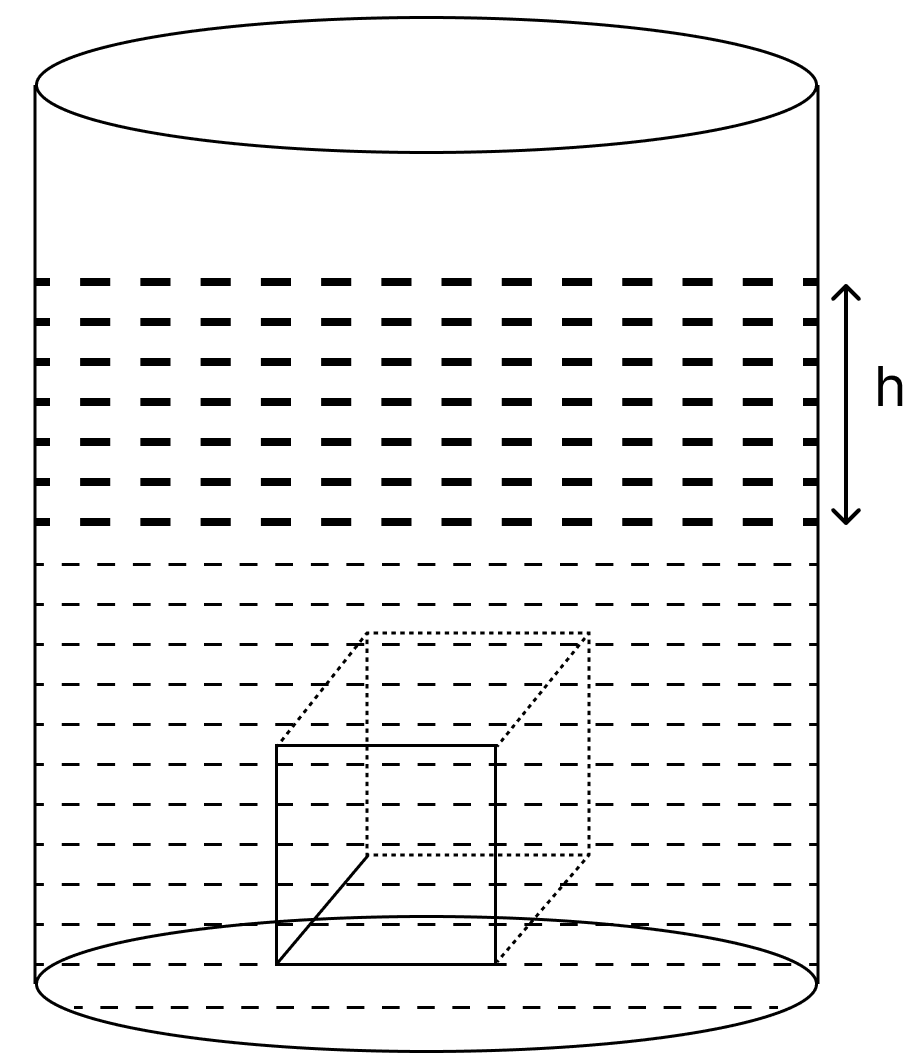
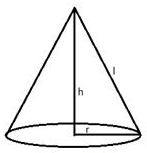
9Exercise 20(F)

A cylindrical can, whose base is horizontal and of radius 3.5 cm, contains sufficient water so that when a sphere is placed in the can, the water just covers the sphere. Given that the sphere just fits into the can, calculate :

(i) the total surface area of the can in contact with water when the sphere is in it;

(ii) the depth of water in the can before the sphere was put into the can.

Show SolutionHide Solution↓

(i) Given,

Radius of base of cylindrical can (R) = 3.5 cm

A cylindrical can, whose base is horizontal and of radius 3.5 cm, contains sufficient water so that when a sphere is placed in the can, the water just covers the sphere. Given that the sphere just fits into the can, calculate : (i) the total surface area of the can in contact with water when the sphere is in it; (ii) the depth of water in the can before the sphere was put into the can. Cylinder, Cone, Sphere, Concise Mathematics Solutions ICSE Class 10.

Since,

When a sphere is placed in the can, the water just covers the sphere.

∴ Height (H) = 2R = 7 cm.

Total surface area = 2πRH + πR2

= πR(2H + R)

= $\frac{22}{7} \times 3.5 \times (2 \times 7 + 3.5)$

= 22 × 0.5 × (14 + 3.5)

= 192.5 cm2.

Hence, the total surface area of the can in contact with water when the sphere is in it = 192.5 cm2.

(ii) Let the depth of the water be h cm in the can.

Volume of water = Volume of cylinder - Volume of sphere

$$\begin{aligned}\Rightarrow πR^2h = πR^2H - \frac{4}{3}πR^3 \\[1em] \Rightarrow πR^2h = πR^2\Big(H - \frac{4}{3}πR\Big) \\[1em] \Rightarrow h = H - \frac{4}{3}R \\[1em] \Rightarrow h = 7 - \frac{4}{3} \times 3.5 \\[1em] \Rightarrow h = 7 - \frac{14}{3} \\[1em] \Rightarrow h = \frac{21 - 14}{3} \\[1em] \Rightarrow h = \frac{7}{3} = 2\frac{1}{3}\text{ cm}.\end{aligned}$$

Hence, depth of water in the can before the sphere was put into the can = $2\frac{1}{3}$ cm.

10Exercise 20(F)

A hollow cylinder has solid hemisphere inward at one end and on the other end it is closed with a flat circular plate. The height of water is 10 cm when flat circular surface is downward. Find the level of water, when it is inverted upside down, common diameter is 7 cm and height of cylinder is 20 cm.

Show SolutionHide Solution↓

Given,

For Cylinder :

Height (H) = 20 cm, Radius (R) = 3.5 cm

For Hemisphere :

Radius (r) = Radius of cylinder (R) = 3.5 cm

A hollow cylinder has solid hemisphere inward at one end and on the other end it is closed with a flat circular plate. The height of water is 10 cm when flat circular surface is downward. Find the level of water, when it is inverted upside down, common diameter is 7 cm and height of cylinder is 20 cm. Cylinder, Cone, Sphere, Concise Mathematics Solutions ICSE Class 10.

When flat surface is downward, then height of water (h) = 10 cm.

So, when circular surface part will be downward then,

Let height upto which water fills be h1.

Volume of cylinder (upto height h1) = Volume of cylinder (upto height h) + Volume of hemisphere

$$\begin{aligned}\Rightarrow πR^2h_1 = πR^2h + \frac{2}{3}πr^3 \\[1em] \Rightarrow πR^2h_1 = πR^2h + \frac{2}{3}πR^3 [As, r = R] \\[1em] \Rightarrow πR^2h_1 = πR^2\Big(h + \frac{2}{3}R\Big) \\[1em] \Rightarrow h_1 = h + \frac{2}{3}R \\[1em] \Rightarrow h_1 = 10 + \frac{2}{3}\times 3.5 \\[1em] \Rightarrow h_1 = 10 + \frac{7}{3} \\[1em] \Rightarrow h_1 = \frac{30 + 7}{3} \\[1em] \Rightarrow h_1 = \frac{37}{3} = 12\frac{1}{3} = 12.33\text{ cm}.\end{aligned}$$

Hence, the level of water, when cylinder is inverted upside down = 12.33 cm.

1(a)Test Yourself

The given figure shows a solid cylinder and a solid cone on it according to the given measurement, the total surface area of the solid in terms of π and r is :

The radii of two solid spheres are 10 cm and 20 cm. The ratio between their volumes is : Cylinder, Cone, Sphere, Concise Mathematics Solutions ICSE Class 10.
Show SolutionHide Solution↓

From figure,

Total surface area of solid = Curved surface area of cylinder + Curved surface area of cone + Area of cross-section

= 2πrh + πrl + πr2

= 2πr.r + πr.2r + πr2

= 2πr2 + 2πr2 + πr2

= 5πr2.

Hence, Option 2 is the correct option.

1(b)Test Yourself

The radii of two solid spheres are 10 cm and 20 cm. The ratio between their volumes is :

Show SolutionHide Solution↓

Radius of first solid sphere (r) = 10 cm

Radius of second solid sphere (R) = 20 cm

Ratio of volumes of two spheres :

$$\begin{aligned}\Rightarrow \frac{\text{Vol. of 1st sphere}}{\text{Vol. of 2nd sphere}} = \frac{\frac{4}{3}πr^3}{\frac{4}{3}πR^3} \\[1em] = \frac{r^3}{R^3} \\[1em] = \frac{10^3}{20^3} \\[1em] = \frac{1000}{8000} \\[1em] = \frac{1}{8} \\[1em] = 1 : 8.\end{aligned}$$

Hence, Option 3 is the correct option.

1(c)Test Yourself

A cone and a sphere have equal volumes. If height of the cone = radius of the sphere = 10 cm, the radius of the cone is :

Show SolutionHide Solution↓

Given,

Height of the cone (H) = radius of the sphere (r) = 10 cm

Volume of cone and sphere are equal.

Let radius of cone be R cm.

$$\begin{aligned}\therefore \frac{1}{3}πR^2H = \frac{4}{3}πr^3 \\[1em] \Rightarrow R^2H = 4r^3 \\[1em] \Rightarrow R^2 = \frac{4r^3}{H} \\[1em] \Rightarrow R^2 = \frac{4 \times 10^3}{10} \\[1em] \Rightarrow R^2 = 4 \times 10^2 \\[1em] \Rightarrow R^2 = 400 \\[1em] \Rightarrow R = \sqrt{400} = 20 \text{ cm}.\end{aligned}$$

Hence, Option 4 is the correct option.

1(d)Test Yourself

A solid metal cuboid with dimension 10 cm, 11 cm and 8 cm is melted and identical solid spheres, each of radius 1 cm, are formed. The number of sphere formed is :

Show SolutionHide Solution↓

Given,

A solid metal cuboid with dimensions 10 cm, 11 cm and 8 cm is melted and identical solid spheres, each of radius 1 cm, are formed. Let no. of spheres formed be n.

∴ Volume of metal cuboid = n × Volume of sphere

⇒ l × b × h = n × $\frac{4}{3}πr^3$

⇒ 10 × 11 × 8 = n × $\frac{4}{3} \times \frac{22}{7} \times 1^3$

⇒ 880 = n × $\frac{88}{21}$

⇒ n = $\frac{880 \times 21}{88}$

⇒ n = 10 x 21 = 210.

Hence, option 2 is the correct option.

1(e)Test Yourself

By applying force on an uniform metallic wire, the wire is extended four times along its length with same width all around. Then :

(i) The volume of metal in both the cases is same.

(ii) The surface area of solid wires in both the cases is same.

Which of the above statements is/are true?

Show SolutionHide Solution↓

On transforming a solid from one shape to another by any external force, the volume of solid remains same.

Let initial length of wire be l and radius be r.

After extension,

Length of wire = 4l and Radius be R.

Since, volume is equal in both the cases :

∴ πr2h = πR2H

⇒ πr2l = πR2.4l

⇒ r2 = 4R2

⇒ r = $\sqrt{4R^2}$

⇒ r = 2R

⇒ R = $\frac{r}{2}$

Surface area in first case :

⇒ 2πrh

⇒ 2πrl

Surface area in second case :

⇒ 2πRh

⇒ $2π \times \frac{r}{2} \times 4l$

⇒ 4πrl.

∴ Surface area of solid wires in both the cases are different.

Hence, Option 1 is the correct option.

1(f)Test Yourself

The given figure shows a toy made of very thin metal sheet. The toy has the hemisphere, a cylinder and a cone all of the same radius.

The given figure shows a toy made of very thin metal sheet. The toy has the hemisphere, a cylinder and a cone all of the same radius. Concise Mathematics Solutions ICSE Class 10.

Assertion(A): The minimum area of metal sheet required is:

Curved surface area of conical part + curved surface area of cylinder part - curved surface area of hemispherical part

Reason(R): Metal sheet required = curved surface area of (conical part + cylindrical part + hemispherical part)

Show SolutionHide Solution↓

The toy has the hemisphere, a cylinder and a cone all of the same radius.

Metal sheet required = minimum area of metal sheet required

= curved surface area of conical part + curved surface area of cylinder part + curved surface area of hemisphere part

= curved surface area of (conical part + cylindrical part + hemispherical part)

∴ A is false, R is true.

Hence, option 2 is the correct option.

1(g)Test Yourself

The base radius of two right circular cone of the same height are in ratio 3 : 5.

Assertion(A): The ratio between their volume is 9 : 25.

Reason(R): As

$$\begin{aligned}\frac{r_1}{r_2} = \frac{3}{5} \\[1em] \frac{πr_1^2h}{πr_2^2h} = \frac{r_1^2}{r_2^2} = \Big(\frac{3}{5}\Big)^2 \\[1em]\end{aligned}$$

Show SolutionHide Solution↓

Given, the base radius of two right circular cone of the same height are in ratio 3 : 5.

As we know that volume of cone = $\frac{1}{3}πr^2h$

$$\begin{aligned}\frac{\text{Volume of 1st cone}}{\text{Volume of 2nd cone}} = \frac{\frac{1}{3}πr_1^2h}{\frac{1}{3}πr_2^2h}\\[1em] = \frac{πr_1^2h}{πr_2^2h}\\[1em] = \frac{r_1^2}{r_2^2}\\[1em] = \frac{3^2}{5^2}\\[1em] = \Big(\frac{3}{5}\Big)^2\\[1em] = \frac{9}{25}.\end{aligned}$$

∴ Both A and R are true and R is correct reason for A.

Hence, option 3 is the correct option.

1(h)Test Yourself

A solid cone of height 3 cm and radius 3 cm is recast into solid cylinder each of height 1 cm and radius 1 cm.

Assertion(A): Number of cylinders formed = $\frac{1}{3}$ x 3 x 3 x 3

Reason(R): Number of cylinders formed = $\frac{\frac{1}{3}π(3)^2 \times 3}{π(1)^2 \times 1}$

Show SolutionHide Solution↓

Given, radius of solid cone, R = 3 cm

Height of solid cone, H = 3 cm

Radius of solid cylinder, r = 1 cm

Height of solid cylinder, h = 1 cm

By formula,

Volume of cone = $\frac{1}{3}πR^2H$

Volume of cylinder = $πr^2h$.

Given,

Solid cone is recasted into cylinders. Let no. of cylinders formed be n.

∴ Volume of cone = n × Volume of cylinder

$$\begin{aligned}\Rightarrow \frac{1}{3}πR^2H = n × πr^2h\\[1em] \Rightarrow \frac{1}{3}π(3)^2 \times 3 = n × π(1)^2 \times 1\\[1em] \Rightarrow \frac{1}{3} (3)^2 \times 3 = n × 1 \times 1\\[1em] \Rightarrow n = \frac{1}{3} \times 3 \times 3 \times 3\\[1em] \Rightarrow n = 9.\end{aligned}$$

∴ Both A and R are true and R is correct reason for A.

Hence, option 3 is the correct option.

1(i)Test Yourself

A solid wooden cylinder is of height h cm and radius r cm. A conical cavity of same height and the same radius is drill out of the solid cylinder.

Statement (1): The volume of the remaining wood = volume of the solid cylinder - volume of the cone drilled.

Statement (2): The volume of the remaining wood = πr2h - $\frac{1}{3}$ πr2h = $\frac{2}{3}$ πr2h

Show SolutionHide Solution↓

The volume of the remaining wood is the volume of the original solid cylinder minus the volume of the conical cavity drilled out.

Let radius and height of cylinder and conical cavity (both are equal) be r and h units.

Volume of the cylinder : πr2h

Volume of the cone : $\frac{1}{3}$ πr2h

The volume of the remaining wood = Volume of the solid cylinder - Volume of the cone drilled.

= πr2h - $\frac{1}{3}$ πr2h

= $\Big(1 - \frac{1}{3}\Big)$ πr2h

= $\Big(\frac{3 - 1}{3}\Big)$ πr2h

= $\frac{2}{3}$ πr2h.

∴ Both the statements are true.

Hence, option 1 is the correct option.

1(j)Test Yourself

A solid sphere of radius 6 cm is melted and recast into solid spheres of diameter 2 cm each.

Statement (1): The number of solid sphere formed is 6 x 6 x 6 = 216.

Statement (2): If the smaller spheres formed are identical, the number of solid sphere formed = $\frac{\text{Volume of sphere melted}}{\text{Volume of each of the sphere formed}}$

Show SolutionHide Solution↓

Given, radius of solid sphere, R = 6 cm

Diameter of new sphere, d = 2 cm

Radius of new sphere, r = $\frac{2}{2}$ cm = 1 cm

Volume of the sphere: $\frac{4}{3}$ πr3

Given,

A solid sphere of radius 6 cm is melted and recast into solid spheres of diameter 2 cm each. Let no. of spheres formed be n.

∴ Volume of sphere = n × Volume of sphere recasted.

⇒ n = $\frac{\text{Volume of sphere melted}}{\text{Volume of each new sphere formed}}$

∴ Statement 2 is true.

$$\begin{aligned}\Rightarrow n = \frac{\frac{4}{3}πR^3}{\frac{4}{3}πr^3}\\[1em] \Rightarrow n = \frac{R^3}{r^3}\\[1em] \Rightarrow n = \frac{6^3}{1^3}\\[1em] \Rightarrow n = \frac{216}{1}\\[1em] \Rightarrow n = 216.\end{aligned}$$

∴ Statement 1 is true.

Thus, both the statements are true.

Hence, option 1 is the correct option.

1(k)Test Yourself

Water in a canal 6 m wide and 2 m deep, is flowing with the speed of 18 km/h.

Statement (1): The volume of water that flows through the canal in 20 minutes = 6 x 2 x $\Big(18 \times \frac{5}{18}\Big)$ x 20 x 60 m3.

Statement (2): The volume of water that flows through the canal = 6 x 2 x 18 x 20 m3.

Show SolutionHide Solution↓

Given, water in a canal 6 m wide and 2 m deep, is flowing with the speed of 18 km/h.

Volume of water flowing through the canal = Area of cross-section x speed x time

Area of cross-section = width × depth = (6 × 2) m2

Speed = 18 km/h = 18 × $\frac{1000}{3600}$ = $\Big(18 × \frac{5}{18}\Big)$ m/sec

Time = 20 minutes = 20 × 60 sec

∴ Volume = 6 × 2 x 18 × $\frac{5}{18}$ x 20 × 60 m3

Thus, Statement 1 is true, and statement 2 is false.

Hence, option 3 is the correct option.

2Test Yourself

What is the least number of solid metallic spheres, each of 6 cm diameter, that should be melted and recast to form a solid metal cone whose height is 45 cm and diameter 12 cm ?

Show SolutionHide Solution↓

Given,

Diameter of metallic spheres = 6 cm

Radius of metallic spheres (r) = $\frac{6}{2}$ = 3 cm.

Height of cone (H) = 45 cm

Diameter of cone = 12 cm

Radius of cone (R) = $\frac{12}{2}$ = 6 cm.

Let no. of spheres melted to form a solid metal cone be n.

∴ n × Volume of each sphere = Volume of solid metal cone

$$\begin{aligned}\Rightarrow n \times \frac{4}{3}πr^3 = \frac{1}{3}πR^2H \\[1em] \Rightarrow n = \frac{\frac{1}{3}πR^2H}{\frac{4}{3}πr^3} \\[1em] \Rightarrow n = \frac{πR^2H \times 3}{3 \times4 \times πr^3} \\[1em] \Rightarrow n = \frac{R^2H}{4r^3} \\[1em] \Rightarrow n = \frac{6^2 \times 45}{4 \times 3^3} \\[1em] \Rightarrow n = \frac{36 \times 45}{4 \times 27} \\[1em] \Rightarrow n = \frac{1620}{108} \\[1em] \Rightarrow n = 15.\end{aligned}$$

Hence, 15 solid metallic spheres need to be melted.

3Test Yourself

A largest sphere is to be carved out of a right circular cylinder of radius 7 cm and height 14 cm. Find the volume of the sphere.
(Answer correct to the nearest integer)

Show SolutionHide Solution↓

Radius of largest sphere from a right circular cylinder will be equal to radius of circular cylinder = 7 cm.

Volume of sphere = $\frac{4}{3}πr^3$

$$\begin{aligned}= \frac{4}{3} \times \frac{22}{7} \times 7^3 \\[1em] = \frac{4}{3} \times 22 \times 7^2 \\[1em] = 1437 \text{ m}^3.\end{aligned}$$

Hence, volume of sphere = 1437 m3.

4Test Yourself

A right circular cylinder having diameter 12 cm and height 15 cm is full of ice-cream. The ice-cream is to be filled in identical cones of height 12 cm and diameter 6 cm having a hemi-spherical shape on the top. Find the number of cones required.

Show SolutionHide Solution↓

Given,

Diameter of the cylinder = 12 cm

So, its radius (r) = $\frac{12}{2}$ = 6 cm

Height of the cylinder (h) = 15 cm

Diameter of the cone = 6 cm

So, its radius (R) = $\frac{6}{2}$ = 3 cm

Height of the cone (H) = 12 cm

Radius of the hemisphere = Radius of cone = R = 3 cm

Now,

Let the number of cones be n.

Volume of the cylinder = πr2h

= π × (6)2 × 15

= 540π cm2.

Volume of an ice-cream cone with ice-cream = Volume of cone + Volume of hemisphere

$$\begin{aligned}= \frac{1}{3}πR^2H + \frac{2}{3} \times π \times R^3 \\[1em] = \frac{1}{3} \times π \times 3^2 \times 12 + \frac{2}{3} \times π \times 3^3 \\[1em] = 36 π + 18 π \\[1em] = 54 π \text{ cm}^3.\end{aligned}$$

Let no. of cones required be n.

Volume of cylinder = n × Volume of each cone

n = $\frac{\text{Vol. of cylinder}}{\text{Vol. of ice-cream cone}} = \frac{540π}{54π}$ = 10.

Hence, the number of cones required = 10.

5Test Yourself

A solid is in the form of a cone standing on a hemisphere with both their radii being equal to 8 cm and the height of cone is equal to its radius. Find in terms of π, the volume of the solid.

Show SolutionHide Solution↓

Given,

Radius of both cone and hemisphere (r) = 8 cm

Height of cone (h) = 8 cm

From figure,

Volume of the solid = Volume of cone + Volume of hemisphere

$$\begin{aligned}= \frac{1}{3}πr^2h + \frac{2}{3} πr^3 \\[1em] = \frac{1}{3} \times π \times 8^2 \times 8 + \frac{2}{3} \times π \times 8^3 \\[1em] = \frac{1}{3}.π.8^3 + \frac{2}{3}.π.8^3 \\[1em] = \Big(\frac{1 + 2}{3}\Big) \times π \times 512 \\[1em] = 512π \text{ cm}^3.\end{aligned}$$

Hence, volume of solid = 512π cm3.

6Test Yourself

The diameter of a sphere is 6 cm. It is melted and drawn into a wire of diameter 0.2 cm. Find the length of wire.

Show SolutionHide Solution↓

Given,

Diameter of the sphere = 6 cm

So, its radius (R) = $\frac{6}{2}$ = 3 cm

Diameter of cylindrical wire = 0.2 cm

So, the radius of the wire (r) = $\frac{0.2}{2}$ = 0.1 cm

Let length of wire = h

Since, sphere is melted and recasted into a wire.

∴ Volume of sphere = Volume of wire

$$\begin{aligned}\Rightarrow \frac{4}{3}πR^3 = πr^2h \\[1em] \Rightarrow h = \frac{\frac{4}{3}πR^3}{πr^2} \\[1em] \Rightarrow h = \frac{4R^3}{3r^2} \\[1em] \Rightarrow h = \frac{4 \times 3^3}{3 \times (0.1)^2} \\[1em] \Rightarrow h = \frac{4 \times 3^2}{0.01} \\[1em] \Rightarrow h = 4 \times 3^2 \times 100 \\[1em] \Rightarrow h = 3600 \text{ cm} \\[1em] \Rightarrow h = 3600 \times \frac{1}{100} \text{ m} \\[1em] \Rightarrow h = 36 \text{ m}.\end{aligned}$$

Hence, length of the wire = 36 m.

7Test Yourself

Determine the ratio of the volume of a cube to that of a sphere which will exactly fit inside the cube.

Show SolutionHide Solution↓

Let edge of the cube = a units.

Then, Volume of the cube = a x a x a = a3

The sphere that exactly fits in the cube will have diameter a units.

Radius of sphere (r) = $\frac{a}{2}$ units.

$$\begin{aligned}\frac{\text{Vol. of cube}}{\text{Vol. of sphere}} = \frac{\text{(side)}^3}{\frac{4}{3}πr^3} \\[1em] = \frac{a^3}{\frac{4}{3}π \times \Big(\frac{a}{2}\Big)^3} \\[1em] = \frac{a^3 \times 3 \times 2^3}{4π \times a^3} \\[1em] = \frac{3 \times 8}{4 \times \frac{22}{7}} \\[1em] = \frac{3 \times 8 \times 7}{4 \times 22} \\[1em] = \frac{21}{11} \\[1em] = 21 : 11.\end{aligned}$$

Hence, ratio of volume of cube to volume of sphere = 21 : 11.

8Test Yourself

An iron pole consisting of a cylindrical portion 110 cm high and of base diameter 12 cm is surmounted by a cone 9 cm high. Find the mass of the pole, given that 1 cm3 of iron has 8 gm of mass (approx). (Take π = $\frac{355}{113}$)

Show SolutionHide Solution↓

Given,

Diameter of cylindrical portion = 12 cm

Radius of cylindrical portion (r) = $\frac{12}{2}$ = 6 cm

Height of the cylindrical part (H) = 110 cm

Height of the conical part (h) = 9 cm

From figure,

An iron pole consisting of a cylindrical portion 110 cm high and of base diameter 12 cm is surmounted by a cone 9 cm high. Find the mass of the pole, given that 1 cm<sup>3</sup> of iron has 8 gm of mass (approx). Cylinder, Cone, Sphere, Concise Mathematics Solutions ICSE Class 10.

Radius of conical part = Radius of cylindrical portion = r = 6 cm.

Volume of iron pole = Volume of cylindrical portion + Volume of conical portion

$$\begin{aligned}= πr^2H + \frac{1}{3}πr^2h \\[1em] = πr^2\Big(H + \frac{1}{3}h\Big) \\[1em] = \frac{355}{113} \times 6^2 \times \Big(110 + \frac{1}{3} \times 9\Big) \\[1em] = \frac{355}{113} \times 36 \times 113 \\[1em] = 12780 \text{ cm}^3.\end{aligned}$$

Given,

Weight of 1 cm3 of iron = 8 gm.

Total weight = 12780 x 8 gm = 102240 gm

= $\frac{102240}{1000}$ kg = 102.24 kg.

Hence, mass of pole = 102.24 kg

9Test Yourself

A cylindrical water tank of diameter 2.8 m and height 4.2 m is being fed by a pipe of diameter 7 cm through which water flows at the rate of 4 m s-1. Calculate, in minutes, the time it takes to fill the tank.

Show SolutionHide Solution↓

Given,

Diameter of cylindrical tank = 2.8 m

So, its radius (R) = $\frac{2.8}{2}$ = 1.4 m

Height (H) = 4.2 m

Volume of water filled in it = πr2h

= $\frac{22}{7}$ x 1.4 x 1.4 x 4.2

= 25.872 m3

= 25.872 × (100)3 cm3

Given,

Diameter of the pipe = 7 cm

Radius (r) = $\frac{7}{2}$ = 3.5 cm

Area of cross section of pipe = πr2

= $\frac{22}{7} \times (3.5)^2$

= 22 × 0.5 × 3.5

= 38.5 cm2.

Volume of water discharged per second = 38.5 cm2 × 4 m s-1

= 38.5 × 400 cm s-1

Let the pipe fill the tank in n seconds.

∴ n × Volume of water discharged per second = Volume of tank

$$\begin{aligned}\Rightarrow n \times 38.5 × 400 = 25.872 × (100)^3 \\[1em] \Rightarrow n = \frac{25.872 \times 100^3}{38.5 \times 400} \\[1em] \Rightarrow n = \frac{25872000}{15400} \\[1em] \Rightarrow n = 1680 \text{ seconds} \\[1em] \Rightarrow n = 1680 \times \frac{1}{60} \text{ minutes} \\[1em] \Rightarrow n = 28\text{ minutes}.\end{aligned}$$

Hence, it takes 28 minutes to fill the tank.

10Test Yourself

Water flows, at 9 km per hour, through a cylindrical pipe of cross-sectional area 25 cm2. If this water is collected into a rectangular cistern of dimensions 7.5 m by 5 m by 4 m; calculate the rise in level in the cistern in 1 hour 15 minutes.

Show SolutionHide Solution↓

Given,

Rate of water flow = 9 km/hr

= 9 × 105 cm/hr. [As, 1 km = 105 cm.]

1 hour 15 minutes = $1 + \frac{15}{60} = 1 + \frac{1}{4} = \frac{5}{4}$ hours.

Volume of water flowing in $\frac{5}{4}$ hours = Area of cross-section of pipe × Rate of water flow × $\frac{5}{4}$ hours

= 25 cm2 × 9 km/hr × $\frac{5}{4}$ hr

= 25 cm2 × (9 × 105) cm/hr × $\frac{5}{4}$ hr

= $\frac{1125 \times 10^5}{4}$ cm3.

Let increase in level of water be h cm.

Given,

Length of rectangular cistern = 7.5 m = 750 cm

Breadth of rectangular cistern = 5 m = 500 cm

Volume of water increase in cistern = 750 × 500 × h cm3

We know that,

Volume of water increase in cistern = Volume of water flowing in $\frac{5}{4}$ hours

$$\begin{aligned}\Rightarrow 750 × 500 × h = \frac{1125 \times 10^5}{4} \\[1em] \Rightarrow h = \frac{1125 \times 10^5}{4 \times 750 \times 500} \\[1em] \Rightarrow h = 0.00075 \times 10^5 \\[1em] \Rightarrow h = 75 \text{ cm}.\end{aligned}$$

Hence, there is an increase of 75 cm in level of water in cistern.

11Test Yourself

The given figure shows the cross-section of a cone, a cylinder and a hemisphere all with the same diameter 10 cm, and the other dimensions are as shown.

Calculate :

(i) the total surface area,

(ii) the total volume of the solid and

(iii) the density of the material if its total weight is 1.7 kg.

The given figure shows the cross-section of a cone, a cylinder and a hemisphere all with the same diameter 10 cm, and the other dimensions are as shown. Calculate : (i) the total surface area, (ii) the total volume of the solid and (iii) the density of the material if its total weight is 1.7 kg. Cylinder, Cone, Sphere, Concise Mathematics Solutions ICSE Class 10.
Show SolutionHide Solution↓

(i) Given,

Diameter of cone, cylinder and hemisphere = 10 cm

Radius of cone, cylinder and hemisphere (r) = $\frac{10}{2}$ = 5 cm.

From figure,

Height of cone (h) = 12 cm

By formula,

⇒ l2 = r2 + h2

⇒ l2 = 52 + 122

⇒ l2 = 25 + 144

⇒ l2 = 169

⇒ l = $\sqrt{169}$ = 13 cm.

Total surface area = Surface area of cone + Surface area of cylinder + Surface area of hemisphere

= πrl + 2πrh + 2πr2

= πr(l + 2h + 2r)

= $\frac{22}{7} \times 5 \times (13 + 2 \times 12 + 2 \times 5)$

= $\frac{110}{7} \times (13 + 24 + 10)$

= $\frac{110 \times 47}{7}$

= 738.57 cm2.

Hence, surface area of figure = 738.57 cm2.

(ii) From figure,

Volume of figure = Volume of cone + Volume of cylinder + Volume of hemisphere

$$\begin{aligned}= \frac{1}{3}πr^2h + πr^2h + \frac{2}{3}πr^3 \\[1em] = πr^2\Big(\frac{1}{3}h + h + \frac{2}{3}r\Big) \\[1em] = \frac{22}{7} \times 5^2 \times \Big(\frac{1}{3} \times 12 + 12 + \frac{2}{3} \times 5\Big) \\[1em] = \frac{550}{7} \times \Big(4 + 12 + \frac{10}{3}\Big) \\[1em] = \frac{550}{7} \times \frac{58}{3} \\[1em] = \frac{31900}{21} \\[1em] = 1519.05 \text{ cm}^3.\end{aligned}$$

Hence, volume of figure = 1519.05 cm3.

(iii) By formula,

Density = $\frac{\text{Mass}}{\text{Volume}}$

Given,

Mass = 1.7 kg = 1700 gm

Substituting values we get,

Density = $\frac{1700}{1519.05}$ = 1.12 g/cm3.

Hence, density of material = 1.12 g/cm3.

12Test Yourself

A solid, consisting of a right circular cone standing on a hemisphere, is placed upright in a right circular cylinder, full of water, and touches the bottom. Find the volume of water left in the cylinder, having given that the radius of the cylinder is 3 cm and its height is 6 cm; the radius of the hemisphere is 2 cm and the height of cone is 4 cm. Give your answer to the nearest cubic centimeter.

Show SolutionHide Solution↓

Given,

Height of cylinder (H) = 6 cm

Radius of cylinder (R) = 3 cm

Height of cone (h) = 4 cm

Radius of cone = Radius of hemisphere = r = 2 cm

A solid, consisting of a right circular cone standing on a hemisphere, is placed upright in a right circular cylinder, full of water, and touches the bottom. Find the volume of water left in the cylinder, having given that the radius of the cylinder is 3 cm and its height is 6 cm; the radius of the hemisphere is 2 cm and the height of cone is 4 cm. Give your answer to the nearest cubic centimeter. Cylinder, Cone, Sphere, Concise Mathematics Solutions ICSE Class 10.

Volume of water left in cylinder = Volume of cylinder - Volume of cone - Volume of hemisphere

$$\begin{aligned}= πR^2H - \frac{1}{3}πr^2h - \frac{2}{3}πr^3 \\[1em] = π\Big(R^2H - \frac{1}{3}r^2h - \frac{2}{3}r^3\Big) \\[1em] = \frac{22}{7} \times \Big(3^2 \times 6 - \frac{1}{3} \times 2^2 \times 4 - \frac{2}{3} \times 2^3\Big) \\[1em] = \frac{22}{7} \times \Big(54 - \frac{16}{3} - \frac{16}{3}\Big) \\[1em] = \frac{22}{7} \times \Big(54 - \frac{32}{3}\Big) \\[1em] = \frac{22}{7} \times \Big(\frac{162 - 32}{3}\Big) \\[1em] = \frac{22}{7} \times \frac{130}{3} \\[1em] = \frac{2860}{21} \\[1em] = 136 \text{ cm}^3.\end{aligned}$$

Hence, volume of water left in cylinder = 136 cm3.

13Test Yourself

A metal container in the form of a cylinder is surmounted by a hemisphere of the same radius. The internal height of the cylinder is 7 m and the internal radius is 3.5 m. Calculate :

(i) the total area of the internal surface, excluding the base;

(ii) the internal volume of the container in m3.

Show SolutionHide Solution↓

Given,

Radius of cylindrical portion = Radius of hemispherical portion = r = 3.5 m.

Height of cylinder (h) = 7 m.

A metal container in the form of a cylinder is surmounted by a hemisphere of the same radius. The internal height of the cylinder is 7 m and the internal radius is 3.5 m. Calculate : (i) the total area of the internal surface, excluding the base; (ii) the internal volume of the container in m<sup>3</sup>. Cylinder, Cone, Sphere, Concise Mathematics Solutions ICSE Class 10.

(i) Area of internal surface = Surface area of cylinder + Surface area of hemisphere

= 2πrh + 2πr2

= 2πr(h + r)

= $2 \times \frac{22}{7} \times 3.5 \times (7 + 3.5)$

= 2 × 22 × 0.5 × 10.5

= 231 m2.

Hence, the total area of the internal surface = 231 m2.

(ii) Internal volume of container = Volume of hemisphere + Volume of cylinder

$$\begin{aligned}= \frac{2}{3}πr^3 + πr^2h \\[1em] = πr^2\Big(\frac{2r}{3} + h\Big) \\[1em] = \frac{22}{7} \times (3.5)^2 \times \Big(\frac{2 \times 3.5}{3} + 7\Big) \\[1em] = 22 \times 0.5 \times 3.5 \times \Big(\frac{7}{3} + 7\Big) \\[1em] = 38.5 \times \frac{28}{3} \\[1em] = 359.33 \text{ m}^3.\end{aligned}$$

Hence, volume of container = 359.33 m3.

14Test Yourself

An exhibition tent is in the form of a cylinder surmounted by a cone. The height of the tent above ground is 85 m and height of the cylindrical part is 50 m. If the diameter of the base is 168 m, find the quantity of canvas required to make the tent. Allow 20% extra for fold and for stitching. Give your answer to the nearest m2.

Show SolutionHide Solution↓

Given,

Diameter of base = 168 m

From figure,

An exhibition tent is in the form of a cylinder surmounted by a cone. The height of the tent above ground is 85 m and height of the cylindrical part is 50 m. If the diameter of the base is 168 m, find the quantity of canvas required to make the tent. Allow 20% extra for fold and for stitching. Give your answer to the nearest m<sup>2</sup>. Cylinder, Cone, Sphere, Concise Mathematics Solutions ICSE Class 10.

Diameter of cylindrical base = Diameter of cone

Radius of cylindrical base = Radius of conical base = r = $\frac{168}{2}$ = 84 m.

Height of cylindrical part (H) = 50 m

Height of conical part (h) = 35 m

By formula,

⇒ l2 = r2 + h2

⇒ l2 = 842 + 352

⇒ l2 = 7056 + 1225

⇒ l2 = 8281

⇒ l = $\sqrt{8281}$ = 91 m.

Surface area of exhibition tent = Surface area of cylindrical part + Surface area of conical part

= 2πrH + πrl

$$\begin{aligned}= 2 \times \frac{22}{7} \times 84 \times 50 + \frac{22}{7} \times 84 \times 91 \\[1em] = 26400 + 24024 \\[1em] = 50424 \text{ m}^2.\end{aligned}$$

Area required for folds and stitching = $\frac{20}{100} \times 50424$ = 10084.8 m2.

Total area of canvas required = 50424 + 10084.8 = 60508.8 m2 ≈ 60509 m2 (to the nearest m2).

Hence, area of canvas required = 60509 m2.

15Test Yourself

A test tube consists of a hemisphere and a cylinder of the same radius. The volume of the water required to fill the whole tube is $\frac{5159}{6}$ cm3, and $\frac{4235}{6}$ cm3 of water is required to fill the tube to a level which is 4 cm below the top of the tube. Find the radius of the tube and the length of its cylindrical part.

Show SolutionHide Solution↓

Given,

Let radius of hemisphere be r cm and height of cylindrical portion be h cm.

A test tube consists of a hemisphere and a cylinder of the same radius. The volume of the water required to fill the whole tube is cm<sup>3</sup>, and cm<sup>3</sup> of water is required to fill the tube to a level which is 4 cm below the top of the tube. Find the radius of the tube and the length of its cylindrical part. Cylinder, Cone, Sphere, Concise Mathematics Solutions ICSE Class 10.

Total volume of test tube = Volume of hemisphere + Volume of cylinder

$$\begin{aligned}\Rightarrow \frac{5159}{6} = \frac{2}{3}πr^3 + πr^2h \\[1em] \Rightarrow \frac{5159}{6} = πr^2\Big(\frac{2}{3}r + h\Big) \\[1em] \Rightarrow \frac{5159}{6} = πr^2\Big(\frac{2r + 3h}{3}\Big) \\[1em] \Rightarrow πr^2(2r + 3h) = \frac{5159}{6} \times 3 \\[1em] \Rightarrow πr^2(2r + 3h) = \frac{5159}{2} ..............(1)\end{aligned}$$

Given,

$\frac{4235}{6}$ cm3 of water is required to fill the tube to a level which is 4 cm below the top of the tube.

$$\begin{aligned}\therefore \frac{4235}{6} = \text{Vol. of hemisphere + Vol. of cylinder[upto (h - 4) cm]} \\[1em] \Rightarrow \frac{4235}{6} = \frac{2}{3}πr^3 + πr^2(h - 4) \\[1em] \Rightarrow \frac{4235}{6} = πr^2\Big(\frac{2}{3}r + h - 4\Big) \\[1em] \Rightarrow \frac{4235}{6} = πr^2\Big(\frac{2r + 3h - 12}{3}\Big) \\[1em] \Rightarrow \frac{4235 \times 3}{6} = πr^2(2r + 3h) - 12πr^2 \\[1em] \Rightarrow \frac{4235}{2} = πr^2(2r + 3h) - 12πr^2\end{aligned}$$

Substituting value of πr2(2r + 3h) from equation 1 in above equation.

$$\begin{aligned}\Rightarrow \frac{4235}{2} = \frac{5159}{2} - 12πr^2 \\[1em] \Rightarrow 12πr^2 = \frac{5159}{2} - \frac{4235}{2} \\[1em] \Rightarrow 12πr^2 = \frac{924}{2} \\[1em] \Rightarrow r^2 = \frac{924}{2 \times 12π} \\[1em] \Rightarrow r^2 = \frac{924}{24 \times \frac{22}{7}} \\[1em] \Rightarrow r^2 = \frac{924 \times 7}{24 \times 22} \\[1em] \Rightarrow r^2 = \frac{6468}{528} \\[1em] \Rightarrow r^2 = 12.25 \\[1em] \Rightarrow r = \sqrt{12.25} \\[1em] \Rightarrow r = 3.5 \text{ cm}.\end{aligned}$$

Substituting value of r in equation 1, we get :

$$\begin{aligned}\Rightarrow πr^2(2r + 3h) = \frac{5159}{2} \\[1em] \Rightarrow \frac{22}{7} \times (3.5)^2 \times (2 \times 3.5 + 3h) = \frac{5159}{2} \\[1em] \Rightarrow 22 \times 0.5 \times 3.5 \times (7 + 3h) = \frac{5159}{2} \\[1em] \Rightarrow 38.5 \times (7 + 3h) = \frac{5159}{2} \\[1em] \Rightarrow 7 + 3h = \frac{5159}{2 \times 38.5} \\[1em] \Rightarrow 7 + 3h = \frac{5159}{77} \\[1em] \Rightarrow 7 + 3h = 67 \\[1em] \Rightarrow 3h = 67 - 7 \\[1em] \Rightarrow 3h = 60 \\[1em] \Rightarrow h = \frac{60}{3} \\[1em] \Rightarrow h = 20 \text{ cm}.\end{aligned}$$

Hence, radius of cylindrical part = 3.5 cm and height = 20 cm.

16Test Yourself

A solid is in the form of a right circular cone mounted on a hemisphere. The diameter of the base of the cone, which exactly coincides with hemisphere, is 7 cm and its height is 8 cm. The solid is placed in a cylindrical vessel of internal radius 7 cm and height 15 cm. How much water, in cm3, will be required to fill the vessel completely?

Show SolutionHide Solution↓

Given,

Diameter of cone = 7 cm

Radius of cone (r) = $\frac{7}{2}$ = 3.5 cm

Height of cone (h) = 8 cm

Radius of hemisphere = radius of cone = r = 3.5 cm

Radius of cylindrical vessel (R) = 7 cm

Height of cylindrical vessel (H) = 15 cm.

A solid is in the form of a right circular cone mounted on a hemisphere. The diameter of the base of the cone, which exactly coincides with hemisphere, is 7 cm and its height is 8 cm. The solid is placed in a cylindrical vessel of internal radius 7 cm and height 15 cm. How much water, in cm<sup>3</sup>, will be required to fill the vessel completely? Cylinder, Cone, Sphere, Concise Mathematics Solutions ICSE Class 10.

Volume of solid = Volume of cone + Volume of hemisphere

$$\begin{aligned}= \frac{1}{3}πr^2h + \frac{2}{3}πr^3 = πr^2\Big(\frac{1}{3}h + \frac{2}{3}r) \\[1em] = \frac{22}{7} \times (3.5)^2 \times \Big(\frac{1}{3} \times 8 + \frac{2}{3} \times 3.5\Big) \\[1em] = 22 \times 0.5 \times 3.5 \times \Big(\frac{8}{3} + \frac{7}{3}\Big) \\[1em] = 38.5 \times \frac{15}{3} \\[1em] = 38.5 \times 5 \\[1em] = 192.5 \text{ cm}^3.\end{aligned}$$

By formula,

Volume of cylindrical vessel = πR2H

$$\begin{aligned}= \frac{22}{7} \times 7^2 \times 15 \\[1em] = 22 \times 7 \times 15 \\[1em] = 2310 \text{ cm}^3.\end{aligned}$$

Volume of water required to fill the vessel completely = Volume of cylindrical vessel - Volume of solid

= 2310 - 192.5

= 2117.5 cm3.

Hence, volume of water required to fill the vessel completely = 2117.5 cm3.

17Test Yourself

A certain number of metallic cones, each of radius 2 cm and height 3 cm, are melted and recast into a solid sphere of radius 6 cm. Find the number of cones used.

Show SolutionHide Solution↓

Given,

Radius of cone (r) = 2 cm,

Height of cone (h) = 3 cm,

Radius of sphere (R) = 6 cm.

Let n cones be melted to recast into a solid sphere.

∴ n × Volume of each cone = Volume of sphere

$$\begin{aligned}\Rightarrow n \times \frac{1}{3}πr^2h = \frac{4}{3}πR^3 \\[1em] \Rightarrow n = \frac{\frac{4}{3}πR^3}{\frac{1}{3}πr^2h} \\[1em] \Rightarrow n = \frac{4πR^3 \times 3}{πr^2h \times 3} \\[1em] \Rightarrow n = \frac{4R^3}{r^2h} \\[1em] \Rightarrow n = \frac{4 \times 6^3}{2^2 \times 3} \\[1em] \Rightarrow n = \frac{864}{12} \\[1em] \Rightarrow n = 72.\end{aligned}$$

Hence, 72 cones need to be melted to recast into a solid sphere.

18Test Yourself

A conical tent is to accommodate 77 persons. Each person must have 16 m3 of air to breathe. Given the radius of the tent as 7 m, find the height of the tent and also its curved surface area.

Show SolutionHide Solution↓

Given,

Each person must have 16 m3 of air to breathe.

∴ 77 persons need 77 × 16 m3 = 1232 m3.

Radius of tent (r) = 7 m.

Let height of conical tent be h meters.

Since, conical tent needs to accommodate 77 persons, so its volume will be equal to volume of air required for 77 persons.

$$\begin{aligned}\Rightarrow \frac{1}{3}πr^2h = 1232 \\[1em] \Rightarrow \frac{1}{3} \times \frac{22}{7} \times 7^2 \times h = 1232 \\[1em] \Rightarrow \frac{1}{3} \times 22 \times 7 \times h = 1232 \\[1em] \Rightarrow h = \frac{1232 \times 3}{22 \times 7} \\[1em] \Rightarrow h = \frac{3696}{154} \\[1em] \Rightarrow h = 24 \text{ m}.\end{aligned}$$

By formula,

⇒ l2 = r2 + h2

⇒ l2 = 72 + 242

⇒ l2 = 49 + 576

⇒ l2 = 625

⇒ l = $\sqrt{625}$ = 25 m.

Curved surface area of tent = πrl

= $\frac{22}{7} \times 7 \times 25$

= 22 × 25

= 550 m2.

Hence, height of tent = 24 m and curved surface area of tent = 550 m2.

19Test Yourself

A metallic solid cylinder has one end surmounted by a cone of the same radius and a hemisphere, which is also of same radius as that of the cone. The conical portion, the cylindrical portion and the hemispherical portion are separated as shown below. If the radius of the given solid is r cm and the height of the cone = the height of the cylinder = h cm, find expression for the total surface area of the three parts obtained.

A metallic solid cylinder has one end surmounted by a cone of the same radius and a hemisphere, which is also of same radius as that of the cone. The conical portion, the cylindrical portion and the hemispherical portion are separated as shown below. If the radius of the given solid is r cm and the height of the cone = the height of the cylinder = h cm, find expression for the total surface area of the three parts obtained. Concise Mathematics Solutions ICSE Class 10.
Show SolutionHide Solution↓

When the three portions are separated, each becomes a complete solid. So, we add the entire surface area of the cone, the cylinder and the hemisphere.

For the cone :

Radius = r cm and height = h cm.

Slant height (l) = $\sqrt{h^2 + r^2}$ cm.

Total surface area of cone = πrl + πr2 = $πr\sqrt{h^2 + r^2}$ + πr2.

For the cylinder :

Radius = r cm and height = h cm.

Total surface area of cylinder = 2πrh + 2πr2.

For the hemisphere :

Radius = r cm.

Total surface area of hemisphere = 2πr2 + πr2 = 3πr2.

∴ Total surface area of the three parts

$$\begin{aligned}= \left(πr\sqrt{h^2 + r^2} + πr^2\right) + \left(2πrh + 2πr^2\right) + 3πr^2 \\[1em] = πr\sqrt{h^2 + r^2} + 2πrh + 6πr^2 \\[1em] = πr\left(\sqrt{h^2 + r^2} + 2h + 6r\right).\end{aligned}$$

Hence, total surface area of the three parts = πr$\left(\sqrt{h^2 + r^2} + 2h + 6r\right)$ cm2.

20Test Yourself

A solid cone of radius 20 cm is cut from its middle, parallel to its base, into two parts as shown. Find :

The ratio between the volumes of the two parts obtained.

A solid cone of radius 20 cm is cut from its middle, parallel to its base, into two parts as shown. Find : Concise Mathematics Solutions ICSE Class 10.
Show SolutionHide Solution↓

Let the radius of the base of the cone be R = 20 cm and its height be H cm.

The cone is cut at the middle of its height by a plane parallel to the base. So the cut is at a height $\frac{H}{2}$ from the apex.

The upper part is a small cone similar to the whole cone. Since the height is halved, by similar triangles its radius is also halved.

∴ Radius of small cone (r) = $\frac{R}{2}$ = 10 cm and height = $\frac{H}{2}$.

Volume of small cone (upper part) :

$V_1 = \frac{1}{3}πr^2\left(\frac{H}{2}\right) = \frac{1}{3}π(10)^2 \times \frac{H}{2} = \frac{1}{3}π \times 50H.$

Volume of the whole cone :

$V = \frac{1}{3}πR^2H = \frac{1}{3}π(20)^2H = \frac{1}{3}π \times 400H.$

Volume of lower part (frustum) = Volume of whole conce - Volume of small cone

$V_2 = V - V_1 = \frac{1}{3}π \times 400H - \frac{1}{3}π \times 50H = \frac{1}{3}π \times 350H.$

∴ Ratio of the two parts :

$V_1 : V_2 = \frac{1}{3}π \times 50H : \frac{1}{3}π \times 350H = 50 : 350 = 1 : 7.$

Hence, the ratio between the volumes of the two parts (smaller cone : frustum) is 1 : 7.

1Case-Study Based Question

In the given figure, ABCDE represents the bowl of a concrete mixer. ABDE can be a part of a cone FDB as shown below where radius OD = 30 cm, OP = 20 cm and PF = 1 m.

In the given figure, ABCDE represents the bowl of a concrete mixer. ABDE can be a part of a cone FDB as shown below where radius OD = 30 cm, OP = 20 cm and PF = 1 m. Concise Mathematics Solutions ICSE Class 10.

(i) Calculate the value of PE using similarity of triangles.

(ii) Calculate the volume of the part with cross-section ABDE.

(iii) Calculate the volume of the whole concrete mixer to the nearest litre.

Show SolutionHide Solution↓

(i) F is the apex of the cone FDB. P and O lie on the axis with PF = 1 m = 100 cm and OP = 20 cm.

∴ FO = FP + PO = 100 + 20 = 120 cm.

In △FPE and △FOD :

∠PFE = ∠OFD (common angle)

∠FPE = ∠FOD (each = 90°, both perpendicular to the axis)

∴ △FPE ∼ △FOD (by AA axiom)

We know that,

In similar triangles corresponding sides are proportional.

$$\begin{aligned}\Rightarrow \frac{PE}{OD} = \frac{FP}{FO} \\[1em] \Rightarrow \frac{PE}{30} = \frac{100}{120} \\[1em] \Rightarrow PE = \frac{100}{120} \times 30 = 25 \text{ cm}.\end{aligned}$$

Hence, PE = 25 cm.

(ii) From figure,

For cone FBD :

Radius (R) = 30 cm

Height (H) = 120 cm

For cone FAE :

Radius (r) = 25 cm

Height (h) = 100 cm

Volume of part with cross section ABDE (V) = Volume of cone FBD - Volume of cone FAE

$$\begin{aligned}\Rightarrow V = \frac{1}{3} \times \frac{22}{7} \times 30^2 \times 120 - \frac{1}{3} \times \frac{22}{7} \times 25^2 \times 100 \\[1em] \Rightarrow V = \frac{1}{3} \times \frac{22}{7} \times 900 \times 120 - \frac{1}{3} \times \frac{22}{7} \times 625 \times 100 \\[1em] \Rightarrow V = \frac{1}{3} \times \frac{22}{7} \times \left(108000 - 62500\right) \\[1em] \Rightarrow V = \frac{1}{3} \times \frac{22}{7} \times 45500 \\[1em] \Rightarrow V = \frac{22}{3} \times 6500 \\[1em] \Rightarrow V = \frac{143000}{3} = 47666\frac{2}{3} \approx 47666.67 \text{ cm}^3\end{aligned}$$

Hence, volume of part with cross section ABDE = 47666.7 cm3.

(iii) From figure,

For hemisphere BCD,

Radius (R) = 30 cm

Volume of hemisphere BCD = $\frac{2}{3}πR^3$

$$\begin{aligned}\text{Volume of hemisphere BCD} = \frac{2}{3} \times \frac{22}{7} \times (30)^3 \\[1em] = \frac{2}{3} \times \frac{22}{7} \times 27000 \\[1em] = \frac{22}{7} \times 18000 \\[1em] = \frac{396000}{7} = 56571\frac{3}{7} \approx 56571.43 \text{ cm}^3\end{aligned}$$

Volume of whole concrete mixer = Volume of part with cross section ABDE + Volume of hemisphere BCD

= 47666.7 + 56571.4

= 104238.1 cm3

= 104238.1 × 0.001 liters

= 104.238 liters.

Hence, the volume of the whole concrete mixer ≈ 104 litres.

Press ↓ to reveal a solution and move to the next question. Back to Selina Concise Mathematics.

Free sample bank