Home › Mathematics › RS Aggarwal Mathematics › Trigonometrical Identities Trigonometrical Identities
ICSE Class 10 Mathematics · RS Aggarwal Mathematics · 102 solved questions
1 Exercise 22A
Prove the following identity:
$\Big(\frac{\cosec A + 1}{\cosec A - 1}\Big) = \Big(\frac{1 + \sin A}{1 - \sin A}\Big)$
Show Solution Hide Solution ↓ Solving L.H.S:
$$\begin{aligned}\Rightarrow \frac{\cosec A + 1}{\cosec A - 1} \\[1em] \Rightarrow \frac{\frac{1}{\sin A} + 1}{\frac{1}{\sin A} - 1} \\[1em] \Rightarrow \frac{\frac{1 + \sin A}{\sin A}}{\frac{1 - \sin A}{\sin A}} \\[1em] \Rightarrow \frac{(1 + \sin A) \times \sin A}{(1 - \sin A) \times \sin A} \\[1em] \Rightarrow \frac{1 + \sin A}{1 - \sin A}.\end{aligned}$$
Since, L.H.S. = R.H.S.
Hence, proved that $\Big(\frac{\cosec A + 1}{\cosec A - 1}\Big) = \Big(\frac{1 + \sin A}{1 - \sin A}\Big)$.
2 Exercise 22A
Prove the following identity:
$\Big(\frac{\sec A - 1}{\sec A + 1}\Big) = \Big(\frac{1 - \cos A}{1 + \cos A}\Big)$
Show Solution Hide Solution ↓ Solving L.H.S:
$$\begin{aligned}\Rightarrow \frac{\sec A - 1}{\sec A + 1} \\[1em] \Rightarrow \frac{\frac{1}{\cos A} - 1}{\frac{1}{\cos A} + 1} \\[1em] \Rightarrow \frac{\frac{1 - \cos A}{\cos A}}{\frac{1 + \cos A}{\cos A}} \\[1em] \Rightarrow \frac{(1 - \cos A) \times \cos A}{(1 + \cos A) \times \cos A} \\[1em] \Rightarrow \frac{1 - \cos A}{1 + \cos A}.\end{aligned}$$
Since, L.H.S. = R.H.S.
Hence, proved that $\Big(\frac{\sec A - 1}{\sec A + 1}\Big) = \Big(\frac{1 - \cos A}{1 + \cos A}\Big)$.
3 Exercise 22A
Prove the following identity:
$\Big(\frac{\sin A \times \tan A}{1 - \cos A}\Big) = 1 + \sec A$
Show Solution Hide Solution ↓ Solving L.H.S of the equation:
$$\begin{aligned}\Rightarrow \frac{\sin A \times \frac{\sin A}{\cos A}}{1 - \cos A} \\[1em] \Rightarrow \frac{\sin^2 A}{\cos A(1 - \cos A)} \\[1em] \text{ By formula, } \sin^2 A = 1 - \cos^2 A \\[1em] \Rightarrow \frac{1 - \cos^2 A}{\cos A(1 - \cos A)} \\[1em] \Rightarrow \frac{(1 + \cos A)(1 - \cos A)}{\cos A(1 - \cos A)} \\[1em] \Rightarrow \frac{(1 + \cos A)}{\cos A} \\[1em] \Rightarrow \frac{1}{\cos A} + \frac{\cos A}{\cos A} \\[1em] \Rightarrow \sec A + 1.\end{aligned}$$
Since, L.H.S. = R.H.S.
Hence, proved that $\Big(\frac{\sin A \times \tan A}{1 - \cos A}\Big) = 1 + \sec A$.
4 Exercise 22A
Prove the following identity:
$\Big(\frac{1}{\tan A + \cot A}\Big) = \cos A \times \sin A$
Show Solution Hide Solution ↓ Solving L.H.S. of the equation :
$$\begin{aligned}\Rightarrow \frac{1}{\tan A + \cot A} \\[1em] \Rightarrow \frac{1}{\frac{\sin A}{\cos A} + \frac{\cos A}{\sin A}} \\[1em] \Rightarrow \frac{1}{\frac{\sin^2 A + \cos^2 A}{\sin A \cos A}} \\[1em] \Rightarrow \frac{\sin A \cos A}{\sin^2 A + \cos^2 A} \\[1em] \Rightarrow \sin A \cos A\end{aligned}$$
Since, L.H.S. = R.H.S.
Hence, proved that $\Big(\frac{1}{\tan A + \cot A}\Big) = \cos A \times \sin A$.
5 Exercise 22A
Prove the following identity:
(1 + tan A)2 + (1 - tan A)2 = 2 sec2 A
Show Solution Hide Solution ↓ Solving L.H.S. of the equation :
⇒ (1 + tan A)2 + (1 - tan A)2
⇒ 1 + tan2 A + 2 tan A + 1 + tan2 A - 2 tan A
⇒ 2 + 2 tan2 A
⇒ 2(1 + tan2 A)
By formula,
1 + tan2 A = sec2 A
⇒ 2sec2 A
Since, L.H.S. = R.H.S.
Hence, proved that (1 + tan A)2 + (1 - tan A)2 = 2 sec2 A.
6 Exercise 22A
Prove the following identity:
(sin2 θ - 1) (tan2 θ + 1) + 1 = 0
Show Solution Hide Solution ↓ Solving L.H.S:
⇒ (sin2 θ - 1) (tan2 θ + 1) + 1
By formula,
⇒ sin2 θ − 1 = − cos2 θ
⇒ tan2 θ+ 1 = sec2 θ
= -cos2 θ (sec2 θ) + 1
By formula,
⇒ cos2 θ × sec2 θ = 1
= −1 + 1
= 0
Since, L.H.S. = R.H.S.
Hence, proved that (sin2 θ - 1) (tan2 θ + 1) + 1 = 0.
7 Exercise 22A
Prove the following identity:
cosec A (1 + cos A)(cosec A - cot A) = 1
Show Solution Hide Solution ↓ Solving L.H.S. of the equation :
⇒ cosec A(1 + cos A)(cosec A - cot A)
$$\begin{aligned}\Rightarrow \frac{1}{\sin A} \times (1 + \cos A) \times \Big(\frac{1}{\sin A} - \frac{\cos A}{\sin A}\Big) \\[1em] \Rightarrow \frac{1 + \cos A}{\sin A} \times \frac{1 - \cos A}{\sin A} \\[1em] \Rightarrow \frac{1 - \cos^2 A}{\sin^2 A} \\[1em] \text{ By formula, } \sin^2 A + \cos^2 A = 1 \\[1em] \Rightarrow \frac{1 - \cos^2 A}{1 -\cos^2 A} \\[1em] \Rightarrow 1.\end{aligned}$$
Since, L.H.S. = R.H.S.
Hence, proved that cosec A (1 + cos A)(cosec A - cot A) = 1.
8 Exercise 22A
Prove the following identity:
sec A (1 - sin A)(sec A + tan A) = 1
Show Solution Hide Solution ↓ Solving L.H.S. of the equation :
⇒ sec A(1 - sin A)(sec A + tan A)
$$\begin{aligned}\Rightarrow \frac{1}{\cos A} \times (1 - \sin A) \times \Big(\frac{1}{\cos A} + \frac{\sin A}{\cos A}\Big) \\[1em] \Rightarrow \frac{1 - \sin A}{\cos A} \times \frac{1 + \sin A}{\cos A} \\[1em] \Rightarrow \frac{1 - \sin^2 A}{\cos^2 A} \\[1em] \Rightarrow \frac{\cos^2 A}{\cos^2 A} \\[1em] \Rightarrow 1.\end{aligned}$$
Since, L.H.S. = R.H.S.
Hence, proved that sec A (1 - sin A)(sec A + tan A) = 1.
9 Exercise 22A
Prove the following identity:
(cosec θ - sin θ)(sec θ - cos θ)(tan θ + cot θ) = 1
Show Solution Hide Solution ↓ Solving L.H.S. of the equation :
⇒ (cosec θ - sin θ)(sec θ - cos θ)(tan θ + cot θ) = 1
$$\begin{aligned}\Rightarrow \Big(\frac{1}{\sin \theta } - \sin \theta \Big) \Big(\frac{1}{\cos \theta } - \cos \theta \Big) \Big(\frac{\sin \theta}{\cos \theta } + \frac{\cos \theta}{\sin \theta }\Big) \\[1em] \Rightarrow \Big(\frac{1 - \sin^2 \theta}{\sin \theta}\Big) \Big(\frac{1 - \cos^2 \theta}{\cos \theta } \Big) \Big(\frac{\sin^2 \theta + \cos^2 \theta}{\cos \theta \sin \theta } \Big) \\[1em] \Rightarrow \Big(\frac{\cos^2 \theta}{\sin \theta}\Big) \Big(\frac{\sin^2 \theta}{\cos \theta } \Big) \Big(\frac{1}{\cos \theta \sin \theta } \Big) \\[1em] \Rightarrow \frac{\cos^2 \theta \sin^2 \theta}{\cos^2 \theta \sin^2 \theta } \\[1em] \Rightarrow 1.\end{aligned}$$
Since, L.H.S. = R.H.S.
Hence, proved that (cosec θ - sin θ)(sec θ - cos θ)(tan θ + cot θ) = 1.
10 Exercise 22A
Prove the following identity:
(cosec A + sin A)(cosec A - sin A) = cot2 A + cos2 A
Show Solution Hide Solution ↓ By formula,
cosec2 A = 1 + cot2 A
sin2 A = 1 - cos2 A
Solving L.H.S. of the equation
⇒ (cosec A + sin A)(cosec A - sin A)
⇒ cosec2 A - sin2 A
⇒ 1 + cot2 A - (1 - cos2 A)
⇒ 1 - 1 + cot2 A + cos2 A
⇒ cot2 A + cos2 A.
Hence, proved that (cosec A + sin A)(cosec A - sin A) = cot2 A + cos2 A.
11 Exercise 22A
Prove the following identity:
(sec A + cos A)(sec A - cos A) = sin2 A + tan2 A
Show Solution Hide Solution ↓ By formula,
sec2 A = 1 + tan2 A
cos2 A = 1 - sin2 A
Solving L.H.S. of the equation
⇒ (sec A - cos A)(sec A + cos A)
⇒ sec2 A - cos2 A
⇒ 1 + tan2 A - (1 - sin2 A)
⇒ 1 - 1 + tan2 A + sin2 A
⇒ sin2 A + tan2 A.
Since, L.H.S. = R.H.S.,
Hence, proved that (sec A + cos A)(sec A - cos A) = sin2 A + tan2 A.
12 Exercise 22A
Prove the following identity:
tan2 A - sin2 A = sin2 A tan2 A
Show Solution Hide Solution ↓ Solving L.H.S of equation,
$$\begin{aligned}\Rightarrow \frac{\sin^2 A}{\cos^2 A} - \sin^2 A \\[1em] \Rightarrow \sin^2 A \Big( \frac{1}{\cos^2 A} - 1 \Big) \\[1em] \Rightarrow \sin^2 A \Big( \frac{1 - \cos^2 A}{\cos^2 A} \Big) \\[1em] \Rightarrow \sin^2 A \Big(\frac{\sin^2 A}{\cos^2 A} \Big) \\[1em] \Rightarrow \sin^2 A \tan^2 A.\end{aligned}$$
Since, L.H.S. = R.H.S.,
Hence, proved that tan2 A - sin2 A = sin2 A tan2 A.
13 Exercise 22A
Prove the following identity:
cot2 A - cos2 A = cos2 A cot2 A
Show Solution Hide Solution ↓ Solving L.H.S of equation,
$$\begin{aligned}\Rightarrow \frac{\cos^2 A}{\sin^2 A} - \cos^2 A \\[1em] \Rightarrow \cos^2 A \Big( \frac{1}{\sin^2 A} - 1 \Big) \\[1em] \Rightarrow \cos^2 A \Big( \frac{1 - \sin^2 A}{\sin^2 A} \Big) \\[1em] \Rightarrow \cos^2 A \Big(\frac{\cos^2 A}{\sin^2 A} \Big) \\[1em] \Rightarrow \cos^2 A \cot^2 A.\end{aligned}$$
Since, L.H.S. = R.H.S.,
Hence, proved that cot2 A - cos2 A = cos2 A cot2 A.
14 Exercise 22A
Prove the following identity:
sec2 A + cosec2 A = sec2 A cosec2 A
Show Solution Hide Solution ↓ Solving L.H.S of equation,
$$\begin{aligned}\Rightarrow \frac{1}{\cos^2 A} + \frac{1}{\sin^2 A} \\[1em] \Rightarrow \frac{\sin^2 A + \cos^2 A}{\cos^2 A \sin^2 A} \\[1em] \text{ By formula, } \sin^2 A + \cos^2 A = 1 \\[1em] \Rightarrow \frac{1}{\cos^2 A \sin^2 A} \\[1em] \Rightarrow \frac{1}{\cos^2 A} \times \frac{1}{\sin^2 A} \\[1em] \Rightarrow \sec^2 A \cosec^2 A.\end{aligned}$$
Since, L.H.S. = R.H.S.,
Hence, proved that sec2 A + cosec2 A = sec2 A cosec2 A.
15 Exercise 22A
Prove the following identity:
tan2 A + cot2 A + 2 = sec2 A cosec2 A
Show Solution Hide Solution ↓ Solving L.H.S of equation,
$$\begin{aligned}\Rightarrow \frac{\sin^2 A}{\cos^2 A} + \frac{\cos^2 A}{\sin^2 A} + 2 \\[1em] \Rightarrow \frac{\sin^4 A + \cos^4 A + 2\cos^2 A \sin^2 A}{\cos^2 A \sin^2 A} \\[1em] \Rightarrow \frac{(\sin^2 A + \cos^2 A)^2}{\cos^2 A \sin^2 A} \\[1em] \Rightarrow \frac{1^2}{\cos^2 A \sin^2 A} \\[1em] \Rightarrow \frac{1}{\sin^2 A} \times \frac{1}{\cos^2 A} \\[1em] \Rightarrow \cosec^2 A \sec^2 A .\end{aligned}$$
Since, L.H.S. = R.H.S.,
Hence, proved that tan2 A + cot2 A + 2 = sec2 A cosec2 A.
16 Exercise 22A
Prove the following identity:
sin A (1 + tan A) + cos A (1 + cot A) = sec A + cosec A
Show Solution Hide Solution ↓ Solving L.H.S of equation,
⇒ sin A (1 + tan A) + cos A (1 + cot A)
⇒ sin A + sin A tan A + cos A + cos A cotA
$$\begin{aligned}\Rightarrow \sin A + \frac{\sin^2 A}{\cos A} + \cos A + \frac{\cos^2 A}{\sin A} \\[1em] \Rightarrow \sin A + \frac{\cos^2 A}{\sin A} + \cos A +\frac{\sin^2 A}{\cos A} \\[1em] \Rightarrow \frac{\sin^2 A + \cos^2 A}{\sin A} + \frac{\sin^2 A + \cos^2 A}{\cos A} \\[1em] \Rightarrow \frac{1}{\sin A} + \frac{1}{\cos A} \\[1em] \Rightarrow \sec A + \cosec A.\end{aligned}$$
Since, L.H.S. = R.H.S.,
Hence, proved that sin A (1 + tan A) + cos A (1 + cot A) = sec A + cosec A.
17 Exercise 22A
Prove the following identity:
$\Big(\frac{1}{1 + \tan^2 A}\Big) + \Big(\frac{1}{1 + \cot^2 A}\Big) = 1$
Show Solution Hide Solution ↓ Solving L.H.S of equation,
$\Big(\frac{1}{1 + \tan^2 A}\Big) + \Big(\frac{1}{1 + \cot^2 A}\Big) = 1$
By formula:
1 + tan2 A = sec2 A
1 + cot2 A = cosec2 A
$$\begin{aligned}\Rightarrow \frac{1}{\sec^2 A} + \frac{1}{\cosec^2 A} \\[1em] \Rightarrow \cos^2 A + \sin^2 A\\[1em] \text{ By formula, } \sin^2 A + \cos^2 A = 1 \\[1em] \Rightarrow 1.\end{aligned}$$
Since, L.H.S. = R.H.S.,
Hence, proved that $\Big(\frac{1}{1 + \tan^2 A}\Big) + \Big(\frac{1}{1 + \cot^2 A}\Big) = 1$.
18 Exercise 22A
Prove the following identity:
$\Big(\frac{1}{1 + \sin A}\Big) + \Big(\frac{1}{1 - \sin A}\Big) = 2 \sec^2 A$
Show Solution Hide Solution ↓ Solving L.H.S. of the equation :
$$\begin{aligned}\Rightarrow \frac{1}{1 + \sin A} + \frac{1}{1 - \sin A} \\[1em] \Rightarrow \frac{1 - \sin A + 1 + \sin A}{(1 - \sin A)(1 + \sin A)} \\[1em] \Rightarrow \frac{2}{(1 - \sin^2 A)} \\[1em] \text{ By formula, } \sin^2 A + \cos^2 A = 1 \\[1em] \Rightarrow \frac{2}{\cos^2 A} \\[1em] \Rightarrow 2\sec^2 A.\end{aligned}$$
Since, L.H.S. = R.H.S.,
Hence, proved that $\Big(\frac{1}{1 + \sin A}\Big) + \Big(\frac{1}{1 - \sin A}\Big) = 2 \sec^2 A$.
19 Exercise 22A
Prove the following identity:
$\frac{\sin A - \sin^3 A}{\cos^3 A - \cos A} \times (\sec A - \cosec A) = \cosec A(\cot A - 1)$
Show Solution Hide Solution ↓ Solving L.H.S,
$$\begin{aligned}\Rightarrow \frac{\sin A - \sin^3 A}{\cos^3 A - \cos A} \times (\sec A - \cosec A) \\[1em] \Rightarrow \frac{\sin A(1 - \sin^2 A)}{\cos A(\cos^2 A - 1)} \times \Big(\frac{1}{\cos A} - \frac{1}{\sin A}\Big) \\[1em] \Rightarrow \frac{\sin A(1 - \sin^2 A)}{-\cos A(1- \cos^2 A)} \times \Big(\frac{1}{\cos A} - \frac{1}{\sin A}\Big) \\[1em] \Rightarrow \frac{\sin A (\cos^2 A)}{-\cos A(\sin^2 A)} \times \Big(\frac{\sin A - \cos A}{\cos A \sin A}\Big) \\[1em] \Rightarrow -\frac{\cos A}{\sin A} \times \Big(\frac{\sin A - \cos A}{\cos A \sin A}\Big) \\[1em] \Rightarrow -\Big(\frac{\sin A - \cos A}{\sin^2 A}\Big) \\[1em] \Rightarrow \frac{\cos A - \sin A}{\sin^2 A} \\[1em] \Rightarrow \frac{1}{\sin A} \Big(\frac{\cos A - \sin A}{\sin A}\Big) \\[1em] \Rightarrow \frac{1}{\sin A} \Big(\frac{\cos A}{\sin A} - \frac{\sin A}{\sin A}\Big) \\[1em] \Rightarrow \cosec A (\cot A - 1).\end{aligned}$$
Since,
L.H.S = R.H.S
Hence, proved that
$\frac{\sin A - \sin^3 A}{\cos^3 A - \cos A} \times (\sec A - \cosec A) = \cosec A(\cot A - 1)$.
20 Exercise 22A
Prove the following identity:
$\Big(\frac{\cosec A}{\cosec A - 1}\Big) + \Big(\frac{\cosec A}{\cosec A + 1}\Big) = 2 \sec^2 A$
Show Solution Hide Solution ↓ Solving L.H.S. of the equation :
$$\begin{aligned}\Rightarrow \frac{\cosec A}{\cosec A - 1} + \frac{\cosec A}{\cosec A + 1} \\[1em] \Rightarrow \frac{\cosec A(\cosec A + 1) + \cosec A(\cosec A - 1)}{(\cosec A - 1) (\cosec A + 1)} \\[1em] \Rightarrow \frac{\cosec^2 A + \cosec A + \cosec^2 A - \cosec A}{\cosec^2 A - 1} \\[1em] \Rightarrow \frac{2\cosec^2 A}{\cot^2 A} \\[1em] \Rightarrow \frac{2 \times \frac{1}{\sin^2 A}}{\frac{\cos^2 A}{\sin^2 A}} \\[1em] \Rightarrow \frac{2}{\cos^2 A} \\[1em] \Rightarrow 2\sec^2 A.\end{aligned}$$
Since, L.H.S. = R.H.S.,
Hence, proved that $\Big(\frac{\cosec A}{\cosec A - 1}\Big) + \Big(\frac{\cosec A}{\cosec A + 1}\Big) = 2 \sec^2 A$.
21 Exercise 22A
Prove the following identity:
(1 + cot A - cosec A)(1 + tan A + sec A) = 2
Show Solution Hide Solution ↓ Solving L.H.S. of the equation :
$$\begin{aligned}\Rightarrow \Big(1 + \frac{\cos A}{\sin A} - \frac{1}{\sin A} \Big)\Big(1 + \frac{\sin A}{\cos A} + \frac{1}{\cos A} \Big) \\[1em] \Rightarrow \Big(\frac{\sin A + \cos A - 1}{\sin A}\Big)\Big(\frac{\cos A + \sin A + 1}{\cos A} \Big) \\[1em] \Rightarrow \frac{(\sin A + \cos A - 1) (\cos A + \sin A + 1)}{\sin A \cos A} \\[1em] \Rightarrow \frac{\sin^2 A + \sin A \cos A + \sin A + \sin A \cos A + \cos A + \cos^2 A - \sin A - \cos A - 1}{\sin A \cos A} \\[1em] \Rightarrow \frac{\sin^2 A + \cos^2 A + 2\sin A \cos A - 1}{\sin A \cos A} \\[1em] \Rightarrow \frac{1 + 2\sin A \cos A - 1}{\sin A \cos A} \\[1em] \Rightarrow \frac{ 2\sin A \cos A }{\sin A \cos A} \\[1em] \Rightarrow 2.\end{aligned}$$
Since, L.H.S. = R.H.S.,
Hence, proved that (1 + cot A - cosec A)(1 + tan A + sec A) = 2.
22 Exercise 22A
Prove the following identity:
(sin A + cosec A)2 + (cos A + sec A)2 = 7 + tan2 A + cot2 A
Show Solution Hide Solution ↓ By formula,
sin2 A + cos2 A = 1
sec2 A = 1 + tan2 A
cosec2 A = 1 + cot2 A
Solving L.H.S. of the equation :
⇒ (sin A + cosec A)2 + (cos A + sec A)2 = 7 + tan2 A + cot2 A
⇒ sin2 A + cosec2 A + 2 sin A. cosec A + cos2 A + sec2 A + 2 cos A. sec A
⇒ sin2 A + 1 + cot2 A + 2 × sin A × $\frac{1}{\sin A}$ + cos2 A + 1 + tan2 A + 2 × cos A × $\frac{1}{\cos A}$
⇒ sin2 A + cos2 A + 1 + cot2 A + 2 + 1 + tan2 A + 2
⇒ 1 + 1 + 2 + 1 + 2 + cot2 A + tan2 A
⇒ 7 + tan2 A + cot2 A.
Since, L.H.S. = R.H.S.
Hence, proved that (sin A + cosec A)2 + (cos A + sec A)2 = 7 + tan2 A + cot2 A.
23 Exercise 22A
Prove the following identity:
$\frac{\text{sin}^3 θ + \text{cos}^3 θ}{\text{sin θ + cos θ}}$ + sin θ cos θ = 1
Show Solution Hide Solution ↓ Factorizing,
⇒ sin3 θ + cos3 θ = (sin θ + cos θ)(sin2 θ + cos2 θ - sin θ cos θ)
⇒ sin3 θ + cos3 θ = (sin θ + cos θ)(1 - sin θ cos θ) ...........(1)
To prove,
$\frac{\text{sin}^3 θ + \text{cos}^3 θ}{\text{sin θ + cos θ}}$ + sin θ cos θ = 1
Substituting value of sin3 θ + cos3 θ from equation (1) in L.H.S. of above equation :
⇒ $\frac{\text{(sin θ + cos θ)(1 - sin θ cos θ)}}{\text{sin θ + cos θ}} + \text{sin θ cos θ}$
⇒ 1 - sin θ cos θ + sin θ cos θ
⇒ 1.
Since, L.H.S. = R.H.S.
Hence, proved that $\frac{\text{sin}^3 θ + \text{cos}^3 θ}{\text{sin θ + cos θ}} + \text{sin θ cos θ} = 1$.
24 Exercise 22A
Prove the following identity:
$\Big(\frac{\tan A}{1 - \cot A}\Big) + \Big(\frac{\cot A}{1 - \tan A}\Big) = \sec A \cosec A + 1$
Show Solution Hide Solution ↓ Solving L.H.S of equation,
$$\begin{aligned}\Rightarrow \frac{\frac{\sin A}{\cos A}}{1 - \frac{\cos A}{\sin A}} + \frac{\frac{\cos A}{\sin A}}{1 - \frac{\sin A}{\cos A}} \\[1em] \Rightarrow \frac{\frac{\sin A}{\cos A}}{\frac{\sin A - \cos A}{\sin A}} + \frac{\frac{\cos A}{\sin A}}{\frac{\cos A - \sin A}{\cos A}} \\[1em] \Rightarrow \frac{\frac{\sin^2 A}{\cos A}}{\sin A - \cos A} + \frac{\frac{\cos^2 A}{\sin A}}{\cos A - \sin A} \\[1em] \Rightarrow \frac{\sin^2 A}{\cos A(\sin A - \cos A)} - \frac{\cos^2 A}{\sin A(\sin A - \cos A)} \\[1em] \Rightarrow \frac{1}{\sin A - \cos A} \Big(\frac{\sin^2 A}{\cos A} - \frac{\cos^2 A}{\sin A} \Big) \\[1em] \Rightarrow \frac{1}{\sin A - \cos A} \Big(\frac{\sin^3 A - \cos^3 A}{\cos A \sin A} \Big) \\[1em] \Rightarrow \frac{1}{\sin A - \cos A} \Big(\frac{(\sin A - \cos A)(\sin^2 A + \cos^2 A + \sin A \cos A)}{\cos A \sin A} \Big) \\[1em] \Rightarrow \frac{1 + \sin A \cos A}{\cos A \sin A} \\[1em] \Rightarrow \frac{1}{\cos A \sin A} + \frac{\cos A \sin A}{\cos A \sin A} \\[1em] \Rightarrow \sec A \cosec A + 1.\end{aligned}$$
Since, L.H.S. = R.H.S.
Hence, proved that $\Big(\frac{\tan A}{1 - \cot A}\Big) + \Big(\frac{\cot A}{1 - \tan A}\Big) = \sec A \cosec A + 1$.
25 Exercise 22A
Prove the following identity:
$\Big(\frac{\sin A}{1 + \cot A}\Big) - \Big(\frac{\cos A}{1 + \tan A}\Big) = \sin A - \cos A$
Show Solution Hide Solution ↓ The L.H.S of above equation can be written as,
$$\begin{aligned}\Rightarrow \Big(\frac{\sin A}{1 + \cot A}\Big) - \Big(\frac{\cos A}{1 + \tan A}\Big) \\[1em] \Rightarrow \frac{\sin A}{1 + \frac{\cos A}{\sin A}} - \frac{\cos A}{1 + \frac{\sin A}{\cos A}} \\[1em] \Rightarrow \frac{\sin A}{\frac{\sin A + \cos A}{\sin A}} - \frac{\cos A}{\frac{\cos A + \sin A}{\cos A}} \\[1em] \Rightarrow \frac{\sin^2 A}{\sin A + \cos A} - \frac{\cos^2 A}{\cos A + \sin A} \\[1em] \Rightarrow \frac{\sin^2 A - \cos^2 A}{\cos A + \sin A} \\[1em] \Rightarrow \frac{(\sin A + \cos A)(\sin A - \cos A)}{\cos A + \sin A} \\[1em] \Rightarrow \sin A - \cos A.\end{aligned}$$
Since, L.H.S. = R.H.S.
Hence, proved that $\Big(\frac{\sin A}{1 + \cot A}\Big) - \Big(\frac{\cos A}{1 + \tan A}\Big) = \sin A - \cos A$.
26 Exercise 22A
Prove the following identity:
$\Big(\frac{\tan \theta + \sin \theta}{\tan \theta - \sin \theta}\Big) = \Big(\frac{\sec \theta + 1}{\sec \theta - 1}\Big)$
Show Solution Hide Solution ↓ Solving L.H.S of the equation,
$$\begin{aligned}\Rightarrow \frac{\tan \theta + \sin \theta}{\tan \theta - \sin \theta} \\[1em] \Rightarrow \frac{\frac{\sin \theta}{\cos \theta} + \sin \theta}{\frac{\sin \theta}{\cos \theta} - \sin \theta} \\[1em] \Rightarrow \frac{\sin \theta \Big(\frac{1}{\cos \theta} + 1\Big)}{\sin \theta \Big(\frac{1}{\cos \theta} - 1\Big)} \\[1em] \Rightarrow \frac{\frac{1}{\cos \theta} + 1}{\frac{1}{\cos \theta} - 1} \\[1em] \Rightarrow \frac{\sec \theta + 1}{\sec \theta - 1}.\end{aligned}$$
Since, L.H.S. = R.H.S.
Hence, proved that $\Big(\frac{\tan \theta + \sin \theta}{\tan \theta - \sin \theta}\Big) = \Big(\frac{\sec \theta + 1}{\sec \theta - 1}\Big)$.
27 Exercise 22A
Prove the following identity:
$\Big(\frac{\cot \theta + \cosec \theta - 1}{\cot \theta - \cosec \theta + 1}\Big) = \Big(\frac{1 + \cos \theta}{\sin \theta}\Big)$
Show Solution Hide Solution ↓ L.H.S. of the equation can be written as,
$$\begin{aligned}\Rightarrow \frac{\cot \theta + \cosec \theta - 1}{\cot \theta - \cosec \theta + 1} \\[1em] \Rightarrow \frac{\frac{\cos \theta}{\sin \theta} + \frac{1}{\sin \theta} - 1}{\frac{\cos \theta}{\sin \theta} - \frac{1}{\sin \theta} + 1} \\[1em] \Rightarrow \frac{\frac{\cos \theta + 1 - \sin \theta}{\sin \theta}}{\frac{\cos \theta - 1 + \sin \theta}{\sin \theta}} \\[1em] \Rightarrow \frac{\cos \theta + 1 - \sin \theta}{\cos \theta - 1 + \sin \theta} \\[1em] \Rightarrow \frac{\cos \theta + (1 - \sin \theta)}{\cos \theta - (1 - \sin \theta)} \\[1em] \Rightarrow \frac{\cos \theta + (1 - \sin \theta)}{\cos \theta - (1 - \sin \theta)} \times \frac{\cos \theta + (1 - \sin \theta)}{\cos \theta + (1 - \sin \theta)} \\[1em] \Rightarrow \frac{[\cos \theta + (1 - \sin \theta)]^2}{\cos^2 \theta - (1 - \sin \theta)^2} \\[1em] \Rightarrow \frac{\cos^2 \theta + (1 - \sin \theta)^2 + 2\cos \theta(1 - \sin \theta)}{\cos^2 \theta - (1 - \sin \theta)^2} \\[1em] \Rightarrow \frac{\cos^2 \theta + \sin^2 \theta + 1 + 2\cos \theta - 2\sin \theta - 2\sin \theta \cos \theta}{\cos^2 \theta - 1 - \sin^2 \theta + 2\sin \theta} \\[1em] \text{ By formula, } \sin^2 A + \cos^2 A = 1 \\[1em] \Rightarrow \frac{1 + 1 + 2\cos \theta - 2\sin \theta - 2\sin \theta \cos \theta}{1 - \sin^2 \theta - 1 - \sin^2 \theta + 2\sin \theta} \\[1em] \Rightarrow \frac{2 + 2\cos \theta - 2\sin \theta - 2\sin \theta \cos \theta}{2\sin \theta - 2\sin^2 \theta} \\[1em] \Rightarrow \frac{2(1 + \cos \theta) - 2\sin \theta (1 + \cos \theta)}{2\sin \theta (1 - \sin \theta)} \\[1em] \Rightarrow \frac{(1 + \cos \theta) (2 - 2\sin \theta)}{2\sin \theta (1 - \sin \theta)} \\[1em] \Rightarrow \frac{2(1 + \cos \theta) (1 - \sin \theta)}{2\sin \theta (1 - \sin \theta)} \\[1em] \Rightarrow \frac{1 + \cos \theta}{\sin \theta}.\end{aligned}$$
Since, L.H.S. = R.H.S.
Hence, proved that $\Big(\frac{\cot \theta + \cosec \theta - 1}{\cot \theta - \cosec \theta + 1}\Big) = \Big(\frac{1 + \cos \theta}{\sin \theta}\Big)$.
28 Exercise 22A
Prove the following identity:
$\Big(\frac{\cot A - 1}{2 - \sec^2 A}\Big) = \Big(\frac{\cot A}{1 + \tan A}\Big)$
Show Solution Hide Solution ↓ L.H.S. of the equation can be written as,
$$\begin{aligned}\Rightarrow \frac{\frac{\cos A}{\sin A} - 1}{2 - \frac{1}{\cos^2 A}} \\[1em] \Rightarrow \frac{\frac{\cos A - \sin A}{\sin A}}{\frac{2\cos^2 - 1}{\cos^2 A}} \\[1em] \Rightarrow \frac{\cos^2 A(\cos A - \sin A)}{ \sin A(2\cos^2 A - 1)} \\[1em] \Rightarrow \frac{\cos^2 A(\cos A - \sin A)}{ \sin A[2\cos^2 A - (\sin^2 A + \cos^2 A)]} \\[1em] \Rightarrow \frac{\cos^2 A(\cos A - \sin A)}{ \sin A[2\cos^2 A - \sin^2 A - \cos^2 A]} \\[1em] \Rightarrow \frac{\cos^2 A(\cos A - \sin A)}{ \sin A(\cos^2 A - \sin^2 A)} \\[1em] \Rightarrow \frac{\cos^2 A(\cos A - \sin A)}{ \sin A(\cos A - \sin A)(\cos A + \sin A)} \\[1em] \Rightarrow \frac{\cos^2 A}{ \sin A(\cos A + \sin A)} \\[1em] \Rightarrow \frac{(\cos A)(\cos A)}{ \sin A(\cos A + \sin A)} \\[1em] \Rightarrow \frac{\cot A(\cos A)}{(\cos A + \sin A)} \\[1em] \Rightarrow \frac{\frac{\cot A(\cos A)}{\cos A}}{\frac{(\cos A + \sin A)}{\cos A}} \\[1em] \Rightarrow \frac{\cot A}{1 + \tan A}.\end{aligned}$$
Since, L.H.S. = R.H.S.
Hence, proved that $\Big(\frac{\cot A - 1}{2 - \sec^2 A}\Big) = \Big(\frac{\cot A}{1 + \tan A}\Big)$.
29 Exercise 22A
Prove the following identity:
$\Big(\frac{1}{\sec A + \tan A}\Big) - \Big(\frac{1}{\cos A}\Big) = \Big(\frac{1}{\cos A}\Big) - \Big(\frac{1}{\sec A - \tan A}\Big)$
Show Solution Hide Solution ↓ The equation can be written as,
$\frac{1}{\sec A + \tan A} + \frac{1}{\sec A - \tan A} = \frac{2}{\cos A}$
L.H.S. of the equation can be written as,
$$\begin{aligned}\Rightarrow \frac{\sec A - \tan A + \sec A + \tan A}{(\sec A + \tan A)(\sec A - \tan A)} \\[1em] \Rightarrow \frac{2\sec A}{(\sec^2 A - \tan^2 A)} \\[1em] \Rightarrow 2\sec A \\[1em] \Rightarrow \frac{2}{\cos A}.\end{aligned}$$
Since, L.H.S. = R.H.S.
Hence, proved that
$\Big(\frac{1}{\sec A + \tan A}\Big) - \Big(\frac{1}{\cos A}\Big) = \Big(\frac{1}{\cos A}\Big) - \Big(\frac{1}{\sec A - \tan A}\Big)$.
30 Exercise 22A
Prove the following identity:
$\Big(\frac{\sin A}{\cot A + \cosec A}\Big) = 2 + \Big(\frac{\sin A}{\cot A - \cosec A}\Big)$
Show Solution Hide Solution ↓ L.H.S. of the equation can be written as,
$$\begin{aligned}\Rightarrow \Big(\frac{\sin A}{\cot A + \cosec A}\Big) \\[1em] \Rightarrow \frac{\sin A}{\frac{\cos A}{\sin A} + \frac{1}{\sin A}} \\[1em] \Rightarrow \frac{\sin A}{\frac{\cos A + 1}{\sin A}} \\[1em] \Rightarrow \frac{\sin^2 A}{\cos A + 1} \\[1em]\end{aligned}$$
Multiplying numerator and denominator by (cos A - 1), we get :
$$\begin{aligned}\Rightarrow \frac{\sin^2 A(\cos A − 1)}{\cos A + 1(\cos A − 1)} \\[1em] \Rightarrow \frac{\sin^2 A(\cos A − 1)}{\cos^2 A - 1} \\[1em] \Rightarrow \frac{\sin^2 A(\cos A − 1)}{-\sin^2 A} \\[1em] \Rightarrow -(\cos A − 1) \\[1em] \Rightarrow 1 - \cos A\end{aligned}$$
R.H.S. of the equation can be written as,
$$\begin{aligned}\Rightarrow 2 + \Big(\frac{\sin A}{\cot A - \cosec A}\Big) \\[1em] \Rightarrow 2 + \frac{\sin A}{\frac{\cos A}{\sin A} - \frac{1}{\sin A}} \\[1em] \Rightarrow 2 + \frac{\sin A}{\frac{\cos A - 1}{\sin A}} \\[1em] \Rightarrow 2 + \frac{\sin^2 A}{\cos A - 1} \\[1em]\end{aligned}$$
Multiplying numerator and denominator by (cos A + 1), we get :
$$\begin{aligned}\Rightarrow 2 + \frac{\sin^2 A(\cos A + 1)}{\cos A - 1(\cos A + 1)} \\[1em] \Rightarrow 2 + \frac{\sin^2 A(\cos A + 1)}{\cos^2 A - 1} \\[1em] \Rightarrow 2 + \frac{\sin^2 A(\cos A + 1)}{-\sin^2 A} \\[1em] \Rightarrow 2 -(\cos A + 1) \\[1em] \Rightarrow 1 - \cos A\end{aligned}$$
Since, L.H.S. = R.H.S.
Hence, proved that $\Big(\frac{\sin A}{\cot A + \cosec A}\Big) = 2 + \Big(\frac{\sin A}{\cot A - \cosec A}\Big)$.
31 Exercise 22A
Prove the following identity:
$\cot A - \tan A = \Big(\frac{2 \cos^2 A - 1}{\sin A \cos A}\Big)$
Show Solution Hide Solution ↓ L.H.S. of the equation can be written as,
$$\begin{aligned}\Rightarrow \frac{\cos A}{\sin A} - \frac{\sin A}{\cos A} \\[1em] \Rightarrow \frac{\cos^2 A - \sin^2 A}{\sin A \cos A} \\[1em] \Rightarrow \frac{\cos^2 A - (1 - \cos^2 A)}{\sin A \cos A} \\[1em] \Rightarrow \frac{\cos^2 A - 1 + \cos^2 A}{\sin A \cos A} \\[1em] \Rightarrow \frac{2\cos^2 A - 1}{\sin A \cos A}.\end{aligned}$$
Since, L.H.S. = R.H.S.
Hence, proved that $\cot A - \tan A = \Big(\frac{2 \cos^2 A - 1}{\sin A \cos A}\Big)$.
32 Exercise 22A
Prove the following identity:
$\sqrt{\Big(\frac{1 + \cos A}{1 - \cos A}\Big)} = \cosec A + \cot A$
Show Solution Hide Solution ↓ The L.H.S. of the equation can be written as,
$$\begin{aligned}\Rightarrow \sqrt{\frac{(1 + \cos A)(1 + \cos A)}{(1 - \cos A)(1 + \cos A)}} \\[1em] \Rightarrow \sqrt{\frac{(1 + \cos A)^2}{(1 - \cos^2 A)}} \\[1em] \Rightarrow \sqrt{\frac{(1 + \cos A)^2}{\sin^2 A}} \\[1em] \Rightarrow \frac{(1 + \cos A)}{\sin A} \\[1em] \Rightarrow \frac{1}{\sin A} + \frac{\cos A}{\sin A} \\[1em] \Rightarrow \cosec A + \cot A\end{aligned}$$
Since, L.H.S. = R.H.S.
Hence, proved that $\sqrt{\Big(\frac{1 + \cos A}{1 - \cos A}\Big)} = \cosec A + \cot A$.
33 Exercise 22A
Prove the following identity:
$\sqrt{\Big(\frac{1 - \sin A}{1 + \sin A}\Big)} = \sec A - \tan A$
Show Solution Hide Solution ↓ The L.H.S. of the equation can be written as,
$$\begin{aligned}\Rightarrow \sqrt{\Big(\frac{1 - \sin A}{1 + \sin A}\Big)} \\[1em] \Rightarrow \sqrt{\frac{1 - \sin A}{1 + \sin A} \times \frac{1 - \sin A}{1 - \sin A} } \\[1em] \Rightarrow \sqrt{\frac{(1 - \sin A)^2}{1 - \sin^2 A}} \\[1em] \Rightarrow \sqrt{\frac{(1 - \sin A)^2}{\cos^2 A}} \\[1em] \Rightarrow \frac{(1 - \sin A)}{\cos A} \\[1em] \Rightarrow \frac{1}{\cos A} - \frac{\sin A}{\cos A} \\[1em] \Rightarrow \sec A - \tan A.\end{aligned}$$
Since, L.H.S. = R.H.S.
Hence, proved that $\sqrt{\Big(\frac{1 - \sin A}{1 + \sin A}\Big)} = \sec A - \tan A$.
34 Exercise 22A
Prove the following identity:
$\Big(\frac{\cot^2 A}{(\cosec A + 1)^2}\Big) = \Big(\frac{1 - \sin A}{1 + \sin A}\Big)$
Show Solution Hide Solution ↓ The L.H.S. of the equation can be written as,
$$\begin{aligned}\Rightarrow \Big(\frac{\cot^2 A}{(\cosec A + 1)^2}\Big) \\[1em] \Rightarrow \frac{\cosec^2 A - 1}{(\cosec A + 1)^2}\\[1em] \Rightarrow \frac{(\cosec A - 1)(\cosec A + 1)}{(\cosec A + 1)^2}\\[1em] \Rightarrow \frac{\cosec A - 1}{(\cosec A + 1)}\\[1em] \Rightarrow \frac{\frac{1}{\sin A} - 1}{\frac{1}{\sin A} + 1}\\[1em] \Rightarrow \frac{\frac{1 - \sin A}{\sin A}}{\frac{1 + \sin A}{\sin A} }\\[1em] \Rightarrow \frac{1 - \sin A}{1 + \sin A}.\end{aligned}$$
Since, L.H.S. = R.H.S.
Hence, proved that $\Big(\frac{\cot^2 A}{(\cosec A + 1)^2}\Big) = \Big(\frac{1 - \sin A}{1 + \sin A}\Big)$.
35 Exercise 22A
Prove the following identity:
$\Big(\frac{\cos A}{1 - \tan A}\Big) + \Big(\frac{\sin^2 A}{\sin A - \cos A}\Big) = \cos A + \sin A$
Show Solution Hide Solution ↓ The L.H.S. of the equation can be written as,
$$\begin{aligned}\Rightarrow \Big(\frac{\cos A}{1 - \tan A}\Big) + \Big(\frac{\sin^2 A}{\sin A - \cos A}\Big) \\[1em] \Rightarrow \frac{\cos A}{1 - \frac{\sin A}{\cos A}} + \frac{\sin^2 A}{\sin A - \cos A} \\[1em] \Rightarrow \frac{\cos A}{\frac{\cos A - \sin A}{\cos A}} + \frac{\sin^2 A}{\sin A - \cos A} \\[1em] \Rightarrow \frac{\cos^2 A}{\cos A - \sin A} - \frac{\sin^2 A}{\cos A - \sin A} \\[1em] \Rightarrow \frac{\cos^2 A - \sin^2 A}{\cos A - \sin A} \\[1em] \Rightarrow \frac{(\cos A + \sin A)(\cos A - \sin A)}{\cos A - \sin A} \\[1em] \Rightarrow \cos A + \sin A\end{aligned}$$
Since, L.H.S. = R.H.S.
Hence, proved that $\Big(\frac{\cos A}{1 - \tan A}\Big) + \Big(\frac{\sin^2 A}{\sin A - \cos A}\Big) = \cos A + \sin A$.
36 Exercise 22A
Prove the following identity:
$\Big(\frac{1 - \tan \theta}{1 - \cot \theta}\Big)^2 = \tan^2 \theta$
Show Solution Hide Solution ↓ The L.H.S of above equation can be written as,
$$\begin{aligned}\Rightarrow \Big(\frac{1 - \tan \theta}{1 - \cot \theta}\Big)^2 \\[1em] \Rightarrow \Big(\frac{1 - \tan \theta}{1 - \frac{1}{\tan \theta}}\Big)^2 \\[1em] \Rightarrow \Big(\frac{(1 - \tan \theta)(\tan \theta)}{{\tan \theta - 1}}\Big)^2 \\[1em] \Rightarrow \Big(\frac{(1 - \tan \theta)(\tan \theta)}{{-(1 - \tan \theta)}}\Big)^2 \\[1em] \Rightarrow (-\tan \theta)^2 \\[1em] \Rightarrow \tan^2 \theta .\end{aligned}$$
Since, L.H.S. = R.H.S.
Hence, proved that $\Big(\frac{1 - \tan \theta}{1 - \cot \theta}\Big)^2 = \tan^2 \theta$.
37 Exercise 22A
Prove the following identity:
$\Big(\frac{\cos A}{1 + \sin A}\Big) + \tan A = \sec A$
Show Solution Hide Solution ↓ The L.H.S of above equation can be written as,
$$\begin{aligned}\Rightarrow \Big(\frac{\cos A}{1 + \sin A}\Big) + \tan A \\[1em] \Rightarrow \Big(\frac{\cos A}{1 + \sin A} \times \frac{1 - \sin A}{1 - \sin A} \Big) + \frac{\sin A}{\cos A} \\[1em] \Rightarrow \Big(\frac{\cos A(1 - \sin A)}{1 - \sin^2 A} \Big) + \frac{\sin A}{\cos A} \\[1em] \Rightarrow \Big(\frac{\cos A(1 - \sin A)}{\cos^2 A} \Big) + \frac{\sin A}{\cos A} \\[1em] \Rightarrow \Big(\frac{1 - \sin A}{\cos A} \Big) + \frac{\sin A}{\cos A} \\[1em] \Rightarrow \Big(\frac{1 - \sin A + \sin A}{\cos A} \Big) \\[1em] \Rightarrow \Big(\frac{1}{\cos A} \Big) \\[1em] \Rightarrow \sec A.\end{aligned}$$
Since, L.H.S. = R.H.S.
Hence, proved that $\Big(\frac{\cos A}{1 + \sin A}\Big) + \tan A = \sec A$.
38 Exercise 22A
Prove the following identity:
Prove that:
$\frac{(\cot A + \tan A - 1)(\sin A + \cos A)}{\sin^{3}A + \cos^{3}A} = \sec A \times \cosec A$
Show Solution Hide Solution ↓ Solving L.H.S.,
$$\begin{aligned}\Rightarrow \frac{(\cot A+\tan A-1)(\sin A+\cos A)}{\sin^{3}A+\cos^{3}A} \\[1em] \Rightarrow\frac{\Big(\frac{\cos A}{\sin A}+\frac{\sin A}{\cos A}-1\Big)(\sin A+\cos A)}{(\sin A+\cos A)(\sin^{2}A-\sin A\cos A+\cos^{2}A)} \\[1em] \Rightarrow \frac{\Big(\frac{\cos^{2}A+\sin^{2}A}{\sin A\cos A}-1\Big)(\sin A+\cos A)}{(\sin A+\cos A)(1-\sin A\cos A)} \\[1em] \Rightarrow \frac{\Big(\frac{1}{\sin A\cos A}-1\Big)(\sin A+\cos A)}{(\sin A+\cos A)(1-\sin A\cos A)} \\[1em] \Rightarrow \frac{\frac{1-\sin A\cos A}{\sin A\cos A}(\sin A+\cos A)}{(\sin A+\cos A)(1-\sin A\cos A)} \\[1em] \Rightarrow \frac{\text{(1 - sin A cos A)}}{\text{sin A cos A(1 - sin A cos A)}} \\[1em] \Rightarrow \frac{1}{\sin A\cos A} \\[1em] \Rightarrow \sec A \times \cosec A\end{aligned}$$
Hence, $\frac{(\cot A + \tan A - 1)(\sin A + \cos A)}{\sin^{3}A + \cos^{3}A} = \sec A \times \cosec A$.
39 Exercise 22A
Prove the following identities:
(i) $(\sin \theta + \cos \theta)(\tan \theta + \cot \theta) = \sec \theta + \cosec \theta$ (2014)
(ii) (sin θ + cos θ)(cosec θ - sec θ) = cosec θ.sec θ - 2 tan θ
Show Solution Hide Solution ↓ (i) Solving L.H.S. of the equation :
$$\begin{aligned}\Rightarrow (\sin \theta + \cos \theta)(\tan \theta + \cot \theta) \\[1em] \Rightarrow (\sin \theta + \cos \theta) \Big(\frac{\sin \theta}{\cos \theta} + \frac{\cos \theta}{\sin \theta}\Big) \\[1em] \Rightarrow (\sin \theta + \cos \theta) \Big(\frac{\sin^2 \theta + \cos^2 \theta}{\cos \theta \sin \theta} \Big) \\[1em] \Rightarrow (\sin \theta + \cos \theta) \Big(\frac{1}{\cos \theta \sin \theta} \Big) \\[1em] \Rightarrow \frac{\sin \theta}{\cos \theta \sin \theta} + \frac{\cos \theta}{\cos \theta \sin \theta} \\[1em] \Rightarrow \frac{1}{\cos \theta} + \frac{1}{\sin \theta} \\[1em] \Rightarrow \sec \theta + \cosec \theta.\end{aligned}$$
Since, L.H.S. = R.H.S.
Hence, proved that $(\sin \theta + \cos \theta)(\tan \theta + \cot \theta) = \sec \theta + \cosec \theta$.
(ii) Solving L.H.S. of the equation :
$$\begin{aligned}\phantom{\Rightarrow} \text{(sin θ + cos θ)(cosec θ - sec θ)} \\[1em] \Rightarrow \text{(sin θ + cos θ)} \times \Big(\frac{1}{\text{sin θ}} - \frac{1}{\text{cos θ}}\Big) \\[1em] \Rightarrow \text{(sin θ + cos θ)} \times \Big(\frac{\text{cos θ - sin θ}}{\text{sin θ cos θ}}\Big) \\[1em] \Rightarrow \frac{\text{cos}^2 θ - \text{sin}^2 θ}{\text{sin θ. cos θ}} \\[1em] \Rightarrow \frac{\text{1 - 2 sin}^2 \text{ θ}}{\text{sin θ.cos θ}} \quad [\because \text{cos}^2 \text{ θ} = 1 - \text{sin}^2 \text{ θ}] \\[1em] \Rightarrow \frac{1}{\text{sin θ.cos θ}} - \frac{\text{2 sin}^2 \text{ θ}}{\text{sin θ.cos θ}} \\[1em] \Rightarrow \text{cosec θ.sec θ} - \frac{\text{2 sin}^2 \text{ θ}}{\text{sin θ.cos θ}} \\[1em] \Rightarrow \text{cosec θ.sec θ - 2 tan θ}.\end{aligned}$$
Hence, proved that (sin θ + cos θ)(cosec θ - sec θ) = cosec θ.sec θ - 2 tan θ.
40 Exercise 22A
Prove the following identity:
$(1 + \tan^2 A) + (1 + \cot^2 A) = \Big(\frac{1}{\sin^2 A - \sin^4 A}\Big)$
Show Solution Hide Solution ↓ Solving L.H.S. of the equation :
$$\begin{aligned}\Rightarrow (1 + \tan^2 A) + (1 + \cot^2 A) \\[1em] \Rightarrow \sec^2 A + \cosec^2 A \\[1em] \Rightarrow \frac{1}{\cos^2 A} + \frac{1}{\sin^2 A} \\[1em] \Rightarrow \frac{\sin^2 A + \cos^2 A}{\cos^2 A \sin^2 A} \\[1em] \Rightarrow \frac{1}{\cos^2 A \sin^2 A} \\[1em] \Rightarrow \frac{1}{(1 - \sin^2 A) \sin^2 A} \\[1em] \Rightarrow \frac{1}{\sin^2 A - \sin^4 A} .\end{aligned}$$
Since, L.H.S. = R.H.S.
Hence, proved that $(1 + \tan^2 A) + (1 + \cot^2 A) = \Big(\frac{1}{\sin^2 A - \sin^4 A}\Big)$.
41 Exercise 22A
Prove the following identity:
$\sqrt{\sec^2 A + \cosec^2 A} = \tan A + \cot A$
Show Solution Hide Solution ↓ Solving L.H.S. of the equation :
$$\begin{aligned}\Rightarrow \sqrt{\sec^2 A + \cosec^2 A} \\[1em] \Rightarrow \sqrt{\frac{1}{\cos^2 A} + \frac{1}{\sin^2 A}} \\[1em] \Rightarrow \sqrt{\frac{\sin^2 A + \cos^2 A}{\cos^2 A \sin^2 A}} \\[1em] \Rightarrow \sqrt{\frac{1}{\cos^2 A \sin^2 A}} \\[1em] \Rightarrow \frac{1}{\cos A \sin A}.\end{aligned}$$
Solving R.H.S. of the equation :
$$\begin{aligned}\Rightarrow \tan A + \cot A \\[1em] \Rightarrow \frac{\sin A}{\cos A} + \frac{\cos A}{\sin A} \\[1em] \Rightarrow \frac{\sin^2 A + \cos^2 A}{\cos A \sin A} \\[1em] \Rightarrow \frac{1}{\cos A \sin A}.\end{aligned}$$
Since, L.H.S. = R.H.S.
Hence, proved that $\sqrt{\sec^2 A + \cosec^2 A} = \tan A + \cot A$.
42 Exercise 22A
Prove the following identity:
(tan A + cot A)(cosec A - sin A)(sec A - cos A) = 1
Show Solution Hide Solution ↓ Solving L.H.S. of the above equation :
⇒ (tan A + cot A)(cosec A - sin A)(sec A - cos A)
$$\begin{aligned}\Rightarrow \Big(\frac{\sin A}{\cos A} + \frac{\cos A}{\sin A} \Big) \Big(\frac{1}{\sin A} - \sin A\Big) \Big(\frac{1}{\cos A} - \cos A \Big) \\[1em] \Rightarrow \Big(\frac{\sin^2 A + \cos^2 A}{\cos A \sin A} \Big) \Big(\frac{1 - \sin^2 A}{\sin A}\Big) \Big(\frac{1 - \cos^2 A}{\cos A}\Big) \\[1em] \text{By formula,} \sin^2 A + \cos^2 A = 1, 1 - \sin^2 A = \cos^2 A and 1 - \cos^2 A = \sin^2 A. \\[1em] \Rightarrow \Big(\frac{1}{\cos A \sin A} \Big) \Big(\frac{\cos^2 A}{\sin A}\Big) \Big(\frac{\sin^2 A}{\cos A}\Big) \\[1em] \Rightarrow \Big(\frac{\cos^2 A\sin^2 A}{\cos^2 A \sin^2 A} \Big) \\[1em] \Rightarrow 1.\end{aligned}$$
Since, L.H.S. = R.H.S.
Hence, proved that (tan A + cot A)(cosec A - sin A)(sec A - cos A) = 1.
43 Exercise 22A
Prove the following identity:
$\frac{(1 + \sin \theta)^2 + (1 - \sin \theta)^2}{2 \cos^2 \theta} = \sec^2 \theta + \tan^2 \theta$
Show Solution Hide Solution ↓ Solving L.H.S. of the above equation :
$$\begin{aligned}\Rightarrow \frac{(1 + 2\sin \theta + \sin^2 \theta) + (1 - 2\sin \theta + \sin^2 \theta)}{2 \cos^2 \theta} \\[1em] \Rightarrow \frac{2 + 2 \sin^2 \theta}{2 \cos^2 \theta} \\[1em] \Rightarrow \frac{2(1 + \sin^2 \theta)}{2 \cos^2 \theta} \\[1em] \Rightarrow \frac{(1 + \sin^2 \theta)}{\cos^2 \theta} \\[1em] \Rightarrow \frac{1}{\cos^2 \theta} + \frac{\sin^2 \theta}{\cos^2 \theta} \\[1em] \Rightarrow \sec^2 \theta + \tan^2 \theta.\end{aligned}$$
Since, L.H.S. = R.H.S.
Hence, proved that $\frac{(1 + \sin \theta)^2 + (1 - \sin \theta)^2}{2 \cos^2 \theta} = \sec^2 \theta + \tan^2 \theta$.
1 Exercise 22B
Eliminate θ between the given equations:
x = a cosec θ, y = b cot θ
Show Solution Hide Solution ↓ Given,
x = a cosec θ, y = b cot θ
⇒ cosec θ = $\frac{x}{a}$
⇒ cot θ = $\frac{y}{b}$
Using the identity
cosec2 θ - cot2 θ = 1
Substitute the values:
$$\begin{aligned}\Rightarrow \Big(\frac{x}{a}\Big)^2 - \Big(\frac{y}{b}\Big)^2 = 1 \\[1em] \Rightarrow \frac{x^2}{a^2} - \frac{y^2}{b^2} = 1\end{aligned}$$
Hence, the required relation is $\frac{x^2}{a^2} - \frac{y^2}{b^2} = 1$.
2 Exercise 22B
Eliminate θ between the given equations:
x = a cot θ + b cosec θ, y = a cosec θ + b cot θ
Show Solution Hide Solution ↓ x = a cot θ + b cosec θ .....(1)
y = a cosec θ + b cot θ .....(2)
Subtract equation (2) from (1):
⇒ x - y = a cot θ + b cosec θ - (a cosec θ + b cot θ)
⇒ x - y = a cot θ + b cosec θ - a cosec θ - b cot θ
⇒ x - y = a (cot θ - cosec θ) - b (cot θ - cosec θ)
⇒ x - y = (a - b) (cot θ - cosec θ)
Add equation (2) from (1):
⇒ x + y = a cot θ + b cosec θ + (a cosec θ + b cot θ)
⇒ x + y = a (cot θ + cosec θ) + b (cot θ + cosec θ)
⇒ x + y = (a + b) (cot θ + cosec θ)
Now multiply:
⇒ (x + y)(x - y) = (a + b)(a - b)(cot θ + cosec θ)(cot θ - cosec θ)
⇒ x2 - y2 = (a2 - b2 )(cot2 θ - cosec2 θ)
By identity: cot2 θ − cosec 2 θ = −1
⇒ x2 - y2 = - (a2 - b2 )
⇒ x2 - y2 = b2 - a2
Hence, the required relation is x2 - y2 = b2 - a2 .
3 Exercise 22B
Eliminate θ between the given equations:
x = a sec3 θ, y = b tan3 θ
Show Solution Hide Solution ↓ Given,
⇒ x = a sec3 θ
⇒ sec3 θ = $\frac{x}{a}$
⇒ sec2 θ = $\Big(\frac{x}{a}\Big)^\frac{2}{3}$
⇒ y = b tan3 θ
⇒ tan3 θ = $\frac{y}{b}$
⇒ tan2 θ = $\Big(\frac{y}{b}\Big)^\frac{2}{3}$
Using the identity
sec2 θ - tan2 θ = 1
Substitute,
$\Big(\frac{x}{a}\Big)^\frac{2}{3} - \Big(\frac{y}{b}\Big)^\frac{2}{3} = 1$
Hence,the required relation is $\Big(\frac{x}{a}\Big)^\frac{2}{3} - \Big(\frac{y}{b}\Big)^\frac{2}{3} = 1$.
4 Exercise 22B
Eliminate θ between the given equations:
$\Big(\frac{x}{a}\Big) \cos \theta + \Big(\frac{y}{b}\Big) \sin \theta = 1, \Big(\frac{x}{a}\Big) \sin \theta - \Big(\frac{y}{b}\Big) \cos \theta = -1$
Show Solution Hide Solution ↓ $$\begin{aligned}\Big(\frac{x}{a}\Big) \cos \theta + \Big(\frac{y}{b}\Big) \sin \theta = 1.....(1)\\[1em] \Big(\frac{x}{a}\Big) \sin \theta - \Big(\frac{y}{b}\Big) \cos \theta = -1.....(2)\end{aligned}$$
Square and add equations (1) and (2):
$$\begin{aligned}\Rightarrow \Big[\Big(\frac{x}{a}\Big) \cos \theta + \Big(\frac{y}{b}\Big) \sin \theta\Big]^2 + \Big[\Big(\frac{x}{a}\Big) \sin \theta - \Big(\frac{y}{b}\Big) \cos \theta\Big]^2 = 1^2 + (-1)^2 \\[1em] \Rightarrow \Big[\Big(\frac{x}{a}\Big)^2 \cos^2 \theta + \Big(\frac{y}{b}\Big)^2 \sin^2 \theta + 2\frac{xy}{ab} \sin \theta \cos \theta \Big] + \Big[\Big(\frac{x}{a}\Big)^2 \sin^2 \theta + \Big(\frac{y}{b}\Big)^2 \cos^2 \theta - 2\frac{xy}{ab} \sin \theta \cos \theta\Big] = 2 \\[1em] \Rightarrow \Big(\frac{x}{a}\Big)^2 \cos^2 \theta + \Big(\frac{y}{b}\Big)^2 \sin^2 \theta + \Big(\frac{x}{a}\Big)^2 \sin^2 \theta + \Big(\frac{y}{b}\Big)^2 \cos^2 \theta = 2 \\[1em] \Rightarrow \Big(\frac{x}{a}\Big)^2 (\cos^2 \theta + \sin^2 \theta) + \Big(\frac{y}{b}\Big)^2 (\sin^2 \theta + \cos^2 \theta) = 2 \\[1em] \Rightarrow \Big(\frac{x}{a}\Big)^2 + \Big(\frac{y}{b}\Big)^2 = 2 .\end{aligned}$$
Hence, the required relation is $\Big(\frac{x}{a}\Big)^2 + \Big(\frac{y}{b}\Big)^2 = 2$.
5 Exercise 22B
Eliminate θ between the given equations:
x = h + a cos θ, y = k + b sin θ
Show Solution Hide Solution ↓ ⇒ x = h + a cos θ
⇒ cos θ = $\frac{x - h}{a}$.....(1)
⇒ y = k + b sin θ
⇒ sin θ = $\frac{y - k}{b}$.....(2)
Square and add equations (1) and (2):
$$\begin{aligned}\Rightarrow \Big(\frac{x - h}{a}\Big)^2 + \Big(\frac{y - k}{b}\Big)^2 = \cos^2 \theta + \sin^2 \theta \\[1em] \Rightarrow \Big(\frac{x - h}{a}\Big)^2 + \Big(\frac{y - k}{b}\Big)^2 = 1 \\[1em] \Rightarrow \frac{(x - h)^2}{a^2} + \frac{(y - k)^2}{b^2} = 1 .\end{aligned}$$
Hence,the required relation is $\frac{(x - h)^2}{a^2} + \frac{(y - k)^2}{b^2} = 1$.
6 Exercise 22B
If $\frac{\cos A}{\cos B}$ = m and $\frac{\cos A}{\sin B}$ = n, prove that : (m2 + n2 )cos2 B = n2
Show Solution Hide Solution ↓ To prove:
(m2 + n2 )cos2 B = n2
Substituting value of m and n in L.H.S. of the above equation :
$$\begin{aligned}\Rightarrow \Big[\Big(\frac{\cos A}{\cos B}\Big)^2 + \Big(\frac{\cos A}{\sin B}\Big)^2 \Big] \cos^2B \\[1em] \Rightarrow \Big[\frac{\cos^2 A}{\cos^2 B} + \frac{\cos^2 A}{\sin^2 B} \Big] \cos^2B \\[1em] \Rightarrow \Big[\frac{\cos^2 A \sin^2 B + \cos^2 A\cos^2 B}{\cos^2 B\sin^2 B} \Big] \cos^2 B \\[1em] \Rightarrow \frac{\cos^2 A (\sin^2 B + \cos^2 B)}{\sin^2 B} \\[1em] \Rightarrow \frac{\cos^2 A}{\sin^2 B} \\[1em] \Rightarrow \Big(\frac{\cos A}{\sin B}\Big)^2 \\[1em] \Rightarrow n^2\end{aligned}$$
Since, L.H.S. = R.H.S.
Hence, proved that (m2 + n2 )cos2 B = n2 .
7 Exercise 22B
If x = a sec A cos B, y = b sec A sin B and z = c tan A, prove that $\frac{x^2}{a^2} + \frac{y^2}{b^2} - \frac{z^2}{c^2} = 1$
Show Solution Hide Solution ↓ ⇒ x = a sec A cos B
sec A cos B = $\frac{x}{a}$....(1)
⇒ y = b sec A sin B
sec A sin B = $\frac{y}{b}$....(2)
Square and add equations (1) and (2) :
$$\begin{aligned}\Rightarrow \frac{x^2}{a^2} + \frac{y^2}{b^2} = \sec^2 A \cos^2 B + \sec^2 A \sin^2 B \\[1em] \Rightarrow \frac{x^2}{a^2} + \frac{y^2}{b^2} = \sec^2 A (\cos^2 B + \sin^2 B) \\[1em] \Rightarrow \frac{x^2}{a^2} + \frac{y^2}{b^2} = \sec^2 A ...(3)\end{aligned}$$
Now,
⇒ z = c tan A
tan A = $\frac{z}{c}$
tan2 A = $\frac{z^2}{c^2}$...(4)
Subtract (4) from (3):
$$\begin{aligned}\Rightarrow \frac{x^2}{a^2} + \frac{y^2}{b^2} - \frac{z^2}{c^2} = \sec^2 A - \tan^2 A \\[1em] \Rightarrow \frac{x^2}{a^2} + \frac{y^2}{b^2} - \frac{z^2}{c^2} = 1.\end{aligned}$$
Hence, proved that $\frac{x^2}{a^2} + \frac{y^2}{b^2} - \frac{z^2}{c^2} = 1$.
1 Exercise 22C
Using tables, find the values of:
(i) sin 83° 12′
(ii) sin 61° 14′
(iii) sin 9° 55′
(iv) sin 32° 40′
Show Solution Hide Solution ↓ (i) Given,
sin 83° 12′
⇒ sin 83° 12′
From table we have,
∴ sin 83° 12′ = 0.9930
Mean difference of 0′ = 0.0000
Hence, sin 83° 12′ = 0.9930.
(ii) Given,
sin 61° 12′
⇒ sin 61° 12′ + 1'
From table we have,
sin 61° 12′ = 0.8763
Mean difference of 2' = .0003 (To be added)
sin 61° 14′ = 0.8763 + 0.0003 = 0.8766
Hence, sin 61° 14′ = 0.8766.
(iii) Given,
sin 9° 55′
⇒ sin 9° 54′ + 1'
From table we have,
sin 9° 54′ = 0.1719
Mean difference of 1' = .0003 (To be added)
sin 9° 55′ = 0.1719 + 0.0003 = 0.1722
Hence, sin 9° 55′ = 0.1722.
(iv) Given,
sin 32° 40′
⇒ sin 32° 36′ + 4'
From table we have,
sin 32° 36′ = 0.5388
Mean difference of 4' = .0010 (To be added)
sin 32° 40′ = 0.5388 + 0.0010 = 0.5398
Hence, sin 32° 40′ = 0.5398.
2 Exercise 22C
Using tables, find the values of:
(i) cos 48° 36′
(ii) cos 23° 6′
(iii) cos 70° 17′
(iv) cos 85° 8′
Show Solution Hide Solution ↓ (i) Given,
cos 48° 36′
⇒ cos 48° 36′ = cos 48° 36′
From table we have,
cos 48° 36′ = 0.6613
Mean difference of 0′ = 0.0000
Therefore,
cos 48° 36′ = 0.6613
Hence, cos 48° 36′ = 0.6613.
(ii) Given,
cos 23° 6′
⇒ cos 23° 6′ = cos 23° 6′
From table we have,
cos 23° 6′ = 0.9198
Mean difference of 0′ = 0.0000
Therefore,
cos 23° 6′ = 0.9198
Hence, cos 23° 6′ = 0.9198.
(iii) Given,
cos 70° 17′
⇒ cos 70° 18′ − 1′
From table we have,
cos 70° 18′ = 0.3371
Mean difference of 1′ = 0.0003 (to be added)
Therefore,
cos 70° 17′ = 0.3371 + 0.0003
cos 70° 17′ = 0.3374
Hence, cos 70° 17′ = 0.3374.
(iv) Given,
cos 85° 8′
From table we have,
cos 85° 6′ = 0.0854
Mean difference of 2′ = 0.0006 (to be subtracted)
Therefore,
cos 85° 8′ = 0.0854 − 0.0006
cos 85° 8′ = 0.0848
Hence, cos 85° 8′ = 0.0848.
3 Exercise 22C
Using tables, find the values of :
(i) tan 24° 24′
(ii) tan 9° 38′
(iii) tan 31° 27′
(iv) tan 65° 50′
Show Solution Hide Solution ↓ (i) Given,
tan 24° 24′
⇒ tan 24° 24′
From table we have,
tan 24° 24′ = 0.4536
Mean difference of 0′ = 0.0000
Therefore,
tan 24° 24′ = 0.4536
Hence, tan 24° 24′ = 0.4536.
(ii) Given,
tan 9° 38′
⇒ tan 9° 36′ + 2'
From table we have,
tan 9° 36′ = 0.1691
Mean difference of 2′ = 0.0006 (to be added)
Therefore,
tan 9° 38′ = 0.1691 + 0.0006 = 0.1697
Hence, tan 9° 38′ = 0.1697.
(iii) Given,
tan 31° 27′
⇒ tan 31° 24′ + 3'
From table we have,
tan 31° 24′ = 0.6104
Mean difference of 3′ = 0.0012 (to be added)
Therefore,
tan 31° 27′ = 0.6104 + 0.0012 = 0.6116
Hence, tan 31° 27′ = 0.6116.
(iv) Given,
tan 65° 50′
⇒ tan 65° 48′ + 2'
From table we have,
tan 65° 48′ = 2.2251
Mean difference of 2′ = 0.0034 (to be added)
Therefore,
tan 65° 50′ = 2.2251 + 0.0034 = 2.2285
Hence, tan 65° 50′ = 2.2285.
4 Exercise 22C
Using tables, find the acute angle θ, when:
sin θ = 0.36
sin θ = 0.4274
sin θ = 0.5955
sin θ = 0.8229
Show Solution Hide Solution ↓ (i) Given,
sin θ = 0.36
sin 21° 6' = .3600 (From tables)
Difference = .0000
Mean difference for 0' = .0000
Hence, θ = 21° 6'.
(ii) Given,
sin θ = 0.4274
sin 25° 18' = 0.4274 (From tables)
Difference = .0000
Mean difference for 0' = .0000
Hence, θ = 25° 18'.
(iii) Given,
sin θ = 0.5955
sin 36° 30' = 0.5948 (From tables)
Difference = .0007
Mean difference for 3' = .0007
θ = 36° 30'+ 3' = 36° 33'
Hence, θ = 36° 33'.
(iv) Given,
sin θ = 0.8229
sin 55° 18' = 0.8221 (From tables)
Difference = .0008
Mean difference for 5' = .0008
θ = 55° 18'+ 5' = 55° 23'
Hence, θ = 55° 23'.
5 Exercise 22C
If sin θ = 0.42, find :
(i) θ
(ii) cos θ
(iii) tan θ
Show Solution Hide Solution ↓ (i) Given,
sin θ = 0.42
sin 24° 48'= 0.4195 (From tables)
Difference = .0005
Mean difference for 2' = .0005
θ = 24° 48'+ 2' = 24° 50'
Hence, θ = 24° 50'.
(ii) cos θ
cos 24° 48' = 0.9078
Mean difference for 2' = .0002 (to be subtracted)
Therefore,
cos 24° 50' = 0.9078 - 0.0002 = 0.9076
Hence, cos 24° 50' = 0.9076.
(iii) tan θ
tan 24° 48' = 0.4621
Mean difference for 2' = .0007 (to be added)
Therefore,
tan 24° 48' = 0.4621 + 0.0007 = 0.4628
Hence, tan 24° 50' = 0.4628.
6 Exercise 22C
Using tables, find the acute angle θ, when:
(i) cos θ = 0.94
(ii) cos θ = 0.8092
(iii) cos θ = 0.1679
Show Solution Hide Solution ↓ (i) Given,
cos θ = 0.94
cos 19° 54' = .9403
Difference = .0003
Mean difference of 3' = .0003
θ = 19° 54' + 3' = 19° 57'.
Hence, θ = 19° 57'.
(ii) Given,
cos θ = 0.8092
cos 35° 54' = .8100
Difference = .0008
Mean difference of 5' = .0008
θ = 35° 54' + 5' = 35° 59'.
Hence, θ = 35° 59'.
(iii) Given,
cos θ = 0.1679
cos 80° 18' = 0.1685
Difference = .0006
Mean difference of 2' = .0006
θ = 80° 18' + 2' = 80° 20'.
Hence, θ = 80° 20'.
7 Exercise 22C
If cos θ = 0.51, find:
(i) θ
(ii) sin θ
(iii) tan θ
Show Solution Hide Solution ↓ (i) Given,
cos θ = 0.51
cos 59° 18' = 0.5105
Difference = 0.5105 − 0.5100 = 0.0005
Mean difference of 2' = 0.0005
θ = 59° 18' + 2' = 59° 20'.
Hence, θ = 59° 20'.
(ii) Given,
sin θ
sin 59° 18' = 0.8599
Mean difference of 2' = 0.0003
sin 59° 20' = 0.8599 + 0.0003 = 0.8602.
Hence, sin θ = 0.8602.
(iii) Given,
tan θ
tan 59° 18' = 1.6842
Mean difference of 2' = 0.0022
tan 59° 20' = 1.6842 + 0.0022 = 1.6864.
Hence, tan θ = 1.6864.
8 Exercise 22C
Using tables, find the acute angle θ, when:
(i) tan θ = 1.476
(ii) tan θ = 2.91
(iii) tan θ = 0.3
Show Solution Hide Solution ↓ (i) Given,
tan θ = 1.476
tan 55° 54' = 1.4770
Difference = .0010
Mean difference of 1' = .0009(to be subtracted)
θ = 55° 54' - 1' = 55° 53'.
Hence, θ = 55° 53'.
(ii) Given,
tan θ = 2.91
tan 71° = 2.9042
Difference = .0058
Mean difference of 2' = .0058(to be added)
θ = 71° + 2' = 71° 2'.
Hence, θ = 71° 2'.
(iii) Given,
tan θ = 0.3
tan 16° 42' = 0.3
Difference = 0.000
Mean difference of 0' = .000
θ = 16° 42'.
Hence, θ = 16° 42'.
1 1 Mark · Multiple Choice Questions
In ΔABC, if AC = 17 m and BC = 8 m, then tan A =
(a) $\Big(\frac{8}{15}\Big)$ (b) $\Big(\frac{15}{8}\Big)$ (c) $\Big(\frac{8}{17}\Big)$ (d) $\Big(\frac{15}{17}\Big)$ Show Solution Hide Solution ↓ tan A = $\frac{\text{opposite}}{\text{adjacent}} = \frac{BC}{AB} = \frac{8}{15}$
Hence, option 1 is the correct option.
2 1 Mark · Multiple Choice Questions
If sin θ = $\Big(\frac{5}{13}\Big)$, then the value of tan θ is:
(a) $\Big(\frac{5}{12}\Big)$ (b) $\Big(\frac{12}{13}\Big)$ (c) $\Big(\frac{12}{5}\Big)$ (d) $\Big(\frac{13}{12}\Big)$ Show Solution Hide Solution ↓ Given,
sin θ = $\Big(\frac{5}{13}\Big) = \frac{\text{opposite}}{\text{hypotenuse}}$
Opposite = 5, Hypotenuse = 13
tan A = $\frac{\text{opposite}}{\text{adjacent}} = \frac{5}{12}$
Hence, option 1 is the correct option.
3 1 Mark · Multiple Choice Questions
If sec θ = $\Big(\frac{25}{7}\Big)$, then the value of cot θ is:
(a) $\Big(\frac{25}{24}\Big)$ (b) $\Big(\frac{24}{7}\Big)$ (c) $\Big(\frac{7}{24}\Big)$ (d) $\Big(\frac{24}{25}\Big)$ Show Solution Hide Solution ↓ sec θ = $\Big(\frac{25}{7}\Big) = \frac{\text{hypotenuse}}{\text{base}}$
Perpendicular = $\sqrt{25^2 - 7^2} = \sqrt{576}$ = 24.
cot θ = $\frac{\text{Base}}{\text{perpendicular}} = \Big(\frac{7}{24}\Big)$.
Hence, option 3 is the correct option.
4 1 Mark · Multiple Choice Questions
The value of (1 + tan2 θ)(1 − sin θ)(1 + sin θ) is:
(a) 0 (b) 1 (c) sec2 θ sin2 θ (d) cot2 θ Show Solution Hide Solution ↓ Given,
⇒ (1 + tan2 θ)(1 − sin θ)(1 + sin θ)
⇒ sec2 θ (1 - sin2 θ)
⇒ sec2 θ cos2 θ
⇒ 1
Hence, option 2 is the correct option.
5 1 Mark · Multiple Choice Questions
Given that sin θ = $\Big(\frac{a}{b}\Big)$, then cos θ is equal to:
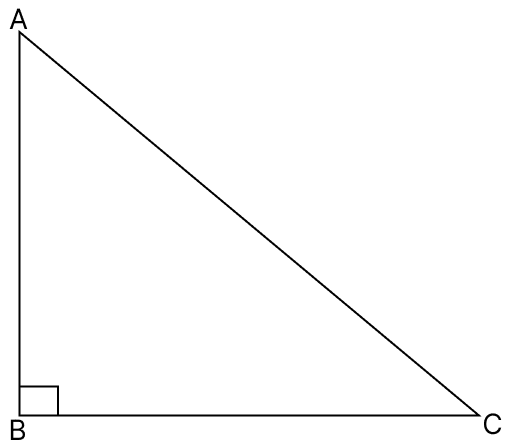
(a) $\Big(\frac{b}{a}\Big)$ (b) $\Big(\frac{a}{\sqrt{b^2 - a^2}}\Big)$ (c) $\Big(\frac{b}{\sqrt{b^2 - a^2}}\Big)$ (d) $\Big(\frac{\sqrt{b^2 - a^2}}{b}\Big)$ Show Solution Hide Solution ↓ Let ABC be a right angle triangle with ∠B = 90° and ∠C = θ.
By formula,
$\sin \theta = \frac{\text{perpendicular}}{\text{hypotenuse}}$
Substituting values we get :
$\frac{a}{b} = \frac{AB}{AC}$
Let AB = ak and AC = bk.
In right angle triangle ABC,
⇒ AC2 = AB2 + BC2
⇒ (bk)2 = (ak)2 + BC2
⇒ b2 k2 = a2 k2 + BC2
⇒ BC2 = b2 k2 - a2 k2
⇒ BC = k$\sqrt{b^2 - a^2}$
By formula,
$$\begin{aligned}\cos \theta = \frac{\text{base}}{\text{hypotenuse}} \\[1em] = \frac{BC}{AC} \\[1em] = \frac{k\sqrt{b^2 - a^2}}{bk} \\[1em] = \frac{\sqrt{b^2 - a^2}}{b} .\end{aligned}$$
Hence, option 4 is the correct option.
6 1 Mark · Multiple Choice Questions
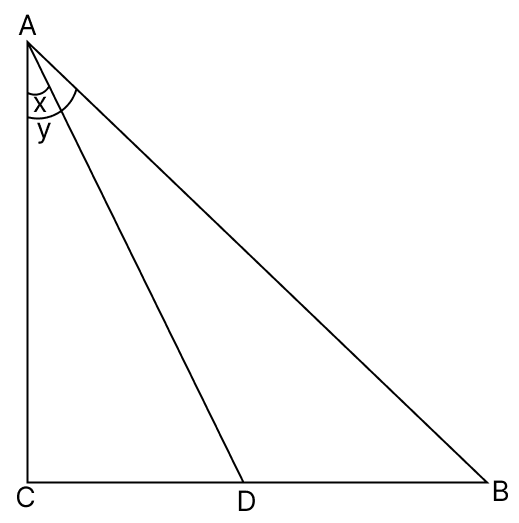
In the adjoining figure, D is the mid-point of BC. Then the value of $\Big(\frac{\cot y}{\cot x}\Big)$ is:
(a) $\Big(\frac{1}{2}\Big)$ (b) $\Big(\frac{1}{3}\Big)$ (c) $\Big(\frac{1}{4}\Big)$ (d) 2 Show Solution Hide Solution ↓ We know that,
$$\begin{aligned}cot θ = \frac{\text{base}}{\text{perpendicular}} \\[1em] \Rightarrow \frac{\cot y}{\cot x} = \frac{\frac{AC}{BC}}{\frac{AC}{CD}} \\[1em] \Rightarrow \frac{\cot y}{\cot x} = \frac{CD}{BC} \\[1em] \Rightarrow \frac{\cot y}{\cot x} = \frac{CD}{2CD} \\[1em] \Rightarrow \frac{\cot y}{\cot x} = \frac{1}{2} .\end{aligned}$$
Hence, option 1 is the correct option.
7 1 Mark · Multiple Choice Questions
If tan A = $\Big(\frac{5}{12}\Big)$, then the value of (sin A + cos A) sec A is:
(a) $\Big(\frac{5}{12}\Big)$ (b) $\Big(\frac{7}{12}\Big)$ (c) $\Big(\frac{17}{12}\Big)$ (d) $\Big(\frac{5}{13}\Big)$ Show Solution Hide Solution ↓ Given,
(sin A + cos A) sec A
$$\begin{aligned}\Rightarrow (\sin A + \cos A)\frac{1}{\cos A} \\[1em] \Rightarrow \frac{\sin A}{\cos A} + \frac{\cos A}{\cos A} \\[1em] \Rightarrow \tan A + 1 \\[1em] \Rightarrow \frac{5}{12} + 1 \\[1em] \Rightarrow \frac{5 + 12}{12} \\[1em] \Rightarrow \frac{17}{12}.\end{aligned}$$
Hence, option 3 is the correct option.
8 1 Mark · Multiple Choice Questions
If 3 cos θ = 1, then the value of cosec θ is:
(a) $2\sqrt{2}$ (b) $\Big(\frac{3}{2\sqrt{2}}\Big)$ (c) $\Big(\frac{2\sqrt{3}}{3}\Big)$ (d) $\Big(\frac{4}{3\sqrt{2}}\Big)$ Show Solution Hide Solution ↓ Given,
3 cos θ = 1
We know that,
⇒ sin2 θ = 1 - cos2 θ
$$\begin{aligned}\Rightarrow \sin^2 \theta = 1 - \frac{1}{9} \\[1em] \Rightarrow \sin^2 \theta = \frac{9 - 1}{9} \\[1em] \Rightarrow \sin^2 \theta = \frac{8}{9} \\[1em] \Rightarrow \sin \theta = \frac{2\sqrt{2}}{3} \\[1em] \Rightarrow \cosec \theta = \frac{1}{\sin \theta} = \frac{3}{2\sqrt{2}}.\end{aligned}$$
Hence, option 2 is the correct option.
9 1 Mark · Multiple Choice Questions
If x cos A = 1 and tan A = y, then x2 − y2 is equal to:
(a) 0 (b) 1 (c) −tan A (d) tan A Show Solution Hide Solution ↓ Given,
x cos A = 1
cos A = $\frac{1}{x}$
⇒ sec A = x
tan A = y
We know that
sec2 A - tan2 A = 1
∴ x2 − y2 = 1
Hence, option 2 is the correct option.
10 1 Mark · Multiple Choice Questions
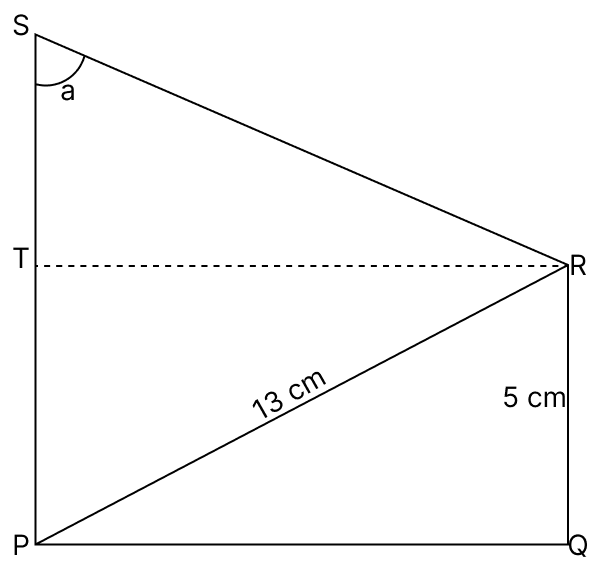
In the adjoining figure, if PS = 14 cm, then the value of tan α is equal to:
(a) $\Big(\frac{4}{3}\Big)$ (b) $\Big(\frac{5}{3}\Big)$ (c) $\Big(\frac{13}{3}\Big)$ (d) $\Big(\frac{14}{3}\Big)$ Show Solution Hide Solution ↓ ST = PS − RQ = 14 − 5 = 9 cm
In ΔSTR,
$TR = \sqrt{13^2 - 5^2} = \sqrt{169 - 25} = \sqrt{144} = 12.$
We know that,
$$\begin{aligned}\tan \alpha = \frac{\text{opposite}}{\text{adjacent}} \\[1em] \tan \alpha = \frac{TR}{ST} \\[1em] \tan \alpha = \frac{12}{9} \\[1em] \tan \alpha = \frac{4}{3}.\end{aligned}$$
Hence, option 1 is the correct option.
11 1 Mark · Multiple Choice Questions
The value of (1 + tan θ + sec θ)(1 + cot θ − cosec θ) is:
Show Solution Hide Solution ↓ Given,
(1 + tan θ + sec θ)(1 + cot θ − cosec θ)
$$\begin{aligned}\Rightarrow \Big(1 + \frac{\sin \theta}{\cos \theta} + \frac{1}{\cos \theta}\Big) \Big(1 + \frac{\cos \theta}{\sin \theta} - \frac{1}{\sin \theta}\Big)\\[1em] \Rightarrow \Big( \frac{\cos \theta + \sin \theta + 1}{\cos \theta} \Big) \Big(\frac{\sin \theta + \cos \theta - 1}{\sin \theta} \Big)\\[1em] \Rightarrow \frac{(\cos \theta + \sin \theta)^2 - 1^2}{\cos \theta \sin \theta} \\[1em] \Rightarrow \frac{\cos^2 \theta + \sin^2 \theta + 2\sin \theta \cos \theta - 1}{\cos \theta \sin \theta} \\[1em] \Rightarrow \frac{1 + 2\sin \theta \cos \theta - 1}{\cos \theta \sin \theta} \\[1em] \Rightarrow \frac{ 2\sin \theta \cos \theta}{\cos \theta \sin \theta} \\[1em] \Rightarrow 2.\end{aligned}$$
Hence, option 4 is the correct option.
12 1 Mark · Multiple Choice Questions
If sin θ = $\Big(\frac{1}{2}\Big)$, then the value of $\Big(\frac{1}{5} \cot^2\theta + \frac{1}{5}\Big)$ is:
(a) $\Big(\frac{1}{5}\Big)$ (b) $\Big(\frac{4}{5}\Big)$ (c) $\Big(\frac{1}{125}\Big)$ (d) 25 Show Solution Hide Solution ↓ Solving,
$$\begin{aligned}\Rightarrow \Big(\frac{1}{5} \cot^2\theta + \frac{1}{5}\Big) \\[1em] \Rightarrow \frac{1}{5} \Big(\cot^2\theta + 1 \Big) \\[1em] \Rightarrow \frac{1}{5} (\cosec^2 \theta).\end{aligned}$$
We know that,
$$\begin{aligned}\cosec \theta = \frac{1}{\sin \theta } \\[1em] \Rightarrow \cosec \theta = \frac{1}{\frac{1}{2}} = 2\\[1em] \Rightarrow \cosec^2 \theta = 2^2 = 4 \\[1em] \Rightarrow \frac{1}{5}\cosec^2 \theta \\[1em] \Rightarrow \frac{1}{5}(4) \\[1em] \Rightarrow \frac{4}{5}.\end{aligned}$$
Hence, option 2 is the correct option.
13 1 Mark · Multiple Choice Questions
If cos θ = $\Big(\frac{2}{3}\Big)$, then 2 sec2 θ + 2 tan2 θ − 7 is equal to:
Show Solution Hide Solution ↓ cos θ = $\frac{2}{3}$
sec θ = $\frac{3}{2}$
sec2 θ = $\frac{9}{4}$
tan2 θ = sec2 θ - 1 = $\frac{9}{4} - 1 = \frac{5}{4}$
Given,
⇒ 2 sec2 θ + 2 tan2 θ − 7
$$\begin{aligned}\Rightarrow 2\Big(\frac{9}{4}\Big) + 2\Big(\frac{5}{4}\Big) - 7 \\[1em] \Rightarrow \Big(\frac{18}{4}\Big) + \Big(\frac{10}{4}\Big) - 7 \\[1em] \Rightarrow \Big(\frac{28}{4}\Big) - 7 \\[1em] \Rightarrow 7 - 7 \\[1em] \Rightarrow 0.\end{aligned}$$
Hence, option 1 is the correct option.
14 1 Mark · Multiple Choice Questions
If 24 cot θ = 7, then sin θ is equal to:
(a) $\Big(\frac{24}{7}\Big)$ (b) $\Big(\frac{24}{25}\Big)$ (c) $\Big(\frac{7}{25}\Big)$ (d) $\Big(\frac{25}{24}\Big)$ Show Solution Hide Solution ↓ Given,
24 cot θ = 7
cot θ = $\frac{7}{24} = \frac{\text{adjacent}}{\text{opposite}}$
We know that,
$$\begin{aligned}\Rightarrow \text{Hypotenuse} = \sqrt{\text{opposite}^2 + \text{adjacent}^2 } \\[1em] = \sqrt{(24)^2 + (7)^2} \\[1em] = \sqrt{576 + 49} \\[1em] = \sqrt{625} \\[1em] = 25.\end{aligned}$$
Now,
sin θ = $\frac{\text{opposite}}{\text{hypotenuse}} = \frac{24}{25}$
Hence, option 2 is the correct option.
15 1 Mark · Multiple Choice Questions
If tan θ + cot θ = 2, then tan2 θ + cot2 θ is equal to:
Show Solution Hide Solution ↓ Given,
tan θ + cot θ = 2
Square on both sides,
⇒ (tan θ + cot θ)2 = 22
⇒ tan2 θ + cot2 θ + 2 tan θ cot θ = 4
⇒ tan2 θ + cot2 θ + 2 tan θ $\frac{1}{\tan \theta}$ = 4
⇒ tan2 θ + cot2 θ + 2 = 4
⇒ tan2 θ + cot2 θ = 4 - 2
⇒ tan2 θ + cot2 θ = 2
Hence, option 2 is the correct option.
16 1 Mark · Multiple Choice Questions
If cot A + $\Big(\frac{1}{\cot A}\Big)$ = 2, then cot2 A + $\Big(\frac{1}{\cot^2 A}\Big)$ equals:
Show Solution Hide Solution ↓ Given,
cot A + $\Big(\frac{1}{\cot A}\Big)$ = 2
Square on both sides,
$$\begin{aligned}\Rightarrow \Big(\cot A + \frac{1}{\cot A}\Big)^2 = 2^2 \\[1em] \Rightarrow \cot^2 A + \frac{1}{\cot^2 A} + 2 = 4 \\[1em] \Rightarrow \cot^2 A + \frac{1}{\cot^2 A} = 4 - 2 \\[1em] \Rightarrow \cot^2 A + \frac{1}{\cot^2 A} = 2 .\end{aligned}$$
Hence, option 3 is the correct option.
17 1 Mark · Multiple Choice Questions
If 4 tan θ = 3, then $\Big(\frac{4\sin\theta - 3\cos\theta}{4\sin\theta + 3\cos\theta}\Big)$ = ?
(a) 0 (b) $\Big(\frac{1}{3}\Big)$ (c) $\Big(\frac{2}{3}\Big)$ (d) $\Big(\frac{3}{4}\Big)$ Show Solution Hide Solution ↓ tan θ = $\frac{3}{4}$
Then,
sin θ = $\frac{3}{5}$, cos θ = $\frac{4}{5}$
Substitute,
$$\begin{aligned}\Rightarrow \frac{4\Big(\frac{3}{5}\Big) - 3\Big(\frac{4}{5}\Big)}{4\Big(\frac{3}{5}\Big) + 3\Big(\frac{4}{5}\Big)} \\[1em] \Rightarrow \frac{\Big(\frac{12}{5}\Big) - \Big(\frac{12}{5}\Big)}{\Big(\frac{12}{5}\Big) + \Big(\frac{12}{5}\Big)} \\[1em] \Rightarrow \frac{0}{\frac{24}{5}} \\[1em] \Rightarrow 0.\end{aligned}$$
Hence, option 1 is the correct option.
18 1 Mark · Multiple Choice Questions
If tan θ = $\Big(\frac{1}{\sqrt{7}}\Big)$, then the value of $\Big(\frac{\cosec^2\theta + \sec^2\theta}{\cosec^2\theta - \sec^2\theta}\Big)$ is:
(a) $\Big(\frac{3}{4}\Big)$ (b) $\Big(\frac{4}{3}\Big)$ (c) $\Big(\frac{3}{7}\Big)$ (d) $\Big(\frac{4}{7}\Big)$ Show Solution Hide Solution ↓ Given,
tan θ = $\Big(\frac{1}{\sqrt{7}}\Big)$
tan2 θ = $\Big(\frac{1}{7}\Big)$
We know that,
$$\begin{aligned}\sec^2 \theta = 1 + \tan^2 \theta \\[1em] \sec^2 \theta = 1 + \frac{1}{7} \\[1em] \sec^2 \theta = \frac{8}{7}. \\[1em] \cosec^2 \theta = 1 + \cot^2 \theta \\[1em] \cosec^2 \theta = 1 + 7 \\[1em] \cosec^2 \theta = 8.\end{aligned}$$
Given expression,
$$\begin{aligned}\Rightarrow \Big(\frac{\cosec^2\theta + \sec^2\theta}{\cosec^2\theta - \sec^2\theta}\Big) \\[1em] \Rightarrow \frac{8 + \frac{8}{7}}{8 - \frac{8}{7}} \\[1em] \Rightarrow \frac{\frac{56 + 8}{7}}{\frac{56 - 8}{7}} \\[1em] \Rightarrow \frac{64}{48} = \frac{4}{3}.\end{aligned}$$
Hence, option 2 is the correct option.
19 1 Mark · Multiple Choice Questions
(1 + sin A)(1 − sin A) is equal to:
(a) cosec2 A (b) sin2 A (c) sec2 A (d) cos2 A Show Solution Hide Solution ↓ ⇒ (1 + sin A)(1 − sin A)
⇒ 1 − sin2 A
⇒ cos2 A
Hence, option 4 is the correct option.
20 1 Mark · Multiple Choice Questions
sin A expressed in terms of cot A is:
(a) $\Big(\frac{1}{\sqrt{1 + \cot^2 A}}\Big)$ (b) $\Big(\frac{\sqrt{1 + \cot^2 A}}{\cot A}\Big)$ (c) $\Big(\frac{\sqrt{1 + \cot^2 A}}{1}\Big)$ (d) $\Big(\frac{\sqrt{1 - \cot^2 A}}{\cot A}\Big)$ Show Solution Hide Solution ↓ 1 + cot2 A = cosec2 A
$\sqrt{1 + \cot^2 A}$ = cosec A
sin A = $\frac{1}{\cosec A}$
sin A = $\frac{1}{\sqrt{1 + \cot^2 A}}$
Hence, option 1 is the correct option.
21 1 Mark · Multiple Choice Questions
If sec θ = 2x and y tan θ = 2, then the value of $2\Big(x^2 - \frac{1}{y^2}\Big)$ is:
(a) $\Big(\frac{1}{2}\Big)$ (b) $\Big(\frac{1}{3}\Big)$ (c) $\Big(\frac{1}{4}\Big)$ (d) 1 Show Solution Hide Solution ↓ sec θ = 2x
x = $\frac{\sec \theta}{2}$
y tan θ = 2
$\frac{1}{y} = \frac{\tan \theta}{2}$
We have,
$$\begin{aligned}\Rightarrow 2\Big(x^2 - \frac{1}{y^2}\Big) \\[1em] \Rightarrow 2\Big(\frac{\sec^2 \theta}{4} - \frac{\tan^2 \theta}{4}\Big) \\[1em] \Rightarrow \frac{2}{4}\Big(\sec^2 \theta - \tan^2 \theta\Big) \\[1em] \Rightarrow \frac{1}{2}\Big(\sec^2 \theta - \tan^2 \theta\Big) \\[1em] \Rightarrow \frac{1}{2}.\end{aligned}$$
Hence, option 1 is the correct option.
22 1 Mark · Multiple Choice Questions
Given a = 3 sec2 θ and b = 3 tan2 θ - 2. The value of (a - b) is :
Show Solution Hide Solution ↓ a - b = 3 sec2 θ - (3 tan2 θ - 2)
= 3 sec2 θ - 3 tan2 θ + 2
= 3(sec2 θ - tan2 θ) + 2
= 3(1) + 2
= 3 + 2
= 5.
Hence, option 4 is the correct option.
23 1 Mark · Multiple Choice Questions
(cos4 θ − sin4 θ) is equal to :
(a) 2 cos2 θ + 1 (b) 2 cos2 θ − 1 (c) 2 sin2 θ + 1 (d) 2 sin2 θ − 1 Show Solution Hide Solution ↓ ⇒ (cos4 θ − sin4 θ)
⇒ (cos2 θ − sin2 θ)(cos2 θ + sin2 θ)
⇒ (cos2 θ - sin2 θ)
⇒ (cos2 θ - 1 + cos2 θ)
⇒ (2cos2 θ - 1)
Hence, option 2 is the correct option.
24 1 Mark · Multiple Choice Questions
If cosec θ − cot θ = $\frac{1}{3}$, then the value of cosec θ + cot θ is :
Show Solution Hide Solution ↓ We know that,
cosec2 θ − cot2 θ = 1
cosec θ − cot θ (cosec θ + cot θ)= 1
$\frac{1}{3}$ (cosec θ + cot θ)= 1
(cosec θ + cot θ)= 3
Hence, option 3 is the correct option.
25 1 Mark · Multiple Choice Questions
If sin θ − cos θ = 0, then the value of sin θ + cos θ is :
(a) $\frac{1}{\sqrt{2}}$ (b) $\sqrt{2}$ (c) $\frac{1}{4}$ (d) $\frac{3}{4}$ Show Solution Hide Solution ↓ sin θ = cos θ
Divide both sides by cos θ
$\frac{\sin \theta}{\cos \theta} = \frac{\cos \theta}{\cos \theta}$
tan θ = 1
For acute angles, tan θ = 1 when θ = 45°.
⇒ sin 45° + cos 45°
$\frac{1}{\sqrt2} + \frac{1}{\sqrt2}$
⇒ $\frac{2}{\sqrt2}$
⇒ $\sqrt2$
Hence, option 2 is the correct option.
26 1 Mark · Multiple Choice Questions
If sec θ + tan θ + 1 = 0, then sec θ − tan θ is equal to :
Show Solution Hide Solution ↓ ⇒ sec θ + tan θ + 1 = 0
⇒ sec θ + tan θ = -1
We know that,
⇒ sec2 θ - tan2 θ = 1
⇒ (sec θ + tan θ)(sec θ - tan θ) = 1
⇒ (-1)(sec θ - tan θ) = 1
⇒ sec θ - tan θ = -1
Hence, option 1 is the correct option.
27 1 Mark · Multiple Choice Questions
If sec θ + tan θ = x, then sec θ is equal to :
(a) $\frac{x^2 + 1}{x}$ (b) $\frac{x^2 − 1}{x}$ (c) $\frac{x^2 + 1}{2x}$ (d) $\frac{x^2 − 1}{2x}$ Show Solution Hide Solution ↓ ⇒ sec θ + tan θ = x ....(1)
We know that,
⇒ sec2 θ − tan2 θ = 1
⇒ (sec θ + tan θ)(sec θ − tan θ) = 1
⇒ x (sec θ − tan θ) = 1
⇒ sec θ − tan θ = $\frac{1}{x}$ ....(2)
Adding eqn (1) and (2):
⇒ sec θ + tan θ + sec θ − tan θ = x + $\frac{1}{x}$
⇒ 2 sec θ = $x + \frac{1}{x}$
⇒ sec θ = $\frac{1}{2}\Big(x + \frac{1}{x}\Big)$
⇒ sec θ = $\frac{1}{2}\Big(\frac{x^2 + 1}{x}\Big)$
⇒ sec θ = $\frac{x^2 + 1}{2x}$
Hence, option 3 is the correct option.
28 1 Mark · Multiple Choice Questions
If sin θ − cos θ = 0, then the value of (sin4 θ + cos4 θ) is :
(a) $\frac{1}{4}$ (b) $\frac{1}{2}$ (c) $\frac{3}{4}$ (d) 1 Show Solution Hide Solution ↓ ⇒ sin θ − cos θ = 0
⇒ sin θ = cos θ
Divide by cos θ
⇒ $\frac{sin \theta}{\cos \theta}$ = 1
tan 45° = 1
Given expression,
(sin4 45° + cos4 45°)
$$\begin{aligned}\Rightarrow \Big(\frac{1}{\sqrt2}\Big)^4 + \Big(\frac{1}{\sqrt2}\Big)^4 \\[1em] \Rightarrow \Big(\frac{1}{4}\Big) + \Big(\frac{1}{4}\Big) \\[1em] \Rightarrow \frac{1}{2}.\end{aligned}$$
Hence, option 2 is the correct option.
29 1 Mark · Multiple Choice Questions
If a cot θ + b cosec θ = p and b cot θ + a cosec θ = q, then p2 − q2 is equal to :
(a) a2 − b2 (b) b2 − a2 (c) a2 + b2 (d) b − a Show Solution Hide Solution ↓ ⇒ a cot θ + b cosec θ = p
p2 = (a cot θ + b cosec θ)2
p2 = (a2 cot2 θ + b2 cosec2 θ + 2ab cot θ cosec θ)
⇒ b cot θ + a cosec θ = q
q2 = (b cot θ + a cosec θ)2
q2 = (b2 cot2 θ + a2 cosec2 θ + 2ab cot θ cosec θ)
⇒ p2 − q2 = (a2 cot2 θ + b2 cosec2 θ + 2ab cot θ cosec θ) - (b2 cot2 θ + a2 cosec2 θ + 2ab cot θ cosec θ)
= (a2 cot2 θ + b2 cosec2 θ + 2ab cot θ cosec θ - b2 cot2 θ - a2 cosec2 θ - 2ab cot θ cosec θ)
= (a2 cot2 θ + b2 cosec2 θ - b2 cot2 θ - a2 cosec2 θ )
= a2 (cot2 θ - cosec2 ) + b2 (cosec2 θ - cot2 θ )
= a2 (-1) + b2 (1)
= b2 - a2 .
Hence, option 2 is the correct option.
30 1 Mark · Multiple Choice Questions
The expression equivalent to sec2 θ + cosec2 θ is :
(a) sec2 θ · cosec2 θ (b) tan2 θ + cot2 θ (c) $\frac{1}{\sec^2 θ \times \cosec^2 θ}$ (d) 2 sec2 θ + 1 Show Solution Hide Solution ↓ sec2 θ + cosec2 θ
$$\begin{aligned}\Rightarrow \frac{1}{\cos^2 \theta} + \frac{1}{\sin^2 \theta} \\[1em] \Rightarrow \frac{\sin^2 \theta + \cos^2 \theta}{\cos^2 \theta\sin^2 \theta} \\[1em] \Rightarrow \frac{1}{\cos^2 \theta\sin^2 \theta} \\[1em] \Rightarrow \sec^2 \theta (\cosec^2 \theta)\end{aligned}$$
Hence, option 1 is the correct option.
31 1 Mark · Multiple Choice Questions
If x = a cos3 θ and y = b sin3 θ, then $\Big(\frac{x}{a}\Big)^{\frac{2}{3}} + \Big(\frac{y}{b}\Big)^{\frac{2}{3}}$ is equal to :
Show Solution Hide Solution ↓ Given,
x = a cos3 θ and y = b sin3 θ
$$\begin{aligned}\Rightarrow \frac{x}{a} = \cos^3 θ \\[1em] \Rightarrow \Big(\frac{x}{a}\Big)^{\frac{2}{3}} = \cos^2 θ \\[1em] \Rightarrow \frac{y}{b} = \sin^3 θ \\[1em] \Rightarrow \Big(\frac{y}{b}\Big)^{\frac{2}{3}} = \sin^2 θ\end{aligned}$$
Add the expressions,
$\Big(\frac{x}{a}\Big)^{\frac{2}{3}} + \Big(\frac{y}{b}\Big)^{\frac{2}{3}}$ = cos2 θ + sin2 θ
$\Big(\frac{x}{a}\Big)^{\frac{2}{3}} + \Big(\frac{y}{b}\Big)^{\frac{2}{3}}$ = 1
Hence, option 3 is the correct option.
32 1 Mark · Multiple Choice Questions
If sin θ + cosec θ = 2, then sin3 θ + cosec3 θ is equal to :
(a) 2 (b) 2 sin θ (c) −2 sin θ (d) 2 cos θ Show Solution Hide Solution ↓ sin θ + cosec θ = 2
Let,
⇒ sin θ = x
⇒ cosec θ = $\frac{1}{x}$
$$\begin{aligned}\Rightarrow x + \frac{1}{x} = 2 \\[1em] \Rightarrow \frac{x^2 + 1}{x} = 2 \\[1em] \Rightarrow x^2 + 1 = 2x \\[1em] \Rightarrow x^2 + 1 - 2x = 0 \\[1em] \Rightarrow (x - 1)^2 = 0 \\[1em] \Rightarrow x = 1\end{aligned}$$
Hence,
sin θ = 1 and cosec θ = 1
⇒ sin3 θ + cosec3 θ
⇒ 13 + 13
⇒ 2
Hence, option 1 is the correct option.
33 1 Mark · Multiple Choice Questions
The expression equivalent to sec x, is :
(a) $\tan x + \frac{\sin x}{\sec x}$ (b) $\cos x + \frac{\tan x}{\cos x}$ (c) cos x + tan x sin x (d) tan x − cos x sin x Show Solution Hide Solution ↓ Solving for option 3,
cos x + tan x sin x
$$\begin{aligned}\Rightarrow \cos x + \frac{\sin x}{\cos x} \times \sin x \\[1em] \Rightarrow \cos x + \frac{\sin^2 x}{\cos x} \\[1em] \Rightarrow \frac{\cos^2 x + \sin^2 x}{\cos x} \\[1em] \Rightarrow \frac{1}{\cos x} \\[1em] \Rightarrow \sec x\end{aligned}$$
Hence, option 3 is the correct option.
34 1 Mark · Multiple Choice Questions
$\frac{\sin^4 A − \cos^4 A}{1 − \sin^2 A}$ is equal to :
(a) cot2 A − 1 (b) tan2 A − 1 (c) 1 − cot2 A (d) 1 − tan2 A Show Solution Hide Solution ↓ $$\begin{aligned}\Rightarrow \frac{\sin^4 A − \cos^4 A}{1 − \sin^2 A} \\[1em] \Rightarrow \frac{(\sin^2 A − \cos^2 A)(\sin^2 A + \cos^2 A)}{\cos^2 A} \\[1em] \Rightarrow \frac{\sin^2 A − \cos^2 A}{\cos^2 A} \\[1em] \Rightarrow \frac{\sin^2 A }{\cos^2 A} - 1 \\[1em] \Rightarrow \tan^2 A - 1 .\end{aligned}$$
Hence, option 2 is the correct option.
35 1 Mark · Multiple Choice Questions
If sin A + sin2 A = 1, then cos2 A + cos4 A is :
(a) $\frac{1}{2}$ (b) 1 (c) 2 (d) 3 Show Solution Hide Solution ↓ Given,
sin A + sin2 A = 1
It can be written as
sin A = 1 - sin2 A …. (1)
We have to find the value of (cos2 A + cos4 A)
Using the trigonometric identities,
cos2 A = 1 - sin2 A ….. (2)
From both the equations
sin A = cos2 A
Now, (cos2 A + cos4 A) = (cos2 A + (sin A)2 )
= cos2 A + sin2 A
cos2 A + sin2 A = 1
Therefore, (cos2 A + cos4 A) = 1
Hence, option 2 is the correct option.
36 1 Mark · Multiple Choice Questions
If cos A + cos2 A = 1, then sin2 A + sin4 A is :
Show Solution Hide Solution ↓ cos A + cos2 A = 1
⇒ 1 - cos2 A = cos A
⇒ sin2 A = cos A
Given,
⇒ sin2 A + sin4 A
⇒ sin2 A + (sin2 A)2
⇒ sin2 A + cos2 A [∵ sin2 A = cos A]
⇒ 1.
Hence, option 1 is the correct option.
37 1 Mark · Multiple Choice Questions
$\sqrt{\Big(\frac{1 − \sin A}{1 + \sin A}\Big)}$ = ?
(a) sec A + tan A (b) sec A − tan A (c) sec A tan A (d) none of these Show Solution Hide Solution ↓ Rationalize the expression,
$$\begin{aligned}\Rightarrow \sqrt{\Big(\frac{1 − \sin A}{1 + \sin A}\Big)} \\[1em] \Rightarrow \sqrt{\Big(\frac{1 − \sin A}{1 + \sin A}\Big) \times \frac{1 - \sin A}{1 - \sin A}} \\[1em] \Rightarrow \sqrt{\Big(\frac{(1 − \sin A)^2}{1 - \sin^2 A}\Big)} \\[1em] \Rightarrow \sqrt{\Big(\frac{(1 − \sin A)^2}{\cos^2 A}\Big)} \\[1em] \Rightarrow \frac{(1 − \sin A)}{\cos A} \\[1em] \Rightarrow \frac{1}{\cos A} − \frac{\sin A}{\cos A} \\[1em] \Rightarrow \sec A − \tan A\end{aligned}$$
Hence, option 2 is the correct option.
38 1 Mark · Multiple Choice Questions
Statement 1 : sin2 θ + cos2 θ = 1
Statement 2 : cosec2 θ + cot2 θ = 1
Which of the following is valid ?
(a) only (1) (b) only (2) (c) both (1) and (2) (d) neither (1) nor (2) Show Solution Hide Solution ↓ Trigonometry identity :
sin2 θ + cos2 θ = 1
cosec2 θ - cot2 θ = 1
∴ Only statement (i) is correct.
Hence, Option 1 is the correct option.
1 Assertion-Reason Type Questions
Assertion (A): If sin2 A + sin A = 1 then cos4 A + cos2 A = 1.
Reason (R): 1 - sin2 A = cos2 A
(a) Both A and R are true, and R is the correct explanation of A. (b) Both A and R are true, but R is not the correct explanation of A. (c) A is true, but R is false. (d) A is false, but R is true. Show Solution Hide Solution ↓ Given,
⇒ sin2 A + sin A = 1
⇒ sin A = 1 - sin2 A
⇒ sin A = cos2 A
Squaring both the sides, we get :
⇒ (sin A)2 = (cos2 A)2
⇒ sin2 A = cos4 A ......................(1)
Solving L.H.S. of cos4 A + cos2 A = 1, we get :
⇒ cos4 A + cos2 A
⇒ sin2 A + cos2 A [From equation (1)]
⇒ 1.
Since, L.H.S. = R.H.S.
∴ Assertion (A) is true.
As we know that, sin2 A + cos2 A = 1
⇒ 1 - sin2 A = cos2 A
∴ Reason (R) is true.
∴ Both (A) and (R) are true, and (R) is the correct explanation for (A).
Hence, option 1 is the correct option.
2 Assertion-Reason Type Questions
Assertion (A): $\Big(\frac{1 + \tan \theta}{1 + \cot \theta} \Big)^2 = \tan^2 \theta$
Reason (R): tan2 θ + sec2 θ = 1
(a) Both A and R are true, and R is the correct explanation of A. (b) Both A and R are true, but R is not the correct explanation of A. (c) A is true, but R is false. (d) A is false, but R is true. Show Solution Hide Solution ↓ $$\begin{aligned}\Rightarrow \Big(\frac{1 + \tan \theta}{1 + \cot \theta} \Big)^2 \\[1em] \Rightarrow \Big(\frac{1 + \tan \theta}{1 + \frac{1}{\tan \theta}} \Big)^2 \\[1em] \Rightarrow \Big(\frac{1 + \tan \theta}{ \frac{\tan \theta + 1}{\tan \theta}} \Big)^2 \\[1em] \Rightarrow \tan^2 \theta\end{aligned}$$
∴ Assertion (A) is true.
tan2 θ + sec2 θ = 1 is incorrect; the correct identity is sec2 θ − tan2 θ = 1.
∴ Reason (R) is false.
Hence, option 3 is the correct option.
3 Assertion-Reason Type Questions
Assertion (A): (1 − cosec2 θ)(1 − sec2 θ) = 1
Reason (R): 1 + tan2 θ = sec2 θ and 1 + cot2 θ = cosec2 θ
(a) Both A and R are true, and R is the correct explanation of A. (b) Both A and R are true, but R is not the correct explanation of A. (c) A is true, but R is false. (d) A is false, but R is true. Show Solution Hide Solution ↓ Solving L.H.S,
(1 − cosec2 θ)(1 − sec2 θ)
= (− cot2 θ)(− tan2 θ) [∵ 1 − cosec2 θ = − cot2 θ and 1 − sec2 θ = − tan2 θ]
= $\frac{1}{\tan^2 \theta}$ (tan2 θ) = 1
∴ Assertion (A) is true.
1 + tan2 θ = sec2 θ and 1 + cot2 θ = cosec2 θ are standard identities, and these are exactly the relations used to simplify the Assertion.
∴ Reason (R) is true and is the correct explanation of A.
Hence, option 1 is the correct option.
4 Assertion-Reason Type Questions
Assertion (A): If sec θ + tan θ = p, then sec θ = $\frac{2p}{p^2 + 1}$
Reason (R): sec2 θ − tan2 θ = 1
(a) Both A and R are true, and R is the correct explanation of A. (b) Both A and R are true, but R is not the correct explanation of A. (c) A is true, but R is false. (d) A is false, but R is true. Show Solution Hide Solution ↓ Given, sec θ + tan θ = p.
We know that sec2 θ − tan2 θ = 1.
⇒ (sec θ + tan θ)(sec θ − tan θ) = 1
⇒ (p)(sec θ − tan θ) = 1
⇒ sec θ − tan θ = $\frac{1}{p}$
Adding sec θ + tan θ = p and sec θ − tan θ = $\frac{1}{p}$ :
⇒ 2 sec θ = p + $\frac{1}{p}$ = $\frac{p^2 + 1}{p}$
⇒ sec θ = $\frac{p^2 + 1}{2p}$.
So the correct value is $\frac{p^2 + 1}{2p}$, not $\frac{2p}{p^2 + 1}$.
∴ Assertion (A) is false.
sec2 θ − tan2 θ = 1 is a standard Pythagorean identity.
∴ Reason (R) is true.
Hence, option 4 is the correct option.
5 Assertion-Reason Type Questions
Assertion (A): For an acute angle θ, if sin θ = cos θ, then 2 sin2 θ + tan2 θ = 2
Reason (R): For any acute angle θ, sin (90° − θ) = cos θ
(a) Both A and R are true, and R is the correct explanation of A. (b) Both A and R are true, but R is not the correct explanation of A. (c) A is true, but R is false. (d) A is false, but R is true. Show Solution Hide Solution ↓ Given, sin θ = cos θ.
⇒ $\frac{\sin \theta}{\cos \theta}$ = 1 ⇒ tan θ = 1, which for an acute angle gives θ = 45°.
Also, sin θ = cos θ ⇒ sin2 θ = cos2 θ, and since sin2 θ + cos2 θ = 1, we get 2 sin2 θ = 1.
⇒ 2 sin2 θ + tan2 θ = 1 + (1)2 = 1 + 1 = 2.
∴ Assertion (A) is true.
sin (90° − θ) = cos θ is a true complementary-angle identity.
∴ Reason (R) is true.
However, the value 2 sin2 θ + tan2 θ = 2 is obtained using tan θ = 1 and 2 sin2 θ = 1, not from the complementary-angle relation. So R does not explain A.
Hence, option 2 is the correct option.
6 Assertion-Reason Type Questions
Assertion (A): If sec θ + tan θ = a and sec θ − tan θ = b then ab = 1.
Reason (R): sec2 θ - tan2 θ = 1
(a) Both A and R are true, and R is the correct explanation of A. (b) Both A and R are true, but R is not the correct explanation of A. (c) A is true, but R is false. (d) A is false, but R is true. Show Solution Hide Solution ↓ Given,
⇒ sec θ + tan θ = a
⇒ sec θ − tan θ = b
⇒ ab = (sec θ + tan θ)(sec θ - tan θ)
⇒ ab = sec2 θ - tan2 θ
⇒ ab = 1
So assertion (A) is true.
We know that,
⇒ sec2 θ - tan2 θ = 1
This is a fundamental trigonometric identity.
So reason (R) is true.
Thus, Both (A) and (R) are true and (R) is the correct explanation of (A).
Hence, option 1 is the correct option.
Press ↓ to reveal a solution and move to the next question. Back to RS Aggarwal Mathematics .