Loci

ICSE Class 10 Mathematics · RS Aggarwal Mathematics · 37 solved questions

Exercise
Marks
1Exercise 17

Describe and construct each of the following loci:

(i) The locus of the tip of a minute hand of a watch.

(ii) The locus of the tip of the pendulum of a clock.

(iii) The locus of a point 5 cm from a fixed point O.

(iv) The locus of a point at a distance of 3 cm from a fixed line AB.

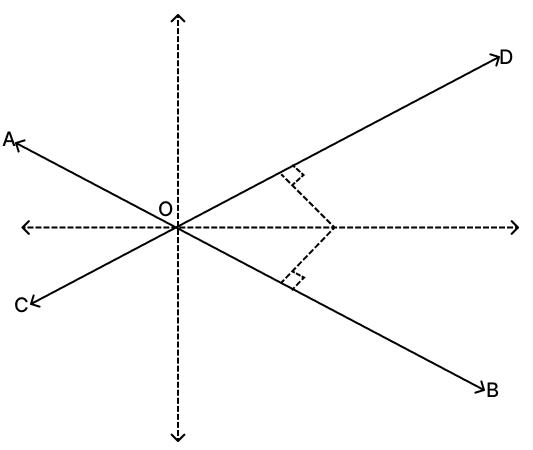
(v) The locus of a point equidistant from the arms OA and OB of ∠AOB.

(vi) The locus of the centres of all circles, each of radius 1 cm and touching externally a fixed circle with centre O and radius 3 cm.

(vii) The locus of the centres of all circles to which both the arms of an angle ∠AOB are tangents.

(viii) The locus of a point 1 cm from the circumference of a fixed circle towards the centre O, whose radius is 3 cm.

(ix) The locus of a point 1 cm from the centre of a circle of radius 2.5 cm.

(x) The locus of a stone dropped from a tower.

(xi) AB is a fixed line. State the locus of a point P such that ∠APB = 90°.

Show SolutionHide Solution↓

(i) Let radius of minute hand be r units.

The minute hand rotates around a fixed center. The distance from the tip to the center remains constant, forming a circle.
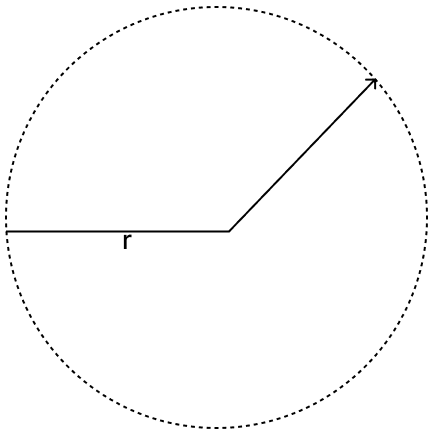
The locus of the tip of a minute hand of a watch. Loci, RSA Mathematics Solutions ICSE Class 10.

Hence, the locus of the tip of a minute hand of a watch is the circumference of a circle with radius equal to the length of minute hand.

(ii) A pendulum swings in an arc from a fixed pivot, always at a constant distance from the pivot.
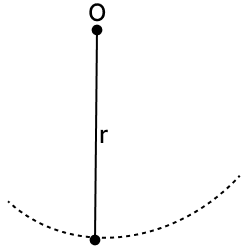
The locus of the tip of the pendulum of a clock. Loci, RSA Mathematics Solutions ICSE Class 10.

Hence, the locus of the tip of the pendulum of a clock is an arc of a circle whose radius is equal to length of pendulum.

(iii) All points 5 cm from one point form a circle.
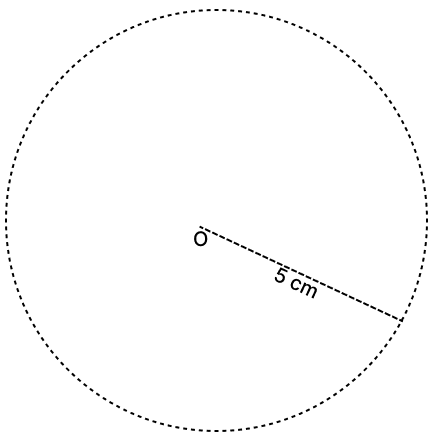
The locus of a point 5 cm from a fixed point O. Loci, RSA Mathematics Solutions ICSE Class 10.

Hence, the locus of a point 5 cm from a fixed point O is the circumference of a circle with center O and radius 5 cm.

(iv) All points 3 cm from a line lie on two lines parallel to the original line.
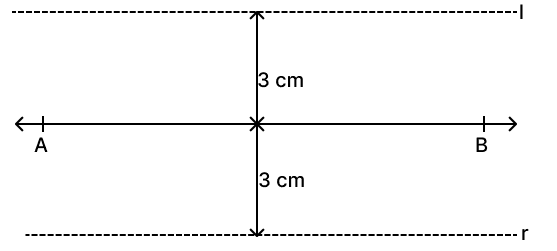
The locus of a point at a distance of 3 cm from a fixed line AB. Loci, RSA Mathematics Solutions ICSE Class 10.

Hence, the locus of a point at a distance of 3 cm from a fixed line AB are two parallel lines, 3 cm away from AB.

(v) Points equidistant from two intersecting lines lie on the angle bisector.
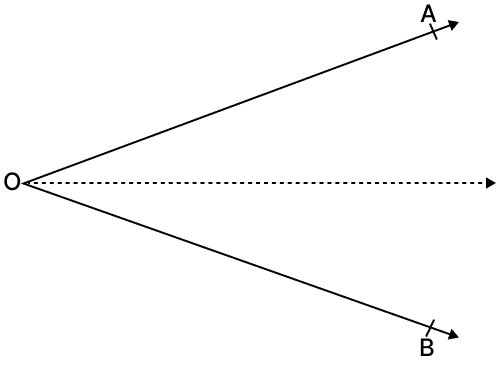
The locus of a point equidistant from the arms OA and OB of ∠AOB. Loci, RSA Mathematics Solutions ICSE Class 10.

Hence, the locus of a point equidistant from the arms OA and OB of ∠AOB is the bisector of ∠AOB.

(vi) The locus of centres of all circles of radius 1 cm touching externally a fixed circle of radius 3 cm. Distance between centers = 3 + 1 = 4 cm, forming a concentric circle.
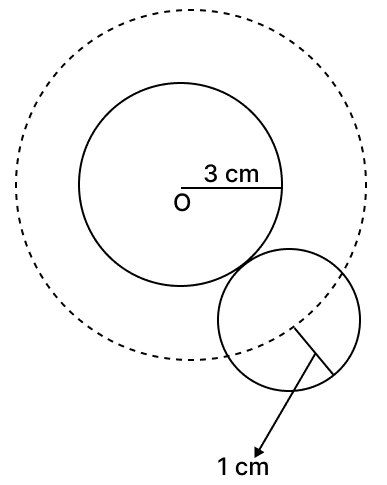
The locus of the centres of all circles, each of radius 1 cm and touching externally a fixed circle with centre O and radius 3 cm. Loci, RSA Mathematics Solutions ICSE Class 10.

Hence, the locus of the centres of all such circles is a circle with center O and radius 4 cm.

(vii) The locus of centres of all circles tangent to both arms of ∠AOB. The center must be equidistant from both arms i.e. angle bisector of the angle between OA and OB.
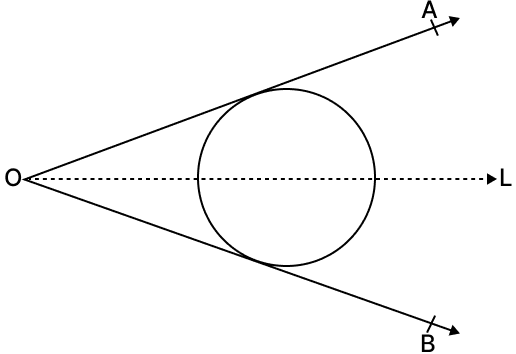
The locus of the centres of all circles to which both the arms of an angle ∠AOB are tangents. Loci, RSA Mathematics Solutions ICSE Class 10.

Hence, the locus of the centres of all circles to which both the arms of an angle ∠AOB are tangents is the bisector of ∠AOB.

(viii) The locus of a point 1 cm from the circumference of a circle of radius 3 cm, towards the centre will be a circle with same center and radius equal to 2 cm (3 - 1).
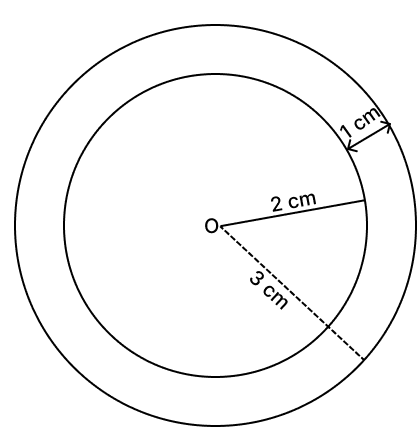
The locus of a point 1 cm from the circumference of a fixed circle towards the centre O, whose radius is 3 cm. Loci, RSA Mathematics Solutions ICSE Class 10.

Hence, the locus of a point is a circle concentric with the fixed circle, having center O and radius 2 cm.

(ix) The locus of a point 1 cm from the centre of a circle of radius 2.5 cm. The radius of the original circle is irrelevant. Distance from center is fixed at 1 cm.
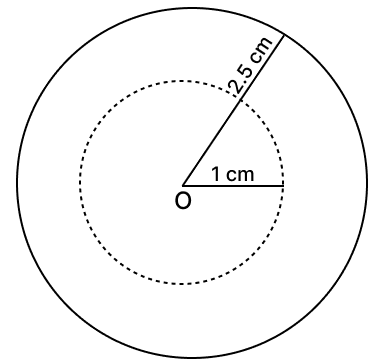
The locus of a point 1 cm from the centre of a circle of radius 2.5 cm. Loci, RSA Mathematics Solutions ICSE Class 10.

Hence, the locus of a point 1 cm from the centre of a circle is the circumference of a circle with center O and radius 1 cm.

(x) The locus of a stone dropped from a tower is a straight line parallel to tower.
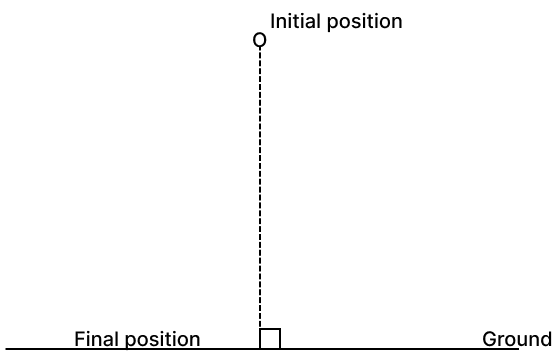
The locus of a stone dropped from a tower. Loci, RSA Mathematics Solutions ICSE Class 10.

Hence, the locus of a stone dropped from a tower is a straight vertical line segment.

(xi) We know that the angle in a semi-circle is always equal to 90°.
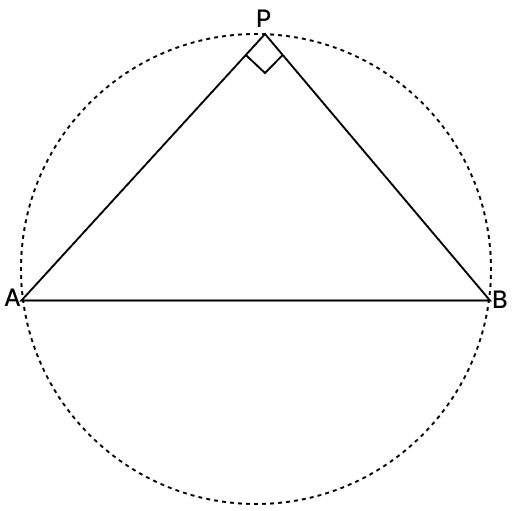
AB is a fixed line. State the locus of a point P such that ∠APB = 90°. Loci, RSA Mathematics Solutions ICSE Class 10.

Hence, the locus of point P will be the circle whose diameter is AB.
2Exercise 17

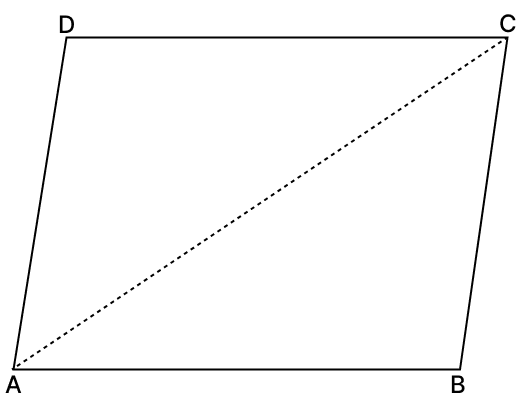
Describe the locus of a point in a rhombus ABCD which is equidistant from

(i) AB and AD

(ii) A and C

Show SolutionHide Solution↓

(i) Locus of a point equidistant from AB and AD

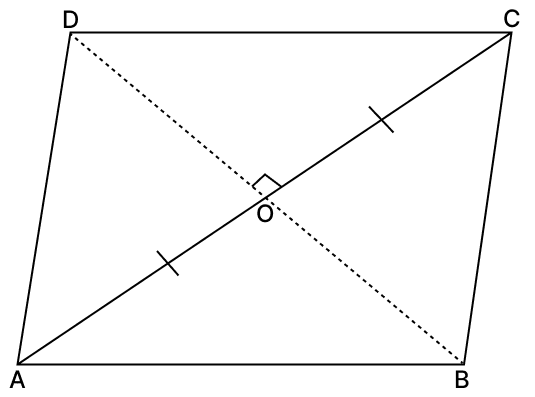
Describe the locus of a point in a rhombus ABCD which is equidistant from. Loci, RSA Mathematics Solutions ICSE Class 10.

The locus of a point equidistant from two intersecting lines AB and AD is the angle bisector of the angle formed by those lines i.e. angle bisector of ∠DAB.

Since, diagonals of rhombus bisect the interior angles.

Hence, locus of a point in rhombus ABCD equidistant from AB and AD is the bisector of ∠DAB, i.e., diagonal AC.

(ii) Locus of a point equidistant from A and C

Describe the locus of a point in a rhombus ABCD which is equidistant from. Loci, RSA Mathematics Solutions ICSE Class 10.

The locus of a point equidistant from two fixed points A and C is the perpendicular bisector of the line segment joining the two points AC.

Since, diagonals of a rhombus always bisect each other at right angles.

Hence, locus of a point in rhombus ABCD equidistant from A and C is the perpendicular bisector of AC, i.e., diagonal BD.

3Exercise 17

Construct a ΔABC in which BC = 5.3 cm, CA = 4.8 cm and AB = 4 cm. Find by construction a point P which is equidistant from BC and AB and also equidistant from B and C.

Show SolutionHide Solution↓
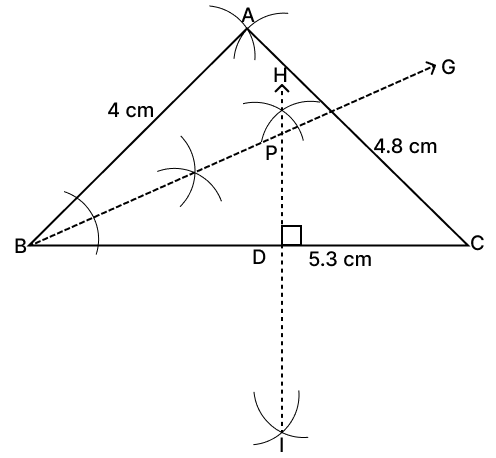
Construct a ΔABC in which BC = 5.3 cm, CA = 4.8 cm and AB = 4 cm. Find by construction a point P which is equidistant from BC and AB and also equidistant from B and C. Loci, RSA Mathematics Solutions ICSE Class 10.

Steps of construction:

  1. Draw base BC of length 5.3 cm.

  2. With B as the center and a radius of 4 cm, draw an arc.

  3. With C as the center and a radius of 4.8 cm, draw a second arc intersecting previous arc at A. Join ABC to get required triangle.

  4. Draw BG angle bisector of ∠ABC.

  5. Draw HI, the perpendicular bisector of BC.

The intersection of the angle bisector BG and the perpendicular bisector HI is the required point P.

4Exercise 17

Construct ∠AOB = 60°. Mark a point P equidistant from OA and OB such that its distance from another given line CD is 3 cm.

Show SolutionHide Solution↓
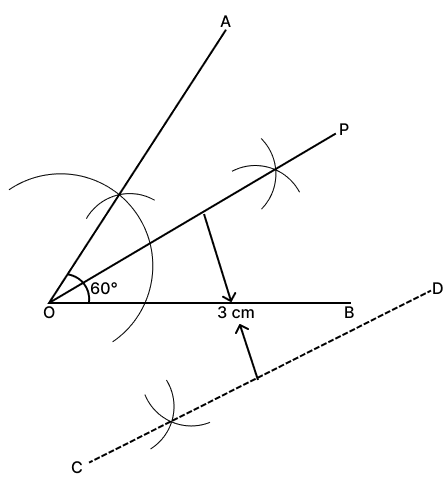
Construct ∠AOB = 60°. Mark a point P equidistant from OA and OB such that its distance from another given line CD is 3 cm. Loci, RSA Mathematics Solutions ICSE Class 10.

Steps of construction:

  1. Draw base OB.

  2. Make angle 60° at O, ∠AOB = 60°.

  3. Draw OP the angle bisector of ∠AOB.

  4. Draw line parallel to OP 3 cm away from CD.

5Exercise 17

Use ruler and compass to answer this question. Construct ∠ABC = 90°, where AB = 6 cm, BC = 8 cm.

(i) Construct the locus of points equidistant from B and C.

(ii) Construct the locus of points equidistant from A and B.

(iii) Mark the point which satisfies both the conditions (i) and (ii) as O. Construct the locus of points keeping a fixed distance OA from the fixed point O.

(iv) Construct the locus of points which are equidistant from BA and BC.

Show SolutionHide Solution↓

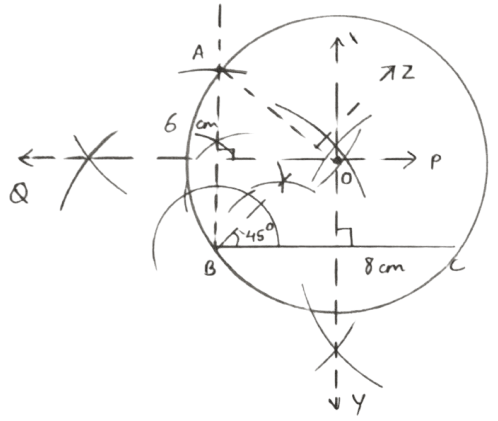
Steps of construction :

  1. Draw a line segment BC = 8 cm

  2. Construct ∠ABC = 90°, such that AB = 6 cm.

  3. Draw XY, the perpendicular bisector of BC.

  4. Draw PQ, the perpendicular bisector of AB.

  5. Mark point O, the intersection of segment XY and PQ.

  6. Draw BZ, the angle bisector of AB and BC.

Use ruler and compass to answer this question. Construct ∠ABC = 90°, where AB = 6 cm, BC = 8 cm. ICSE 2024 Maths Solved Question Paper.

We know that,

Locus of points equidistant from two points is the perpendicular bisector of the line joining the two points segment.

(i) Locus of points equidistant from B and C is XY.

(ii) Locus of points equidistant from A and B is PQ.

We know that,

Locus of points equidistant from two sides is the angular bisector of angle between them.

(iv) Locus of points which are equidistant from BA and BC is BZ.

6Exercise 17

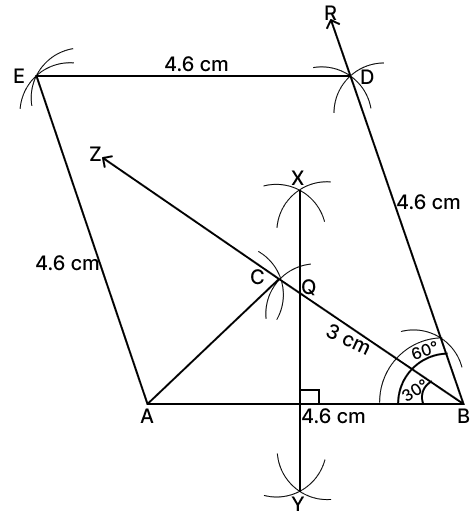
Using ruler and compasses only, construct a ΔABC such that AB = 4.6 cm, BC = 3 cm and ∠ABC = 30°. Complete the rhombus ABDE such that C is equidistant from AB and BD. Locate the point Q on BC such that Q is equidistant from A and B.

Show SolutionHide Solution↓
Using ruler and compasses only, construct a ΔABC such that AB = 4.6 cm, BC = 3 cm and ∠ABC = 30°. Complete the rhombus ABDE such that C is equidistant from AB and BD. Locate the point Q on BC such that Q is equidistant from A and B. Loci, RSA Mathematics Solutions ICSE Class 10.

Steps of construction:

  1. Draw a line segment AB = 4.6 cm.

  2. Draw BZ such that ∠ABZ = 30°.

  3. From BZ cut off BC = 3 cm, ∠ABC = 30°.

  4. Join AC.

Since, C is equidistant from AB and BD, thus it will lie on the angle bisector of angle between AB and BD. Since, ∠ABC = 30°.

∴ ∠ABR = 60°

  1. Draw ∠ABR = 60°.

  2. From BR cut off BD = 4.6 cm, ∠ABD = 60° .

  3. With D and A as center draw arcs of 4.6 cm cutting each other at point E.

  4. Join DE and AE. Complete the rhombus ABDE .

  5. Draw XY, the perpendicular bisector of AB.

  6. Mark point Q as the intersection point of BC and XY.

7Exercise 17

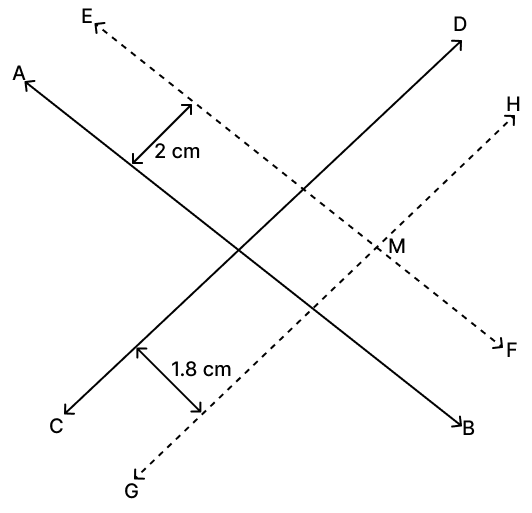
AB and CD are two intersecting lines. Find the position of the point distant 2 cm from AB and 1.8 cm from CD.

Show SolutionHide Solution↓
AB and CD are two intersecting lines. Find the position of the point distant 2 cm from AB and 1.8 cm from CD. Loci, RSA Mathematics Solutions ICSE Class 10.

Steps of construction:

  1. Draw EF at a distance of 2 cm and parallel to AB.

  2. Draw GH at a distance of 1.8 cm and parallel to CD.

  3. The point M is the point of intersection of EF and GH.

Hence, point M is the position of point which is at a distance of 2 cm from AB and 1.8 cm from CD.

8Exercise 17

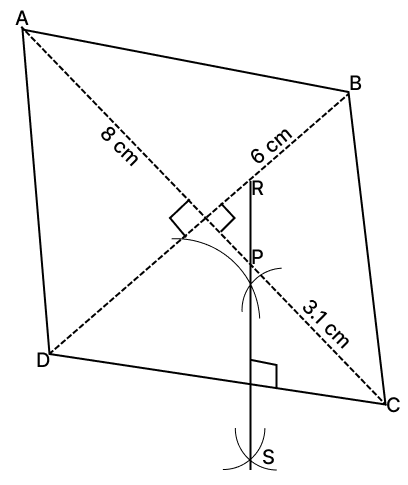
Using ruler and compasses only, construct a rhombus ABCD whose diagonals AC and BD are 8 cm and 6 cm long respectively. Find by construction a point P equidistant from AB and AD and also equidistant from C and D. Measure PC.

Show SolutionHide Solution↓
Using ruler and compasses only, construct a rhombus ABCD whose diagonals AC and BD are 8 cm and 6 cm long respectively. Find by construction a point P equidistant from AB and AD and also equidistant from C and D. Measure PC. Loci, RSA Mathematics Solutions ICSE Class 10.

Steps of construction :

  1. Draw AC = 8 cm and BD = 6 cm as diagonals perpendicular and bisecting each other. Join the points to form rhombus ABCD.

  2. Since, diagonals of rhombus bisects vertices, hence, AC is angular bisector of BAD.

  3. Draw RS, the perpendicular bisector of CD.

  4. The intersection of RS and AC is the point P which satisfies both i.e. it is equidistant from AD, AB and C and D also.

On measuring we get, CP = 3.1 cm.

9Exercise 17

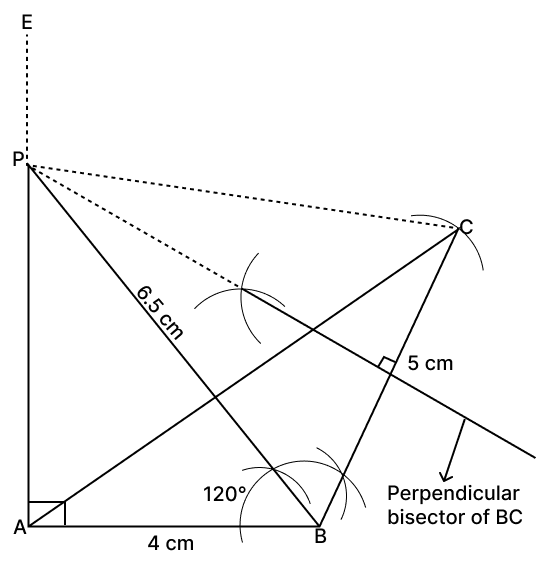
Using ruler and compasses only, construct a ΔABC in which AB = 4 cm, BC = 5 cm and ∠ABC = 120°.

(i) Locate the point P such that ∠BAP = 90° and BP = CP.

(ii) Measure the length of BP.

Show SolutionHide Solution↓
Using ruler and compasses only, construct a ΔABC in which AB = 4 cm, BC = 5 cm and ∠ABC = 120°. Loci, RSA Mathematics Solutions ICSE Class 10.

Steps of construction:

  1. Draw AB of length 4 cm.

  2. Make angle 120° at B, draw an arc of radius 5 cm from point B on this angle. Join BC and AC.

  3. At point A, draw a line AE ⟂ AB.

  4. Draw perpendicular bisector of BC

(i) Mark the point of intersection of bisector and AE as P. Thus BP = CP, as point P lies on perpendicular bisector of BC.

(ii) On measuring, BP = 6.5 cm.

10Exercise 17

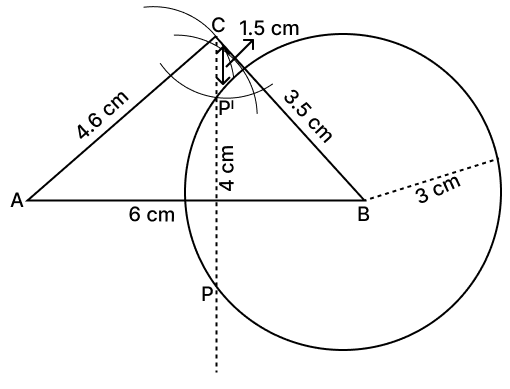
Using ruler and compasses only, construct a ΔABC in which AB = 6 cm, BC = 3.5 cm and CA = 4.6 cm.

(i) Draw the locus of a point P which moves so that it is always 3 cm from B.

(ii) Draw the locus of a point which moves so that it is equidistant from BC and CA.

(iii) Mark the point of intersection of the two loci obtained above. Measure PC.

Show SolutionHide Solution↓
Using ruler and compasses only, construct a ΔABC in which AB = 6 cm, BC = 3.5 cm and CA = 4.6 cm. Loci, RSA Mathematics Solutions ICSE Class 10.

Steps of construction :

  1. Draw a line segment AB = 6 cm.

  2. With B as the center and a radius of 3.5 cm, draw an arc.

  3. With A as the center and a radius of 4.6 cm, draw a second arc intersecting the first arc at C.

  4. Join ABC, ABC is required triangle.

  5. With B as the center and a radius of 3 cm, draw a circle.

  6. Draw the angle bisector of C.

  7. Mark the point where bisector meets circle as P and P'. Measure CP and CP'.

On measuring PC = 4 cm and CP' = 1.5 cm.

11Exercise 17

Use ruler and compass for the following constructions:

Construct:

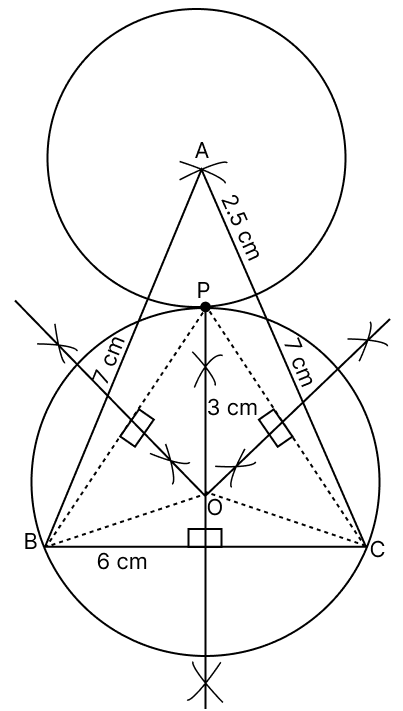
(i) an isosceles ΔABC in which AB = AC = 7 cm and BC = 6 cm.

(ii) the locus of points which moves such that it is 2.5 cm from the point A.

(iii) the locus of points equidistant from B and C. Mark point P which satisfies both the conditions mentioned in (ii) and (iii).

(iv) a circle passing through P, B and C.

Show SolutionHide Solution↓

We know that,

The locus of points at a fixed distance from a point, is the circle with fixed point as center and distance as radius.

The locus of points equidistant from two points is the perpendicular bisector of the line joining the two points.

Steps of Construction:

  1. Draw a line segment BC of length 6 cm.

  2. Take point B as the center, use a compass to draw an arc with a radius of 7 cm. With C as the center and radius 7 cm draw another arc that intersects the first arc. Label the point of intersection as A. Join A to B and A to C to form the isosceles triangle ABC.

  3. With A as center and radius 2.5 cm draw a circle.

  4. Construct the perpendicular bisector of the line BC. Mark one of the points where the circle and the perpendicular bisector intersect as P.Join PB and PC.

  5. Draw the perpendicular bisector of PB and PC.

  6. Mark the point as O, where the perpendicular bisectors of PB, BC and PC meet.

  7. With O as center and radius equal to OB draw a circle passing through the points P, B and C.

Use ruler and compass for the following constructions: ICSE 2025 Improvement Maths Solved Question Paper.
12Exercise 17

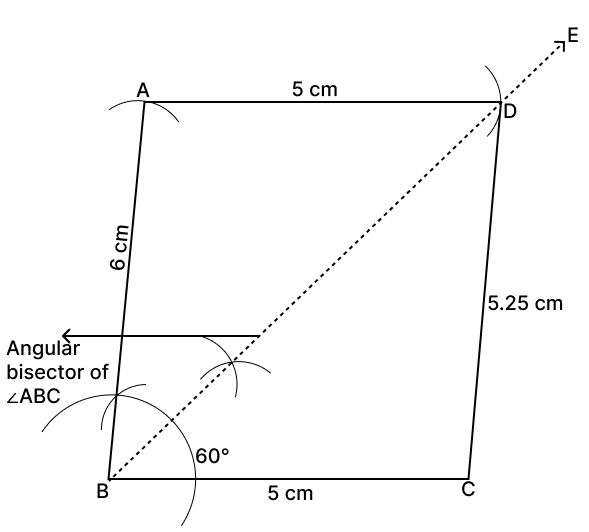
Using ruler and compasses only, construct a quadrilateral ABCD in which AB = 6 cm, BC = 5 cm, ∠B = 60°, AD = 5 cm and D is equidistant from AB and BC.

Show SolutionHide Solution↓
Using ruler and compasses only, construct a quadrilateral ABCD in which AB = 6 cm, BC = 5 cm, ∠B = 60°, AD = 5 cm and D is equidistant from AB and BC. Loci, RSA Mathematics Solutions ICSE Class 10.

Steps of construction :

  1. Draw BC = 5 cm as base.

  2. Make angle 60° at B.

  3. Cut off an arc of 6 cm from B at the angle and mark it A as in figure.

  4. Since, D is equidistant from AB and BC hence, it will lie on angle bisector of ∠ABC i.e. on BE.

  5. Make an arc of 5 cm from point A take point D where the arc cuts BE.

  6. Join, the points A, B, C and D to form quadrilateral ABCD.

13Exercise 17

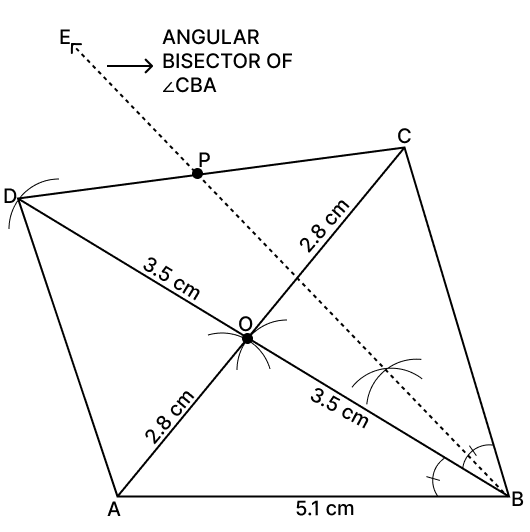
Using ruler and compasses only, construct a parallelogram ABCD in which AB = 5.1 cm, diagonal AC = 5.6 cm and diagonal BD = 7 cm. Locate the point P on DC, which is equidistant from AB and BC.

Show SolutionHide Solution↓
Using ruler and compasses only, construct a parallelogram ABCD in which AB = 5.1 cm, diagonal AC = 5.6 cm and diagonal BD = 7 cm. Locate the point P on DC, which is equidistant from AB and BC. Loci, RSA Mathematics Solutions ICSE Class 10.

Steps of construction :

  1. Draw AB = 5.1 cm as base.

  2. At A, with radius 2.8 cm and at B with radius 3.5 cm draw two arcs intersecting each other at O.

  3. Join AO and produce it till C such that OC = AO = 2.8 cm and join BO and produce it till D such that OD = BO = 3.5 cm.

  4. Join A, B, C and D forming parallelogram ABCD.

  5. We know that locus of point equidistant from two lines is the angle bisector of the two lines.

From figure,

BE is the angle bisector of ∠ABC which meets DC at P.

14Exercise 17

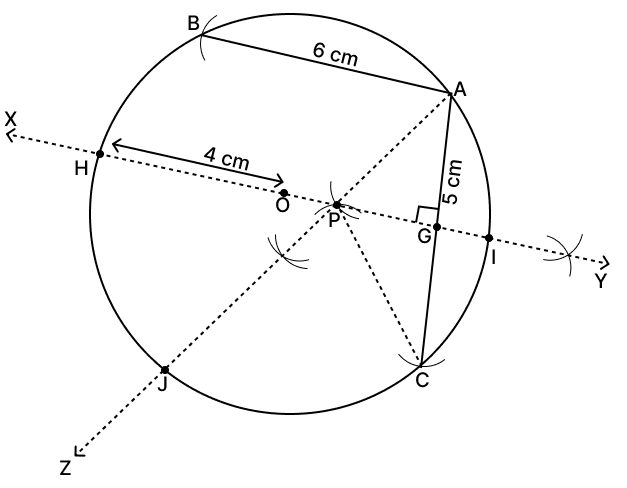
Draw a circle of radius 4 cm and mark two chords AB and AC of the circle of length 6 cm and 5 cm respectively.

(i) Construct the locus of points inside the circle, that are equidistant from A and C.

(ii) Construct the locus of points, inside the circle, that are equidistant from AB and AC.

Show SolutionHide Solution↓
Draw a circle of radius 4 cm and mark two chords AB and AC of the circle of length 6 cm and 5 cm respectively. Loci, RSA Mathematics Solutions ICSE Class 10.

Steps of construction :

  1. Construct a circle with center as O and radius 4 cm.

  2. Take a point A on the circle. From A make arcs of radius 6 cm and 5 cm and where they intersect the circle mark those points as B and C respectively.

(i) We know that locus of points that are equidistant from two points is the perpendicular bisector of line segment joining those points.

So from figure,

IH is the locus of points inside the circle, that are equidistant from A and C.

Hence, the locus is the diameter of the circle which is perpendicular to the chord AC.

Proof:

Consider △GPA and △GPC.

∠PGC = ∠PGA (Both are equal to 90°)

PG = PG (Common side)

CG = AG (They are equal as GH bisects AC).

Hence, by SAS axiom △GPA congruent to △GPC.

Since triangles are similar, hence the ratio of their corresponding sides are equal.

$$\begin{aligned}\therefore \frac{AP}{PG} = \frac{PC}{PG} \\[1em] \Rightarrow AP = \frac{PC}{PG} \times PG \\[1em] \Rightarrow AP = PC\end{aligned}$$

Hence, proved that AP = PC.

(ii) We know that locus of points that are equidistant from two lines is the angular bisector of the lines.

So, from figure,

AZ is the angular bisector of angle between AB and AC.

AJ is the locus of points equidistant from AB and AC inside the circle.

Hence, locus is the chord of the circle bisecting ∠BAC.

15Exercise 17

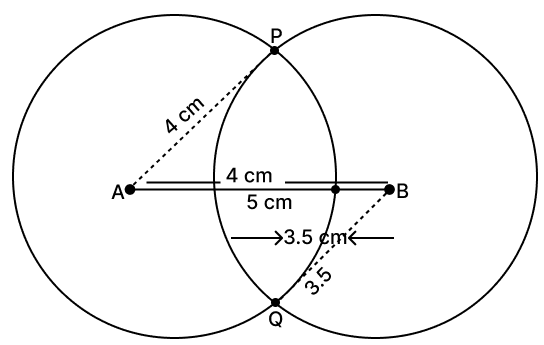
A and B are fixed points 5 cm apart. The locus of the point P is the set of those points for which AP = 4 cm and the locus of Q is the set of those points for which BQ = 3.5 cm.
Construct the loci of P and Q and the points of intersection of the two loci. How many such points are there?

Show SolutionHide Solution↓
A and B are fixed points 5 cm apart. The locus of the point P is the set of those points for which AP = 4 cm and the locus of Q is the set of those points for which BQ = 3.5 cm. Loci, RSA Mathematics Solutions ICSE Class 10.

Steps of construction :

  1. Draw a line segment AB = 5 cm.

  2. With A as the center and a radius of 4 cm, draw the circle.

  3. With B as the center and a radius of 3.5 cm, draw the circle.

  4. Mark the two points where the circle intersect as P and Q.

The loci of point P is a circle with center as point A and loci of point Q is a circle with centre as point B.

The two circles intersect at two distinct points.

16Exercise 17

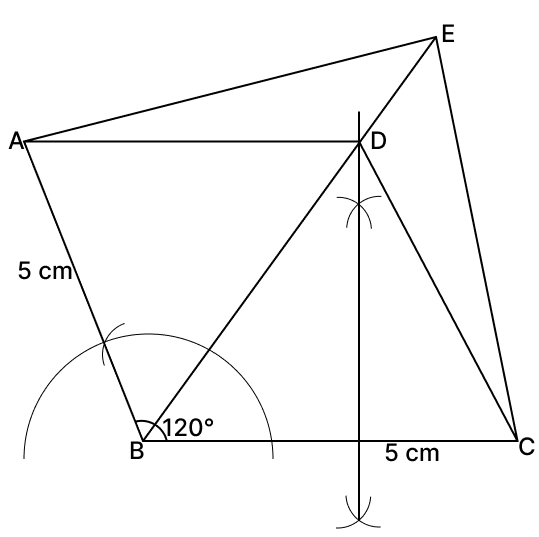
Using only a ruler and compasses, construct ∠ABC = 120°, where AB = BC = 5 cm.

(a) Mark two points D and E which satisfy the condition that they are equidistant from both BA and BC.

(b) In the above figure, join AE and EC. Describe the figures.

(i) ABCD
(ii) BD
(iii) ABE

Show SolutionHide Solution↓
Using only a ruler and compasses, construct ∠ABC = 120°, where AB = BC = 5 cm. Loci, RSA Mathematics Solutions ICSE Class 10.

Steps of construction :

  1. Draw a straight line segment BC = 5 cm.

  2. From B with radius 5cm mark an arc as A.Construct ∠ABC = 120° .

  3. Join AB, so that ∠ABC = 120° and AB = 5 cm.

  4. Construct the angle bisector BE of ∠ABC.

  5. Draw perpendicular bisector of BC. Mark the point of intersection of bisectors as D.

  6. Join AD and DC.

  7. E lies on the angle bisector of ∠ABC.

  8. Join AE and CE.

(i) ABCD is a rhombus.

(ii) BD is angle bisector of ∠ABC.

(iii) ABE is a triangle.

17Exercise 17

Using ruler and compasses only,

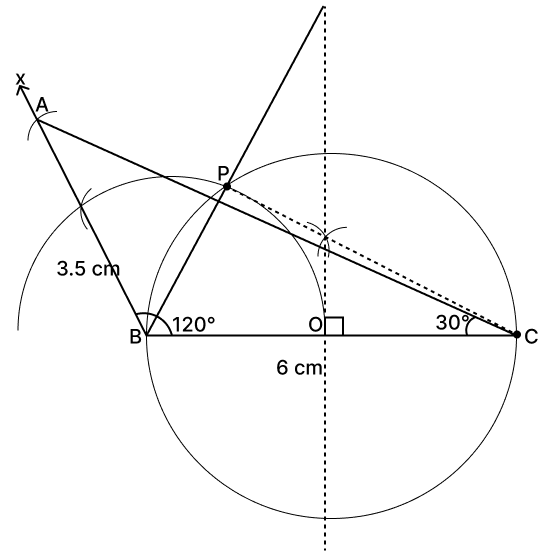
(i) Construct a ΔABC in which BC = 6 cm, ∠ABC = 120° and AB = 3.5 cm.

(ii) In the above figure, draw a circle with BC as diameter. Find a point P on the circumference of the circle which is equidistant from AB and BC. Measure ∠BCP.

Show SolutionHide Solution↓
Construct a ΔABC in which BC = 6 cm, ∠ABC = 120° and AB = 3.5 cm. Loci, RSA Mathematics Solutions ICSE Class 10.

Steps of construction :

  1. Draw a line BC = 6 cm.

  2. At B, draw a ray BX making an angle of 120° with BC. With B as center and radius 3.5 cm, cut off AB = 3.5 cm.

  3. Join AC. ABC is the required triangle.

  4. Draw perpendicular bisector of BC which cuts BC at point O. With O as center and radius = OB, draw a circle.

  5. Draw angle bisector of ∠ABC which meets the circle at point P. Thus, point P is equidistant from AB and BC.

  6. Measure ∠BCP.

On measuring, ∠BCP = 30°.

18Exercise 17

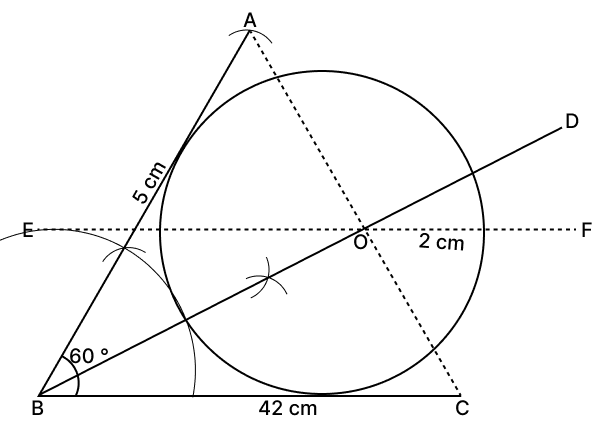
Use a ruler and a pair of compasses to construct ΔABC in which BC = 4.2 cm, ∠ABC = 60° and AB = 5 cm. Construct a circle of radius 2 cm to touch both the arms of ∠ABC of ΔABC.

Show SolutionHide Solution↓
Use a ruler and a pair of compasses to construct ΔABC in which BC = 4.2 cm, ∠ABC = 60° and AB = 5 cm. Construct a circle of radius 2 cm to touch both the arms of ∠ABC of ΔABC. Loci, RSA Mathematics Solutions ICSE Class 10.

Steps of construction:

  1. Draw BC of length 4.2 cm.

  2. Make angle 60° at B.

  3. With B as center and radius 5 cm, cut off AB = 5 cm.

  4. Join AC, ΔABC required triangle.

  5. Draw BD angle bisector of ∠ABC.

  6. Draw EF || BC at 2 cm from BC, intersects BD at O.

  7. Taking O as centre and 2 cm as radius draw required circle.

19Exercise 17

Using ruler and compasses construct

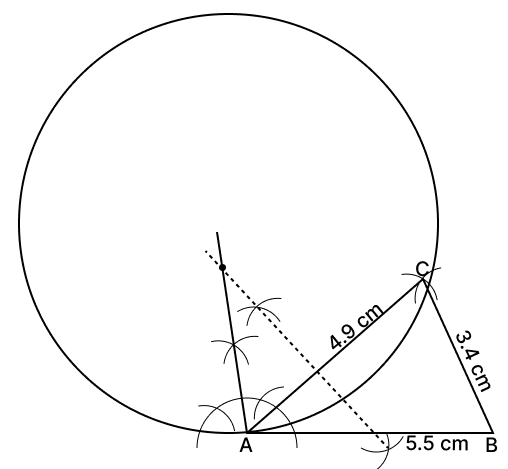
(i) a triangle ABC in which AB = 5.5 cm, BC = 3.4 cm and CA = 4.9 cm.

(ii) the locus of points equidistant from A and C.

(iii) a circle touching AB at A and passing through C.

Show SolutionHide Solution↓

(i) The figure below shows the constructed triangle ABC:

The figure below shows the constructed triangle ABC: Loci, RSA Mathematics Solutions ICSE Class 10.

Steps of construction,

  1. Draw AB = 5.5 cm.

  2. With A as centre and 4.9 cm radius draw an arc.

  3. With B as centre and 3.4 cm radius cut the previous arc. Mark point of intersection as C.

  4. Draw a right angle at A and perpendicular bisector to AC.

  5. Mark point of intersection as O. With OA as radius draw a circle.

(ii) From figure we can see,

The locus of points A and C will be the perpendicular bisector of the line segment joining A and C.

20Exercise 17

Use ruler and compasses for the following question taking a scale of 10 m = 1 cm.

A park in the city is bounded by straight fences AB, BC, CD and DA.

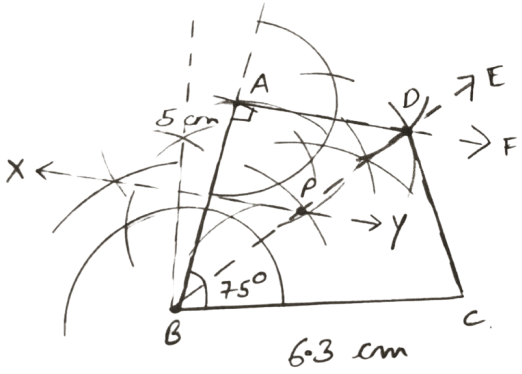
Given that AB = 50 m, BC = 63 m, ∠ABC = 75°. D is a point equidistant from the fences AB and BC. If ∠BAD = 90°, construct the outline of the park ABCD.

Also locate a point P on the line BD for the flag post which is equidistant from the corners of the park A and B.

Show SolutionHide Solution↓

We know that,

The locus of a point equidistant from two intersecting lines is pair of bisectors of the angles between the two lines.

The locus of a point which is equidistant from two given points is actually the perpendicular bisector of the segment that joins the two points.

Given,

Scale : 10 m = 1 cm

BC = 63 m = $\frac{63}{10}$ = 6.3 cm.

AB = 50 m = $\frac{50}{10}$ = 5 cm.

Steps of construction :

  1. Draw a line BC = 6.3 cm.

  2. Draw ∠ABC = 75° such that AB = 5 cm.

  3. Draw BE, angle bisector of ∠ABC.

  4. Construct ∠BAF = 90°, intersecting BE at D.

  5. Join ABCD.

  6. Construct XY, the perpendicular bisector of AB, intersecting BE at P.

Use ruler and compasses for the following question taking a scale of 10 m = 1 cm. ICSE 2025 Maths Solved Question Paper.
21Exercise 17

Use a ruler and compass to answer this question.

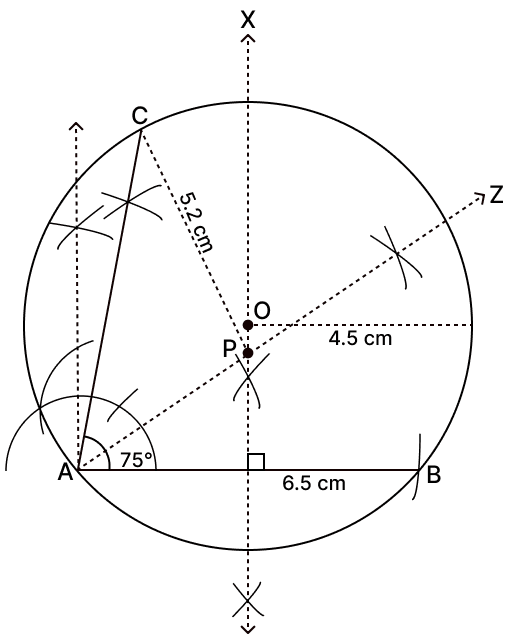
(i) Construct a circle of radius 4.5 cm and draw a chord AB of length 6.5 cm.

(ii) At A, construct ∠CAB = 75°, where C lies on the circumference of the circle.

(iii) Construct the locus of all points equidistant from A and B.

(iv) Construct the locus of all points equidistant from CA and BA.

(v) Mark the point of intersection of the two loci as P. Measure and write down the length of CP.

Show SolutionHide Solution↓

Steps of construction :

  1. With O as center draw a circle of radius 4.5 cm.

  2. Take a point A on the circumference with A as center cut an arc of radius 6.5 cm, intersecting circumference at point B.

  3. Construct ∠CAB = 75°, where C lies on the circumference of the circle.

  4. Draw XY, the perpendicular bisector of AB.

  5. Draw AZ, the angular bisector of angle A.

  6. Mark point P as the intersection of AZ and XY.

  7. Measure CP.

Use a ruler and compass to answer this question. ICSE 2026 Maths Solved Question Paper.

Hence, the length of CP = 5.2 cm.

11 Mark · Multiple Choice Questions

The locus of a point which moves in a plane in such a way that its distance from a fixed point is always constant, is known as :

Show SolutionHide Solution↓

The locus of a point that moves in a plane such that its distance from a fixed point is always constant, is known as a circle.

The fixed point is the center of the circle, and the constant distance is the radius of the circle.

Hence, option 3 is the correct option.

21 Mark · Multiple Choice Questions

The locus of a point which is equidistant from two given fixed points, is the ______ of the line segment joining the given fixed points.

Show SolutionHide Solution↓

The perpendicular bisector of a line segment is the set of all points that maintain equal distance from the two endpoints of that segment.

Hence, option 4 is the correct option.

31 Mark · Multiple Choice Questions

The locus of a point which is equidistant from two intersecting lines is the ______ formed by the given lines.

Show SolutionHide Solution↓
The locus of a point which is equidistant from two intersecting lines is the. Loci, RSA Mathematics Solutions ICSE Class 10.

Let AB and CD meet at point O.

For two intersecting lines, the points that are equidistant from both lines lie on the lines that bisect the angles formed at their intersection, every point maintains equal perpendicular distance from the two intersecting lines.

Hence, option 1 is the correct option.

41 Mark · Multiple Choice Questions

The locus of a toy bird fixed at the tip of one of the blades of a rotating ceiling fan is a:

Show SolutionHide Solution↓

Given,

The toy bird, fixed at the tip of the blade, is at a constant distance from this central point.

The locus of a point equidistant from a fixed point is a circle with fixed point as centre.

Thus, the locus of toy bird will be a circle.

Hence, option 2 is the correct option.

51 Mark · Multiple Choice Questions

If A and B are two fixed points, then the locus of a point P such that ∠APB = 90°, is the:

Show SolutionHide Solution↓

All points P that satisfy ∠APB = 90° lie on a circle for which AB is the diameter.

This is because a right angle is subtended only by the diameter of a circle.

So, the locus is a circle.

Hence, option 3 is the correct option.

61 Mark · Multiple Choice Questions

A point P moves such that its distance from a fixed line AB is always the same. What is the relation between AB and the path traveled by P ?

Show SolutionHide Solution↓

If a point moves so that its distance from a fixed line remains constant, it must stay on two lines that maintain that same constant distance on both sides of the given line. These lines are parallel to the original line AB.

So the path is two parallel lines, each at the given fixed distance from AB.

Hence, option 2 is the correct option.

71 Mark · Multiple Choice Questions

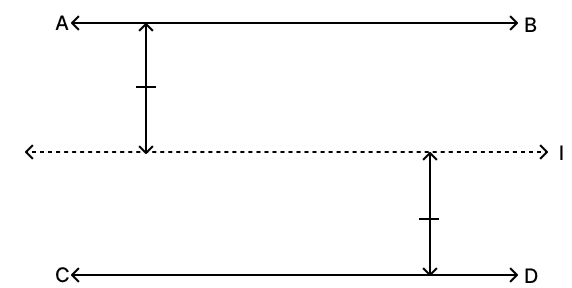
A point P moves so that its perpendicular distance from two given parallel lines AB and CD are equal. Then, the locus of the point P is:

Show SolutionHide Solution↓
A point P moves so that its perpendicular distance from two given parallel lines AB and CD are equal. Then, the locus of the point P is: Loci, RSA Mathematics Solutions ICSE Class 10.

If the perpendicular distances of a moving point from two parallel lines are equal, then the point must lie exactly halfway between them.

The set of all such points forms a single line parallel to both AB and CD, drawn exactly midway between them.

Hence, option 3 is the correct option.

81 Mark · Multiple Choice Questions

The locus of a point equidistant from two concentric circles is:

Show SolutionHide Solution↓

For concentric circles, every point’s distance from each circle is measured along the same radial direction because the centre is common.

A point that is equidistant from both circles must lie at a radius that is exactly midway between the two radii.

Hence, option 3 is the correct option.

91 Mark · Multiple Choice Questions

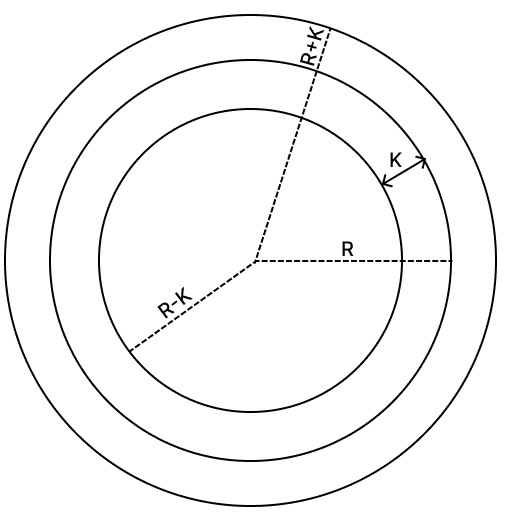
The locus of a point which is equidistant from a given circle consists of:

Show SolutionHide Solution↓
The locus of a point which is equidistant from a given circle consists of. Loci, RSA Mathematics Solutions ICSE Class 10.

If a point stays at a constant distance (let k) from a given circle, then:

One set of such points lies outside the circle at distance k, forming a circle of radius (R + k).

Another set lies inside the circle at distance k, forming a circle of radius (R − k).

Hence, option 1 is the correct option.

101 Mark · Multiple Choice Questions

A and B are two fixed points in a plane. Then, the locus of a point P which moves in such a way that PA2 + PB2 = AB2, is:

Show SolutionHide Solution↓

The condition PA2 + PB2 = AB2 is exactly the Pythagorean relation.

This holds only when ∠APB = 90°.

All points that subtend a right angle at AB lie on a circle with AB as its diameter.

Therefore, the locus of point P is the circle having AB as its diameter.

Hence, option 4 is the correct option.

111 Mark · Multiple Choice Questions

The locus of the tip of the pendulum of a clock is:

Show SolutionHide Solution↓

Let the fixed pivot be O and the constant length be "r"

The locus of the tip of the pendulum of a clock is: Loci, RSA Mathematics Solutions ICSE Class 10.

A pendulum swings back and forth from a fixed pivot. Its length remains constant, so its tip moves along a portion of a circle, not the full circle.

Therefore, the path traced is an arc of a circle.

Hence, option 3 is the correct option.

121 Mark · Multiple Choice Questions

The circumcentre of a triangle is the point which is ∶

Show SolutionHide Solution↓

The circumcenter of a triangle is defined as the point equidistant from the three vertices of the triangle.

Hence, Option 2 is the correct option.

1Assertion-Reason Questions

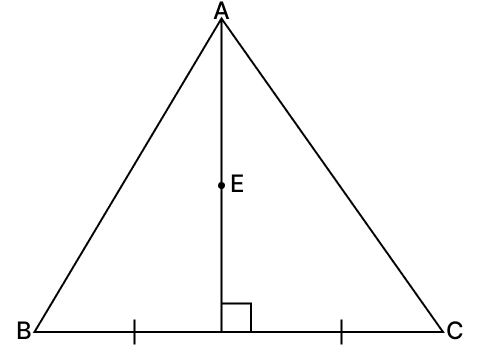
Assertion (A): In the figure, D is the mid-point of BC and AD ⟂ BC. If E lies on AD, then BE = CE.

Reason (R): Every point on the perpendicular bisector of a line segment is equidistant from its end points.

In the figure, D is the mid-point of BC and AD ⟂ BC. If E lies on AD, then BE = CE. Loci, RSA Mathematics Solutions ICSE Class 10.
Show SolutionHide Solution↓

Since D is the mid-point of BC and AD ⟂ BC, AD is the perpendicular bisector of BC.

The point E lies on AD, i.e. on the perpendicular bisector of BC.

∴ BE = CE

So, Assertion (A) is true.

We know that every point on the perpendicular bisector of a line segment is equidistant from its end points.

So, Reason (R) is true, and it correctly explains why BE = CE.

Both (A) and (R) are true, and (R) is the correct explanation of (A).

Hence, option 1 is the correct option.

2Assertion-Reason Questions

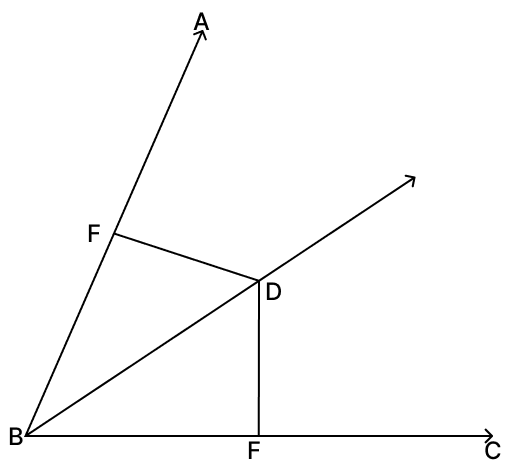
Assertion (A): In the figure, ∠ABD = ∠CBD, so DE = DF.

Reason (R): Every point on the angle bisector of two intersecting lines is equidistant from the lines.

In the figure, ∠ABD = ∠CBD, so DE = DF. Loci, RSA Mathematics Solutions ICSE Class 10.
Show SolutionHide Solution↓

Since ∠ABD = ∠CBD, BD is the bisector of ∠ABC, so D lies on the angle bisector of the two arms BA and BC.

In the figure, DE and DF are the perpendicular distances from D to BA and BC respectively.

We know that every point on the angle bisector of two intersecting lines is equidistant from the lines.

∴ DE = DF

So, Assertion (A) is true.

Reason (R) is also true, and it correctly explains why DE = DF.

Both (A) and (R) are true, and (R) is the correct explanation of (A).

Hence, option 1 is the correct option.

1Analytical and Application Based Questions

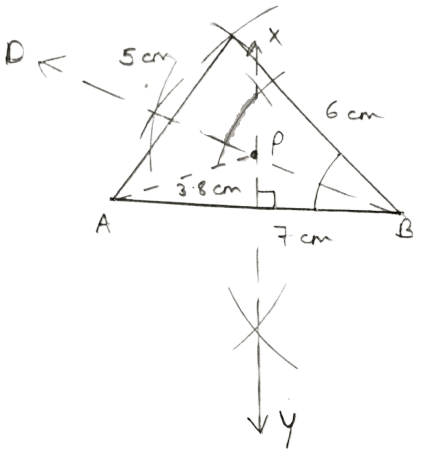
Construct a triangle ABC such that AB = 7 cm, BC = 6 cm and CA = 5 cm (use ruler and compass to do so).

(a) Draw the locus of the points such that

(i) it is equidistant from BC and BA.

(ii) it is equidistant from points A and B.

(b) Mark P where the loci (i) and (ii) meet, measure and write length of PA.

Show SolutionHide Solution↓

We know that,

Locus of the points equidistant from two sides is the angle bisector between two sides.

Locus of the points equidistant from two points is the perpendicular bisector of the line joining two points.

Steps of construction :

  1. Draw a line segment AB = 7 cm.

  2. With A and B as center and radii 5 cm and 6 cm respectively draw arcs intersecting at C.

  3. Join AC and BC.

  4. Draw BD, angle bisector of B.

  5. Draw XY perpendicular bisector of AB.

  6. Mark point P, the intersection point of XY and BD.

  7. Measure AP.

Construct a triangle ABC such that AB = 7 cm, BC = 6 cm and CA = 5 cm. Maths Competency Focused Practice Questions Class 10 Solutions.

Hence, AP = 3.8 cm.

2Analytical and Application Based Questions

(Use a ruler and a compass for this question.)

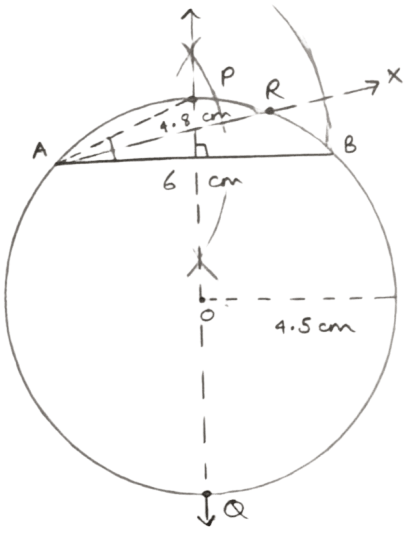
(a) Construct the locus of a moving point which moves such that it keeps a fixed distance of 4.5 cm from a fixed-point O.

(b) Draw line segment AB of 6 cm where A and B are two points on the locus (a).

(c) Construct the locus of all points equidistant from A and B. Name the points of intersection of the loci (a) and (c) as P and Q respectively.

(d) Join PA. Find the locus of all points equidistant from AP and AB.

(e) Mark the point of intersection of the locus (a) and (d) as R. Measure and write down the length of AR.

Show SolutionHide Solution↓

We know that,

Locus of a point at a fixed distance from a fixed point is the circumference of the circle with fixed point as center and fixed distance as radius.

Steps of construction :

  1. Mark point O.

  2. With center O and radius = 4.5 cm draw a circle.

  3. Use a ruler to mark point A.

  4. From point A, measure 6 cm along a straight line and mark point B.

  5. Draw a straight line connecting points A and B.
    We know that, locus of points equidistant from two points is the perpendicular bisector of the line joining the two points.

  6. Draw perpendicular bisector of AB.

  7. Mark the points P and Q where the perpendicular bisector intersects circle.
    We know that, locus of points equidistant from two lines is the angle bisector of the angle between the lines.

  8. Join PA.

  9. Draw AX, the angle bisector of ∠A.

  10. Mark point R as the intersection point of AX on the circumference of the circle.

  11. Measure AR.

Construct the locus of a moving point which moves such that it keeps a fixed distance of 4.5 cm from a fixed-point O. Maths Competency Focused Practice Questions Class 10 Solutions.

Hence, AR = 4.8 cm.

Press ↓ to reveal a solution and move to the next question. Back to RS Aggarwal Mathematics.

Free sample bank