Constructions

ICSE Class 10 Mathematics · RS Aggarwal Mathematics · 38 solved questions

Exercise
Marks
1Exercise 20A

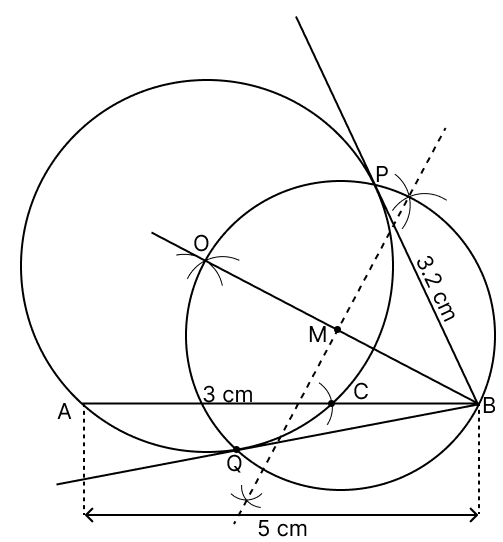
Draw a line AB = 5 cm. Mark a point C on AB such that AC = 3 cm. Using a ruler and a compass only construct:

(i) A circle of radius 2.5 cm passing through A and C.

(ii) Construct two tangents to the circle from the external point B.

Measure and record the lengths of the tangents.

Show SolutionHide Solution↓

Steps of construction :

  1. Draw a line segment AB = 5 cm.

  2. With A as center cut an arc of 3 cm on AB to obtain C.

  3. With A as center and radius = 2.5 cm draw an arc.

  4. With C as center and radius = 2.5 cm draw an arc cutting the previous arc and mark the point O.

  5. With O as center and radius = 2.5 cm draw a circle.

  6. Join OB.

  7. Draw the perpendicular bisector of OB, let it meet OB at point M.

  8. With M as center and radius equal to OM, draw a circle to cut the previous circle at points P and Q.

  9. Join PB and QB. Hence, PB and QB are required tangents.

  10. Measure PB and QB.

Draw a line AB = 5 cm. Mark a point C on AB such that AC = 3 cm. Using a ruler and a compass only construct: Tangent Properties of Circles, RSA Mathematics Solutions ICSE Class 10.

On measuring, PB = QB = 3.2 cm.

Hence, length of each tangent = 3.2 cm.
2Exercise 20A

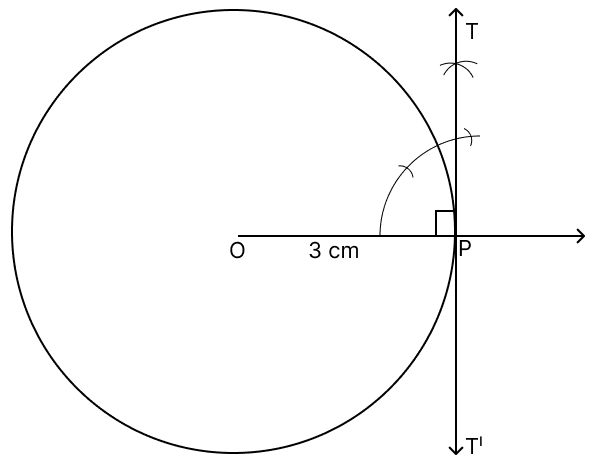
Draw a circle of radius 3 cm. Take a point P on it. Using ruler and compasses only construct a tangent to the circle at the point P.

Show SolutionHide Solution↓

Steps of Construction :

  1. Draw a circle of radius = 3 cm with centre as O.

  2. Extend the radius of the circle on one the side and mark point P, Join OP.

  3. At point P, construct a line perpendicular to OP and name it as TT'.

Draw a circle of radius 3 cm. Take a point P on it. Using ruler and compasses only construct a tangent to the circle at the point P. Tangent Properties of Circles, RSA Mathematics Solutions ICSE Class 10.
3Exercise 20A

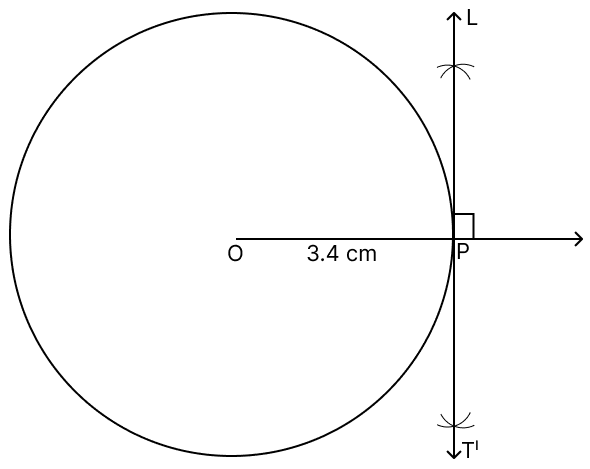
Draw a circle of radius 3.4 cm. Take a point P on it. Without using the centre of the circle, construct a tangent to the circle at the point P.

Show SolutionHide Solution↓

Steps of Construction :

  1. Draw a circle of radius = 3.4 cm with centre as O.

  2. Extend the radius of the circle on one the side and mark point P, Join OP.

  3. At point P, construct a line perpendicular to OP and name it as L.

Draw a circle of radius 3.4 cm. Take a point P on it. Without using the centre of the circle, construct a tangent to the circle at the point P. Tangent Properties of Circles, RSA Mathematics Solutions ICSE Class 10.
4Exercise 20A

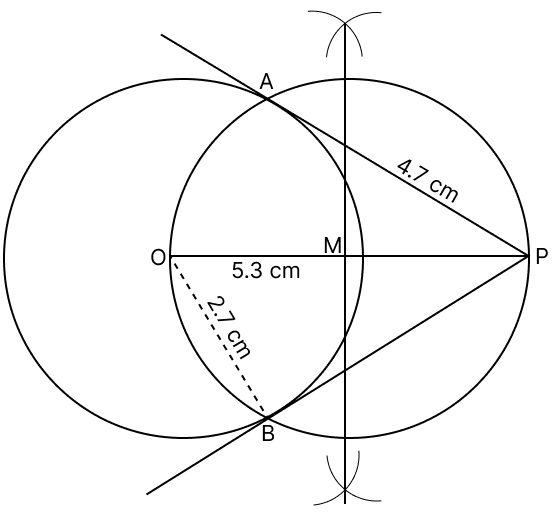
Draw a circle of radius 2.7 cm. Mark its centre as O. Take a point P at a distance of 5.3 cm from O. From the point P, draw two tangents to the circle. Measure the length of each.

Show SolutionHide Solution↓

Steps of Construction :

  1. Draw a circle of radius = 2.7 cm with centre as O.

  2. Mark a point P at a distance of 5.3 cm from O. Join OP. Draw its perpendicular bisector to meet OP at M.

  3. With M as centre and OM as radius, draw a circle. Let this circle intersect the given circle with centre as O at points A and B.

  4. Join PA and PB.

Draw a circle of radius 2.7 cm. Mark its centre as O. Take a point P at a distance of 5.3 cm from O. From the point P, draw two tangents to the circle. Measure the length of each. Tangent Properties of Circles, RSA Mathematics Solutions ICSE Class 10.

On measuring we get : PA = PB = 4.7 cm.

Hence, the length of each tangent = 4.7 cm.

5Exercise 20A

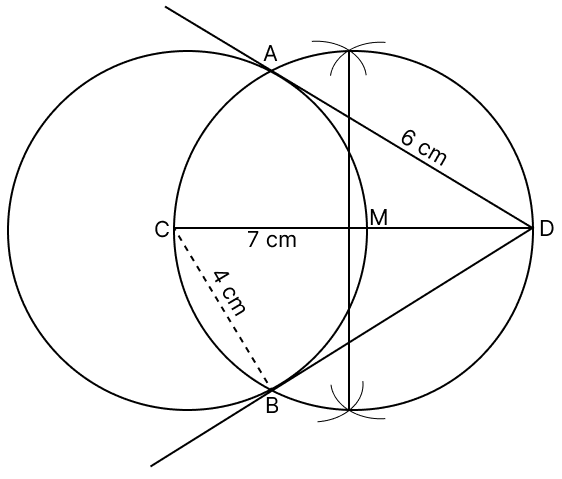
Draw a circle of radius 4 cm. Mark its centre as C and mark a point D such that CD = 7 cm. Using ruler and compasses only but not using the centre of the circle, construct two tangents from D.

Show SolutionHide Solution↓

Steps of construction :

  1. Construct a circle with centre as C and radius = 4 cm.

  2. Mark a point D at a distance of 7 cm from the centre. Join CD. Draw its perpendicular bisector to meet CD at M.

  3. With M as centre and CM (or MD) as radius, draw a circle. Let this circle intersect the given circle with centre as C at points A and B.

  4. Join DA and DB.

Draw a circle of radius 4 cm. Mark its centre as C and mark a point D such that CD = 7 cm. Using ruler and compasses only but not using the centre of the circle, construct two tangents from D. Tangent Properties of Circles, RSA Mathematics Solutions ICSE Class 10.
6Exercise 20A

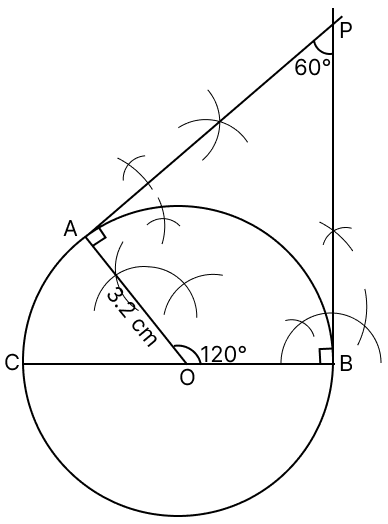
Draw a circle of radius 3.2 cm. Draw two tangents to it inclined at an angle of 60° with each other.

Show SolutionHide Solution↓

Steps of Construction :

  1. Draw a circle with center O, radius = 3.2 cm and BC as diameter.

  2. Draw arcs making an angle of 120° at O such that ∠AOB = 120°.

  3. At A and B, draw two rays making an angle of 90° at each point which meet other at point P.

Draw a circle of radius 3.2 cm. Draw two tangents to it inclined at an angle of 60° with each other. Tangent Properties of Circles, RSA Mathematics Solutions ICSE Class 10.

Hence, AP and BP are required tangents making an angle of 60° with each other.

7Exercise 20A

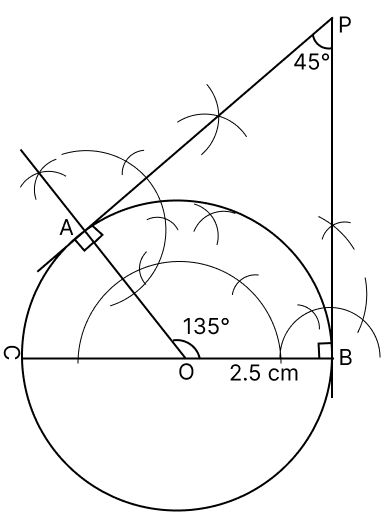
Draw a circle of radius 2.5 cm. Draw two tangents to it inclined at an angle of 45° to each other.

Show SolutionHide Solution↓

Steps of Construction :

  1. Draw a circle with center O, radius = 2.5 cm and BC as diameter.

  2. Draw arcs making an angle of 135° (180° - 45°) at O such that ∠AOB = 135°.

  3. At A and B, draw two rays making an angle of 90° at each point which meet other at point P.

Draw a circle of radius 2.5 cm. Draw two tangents to it inclined at an angle of 45° to each other. Tangent Properties of Circles, RSA Mathematics Solutions ICSE Class 10.

Hence, AP and BP are required tangents making an angle of 45° with each other.

8Exercise 20A

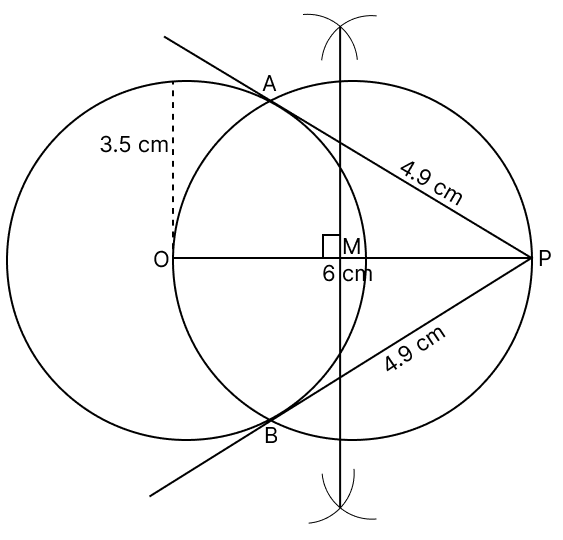
Draw a circle of radius 3.5 cm. Mark a point P outside the circle at a distance of 6 cm from the centre. Construct two tangents from P to the given circle. Measure the length of one tangent.

Show SolutionHide Solution↓

Steps of construction :

  1. With O as center and radius = 3.5 cm draw a circle.

  2. Take a point P such that OP = 6 cm.

  3. Draw perpendicular bisector of OP, cutting OP at M.

  4. With center M and radius OM, draw a circle which intersects the circle with center O at A and B.

  5. Join AP and BP. Measure AP and BP.

Hence, AP and BP are required tangents.

Draw a circle of radius 3.5 cm. Mark a point P outside the circle at a distance of 6 cm from the centre. Construct two tangents from P to the given circle. Measure the length of one tangent. Tangent Properties of Circles, RSA Mathematics Solutions ICSE Class 10.

On measuring,

AP = BP = 4.9 cm.

Hence, length of each tangent = 4.9 cm.

9Exercise 20A

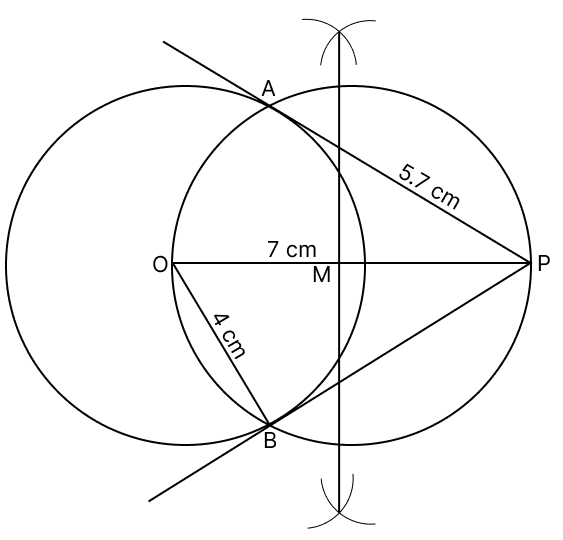
Use ruler and compasses only for answering this question. Draw a circle of radius 4 cm. Mark the centre as O. Mark a point P outside the circle at a distance of 7 cm from the centre. Construct two tangents to the circle from the external point P. Measure and write down the length of any one tangent.

Show SolutionHide Solution↓

Steps of construction :

  1. Construct a circle with centre as O and radius = 4 cm.

  2. Mark a point P at a distance of 7 cm from the centre. Join OP. Draw its perpendicular bisector to meet OP at M.

  3. With M as centre and OM (or MP) as radius, draw a circle. Let this circle intersect the given circle with centre as O at points A and B.

  4. Join PA and PB.

Use ruler and compasses only for answering this question. Draw a circle of radius 4 cm. Mark the centre as O. Mark a point P outside the circle at a distance of 7 cm from the centre. Construct two tangents to the circle from the external point P. Measure and write down the length of any one tangent. Tangent Properties of Circles, RSA Mathematics Solutions ICSE Class 10.

On measuring, PA = PB = 5.7 cm

Hence, the length of each tangent = 5.7 cm.

1Exercise 20B

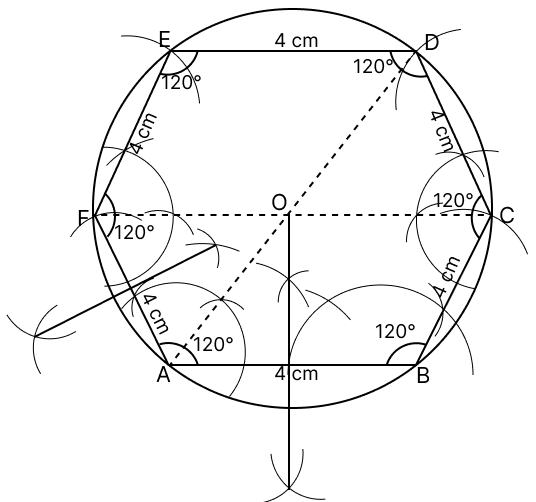
Construct a regular hexagon of side 4 cm. Construct a circle circumscribing the hexagon.

Show SolutionHide Solution↓

We know that each angle in a regular hexagon = 120°.

Steps of construction :

  1. Draw a regular hexagon ABCDEF with each side equal to 4 cm and each interior angle = 120°.

  2. Draw the perpendicular bisectors of AB and AF which intersect each other at O.

  3. With O as center and OA as radius draw a circle which will pass through all the vertices of the regular hexagon.

Hence, above is the required circumcircle of regular hexagon.

Construct a regular hexagon of side 4 cm. Construct a circle circumscribing the hexagon. Tangent Properties of Circles, RSA Mathematics Solutions ICSE Class 10.
2Exercise 20B

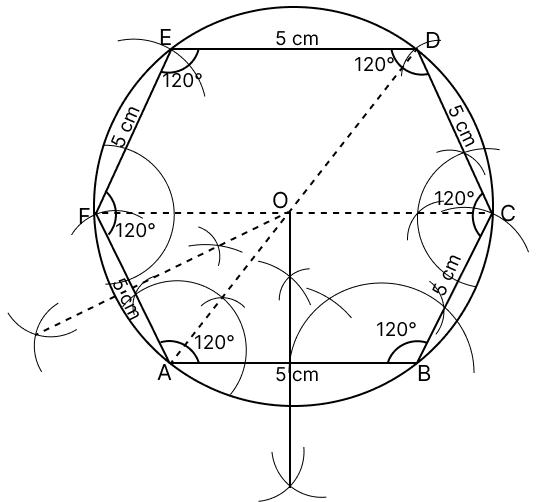
Construct a regular hexagon of side 5 cm. Construct a circle circumscribing the hexagon.

Show SolutionHide Solution↓

Steps of construction :

  1. Draw a regular hexagon ABCDEF with each side equal to 5 cm and each interior angle = 120°.

  2. Draw the perpendicular bisectors of AB and AF which intersect each other at O.

  3. With O as center and OA as radius draw a circle which will pass through all the vertices of the regular hexagon.

Hence, above is the required circumcircle of regular hexagon.

Construct a regular hexagon of side 5 cm. Construct a circle circumscribing the hexagon. Tangent Properties of Circles, RSA Mathematics Solutions ICSE Class 10.
3Exercise 20B

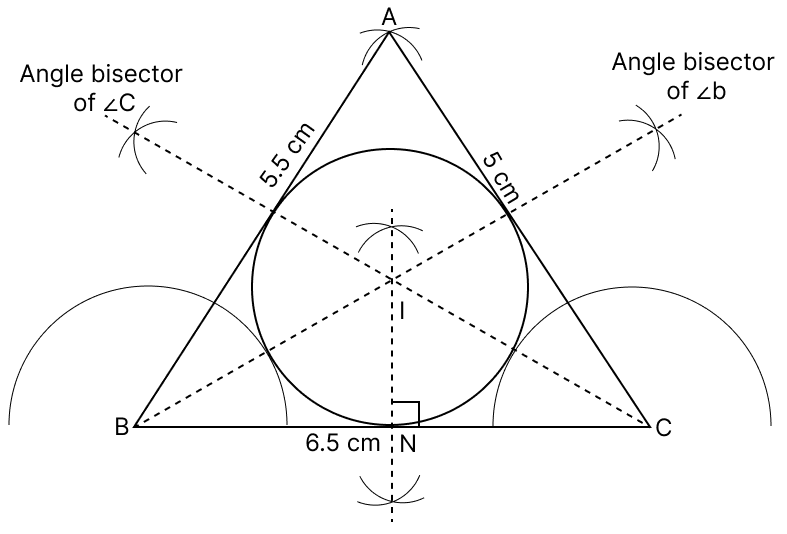
Construct a ΔABC with BC = 6.5 cm, AB = 5.5 cm and AC = 5 cm. Construct the incircle of the triangle. Measure the radius of the incircle.

Show SolutionHide Solution↓

Steps of construction :

  1. Draw a line segment BC = 6.5 cm.

  2. Cut an arc from C of 5 cm and an arc of 5.5 cm from B.

  3. Mark the point as A where the arcs from B and C intersect.

  4. Join A, B and C. Hence, the △ABC is formed.

  5. Draw the (internal) bisectors of ∠B and ∠C. Let these bisectors meet at point I.

  6. From I, draw IN perpendicular to the side BC.

  7. With I as centre and radius equal to IN, draw a circle. The circle so drawn touches all the sides of the △ABC, and is the required incircle of △ABC.

Construct a ΔABC with BC = 6.5 cm, AB = 5.5 cm and AC = 5 cm. Construct the incircle of the triangle. Measure the radius of the incircle. Tangent Properties of Circles, RSA Mathematics Solutions ICSE Class 10.

On measuring IN, we get the radius of the incircle.

Hence, the radius of incircle is 1.5 cm.

4Exercise 20B

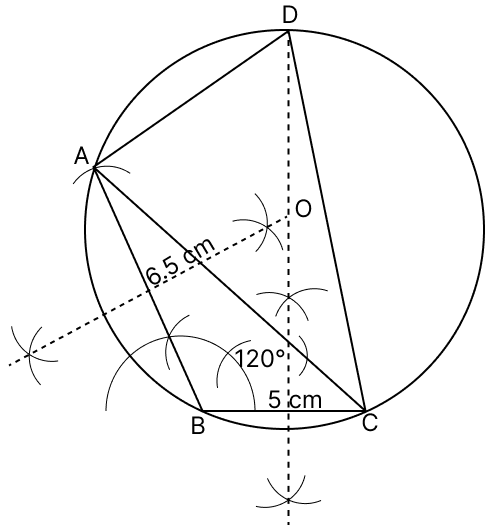
(i) Construct a ΔABC in which BC = 5 cm, AB = 6.5 cm and ∠ABC = 120°.

(ii) Construct a circle circumscribing ΔABC.

(iii) Draw a cyclic quadrilateral ABCD so that D is equidistant from B and C.

Show SolutionHide Solution↓

Steps of construction :

  1. Draw a line segment BC = 5 cm.

  2. From B construct angle 120° and extend the line such that AB = 6.5 cm.

  3. Join points A, B and C. Hence, the △ABC is formed.

  4. Draw the perpendicular bisector of AB and BC. Let these bisectors meet at the point O.

  5. With O as center and radius equal to OA, draw a circle. The circle so drawn passes through the points A, B and C, and is required circumcircle of △ABC.

  6. Extend perpendicular bisector of BC, until it intersect circle and mark it as D.

  7. Join AD and CD.

Construct a ΔABC in which BC = 5 cm, AB = 6.5 cm and ∠ABC = 120°. Tangent Properties of Circles, RSA Mathematics Solutions ICSE Class 10.
5Exercise 20B

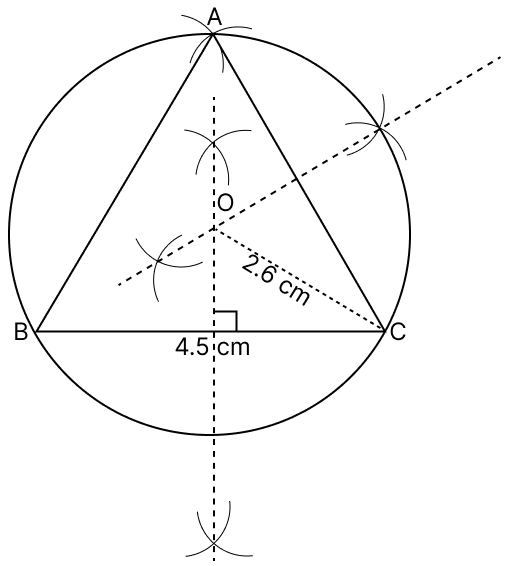
Using ruler and compasses only, draw an equilateral triangle of side 4.5 cm and draw its circumscribed circle. Measure the radius of the circle.

Show SolutionHide Solution↓

Steps of Construction :

  1. Draw a line segment BC = 4.5 cm.

  2. With centers B and C, draw two arcs of radius 4.5 cm which intersect each other at A.

  3. Join AC and AB.

  4. Draw perpendicular bisectors of AC and BC intersecting each other at O.

  5. With center O, and radius OA or OB or OC draw a circle which pass through A, B and C. Measure OC.

Using ruler and compasses only, draw an equilateral triangle of side 4.5 cm and draw its circumscribed circle. Measure the radius of the circle. Tangent Properties of Circles, RSA Mathematics Solutions ICSE Class 10.

On measuring, OC = 2.6 cm.

Hence, above is the required circumcircle with radius = 2.6 cm.

6Exercise 20B

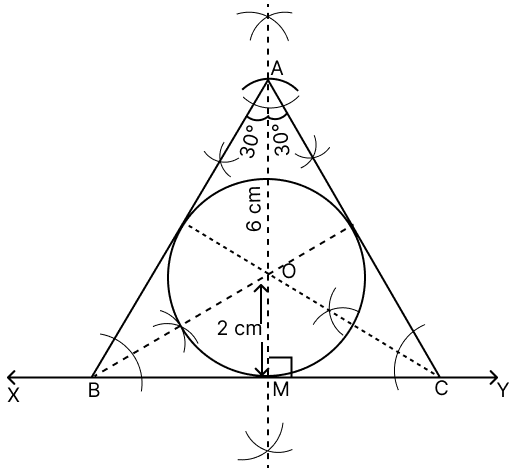
Using ruler and compasses only, draw an equilateral triangle of height 6 cm and draw its inscribed circle. Measure the radius of the circle.

Show SolutionHide Solution↓

Steps of construction :

  1. Draw a line XY.

  2. Construct perpendicular bisector of XY, let bisector intersect XY at point M.

  3. From point M, draw an arc with radius 6 cm, mark the point of intersection of arc and perpendicular bisector as A.

  4. Construct ∠MAB = 30° and ∠MAC = 30°.

  5. Draw angle bisectors of ∠B and ∠C intersecting each other at O.

  6. Draw OM perpendicular to BC. With O as center and OM as radius draw a circle, touching sides of △ABC. Measure OM.

Using ruler and compasses only, draw an equilateral triangle of height 6 cm and draw its inscribed circle. Measure the radius of the circle. Tangent Properties of Circles, RSA Mathematics Solutions ICSE Class 10.

On measuring,

OM = 2 cm.

Hence, radius of the circle = 2 cm.

7(i)Exercise 20B

Construct a triangle with sides 5 cm, 4 cm and 3 cm. Draw its circumcircle and measure its radius.

Show SolutionHide Solution↓

Steps of construction :

  1. Draw a line segment BC = 4 cm.

  2. From B cut an arc of 3 cm and from C cut an arc of 5 cm.

  3. Mark the point as A where the arcs meet.

  4. Join the points A, B and C. Hence, the △ABC is formed.

  5. Draw the perpendicular bisector of AB and BC. Let these bisectors meet at the point O.

  6. With O as center and radius equal to OA, draw a circle. The circle so drawn passes through the points A, B and C, and is the required circumcircle of △ABC.

Construct a triangle with sides 5 cm, 4 cm and 3 cm. Draw its circumcircle and measure its radius. Tangent Properties of Circles, RSA Mathematics Solutions ICSE Class 10.

Measuring OB we get the radius of the circumcircle.

Hence,the radius of the circumcircle = 2.5 cm.

7(ii)Exercise 20B

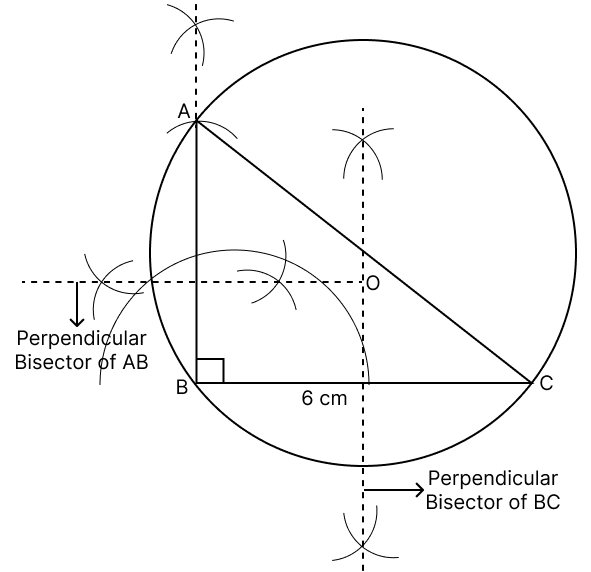
(ii) Using a ruler and a pair of compasses only, construct:

(a) a triangle ABC, given AB = 4 cm, BC = 6 cm and ∠ABC = 90°.

(b) a circle which passes through the points A, B and C and mark its centre as O.

Show SolutionHide Solution↓

Steps of construction :

  1. Draw a line segment BC = 6 cm.

  2. Draw the perpendicular from point B and cut AB from that perpendicular such that AB = 4 cm.

  3. Join points A, B and C.

  4. In the above triangle, draw the perpendicular bisector of AB and BC. Let these bisectors meet at the point O.

  5. With O as center and radius equal to OA, draw a circle. The circle so drawn passes through the points A, B and C, and is required circumcircle of △ABC.

Using a ruler and a pair of compasses only, construct: Tangent Properties of Circles, RSA Mathematics Solutions ICSE Class 10.
8Exercise 20B

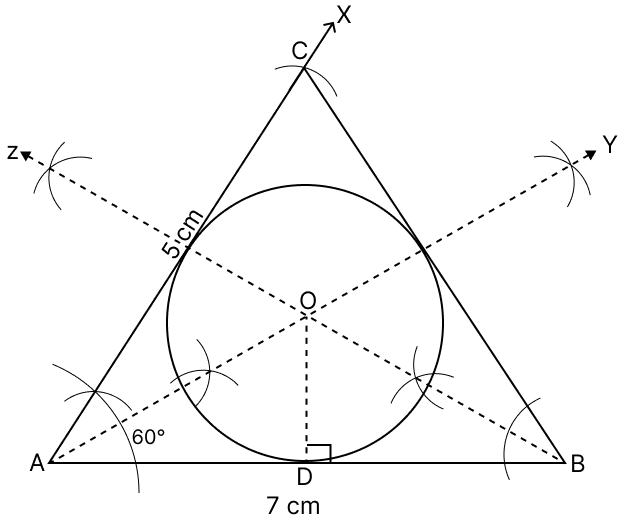
Using a ruler and a compass construct a triangle ABC in which AB = 7 cm, ∠CAB = 60° and AC = 5 cm. Construct the locus of:

(i) Points equidistant from AB and AC.

(ii) Points equidistant from BA and BC.

Hence, construct a circle touching the three sides of the triangle internally.

Show SolutionHide Solution↓

Steps of construction :

  1. Draw a line segment AB = 7 cm.

  2. Construct AX such that ∠XAB = 60°.

  3. With A as center and radius = 5 cm cut arc on AX and mark it as point C.

  4. Join BC. ABC is the required triangle.

  5. Draw AY and BZ, angle bisector of A and B.

  6. Let AY and BZ meet at point O.

  7. Draw OD ⊥ AB.

  8. With O as center and OD as radius draw a circle.

Using a ruler and a compass construct a triangle ABC in which AB = 7 cm, ∠CAB = 60° and AC = 5 cm. Construct the locus of: Tangent Properties of Circles, RSA Mathematics Solutions ICSE Class 10.

(i) Hence, AY is the locus of points equidistant from AB and AC.

(ii) Hence, BZ is the locus of points equidistant from BA and BC.

9Exercise 20B

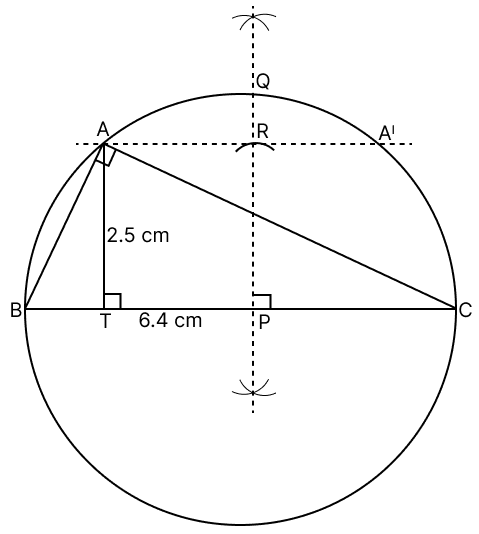
Draw a right-angled ΔABC in which hypotenuse BC = 6.4 cm and the altitude from A on BC is 2.5 cm. Draw the circumcircle of the triangle and measure its radius.

Show SolutionHide Solution↓

Steps of construction :

  1. Draw BC = 6.4 cm.

  2. Draw PQ, the right bisector of BC and draw a circle with PB as radius.

  3. Along PQ, cut off PR = 2.5 cm.

  4. Through R, draw AA′ ∥ BC meeting the circle at A and A′.

  5. Join AB and AC. Draw AT perpendicular to BC, AT = 2.5 cm.

  6. Mid-point of BC is circumcentre and radius = $\frac{1}{2}$ BC.

Draw a right-angled ΔABC in which hypotenuse BC = 6.4 cm and the altitude from A on BC is 2.5 cm. Draw the circumcircle of the triangle and measure its radius. Tangent Properties of Circles, RSA Mathematics Solutions ICSE Class 10.

Hence, radius PQ = 3.2 cm.
10Exercise 20B

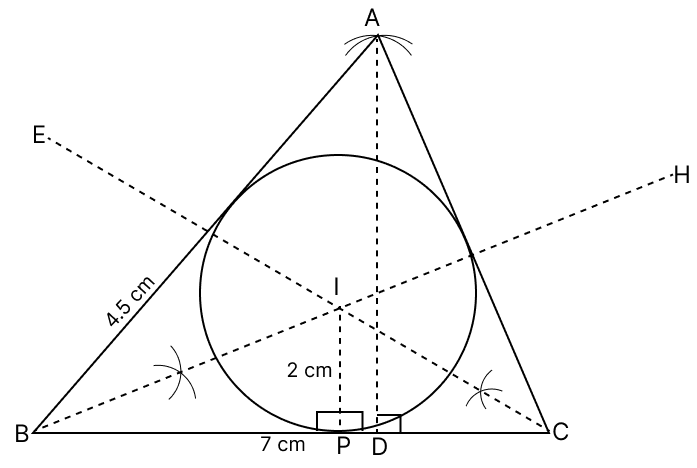
Construct a ΔABC in which AB = 4.5 cm, BC = 7 cm and median AD = 4 cm. Draw the inscribed circle of the triangle and measure its radius.

Show SolutionHide Solution↓

Steps of construction :

  1. Draw BC = 7 cm. Mark its mid-point as D.

  2. With B as centre and radius 4.5 cm, draw an arc.

  3. With D as centre and 4 cm as radius, draw another arc, cutting the first arc at A.

  4. Join AB and AC.

  5. Construct the angle bisectors BH and CE of ∠ABC and ∠ACB.

  6. Let the two angle bisectors intersect at point I.

  7. Draw IP perpendicular to BC.

  8. With I as centre and IP as radius, draw a circle.

Construct a ΔABC in which AB = 4.5 cm, BC = 7 cm and median AD = 4 cm. Draw the inscribed circle of the triangle and measure its radius. Tangent Properties of Circles, RSA Mathematics Solutions ICSE Class 10.

Hence, radius IP = 2 cm.

11Exercise 20B

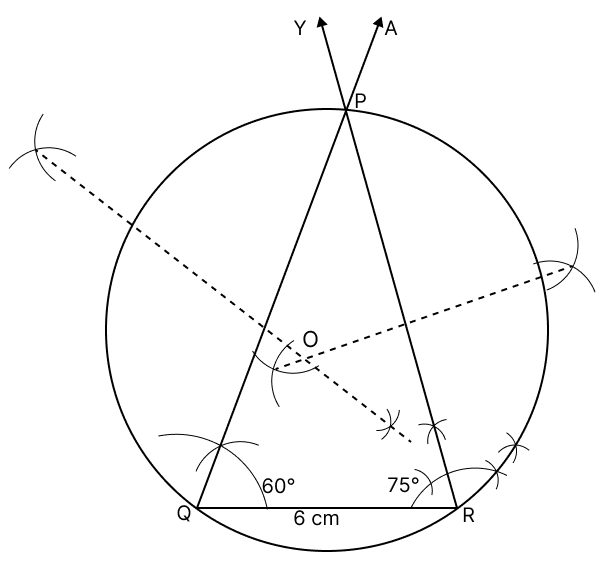
Using ruler and compasses only construct a ΔPQR in which QR = 6 cm, ∠Q = 60° and ∠R = 75°. Draw the circumcircle of the triangle.

Show SolutionHide Solution↓

Steps of construction :

  1. Draw a line segment QR = 6 cm.

  2. At point Q, draw ray QA, such that ∠Q = 60°.

  3. At point R, draw ray RY, such that ∠R = 75°.

  4. The rays QA and RY intersect at point P.

  5. Δ PQR is the required triangle.

  6. Draw the perpendicular bisector of PQ and PR. Let these bisectors intersect at O.

  7. With O as centre and OQ as radius, draw a circle, which is the required circumcircle of triangle PQR.

Using ruler and compasses only construct a ΔPQR in which QR = 6 cm, ∠Q = 60° and ∠R = 75°. Draw the circumcircle of the triangle. Tangent Properties of Circles, RSA Mathematics Solutions ICSE Class 10.
12Exercise 20B

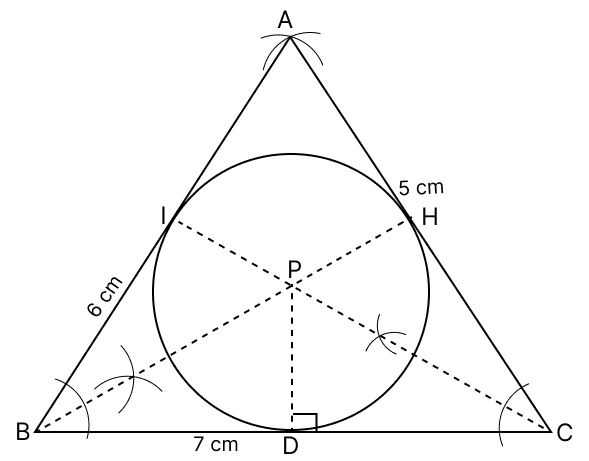
Using compasses and ruler, construct a ΔABC in which AB = 6 cm, BC = 7 cm and AC = 5 cm. Draw a circle inside the triangle touching its sides.

Show SolutionHide Solution↓

Steps of construction :

  1. Draw BC = 7 cm.

  2. With B as centre, draw an arc of radius 6 cm.

  3. With C as the centre, draw an arc of radius 5 cm.

  4. Join AB and AC to form ΔABC.

  5. Construct the angle bisector BH and CI of ∠ABC and ∠ACB respectively.

  6. Let the two angle bisectors intersect at point P.

  7. Draw PD perpendicular to BC. With P as centre and PD as radius, draw a circle.

Using compasses and ruler, construct a ΔABC in which AB = 6 cm, BC = 7 cm and AC = 5 cm. Draw a circle inside the triangle touching its sides. Tangent Properties of Circles, RSA Mathematics Solutions ICSE Class 10.
13Exercise 20B

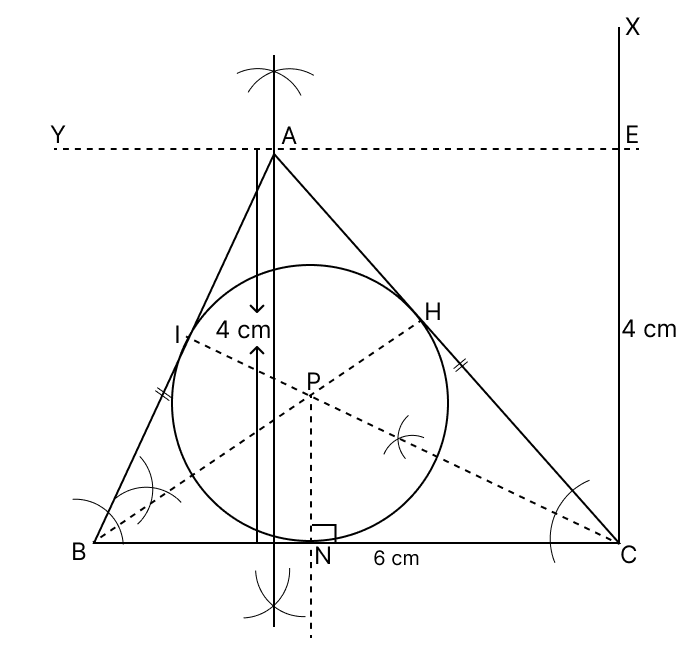
Draw an isosceles ΔABC in which base BC = 6 cm and the altitude from vertex to the base is 4 cm. Draw its inscribed circle.

Show SolutionHide Solution↓

Steps of construction :

  1. Draw BC = 6 cm as base.

  2. At C, draw a perpendicular line CX and from it, cut off CE = 4 cm.

  3. From E, draw EY, perpendicular to CX.

  4. Draw perpendicular bisector of BC that intersects EY at A, such that AB = AC.

  5. Join AB and AC to form △ABC.

  6. Construct the angle bisector BH and IC of ∠ABC and ∠ACB respectively.

  7. Let the two angle bisectors intersect at point P.

  8. From P, draw PN perpendicular to the side BC.

  9. With P as centre and radius equal to PN, draw a circle. The circle so drawn touches all the sides of the △ABC, and is the required incircle of △ABC.

Draw an isosceles ΔABC in which base BC = 6 cm and the altitude from vertex to the base is 4 cm. Draw its inscribed circle. Tangent Properties of Circles, RSA Mathematics Solutions ICSE Class 10.
14Exercise 20B

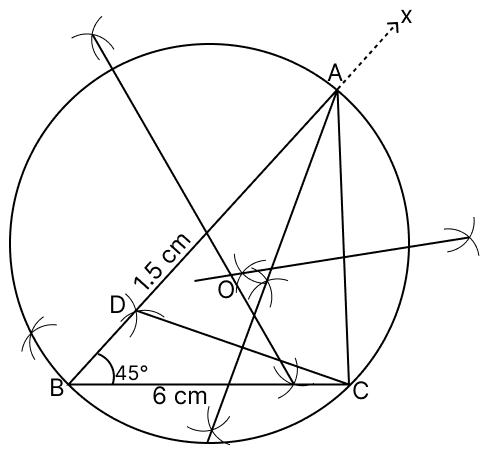
Draw a ΔABC in which BC = 6 cm, ∠B = 45° and (AB − AC) = 1.5 cm. Draw the circumcircle of the triangle. Use ruler and compasses only.

Show SolutionHide Solution↓
  1. Draw BC = 6 cm.

  2. At point B, Construct an angle of 45°, ∠XBC = 45°.

  3. Let D be a point on the ray XB such that BD = 1.5 cm.

  4. Join CD. Draw the perpendicular bisector of CD such that bisector intersect ray XB at point A.

  5. Join AB and AC. ΔABC is the required triangle.

  6. Draw the perpendicular bisector of AB and AC. Let these bisectors intersect at O.

  7. With O as centre and OA as radius, draw a circle.

Draw a ΔABC in which BC = 6 cm, ∠B = 45° and (AB − AC) = 1.5 cm. Draw the circumcircle of the triangle. Use ruler and compasses only. Tangent Properties of Circles, RSA Mathematics Solutions ICSE Class 10.
15Exercise 20B

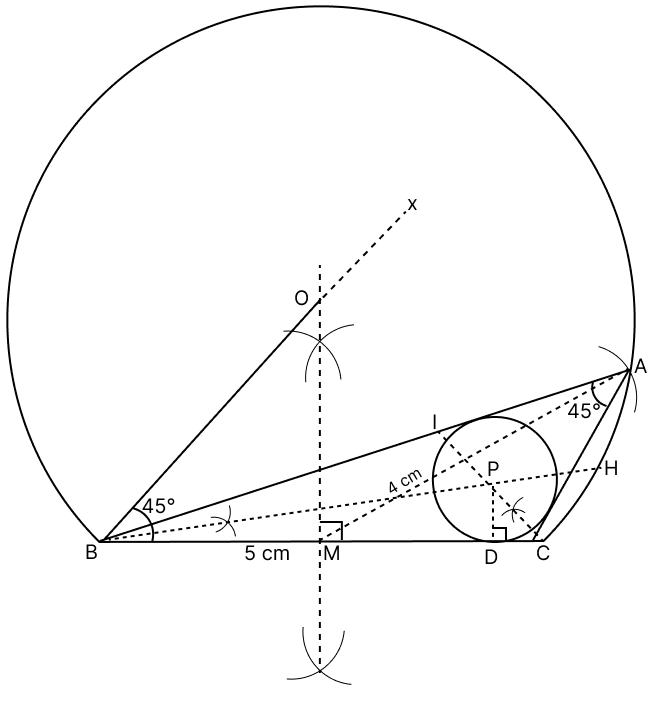
Using ruler and compasses only construct a ΔABC having base = 5 cm, vertical angle = 45° and median through vertex equal to 4 cm. Draw the incircle of the triangle.

Show SolutionHide Solution↓

Steps of construction :

  1. Draw a line segment BC = 5 cm.

  2. Construct perpendicular bisector of BC.

  3. At point B, construct an angle of 45°, ∠XBC = 45°.

  4. Let this ray XB intersect the perpendicular bisector of BC at O. With a radius of OB draw major arc.

  5. From M, draw an arc of radius 4 cm, that intersects the major arc and label it as A.

  6. Join AB and AC. Hence, ABC is the required triangle.

  7. Construct the angle bisector BH and CI of ∠ABC and ∠ACB respectively.

  8. Let the two angle bisectors intersect at point P.

  9. Draw PD perpendicular to BC. With P as centre and PD as radius, draw a circle.

Using ruler and compasses only construct a ΔABC having base = 5 cm, vertical angle = 45° and median through vertex equal to 4 cm. Draw the incircle of the triangle. Tangent Properties of Circles, RSA Mathematics Solutions ICSE Class 10.
16Exercise 20B

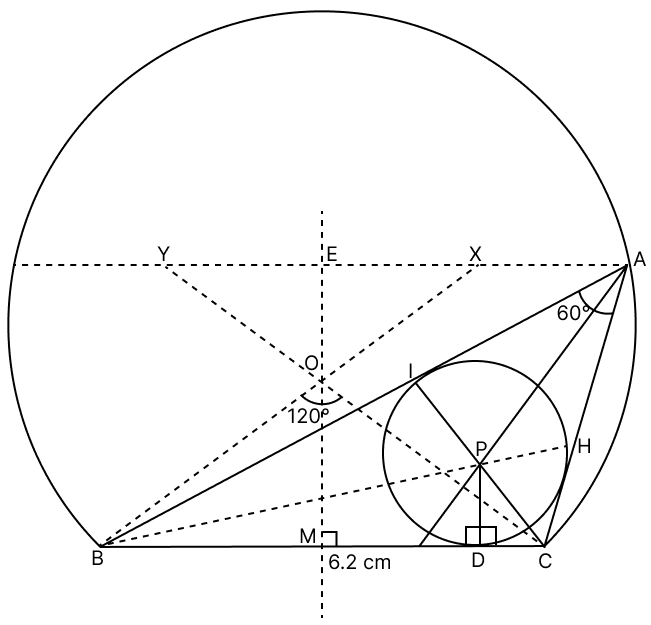
Using ruler and compasses only construct a ΔABC in which BC = 6.2 cm, ∠A = 60° and the altitude through A is 2.6 cm. Draw the incircle of the triangle.

Show SolutionHide Solution↓

Steps of construction :

  1. Draw a line segment BC = 6.2 cm.

  2. Construct perpendicular bisector of BC, intersecting BC at point M.

  3. At point B and C, construct an angle of 30°, ∠XBC = 30° and ∠YCB = 30°.

  4. Let this rays XB and CY intersect at O. With center as O and radius as OB, draw major arc.

  5. From M, draw an arc of radius 2.6 cm on perpendicular bisector of BC mark it as E.

  6. Draw a line parallel to BC passing through E, which intersect major arc at A.

  7. Join AB and AC. Hence, ABC is the required triangle.

  8. Construct the angle bisector BH and CI of ∠ABC and ∠ACB respectively.

  9. Let the two angle bisectors intersect at point P.

  10. Draw PD perpendicular to BC. With P as centre and PD as radius, draw a circle.

Using ruler and compasses only construct a ΔABC in which BC = 6.2 cm, ∠A = 60° and the altitude through A is 2.6 cm. Draw the incircle of the triangle. Tangent Properties of Circles, RSA Mathematics Solutions ICSE Class 10.
17Exercise 20B

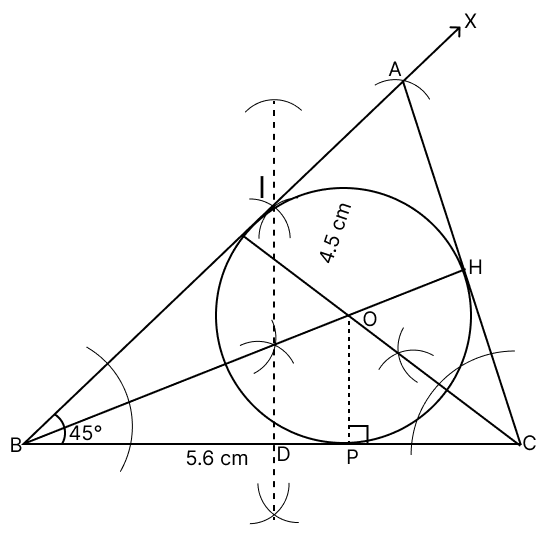
Draw a ΔABC in which BC = 5.6 cm, ∠B = 45° and the median AD from A to BC is 4.5 cm. Inscribe a circle in it.

Show SolutionHide Solution↓

Steps of construction :

  1. Draw a line segment BC = 5.6 cm.

  2. Construct perpendicular bisector of BC which intersect BC at D.

  3. At B, construct angle ∠XBC = 45°.

  4. From D, with radius 4.5 cm draw an arc that intersect BX, mark it as A.

  5. Join AB and AC. Hence, ABC is the required triangle.

  6. Construct the angle bisector BH and CI of ∠ABC and ∠ACB respectively.

  7. Let the two angle bisectors intersect at point O.

  8. Draw OP perpendicular to BC. With O as centre and OP as radius, draw a circle.

Draw a ΔABC in which BC = 5.6 cm, ∠B = 45° and the median AD from A to BC is 4.5 cm. Inscribe a circle in it. Tangent Properties of Circles, RSA Mathematics Solutions ICSE Class 10.
18Exercise 20B

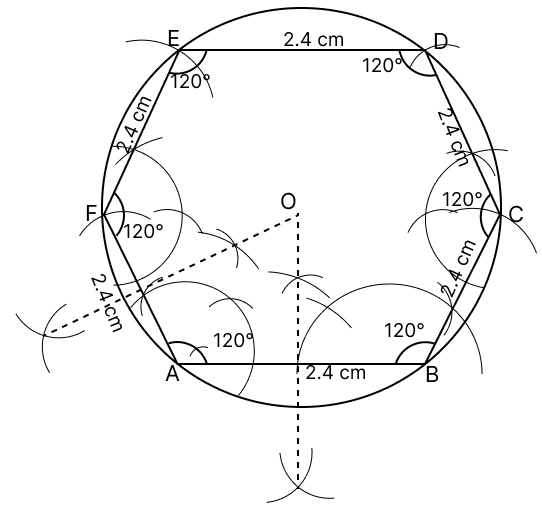
Draw a regular hexagon of side 2.4 cm. Circumscribe a circle to it.

Show SolutionHide Solution↓

Steps of construction :

  1. We know that each angle in a regular hexagon = 120°.

  2. Draw a line segment AB = 2.4 cm.

  3. At A and B draw rays making an angle of 120° each and cut off AF = BC = 2.4 cm.

  4. At F and C, draw rays making angle of 120° each and cut off EF = CD = 2.4 cm.

  5. Join ED. Hence, ABCDEF is the required hexagon.

  6. Draw the perpendicular bisectors of AB and AF which intersect each other at O.

  7. With O as center and OA as radius draw a circle which will pass through all the vertices of the regular hexagon.

Hence, above is the required circumcircle of regular hexagon.

FDraw a regular hexagon of side 2.4 cm. Circumscribe a circle to it. Tangent Properties of Circles, RSA Mathematics Solutions ICSE Class 10.

Hence, ABCDEF is the required hexagon.

19Exercise 20B

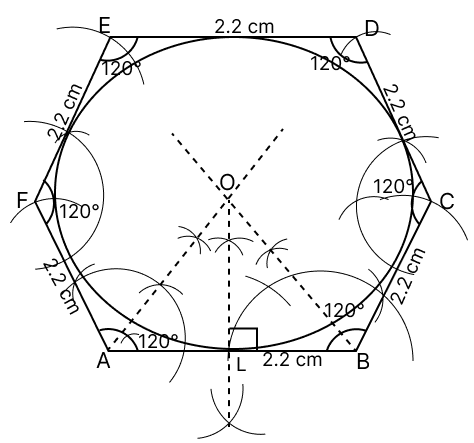
Draw a regular hexagon of side 2.2 cm. Inscribe a circle in it.

Show SolutionHide Solution↓

We know that each angle in a regular hexagon = 120°.

  1. Draw a line segment AB = 2.2 cm.

  2. At A and B draw rays making an angle of 120° each and cut off AF = BC = 2.2 cm.

  3. At F and C, draw rays making angle of 120° each and cut off EF = CD = 2.2 cm.

  4. Join ED. Hence, ABCDEF is the required hexagon.

  5. Draw the angle bisectors of A and B which intersect each other at O.

  6. Draw OL ⊥ AB.

  7. With centre O and radius OL, draw a circle which touches the sides of hexagon. This is the required incircle of hexagon ABCDEF.

Draw a regular hexagon of side 2.2 cm. Inscribe a circle in it. Tangent Properties of Circles, RSA Mathematics Solutions ICSE Class 10.

Hence, ABCDEF is required hexagon.

20Exercise 20B

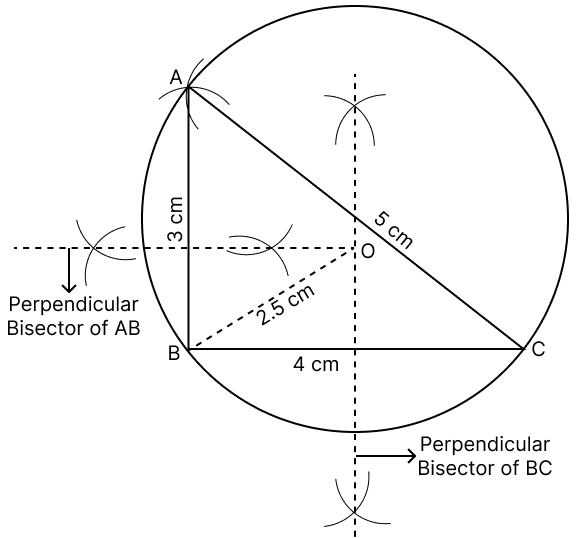
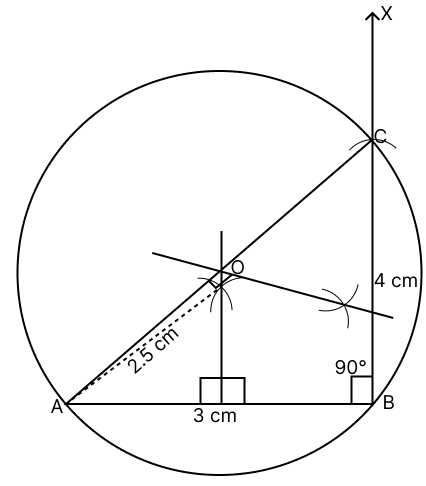
Using ruler and compass, construct a triangle ABC, where AB = 3 cm, BC = 4 cm and ∠ABC = 90°. Hence, construct a circle circumscribing the triangle ABC. Measure and write down the radius of the circle.

Show SolutionHide Solution↓

Steps of construction :

  1. Draw a line segment AB = 3 cm.

  2. From B, draw a ray BX such that ∠XBA = 90°.

  3. From B draw an arc of 4 cm cutting XB at C.

  4. Join AC. ABC is the required triangle.

  5. Construct perpendicular bisectors of AB and AC, such that they intersect at O.

  6. With O as center and OA as radius draw a circle passing through A, B and C.

  7. Measure OA.

Hence, above is the required circumcircle of triangle ABC.

Using ruler and compass, construct a triangle ABC, where AB = 3 cm, BC = 4 cm and ∠ABC = 90°. Hence, construct a circle circumscribing the triangle ABC. Measure and write down the radius of the circle. Tangent Properties of Circles, RSA Mathematics Solutions ICSE Class 10.

On measuring we get OA = 2.5 cm.

Hence,the length of the radius of the circle = 2.5 cm.

11 Mark · Multiple Choice Questions

The point of concurrence of the angle bisectors of a triangle is called the ............... of the triangle.

Show SolutionHide Solution↓

The point of concurrence of the angle bisectors of a triangle is called the incenter of the triangle.

Hence, option 2 is the correct option.

21 Mark · Multiple Choice Questions

Which of the following points is equidistant from all the three sides of a triangle?

Show SolutionHide Solution↓

The incentre is the point of intersection of the angle bisectors of a triangle, and it is equidistant from all the three sides of the triangle.

Hence, option 2 is the correct option.

31 Mark · Multiple Choice Questions

Which of the following statements is not true?

Show SolutionHide Solution↓

At a given point on a circle, one and only one tangent can be drawn, so statement 1 is true. From a given external point, exactly two tangents can be drawn, so statement 2 is true. However, a tangent at a given point on a circle can be drawn even without knowing its centre — as shown in the construction without using the centre (Exercise 20A, Question 3). So, statement 3 is not true.

Hence, option 3 is the correct option.

41 Mark · Multiple Choice Questions

The point of concurrence of the perpendicular bisectors of the sides of a triangle is called the ________ of the triangle.

Show SolutionHide Solution↓

The perpendicular bisectors of the sides of a triangle are concurrent, and their point of concurrence is the circumcentre of the triangle. The circumcentre is equidistant from the three vertices and is the centre of the circumcircle.

Hence, option 4 is the correct option.

1Assertion–Reason Questions

Assertion (A): The point which is equidistant from three non-collinear points D, E and F is the circumcentre of ΔDEF.

Reason (R): The incentre of a triangle is the point where the bisectors of the angles intersect.

Show SolutionHide Solution↓

The circumcentre of a triangle is equidistant from its three vertices. So, the point which is equidistant from the three non-collinear points D, E and F is the circumcentre of ΔDEF.

∴ Assertion (A) is true.

The incentre of a triangle is the point of intersection of its angle bisectors.

∴ Reason (R) is true.

Reason (R) states a property of the incentre, which is unrelated to the property of the circumcentre stated in the Assertion. So, R is not the correct explanation of A.

Hence, option 2 is the correct option.

1Analytical and Application Based Questions

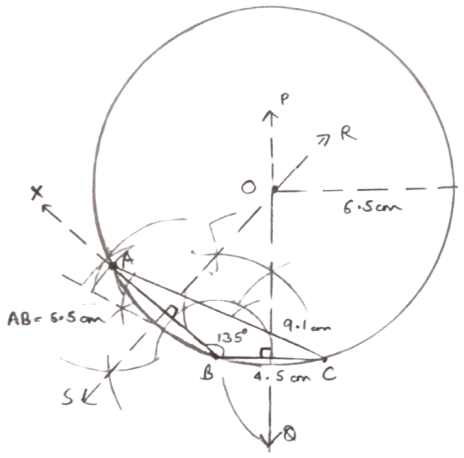
Use ruler and compass to answer this question. Construct a triangle ABC where AB = 5.5 cm, BC = 4.5 cm and angle ABC = 135°. Construct the circumcircle to the triangle ABC. Measure and write down the length of AC.

Show SolutionHide Solution↓

Steps of construction :

  1. Draw a line segment BC = 4.5 cm

  2. Construct XB such that ∠XBC = 135°.

  3. Cut AB = 5.5 cm from XB.

  4. Join and measure AC.

  5. Draw PQ and RS the perpendicular bisectors of BC and AB.

  6. Mark point O the intersection of PQ and RS.

  7. With O as center and radius as OA, draw a circle touching the vertices A, B and C.

Use ruler and compass to answer this question. Construct a triangle ABC where AB = 5.5 cm, BC = 4.5 cm and angle ABC = 135°. Construct the circumcircle to the triangle ABC. Measure and write down the length of AC. Maths Competency Focused Practice Questions Class 10 Solutions.

On measuring AC = 9.1 cm and radius = 6.5 cm.

2Analytical and Application Based Questions

Use a ruler and a compass for this question.

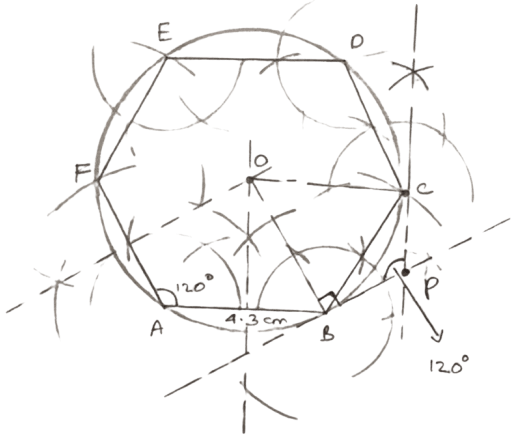
Construct a regular hexagon ABCDEF of side 4.3 cm and construct its circumscribed circle. Also, construct tangents to the circumscribed circle at points B and C which meets each other at point P. Measure and record ∠BPC.

Show SolutionHide Solution↓

We know that each angle in a regular hexagon = 120°.

  1. Draw a line segment AB = 4.3 cm.

  2. At A and B draw rays making an angle of 120° each and cut off AF = BC = 4.3 cm.

  3. At F and C, draw rays making angle of 120° each and cut off EF = CD = 4.3 cm.

  4. Join ED. Hence, ABCDEF is the required hexagon.

  5. Draw the perpendicular bisector of AB and AF. Let these bisectors meet at the point O.

  6. With O as center and radius equal to OA or OB draw a circle which passes through the vertices of the hexagon. This is the required circumcircle of hexagon ABCDEF.

  7. Draw the radius OB and OC.

  8. At point B, construct a line perpendicular to OB. This line is the tangent at B.

  9. At point C, construct a line perpendicular to OC. This line is the tangent at C.

  10. The two tangents will intersect at point P.

  11. Measure ∠BPC.

Construct a regular hexagon ABCDEF of side 4.3 cm and construct its circumscribed circle. Also, construct tangents to the circumscribed circle at points B and C which meets each other at point P. Measure and record ∠BPC. Maths Competency Focused Practice Questions Class 10 Solutions.

Hence, ∠BPC = 120°.

3Analytical and Application Based Questions

Use a ruler and a compass for this question.

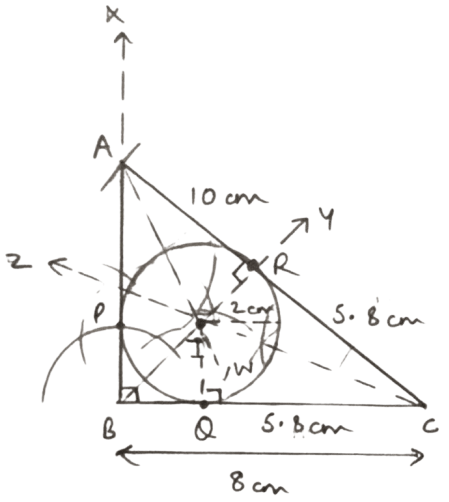
(a) Construct a triangle ABC such that BC = 8 cm, AC = 10 cm and ∠ABC = 90°.

(b) Construct an incircle to this triangle. Mark the centre as I.

(c) Measure and write the length of the in-radius.

(d) Measure and write the length of the tangents from vertex C to the incircle.

(e) Mark points P, Q and R where the incircle touches the sides AB, BC, and AC of the triangle respectively. Write the relationship between ∠RIQ and ∠QCR.

Show SolutionHide Solution↓

Steps of construction :

  1. Draw a line segment BC = 8 cm.

  2. Draw BX perpendicular to BC.

  3. With C as center and radius = 10 cm, draw an arc cutting BX at A.

  4. Join AB and AC.

  5. Draw AW, BY and CZ the angle bisectors of A, B and C respectively.

  6. Mark the point of intersection as I.

  7. Draw IR perpendicular to side AC.

  8. With I as center and radius IR draw a circle, which is the required incircle.

  9. Mark points P, Q and R where the incircle touches the sides AB, BC, and AC of the triangle respectively.

  10. Measure CQ and CR.

Construct a triangle ABC such that BC = 8 cm, AC = 10 cm and ∠ABC = 90°. Maths Competency Focused Practice Questions Class 10 Solutions.

From figure,

⇒ ∠IRC = ∠IQC = 90° (The radius from the center of the circle to the point of tangency is perpendicular to the tangent line.)

⇒ ∠RCI = ∠QCI = $\frac{∠C}{2}$ (As CZ is angle bisector)

In △ IRC,

⇒ ∠RIC = 180° - ∠RCI - ∠IRC [∵ Sum of ∠'s in a Δ = 180°]

⇒ ∠RIC = 180° - $\frac{∠C}{2}$ - 90°

⇒ ∠RIC = 90° - $\frac{∠C}{2}$ ............(1)

In △ IQC,

⇒ ∠QIC = 180° - ∠IQC - ∠ICQ [∵ Sum of ∠'s in a Δ = 180°]

⇒ ∠QIC = 180° - 90° - $\frac{∠C}{2}$

⇒ ∠QIC = 90° - $\frac{∠C}{2}$ ............(2)

Adding equations (1) and (2), we get :

⇒ ∠RIC + ∠QIC = 90° - $\frac{∠C}{2}$ + 90° - $\frac{∠C}{2}$

⇒ ∠RIQ = 180° - ∠C

⇒ ∠RIQ = 180° - ∠RCQ

⇒ ∠RIQ + ∠RCQ = 180°.

Hence, ∠RIQ + ∠QCR = 180°.

Press ↓ to reveal a solution and move to the next question. Back to RS Aggarwal Mathematics.

Free sample bank