Reflection

ICSE Class 10 Mathematics · ML Aggarwal Mathematics · 53 solved questions

Exercise
Marks
1Exercise 10

Find the coordinates of the images of the following points under reflection in the x-axis :

(i) (2, -5)

(ii) $\Big(-\frac{3}{2}, -\frac{1}{2}\Big)$

(iii) (-7, 0).

Show SolutionHide Solution↓

(i) We know that,

Rule to find reflection of a point in x-axis :

  1. Retain the abscissa i.e. x-coordinate.
  2. Change the sign of ordinate i.e. y-coordinate.

∴ Point P'(2, 5) is the image on reflection.

Hence, (2, 5) is the image of the point (2, -5) on reflection in x-axis.

(ii) We know that,

Rule to find reflection of a point in x-axis :

  1. Retain the abscissa i.e. x-coordinate.
  2. Change the sign of ordinate i.e. y-coordinate.

∴ Point P'$\Big(-\frac{3}{2}, \frac{1}{2}\Big)$ is the image on reflection.

Hence, $\Big(-\frac{3}{2}, \frac{1}{2}\Big)$ is the image of the point $\Big(-\frac{3}{2}, -\frac{1}{2}\Big)$ on reflection in x-axis.

(iii) We know that,

Rule to find reflection of a point in x-axis :

  1. Retain the abscissa i.e. x-coordinate.
  2. Change the sign of ordinate i.e. y-coordinate.

∴ Point P'(-7, 0) is the image on reflection.

Hence, (-7, 0) is the image of the point (-7, 0) on reflection in x-axis.
2Exercise 10

Find the coordinates of the images of the following points under reflection in the y-axis :

(i) (2, -5)

(ii) $\Big(-\frac{3}{2}, \frac{1}{2}\Big)$

(iii) (0, -7).

Show SolutionHide Solution↓

(i) We know that,

Rule to find reflection of a point in y-axis :

  1. Change the sign of abscissa i.e. x-coordinate.
  2. Retain the ordinate i.e. y-coordinate.

∴ Point P'(-2, -5) is the image on reflection.

Hence, (-2, -5) is the image of the point (2, -5) on reflection in y-axis.

(ii) We know that,

Rule to find reflection of a point in y-axis :

  1. Change the sign of abscissa i.e. x-coordinate.
  2. Retain the ordinate i.e. y-coordinate.

∴ Point P'$(\frac{3}{2}, \frac{1}{2})$ is the image on reflection.

Hence, $(\frac{3}{2}, \frac{1}{2})$ is the image of the point $(-\frac{3}{2}, -\frac{1}{2})$ on reflection in y-axis.

(iii) We know that,

Rule to find reflection of a point in y-axis :

  1. Change the sign of abscissa i.e. x-coordinate.
  2. Retain the ordinate i.e. y-coordinate.

∴ Point P'(0, -7) is the image on reflection.

Hence, (0, -7) is the image of the point (0, -7) on reflection in y-axis.

3Exercise 10

Find the coordinates of the images of the following points under reflection in the origin :

(i) (2, -5)

(ii) $\Big(-\frac{3}{2}, -\frac{1}{2}\Big)$

(iii) (0, 0).

Show SolutionHide Solution↓

(i) We know that,

Rules to find the reflection of a point in the origin :

  1. Change the sign of abscissa i.e. x-coordinate.
  2. Change the sign of ordinate i.e. y-coordinate.

∴ Point P'(-2, 5) is the image on reflection.

Hence, (-2, 5) is the image of the point (2, -5) on reflection in origin.

(ii) We know that,

Rules to find the reflection of a point in the origin :

  1. Change the sign of abscissa i.e. x-coordinate.
  2. Change the sign of ordinate i.e. y-coordinate.

∴ Point P'$(\frac{3}{2}, \frac{1}{2})$ is the image on reflection.

Hence, $(\frac{3}{2}, \frac{1}{2})$ is the image of the point $(-\frac{3}{2}, -\frac{1}{2})$ on reflection in origin.

(iii) We know that,

Rules to find the reflection of a point in the origin :

  1. Change the sign of abscissa i.e. x-coordinate.
  2. Change the sign of ordinate i.e. y-coordinate.

∴ Point P'(0, 0) is the image on reflection.

Hence, (0, 0) is the image of the point (0, 0) on reflection in origin.

4Exercise 10

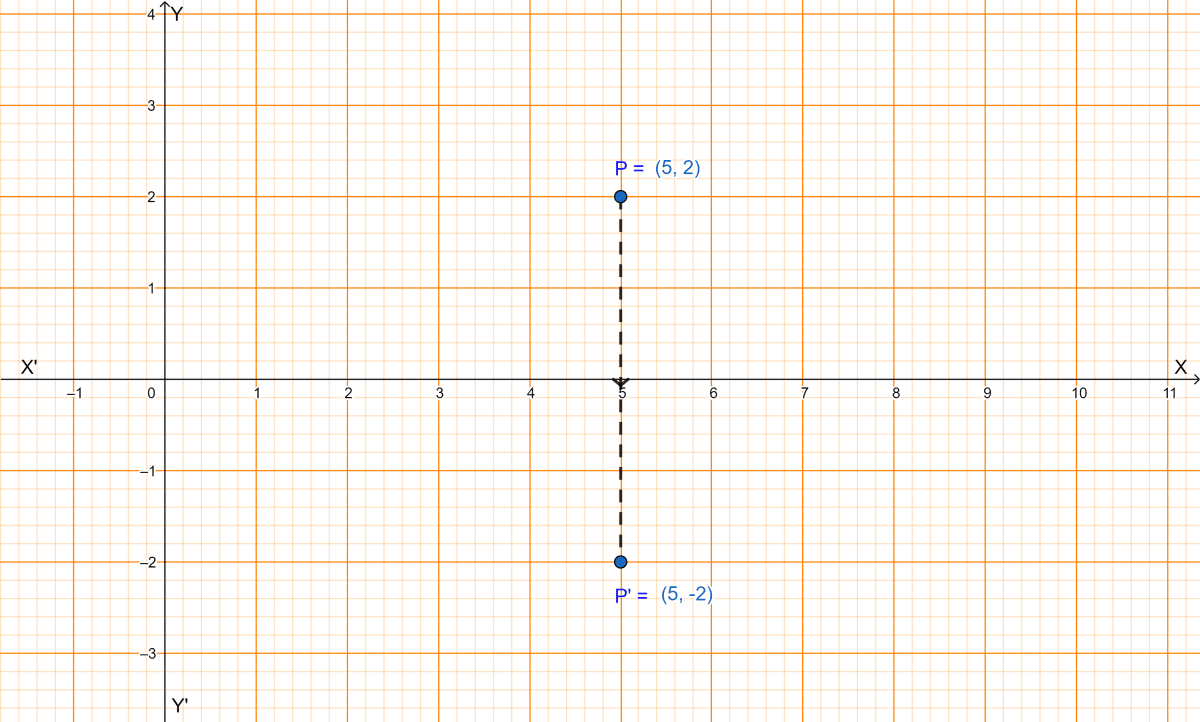
The image of a point P under reflection in the x-axis is (5, -2). Write down the coordinates of P.

Show SolutionHide Solution↓

Since, (5, -2) is the image of P under reflection in x-axis, from graph we get,

The image of a point P under reflection in the x-axis is (5, -2). Write down the coordinates of P. Reflection, ML Aggarwal Understanding Mathematics Solutions ICSE Class 10.

The coordinates of P are (5, 2).

5Exercise 10

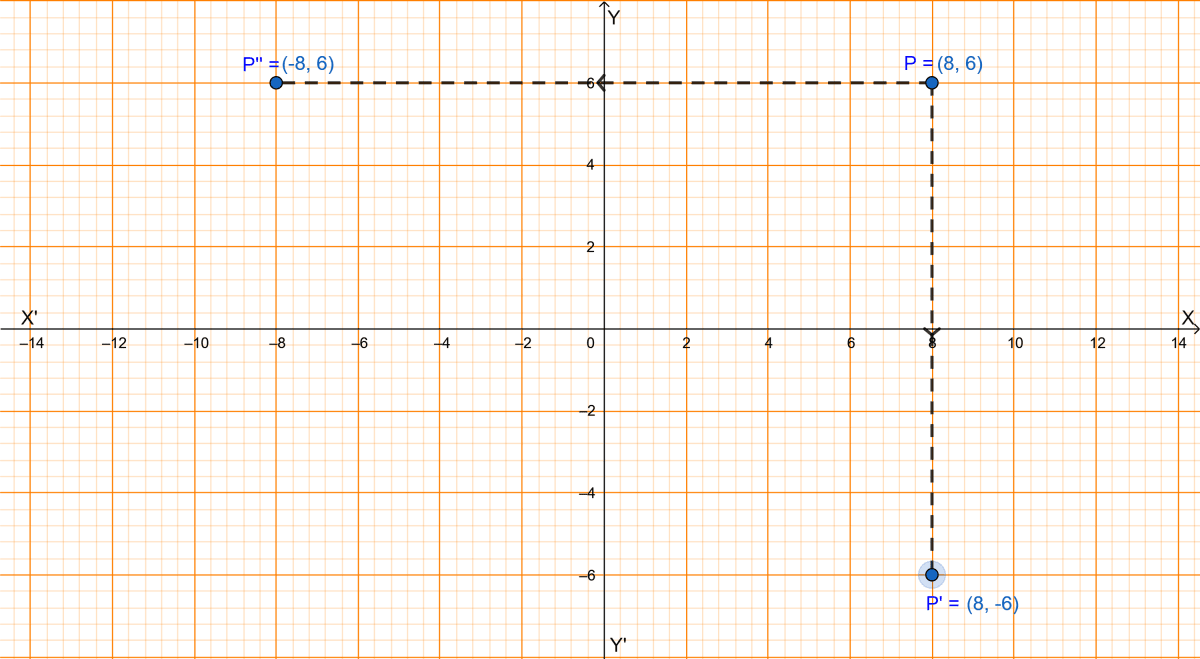
A point P is reflected in the x-axis. Coordinates of its image are (8, -6).

(i) Find the coordinates of P.

(ii) Find the coordinates of the image of P under reflection in the y-axis.

Show SolutionHide Solution↓

(i) Since, (8, -6) is the image of P under reflection in x-axis, let this point be P' so from graph we get,

A point P is reflected in the x-axis. Coordinates of its image are (8, -6). Find the coordinates of P. Find the coordinates of the image of P under reflection in the y-axis. Reflection, ML Aggarwal Understanding Mathematics Solutions ICSE Class 10.

The coordinates of P are (8, 6).

(ii) We know that,

Rule to find reflection of a point in y-axis :

  1. Change the sign of abscissa i.e. x-coordinate.
  2. Retain the ordinate i.e. y-coordinate.

∴ Point P''(-8, 6) is the image on reflection.

Hence, (-8, 6) is the image of the point (8, 6) on reflection in y-axis.

6Exercise 10

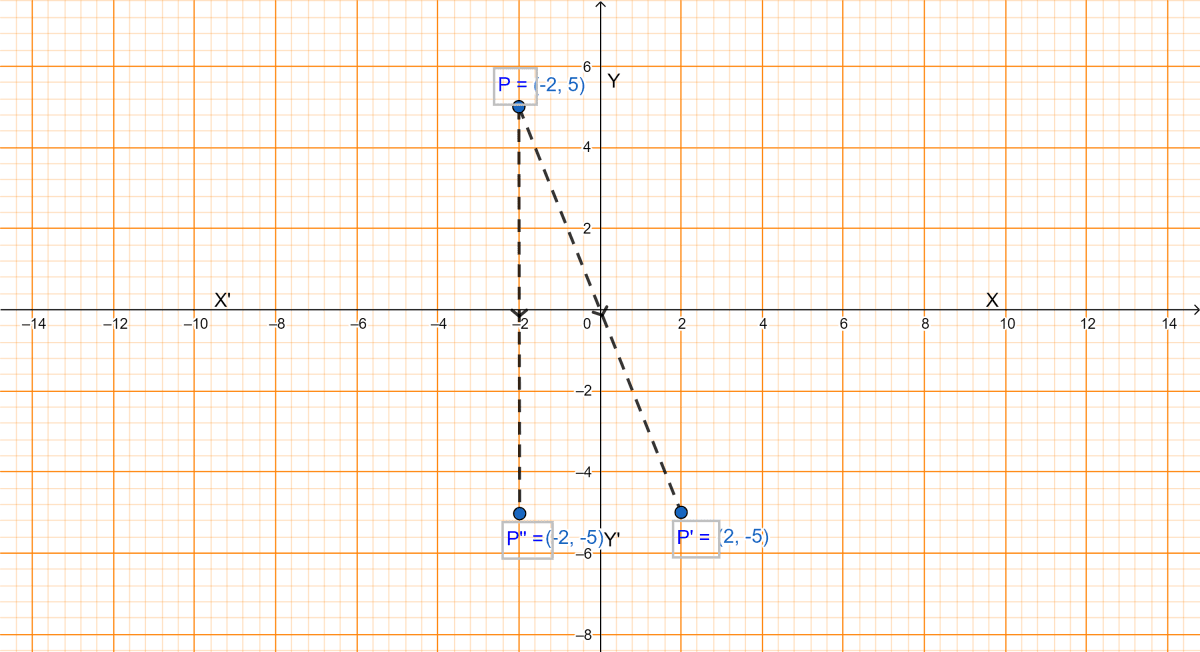
A point P is reflected in the origin. Coordinates of its image are (2, -5). Find

(i) the coordinates of P.

(ii) the coordinates of the image of P in the x-axis.

Show SolutionHide Solution↓

(i) Since, (2, -5) is the image of P under reflection in origin, let this point be P' so from graph we get,

A point P is reflected in the origin. Coordinates of its image are (2, -5). Find (i) the coordinates of P (ii) the coordinates of the image of P in the x-axis. Reflection, ML Aggarwal Understanding Mathematics Solutions ICSE Class 10.

The coordinates of P are (-2, 5).

(ii) We know that,

Rule to find reflection of a point in x-axis :

  1. Retain the abscissa i.e. x-coordinate.
  2. Change the sign of ordinate i.e. y-coordinate.

∴ Point P''(-2, -5) is the image on reflection.

Hence, P''(-2, -5) is the image of the point P(-2, 5) on reflection in x-axis.
7(i)Exercise 10

The point P(2, 3) is reflected in the line x = 4 to the point P'. Find the coordinates of the point P'.

Show SolutionHide Solution↓

We know that the reflection of the point (x, y) in the line x = a is the point (-x + 2a, y).

∴ The image of the point P(2, 3) under reflection in the line x = 4 is the point P'(-2 + 2 × 4, 3) i.e., the point P'(6, 3).

The coordinates of the point P' is (6, 3).

7(ii)Exercise 10

Find the image of the point P(1, -2) in the line x = -1.

Show SolutionHide Solution↓

We know that the reflection of the point (x, y) in the line x = a is the point (-x + 2a, y).

∴ The image of the point P(1, -2) under reflection in the line x = -1 is the point P'(-1 + 2 × (-1), -2) i.e., the point P'(-3, -2).

The coordinates of the point P' is (-3, -2).

8(i)Exercise 10

The point P(2, 4) on reflection in the line y = 1 is mapped onto P'. Find the coordinates of P'.

Show SolutionHide Solution↓

We know that the reflection of the point (x, y) in the line y = a is the point (x, -y + 2a).

∴ The image of the point P(2, 4) under reflection in the line y = 1 is the point P'(2, -4 + 2 × 1) i.e., the point P'(2, -2).

The coordinates of the point P' is (2, -2).

8(ii)Exercise 10

Find the image of the point P(-3, -5) in the line y = -2.

Show SolutionHide Solution↓

We know that the reflection of the point (x, y) in the line y = a is the point (x, -y + 2a).

∴ The image of the point P(-3, -5) under reflection in the line y = -2 is the point P'(-3, -(-5) + 2 × (-2)) i.e., the point P'(-3, 1).

Hence, the image of the point (-3, -5) in y = -2 is (-3, 1).

9Exercise 10

The point P(-4, -5) on reflection in y-axis is mapped on P'. The point P' on reflection in the origin is mapped on P''. Find the coordinates of P' and P''. Write down a single transformation that maps P onto P''.

Show SolutionHide Solution↓

We know that,

Rule to find reflection of a point in y-axis :

  1. Change the sign of abscissa i.e. x-coordinate.
  2. Retain the ordinate i.e. y-coordinate.

∴ Point P(-4, -5) becomes P'(4, -5) on reflection in y-axis.

We know that,

Rules to find the reflection of a point in the origin :

  1. Change the sign of abscissa i.e. x-coordinate.
  2. Change the sign of ordinate i.e. y-coordinate.

∴ Point P'(4, -5) becomes P''(-4, 5) on reflection in origin.

On reflecting the point P(-4, -5) in x-axis, it becomes (-4, 5) which are the coordinates of P''.

Hence, the single transformation that maps P(-4, -5) onto P''(-4, 5) is reflection of point P in x-axis.

10Exercise 10

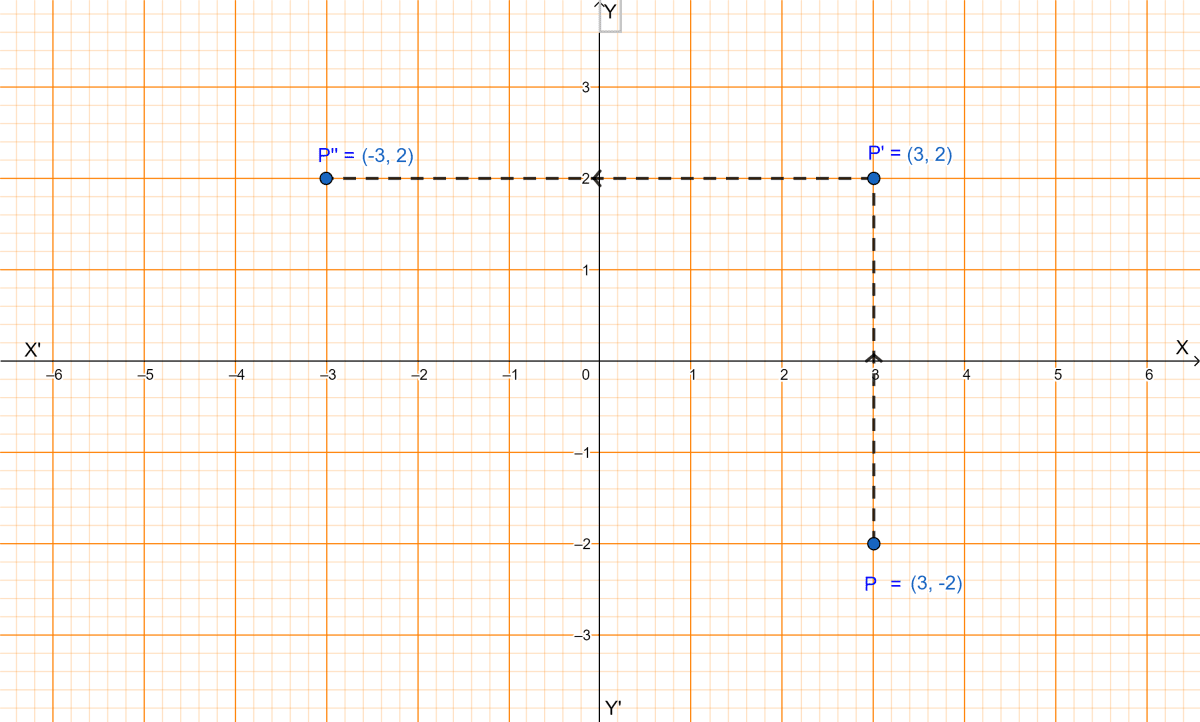
Write down the coordinates of the image of the point (3, -2) when:

(i) reflected in the x-axis.

(ii) reflected in the y-axis.

(iii) reflected in the x-axis followed by reflection in the y-axis.

(iv) reflected in the origin.

Show SolutionHide Solution↓

(i) We know that,

Rule to find reflection of a point in x-axis :

  1. Retain the abscissa i.e. x-coordinate.
  2. Change the sign of ordinate i.e. y-coordinate.

∴ Point P'(3, 2) is the image on reflection.

Hence, (3, 2) is the image of the point (3, -2) on reflection in x-axis.
(ii) We know that,

Rule to find reflection of a point in y-axis :

  1. Change the sign of abscissa i.e. x-coordinate.
  2. Retain the ordinate i.e. y-coordinate.

∴ Point P'(-3, -2) is the image on reflection.

Hence, (-3, -2) is the image of the point (3, -2) on reflection in y-axis.

(iii) On reflection in x-axis the point P(3, -2) becomes P'(3, 2) which on further reflection in y-axis becomes P''(-3, 2) as shown in the graph.

Write down the coordinates of the image of the point (3, -2) when (i) reflected in the x-axis. (ii) reflected in the y-axis. (iii) reflected in the x-axis followed by reflection in the y-axis. (iv) reflected in the origin. Reflection, ML Aggarwal Understanding Mathematics Solutions ICSE Class 10.

Hence, P''(-3, 2) is the final image after reflections.

(iv) We know that,

Rules to find the reflection of a point in the origin :

  1. Change the sign of abscissa i.e. x-coordinate.
  2. Change the sign of ordinate i.e. y-coordinate.

∴ Point P'(-3, 2) is the image on reflection.

Hence, (-3, 2) is the image of the point (3, -2) on reflection in origin.

11Exercise 10

Find the coordinates of the image of (3, 1) under reflection in x-axis followed by reflection in the line x = 1.

Show SolutionHide Solution↓

We know that,

Rule to find reflection of a point in x-axis :

  1. Retain the abscissa i.e. x-coordinate.
  2. Change the sign of ordinate i.e. y-coordinate.

∴ Point P'(3, -1) is the image on reflection of (3, 1) in x-axis.

We know that the reflection of the point (x, y) in the line x = a is the point (-x + 2a, y).

∴ The image of the point P'(3, -1) under reflection in the line x = 1 is the point P'(-3 + 2 × 1, -1) i.e., the point P'(-1, -1).

Hence, the coordinates of the final image is P''(-1, -1).

12Exercise 10

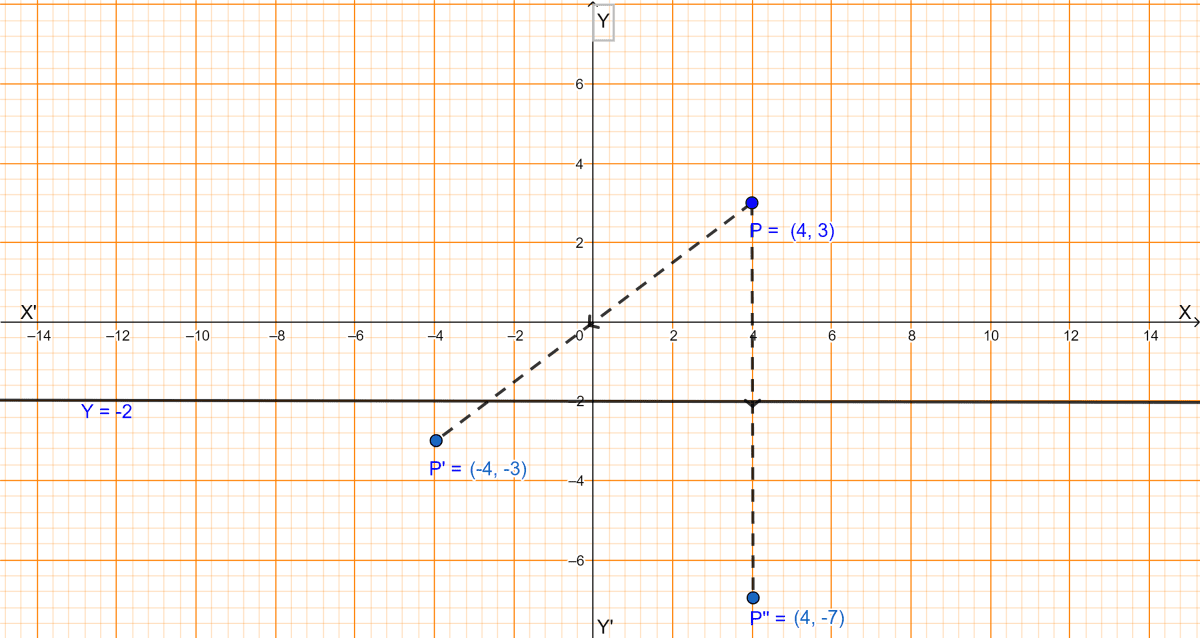
If P'(-4, -3) is the image of a point P under reflection in the origin, find

(i) the coordinates of P.

(ii) the coordinates of the image of P under reflection in the line y = -2.

Show SolutionHide Solution↓

(i) Since, P'(-4, -3) is the image of P under reflection in the origin, from graph P(4, 3).

If P'(-4, -3) is the image of a point P under reflection in the origin, find (i) the coordinates of P. (ii) the coordinates of the image of P under reflection in the line y = -2. Reflection, ML Aggarwal Understanding Mathematics Solutions ICSE Class 10.

Hence, the coordinates of P are (4, 3).

(ii) We know that the reflection of the point (x, y) in the line y = a is the point (x, -y + 2a).

∴ The image of the point P(4, 3) under reflection in the line y = -2 is the point P''(4, -(3) + 2 × (-2)) i.e., the point P''(4, -7).

Hence, the coordinates of P under reflection in the line y = -2 is (4, -7).

13Exercise 10

A point P(a, b) is reflected in the x-axis to P'(2, -3), write down the values of a and b. P'' is the image of P, when reflected in the y-axis. Write down the coordinates of P''. Find the coordinates of P''', when P is reflected in the line, parallel to y-axis such that x = 4.

Show SolutionHide Solution↓

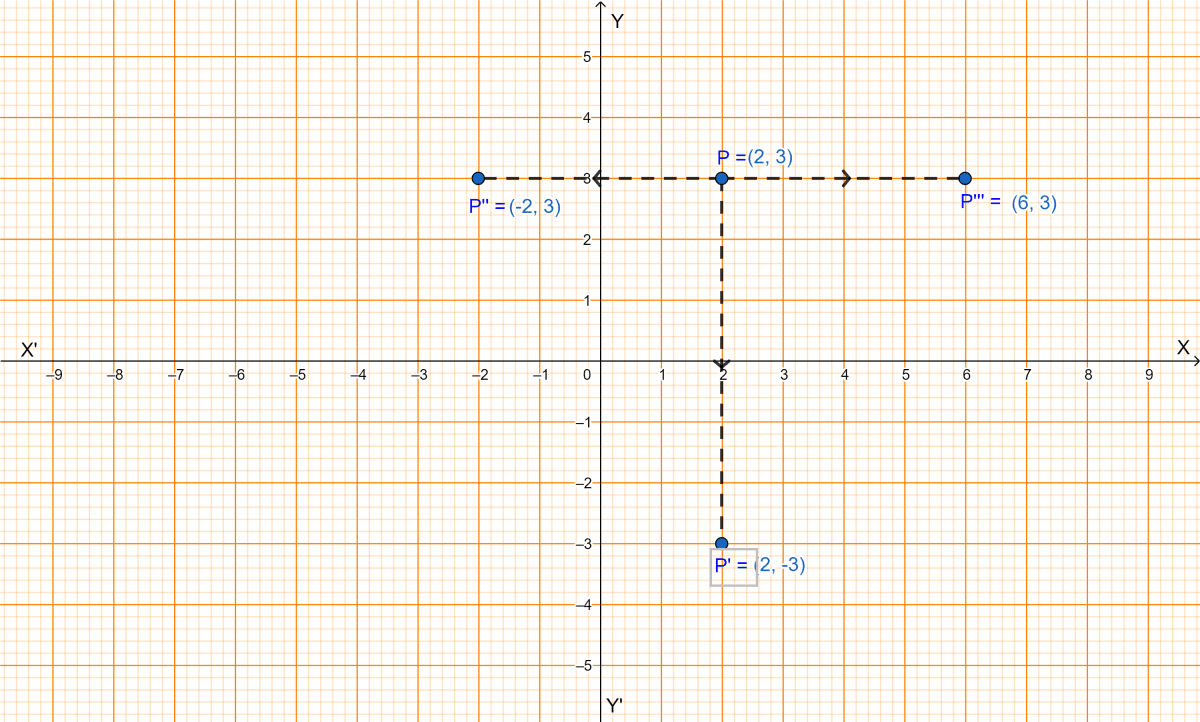
Since, P'(2, -3) is the image of P under reflection in the x-axis, from graph we get P(2, 3).

A point P(a, b) is reflected in the x-axis to P'(2, -3), write down the values of a and b. P'' is the image of P, when reflected in the y-axis. Write down the coordinates of P''. Find the coordinates of P''', when P is reflected in the line, parallel to y-axis such that x = 4. Reflection, ML Aggarwal Understanding Mathematics Solutions ICSE Class 10.

∴ The coordinates of P are (2,3), comparing with P(a, b) we get, a = 2 and b = 3.

We know that,

Rule to find reflection of a point in y-axis :

  1. Change the sign of abscissa i.e. x-coordinate.
  2. Retain the ordinate i.e. y-coordinate.

Since, P'' is image on reflection of P in y-axis.

∴ The coordinates of P'' are (-2,3).

We know that the reflection of the point (x, y) in the line x = a is the point (-x + 2a, y).

∴ The image of the point P(2, 3) under reflection in the line x = 4 is the point P'''(-2 + 2 × 4, 3) i.e the point P'''(6, 3).

Hence, the value of a = 2, b = 3 and the coordinates of P''(-2, 3), P'''(6, 3).

14Exercise 10

(i) Point P(a, b) is reflected in the x-axis to P'(5, -2). Write down the values of a and b.

(ii) P'' is the image of P when reflected in the y-axis. Write down the coordinates of P''.

(iii) Name a single transformation that maps P' into P''.

Show SolutionHide Solution↓

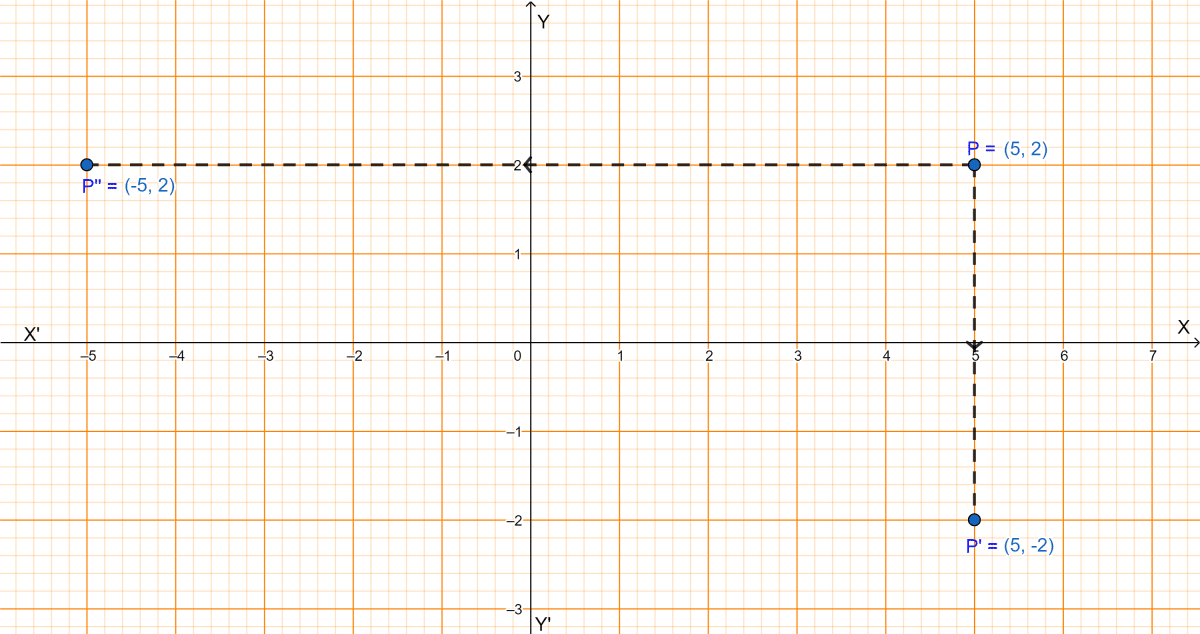
(i) Since, P'(5, -2) is the image of P under reflection in the x-axis, from graph P(5, 2).

Point P(a, b) is reflected in the x-axis to P'(5, -2). Write down the values of a and b. P'' is the image of P when reflected in the y-axis. Write down the coordinates of P''. Name a single transformation that maps P' into P''. Reflection, ML Aggarwal Understanding Mathematics Solutions ICSE Class 10.

∴ The coordinates of P are (5,2), comparing with P(a, b) we get, a = 5 and b = 2.

Hence, the value of a = 5 and b = 2.

(ii) We know that,

Rule to find reflection of a point in y-axis :

  1. Change the sign of abscissa i.e. x-coordinate.
  2. Retain the ordinate i.e. y-coordinate.

Since, P'' is image on reflection of P(5, 2) in y-axis.

Hence, the coordinates of P'' are (-5, 2).

(iii) The single transformation that maps P'(5, -2) into P''(-5, 2) is reflection in the origin.

15Exercise 10

Points A and B have coordinates (2, 5) and (0, 3). Find :

(i) the image A' of A under reflection in the x-axis.

(ii) the image B' of B under reflection in the line AA'.

Show SolutionHide Solution↓

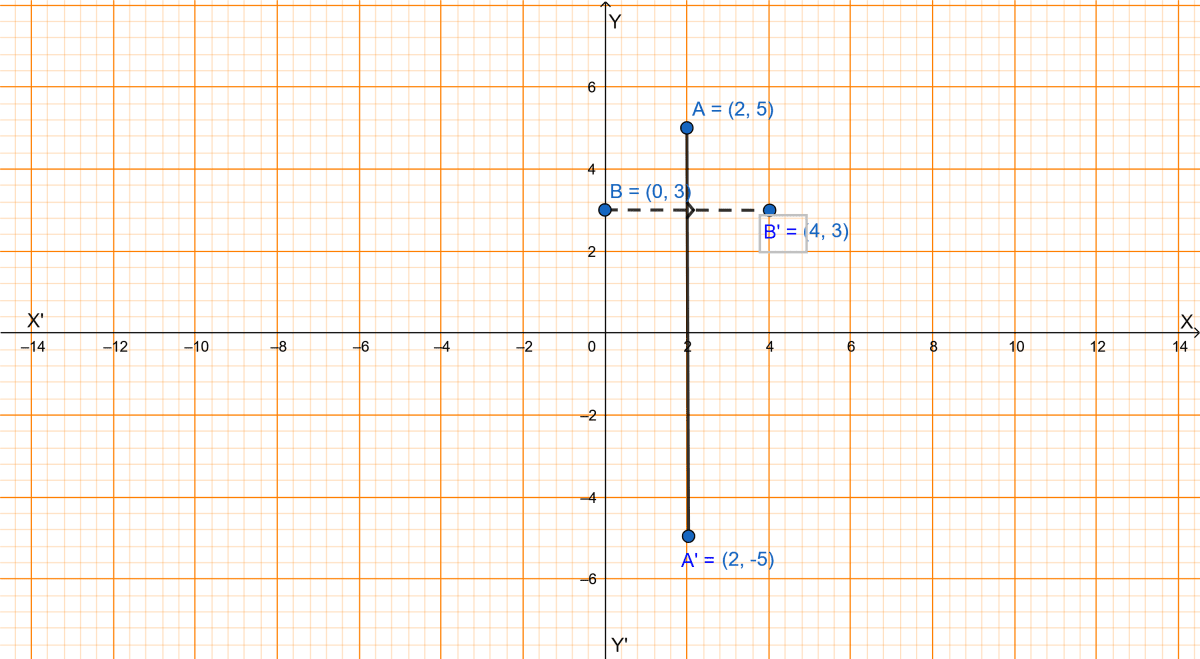
The graph with the points A (2, 5), B (0, 3) and their images A' and B' is shown below:

Points A and B have coordinates (2, 5) and (0, 3). Find (i) the image A' of A under reflection in the x-axis. (ii) the image B' of B under reflection in the line AA'. Reflection, ML Aggarwal Understanding Mathematics Solutions ICSE Class 10.

(i) We know that,

Rule to find reflection of a point in x-axis :

  1. Retain the abscissa i.e. x-coordinate.
  2. Change the sign of ordinate i.e. y-coordinate.

∴ Point A'(2, -5) is the image on reflection of A(2, 5) in x-axis.

The coordinates of A' are (2, -5).

(ii) From graph we get,

The coordinates of B' are (4, 3).

16Exercise 10

Plot the points A(2, -3), B(-1, 2) and C(0, -2) on the graph paper. Draw the triangle formed by reflecting these points in the x-axis. Are the two triangles congruent ?

Show SolutionHide Solution↓

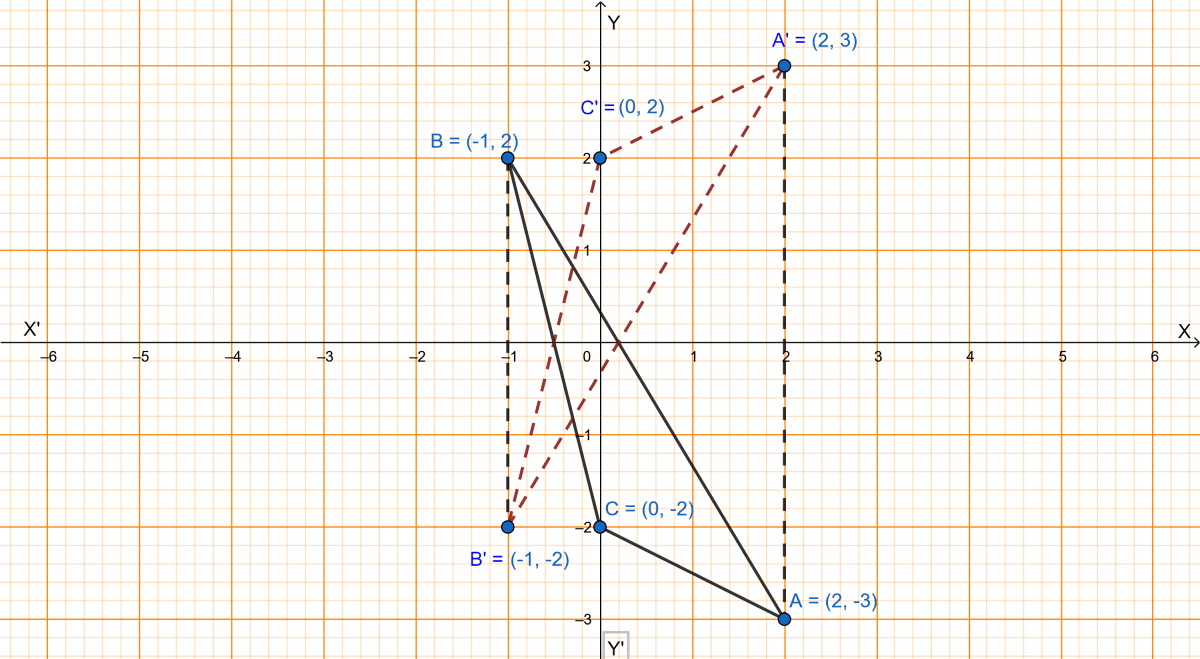
The points A(2, -3), B(-1, 2) and C(0, -2) are plotted on the graph below:

Plot the points A(2, -3), B(-1, 2) and C(0, -2) on the graph paper. Draw the triangle formed by reflecting these points in the x-axis. Are the two triangles congruent? Reflection, ML Aggarwal Understanding Mathematics Solutions ICSE Class 10.

From graph we get,

AB = A'B'
AC = A'C'
BC = B'C'

Hence, △ABC and △A'B'C' are congruent.

17Exercise 10

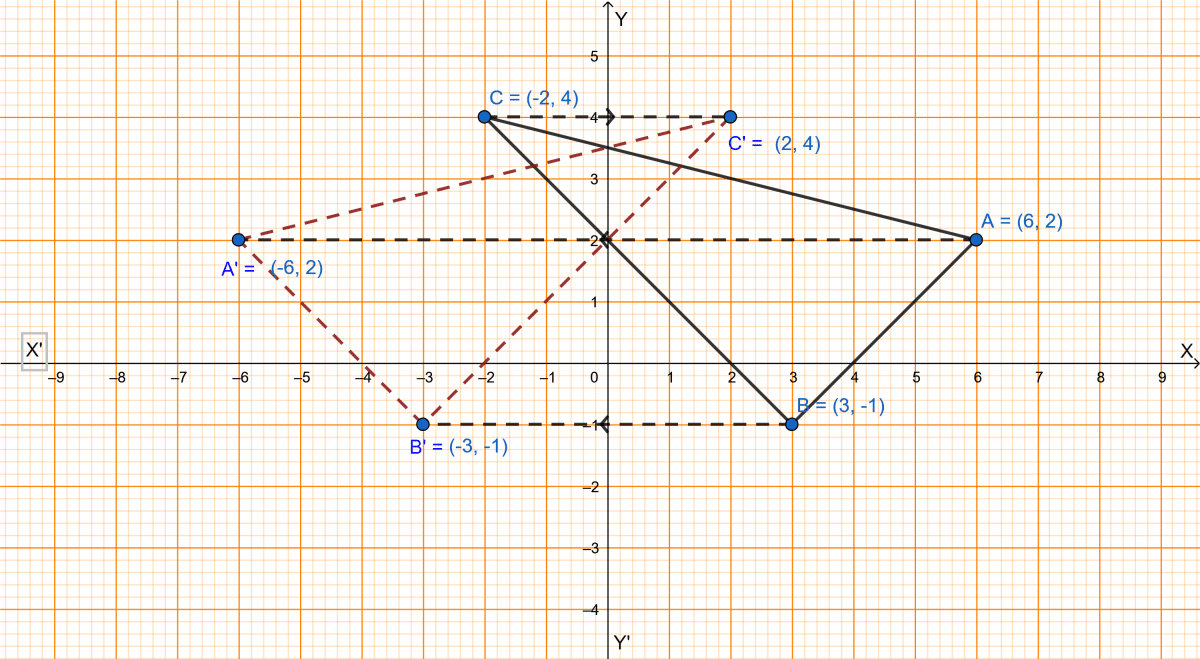
The points (6, 2), (3, -1) and (-2, 4) are the vertices of a right angled triangle. Check whether it remains a right angled triangle after reflection in the y-axis.

Show SolutionHide Solution↓

The right angled triangle with points (6, 2), (3, -1) and (-2, 4) as vertices is plotted below:

The points (6, 2), (3, -1) and (-2, 4) are the vertices of a right angled triangle. Check whether it remains a right angled triangle after reflection in the y-axis. Reflection, ML Aggarwal Understanding Mathematics Solutions ICSE Class 10.

From graph we get,

AB = A'B'
AC = A'C'
BC = B'C'

∴ △ABC and △A'B'C' are congruent.

Since, △ABC is a right angled triangle hence, △A'B'C' is also a right angled triangle.

18Exercise 10

The triangle ABC where A(1, 2), B(4, 8), C(6, 8) is reflected in the x-axis to triangle A'B'C'. The triangle A'B'C' is then reflected in the origin to the triangle A''B''C''. Write down the coordinates of A'', B'', C''. Write down a single transformation that maps ABC onto A''B''C''.

Show SolutionHide Solution↓

We know that,

Rule to find reflection of a point in x-axis :

  1. Retain the abscissa i.e. x-coordinate.
  2. Change the sign of ordinate i.e. y-coordinate.

∴ Coordinates of
⇒ A(1, 2) on reflection in x-axis becomes A'(1, -2).
⇒ B(4, 8) on reflection in x-axis becomes B'(4, -8).
⇒ C(6, 8) on reflection in x-axis becomes C'(6, -8).

We know that,

Rules to find the reflection of a point in the origin :

  1. Change the sign of abscissa i.e. x-coordinate.
  2. Change the sign of ordinate i.e. y-coordinate.

∴ Coordinates of
⇒ A'(1, -2) on reflection in origin becomes A''(-1, 2).
⇒ B'(4, -8) on reflection in origin becomes B''(-4, 8).
⇒ C'(6, -8) on reflection in origin becomes C''(-6, 8).

A single transformation that maps A ⇒ A'', B ⇒ B'' and C ⇒ C'' is reflection in y-axis.

Hence, the coordinates of A'', B'' and C'' are (-1, 2), (-4, 8) and (-6, 8) respectively, and a single transformation that maps ABC to A''B''C'' is reflection in y-axis.

19Exercise 10

The image of a point P on reflection in a line l is a point P'. Describe the location of the line l.

Show SolutionHide Solution↓

Given, P on reflection in a line l is a point P'.

Hence, The line l is the right bisector of the line segment PP'.

20Exercise 10

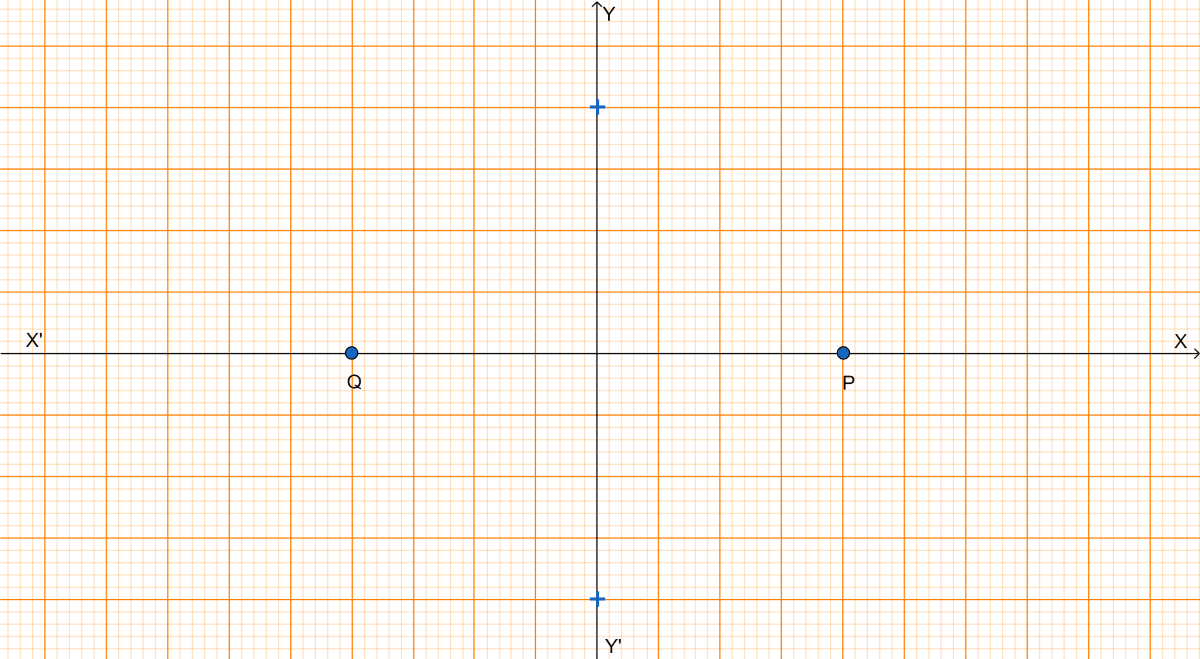
Given two points P and Q, and that (1) the image of P on reflection in y-axis is the point Q and (2) the mid point of PQ is invariant on reflection in x-axis. Locate (i) the x-axis (ii) the y-axis and (iii) the origin.
Show SolutionHide Solution↓

Given, Q is the image of P on reflection in y-axis and midpoint of PQ is invariant on reflection in x-axis.
Given two points P and Q, and that (1) the image of P on reflection in y-axis is the point Q and (2) the mid point of PQ is invariant on reflection in x-axis. Locate (i) the x-axis (ii) the y-axis and (iii) the origin. Reflection, ML Aggarwal Understanding Mathematics Solutions ICSE Class 10.
From graph we get,

(i) x-axis will be the line joining the points P and Q.

(ii) The line perpendicular bisector of the line segment PQ is the y-axis.

(iii) The origin will be the mid point of the line segment PQ.

21Exercise 10

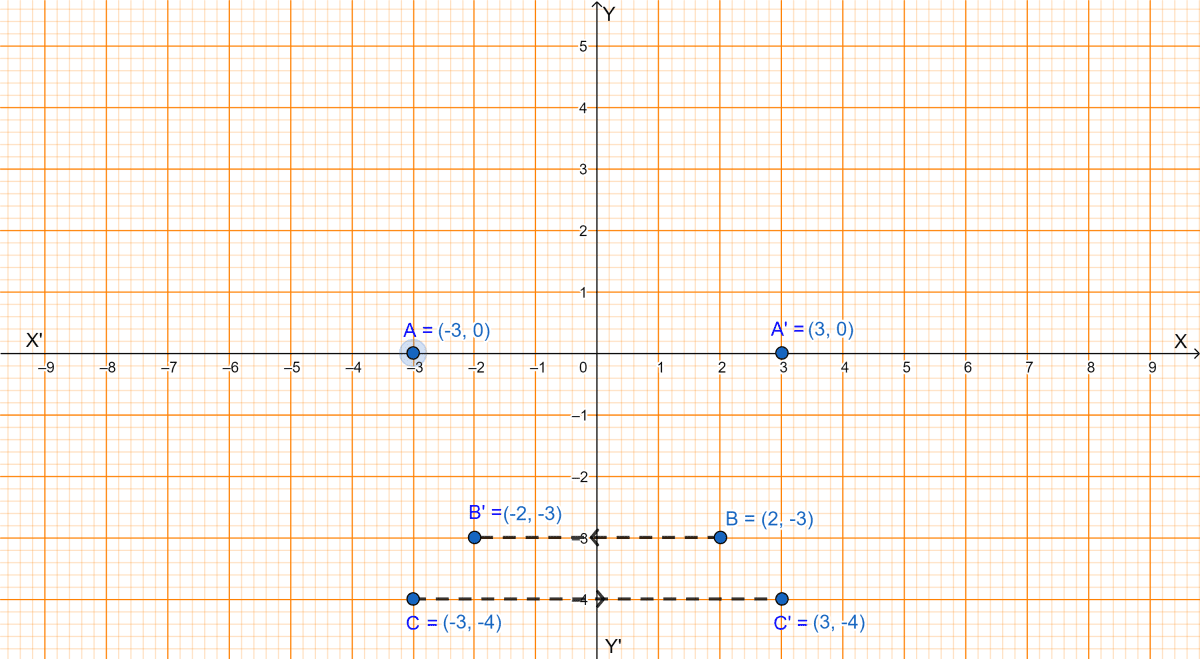
The point (-3, 0) on reflection in a line is mapped as (3, 0) and the point (2, -3) on reflection in the same line is mapped as (-2, -3).

(i) Name the mirror line.

(ii) Write the coordinates of the image of (-3, -4) in the mirror line.

Show SolutionHide Solution↓

Given, the point (-3, 0) is the image of point (3, 0) and (-2, -3) is the image of point (2, -3) in the same line.

Considering graph,

The point (-3, 0) on reflection in a line is mapped as (3, 0) and the point (2, -3) on reflection in the same line is mapped as (-2, -3). (i) Name the mirror line. (ii) Write the coordinates of the image of (-3, -4) in the mirror line. Reflection, ML Aggarwal Understanding Mathematics Solutions ICSE Class 10.

(i) The mirror line is y-axis.

(ii) Since, the mirror line is y-axis. We know that,

Rule to find reflection of a point in y-axis :

  1. Change the sign of abscissa i.e. x-coordinate.
  2. Retain the ordinate i.e. y-coordinate.

Let C be the point (-3, -4).

∴ C' (3, -4) is the image on reflection of C (-3, -4) in y-axis.

Hence, the reflection of (-3, -4) in y-axis is (3, -4).

22Exercise 10

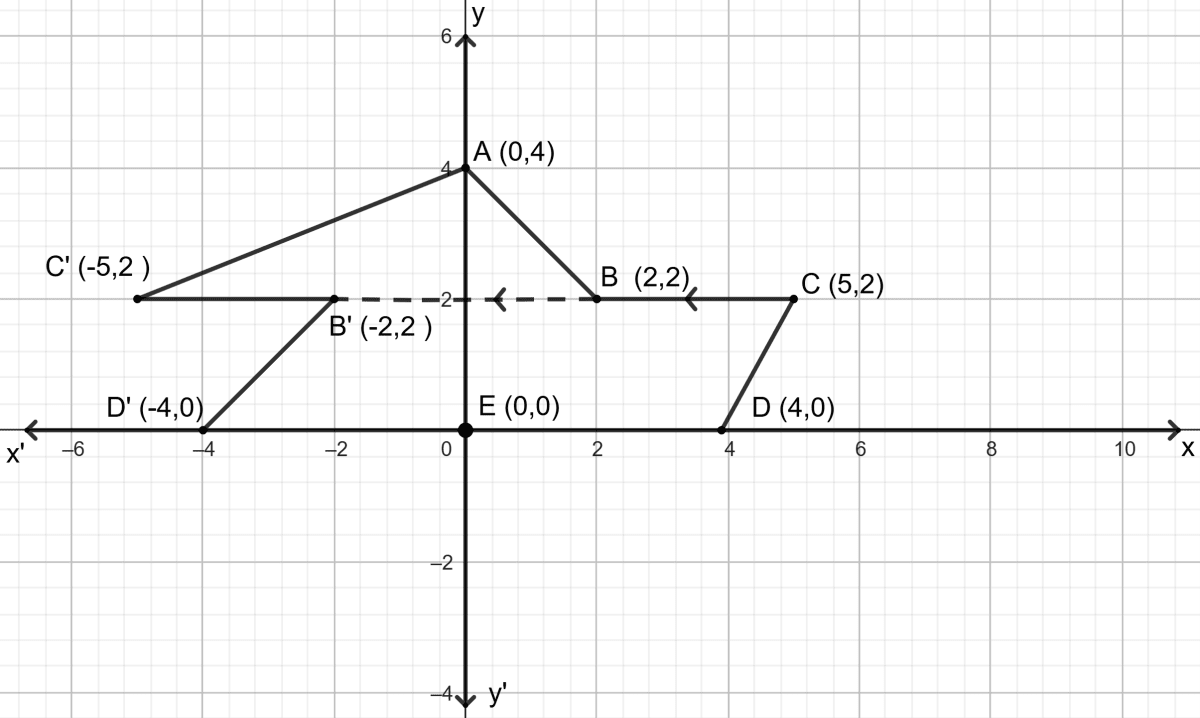
Use graph paper for this question.

Take 2 cm = 1 unit on both the axes.

(i) Plot the points A(0, 4), B(2, 2), C(5, 2) and D(4, 0), E(0, 0) is the origin.

(ii) Reflect B, C, D on the y-axis and name them as B', C' and D' respectively.

(iii) Join the points ABCDD'B'C' and A in order and give a geometrical name to the closed figure.

Show SolutionHide Solution↓

(i) The point A(0, 4), B(2, 2), C(5, 2) and D(4, 0), E(0, 0) are plotted on the graph below :

Use graph paper for this question. Take 1 cm = 1 unit on both the axes Reflection, ML Aggarwal Understanding Mathematics Solutions ICSE Class 10.

(ii) From graph, on reflecting B, C, D on y-axis we get,

B(2, 2) ⇒ B'(-2, 2)

C(5, 2) ⇒ C'(-5, 2)

D(4, 0) ⇒ D'(-4, 0).

(iii) Hence, the figure formed is a heptagon/septagon.

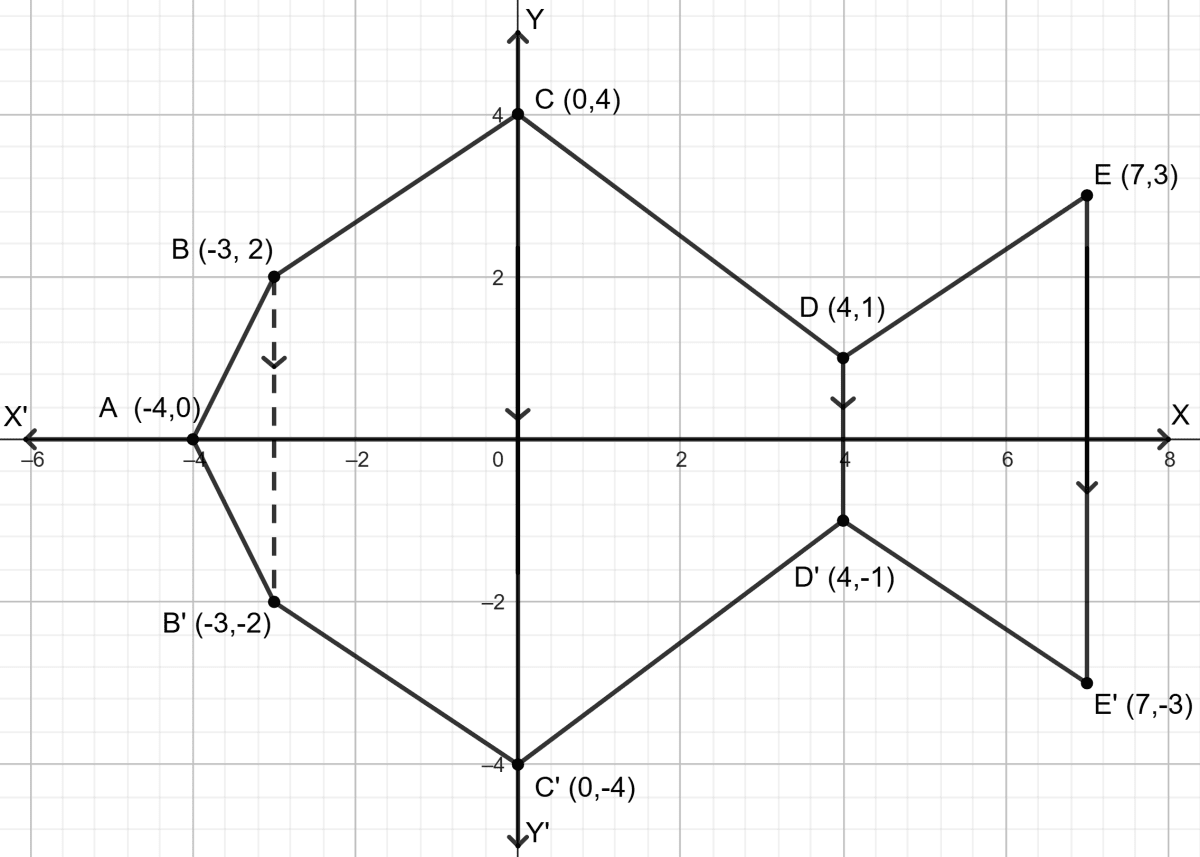
23Exercise 10

Use graph paper for this question.

Take 1 cm = 1 unit on both the axes.

(i) Plot the following points on your graph sheet:

A(-4, 0), B(-3, 2), C(0, 4), D(4, 1) and E(7, 3)

(ii) Reflect the points B, C, D and E on the x-axis and name them as B', C', D' and E' respectively.

(iii) Join A, B, C, D, E, E', D', C', B' and A in order.

(iv) Name the closed figure formed.

Show SolutionHide Solution↓

(i) The point A(-4, 0), B(-3, 2), C(0, 4), D(4, 1) and E(7, 3) are plotted on the graph below :

Use graph paper for this question. Take 1 cm = 1 unit on both the axes Reflection, ML Aggarwal Understanding Mathematics Solutions ICSE Class 10.

(ii) From graph, on reflecting B, C, D on x-axis we get,

B(-3, -2) ⇒ B'(-3, -2)

C(0, 4) ⇒ C'(0, -4)

D(4, 1) ⇒ D'(4, -1).

(iii) Points A, B, C, D, E, E', D', C', B' and A are joined in order.

(iv) The closed figure formed is a nonagon and resembles a fish.

24Exercise 10

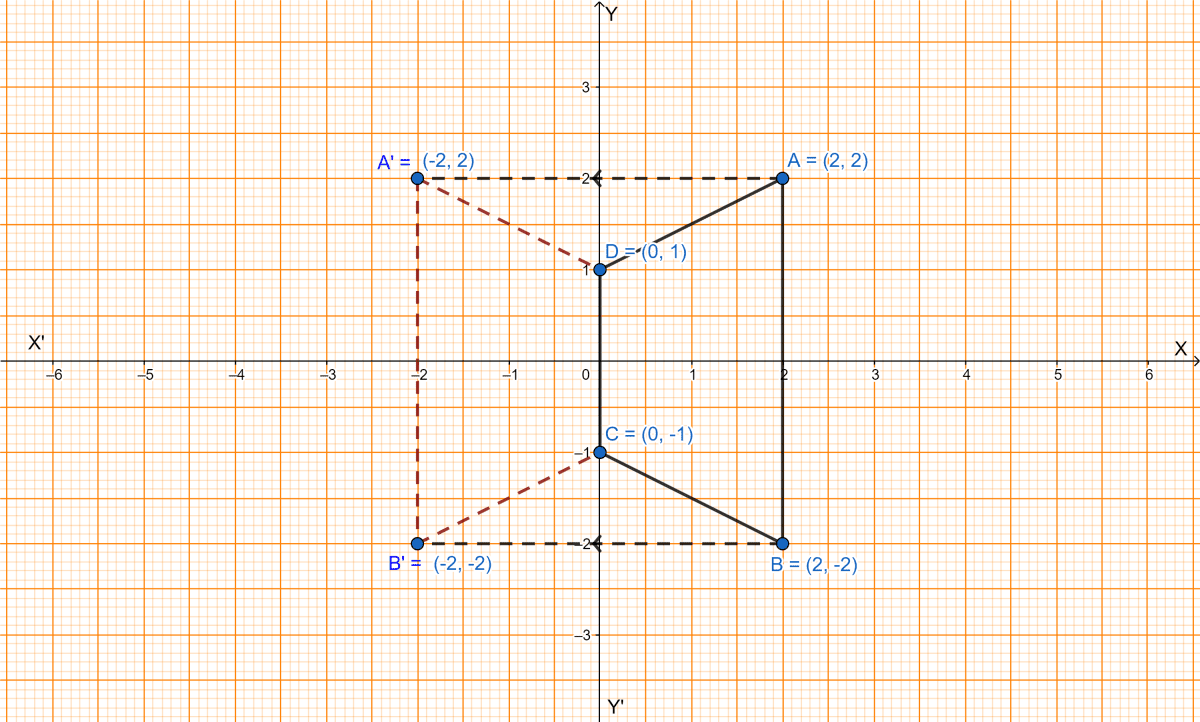
Use graph paper for this question (take 2cm = 1 unit along both x and y axis). ABCD is a quadrilateral whose vertices are A(2, 2), B(2, -2), C(0, -1) and D(0, 1).

(i) Reflect quadrilateral ABCD on the y-axis and name it as A'B'CD.

(ii) Write down the coordinates of A' and B'.

(iii) Name two points which are invariant under the above reflection.

(iv) Name the polygon A'B'CD.

Show SolutionHide Solution↓

(i) Reflected quadrilateral A'B'CD is shown in the graph below:

Use graph paper for this question (take 2cm = 1 unit along both x and y axis). ABCD is a quadrilateral whose vertices are A(2, 2), B(2, -2), C(0, -1) and D(0, 1). (i) Reflect quadrilateral ABCD on the y-axis and name it as A'B'CD. (ii) Write down the coordinates of A' and B'. (iii) Name two points which are invariant under the above reflection. (iv) Name the polygon A'B'CD. Reflection, ML Aggarwal Understanding Mathematics Solutions ICSE Class 10.

(ii) From graph we get,

The coordinates of A' and B' are (-2, 2) and (-2, -2) respectively.

(iii) From graph we get,

The two points which are invariant under the above reflection are C and D.

(iv) From graph we get,

The polygon(A'B'CD) formed is an isosceles trapezium.

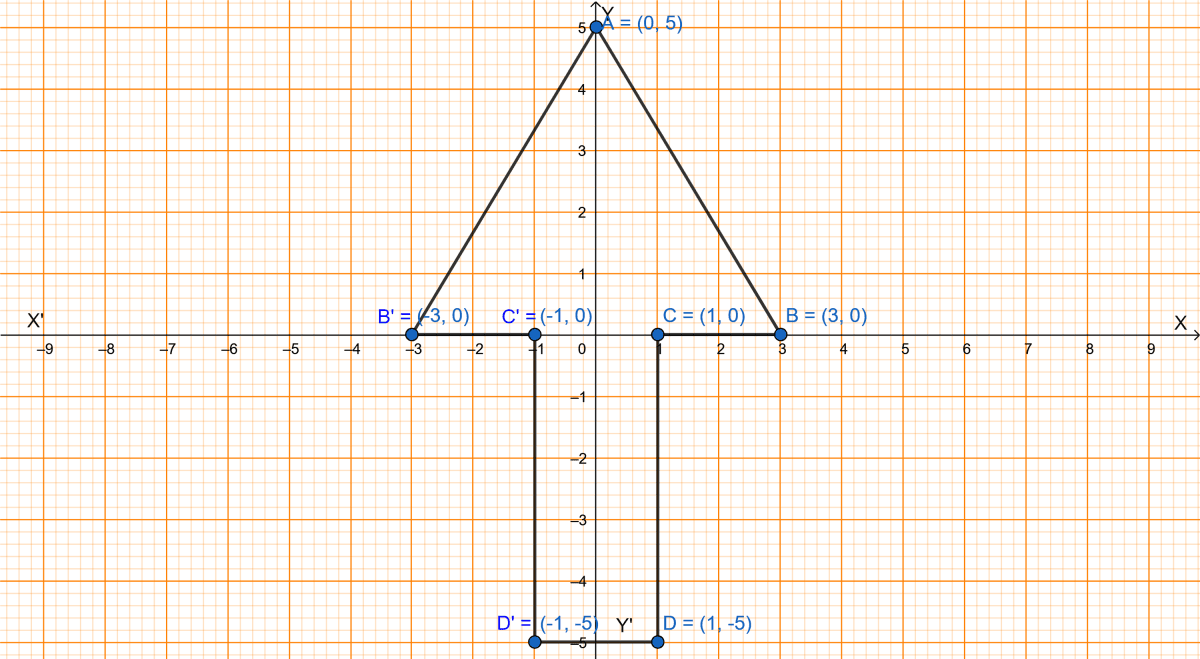
25Exercise 10

Use a graph sheet for this question. Take 1cm = 1 unit along both x and y-axes.

(i) Plot the points : A(0, 5), B(3, 0), C(1, 0) and D(1, -5).

(ii) Reflect the points B, C and D on the y-axis and name them as B', C' and D' respectively.

(iii) Write down the coordinates of B', C' and D'.

(iv) Join the points A, B, C, D, D', C', B', A in order and give a name to the closed figure ABCDD'C'B'.

Show SolutionHide Solution↓

Parts (i) and (ii) are solved in the graph below:

Use graph paper for this question (take 2cm = 1 unit along both x and y axis). (i) Plot the points : A(0, 5), B(3, 0), C(1, 0) and D(1, -5). (ii) Reflect the points B, C and D on the y-axis and name them as B', C' and D' respectively. (iii) Write down the coordinates of B', C' and D'. (iv) Join the points A, B, C, D, D', C', B', A in order and give a name to the closed figure ABCDD'C'B'. Reflection, ML Aggarwal Understanding Mathematics Solutions ICSE Class 10.

(iii) From graph we get,

The coordinates of B', C' and D' are (-3, 0), (-1, 0) and (-1, -5) respectively.

(iv) From graph we get,

The closed figure (ABCDD'C'B') formed is a heptagon/septagon (i.e., a polygon with seven sides).

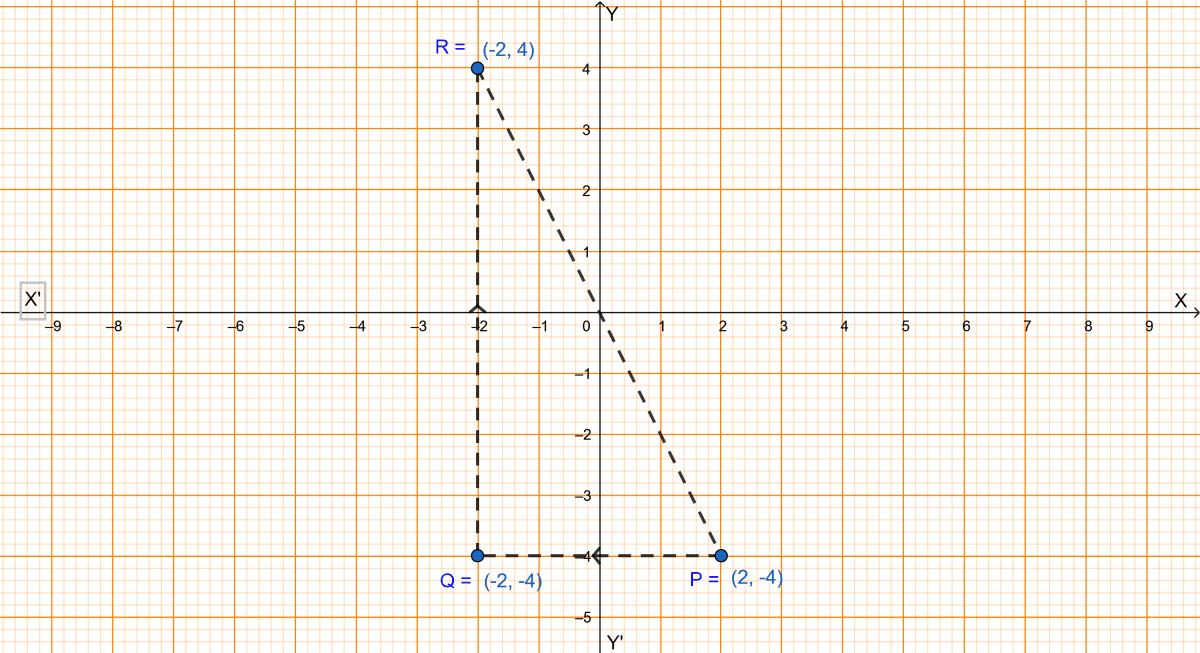
26Exercise 10

Use graph paper for this question.

(i) The point P(2, -4) is reflected about the line x = 0 to get the image Q. Find the coordinates of Q.

(ii) Point Q is reflected about the line y = 0 to get the image R. Find the coordinates of R.

(iii) Name the figure PQR.

(iv) Find the area of the figure PQR.

Show SolutionHide Solution↓

The graph is given below:

Use graph paper for this question. (i) The point P(2, -4) is reflected about the line x = 0 to get the image Q. Find the coordinates of Q. (ii) Point Q is reflected about the line y = 0 to get the image R. Find the coordinates of R. (iii) Name the figure PQR. (iv) Find the area of the figure PQR. Reflection, ML Aggarwal Understanding Mathematics Solutions ICSE Class 10.

(i) From graph we get,

The coordinate of Q is (-2, -4).

(ii) From graph we get,

The coordinate of R is (-2, 4).

(iii) From graph we get,

The image formed is right angled triangle.

(iv) We know that in the graph,

One block represents 1 unit.

Area of right angle triangle = $\frac{1}{2} \times$ base × height.

$$\begin{aligned}= \frac{1}{2} \times \text{PQ} \times \text{QR} \\[1em] = \frac{1}{2} \times 4 \text{ units } \times 8 \text{ units } \\[1em] = 16 \text{ sq. units}.\end{aligned}$$

Hence, the area of figure PQR is 16 sq. units.

27Exercise 10

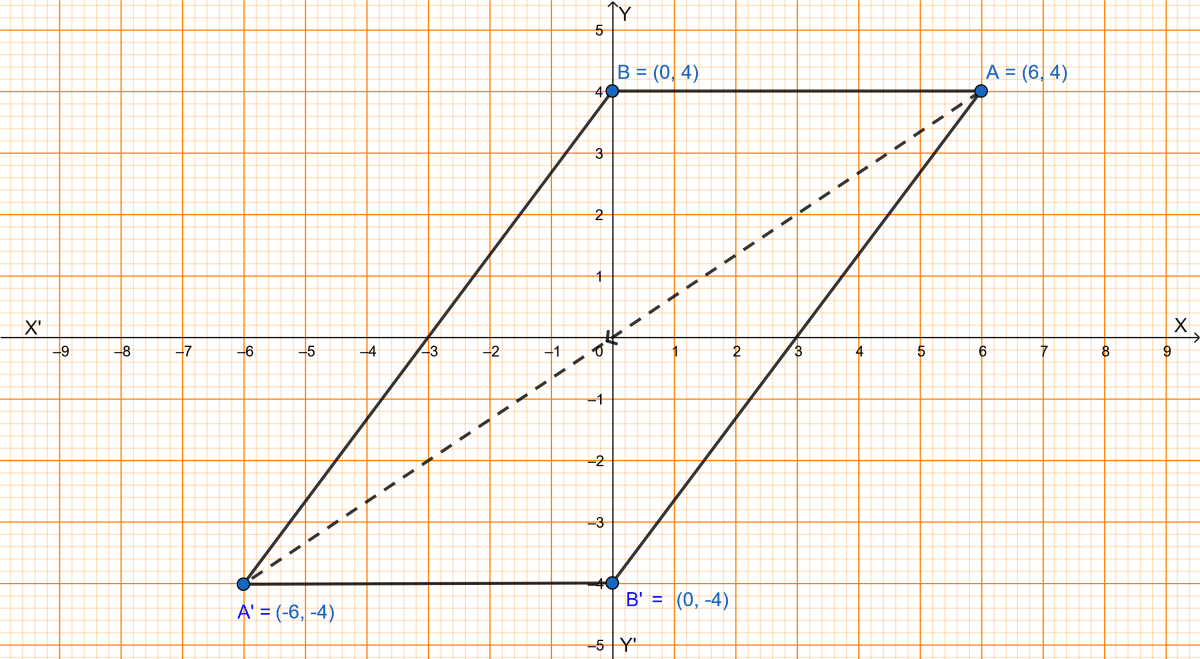
Using a graph paper, plot the points A(6, 4) and B(0, 4).

(i) Reflect A and B in the origin to get images A' and B'.

(ii) Write the coordinates of A' and B'.

(iii) State the geometrical name for the figure ABA'B'.

(iv) Find its perimeter.

Show SolutionHide Solution↓

(i) A' and B' are plotted on the graph below:

Using a graph paper, plot the points A(6, 4) and B(0, 4). (i) Reflect A and B in the origin to get images A' and B'. (ii) Write the coordinates of A' and B'. (iii) State the geometrical name for the figure ABA'B'. (iv) Find its perimeter. Reflection, ML Aggarwal Understanding Mathematics Solutions ICSE Class 10.

(ii) From graph we get,

The coordinates of A' and B' are (-6, -4) and (0, -4) respectively.

(iii) From graph we get,

ABA'B' formed is a parallelogram.

(iv) From graph we get,

By pythagoras theorem,

$$\begin{aligned}\text{AB}' = \sqrt{(\text{AB})^2 + (\text{BB}')^2} \\[1em] = \sqrt{6^2 + 8^2} \\[1em] = \sqrt{100} \\[1em] = 10 \text{ units }.\end{aligned}$$

Perimeter = Sum of all sides = AB' + B'A' + A'B + BA = 10 + 6 + 6 + 10 = 32 units.

Hence, the perimeter of the parallelogram is 32 units.

28Exercise 10

Use graph paper to solve this question.

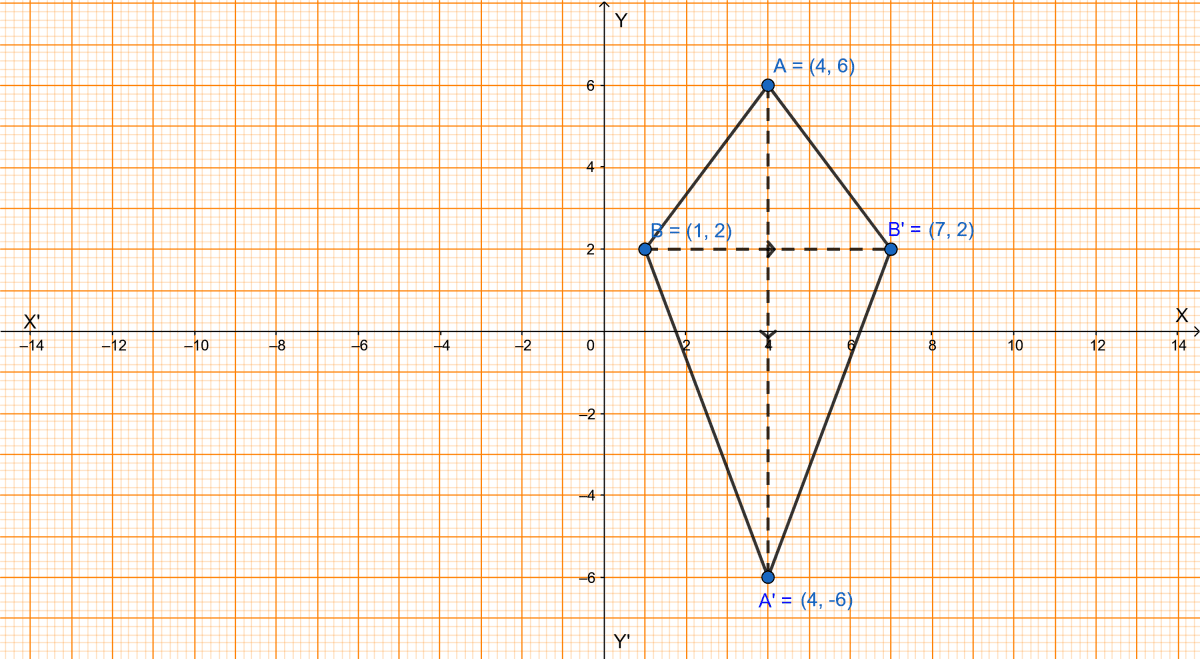
(i) Plot the points A(4, 6) and B(1, 2).

(ii) If A' is the image of A when reflected in the x-axis, write the coordinates of A'.

(iii) If B' is the image of B when reflected in the line AA', write the coordinates of B'.

(iv) Give the geometrical name for the figure ABA'B'.

Show SolutionHide Solution↓

(i) Points A(4, 6) and B(1, 2) are plotted on the graph below:

Use graph paper to solve this question. (i) Plot the points A(4, 6) and B(1, 2). (ii) If A' is the image of A when reflected in the x-axis, write the coordinates of A'. (iii) If B' is the image of B when reflected in the line AA', write the coordinates of B'. (iv) Give the geometrical name for the figure ABA'B'. Reflection, ML Aggarwal Understanding Mathematics Solutions ICSE Class 10.

(ii) From graph we get,

The coordinates of point A' = (4, -6).

(iii) From graph we get,

The coordinates of point B' = (7, 2).

(iii) From graph we get,

ABA'B' formed is a kite (or a Quadrilateral).

29Exercise 10

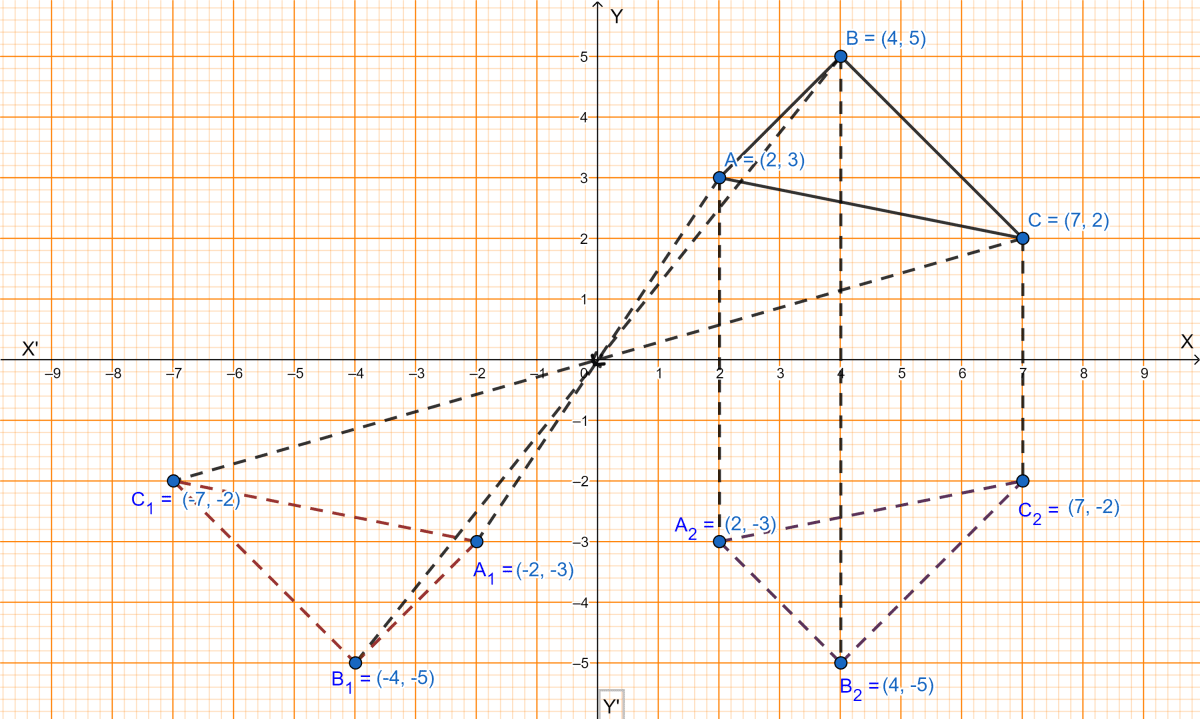
The points A(2, 3), B(4, 5) and C(7, 2) are the vertices of △ABC.

(i) Write down the coordinates of A1, B1, C1 if △A1B1C1 is the image of △ABC when reflected in the origin.

(ii) Write down the coordinates of A2, B2, C2 if △A2B2C2 is the image of △ABC when reflected in the x-axis.

(iii) Assign the special name to quadrilateral BCC2B2 and find its area.

Show SolutionHide Solution↓

The graph is shown below:

The points A(2, 3), B(4, 5) and C(7, 2) are the vertices of △ABC. (i) Write down the coordinates of A1, B1, C1 if △A1B1C1 is the image of △ABC when reflected in the origin. (ii) Write down the coordinates of A2, B2, C2 if △A2B2C2 is the image of △ABC when reflected in the x-axis. (iii) Assign the special name to quadrilateral BCC2B2 and find its area. Reflection, ML Aggarwal Understanding Mathematics Solutions ICSE Class 10.

(i) From graph we get,

The coordinates of A1, B1, C1 are (-2, -3), (-4, -5) and (-7, -2) respectively.

(ii) From graph we get,

The coordinates of A2, B2, C2 are (2, -3), (4, -5) and (7, -2) respectively.

(iii) From graph we get,

BCC2B2 formed is an isosceles trapezium.

We know that,

Area of trapezium = $\frac{1}{2} \times$ sum of parallel sides $\times$ distance between them

$$\begin{aligned}= \frac{1}{2} \times (\text{BB}_2 + \text{CC}_2) \times 3 \\[1em] = \frac{1}{2} \times (10 + 4) \times 3 \\[1em] = \frac{1}{2} \times 42 \\[1em] = 21 \text{ sq. units}\end{aligned}$$

30Exercise 10

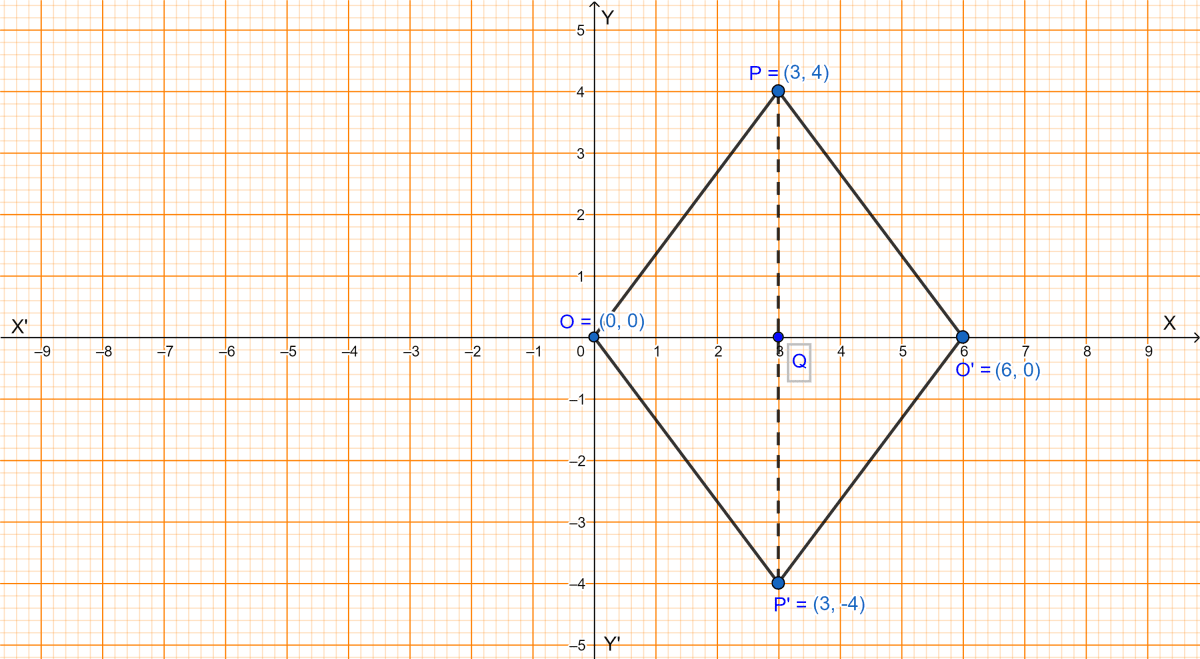
The point P(3, 4) is reflected to P' in the x-axis and O' is the image of O(origin) in the line PP'. Find :

(i) the coordinates of P' and O'.

(ii) the length of segments PP' and OO'.

(iii) the perimeter of the quadrilateral POP'O'.

Show SolutionHide Solution↓

The graph is shown below:

The point P(3, 4) is reflected to P' in the x-axis and O' is the image of O(origin) in the line PP'. Find (i) the coordinates of P' and O'. (ii) the length of segments PP' and OO'. (iii) the perimeter of the quadrilateral POP'O'. Reflection, ML Aggarwal Understanding Mathematics Solutions ICSE Class 10.

(i) From graph we get,

The coordinates of P' and O' are (3, -4) and (6, 0) respectively.

(ii) From graph we get,

Length of PP' = 8 units and OO' = 6 units.

(iii) OP = PO' = O'P' = P'O, as all are hypotenuse for same base and perpendicular.

∴ Perimeter of POP'O' is = 4 × OP

$$\begin{aligned}= 4 \times \sqrt{(OQ)^2 + (PQ)^2} \\[1em] = 4 \times \sqrt{(3)^2 + (4)^2} \\[1em] = 4 \times \sqrt{9 + 16} \\[1em] = 4 \times \sqrt{25} \\[1em] = 4 \times 5 \\[1em] = 20 \text{ units }.\end{aligned}$$

The perimeter of the quadrilateral POP'O' is 20 units.

31Exercise 10

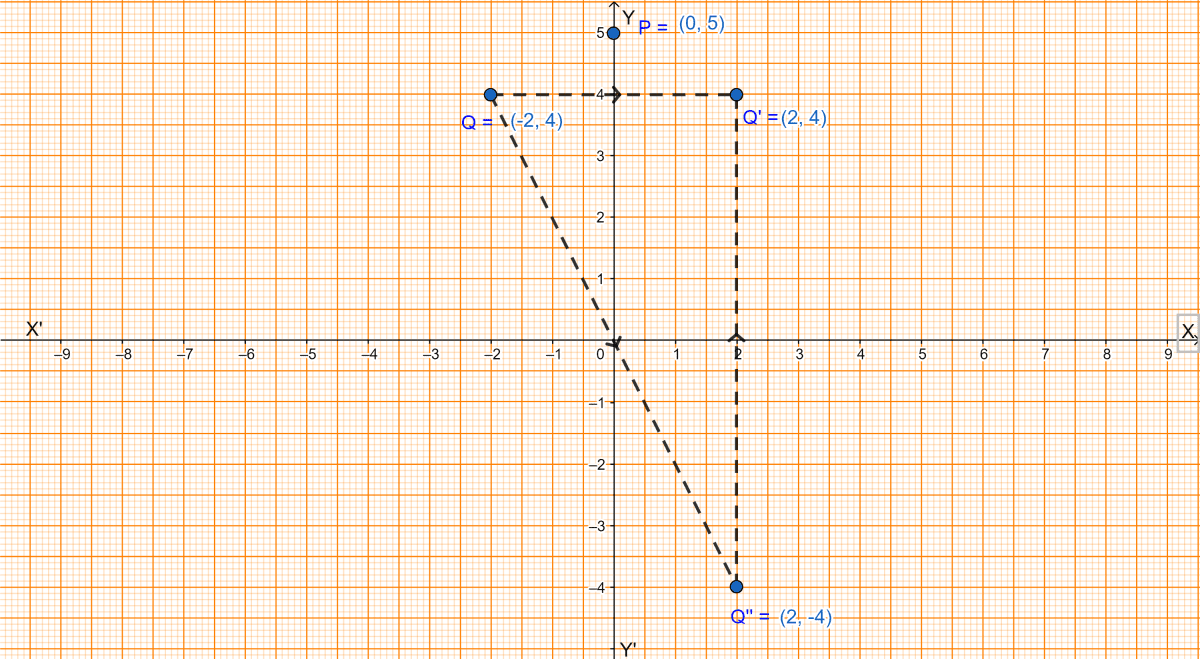
Use a graph paper for this question. (Take 10 small divisions = 1 unit on both axes). P and Q have coordinates (0, 5) and (-2, 4).

(i) P is invariant when reflected in an axis. Name the axis.

(ii) Find the image of Q on reflection in the axis found in (i).

(iii) (0, k) on reflection in the origin is invariant. Write the value of k.

(iv) Write the coordinates of the image of Q, obtained by reflecting it in the origin followed by reflection in x-axis.
Show SolutionHide Solution↓

The graph for the question is shown below:

Use a graph paper for this question. (Take 10 small divisions = 1 unit on both axes). P and Q have coordinates (0, 5) and (-2, 4). (i) P is invariant when reflected in an axis. Name the axis. (ii) Find the image of Q on reflection in the axis found in (i). (iii) (0, k) on reflection in the origin is invariant. Write the value of k. (iv) Write the coordinates of the image of Q, obtained by reflecting it in the origin followed by reflection in x-axis. Reflection, ML Aggarwal Understanding Mathematics Solutions ICSE Class 10.
(i) The point P(0, 5) is invariant in y-axis.

(ii) From graph we get,

The image of Q(-2, 4) on reflection in y-axis is Q'(2, 4).

(iii) Given, (0, k) on reflection in the origin is invariant.

From graph we get, (0, 0) on reflection in the origin is invariant. Comparing (0, k) with (0, 0) we get k = 0.

Hence, the value of k = 0.

(iv) From graph we get,

The coordinates of image of Q after reflection in origin and then in x-axis is (2, 4).

11 Mark · Multiple Choice Questions

The co-ordinates of the point P(-3, 5) on reflection in the x -axis are :

Show SolutionHide Solution↓

We know that,

On reflection in x-axis :

The sign of y-coordinate changes and x-coordinate remains the same.

So, on reflection in x-axis coordinates of P(-3, 5) becomes (-3, -5).

Hence, option 2 is the correct option.

21 Mark · Multiple Choice Questions

The reflection of the point P(-2, 3) in the y-axis is

Show SolutionHide Solution↓

We know that,

Rule to find reflection of a point in y-axis :

  1. Change the sign of abscissa i.e. x-coordinate.
  2. Retain the ordinate i.e. y-coordinate.

∴ Coordinates of point P(-2, 3) on reflection in y-axis is (2, 3).

Hence, Option 1 is the correct option.

31 Mark · Multiple Choice Questions

If the image of the point P under reflection in the x-axis is (-3, 2), then the coordinates of the point P are

Show SolutionHide Solution↓

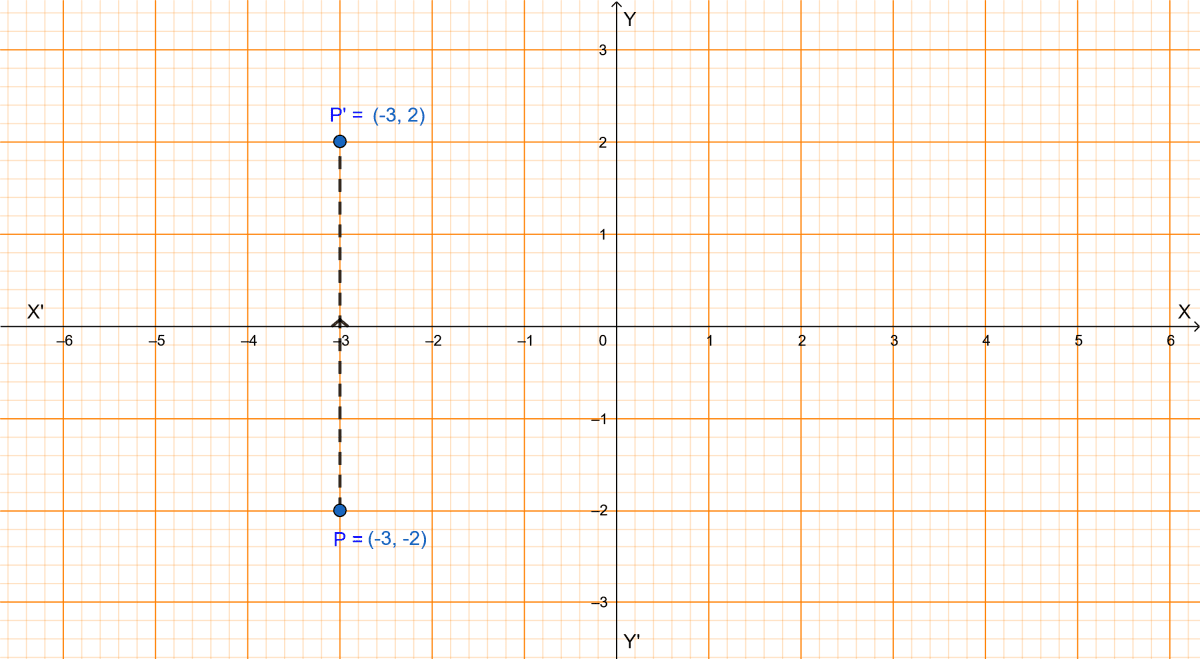
Since, (-3, 2) is the image of the point P on reflection in x-axis so from graph P(-3, -2).

If the image of the point P under reflection in the x-axis is (-3, 2), then the coordinates of the point P are. Reflection, ML Aggarwal Understanding Mathematics Solutions ICSE Class 10.

Hence, Option 2 is the correct option.

41 Mark · Multiple Choice Questions

The reflection of the point P(1, -2) in the line y = -1 is

Show SolutionHide Solution↓

We know that the reflection of the point (x, y) in the line y = a is the point (x, -y + 2a).

∴ The image of the point P(1, -2) under reflection in the line y = -1 is the point (1, -(-2) + 2 × (-1)) i.e the point (1, 0).

Hence, Option 4 is the correct option.

51 Mark · Multiple Choice Questions

The reflection of the point A(4, -1) in the line x = 2 is

Show SolutionHide Solution↓

We know that the reflection of the point (x, y) in the line x = a is the point (-x + 2a, y).

∴ The image of the point A(4, -1) under reflection in the line x = 2 is the point (-4 + 2 × 2, -1) i.e., the point P'(0, -1).

Hence, Option 1 is the correct option.

61 Mark · Multiple Choice Questions

The reflection of the point (-3, 0) in the origin is the point

Show SolutionHide Solution↓

We know that,

Rules to find the reflection of a point in the origin :

  1. Change the sign of abscissa i.e. x-coordinate.
  2. Change the sign of ordinate i.e. y-coordinate.

∴ Point (3, 0) is the image on reflection.

Hence, Option 3 is the correct option.

71 Mark · Multiple Choice Questions

Which of the following points is invariant with respect to the line y = -2?

Show SolutionHide Solution↓

Since, in (3, -2), y = -2, it means this point lies on the line. Hence, it a invariant point.

Hence, Option 2 is the correct option.

1Assertion-Reason Type Questions

P(2, 4) is a point in first quadrant.

Assertion (A): Its reflection P' in origin O is in 2nd quadrant.

Reason (R): PO = P'O

Show SolutionHide Solution↓

Reflection of a point (x, y) in the origin gives P'(-x, -y).

Thus, reflection of a P(2, 4) in the origin gives P'(-2, -4).

P'(-2, -4) lies in the third quadrant, where both x and y are negative.

So, assertion (A) is false.

Reflection in the origin preserves distance from the origin.

Both P and P' are at the same distance from the origin:

∴ PO = P'O

So, reason (R) is true.

Thus, Assertion (A) is false, but Reason (R) is true.

Hence, option 2 is the correct option.

2Assertion-Reason Type Questions

P(-5, m) is invariant with respect to y = 2.

Assertion (A): Value of m is -2.

Reason (R): P lies on y = 2.

Show SolutionHide Solution↓

A point is invariant with respect to a line if lies on the line.

So, if a point is invariant under reflection over y = 2, it must lie on the line y = 2.

So, reason (R) is true.

If P(-5, m) is invariant under reflection over y = 2, so it lies on the line y = 2, so m = 2.

So, assertion (A) is false.

Thus, Assertion (A) is false, but Reason (R) is true.

Hence, option 2 is the correct option.

3Assertion-Reason Type Questions

P is the point of intersection of the line 3x - 5y = 3 and x - axis.

Assertion (A): P is invariant with respect to given line.

Reason (R): Coordinates of P are (0, 1).

Show SolutionHide Solution↓

We know that,

The y-coordinate of any point on x-axis equals to 0.

Substituting y = 0 into the equation 3x - 5y = 3, we get :

⇒ 3x - 5.0 = 3

⇒ 3x = 3

⇒ x = $\frac{3}{3}$ = 1

So the point of intersection is P(1, 0).

So, reason (R) is false.

A point is invariant with respect to a line if it lies on that line.

Since, P is the point of intersection of line 3x - 5y = 3 and x-axis, so it lies on line 3x - 5y = 3.

So, assertion (A) is true.

Thus, Assertion (A) is true, but Reason (R) is false.

Hence, option 1 is the correct option.

4Assertion-Reason Type Questions

ABC is a triangle and its vertices A, B, C are reflected in y-axis to the points A', B' and C' respectively.

Assertion (A): Area (Δ ABC) = Area (Δ A'B'C').

Reason (R): The two triangles are congruent.

Show SolutionHide Solution↓

A point (x, y) reflected in the y-axis becomes (−x, y).

This changes the sign of the x-coordinate but preserves the y-coordinate.

As a result, distances and angles are preserved, and so is area.

Reflection over an axis is a rigid transformation (i.e., it preserves size and shape)

Thus, the area remains unchanged.

So, assertion (A) is true.

Since all corresponding sides and angles remain equal under reflection.

Thus, the two triangles are congruent.

So, reason (R) is true and reason (R) is the correct explanation of assertion (A).

Thus, both Assertion (A) and Reason (R) are correct, and Reason (R) is the correct reason for Assertion (A).

Hence, option 3 is the correct option.

5Assertion-Reason Type Questions

A point is invariant with respect to both x-axis and y-axis.

Assertion (A): It is invariant with respect to origin also.

Reason (R): The point is origin itself.

Show SolutionHide Solution↓

We know that,

Point invariant to both x-axis and y-axis is their point of intersection i.e. the origin.

So, assertion (A) is true.

A point is invariant to itself.

So, reason (R) is true.

Both Assertion (A) and Reason (R) are correct, and Reason (R) is the correct reason for Assertion (A).

Hence, Option 3 is the correct option.

1Chapter Test

The point P(4, -7) on reflection in x-axis is mapped onto P'. Then P' on reflection in the y-axis is mapped onto P''. Find the coordinates of P' and P''. Write down a single transformation that maps P onto P''.

Show SolutionHide Solution↓

We know that,

Rule to find reflection of a point in x-axis :

  1. Retain the abscissa i.e. x-coordinate.
  2. Change the sign of ordinate i.e. y-coordinate.

∴ Coordinates of point P(4, -7) on reflection in x-axis is P'(4, 7).

We know that,

Rule to find reflection of a point in y-axis :

  1. Change the sign of abscissa i.e. x-coordinate.
  2. Retain the ordinate i.e. y-coordinate.

∴ Coordinates of point P'(4, 7) on reflection in y-axis is P''(-4, 7).

The single transformation that maps P(4, -7) onto P''(-4, 7) is reflection in the origin.

2Chapter Test

The point P(a, b) is first reflected in the origin and then reflected in the y-axis to P'. If P' has coordinates (3, -4), evaluate a, b.

Show SolutionHide Solution↓

We know that,

Rules to find the reflection of a point in the origin :

  1. Change the sign of abscissa i.e. x-coordinate.
  2. Change the sign of ordinate i.e. y-coordinate.

∴ Coordinates of point P(a, b) on reflection in origin is (-a, -b).

We know that,

Rule to find reflection of a point in y-axis :

  1. Change the sign of abscissa i.e. x-coordinate.
  2. Retain the ordinate i.e. y-coordinate.

∴ Coordinates of point (-a, -b) on reflection in y-axis is (a, -b).

According to question after reflection in y-axis the point is P'(3, -4).

∴ (3, -4) = (a, -b) or, a = 3 and b = 4.

Hence, the value of a = 3, b = 4.

3Chapter Test

A point P(a, b) become (-2, c) after reflection in the x-axis, and P becomes (d, 5) after reflection in the origin. Find the values of a, b, c and d.

Show SolutionHide Solution↓

We know that,

Rule to find reflection of a point in x-axis :

  1. Retain the abscissa i.e. x-coordinate.
  2. Change the sign of ordinate i.e. y-coordinate.

∴ Coordinates of point P(a, b) on reflection in x-axis is P'(a, -b).

According to question after reflection in x-axis P becomes (-2, c).

∴ (a, -b) = (-2, c) or,
⇒ a = -2
⇒ -b = c or b = -c.

We know that,

Rules to find the reflection of a point in the origin :

  1. Change the sign of abscissa i.e. x-coordinate.
  2. Change the sign of ordinate i.e. y-coordinate.

∴ Coordinates of point P(a, b) on reflection in origin is (-a, -b).

According to question after reflection in origin P becomes (d, 5).

∴ (-a, -b) = (d, 5) or,
⇒ -a = d or d = -(-2) = 2.
⇒ -b = 5 or b = -5.

Since, b = -c = -5, so, c = 5.

Hence, the value of a = -2, b = -5, c = 5 and d = 2.

4Chapter Test

A(4, -1), B(0, 7) and C(-2, 5) are the vertices of a triangle. △ABC is reflected in the y-axis and then reflected in the origin. Find the coordinates of the final images of the vertices.

Show SolutionHide Solution↓

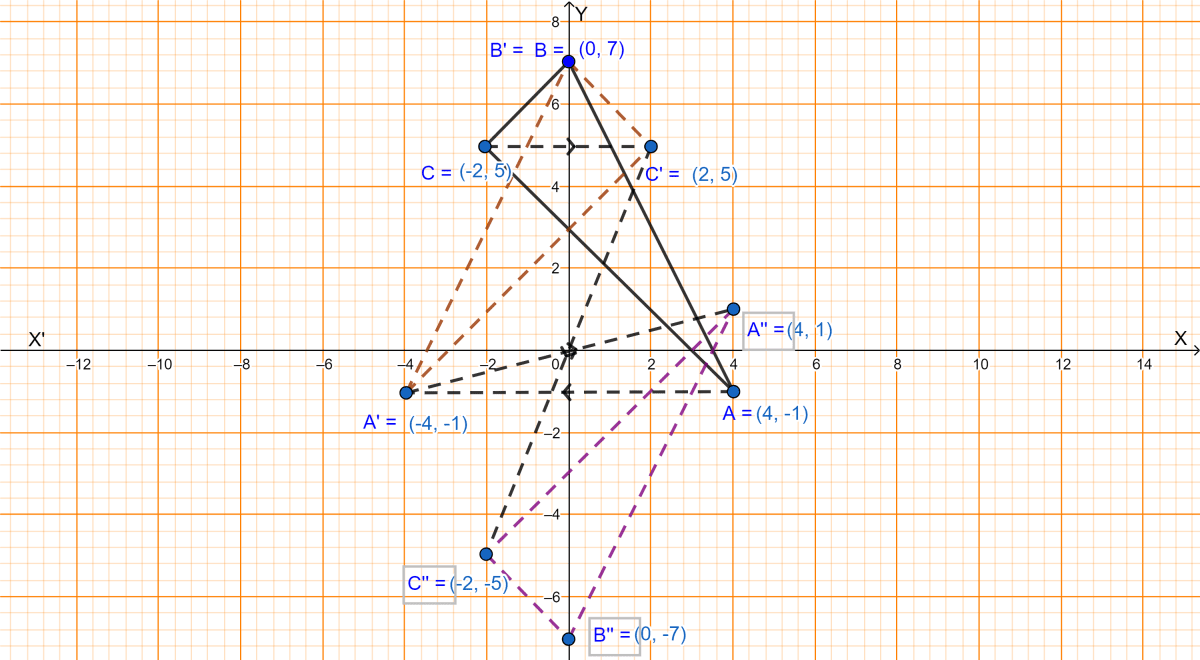
The graph for this problem is shown below:

A(4, -1), B(0, 7) and C(-2, 5) are the vertices of a triangle. △ABC is reflected in the y-axis and then reflected in the origin. Find the coordinates of the final images of the vertices. Reflection, ML Aggarwal Understanding Mathematics Solutions ICSE Class 10.

First the triangle is reflected in y-axis.

We know that,

Rule to find reflection of a point in y-axis :

  1. Change the sign of abscissa i.e. x-coordinate.
  2. Retain the ordinate i.e. y-coordinate.

∴ Coordinates of
⇒ A(4, -1) on reflection in y-axis becomes A'(-4, -1).
⇒ B(0, 7) on reflection in y-axis becomes B'(0, 7).
⇒ C(-2, 5) on reflection in y-axis becomes C'(2, 5).

Now the triangle is reflected in origin.

We know that,

Rules to find the reflection of a point in the origin :

  1. Change the sign of abscissa i.e. x-coordinate.
  2. Change the sign of ordinate i.e. y-coordinate.

∴ Coordinates of
⇒ A'(-4, -1) on reflection in y-axis becomes A''(4, 1).
⇒ B'(0, 7) on reflection in y-axis becomes B''(0, -7).
⇒ C'(2, 5) on reflection in y-axis becomes C''(-2, -5).

Hence, the coordinates of the final images of the vertices are (4, 1), (0, -7) and (-2, -5) respectively.

5Chapter Test

The points A(4, -11), B(5, 3), C(2, 15) and D(1, 1) are the vertices of a parallelogram. If the parallelogram is reflected in the y-axis and then in the origin, find the coordinates of the final images. Check whether it remains a parallelogram. Write down a single transformation that brings the above change.

Show SolutionHide Solution↓

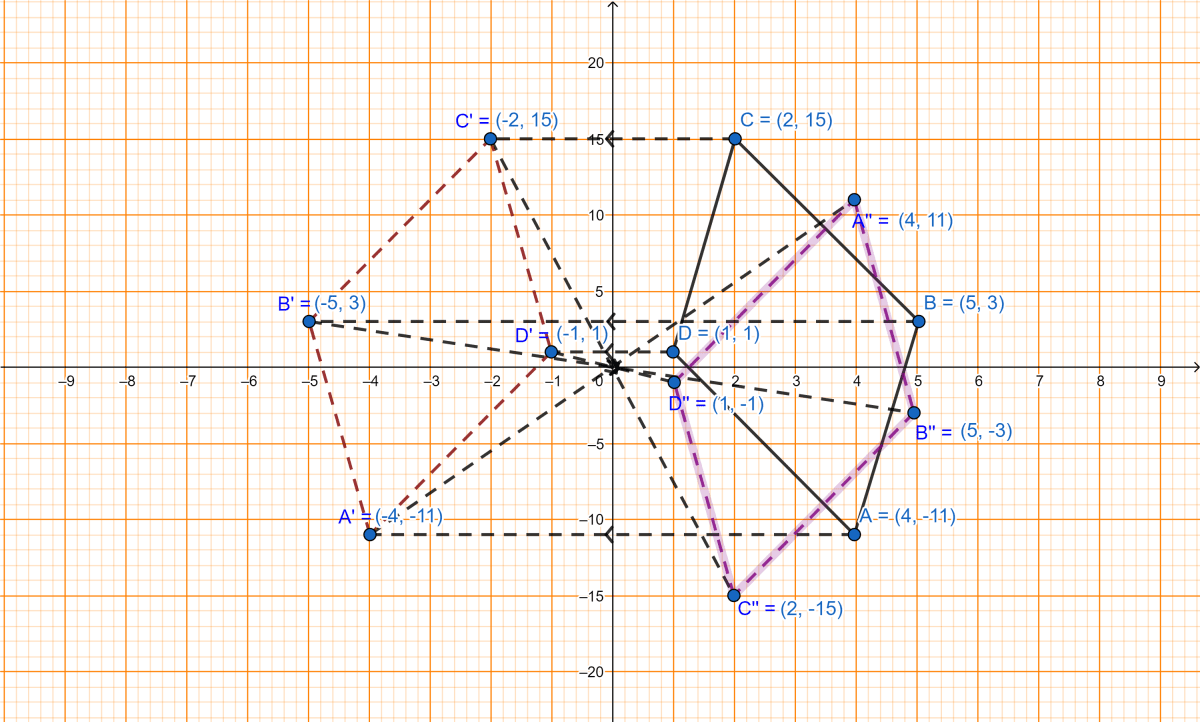
The graph for this problem is shown below:

The points A(4, -11), B(5, 3), C(2, 15) and D(1, 1) are the vertices of a parallelogram. If the parallelogram is reflected in the y-axis and then in the origin, find the coordinates of the final images. Check whether it remains a parallelogram. Write down a single transformation that brings the above change. Reflection, ML Aggarwal Understanding Mathematics Solutions ICSE Class 10.

First the parallelogram is reflected in y-axis.

We know that,

Rule to find reflection of a point in y-axis :

  1. Change the sign of abscissa i.e. x-coordinate.
  2. Retain the ordinate i.e. y-coordinate.

∴ Coordinates of
⇒ A(4, -11) on reflection in y-axis becomes A'(-4, -11).
⇒ B(5, 3) on reflection in y-axis becomes B'(-5, 3).
⇒ C(2, 15) on reflection in y-axis becomes C'(-2, 15).
⇒ D(1, 1) on reflection in y-axis becomes D'(-1, 1).

We know that,

Rules to find the reflection of a point in the origin :

  1. Change the sign of abscissa i.e. x-coordinate.
  2. Change the sign of ordinate i.e. y-coordinate.

∴ Coordinates of
⇒ A'(-4, -11) on reflection in origin becomes A''(4, 11).
⇒ B'(-5, 3) on reflection in origin becomes B''(5, -3).
⇒ C'(-2, 15) on reflection in origin becomes C''(2, -15).
⇒ D'(-1, 1) on reflection in origin becomes D''(1, -1)

From graph we can see that A"B"C"D" is also a parallelogram.

The single transformation that marks the following changes i.e.
A(4, -11) ⇒ A"(4, 11)
B(5, 3) ⇒ B"(5, -3)
C(2, 15) ⇒ C"(2, -15)
D(1, 1) ⇒ D"(1, -1), is reflection in x-axis.
Hence,

  1. The coordinates of the final images of the vertices are (4, 11), (5, -3), (2, -15) and (1, -1) respectively.
  2. These new images still form parallelogram.
  3. The single transformation from ABCD ⇒ A"B"C"D" can be achieved by reflection in x-axis.
6Chapter Test

Use a graph paper for this question (take 2 cm = 1 unit on both x and y axes).

(i) Plot the following points : A(0, 4), B(2, 3), C(1, 1) and D(2, 0).

(ii) Reflect points B, C, D on y-axis and write down their coordinates. Name the images as B', C', D' respectively.

(iii) Join points A, B, C, D, D', C', B' and A in order, so as to form a closed figure. Write down the equation of line of symmetry of the figure formed.

Show SolutionHide Solution↓

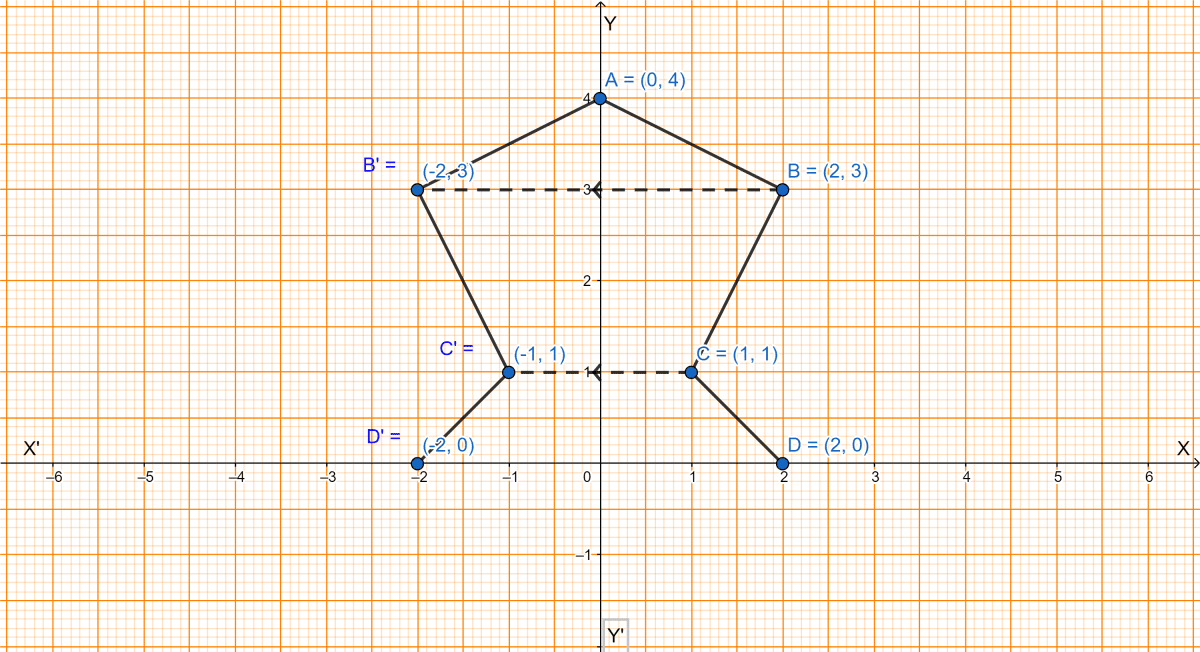
(i) The point A(0, 4), B(2, 3), C(1, 1) and D(2, 0) are plotted on the graph below:

Use a graph paper for this question (take 2 cm = 1 unit on both x and y axes). (i) Plot the following points : A(0, 4), B(2, 3), C(1, 1) and D(2, 0). (ii) Reflect points B, C, D on y-axis and write down their coordinates. Name the images as B', C', D' respectively. (iii) Join points A, B, C, D, D', C', B' and A in order, so as to form a closed figure. Write down the equation of line of symmetry of the figure formed. Reflection, ML Aggarwal Understanding Mathematics Solutions ICSE Class 10.

(ii) From graph, on reflecting B, C, D on y-axis we get,

     B(2, 3) ⇒ B'(-2, 3)
     C(1, 1) ⇒ C'(-1, 1)
     D(2, 0) ⇒ D'(-2, 0).

(iii) From graph we see that the figure is divided into two symmetrical parts by y-axis. Hence, the equation of line of symmetry is x = 0.

7Chapter Test

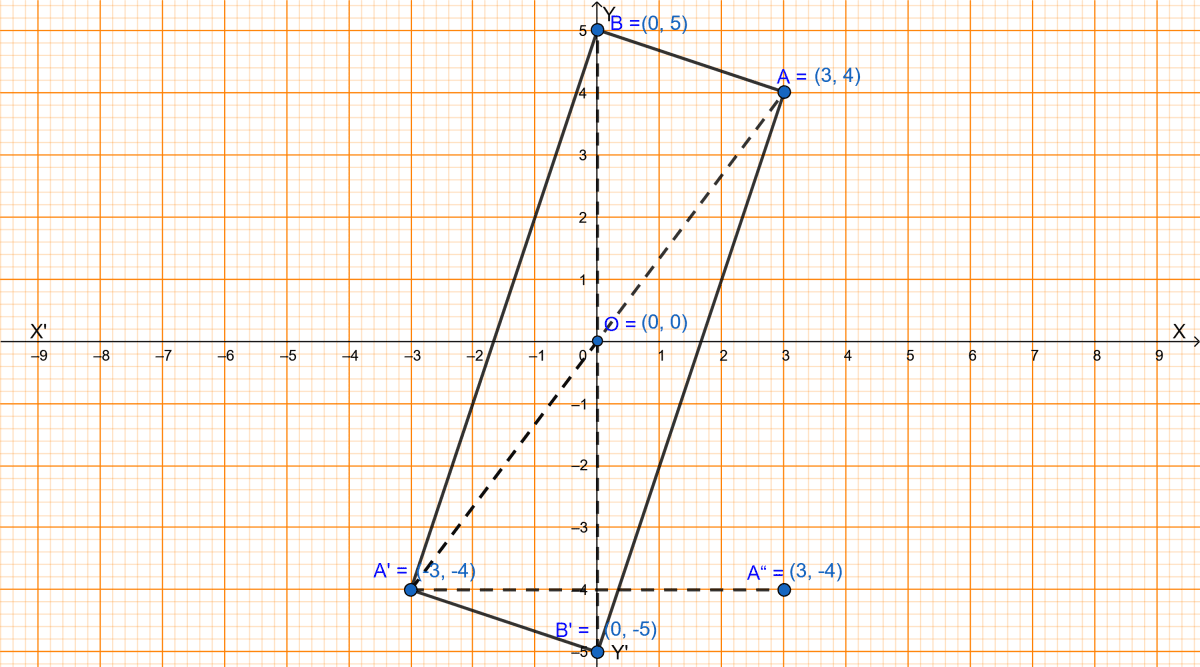
The triangle OAB is reflected in the origin O to triangle OA'B'. A' and B' have coordinates (-3, -4) and (0, -5) respectively.

(i) Find the coordinates of A and B.

(ii) Draw a diagram to represent the given information.

(iii) What kind of figure is the quadrilateral ABA'B'?

(iv) Find the coordinates of A'', the reflection of A in the origin followed by reflection in the y-axis.

(v) Find the coordinates of B'', the reflection of B in the x-axis followed by the reflection in the origin.

Show SolutionHide Solution↓

The graph showing the given information is drawn below:

(i) Find the coordinates of A and B. (ii) Draw a diagram to represent the given information. (iii) What kind of figure is the quadrilateral ABA'B'? (iv) Find the coordinates of A'', the reflection of A in the origin followed by reflection in the y-axis. (v) Find the coordinates of B'', the reflection of B in the x-axis followed by the reflection in the origin. Reflection, ML Aggarwal Understanding Mathematics Solutions ICSE Class 10.

(i) Since, on reflection in the origin A becomes A'(-3, -4) and B becomes B'(0, -5) thus,

A = (3, 4) and B = (0, 5).

(iii) The quadrilateral ABA'B' represents a rectangle.

(iv) From graph we get,

The coordinates of A" is (3, -4).

(v) From graph we get,

The coordinates of B" is (0, 5).

8Chapter Test

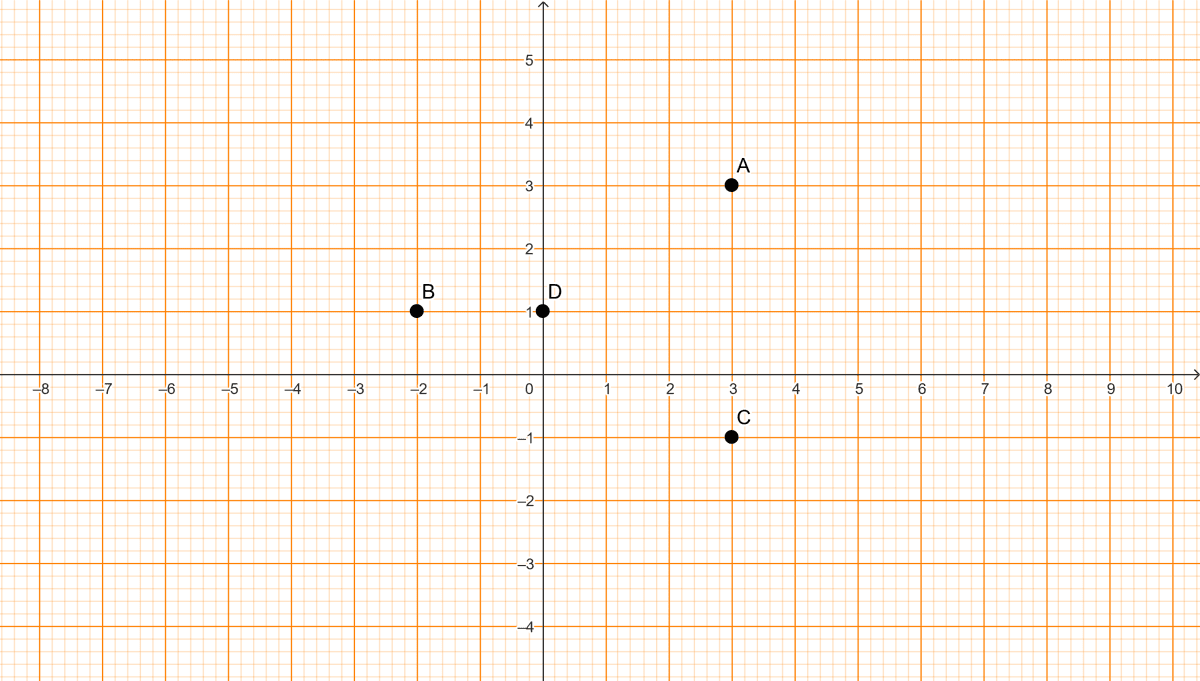
Study the graph and answer each of the following :

(a) Write the coordinates of points A, B, C and D.

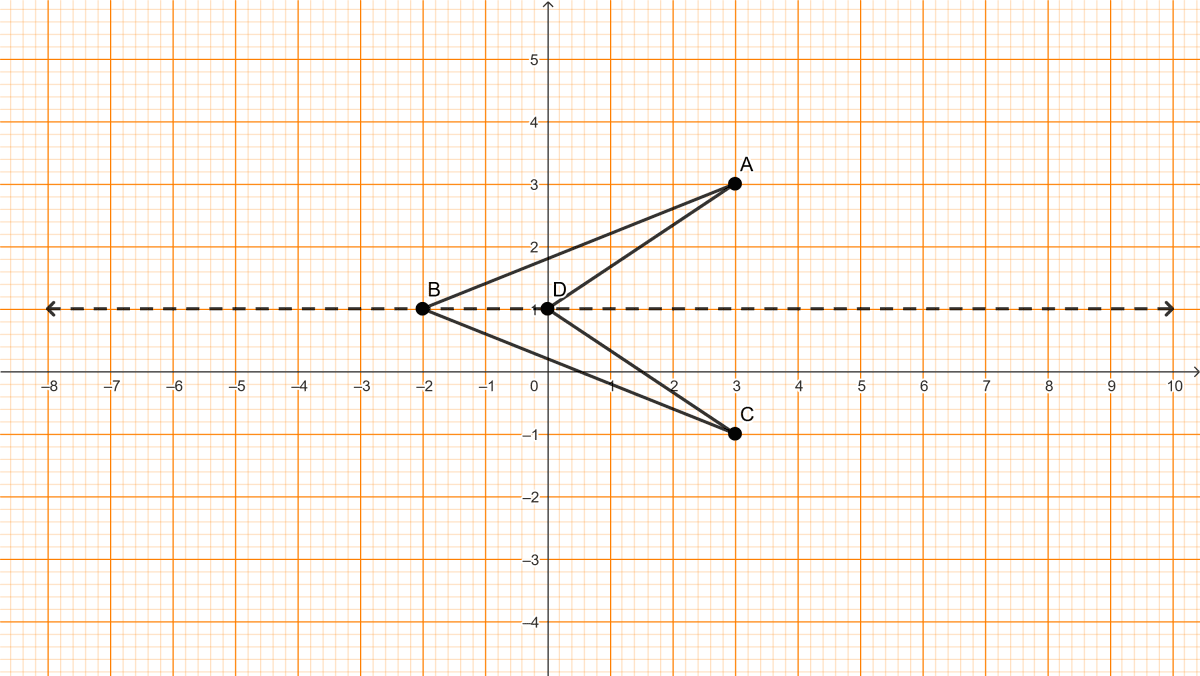
(b) Given that, point C is the image of point A. Name and write the equation of the line of reflection.

(c) Write the coordinates of the image of the point D under reflection in y-axis.

(d) What is the name given to a point whose image is the point itself ?

(e) On joining the points A, B, C, D and A in order, a figure is formed. Name the closed figure.

Study the graph and answer each of the following : ICSE 2025 Maths Solved Question Paper.
Show SolutionHide Solution↓

(a) From graph,

Coordinates of A = (3, 3), B = (-2, 1), C = (3, -1) and D = (0, 1).

Study the graph and answer each of the following : ICSE 2025 Maths Solved Question Paper.

(b) From graph,

C is the image of point A in the line y = 1.

Hence, the line is BD and its equation is y = 1.

(c) Since, point D lies on y-axis, thus it is invariant under reflection in y-axis.

Hence, coordinates of point D on reflection in y-axis is (0, 1).

(d) A point whose image is the point itself is called invariant point.

(e) On joining the points A, B, C, D and A in order the figure formed is a concave quadrilateral or arrowhead.

Press ↓ to reveal a solution and move to the next question. Back to ML Aggarwal Mathematics.

Free sample bank