Short Answer Questions 2

ICSE Class 10 Mathematics · Competency Practice · 28 solved questions

Exercise
Marks
784 Marks · Short Answer Questions 2

The following bill shows the GST rate and the marked price of items :

S.No.ItemMarked price (₹)QuantityRate of GST
1Wheat Flour (unpacked)35.005 kgx%
2Basmati Rice (Branded & packed)180.005 kg5%
3Surf Excel Quick Wash Detergent220.00y kg18%

Find :

(a) the value of x if the total GST on wheat flour and basmati rice is ₹ 45.

(b) the value of y, if CGST paid for detergent powder is ₹ 39.60

(c) total amount to be paid (including GST) for the above bill.

Show SolutionHide Solution↓

(a) Given, total GST on wheat flour and basmati rice is ₹ 45.

Total price of wheat flour = 35 × 5 = ₹ 175.

Total price of basmati rice = 180 × 5 = ₹ 900.

Given,

Total GST on wheat flour and basmati rice is ₹ 45.

$$\begin{aligned}\therefore \frac{x}{100} \times 175 + \frac{5}{100} \times 900 = 45 \\[1em] \Rightarrow 1.75x + 45 = 45 \\[1em] \Rightarrow 1.75x = 45 - 45 \\[1em] \Rightarrow 1.75x = 0 \\[1em] \Rightarrow x = 0.\end{aligned}$$

Hence, x = 0%.

(b) From table,

Total price of surf excel detergent = 220 × y = ₹ 220y.

GST on detergent powder = 18%

CGST = $\frac{\text{GST}}{2} = \frac{18}{2}$ = 9%.

Given,

CGST paid for detergent powder is ₹ 39.60

$$\begin{aligned}\therefore \frac{9}{100} \times 220y = 39.60 \\[1em] \Rightarrow 9 \times 220y = 39.60 \times 100 \\[1em] \Rightarrow y = \frac{39.60 \times 100}{9 \times 220} \\[1em] \Rightarrow y = \frac{3960}{1980} = 2.\end{aligned}$$

Hence, y = 2 kg.

(c) For wheat flour,

Total price = 35 × 5 = ₹ 175

GST = 0%

So, total price = ₹ 175.

For basmati rice,

Total price = 180 × 5 = ₹ 900

GST = 5%

So, total price = ₹ 900 + $\frac{5}{100} \times 900$ = ₹ 900 + ₹ 45 = ₹ 945.

For detergent powder,

Total price = 220 × 2 = ₹ 440

GST = 18%

So, total price = ₹ 440 + $\frac{18}{100} \times 440$ = ₹ 440 + ₹ 79.20 = ₹ 519.20

Total bill = ₹ 175 + ₹ 945 + ₹ 519.20 = ₹ 1639.20

Hence, total bill = ₹ 1639.20

794 Marks · Short Answer Questions 2

Amit deposited ₹ 600 per month in a recurring deposit account. The bank pays a simple interest of 12% p.a. Calculate the:

(a) number of monthly installments Amit deposits to get a maturity amount of ₹ 11826?

(b) total interest paid by the bank.

(c) total amount deposited by him.

Show SolutionHide Solution↓

(a) Let money be deposited for n months.

By formula,

M.V. = P × n + $\frac{P \times n(n + 1)}{2 \times 12} \times \frac{r}{100}$

Substituting values we get :

$$\begin{aligned}\Rightarrow 11826 = 600 \times n + \frac{600 \times n(n + 1)}{2 \times 12} \times \frac{12}{100} \\[1em] \Rightarrow 11826 = 600n + \frac{600(n^2 + n)}{200} \\[1em] \Rightarrow 11826 = 600n + 3(n^2 + n) \\[1em] \Rightarrow 11826 = 600n + 3n^2 + 3n \\[1em] \Rightarrow 3n^2 + 603n = 11826 \\[1em] \Rightarrow 3(n^2 + 201n) = 11826 \\[1em] \Rightarrow n^2 + 201n = \frac{11826}{3} \\[1em] \Rightarrow n^2 + 201n = 3942 \\[1em] \Rightarrow n^2 + 201n - 3942 = 0 \\[1em] \Rightarrow n^2 + 219n - 18n - 3942 = 0 \\[1em] \Rightarrow n(n + 219) - 18(n + 219) = 0 \\[1em] \Rightarrow (n - 18)(n + 219) = 0 \\[1em] \Rightarrow n - 18 = 0 \text{ or } n + 219 = 0 \\[1em] \Rightarrow n = 18 \text{ or } n = -219.\end{aligned}$$

Since, no. of months cannot be negative.

∴ n = 18.

Hence, number of monthly installments = 18.

(b) By formula,

Interest = $\frac{P \times n(n + 1)}{2 \times 12} \times \frac{r}{100}$

Substituting values we get :

$$\begin{aligned}\text{Interest } = \frac{600 \times 18(18 + 1)}{2 \times 12} \times \frac{12}{100} \\[1em] = \frac{600 \times 18 \times 19}{200} \\[1em] = 3 \times 18 \times 19 \\[1em] = \text{₹ 1026}.\end{aligned}$$

Hence, total interest paid = ₹ 1026.

(c) Total amount deposited by Amit = P × n

= ₹ 600 × 18

= ₹ 10800.

Hence, total amount deposited by Amit = ₹ 10800.

804 Marks · Short Answer Questions 2

Aman has 500, ₹ 100 shares of a company quoted at ₹ 120, paying a 10% dividend. When the share price rises to ₹ 200 each, he sells all his shares. He invests half of the sale proceeds in ₹ 10, 12% shares at ₹ 25, and the remaining sale proceeds in ₹ 400, 9% shares at ₹ 500.

Find his:

(a) sales proceeds.

(b) investment in ₹ 10, 12% shares at ₹ 25.

(c) original income.

(d) change in income.

Show SolutionHide Solution↓

(a) No. of shares Aman sells = 500

Aman sells the share when they rise to ₹ 200.

Sale proceeds = 500 × ₹ 200 = ₹ 1,00,000.

Hence, sale proceeds = ₹ 1,00,000.

(b) Given,

Aman invests half of the sale proceeds in ₹ 10, 12% shares at ₹ 25.

∴ Investment = $\frac{\text{Sale proceeds}}{2} = \frac{100000}{2}$ = ₹ 50,000.

Hence, investment in ₹ 10, 12% shares at ₹ 25 = ₹ 50,000.

(c) By formula,

Income = No. of shares × $\frac{\text{Rate of dividend}}{100}$ × Nominal value of share

= 500 × $\frac{10}{100}$ × 100

= ₹ 5,000.

Hence, original income = ₹ 5,000.

(d) Aman invests ₹ 50,000 in each of the new shares.

For 1st share :

N.V. = ₹ 10

Dividend = 12%

M.V. = ₹ 25

No. of shares bought = $\frac{50000}{25}$ = 2000.

Income = No. of shares × $\frac{\text{Rate of dividend}}{100}$ × Nominal value of share

= 2000 × $\frac{12}{100} \times 10$

= ₹ 2400.

For 2nd share :

N.V. = ₹ 400

Dividend = 9%

M.V. = ₹ 500

No. of shares bought = $\frac{50000}{500}$ = 100.

Income = No. of shares × $\frac{\text{Rate of dividend}}{100}$ × Nominal value of share

= 100 × $\frac{9}{100} \times 400$

= ₹ 3,600.

New income = ₹ 3,600 + ₹ 2,400 = ₹ 6000

Change in income = New income - Original income = ₹ 6,000 - ₹ 5,000 = ₹ 1,000.

Hence, change in income = ₹ 1,000 (increase).

814 Marks · Short Answer Questions 2

Solve the following inequation.

$\frac{11 + 3x}{5} \ge 3 - x \gt -\frac{3}{2}$, x ∈ R

(a) Write the solution set.

(b) Represent the solution on the number line.

Show SolutionHide Solution↓

Given,

$\frac{11 + 3x}{5} \ge 3 - x \gt -\frac{3}{2}$

Solving L.H.S. of the equation,

$$\begin{aligned}\Rightarrow \frac{11 + 3x}{5} \ge 3 - x \\[1em] \Rightarrow 11 + 3x \ge 5(3 - x) \\[1em] \Rightarrow 11 + 3x \ge 15 - 5x \\[1em] \Rightarrow 3x + 5x \ge 15 - 11 \\[1em] \Rightarrow 8x \ge 4 \\[1em] \Rightarrow x \ge \frac{4}{8} \\[1em] \Rightarrow x \ge \frac{1}{2} \text{ ...........(1)}\end{aligned}$$

Solving R.H.S. of the equation,

$$\begin{aligned}\Rightarrow 3 - x \gt -\frac{3}{2} \\[1em] \Rightarrow x \lt 3 + \frac{3}{2} \\[1em] \Rightarrow x \lt \frac{6 + 3}{2} \\[1em] \Rightarrow x \lt \frac{9}{2} \text{ .......(2)}\end{aligned}$$

From equation (1) and (2), we get :

$\Rightarrow \frac{1}{2} \le x \lt \frac{9}{2}$

Solve the following inequation. Maths Competency Focused Practice Questions Class 10 Solutions.

Hence, solution set = {$x : \frac{1}{2} \le x \lt \frac{9}{2}, x ∈ R$}

824 Marks · Short Answer Questions 2

Determine whether the following quadratic equation has real roots.

5𝑥2 − 9𝑥 + 4 = 0

(a) Give reasons for your answer.

(b) If the equation has real roots, identify them.

Show SolutionHide Solution↓

(a) Given, equation : 5𝑥2 − 9𝑥 + 4 = 0

Comparing above equation with ax2 + bx + c = 0, we get :

a = 5, b = -9 and c = 4.

Discriminant (D) = b2 - 4ac = (-9)2 - 4 × 5 × 4 = 81 - 80 = 1.

Since, D > 0 and a perfect square.

Hence, equation 5𝑥2 − 9𝑥 + 4 = 0 has real roots.

(b) Solving,

⇒ 5𝑥2 − 9𝑥 + 4 = 0

⇒ 5x2 - 5x - 4x + 4 = 0

⇒ 5x(x - 1) - 4(x - 1) = 0

⇒ (5x - 4)(x - 1) = 0

⇒ 5x - 4 = 0 or x - 1 = 0

⇒ 5x = 4 or x = 1

⇒ x = $\frac{4}{5}$ or x = 1.

Hence, roots of the equation are 1 and $\frac{4}{5}$.

834 Marks · Short Answer Questions 2

The profit in rupees in a local restaurant and the number of customers who visited the restaurant are tabulated below for each week for one month.

Week numberWeek 1Week 2Week 3Week 4
Number of customers14005600x3212
Profit in ₹2800011200032140y

Find :

(a) if the number of customers and profit per week in continued proportion or not? Justify your answer.

(b) the value of x and y.

Show SolutionHide Solution↓

(a) Since,

$\frac{1400}{28000} = \frac{5600}{112000} = \frac{1}{20}$.

Hence, number of customers and profit per week are in proportion but not in continued proportion.

(b) As,

Number of customers and profit per week are in proportion.

$$\begin{aligned}\therefore \frac{x}{32140} = \frac{1}{20} \\[1em] \Rightarrow x = 32140 \times \frac{1}{20} = 1607 \\[1em]\end{aligned}$$

and

$$\begin{aligned}\therefore \frac{3212}{y} = \frac{1}{20} \\[1em] \Rightarrow y = 3212 \times 20 = 64240.\end{aligned}$$

Hence, x = 1607 and y = 64240.

844 Marks · Short Answer Questions 2

Given, 9𝑥2 - 4 is a factor of 9𝑥3 - m𝑥2 - n𝑥 + 8 :

(a) find the value of m and n using the remainder and factor theorem.

(b) factorise the given polynomial completely.

Show SolutionHide Solution↓

(a) Simplifying 9𝑥2 - 4, we get :

⇒ 9𝑥2 - 4

⇒ (3𝑥)2 - 22

⇒ (3𝑥 + 2)(3𝑥 - 2).

We know that,

If (x - a) is a factor of f(x), then f(a) = 0.

Given,

9𝑥2 - 4 is a factor of 9𝑥3 - m𝑥2 - n𝑥 + 8.

∴ (3𝑥 + 2) and (3𝑥 - 2) are the factors of 9𝑥3 - m𝑥2 - n𝑥 + 8.

⇒ 3𝑥 + 2 = 0

⇒ 3𝑥 = -2

⇒ 𝑥 = $-\frac{2}{3}$

Substituting x = $-\frac{2}{3}$ in 9𝑥3 - mx2 - nx + 8, we get remainder = 0.

$$\begin{aligned}\Rightarrow 9 \times \Big(-\frac{2}{3}\Big)^3 - m \times \Big(-\frac{2}{3}\Big)^2 - n \times \Big(-\frac{2}{3}\Big) + 8 = 0 \\[1em] \Rightarrow 9 \times -\frac{8}{27} - m \times \frac{4}{9} + \frac{2n}{3} + 8 = 0 \\[1em] \Rightarrow -\frac{8}{3} - \frac{4m}{9} + \frac{2n}{3} + 8 = 0 \\[1em] \Rightarrow \frac{-24 - 4m + 6n + 72}{9} = 0 \\[1em] \Rightarrow \frac{6n - 4m + 48}{9} = 0 \\[1em] \Rightarrow 6n - 4m + 48 = 0 \\[1em] \Rightarrow 2(3n - 2m + 24) = 0 \\[1em] \Rightarrow 3n - 2m + 24 = 0 \\[1em] \Rightarrow 3n - 2m = -24 \text{ ..........(1)}\end{aligned}$$

⇒ 3𝑥 - 2 = 0

⇒ 3𝑥 = 2

⇒ 𝑥 = $\frac{2}{3}$

Substituting 𝑥 = $\frac{2}{3}$ in 9𝑥3 - m𝑥2 - n𝑥 + 8, we get remainder = 0.

$$\begin{aligned}\Rightarrow 9 \times \Big(\frac{2}{3}\Big)^3 - m \times \Big(\frac{2}{3}\Big)^2 - n \times \Big(\frac{2}{3}\Big) + 8 = 0 \\[1em] \Rightarrow 9 \times \frac{8}{27} - m \times \frac{4}{9} - \frac{2n}{3} + 8 = 0 \\[1em] \Rightarrow \frac{8}{3} - \frac{4m}{9} - \frac{2n}{3} + 8 = 0 \\[1em] \Rightarrow \frac{24 - 4m - 6n + 72}{9} = 0 \\[1em] \Rightarrow \frac{96 - 6n - 4m}{9} = 0 \\[1em] \Rightarrow 96 - 6n - 4m = 0 \\[1em] \Rightarrow 4m + 6n = 96 \\[1em] \Rightarrow 2(2m + 3n) = 96 \\[1em] \Rightarrow 2m + 3n = \frac{96}{2} \\[1em] \Rightarrow 2m + 3n = 48 \text{ ..........(2)}\end{aligned}$$

Adding equation (1) and (2), we get :

⇒ 3n - 2m + 2m + 3n = -24 + 48

⇒ 6n = 24

⇒ n = $\frac{24}{6}$

⇒ n = 4.

Substituting value of n in equation (1), we get :

⇒ 3(4) - 2m = -24

⇒ 12 - 2m = -24

⇒ -2m = -24 - 12

⇒ -2m = -36

⇒ m = $\frac{-36}{-2}$ = 18.

Hence, m = 18 and n = 4.

(b) Substituting value of m and n in 9𝑥3 - m𝑥2 - n𝑥 + 8, we get :

9𝑥3 - 18𝑥2 - 4𝑥 + 8

Dividing 9𝑥3 - 18𝑥2 - 4𝑥 + 8 by 9𝑥2 - 4, we get :

$$\begin{array}{l} \phantom{9x^2 - 4)}{\quad x - 2} \\ 9x^2 - 4\overline{\smash{\big)}\quad 9x^3 - 18x^2 - 4x + 8} \\ \phantom{9x^2 - 4)}\phantom{)}\underline{\underset{-}{+}9x^3 \phantom{- 18x^2} \underset{+}{-}4x} \\ \phantom{{9x^2 - 4}{+9x^3 - }}-18x^2 \phantom{- 4x} + 8 \\ \phantom{{9x^2 - 4)}{+9x^3 - }}\underline{\underset{+}{-}18x^2 \phantom{- 4x} \underset{-}{+} 8} \\ \phantom{{9x^2 - 4)}{x^3-2x^{2}(31)}{x}}\times \end{array}$$

∴ 9𝑥3 - 18𝑥2 - 4𝑥 + 8 = (9𝑥2 - 4)(𝑥 - 2)

= (3𝑥 + 2)(3𝑥 - 2)(𝑥 - 2).

Hence, factors are (3𝑥 + 2), (3𝑥 - 2) and (𝑥 - 2).

854 Marks · Short Answer Questions 2

The marks scored by 100 students are given below:

Marks scoredNo. of students
0-104
10-205
20-309
30-407
40-5013
50-6012
60-7015
70-8011
80-9014
90-10010

A student in the class is selected at random. Find the probability that the student has scored:

(a) less than 20

(b) below 60 but 30 or more

(c) more than or equal to 70

(d) above 89.

Show SolutionHide Solution↓
Marks scoredNo. of studentsCumulative frequency
0-1044
10-2059
20-30918
30-40725
40-501338
50-601250
60-701565
70-801176
80-901490
90-10010100

(a) By formula,

Probability that student has scored less than 20

= $\frac{\text{No. of students who scored less than 20}}{\text{Total no. of students}} = \frac{9}{100}$.

Hence, probability that the student has scored less than 20 = $\frac{9}{100}$.

(b) From table,

No. of students who scored less than 60 = 50

No. of students who scored less than 30 = 18

∴ No. of students who score below 60 but 30 or more = 50 - 18 = 32.

Probability that student has scored below 60 but 30 or more = $\frac{\text{No. of students scoring between 60 and 30}}{\text{Total no. of students}} = \frac{32}{100} = \frac{8}{25}$.

Hence, probability that the student has scored below 60 but 30 or more = $\frac{8}{25}$.

(c) From table,

No. of students who scored less than 70 = 65

Total no. of students = 100

∴ No. of students who score more than or equal to 70 = 100 - 65 = 35.

Probability that student has scored more than or equal to 70 = $\frac{\text{No. of students scoring 70 or more}}{\text{Total no. of students}} = \frac{35}{100} = \frac{7}{20}$.

Hence, probability that the student has scored more than or equal to 70 = $\frac{7}{20}$.

(d) No. of students those who have scored more than 89 = No. of students who has scored between 90-100 = 10.

Probability that student has scored more than 89 = $\frac{\text{No. of students scoring \textgreater 89}}{\text{Total no. of students}} = \frac{10}{100} = \frac{1}{10}$.

Hence, probability that the student has scored more than 89 = $\frac{1}{10}$.

864 Marks · Short Answer Questions 2

Given, matrix A = $$\begin{bmatrix*}[r] x & 1 \\ y & 2 \end{bmatrix*} \text{ and } B = \begin{bmatrix*}[r] x \\ x - 2 \end{bmatrix*}$$ such that AB is a null matrix. Find :

(a) order of the null matrix

(b) possible values of x and y.

Show SolutionHide Solution↓

Given,

AB is a null matrix.

Let AB = X, where X is a null matrix of order a × b.

⇒ AB = X

⇒ A2 × 2 × B2 × 1 = Xa × b

We know that,

The resultant matrix has no. of rows equal to the rows in the first matrix and no. of columns equal to the no. of columns in the second matrix.

∴ a = 2 and b = 1.

$$\therefore \begin{bmatrix*}[r] x & 1 \\ y & 2 \end{bmatrix*}_{2 \times 2} \begin{bmatrix*}[r] x \\ x - 2 \end{bmatrix*}_{2 \times 1} = \begin{bmatrix*}[r] 0 \\ 0 \end{bmatrix*} \\[1em] \Rightarrow \begin{bmatrix*}[r] x^2 + 1(x - 2) \\ xy + 2(x - 2) \end{bmatrix*} = \begin{bmatrix*}[r] 0 \\ 0 \end{bmatrix*} \\[1em] \Rightarrow \begin{bmatrix*}[r] x^2 + x - 2 \\ xy + 2x - 4 \end{bmatrix*} = \begin{bmatrix*}[r] 0 \\ 0 \end{bmatrix*} \text{ .............(1)}$$

From equation (1) :

⇒ x2 + x - 2 = 0

⇒ x2 + 2x - x - 2 = 0

⇒ x(x + 2) - 1(x + 2) = 0

⇒ (x - 1)(x + 2) = 0

⇒ x - 1 = 0 or x + 2 = 0

⇒ x = 1 or x = -2.

From equation (1) :

⇒ xy + 2x - 4 = 0

Substituting x = 1, we get :

⇒ 1.y + 2.1 - 4 = 0

⇒ y + 2 - 4 = 0

⇒ y - 2 = 0

⇒ y = 2.

Substituting x = -2, we get :

⇒ (-2).y + 2.(-2) - 4 = 0

⇒ -2y - 4 - 4 = 0

⇒ -2y - 8 = 0

⇒ -2y = 8

⇒ y = $\frac{8}{-2}$ = -4.

Hence, x = 1, y = 2 or x = -2, y = -4.

874 Marks · Short Answer Questions 2

The sum of a certain number of terms of the Arithmetic Progression (A.P.) 20, 17, 14, ....... is 65. Find the:

(a) number of terms.

(b) last term.

Show SolutionHide Solution↓

(a) Let no. of terms be n.

By formula,

Sum of A.P. = $\frac{n}{2}[2a + (n - 1)d]$

Substituting values we get :

$$\begin{aligned}\Rightarrow 65 = \frac{n}{2}[2 \times 20 + (n - 1) \times (-3)] \\[1em] \Rightarrow 65 = \frac{n}{2}[40 - 3n + 3] \\[1em] \Rightarrow 65 = \frac{n}{2}[43 - 3n] \\[1em] \Rightarrow 65 \times 2 = n(43 - 3n) \\[1em] \Rightarrow 130 = 43n - 3n^2 \\[1em] \Rightarrow 3n^2 - 43n + 130 = 0 \\[1em] \Rightarrow 3n^2 - 30n - 13n + 130 = 0 \\[1em] \Rightarrow 3n(n - 10) - 13(n - 10) = 0 \\[1em] \Rightarrow (3n - 13)(n - 10) = 0 \\[1em] \Rightarrow 3n - 13 = 0 \text{ or } n - 10 = 0 \\[1em] \Rightarrow 3n = 13 \text{ or } n = 10 \\[1em] \Rightarrow n = \frac{13}{3} \text{ or } n = 10.\end{aligned}$$

Since, no. of terms cannot be in fraction.

∴ n = 10.

Hence, no. of terms = 10.

(b) By formula,

Last term (l) = a + (n - 1)d

= 20 + (10 - 1) × (-3)

= 20 + 9 × (-3)

= 20 - 27

= -7.

Hence, last term = -7.

884 Marks · Short Answer Questions 2

(a) Point P(2, -3) on reflection becomes P'(2, 3). Name the line of reflection (say L1).

(b) Point P' is reflected to P'' along the line (𝐿2), which is perpendicular to the line 𝐿1 and passes through the point, which is invariant along both axes. Write the coordinates of P''.

(c) Name and write the coordinates of the point of intersection of the lines 𝐿1 and 𝐿2.

(d) Point P is reflected to P''' on reflection through the point named in the answer of part I of this question. Write the coordinates of P'''. Comment on the location of the points P'' and P'''.

Show SolutionHide Solution↓

(a) P(2, -3) ⇒ P'(2, 3)

Since, sign of y-coordinate changes.

∴ L1 = x-axis

Hence, point P becomes P' on reflection in x-axis.

(b) Origin remains invariant on reflection along both the axes.

L2 is perpendicular to L1.

It means L2 is perpendicular to x-axis and passes through (0, 0).

∴ L2 is y-axis.

P'(2, 3) on reflection in y-axis becomes P''(-2, 3).

Hence, coordinates of P'' = (-2, 3).

(c) x-axis and y-axis intersect at origin.

Hence, coordinates of intersection of lines L1 and L2 is (0, 0).

(d) P(2, -3) on reflection in origin becomes P'''(-2, 3).

Since, P'' and P''' have similar co-ordinates.

Hence, P'' and P''' are coincident points.

894 Marks · Short Answer Questions 2

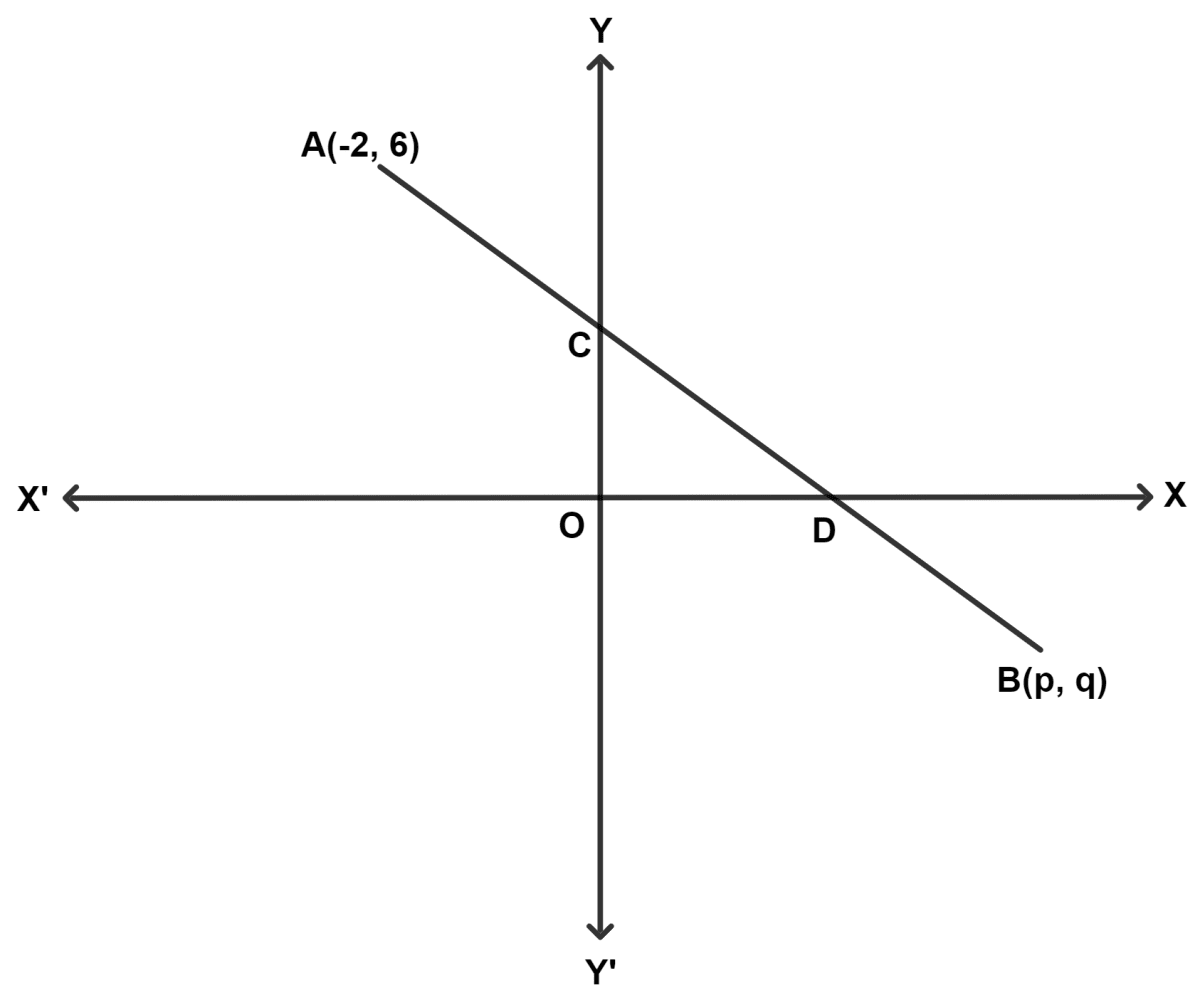
In the given figure, if the line segment AB is intercepted by the y-axis and x-axis at C and D, respectively, such that AC : AD = 1 : 4 and D is the midpoint of CB. Find the coordinates of D, C and B.

In the given figure, if the line segment AB is intercepted by the y-axis and x-axis at C and D, respectively, such that AC : AD = 1 : 4 and D is the midpoint of CB. Find the coordinates of D, C and B. Maths Competency Focused Practice Questions Class 10 Solutions.
Show SolutionHide Solution↓

Let coordinates of C be (0, b) and D be (a, 0).

Given,

AC : AD = 1 : 4

Let AC = x and AD = 4x.

From figure,

⇒ AD = AC + CD

⇒ 4x = x + CD

⇒ CD = 4x - x = 3x.

AC : CD = 1 : 3.

By section formula,

$$\begin{aligned}\Rightarrow (x, y) = \Big(\frac{m_1x_2 + m_2x_1}{m_1 + m_2}, \frac{m_1y_2 + m_2y_1}{m_1 + m_2}\Big) \\[1em] \Rightarrow (0, b) = \Big(\frac{1 \times a + 3 \times -2}{1 + 3}, \frac{1 \times 0 + 3 \times 6}{1 + 3}\Big) \\[1em] \Rightarrow (0, b) = \Big(\frac{a - 6}{4}, \frac{0 + 18}{4}\Big) \\[1em] \Rightarrow (0, b) = \Big(\frac{a - 6}{4}, \frac{18}{4}\Big) \\[1em] \Rightarrow \frac{a - 6}{4} = 0 \text{ and } b = \frac{18}{4} \\[1em] \Rightarrow a - 6 = 0 \text{ and } b = \frac{9}{2} \\[1em] \Rightarrow a = 6 \text{ and } b = \frac{9}{2}.\end{aligned}$$

C = (0 , b) = $\Big(0, \frac{9}{2}\Big)$ and D = (6, 0).

Given, D is the mid-point of CB.

$$\begin{aligned}\therefore (6, 0) = \Big(\frac{0 + p}{2}, \frac{\frac{9}{2} + q}{2}\Big) \\[1em] \Rightarrow (6, 0) = \Big(\frac{p}{2}, \frac{9 + 2q}{2 \times 2}\Big) \\[1em] \Rightarrow (6, 0) = \Big(\frac{p}{2}, \frac{9 + 2q}{4}\Big) \\[1em] \Rightarrow \frac{p}{2} = 6 \text{ and } \frac{9 + 2q}{4} = 0 \\[1em] \Rightarrow p = 12 \text{ and } 9 + 2q = 0 \\[1em] \Rightarrow p = 12 \text{ and } 2q = -9 \\[1em] \Rightarrow p = 12 \text{ and } q = -\frac{9}{2} \\[1em] \Rightarrow B = (p, q) = \Big(12, -\frac{9}{2}\Big).\end{aligned}$$

Hence, coordinates of B = $\Big(12, -\frac{9}{2}\Big), C = \Big(0, \frac{9}{2}\Big)$ and D = (6, 0).

904 Marks · Short Answer Questions 2

Find the equation of the straight line perpendicular to the line x + 2y = 4, which cuts an intercept of 2 units from the positive y-axis. Hence, find the intersection point of the two lines.

Show SolutionHide Solution↓

Given,

Equation : x + 2y = 4

⇒ 2y = -x + 4

⇒ y = $-\frac{1}{2}x + 4$

Comparing above equation with y = mx + c we get :

⇒ m = $-\frac{1}{2}$

Let slope of line perpendicular to line x + 2y = 4 be m1.

We know that,

Product of slope of perpendicular lines = -1.

$$\begin{aligned}\Rightarrow m_1 \times -\frac{1}{2} = -1 \\[1em] \Rightarrow m_1 = \frac{-1 \times 2}{-1} = 2.\end{aligned}$$

Substituting values we get :

⇒ y = mx + c

⇒ y = 2x + 2.

Simultaneously solving equation :

⇒ x + 2y = 4 .........(1)

⇒ y = 2x + 2 .......(2)

Substituting value of y from equation (2) in (1), we get :

⇒ x + 2(2x + 2) = 4

⇒ x + 4x + 4 = 4

⇒ 5x = 4 - 4

⇒ 5x = 0

⇒ x = $\frac{0}{5}$ = 0.

Substituting value of x in equation (2), we get :

⇒ y = 2(0) + 2 = 2.

Hence, equation of required line is y = 2x + 2 and point of intersection = (0, 2).

914 Marks · Short Answer Questions 2

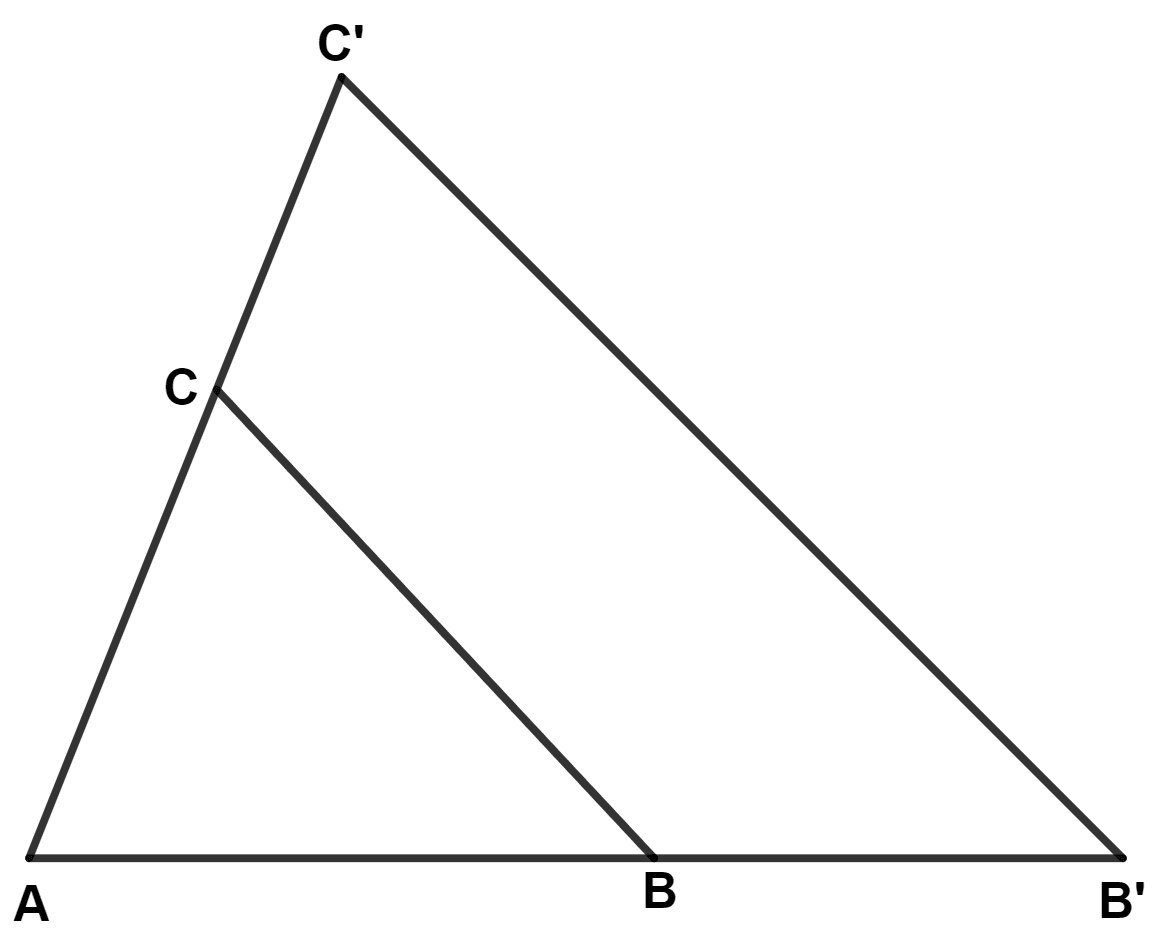
While preparing a PowerPoint presentation, ∆ ABC is enlarged along the side BC to ∆ AB'C', as shown in the diagram, such that BC ∶ B'C' is 3 ∶ 5. Find :

(a) AB ∶ BB'

(b) length AB, if BB' = 4 cm.

(c) Is ∆ ABC ~ ∆ AB'C' ? Justify your answer.

(d) ar (∆ ABC) : ar (quad. BB'C'C).

While preparing a PowerPoint presentation, ∆ ABC is enlarged along the side BC to ∆ AB'C', as shown in the diagram, such that BC ∶ B'C' is 3 ∶ 5. Find : Maths Competency Focused Practice Questions Class 10 Solutions.
Show SolutionHide Solution↓

Since, ∆ ABC is enlarged along the side BC to ∆ AB'C'.

∴ ∆ ABC and ∆ AB'C' are similar triangles.

(a) We know that,

Ratio of corresponding sides of similar triangles are proportional.

$$\begin{aligned}\therefore \frac{AB}{AB'} = \frac{BC}{B'C'} \\[1em] \Rightarrow \frac{AB}{AB'} = \frac{3}{5}\end{aligned}$$

Let AB = 3x and AB' = 5x

From figure,

⇒ AB' = AB + BB'

⇒ 5x = 3x + BB'

⇒ BB' = 5x - 3x = 2x.

⇒ AB : BB' = 3x : 2x = 3 : 2.

Hence, AB : BB' = 3 : 2.

(b) As,

$$\begin{aligned}\Rightarrow \frac{AB}{BB'} = \frac{3}{2} \\[1em] \Rightarrow \frac{AB}{4} = \frac{3}{2} \\[1em] \Rightarrow AB = \frac{3}{2} \times 4 \\[1em] \Rightarrow AB = 6 \text{ cm}.\end{aligned}$$

Hence, AB = 6 cm.

(c) Since, ∆ ABC is enlarged along the side BC to ∆ AB'C'.

∴ BC || B'C'

In ∆ ABC and ∆ AB'C',

⇒ ∠BAC = ∠B'AC' (Common angle)

⇒ ∠ABC = ∠AB'C' (Corresponding angle are equal)

∴ ∆ ABC ~ ∆ AB'C' (By A.A. axiom).

Hence, proved that ∆ ABC ~ ∆ AB'C'.

(d) We know that,

The ratio of the areas of two similar triangles is equal to the square of the ratio of their corresponding sides.

$$\begin{aligned}\therefore \frac{\text{Area of ∆ ABC}}{\text{Area of ∆ AB'C'}} = \Big(\frac{AB}{AB'}\Big)^2 \\[1em] \Rightarrow \frac{\text{Area of ∆ ABC}}{\text{Area of ∆ AB'C'}} = \Big(\frac{3}{5}\Big)^2 \\[1em] \Rightarrow \frac{\text{Area of ∆ ABC}}{\text{Area of ∆ AB'C'}} = \frac{9}{25}.\end{aligned}$$

Let area of ∆ ABC = 9a and area of ∆ AB'C' = 25a.

Area of quadrilateral BB'C'C = Area of ∆ AB'C' - Area of ∆ ABC = 25a - 9a = 16a.

∴ Area of ∆ ABC : Area of quadrilateral BB'C'C = 9a : 16a = 9 : 16.

Hence, area of ∆ ABC : area of quadrilateral BB'C'C = 9 : 16.

924 Marks · Short Answer Questions 2

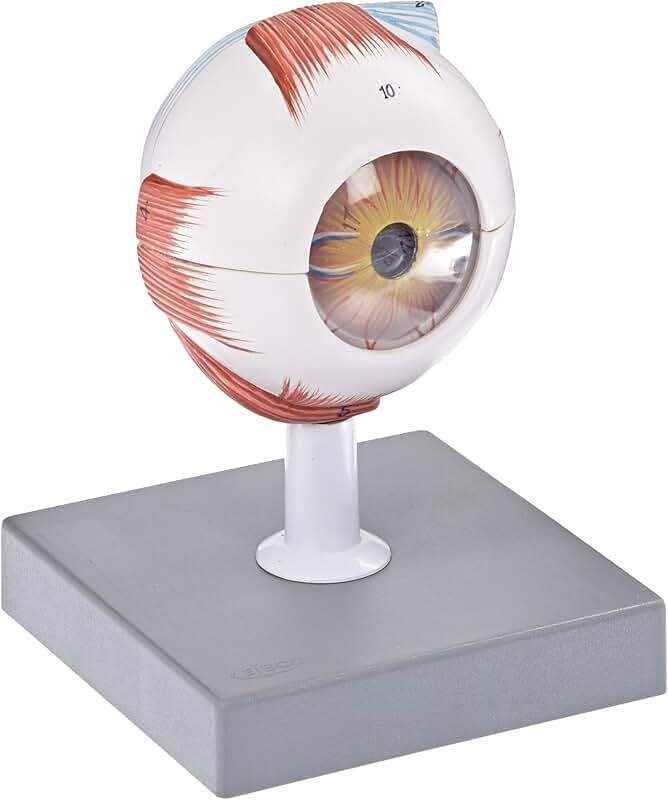
The approximate volume of a human eye is 6.5 cm3. The volume of a laboratory model (excluding base and stand) of the human eye is 1404 cm3.

The approximate volume of a human eye is 6.5 cm3. The volume of a laboratory model (excluding base and stand) of the human eye is 1404 cm3. Maths Competency Focused Practice Questions Class 10 Solutions.

(a) State whether the scale factor k is less than, equals to or greater than 1.

(b) Calculate the:

(i) value of k

(ii) diameter of the human eye if the radius of the model is 7.2 cm.

(iii) the external surface area of the human eye if the surface area of the model is 651.6 cm2.

Show SolutionHide Solution↓

(a) Scale factor is greater than 1 as volume of model is greater than the original eye.

(b)

(i) By formula,

$$\begin{aligned}\Rightarrow k^3 = \frac{\text{Volume of model}}{\text{Volume of original human eye}} \\[1em] \Rightarrow k^3 = \frac{1404}{6.5} \\[1em] \Rightarrow k^3 = \frac{216}{1} \\[1em] \Rightarrow k^3 = 6^3 \\[1em] \Rightarrow k = 6.\end{aligned}$$

Hence, scale factor (k) = 6.

(ii) By formula,

$$\begin{aligned}\Rightarrow k = \frac{\text{Radius of model}}{\text{Radius of human eye}} \\[1em] \Rightarrow 6 = \frac{7.2}{\text{Radius of human eye}} \\[1em] \Rightarrow \text{Radius of human eye} = \frac{7.2}{6} = 1.2 \text{ cm}\end{aligned}$$

Diameter of human eye = 1.2 × 2 = 2.4 cm

Hence, diameter of human eye = 2.4 cm.

(iii) By formula,

$$\begin{aligned}\Rightarrow k^2 = \frac{\text{Surface area of model}}{\text{Surface area of human eye}} \\[1em] \Rightarrow 6^2 = \frac{651.6}{\text{Surface area of human eye}} \\[1em] \Rightarrow \text{Surface area of human eye} = \frac{651.6}{6^2} \\[1em] \Rightarrow \text{Surface area of human eye} = \frac{651.6}{36} = 18.1 \text{ cm}^2.\end{aligned}$$

Hence, surface area of human eye = 18.1 cm2.

934 Marks · Short Answer Questions 2

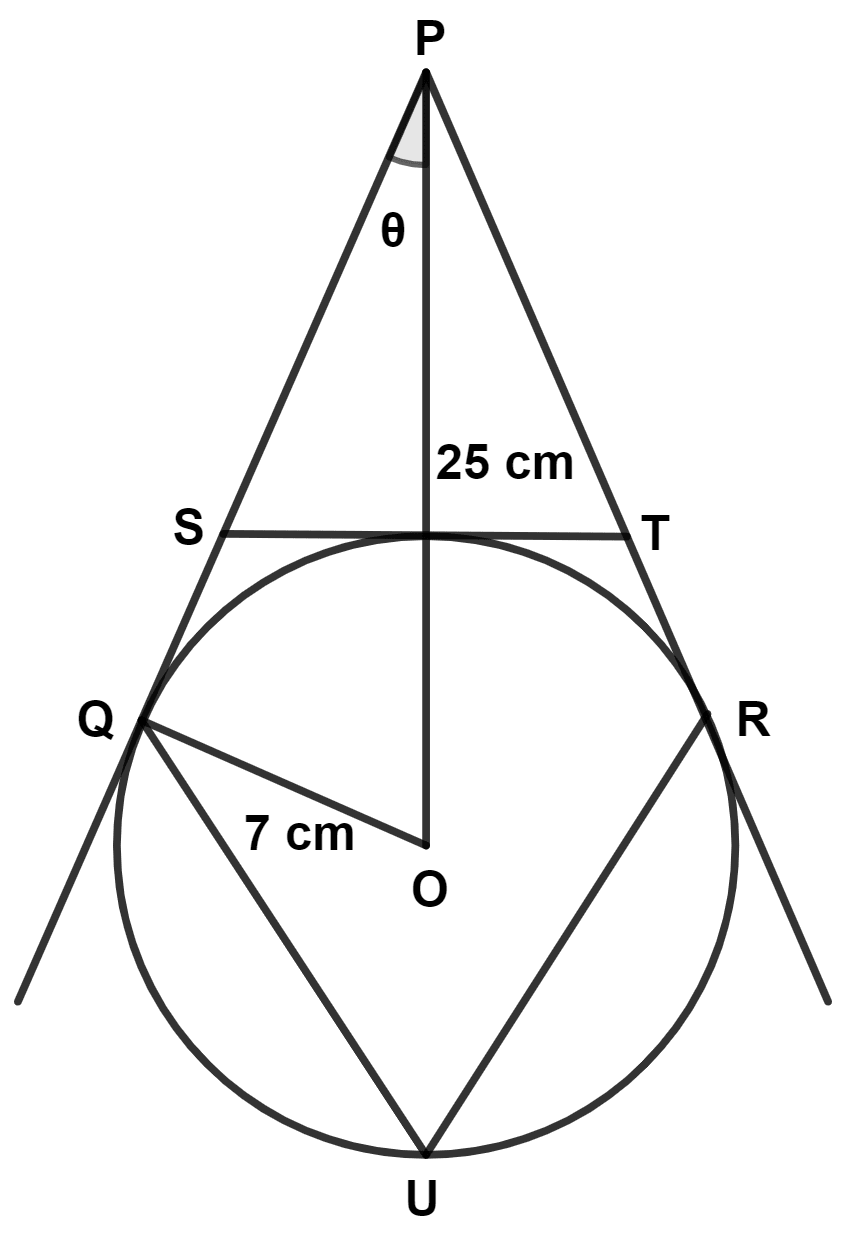
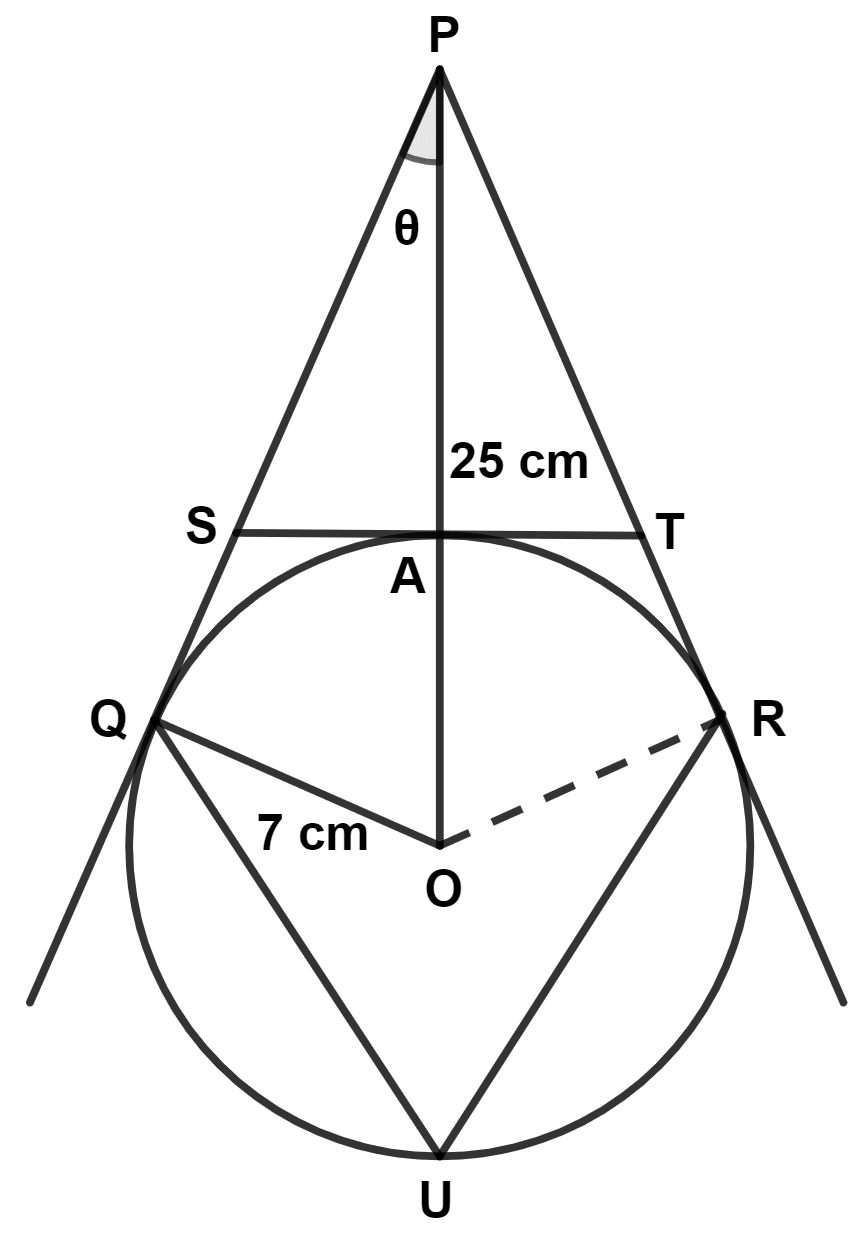
In the adjoining diagram PQ, PR and ST are the tangents to the circle with centre O and radius 7 cm. Given OP = 25 cm. Find :

(a) length of ST

(b) value of ∠OPQ, i.e. θ

(c) ∠QUR, in nearest degree

In the adjoining diagram PQ, PR and ST are the tangents to the circle with centre O and radius 7 cm. Given OP = 25 cm. Find : Maths Competency Focused Practice Questions Class 10 Solutions.
Show SolutionHide Solution↓

(a) We know that,

The radius of a circle and tangent are perpendicular at the point of contact.

∴ ∠PQO = 90°

In the adjoining diagram PQ, PR and ST are the tangents to the circle with centre O and radius 7 cm. Given OP = 25 cm. Find : Maths Competency Focused Practice Questions Class 10 Solutions.

In right-angled triangle PQO,

⇒ PO2 = PQ2 + OQ2

⇒ 252 = PQ2 + 72

⇒ 625 = PQ2 + 49

⇒ PQ2 = 625 - 49

⇒ PQ2 = 576

⇒ PQ = $\sqrt{576}$ = 24 cm.

In △ POQ,

⇒ tan θ = $\frac{OQ}{PQ}$

⇒ tan θ = $\frac{7}{24}$ ...............(1)

From figure,

⇒ ∠PAS = 90°

⇒ PA = OP - OA = 25 - 7 = 18 cm.

⇒ tan θ = $\frac{AS}{PA}$

⇒ tan θ = $\frac{AS}{18}$ ...........(2)

From equation (1) and (2), we get :

$$\begin{aligned}\Rightarrow \frac{7}{24} = \frac{AS}{18} \\[1em] \Rightarrow AS = \frac{7}{24} \times 18 \\[1em] \Rightarrow AS = \frac{7 \times 3}{4} = \frac{21}{4} \text{ cm}.\end{aligned}$$

From figure,

⇒ ST = 2 × AS = $2 \times \frac{21}{4} = \frac{21}{2}$ = 10.5 cm

Hence, ST = 10.5 cm.

(b) From equation (1),

⇒ tan θ = $\frac{7}{24}$

⇒ tan θ = 0.292

⇒ tan θ = tan 16° 16'

⇒ θ = 16° 16'.

Hence, θ = 16° 16'.

(c) In △ POQ,

⇒ ∠POQ + ∠PQO + ∠QPO = 180°

⇒ ∠POQ + 90° + 16° 16' = 180°

⇒ ∠POQ + 106° 16' = 180°

⇒ ∠POQ = 180° - 106° 16' = 73° 44' = 74°.

We know that,

Tangent from an external point to the circle are equal in length.

∴ PQ = PR.

Also,

OR = OQ (Both equal to radius of circle)

In △ POQ and △ POR,

⇒ PQ = PR (Proved above)

⇒ OQ = OR (Radius of same circle)

⇒ PO = PO (Common side)

∴ △ POQ ≅ △ POR (By S.S.S. axiom)

We know that,

Corresponding parts of congruent triangles are equal.

∴ ∠POR = ∠POQ = 74°

From figure,

⇒ ∠QOR = ∠POR + ∠POQ = 74° + 74° = 148°.

We know that,

The angle subtended by an arc of a circle at its center is twice the angle it subtends anywhere on the circle's circumference.

⇒ ∠QOR = 2∠QUR

⇒ ∠QUR = $\frac{∠QOR}{2} = \frac{148°}{2}$ = 74°.

Hence, ∠QUR = 74°.

944 Marks · Short Answer Questions 2

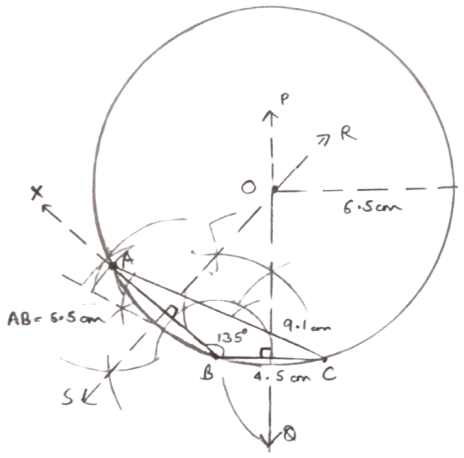
Use ruler and compass to answer this question. Construct a triangle ABC where AB = 5.5 cm, BC = 4.5 cm and angle ABC = 135°. Construct the circumcircle to the triangle ABC. Measure and write down the length of AC.

Show SolutionHide Solution↓

Steps of construction :

  1. Draw a line segment BC = 4.5 cm

  2. Construct XB such that ∠XBC = 135°.

  3. Cut AB = 5.5 cm from XB.

  4. Join and measure AC.

  5. Draw PQ and RS the perpendicular bisectors of BC and AB.

  6. Mark point O the intersection of PQ and RS.

  7. With O as center and radius as OA, draw a circle touching the vertices A, B and C.

Use ruler and compass to answer this question. Construct a triangle ABC where AB = 5.5 cm, BC = 4.5 cm and angle ABC = 135°. Construct the circumcircle to the triangle ABC. Measure and write down the length of AC. Maths Competency Focused Practice Questions Class 10 Solutions.

On measuring AC = 9.1 cm and radius = 6.5 cm.

954 Marks · Short Answer Questions 2

The curved surface area of a right circular cone is half of another right circular cone. If the ratio of their slant heights is 2 : 1 and that of their volumes is 3 : 1, find ratio of their:

(a) radii

(b) heights

Show SolutionHide Solution↓

(a) Let radius of smaller and larger cone be r and R, respectively.

Let height of smaller and larger cone be h and H, respectively.

Let slant height of smaller and larger cone be l and L respectively.

Given,

Ratio of their slant heights is 2 : 1.

∴ l : L = 2 : 1.

Given,

Curved surface area of a right circular cone is half of the other right circular cone.

∴ πrl = $\frac{1}{2}πRL$

⇒ rl = $\frac{1}{2}RL$

⇒ $\frac{r}{R} = \frac{L}{2l} = \frac{1}{2} \times \frac{1}{2}$

⇒ $\frac{r}{R} = \frac{1}{4}$

⇒ r : R = 1 : 4

Hence, ratio of the radii = 1 : 4.

(b) Let volume of cone with smaller curved surface area be v and that with larger curved surface area be V.

Given,

Volumes are in the ratio 3 : 1.

∴ v : V = 3 : 1

$$\begin{aligned}\Rightarrow \frac{\text{Volume of larger CSA cone}}{\text{Volume of smaller CSA cone}} = \frac{V}{v} \\[1em] \Rightarrow \frac{\frac{1}{3}πR^2H}{\frac{1}{3}πr^2h} = \frac{1}{3} \\[1em] \Rightarrow \frac{4^2}{1^2} \times \frac{H}{h} = \frac{1}{3} \\[1em] \Rightarrow \frac{16}{1} \times \frac{H}{h} = \frac{1}{3} \\[1em] \Rightarrow \frac{H}{h} = \frac{1}{3 \times 16} \\[1em] \Rightarrow \frac{H}{h} = \frac{1}{48} \\[1em] \Rightarrow \frac{h}{H} = \frac{48}{1}.\end{aligned}$$

Hence, ratio of heights = 48 : 1.

964 Marks · Short Answer Questions 2

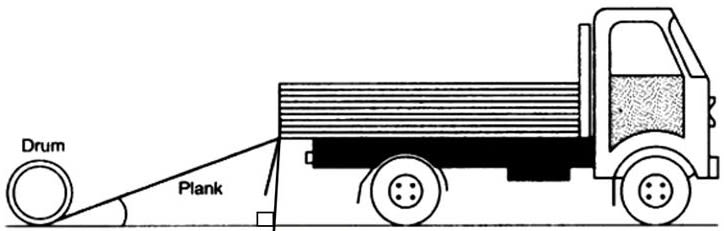
A cylindrical drum is unloaded from a truck by rolling it down along a wooden plank. The length of the plank is 10 m and it is making an angle of 10° with the horizontal ground. Find the height from which the cylindrical drum was rolled down. Give your answer correct to 3 significant figures.

A cylindrical drum is unloaded from a truck by rolling it down along a wooden plank. The length of the plank is 10 m and it is making an angle of 10° with the horizontal ground. Find the height from which the cylindrical drum was rolled down. Give your answer correct to 3 significant figures. Maths Competency Focused Practice Questions Class 10 Solutions.
Show SolutionHide Solution↓

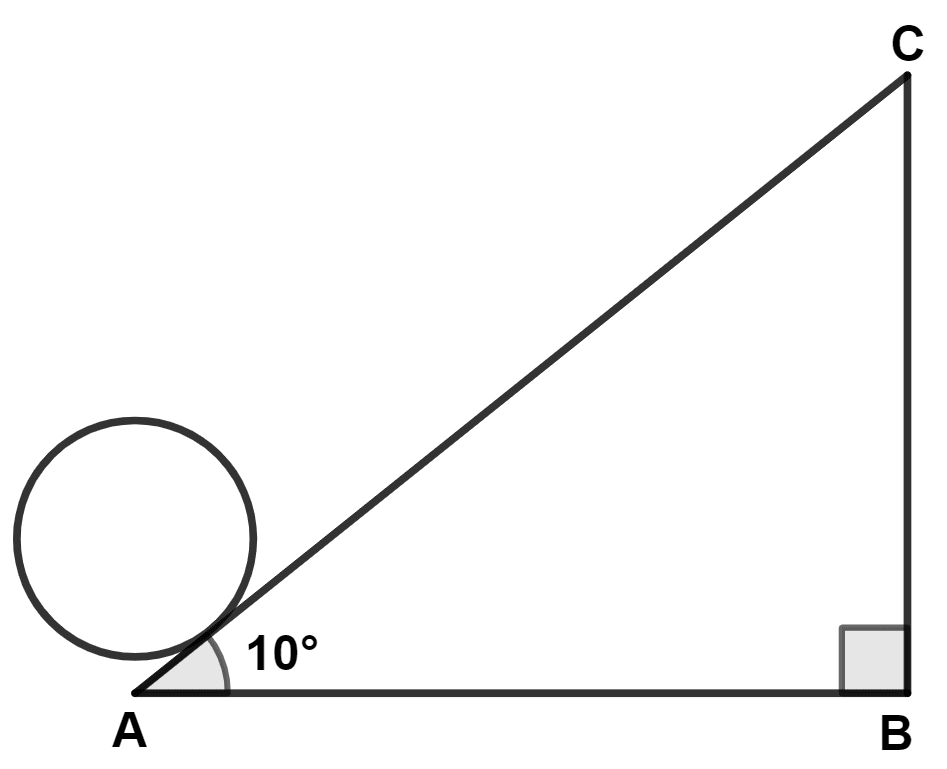
Let AC be the plank and BC be the height from where the drum is rolled down.

A cylindrical drum is unloaded from a truck by rolling it down along a wooden plank. The length of the plank is 10 m and it is making an angle of 10° with the horizontal ground. Find the height from which the cylindrical drum was rolled down. Give your answer correct to 3 significant figures. Maths Competency Focused Practice Questions Class 10 Solutions.

⇒ sin θ = $\frac{\text{Perpendicular}}{\text{Hypotenuse}}$

⇒ sin 10° = $\frac{BC}{AC}$

⇒ 0.1736 = $\frac{BC}{10}$

⇒ BC = 1.736 ~ 1.74 m

Hence, height from which the cylindrical drum was rolled down = 1.74 m.

974 Marks · Short Answer Questions 2

The data given below shows the marks of 12 students in a test, arranged in ascending order :

2, 3, 3, 3, 4, x, x + 2, 8, p, q, 8, 9.

If the given value of the median and mode is 6 and 8 respectively, then find the values of x, p, q.

Show SolutionHide Solution↓

By formula,

Median = $\frac{\frac{n}{2}\text{ th term} + \Big(\frac{n}{2} + 1\Big)\text{ th term}}{2}$

Substituting values we get :

$$\begin{aligned}\Rightarrow 6 = \frac{\frac{12}{2}\text{ th term} + \Big(\frac{12}{2} + 1\Big)\text{ th term}}{2} \\[1em] \Rightarrow 6 \times 2 = \text{6th term + 7th term} \\[1em] \Rightarrow 12 = x + x + 2 \\[1em] \Rightarrow 12 = 2x + 2 \\[1em] \Rightarrow 12 - 2 = 2x \\[1em] \Rightarrow 2x = 10 \\[1em] \Rightarrow x = \frac{10}{2} = 5.\end{aligned}$$

Numbers :

2, 3, 3, 3, 4, 5, 7, 8, p, q, 8, 9.

Since, mode = 8, it means 8 occurs for the most times in the series.

Since, 3 occurs 3 times in the series,

∴ 8 must occur for atleast 4 times in order to be the mode.

∴ p = q = 8.

Hence, x = 5, p = 8 and q = 8.

984 Marks · Short Answer Questions 2

Solve the linear inequation, write down the solution set and represent it on the real number line :

5(2 - 4x) > 18 - 16x > 22 - 20x, x ∈ R

Show SolutionHide Solution↓

Given,

5(2 - 4x) > 18 - 16x > 22 - 20x

Solving L.H.S. of the above equation :

⇒ 5(2 - 4x) > 18 - 16x

⇒ 10 - 20x > 18 - 16x

⇒ -16x + 20x < 10 - 18

⇒ 4x < -8

⇒ x < $-\frac{8}{4}$

⇒ x < -2 ...........(1)

Solving R.H.S. of the above equation :

⇒ 18 - 16x > 22 - 20x

⇒ 20x - 16x > 22 - 18

⇒ 4x > 4

⇒ x > $\frac{4}{4}$

⇒ x > 1 ............(2)

From equation (1) and (2), we get :

Solution set : {x : x < -2 or x > 1, x ∈ R}

Solve the linear inequation, write down the solution set and represent it on the real number line : Maths Competency Focused Practice Questions Class 10 Solutions.

Hence, solution set = {x : x < -2 or x > 1, x ∈ R}.

994 Marks · Short Answer Questions 2

If a polynomial x3 + 2x2 – ax + b leaves a remainder -6 when divided by x + 1 and the same polynomial has x - 2 as a factor, then find the values of a and b.

Show SolutionHide Solution↓

Given,

x3 + 2x2 – ax + b leaves a remainder -6 when divided by x + 1.

⇒ x + 1 = 0

⇒ x = -1.

Let f(x) = x3 + 2x2 – ax + b, then f(-1) = -6.

⇒ f(-1) = -6

⇒ (-1)3 + 2(-1)2 - a(-1) + b = -6

⇒ -1 + 2(1) + a + b = -6

⇒ -1 + 2 + a + b = -6

⇒ a + b + 1 = -6

⇒ a + b = -6 - 1

⇒ a + b = -7 ........(1)

Given ,

x - 2 is a factor of f(x).

⇒ x - 2 = 0

⇒ x = 2.

f(2) = 0

⇒ 23 + 2(2)2 – 2a + b = 0

⇒ 8 + 2(4) - 2a + b = 0

⇒ 8 + 8 - 2a + b = 0

⇒ 16 - 2a + b = 0

⇒ 2a - b = 16 ......(2)

Adding equation (1) and (2), we get :

⇒ a + b + 2a - b = -7 + 16

⇒ 3a = 9

⇒ a = $\frac{9}{3}$ = 3.

Substituting value of a = 3 in equation (1), we get :

⇒ 3 + b = -7

⇒ b = -7 - 3 = -10.

Hence, a = 3 and b = -10.

1004 Marks · Short Answer Questions 2

If A = $$\begin{bmatrix*}[r] -1 & 3 \\ 2 & 0 \end{bmatrix*}, B = \begin{bmatrix*}[r] 1 & -2 \\ 0 & 3 \end{bmatrix*}, C = \begin{bmatrix*}[r] 1 & -4 \end{bmatrix*} \text{ and } D = \begin{bmatrix*}[r] 4 \\ 1 \end{bmatrix*}$$

(a) Is the product AC possible? Justify your answer.

(b) Find the matrix X, such that X = AB + B2 − DC

Show SolutionHide Solution↓

(a) Order of matrix A = 2 × 2, Order of matrix C = 1 × 2

The product AC is not possible as the no. of columns in A is not equal to the no. of rows in C.

Hence, product AC is not possible.

(b) Given,

$$\Rightarrow X = AB + B^2 - DC \\[1em] \Rightarrow X = \begin{bmatrix*}[r] -1 & 3 \\ 2 & 0 \end{bmatrix*}\begin{bmatrix*}[r] 1 & -2 \\ 0 & 3 \end{bmatrix*} + \begin{bmatrix*}[r] 1 & -2 \\ 0 & 3 \end{bmatrix*}\begin{bmatrix*}[r] 1 & -2 \\ 0 & 3 \end{bmatrix*} - \begin{bmatrix*}[r] 4 \\ 1 \end{bmatrix*}\begin{bmatrix*}[r] 1 & -4 \end{bmatrix*} \\[1em] \Rightarrow X = \begin{bmatrix*}[r] -1 \times 1 + 3 \times 0 & -1 \times -2 + 3 \times 3 \\ 2 \times 1 + 0 \times 0 & 2 \times -2 + 0 \times 3 \end{bmatrix*} + \begin{bmatrix*}[r] 1 \times 1 + -2 \times 0 & 1 \times -2 + -2 \times 3 \\ 0 \times 1 + 3 \times 0 & 0 \times -2 + 3 \times 3 \end{bmatrix*} - \begin{bmatrix*}[r] 4 \times 1 & 4 \times -4 \\ 1 \times 1 & 1 \times -4 \end{bmatrix*} \\[1em] \Rightarrow X = \begin{bmatrix*}[r] -1 + 0 & 2 + 9 \\ 2 + 0 & -4 + 0 \end{bmatrix*} + \begin{bmatrix*}[r] 1 + 0 & -2 - 6 \\ 0 + 0 & 0 + 9 \end{bmatrix*} - \begin{bmatrix*}[r] 4 & -16 \\ 1 & -4 \end{bmatrix*} \\[1em] \Rightarrow X = \begin{bmatrix*}[r] -1 & 11 \\ 2 & -4 \end{bmatrix*} + \begin{bmatrix*}[r] 1 & -8 \\ 0 & 9 \end{bmatrix*} - \begin{bmatrix*}[r] 4 & -16 \\ 1 & -4 \end{bmatrix*} \\[1em] \Rightarrow X = \begin{bmatrix*}[r] -1 + 1 - 4 & 11 + (-8) - (-16) \\ 2 + 0 - 1 & (-4) + 9 - (-4) \end{bmatrix*} \\[1em] \Rightarrow X = \begin{bmatrix*}[r] -4 & 11 - 8 + 16 \\ 1 & -4 + 9 + 4 \end{bmatrix*} \\[1em] \Rightarrow X = \begin{bmatrix*}[r] -4 & 19 \\ 1 & 9 \end{bmatrix*}$$

Hence, X = $$\begin{bmatrix*}[r] -4 & 19 \\ 1 & 9 \end{bmatrix*}.$$

1014 Marks · Short Answer Questions 2

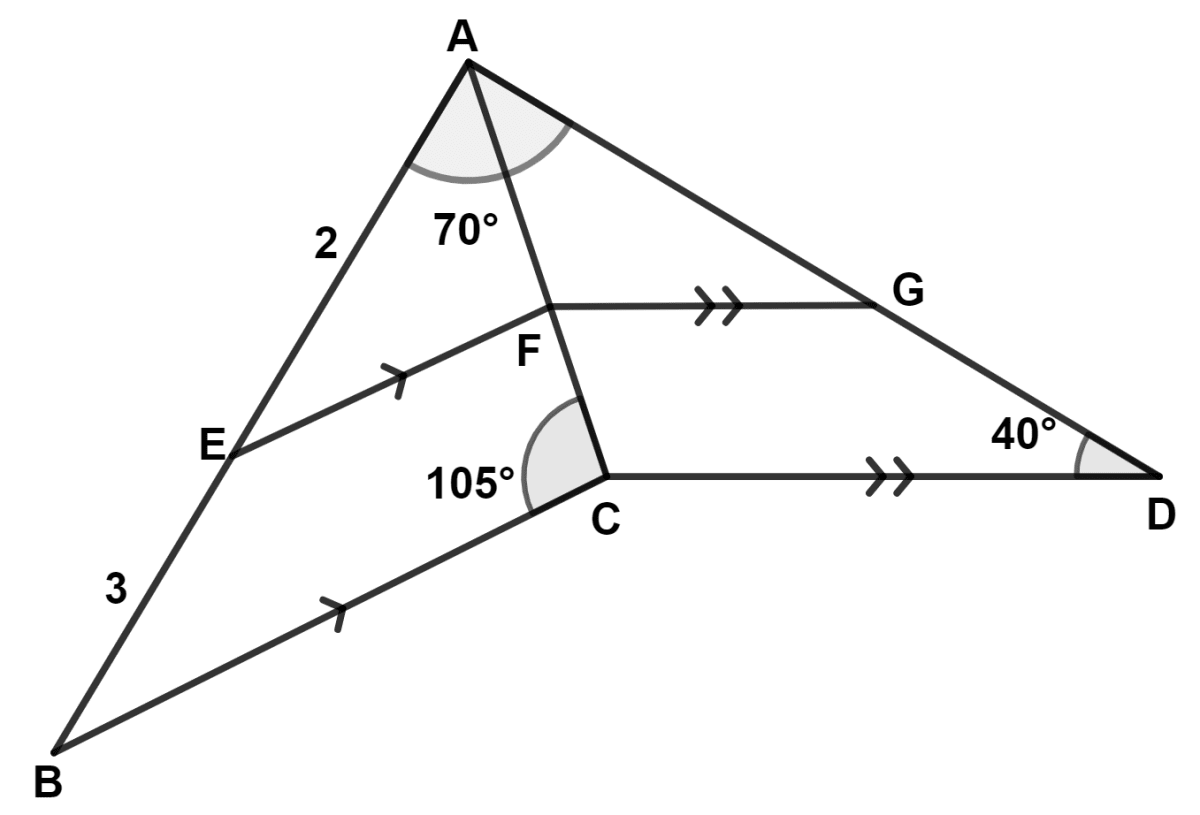
In the given figure (not drawn to scale), BC is parallel to EF, CD is parallel to FG, AE : EB = 2 : 3, ∠BAD = 70°, ∠ACB = 105°, ∠ADC = 40° and AC is bisector of ∠BAD.

In the given figure (not drawn to scale), BC is parallel to EF, CD is parallel to FG, AE : EB = 2 : 3, ∠BAD = 70°, ∠ACB = 105°, ∠ADC = 40° and AC is bisector of ∠BAD. Maths Competency Focused Practice Questions Class 10 Solutions.

(a) Prove Δ AEF ~ Δ AGF

(b) Find :

(i) AG : AD

(ii) area of Δ ACB: area Δ ACD

(iii) area of quadrilateral ABCD: area of Δ ACB.

Show SolutionHide Solution↓

(a) In Δ AFE,

⇒ ∠AFE = ∠ACB = 105° (Corresponding angle are equal)

⇒ ∠EAF = $\frac{∠BAD}{2} = \frac{70°}{2}$ = 35° (AC is the bisector of ∠BAD)

By angle sum property of triangle,

⇒ ∠AFE + ∠EAF + ∠AEF = 180°

⇒ 105° + 35° + ∠AEF = 180°

⇒ 140° + ∠AEF = 180°

⇒ ∠AEF = 180° - 140° = 40°.

∠AGF = ∠ADC = 40° (Corresponding angles are equal)

In Δ AGF,

⇒ ∠GAF = $\frac{∠BAD}{2} = \frac{70°}{2}$ = 35° (AC is the bisector of ∠BAD)

In Δ AEF and Δ AGF,

⇒ ∠EAF = ∠GAF = 35° (AC being the bisector)

⇒ ∠AEF = ∠AGF = 40° (Proved above)

∴ Δ AEF ~ Δ AGF (By A.A. axiom)

Hence, proved that Δ AEF ~ Δ AGF.

(b) In Δ ACD,

⇒ ∠CAD = 35°

⇒ ∠ADC = 40°

By angle sum property of triangle,

⇒ ∠CAD + ∠ADC + ∠DCA = 180°

⇒ 35° + 40° + ∠DCA = 180°

⇒ ∠DCA + 75° = 180°

⇒ ∠DCA = 180° - 75° = 105°.

In Δ ACD and Δ ACB,

⇒ ∠ACB = ∠ACD = 105° (Proved above)

⇒ ∠BAC = ∠DAC = 35° (Proved above)

∴ Δ ACD ~ Δ ACB (By A.A. axiom)

(i) Given,

⇒ AE : EB = 2 : 3

Let AE = 2x and EB = 3x.

∴ AB = AE + EB = 2x + 3x = 5x.

We know that,

Ratio of corresponding sides are proportional.

$$\begin{aligned}\therefore \frac{AE}{AG} = \frac{AB}{AD} \\[1em] \Rightarrow \frac{AG}{AD} = \frac{AE}{AB} \\[1em] \Rightarrow \frac{AG}{AD} = \frac{2x}{5x} = \frac{2}{5}.\end{aligned}$$

Hence, AG : AD = 2 : 5.

(ii) In △ ABC and △ ADC,

⇒ ∠BAC = ∠DAC (Both equal to 35°)

⇒ ∠ACB = ∠ACD (Both equal to 105°)

⇒ ∠ABC = ∠ADC (Both equal to 40°)

∴ △ ABC and △ ADC are congruent.

We know that,

Area of congruent triangles are equal.

Let area of △ ABC and area of △ ADC = x.

∴ Area of △ ABC : Area of △ ADC = x : x = 1 : 1.

Hence, area of △ ABC : area of △ ADC = 1 : 1.

(iii) From figure,

Area of quadrilateral ABCD = Area of △ ABC + Area of △ ADC = x + x = 2x.

∴ Area of quadrilateral ABCD : Area of △ ACB = 2x : x = 2 : 1.

Hence, area of quadrilateral ABCD : area of △ ACB = 2 : 1.

1024 Marks · Short Answer Questions 2

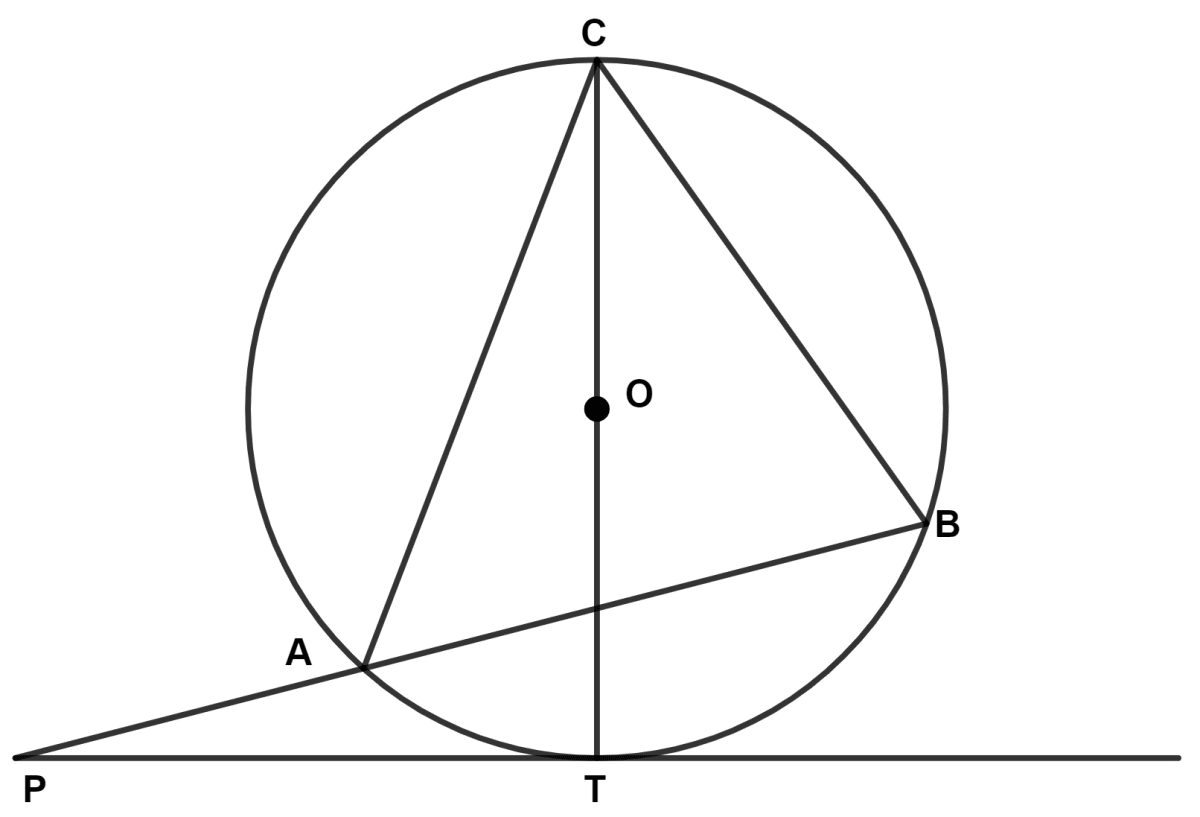
In the given figure, angle ABC = 70° and angle ACB = 50°. Given, O is the centre of the circle and PT is the tangent to the circle. Then calculate the following angles

(a) ∠CBT

(b) ∠BAT

(c) ∠PBT

(d) ∠APT

In the given figure, angle ABC = 70° and angle ACB = 50°. Given, O is the centre of the circle and PT is the tangent to the circle. Then calculate the following angles. Maths Competency Focused Practice Questions Class 10 Solutions.
Show SolutionHide Solution↓

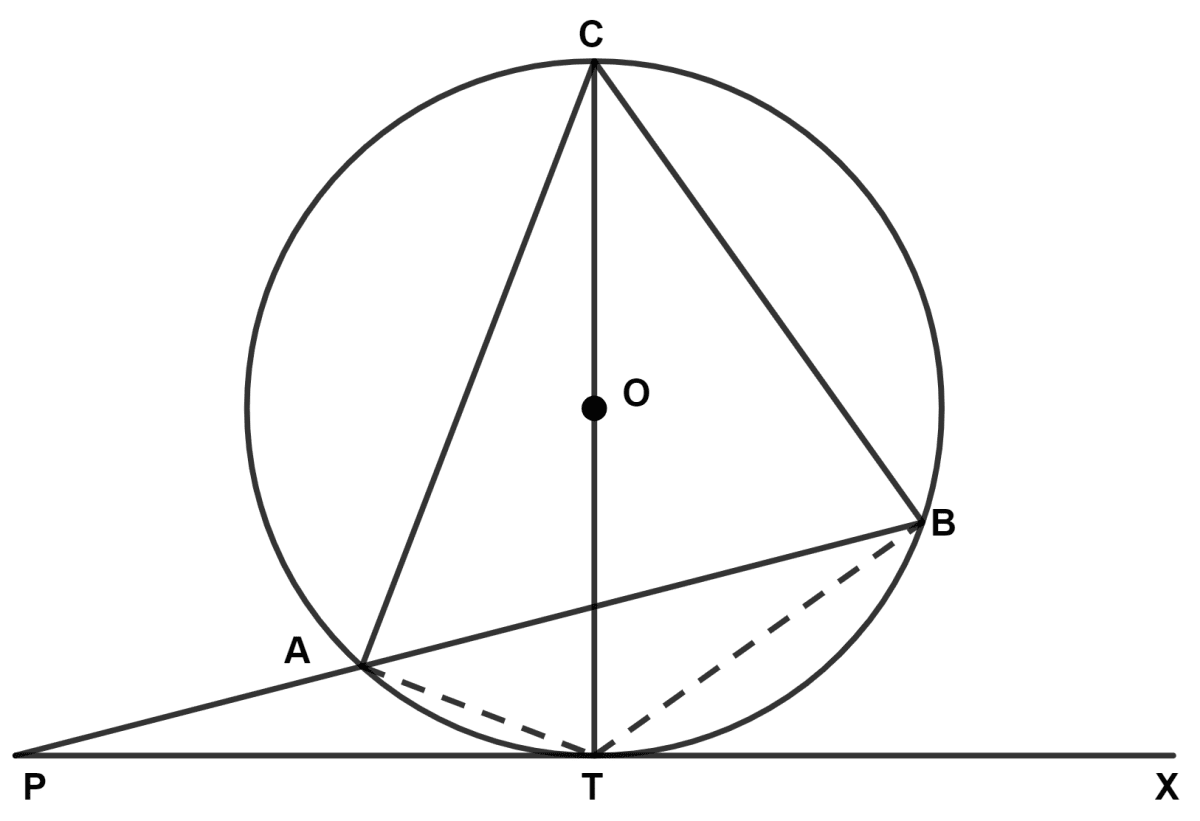
Join AT and BT.

In the given figure, angle ABC = 70° and angle ACB = 50°. Given, O is the centre of the circle and PT is the tangent to the circle. Then calculate the following angles. Maths Competency Focused Practice Questions Class 10 Solutions.

(a) We know that,

Angle in a semicircle is a right angle.

∴ ∠CBT = 90°.

Hence, ∠CBT = 90°.

(b) In cyclic quadrilateral ATBC,

⇒ ∠CBT + ∠CAT = 180° (∵ Sum of opposite angles of a cyclic quadrilateral = 180°)

⇒ 90° + ∠CAT = 180°

⇒ ∠CAT = 180° - 90° = 90°.

In △ABC,

⇒ ∠CBA + ∠CAB + ∠ACB = 180° [By angle sum property of triangle]

⇒ 70° + ∠CAB + 50° = 180°

⇒ ∠CAB + 120° = 180°

⇒ ∠CAB = 180° - 120°

⇒ ∠CAB = 60°.

From figure,

∠BAT = ∠CAT - ∠CAB = 90° - 60° = 30°.

Hence, ∠BAT = 30°.

(c) From figure,

∠BTX = ∠BAT = 30° [Angle in same segment are equal]

∠PBT = ∠CBT - ∠CBA = 90° - 70° = 20°.

Hence, ∠PBT = 20°.

(d) Since, ∠PTB and ∠BTX are linear pairs.

⇒ ∠PTB = 180° - ∠BTX = 180° - 30° = 150°.

In △PBT,

⇒ ∠PBT + ∠PTB + ∠APT = 180° [By angle sum property of triangle]

⇒ 20° + 150° + ∠APT = 180°

⇒ ∠APT + 170° = 180°

⇒ ∠APT = 180° - 170°

⇒ ∠APT = 10°.

Hence, ∠APT = 10°.

1034 Marks · Short Answer Questions 2

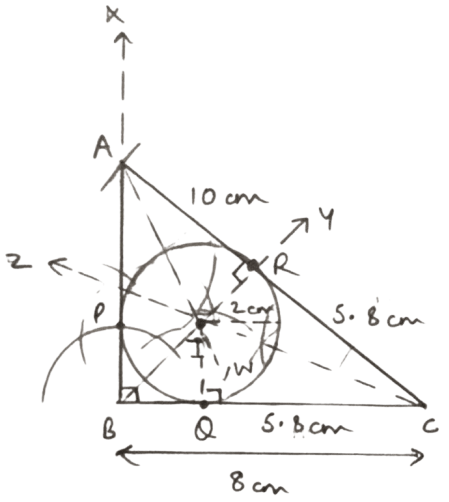
(a) Construct a triangle ABC such that BC = 8 cm, AC = 10 cm and ∠ABC = 90°.

(b) Construct an incircle to this triangle. Mark the centre as I.

(c) Measure and write the length of the in-radius.

(d) Measure and write the length of the tangents from vertex C to the incircle.

(e) Mark points P, Q and R where the incircle touches the sides AB, BC, and AC of the triangle respectively. Write the relationship between ∠RIQ and ∠QCR.

(Use a ruler and a compass for this question.)

Show SolutionHide Solution↓

Steps of construction :

  1. Draw a line segment BC = 8 cm.

  2. Draw BX perpendicular to BC.

  3. With C as center and radius = 10 cm, draw an arc cutting BX at A.

  4. Join AB and AC.

  5. Draw AW, BY and CZ the angle bisectors of A, B and C respectively.

  6. Mark the point of intersection as I.

  7. Draw IR perpendicular to side AC.

  8. With I as center and radius IR draw a circle, which is the required incircle.

  9. Mark points P, Q and R where the incircle touches the sides AB, BC, and AC of the triangle respectively.

  10. Measure CQ and CR.

Construct a triangle ABC such that BC = 8 cm, AC = 10 cm and ∠ABC = 90°. Maths Competency Focused Practice Questions Class 10 Solutions.

From figure,

⇒ ∠IRC = ∠IQC = 90° (The radius from the center of the circle to the point of tangency is perpendicular to the tangent line.)

⇒ ∠RCI = ∠QCI = $\frac{∠C}{2}$ (As CZ is angle bisector)

In △ IRC,

⇒ ∠RIC = 180° - ∠RCI - ∠IRC [∵ Sum of ∠'s in a Δ = 180°]

⇒ ∠RIC = 180° - $\frac{∠C}{2}$ - 90°

⇒ ∠RIC = 90° - $\frac{∠C}{2}$ ............(1)

In △ IQC,

⇒ ∠QIC = 180° - ∠IQC - ∠ICQ [∵ Sum of ∠'s in a Δ = 180°]

⇒ ∠QIC = 180° - 90° - $\frac{∠C}{2}$

⇒ ∠QIC = 90° - $\frac{∠C}{2}$ ............(2)

Adding equations (1) and (2), we get :

⇒ ∠RIC + ∠QIC = 90° - $\frac{∠C}{2}$ + 90° - $\frac{∠C}{2}$

⇒ ∠RIQ = 180° - ∠C

⇒ ∠RIQ = 180° - ∠RCQ

⇒ ∠RIQ + ∠RCQ = 180°.

Hence, ∠RIQ + ∠QCR = 180°.

1044 Marks · Short Answer Questions 2

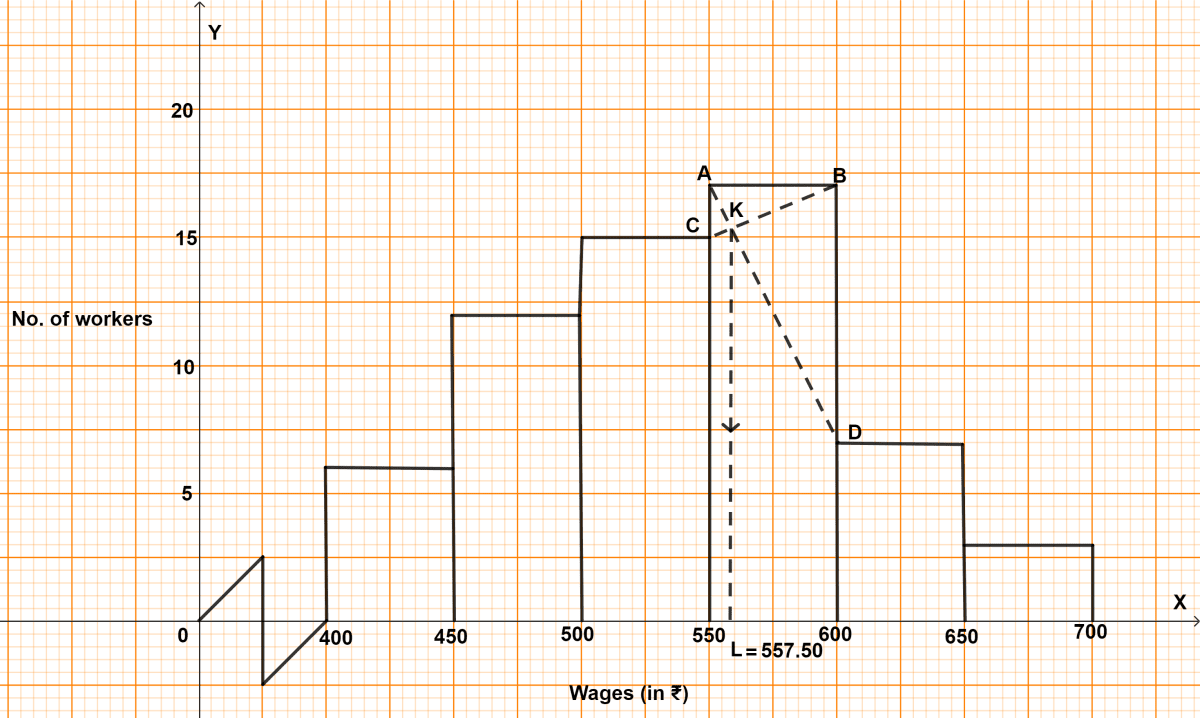
The daily wages of workers in a construction unit were recorded as follows :

Class marks (Wages)No. of workers
4256
47512
52515
57517
6257
67513

Form a frequency distribution table with class intervals and find modal wage by plotting a histogram.

Show SolutionHide Solution↓

Difference between two consecutive class marks = 475 - 425 = 50.

Adjustment factor = $\frac{\text{Class width}}{2} = \frac{50}{2}$ = 25.

Lower class limit = Class mark - Adjustment factor

Upper class limit = Class mark + Adjustment factor

ClassFrequency
400-4506
450-50012
500-55015
550-60017
600-6507
650-7003

Steps of construction :

  1. Take 2 cm along x-axis = ₹50 and 2 cm along y-axis = 5 workers.

  2. Construct rectangles corresponding to the given data.

  3. In highest rectangle, draw two st. lines AD and BC from corners of the rectangles on either side of the highest rectangle to the opposite corners of the highest rectangle.

  4. Let K be the point of intersection of AD and BC. Through K, draw a vertical line to meet the x-axis at L. The abscissa of the point L represents 557.50.

The daily wages of workers in a construction unit were recorded as follows : Maths Competency Focused Practice Questions Class 10 Solutions.

Hence, mode = ₹ 557.50

1054 Marks · Short Answer Questions 2

A bag contains 13 red cards, 13 black cards and 13 green cards. Each set of cards are numbered 1 to 13. From these cards, a card is drawn at random. What is the probability that the card drawn is a:

(a) green card?

(b) a card with an even number?

(c) a red or black card with a number which is a multiple of three?

Show SolutionHide Solution↓

Total no. of cards = 13 + 13 + 13 = 39 cards.

(a) P(that card drawn is a green card) = $\frac{\text{No. of green cards}}{\text{Total no. of cards}} = \frac{13}{39} = \frac{1}{3}$.

Hence, probability that card drawn is a green card = $\frac{1}{3}$.

(b) Even number cards are : 2, 4, 6, 8, 10, 12.

So, there are 6 even cards of each set.

∴ 18 cards.

P(that card drawn is a card with even number)

= $\frac{\text{No. of even number cards}}{\text{Total no. of cards}} = \frac{18}{39} = \frac{6}{13}$.

Hence, probability that card drawn is a card with even number = $\frac{6}{13}$.

(c) Multiples of three : 3, 6, 9, 12.

So, there are 4 cards of each red and black colour.

∴ 8 cards.

P(that card drawn is a red or black card with multiple of three)

= $\frac{\text{No. of red or black card with multiple of 3}}{\text{Total no. of cards}} = \frac{8}{39}$.

Hence, probability that card drawn is a red or black card with multiple of three = $\frac{8}{39}$.

Press ↓ to reveal a solution and move to the next question. Back to Competency Practice.

Free sample bank