In the given figure, the parallelogram ABCD circumscribes a circle, touching the circle at P, Q, R and S. Prove that :
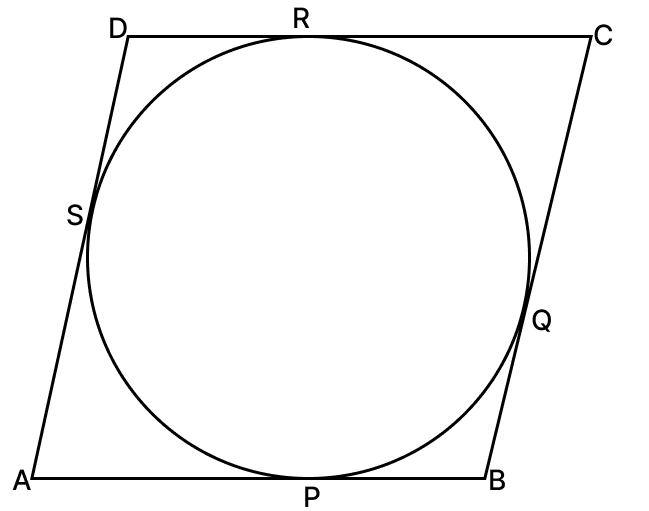
(a) AB = BC
(b) diagonals AC and BD bisect each other at right angles.
Show SolutionHide Solution↓
Join AC and BD.
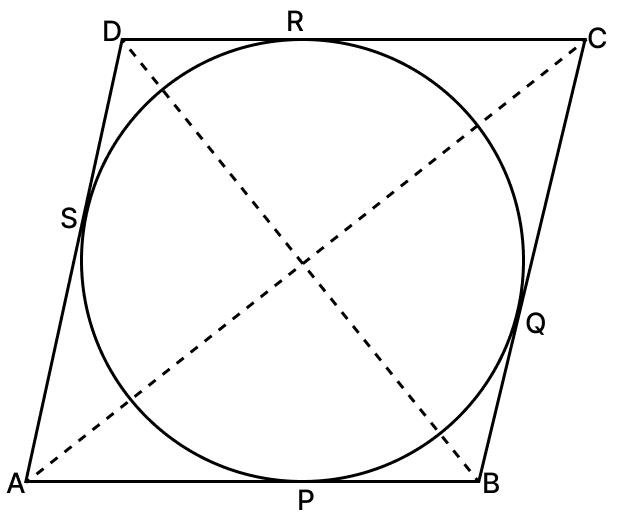
(a) We know that,
If two tangents are drawn to a circle from an exterior point, the tangents are equal in length.
∴ AP = AS, BP = BQ, CR = CQ and DR = DS
Adding the equations, we get :
⇒ AP + BP + CR + DR = AS + BQ + CQ + DS
⇒ (AP + BP) + (CR + DR) = (AS + DS) + (BQ + CQ)
⇒ AB + CD = AD + BC ......(1)
We know that,
Opposite sides of a parallelogram are equal.
∴ AB = CD and AD = BC
Substituting the above values in equation (1), we get :
⇒ AB + AB = BC + BC
⇒ 2AB = 2BC
⇒ AB = BC.
Hence, proved that AB = BC.
(b) From part (a),
⇒ AB = BC
Also, AB = CD and AD = BC [Opposite sides of a parallelogram are equal]
∴ AB = BC = CD = AD
Since, all the four sides of the parallelogram ABCD are equal, ABCD is a rhombus.
We know that,
The diagonals of a rhombus bisect each other at right angles.
Hence, proved that the diagonals AC and BD bisect each other at right angles.