In the given figure (not drawn to scale) chords AD and BC intersect at P, where AB = 9 cm, PB = 3 cm and PD = 2 cm.
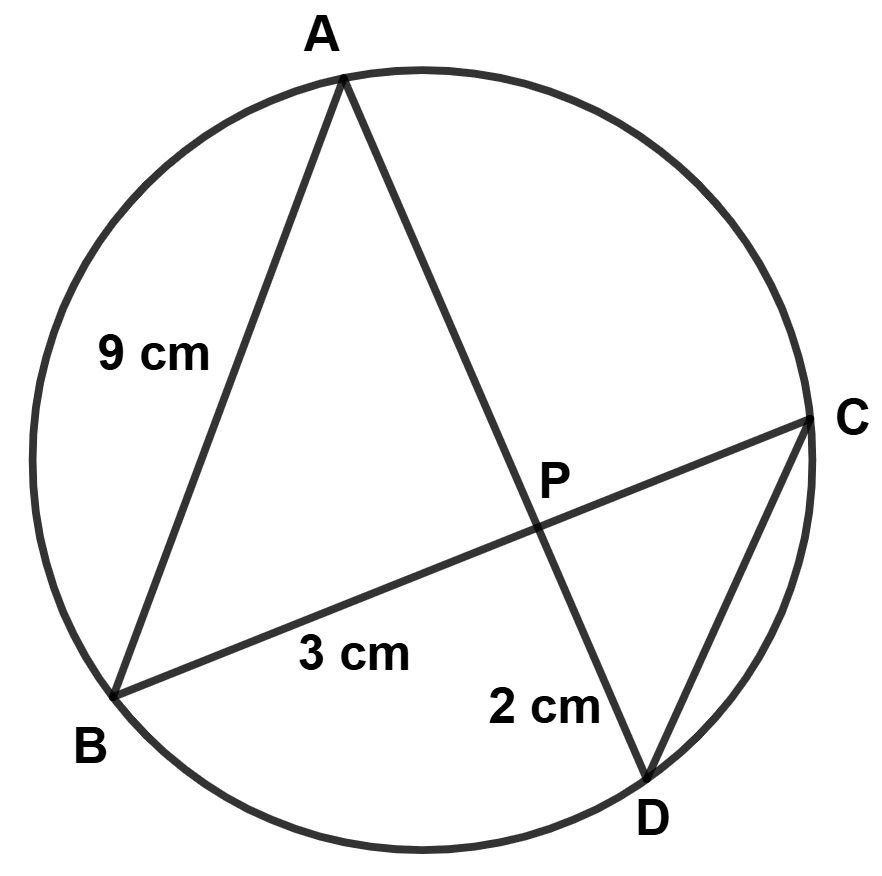
(a) Prove that ∆APB ~ ∆CPD.
(b) Find the length of CD.
(c) Find area ∆APB : area ∆CPD.
Show SolutionHide Solution↓
(a) In ∆APB and ∆CPD,
⇒ ∠APB = ∠CPD (Vertically opposite angles are equal)
⇒ ∠BAP = ∠DCP (Angles in same segment are equal)
∴ ∆APB ~ ∆CPD (By A.A. axiom)
Hence, proved that ∆APB ~ ∆CPD.
(b) We know that,
Corresponding sides of similar triangles are proportional.
$$\begin{aligned}\therefore \frac{CD}{AB} = \frac{PD}{PB} \\[1em] \Rightarrow \frac{CD}{9} = \frac{2}{3} \\[1em] \Rightarrow CD = \frac{2}{3} \times 9 \\[1em] \Rightarrow CD = 6 \text{ cm}.\end{aligned}$$
Hence, CD = 6 cm.
(c) We know that,
Ratio of area of similar triangles is equal to the ratio of square of their corresponding sides.
$$\begin{aligned}\therefore \frac{\text{Area of ∆APB}}{\text{Area of ∆CDP}} = \frac{PB^2}{PD^2} \\[1em] = \frac{3^2}{2^2} \\[1em] = \frac{9}{4} \\[1em] = 9 : 4.\end{aligned}$$
Hence, area ∆APB : area ∆CPD = 9 : 4.