In the figure given below, AC is a diameter of the circle.
AP = 3 cm and PB = 4 cm and QP ⊥ AB. If the area of ∆APQ is 18 cm2, then the area of shaded portion QPBC is :
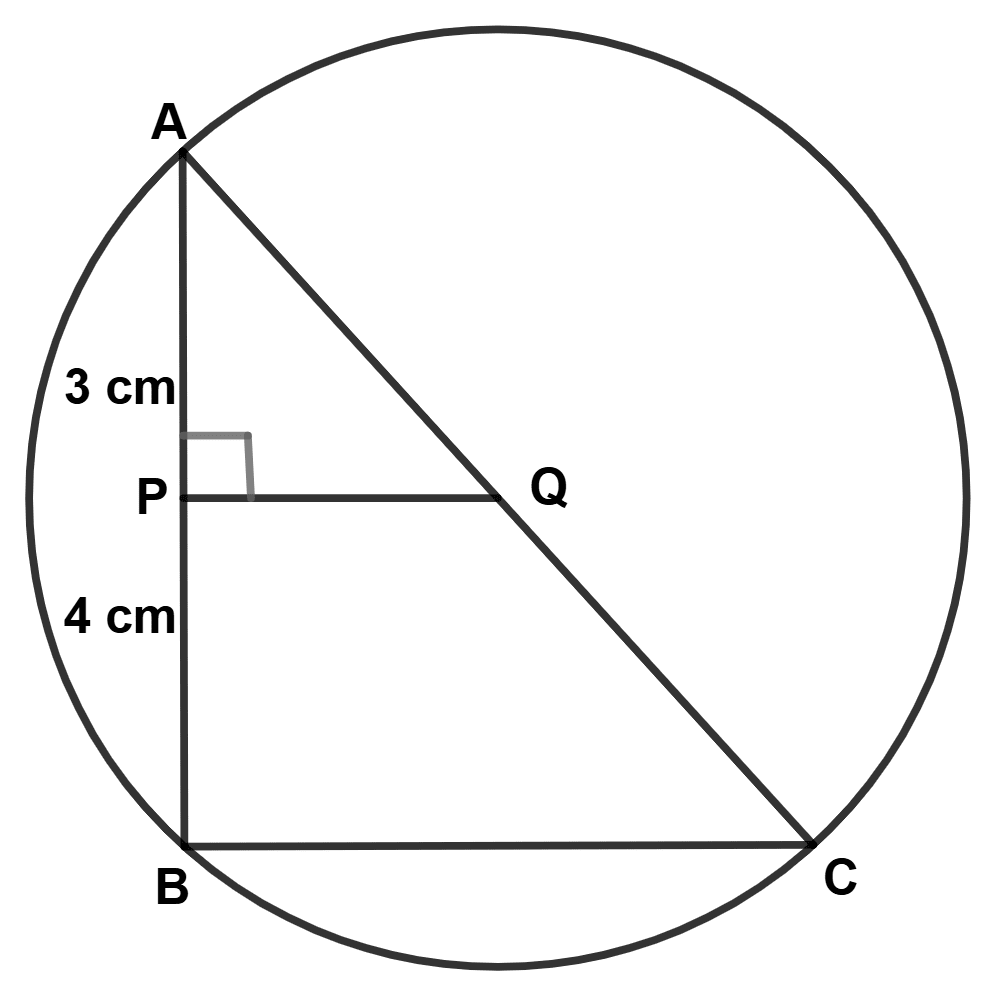
- (a)32 cm2
- (b)49 cm2
- (c)80 cm2
- (d)98 cm2
Show SolutionHide Solution↓
Given,
We know that,
Angle in a semi-circle is a right angle.
∴ ∠ABC = 90°.
In ∆APQ and ∆ABC,
⇒ ∠APQ = ∠ABC [Both equal to 90°]
⇒ ∠BAC = ∠PAQ [Common angles]
∴ ∆APQ ∼ ∆ABC (By A.A. axiom)
We know that,
The ratio of area of similar triangles is equal to the ratio of the square of the corresponding sides.
$$\begin{aligned}\Rightarrow \frac{\text{Area of ∆APQ}}{\text{Area of ∆ABC}} = \frac{AP^2}{AB^2} \\[1em] \Rightarrow \frac{18}{\text{Area of ∆ABC}} = \frac{AP^2}{AB^2} \\[1em] \Rightarrow \text{Area of ∆ABC} = \frac{AB^2}{AP^2} \times 18 \\[1em] \Rightarrow \text{Area of ∆ABC}= \frac{(4 + 3)^2}{3^2} \times 18 \\[1em] \Rightarrow \text{Area of ∆ABC} = \frac{7^2}{3^2} \times 18 \\[1em] \Rightarrow \text{Area of ∆ABC} = \frac{49}{9} \times 18 = 98 \text{ cm}^2.\end{aligned}$$
From figure,
Area QPBC = Area of ∆ABC − Area of ∆APQ
= 98 - 18 = 80 cm2.
Hence, option 3 is the correct option.