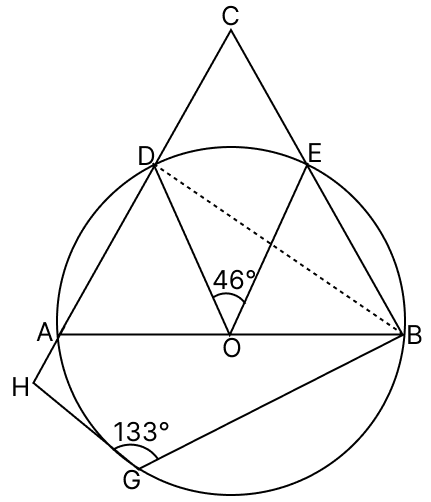
In the adjoining diagram ∠DOE = 46° and ∠BGH = 113°.
(a) Find ∠DBC and ∠DCE.
(b) Prove that CBGH is a cyclic quadrilateral.
Show SolutionHide Solution↓
We know that,
The angle subtended by an arc at the center is double the angle subtended by it at any point on the remaining part of the circle.
∴ ∠DBE = $\frac{1}{2}$ DOE
⇒ ∠DBE = $\frac{1}{2}$ × 46° = 23°
From figure,
⇒ ∠DBC = ∠DBE = 23°.
From figure,
⇒ ∠BDA = 90° [Angle in a semicircle]
⇒ ∠BDC = 180° - ∠BDA [Angles on a straight line]
⇒ ∠BDC = 180° - 90°
⇒ ∠BDC = 90°.
In triangle BDC,
Sum of angles in a triangle = 180°
⇒ ∠BDC + ∠DCB + ∠DBC = 180°
⇒ 90° + ∠DCB + 23° = 180°
⇒ 113° + ∠DCB = 180°
⇒ ∠DCB = 180° - 113°
⇒ ∠DCB = 67°
From figure,
∠DCE = ∠DCB = 67°.
Hence, ∠DBC = 23° and ∠DCE = 67°.
(b) From figure,
⇒ ∠BCH = ∠DCE = 67° [Common angles]
⇒ ∠BGH = 113°
⇒ ∠BGH + ∠BCH = 113° + 67° = 180°.
Since, the sum of opposite sides of quadrilateral is 180°, thus CBGH is a cyclic quadrilateral.
Hence, proved that CBGH is a cyclic quadrilateral.