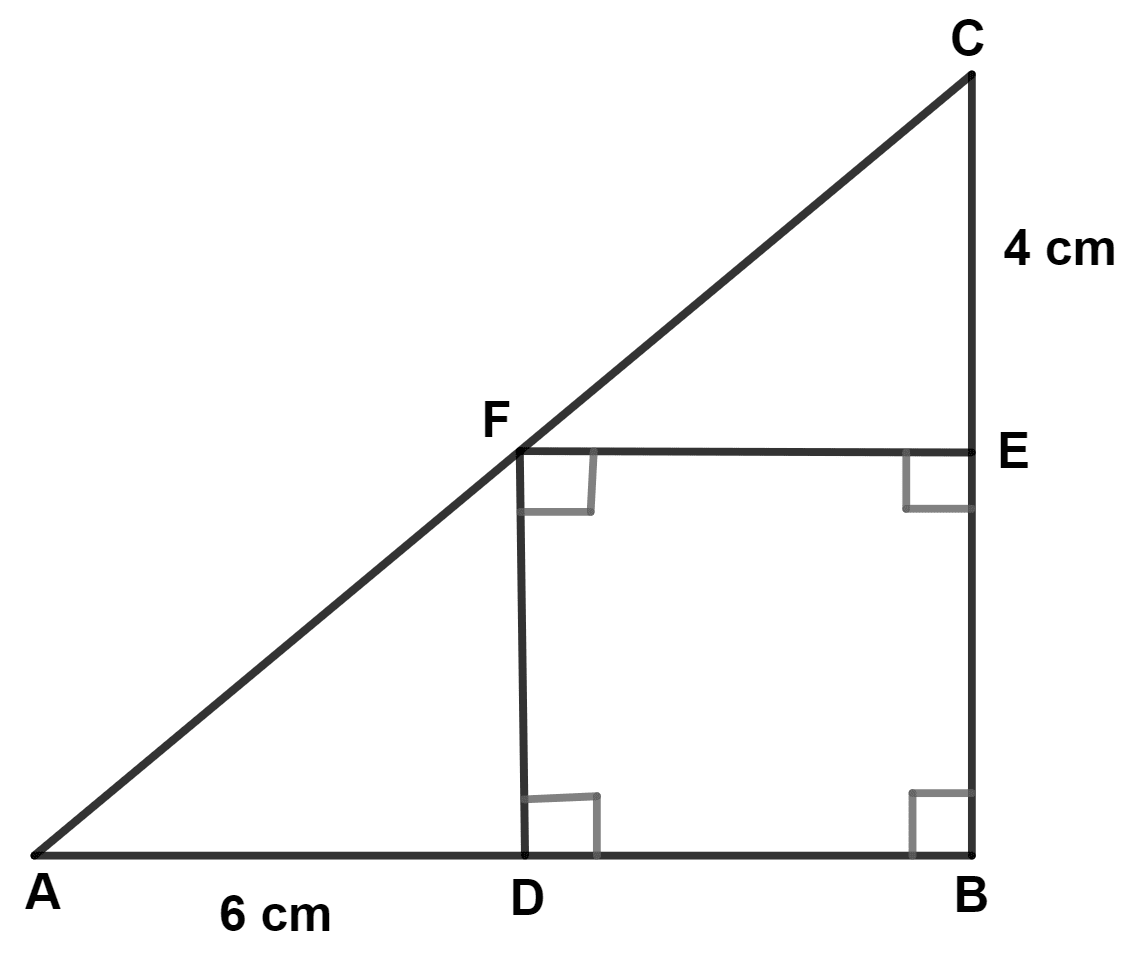
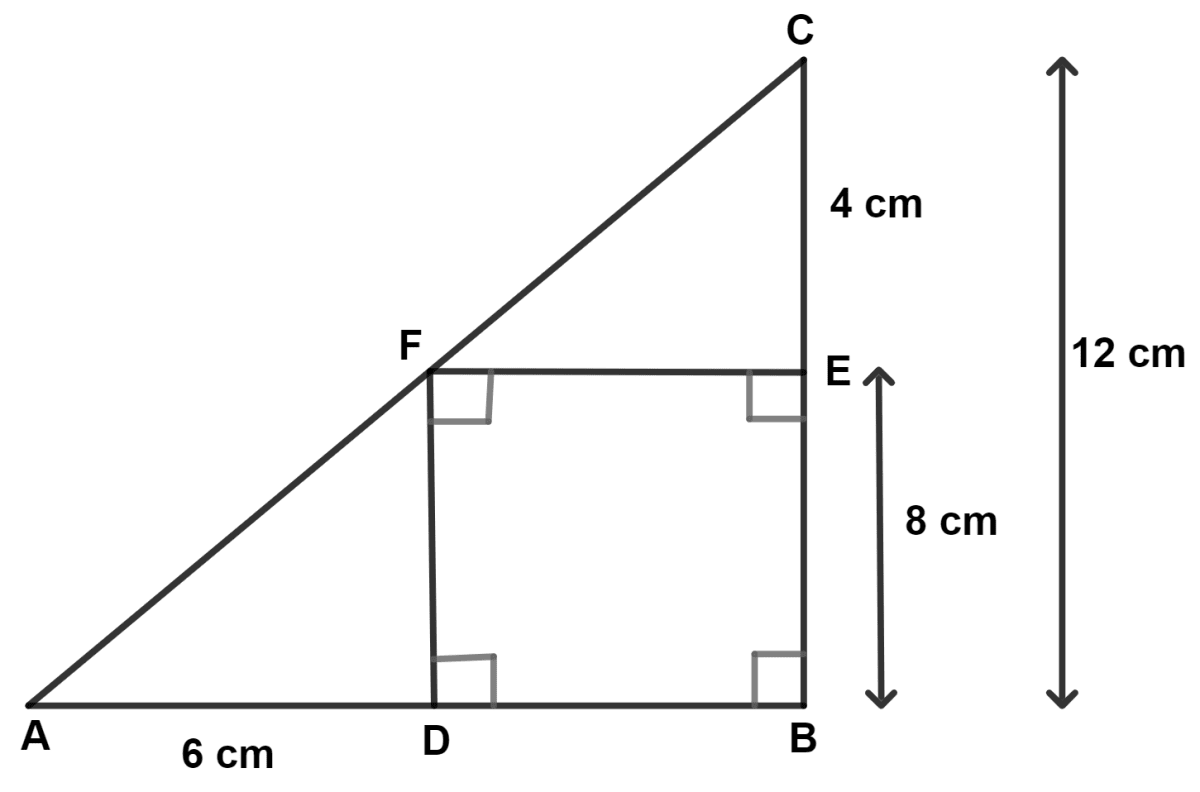
In the given diagram, △ ABC is right angled at ∠B. BDFE is a rectangle. AD = 6 cm, CE = 4 cm and BC = 12 cm.
(a) prove that △ADF ~ △FEC.
(b) prove that △ADF ~ △ABC.
(c) find the length of FE
(d) find area △ADF : area △ABC
Show SolutionHide Solution↓
(a) In △ADF,
⇒ ∠ADF = 90°
By angle sum property of triangle,
⇒ ∠ADF + ∠AFD + ∠A = 180°
⇒ 90° + ∠AFD + ∠A = 180°
⇒ ∠AFD + ∠A = 180° - 90°
⇒ ∠AFD + ∠A = 90° .........(1)
In △ ABC,
By angle sum property of triangle,
⇒ ∠A + ∠B + ∠C = 180°
⇒ ∠A + 90° + ∠C = 180°
⇒ ∠A + ∠C = 180° - 90°
⇒ ∠A + ∠C = 90° .........(2)
From equation (1) and (2), we get :
⇒ ∠AFD + ∠A = ∠A + ∠C
⇒ ∠AFD = ∠C
In △ ADF and △ FEC,
⇒ ∠ADF = ∠FEC (Both equal to 90°)
⇒ ∠AFD = ∠C (Proved above)
∴ △ ADF ~ △ FEC [By A.A. axiom]
Hence, proved that △ ADF ~ △ FEC.
(b) In △ ADF and △ ABC,
⇒ ∠DAF = ∠BAC (Common angle)
⇒ ∠ADF = ∠ABC (Both equal to 90°)
∴ △ ADF ~ △ ABC [By A.A. axiom]
Hence, proved that △ ADF ~ △ ABC.
(c) From figure,
⇒ DB = FE = x (let)
⇒ AB = AD + DB = (6 + x) cm
⇒ DF = BE = BC - CE = 12 - 4 = 8 cm.
△ ADF ~ △ ABC [proved above]
We know that,
Corresponding sides of similar triangle are proportional.
$$\begin{aligned}\Rightarrow \frac{AD}{AB} = \frac{DF}{BC} \\[1em] \Rightarrow \frac{6}{6 + x} = \frac{8}{12} \\[1em] \Rightarrow 8(6 + x) = 6 \times 12 \\[1em] \Rightarrow 48 + 8x = 72 \\[1em] \Rightarrow 8x = 72 - 48 \\[1em] \Rightarrow 8x = 24 \\[1em] \Rightarrow x = \frac{24}{8} = 3 \text{ cm}.\end{aligned}$$
Hence, FE = 3 cm.
(d) We know that,
The ratio of the area of two similar triangles is equal to the square of the ratio of any pair of the corresponding sides of the similar triangles.
$$\begin{aligned}\Rightarrow \frac{\text{Area of △ ADF}}{\text{Area of △ ABC}} = \frac{AD^2}{AB^2} \\[1em] \Rightarrow \frac{\text{Area of △ ADF}}{\text{Area of △ ABC}} = \frac{6^2}{(6 + 3)^2} \\[1em] \Rightarrow \frac{\text{Area of △ ADF}}{\text{Area of △ ABC}} = \frac{6^2}{9^2} \\[1em] \Rightarrow \frac{\text{Area of △ ADF}}{\text{Area of △ ABC}} = \frac{36}{81} = \frac{4}{9}.\end{aligned}$$
Hence, area △ ADF : area △ ABC = 4 : 9.