In the given diagram ∆ADB and ∆ACB are two right angled triangles with ∠ADB = ∠BCA = 90°. If AB = 10 cm, AD = 6 cm, BC = 2.4 cm and DP = 4.5 cm
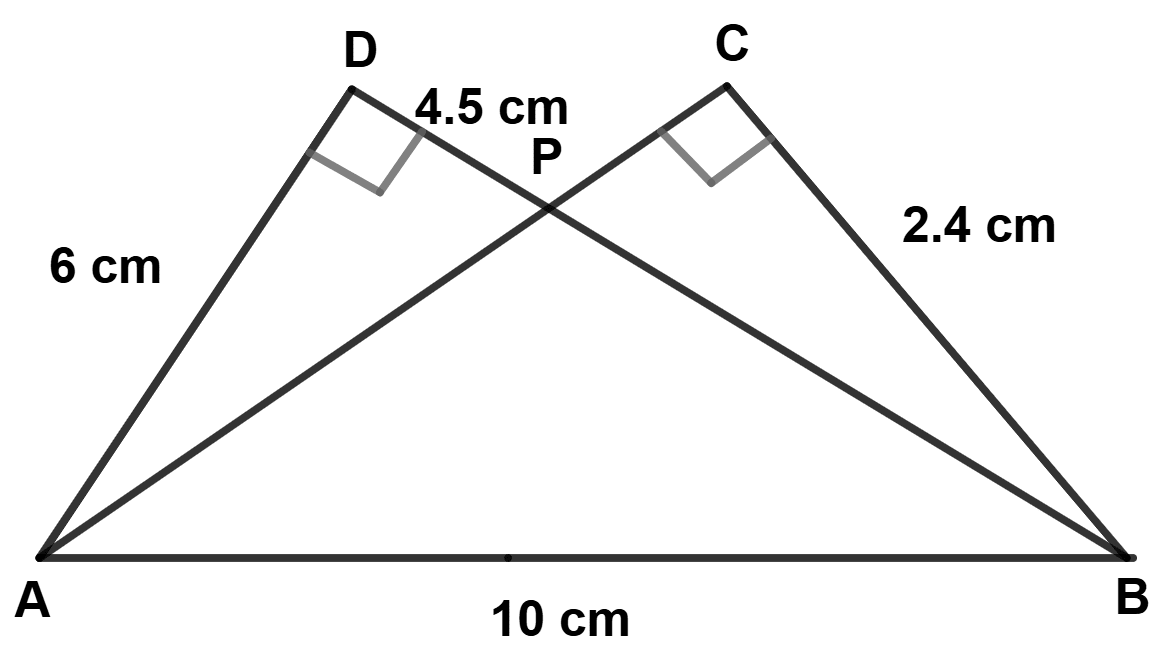
(a) Prove that ∆APD ∼ ∆BPC.
(b) Find the length of BD and PB
(c) Hence, find the length of PA
(d) Find area ∆APD : area ∆BPC
Show SolutionHide Solution↓
(a) In ∆APD and ∆BPC,
⇒ ∠APD = ∠BPC (Vertically opposite angles are equal)
⇒ ∠ADP = ∠BCP (Both equal to 90°)
Hence, proved that ∆APD ∼ ∆BPC.
(b) In ∆ADB,
By pythagoras theorem,
⇒ AB2 = AD2 + BD2
⇒ 102 = 62 + BD2
⇒ BD2 = 100 - 36
⇒ BD2 = 64
⇒ BD = $\sqrt{64}$ = 8 cm.
⇒ PB = BD - PD = 8 - 4.5 = 3.5 cm
Hence, BD = 8 cm and PB = 3.5 cm.
(c) In ∆APD,
By pythagoras theorem,
⇒ AP2 = AD2 + DP2
⇒ AP2 = 62 + (4.5)2
⇒ AP2 = 36 + 20.25
⇒ AP2 = 56.25
⇒ AP = $\sqrt{56.25}$ = 7.5 cm
Hence, length of AP = 7.5 cm.
(d) We know that,
Ratio of area of similar triangles is equal to the square of the corresponding sides.
$$\begin{aligned}\therefore \frac{\text{Area of △APD}}{\text{Area of △BPC}} = \frac{AD^2}{BC^2} \\[1em] = \frac{6^2}{(2.4)^2} \\[1em] = \frac{6 \times 6}{2.4 \times 2.4} \\[1em] = \frac{1 \times 1}{0.4 \times 0.4} \\[1em] = \frac{10 \times 10}{4 \times 4} \\[1em] = \frac{100}{16} \\[1em] = \frac{25}{4} \\[1em] = 25 : 4.\end{aligned}$$
Hence, area ∆APD : area ∆BPC = 25 : 4.