The State Judiciary : The High Courts

ICSE Class 10 History & Civics · Kundra History & Civics · 32 solved questions

Exercise
Marks
11 Mark · Multiple Choice Questions

The High Court Judge can remain in the office till he/she attains the age of.....

Show SolutionHide Solution↓

62 years

Reason — A High Court judge holds office until attaining the age of 62 years.

21 Mark · Multiple Choice Questions

The Chief Justice of High Court is appointed by

Show SolutionHide Solution↓

President of India

Reason — The Chief Justice of a High Court is appointed by the President in consultation with the Chief Justice of the Supreme Court and the Governor of the State concerned.

31 Mark · Multiple Choice Questions

The ordinary judges of the High Courts are appointed by the President in consultation with

Show SolutionHide Solution↓

All of these

Reason — In making the appointment of the other Judges of a High Court, the President consults the Chief Justice of India, the Governor of the state and the Chief Justice of the High Court. Hence, all of these are consulted.

41 Mark · Multiple Choice Questions

Choose the correct statement :

Show SolutionHide Solution↓

The High Court is the highest Court of Law and Appeal in the State

Reason — Statement 1 is correct because the High Court serves as the apex judicial authority and highest court of appeal within a state's territorial jurisdiction. Statements 2 and 3 are incorrect because appeals from district courts must proceed to the High Court before reaching the Supreme Court, and every state in India is under the jurisdiction of a High Court.

51 Mark · Multiple Choice Questions

On what grounds can a Judge of the Supreme Court or a High Court be removed?

Show SolutionHide Solution↓

Misbehaviour or incapacity

Reason — A Supreme Court or a High Court Judge can be removed only by the President through a difficult procedure involving an address passed by both Houses of Parliament with a special majority. The constitutional grounds for such removal are proved misbehaviour or incapacity.

61 Mark · Multiple Choice Questions

How many High Courts are there in India?

Show SolutionHide Solution↓

25

Reason — At present there are 25 High Courts in the whole of the country.

71 Mark · Multiple Choice Questions

The High Court enjoys the power

I. To issue writs for enforcement of rights conferred on citizens
II. To exercise superintendence over the working of courts and tribunals under its jurisdiction
III. To make general rules and prescribe formats regarding practices and proceedings of courts under its jurisdiction

Show SolutionHide Solution↓

All of these

Reason — The High Court can issue writs for the enforcement of the Fundamental Rights of citizens, exercises supervision (superintendence) over all the courts and tribunals falling under its jurisdiction, and frames rules regarding the practices and proceedings of these courts. Hence, it enjoys all the powers listed.

81 Mark · Multiple Choice Questions

Which of the following courts acts as the guardian of the Fundamental Rights?

Show SolutionHide Solution↓

Both of these

Reason — The High Courts function as guardians of the Fundamental Rights of Indian citizens and protect them from being eroded, infringed upon or abridged. Like the Supreme Court, the High Court also performs this duty. Hence, both the courts act as the guardian of the Fundamental Rights.

91 Mark · Multiple Choice Questions

Ordinary Judges of the High Court are appointed by the President in consultation with

I. Chief Justice of the High Court
II. Chief Justice of India
III. Governor of the State

Show SolutionHide Solution↓

I, II and III

Reason — In making the appointment of the other Judges of a High Court, the President consults the Chief Justice of India, the Governor of the state and the Chief Justice of the High Court. Hence, all three are consulted.

101 Mark · Multiple Choice Questions

The Chief Justice of a High Court is appointed by

Show SolutionHide Solution↓

President

Reason — The Chief Justice of a High Court is appointed by the President in consultation with the Chief Justice of the Supreme Court and the Governor of the State concerned.

111 Mark · Multiple Choice Questions

Read the passage given below and answer the following questions.

In order to ensure the independence of the Judiciary even in the States, it has been provided that once appointed the Chief Justice and the other judges of the High Courts shall continue to function till they attain the age of 62 or they themselves resign their office. The procedure of their removal has been made very difficult. They can be removed by the President only upon a joint address by both the Houses of the Parliament. But such an address must be passed by a majority of the total membership of both the Houses and also by two-thirds of the members present and voting. Undoubtedly, this is a very difficult procedure. Thus, the position of the High Court Judges has been as independent as possible.

(i) The Chief Justice and other judges of High Court retire at the age of

  1. 62
  2. 63
  3. 64
  4. 65

(ii) Who can remove a Judge of High Court?

Show SolutionHide Solution↓

(i) 62

Reason — The passage states that the Chief Justice and the other judges of the High Courts continue to function till they attain the age of 62.

(ii) President on impeachment by Parliament

Reason — The passage states that a High Court Judge can be removed by the President only upon a joint address by both the Houses of Parliament passed by the required special majority. Hence, the correct answer is the President acting on such an address.

121 Mark · Multiple Choice Questions

In the question given below, there are two statements marked as Assertion (A) and Reason (R). Read the statements and choose the correct option.

Assertion (A) : The Chief Justice of a High Court is appointed by the President.

Reason (R) : The Governor administers the oath of office to the High Court Judges.

Show SolutionHide Solution↓

(A) and (R) are independent of each other

Explanation — The Chief Justice of a High Court in India is appointed by the President in consultation with the Chief Justice of the Supreme Court and the Governor of the State concerned. The Governor administers the oath of office to the High Court Judges. Both the statements are correct, but the administering of the oath by the Governor is not the reason why the appointment is made by the President. Hence, (A) and (R) are independent of each other.

131 Mark · Multiple Choice Questions

Identify the cases over which the High Court enjoys original jurisdiction.

P : Mr. Prasad is levied more land revenue than his dues.

Q : There is a dispute among the sons of a deceased regarding his will.

R : Mr. Singh has been awarded death sentence by the Session Court.

S : There is a property dispute between two persons and the District Court has deliberately favoured the accused.

Show SolutionHide Solution↓

P and Q

Explanation — The High court has original jurisdiction over matters relating to State revenue and its collection, and cases relating to Fundamental Rights, divorce, wills and laws relating to marriage. Statements R and S are cases that fall under Appellate and Revisory jurisdiction respectively.

141 Mark · Multiple Choice Questions

Read the two statements given below regarding the independence of High Court Judges. Select the correct relationship between (A) and (B).

(A) Their salaries are charged on the Consolidated Fund of the state.

(B) Retired Judges of a High Court can practise as an advocate in any High Court and before the Supreme Court.

Show SolutionHide Solution↓

(A) is true but (B) is false

Explanation — The salaries of the High Court Judges are charged on the Consolidated Fund of the State. A retired Judge of a High Court cannot practise in the same High Court in which he held office, though he may practise before the Supreme Court or other High Courts.

151 Mark · Multiple Choice Questions

Given below are details of Indian citizens. Select the ones who are eligible for appointment as a High Court Judge:

CandidateAgeDetails
P65Is a distinguished jurist
Q61Has been a High Court Advocate for 10 years
R67Has been a High Court Advocate for 5 years
S56Has held a judicial Office for at least 10 year
Show SolutionHide Solution↓

Q and S

Reason — A person is eligible for appointment as a Judge of a High Court if he has held a judicial office in India for at least ten years or has been an advocate of a High Court (or High Courts) continuously for ten years. Therefore, Q and S satisfy the prescribed qualifications, whereas R has only five years' experience as an advocate.

161 Mark · Multiple Choice Questions

When a case comes from a Subordinate Court, the High Court deals with it under .......

Show SolutionHide Solution↓

Appellate Jurisdiction

Explanation — Under Appellate Jurisdiction, all the decisions made by the Subordinate Courts in all types of civil as well as criminal matters can be brought to the High Courts by an appeal.

171 Mark · Multiple Choice Questions

The High Court feels there has been blatant injustice in a case solved by the lower court and transfers the case to itself to check the judgement. Which jurisdiction is it exercising?

Show SolutionHide Solution↓

Revisory

Explanation — Under Revisory Jurisdiction, if the High Court feels that a Subordinate Court has acted beyond its jurisdiction or that a gross irregularity has been committed in any case, it can send for the record of that case and take up the case itself. Such a case is called a transferred case.

1Short-Answer Questions

Who appoints the Chief Justice of a High Court?

Show SolutionHide Solution↓

The Chief Justice of a High Court in India is appointed by the President in consultation with the Chief Justice of the Supreme Court and the Governor of the State concerned.

2Short-Answer Questions

Mention two qualifications necessary for a person to be appointed as the judge of a High Court.

Show SolutionHide Solution↓

Two qualifications necessary for a person to be appointed as the judge of a High Court are:

  1. He must be a citizen of India.
  2. He must have worked as a judge in any court in India for not less than ten years.
    OR
    He must have worked as an advocate in the High Court or High Courts in India continuously for ten years.
3Short-Answer Questions

Mention two types of cases in which the High Courts have original jurisdiction.

Show SolutionHide Solution↓

A High Court has original jurisdiction in certain matters :

  1. It has original jurisdiction over matters relating to State revenue and its collection.
  2. Cases relating to Fundamental Rights, divorce, wills and laws relating to marriage can be brought directly to a High Court.
4Short-Answer Questions

What is the "Appellate Jurisdiction" of the High Court?

Show SolutionHide Solution↓

Under Appellate jurisdiction, all the decisions made by the Subordinate Courts within its jurisdiction, in all types of civil as well as criminal matters can be brought to the High Courts by an appeal.

5Short-Answer Questions

How does the High Court control the power of the Legislature and the Executive?

Show SolutionHide Solution↓

The High Court controls the power of the Legislature and the Executive by its power of Judicial Review. Judicial Review means that the High Court can review a State law to establish its constitutionality. If it finds any law, executive order or any ordinance to be inconsistent with the provisions of the Constitution, it can declare it null and void.

6Short-Answer Questions

In which two ways the Constitution has ensured the independence of the High Courts?

Show SolutionHide Solution↓

Two ways in which the Constitution has ensured the independence of the High Courts are:

  1. Security of Service : A Judge can be removed only by the President on an Address of each House of Parliament.
  2. Security of Pay and Allowances : Their salaries are charged on the Consolidated Fund of the state. Hence it is not subject to vote.
7Short-Answer Questions

What is meant by the term 'Judicial Review' of the High Court?

Show SolutionHide Solution↓

Judicial Review means that the High Court can review a State law to establish its constitutionality. If it finds any law, executive order or ordinance inconsistent with the provisions of the Constitution, it can declare it null and void.

8Short-Answer Questions

Mention any two writs issued by the High Court.

Show SolutionHide Solution↓

Two writs issued by the High Court are —

  1. Habeas Corpus
  2. Mandamus
9Short-Answer Questions

2nd February 2024, the ANI reported:

Centre notifies appointment of Chief Justices of seven different High Courts.

Can the Centre remove the judges? Give a reason for your answer.

Show SolutionHide Solution↓

No, the Centre cannot remove High Court judges. They can be removed only by the President through impeachment on grounds of proved misbehaviour or incapacity, with a two-thirds majority in both Houses of Parliament. This ensures judicial independence.

10Short-Answer Questions

The Madras High Court has accepted a request made on behalf of Minister's wife, for an urgent hearing of a Habeas Corpus petition filed by her accusing the Enforcement Directorate (ED) of not having followed due procedure while arresting her husband early on Wednesday.
**Reference: https://www.thehindu.com

In the situation given above, what does the 'Habeas Corpus' mean? Which bodies in our country are authorised to issue such orders?

Show SolutionHide Solution↓

'Habeas Corpus' means 'to have the body', i.e., the arrested minister would be presented before the Madras High Court by the Enforcement Directorate. The High Court will justify the legality of the arrest and detention. If the Court finds that the due procedure was not followed, or that the detention is illegal, the detained minister would be immediately released.
The Supreme Court and High Courts are authorised to issue 'Habeas Corpus'.

1Structured Questions

With reference to the Judges of a High Court, answer the following :

(a) What are the qualifications of the Judges of a High Court?

(b) How are they appointed?

(c) How can they be removed?

Show SolutionHide Solution↓

(a) The qualifications of the Judges of a High Court are given below:

  1. He must be a citizen of India.
  2. He must have worked as a judge in any court in India for not less than ten years.
    OR
    He must have worked as an advocate in the High Court or High Courts in India continuously for ten years.

(b) The Chief Justice of a High Court in India is appointed by the President in consultation with the Chief Justice of the Supreme Court and the Governor of the State concerned. Other Judges of a High Court are appointed by the President in consultation with the Chief Justice of India, the Governor of the state and the Chief Justice of the High Court.

(c) A Judge of the High Court can be removed by the President only upon a joint address by both the Houses of Parliament. Such an address must be passed by a majority of the total membership of both the Houses and also by two-thirds of the members present and voting. Thus, the procedure of removal has been made very difficult.

2Structured Questions

With reference to the powers and functions of the High Courts, explain the following :

(a) Cases in which a High Court has Original Jurisdiction.

(b) What is meant by 'Appellate Jurisdiction'?

(c) Mention two types of cases which come under the Appellate Jurisdiction of a High Court.

Show SolutionHide Solution↓

(a) A High Court has original jurisdiction in certain matters :

  1. It has original jurisdiction over matters relating to State revenue and its collection.
  2. Cases relating to Fundamental Rights, divorce, wills and laws relating to marriage can be brought directly to a High Court.

(b) Under Appellate jurisdiction, all the decisions made by the Subordinate Courts within its jurisdiction, in all types of civil as well as criminal matters can be brought to the High Courts by an appeal.

(c) Two types of cases that come under the Appellate Jurisdiction of a High Court are given below:

  1. Civil cases — In Civil cases the High Courts hear the appeals against the decisions of District Judges.
  2. Criminal cases — In Criminal cases appellate jurisdiction consists of Appeals:
    1. Against the judgement of a Sessions Judge or an Additional Sessions Judge, where the sentence of imprisonment exceeds seven years.
    2. Against the judgement of Assistant Sessions Judge, the Chief Metropolitan Magistrate or other Judicial Magistrates, where the sentence of imprisonment exceeds four years.
3Structured Questions

India has a single integrated judicial system that is Independent and Supreme.

With reference to the Judiciary, answer the following:

(a) (i) Who appoints the Judges of the High Court?

(ii) State any two qualifications required for a person to be appointed as a High Court judge.

(b) Explain briefly the term 'Court of Record' with reference to the High Court.

List any four writs that the High Court can issue for the enforcement of Fundamental Rights.

Show SolutionHide Solution↓

(a) (i) The Judges of a High Court are appointed by the President.

(ii) Two qualifications required for a person to be appointed as a High Court judge are:

  1. He must be a citizen of India.
  2. He must have worked as a judge in any court in India for not less than ten years.
    OR
    He must have worked as an advocate in the High Court or High Courts in India continuously for ten years.

(b) A High Court acts as a Court of Record. All the decisions and decrees issued by the High Courts are printed and are kept as a record for future references by the courts as well as by the lawyers, if such a need arises.

Four writs that the High Court can issue for the enforcement of Fundamental Rights are:

  1. Habeas Corpus — It directs the authority which has detained a person to produce that person before the court and to justify the detention.
  2. Mandamus — It commands a public official or a public body to perform a duty which it has failed or refused to perform.
  3. Prohibition — It is issued by a higher court to a lower court or tribunal forbidding it to proceed with a case which lies beyond its jurisdiction.
  4. Certiorari — It is issued by a higher court to a lower court or tribunal either to transfer a pending case to itself or to quash an order already passed by it.
4Structured Questions

Compare the two higher courts of our country with reference to the following:

(a) qualification

(b) age of retirement

(c) one example of each of their Original Jurisdiction.

Show SolutionHide Solution↓

The two higher courts of our country are the Supreme Court and the High Court.

(a) Qualification

Supreme Court : A Judge of the Supreme Court must be a citizen of India and must have been a Judge of a High Court for at least five years, or an advocate of a High Court for at least ten years, or a distinguished jurist in the opinion of the President.

High Court : A Judge of a High Court must be a citizen of India and must have worked as a judge in any court in India for not less than ten years, or must have worked as an advocate in the High Court or High Courts in India continuously for ten years.

(b) Age of retirement

Supreme Court : A Judge of the Supreme Court retires on attaining the age of 65 years.

High Court : A Judge of a High Court retires on attaining the age of 62 years.

(c) One example of each of their Original Jurisdiction

Supreme Court : A dispute between the Government of India and one or more States can be brought directly before the Supreme Court.

High Court : A case relating to State revenue and its collection can be brought directly before the High Court.
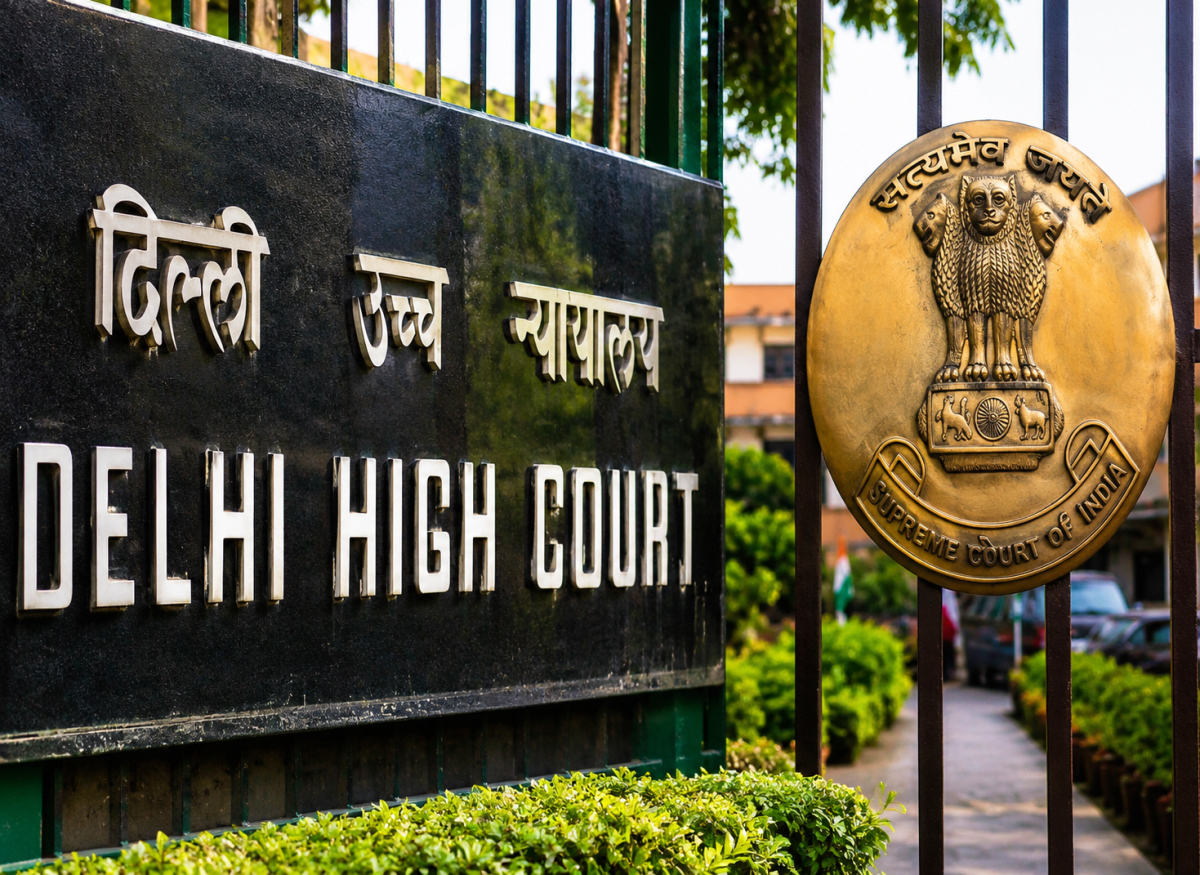
1Picture Study

Study the image carefully and answer the following questions:

Study the image carefully and answer the following questions:. The State Judiciary : The High Courts, DN Kundra History and Civics Goyal Brothers Solutions ICSE Class 10.

(a) What does 'Original Jurisdiction' of a High Court mean? Which writ is used to produce a person held in detention before the court?

(b) Name two types of cases that fall under the Appellate Jurisdiction of a High Court.

(c) What is the significance of the High Court's power of Judicial Review?

Show SolutionHide Solution↓

(a) 'Original Jurisdiction' of a High Court means those cases which can be brought directly before the High Court without first going to any lower court. A High Court has original jurisdiction over matters relating to State revenue and its collection, and over cases relating to Fundamental Rights, divorce, wills and laws relating to marriage.

The writ used to produce a person held in detention before the court is Habeas Corpus.

(b) Two types of cases that fall under the Appellate Jurisdiction of a High Court are:

  1. Civil cases — The High Courts hear appeals against the decisions of District Judges.
  2. Criminal cases — The High Courts hear appeals against the judgments of Sessions Judges or Additional Sessions Judges where the sentence exceeds seven years, and against the judgments of Assistant Sessions Judges, Chief Metropolitan Magistrates or other Judicial Magistrates where the sentence exceeds four years.

(c) By its power of Judicial Review, the High Court can review a State law to establish its constitutionality. If it finds any law, executive order or ordinance to be inconsistent with the provisions of the Constitution, it can declare it null and void. Thus, it keeps the Legislature and the Executive within the limits laid down by the Constitution.

Press ↓ to reveal a solution and move to the next question. Back to Kundra History & Civics.

Free sample bank