1
Which language does the CPU understand?
- (a)Machine language ✓
- (b)Assembly language
- (c)High-level language
- (d)English language
ICSE Class 10 Computer Applications · Logix Computer Applications · 28 solved questions
Which language does the CPU understand?
Stand-alone Java applications ........... for execution.
What is the full form of JVM?
The full form of JRE is ...........
Java uses ........... for execution.
A program that translates code written in a high-level language into machine code is called ...........
A program that translates an assembly language program into machine code is called ...........
Feature(s) of Java include ...........
Java can be used to write ...........
Java applications can run on ...........
Java applications ...........
A Java program can run as a stand-alone application only if it has ...........
What is the extension of a Java source code file?
What is the extension of a Java class file?
Choose the correct statement.
Write a short note on types of Java programs.
There are two types of Java programs — Java Stand-Alone Applications and Java Applets.
Java Stand-Alone Applications
A stand-alone Java application refers to a Java program that can run independently on a computer. Acrobat Reader is an excellent example of this type of application. In Java, every stand-alone application begins its execution with the main() method. Java stand-alone applications can be classified into two types:
a. Console based applications
b. Graphical User Interface based applications
Java Applets
Java applets are Java applications that run within a web browser. They are mainly used for internet programming. The applet is capable of performing many tasks on a web page, such as displaying graphics, playing sounds, and accepting user input.
Which language does the CPU understand?
CPU understands Machine Language.
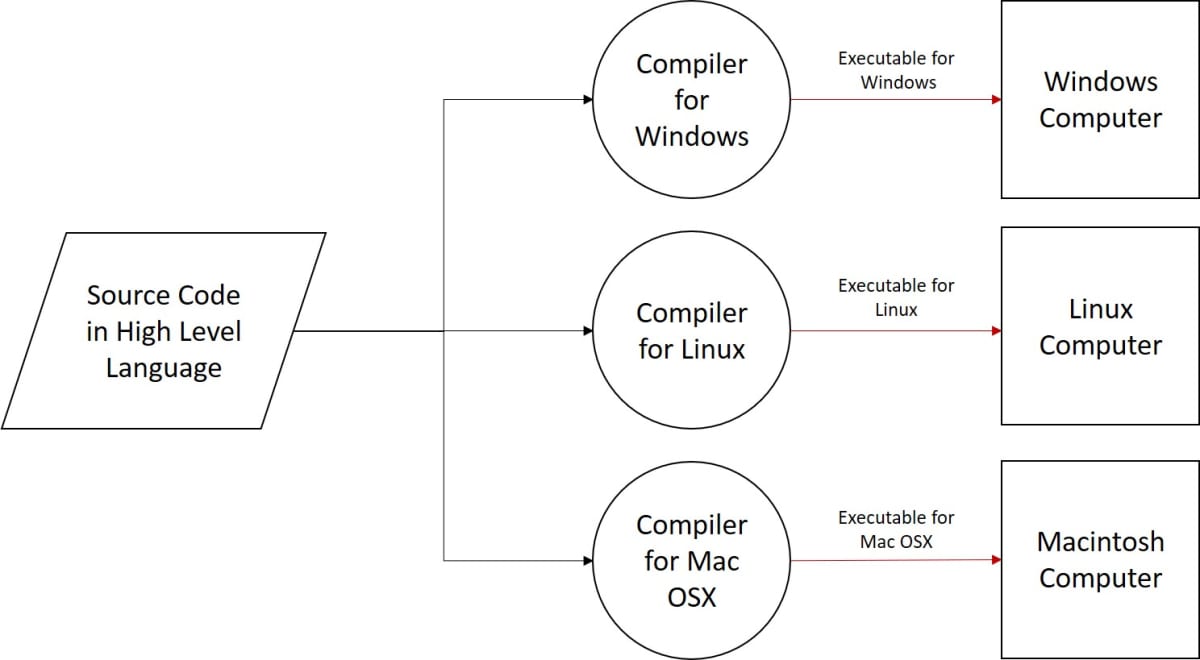
Describe the traditional compilation process with a suitable diagram.
In traditional compilation process, the machine language code generated by the compiler is specific to the platform for which the source code is compiled. Every high-level language has a separate platform specific compiler to generate the machine code that can run on the specific platform. For example, the executable file generated by compiling a C++ program on Windows platform will not run on Macintosh. It needs to be compiled with C++ Macintosh compiler. The below diagram illustrates this:
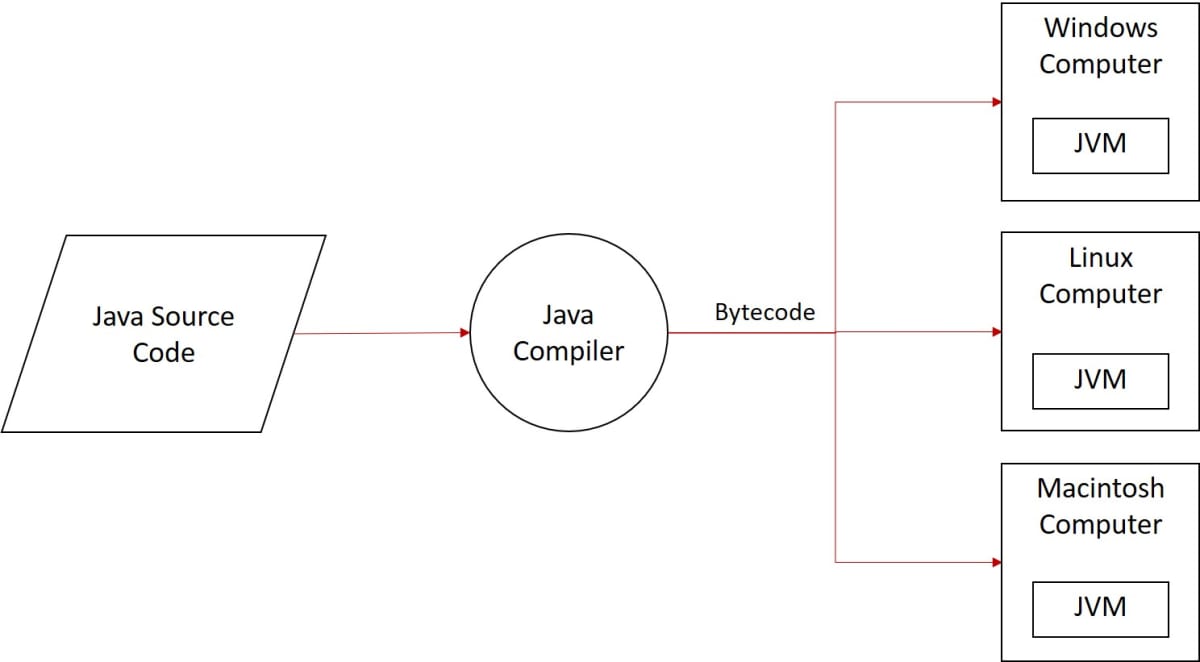
Describe the Java compilation process with a suitable diagram.
In Java compilation process, the source code of a Java program is compiled to an intermediate binary code called the Bytecode. This Bytecode cannot be directly executed by the machine. It is understood by a virtual machine known as Java Virtual Machine or JVM. JVM contains a Java interpreter which converts the Bytecode into machine code of the target computer. JVM is platform specific i.e. each platform has its own JVM. But once the proper JVM is installed on the machine, it can run any Java Bytecode program. The below diagram illustrates this:
What is the difference between an interpreted language and a compiled language?
Program written in an interpreted language is converted into machine code line by line and executed one line at a time whereas program written in a compiled language is converted into machine code all at once and executed.
How is traditional compilation process different from Java compilation process?
In traditional compilation process, the machine language code generated by the compiler is specific to the platform for which the source code is compiled. The executable file generated for one platform like Windows will not work on other platforms like Macintosh. In Java compilation process, the source code of a Java program is compiled to an intermediate binary code called the Bytecode. This Bytecode is interpreted and executed by JVM on the target platform. Bytecode is platform independent so the same Bytecode which is generated for one platform like Windows will work on other platforms like Macintosh without any modifications.
What are JVM and JIT?
JVM
JVM stands for the Java Virtual Machine. It is a virtual machine that runs Java programs and can be installed on several different operating systems such as Windows, UNIX, Macintosh etc. JVMs allow Java programs to run on almost any computer. A JVM processes instructions similar to a physical processor. However, the Java code (with "java" extension) must first be converted into Bytecode that the JVM understands.
JIT
JIT is the Just-In-Time compiler included in the JVM that compiles selected portions of the Bytecode into executable codes to improve the execution performance.
Distinguish between the following:
a. Source code and Object code
| Source Code | Object Code |
|---|---|
| It is a set of instructions written in a high-level programming language. | It is the compiler generated machine language version of the source code. |
| It can be read and understood by humans. | It is not human readable but is understood by machines. |
b. Compiler and Interpreter
| Compiler | Interpreter |
|---|---|
| It converts the whole source program into the object program at once. | It converts the source program into the object program, one line at a time. |
| It displays the errors for the whole program together, after the compilation. | It displays the error one line at a time and only after fixing that error the control goes to the next line. |
c. ".java" file and ".class" file
| ".java" file | ".class" file |
|---|---|
| It contains the Java source code of the program. | It contains the Bytecode of the program. |
| It is written by human (programmer) | It is generated by Java compiler. |
Describe the slogan, "Write once, run anywhere" in relation to Java.
Bytecode and JVM makes Java programs platform independent. This is one of the most important and powerful features of Java. The Bytecode of a Java program can be run on any platform that has a corresponding JVM installed on it. No modifications to this Bytecode are required. Hence, it is said that Java provides "Write once, run anywhere" capabilities.
Describe four features of Java.
Four features of Java are:
What is the difference between machine code and Bytecode?
| Machine Code | Bytecode |
|---|---|
| It is executed directly by the processor. | It is executed by the JVM. |
| It is platform specific. | It is platform independent. |
What role does the Java Virtual Machine play in the compilation and interpretation process?
Java Virtual Machine or JVM is a virtual machine that runs Java programs. It takes the compiled Bytecode as input, converts it into machine code with the help of the Java interpreter. Selected portions of the Bytecode are also compiled by JVM using the Just-In-Time (JIT) compiler for performance. This machine code generated by JVM is then executed by the processor. So JVM along with Bytecode gives Java its "Write once, run anywhere" capabilities.
Can Java run on any machine? What is required to run Java on a computer?
A platform specific JVM is required to run Java programs on a computer. If a corresponding JVM is installed on the machine then Java can run on that machine.
Press ↓ to reveal a solution and move to the next question. Back to Logix Computer Applications.