Constructors

ICSE Class 10 Computer Applications · Logix Computer Applications · 15 solved questions

Exercise
Marks
11 Mark · Multiple Choice Questions

A member method having the same name as that of the class is called ............... .

Show SolutionHide Solution↓

a constructor

Reason — A member method having the same name as that of the class is called constructor.

21 Mark · Multiple Choice Questions

A constructor has ............... return type.

Show SolutionHide Solution↓

no

Reason — A constructor has no return type.

31 Mark · Multiple Choice Questions

A constructor is used when an object is ............... .

Show SolutionHide Solution↓

created

Reason — A constructor is used when an object is created.

41 Mark · Multiple Choice Questions

A default constructor has ............... .

Show SolutionHide Solution↓

no parameters

Reason — A default constructor has no parameters.

51 Mark · Multiple Choice Questions

Pick the correct answer.

Show SolutionHide Solution↓

All of the above

Reason — All the statements are correct.

61 Mark · Multiple Choice Questions

In constructor overloading, ............... .

Show SolutionHide Solution↓

All constructors must have the same name as that of the class.

Reason — In constructor overloading, all constructors must have the same name as that of the class.

1Assignment Questions

What is a constructor? Why do you need a constructor?

Show SolutionHide Solution↓

A constructor is a member method of a class that is used to initialise the instance variables. It has the same name as that of its defining class and does not have a return type.

A constructor is needed as it instructs the computer to perform the start-up tasks of a new object. These can be like assigning default values to instance variables, aligning all the buttons on a screen when a new window object is created, or moving the cursor to a specific data entry field for the user input.

2Assignment Questions

If the constructor is automatically generated by the compiler, why do you need to define your own constructor?

Show SolutionHide Solution↓

A default constructor does not have any statement inside it. It initializes default values to the instance variables.

If we define our own constructor in a class, we can initialise the instance variables according to our requirements. A parameterised constructor allows the programmer to initialise objects with different values. This is achieved by passing the required values as arguments to the constructor method.

3Assignment Questions

Explain the statement, "you cannot invoke constructors as normal method calls".

Show SolutionHide Solution↓

A constructor cannot be explicitly invoked like a method. It is automatically invoked via the new operator at the time of object creation. On the other hand, a method can be called directly by an object that has already been created. Normal method calls are specified by the programmer.

The below program highlights the difference in the way the constructor is invoked versus a normal method call:

class Test  {
    int a, b;
    public Test(int x, int y)   {
        a = x;
        b = y;
    }
    void add()  {
        System.out.println(a + b);
    }
}

class invokeConst   {
    public static void main(String args[])  {
        Test obj1 = new Test(10, 20);   // constructor invoked
        obj1.add();    // calling add() method
    }
}
4Assignment Questions

Describe the importance of parameterised constructors.

Show SolutionHide Solution↓

Parameterized constructors are important because they provide a way to initialize objects with different values. For example, if we have a class representing a bank account, we could use a parameterized constructor to initialize a bank account with a specific balance, rather than always starting with a balance of zero. This makes the class more flexible and reusable, as it can be used to create objects with a variety of different initial states.

5Assignment Questions

If a class is named DemoClass, what names are allowed as constructor names in the class DemoClass?

Show SolutionHide Solution↓

The constructor can only have the name of the class in which it is defined. Thus, all the constructors of class DemoClass will be named DemoClass.

6Assignment Questions

Explain the concept of constructor overloading with an example.

Show SolutionHide Solution↓

The process of creating more than one constructor with the same name but with different parameter declarations is called constructor overloading.

The below example shows constructor overloading being used to create a class having three constructors:

public class Rectangle
{
    int length;
    int width;

    //Constructor without any parameters
    public Rectangle()   {
        System.out.println("Invoking constructor with no parameters"); 
        length = 20;
        width = 15;
    }

    // Constructor with one parameter
    public Rectangle(int len)   {
        System.out.println("Invoking constructor with one parameter"); 
        length = len;
        width = 20;
    }

    // Constructor with two parameters
    public Rectangle(int  len, int  wd)    {
        System.out.println("Invoking constructor with two parameters"); 
        length = len;
        width = wd;
    }

    public void Area()    {
        int area = length * width;
        System.out.println("Length = " + length);
        System.out.println("Width = " + width);
        System.out.println("Area = " + area);
    }

    public static void main(String args[])  {
        Rectangle rect1 = new Rectangle();
        rect1.Area();

        Rectangle rect2 = new Rectangle(30);
        rect2.Area();

        Rectangle rect3 = new Rectangle(30, 10);
        rect3.Area();
    }
}
7Assignment Questions

What is the use of the keyword this?

Show SolutionHide Solution↓

Within a constructor or a method, this is a reference to the current object — the object whose constructor or method is being invoked. The keyword this stores the address of the currently-calling object.

For example, the below program makes use of the this keyword to resolve the conflict between method parameters and instance variables.

class  Area
{
    int  length,  breadth;

    public Area(int length, int breadth) {
        this.length = length;
        this.breadth =  breadth;
    }
    
    public void Display() {
    int	area = length * breadth;
    System.out.println("Area is " + area);
    }

    public static void main(String args[J) {
    Area area = new Area(2, 3);
    area.Display();
    }
}
8Assignment Questions

What is a no-argument constructor? Does every class have a no-argument constructor?

Show SolutionHide Solution↓

A no-argument constructor is a constructor that accepts no arguments and has no statements in its body. It is also called the default constructor.

If the programmer has not explicitly defined a constructor for the class then Java compiler automatically adds a no-argument constructor/default constructor. However, if the constructor is defined explicitly then no-argument constructor is not added.

9Assignment Questions

Create a class named Pizza that stores details about a pizza. It should contain the following:

Instance Variables:
String pizzaSize — to store the size of the pizza (small, medium, or large)
int cheese — the number of cheese toppings
int pepperoni — the number of pepperoni toppings
int mushroom — the number of mushroom toppings

Member Methods:
Constructor — to initialise all the instance variables
CalculateCost() — A public method that returns a double value, that is, the cost of the pizza.
Pizza cost is calculated as follows:

  • Small: Rs.500 + Rs.25 per topping
  • Medium: Rs.650 + Rs.25 per topping
  • Large: Rs.800 + Rs.25 per topping

PizzaDescription() — A public method that returns a String containing the pizza size, quantity of each topping, and the pizza cost as calculated by CalculateCost().

public class Pizza
{
    String pizzaSize;
    int cheese; 
    int pepperoni;
    int mushroom;
    
    public Pizza(String size, 
                    int tc, 
                    int tp, 
                    int tm) {
        pizzaSize = size;
        cheese = tc;
        pepperoni = tp;
        mushroom = tm;
    }
    
    public double CalculateCost()   {
        double totalCost = 0;
        double topCost = 25 * (cheese + pepperoni + mushroom);
        
        if (pizzaSize == "small")
            totalCost = 500 + topCost;
        else if(pizzaSize == "medium")
            totalCost = 650 + topCost;
        else
            totalCost = 800 + topCost;
            
        return totalCost;
    }
    
    public String PizzaDescription()    {
        double cost = CalculateCost();
        String desc = "Size: " + pizzaSize 
        + " Cheese: " + cheese 
        + " Pepperoni: " + pepperoni 
        + " Mushroom: " + mushroom 
        + " Cost: Rs. " + cost;
        
        return desc;
    }
    
    public static void main(String args[])  {
        Pizza p = new Pizza("medium", 15, 5, 10);
        String desc = p.PizzaDescription();
        System.out.println(desc);
    }
    
    
}
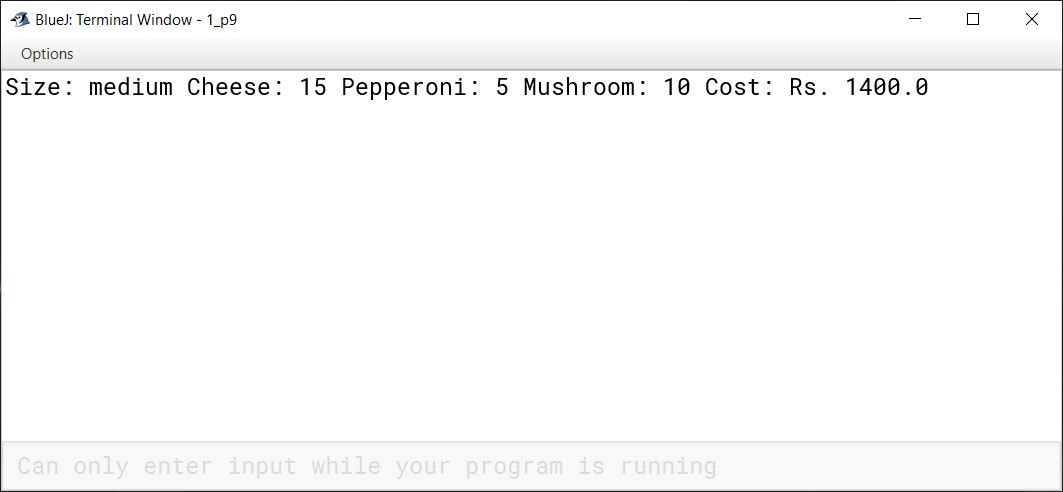
BlueJ output of Pizza.java

Solution not available in the source paper.

Press ↓ to reveal a solution and move to the next question. Back to Logix Computer Applications.

Free sample bank