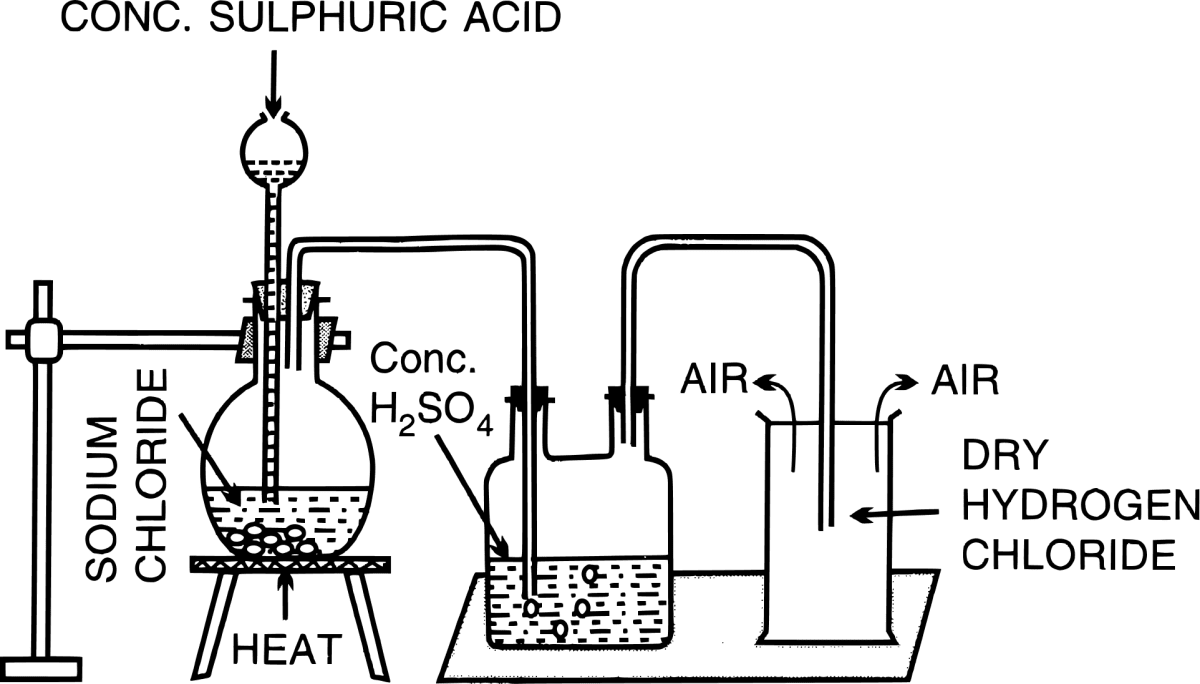
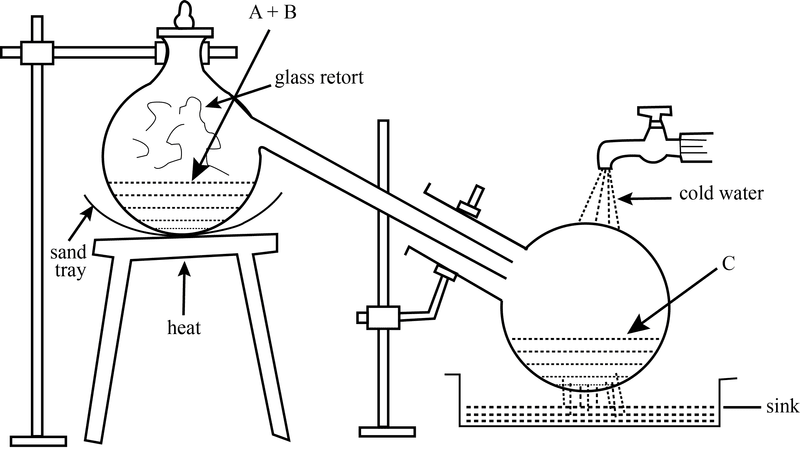
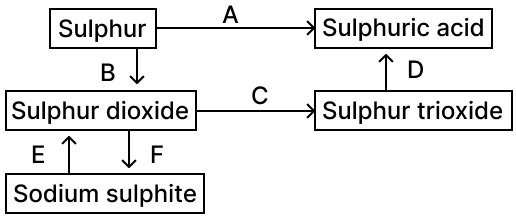
Draw a labelled diagram for the laboratory preparation of hydrogen chloride gas and answer the following.
(a) Name the acid used. Why is this particular acid preferred to other acids?
(b) Give the balanced equation for the reaction.
(c) Name the drying agent used in drying hydrogen chloride gas.
(d) Phosphorus pentoxide and calcium oxide are good drying agents, but they cannot be used to dry hydrogen chloride gas. Why?
(e) Why is direct absorption of HCl gas in water not feasible?
Show SolutionHide Solution↓
The labelled diagram for the laboratory preparation of hydrogen chloride gas is shown below:
(a) Conc. H2SO4 is used for the preparation of hydrogen chloride gas in the laboratory.
As conc. H2SO4 is non-volatile and has a high boiling point, therefore, it displaces the volatile hydrogen chloride from the salt sodium chloride. Hence, conc. H2SO4 is used as a reactant in the laboratory preparation of HCl from sodium chloride.
Reason — Drying agent used for drying should only remove the moisture and not react with it, hence, conc. sulphuric acid is used as the drying agent.
(d) Phosphorus pentoxide and calcium oxide are good drying agents, but they cannot be used to dry hydrogen chloride gas since they react with it.
2P2O5 + 3HCl ⟶ POCl3 + 3HPO3
CaO + 2HCl ⟶ CaCl2 + H2O
(e) Direct absorption of hydrogen chloride gas in water is not feasible because it causes back suction in the delivery tube.
Hydrogen chloride gas is extremely soluble in water.
If a delivery tube through which HCl gas is passed is directly immersed in water, the rate of absorption of HCl gas is high and hence a partial vacuum is created in the tube.
The pressure outside being higher causes the water to be pushed up into the delivery tube and damages the apparatus. This is called back-suction.
2Intext Questions 1
In the laboratory preparation of hydrochloric acid, hydrogen chloride gas is dissolved in water.
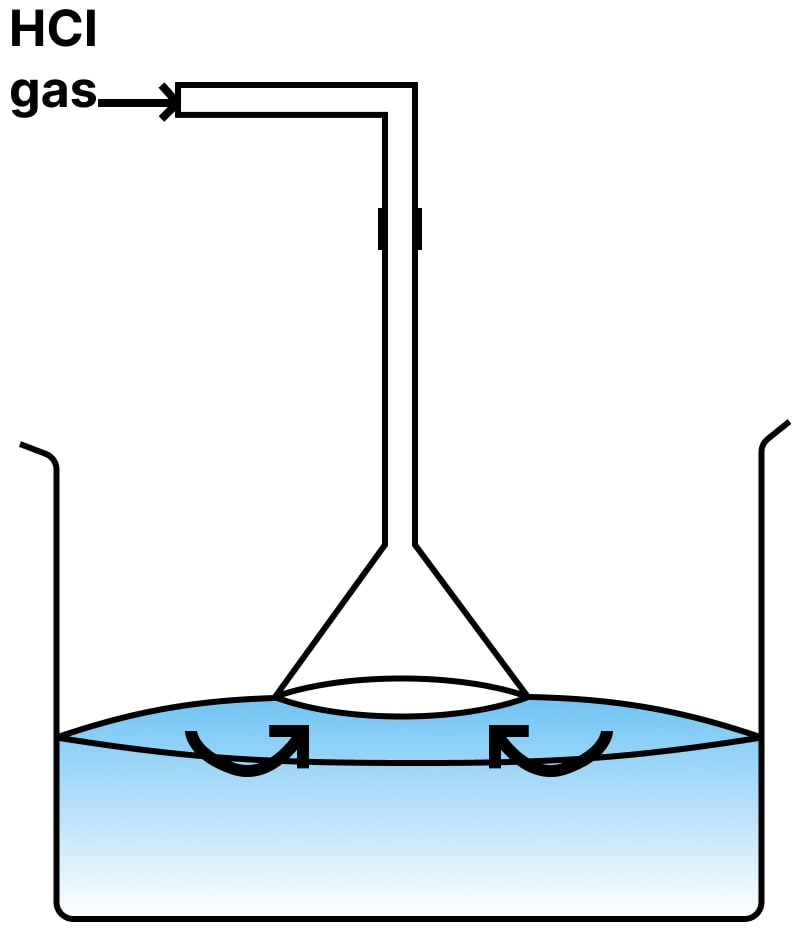
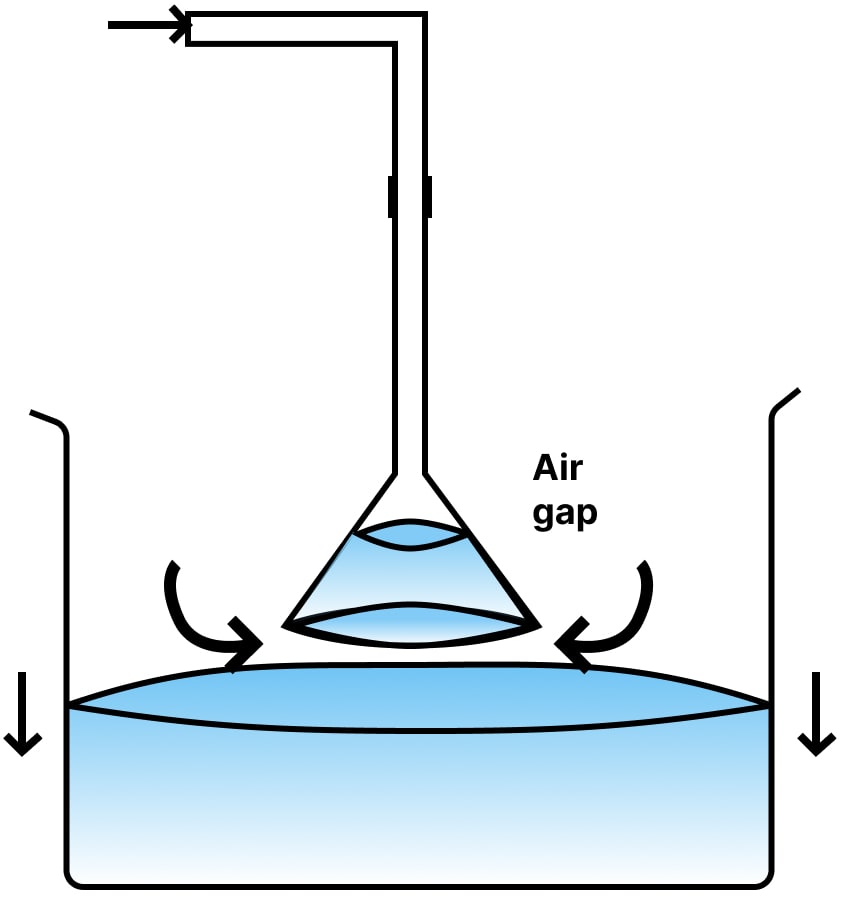
(a) Draw a diagram to show the arrangement used for the absorption of HCl gas in water.
(b) State why such an arrangement is necessary. Give two reasons for the same.
(c) Write balanced chemical equations for the laboratory preparation of HCl gas when the reaction is :
(A) below 200°C
(B) above 200°C
Show SolutionHide Solution↓
(a) Below diagrams show the special funnel arrangement used for the absorption of HCl gas in water:
(b) The reasons are :
Prevents or minimizes back-suction of water.
Provides a large surface area for the absorption of the HCl gas.
(a) hydrogen chloride gas is not collected over water.
(b) hydrogen chloride gas cannot be dried over quick lime.
(c) thick white fumes are formed when a glass rod dipped in NH4OH is brought near the mouth of a bottle full of HCl gas.
(d) HCl fumes in air.
Show SolutionHide Solution↓
(a) Hydrogen chloride gas is not collected over water since it is highly soluble in water.
(b) Quicklime [CaO] is alkaline in nature and it reacts with HCl forming the respective chloride. Hence, it can't be used as a drying agent.
(c) When a glass rod dipped in ammonium hydroxide (NH4OH) is brought near the mouth of a bottle full of HCl gas, then it leads to the formation of dense white fumes due to the production of ammonium chloride.
NH4OH + HCl ⟶ NH4Cl + H2O
(d) Hydrogen chloride gas fumes in moist air because it dissolves in water vapour present in air to form tiny droplets of hydrochloric acid, which appear as white fumes.
4Intext Questions 1
With respect to the laboratory preparation of HCl gas, answer the following questions :
(a) Name the reactants used and the product(s) formed.
(b) Under what conditions do the reactants react?
(c) How is the gas identified?
(d) State the precautions to be taken.
Show SolutionHide Solution↓
(a) Reactants: Sodium chloride (common salt) and concentrated sulphuric acid.
Products: Hydrogen chloride gas and Sodium bisulphate (at low temperatures) or Sodium sulphate (at high temperatures).
(b) Conditions of reaction:
The reaction typically occurs in two stages depending on the temperature: Below 200°C: The reaction yields sodium bisulphate.
Above 200°C: If the temperature is increased further, the sodium bisulphate reacts with more salt to form sodium sulphate. However, this is usually avoided in labs to protect the glass apparatus and prevent the formation of a hard crust.
(c) Identification of the gas : Bring a glass rod dipped in ammonia solution near the jar mouth; dense white fumes of ammonium chloride (NH4Cl) forms. It also turns moist blue litmus paper red, showing its acidic nature.
(d) Precautions to be taken :
The lower end of the thistle funnel must be dipped in conc. sulphuric acid.
Delivery tube should be dipped in drying agent i.e., conc. H2SO4.
Avoid temperatures above 200°C to prevent glass apparatus from cracking, wasting fuel, and forming a hard sodium sulphate crust.
11 Mark · Exercise 8 — Multiple Choice Type
Hydrogen chloride molecule is:
(a)Polar covalent
(b)Non polar
(c)Ionic
(d)Co-ordinate
Show SolutionHide Solution↓
Polar covalent
Reason — Hydrogen chloride (HCl) is a polar covalent molecule because it is formed by sharing of electrons between hydrogen and chlorine atoms. However, chlorine is more electronegative than hydrogen, so it pulls the shared electrons closer to itself. This creates a partial negative charge on chlorine and a partial positive charge on hydrogen, making the molecule polar.
21 Mark · Exercise 8 — Multiple Choice Type
Hydrogen chloride gas being highly soluble in water is dried by
(a)Anhydrous calcium chloride
(b)Phosphorous pentoxide
(c)Quicklime
(d)Conc. sulphuric acid
Show SolutionHide Solution↓
Conc. sulphuric acid.
Reason — Drying agent used for drying should only remove the moisture and not react with it, hence, conc. sulphuric acid is used as the drying agent.
31 Mark · Exercise 8 — Multiple Choice Type
The aim of the Fountain experiment is to prove that:
(a)HCl turns blue litmus red
(b)HCl is denser than air
(c)HCl is highly soluble in water
(d)HCl fumes in moist air
Show SolutionHide Solution↓
HCl is highly soluble in water
Reason — Fountain experiment is performed to show the great solubility of HCl gas in water.
41 Mark · Exercise 8 — Multiple Choice Type
HCl dissolves in toluene (C6H5CH3) and the solution:
P — contains hydronium ions.
Q — can produce carbon dioxide on reacting with sodium carbonate.
R — does not show any acidic property.
Which of the following holds true?
(a)Only P
(b)Only Q
(c)Only R
(d)Both P and Q
Show SolutionHide Solution↓
Only R
Reason — Toluene is an organic solvent and non-polar in nature. When HCl dissolves in toluene, it does not ionize to form hydronium [H3O+] ions. Since there are no free hydrogen ions, the solution does not show acidic properties and also cannot react with sodium carbonate to release carbon dioxide gas. Therefore, only R is correct — the solution does not show any acidic property. b
51 Mark · Exercise 8 — Multiple Choice Type
Assertion (A): HCl is produced by the reaction of hydrogen and chlorine in diffused sunlight.
Reason (R): This reaction is explosive in sunlight.
(a)Both A and R are true and R is the correct explanation of A.
(b)Both A and R are true but R is not the correct explanation of A.
(c)A is true but R is false.
(d)A is false but R is true.
Show SolutionHide Solution↓
Both A and R are true and R is the correct explanation of A.
Explanation— HCl is produced, when moist hydrogen gas combines with chlorine in presence of diffused sunlight. Hence, assertion (A) is true.
The formation HCl is a explosive reaction in direct sunlight but it is negligible in dark. So, it is carried out in diffused sunlight. Hence, reason (R) is true.
Therefore, Reason (R) thus provides a valid explanation for why this reaction is occurring in diffused sunlight. Hence, Reason (R) is the correct explanation of assertion
61 Mark · Exercise 8 — Multiple Choice Type
Assertion (A): The Fountain experiment is used to demonstrate the high solubility of HCl gas.
Reason (R): Red litmus solution turns blue in Fountain experiment.
(a)Both A and R are true and R is the correct explanation of A.
(b)Both A and R are true but R is not the correct explanation of A.
(c)A is true but R is false.
(d)A is false but R is true.
Show SolutionHide Solution↓
A is true but R is false.
Explanation— The principle of fountain experiment is to show the great solubility of the HCl gas. Hence the assertion (A) is true.
The blue litmus solution turns red due to the acidic nature of hydrogen chloride gas in the Fountain experiment. Hence reason (R) is false.
71 Mark · Exercise 8 — Multiple Choice Type
Assertion (A): HCl gas is collected by downward delivery.
Reason (R): HCl gas is heavier than air.
(a)Both A and R are true and R is the correct explanation of A.
(b)Both A and R are true but R is not the correct explanation of A.
(c)A is true but R is false.
(d)A is false but R is true.
Show SolutionHide Solution↓
Both A and R are true and R is the correct explanation of A.
Explanation— Hydrogen chloride gas is collected by the downward delivery (upward displacement of air). Hence, the assertion (A) is true. HCl is collected by downward delivery because it is 1.28 times heavier than air. Hence, reason (R) is true and it is the correct explanation of assertion (A).
81 Mark · Exercise 8 — Multiple Choice Type
Assertion (A): HCl gas fumes in moist air.
Reason (R): HCl gas is highly soluble in water.
(a)Both A and R are true and R is the correct explanation of A.
(b)Both A and R are true but R is not the correct explanation of A.
(c)A is true but R is false.
(d)A is false but R is true.
Show SolutionHide Solution↓
Both A and R are true and R is the correct explanation of A.
Explanation— Hydrogen chloride (HCl) gas fumes in moist air because it is highly soluble in water. In the presence of moisture, HCl gas dissolves in water vapour in the air to form tiny droplets of hydrochloric acid, which appear as white fumes. So, both the assertion and the reason are true, and the reason correctly explains the assertion.
91 Mark · Exercise 8 — Multiple Choice Type
Assertion (A): HCl gas dissolves in water as well as organic compounds like toluene.
Reason (R): HCl is a polar covalent compound.
(a)Both A and R are true and R is the correct explanation of A.
(b)Both A and R are true but R is not the correct explanation of A.
(c)A is true but R is false.
(d)A is false but R is true.
Show SolutionHide Solution↓
Both A and R are true and R is the correct explanation of A.
Explanation— Hydrogen chloride (HCl) is a polar covalent compound, which means it can dissolve in polar solvents like water due to attraction between opposite charges. Interestingly, it can also physically dissolve in some non-polar organic solvents like toluene, but without ionizing. The reason HCl can dissolve in both is due to its polar covalent nature. Hence, both the Assertion (A) and Reason (R) are true, and Reason (R) correctly explains Assertion (A).
101 Mark · Exercise 8 — Multiple Choice Type
Assertion (A): HCl gas is used in the preparation of chlorine and chlorides.
Reason (R): Lead chloride is not produced from HCl.
(a)Both A and R are true and R is the correct explanation of A.
(b)Both A and R are true but R is not the correct explanation of A.
(c)A is true but R is false.
(d)A is false but R is true.
Show SolutionHide Solution↓
A is true but R is false.
Explanation— HCl gas dissociates into hydrogen and chlorine, when heated to 500°C and hydrogen chloride reacts with metals that come before hydrogen in the electrochemical series to form corresponding chlorides of those metals. Hence, assertion (A) is true. When concentrated Hydrochloric acid is oxidised by strong oxidising agent like lead oxide lead chloride is formed. Hence, reason (R) is false.
Pb3O4 + 8HCl (conc.) ⟶ 3PbCl2 + 4H2O + Cl2 ↑
111 Mark · Exercise 8 — Multiple Choice Type
Assertion (A): Few drops of dilute hydrochloric acid is added to a solution of iron sulphide, a colourless gas is formed with a rotten egg odour.
Reason (R): The gas formed does not turn moist lead acetate paper silvery black.
(a)Both A and R are true and R is the correct explanation of A.
(b)Both A and R are true but R is not the correct explanation of A.
(c)A is true but R is false.
(d)A is false but R is true.
Show SolutionHide Solution↓
A is true but R is false.
Explanation— When dilute hydrochloric acid (HCl) reacts with iron(II) sulphide (FeS), it undergoes a double displacement reaction to form iron(II) chloride and hydrogen sulphide gas (H2S), which is a colourless gas with a rotten egg smell. Hence, assertion (A) is true. Hydrogen sulphide gas (H2S) does react with moist lead acetate paper. It turns the paper silvery black (or brownish-black) due to the formation of lead sulphide (PbS). Hence, reason (R) is false.
1Exercise 8 — Very Short Answer Type
Fill in the blank from the choices in the bracket :
(a) Quicklime is not used to dry HCl gas because CaO is ............... [alkaline/acidic/neutral]
(b) When sodium chloride is heated with concentrated sulphuric acid below 200°C, one of the product formed is ............... (sodium hydrogen sulphate / sodium sulphate / chlorine).
Show SolutionHide Solution↓
(a) Quicklime is not used to dry HCl gas because CaO is alkaline.
(b) When sodium chloride is heated with concentrated sulphuric acid below 200°C, one of the product formed is sodium hydrogen sulphate.
2Exercise 8 — Very Short Answer Type
A solution of hydrogen chloride in water is prepared.
The following substances are added to the solution taken in different test tubes :
S. No.
Substances added
Gas evolved
Odour
1
Calcium carbonate
2
Magnesium ribbon
3
Manganese(IV) oxide with heating
4
Sodium sulphide
Complete the table by writing the gas evolved in case and it's odour.
Show SolutionHide Solution↓
S. No.
Substances added
Gas evolved
Odour
1
Calcium carbonate
CO2
odourless
2
Magnesium ribbon
H2
odourless
3
Manganese(IV) oxide with heating
Cl2
Pungent smell
4
Sodium sulphide
H2S
Rotten egg smell
3Exercise 8 — Very Short Answer Type
Name :
(a) a black metallic oxide which reacts with hydrochloric acid to give a coloured solution.
(b) two colourless gases, which when mixed produce a white solid
(c) two gases which chemically combine to form a liquid.
(d) a chloride which is soluble in excess of ammonium hydroxide.
(e) the chemical in which gold can be dissolved.
(f) the experiment which demonstrates that hydrogen chloride is soluble in water.
(g) the gas produced when chlorine water is exposed to sunlight.
(h) the acid which on mixing with silver nitrate solution produces a white precipitate which is soluble in excess of ammonium hydroxide.
(i) the gas which produces dense white fumes with ammonia gas.
(j) an element which reacts with hydrogen to form compound which is strongly acidic in water.
Show SolutionHide Solution↓
(a) Copper oxide (CuO)
(b) Hydrogen chloride and Ammonia
(c) Hydrogen and Oxygen
(d) Silver chloride
(e) Aqua Regia
(f) Fountain experiment
(g) Oxygen gas
(h) Dilute hydrochloric acid
(i) Hydrogen chloride
(j) Chlorine
Explanation
(a) Copper oxide (CuO) is black, reacts with HCl to form blue-coloured copper(II) chloride solution. CuO + 2HCl ⟶ CuCl2 + H2O
(b) NH3 (g) + HCl (g) ⟶ NH4Cl (white solid)
(c) 2H2 (g) + O2 (g) ⟶ 2H2O (liquid water)
(d) AgCl dissolves in excess NH4OH due to formation of [Ag(NH3)2]+ complex. AgCl + 2NH4OH ⟶ [Ag(NH3)2]+Cl- + 2H2O
(e) Aqua regia (1 part of conc. HNO3 and 3 parts of conc. HCl) dissolves gold.
(f) Fountain experiment vividly shows HCl gas dissolving in water, creating a fountain effect due to pressure drop.
(g) When chlorine water is exposed to sunlight, chlorine reacts with water to form hypochlorous acid. This acid then breaks apart to give nascent oxygen (O) and hydrochloric acid (HCl). The nascent oxygen combines to form Oxygen gas: Cl2 + H2 $\xrightarrow{\text{sunlight}}$ HClO + HCl HClO $\xrightarrow{\text{sunlight}}$ HCl + [O] (nascent oxygen) [O] + [O] ⟶ O2
(h) AgNO3 + HCl ⟶ AgCl (white ppt.) + HNO3 which dissolves in excess NH4OH.
(i) NH3 [g] + HCl [g] ⟶ NH4Cl [s]
(j) H2 + Cl2 ⟶ 2HCl; HCl is strongly acidic in water.
4Exercise 8 — Very Short Answer Type
Match the following reactions in column A with the gas evolved in column B :
Column A
Column B
(a) Potassium sulphite is treated with dilute hydrochloric acid.
A. Cl2
(b) Concentrated hydrochloric acid is made to react with manganese dioxide.
B. H2S
(c) Iron sulphide reacts with dil. HCl
C. SO2
(d) Calcium carbonate is added to dil. HCl
D. CO2
Show SolutionHide Solution↓
Column A
Column B
(a) Potassium sulphite is treated with dilute hydrochloric acid.
C. SO2
(b) Concentrated hydrochloric acid is made to react with manganese dioxide.
A. Cl2
(c) Iron sulphide reacts with dil. HCl
B. H2S
(d) Calcium carbonate is added to dil. HCl
D. CO2
5Exercise 8 — Very Short Answer Type
Solution A reacts with an acid B (which gives greenish yellow gas on reacting with oxidising agents like Pb3O4) to give white precipitate C insoluble in nitric acid but soluble in ammonium hydroxide. Name A, B and C.
Show SolutionHide Solution↓
A → Silver nitrate B → Hydrochloric acid C → Silver chloride
Explanation — Solution A is silver nitrate which reacts with acid B i.e., Hydrochloric acid to give a white precipitate C of AgCl which is insoluble in nitric acid but soluble in ammonium hydroxide.
AgNO3 + HCl ⟶ AgCl ↓ + HNO3
AgNO3 + HNO3 ⟶ no reaction
AgCl + 2NH4OH ⟶ [Ag(NH3)2Cl)] + 2H2O
6Exercise 8 — Very Short Answer Type
State the composition of aqua regia. State which component is the oxidizing agent in aqua regia.
Show SolutionHide Solution↓
Aqua regia : 1 part of conc. HNO3 and 3 parts of conc. HCl
Nitric acid present in aqua regia oxidizes HCl to chlorine.
7Exercise 8 — Very Short Answer Type
MnO2, PbO2 and red lead react with conc. HCl acid liberates Cl2.
What is the common property being shown by these metal oxides?
Show SolutionHide Solution↓
It shows that hydrochloric acid (HCl) is oxidized to chlorine (Cl2) by strong oxidizing agents such as MnO2, PbO2 and red lead.
1Exercise 8 — Short Answer Type
Complete and balance the following reactions, state whether dilute or conc. acid is used.
(a) NH4OH + HCl ⟶
(b) NaHSO3 + HCl ⟶
(c) Pb(NO3)2 + HCl ⟶
(d) Pb3O4 + HCl ⟶
Show SolutionHide Solution↓
(a) NH4OH + HCl (dil.)⟶ NH4Cl + H2O
(b) NaHSO3 + HCl (dil.) ⟶ NaCl + H2O + SO2
(c) Pb(NO3)2 + 2HCl (dil.) ⟶ PbCl2+ 2HNO3
(d) Pb3O4 + 8HCl (conc.) ⟶ 3PbCl2 + 4H2O + Cl2 ↑
2Exercise 8 — Short Answer Type
How will the action of dilute hydrochloric acid enable you to distinguish between the following?
(a) Sodium carbonate and sodium sulphite
(b) Sodium thiosulphate and sodium sulphite.
Show SolutionHide Solution↓
(a) When Sodium carbonate is treated with dil. HCl, odourless carbon dioxide gas is produced.
Na2CO3 + 2HCl ⟶ 2NaCl + H2O + CO2 ↑
However, when sodium sulphite is treated with dil.HCl, sulphur dioxide gas with a suffocating odour (burning smell) is produced.
Na2SO3 + 2HCl ⟶ 2NaCl + H2O + SO2 ↑
(b) When sodium thiosulphate is treated with dil. HCl it produces sulphur dioxide gas and yellow sulphur precipitates.
Na2S2O3 + 2HCl ⟶ 2NaCl + S + H2O + SO2 ↑
However, S is not produced when sodium sulphite is treated with dil.HCl.
Na2SO3 + 2HCl ⟶ 2NaCl + H2O + SO2 ↑
3Exercise 8 — Short Answer Type
Write an equation for the reactions of hydrochloric acid on :
(a) anhydrous HCl is a poor conductor while aqueous HCl is an excellent conductor.
(b) when the stopper of a bottle full of hydrogen chloride gas is opened there are fumes in the air.
(c) a solution of hydrogen chloride in water turns blue litmus red and conducts electricity, while a solution of the same gas in toluene
(i) has no effect on litmus, and
(ii) does not conduct electricity.
(d) dry hydrogen chloride gas does not affect a dry strip of blue litmus paper, but it turns red in the presence of a drop of water.
(e) dilute hydrochloric acid cannot be concentrated by boiling beyond 22.2%.
Show SolutionHide Solution↓
(a) Anhydrous HCl is a gas and does not contain any ions, hence it is a poor conductor of electricity. On the other hand, aqueous HCl (HCl dissolved in water) forms ions in solution, and thus becomes an excellent conductor of electricity.
HCl + H2O ⟶ H3O+ + Cl-
(b) When hydrogen chloride gas is exposed to air, it gives white fumes, due to the formation of hydrochloric acid on dissolving in atmospheric water vapour.
(c) A solution of hydrogen chloride in water gives ions,
HCl + H2O ⟶ H3O+ + Cl-
These ions are responsible for conducting electricity and turning blue litmus red, due to the presence of hydronium [H3O+] ions which make aqueous solution of HCl acidic in nature.
Toluene is an organic solvent and HCl is a covalent compound. A solution of HCl in toluene contains only molecules and not ions due to which it does not conduct electricity. The absence of hydronium [H3O+] ions make the solution neutral and it does not effect litmus paper.
(d) Dry hydrogen chloride gas does not contain any ions. Due to the absence of hydronium [H3O+] ions, it is neutral and does not affect a dry strip of blue litmus paper. On the other hand, in the presence of a drop of water, HCl dissolves in it and dissociates into hydronium [H3O+] ions and chloride ions [Cl-]
HCl + H2O ⟶ H3O+ + Cl-
The presence of hydronium [H3O+] ions makes the aqueous solution acidic and blue litmus turns red.
(e) Hydrochloric acid forms a constant boiling mixture at 110°C, 22.2% by weight. On boiling further, the mixture evolves out the vapours of both acid and water in the same proportion as in the liquid.
Hence, dilute HCl cannot be concentrated beyond 22.2% by boiling.
5Exercise 8 — Short Answer Type
Give balanced equations with conditions, if any, for the following conversions
How would you distinguish between dilute HCl and dilute HNO3, by addition of only one solution.
Show SolutionHide Solution↓
When silver nitrate soln. is added to dil. HCl, curdy white ppt. of silver chloride is formed whereas, there is no reaction when silver nitrate soln. is added to dil. HNO3.
AgNO3 + HCl ⟶ AgCl (white ppt.) + HNO3
AgNO3 + HNO3 ⟶ no reaction
9Exercise 8 — Short Answer Type
State one appropriate observation when :
(a) Copper sulphide is treated with dilute hydrochloric acid.
(b) A few drops of dil. HCl are added to AgNO3 solution. followed by addition of NH4OH solution.
(c) Lead nitrate solution is mixed with dilute hydrochloric acid and heated.
(d) A small piece of zinc is added to dilute hydrochloric acid.
(e) Dilute HCl is added to sodium carbonate crystals.
(f) Concentrated HCl is added to manganese dioxide.
Show SolutionHide Solution↓
(a) A colourless gas having smell of rotten eggs is given off. The gas evolved is H2S CuS + 2HCl ⟶ CuCl2 + H2S ↑
(b) Curdy white precipitate of silver chloride [AgCl] is obtained, which is soluble in excess of NH4OH. AgNO3 + HCl ⟶ AgCl ↓ + HNO3 AgCl + 2NH4OH ⟶ [Ag(NH3)2Cl)] + 2H2O
(c) White precipitate of PbCl2 is formed which is soluble in hot water. Pb(NO3)2 + 2HCl ⟶ PbCl2 ↓ + 2HNO3
(d) Hydrogen gas is evolved with bubbles and it burns with a pop sound Zn + 2HCl ⟶ ZnCl2 + H2 ↑
(e) Effervescence of CO2 seen which turns lime water milky. Na2CO3 + 2HCl ⟶ 2NaCl + H2O + CO2 ↑
(f) When concentrated hydrochloric acid is added to manganese dioxide (MnO2), a greenish-yellow gas (chlorine gas) is evolved with effervescence. MnO2 + 4HCl (conc.) $\xrightarrow{\Delta}$ MnCl2 + 2H2O + Cl2↑
10Exercise 8 — Short Answer Type
Distinguish by using HCl.
(a) Lead nitrate solution and silver nitrate solution.
(b) Potassium sulphite and potassium sulphide.
Show SolutionHide Solution↓
(a) On reaction with HCl, lead nitrate solution gives white precipitate which can be dissolved in hot water.
Pb(NO3)2 + 2HCl ⟶ PbCl2 ↓ + 2HNO3
Whereas, silver nitrate solution gives thick curdy white precipitate which is insoluble in hot water.
AgNO3 + HCl ⟶ AgCl ↓ + HNO3
(b) On reaction with HCl, potassium sulphite gives SO2 gas with pungent odour
K2SO3 + 2HCl ⟶ 2KCl + H2O + SO2 ↑
However, potassium sulphide gives H2S gas with rotten eggs odour.
K2S + 2HCl ⟶ 2KCl + H2S ↑
1Exercise 8 — Long Answer Type
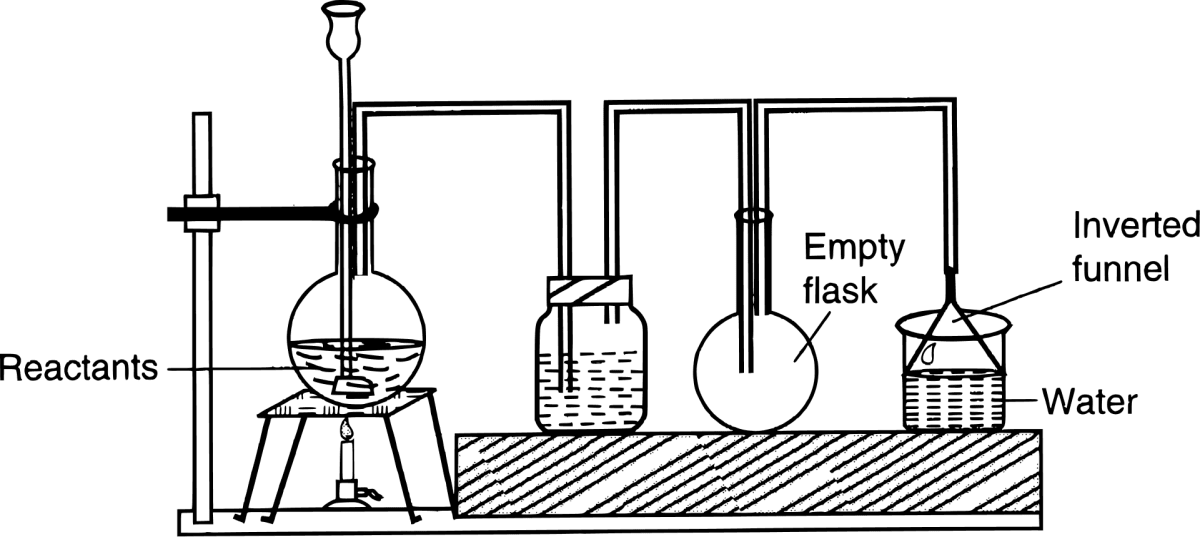
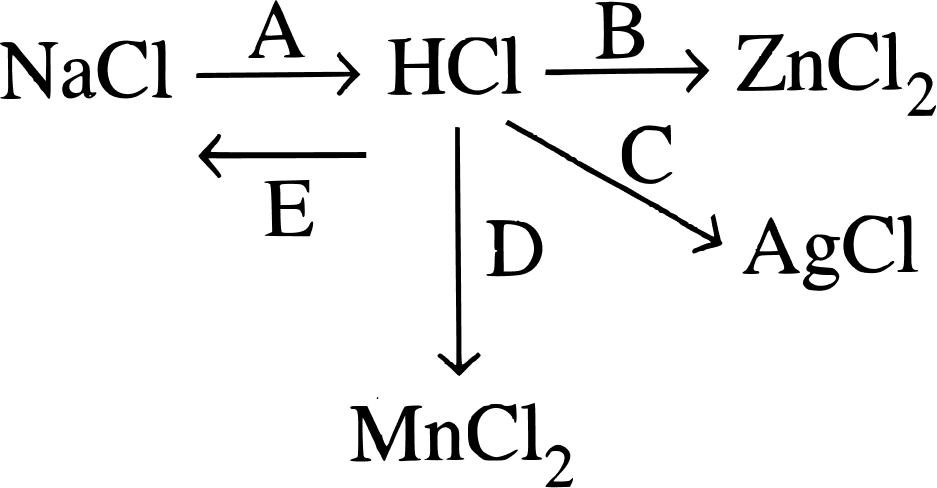
The given set up in the figure is for the preparation of an acid
(a) Name the acid prepared by this method.
(b) Name the reactants used.
(c) Why an empty flask is used?
(d) What is the drying agent used? Why is this drying agent chosen ?
(e) What is the role of inverted funnel in the arrangement?
Show SolutionHide Solution↓
(a) Hydrochloric acid (HCl)
(b) The reactants used are sodium chloride and sulphuric acid.
(c) The empty flask acts as an Anti-Suction device. If back suction takes place then the water gets collected in it and will not reach the generating flask.
(d) The drying agent used is Concentrated Sulphuric acid. It is chosen as drying agent because it does not react with HCl.
(e) The role of the inverted funnel in the arrangement is -
It prevents or minimizes back suction of water.
It provides a large surface area for absorption of HCl gas.
2Exercise 8 — Long Answer Type
The following questions pertain to the laboratory preparation of hydrogen chloride gas:
(a) Write the equation for it's preparation mentioning the conditions required.
(b) Name the drying agent used in the above preparation and give a reason for the choice.
(c) State a safety precaution taken during the preparation of hydrochloric acid.
Show SolutionHide Solution↓
(a) The equation for the laboratory preparation of hydrogen chloride gas :
(b) Concentrated sulphuric acid is used as the drying agent used in the above preparation.
Reason — Drying agent used for drying should only remove the moisture and not react with it, hence, conc. sulphuric acid is used as the drying agent. Other drying agents like phosphorous pentoxide (P2O5) and quick lime (CaO) cannot be used since they react with hydrogen chloride gas.
(c) Temperature is maintained at nearly 200°C as at higher temperatures above 200°C the glass apparatus may crack, fuel is wasted, sodium sulphate formed, forms a hard crust which sticks to the glass and is difficult to remove.
3Exercise 8 — Long Answer Type
How will you prove that Hydrochloric acid contains
(i) hydrogen
(ii) chlorine.
Write equations for the reactions.
Show SolutionHide Solution↓
(i) Using an active metal below magnesium
Fe + 2HCl ⟶ FeCl2 + H2↑
(ii) Using an oxidising agent not containing lead.
MnO2 + 4HCl ⟶ MnCl2 + 2H2O + Cl2↑
4Exercise 8 — Long Answer Type
Give three distinct tests [apart from using an indicator] you would carry out with solution of HCl to illustrate the typical properties of an acid.
Show SolutionHide Solution↓
(i) Action on metals — Hydrochloric acid reacts with metals above hydrogen in the activity series forming metallic chlorides and evolving hydrogen.
Ca + 2HCl ⟶ CaCl2 + H2 ↑
(ii) Action on oxides — Hydrochloric acid reacts with oxides to form salt and water only.
CuO + 2HCl ⟶ CuCl2 + H2O
(iii) With salts of weaker acids — Hydrochloric acid decomposes salts of weaker acids.
Na2CO3 + 2HCl ⟶ 2NaCl + H2O + CO2 ↑
5Exercise 8 — Long Answer Type
Convert:
(a) Two soluble metallic nitrates to insoluble metallic chlorides.
(b) Insoluble iron(II) oxide to a soluble compound.
(c) Insoluble metal carbonate to a soluble chloride.
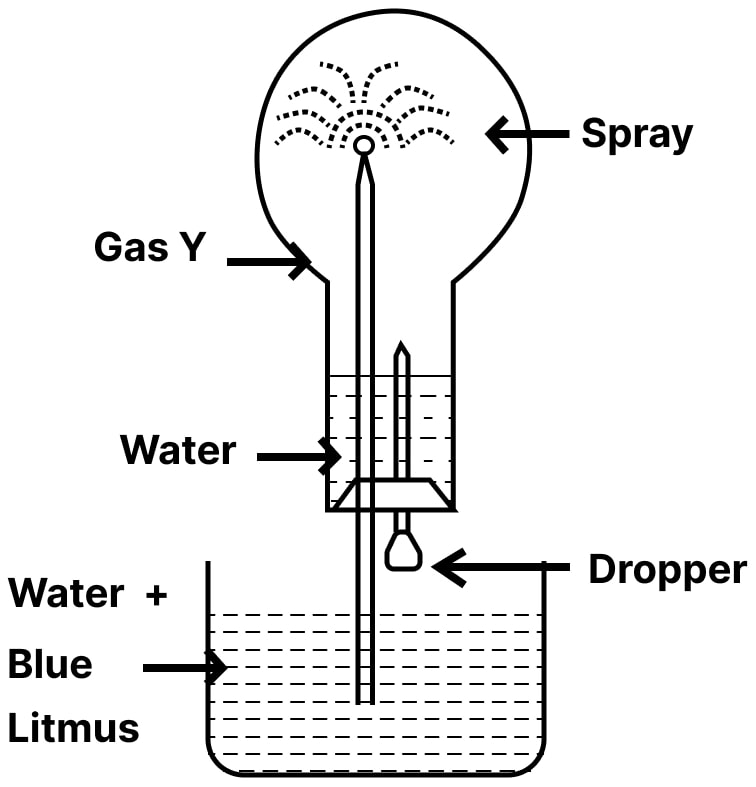
Study the figure given below and answer the questions that follow :
(i) Identify the gas Y.
(ii) What property of gas Y does this experiment demonstrate?
(iii) Name another gas which has the same property and can be demonstrated through this experiment.
Show SolutionHide Solution↓
(i) Dry HCl (Hydrogen chloride) gas is the gas Y
(ii) High solubility of HCl in water
(iii) Ammonia (NH3) gas also demonstrates high solubility in water.
8Exercise 8 — Long Answer Type
Identify the gas evolved and give the chemical test in each of the following cases.
Dilute hydrochloric acid reacts with:
(i) Iron [II] sulphide.
(ii) Sodium sulphite.
Show SolutionHide Solution↓
(i) H2S gas is evolved when dilute hydrochloric acid reacts with Iron [II] sulphide.
FeS + 2HCl ⟶ FeCl2 + H2S ↑
(ii) SO2 is evolved when dilute hydrochloric acid reacts with sodium sulphite.
Na2SO3 + 2HCl ⟶ 2NaCl + H2O + SO2 [g] ↑
9Exercise 8 — Long Answer Type
State your observations:
(a) HCl gas is passed through lead nitrate solution and the mixture is heated.
(b) Hydrochloric acid is added to silver nitrate solution.
(c) Ammonium hydroxide solution is added to the resultant product of part (b).
Show SolutionHide Solution↓
(a) When HCl gas is passed through lead nitrate, white precipitate of lead chloride is formed.
Pb(NO3)2 + 2HCl ⟶ PbCl2 ↓ + 2HNO3
(b) Hydrochloric acid, when reacted with silver nitrate solution it gives a thick curdy white precipitate of silver chloride. This white precipitate is insoluble in nitric acid.
AgNO3 + HCl ⟶ AgCl ↓ + HNO3
(c) On addition of ammonium hydroxide, the resultant of part (b) i.e., thick curdy white precipitate of silver chloride dissolves and forms a complex salt called diammine silver (I) chloride.
AgCl + 2NH4OH ⟶ [Ag(NH3)2Cl)] + 2H2O
10Exercise 8 — Long Answer Type
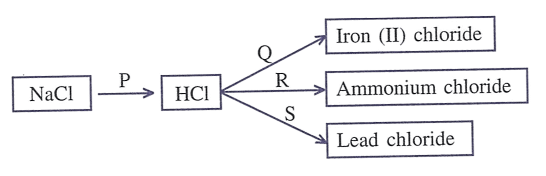
Refer to the diagram given below and write balanced equations with conditions, if any, for the following conversions P to S.
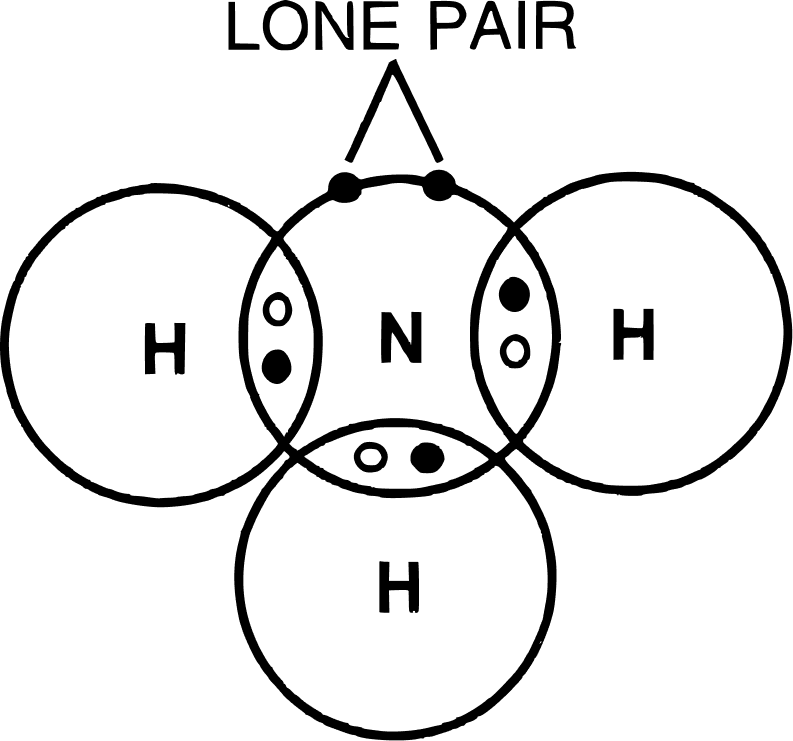
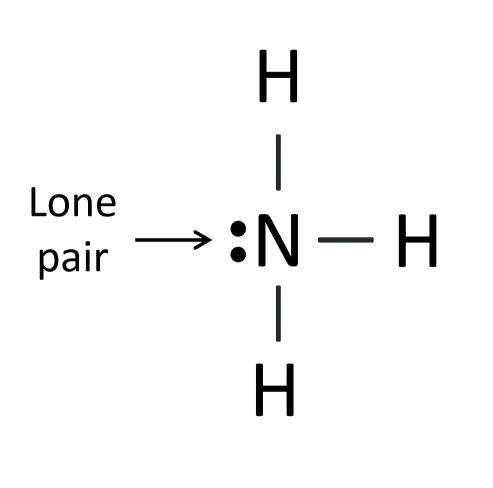
(a) State the type of bonding present in ammonia, show by a diagram.
(b) What is the formula of liquid ammonia? Account for the basic nature of this compound.
Show SolutionHide Solution↓
(a) Covalent bonding is present in ammonia as shown below —
(b) The formula of liquid ammonia is NH4OH.
The aqueous solution of ammonia [NH4OH] is a weak base. It dissociates partially to give hydroxyl ions [OH1-].
The basic nature of NH4OH is due to the presence of hydroxyl ions [OH1-].
NH3 + H2O ⟶ NH4OH
NH4OH ⇌ NH4+ + OH-
2Intext Questions 1
(a) Write a balanced chemical equation for the lab preparation of ammonia.
(b) How is ammonia dried and collected in the laboratory?
(c) Ammonia cannot be collected over water. Give reason.
Show SolutionHide Solution↓
(a) 2NH4Cl + Ca(OH)2 ⟶ CaCl2 + 2H2O + 2NH3 [g]
(b) In order to get dry ammonia, the gas is passed through a drying tower containing lumps of quicklime [CaO]. Ammonia gas is collected in inverted gas jars by the downward displacement of air.
(c) As ammonia gas is highly soluble in water, therefore, it is not collected over water.
3Intext Questions 1
(a) Explain with a diagram the preparation of aqueous ammonia.
(b) Why drying agents such as P2O5 and CaCl2 are not used to dry NH3 ?
Show SolutionHide Solution↓
(a) The diagram below shows the preparation of aqueous ammonia:
Procedure : Water is taken in a container and only a small portion of the mouth of the funnel is dipped in water.
As ammonia dissolves in water at a higher rate than it's production in the flask, the pressure in the funnel above water level decreases for a moment and water rushes into the funnel.
As a result, the rim of the funnel loses it's contact with water. Since, ammonia produced pushes the water down, the funnel comes in contact with water again. In this way, ammonia dissolves in water without back suction of water.
(b) Ammonia being basic in nature reacts chemically with P2O5 and CaCl2
6NH3 + P2O5 + 3H2O ⟶ 2(NH4)3PO4
4NH3 + CaCl2 ⟶ CaCl2.4NH3
Hence, P2O5 and CaCl2 are not used to dry NH3
4Intext Questions 1
A substance 'A' was heated with slaked lime and a gas 'B' with a pungent smell was obtained. Name the substances A and B and give a balanced equation.
Show SolutionHide Solution↓
Substance A is Ammonium chloride (NH4Cl) and gas B is Ammonia
2NH4Cl + Ca(OH)2 ⟶ CaCl2 + 2H2O + 2NH3 [g]
5Intext Questions 1
Ammonia is manufactured by Haber's process —
(a) Under what conditions do the reactants combine to form ammonia? Give a balanced equation for the reaction.
(b) In what ratio by volume, are the above gases used?
(c) State one possible source of each reactant used in Haber Process.
(d) State whether the formation of ammonia is promoted by the use of high pressure or low pressure?
(e) Mention two possible ways by which ammonia produced is removed from unchanged gases.
(f) What is the function of
(i) finely divided iron,
(ii) molybdenum in the above process?
(g) What is the percentage formation of ammonia?
(h) How can this percentage formation be increased?
Show SolutionHide Solution↓
(a) Nitrogen reacts with hydrogen under specific conditions liberating ammonia
N2 + 3H2 ⇌ 2NH3 + Δ
Conditions :
Temperature : 450-500°C [Optimum temperature]
Pressure : 200 to 900 atmospheres [Optimum pressure]
Catalyst : Finely divided iron [Fe]
Promotor : Molybdenum [Mo]
[Catalyst - iron [III] oxide [Fe2O3] may also be used containing promoters about 1% K2O and 3% Al2O3]
(b) According to the above equation, nitrogen and hydrogen combines in 1:3 ratio by volume.
(c) Nitrogen is obtained by fractional distillation of liquid air. Hydrogen is obtained from the water gas (Bosch process) or from natural gas.
(d) The formation of ammonia is promoted by the use of high pressure as it favours the forward direction.
(e) Two possible ways by which ammonia produced is removed from unchanged gases are:
By Liquefaction — ammonia is liquefied easily as compared to nitrogen and hydrogen.
By Absorbing in water — because ammonia is highly soluble in water, as hydrogen and nitrogen are very slightly soluble.
(f) Function of finely divided iron and molybdenum are:
Finely divided iron increases the rate of reaction.
Molybdenum acts as a promoter to increase the efficiency of the catalyst.
(g) 15%
(h) The unchanged nitrogen and hydrogen are recirculated through the plant to get more ammonia, by this way we can achieve 98% of ammonia.
6aIntext Questions 1
Give reason —
Ammonium compounds does not occur in minerals.
Show SolutionHide Solution↓
Due to the high solubility of Ammonium compounds in water it does not occur in minerals.
6bIntext Questions 1
Give reason —
Ammonium nitrate is not used in the preparation of ammonia.
Show SolutionHide Solution↓
As ammonium nitrate is explosive in nature and may itself decompose forming nitrous oxide and water vapour, hence it is not used in the preparation of ammonia.
NH4NO3 $\xrightarrow{\Delta}$ N2O + 2H2O
6cIntext Questions 1
Give reason —
Conc. H2SO4 is a good drying agent, yet it is not used to dry NH3.
Show SolutionHide Solution↓
As sulphuric acid reacts chemically with ammonia to form ammonium sulphate hence, it is not used as a drying agent for drying ammonia.
2NH3 + H2SO4 ⟶ (NH4)2SO4
6dIntext Questions 1
Give reason —
In the lab. preparation of ammonia
(a)calcium hydroxide is used in excess.
(b)Flask is fitted in slanting position.
Show SolutionHide Solution↓
In the lab preparation of ammonia, ammonium chloride is used. Ammonium chloride is sublime, during the reaction, the heat will cause ammonium chloride to vapourise. To prevent this, calcium hydroxide is used in excess. It absorbs excess heat and prevents the loss of ammonium chloride as vapours.
The flask is fitted in slanting position so that the water formed in the reaction does not trickle back into the heated flask and thus break it.
7Intext Questions 1
State the following conditions required in the Haber's process-
(a) Temperature
(b) Pressure
(c) Catalyst
Show SolutionHide Solution↓
Conditions :
(a) Temperature : 450-500°C [Optimum temperature]
(b) Pressure : 200 to 900 atmospheres [Optimum pressure]
(c) Catalyst : Finely divided iron [Fe]
8Intext Questions 1
Choose the correct word or phrase from the brackets to complete the following sentences and write balanced equations for the same.
(a) Ammonium chloride is a soluble salt prepared by ............... [precipitation, neutralization].
(b) When ammonium chloride is heated, it undergoes ............... [thermal decomposition/dissociation].
(a) Ammonium chloride is a soluble salt prepared by neutralization.
NH3 (gas) + HCl (gas) ⟶ NH4Cl (solid)
(b) When ammonium chloride is heated, it undergoes thermal dissociation.
NH4Cl ⇌ NH3 + HCl
(c) Heating ammonium chloride with sodium hydroxide produces ammonia.
NH4Cl + NaOH ⟶ NaCl+ H2O + NH3
9Intext Questions 1
An element has 2 electrons in it's N shell. It reacts with a non-metal of atomic number 7. The compound formed reacts with warm water and produces a basic gas. Identify the elements and write the balanced chemical reactions.
Show SolutionHide Solution↓
An element has 2 electrons in it's N shell, hence, it has
2 (electrons in K shell) +
8 (electrons in L shell) +
8 (electrons in M shell) +
2 (electrons in N shell) = 20 electrons total i.e. Calcium
Non metal (atomic number 7) is Nitrogen
Calcium and Nitrogen react to form calcium nitride.
3Ca + N2 ⟶ Ca3N2
Ca3N2 reacts with water to give calcium hydroxide and ammonia.
Ca3N2 + 6H2O ⟶ 3Ca(OH)2 + 2NH3 [g]
10Intext Questions 1
The following reactions are carried out
A: Nitrogen + metal ⟶ compound X.
B: X + water ⟶ ammonia + another compound.
C: Ammonia + metal oxide ⟶ metal + water + N2
One metal that can be used for reaction A is magnesium.
(a) Write the formula of the compound X formed
(b) Write the correctly balanced equation for reaction B where X is the compound formed.
(c) What property of ammonia is demonstrated by reaction C ?
Show SolutionHide Solution↓
(a) When metal for A is magnesium, then, compound X is Mg3N2
N2 + 3Mg ⟶ Mg3N2
(b) Magnesium nitride
Mg3N2 + 6H2O ⟶ 3Mg(OH)2 + 2NH3 [g]
(c) Ammonia is a reducing agent and hence it reduces the less reactive metal oxide to the respective metal.
2NH3 + 3MgO ⟶ 3Mg + 3H2O + N2
11Intext Questions 1
Correct the following:
(a) A reddish-brown precipitate is obtained when ammonium hydroxide is added to ferrous sulphate.
(b) Liquid ammonia is a solution of NH3.
(c) Finely divided platinum is used in Haber's Process.
(d) Conc. H2SO4 is a drying agent for NH3.
(e) Ammonium salts, on heating, decompose to give ammonia.
Show SolutionHide Solution↓
(a) A dirty green precipitate is obtained when ammonium hydroxide is added to ferrous sulphate.
(b) Aqueous ammonia is a solution of NH3in water.
(c) Finely divided iron is used in Haber's Process.
(d) Quicklime, is a drying agent for NH3,
(e) Ammonium salts, on heating with caustic alkali, decompose to give ammonia.
12Intext Questions 1
Choose the correct option from the following:
Ammonia can be obtained by adding water to
A : Ammonium chloride.
B : Ammonium nitrite.
C : Magnesium nitride.
D : Magnesium nitrate
Show SolutionHide Solution↓
Magnesium nitride
Mg3N2 + 6H2O ⟶ 3Mg(OH)2 + 2NH3 [g]
11 Mark · Exercise 9 — Multiple Choice Type
The catalyst used in Haber's process is:
(a)Molybdenum
(b)Platinum
(c)Nickel
(d)Iron
Show SolutionHide Solution↓
Iron
Reason — The catalyst used in haber's process of manufacture of ammonia is Finely divided iron.
21 Mark · Exercise 9 — Multiple Choice Type
Nitrogen gas can be obtained by heating :
(a)Ammonium nitrate
(b)Ammonium nitrite
(c)Magnesium nitride
(d)Ammonium chloride
Show SolutionHide Solution↓
Ammonium nitrite
Reason — When ammonium nitrate is heated it decomposes into nitrogen gas and water.
NH4NO2 $\xrightarrow\Delta$ 2H2O + N2
31 Mark · Exercise 9 — Multiple Choice Type
Ammonia can be obtained by adding water to:
(a)NH4Cl
(b)Mg3N2
(c)Mg (NO3) 2
(d)(NH4)2 SO4
Show SolutionHide Solution↓
Mg3N2
Reason — Ammonia can also be obtained by the action of warm water on nitride of metal like magnesium.
Mg2N2 + 6H2O ⟶ 3Mg(OH)2 + 2NH3 ↑
41 Mark · Exercise 9 — Multiple Choice Type
The gas collected by downward displacement of air is
(a)HCl
(b)NH3
(c)CO2
(d)H2S
Show SolutionHide Solution↓
NH3
Reason — Ammonia (NH3) gas is collected in inverted gas jars by downward displacement of air because it is lighter than air.
51 Mark · Exercise 9 — Multiple Choice Type
In the Haber's process, the ratio of reactants nitrogen and hydrogen is:
(a)2 : 3
(b)3 : 2
(c)1 : 3
(d)3 : 1
Show SolutionHide Solution↓
1 : 3
Reason — In the Haber's process, the ratio of reactants nitrogen and hydrogen is 1 : 3. One volume of nitrogen (from liquid air) and three volume of hydrogen (water gas from Bosch process).
61 Mark · Exercise 9 — Multiple Choice Type
When ammonia reacts with an excess of chlorine, the main product formed is:
(a)NH4Cl
(b)NCl3
(c)Cl2
(d)HCl
Show SolutionHide Solution↓
NCl3
Reason — When ammonia reacts with an excess of chlorine, products formed are hydrogen chloride and yellow coloured highly explosive liquid nitrogen trichloride. NH3 + 3Cl2 ⟶ 3HCl + NCl3
71 Mark · Exercise 9 — Multiple Choice Type
Ammonia is used in:
(a)Contact process
(b)Haber's process
(c)Ostwald process
(d)Bayer's process
Show SolutionHide Solution↓
Ostwald process
Reason — Ammonia is used as a starting material for manufacturing nitric acid using ostwald process.
81 Mark · Exercise 9 — Multiple Choice Type
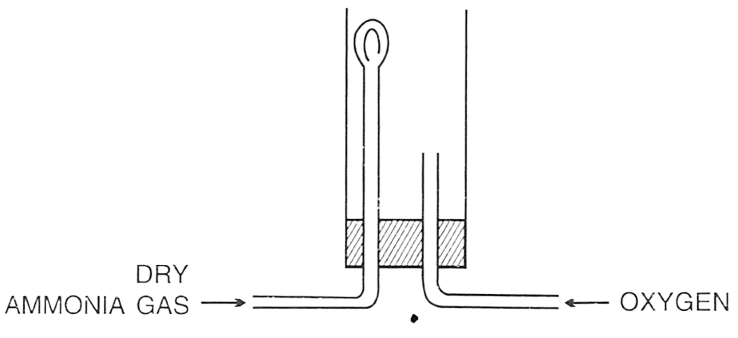
In the following set up for burning ammonia in oxygen, ammonia tube is fitted higher and oxygen tube is kept lower because ?
P — Oxygen is lighter than ammonia.
Q — Ammonia is lighter than oxygen.
R — Ammonia and oxygen mixture is explosive and by keeping them in this position, limited oxygen will react with ammonia.
Which of the following is true ?
(a)Only P
(b)Only Q
(c)Only R
(d)Both P and Q
Show SolutionHide Solution↓
Only R
Reason — Ammonia burns in oxygen with greenish yellow fumes. This reaction is explosive and dangerous. Hence, by keeping ammonia tube higher than oxygen tube, limited oxygen will react with ammonia.
91 Mark · Exercise 9 — Multiple Choice Type
Assertion (A): Ammonia does not conduct electricity in gaseous or liquid state.
Reason (R): Ions in ammonia gas or liquid ammonia are not free to move.
(a)Both A and R are true and R is the correct explanation of A.
(b)Both A and R are true but R is not the correct explanation of A.
(c)A is true but R is false.
(d)A is false but R is true.
Show SolutionHide Solution↓
A is true but R is false.
Explanation — Pure ammonia (NH3) in its gaseous or liquid form is covalent and does not contain free ions to conduct electricity. Hence, the assertion (A) is true. Ammonia consist of molecule, it doesn't have free ions to conduct electricity. Hence, the reason (R) is false.
101 Mark · Exercise 9 — Multiple Choice Type
Assertion (A): Ammonia is dried by passing through a drying tower containing CaO.
Reason (R): Ammonia being basic in nature reacts with other drying agents.
(a)Both A and R are true and R is the correct explanation of A.
(b)Both A and R are true but R is not the correct explanation of A.
(c)A is true but R is false.
(d)A is false but R is true.
Show SolutionHide Solution↓
Both A and R are true and R is the correct explanation of A.
Explanation— Ammonia is dried by passing it through a drying tower containing lumps of quicklime (CaO). Hence, the assertion (A) is true. Other drying agents like conc. sulphuric acid, phosphorous pentoxide and anhydrous calcium chloride are not used, as ammonia is basic in nature, reacts with other drying agents. Hence, the reason (R) is true and it is the correct explanation of assertion (A).
111 Mark · Exercise 9 — Multiple Choice Type
Assertion (A): Ammonia and its compounds do not occur in minerals.
Reason (R): Ammonia is not soluble in water.
(a)Both A and R are true and R is the correct explanation of A.
(b)Both A and R are true but R is not the correct explanation of A.
(c)A is true but R is false.
(d)A is false but R is true.
Show SolutionHide Solution↓
A is true but R is false.
Explanation— Ammonia and ammonium compounds do not occur as minerals because they are highly soluble in water. Hence, the assertion (A) is true. Ammonia is highly soluble in water. Hence, the reason (R) is false.
121 Mark · Exercise 9 — Multiple Choice Type
Assertion (A): In the preparation of ammonia, hydrogen is obtained by Bosch process.
Reason (R): Hydrogen and nitrogen are used in the ratio 1:3.
(a)Both A and R are true and R is the correct explanation of A.
(b)Both A and R are true but R is not the correct explanation of A.
(c)A is true but R is false.
(d)A is false but R is true.
Show SolutionHide Solution↓
A is true but R is false.
Explanation — In the Haber's process of manufacturing ammonia, nitrogen and hydrogen are used as reactants. Where, hydrogen is obtained as water gas from Bosch process. Hence, the assertion (A) is true. The ratio of reactants nitrogen and hydrogen in the Haber's process is 1 : 3. One volume of nitrogen (from liquid air) and three volume of hydrogen (water gas from Bosch process). Hence, reason (R) is false.
131 Mark · Exercise 9 — Multiple Choice Type
Assertion (A): Haber's process is used to manufacture ammonia.
Reason (R): The catalyst used in this process is vanadium oxide or platinum.
(a)Both A and R are true and R is the correct explanation of A.
(b)Both A and R are true but R is not the correct explanation of A.
(c)A is true but R is false.
(d)A is false but R is true.
Show SolutionHide Solution↓
A is true but R is false.
Explanation — Haber's process is used to manufacture ammonia. Hence, the assertion (A) is true. The catalyst used in Haber's process is finely divided iron. Hence, the reason (R) is false.
141 Mark · Exercise 9 — Multiple Choice Type
Assertion (A): Ammonia is recovered by liquification process in Haber's process.
Reason (R): Nitrogen and hydrogen liquify with difficulty as compared to ammonia.
(a)Both A and R are true and R is the correct explanation of A.
(b)Both A and R are true but R is not the correct explanation of A.
(c)A is true but R is false.
(d)A is false but R is true.
Show SolutionHide Solution↓
Both A and R are true and R is the correct explanation of A.
Explanation — Ammonia obtained from Haber's process is separated from the unreacted nitrogen and hydrogen by liquification process. Hence, the assertion (A) is true. Ammonia is recovered by liquification process because ammonia is liquified easily as compared to Nitrogen and Hydrogen. Hence, the reason (R) is true and it is the correct explanation of assertion (A).
151 Mark · Exercise 9 — Multiple Choice Type
Assertion (A): Liquid ammonia is used as a refrigerant in ice plants.
Reason (R): CFC, the main refrigerant, causes global warming.
(a)Both A and R are true and R is the correct explanation of A.
(b)Both A and R are true but R is not the correct explanation of A.
(c)A is true but R is false.
(d)A is false but R is true.
Show SolutionHide Solution↓
Both A and R are true but R is not the correct explanation of A.
Explanation — Liquid ammonia is used as a refrigerant in ice plants because anhydrous ammonia is a clear, colourless liquid under pressure. It evaporates rapidly and produces cooling effect. This makes ammonia a good refrigerant. Hence, the assertion (A) is true. CFC, the main refrigerant, decompose by ultraviolet rays to form free chlorine radicals. These free radicals contribute to global warming and ozone depletion. Hence, the reason (R) is true.
Since, reason (R) doesn't explain why liquid ammonia is used as refrigerant in ice plants, it is not the correct explanation of assertion (A).
1Exercise 9 — Very Short Answer Type
Match the following :
Column I
Column II
(a) Explosive
(i) NH4OH
(b) Fertilizer
(ii) NH4NO3
(c) Medicine
(iii) NH2CONH2
(d) Laboratory reagent
(iv) (NH4)2CO3
Show SolutionHide Solution↓
Column I
Column II
(a) Explosive
(ii) NH4NO3
(b) Fertilizer
(iii) NH2CONH2
(c) Medicine
(iv) (NH4)2CO3
(d) Laboratory reagent
(i) NH4OH
2Exercise 9 — Very Short Answer Type
Fill in the blank from the choices given in bracket :
(a) Ammonia gas is collected by .............. (upward displacement of air, downward displacement of water, downward displacement of air).
(b) Ammonia reacts with excess chorine to form ............... (nitrogen / nitrogen trichloride / ammonium chloride).
Show SolutionHide Solution↓
(a) Ammonia gas is collected by downward displacement of air.
(b) Ammonia reacts with excess chlorine to form nitrogen trichloride NH3 + 3Cl2 [excess] ⟶ 3HCl + NCl3
3Exercise 9 — Very Short Answer Type
Complete the blanks (i) to (v) in the passage given, using the following words. [Ammonium, reddish brown, hydroxyl, nitrogen dioxide, ammonia, dirty green, alkaline, acidic].
In the presence of a catalyst, nitrogen and hydrogen combine to give (i) .............. gas. When the same gas is passed through water, it forms a solution. which will be (ii).............. in nature, and will contain the ions (iii) .............. and (iv) ............... . A (v) .............. coloured ppt. of iron [II] hydroxide is formed when the above solution is added to iron [II] sulphate solution.
Show SolutionHide Solution↓
(i) Ammonia
(ii) Alkaline
(iii) Ammonium
(iv) Hydroxyl
(v) Dirty green
4Exercise 9 — Very Short Answer Type
Name:
(a) the gas which is prepared by Haber's process.
(b) two gases which give dense white fumes with ammonia.
(c) one salt of ammonia in each case which is used in: (i) dry cell (ii) explosives (iii) medicine
(d) an acidic gas which reacts with a basic gas liberating a neutral gas,
(e) a metallic chloride soluble in ammonium hydroxide,
(f) the gas obtained when ammonia burns in an atmosphere of oxygen without any catalyst,
(g) a nitride of a divalent metal which reacts with warm water liberating ammonia,
(h) an amphoteric oxide reduced by the basic gas,
(i) a white salt produced by an acidic gas and a basic gas,
(j) The gas that burns in oxygen with a green flame.
(k) The gas produced when excess ammonia reacts with chlorine.
(l) The white crystalline solid that is soluble in water which liberates a pungent smelling gas when heated with sodium hydroxide solution.
(m) An alkaline gas which produces dense white fumes when reacted with HCl gas.
Show SolutionHide Solution↓
(a) Ammonia
(b) Hydrogen chloride and chlorine gas
(c) (i) dry cell — ammonium chloride (ii) explosives — ammonium nitrate (iii) medicine — ammonium carbonate
(d) Acidic gas — Cl2 ; Basic gas — Ammonia; Neutral gas — N2 2NH3 + 3Cl2 ⟶ N2 + 6HCl
(e) Silver chloride
(f) Nitrogen
(g) Magnesium nitride
(h) Lead oxide
(i) Ammonium chloride
(j) Ammonia (NH3)
(k) Nitrogen 8NH3 [excess] + 3Cl2 ⟶ 6NH4Cl + N2
(l) Ammonium salts like ammonium chloride, ammonium sulphate
(m) Ammonia gas NH3 + HCl ⟶ NH4Cl
5Exercise 9 — Very Short Answer Type
Name the gas evolved when the following mixtures are heated :
(a) Calcium hydroxide and Ammonium chloride.
(b) Sodium nitrite and Ammonium chloride.
Show SolutionHide Solution↓
(a) Ammonia gas
2NH4Cl + Ca(OH)2 ⟶ CaCl2 + 2H2O + 2NH3
(b) Nitrogen gas
NH4Cl + NaNO2 ⟶ NaCl + NH4NO2
NH4NO2 ⟶ 2H2O + N2
6Exercise 9 — Very Short Answer Type
From the list of the gases — Ammonia, ethane, hydrogen chloride, hydrogen sulphide — Select the gas which is used as a reducing agent in reducing copper oxide to copper.
A gas 'P' gives dense white fumes with chlorine. It's aqueous solution gives a blue colour with copper (II) hydroxide. Give the name and formula of the gas P.
Show SolutionHide Solution↓
Gas 'P' is Ammonia and its formula is NH3.
With chlorine, ammonia gas gives dense white fumes of NH4Cl.
8NH3 [excess] + 3Cl2 ⟶ 6NH4Cl + N2
Reaction of copper (II) hydroxide with aqueous solution of Ammonia (NH4OH) is given below:
(a) Ammonia is basic in nature and rest are acidic.
(b) Copper oxide is less reactive and can be reduced by C, CO or hydrogen whereas aluminium oxide, sodium oxide, magnesium oxide are reduced by electrolysis.
3Exercise 9 — Short Answer Type
State two relevant observations for : ammonium hydroxide soln. is added to zinc nitrate soln. slowly and then in excess.
Show SolutionHide Solution↓
White gelatinous precipitate of zinc hydroxide is formed which dissolves in excess of NH4OH solution.
Zn(NO3)2 + 2NH4OH ⟶ 2NH4NO3 + Zn(OH)2 ↓
4Exercise 9 — Short Answer Type
(a) What do you observe when ammonium hydroxide is added to the aqueous solution of :
(i) FeSO4
(ii) Iron (III) chloride.
(iii) Lead nitrate
(iv) Zinc nitrate
(b) Write balanced equation for Q.4(a).
Show SolutionHide Solution↓
(i) Dirty green ppt. of ferrous hydroxide is formed which is insoluble in excess of NH4OH.
(ii) Reddish brown ppt. of ferric hydroxide is formed which is insoluble in excess of NH4OH.
(iii) White ppt. of lead hydroxide is formed which is insoluble in excess of NH4OH.
(iv) White gelatinous ppt. of Zinc hydroxide is formed which is soluble in excess of NH4OH.
(b) The balanced chemical equations are given as :
(i) FeSO4 + 2NH4OH ⟶ (NH4)2SO4 + Fe(OH)2 ↓
(ii) FeCl3 + 3NH4OH ⟶ 3NH4Cl + Fe(OH)3 ↓
(iii) Pb(NO3)2 + 2NH4OH ⟶ 2NH4NO3 + Pb(OH)2 ↓
(iv) Zn(NO3)2 + 2NH4OH ⟶ 2NH4NO3 + Zn(OH)2 ↓
5Exercise 9 — Short Answer Type
When ammonium hydroxide is added to solution B, a pale blue precipitate is formed. This pale blue precipitate dissolves in excess ammonium hydroxide giving an inky blue solution. What is the cation (positive ion) present in solution B? What is the probable colour of solution B.
Show SolutionHide Solution↓
Solution B is Copper Sulphate and cation present is (Cu2+). The colour of solution B is Blue.
Ammonium hydroxide gives a blue precipitate when it combines with a solution of copper salt, due to the formation of Cu(OH)2
CuSO4 + 2NH4OH ⟶ (NH4)2SO4 + Cu(OH)2 ↓
The pale blue precipitate of copper hydroxide dissolves in excess of ammonium hydroxide forming tetraamine copper [II] sulphate, an azure blue soluble complex salt.
(a) Liquid ammonia is used as a refrigerant in ice plants.
(b) Aqueous solution of ammonia is used for removing grease stains from woollen clothes.
(c) Aqueous solution of ammonia gives a pungent smell.
(d) Aqueous solution of ammonia conducts electricity.
Show SolutionHide Solution↓
(a) Liquid ammonia is a clear, colourless liquid under pressure. It evaporates rapidly and produces cooling effect. Moreover, Ammonia is environmentally compatible, has superior thermodynamic properties and its leaks are easily detectable due to its recognizable odour. All these reasons make liquid ammonia a good refrigerant.
(b) As aqueous solution of ammonia emulsifies or dissolves fats, grease etc., hence it is used for removing grease stains from woollen clothes.
(c) Pungent smell of aqueous solution of ammonia is due to the presence of ammonia, which has strong, pungent choking smell.
(d) In aqueous solution, the ammonia molecule combines with a hydrogen atom H+ by sharing the lone pair of electrons of nitrogen atom to form ammonium ion (NH4+). Thus, in water, ammonium hydroxide (NH4OH) dissociates into NH4+ (ammonium ion) and OH- (hydroxide ion) as follows:
NH4OH ⟶ NH4+ + OH-
Due to this ionisation, aqueous solution of ammonia (NH4OH) conducts electricity.
11Exercise 9 — Short Answer Type
Write balanced chemical equation for the following:
(a) Ammonium hydroxide is added to ferrous sulphate solution.
(b) Magnesium nitride is treated with warm water.
(c) Ammonium chloride is heated with sodium hydroxide.
(d) Chlorine reacts with excess of ammonia.
(e) Ammonia and Oxygen in the presence of a catalyst.
(f) Reduction of hot copper (II) oxide to copper using Ammonia gas.
(g) To illustrate the reducing nature of ammonia.
(h) Lab. preparation of ammonia using an ammonium salt.
(i) Reaction of ammonia with excess of chlorine.
(j) Reaction of ammonia with sulphuric acid.
(k) When excess of ammonia is treated with chlorine.
Write a balanced equation for a reaction in which ammonia is oxidized by :
(a) a metal oxide
(b) a gas which is not oxygen.
Show SolutionHide Solution↓
(a) 2NH3 + 3CuO ⟶ 3Cu + 3H2O + N2 ↑
(b) NH3 + 3Cl2 ⟶ 3HCl + NCl3 ↑
13Exercise 9 — Short Answer Type
Write a relevant equation, to show that ammonia acts as a reducing agent.
Show SolutionHide Solution↓
Ammonia gas is a strong reducing agent. Below equation shows reduction of Black Copper [II] oxide to brown Copper by Ammonia.
2NH3 + 3CuO ⟶ 3Cu + 3H2O + N2 [g]
14Exercise 9 — Short Answer Type
Rewrite the correct statement with the missing word/s — Magnesium nitride reacts with water to liberate ammonia.
Show SolutionHide Solution↓
Magnesium nitride reacts with warm water to liberate ammonia along with magnesium hydroxide.
15Exercise 9 — Short Answer Type
Distinguish between the following (using ammonia solution) :
(a) Calcium chloride and zinc chloride.
(b) Ferric salt and ferrous salt
(c) Zinc nitrate and lead nitrate
Show SolutionHide Solution↓
(a) When we add ammonium hydroxide solution to both the given salt solutions, Zinc Chloride reacts to form a gelatinous white precipitate of Zinc Hydroxide (ZnOH), whereas, no such observations i.e no precipitate will form in case of Calcium Chloride solution because ammonium hydroxide is a weak base and it cannot react with calcium salts to precipitate the hydroxide of calcium.
ZnCl2 + 2NH4OH ⟶ Zn(OH)2 + 2NH4Cl
(b) On reaction with ammonium hydroxide, Iron [II] sulphate (ferrous salt) forms a dirty green ppt whereas iron [III] sulphate (ferric salt) forms a reddish brown ppt. Hence, the two can be distinguished easily.
FeSO4 + 2NH4OH ⟶ (NH4)2SO4 + Fe(OH)2 ↓
Fe2(SO4)3 + 6NH4OH ⟶ 3(NH4)2SO4 + 2Fe(OH)3 ↓
(c) When zinc nitrate is treated with ammonium hydroxide, white gelatinous ppt. of Zinc hydroxide is formed which is soluble in excess of NH4OH.
Zn(NO3)2 + 2NH4OH ⟶ 2NH4NO3 + Zn(OH)2 ↓
Whereas, when lead nitrate is treated with ammonium hydroxide, white ppt. of lead hydroxide is formed which is insoluble in excess of NH4OH
Pb(NO3)2 + 2NH4OH ⟶ 2NH4NO3 + Pb(OH)2 ↓
16Exercise 9 — Short Answer Type
Give balanced equations for the following conversions :
Distinguish between the following pairs of compounds using the test given in bracket :
(a) Iron [II] sulphate and iron [III] sulphate [using ammonium hydroxide]
(b) A lead salt and a zinc salt [using excess ammonium hydroxide]
Show SolutionHide Solution↓
(a) On reaction with ammonium hydroxide, Iron [II] sulphate forms a dirty green ppt whereas iron [III] sulphate forms a reddish brown ppt. Hence, the two can be distinguished easily.
FeSO4 + 2NH4OH ⟶ (NH4)2SO4 + Fe(OH)2 ↓
Fe2(SO4)3 + 6NH4OH ⟶ 3(NH4)2SO4 + 2Fe(OH)3 ↓
(b) A lead salt gives a chalky white ppt. on reaction with ammonium hydroxide that is insoluble in excess of ammonium hydroxide.
Pb(NO3)2 + 2NH4OH ⟶ 2NH4NO3 + Pb(OH)2 ↓
On the other hand, zinc salt forms a white gelatinous ppt. which dissolves when excess of ammonium hydroxide is added. Hence, the two can be distinguished.
(a) Ammonia gas is passed over heated copper (II) oxide.
(b) In the absence of catalyst, ammonia is burnt in an atmosphere of oxygen.
(c) Ammonium hydroxide is first added in a small quantity and then in excess to a solution of copper sulphate.
(d) Water is added to the product formed, when Al is burnt in a jar of nitrogen gas.
(e) Excess of chlorine gas is reacted with ammonia gas.
(f) Calcium hydroxide is heated with ammonium chloride crystals.
Show SolutionHide Solution↓
(a) Black copper [II] oxide is reduced to brown copper.
2NH3 + 3CuO ⟶ 3Cu + 3H2O + N2 [g]
(b) Green or greenish yellow flame is seen when ammonia gas is burnt in an atmosphere of oxygen. The reaction of combustion of Ammonia is:
4NH3 + 3O2 ⟶ 2N2 + 6H2O
(c) Ammonium hydroxide if first added in small quantity and then in excess to a solution of copper sulphate, a pale blue ppt. of copper hydroxide is formed which dissolves in excess of ammonium hydroxide forming a soluble complex salt.
(d) When Al metal is burnt in a jar of nitrogen gas, its nitride i.e., AlN is formed. When warm water is added to AlN, it undergoes hydrolysis and is decomposed by warm water to give pungent smelling ammonia gas. The corresponding insoluble metal hydroxide (i.e., Al(OH)3) is precipitated out. The reactions are shown below:
2Al + N2 ⟶ 2AlN
AlN + 3H2O ⟶ Al(OH)3 + NH3 [g]
(e) Colourless ammonia gas reacts with greenish yellow excess chlorine giving a yellow explosive liquid (Nitrogen trichloride).
NH3 + 3Cl2 [excess] ⟶ 3HCl + NCl3
(f) Pungent smelling gas (ammonia) is given out.
2NH4Cl + Ca(OH)2 ⟶ CaCl2 + 2H2O + 2NH3
19Exercise 9 — Short Answer Type
(a) Is ammonia more dense or less dense than air?
(b) What property of ammonia is demonstrated by the Fountain Experiment?
(c) Write the balanced equation for the reaction between ammonia and sulphuric acid.
Show SolutionHide Solution↓
(a) Ammonia is less dense than air because vapour density of ammonia is 8.5 and that of air is 14.4.
(b) Fountain Experiment demonstrates the high solubility of ammonia gas in water.
(c) 2NH3 + H2SO4 ⟶ (NH4)2SO4
20Exercise 9 — Short Answer Type
Ammonia solution in water gives a blue precipitate when it combines with a solution of copper salt. The blue precipitate further dissolves in excess of ammonia solution to give an azure blue solution. Explain with equation.
Show SolutionHide Solution↓
Ammonia solution in water gives a blue precipitate when it combines with a solution of copper salt, due to the formation of Cu(OH)2
CuSO4 + 2NH4OH ⟶ (NH4)2SO4 + Cu(OH)2 ↓
The pale blue precipitate of copper hydroxide dissolves in excess of ammonium hydroxide forming tetraamine copper [II] sulphate, an azure blue soluble complex salt.
Give chemical equation(s) to prove that NH3 contains nitrogen and hydrogen?
Show SolutionHide Solution↓
Ammonia dissociates into nitrogen and hydrogen at high temperature or by electric sparks
2NH3 ⇌ N2 + 3H2
2Exercise 9 — Long Answer Type
When an ammonium salt is warmed with sodium hydroxide solution, a gas is evolved. State three ways in which you could identify this gas.
Show SolutionHide Solution↓
When an ammonium salt is warmed with sodium hydroxide solution, ammonia gas is evolved.
NH4Cl + NaOH ⟶ NaCl + H2O + NH3
Three ways in which ammonia gas can be identified is:
It has a sharp characteristic odour.
It turns:
moist red litmus blue,
moist turmeric paper brown,
phenolphthalein solution pink.
It gives dense white fumes with conc. hydrochloric acid. NH3 + HCl ⟶ NH4Cl
3Exercise 9 — Long Answer Type
A gas 'A' reacts with another gas 'B' in the presence of a catalyst to give a colourless gas 'C'. The gas 'C' when comes in contact with air produces a brown gas 'D'. The solution of 'A' in water turns red litmus blue. Explain the observations.
Show SolutionHide Solution↓
As the 'A' turns red litmus blue it is a base. Now the gas 'A' combines with 'B' in presence of Catalyst to give colourless gas Nitrogen monoxide. It reacts with oxygen to give brown gas which is Nitrogen dioxide. The gases are given as :
(a) Name the common refrigerant. How does it deplete ozone layer?
(b) What is the alternative of chlorofluorocarbons ?
(c) State the advantages and disadvantages of using ammonia as refrigerant?
Show SolutionHide Solution↓
(a) The main refrigerants used are Freon chlorofluorocarbons (CFC). They deplete ozone layer and contribute to global warming. The chlorofluorocarbons are decomposed by ultraviolet rays to highly reactive chlorine which is produced in the atomic form.
The free radical [Cl] reacts with ozone and chlorine monoxide is formed.
Cl + O3 [ozone] ⟶ ClO + O2
This causes depletion of ozone. Chlorine monoxide further reacts with atomic oxygen and produces more free radicals.
ClO + O ⟶ Cl + O2
Again this free radical [Cl] destroys ozone, and the process continues thereby giving rise to ozone depletion.
(b) Liquid ammonia
(c) Advantages of ammonia as refrigerant:
Ammonia is environmentally compatible. It does not deplete ozone layer and does not contribute towards global warming.
It has superior thermodynamic qualities as result ammonia refrigeration systems use less electricity.
Ammonia has a recognizable odour and so leaks are not likely to escape. It being lighter than air goes up in the atmosphere not affecting the life too much on earth.
Disadvantages of ammonia as a refrigerant are as follows:
It is not compatible with copper, so it cannot be used in any system with copper pipes.
It is poisonous in high concentration.
5Exercise 9 — Long Answer Type
(a) Which feature of ammonia molecule leads to the formation of the ammonium ion when ammonia dissolves in water?
(b) Name the other ion formed when ammonia dissolves in water.
(c) Give one test that can be used to detect the presence of the ion produced in (b).
Show SolutionHide Solution↓
(a) Ammonia molecule has a lone pair of electrons on it's nitrogen atom.
Due to this lone pair of electrons, in aqueous solutions it forms ammonium ion.
NH3 + H2O ⟶ NH4OH
NH4OH ⇌ NH4+ + OH-
(b) Hydroxyl ion [OH-].
(c) The red litmus paper turns blue due to the presence of hydroxyl ion in the solution.
6Exercise 9 — Long Answer Type
(a) Of the two gases, ammonia and hydrogen chloride, which is more dense? Name the method of collection of this gas.
(b) Give one example of a reaction between the above two gases which produces a solid compound.
Show SolutionHide Solution↓
(a) HCl gas is denser as it's vapour density = 18.25, and that of ammonia is 8.5. HCl gas is collected by the upward displacement of air.
(b) NH3 + HCl ⟶ NH4Cl
7Exercise 9 — Long Answer Type
Study the flow chart given and give balanced equations to represent the reactions A, B and C.
B: $\underset{\text{[aq.]}}{\text{NH}_3} + \underset{\text{[vapour]}}{\text{HCl}} \longrightarrow \underset{\text{[dense white fumes]}}{\text{NH}_4\text{Cl}}$
C: 2NH4Cl + Ca(OH)2 ⟶ CaCl2 + 2H2O + 2NH3↑
8Exercise 9 — Long Answer Type
With respect to the manufacture of ammonia, answer the following:
(a) Name the process involved.
(b) State the ratio of the reactants taken.
(c) State the catalyst used.
(d) Give the equation for the manufacture of the gas - ammonia.
Show SolutionHide Solution↓
(a) Haber's Process
(b) Nitrogen (N2) and hydrogen (H2) in the ratio 1:3 by volume
(c) Finely divided iron (Fe)
(d) N2 + 3H2 ⇌ 2NH3 + Δ
9Exercise 9 — Long Answer Type
The following questions are based on the preparation of ammonia gas in the laboratory:
(a) Explain why ammonium nitrate is not used in the preparation of ammonia.
(b) Name the compound normally used as a drying agent during the process.
(c) How is ammonia gas collected? Explain why it is not collected over water.
Show SolutionHide Solution↓
(a) As ammonium nitrate is explosive in nature and may itself decompose forming nitrous oxide and water vapour, hence it is not used in the preparation of ammonia.
(b) Quick lime [CaO] is used as a drying agent during the process.
(c) Downward displacement of air is the method used for the collection of the ammonia gas. As ammonia gas is highly soluble in water, therefore, it is not collected over water.
10Exercise 9 — Long Answer Type
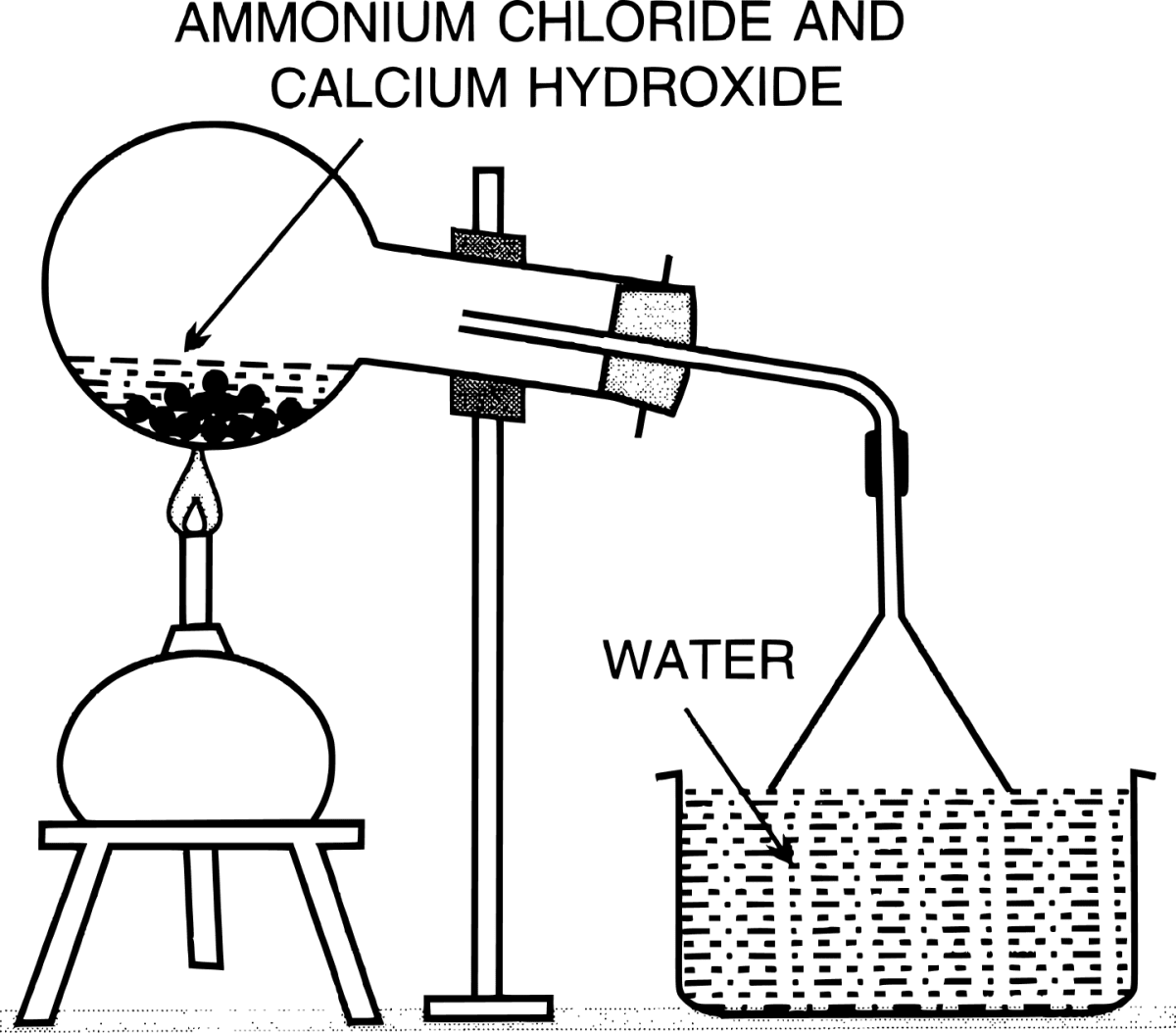
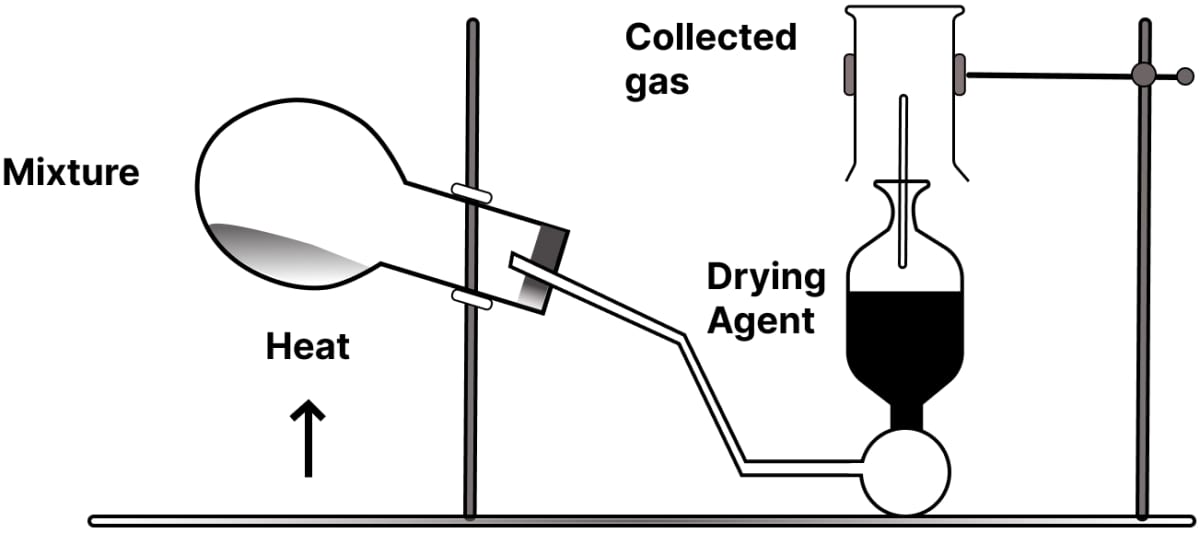
The diagram below shows set up for the lab. preparation of a pungent alkaline gas.
(a) Name the gas collected in the jar.
(b) Give a balanced equation for the above preparation
(c) State how the above gas is collected?
(d) Name the drying agent used.
(e) State how you will find out that the jar is full of the pungent gas?
Show SolutionHide Solution↓
(a) Ammonia (NH3) gas is collected.
(b) 2NH4Cl + Ca(OH)2 ⟶ CaCl2 + 2H2O + 2NH3
(c) Downward displacement of air is the method used to collect the gas.
(d) Quicklime (CaO) is the drying agent.
(e) A glass rod dipped in conc. HCl acid is brought near the mouth of the jar. If the jar is full-dense white fumes of ammonium chloride are formed.
11Exercise 9 — Long Answer Type
Answer the following questions with respect to the given figure.
(a) Identify gas P and gas Q.
(b) Give a balanced equation to convert ammonia into gas P by a method other than decomposition. State the property of ammonia used in carrying out the conversion.
(c) Name fertiliser S and give a balanced equation for its preparation.
(d) Name process T and state the conditions that enable conversion of ammonia to nitric oxide.
(e) Give a balanced equation for the conversion of brown gas to liquid U.
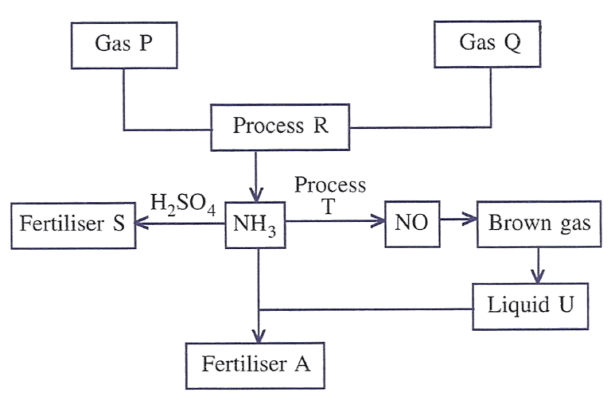
(f) Name fertiliser A.
(g) Name process R.
Show SolutionHide Solution↓
(a) Gas P — Nitrogen [N2] and Gas Q — Hydrogen [H2]
(b) 2NH3 + 3CuO ⟶ 3Cu + 3H2O + N2 (g) Ammonia acts as a reducing agent reducing copper oxide to copper and itself is oxidised to nitrogen gas.
(c) Fertiliser S is Ammonium sulphate 2NH3 + H2SO4 ⟶ (NH4)2 SO4
(d) Process T is Ostwald's process Conditions that enable conversion of ammonia to nitric oxide are 800°C temperature and platinum as catalyst.
(e) 4NO2 (g) + H2O (l) + O2 (g) ⟶ 4HNO3 (aq.)
(f) Fertiliser A is Ammonium nitrate.
(g) Process R is the Haber's process.
12Exercise 9 — Long Answer Type
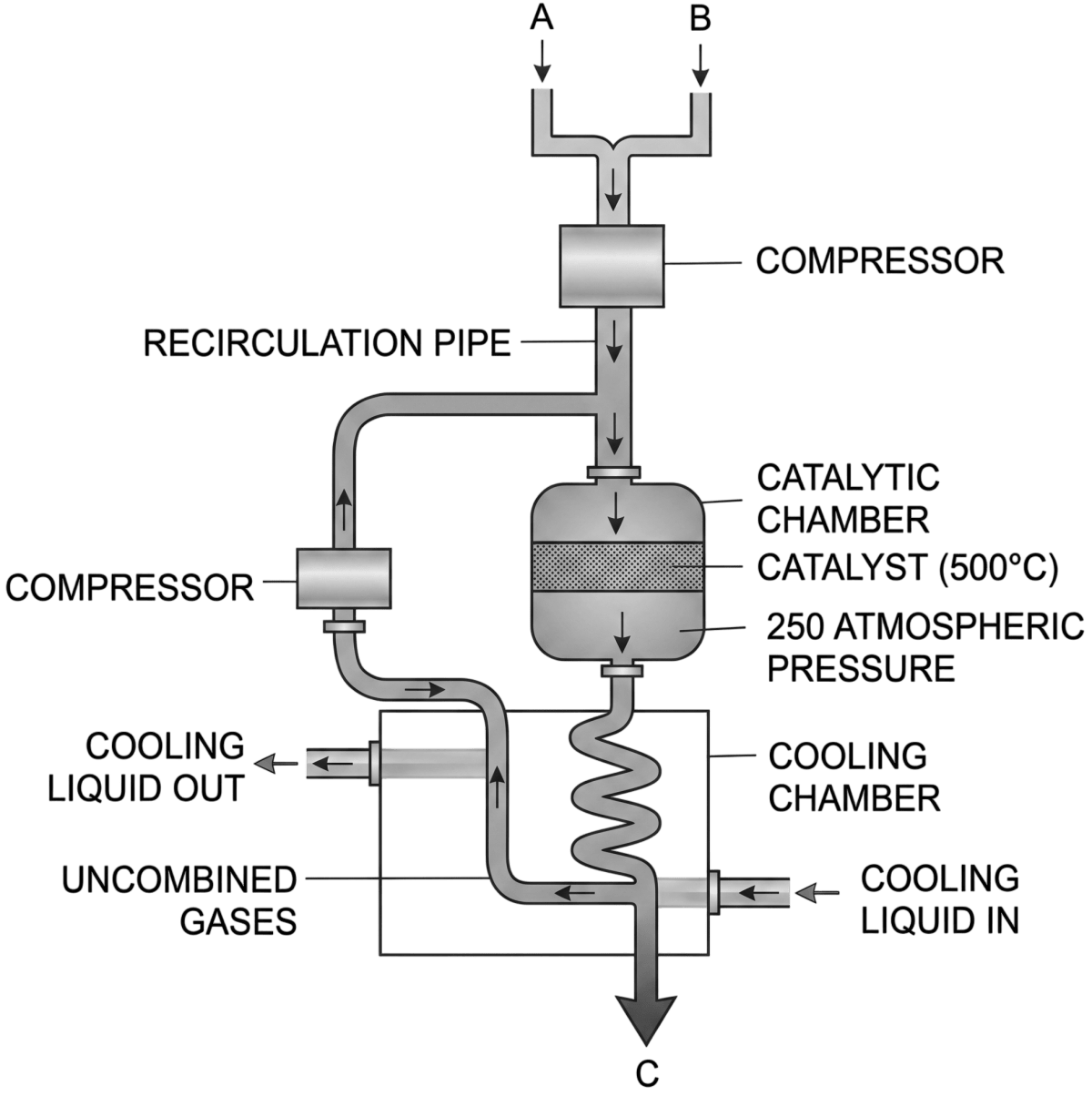
The diagram given below describes the manufacturing process of a gas.
(a) Name the process.
(b) Identify A, B and C.
(c) State the ratio of A and B
(d) Write the equation involved with their respective conditions.
(e) How is the product separated from unreacted reactants ?
Show SolutionHide Solution↓
(a) Haber's process
(b) A — Nitrogen B — Hydrogen C — Liquid ammonia
(c) Ratio of A and B is 1:3
(d) Reaction: N2 + 3H2 ⇌ 2NH3 + heat
Favorable Conditions:
Temperature
450-500°C
Pressure
Above 200 atm
Catalyst
Finely divided iron
Promoter
Traces of molybdenum or Al2O3
(e) Product is separated from unreacted reactants by Liquification. Ammonia is liquified easily as compared to nitrogen and hydrogen.
1Intext Questions 1
Fill in the blank :
Cold dil. nitric acid reacts with copper to form ............... (Hydrogen, nitrogen dioxide, nitric oxide).
Show SolutionHide Solution↓
Cold dilute nitric acid reacts with copper to form nitric oxide.
2aIntext Questions 1
What is aqua fortis ?
Show SolutionHide Solution↓
Nitric acid (HNO3) was formerly known aqua fortis, meaning strong water. It is so called because it reacts with nearly all metals. It can even dissolve silver which does not dissolve in other acids.
2bIntext Questions 1
What is aqua regia ?
Show SolutionHide Solution↓
Conc. nitric acid (1 part by volume) when mixed with conc. hydrochloric acid (3 parts by volume) gives the mixture called Aqua Regia (meaning royal water).
2cIntext Questions 1
What is fixation of nitrogen?
Show SolutionHide Solution↓
The conversion of free atmospheric nitrogen (N2) into useful nitrogenous compounds in the soil is known as fixation of nitrogen.
3Intext Questions 1
During thunderstorms, rain water contains nitric acid. Explain with reactions.
Show SolutionHide Solution↓
During thunderstorms, the nitrogen present in the atmosphere reacts with oxygen to form nitric oxide.
N2 + O2 ⟶ 2NO
Nitric oxide is further oxidized to nitrogen dioxide.
2NO + O2 ⟶ 2NO2
The nitrogen dioxide dissolves in atmospheric moisture or rain water in the presence of oxygen of the air and forms nitric acid which is washed down during rain and combines with the salt present on the surface of the earth.
4NO2 + 2H2O + O2 ⟶ 4HNO3
4Intext Questions 1
Ammonia is used in the Ostwald process,
(a) Give the source of reactants used in this process.
(b) Name the catalyst used in the process.
(c) Name the oxidising agent used in this process.
(d) What is the ratio of ammonia and air taken in this process?
(e) Why is quartz used in this process?
Show SolutionHide Solution↓
(a) Dry air (free from carbon dioxide and dust particles) and dry ammonia produced in Haber’s process.
(b) Platinum gauze
(c) Oxygen
(d) 1:10 i.e., 1 volume of ammonia and 10 volume of air.
(e) Quartz is acid resistant and when packed in layers, it slows down the movement of the gaseous NO2 so that it can dissolve in water uniformly.
5aIntext Questions 1
Write a balanced chemical equation for the laboratory preparation of nitric acid.
Show SolutionHide Solution↓
Below is the equation for the lab. preparation of HNO3 from potassium nitrate and conc. H2SO4:
In the preparation of nitric acid from KNO3, Concentrated hydrochloric acid is not used in place of concentrated sulphuric acid. Explain why.
Show SolutionHide Solution↓
Conc. HCl is not used in place of conc. Sulphuric Acid (H2SO4) because HCl is volatile and hence nitric acid vapous will carry HCl vapours.
5cIntext Questions 1
Conc. nitric acid prepared in the laboratory is yellow in colour. Why? How is this colour removed?
Show SolutionHide Solution↓
Concentrated nitric acid prepared in the laboratory is yellow in color due to dissolution of reddish brown nitrogen dioxide gas in the acid. This gas is produced due to the thermal decomposition of a portion of nitric acid.
4HNO3 ⟶ 2H2O + 4NO2 + O2
The yellow color of the acid is removed :
If dry air or CO2 is bubbled through the yellow acid, the latter turns colourless because it drives out NO2 gas from warm acid, which is further oxidised to nitric acid.
By adding excess water, nitrogen dioxide gas dissolves in water and thus yellow color of acid is removed.
5dIntext Questions 1
Give reasons for the following:
In the laboratory preparation of nitric acid, the mixture of concentrated sulphuric acid and sodium nitrate should not be heated very strongly above 200°C.
Show SolutionHide Solution↓
The temperature of the reaction should not increase above 200°C, because sodium sulphate formed at higher temperature, forms a hard crust which sticks to the walls of the retort and is difficult to remove, although the yield of nitric acid is higher.
(a) Nitric acid cannot be concentrated beyond 68% by the distillation of a dilute solution of HNO3. State the reason.
(b) What is passive iron? How is passivity removed?
Show SolutionHide Solution↓
(a) An aqueous solution of nitric acid (68% concentration) forms a constant boiling mixture at 121°C. A constant boiling mixture is one which boils without change in composition.
Hence on boiling further, the mixture evolves out the vapours of both acid and water in the same proportion as in the liquid.
Therefore, dilute HNO3 cannot be concentrated beyond 68% by boiling.
(b) Iron becomes passive or inert when treated with pure concentrated nitric acid due to the formation of the extremely thin layer of insoluble iron oxide (passivity) which stops the reaction.
Fe + 6HNO3 ⟶ Fe(NO3)3 + 3H2O + 3NO2
This inert iron is known as passive iron.
Passivity can be removed by rubbing the surface layer with sandpaper or by treating with strong reducing agent.
7Intext Questions 1
Name the products formed when:
(a) carbon and conc. nitric acid is heated,
(b) dilute HNO3 is added to copper.
Show SolutionHide Solution↓
(a) The products formed when carbon and conc. nitric acid is heated are carbon dioxide, nitrogen dioxide and water
C + 4HNO3 ⟶ CO2 + 2H2O + 4NO2
(b) The products formed when dilute HNO3 is added to copper are copper nitrate, nitric oxide and water
3Cu + 8HNO3 ⟶ 3Cu(NO3)2 + 4H2O + 2NO
8Intext Questions 1
Give two chemical equations for each of the following:
(d) Nitric acid turns yellow when exposed to light.
(e) Magnesium reacts with very dilute (about 1%) nitric acid to liberate hydrogen gas.
11 Mark · Exercise 10 — Multiple Choice Type
The nitrate salt which does not give a mixture of NO2 and O2 on heating is:
(a)AgNO3
(b)KNO3
(c)Cu(NO3)2
(d)Zn(NO3)2
Show SolutionHide Solution↓
KNO3
Reason — The alkali metal nitrates such as sodium or potassium nitrates when heated melts into colourless liquids which decompose on heating to give oxygen gas.
Reason — In the brown ring test the conc. sulphuric acid being heavier settles down and the iron [II] sulphate layer remains above it resulting in formation of the brown ring at the junction.
Reason — Nitric acid is manufactured by Ostwald process developed by a german chemist Ostwald, in 1914.
61 Mark · Exercise 10 — Multiple Choice Type
The catalyst used in the manufacture of HNO3 is :
(a)Pt
(b)V2O5
(c)Fe
(d)Pd
Show SolutionHide Solution↓
Pt
Reason — The catalyst used in the manufacture of HNO3 by Ostwald's process is Platinum.
71 Mark · Exercise 10 — Multiple Choice Type
Cold and dilute HNO3 reacts with Cu to give :
(a)NO2
(b)NO
(c)N2
(d)O2
Show SolutionHide Solution↓
NO
Reason — Cold and dilute HNO3 reacts with Copper and oxidises it to give Nitric oxide (NO)
3Cu + 8HNO3 ⟶ 3Cu(NO3)2 + 4H2O + 2NO
81 Mark · Exercise 10 — Multiple Choice Type
The brown ring test is used for the detection of :
(a)CO32-
(b)Cl-
(c)NO3-
(d)SO32-
Show SolutionHide Solution↓
NO3-
Reason — The brown ring test is a qualitative test used to detect the presence of nitrate ions (NO3-) in a solution. A brown ring forms at the junction of the two liquids if nitrate ions are present.
91 Mark · Exercise 10 — Multiple Choice Type
Sulphur reacts with conc. HNO3 to give :
(a)SO2
(b)H2
(c)H2SO4
(d)H2S
Show SolutionHide Solution↓
H2SO4
Reason — Conc. Nitric acid (HNO3) reacts with non-metals like sulphur to give sulphuric acid and nitrogen dioxide.
S + 6HNO3 ⟶ H2SO4 + 2H2O + 6NO2
101 Mark · Exercise 10 — Multiple Choice Type
The solvent for NO is :
(a)Freshly prepared FeSO4
(b)Fe2(SO4)3
(c)FeCl3
(d)FeCl2
Show SolutionHide Solution↓
Freshly prepared FeSO4
Reason — The solvent for NO is freshly prepared FeSO4, because upon exposure to the atmosphere, it is oxidised to ferric sulphate which will not give brown ring.
111 Mark · Exercise 10 — Multiple Choice Type
The acid which can be used to etch designs on brassware is :
(a)HCl
(b)HNO3
(c)H2SO4
(d)H2CO3
Show SolutionHide Solution↓
HNO3
Reason — Nitric acid (HNO3) is used to etch designs on brassware because it acts as solvent for a large number of metals except noble metals.
121 Mark · Exercise 10 — Multiple Choice Type
HNO3 is kept in reagent bottles because it is :
(a)an oxidising agent
(b)a reducing agent
(c)hygroscopic in nature
(d)decompose in the presence of light
Show SolutionHide Solution↓
decompose in the presence of light
Reason — Nitric acid (HNO3) decomposes in presence of sunlight even at room temperature and turn into yellow colour solution. To avoid the decomposition, nitric acid is normally stored in reagent bottles.
131 Mark · Exercise 10 — Multiple Choice Type
The nitrate which does not leave any residue behind on heating is :
On heating zinc nitrate, the products formed are zinc oxide, nitrogen dioxide and oxygen. Zinc oxide is :
P — a black solid
Q — brown when hot, yellow when cold
R — yellow when hot, white when cold
Which of the following is true ?
(a)Only P
(b)Only Q
(c)Only R
(d)Both Q and R
Show SolutionHide Solution↓
Only R
Reason — On heating zinc nitrate, the products formed are zinc oxide, nitrogen dioxide and oxygen. Zinc oxide is yellow when hot, white when cold.
2Zn(NO3)2 $\xrightarrow{\Delta}$ 2ZnO + 4NO2 + O2
151 Mark · Exercise 10 — Multiple Choice Type
Assertion (A): KNO3 and conc. H2SO4 are the reactants for the preparation of nitric acid.
Reason (R): Conc. H2SO4 being a non volatile acid is used in the preparation of volatile acids.
(a)Both A and R are true and R is the correct explanation of A.
(b)Both A and R are true but R is not the correct explanation of A.
(c)A is true but R is false.
(d)A is false but R is true.
Show SolutionHide Solution↓
Both A and R are true and R is the correct explanation of A.
Explanation— In the laboratory preparation of Nitric acid, nitric acid is obtained by distilling the reactants, conc. sulphuric acid (H2SO4) and potassium nitrate (KNO3). Hence, the assertion (A) is true. Sulphuric acid is a non-volatile acid and produces volatile nitric acid on reacting with potassium nitrate or sodium nitrate. Hence, the reason (R) is true. Reason (R) explains why conc. sulphuric acid (H2SO4) and potassium nitrate (KNO3) are used as reactants for the preparation of nitric acid. Hence, reason (R) is a correct explanation of assertion (A).
161 Mark · Exercise 10 — Multiple Choice Type
Assertion (A): Nitric acid prepared in the laboratory is yellow in colour.
Reason (R): Brown gas is used in its preparation.
(a)Both A and R are true and R is the correct explanation of A.
(b)Both A and R are true but R is not the correct explanation of A.
(c)A is true but R is false.
(d)A is false but R is true.
Show SolutionHide Solution↓
A is true but R is false.
Explanation— Pure nitric acid is colourless but the acid obtained in the laboratory is slightly yellow. The yellow colour is due to dissolution of reddish brown coloured nitrogen dioxide gas in the acid. This gas is produced due to the thermal decomposition of a portion of nitric acid. Hence, the assertion (A) is true.
Brown gas is not used in nitric acid preparation but brown coloured nitrogen dioxide gas is produced due to the thermal decomposition of portion of nitric acid. Hence, the reason (R) is false.
171 Mark · Exercise 10 — Multiple Choice Type
Assertion (A): Catalytic oxidation of Ammonia does not require any external heat in Ostwald process.
Reason (R): Catalytic oxidation of ammonia is an endothermic process.
(a)Both A and R are true and R is the correct explanation of A.
(b)Both A and R are true but R is not the correct explanation of A.
(c)A is true but R is false.
(d)A is false but R is true.
Show SolutionHide Solution↓
A is true but R is false.
Explanation— Catalytic oxidation of Ammonia by Ostwald's process does not require any external heat because the reaction itself is exothermic and the heat evolved maintains the temperature of the catalytic chamber. Hence, the assertion (A) is true.
Catalytic oxidation of ammonia is an exothermic process. Hence, the reason (R) is false.
181 Mark · Exercise 10 — Multiple Choice Type
Assertion (A): The yellow colour of nitric acid is removed by using carbon dioxide gas or dry air.
Reason (R): Carbon dioxide gas or dry air drives away NO2 gas from the warm nitric acid.
(a)Both A and R are true and R is the correct explanation of A.
(b)Both A and R are true but R is not the correct explanation of A.
(c)A is true but R is false.
(d)A is false but R is true.
Show SolutionHide Solution↓
Both A and R are true and R is the correct explanation of A.
Explanation — The yellow colour of nitric acid is removed by bubbling carbon dioxide gas or dry air into it. Hence, the assertion (A) is true. The yellow colour will disappear because carbon dioxide gas or dry air drive out NO2 gas from the warm nitric acid. Hence, the reason (R) is true.
Reason (R) explains how the use of carbon dioxide and dry air turn yellow colour nitric acid into a colourless compound. Hence, reason (R) is a correct explanation of assertion (A).
191 Mark · Exercise 10 — Multiple Choice Type
Assertion (A): Nitric acid reacts with NaOH/KOH to form salt and water.
Reason (R): Alkalies react with acids to form salt and water.
(a)Both A and R are true and R is the correct explanation of A.
(b)Both A and R are true but R is not the correct explanation of A.
(c)A is true but R is false.
(d)A is false but R is true.
Show SolutionHide Solution↓
Both A and R are true and R is the correct explanation of A.
Explanation — Nitric acid reacts with alkalies like NaOH/KOH and neutralises it to form salt and water. Hence, the assertion (R) is true.
NaOH + HNO3 ⟶ NaNO3 + 2H2O
Alkalies react with acids to form salt and water. Such type of reactions are called as neutralisation reaction. Hence, the reason (R) is true.
Since, reason (R) depicts the neutralisation reaction that takes place between Nitric acid and NaOH/KOH, it is the correct explanation of assertion (A).
201 Mark · Exercise 10 — Multiple Choice Type
Assertion (A): Cold and dilute nitric acid oxidise metals to their nitrates and nitric oxide.
Reason (R): Hot and concentrated nitric acid liberates nitrogen dioxide.
(a)Both A and R are true and R is the correct explanation of A.
(b)Both A and R are true but R is not the correct explanation of A.
(c)A is true but R is false.
(d)A is false but R is true.
Show SolutionHide Solution↓
Both A and R are true but R is not the correct explanation of A.
Explanation — Cold and dilute nitric acid oxidises metals to their nitrates and nitric oxide. Hence, the assertion (A) is true.
3Cu + 8HNO3 ⟶ 3Cu(NO3)2 + 4H2O + 2NO
Hot dilute nitric acid or concentrated nitric acid liberates nitrogen dioxide. Hence, the reason (R) is true.
Cu + 4HNO3 ⟶ Cu(NO3)2 + 2H2O + 2NO2
However, reason (R) doesn't explain the action of Cold and dilute nitric acid on metals. So, it is not the correct explanation of assertion (A).
1Exercise 10 — Very Short Answer Type
Match the following :
Column I
Column II
(a) A substance which gives off only oxygen when heated.
(i) Zinc nitrate
(b) A substance which on heating decomposes into nitrous oxide and steam.
(ii) Sodium nitrate
(c) A substance which gives off oxygen and nitrogen dioxide when heated.
(iii) Lead nitrate
(d) A substance which on heating leaves yellow residue.
(iv) Ammonium nitrate
Show SolutionHide Solution↓
Column I
Column II
(a) A substance which gives off only oxygen when heated.
(ii) Sodium nitrate
(b) A substance which on heating decomposes into nitrous oxide and steam.
(iv) Ammonium nitrate
(c) A substance which gives off oxygen and nitrogen dioxide when heated.
(i) Zinc nitrate
(d) A substance which on heating leaves yellow residue.
(iii) Lead nitrate
2Exercise 10 — Very Short Answer Type
Choose the most appropriate option from the list given below to fill in the blanks. [NO, Nessler's reagent, NO2, Iron, brown ring, magnesium, Haber's, Ostwald, Iron (II) sulphate, Hydrogen, Iron (III) sulphate]
(a) A yellow non-metal, sulphur reacts with nitric acid to liberate ............... .
(b) ............... test is used to identify the nitrate radical.
(c) Dilute HNO3 reacts with copper evolving ............... gas.
(d) Nitric acid is obtained on a large scale by the ............... process and the catalyst used is ............... .
(e) In ............... test, freshly prepared ............... solution is used.
(f) Nitric acid in a very dilute form reacts with ............... to form ............... .
Show SolutionHide Solution↓
(a) A yellow non-metal, sulphur reacts with nitric acid to liberate NO2 (Nitrogen dioxide).
(b) Brown ring test is used to identify the nitrate radical.
(c) Dilute HNO3 reacts with copper evolving NO (Nitric oxide)) gas.
(d) Nitric acid is obtained on a large scale by the Ostwald process and the catalyst used is platinum.
(e) In Brown ring test, freshly prepared Iron (II) sulphate solution is used.
(f) Nitric acid in a very dilute form reacts with magnesium to form hydrogen.
3Exercise 10 — Very Short Answer Type
Name :
(a) a nitrate of metal which on heating does not give nitrogen dioxide.
(b) a nitrate which on heating leaves no residue behind.
(c) a metal nitrate which on heating is changed into metal oxide.
(d) a metal nitrate which on heating is changed into metal.
(e) a solution which absorbs nitric oxide.
(f) the oxide of nitrogen which turns brown on exposure to air.
(g) the gas produced when copper reacts with conc. HNO3.
What is the property of nitric acid which allows it to react with copper?
Show SolutionHide Solution↓
When nitric acid undergoes decomposition it yields nascent oxygen. This nascent oxygen oxidises copper allowing it to react with nitric acid. Hence, the oxidising nature of nitric acid helps it to react with copper.
1Exercise 10 — Short Answer Type
Explain why
(a) Only all-glass apparatus should be used for the preparation of nitric acid by heating concentrated sulphuric acid and potassium nitrate.
(b) Nitric acid is kept in a reagent bottle for a long time.
(c) Iron is rendered passive with fuming HNO3. Give reason.
(d) Dil. HNO3 is generally considered a typical acid but not so in the reaction with metals.
(e) When it is left standing in a glass bottle, concentrated nitric acid appears yellow.
Show SolutionHide Solution↓
(a) All glass apparatus is used in the laboratory preparation of nitric acid since the vapours of nitric acid being highly corrosive attack rubber, cork, etc.
(b) When nitric acid is kept in a reagent bottle for a long time, it turns dark yellowish brown in colour. This is because nitric acid is unstable hence, it decomposes slightly even at ordinary temperatures and in the presence of sunlight. When it is kept for a long time, the decomposition is complete resulting in the formation of reddish brown nitrogen dioxide [NO2] that dissolves in the acid giving it a darker yellowish brown colour.
4HNO3 ⟶ O2 + 2H2O + 2NO2
(c) Iron or aluminium are rendered passive on reaction with fuming HNO3 due to formation of a thin oxide coating on the surface of the metal which prevents further reaction
(d) Dilute nitric acid is generally considered a typical acid except for it's reaction with metals since it generally does not liberate hydrogen on reaction with metals. Nitric oxide on decomposition forms nascent oxygen which oxidizes the hydrogen to water.
(e) Pure nitric acid [HNO3] is colourless and unstable and decomposes slightly even at ordinary temperatures and in the presence of sunlight. The decomposition results in formation of reddish brown nitrogen dioxide [NO2] which remains dissolved in the acid thus imparting a slight yellowish brown colour.
2Exercise 10 — Short Answer Type
A dilute acid B does not normally give hydrogen when reacted with metals but does give a gas when reacts with copper. Identify B. Write equation with copper.
Show SolutionHide Solution↓
HNO3 (Nitric acid)
3Cu + 8HNO3 ⟶ 3Cu(NO3)2 + 4H2O + 2NO
3Exercise 10 — Short Answer Type
State one observation :
(a) Concentrated nitric acid is reacted with sulphur.
(b) Lead nitrate is heated strongly in a test tube.
(c) Zinc nitrate crystals are strongly heated.
(d) Copper nitrate crystals are heated in a test tube.
Show SolutionHide Solution↓
(a) When concentrated nitric acid is reacted with sulphur, dense brown fumes of nitrogen dioxide are observed.
S + 6HNO3 [conc.] ⟶ H2SO4 + 2H2O + 6NO2
(b) Lead nitrate decomposes on heating to give nitrogen dioxide, oxygen gas and yellow residue of lead oxide which fuses with the glass of the test tube.
2Pb(NO3)2 $\xrightarrow{\Delta}$ 2PbO + 4NO2 + O2
(c) Reddish brown nitrogen dioxide gas is evolved on heating zinc nitrate crystals.
X, Y and Z are three crystalline solids which are soluble in water and have a common anion. To help you to identify X, Y and Z, you are provided with the following experimental observations. Copy and complete the corresponding inferences in (a) to (e).
(a) A reddish-brown gas is obtained when X, Y and Z are separately warmed with concentrated sulphuric acid and copper turning added to the mixture.
INFERENCE 1: The common anion is the ............... ion.
(b) When X is heated, it melts and gives off only one gas which re-lights a glowing splint.
INFERENCE 2: The cation in X is either ............... or ...............
(c) The action of heat on Y produces a reddish-brown gas and a yellow residue which fuses with the glass of the test tube.
INFERENCE 3: The metal ion present in Y is the ............... ion.
(d) When Z is heated, it leaves no residue. Warming Z with sodium hydroxide solution liberates a gas which turns moist red litmus paper blue.
INFERENCE 4: Z contains the ............... cation.
(e) Write the equations for the following reactions.
(a)X and concentrated sulphuric acid (below 200° C). (One equation only for either of the cations given in INFERENCE 2).
(b)Action of heat on Y.
(c)Concentrated nitric acid is added to copper turnings kept in a beaker.
Show SolutionHide Solution↓
(a) The common anion is the nitrate ion.
(b) The cation in X is either sodium or potassium
(c) The metal ion present in Y is the lead ion.
(d) Z contains the ammonium ion
(e) The balanced equations are:
Reaction between Potassium nitrate and concentrated sulphuric acid (below 200° C):
(a) On adding copper to acidified nitrates and heating, dense reddish brown fumes of nitrogen dioxide [NO2] are evolved.
(b) The alkali metal nitrates such as sodium or potassium nitrates when heated melts into colourless liquids which decompose on heating to give oxygen gas.
(c) Lead nitrate decomposes on heating to give nitrogen dioxide, oxygen gas and yellow residue of lead oxide which fuses with the glass of the test tube.
2Pb(NO3)2 $\xrightarrow{\Delta}$ 2PbO + 4NO2 + O2
(d) Ammonium nitrate decomposes explosively on heating leaving behind no residue.
NH4NO3 $\xrightarrow{\Delta}$ N2O + 2H2O
Ammonium nitrate reacts with sodium hydroxide to give sodium nitrate, ammonia, and water. Ammonia gas turns moist red litmus paper blue.
NH4NO3 + NaOH ⟶ NaNO3 + NH3 + H2O
2Exercise 10 — Long Answer Type
The diagram given below is a representation of the Industrial preparation of Nitric acid by Ostwald's process. With respect to the process, answer the following questions :
(a) Write the temperature and the catalyst required during the catalytic oxidation of ammonia.
(b) Give balanced chemical equation for the reaction occurring during the conversion of nitrogen dioxide to nitric acid.
Show SolutionHide Solution↓
(a) In the catalytic oxidation of ammonia by Ostwald's process, the temperature should be 800° C and catalyst used is platinum.
FeSO4 + NO ⟶ FeSO4.NO [Nitroso Ferrous sulphate, a brown compound]
(c) A freshly prepared ferrous sulphate solution is used, because on exposure to the atmosphere, it is oxidised to ferric sulphate, which will not give the brown ring test.
4Exercise 10 — Long Answer Type
The action of heat on the blue crystalline solid X, gives a reddish brown gas Y, a gas which re-lights a glowing splint and leaves a black residue. When gas Z, which has a rotten egg smell, is passed through a solution of X, a black ppt. is formed.
(a) Identify X, Y and Z.
(b) Write equation for action of heat on X.
(c) Write equation between solution of X and gas Z.
Show SolutionHide Solution↓
(a) X is copper nitrate [Cu(NO3)2], Y is nitrogen dioxide [NO2] and Z is hydrogen sulphide [H2S].
(c) When a H2S gas, which has a rotten egg smell, is passed through a solution of Cu(NO3)2, a black ppt. of CuS is formed. Cu(NO3)2 + H2S ⟶ CuS + 2HNO3
5Exercise 10 — Long Answer Type
(a) Dilute nitric acid is generally considered a typical acid except for it's reaction with metals. In what way is dilute nitric acid different from other acids when it reacts with metals?
(b) Write the equation for the reaction of dilute nitric acid and conc. nitric acid with copper.
Show SolutionHide Solution↓
(a) Dilute nitric acid is considered a typical acid except for it's reaction with metals since it does not liberate hydrogen. It is a powerful oxidising agent and the nascent oxygen formed oxidises the hydrogen to water.
3Cu + 8HNO3 ⟶ 3Cu(NO3)2 + 4H2O + 2NO
3Zn + 8HNO3 ⟶ 3Zn(NO3)2 + 4H2O + 2NO
3Fe + 8HNO3 ⟶ 3Fe(NO3)2 + 4 H2O + 2NO
(b) Reaction with dil. HNO3:
3Cu + 8HNO3 ⟶ 3Cu(NO3)2 + 4H2O + 2NO
Reaction with conc. HNO3:
Cu + 4HNO3 (conc.) ⟶ Cu(NO3)2 + 2H2O + 2NO2.
6Exercise 10 — Long Answer Type
The figure given below illustrates the apparatus used in the laboratory preparation of nitric acid.
(a) Name A (a liquid), B (a solid) and C (a liquid). (Do not give the formulae).
(b) Write an equation to show how nitric acid undergoes decomposition.
(c) Write the equation for the reaction in which copper is oxidized by concentrated nitric acid.
Show SolutionHide Solution↓
(a) A — concentrated sulphuric acid,
B — sodium nitrate or potassium nitrate and
C — is nitric acid.
(b) Nitric acid decomposes to liberate nitrogen dioxide along with oxygen and form water.
4HNO3 $\xrightarrow{\Delta}$ 4NO2 + 2H2O + O2
(c) Copper metal is oxidised by concentrated nitric acid to copper nitrate.
Cu + 4HNO3 $\xrightarrow{\Delta}$ Cu(NO3)2 + 2H2O + 2NO2
7Exercise 10 — Long Answer Type
With respect to the brown ring test for nitrates, explain :
(a) Freshly prepared ferrous sulphate is used.
(b) Brown ring disappear if the test tube is disturbed.
(c) Lead nitrate does not respond properly to the brown ring test. Hint - Salt solution forming insoluble sulphates interfere with the result of the brown ring test.
(d) What is the name and formula of the brown ring formed ?
Show SolutionHide Solution↓
(a) Freshly prepared FeSO4 is used in the brown ring test, because upon exposure to the atmosphere, it is oxidised to ferric sulphate which will not give brown ring.
(b) The brown ring of nitroso ferrous sulphate decomposes on disturbing the test tube. The heat evolved decomposes the unstable brown ring.
(c) Lead nitrate (Pb(NO3)2) contains Pb2+ ions, which can form an insoluble precipitate of PbSO4 when H2SO4 (sulphuric acid) is added.
This precipitate interferes with the formation of the necessary layers and prevents proper diffusion and interaction with Fe2+, thus suppressing the brown ring formation.
(d) Nitroso ferrous sulphate - FeSO4.NO
1Intext Questions 1
Comment, sulphuric acid is referred to as:
(a) King of chemicals
(b) Oil of Vitriol
Show SolutionHide Solution↓
(a) Sulphuric acid is referred as the King of Chemicals because there is no other manufactured compound which is used by such a large number of key industries. It has been known for a long time.
(b) Sulphuric acid is referred to as Oil of vitriol because in the later middle ages, it was obtained as an oily viscous liquid by heating crystals of green vitriol.
2Intext Questions 1
Sulphuric acid is manufactured by contact process.
(a) Give two balanced equations to obtain SO2 in this process.
(b) Give the conditions for the oxidation of SO2.
(c) Name the catalyst used.
(d) Why H2SO4 is not obtained by directly reacting SO3 with water?
(e) Name the chemical used to dissolve SO3 and also name the product formed. Give all the main reactions of this process.
Show SolutionHide Solution↓
(a) 4FeS2 (iron pyrite) + 11O2 ⟶ 2Fe2O3 + 8SO2 ↑
S + O ⟶ SO2 ↑
(b) The conditions for the oxidation of SO2 are:
The temperature should be as low as possible. The yield has been found to be maximum at about 410 ⁰C – 450 ⁰C.
High pressure favours the reaction because the product formed has less volume than reactant. Pressure : 1 to 2 atmosphere.
Excess of oxygen increases the production of sulphur trioxide.
(c) Vanadium pentoxide [V2O5]
(d) Sulphuric acid is not obtained by directly reacting SO3 with water since sulphur trioxide does not dissolve in water satisfactorily and it gives a lot of heat and forms misty droplets of sulphuric acid.
(e) The chemical used to dissolve SO3 is concentrated sulphuric acid and the product formed is oleum.
Main reactions of this process are:
SO3 + H2SO4 (conc.) ⟶ H2S2O7 (oleum)
H2S2O7 + H2O ⟶ 2H2SO4
3Intext Questions 1
Why the impurity of arsenic oxide must be removed before passing the mixture of SO2 and air through the catalytic chamber?
Show SolutionHide Solution↓
Impurity of arsenic oxide must be removed before passing the mixture of SO2 and air through the catalytic chamber otherwise the catalyst loses it's efficiency.
4Intext Questions 1
(a) Name the catalyst which helps in the conversion of sulphur dioxide to sulphur trioxide in step C.
(b) In the Contact process for the manufacture of sulphuric acid, sulphur trioxide is not converted to sulphuric acid by reacting it with water. Instead a two steps procedure is used. Write the equations for the two steps involved in D.
(c) What type of substance will liberate sulphur dioxide from sodium sulphite in step E?
(d) Write the equation for the reaction by which sulphur dioxide is converted to sodium sulphite in step F.
Show SolutionHide Solution↓
(a) Vanadium pentoxide
$2\text{SO}_2 + \text{O}_2 \xrightleftharpoons [450-500\text{^{\circ} C }/1 - 2 \text{ atmos}]{\text{V}_2\text{O}_5} 2\text{SO}_3 + \text{45 K cals}$
(b) Main reactions of this process are:
SO3 + H2SO4 (conc.) ⟶ H2S2O7 (oleum)
H2S2O7 + H2O ⟶ 2H2SO4
(c) Dilute Sulphuric acid
Na2SO3 + H2SO4 ⟶ Na2SO4 + H2O + SO2[g] ↑
(d) 2NaOH + SO2 ⟶ Na2SO3 + H2O
11 Mark · Exercise 11 — Multiple Choice Type
The gas evolved when dil. sulphuric acid reacts with iron sulphide.
(a)Hydrogen sulphide
(b)Sulphur dioxide
(c)Sulphur trioxide
(d)Vapour of sulphuric acid.
Show SolutionHide Solution↓
Hydrogen sulphide
Reason —
FeS + H2SO4 [dil.] ⟶ FeSO4 + H2S
21 Mark · Exercise 11 — Multiple Choice Type
In the given equation :
H2S + H2SO4 ⟶ S + 2H2O + SO2
Identify the role played by conc. H2SO4
(a)Non-volatile acid
(b)Oxidising agent
(c)Dehydrating agent
(d)None of the above.
Show SolutionHide Solution↓
Oxidising agent
Reason — The oxidising property of concentrated sulphuric acid leads to its thermal decomposition, and yields nascent oxygen [O]. In the above reaction, Hydrogen sulphide is oxidised by this nascent oxygen released from sulphuric acid.
31 Mark · Exercise 11 — Multiple Choice Type
Dilute sulphuric acid will produce a white ppt. when added to a solution of:
On passing SO2 through chlorine water, the acid produced is :
(a)H2SO3
(b)HNO3
(c)H2SO4
(d)H3PO4
Show SolutionHide Solution↓
H2SO4
Reason — On passing SO2 through chlorine water, oxidation of aqueous solution of sulphur dioxide takes place and H2SO4 is formed.
SO2 + H2O + Cl2 ⟶ H2SO4 + 2HCl
51 Mark · Exercise 11 — Multiple Choice Type
When HCl is prepared by the reaction of NaCl with H2SO4, the property of H2SO4 exhibited is :
(a)Dehydrating agent
(b)Drying agent
(c)Oxidising property
(d)Non volatile acid
Show SolutionHide Solution↓
Non volatile acid
Reason — Concentrated sulphuric acid is used for preparing volatile acid hydrochloric acid from their salts by double decomposition, because sulphuric acid is considered to be a non-volatile acid with high boiling point (338 °C).
61 Mark · Exercise 11 — Multiple Choice Type
The catalyst preferred in contact process is :
(a)Pt
(b)V2O5
(c)Fe
(d)Pd
Show SolutionHide Solution↓
V2O5
Reason — The catalyst preferred in contact process is vanadium pentoxide (V2O5). It is highly efficient at converting SO2 to SO3.
71 Mark · Exercise 11 — Multiple Choice Type
The substance added to SO3 to manufacture H2SO4 by contact process is :
(a)H2O
(b)H2SO4
(c)H2S2O7
(d)H2S
Show SolutionHide Solution↓
H2SO4
Reason — The substance added to SO3 to manufacture H2SO4 by contact process is H2SO4. Sulphur trioxide on dissolving in water can produce sulphuric acid, but it does not dissolve in water satisfactorily and it gives a lot of heat and forms misty droplets of sulphuric acid so it is not directly absorbed by water. It is first absorbed by sulphuric acid to produce oleum. oleum is further diluted to produce H2SO4.
81 Mark · Exercise 11 — Multiple Choice Type
The role of sulphuric acid in the reaction given below is :
S + 2H2SO4 ⟶ 3SO2 + 2H2O
(a)Non volatile acid
(b)Oxidising agent
(c)Dehydrating agent
(d)None of the above
Show SolutionHide Solution↓
Oxidising agent
Reason — The oxidising property of concentrated sulphuric acid leads to its thermal decomposition, and yields nascent oxygen [O]. In the above reaction, sulphur is oxidised by this nascent oxygen released from sulphuric acid.
91 Mark · Exercise 11 — Multiple Choice Type
Dilute H2SO4 and conc. H2SO4 can be distinguished by :
(a)Copper
(b)Silver
(c)Gold
(d)Platinum
Show SolutionHide Solution↓
Copper
Reason — Dilute H2SO4 and conc. H2SO4 can be distinguished by Copper. Copper does not react with dilute H2SO4, because dilute H2SO4 cannot act as an oxidising agent. Whereas, conc. sulphuric acid on heating with copper evolves sulphur dioxide.
101 Mark · Exercise 11 — Multiple Choice Type
On adding conc. H2SO4 to cane sugar, the colour observed is :
(a)yellow
(b)black
(c)green
(d)violet
Show SolutionHide Solution↓
black
Reason — On adding conc. H2SO4 to cane sugar (carbohydrate), they react immediately to give a black spongy mass of carbon.
111 Mark · Exercise 11 — Multiple Choice Type
The acid which produces charcoal from sugar is :
(a)conc. HNO3
(b)conc. HCl
(c)conc. H2SO4
(d)conc. H3PO4
Show SolutionHide Solution↓
Conc. H2SO4
Reason — All carbohydrates react with Conc. H2SO4 immediately to give a black spongy mass of carbon. Carbon obtained in this reaction is very pure and is called as sugar charcoal.
121 Mark · Exercise 11 — Multiple Choice Type
The substance which can be used as drying as well as dehydrating agent is :
(a)conc. H2SO4
(b)conc. HNO3
(c)conc. HCl
(d)conc. H2CO3
Show SolutionHide Solution↓
Conc. H2SO4
Reason — Conc. H2SO4 has a great affinity for water. It readily removes chemically combined water molecules i.e., elements of water from other compounds. Hence, it acts as drying as well as dehydrating agent.
131 Mark · Exercise 11 — Multiple Choice Type
The compound formed by the oxidation of sulphur by nitric acid is :
P — Sulphuric acid
Q — Nitrogen dioxide
R — Sulphur dioxide
(a)Only P
(b)Only Q
(c)Only R
(d)Both P and Q
Show SolutionHide Solution↓
Both P and Q
Reason — The compounds formed by the oxidation of sulphur by nitric acid are Sulphuric acid (H2SO4) and Nitrogen dioxide (NO2).
S + 6HNO3 ⟶ H2SO4 + 6NO2 + 2H2O
141 Mark · Exercise 11 — Multiple Choice Type
Assertion (A): Sulphuric acid is known as the oil of vitriol.
Reason (R): Sulphuric acid was first obtained by heating crystals of green vitriol.
(a)Both A and R are true and R is the correct explanation of A.
(b)Both A and R are true but R is not the correct explanation of A.
(c)A is true but R is false.
(d)A is false but R is true.
Show SolutionHide Solution↓
Both A and R are true and R is the correct explanation of A.
Explanation— Sulphuric acid is referred to as Oil of vitriol because in the later middle ages, it was obtained as an oily viscous liquid by heating crystals of green vitriol. Hence, the assertion (A) is true. Sulphuric acid was first obtained by heating crystals of green vitriol. Hence, reason (R) is true.
Reason (R) explains why sulphuric acid is known as the oil of vitriol. Hence, reason (R) is the correct explanation of assertion (A).
151 Mark · Exercise 11 — Multiple Choice Type
Assertion (A): V2O5 or Pt is used in the catalytic oxidation of sulphur dioxide
Reason (R): The catalytic oxidation of SO2 is an exothermic reaction, so it requires to be heated to about 450°C only in the beginning.
(a)Both A and R are true and R is the correct explanation of A.
(b)Both A and R are true but R is not the correct explanation of A.
(c)A is true but R is false.
(d)A is false but R is true.
Show SolutionHide Solution↓
Both A and R are true but R is not the correct explanation of A.
Explanation— In the catalytic oxidation of sulphur dioxide, vanadium pentoxide (V2O5) or platinum (Pt) is used as a catalyst. Hence, the assertion (A) is true. The catalytic oxidation of sulphur dioxide is highly exothermic, the catalyst is heated only in the beginning to about 450°C. This temperature is maintained by the heat evolved during the reaction. Hence, the reason (R) is true.
Reason (R) doesn't explain why V2O5 or Pt is used as the catalyst. Hence, reason (R) is not the correct explanation of assertion (A).
161 Mark · Exercise 11 — Multiple Choice Type
Assertion (A): Sulphuric acid when dissolved in water forms a basic salt
Reason (R): Sulphuric acid ionises in two stages, it is a dibasic acid.
(a)Both A and R are true and R is the correct explanation of A.
(b)Both A and R are true but R is not the correct explanation of A.
(c)A is true but R is false.
(d)A is false but R is true.
Show SolutionHide Solution↓
A is false but R is true.
Explanation— Sulphuric acid when dissolved in water forms hydronium ion and shows acidic properties. Hence, the assertion (A) is false.
Sulphuric acid ionises in two stages and is called dibasic acid. Hence, the reason (R) is true.
H2SO4 + 2H2O $\rightleftharpoons$ H3O+ + HSO4-
HSO4- + 2H2O $\rightleftharpoons$ H3O+ + SO42-
171 Mark · Exercise 11 — Multiple Choice Type
Assertion (A): Pure sulphuric acid is almost a non-conductor of electricity.
Reason (R): Dilute sulphuric acid is a good conductor of electricity.
(a)Both A and R are true and R is the correct explanation of A.
(b)Both A and R are true but R is not the correct explanation of A.
(c)A is true but R is false.
(d)A is false but R is true.
Show SolutionHide Solution↓
Both A and R are true but R is not the correct explanation of A.
Explanation— Pure (concentrated) H2SO4 is not ionized significantly because no water is present to dissociate it into ions. Therefore, it does not conduct electricity. Hence, the assertion (A) is true. When H2SO4 is diluted with water, it ionizes completely to give H- and SO42- ions, which are free to move. These ions carry electric current, making it a strong electrolyte. Hence, the reason (R) is true.
However, reason (R) does not explain why pure sulphuric acid is a poor conductor of electricity. Hence, reason (R) is not the correct explanation of assertion (A).
181 Mark · Exercise 11 — Multiple Choice Type
Assertion (A): Impurity of arsenic oxide must be removed before passing the mixture of SO2 and air through the catalytic chamber.
Reason (R): Arsenic oxide poisons the catalyst.
(a)Both A and R are true and R is the correct explanation of A.
(b)Both A and R are true but R is not the correct explanation of A.
(c)A is true but R is false.
(d)A is false but R is true.
Show SolutionHide Solution↓
Both A and R are true and R is the correct explanation of A.
Explanation— In the manufacture of sulphuric acid, purification of gases is done by removing the impurity of arsenic oxide before passing the mixture of SO2 and air through the catalytic chamber. Hence, the assertion (A) is true. Purification of gases is done because arsenic oxide poisons the catalyst and the catalyst loses its efficiency. Hence, the reason (R) is true and it is the correct explanation of assertion (A).
191 Mark · Exercise 11 — Multiple Choice Type
Assertion (A): Concentrated sulphuric acid is kept in air tight bottles.
Reason (R): Air contains impurities, therefore H2SO4 will get spoiled.
(a)Both A and R are true and R is the correct explanation of A.
(b)Both A and R are true but R is not the correct explanation of A.
(c)A is true but R is false.
(d)A is false but R is true.
Show SolutionHide Solution↓
A is true but R is false.
Explanation— As concentrated sulphuric acid is hygroscopic and has a great affinity for water hence, it absorbs moisture from the atmosphere. Therefore, it is kept in air tight bottles. Hence, the assertion (A) is true. The main concern to keep sulphuric acid in air tight bottles is to avoid moisture from entering, not impurities. Impurities in air do not significantly affect concentrated sulphuric acid. Hence, the reason (R) is false.
201 Mark · Exercise 11 — Multiple Choice Type
Assertion (A): Sulphuric acid acts as an oxidising agent.
Reason (R): Sulphuric acid produces hydrogen on reacting with zinc.
(a)Both A and R are true and R is the correct explanation of A.
(b)Both A and R are true but R is not the correct explanation of A.
(c)A is true but R is false.
(d)A is false but R is true.
Show SolutionHide Solution↓
Both A and R are true but R is not the correct explanation of A.
Explanation— Sulphuric acid acts as an oxidising agent due to the fact that on thermal decomposition, it yields nascent oxygen [O]. This nascent oxygen oxidises non-metals, metals and inorganic compounds. Hence, the assertion (A) is true.
H2SO4 ⟶ 2H2O + SO2 + [O]
Dilute sulphuric acid reacts with metals like zinc, that is present above hydrogen in the activity series to form metallic sulphate and hydrogen at ordinary temperature. Hence, the reason (R) is true.
Zn + H2SO4 ⟶ ZnSO4 + H2 ↑
But, reason (R) doesn't explain the reason behind oxidising property of sulphuric acid. Hence, reason (R) is not the correct explanation of assertion (A).
1Exercise 11 — Very Short Answer Type
Match the following : Some properties of sulphuric acid are listed below. Choose the property (a), (b), (c) or (d) which is responsible for the reactions (i) to (iv). Some properties may be repeated:
Some properties of sulphuric acid are listed below. Choose the role played by sulphuric acid – A, B, C, or D which is responsible for the reactions (i) to (v). Some role/s may be repeated.
Column I (A) Dilute acid
(B) Dehydrating agent
(C) Non-volatile acid
(D) Oxidising agent
Column II (a) CuSO4.5H2O $\xrightarrow{\text{Conc. H}_2 \text{SO}_4}$ CuSO4 + 5H2O
Fill in the blanks. Choose from the following : [oleum, two, three, acid, black, white, lead nitrate, ethene, sulphate, barium chloride solution, sulphur dioxide, normal]
(a) Sulphur can be oxidised to ............... by conc. sulphuric acid.
(b) Conc. sulphuric acid convert ethanol to ............... .
(c) Sulphate ion can be tested by ............... or ............... .
(d) Sulphur trioxide reacts with conc. sulphuric acid to form ............... .
(e) The basicity of sulphuric acid is ............... . It can form ............... salt and ............... salt.
(f) Metal sulphate solution gives ............... precipitate with ............... solution.
Show SolutionHide Solution↓
(a) Sulphur can be oxidised to sulphur dioxide by conc. sulphuric acid.
(b) Conc. sulphuric acid convert ethanol to ethene.
(c) Sulphate ion can be tested by barium chloride solution or lead nitrate.
(d) Sulphur trioxide reacts with conc. sulphuric acid to form oleum.
(e) The basicity of sulphuric acid is two. It can form acid salt and normal salt.
(f) Metal sulphate solution gives white precipitate with lead nitrate solution.
4Exercise 11 — Very Short Answer Type
Following are the typical properties of dilute acid. Complete them by inserting suitable words:
(a) Active metal + acid ⟶ ............... + ...............
(b) Base + Acid ⟶ ............... + ...............
(c) When oil vitriol is added to sodium carbonate brisk effervescence are seen due to the evolution of Carbon dioxide.
Na2CO3 + H2SO4 ⟶ H2O + Na2SO4 + CO2 ↑
2Exercise 11 — Short Answer Type
Why is water not added to concentrated H2SO4 in order to dilute it?
Show SolutionHide Solution↓
Water is never poured on concentrated H2SO4 to dilute it as large amount of heat is evolved which changes poured water to steam. The steam so formed causes spurting of acid which can cause burn injuries, so dilution is done by pouring acid on a given amount of water in a controlled manner by continuous stirring, else acid being heavier will settle down. The evolved heat is dissipated in the water itself and hence the spurting of the acid is minimized.
3Exercise 11 — Short Answer Type
Why is:
(a) Concentrated sulphuric acid kept in air-tight bottles?
(b) H2SO4 is not used as a drying agent for H2S?
(c) Sulphuric acid used in the preparation of HCl and HNO3? Give equations in both cases.
Show SolutionHide Solution↓
(a) As concentrated sulphuric acid is hygroscopic and has a great affinity for water hence, it absorbs moisture from the atmosphere. Therefore, it is kept in air tight bottles.
(b) Sulphuric acid is not a drying agent for H2S because it reacts with H2S to form sulphur. H2S + H2SO4 ⟶ S + 2H2O + SO2 ↑
(c) Concentrated sulphuric acid has a high boiling point (338°C) and so it is considered to be a non-volatile acid. It is, therefore, used for preparing volatile acids like hydrochloric acid and nitric acid from their salts by double decomposition.
(b) Dilute sulphuric acid when reacted with zinc produces Hydrogen gas which burns with a pop sound.
Zn + H2SO4 [dil.] ⟶ ZnSO4 + H2 ↑
Concentrated sulphuric acid when reacted with zinc produces SO2 gas which turns acidified potassium dichromate paper green.
Zn + 2H2SO4 [conc.] ⟶ ZnSO4 + 2H2O + SO2 ↑
(c) Barium chloride soln. reacts with dilute sulphuric acid to give a white ppt. of barium sulphate (BaSO4) but with dilute hydrochloric acid no white ppt. is produced since barium chloride is soluble in dil. sulphuric acid.
(ii) The property of being an oxidizing agent is used.
C + 2H2SO4 [conc.] ⟶ CO2 + 2H2O + 2SO2 ↑
2Exercise 11 — Long Answer Type
(a) Which property of sulphuric acid accounts for it's use as a dehydrating agent?
(b) Concentrated sulphuric acid is both an oxidizing agent and a non-volatile acid. Write one equation each to illustrate the above mentioned properties of sulphuric acid.
Show SolutionHide Solution↓
(a) Sulphuric acid is a powerful dehydrating agent due to it's strong affinity towards water.
(b) (i) Oxidising agent : The oxidising property of concentrated sulphuric acid is due to the fact that on thermal decomposition it yields nascent oxygen [O].
H2SO4 ⟶ H2O + SO2 + [O]
Nascent oxygen oxidises non-metals, metals and inorganic compounds.
C + 2H2SO4 ⟶ CO2 + 2H2O + 2SO2 ↑
(ii) Non-volatile nature : It has a high boiling point so it is considered to be a non-volatile acid. It is, therefore, used for preparing volatile acids like hydrochloric acid, nitric acid and acidic acid from their salts by double decomposition.
Explanation : Sulphur dioxide reacts with oxygen in the presence of a catalyst (V2O5) at 450°C to form sulphur trioxide.
C: SO3 + H2SO4 ⟶ H2S2O7
Explanation : Sulphur trioxide is absorbed in concentrated sulphuric acid to produce pyrosulphuric acid (Oleum).
D: H2S2O7 + H2O ⟶ 2H2SO4
Explanation : Oleum is diluted with a calculated amount of water to obtain concentrated sulphuric acid.
E: Zn + H2SO4 ⟶ ZnSO4 + H2 ↑
Explanation : Since the arrow for "E" is open-ended, it typically refers to a common reaction of H2SO4, such as its reaction with a metal (like Zinc) to form a salt and hydrogen gas.