24. Heated with manganese dioxide [manganese [IV] oxide]
MnO2 + 4HCl ⟶ MnCl2 + 2H2O + Cl2 [g]
1(2007)Questions
Write a balanced equation for Sodium chloride from sodium carbonate soln. and dilute hydrochloric acid.
Show SolutionHide Solution↓
Na2CO3 + 2HCl [dil.] ⟶ 2NaCl + H2O + CO2 [g.]
2(2007)Questions
Of the two gases, NH3 and HCl, which is more dense. Name the method of collection of this gas.
Show SolutionHide Solution↓
Hydrogen chloride gas is denser than NH3. Reason — V.D. of NH3 = 8.5 and that of HCl = 18.25
HCl gas is collected by upward displacement of air.
3(2007)Questions
Give one example of a reaction between the above two gases which produces a solid.
Show SolutionHide Solution↓
NH3 [g] + HCl [g] ⟶ NH4Cl (s-solid)
When a gas jar containing HCl gas in inverted over a jar full of ammonia gas, dense white fumes are formed. These fumes consist of particles of solid ammonium chloride suspended in air.
4(2007)Questions
Write equations for the reaction of dil. HCl with each of the following :
(i) iron
(ii) sodium hydrogen carbonate
(iii) iron [II] sulphide
(iv) sodium sulphite
Show SolutionHide Solution↓
(i) Fe + 2HCl ⟶ FeCl2 + H2
(ii) NaHCO3 + HCl ⟶ NaCl + H2O + CO2
(iii) FeS + 2HCl ⟶ FeCl2 + H2S
(iv) Na2SO3 + 2HCl ⟶ 2NaCl + H2O + SO2 [g]
1(2008)Questions
What property of hydrogen chloride is demonstrated when it is collected by downward delivery [upward displacement]. Why is hydrogen chloride not collected over water.
Show SolutionHide Solution↓
Hydrogen chloride is 1.28 times heavier than air, hence it is collected by downward delivery [upward displacement]. Hydrogen chloride is not collected over water since it is highly soluble in water.
2(2008)Questions
Write equations for the reactions :
(i) dil. HCl and sodium thiosulphate.
(ii) dil. HCl and lead nitrate soln.
Show SolutionHide Solution↓
(i) Na2S2O3 + 2HCl ⟶ 2NaCl + SO2 + S + H2O
(ii) Pb(NO3)2 + 2HCl ⟶ PbCl2 ↓ + 2HNO3
1(2009)Questions
Name the gas evolved - The gas produced by the action of concentrated sulphuric acid on sodium chloride.
(i) A covalent compound which behaves like an ionic compound in aqueous solution. (ii) A compound which is insoluble in cold water but soluble in excess of ammonia solution.
Show SolutionHide Solution↓
(i) [C] Hydrogen chloride (ii) [B] Silver chloride
3(2009)Questions
Write a balanced equation for each of the following :
(i) Red lead is warmed with concentrated hydrochloric acid.
(ii) Magnesium metal is treated with dilute hydrochloric acid.
HCl acid is prepared in the lab. by passing hydrogen chloride directly through water.
Show SolutionHide Solution↓
HCl acid is prepared in the lab. by passing hydrogen chloride gas in water using a special funnel arrangement.
1(2010)Questions
Select the correct answer from A, B, C and D.
(i) Aqua regia is a mixture of :
A : Dilute hydrochloric and conc. nitric acid B : Conc. hydrochloric and dilute nitric acid C : One part of conc. hydrochloric acid and 3 parts of conc. nitric acid. D : 3 parts of conc. hydrochloric acid and 1 part of conc. nitric acid
Show SolutionHide Solution↓
D : 3 parts of conc. hydrochloric acid and 1 part of conc. nitric acid
2(2010)Questions
State your observation when : A glass rod dipped in NH4OH soln. is brought near an open bottle containing conc. HCl
Show SolutionHide Solution↓
Dense white fumes of ammonium chloride are formed when a glass rod dipped in NH4OH soln. is brought near an open bottle containing conc. HCl
$\underset{\text{[aq.]}}{\text{NH}_3} + \underset{\text{[vapour]}}{\text{HCl}} \longrightarrow \underset{\text{[dense white fumes]}}{\text{NH}_4\text{Cl}}$
3(2010)Questions
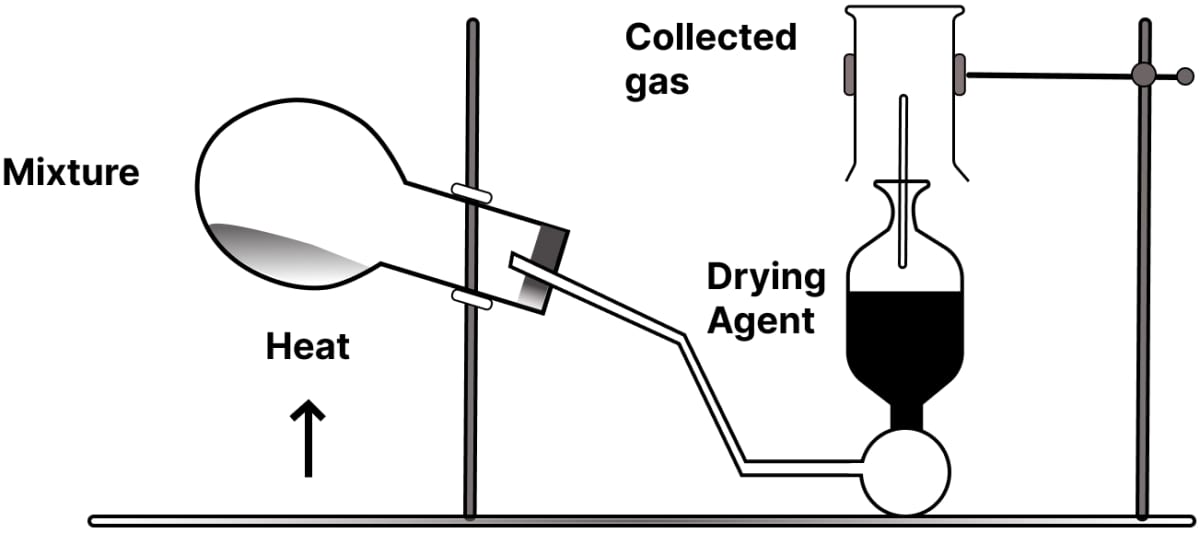
(i) State the salt and the acid, used in the laboratory preparation of hydrogen chloride.
(ii) Give the equation for the preparation.
(iii) State a method to prove that the gas jar used for collection of HCl gas is filled with hydrogen chloride.
(iv) Observing the method of collection of the gas, state what you can tell about the density of hydrogen chloride.
(ii) $\text{NaCl} + \text{H}_2\text{SO}_4 \xrightarrow{\lt 200 ^{\circ}\text{C}} \text{NaHSO}_\text{4} + \text{HCl}$
(iii) A glass rod dipped in NH4OH soln. is brought near the mouth of the gas jar 'Y'. If the gas jar is full with HCl gas then dense white fumes of ammonium chloride are formed.
$\underset{\text{[aq.]}}{\text{NH}_3} + \underset{\text{[vapour]}}{\text{HCl}} \longrightarrow \underset{\text{[dense white fumes]}}{\text{NH}_4\text{Cl}}$
(iv) This method indicates that HCl gas is heavier than air.
4(2010)Questions
How would you distinguish between dilute HCl and dilute HNO3, by addition of only one solution.
Show SolutionHide Solution↓
When silver nitrate soln. is added to dil. HCl, curdy white ppt. of silver chloride is formed. Whereas, there is no reaction when silver nitrate soln. is added to dil. HNO3.
AgNO3 + HCl ⟶ AgCl (white ppt.) + HNO3
AgNO3 + HNO3 ⟶ no reaction
5(2010)Questions
Name two gases which can be used in the study of the fountain experiment. State the common property demonstrated by the fountain experiment ?
Show SolutionHide Solution↓
Dry hydrogen chloride gas (HCl) and Ammonia (NH3) gas can be used in the study of the fountain experiment.
High solubility of HCl gas in water is the common property demonstrated by the fountain experiment.
1(2011)Questions
Choose the correct answer:
Hydrogen chloride gas being highly soluble in water is dried by :
(a)Anhydrous calcium chloride
(b)Phosphorous pentaoxide
(c)Quick lime
(d)Conc. sulphuric acid.
Show SolutionHide Solution↓
Concentrated sulphuric acid.
Reason — Drying agent used for drying should only remove the moisture and not react with it, hence, conc. sulphuric acid is used as the drying agent.
2(2011)Questions
Write balanced equation of dil. HCl with Calcium bicarbonate.
Show SolutionHide Solution↓
Ca(HCO3)2 + 2HCl ⟶ CaCl2 + 2H2O + 2CO2
3(2011)Questions
In the laboratory preparation of hydrochloric acid, hydrogen chloride gas is dissolved in water.
(i) Draw a diagram to show the arrangement used for the absorption of HCl gas in water.
(ii) State why such an arrangement is necessary? Give two reasons for the same.
(iii) Write balanced chemical equations for the laboratory preparation of HCl gas when the reactants are :
(A) below 200°C
(B) above 200°C
Show SolutionHide Solution↓
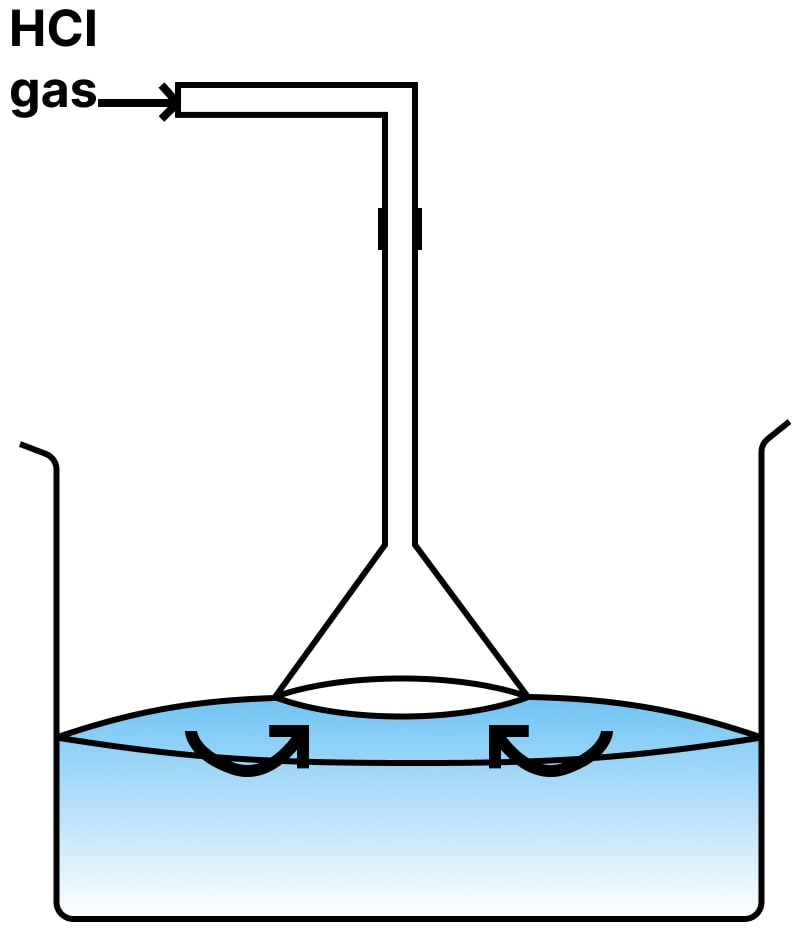
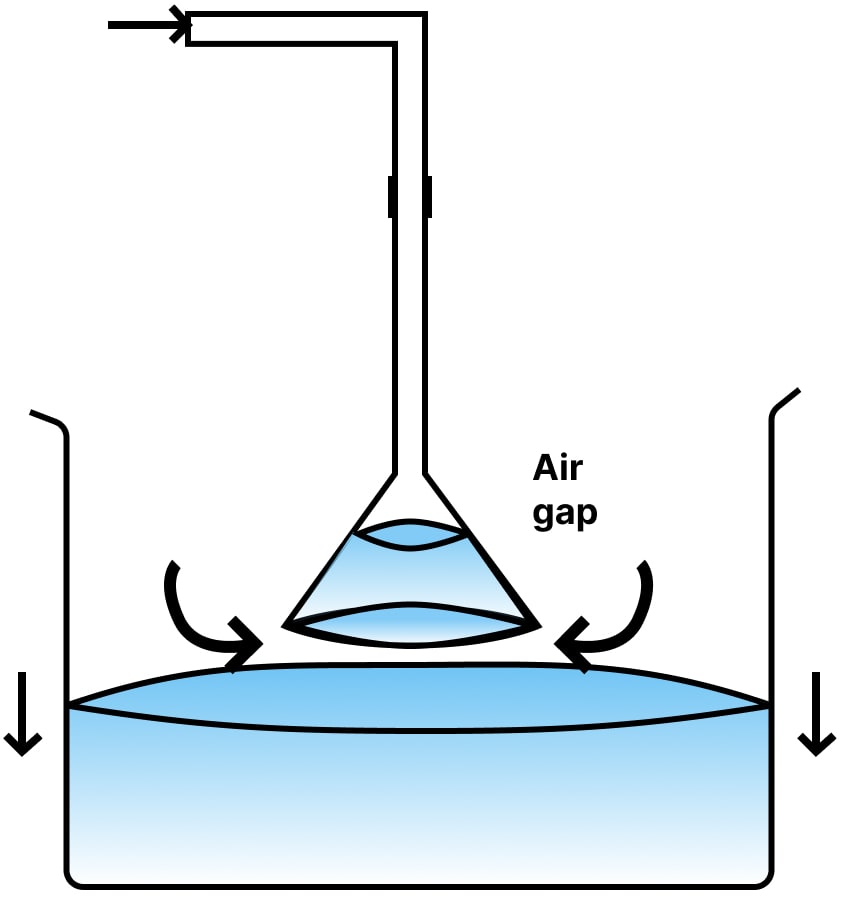
(i) Below diagrams show the special funnel arrangement used for the absorption of HCl gas in water:
(ii) The reasons are :
Prevents or minimizes back-suction of water.
Provides a large surface area for the absorption of the HCl gas.
Rewrite the correct statement with the missing word/s : Aqua regia contains one part by volume of nitric acid and three parts by volume of hydrochloric acid.
Show SolutionHide Solution↓
Aqua regia contains one part by volume of conc. nitric acid and three parts by volume of conc. hydrochloric acid.
2(2012)Questions
Give reason for the following : Hydrogen chloride gas cannot be dried over quick lime.
Show SolutionHide Solution↓
Quicklime [CaO] is alkaline in nature and it reacts with HCl forming the respective chloride. Hence, it can't be used as a drying agent.
3(2012)Questions
Give a balanced equation for the reaction : Conc. hydrochloric acid and potassium permanganate solution.
(i) Potassium sulphite is treated with dilute hydrochloric acid.
(ii) Concentrated hydrochloric acid is made to react with manganese dioxide.
Show SolutionHide Solution↓
(i) Sulphur dioxide gas
(ii) Chlorine gas $\text{MnO}_2 + 4\text{HCl} \xrightarrow{\Delta} \text{MnCl}_2 + 2\text{H}_2\text{O} + \text{Cl}_2$
2(2013)Questions
State one appropriate observation for :
(i) Copper sulphide is treated with dilute hydrochloric acid.
(ii) A few drops of dil. HCl are added to AgNO3 soln. followed by addition of NH4OH soln.
Show SolutionHide Solution↓
(i) A colourless gas having smell of rotten eggs is given off. The gas evolved is H2S
CuS + 2HCl ⟶ CuCl2 + H2S
(ii) Curdy white precipitate of silver chloride [AgCl] is obtained, which is soluble in excess of NH4OH.
AgNO3 + HCl ⟶ AgCl ↓ + HNO3
AgCl + 2NH4OH ⟶ [Ag(NH3)2Cl)] + 2H2O
1(2014)Questions
Fill in the blank from the choices in the bracket :
Quicklime is not used to dry HCl gas because ............... [CaO is alkaline, CaO is acidic, CaO is neutral]
Show SolutionHide Solution↓
Quicklime is not used to dry HCl gas because CaO is alkaline.
2(2014)Questions
Write the balanced equation for: Action of dilute hydrochloric acid on sodium sulphide.
Show SolutionHide Solution↓
Action of dilute hydrochloric acid on sodium sulphide.
Na2S + 2HCl ⟶ 2NaCl + H2S [g.]
3(2014)Questions
State your observation: Dilute HCl is added to sodium carbonate crystals.
Show SolutionHide Solution↓
Na2CO3 + 2HCl ⟶ 2NaCl + H2O + CO2 ↑
Effervescence of CO2 seen which turns lime water milky
4(2014)Questions
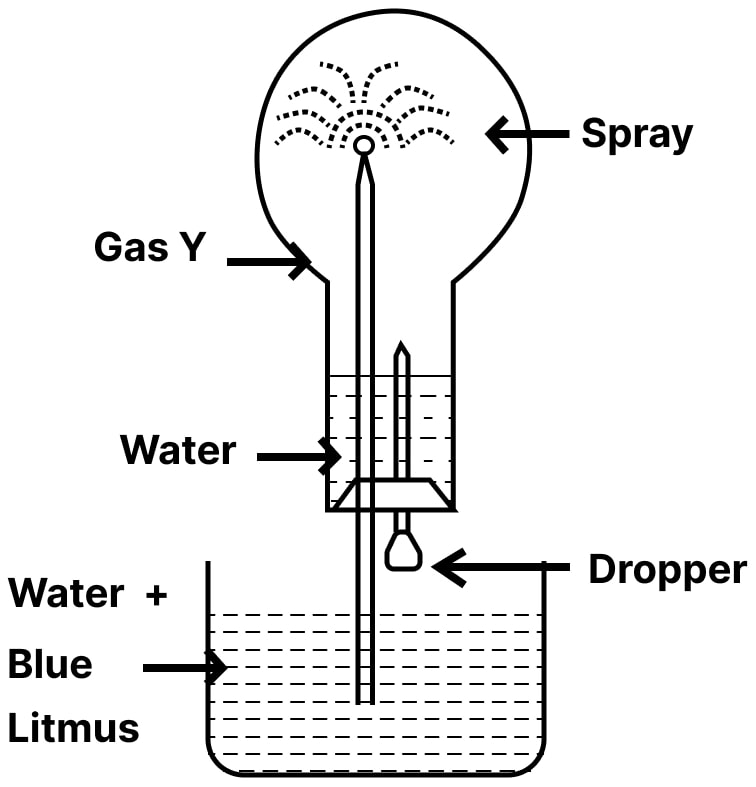
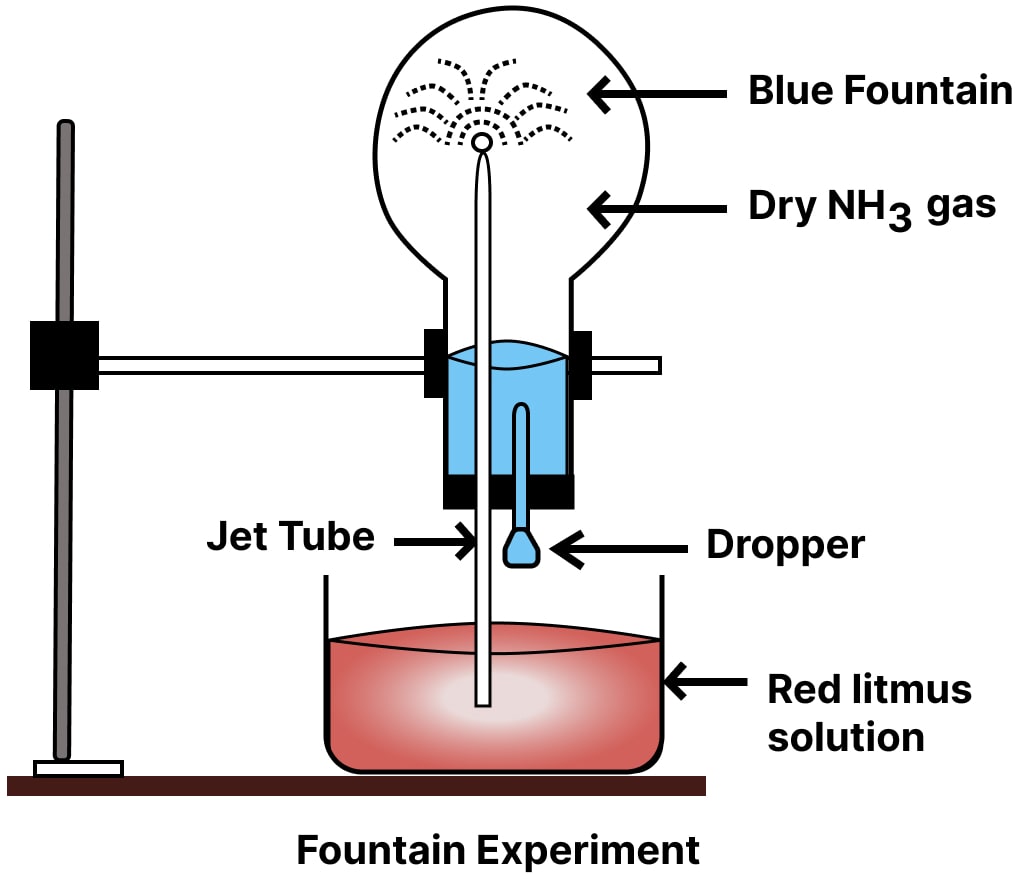
Study the figure given below and answer the questions that follow :
(i) Identify the gas Y.
(ii) What property of gas Y does this experiment demonstrate?
(iii) Name another gas which has the same property and can be demonstrated through this experiment.
Show SolutionHide Solution↓
(i) Dry HCl (Hydrogen chloride) gas is the gas Y
(ii) High solubility of HCl in water
(iii) Ammonia (NH3) gas also demonstrates high solubility in water.
1(2015)Questions
Select from the gases — ammonia, ethane, hydrogen chloride, hydrogen sulphide, ethyne — The gas which produces dense white fumes with ammonia gas.
Show SolutionHide Solution↓
Hydrogen chloride
NH3 [g] + HCl [g] ⟶ NH4Cl (s-solid)
When a gas jar containing HCl gas in inverted over a jar full of ammonia gas, dense white fumes are formed. These fumes consists of particles of solid ammonium chloride suspended in air.
2(2015)Questions
Identify the acid which on mixing with AgNO3 soln. gives a white precipitate, soluble in excess ammonium hydroxide.
Show SolutionHide Solution↓
Dilute hydrochloric acid
AgNO3 + HCl ⟶ AgCl (white ppt.) + HNO3
3(2015)Questions
The following questions pertain to the laboratory preparation of hydrogen chloride gas:
(i) Write the equation for it's preparation mentioning the condition required.
(ii) Name the drying agent used in the above preparation and give a reason for the choice.
(iii) State a safety precaution taken during the preparation of hydrochloric acid.
Show SolutionHide Solution↓
(i) The equation for the laboratory preparation of hydrogen chloride gas :
(ii) Concentrated sulphuric acid is used as the drying agent used in the above preparation. Reason — Drying agent used for drying should only remove the moisture and not react with it, hence, conc. sulphuric acid is used as the drying agent.
(iii) The precautions taken are:
The reaction mixture is initially heated very slowly to control the evolution of HCl gas.
The lower end of the thistle funnel should dip below the acid in the flask otherwise the HCl gas obtained will escape out from the thistle funnel.
1(2016)Questions
Select the correct answer from A, B, C and D : The aim of the Fountain experiment is to prove that :
(A) HCl turns blue litmus red
(B) HCl is denser than air
(C) HCl is highly soluble in water
(D) HCl fumes in moist air.
Show SolutionHide Solution↓
(C) HCl is highly soluble in water
2(2016)Questions
Fill in the blank : ...............[AgCl / PbCl2], a white precipitate is soluble in excess NH4OH.
Show SolutionHide Solution↓
AgCl, a white precipitate is soluble in excess NH4OH.
3(2016)Questions
Write balanced chemical equation for : Action of hydrochloric acid on sodium bicarbonate.
Show SolutionHide Solution↓
NaHCO3 + HCl ⟶ NaCl + H2O + CO2 ↑
4(2016)Questions
State your observations when dilute hydrochloric acid is added to :
(i) Lead nitrate soln. and the mixture is heated.
(ii) Copper carbonate.
(iii) Sodium thiosulphate.
Show SolutionHide Solution↓
(i) White precipitate of PbCl2 is formed which is soluble in hot water.
Pb(NO3)2 + 2HCl ⟶ PbCl2 ↓ + 2HNO3
(ii) Effervescence of CO2 seen which turns lime water milky
CuCO3 + 2HCl ⟶ CuCl2 + H2O + CO2
(iii) Yellow particles of S precipitate.
Na2S2O3 + 2HCl ⟶ 2NaCl + SO2 + S + H2O
5(2016)Questions
Identify the gas evolved and give the chemical test when dilute hydrochloric acid reacts with :
(i) Sodium sulphite.
(ii) Iron [II] sulphide.
Show SolutionHide Solution↓
(i) SO2 is evolved when dilute hydrochloric acid reacts with sodium sulphite.
Na2SO3 + 2HCl ⟶ 2NaCl + H2O + SO2 [g]
(ii) H2S gas is evolved when dilute hydrochloric acid reacts with Iron [II] sulphide.
FeS + 2HCl ⟶ FeCl2 + H2S
1(2017)Questions
Fill in the blanks –
Potassium sulphite on reacting with hydrochloric acid, releases ............... gas. [Cl2, SO2, H2S]
Show SolutionHide Solution↓
Potassium sulphite on reacting with hydrochloric acid, releases SO2 gas.
2(2017)Questions
Identify the substance underlined – A solid formed by the reaction of two gases, one of which is acidic and the other basic in nature.
Show SolutionHide Solution↓
Ammonium chloride.
NH3 [g] + HCl [g] ⟶ NH4Cl (s-solid)
3(2017)Questions
State one relevant observation – Action of dilute hydrochloric acid on iron [II] sulphide.
Show SolutionHide Solution↓
H2S gas is evolved. It has a foul smell like rotten eggs.
FeS + 2HCl [g] ⟶ FeCl2 + H2S
4(2017)Questions
Certain blanks spaces are left in the following table as A & B. Identify each of them.
Lab preparation of
Reactants used
Products formed
Drying agent
Method of collection
HCl gas
NaCl + H2SO4
A
Conc. H2SO4
B
Show SolutionHide Solution↓
A : The products are sodium hydrogen sulphate (NaHSO4) and HCl gas.
B : HCl gas is collected by the upward displacement of air method.
1(2018)Questions
Write a balanced chemical equation for - Action of dilute hydrochloric acid on magnesium sulphite.
Show SolutionHide Solution↓
MgSO3 + 2HCl ⟶ MgCl2 + H2O + SO2 [g]
2(2018)Questions
State one relevant observation - Lead nitrate solution is mixed with dilute hydrochloric acid and heated.
Show SolutionHide Solution↓
White precipitate of PbCl2 is formed which is soluble in hot water.
Pb(NO3)2 + 2HCl ⟶ PbCl2 + 2HNO3
3(2018)Questions
Name the gas that is produced during - Action of dilute hydrochloric acid on sodium sulphide.
Show SolutionHide Solution↓
H2S gas is evolved.
Na2S + 2HCl ⟶ 2NaCl + H2S [g.]
4(2018)Questions
Fill in the blank with the correct choice given in the bracket - Dry hydrogen chloride gas can be collected by ............... displacement of air. [downward/upward]
Show SolutionHide Solution↓
Dry hydrogen chloride gas can be collected by upward displacement of air.
5(2018)Questions
Name the acid used for the preparation of - hydrogen chloride gas in the laboratory. State why this particular acid is preferred to other acids.
Show SolutionHide Solution↓
Conc. H2SO4 is used for the preparation of hydrogen chloride gas in the laboratory.
As conc. H2SO4 is non-volatile and has a high boiling point, therefore, it displaces the volatile hydrogen chloride from the salt sodium chloride. Hence, conc. H2SO4 is used as a reactant in the laboratory preparation of HCl from sodium chloride
6(2018)Questions
Write a balanced chemical equation for - The laboratory preparation of hydrogen chloride gas.
For the preparation of hydrochloric acid in the laboratory —
(i) State why direct absorption of hydrogen chloride gas in water is not feasible.
(ii) State what arrangement is used to dissolve hydrogen chloride gas in water.
Show SolutionHide Solution↓
(i) Direct absorption of hydrogen chloride gas in water is not feasible because it causes back suction in the delivery tube.
Hydrogen chloride gas is extremely soluble in water.
If a delivery tube through which HCl gas is passed is directly immersed in water, the rate of absorption of HCl gas is high and hence a partial vacuum is created in the tube.
The pressure outside being higher causes the water to be pushed up into the delivery tube and damages the apparatus. This is called back-suction.
(ii) Special funnel arrangement is used for avoiding back suction. It (a) Prevents or minimizes back-suction of water (b) Provides a large surface area for absorption of HCl gas.
The rim of the funnel is placed so that it just touches the trough containing water. If back-suction occurs, the water rises up the funnel and the level outside the funnel falls, creating an air gap between the rim of the funnel and the surface of water.
The pressure outside and inside equalize and the water which had risen in the funnel falls down again. This process continues till the water in the trough is saturated with hydrogen chloride gas resulting in the formation of hydrochloric acid.
Hence, hydrochloric acid is not prepared in the laboratory by passing hydrogen chloride gas directly through water, but prepared using a special funnel arrangement.
1(2019)Questions
Choose the correct answer from the options A, B, C and D given :
The drying agent used to dry HCl gas is :
A : Conc. H2SO4 B : ZnO C : Al2O3 D : CaO
Show SolutionHide Solution↓
Conc. H2SO4
Reason — Drying agent used for drying should only remove the moisture and not react with it, hence, conc. sulphuric acid is used as the drying agent.
2(2019)Questions
Fill in the blanks with the choices given in the bracket:
When sodium chloride is heated with concentrated sulphuric acid below 200°C, one of the products formed is ............... [sodium hydrogen sulphate / sodium sulphate / chlorine]
Show SolutionHide Solution↓
When sodium chloride is heated with concentrated sulphuric acid below 200°C, one of the products formed is sodium hydrogen sulphate
3(2019)Questions
State one observation for the following:
A small piece of zinc is added to dilute hydrochloric acid.
Show SolutionHide Solution↓
Effervescence of H2 gas can be seen.
Zn + 2HCl ⟶ ZnCl2 + H2
1(2020)Questions
State one relevant reason for: Hydrogen chloride gas fumes in moist air.
Show SolutionHide Solution↓
Due to its high solubility, HCl gas fumes in moist air and forms a mist of droplets of HCl acid.
2(2020)Questions
Complete the following by selecting the correct option from the choices given.
(i) The indicator which does not change colour on passage of HCl gas is .............. [methyl orange, moist blue litmus, phenolphthalein].
(ii) The acid which cannot act as an oxidizing agent is ............... [conc. H2SO4, conc. HNO3, conc. HCl]
Show SolutionHide Solution↓
(i) The indicator which does not change colour on passage of HCl gas is phenolphthalein.
(ii) The acid which cannot act as an oxidizing agent is conc. HCl
3(2020)Questions
Hydrogen chloride gas is prepared in the laboratory using conc. H2SO4 and NaCl. Answer the questions that follow based on this reaction.
(i) Give the balanced chemical equation for the reaction with suitable condition[s] if any.
(ii) Why is concentrated sulphuric acid used instead of conc. nitric acid.
(iii) How is the gas collected.
(iv) Name the drying agent not used for drying the gas.
Show SolutionHide Solution↓
(i) Balanced chemical equation for the reaction are :
(ii) As conc. H2SO4 is non-volatile and has a high boiling point, therefore, it displaces the volatile hydrogen chloride from the salt sodium chloride. Hence, conc. H2SO4 is used as a reactant in the laboratory preparation of HCl from sodium chloride. Conc. nitric acid cannot be used in place of conc. H2SO4 since it is volatile and may volatize out along with the hydrogen chloride.
(iii) The gas is collected by upward displacement of air method.
(iv) Quicklime (CaO) and phosphorous pentoxide [P2O5] are not used as drying agent, since they react with HCl forming their respective chlorides.
1Complete the Statements
Complete the statements given below pertaining to hydrogen chloride gas or hydrochloric acid:
Hydrogen chloride gas is not dried using ............... [conc.H2SO4, CaO].
Hydrogen chloride gas on heating above 500°C gives hydrogen and chlorine. The reaction is an example of ............... [thermal decomposition, thermal dissociation].
Iron reacts with hydrogen chloride gas forming ............. [iron (II) chloride, iron (III) chloride] and hydrogen. The reaction is an example of ............... [double decomposition, synthesis, simple displacement].
Hydrogen chloride and water are examples of ............... [polar covalent compounds, non-polar covalent compounds] and a solution of hydrogen chloride in water ............... [contains, does not contain] free ions.
Addition of ............... [sodium nitrate, zinc nitrate, silver nitrate] to hydrochloric acid, gives an insoluble precipitate of the respective chloride. This precipitate is ............... [soluble, insoluble] in ammonium hydroxide and ............... [soluble, insoluble] in dilute nitric acid.
Addition of ............... [iron (III) sulphide, iron (II) sulphide, iron pyrites] to dilute hydrochloric acid results in liberation of hydrogen sulphide gas.
Aqua regia is a mixture of ............... [one, two, three] part/s of concentrated nitric acid and ............... [one, two, three] part/s of concentrated hydrochloric acid by .............. [weight, volume]. In aqua regia, nitric acid ............... [oxidises, reduces] hydrochloric acid to chlorine.
Hydrochloric acid can be converted into chlorine by heating with ............... [calcium oxide, lead (II) oxide, lead (IV) oxide] which acts as a/an ............... [oxidising, reducing] agent.
Show SolutionHide Solution↓
Hydrogen chloride gas is not dried using CaO.
Hydrogen chloride gas on heating above 500°C gives hydrogen and chlorine.The reaction is an example of thermal dissociation.
Iron reacts with hydrogen chloride gas forming iron (II) chloride and hydrogen. The reaction is an example of simple displacement.
Hydrogen chloride and water are examples of polar covalent compounds and a solution of hydrogen chloride in water contains free ions.
Addition of silver nitrate to hydrochloric acid, gives an insoluble precipitate of the respective chloride. This precipitate is soluble in ammonium hydroxide and insoluble in dilute nitric acid.
Addition of iron (II) sulphide to dilute hydrochloric acid results in liberation of hydrogen sulphide gas.
Aqua regia is a mixture of one part/s of concentrated nitric acid and three part/s of concentrated hydrochloric acid by volume. In aqua regia, nitric acid oxidises hydrochloric acid to chlorine.
Hydrochloric acid can be converted into chlorine by heating with lead (IV) oxide which acts as an oxidising agent.
1Additional Questions
Give a reason why:
(a) gastric juices of mammals are acidic
(b) HCl is considered a polar covalent compound.
Show SolutionHide Solution↓
(a) HCl is present in gastric juices of mammals, hence the gastric juices of mammals are acidic. It helps in digestion.
(b) Due to difference in electronegativities of H and Cl the bond in HCl is polar covalent.
2Additional Questions
Give the equation for preparation of HCl gas by synthesis. State two conditions involved in the synthesis.
Show SolutionHide Solution↓
Moist hydrogen gas combines with chlorine in the presence of diffused sunlight.
In the laboratory preparation of HCl from sodium chloride, state why the following are preferred –
(i) Conc. H2SO4 as a reactant
(ii) Temp. below 200°C
(iii) Conc. H2SO4 as a drying agent.
Show SolutionHide Solution↓
(i) As conc. H2SO4 is non-volatile and has a high boiling point, therefore, it displaces the volatile hydrogen chloride from the salt sodium chloride. Hence, conc. H2SO4 is used as a reactant in the laboratory preparation of HCl from sodium chloride
(ii) The fuel is not wasted, the glass apparatus does not crack and sodium sulphate does not form hard crust, which in turn may stick to the glass and will be difficult to remove. Therefore, temperature below 200°C is used.
(iii) Drying agent used for drying should only remove the moisture and not react with it, hence, conc. sulphuric acid is used as the drying agent.
5Additional Questions
State with reasons the method of collection of HCl gas in the laboratory.
Show SolutionHide Solution↓
Dry HCl gas is collected by the upward displacement of air because it is 1.28 times heavier than air. It is highly soluble in water, hence not collected over water.
6Additional Questions
Compare the density of HCl gas with air and state the solubility of HCl gas in water.
Show SolutionHide Solution↓
V.D of HCl = 18.25 and air = 14.4. HCl gas is highly soluble in water.
7Additional Questions
State why HCl gas forms a mist of droplets of HCl acid in moist air.
Show SolutionHide Solution↓
Due to high solubility, HCl gas fumes in moist air and forms a mist of droplets of HCl acid.
8Additional Questions
State what the fountain experiment demonstrates with reference to HCl gas.
Show SolutionHide Solution↓
The high solubility of HCl gas in water is demonstrated by the Fountain experiment.
9Additional Questions
State the colour change in three different indicators in presence of HCl gas.
Show SolutionHide Solution↓
Action on indicators:
Indicator
Original colour
Colour changed to
Moist litmus
Blue
Red
Methyl orange
Orange
Pink
Phenolphthalein (alkaline)
Pink
Colourless
10Additional Questions
Give a balanced equation for thermal dissociation of
(ii) $\text{NH}_4\text{Cl} \xrightarrow{\Delta} \text{NH}_3 + \text{HCl}$
11Additional Questions
Give the equation and state the observation seen when HCl gas reacts with ammonia.
Show SolutionHide Solution↓
NH3 [g] + HCl [g] ⟶ NH4Cl (s-solid)
When a gas jar containing HCl gas in inverted over a jar full of ammonia gas dense white fumes are formed. These fumes consists of particles of solid ammonium chloride suspended in air.
12Additional Questions
Convert iron to iron (II) chloride using HCl gas.
Show SolutionHide Solution↓
Fe + 2HCl ⟶ FeCl₂ + H₂
13Additional Questions
Explain the arrangement (i) not used (ii) used – for converting HCl gas into HCl acid.
Show SolutionHide Solution↓
Hydrochloric acid is prepared by dissolving hydrogen chloride gas in water using a special funnel arrangement.
(i) Direct absorption of HCl gas in water using a delivery tube causes back suction. Hence, it is not used for preparing HCl acid from HCl gas.
Hydrogen chloride gas is extremely soluble in water.
If a delivery tube through which HCl gas is passed is directly immersed in water, the rate of absorption of HCl gas is high and hence a partial vacuum is created in the tube.
The pressure outside being higher causes the water to be pushed up into the delivery tube and damages the apparatus. This is called back-suction.
(ii) Special funnel arrangement is used for converting HCl gas into HCl acid as it avoids back suction. It: (a) Prevents or minimizes back-suction of water. (b) Provides a large surface area for absorption of HCl gas.
The rim of the funnel is placed so that it just touches the trough containing water. If back-suction occurs, the water rises up the funnel and the level outside the funnel falls, creating an air gap between the rim of the funnel and the surface of water.
The pressure outside and inside equalize and the water which had risen in the funnel falls down again. This process continues till the water in the trough is saturated with hydrogen chloride gas resulting in the formation of hydrochloric acid.
Hence, hydrochloric acid is not prepared in the laboratory - by passing hydrogen chloride gas directly through water, but prepared using a special funnel arrangement.
14Additional Questions
Explain the term 'constant boiling mixture'.
Show SolutionHide Solution↓
A solution which boils without any change in it's composition is known as the constant boiling mixture. A solution of HCl in water forms a constant boiling mixture at 110° C.
15Additional Questions
State why dilute HCl cannot be concentrated beyond a certain concentration by boiling.
Show SolutionHide Solution↓
On boiling, the mixture evolves out the vapours of both acid and water in the same proportion as in the liquid. Hence, dilute HCl cannot be concentrated beyond a certain concentration by boiling.
16Additional Questions
Name the ions obtained when HCl dissociates in aqueous solution.
Show SolutionHide Solution↓
The ions obtained are hydronium ions (H3O+) and chloride ions (Cl-)
HCl + H2O ⟶ H3O+ + Cl-
17Additional Questions
Name the ion responsible for acidic nature of HCl acid.
Show SolutionHide Solution↓
The presence of hydrogen ions [H+] in HCl imparts acidic properties to an aqueous solution of hydrochloric acid.
18Additional Questions
State which of two — a solution of HCl in water or in toluene is an electrolyte, giving reasons.
Show SolutionHide Solution↓
Water being a polar solvent, ionizes the polar covalent HCl molecule into free ions. Hence, the solution of HCl in water exhibits acidic properties and is an electrolyte whereas toluene not being a polar solvent does not dissociate HCl molecule into free ions. Hence, the solution of HCl in toluene does not exhibit acidic properties and is a non electrolyte.
19Additional Questions
Give four different word equations relating to acidic properties of an aq. soln. of HCl gas.
This nascent chlorine reacts with noble metals like gold forming the corresponding soluble chloride.
Au + 3[Cl] ⟶ AuCl3 [Gold (III) Chloride]
Hence, aqua regia dissolves noble metals like gold and platinum which are insoluble in all other acids.
26Additional Questions
Give three tests for hydrochloric acid. Convert silver nitrate to a soluble salt of silver using hydrochloric acid and an alkali.
Show SolutionHide Solution↓
(i) When glass rod dipped in ammonia solution (NH4OH) is brought near vapours of hydrochloric acid, dense white fumes of ammonium chloride are formed.
$\underset{\text{[aq.]}}{\text{NH}_3} + \underset{\text{[vapour]}}{\text{HCl}} \longrightarrow \underset{\text{[dense white fumes]}}{\text{NH}_4\text{Cl}}$
(ii) On addition of silver nitrate soln. to dil. HCl (acidified with dil. HNO3), curdy white precipitate of silver chloride is obtained.
AgNO3 + HCl ⟶ AgCl ↓ + HNO3
(iii) On heating a mixture of manganese dioxide and conc. HCl, Greenish yellow gas (chlorine) is evolved.
MnO2 + 4HCl ⟶ MnCl2 ↓ + 2H2O + Cl2
27Additional Questions
State two industrial products manufactured from hydrochloric acid, which are also manufactured from nitric and sulphuric acid. Give two general uses of hydrochloric acid.
Show SolutionHide Solution↓
Industrial products manufactured from HCl acid are :
Dyes
Paint
General uses of hydrochloric acid are :
Hydrochloric acid dissolves the calcium phosphate present in bones. Hence, it is used in the extraction of glue from bones.
Hydrochloric acid dissolves the metallic oxide coating [impurities] on the surface of the metal, thereby cleans the surface. Hence, it is used in pickling of metals before galvanizing.
1Unit Test Paper 7A — Hydrogen Chloride
Give balanced equations for the conversions A, B, C, D and E given below :
In the laboratory preparation of HCl acid from NaCl and conc. H2SO4, the residual salt formed at temperatures above 200°C forms a hard crust and sticks to the glass.
Show SolutionHide Solution↓
At temperatures above 200°C, Sodium sulphate is formed. It forms a hard crust, sticks to the glass and is difficult to remove.
2.2Unit Test Paper 7A — Hydrogen Chloride
Give reasons for the following :
Dense white fumes are obtained when a jar of HCl gas is inverted over a jar of ammonia gas.
Show SolutionHide Solution↓
When a gas jar containing HCl gas in inverted over a jar full of ammonia gas, dense white fumes are formed. These fumes consists of particles of solid ammonium chloride suspended in air.
NH3 [g] + HCl [g] ⟶ NH4Cl (s-solid)
2.3Unit Test Paper 7A — Hydrogen Chloride
Give reasons for the following :
In the fountain experiment to demonstrate the high solubility of HCl gas in water, dry HCl gas is filled in the round bottom flask.
Show SolutionHide Solution↓
HCl gas present in the flask dissolves in water due to high solubility, creating a partial vacuum in the flask. The outside pressure being higher pushes the blue litmus solution up the jet tube which emerges out at the end of the tube as red fountain. Hence, the inference is that the HCl gas is highly soluble in water and acidic in nature.
2.4Unit Test Paper 7A — Hydrogen Chloride
Give reasons for the following :
Iron sheets are cleaned with hydrochloric acid before dipping into molten zinc for galvanizing.
Show SolutionHide Solution↓
Hydrochloric acid dissolves the metallic oxide coating [impurities] on the surface of the metal, thereby cleans the metallic surface before galvanizing.
2.5Unit Test Paper 7A — Hydrogen Chloride
Give reasons for the following :
Hydrogen chloride gas fumes in moist air but hydrogen sulphide gas does not.
Show SolutionHide Solution↓
Due to the high solubility of HCl gas, it fumes in moist air and forms a mist of droplets of HCl acid. On the other hand, Hydrogen Sulphide does not do so as it is slightly soluble in water.
3Unit Test Paper 7A — Hydrogen Chloride
Complete the statements given below using the correct word/s
(a)An aqueous solution of HCl gas is named ............... [aqua fortis / muriatic acid / oil of vitriol]
(b)The salt obtained when rock salt reacts with conc. H2SO4 at temperatures below 200°C is a/an ............... [acid/normal] salt.
(c)In the preparation of HCl acid from HCl gas, a funnel arrangement provides ............... [less/more] surface area for absorption of the gas.
(d)The ions which impart acidic properties to an aqueous solution of hydrogen chloride are ............... [chloride/hydrogen/hydronium]
(e)The indicator which does not change colour on passage of hydrogen chloride gas is ............... [moist blue litmus / phenolphthalein / methyl orange].
Show SolutionHide Solution↓
An aqueous solution of HCl gas is named muriatic acid.
The salt obtained when rock salt reacts with conc. H2SO4 at temperatures below 200°C is an acid salt.
In the preparation of HCl acid from HCl gas, a funnel arrangement provides more surface area for absorption of the gas.
The ions which impart acidic properties to an aqueous solution of hydrogen chloride are hydrogen.
The indicator which does not change colour on passage of hydrogen chloride gas is phenolphthalein.
4Unit Test Paper 7A — Hydrogen Chloride
Choose from the letters A, B, C, D and E, to match the descriptions 1 to 5 given below.
A : NH4Cl B : AgCl C : PbCl2 D : FeCl2 E : Ag(NH3)2Cl
(a)A soluble salt obtained on reaction of a metallic chloride with liquor ammonia.
(b)A salt which is insoluble in dilute nitric acid but soluble in ammonium hydroxide.
(c)A salt obtained on reaction of an active metal with hydrogen chloride gas.
(d)A salt obtained when a basic gas reacts with hydrogen chloride gas.
(e)A salt soluble in hot water but not in cold, obtained on heating an oxidising agent with conc. HCl.
Show SolutionHide Solution↓
A soluble salt obtained on reaction of a metallic chloride with liquor ammonia — E : [Ag(NH3)2Cl]
A salt which is insoluble in dilute nitric acid but soluble in ammonium hydroxide. — B : AgCl
A salt obtained on reaction of an active metal with hydrogen chloride gas. — D : FeCl2
A salt obtained when a basic gas reacts with hydrogen chloride gas. — A : NH4Cl
A salt soluble in hot water but not in cold, obtained on heating an oxidising agent with conc. HCl. — C : PbCl2
5Unit Test Paper 7A — Hydrogen Chloride
Select the correct word or formula from the same given in bracket :
(a)The substance reacted with conc. HCl and heated to prove that conc. HCl contains Cl2. [PbCl2/PbO2/PbO]
(b)The metal reacted with dil. HCl to prove that dil. HCl contains hydrogen. [Cu/Fe/Ag/Pb]
(c)The gas/es which is/are heavier than air and highly soluble in water. [NH3/HCl/CO2/H2S]
(d)The acid which is not an oxidizing agent. [Conc. HNO3 / Conc. HCl / Conc. H2SO4]
(e)The acid which is not a monobasic acid. [Acetic/Sulphurous/Hydrochloric/Nitric/Formic acid]
Show SolutionHide Solution↓
The substance reacted with conc. HCl and heated to prove that conc. HCl contains Cl2. — PbO2
The metal reacted with dil. HCl to prove that dil. HCl contains hydrogen. — Fe
The gases which are heavier than air and highly soluble in water. — HCl and NH3
The acid which is not an oxidizing agent. — Conc. HCl
The acid which is not a monobasic acid. — Sulphurous acid
6Unit Test Paper 7A — Hydrogen Chloride
Select the correct words from the list given below to complete the following word equations :
Metallic oxide, active metal, metallic carbonate, metallic bisulphite, active metal, metallic hydroxide, metallic bicarbonate, metallic sulphate, metallic sulphide.
(a)............... + hydrochloric acid (dil) ⟶ salt + hydrogen
(b)............... + hydrochloric acid (dil) ⟶ salt + water
(c)............... + hydrochloric acid (dil) ⟶ salt + water + carbon dioxide
(d)............... + hydrochloric acid (dil) ⟶ salt + water + sulphur dioxide
(e)............... + hydrochloric acid (dil) ⟶ salt + hydrogen sulphide
Show SolutionHide Solution↓
Active metal + hydrochloric acid (dil) ⟶ salt + hydrogen
Metallic oxide, hydroxide + hydrochloric acid (dil) ⟶ salt + water
Metallic carbonate / bicarbonate + hydrochloric acid (dil) ⟶ salt + water + carbon dioxide
Metallic bisulphite + hydrochloric acid (dil) ⟶ salt + water + sulphur dioxide
Write the equation for the reaction in the Haber’s process that forms ammonia.
Show SolutionHide Solution↓
N2 + 3H2 ⇌ 2NH3 + Δ
3(2004)Questions
State the purpose of liquefying the ammonia produced in the Haber’s process.
Show SolutionHide Solution↓
Liquefaction is a technique used for separating ammonia from the uncombined N2 and H2 reactant mixture during Haber's process.
4(2004)Questions
Write an equation for the reaction of chlorine with excess of ammonia.
Show SolutionHide Solution↓
8NH3 [excess] + 3Cl2 ⟶ 6NH4Cl + N2
1(2005)Questions
Name the ion other than ammonium ion formed when ammonia dissolves in water.
Show SolutionHide Solution↓
Hydroxyl ion [OH-1]
NH3 + H2O ⟶ NH4OH
NH4OH ⇌ NH4+ + OH-1
2(2005)Questions
Write equations for the formation of ammonia.
(i) NH4Cl and slaked lime are heated.
(ii) Aluminium nitride and water.
Show SolutionHide Solution↓
(i) 2NH4Cl + Ca(OH)2 ⟶ CaCl2 + 2H2O + 2NH3
(ii) AlN + 3H2O ⟶ Al(OH)3 + NH3 [g]
1(2006)Questions
Select from the list — Ammonia, Copper oxide, Copper sulphate, Hydrogen chloride, Hydrogen sulphide, Lead bromide : The compound which is not a metal hydroxide but it's aqueous solution is alkaline in nature.
Show SolutionHide Solution↓
Ammonia.
Reason — The aq. soln. of ammonia [NH4OH] is alkaline in nature due to the presence of hydroxyl ions [OH-]
NH3 + H2O ⟶ NH4OH
NH4OH ⇌ NH4+ + OH-1
2(2006)Questions
From the substances — Ammonium sulphate, Lead carbonate, Chlorine, Copper nitrate, Iron [II] sulphate — State : A compound which on heating with NaOH produces a gas which forms dense white fumes with HCl.
Show SolutionHide Solution↓
Ammonium sulphate.
Reason — Ammonia gas is produced when ammonium sulphate reacts with NaOH. Ammonia gas forms dense white fumes with HCl.
(NH4)2SO4 + 2NaOH ⟶ Na2SO4 + 2H2O + 2NH3[g]
3(2006)Questions
State what is observed when excess of ammonia is passed through an aq. solution of lead nitrate.
Show SolutionHide Solution↓
Lead hydroxide is precipitated, chalky white in colour and is insoluble in excess of ammonium hydroxide soln.
Pb(NO3)2 + 2NH4OH ⟶ 2NH4NO3 + Pb(OH)2 ↓
4(2006)Questions
Name the substance used for drying ammonia.
Show SolutionHide Solution↓
Quicklime (CaO) is used for drying ammonia.
5(2006)Questions
Write a balanced chemical equation to illustrate the reducing nature of ammonia.
Show SolutionHide Solution↓
Ammonia gas is a strong reducing agent. Below equation shows reduction of Black Copper [II] oxide to brown Copper by Ammonia.
2NH3 + 3CuO ⟶ 3Cu + 3H2O + N2 [g]
6(2006)Questions
With reference to Haber’s process, write the equation and the conditions required.
Show SolutionHide Solution↓
Nitrogen reacts with hydrogen under specific conditions liberating ammonia
N2 + 3H2 ⇌ 2NH3 + Δ
Conditions :
Temperature : 450-500°C [Optimum temperature]
Pressure : 200 to 900 atmospheres [Optimum pressure]
Catalyst : Finely divided iron [Fe]
Promotor : Molybdenum [Mo]
[Catalyst - iron [III] oxide [Fe2O3] may also be used containing promoters about 1% K2O and 3% Al2O3]
Precautions : Impurities like CO, CO2, and H2S may poison the catalyst hence, the nitrogen-hydrogen reactant mixture must be free from them.
1(2007)Questions
Give an equation for formation of ammonium sulphate from ammonia and dilute sulphuric acid.
Show SolutionHide Solution↓
2NH3 + H2SO4 (dil.) ⟶ (NH4)2SO4
2(2007)Questions
Give equation for – reaction in which NH3 is oxidized by :
(i) a metal oxide
(ii) a gas which is not oxygen
Show SolutionHide Solution↓
(i) 2NH3 + 3CuO ⟶ 3Cu + 3H2O + N2 [g]
(ii) 8NH3 [excess] + 3Cl2 ⟶ 6NH4Cl + N2
3(2007)Questions
You enter a laboratory after a class has completed the Fountain Experiment. How will you be able to tell whether the gas used in the experiment was hydrogen chloride or ammonia.
Show SolutionHide Solution↓
If dry ammonia gas is present in the round bottom flask, the red litmus soln. kept in the trough below emerges out as a blue fountain since ammonia gas is basic in nature. On the other hand, if dry HCl was used in the flask instead of ammonia, the blue litmus soln. kept in the trough below, emerges out as a red fountain since HCl is acidic in nature.
1(2008)Questions
Ammonia can be obtained by adding water to : [Select the correct word]
Name : An alkaline gas 'A' which gives dense white fumes with hydrogen chloride.
Show SolutionHide Solution↓
NH3 (Ammonia) NH3 + HCl ⟶ NH4Cl
3(2008)Questions
Write the equation for the following reaction : Aluminium nitride and water.
Show SolutionHide Solution↓
AlN + 3H2O ⟶ Al(OH)3 + NH3 [g]
4(2008)Questions
Complete the table relating to an important industrial processes. [Output refers to the product of the process].
Name of process
Inputs
Catalyst
Equation for catalyzed reaction
Output
Haber process
Hydrogen +
Show SolutionHide Solution↓
Completed table is shown below:
Name of process
Inputs
Catalyst
Equation for catalyzed reaction
Output
Haber process
Hydrogen + Nitrogen
Iron + Molybednum (promoter)
N2 + 3H2 ⇌ 2NH3 + Δ
Ammonia
1(2009)Questions
Name the gas – that burns in oxygen with a green flame.
Show SolutionHide Solution↓
Ammonia (NH3) 4NH3 + 3O2 ⟶ 2N2 + 6H2O
2(2009)Questions
Write a fully balanced equation for — Magnesium nitride is treated with warm water.
Show SolutionHide Solution↓
Mg3N2 + 6H2O ⟶ 3Mg(OH)2 + 2NH3 [g]
3(2009)Questions
Identity the substances 'Q' based on the information given — The white crystalline solid 'Q' is soluble in water. It liberates a pungent smelling gas when heated with sodium hydroxide solution.
Show SolutionHide Solution↓
Substances 'Q' are Ammonium salts like ammonium chloride, ammonium sulphate. They are white solids, soluble in water and liberate pungent smelling ammonia gas on heating with alkalis like NaOH.
1(2010)Questions
Complete the blanks (a) to (e) in the passage given, using the following words. [Ammonium, reddish brown, hydroxyl, nitrogen dioxide, ammonia, dirty green, alkaline, acidic]. In the presence of a catalyst, nitrogen and hydrogen combine to give (a) .............. gas. When the same gas is passed through water, it forms a soln. which will be (b).............. in nature, and will contain the ions (c) .............. and (d) .............. .(e) A .............. coloured ppt. of iron [II] hydroxide is formed when the above solution is added to iron [II] sulphate solution.
Show SolutionHide Solution↓
(a) Ammonia
(b) Alkaline
(c) Ammonium
(d) Hydroxyl
(e) Dirty green
2(2010)Questions
State your observation when — in the absence of catalyst, ammonia is burnt in an atmosphere of oxygen.
Show SolutionHide Solution↓
Green or greenish yellow flame is seen when ammonia gas is burnt in an atmosphere of oxygen. The reaction of combustion of Ammonia is:
4NH3 + 3O2 ⟶ 2N2 + 6H2O
3(2010)Questions
Give the equation for the reaction — ammonium chloride is heated with sodium hydroxide.
Show SolutionHide Solution↓
NH4Cl + NaOH ⟶ NaCl + H2O + NH3
4(2010)Questions
In the manufacture of ammonia:
(i) Name the process.
(ii) State the ratio of the reactants taken?
(iii) State the catalyst used.
(iv) Give the equation for the manufacture of the gas ammonia.
Show SolutionHide Solution↓
(i) Haber's Process
(ii) Nitrogen (N2) and hydrogen (H2) in the ratio 1:3 by volume
(iii) Finely divided iron (Fe)
(iv) N2 + 3H2 ⇌ 2NH3 + Δ
5(2010)Questions
Write a relevant equation, to show that ammonia can act as a reducing agent
Show SolutionHide Solution↓
Ammonia gas is a strong reducing agent. Below equation shows reduction of Black Copper [II] oxide to brown Copper by Ammonia.
2NH3 + 3CuO ⟶ 3Cu + 3H2O + N2 [g]
6(2010)Questions
Name two gases which can be used to study the fountain experiment. State the common property demonstrated by the fountain experiment ?
Show SolutionHide Solution↓
Hydrogen chloride gas (HCl) and Ammonia (NH3) are the two gases which can be used to study the fountain experiment.
The common property demonstrated by the fountain experiment is the solubility of gases.
1(2011)Questions
State what is observed when – Ammonium hydroxide is first added in a small quantity and then in excess to a solution of copper sulphate.
Show SolutionHide Solution↓
Ammonium hydroxide if first added in small quantity and then in excess to a solution of copper sulphate, a pale blue ppt. of copper hydroxide is formed which dissolves in excess of ammonium hydroxide forming a soluble complex salt.
The diagram shows set up for the lab. preparation of a pungent alkaline gas.
(i) Name the gas collected in the jar.
(ii) Give a balanced equation for the above preparation
(iii) State how the above gas is collected?
(iv) Name the drying agent used.
(v) State how you will find out that the jar is full of the pungent gas?
Show SolutionHide Solution↓
(i) Ammonia (NH3) gas is collected.
(ii) 2NH4Cl + Ca(OH)2 ⟶ CaCl2 + 2H2O + 2NH3
(iii) Downward displacement of air is the method used to collect the gas.
(iv) Quicklime (CaO) is the drying agent.
(v) A glass rod dipped in conc. HCl acid is brought near the mouth of the jar. If the jar is full-dense white fumes of ammonium chloride are formed.
3(2011)Questions
Write a balanced chemical equation – Chlorine reacts with excess of ammonia.
Show SolutionHide Solution↓
8NH3 [excess] + 3Cl2 ⟶ 6NH4Cl + N2
4(2011)Questions
State your observation – Water is added to the product formed, when Al is burnt in a jar of nitrogen gas.
Show SolutionHide Solution↓
When Al metal is burnt in a jar of nitrogen gas, its nitride i.e., AlN is formed. When warm water is added to AlN, it undergoes hydrolysis and is decomposed by warm water to give pungent smelling ammonia gas. The corresponding insoluble metal hydroxide (i.e., Al(OH)3) is precipitated out. The reactions are shown below:
2Al + N2 ⟶ 2AlN
AlN + 3H2O ⟶ Al(OH)3 + NH3 [g]
1(2012)Questions
Name the gas produced when excess ammonia reacts with chlorine.
Show SolutionHide Solution↓
Nitrogen
8NH3 [excess] + 3Cl2 ⟶ 6NH4Cl + N2
2(2012)Questions
Rewrite the correct statement with the missing word/s — Magnesium nitride reacts with water to liberate ammonia.
Show SolutionHide Solution↓
Magnesium nitride reacts with warm water to liberate ammonia along with magnesium hydroxide.
3(2012)Questions
Give balanced equation for the reaction : Ammonia and Oxygen in the presence of a catalyst.
Show SolutionHide Solution↓
Below is the equation for the catalytic oxidation of Ammonia:
The following questions are based on the preparation of ammonia gas in the laboratory:
(i) Explain why ammonium nitrate is not used in the preparation of ammonia.
(ii) Name the compound normally used as a drying agent during the process.
(iii) How is ammonia gas collected? Explain why it is not collected over water.
Show SolutionHide Solution↓
(i) As ammonium nitrate is explosive in nature and may itself decompose forming nitrous oxide and water vapour, hence it is not used in the preparation of ammonia.
(ii) Quick lime [CaO] is used as a drying agent during the process.
(iii) Downward displacement of air is the method used for the collection of the ammonia gas. As ammonia gas is highly soluble in water, therefore, it is not collected over water.
1(2013)Questions
State one appropriate observation for : Excess of chlorine gas is reacted with ammonia gas.
Show SolutionHide Solution↓
Colourless ammonia gas reacts with greenish yellow excess chlorine giving a yellow explosive liquid (Nitrogen trichloride).
NH3 + 3Cl2 [excess] ⟶ 3HCl + NCl3
2(2013)Questions
Nitrogen gas can be obtained by heating :
(a) Ammonium nitrate
(b) Ammonium nitrite
(c) Magnesium nitride
(d) Ammonium chloride
Show SolutionHide Solution↓
Ammonium nitrite
NH4NO2 ⟶ 2H2O + N2
3(2013)Questions
State two observations for : NH4OH soln. is added to zinc nitrate soln. slowly and then in excess.
Show SolutionHide Solution↓
White gelatinous precipitate of zinc hydroxide is formed which dissolves in excess of NH4OH solution.
Zn(NO3)2 + 2NH4OH ⟶ 2NH4NO3 + Zn(OH)2 ↓
4(2013)Questions
Give a balanced equation for : Reduction of hot Copper (II) oxide to copper using ammonia gas.
Show SolutionHide Solution↓
2NH3 + 3CuO ⟶ 3Cu + 3H2O + N2 [g]
5(2013)Questions
State the - (i) Temperature (ii) Catalyst used in the Haber's process for manufacture of ammonia. Give the equation for the catalyzed reaction.
Show SolutionHide Solution↓
(i) Temperature : 450 to 500°C [Optimum temperature]
(ii) Catalyst : Finely divided iron (Fe)
(iii) Equation : N2 + 3H2 ⇌ 2NH3 + Δ
6(2013)Questions
Identify : An alkaline gas which produces dense white fumes when reacted with HCl gas.
Show SolutionHide Solution↓
Ammonia gas.
NH3 + HCl ⟶ NH4Cl
1(2014)Questions
Fill in the blank from the choices given in bracket : Ammonia gas is collected by .............. (upward displacement of air, downward displacement of water, downward displacement of air)
Show SolutionHide Solution↓
Ammonia gas is collected by downward displacement of air.
2(2014)Questions
Write balanced equation for : Action of warm water on magnesium nitride.
Show SolutionHide Solution↓
Mg3N2 + 6H2O ⟶ 3Mg(OH)2 + 2NH3 [g]
3(2014)Questions
Distinguish between the following pairs of compounds using the test given in bracket :
(i) Iron [II] sulphate and iron [III] sulphate [using ammonium hydroxide]
(ii) A lead salt and a zinc salt [using excess ammonium hydroxide]
Show SolutionHide Solution↓
(i) On reaction with ammonium hydroxide, Iron [II] sulphate forms a dirty green ppt whereas iron [III] sulphate forms a reddish brown ppt. Hence, the two can be distinguished easily.
FeSO4 + 2NH4OH ⟶ (NH4)2SO4 + Fe(OH)2 ↓
Fe2(SO4)3 + 6NH4OH ⟶ 3(NH4)2SO4 + 2Fe(OH)3 ↓
(ii) A lead salt gives a chalky white ppt. on reaction with ammonium hydroxide that is insoluble in excess of ammonium hydroxide. For example:
Pb(NO3)2 + 2NH4OH ⟶ 2NH4NO3 + Pb(OH)2 ↓
On the other hand, zinc salt forms a white gelatinous ppt. which dissolves when excess of ammonium hydroxide is added. Hence, the two can be distinguished.
From the list of the gases — Ammonia, ethane, hydrogen chloride, hydrogen sulphide, ethyne — Select the gas which is used as a reducing agent in reducing copper oxide to copper.
State one relevant observation — Ammonia gas is burnt in an atmosphere of excess oxygen.
Show SolutionHide Solution↓
4NH3 + 3O2 ⟶ 2N2 + 6H2O
Ammonia burns in the atmosphere of excess oxygen with a green or greenish yellow flame, forming nitrogen and water vapour.
3(2015)Questions
A metal ‘X’ has valency 2 and a non-metal ‘Y’ has a valency 3. If ‘Y ’ is a diatomic gas, write an equation for the direct combination of X and Y to from a compound.
Show SolutionHide Solution↓
X (metal) has a valency 2, hence,
X - 2e- ⟶ X2+
Y (non metal) has a valency 3. hence,
Y + 3e- ⟶ X3-
Therefore, the two combine as :
3X + 2Y ⟶ X3Y2
4(2015)Questions
Give balanced chemical equations for —
(i) Lab. preparation of ammonia using an ammonium salt.
(ii) Reaction of ammonia with excess chlorine.
(iii) Reaction of ammonia with sulphuric acid.
Show SolutionHide Solution↓
(i) 2NH4Cl + Ca(OH)2 ⟶ CaCl2 + 2H2O + 2NH3
(ii) NH3 + 3Cl2 [excess] ⟶ 3HCl + NCl3
(iii) 2NH3 + H2SO4 (dil.) ⟶ (NH4)2SO4
1(2016)Questions
Write balanced equations for :
(i) Action of warm water on AlN.
(ii) Excess of ammonia is treated with chlorine.
(iii) An equation to illustrate the reducing nature of ammonia.
Show SolutionHide Solution↓
(i) AlN + 3H2O ⟶ Al(OH)3 + NH3 [g]
(ii) 8NH3 [excess] + 3Cl2 ⟶ 6NH4Cl + N2
(iii) 2NH3 + 3CuO ⟶ 3Cu + 3H2O + N2 [g]
2(2016)Questions
Name the gas evolved when the following mixtures are heated :
(i) Calcium hydroxide and Ammonium chloride.
(ii) Sodium nitrite and Ammonium chloride.
Show SolutionHide Solution↓
(i) Ammonia gas
2NH4Cl + Ca(OH)2 ⟶ CaCl2 + 2H2O + 2NH3
(ii) Nitrogen gas
NH4Cl + NaNO2 ⟶ NaCl + NH4NO2
NH4NO2 ⟶ 2H2O + N2
1(2017)Questions
Write the balanced chemical equation for each of the following —
(i) Reaction of ammonia with heated copper oxide.
(ii) Laboratory preparation of ammonia from ammonium chloride.
Show SolutionHide Solution↓
(i) 2NH3 + 3CuO ⟶ 3Cu + 3H2O + N2 [g]
(ii) 2NH4Cl + Ca(OH)2 ⟶ CaCl2 + 2H2O + 2NH3
2(2017)Questions
State one relevant observation for the following reaction — Burning of ammonia in air.
Show SolutionHide Solution↓
Ammonia burns in the atmosphere of excess oxygen with a green or greenish yellow flame, forming nitrogen and water.
4NH3 + 3O2 ⟶ 2N2 + 6H2O
3(2017)Questions
Certain blanks spaces are left in the following tables as C, D & E. Identify each of them.
Lab preparation of
Reactants used
Products formed
Drying agent
Method of collection
NH3 gas
C
Mg(OH)2, NH3
D
E
Show SolutionHide Solution↓
C : Magnesium nitride (Mg3N2) and water (H2O).
D : Quick lime [CaO]
E : Downward displacement of air.
4(2017)Questions
Give a balanced chemical equation for each of the following —
Write a balanced chemical equation — To prepare ammonia gas in the laboratory , by using an alkali.
Show SolutionHide Solution↓
2NH4Cl + Ca(OH)2 ⟶ CaCl2 + 2H2O + 2NH3 [g]
2(2018)Questions
Give a reason why —
(i) Concentrated sulphuric acid, is not used for drying ammonia gas.
(ii) Ammonia gas is not collected over water.
Show SolutionHide Solution↓
(i) As sulphuric acid reacts chemically with ammonia to form ammonium sulphate hence, it is not used as a drying agent for drying ammonia.
2NH3 + H2SO4 ⟶ (NH4)2SO4
(ii) As ammonia gas is highly soluble in water hence, it is not collected over water.
1(2019)Questions
Fill in the blank with the choices given in the bracket: Ammonia reacts with excess chlorine to form ................ [nitrogen / nitrogen trichloride / ammonium chloride]
Show SolutionHide Solution↓
Ammonia reacts with excess chlorine to form nitrogen trichloride
2(2019)Questions
State one observation for the following : Ammonia gas is passed over heated copper [II] oxide.
Show SolutionHide Solution↓
Black copper [II] oxide is reduced to brown copper.
2NH3 + 3CuO ⟶ 3Cu + 3H2O + N2 [g]
3(2019)Questions
Identify the substance italicized : The catalyst used to oxidize ammonia.
Write a balanced chemical equation for each of the following:
(i) Reaction of excess ammonia with chlorine.
(ii) Reaction of lead nitrate solution with ammonium hydroxide.
Show SolutionHide Solution↓
(i) 8NH3 [excess] + 3Cl2 ⟶ 6NH4Cl + N2
(ii) Pb(NO3)2 + 2NH4OH ⟶ 2NH4NO3 + Pb(OH)2 ↓
2(2020)Questions
Distinguish between the following pairs of compounds using a reagent as a chemical test.
Ammonium sulphate crystals and sodium sulphate crystals
Show SolutionHide Solution↓
Ammonium salts react with alkalis on heating to liberate Ammonia gas. Hence, we can use NaOH as reagent to distinguish between Ammonium Sulphate crystals and Sodium Sulphate crystals. Below is the reaction for the same:
(NH4)2SO4 + 2NaOH ⟶ Na2SO4 + 2H2O + 2NH3 [g]
3(2020)Questions
Identify the substance underlined in the following sentence: The catalyst used to oxidize ammonia into nitric oxide.
State why nitrogenous matter produces ammonia. State a liquid source of ammonia.
Show SolutionHide Solution↓
Ammonia is produced when nitrogenous matter decays in the absence of air. Putrefying bacteria on organic matter in the soil and the ammonifying bacteria on nitrogenous organic matter bring about decomposition and produces ammonia.
Urine is the liquid source of ammonia.
2Additional Questions
Give the word equation and balanced molecular equation for the laboratory preparation of ammonia from NH4Cl and calcium hydroxide.
Convert ammonium sulphate to ammonia using two different alkalis.
Show SolutionHide Solution↓
(NH4)2SO4 + 2NaOH ⟶ Na2SO4 + 2H2O + 2NH3
(NH4)2SO4 + Ca(OH)2 ⟶ CaSO4 + 2H2O + 2NH3
4Additional Questions
State why ammonia is not obtained in the laboratory from NH4NO3 and NaOH.
Show SolutionHide Solution↓
As ammonium nitrate is explosive in nature and may itself decompose forming nitrous oxide and water vapour, hence a mixture of ammonium nitrate and NaOH are not used in the lab. preparation of ammonia gas.
5Additional Questions
State the method used with reasons for drying and collecting ammonia gas.
Show SolutionHide Solution↓
The ammonia gas is passed through a drying tower before collection of the gas. The drying agent used is quicklime [CaO] Reason — Quicklime being basic in nature does not react with basic ammonia gas. The drying agents not used are conc. H2SO4, P2O5 and fused CaCl2 since they react chemically with ammonia.
Dry ammonia gas is collected by the downward displacement of air as it is lighter than air. Ammonia gas is not collected over water since it is highly soluble in water.
6Additional Questions
State how you would convert (i) Mg (ii) Ca (iii) Al — to ammonia.
Show SolutionHide Solution↓
When metals like Mg, Ca and Al are burnt in Nitrogen gas, they form their respective metal nitrides i.e., Magnesium Nitride, Calcium Nitride and Aluminium Nitride as the products. When warm water is added to these metal nitrides, they undergo hydrolysis decomposing to give pungent ammonia gas. The chemical reactions for each metal is given below:
Ca to NH3 3Ca + N2 ⟶ Ca3N2 Ca3N2 + 6H2O ⟶ 3Ca(OH)2 + 2NH3 [g]
Al to NH3 2Al + N2 ⟶ 2AlN AlN + 3H2O ⟶ Al(OH)3 + NH3 [g]
7Additional Questions
Give a balanced equation with all conditions to obtain NH3 from N2 and H2.
Show SolutionHide Solution↓
Nitrogen reacts with hydrogen under specific conditions liberating ammonia.
Below balanced equation represents this reaction :
N2 + 3H2 ⇌ 2NH3 + Δ
Conditions :
Temperature : 450-500°C [Optimum temperature]
Pressure : 200-900 atmospheres [Optimum pressure]
Catalyst : Finely divided iron [Fe]
Promotor : Molybdenum [Mo]
[Catalyst - iron [III] oxide [Fe2O3] may also be used containing promoters about 1% K2O and 3% Al2O3]
8Additional Questions
State two physical properties of NH3 which enable separation of NH3 from a mixture of NH3, N2 and H2.
Show SolutionHide Solution↓
Ammonia is separated and recovered from the uncombined nitrogen and hydrogen by technique based on the physical properties of ammonia.
Ammonia is easily liquefiable — It condenses to a liquid at around -33°C at 8 atmosphere pressure. N2 and H2 are difficult to liquify. They condense at temperatures around -196°C and -253°C respectively and at comparatively higher pressures.
Ammonia is highly soluble in water — 1 vol of water dissolves about 702 vols. of ammonia at 20°C and 1 atmosphere pressure. N2 and H2 are almost insoluble in water.
9Additional Questions
Compare the density of ammonia with that of air. Name two gases lighter than ammonia.
Show SolutionHide Solution↓
Ammonia is lighter than air. The vapour density of ammonia is 8.5 while that of air is 14.4.
The two gases lighter than ammonia are :
Hydrogen
Helium.
10Additional Questions
'Ammonia is highly soluble in water'. Name two other gases showing similar solubility.
Show SolutionHide Solution↓
Other gases highly soluble in water are :
Hydrogen chloride
Sulphur dioxide
11Additional Questions
Name the experiment and state it's procedure to demonstrate the high solubility of ammonia.
Show SolutionHide Solution↓
Fountain Experiment demonstrates the high solubility of ammonia in water.
Apparatus:
Dry round bottom flask filled with ammonia gas.
Mouth of the flask has a rubber stopper with two holes for (a) Jet tube, (b) Dropper containing water.
Red litmus solution is placed in the trough below.
Procedure:
The dropper containing water is squeezed and water enters the flask.
Observation:
Ammonia gas present in the flask dissolves in water due to it's high solubility, thereby creating a partial vacuum in the flask.
The outside pressure being higher pushes the red litmus solution up the jet tube which emerges out at the end of the tube as a blue fountain.
Inference:
Ammonia gas is highly soluble in water and basic in nature.
12Additional Questions
Give an equation for the burning of ammonia in oxygen. State the observation seen.
Show SolutionHide Solution↓
4NH3 + 3O2 ⟶ 2N2 + 6H2O
Ammonia burns in the atmosphere of excess oxygen with a green or greenish yellow flame, forming nitrogen and water vapour.
13Additional Questions
Convert ammonia to nitric oxide by catalytic oxidation of ammonia. State all conditions.
Conditions: Temperature : 800°C Catalyst : Platinum (Pt)
14Additional Questions
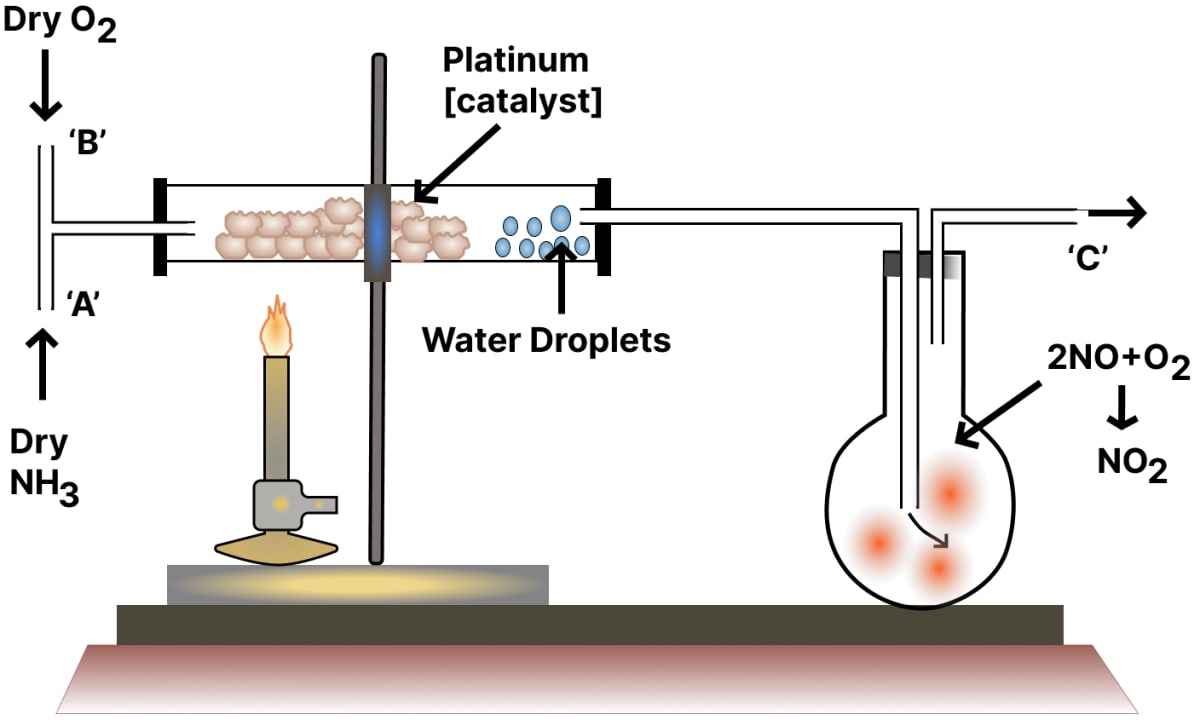
Draw a simple diagram for the catalytic oxidation of ammonia in the laboratory.
Show SolutionHide Solution↓
Below diagram shows the setup for catalytic oxidation of ammonia:
15Additional Questions
Give reasons for the observation seen during catalytic oxidation of ammonia.
Show SolutionHide Solution↓
Following are the observations with reasons:
The colourless nitric oxide formed, on oxidation gives reddish brown nitrogen dioxide 2NO + O2 ⟶ 2NO2
The platinum [catalyst] continues to glow even after the heating is discontinued since the catalytic oxidation of ammonia is an exothermic reaction.
16Additional Questions
Name an industrial process which involves ammonia, oxygen and a catalyst as it's starting reactants.
Show SolutionHide Solution↓
Ostwald’s process for preparing nitric acid.
17Additional Questions
State what an aqueous solution of NH3 is called. State how it is prepared giving reasons.
Show SolutionHide Solution↓
An aqueous solution of NH3 is called Liquor Ammonia.
Preparation: By dissolving ammonia gas in water using a funnel arrangement.
Reasons:
Prevents back suction of water and
Provides a large surface area for absorption of ammonia gas.
NH3 + H2O ⟶ NH4OH [liquor ammonia]
18Additional Questions
State why an aq. soln. of NH3
(i) turns red litmus blue
(ii) is a weak base and a weak electrolyte.
Show SolutionHide Solution↓
(i) The alkaline behaviour of aq. soln. of ammonia [NH4OH] is due to the presence of hydroxyl ions [OH-]. Hence, the aq. soln. of ammonia turns red litmus blue.
(ii) The aq. soln. of ammonia [NH4OH] is alkaline. It undergoes partial dissociation in aq. soln. to give hydroxyl ions [OH-] in low concentration. Therefore, it is a weak base and a weak electrolyte.
19Additional Questions
State two different methods of preparing NH4Cl using hydrochloric acid.
Show SolutionHide Solution↓
Below are the two methods of preparing NH4Cl using hydrochloric acid:
NH3 + HCl (dil.) ⟶ NH4Cl
NH4OH + HCl (dil.) ⟶ NH4Cl + H2O
20Additional Questions
Convert (i) ammonia (ii) ammonium hydroxide to an ammonium salt using (a) HNO3 (b) H2SO4
State a reason why reaction of liquor ammonia with nitric acid is a neutralization reaction.
Show SolutionHide Solution↓
As liquor ammonia is an alkali due to the presence of hydroxyl ions.
NH3 + H2O ⟶ NH4OH
NH4OH ⇌ NH4+ + OH-1
When an acid (nitric acid) and an alkali or base combine completely to form salt and water then the reaction is called a neutralization reaction.
NH4OH + HNO3 ⟶ NH4NO3 + H2O
Hence, the reaction between liquor ammonia and nitric acid is a neutralization reaction.
22Additional Questions
State why an aqueous solution of ammonia (NH4OH) is used for identifying cations.
Show SolutionHide Solution↓
The precipitate which are hydroxides of metallic radicals vary in :
colour
solubility in excess of NH4OH
Hence, ammonium hydroxide is used in qualitative analysis for identifying positive radicals or cations.
23Additional Questions
State how NH4OH is used for identifying:
Give also a balanced equation in each case for a known example.
(a)Fe2+
(b)Fe3+
(c)Pb2+
(d)Zn2+
(e)Cu2+ cations.
Show SolutionHide Solution↓
A soln. of Fe2+ ions gives dirty green ppt. which is insoluble in excess of NH4OH. FeSO4 + 2NH4OH ⟶ (NH4)2SO4+ Fe(OH)2 ↓
A soln. of Fe3+ ions gives reddish brown ppt. which is insoluble in excess of NH4OH FeCl3 + 3NH4OH ⟶ 3NH4Cl + Fe(OH)3 ↓
A soln. of Pb2+ ions gives chalky white ppt. which is insoluble in excess of NH4OH Pb(NO3)2 + 2NH4OH ⟶ 2NH4NO3 + Pb(OH)2 ↓
A soln. of Zn2+ ions gives gelatinous white ppt. which is soluble in excess of NH4OH ZnSO4 + 2NH4OH ⟶ (NH4)2SO4 + Zn(OH)2 ↓ Zn(OH)2 + (NH4)2SO4 + 2NH4OH ⟶ [Zn(NH3)4]SO4 + 4H2O
A soln. of Cu2+ ions gives pale blue ppt. which is soluble in excess of NH4OH CuSO4 + 2NH4OH ⟶ (NH4)2SO4 + Cu(OH)2 ↓ Cu(OH)2 + (NH4)2SO4 + 2NH4OH ⟶ [Cu(NH3)4]SO4 + 4H2O
24Additional Questions
State why the blue ppt. formed on addition of NH4OH to CuSO4 soln. dissolves to give a deep blue solution with excess of NH4OH. Give an equation for the reaction. State why Zn(OH)2 is soluble in excess of NH4OH.
Show SolutionHide Solution↓
Ammonium hydroxide if first added in small quantity and then in excess to a solution of copper sulphate, a pale blue ppt. of copper hydroxide is formed which dissolves in excess of ammonium hydroxide forming a soluble complex salt.
The pale blue ppt. of copper hydroxide is soluble in excess of a NH4OH, since a soluble complex [Cu(NH3)4]SO4 [tetrammine copper [II] sulphate] is formed.
Zinc salt forms a white gelatinous ppt. of Zn(OH)2, which dissolves when excess of ammonium hydroxide is added due to the formation of [Zn(NH3)4]SO4
Give balanced equations for the reducing reactions of ammonia with
(i) copper (II) oxide,
(ii) lead (II) oxide,
(iii) chlorine using (a) excess NH3 (b) excess Cl2
Show SolutionHide Solution↓
(i) 2NH3 + 3CuO ⟶ 3Cu + 3H2O + N2 [g]
(ii) 2NH3 + 3PbO ⟶ 3Pb + 3H2O + N2 [g]
(iii) (a) 8NH3 [excess] + 3Cl2 ⟶ 6NH4Cl + N2
(iii) (b) NH3 + 3Cl2 [excess] ⟶ 3HCl + NCl3
26Additional Questions
State five tests for ammonia where a colour change is involved.
Show SolutionHide Solution↓
Five tests for ammonia
Ammonia turns —
Red litmus solution to blue.
Methyl orange solution to yellow.
Colourless phenolphthalein solution to pink.
Pale blue precipitate of CuSO4 into deep blue coloured solution
Colourless Nesseler's reagent to pale brown.
27Additional Questions
State (i) a light neutral gas (ii) an acid (iii) an explosive (iv) a fertilizer — obtained from ammonia.
Show SolutionHide Solution↓
(i) Hydrogen
(ii) Nitric acid
(iii) Ammonium nitrate (NH4NO3)
(iv) Ammonium sulphate [(NH4)2SO4]
28Additional Questions
Name an ammonium salt which is a constituent of
(a) smelling salts
(b) dry cells.
Give reasons for the use of the named ammonium salt for the same.
Show SolutionHide Solution↓
(a) Ammonium Carbonate, [(NH4)2CO3] is used as smelling salt. It dissociates evolving pungent ammonia gas and hence is used as a constituent for smelling salts.
(NH4)2CO3 ⟶ 2NH3 + CO2 + H2O
The pungent smelling NH3 gas revives a fainted person.
(b) Ammonium Chloride (NH4Cl) is used in dry cells. It oxidizes Zn to Zn2+ ions. The electrons so produced constitute the electric current.
29Additional Questions
Give one use with reason of
(i) an aqueous solution of NH3
(ii) liquefied NH3.
Show SolutionHide Solution↓
(i) An aqueous solution of NH3 is called Liquor Ammonia. It is used as a cleaning agent to remove oil or grease stains from clothes, cleaning window panes, porcelain articles, etc as it emulsifies or dissolves fats, grease etc.
(ii) Liquefied NH3 is used as refrigerant because (a) it is highly volatile and has a high latent heat of evaporation. (b) it easily liquefies under pressure, at low temperature.
30Additional Questions
State what are chlorofluorocarbons and give their use. Give a reason why they are ozone depleting. State a suitable alternative to chlorofluorocarbons which are non-ozone depleting.
Show SolutionHide Solution↓
Chlorofluorocarbons (CFC’s) are compounds of carbon with chlorine or fluorine. CFC are chemicals which like liquefied ammonia gas are used in refrigeration gas.
They enter the atmosphere due to their use as coolants in refrigeration and A/C plants and aerosol sprays and cause ozone depletion in the atmosphere.
Chlorofluorocarbons (CFC’s) are decomposed by U.V. rays to give free Cl radicals.
CFCl3 ⟶ Cl atom
This Cl atom breaks the ozone layer causing ozone depletion.
Cl + O3 [ozone] ⟶ ClO + O2
Hence, ozone layer located in the stratosphere above the earth, which prevents harmful U.V. rays from reaching the earth, gets depleted.
Suitable alternatives to chlorofluorocarbons which are non-ozone depleting include Hydrochlorofluorocarbons [HCFC]
1Unit Test Paper 7B — Ammonia
Choose the letter corresponding to the correct answer from — A : NO2, B : NO, C : N2, D : N2O
The gas obtained when –
(a)Dry ammonia and dry oxygen gas are ignited together.
(b)Ammonia is passed over heated litharge.
(c)A greenish yellow gas reacts with excess ammonia.
(d)(a) Dry NH3 and O2 are passed over heated Pt. (b) The gaseous product obtained is further oxidized.
An aqueous solution of ammonia acts as a weak base.
Show SolutionHide Solution↓
The alkaline behaviour of NH4OH is due to the presence of hydroxyl ions [OH-]. It acts as a weak base, since it undergoes partial dissociation in aq. soln. to give hydroxyl ions [OH-] in low concentration.
4.2Unit Test Paper 7B — Ammonia
Give reasons for the following:
A mixture of ammonium nitrate and slaked lime are not used in the lab. preparation of ammonia gas.
Show SolutionHide Solution↓
As ammonium nitrate is explosive in nature and may itself decompose forming nitrous oxide and water vapour, hence a mixture of ammonium nitrate and slaked lime are not used in the lab. preparation of ammonia gas.
4.3Unit Test Paper 7B — Ammonia
Give reasons for the following:
Finely divided iron catalyst does not affect the percentage yield of ammonia in Haber’s process.
Show SolutionHide Solution↓
The catalyst only accelerates the reaction and does not form a part of the reaction and hence it does not affect the percentage yield of ammonia in Haber’s process.
4.4Unit Test Paper 7B — Ammonia
Give reasons for the following:
Ammonium salts are formed when ammonia reacts with dilute acids in the gaseous or aq. medium.
Show SolutionHide Solution↓
Ammonia gas or aqueous solution of Ammonia is basic in nature. Hence, reaction between dilute acids and ammonia is a neutralization reaction between an acid and a base forming salt and water as the end products. Therefore, ammonium salts are formed when ammonia reacts with dilute acids in the gaseous or aq. medium.
4.5Unit Test Paper 7B — Ammonia
Give reasons for the following:
Aqueous solution of lead and zinc nitrate can be distinguished using an aqueous solution of ammonia.
Show SolutionHide Solution↓
A lead salt gives a chalky white ppt. on reaction with ammonium hydroxide which does not dissolve when excess of ammonium hydroxide is added.
Pb(NO3)2 + 2NH4OH ⟶ 2NH4NO3 + Pb(OH)2 ↓
On the other hand, zinc salt forms a white gelatinous ppt. which dissolves when excess of ammonium hydroxide is added. Hence, the two can be easily distinguished using an aqueous solution of ammonia.
5Unit Test Paper 7B — Ammonia
Complete the statements by selecting the correct word from the words in brackets.
(a)The salt solution which does not give an insoluble precipitate on addition of ammonium hydroxide in small amount is .............. [Mg(NO3)2/NaNO3/Cu(NO3)2]
(b)The alkaline behaviour of liquor ammonia is due to the presence of .............. ions, [ammonium/hydronium/hydroxyl]
(c)Ammonia in the liquefied form is .............. [acidic/basic/ neutral]
(d)Ammonia reduces chlorine to .............. [nitrogen/hydrogen chloride/ ammonium chloride]
(e)The chemical not responsible for ozone depletion is .............. [methyl chloride / ammonia / chloroflourocarbons]
Show SolutionHide Solution↓
The salt solution which does not give an insoluble precipitate on addition of ammonium hydroxide in small amount is NaNO3
The alkaline behaviour of liquor ammonia is due to the presence of hydroxyl ions.
Ammonia in the liquefied form is basic
Ammonia reduces chlorine to hydrogen chloride
The chemical not responsible for ozone depletion is ammonia
6Unit Test Paper 7B — Ammonia
Select the most probable substance from A, B, C, D and E which need to be added to distinguish :
Cu + HNO3 ⟶ ............... + ............... + ............... [g] [dense reddish brown fumes evolved - blue solution remains]
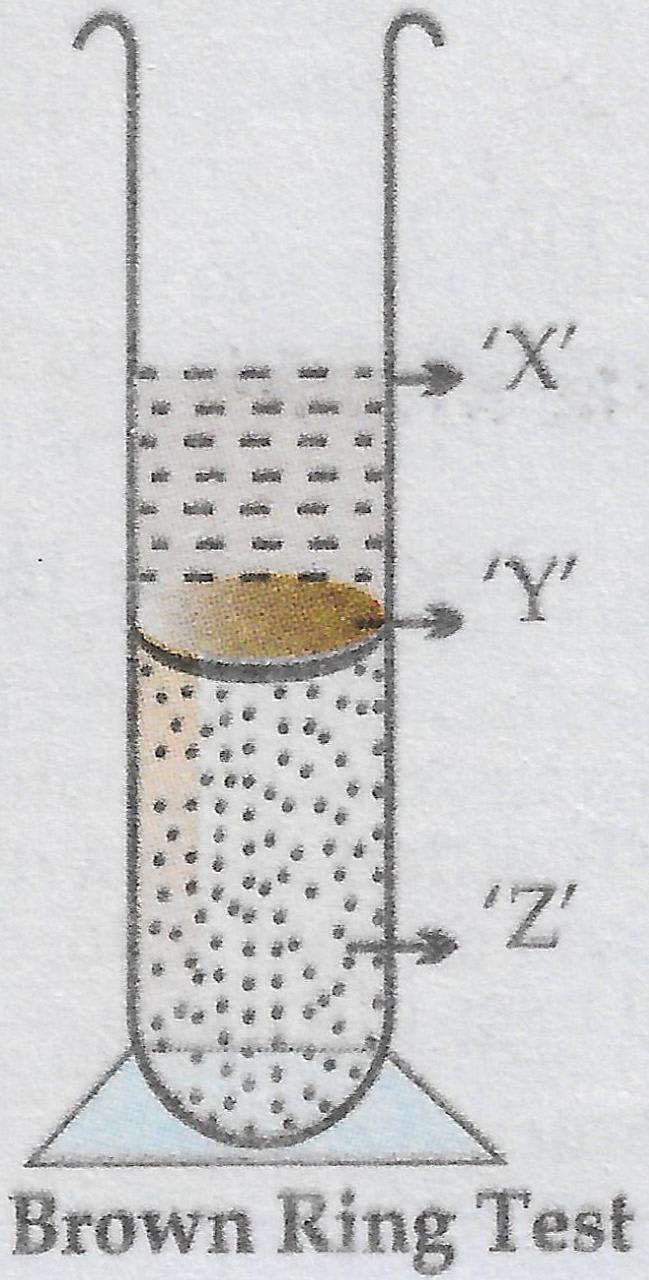
34. Brown ring test
FeSO4 + H2SO4 + ............... ⟶ ............... + ............... + NO [FeSO4 + NO ⟶ ...............] [A brown ring of nitroso ferrous sulphate is formed at the junction of the two liquids]
$\text{Cu} + 4\text{HNO}_3 \xrightarrow{\Delta} \bold{Cu(NO}_3)_2 + \bold{2H}_2\bold{O} + \bold{2NO}_2[g]$ [dense reddish brown fumes evolved - blue solution remains]
34. Brown ring test
6FeSO4 + 3H2SO4 + 2HNO3 ⟶ 3Fe2(SO4)3 + 4H2O +2NO [FeSO4 + NO ⟶ FeSO4.NO] [A brown ring of nitroso ferrous sulphate is formed at the junction of the two liquids]
1(2002)Questions
Give equation for the action of heat on –
State whether the reaction is an example of thermal decomposition or thermal dissociation.
(a)NH4Cl
(b)NH4NO3
Show SolutionHide Solution↓
NH4Cl ⇌ NH3 + HCl This reaction is an example of thermal dissociation.
NH4NO3 ⟶ N2O + 2H2O This reaction is an example of thermal decomposition.
2(2002)Questions
What compounds are required for the laboratory preparation of nitric acid.
Show SolutionHide Solution↓
Potassium nitrate [nitre] or sodium nitrate [chile salt petre] and conc. sulphuric acid are the products required for the laboratory preparation of nitric acid.
3(2002)Questions
State why pure nitric acid takes on a yellowish brown colour when exposed to light.
Show SolutionHide Solution↓
Pure nitric acid [HNO3] is colourless and unstable and decomposes slightly even at ordinary temperatures and in the presence of sunlight.
The decomposition results in formation of reddish brown nitrogen dioxide [NO2] which remains dissolved in the acid thus imparting a slight yellowish brown colour.
4(2002)Questions
Write an equation for the following reaction: Copper and concentrated nitric acid.
Show SolutionHide Solution↓
Cu + 4HNO3 (conc.) ⟶ Cu(NO3)2 + 2H2O + 2NO2.
5(2002)Questions
The first step in the manufacture of HNO3 is the catalytic oxidation of NH3. Name the catalyst used.
Show SolutionHide Solution↓
Platinum gauze
1(2003)Questions
Name a solution which gives nitrogen dioxide with copper.
Show SolutionHide Solution↓
Concentrated nitric acid (HNO3) gives nitrogen dioxide with copper
Cu + 4HNO3 (conc.) ⟶ Cu(NO3)2 + 2H2O + 2NO2.
2(2003)Questions
When nitric acid is prepared by the action of concentrated sulphuric acid on potassium nitrate, what is the special feature of the apparatus used.
Show SolutionHide Solution↓
All glass apparatus is used in the laboratory preparation of nitric acid since the vapours of nitric acid being highly corrosive attack rubber, cork, etc.
3(2003)Questions
Write the equation for the lab. preparation of HNO3 from potassium nitrate and conc. H2SO4
Show SolutionHide Solution↓
Below is the equation for the lab. preparation of HNO3 from potassium nitrate and conc. H2SO4:
Potassium nitrate is prepared from KOH and nitric acid. State the type of reaction involved.
Show SolutionHide Solution↓
Neutralization reaction.
KOH + HNO3 [dil.] ⟶ KNO3 + H2O
5(2003)Questions
State the conc. acid which will oxidise sulphur directly to H2SO4. Write the equation for the same.
Show SolutionHide Solution↓
Hot and conc. nitric acid.
S + 6HNO3 ⟶ H2SO4 + 2H2O + 6NO2
1(2004)Questions
X, Y and Z are three crystalline solids which are soluble in water and have a common anion. To help you to identify X, Y and Z, you are provided with the following experimental observation. Copy and complete the corresponding inference.
A reddish-brown gas is obtained when X, Y and Z are separately warmed with concentrated sulphuric acid and copper turnings added to the mixture. The common anion is the .............. ion.
Show SolutionHide Solution↓
A reddish-brown gas is obtained when X, Y and Z are separately warmed with concentrated sulphuric acid and copper turnings added to the mixture. The common anion is the [NO–] Nitrate ion.
2(2004)Questions
Write a balanced equation for the reaction of conc. HNO3 when added to copper turnings kept in a beaker.
Show SolutionHide Solution↓
Cu + 4HNO3 ⟶ Cu(NO3)2 + 2H2O + 2NO2
1(2005)Questions
Write a balanced equation for the reaction of – sulphur and hot concentrated nitric acid.
Show SolutionHide Solution↓
S + 6HNO3 ⟶ H2SO4 + 2H2O + 6NO2
2(2005)Questions
Dilute nitric acid is generally considered a typical acid except for its reaction with metals. In what way is dilute nitric acid different from other acids when it reacts with metals.
Show SolutionHide Solution↓
Dilute nitric acid is generally considered a typical acid except for it's reaction with metals since it generally does not liberate hydrogen on reaction with metals. Nitric oxide on decomposition forms nascent oxygen which oxidizes the hydrogen to water.
3(2005)Questions
Write the equation for the reaction of dilute nitric acid with copper.
State why a yellow colour appears in conc. nitric acid when left standing in an ordinary glass bottle.
Show SolutionHide Solution↓
Pure nitric acid [HNO3] is colourless and unstable and decomposes slightly even at ordinary temperatures and in the presence of sunlight. The decomposition results in formation of reddish brown nitrogen dioxide [NO2] which remains dissolved in the acid thus imparting a slight yellowish brown colour.
1(2006)Questions
From the substances – Ammonium sulphate, Lead carbonate, Chlorine, Copper nitrate, Ferrous sulphate — State:
A compound which releases a reddish brown gas on reaction with conc. H2SO4 and copper turnings.
Show SolutionHide Solution↓
Copper nitrate
2(2006)Questions
State what is observed when nitric acid is kept in a reagent bottle for a long time.
Show SolutionHide Solution↓
When nitric acid is kept in a reagent bottle for a long time, it turns dark yellowish brown in colour.
This is because nitric acid is unstable hence, it decomposes slightly even at ordinary temperatures and in the presence of sunlight. When it is kept for a long time, the decomposition is complete resulting in the formation of reddish brown nitrogen dioxide [NO2] that dissolves in the acid giving it a darker yellowish brown colour.
3(2006)Questions
Explain why only all-glass apparatus should be used for the preparation of nitric acid by heating concentrated sulphuric acid and potassium nitrate.
Show SolutionHide Solution↓
All glass apparatus is used in the laboratory preparation of nitric acid since the vapours of nitric acid being highly corrosive attack rubber, cork, etc.
1(2007)Questions
In the laboratory preparation of HNO3 - Name the reactants A [a liquid] and B [a solid] used.
Show SolutionHide Solution↓
(A) Liquid → Conc. sulphuric acid
(B) Solid → Potassium Nitrate (Nitre)
2(2007)Questions
Write an equation to show how nitric acid undergoes decomposition.
Show SolutionHide Solution↓
4HNO3 ⟶ 4NO2 + 2H2O + O2
3(2007)Questions
Write the equation for the reaction in which copper is oxidized by concentrated nitric acid.
Show SolutionHide Solution↓
Cu + 4HNO3 [conc.] ⟶ Cu(NO3)2 + 2H2O + 2NO2
1(2008)Questions
Identify the following substances: a dilute acid 'B' which does not normally give hydrogen when reacted with metals but does give a gas when it reacts with copper.
Show SolutionHide Solution↓
HNO3 (Nitric acid)
2(2008)Questions
Copy and complete the following table relating to an important industrial process. Output refers to the product of the process not the intermediate steps.
What is the property of nitric acid which allows it to react with copper ?
Show SolutionHide Solution↓
When nitric acid undergoes decomposition it yields nascent oxygen. This nascent oxygen oxidises copper allowing it to react with nitric acid. Hence, the oxidising nature of nitric acid helps it to react with copper.
4(2008)Questions
Write the equation for the following reaction:- Dilute nitric acid and copper.
Match each substance A to E listed below with the appropriate description given below:
(A) Sulphur
(B) Silver chloride
(C) Hydrogen chloride
(D) Copper [II] sulphate
(E) Graphite.
A non-metal which reacts with concentrated nitric acid to form it's own acid as one of the product.
Show SolutionHide Solution↓
(A) Sulphur
S + 6HNO3 ⟶ H2SO4 + 2H2O + 6NO2
3(2009)Questions
Correct the statement — Copper reacts with nitric acid to produce nitrogen dioxide.
Show SolutionHide Solution↓
Copper reacts with concentrated nitric acid to produce nitrogen dioxide.
Cu + 4HNO3 [conc.] ⟶ Cu(NO3)2 + 2H2O + 2NO2
1(2010)Questions
Select the correct answer from A, B, C, D and E —
(A) Nitroso Iron [II] sulphate
(B) Iron [III] chloride
(C) Chromium sulphate
(D) Lead [II] chloride
(E) Sodium chloride.
The compound responsible for the brown ring in the brown ring test for identifying the nitrate ion.
Show SolutionHide Solution↓
(A) Nitroso Iron [II] sulphate
2(2010)Questions
A blue crystalline solid 'X' on heating gave a reddish brown gas 'Y', a gas which relits a glowing splint and a residue which is black. Identify X and Y, and write the equation for the action of heat on X.
Choose from the list of substances – Acetylene gas, aqua fortis, coke, brass, barium chloride, bronze, platinum. A catalyst used in the manufacture of nitric acid by Ostwald's process.
Show SolutionHide Solution↓
Platinum
2(2011)Questions
State your observation when —
Copper is heated with concentrated nitric acid in a hard glass test tube.
Show SolutionHide Solution↓
Dense brown fumes of nitrogen dioxide can be seen.
FeSO4 + NO ⟶ FeSO4.NO [Nitroso Iron [II] Sulphate] - brown compound
4(2011)Questions
(i) State the special feature of the apparatus used in the laboratory preparation of nitric acid?
(ii) State why the temperature of the reaction mixture of HNO3 is not allowed to rise above 200°C.
Show SolutionHide Solution↓
(i) All glass apparatus is used since, the vapours of nitric acid being highly corrosive attack rubber, cork. etc.
(ii) Temperature above 200°C may cause:
Damage to the glass apparatus.
Further decomposition of nitric acid
Formation of hard residual crust of the corresponding sulphate [Na2SO4 or K2SO4] which being a poor conductor of heat, sticks to the glass and cannot be easily removed from the apparatus.
5(2011)Questions
Give a balanced equation for – Ferric hydroxide reacts with nitric acid.
Show SolutionHide Solution↓
Fe(OH)3 + 3HNO3 [dil.] ⟶ Fe(NO3)3 + 3H2O
1(2012)Questions
Name the gas produced when copper reacts with concentrated nitric acid.
Show SolutionHide Solution↓
Nitrogen dioxide.
Cu + 4HNO3 ⟶ Cu(NO3)2 + 2H2O + 2NO2
2(2012)Questions
State one observation for the following: Zinc nitrate crystals are strongly heated.
Show SolutionHide Solution↓
Reddish brown nitrogen dioxide gas is evolved on heating zinc nitrate crystals.
Rewrite the correct statement with the missing word/s:
Magnesium reacts with nitric acid to liberate hydrogen gas.
Show SolutionHide Solution↓
Magnesium reacts with cold, very dilute nitric acid to liberate hydrogen gas.
4(2012)Questions
Give reasons for the following: Iron is rendered passive with fuming nitric acid.
Show SolutionHide Solution↓
Iron or aluminium are rendered passive on reaction with fuming HNO3 due to formation of a thin oxide coating on the surface of the metal which prevents further reaction
5(2012)Questions
Give a balanced equation for the reaction: Dilute nitric acid and copper carbonate.
Show SolutionHide Solution↓
CuCO3 + 2HNO3 [dil.] ⟶ Cu(NO3)2 + H2O + CO2
1(2013)Questions
Identify the gas evolved when:
(i) Sulphur is treated with concentrated nitric acid.
(ii) A few crystals of KNO3 are heated in a hard glass test tube.
Identify the acid — The acid which is prepared by catalytic oxidation of ammonia.
Show SolutionHide Solution↓
Nitric acid
3(2015)Questions
Explain the following:
(i) Dil. HNO3 is generally considered a typical acid but not so in it's reaction with metals.
(ii) When it is left standing in a glass bottle, concentrated nitric acid appears yellow.
(iii) In the laboratory preparation of nitric acid, an all glass apparatus is used.
Show SolutionHide Solution↓
(i) Dilute nitric acid is generally considered a typical acid except for it's reaction with metals since it generally does not liberate hydrogen on reaction with metals. Nitric oxide on decomposition forms nascent oxygen which oxidizes the hydrogen to water.
(ii) Pure nitric acid [HNO3] is colourless and unstable and decomposes slightly even at ordinary temperatures and in the presence of sunlight.
The decomposition results in formation of reddish brown nitrogen dioxide [NO2] which remains dissolved in the acid thus imparting a slight yellowish brown colour.
(iii) All glass apparatus is used since, the vapours of nitric acid being highly corrosive attack rubber, cork. etc.
4(2015)Questions
From the list of the following salts — AgCl, MgCl2, NaHSO4, PbCO3, ZnCO3, KNO3, Ca(NO3)2. State the salt which on heating, evolves a brown coloured gas.
Give a reason why - For the preparation of nitric acid in the laboratory, the complete apparatus is made up of glass.
Show SolutionHide Solution↓
The vapours of nitric acid are highly corrosive and attack rubber, cork. etc. For this reason, all glass apparatus is used in the laboratory preparation of nitric acid.
1(2019)Questions
State one observation for the following : Concentrated nitric acid is reacted with - sulphur.
Identify the substance italicized : The dilute acid which is an oxidizing agent.
Show SolutionHide Solution↓
Nitric acid
1(2020)Questions
State one relevant observation for the reaction : Action of concentrated nitric acid on copper.
Show SolutionHide Solution↓
Reddish brown fumes of nitrogen dioxide gas are liberated when copper reacts with conc. nitric acid.
Cu + 4HNO3 [conc.] ⟶ Cu(NO3)2 + 2H2O + 2NO2
2(2020)Questions
Write a balanced chemical equation for : Reaction of carbon powder and concentrated nitric acid.
Show SolutionHide Solution↓
C + 4HNO3 [conc.] ⟶ CO2 + 2H2O + 4NO2
3(2020)Questions
State one relevant reason for the following : Concentrated nitric acid appears yellow, when it is left for a while in a glass bottle.
Show SolutionHide Solution↓
Pure nitric acid [HNO3] is colourless and unstable and decomposes slightly even at ordinary temperatures and in the presence of sunlight.
The decomposition results in formation of reddish brown nitrogen dioxide [NO2] which remains dissolved in the acid thus imparting a slight yellowish brown colour.
4(2020)Questions
Match the gas given in column I to the identification of the gases mentioned in column II:
Column I
Column II
Nitric acid
A. Turns acidified potassium dichromate solution green.
B. Turns lime water milky,
C. Turns reddish brown when it reacts with oxygen.
D. Turns moist lead acetate paper silvery black.
Show SolutionHide Solution↓
Column I
Column II
Nitric acid
C. Turns reddish brown when it reacts with oxygen.
1Additional Questions
State how atmospheric nitrogen converts itself to nitric acid.
Show SolutionHide Solution↓
During lightning discharge, nitrogen in the atmosphere reacts with oxygen to form nitric oxide which is further oxidised to nitrogen dioxide.
In the laboratory preparation of nitric acid from – KNO3 or NaNO3 state :
(i) the acid used
(ii) the type of apparatus used
(iii) the precautions to be taken during the preparation
(iv) the method of collection of the acid
(v) the method of identification of the product i.e., acid formed.
Show SolutionHide Solution↓
(i) Conc. Sulphuric Acid [H2SO4]
(ii) All glass apparatus is used
(iii) Precautions are:
Complete apparatus is made of glass since HNO3 vapours are corrosive.
Conc. HCl is not used in place of conc. Sulphuric Acid (H2SO4) as a reactant, since being volatile itself it is not used to displace another volatile acid.
The reaction temperature is properly maintained and controlled to protect the glass apparatus, prevent further decomposition of the nitric acid and to avoid formation of hard residual crust of the corresponding sulphate.
(iv) Conc. HNO3 vapours condense and are collected in water cooled receiver.
(v) The vapours obtained in the receiver on heating alone or with copper turnings evolve reddish brown fumes of nitrogen dioxide which turns acidified iron [II] sulphate solution brown proving that the vapours are of nitric acid.
4Additional Questions
Give reasons for the following — pertaining to the above laboratory preparation of nitric acid
(i) concentrated hydrochloric acid is not used as a reactant in the laboratory preparation.
(ii) the complete apparatus in the laboratory preparation does not contain parts made of rubber or cork.
(iii) the reaction temperature is maintained below 200°C
(iv) at high temperatures the sodium sulphate or potassium sulphate formed, forms a crust and sticks to the glass apparatus.
Show SolutionHide Solution↓
(i) Conc. HCl is not used in place of conc. sulphuric acid, since being volatile itself it is not used to displace another volatile acid.
(ii) All glass apparatus is used in the laboratory preparation of nitric acid since the vapours of nitric acid being highly corrosive attack rubber, cork, etc.
(iii) High temperatures above 200°C are not used as they may cause :
Damage to the glass apparatus.
Further decomposition of nitric acid.
Formation of a hard residual crust of the corresponding sulphate [Na2SO4 and K2SO4] which being a poor conductor of heat, sticks to the glass and cannot be easily removed from the apparatus.
(iv) At high temperatures above 200°C, a hard residual crust of the corresponding sulphate [Na2SO4 and K2SO4] is formed which being a poor conductor of heat, sticks to the glass and cannot be easily removed from the apparatus.
(iii) nitric acid obtained in the laboratory after passage of air or addition of water to it.
Show SolutionHide Solution↓
(i) Colourless
(ii) Slightly yellowish brown due to decomposition of the acid which is negligible at ordinary temperature but substantial at high temperature
(iii) Colourless — bubbling of air drives out the reddish brown nitrogen dioxide gas from the warm acid and further oxidises nitrogen dioxide to nitric acid. Addition of water causes dissolution of the nitrogen dioxide gas which is soluble in water.
6Additional Questions
State which reaction of ammonia forms the first step of Ostwald's process.
Show SolutionHide Solution↓
Catalytic oxidation of ammonia to nitric oxide and water is the first step of Ostwald's process.
Step II : $2\text{NO} + \text{O}_2 \xrightarrow{50 ^{\circ}\text{C}} \text{2NO}_\text{2}$
Step III : $4\text{NO}_\text{2} + 2\text{H}_\text{2}\text{O} + \text{O}_2 \longrightarrow 4\text{HNO}_3$
8Additional Questions
State how —
(i) a higher ratio of the reactant air
(ii) exothermicity of the catalytic reaction
(iii) use of low temp. in the conversion of NO to NO2 — affects each related step in Ostwald's process.
Show SolutionHide Solution↓
(i) Air is used in all the three main reactions of Ostwald's process i.e., the reaction in the catalytic, oxidation and absorption tower including oxidation of nitric oxide to nitrogen dioxide which requires excess of air. Hence, a higher ratio of the reactant air is used.
(ii) Since the reaction is exothermic in nature, the electrical heating is done initially only. The heat evolved i.e., heat of reaction further maintains the required temperature of the reaction.
(iii) Low temperatures are used since they :
Facilitate easy oxidation of nitric oxide to nitrogen dioxide
Minimize the chances of any decomposition of nitrogen dioxide which may take place at higher temperatures.
9Additional Questions
State why nitric acid
(i) stains the skin
(ii) cannot be concentrated beyond 68% by boiling.
Show SolutionHide Solution↓
(i) Nitric acid brings about nitration of protein of the skin forming a yellow compound Xanthoproteic acid which stains the skin yellow.
(ii) A constant boiling mixture is maintained at 121°C, it is when the mixture boils without change in composition. Hence, on boiling, the above mixture evolves out the vapours of both acid and water in the same proportion as in the liquid. Thus, nitric acid cannot be concentrated beyond 68% by boiling.
10Additional Questions
State two conditions which affect the decomposition of nitric acid.
Show SolutionHide Solution↓
Two conditions which affect the decomposition of nitric acid are:
Nitric acid is unstable and it decomposes slightly even at ordinary temperatures and in the presence of sunlight.
It decomposes completely at higher temperatures or after a prolonged period of time.
11Additional Questions
State the change in colour of pure concentrated nitric acid on initial and prolonged decomposition.
Show SolutionHide Solution↓
Pure nitric acid is colourless. The decomposition results in formation of reddish brown nitrogen dioxide which remains dissolved in the acid thus imparting a slight yellowish brown colour.
At higher temperatures or after a prolonged period of time the decomposition is complete and the acid turns a darker yellowish brown colour.
12Additional Questions
State the cation responsible for turning moist neutral litmus red on reaction with dil. HNO3.
Show SolutionHide Solution↓
The high concentration of H+ ions imparts acidic nature to dilute Nitric Acid (HNO3), hence it turns moist neutral litmus red.
State why nitric acid is a strong oxidizing agent and yields varying products such as NO, NO2 on reaction with metals, non-metals etc.
Show SolutionHide Solution↓
The oxidizing property of nitric acid is based on the fact that when nitric acid undergoes decomposition, it yields nascent oxygen, which is very reactive.
2HNO3 (hot conc.) ⟶ H2O + 2NO2 + [O]
2HNO3 (mod. conc.) ⟶ H2O + 2NO + 3[O]
The nascent oxygen oxidises non-metals, metals, inorganic and organic compounds. Nitric acid itself undergoes reduction in a number of ways hence a number of reduction products [NO, NO2, N2O etc.] are formed depending on the acid concentration and the temperature of the reaction.
14Additional Questions
Give an equation for reaction of conc. HNO3 with :
(i) carbon
(ii) copper.
Show SolutionHide Solution↓
(i) C + 4HNO3 ⟶ CO2+ 2H2O + 4NO2
(ii) Cu + 4HNO3 ⟶ Cu(NO3)2 + 2H2O + 2NO2
15Additional Questions
Convert nitric acid to sulphuric acid using a non-metal.
Show SolutionHide Solution↓
S + 6HNO3 ⟶ H2SO4 + 2H2O + 6NO2
16Additional Questions
State how you would obtain:
(i) hydrogen
(ii) nitric oxide
(iii) nascent chlorine – from nitric acid.
State the concentration of nitric acid used in each case.
Show SolutionHide Solution↓
(i) Cold, very dilute (1%) nitric acid reacts with metals like Mg and Mn to give hydrogen Mg + 2HNO3 [cold, very dil.] ⟶ Mg(NO3)2 + H2 [g]
(ii) Dilute nitric acid reacts with metals like Cu, Ag to give nitric oxide (NO). 3Cu + 8HNO3 [dil.] ⟶ 3Cu(NO3)2 + 4H2O + 2NO
(iii) Aqua Regia which is a mixture of conc. nitric acid [1 part] + conc. hydrochloric acid [3 parts] [by volume] liberates nascent chlorine by oxidising hydrochloric acid to chlorine. HNO3 (conc.) + 3HCl (conc.) ⟶ 2H2O + NOCl + 2[Cl]
17Additional Questions
State why hydrogen is liberated when zinc reacts with dil. HCl but not with dil. HNO3.
Show SolutionHide Solution↓
As zinc displace hydrogen from dil. HCl, hence, hydrogen is liberated when zinc reacts with dil. HCl
Zn + 2HCl (dil.) ⟶ ZnCl2 + H2
However, when zinc reacts with dil HNO3, no hydrogen is obtained as nitric acid being a strong oxidising agent decomposes to form nascent oxygen which oxidizes the hydrogen produced to water.
18Additional Questions
State a reason for the inactivity of iron and aluminium on reaction with fuming HNO3.
Show SolutionHide Solution↓
Iron and Aluminium are rendered passive on reaction with fuming HNO3 due to formation of a thin oxide coating on the surface of the metal which prevents further reaction.
19Additional Questions
State your observation when:
(i) nitric acid is added to saw dust
(ii) conc. nitric acid is heated (a) in absence of copper (b) in presence of copper.
Show SolutionHide Solution↓
(i) Saw dust bursts into flames when hot conc. nitric acid is poured on it. The reason is that Nitric acid is a strong oxidising agent. It decomposes to give nascent oxygen which oxidises organic compounds to carbon dioxide and water.
(ii) (b) Cu reacts with conc. nitric acid liberating reddish brown fumes of nitrogen dioxide along with blue coloured solution of copper nitrate.
Cu + 4HNO3 [conc.] ⟶ Cu(NO3)2 + 2H2O + 2NO2
20Additional Questions
State how addition of nitric acid to acidified FeSO4, serves as a test for the former.
Show SolutionHide Solution↓
When nitric acid is added to acidified FeSO4, conc. sulphuric acid being heavier settles down and the iron [II] sulphate layer remains above it resulting in the formation of the brown ring at the junction.
Name three chemical products manufactured from nitric acid. Give two general uses of HNO3.
Show SolutionHide Solution↓
Three chemical products manufactured from nitric acid are:
Tri-nitro toluene [C7H5(NO2)3]
Tri-nitro cellulose [C6H7O2(NO2)3]n
Tri-nitro glycerine [C3H5O3(NO2)3]
Two general uses of nitric acid are:
For etching designs on copper and brassware
In purification of gold.
1Unit Test Paper 7C — Nitric Acid
Select the letters A, B, C, D or E, which form the gaseous products of the reactions from 1 to 5.
A: Nitrogen dioxide only B: Nitric oxide only C: Hydrogen D: Nitrogen dioxide and oxygen E: Nitrogen dioxide and carbon dioxide.
(a)Reaction of manganese with cold, very dil. nitric acid.
(b)Reaction of sulphur with conc. nitric acid.
(c)Reaction of zinc with dil. nitric acid.
(d)Reaction of carbon with conc. nitric acid.
(e)Heat on nitric acid.
Show SolutionHide Solution↓
Reaction of manganese with cold, very dil. nitric acid — (C) Hydrogen
Reaction of sulphur with conc. nitric acid — (A) Nitrogen dioxide only
Reaction of zinc with dil. nitric acid — (B) Nitric oxide only
Reaction of carbon with conc. nitric acid — (E) Nitrogen dioxide and carbon dioxide.
Heat on nitric acid — (D) Nitrogen dioxide and oxygen.
2Unit Test Paper 7C — Nitric Acid
Select the correct word from the list in bracket to complete each statement.
The oxidised product obtained on reaction of H2S gas with dil. HNO3 is ................ [sulphur dioxide / sulphur / sulphuric acid].
Aqua regia is a mixture of one part of ............... and three parts of ............... [conc. hydrochloric acid / conc. nitric acid] in which nitric acid ............... [reduces/oxidises] hydrochloric acid to chlorine.
Pure conc. nitric acid or fuming nitric acid renders the metal ............... [zinc/copper/iron] passive or inactive.
A mineral acid obtained from conc. nitric acid on reaction with a non-metal is ............... [hydrochloric acid / sulphuric acid / carbonic acid].
The reaction of ............... [calcium carbonate / calcium oxide / calcium sulphite] with dilute nitric acid is an example of a neutralization reaction.
Show SolutionHide Solution↓
The oxidised product obtained on reaction of H2S gas with dil. HNO3 is sulphur .
Aqua regia is a mixture of one part of conc. nitric acid and three parts of conc. hydrochloric acid in which nitric acid oxidises hydrochloric acid to chlorine.
Pure conc. nitric acid or fuming nitric acid renders the metal iron passive or inactive.
A mineral acid obtained from conc. nitric acid on reaction with a non-metal is sulphuric acid.
The reaction of calcium oxide with dilute nitric acid is an example of a neutralization reaction.
3Unit Test Paper 7C — Nitric Acid
Give balanced equations for the following conversions A to E.
Nitric acid is not manufactured from atmospheric nitrogen.
Show SolutionHide Solution↓
Direct conversion of atmospheric N2 into HNO3 is highly energy intensive process and it is very expensive. Therefore, nitric acid is not manufactured from atmospheric nitrogen.
5.2Unit Test Paper 7C — Nitric Acid
Give reasons for the following:
Nitric acid affects the skin if it accidently falls on it, staining the skin yellow.
Show SolutionHide Solution↓
Nitric acid brings about nitration of protein of the skin forming a yellow compound Xanthoproteic acid which stains the skin yellow.
5.3Unit Test Paper 7C — Nitric Acid
Give reasons for the following:
The yellow colour of nitric acid obtained in the laboratory is removed by bubbling air through it.
Show SolutionHide Solution↓
Yellow colour of the nitric acid is due to dissolved NO2. Bubbling of air drives out the reddish brown nitrogen dioxide gas from the warm acid and further oxidises nitrogen dioxide to nitric acid.
5.4Unit Test Paper 7C — Nitric Acid
Give reasons for the following:
Nitric acid finds application in the purification of gold.
Show SolutionHide Solution↓
Crude gold contains Cu, Ag, Zn, Pb etc., as impurities which dissolve in HNO3 while gold is unaffected. Hence, nitric acid finds application in the purification of gold.
5.5Unit Test Paper 7C — Nitric Acid
Give reasons for the following:
Nitric acid is a stronger oxidising agent in the conc. state of the acid than in the dilute state.
Show SolutionHide Solution↓
The oxidizing property of nitric acid is based on the fact that when nitric acid undergoes decomposition, it yields nascent oxygen, which is very reactive.
Due to the ease with which conc. HNO3 decomposes to give nascent oxygen, it acts as a powerful oxidising agent compared to nitric acid in dilute state.
6Unit Test Paper 7C — Nitric Acid
Answer the following questions pertaining to the brown ring test for nitric acid:
(a)Name the chemical constituent of the brown ring 'Y'.
(b)Which of the two solutions – iron [II] sulphate or conc. sulphuric acid, do 'X' and 'Z' represent.
(c)State why the unstable brown ring decomposes completely on disturbing the test tube.
(d)Give a reason why the brown ring does not settle down at the bottom of the test tube.
(e)Name the gas evolved when acidified iron [II] sulphate reacts with dilute nitric acid in the brown ring test.
Show SolutionHide Solution↓
Nitroso Iron (II) Sulphate (FeSO4.NO).
X is Iron (II) Sulphate (FeSO4) and Z is conc. Sulphuric Acid (H2SO4).
When the test tube is shaken the conc. sulphuric acid may further mix with water and the heat evolved assists in decomposing the unstable brown ring. Hence, unstable brown ring of nitroso ferrous sulphate decomposes completely on disturbing.
In the brown ring test the conc. sulphuric acid being heavier settles down and the iron [II] sulphate layer remains above it resulting in formation of the brown ring at the junction.
As a non - volatile acid [conc.] Displaces volatile acid from salt
15. Sodium chloride
NaCl + H2SO4 [conc.] ⟶ NaHSO4 + HCl (<200°C)
16. Sodium nitrate
NaNO3 + H2SO4 [conc.] ⟶ NaHSO4 + HNO3 (<200°C)
As an oxidising agent [conc. acid] Oxidation of
17. Carbon
C + 2H2SO4 [conc.] ⟶ CO2 + 2H2O + 2SO2
18. Sulphur
S + 2H2SO4 [conc.] ⟶ 3SO2 + 2H2O
19. Phosphorous
2P + 5H2SO4 [conc.] ⟶ 2H3PO4 + 2H2O + 5SO2
20. Copper
Cu + 2H2SO4 [conc.] ⟶ CuSO4 + 2H2O + SO2
21. Zinc
Zn + 2H2SO4 [conc.] ⟶ ZnSO4 + 2H2O + SO2
22. Hydrogen iodide
2HI + H2SO4 [conc.] ⟶ I2 + 2H2O + SO2
23. Hydrogen sulphide
H2S + H2SO4 [conc.] ⟶ S + 2H2O + SO2
As a dehydrating agent [conc. acid]
24. Glucose
C6H12O6 + H2SO4 [conc.] ⟶ 6C + 6H2O
25. Sucrose
C12H22O11 + H2SO4 [conc.] ⟶ 12C + 11H2O
26. Cellulose
[C6H10O5]n + H2SO4 [conc.] ⟶ 6[C]n + 5[H2O]n
27. Formic acid
H.COOH + H2SO4 [conc.] ⟶ CO + H2O
28. Oxalic acid
H2C2O4 + H2SO4 [conc.] ⟶ CO + CO2 + H2O
29. Hydrated copper sulphate
CuSO4.5H2O + H2SO4 [conc.] ⟶ CuSO4 + 5H2O
1(2002)Questions
State the substance/s reacted with dilute or concentrated sulphuric acid to form the following gases:
(i) Hydrogen
(ii) Carbon dioxide.
State whether the acid used in each case is dilute or concentrated.
Show SolutionHide Solution↓
(i) Zinc, Iron or any active metal reacts with dilute Sulphuric Acid (H2SO4) to form Hydrogen. The reactions are shown below:
Zn + H2SO4 (dil.) ⟶ ZnSO4 + H2 [g]
Fe + H2SO4 (dil.) ⟶ FeSO4 + H2 [g]
(ii) Carbonates and bicarbonates react with dilute Sulphuric Acid (H2SO4) to give Carbon dioxide (CO2). The reactions are shown below:
Na2CO3 + H2SO4 (dil.) ⟶ Na2SO4 + H2O + CO2
2KHCO3 + H2SO4 (dil.) ⟶ K2SO4 + 2H2O + 2CO2
2(2002)Questions
Write the equations for the lab. preparation of:
(i) Na2SO4 using dil. H2SO4,
(ii) PbSO4 using dil. H2SO4
Show SolutionHide Solution↓
(i) 2NaOH + H2SO4 (dil) ⟶ Na2SO4 + 2H2O
(ii) Pb(NO3)2 + H2SO4 (dil) ⟶ PbSO4 ↓ + 2HNO3
1(2003)Questions
State the name of the process by which H2SO4 is manufactured. Name the catalyst used.
Show SolutionHide Solution↓
Contact process is the name of the process by which H2SO4 is manufactured.
Catalyst — Vanadium pentoxide [V2O5] or platinum [Pt.]
2(2003)Questions
Concentrated sulphuric acid is used in the laboratory preparation of nitric acid and hydrochloric acid because it is ............... [less volatile / stronger] in comparison to these two acids.
Show SolutionHide Solution↓
Concentrated sulphuric acid is used in the laboratory preparation of nitric acid and hydrochloric acid because it is less volatile in comparison to these two acids.
3(2003)Questions
Write the equations for the laboratory preparation of the following salts using sulphuric acid:
(i) Copper sulphate from copper
(ii) Lead sulphate from lead nitrate
Show SolutionHide Solution↓
Cu + 2H2SO4 (conc.) ⟶ CuSO4 + SO2 + 2H2O
Pb(NO3)2 + H2SO4 (dil.) ⟶ PbSO4 ↓ + 2HNO3
1(2004)Questions
Name the catalyst which helps in the conversion of sulphur dioxide to sulphur trioxide.
Show SolutionHide Solution↓
Vanadium pentoxide [V2O5] or platinum [Pt.]
2(2004)Questions
In the Contact process, sulphur trioxide is not converted to sulphuric acid by reacting it with water. Instead a two- step procedure is used. Write the equations for the two steps involved.
Show SolutionHide Solution↓
The equations for the two steps involved are:
SO3 + H2SO4 ⟶ H2S2O7
H2S2O7 + H2O ⟶ 2H2SO4
1(2005)Questions
Write balanced equations for the following:
(i) Potassium hydrogen carbonate and dilute sulphuric acid.
(ii) Sodium nitrate and concentrated sulphuric acid.
Dilute hydrochloric acid and dilute sulphuric acid are both colourless solutions. How will the addition of barium chloride solution to each help to distinguish between the two.
Show SolutionHide Solution↓
Barium chloride soln. reacts with dilute sulphuric acid to give a white ppt. of barium sulphate (BaSO4) but with dil. HCl no white ppt. is produced.
Name the gas produced on reaction of dilute sulphuric acid with a metallic sulphide.
Show SolutionHide Solution↓
Hydrogen sulphide (H2S)
2(2012)Questions
Some properties of sulphuric acid are listed below. Choose the role played by sulphuric acid – A, B, C, or D which is responsible for the reactions (i) to (v).
Some role/s may be repeated.
A : Dilute acid B : Dehydrating agent C : Non-volatile acid D : Oxidising agent
Write balanced equations for the following: Action of concentrated sulphuric acid on carbon.
Show SolutionHide Solution↓
C + 2H2SO4 [conc.] ⟶ CO2 + 2H2O + 2SO2
2(2014)Questions
Distinguish between the following pairs of compounds using the test given within brackets: Dilute sulphuric acid and dilute hydrochloric acid [using barium chloride solution]
Show SolutionHide Solution↓
Barium chloride soln. reacts with dilute sulphuric acid to give a white ppt. of barium sulphate (BaSO4) but with dilute hydrochloric acid no white ppt. is produced since barium chloride is soluble in dil. sulphuric acid.
State – How will you distinguish between dilute hydrochloric acid and dilute sulphuric acid using lead nitrate solution.
Show SolutionHide Solution↓
Sulphuric acid forms a white precipitate with lead nitrate solution. This precipitate does not dissolve on warming the reaction mixture.
H2SO4 (dil.) + Pb(NO3)2 ⟶ 2HNO3 + PbSO4 ↓ [white ppt. formed which does not dissolve on warming the mixture].
Hydrochloric acid forms a white precipitate with lead nitrate solution. This precipitate dissolves on warming the reaction mixture so as to form clear solution.
2HCl (dil.) + Pb(NO3)2 ⟶ 2HNO3 + PbCl2 ↓ [white ppt. formed which dissolves on warming the mixture].
Hence, dilute hydrochloric acid and dilute sulphuric acid can be distinguished using lead nitrate solution.
4(2017)Questions
Write balanced chemical equations to show –
(i) The oxidizing action of conc. sulphuric acid on carbon.
(ii) The behaviour of H2SO4 as an acid when it reacts with magnesium.
(iii) The dehydrating property of conc. sulphuric acid with sugar.
(iv) The conversion of SO3 to sulphuric acid in the Contact process.
Write balanced chemical equations for the following reactions:
Action of dilute sulphuric acid on —
(i) Sodium hydroxide
(ii) Zinc sulphide
Show SolutionHide Solution↓
(i) 2NaOH + H2SO4 ⟶ Na2SO4 + 2H2O
(ii) ZnS + H2SO4 (dil.) ⟶ ZnSO4 + H2S
2(2019)Questions
Distinguish between the following pairs of compounds using the reagent given in the bracket:
Dilute hydrochloric acid and dilute sulphuric acid [using lead nitrate soln.]
Show SolutionHide Solution↓
Sulphuric acid forms a white precipitate with lead nitrate solution. This precipitate does not dissolve on warming the reaction mixture.
H2SO4 (dil.) + Pb(NO3)2 ⟶ 2HNO3 + PbSO4 ↓ [white ppt. formed which does not dissolve on warming the mixture].
Hydrochloric acid forms a white precipitate with lead nitrate solution. This precipitate dissolves on warming the reaction mixture so as to form clear solution.
2HCl (dil.) + Pb(NO3)2 ⟶ 2HNO3 + PbCl2 ↓ [white ppt. formed which dissolves on warming the mixture].
Hence, dilute hydrochloric acid and dilute sulphuric acid can be distinguished using lead nitrate solution.
3(2019)Questions
Complete the following equation:
C + conc. H2SO4 ⟶
Show SolutionHide Solution↓
C + 2H2SO4 [conc.] ⟶ CO2 + 2SO2 + 2H2O
4(2019)Questions
Copy and complete the following table which refers to the industrial method for preparation of sulphuric acid.
Name of the compound
Name of the process
Catalytic equation [with the catalyst]
Sulphuric acid
Show SolutionHide Solution↓
Name of the compound
Name of the process
Catalytic equation [with the catalyst]
Sulphuric acid
Contact Process
$2\text{SO}_2 + \text{O}_2 \xrightleftharpoons [450-500\text{^{\circ} C }/1 - 2 \text{ atmos}]{\text{V}_2\text{O}_5} 2\text{SO}_3 + \text{45 K cals}$
1(2020)Questions
Choose the correct answer from the options:
The acid which can produce carbon from cane sugar, is —
Identify the substance underlined in the following :
The acid that is a dehydrating as well as a drying agent.
Show SolutionHide Solution↓
Sulphuric acid
1Additional Questions
State why sulphuric acid was called – 'oil of vitriol'.
Show SolutionHide Solution↓
Sulphuric acid was initially called 'oil of vitriol' because it was prepared by distilling green vitriol [FeSO4.7H2O] and hence the name – 'oil of vitriol' was given.
2FeSO4.7H2O ⟶ Fe2O3 + SO2 + SO3 + 14H2O
SO3 + 14H2O ⟶ H2SO4 + 13H2O
2Additional Questions
State how you would convert (i) sulphur (ii) chlorine (iii) sulphur dioxide — to sulphuric acid.
Show SolutionHide Solution↓
(i) By action of heat on sulphur and nitric acid: S + 6HNO3 [conc.] ⟶ 6NO2 + 2H2O + H2SO4
(ii) By passage of chlorine through an aqueous solution of sulphur dioxide: Cl2 + SO2 + 2H2O ⟶ 2HCl + H2SO4
(iii) By oxidation of an aq. soln. of sulphur dioxide: 2SO2 + 2H2O + O2 ⟶ 2H2SO4
3Additional Questions
State the purpose of the 'Contact process'.
Show SolutionHide Solution↓
The purpose of the 'Contact process' is to manufacture sulphuric acid.
4Additional Questions
In the Contact process
(i) State how you would convert (a) sulphur (b) iron pyrites to sulphur dioxide in the first step of the Contact process.
(ii) State the conditions i.e. catalyst, promoter, temperature and pressure in the catalytic oxidation of sulphur dioxide to sulphur trioxide in the Contact tower. Give a balanced equation for the same.
(iii) State why the above catalytic oxidation reaction supplies energy.
(iv) Give a reason why – vanadium pentoxide is preferred to platinum during the catalytic oxidation of sulphur dioxide.
(v) Give a reason why the catalyst mass is heated electrically – only initially.
(vi) State why sulphur trioxide vapours are absorbed in concentrated sulphuric acid and not in water to obtain sulphuric acid.
Show SolutionHide Solution↓
(i) Sulphur dioxide is produced by burning sulphur [S] or iron pyrites [FeS2]
S + O2 ⟶ SO2
4FeS2 + 11O2 ⟶ 2Fe2O3 + 8SO2
(ii) Catalyst : Vanadium pentoxide [V2O5] or platinum [Pt.]
Temperature : 450 - 500°C , Pressure : 1 to 2 atmosphere
Conversion ratio: 98% of sulphur dioxide converted to sulphur trioxide.
(iii) The catalytic oxidation of SO2 to SO3 is an exothermic reaction, hence, supplies energy.
(iv) Vanadium pentoxide is preferred to platinized asbestos as a catalyst since it is comparatively cheaper and less easily poisoned or susceptible to impurities.
(v) The catalyst mass is only initially heated electrically, since the catalytic oxidation of sulphur dioxide is an exothermic reaction and the heat produced maintains the temperature at 450 – 500°C.
(vi) Even though sulphur trioxide is an acid anhydride of sulphuric acid it is not directly absorbed in water to give sulphuric acid.
The reaction is highly exothermic resulting in production of a dense fog of sulphuric acid particles which do not condense easily.
Hence sulphur trioxide vapours are dissolved in conc. sulphuric acid to give oleum which on dilution with the requisite amount of soft water in the dilution tank gives sulphuric acid of the desired concentration [about 98%].
5Additional Questions
Give a reason why concentrated sulphuric acid is kept in air tight bottles.
Show SolutionHide Solution↓
As, concentrated sulphuric acid is hygroscopic and has a great affinity for water hence, it absorbs moisture from the atmosphere. Therefore, it is kept in air tight bottles.
6Additional Questions
State the basic steps with reasons, involved in diluting a beaker of conc. H2SO4.
Show SolutionHide Solution↓
For dilution of conc. H2SO4, the conc. acid is added to water and not the water to the acid even though heat is evolved in both cases.
If water is added to the acid : There is a sudden increase in the temperature and the acid being in bulk tends to spurt out.
If acid is added to water : The water is in bulk and the acid being heavier settles down. The heat evolved is dissipated in the water itself and hence the spurting of the acid is minimized.
7Additional Questions
Give reasons why dilute sulphuric acid:
(i) behaves as an acid when dilute.
(ii) is dibasic in nature.
Show SolutionHide Solution↓
(i) Acidic properties of sulphuric acid are due to the presence of hydronium ions [H3O+] formed when H2SO4 dissociates in aqueous solution. Hence, it behaves as an acid when dilute.
(ii) Sulphuric acid dissociates in aqueous solution giving two hydrogen ions (H+) ions per molecule of the acid. Hence, it is dibasic in nature.
H2SO4 ⇌ 2H+ + SO42-
H2SO4 + 2H2O ⇌ 2H3O+ + SO42-
8Additional Questions
Convert dil. H2SO4 to –
(i) Hydrogen
(ii) Carbon dioxide
(iii) Sulphur dioxide
(iv) Hydrogen sulphide
(v) An acid salt
(vi) A normal salt.
Show SolutionHide Solution↓
(i) Zn + H2SO4 (dil.) ⟶ ZnSO4 + H2 (g)
(ii) 2KHCO3 + H2SO4 ⟶ K2SO4 + 2H2O + 2CO2
(iii) S + 2H2SO4 (conc.) ⟶ 3SO2 + 2H2O
(iv) FeS + H2SO4 (dil.) ⟶ FeSO4 + H2S
(v) NaOH + H2SO4 (dil.)⟶ NaHSO4 + H2O
(vi) 2NaOH + H2SO4 (dil.)⟶ Na2SO4 + 2H2O
9Additional Questions
Give equations for formation of two different acids from conc. H2SO4. State the property of sulphuric acid involved in the above formation.
The property of being a non-volatile acid is used in the above reactions.
10Additional Questions
Give equations for oxidation of conc. H2SO4 giving the oxidised products –
(i) Carbon dioxide
(ii) Sulphur dioxide
(iii) Phosphoric acid
(iv) Copper (II) sulphate
(v) Iodine
(vi) Sulphur
respectively
Show SolutionHide Solution↓
(i) C + 2H2SO4 (conc.) ⟶ CO2 + 2SO2 + 2H2O
(ii) S + 2H2SO4 (conc.) ⟶ 3SO2 + 2H2O
(iii) 2P + 5H2SO4 (conc.) ⟶ 2H3PO4 + 5SO2 + 2H2O
(iv) Cu + 2H2SO4 (conc.) ⟶ CuSO4 + SO2 + 2H2O
(v) 2HI + H2SO4 (conc.) ⟶ I2 + SO2 + 2H2O
(vi) H2S + H2SO4 (conc.) ⟶ S + SO2 + 2H2O
11Additional Questions
Give a reason why concentrated and not dil H2SO4 behaves as an oxidising and dehydrating agent.
Show SolutionHide Solution↓
Oxidising property of concentrated sulphuric acid is due to the fact that on thermal decomposition, it yields nascent oxygen [O] which helps in oxidation.
H2SO4 ⟶ H2O + SO2 + [O]
Nascent oxygen oxidizes non-metals, metals and inorganic compounds.
On the other hand, dil H2SO4 on heating does not decompose to give nascent oxygen and as such cannot behave as an Oxidising agent.
12Additional Questions
Give the equation for the reaction of conc. sulphuric acid with –
(i) glucose
(ii) sucrose
(iii) cellulose
(iv) an organic acid containing one carbon atom and two hydrogen atoms
(v) an organic acid containing two carbon and two hydrogen atoms
(vi) an alcohol
(vii) hydrated copper [II] sulphate
Show SolutionHide Solution↓
(i) Reaction of conc. sulphuric acid with glucose:
to hot conc. H2SO4 serves as a test for the latter.
Show SolutionHide Solution↓
(i) When Cu is added to hot conc. H2SO4, colourless suffocating (SO2) gas is evolved. The gas turns orange coloured acidified potassium dichromate solution to green colour.
Cu + 2H2SO4 (conc.) $\xrightarrow{\Delta}$ CuSO4 + SO2 + 2H2O
(ii) When NaCl is heated with conc. H2SO4, colourless pungent smelling HCl gas is evolved.
BaCl2 and Pb(NO3)2 are used for the above tests as they react with H2SO4 and form BaSO4 and PbSO4 respectively, which are the only compounds insoluble in dil. sulphuric acid.
16Additional Questions
Give a test to distinguish dilute sulphuric acid from dilute HCl and dilute HNO3.
Show SolutionHide Solution↓
Barium chloride (BaCl2) solution reacts with dilute sulphuric acid to give a white ppt. of barium sulphate (BaSO4) but with dil. HCl and dil. HNO3 no white ppt. is produced since BaCl2 and Ba(NO3)2 is soluble in dil. H2SO4.
(a)Give a balanced equation for the conversion 'A'.
(b)The gaseous mixture of the product of conversion 'A' and air contains dust particles as an impurity. Name another impurity in the same mixture.
(c)Is the conversion 'B' an exothermic or an endothermic reaction. Would lowering the temperature favour or retard the forward reaction.
(d)If the product of conversion 'B' is an acid anhydride of H2SO4, the anhydride of conversion 'A' is ............... .
(e)State why water is added for the conversion 'D' and not for the conversion 'C'
Show SolutionHide Solution↓
4FeS2 + 11O2 ⟶ 2Fe2O3 + 8SO2
Arsenious oxide (As4O6)
The catalytic oxidation of SO2 to SO3 is an exothermic reaction. According to Le Chatelier's principle, higher yield of the product is obtained by lowering the temperature.
acid anhydride of H2SO3 (Sulphurous acid)
Sulphur trioxide is not directly absorbed in water to give sulphuric acid as the reaction is highly exothermic resulting in production of a dense fog of sulphuric acid particles which do not condense easily. Hence, sulphur trioxide vapours are dissolved in conc. sulphuric acid to give oleum which on dilution with the requisite amount of soft water in the dilution tank gives sulphuric acid of the desired concentration.
3Unit Test Paper 7D — Sulphuric Acid
Give balanced equations for the following reactions using sulphuric acid.
(a)Formation of a black mark on a piece of wood on addition of conc. H2SO4 to it.
(b)Oxidation of a foul smelling acidic gas, heavier than air and fairly soluble in H2O by conc. H2SO4.
(c)Formation of an acid salt from sulphuric acid and (a) an alkali (b) a sodium salt.
(d)Formation of a hydrocarbon from an organic compound
(e)Formation of sulphur dioxide using a metal below hydrogen in the activity series.
(a) Formation of an acid salt from sulphuric acid and an alkali (NaOH): NaOH [insufficient] + H2SO4 (dil.)⟶ NaHSO4 + H2O (b) Formation of an acid salt from sulphuric acid and a sodium salt (NaCl): $\text{NaCl} + \text{H}_2\text{SO}_4 [\text{conc.}] \xrightarrow{\lt 200 ^{\circ}\text{C}} \text{NaHSO}_\text{4} + \text{HCl}$
Match the conversions in column 'X' using sulphuric acid, with the type of chemical property of sulphuric acid A to E it represents in column 'Y'
X
Y
1. Nitre → Nitric acid
A: As an oxidising agent
2. Copper [II] oxide → Copper [II] sulphate
B: As a dibasic acid
3. Copper → Copper [II] sulphate
C: As an acid when dilute
4. Ethanol [ethyl alcohol] → Ethene
D: As a least or non-volatile acid
5. Sodium hydroxide → Sodium bisulphate and sodium sulphate
As a dehydrating agent.
Show SolutionHide Solution↓
X
Y
1. Nitre → Nitric acid
D: As a least or non-volatile acid
2. Copper [II] oxide → Copper [II] sulphate
C: As an acid when dilute
3. Copper → Copper [II] sulphate
A: As an oxidising agent
4. Ethanol [ethyl alcohol] → Ethene
E: As a dehydrating agent.
5. Sodium hydroxide → Sodium bisulphate and sodium sulphate
B: As a dibasic acid
5Unit Test Paper 7D — Sulphuric Acid
Select the correct substance from the substances A to J which react with the sulphuric acid to give the product 1 to 10. [State whether the acid used in each case is dilute or concentrated].
A : Iron
B : Sodium carbonate
C : Sodium chloride
D : Formic acid
E : Sodium nitrate
F : Sodium sulphite
G : Ethyl alcohol
H : Sodium sulphide
I : Sodium hydroxide (excess)
J : Hydrogen sulphide
Product — Sulphur dioxide
Product — Sulphur
Product — Hydrogen
Product — Hydrochloric acid
Product — Sodium sulphate
Product — Carbon dioxide
Product — Carbon monoxide
Product — Nitric acid
Product — Hydrogen sulphide
Product — Ethene
Show SolutionHide Solution↓
F: Sodium sulphite and dil. sulphuric acid
J: Hydrogen sulphide and conc. sulphuric acid
A: Iron and dil. sulphuric acid
C: Sodium chloride and conc. sulphuric acid
I: Sodium hydroxide and dil. sulphuric acid
B: Sodium carbonate and dil. sulphuric acid
D: Formic acid and conc. sulphuric acid
E: Sodium nitrate and conc. sulphuric acid
H: Sodium sulphide and dil. sulphuric acid
G: Ethyl alcohol and conc. sulphuric acid
6.1Unit Test Paper 7D — Sulphuric Acid
Give reasons for the following:
Sulphuric acid forms two types of salts with an alkali.
Show SolutionHide Solution↓
Sulphuric acid forms two types of salts i.e., acid salt and normal salt with an alkali since it's basicity is two.
Conc. sulphuric acid is used as a laboratory reagent in the preparation of iodine from hydrogen iodide.
Show SolutionHide Solution↓
As conc. H2SO4 oxidises hydrogen iodide to iodine, hence, conc. sulphuric acid is used as a laboratory reagent in the preparation of iodine from hydrogen iodide.
6.3Unit Test Paper 7D — Sulphuric Acid
Give reasons for the following:
Barium chloride solution can be used to distinguish between dil. H2SO4 and dil HNO3.
Show SolutionHide Solution↓
Barium chloride soln. reacts with dilute sulphuric acid to give a white ppt. of barium sulphate (BaSO4) but with dil. HNO3 no white ppt. is produced since Ba(NO3)2 is soluble in dil. H2SO4.
The gaseous product obtained differs when zinc reacts with dilute and with conc. H2SO4 respectively.
Show SolutionHide Solution↓
Concentrated Sulphuric acid is a strong oxidising agent because on thermal decomposition it yields nascent oxygen which helps in oxidation. Hence, when zinc reacts with conc. H2SO4, Zn is oxidized to ZnSO4 and sulphur dioxide gas is evolved along with hydrogen gas.
Zn + 2H2SO4 (conc.) ⟶ ZnSO4 + 2H2 + 2SO2
Dilute Sulphuric acid on the other hand behaves as a typical acid. Hence, when zinc reacts with dil. H2SO4, displacement reaction takes place, ZnSO4 is formed and hydrogen gas is evolved.
Zn + H2SO4 (dil.) ⟶ ZnSO4 + H2
6.5Unit Test Paper 7D — Sulphuric Acid
Give reasons for the following:
Ethanol can be converted to ethene using sulphuric acid.
Show SolutionHide Solution↓
As H2SO4 is a strong dehydrating agent, so it removes elements of water i.e. hydrogen and oxygen in the ratio 2:1 from carbohydrates, organic compounds etc. Hence, ethanol can be converted to ethene using sulphuric acid.