1
The only phytohormone which is a gas at ordinary temperature:
- (a)Ethane
- (b)Ethyl alcohol
- (c)Ethylene
- (d)Ethyne
Show SolutionHide Solution↓
Ethylene
Reason — Ethylene is the only hormone which is gas at ordinary temperature.
ICSE Class 10 Biology · Selina Concise Biology · 28 solved questions
The only phytohormone which is a gas at ordinary temperature:
Ethylene
Reason — Ethylene is the only hormone which is gas at ordinary temperature.
The hormone which promotes the ripening of fruits is:
Ethylene
Reason — Ethylene helps in natural as well as artificial ripening of fruits.
A growth inhibiting hormone in plants:
Abscisic Acid
Reason — Abscisic Acid acts as growth inhibitor by slowing down plant metabolism.
The hormone which stimulates cell division:
Cytokinins
Reason — Cytokinins stimulate plant growth by promoting cell division. They are present in large amount in germinating seeds and developing fruits.
Development of fruits without fertilization is called:
Parthenocarpy
Reason — Development of fruits without fertilization is called Parthenocarpy. It can be induced by auxins.
The response by parts of the plant towards stimulus is called as:
Tropism
Reason — Growth movements occurring in response to unidirectional external stimuli in a plant part is called tropic movements.
Apical dominance is influenced by :
Auxins
Reason — The phenomenon of the suppression of growth of lateral buds by apical buds is called apical dominance and it is seen due to presence of auxin in apex region of plant.
The growth movement of plant parts which occurs due to touch stimulus is called:
Thigmotropism
Reason — The growth movement of plant parts which occurs due to touch stimulus is called thigmotropism. For example, coiling of tendrils to their support.
The instrument which can be used to demonstrate geotropism is:
Clinostat
Reason — Geotropism can be demonstrated in laboratory by using Clinostat. It has two set-ups with planted pots. One is static while the other rotates.
The hormone which accelerates senescence (ageing) and abscission of leaves is :
ABA
Reason — Abscisic Acid (ABA) is the hormone which accelerates senescence (ageing) and abscission of leaves. It is a growth inhibitor.
Assertion (A): Both roots and shoots show positive phototropic movements.
Reason (R): Most parts of shoots are sensitive to light
A is False and R is True.
Explanation
Roots are negatively phototropic while shoots are sensitive to light so they are positively phototropic.
Assertion (A): Plants do not have sense organs but they can still respond against different stimuli.
Reason (R): Plants have well-developed nervous and hormonal systems which enable them to respond against sunlight, gravity and water, etc.
A is True and R is False.
Explanation
Plants do not have well-developed nervous and hormonal systems which enable them to respond against sunlight, gravity and water, etc. but their remarkable ability to respond to stimuli through hormones and other mechanisms ensures their survival and adaptation to changing environments.
Assertion (A): Parthenocarpic fruits contain a large number of smaller seeds.
Reason (R): The process of development of fruits without fertilization is termed as parthenocarpy.
A is False and R is True.
Explanation
Parthenocarpic fruits do not contain seeds as they are formed without fertilization.
Assertion (A): Auxin is a growth-retarding plant hormone.
Reason (R): Auxins are mainly synthesized in shoot apical meristems and young leaves.
A is False and R is True.
Explanation
Auxin is a growth-promoting plant hormone. Auxins are mainly synthesized in shoot apical meristems, root apical meristem and young leaves.
Assertion (A): Ethylene is the only hormone which is a gas at ordinary temperature.
Reason (R): It helps in the ripening of fruits and is produced in the roots.
A is True and R is False.
Explanation
Ethylene is produced in various tissues of plants, especially in fruits, leaves, and flowers, rather than specifically in the roots.
Match the items in column A with those of column B.
| Column A | Column B |
|---|---|
| (a) Auxin | (i) apical dominance |
| (b) Gibberellin | (ii) cell-division |
| (c) Cytokinin | (iii) fruit ripening |
| (d) Ethylene | (iv) internodal elongation |
| Column A | Column B |
|---|---|
| (a) Auxin | (i) apical dominance |
| (b) Gibberellin | (iv) internodal elongation |
| (c) Cytokinin | (ii) cell division |
| (d) Ethylene | (iii) fruit ripening |
Complete the following sentences:
(a) Growth of root towards water is ............... .
(b) ............... hormone inhibits apical dominance.
(c) ............... and ............... induce chemotropism of angiosperms and gymnosperms.
(d) ............... of sweet peas exhibit thigmotropism.
(e) ............... is also called as "stress hormone".
(a) Growth of root towards water is hydrotropism .
(b) Cytokinins hormone inhibits apical dominance.
(c) Sugars and peptones induce chemotropism of angiosperms and gymnosperms.
(d) Tendrils of sweet peas exhibit thigmotropism.
(e) Abscisic acid is also called as "stress hormone".
Name the following.
(a) A hormone that stimulates growth by cell division.
(b) A growth-retarding hormone in plants.
(c) The main auxin found in most plants.
(a) Cytokinin
(b) Abscisic acid
(c) Indole 3-acetic acid (IAA)
The box given below contains twelve words. Out of these, ten can be arranged in five suitable matching pairs. Make these five pairs in the form of table.
Auxins, Abscissic acid, Fruit ripening, Cytokinins, Closure of stomata, Parthenocarpy, Ethylene, Gibberellins, Tropism, Stem elongation, Cuscuta, Cell division.
| Hormone | Function |
|---|---|
| Auxin | Tropism |
| Abscisic acid | Closure of stomata |
| Cytokinins | Cell division |
| Ethylene | Fruit ripening |
| Gibberellins | Stem elongation |
Define the following terms:
(a) Phytohormones
(b) Tropism
(c) Clinostat
(d) Apical dominance
(e) Parthenocarpy
(f) Abscission
(g) Heliotropism
(a) Phytohormones — Phytohormones or plant hormones are naturally occurring small organic molecules.
(b) Tropism — Response or orientation of a plant to certain stimulus that acts with greater intensity from one direction to another is called tropism.
(c) Clinostat — Clinostat is a mechanical device that rotates at a slow speed to demonstrate geotropism.
(d) Apical dominance — The phenomenon of the suppression of growth of lateral buds by apical buds is called apical dominance.
(e) Parthenocarpy — Development of fruits without fertilisation is called parthenocarpy.
(f) Abscission — Abscission is the shedding of various parts of a plant such as leaves, buds, flowers and fruits.
(g) Heliotropism — The phenomenon in which the young flower heads follow the sun across the sky as it moves from east to west direction is called heliotropism.
Differentiate between:
(a) Thigmotropism and geotropism
(b) Positive and negative tropism
(c) Stimulus and response
(d) Phototropism and chemotropism
(a) Difference between thigmotropism and geotropism
| Thigmotropism | Geotropism |
|---|---|
| Directional growth movement of a plant part in response to the touch of an object. | Directional growth movement of a plant part in response to gravity. |
| Example — Plants such as sweet peas, Cuscuta and vines have tendrils which coil around other plants in response to one sided contact or touch. | Example — Growth of roots of plants in downward direction. |
(b) Difference between positive and negative tropism
| Positive tropism | Negative tropism |
|---|---|
| Movement of plant part towards the direction of the stimulus is called positive tropism. | Movement of plant part against the direction of the stimulus is called negative tropism. |
| Example — Shoots show positive phototropism and grow in the direction of sunlight. | Example — Roots show negative phototropism and grow against the direction of sunlight. |
(c) Difference between stimulus and response
| Stimulus | Response |
|---|---|
| Change in the internal or external environment of an organism is called a stimulus. | Resulting action or movement caused by the stimulus is called a response. |
| Example — In phototropism, sunlight is the stimulus. | Example — In phototropism, the bending of the shoot is the response to the stimulus of sunlight. |
(d) Difference between phototropism and chemotropism
| Phototropism | Chemotropism |
|---|---|
| It means the movement in response to the stimulus of light. | It is the phenomenon of growth or movement of a plant part towards the source of nutrients or chemicals. |
| Example — Growth of shoots of plants in upward direction. | Example — Growth of pollen tube towards sugar and peptones of the female gametophyte. |
Tea plants are never allowed to grow lengthwise. This is done by cutting their apical buds, a process known as pruning. In this way, tea plants get a dense growth and easy yield. Answer the following questions:
(a) Name the scientific phenomenon that is being overcome by pruning.
(b) What plant hormone is responsible for the scientific phenomenon mentioned in (a).
(c) Name one plant hormone which inhibits the said phenomenon.
(a) Apical dominance
(b) Auxins
(c) Cytokinins
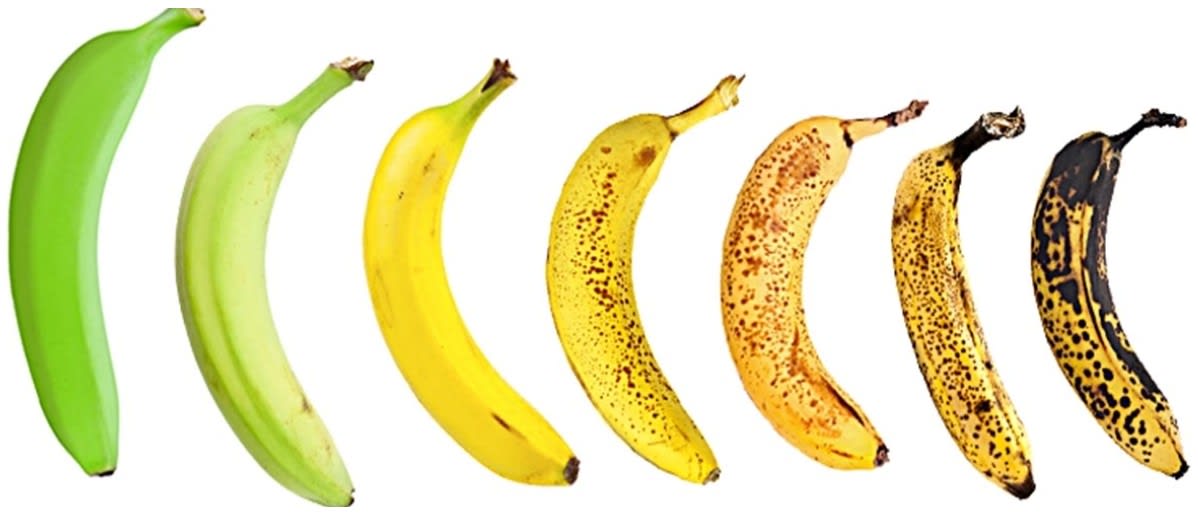
The figure given below shows the stages of ripening in a banana. Answer the questions that follow:
(a) Name the plant hormone responsible for the above changes.
(b) Mention two characteristic features of this hormone.
(a) The plant hormone responsible for the above changes is Ethylene. It is the only hormone which is a gas at ordinary temperature. It is produced in fruits and remain in the same fruit.
(b) Characteristic features of ethylene are:
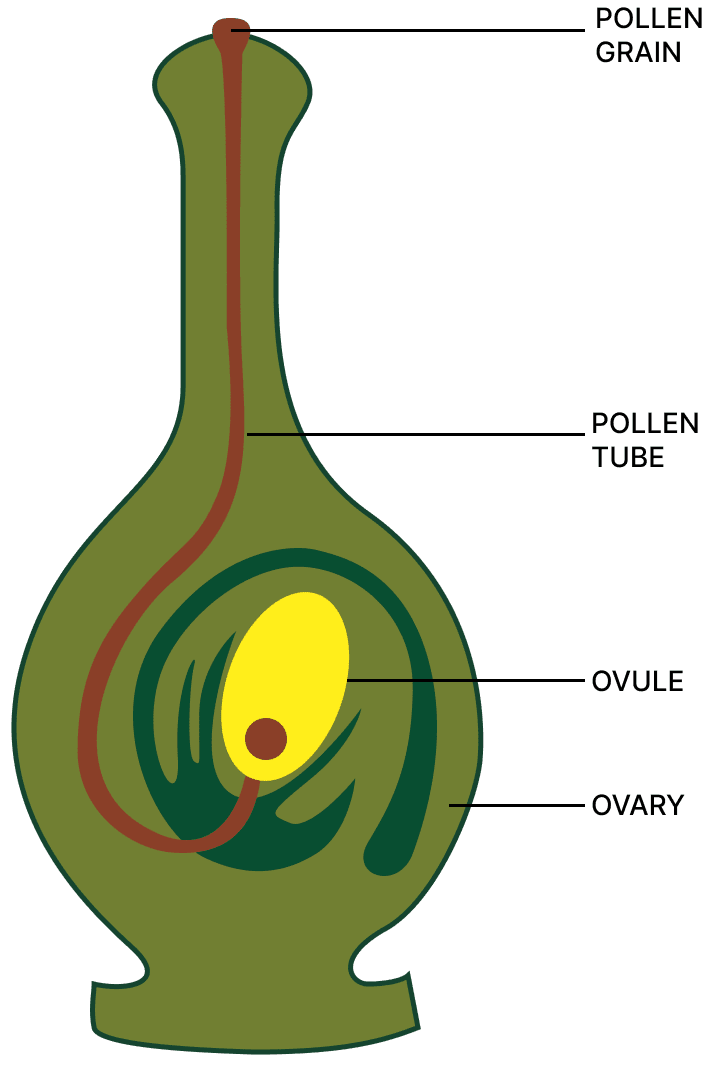
The diagram given alongside shows a type of tropism. Study the same and answer the questions that follow:
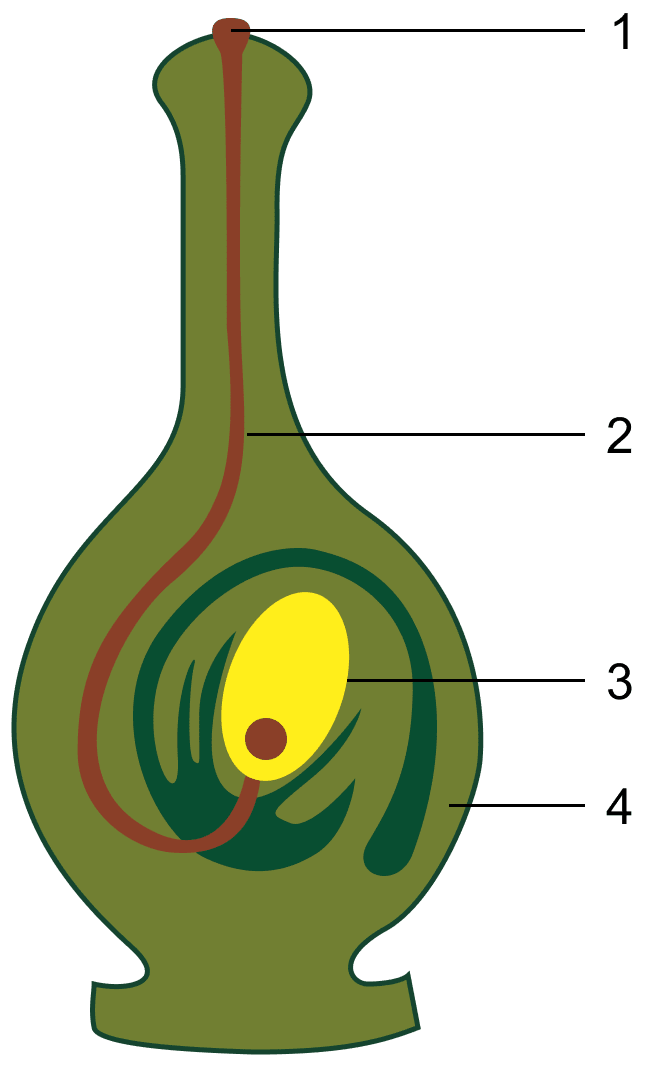
(a) Name and define the type of tropism shown in the diagram.
(b) Label the guidelines (1) to (4).
(c) Name two effective stimulants that help in the growth of part (2).
(d) Name two groups of plants where part (2) grows towards gametophyte with the help of the stimulants mentioned in (c).
(a) The type of tropism shown in the diagram is Chemotropism. It is the phenomenon of growth of plant organs in response to chemicals.
(b) Guidelines (1) to (4) are labelled below:
(c) Sugars and peptones.
(d) Gymnosperms and angiosperms.
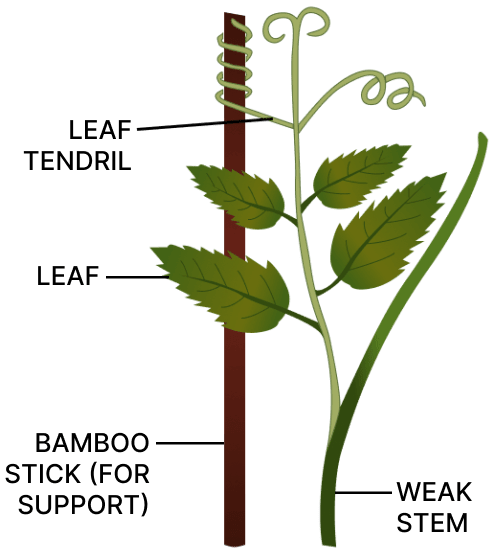
Study the diagrams given below and answer the following questions.
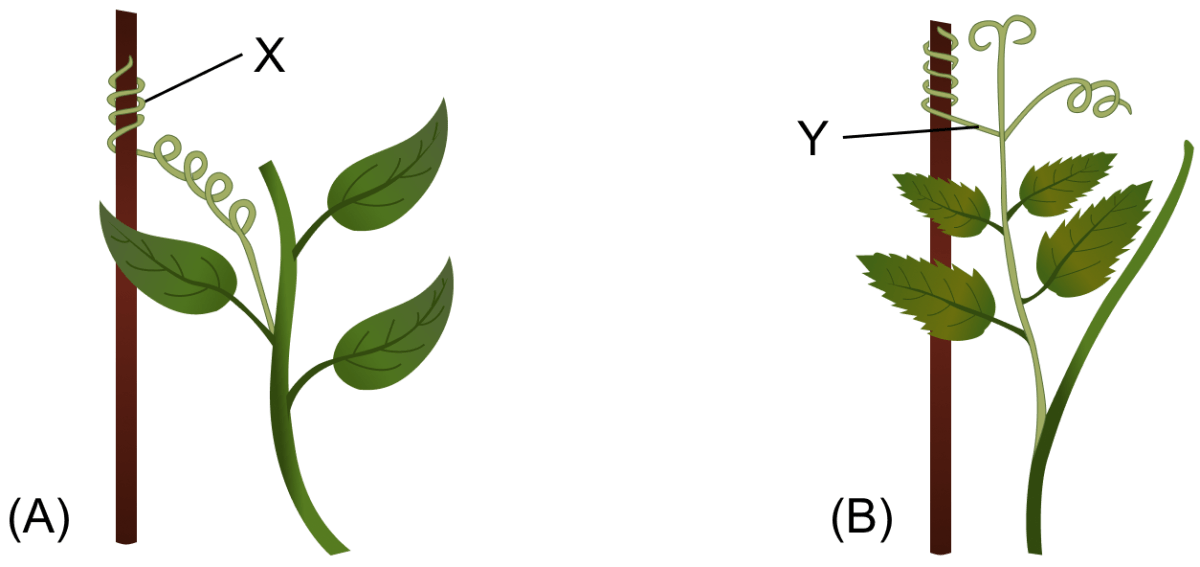
(a) Name the structures shown as X and Y in the figures (A) and (B), respectively.
(b) Write the functions performed by the structures X and Y.
(c) Name the phenomenon depicted and define it.
(d) How do the structures X and Y differ from each other?
(e) Give examples of the plants which show the said phenomenon.
(a) X → Stem tendrils, Y → Leaf tendrils.
(b) Stem tendrils (X) and leaf tendrils (Y) enable the plant to climb up a support.
(c) Thigmotropism is the phenomenon depicted. It is the growth movement of plant parts in response to touch stimulus.
(d) Stem tendrils (X) arise from the stem while leaf tendrils (Y) arise from the leaf of the plant.
(e) Sweet Pea, Vines and Cuscuta.
Given below are the figures showing some kinds of tropic movements in plants. Study the same and answer the following questions:
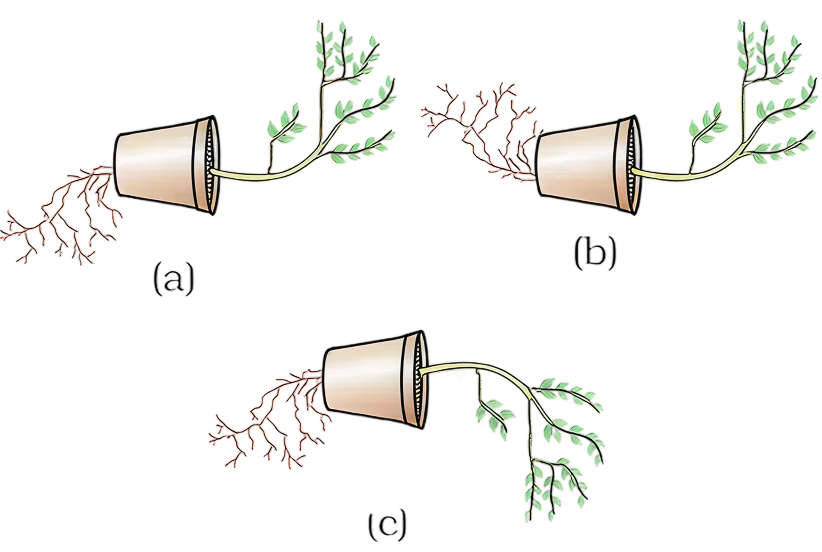
(a) Which one of these figures is correct? Give reason in support of your answer.
(b) Name the kind of movements shown by the root system and the shoot system. Define each.
(c) What are the two stimuli which affect root system and shoot system positively? Name them.
(d) Which of the following stimuli affect the growth of root strongly?
(e) Draw a neat and labelled diagram of the longitudinal section of a pistil showing chemotropism in an angiospermic plant.
(a) Figure A is correct as it shows roots growing towards gravity and shoot growing away from gravity.
(b) Root shows positive geotropism and shoot shows negative geotropism.
Positive geotropism is defined as movement of plant towards earth's gravity. For example, roots show positive geotropism.
Negative geotropism is defined as movement of plant away from gravity. For example, shoot shows negative geotropism.
(c) Root system — Gravity
Shoot system — Light
(d) Water
Reason — For roots, water is a more effective stimulus than gravity.
(e) Below diagram shows chemotropism in a pistil:
The figure given below depicts a kind of tropic movement in plants. Study the same and answer the following questions.
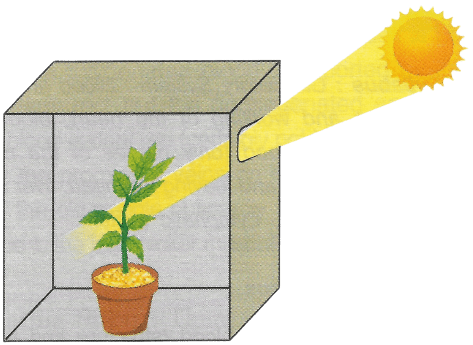
(a) What kind of a movement is shown in figure. Define it.
(b) How does this movement differ from geotropism?
(c) Name the stimulus responsible for thigmotropism. Give one example of a plant showing thigmotropism.
(d) Name one stimulus which gives a positive response for the roots but negative response for the shoot.
(e) Draw a neat and labelled diagram of the part of plant showing leaf tendril. Name the plant.
(a) Phototropism.
It is defined as the movement in response to the stimulus of light.
(b) Stimulus for phototropism is light whereas for geotropism it is gravity.
(c) Touch is the stimulus for thigmotropism.
Example — The tendrils of sweet pea plant start coiling around the support in response to touch.
(d) Gravity
(e) Sweet pea plant shows thigmotropism. The labelled diagram showing leaf tendril is given below:
Rohan set up an experiment with germinating bean seeds. He fixed the seeds on a wire mesh with moist sawdust placed below them. At the start, the radicles grow downward and the plumules upward. After a few days though, he noticed that the radicles began bending towards the moist sawdust instead of simply going straight down.
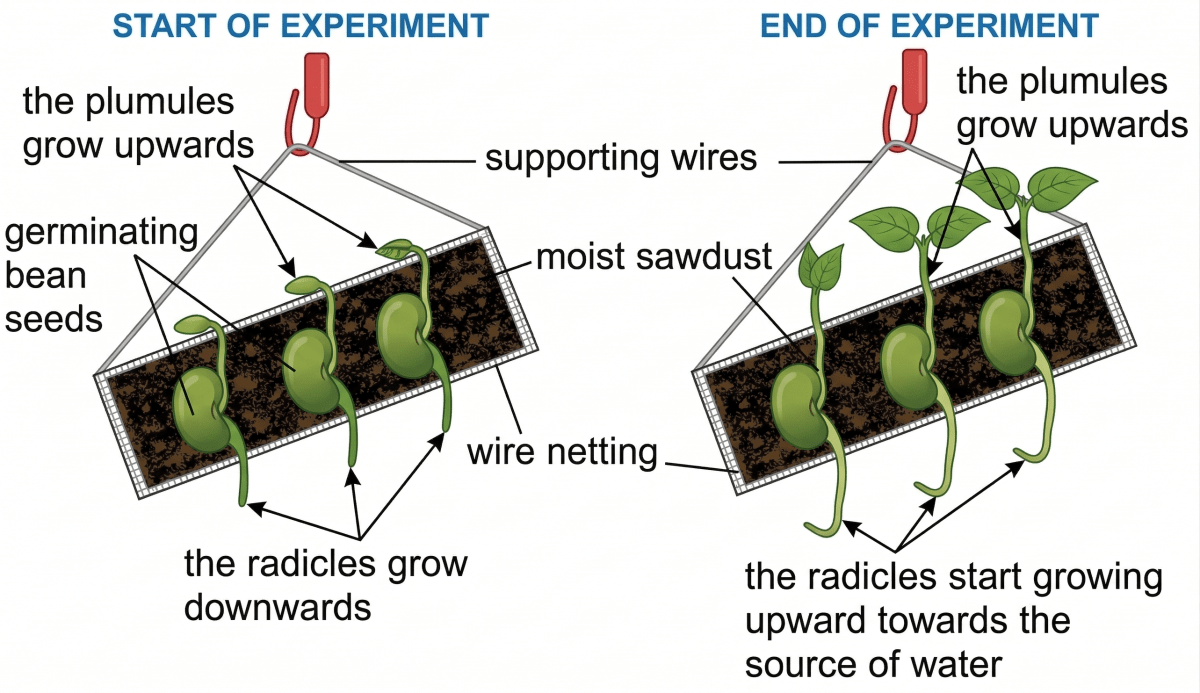
(a) Name two types of tropic movements shown by the radicles in this experiment.
(b) What stimuli are responsible for these movements?
(c) Which one of the stimuli mentioned by you above in (b) is more effective for the growth of the radicles in this experiment ?
(d) Why do the plumules continue to grow upwards even after the radicles bend ?
(a) Two types of tropic movements shown by the radicles in this experiment are geotropism and hydrotropism.
Reason — At first, the radicles grow downward due to positive geotropism. Later, they bend towards the moist sawdust due to positive hydrotropism.
(b) Stimuli responsible for these movements are gravity and moisture.
Reason — Geotropism is a response to gravity and Hydrotropism is a response to moisture/water.
(c) Moisture is more effective for the growth of the radicles in this experiment.
Reason — Since the radicles bend towards the moist sawdust instead of continuing straight downward, moisture has a stronger effect than gravity in this setup.
(d) The plumules continue to grow upwards because they are negatively geotropic, that is, they grow in the direction opposite to gravity.
Press ↓ to reveal a solution and move to the next question. Back to Selina Concise Biology.