Structure of Chromosomes

ICSE Class 10 Biology · Goyal New Approach Biology · 37 solved questions

Exercise
1Test Yourself 3

State true or false:

(i) Chromonema represents a chromatid in the early stages of condensation.
(ii) The disc-shaped structure found on chromosome is called chromomere.
(iii) Chromatin fibres condense to form chromosomes.
(iv) These are 23 pairs of autosomes (chromosomes) in human male.

Show SolutionHide Solution↓

(i) True.

(ii) False.
Corrected Statement — The disc-shaped structure found at the centromere is called the kinetochore.

(iii) True.

(iv) False.
Corrected Statement — There are 22 pairs of autosomes (chromosomes) in a human male; the 23rd pair is of sex chromosomes.

1Choose Most Appropriate Answer

The genetic material in the form of very long, thin and dark staining is called

Show SolutionHide Solution↓

Chromatin

Reason — The genetic material is seen as a network of very long, extremely thin, darkly stained fibres called chromatin (chromatin fibres).

2Choose Most Appropriate Answer

Each chromosome consists of two symmetrical structures called

Show SolutionHide Solution↓

Chromatids

Reason — A chromosome consists of two symmetrical structures called chromatids, which are attached to each other at the centromere.

3Choose Most Appropriate Answer

Rod-shaped chromosome, having centromere at the proximal end is called

Show SolutionHide Solution↓

Telocentric

Reason — A telocentric chromosome is rod-shaped and has its centromere at the proximal end.

4Choose Most Appropriate Answer

A pair of corresponding chromosomes of the same shape, size and one from each parent is called:

Show SolutionHide Solution↓

Homologous chromosomes

Reason — Homologous chromosomes are a pair of corresponding chromosomes of the same shape and size, one member of which is inherited from each parent.

5Choose Most Appropriate Answer

A sequence of DNA has 200 nitrogenous base pairs, of which 100 are Thymine-Adenine pairs. What is the number of Cytosine-Guanine pairs in this sequence:

Show SolutionHide Solution↓

100

Reason — The total number of base pairs is 200. Since 100 of these are Thymine–Adenine pairs, the remaining 200 - 100 = 100 are Cytosine–Guanine pairs.

6Choose Most Appropriate Answer

Pentose sugar, phosphate and nitrogenous base together form

Show SolutionHide Solution↓

nucleotide

Reason — Each nucleotide consists of three subunits — a pentose sugar, a phosphate and a nitrogenous base.

7Choose Most Appropriate Answer

Three hydrogen bonds are present between

Show SolutionHide Solution↓

Guanine and cytosine

Reason — There are three hydrogen bonds between Guanine and Cytosine (G ≡ C), whereas Adenine and Thymine are joined by two hydrogen bonds (A = T).

8Choose Most Appropriate Answer

The sex chromosome in human ovum is

Show SolutionHide Solution↓

X-chromosome

Reason — In humans the female is XX, so every ovum (female gamete) always carries an X-chromosome.

9Choose Most Appropriate Answer

The physical carriers of heredity are

Show SolutionHide Solution↓

Chromosomes

Reason — Chromosomes carry the genes, which are the units of heredity, and thus transfer characters from one generation to the next.

10Choose Most Appropriate Answer

Assertion (A): A nucleosome is composed of histones and DNA.

Reason (R): Nucleosome is the basic unit of chromatin organisation.

Show SolutionHide Solution↓

Both (A) and (R) are true but (R) is not the correct explanation of (A)

Explanation

A nucleosome is formed when a DNA strand wraps around a core of eight histone proteins, so (A) is true. The nucleosome is also the basic repeating unit of chromatin, so (R) is true. However, (R) only states the role of the nucleosome and does not explain its composition, so (R) is not the correct explanation of (A).

11Choose Most Appropriate Answer

The nitrogenous base Adenine always pairs with ..................... .

Show SolutionHide Solution↓

Thymine

Reason — Adenine always pairs with Thymine (A = T) through two hydrogen bonds.

12Choose Most Appropriate Answer

Centromere :

Show SolutionHide Solution↓

It is the point of attachment of two sister chromatids

Reason — The centromere is the region of the chromosome at which the two sister chromatids are joined together.

13Choose Most Appropriate Answer

Pooja was studying the structure of chromosomes in her biology class. She observed a diagram showing a chromosome with two identical arms joined at a specific point. She was asked to identify the structures. What did Pooja correctly identify?

Show SolutionHide Solution↓

The arms are chromatids, and the joining point is the centromere.

Reason — A chromosome consists of two symmetrical arms called chromatids, which are joined together at the centromere.

14Choose Most Appropriate Answer

A biology teacher asked her students to identify the key components of a chromosome.

Raj said: Chromosomes are made up of chromatin, which is a complex of DNA and histone proteins.

Sonu said: Each chromosome consists of two chromatids joined at the centromere.

Lata said: Chromosomes are only visible during the cell's interphase.

Abhay said: The centromere is where the spindle fibres attach during telophase.

Who were correct?

Show SolutionHide Solution↓

Raj and Sonu

Reason — Chromosomes are made of chromatin (DNA + histone proteins) and each chromosome has two chromatids joined at the centromere, so Raj and Sonu are correct. Lata is wrong because chromosomes are seen clearly during cell division, not interphase. Abhay is wrong because spindle fibres attach to the kinetochore at the centromere during metaphase, not telophase.

1Very Short Answer Questions

State whether the following statements are true or false. If false, write the correct statement by choosing the incorrect word/words only :

(i) Genes are some specific sequence of nitrogenous bases on a chromosome.
(ii) Cytosine, Adenine, Thyroid and Guanine are the nitrogenous bases in DNA.
(iii) A cell containing 46 chromosomes will have 23 chromatin fibres inside the nucleus during interphase.
(iv) A nitrogenous base alongwith a sugar and sulphate form a nucleotide.
(v) Nitrogen bonds are present between the complementary nitrogenous bases of DNA.

Show SolutionHide Solution↓

(i) True.

(ii) False.
Corrected Statement — The correct word is Thymine in place of Thyroid.

(iii) False.
Corrected Statement — The correct word is 46 in place of 23.

(iv) False.
Corrected Statement — The correct word is phosphate in place of sulphate.

(v) False.
Corrected Statement — The correct word is Hydrogen bonds in place of Nitrogen bonds.

2Very Short Answer Questions

Name the following :

(i) The nitrogenous base that pairs with adenine.

(ii) The components of nucleotides.

(iii) Type of bond between the complementary bases.

(iv) A pair of corresponding chromosomes of the same size and shape, one from each parent.

(v) Four nitrogenous bases in a DNA molecule.

(vi) The number of chromosomes present in a nerve cell of a human being.

(vii) The complex consisting of a DNA strand and a core of histones.

Show SolutionHide Solution↓

(i) Thymine

(ii) Pentose sugar, phosphate and nitrogenous base

(iii) Hydrogen bond

(iv) Homologous chromosomes

(v) Adenine, Guanine, Cytosine and Thymine

(vi) 46

(vii) Nucleosome

3Very Short Answer Questions

Mention if the following statements are True or False :

(i) Chromatids are attached to each other by centromeres.
(ii) The dark stained fibres found in the nucleus are called chromatin fibres.
(iii) The term 'chromosomes' literally means coloured bodies.
(iv) Histones are a particular type of nucleic acid.
(v) Each DNA strand is composed of repeating nucleotides.
(vi) Genes are the specific parts of nucleolus.
(vii) Telocentric chromosomes look like 'L' shape.

Show SolutionHide Solution↓

(i) True

(ii) True

(iii) True

(iv) False
Corrected statement — Histones are proteins around which DNA is wrapped to form nucleosomes.

(v) True

(vi) False
Corrected statement — Genes are specific segments of DNA present on chromosomes.

(vii) False
Corrected statement — Telocentric chromosomes are rod-shaped because the centromere is located at the terminal (proximal) end.

1Short Answer Questions

What is the structure of DNA as proposed by Watson and Crick?

Show SolutionHide Solution↓

The structure of DNA was proposed by Watson and Crick in 1953. Its main features are:

  • It is made of two strands helically coiled with each other, giving the appearance of a spiral staircase called a double helix.
  • Each strand is made up of small units called nucleotides. Each nucleotide consists of a pentose sugar, a phosphate and a nitrogenous base.
  • It contains four nitrogenous bases — Adenine, Guanine, Cytosine and Thymine.
  • Adenine pairs with Thymine by two hydrogen bonds (A = T) and Guanine pairs with Cytosine by three hydrogen bonds (G ≡ C).
  • DNA has the property of replication.
2Short Answer Questions

Mention the two pairs of nitrogenous bases that are held by together by hydrogen bonds.

Show SolutionHide Solution↓

The two pairs are:

  • Adenine and Thymine (A = T) — held by two hydrogen bonds.
  • Guanine and Cytosine (G ≡ C) — held by three hydrogen bonds.
3Short Answer Questions

Define the term allele.

Show SolutionHide Solution↓

An allele is one of the alternative forms of a gene that occupies the same locus on homologous chromosomes and controls the same character.

4Short Answer Questions

How are sex-chromosomes in man different from those in woman?

Show SolutionHide Solution↓

In a man (male), the sex chromosomes are one X and one Y chromosome (XY). In a woman (female), the sex chromosomes are two X chromosomes (XX).

5Short Answer Questions

Give difference between chromatin fibres and chromosome.

Show SolutionHide Solution↓

Differences between chromatin fibres and chromosome are:

Chromatin fibresChromosome
These are long, thin, thread-like, darkly stained fibres present in the nucleus.These are short, thick, rod-like structures formed by the condensation of chromatin fibres.
They are seen during interphase (non-dividing stage).They are seen clearly during cell division.
They are uncoiled or loosely coiled.They are highly coiled and condensed.
6Short Answer Questions

(i) Expand the abbreviation – DNA.

(ii) What are the strands of DNA made up of?

Show SolutionHide Solution↓

(i) DNA — Deoxyribonucleic acid.

(ii) Each strand of DNA is made up of small units called nucleotides. Each nucleotide consists of a pentose sugar, a phosphate and a nitrogenous base.

7Short Answer Questions

What is crossing over? Give its significance also.

Show SolutionHide Solution↓

Crossing over is the exchange of chromatid material (segments) between the non-sister chromatids of a pair of homologous chromosomes during cell division.

Significance — It brings about recombination of genes, which produces variations and diversity among the offspring.

8Short Answer Questions

What is chromatin? When is it observed clearly?

Show SolutionHide Solution↓

Chromatin is the network of very long, extremely thin, darkly stained fibres, made up of DNA and histone proteins, present in the nucleus of a cell. It is observed clearly during the interphase (non-dividing stage) of the cell.

9Short Answer Questions

State the exact location of centromere.

Show SolutionHide Solution↓

The centromere lies within a thinner segment of the chromosome called the primary constriction, where the two sister chromatids are joined together.

10Short Answer Questions

Mention the two pairs of nitrogenous bases that are present in a DNA strand and pair with each other by hydrogen bonds.

Show SolutionHide Solution↓

The two pairs are:

  • Adenine and Thymine (A = T) — held by two hydrogen bonds.
  • Guanine and Cytosine (G ≡ C) — held by three hydrogen bonds.
11Short Answer Questions

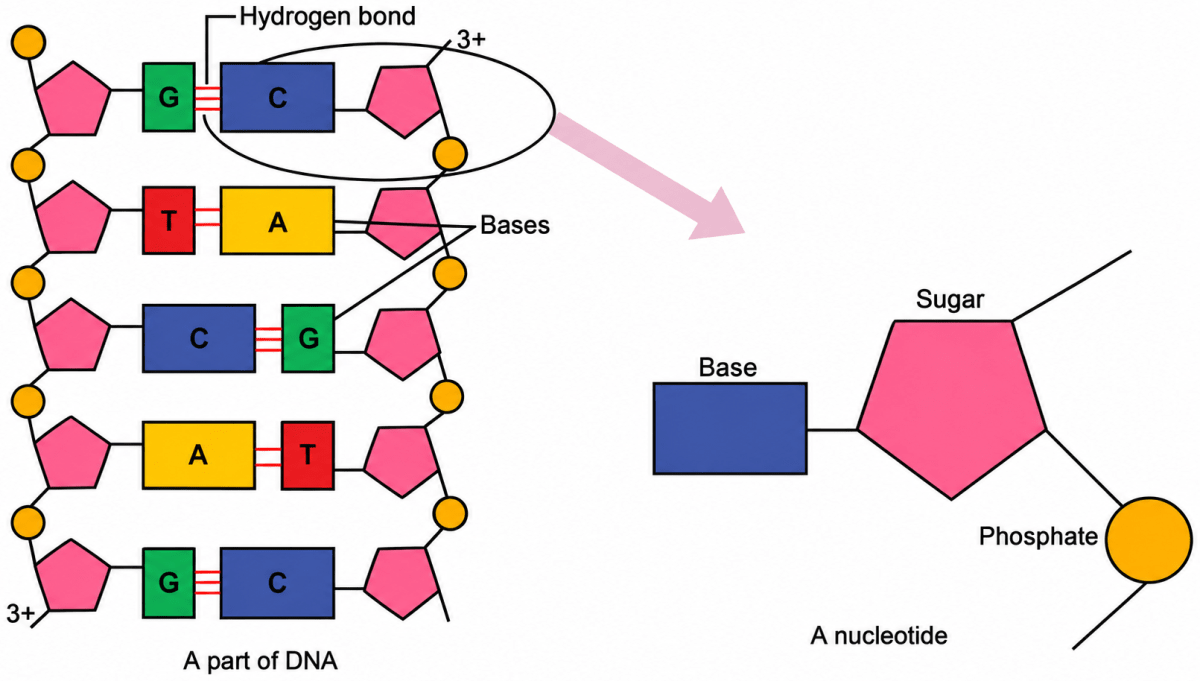
Draw a neat labelled diagram of a nucleotide.

Show SolutionHide Solution↓

Below is a neat labelled diagram of a nucleotide:

Draw a neat labelled diagram of a nucleotide. Structure of Chromosomes, ICSE Class 10 Biology by Goyal Brothers Solutions.
1Long Answer Questions

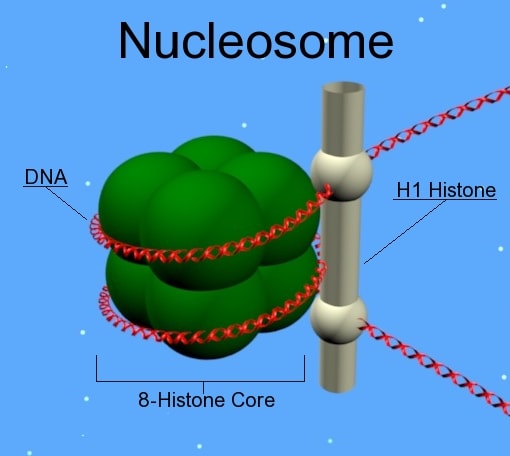
What are nucleosomes? Draw the structure of one nucleosome alongwith DNA strand.

Show SolutionHide Solution↓

A nucleosome is formed when a DNA strand is wrapped around a core (histone octamer) of eight histone proteins. Thus, each unit consisting of the histone octamer together with the associated DNA is called a nucleosome. Nucleosomes are the basic repeating units of a chromatin fibre.

Below is the structure of one nucleosome along with the DNA strand:

What are nucleosomes? Draw the structure of one nucleosome alongwith DNA strand. Structure of Chromosomes, ICSE Class 10 Biology by Goyal Brothers Solutions.
2Long Answer Questions

Explain the structure of a chromosome.

Show SolutionHide Solution↓

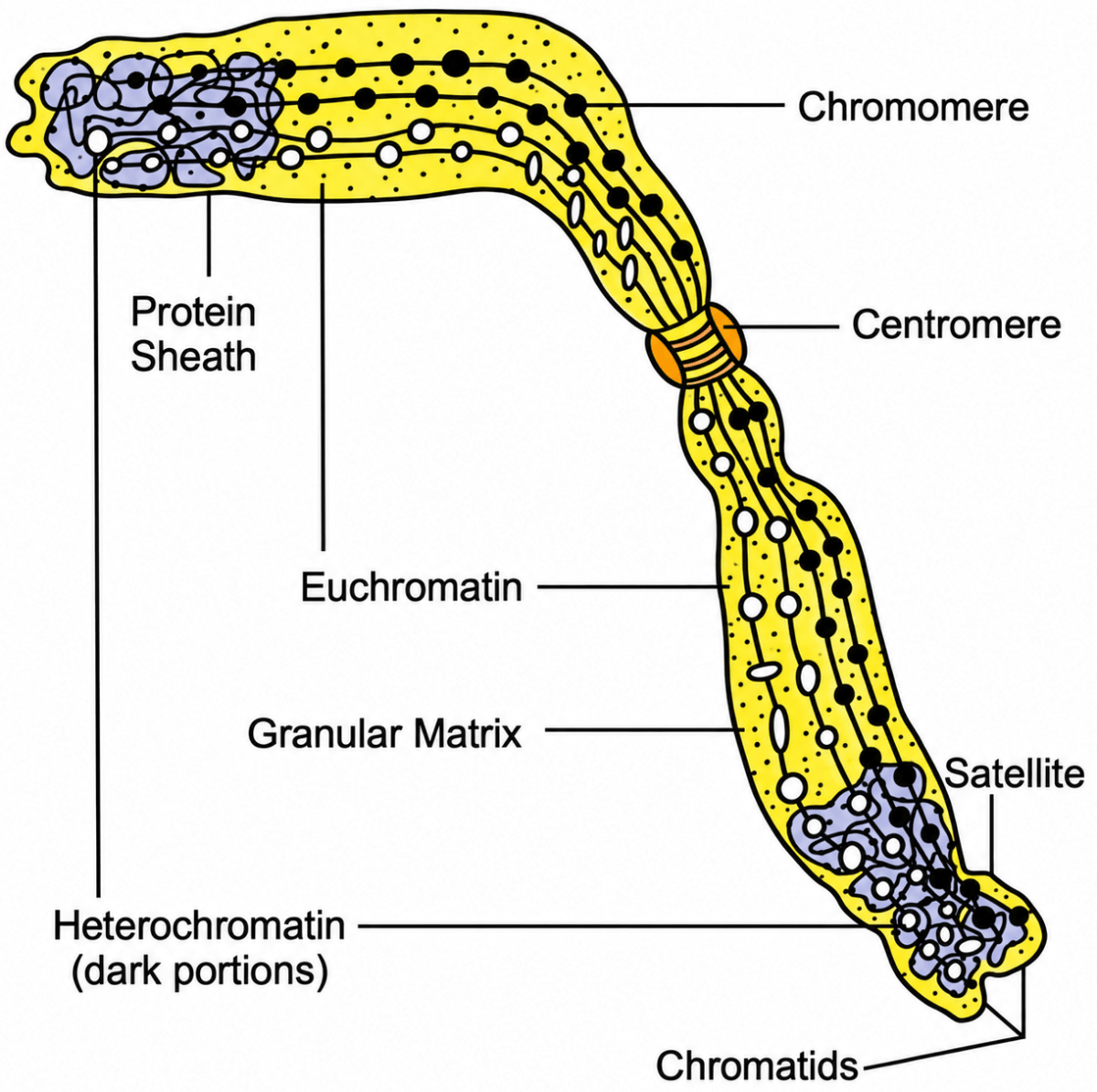
A chromosome has the following structures:

  • Chromatid — A chromosome consists of two symmetrical structures called chromatids, which are attached to each other at the centromere.
  • Centromere — It is the region at which the two sister chromatids are joined. The kinetochore is present on the centromere, and spindle microtubules attach to it during cell division.
  • Chromonema — It represents a chromatid in the early stages of condensation and forms the gene-bearing portion of the chromosome.
  • Chromomere — These are bead-like thickenings present along the chromonema.
  • Euchromatin — It is the lightly stained, partially condensed portion of the chromosome.
  • Heterochromatin — It is the dark stained, condensed portion of the chromosome.
Explain the structure of a chromosome. Structure of Chromosomes, ICSE Class 10 Biology by Goyal Brothers Solutions.
3Long Answer Questions

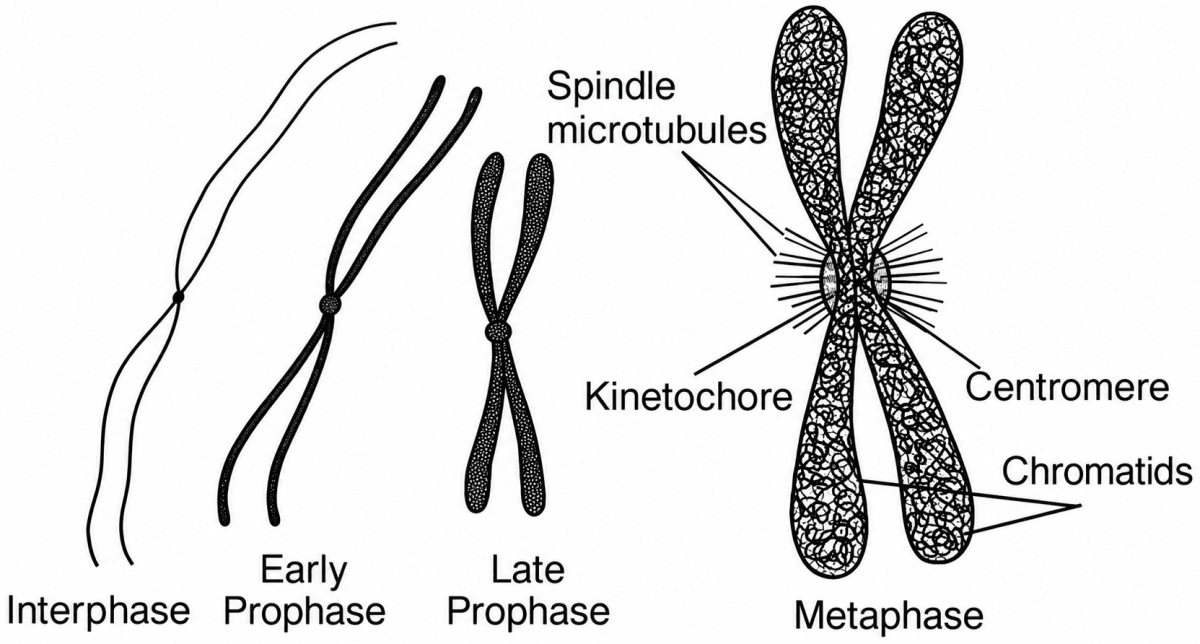
Mention the changes you observe in the structure of chromosomes in different stages of cell cycle.

Show SolutionHide Solution↓

The changes observed in the structure of chromosomes are:

  • Interphase — Chromosomes exist as very long, thin, uncoiled chromatin fibres.
  • Early prophase — The chromatin fibres begin to condense and coil, becoming shorter and thicker.
  • Late prophase — The chromosomes become distinct and appear as two chromatids joined at the centromere.
  • Metaphase — The chromosomes become fully condensed, short and thick, and spindle microtubules attach to the kinetochores at the centromeres.
Mention the changes you observe in the structure of chromosomes in different stages of cell cycle. Structure of Chromosomes, ICSE Class 10 Biology by Goyal Brothers Solutions.
1Structured Questions

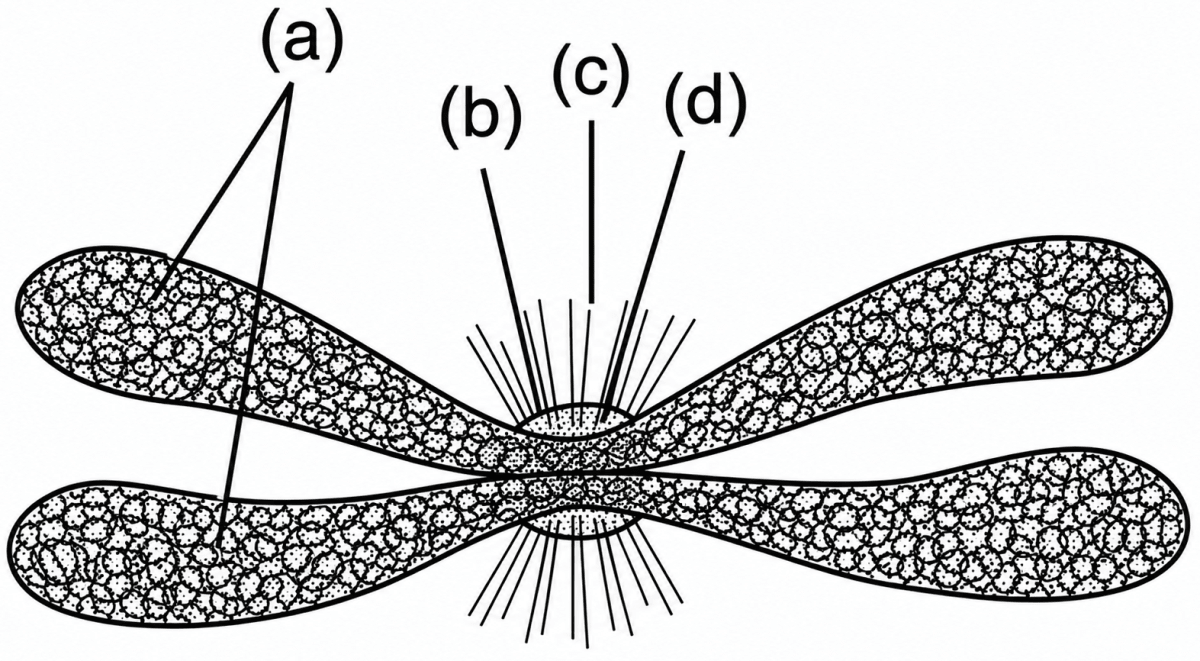
Look at the given below figure and write the name of each part (a) to (d) :

Look at the given below figure and write the name of each part (a) to (d):. Structure of Chromosomes, ICSE Class 10 Biology by Goyal Brothers Solutions.
Show SolutionHide Solution↓

The parts are as follows:

  • (a) → Chromatid
  • (b) → Centromere
  • (c) → Spindle microtubule
  • (d) → Kinetochore
2Structured Questions

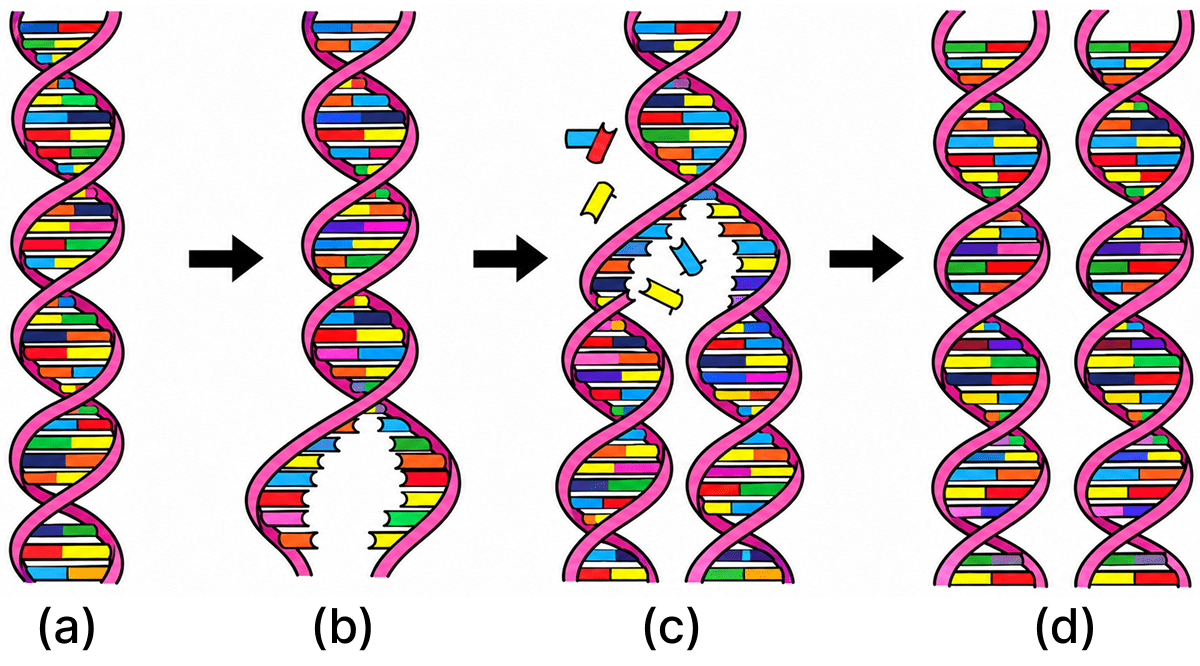
Give the correct sequence of the process of DNA replication :

Give the correct sequence of the process of DNA replication:. Structure of Chromosomes, ICSE Class 10 Biology by Goyal Brothers Solutions.
Show SolutionHide Solution↓

The correct sequence of DNA replication is:

  • (a) The DNA double helix (parental molecule).
  • (b) The molecule unwinds and unzips at one end, so that the two strands separate.
  • (c) Free nucleotides pair with the complementary bases on each old (template) strand.
  • (d) Two identical DNA molecules are formed, each having one old (parental) strand and one new strand.
3Structured Questions

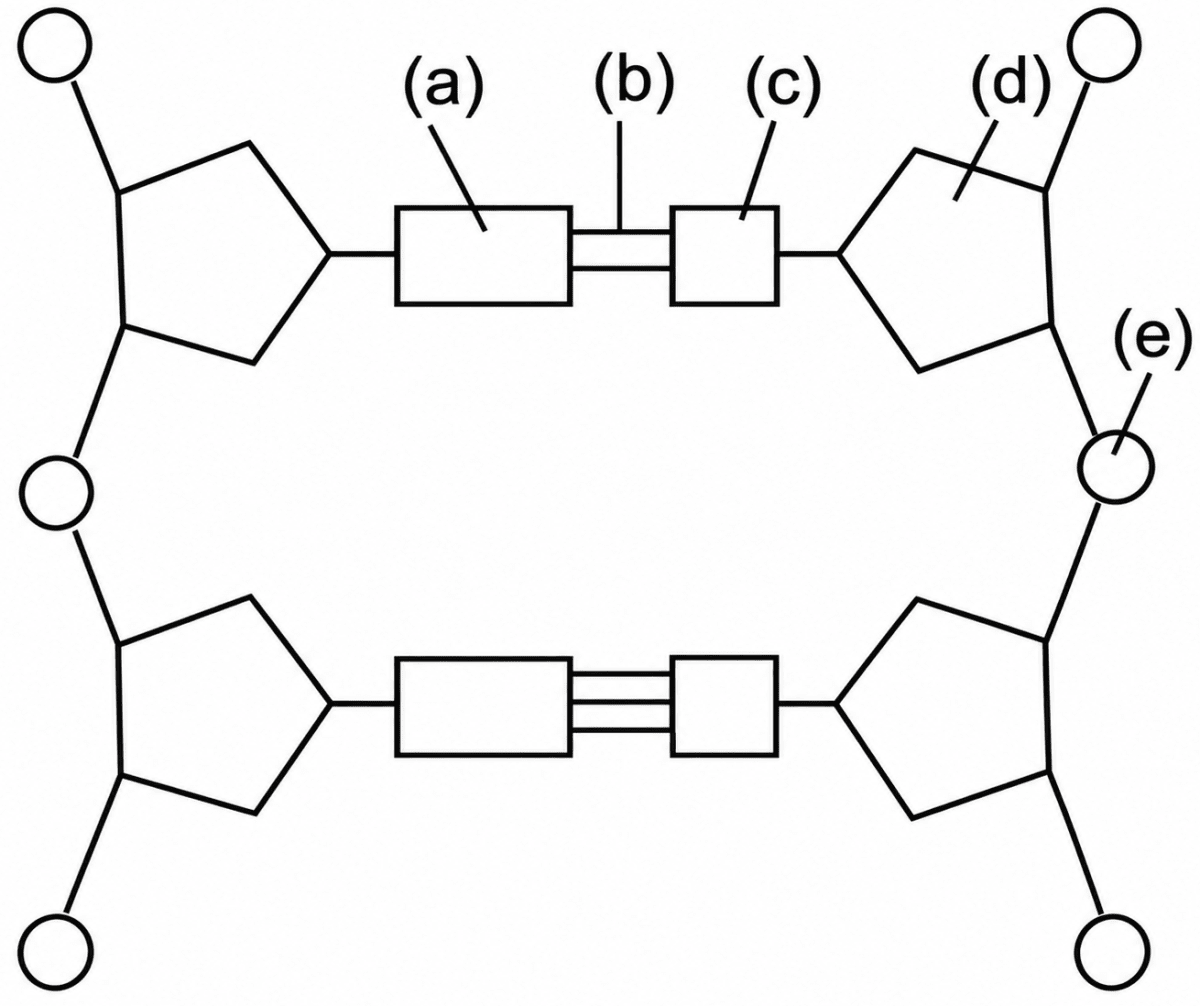
Look at the given below diagram and answer the questions followed :

Look at the given below diagram and answer the questions followed:. Structure of Chromosomes, ICSE Class 10 Biology by Goyal Brothers Solutions.

(i) Name the parts labelled as (a), (b), (c), (d) and (e).

(ii) Name the possible combination of nitrogenous bases.

Show SolutionHide Solution↓

(i) The parts are as follows:

  • (a) → Nitrogenous base
  • (b) → Hydrogen bonds
  • (c) → Nitrogenous base
  • (d) → Pentose sugar
  • (e) → Phosphate

(ii) The possible combinations of nitrogenous bases are:

  • Adenine – Thymine (A – T)
  • Guanine – Cytosine (G – C)
4Structured Questions

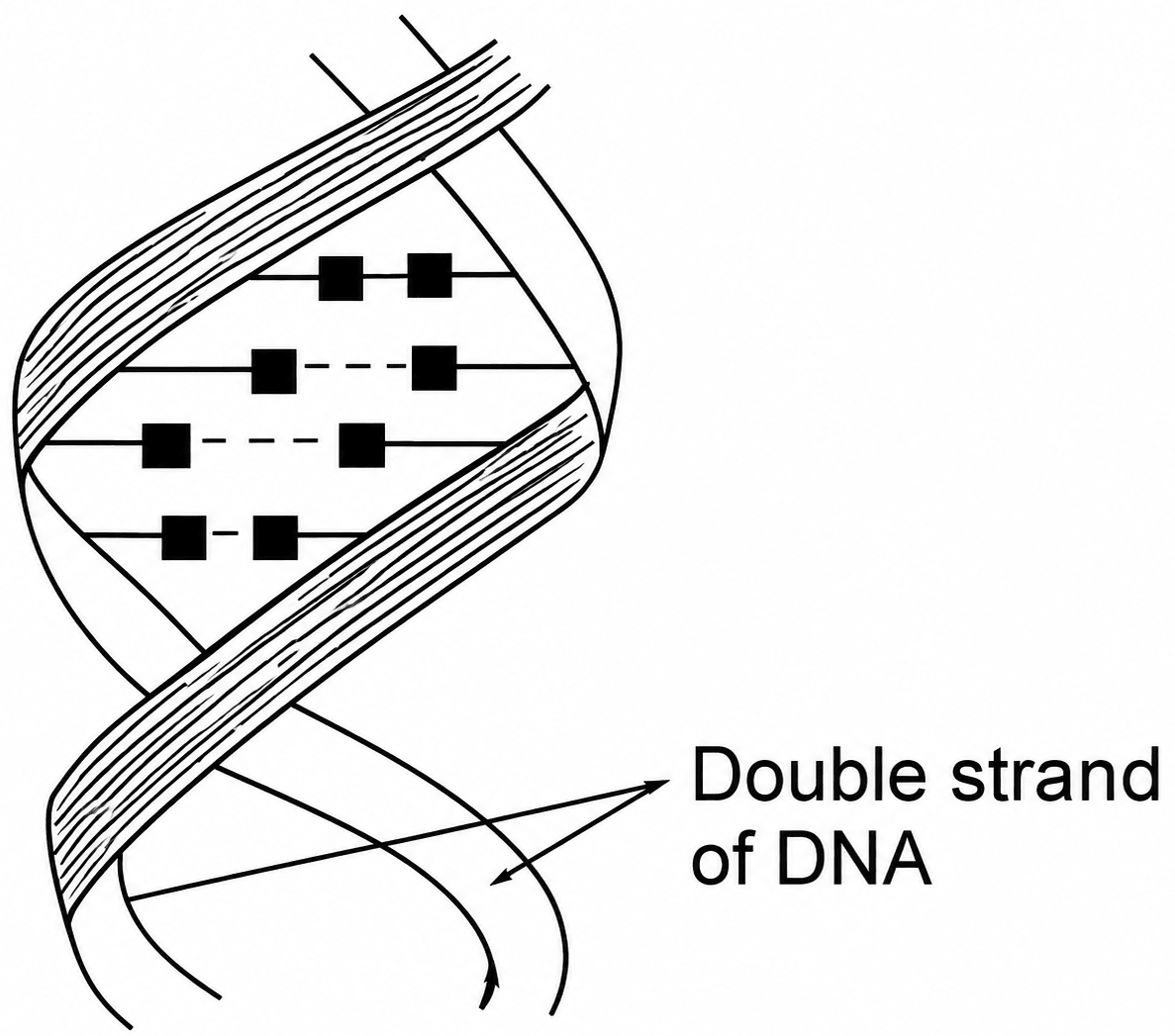
Given below is a diagram of a double helical structure of DNA :

Given below is a diagram of a double helical structure of DNA:. Structure of Chromosomes, ICSE Class 10 Biology by Goyal Brothers Solutions.

(i) Name the four nitrogenous bases that form a DNA molecule.

(ii) Give the full form of DNA.

(iii) Name the unit of heredity.

(iv) Mention two points of differences between Mitosis and Meiosis.

Show SolutionHide Solution↓

(i) The four nitrogenous bases are Adenine, Guanine, Cytosine and Thymine.

(ii) DNA — Deoxyribonucleic acid.

(iii) The unit of heredity is the Gene.

(iv) Difference between Mitosis and Meiosis:

MitosisMeiosis
It produces two daughter cells.It produces four daughter cells.
The chromosome number in each daughter cell remains the same as that of the parent cell (2n → 2n in a diploid cell).The chromosome number in each daughter cell is reduced to half that of the parent cell (2n → n).
5Structured Questions

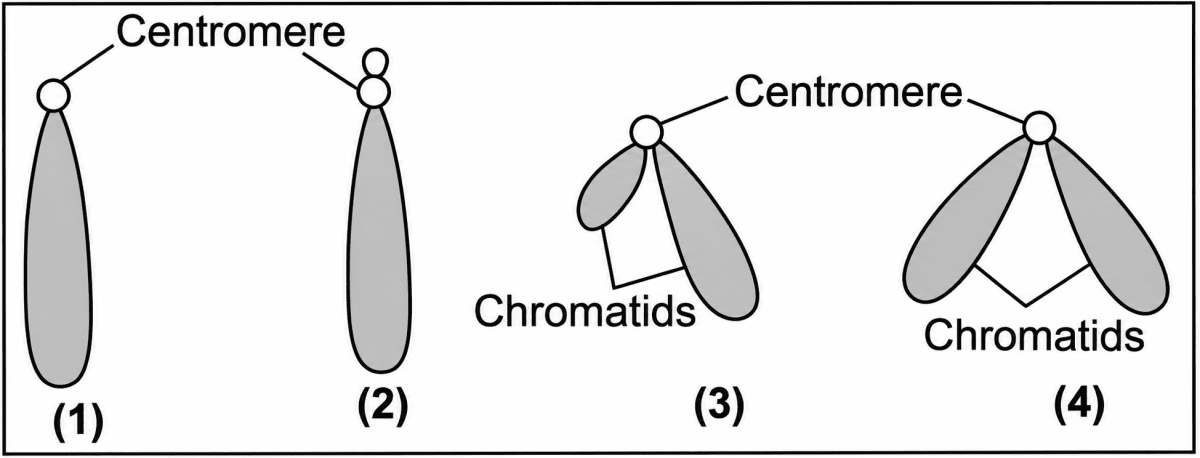
Depending upon the position of centromere, a chromosome may have the following shapes. On the basis of this answer the questions given.

Depending upon the position of centromere, a chromosome may have the following shapes. On the basis of this answer the questions given. Structure of Chromosomes, ICSE Class 10 Biology by Goyal Brothers Solutions.

(i) The rod shaped chromosome having centromere at the proximal end is called

  1. Acrocentric
  2. Metacentric
  3. Submetacentric
  4. Telocentric

(ii) Acrocentric chromosomes can be identified with their feature i.e.

  1. L – shaped structure
  2. Centromere at sightly below the one end
  3. T – shaped structure
  4. V – shaped structure

(iii) V – shaped chromosomes are called

  1. Metacentric
  2. Submetacentric
  3. Telocentric
  4. Acrocentric

(iv) During cell-division the microtubules stick to the chromosomes at

Show SolutionHide Solution↓

(i) Telocentric

Reason — A telocentric chromosome is rod-shaped and has its centromere at the proximal (terminal) end. According to the classification used in the chapter, an acrocentric chromosome is rod-shaped with the centromere near one end, a submetacentric chromosome is T- or L-shaped with the centromere almost at the middle, and a metacentric chromosome is V-shaped with the centromere at the centre.

(ii) Centromere at slightly below the one end

Reason — An acrocentric chromosome is rod-shaped and has its centromere near one end, slightly below the terminal position. This distinguishes it from a telocentric chromosome, whose centromere is at the proximal end.

(iii) Metacentric

Reason — A metacentric chromosome has the centromere at the centre, forming two equal arms and giving it a V-shaped appearance. In the chapter, submetacentric chromosomes are described as T- or L-shaped, while telocentric and acrocentric chromosomes are rod-shaped.

(iv) Kinetochore

Reason — The kinetochore is a protein structure present on the centromere where spindle microtubules attach during cell division.
Spindle fibres do not attach to the chromosome arms. They attach to the kinetochore. The kinetochore, which is located on the centromere, is the actual site of spindle fibre attachment. The centrosome organizes spindle fibres but does not serve as the attachment site on chromosomes.
Press ↓ to reveal a solution and move to the next question. Back to Goyal New Approach Biology.

Free sample bank