ICSE Class 10 Biology · Goyal New Approach Biology · 41 solved questions
Exercise
1(i)Test Yourself 1
Give any two reasons behind population explosion in India.
Show SolutionHide Solution↓
Two reasons behind population explosion in India are:
Lack of education — A large part of the population belongs to the rural community and is mostly illiterate. They do not know even the functioning of the reproductive system and cannot think about the consequences of having a large family.
Desire to have a male child — Most Indians believe that only a son can look after them in their old age and continue the lineage, so couples keep having children.
1(ii)Test Yourself 1
Name three major population revolution in the course of human history.
Show SolutionHide Solution↓
Tool-making revolution
Agricultural revolution
Scientific and industrial revolution
1Test Yourself 2
Complete the statements:
(i) The study of the vital statistics of populations and how they change over time is called ............... .
(ii) Population density is the number of individuals per ............... at any given time.
(iii) Growth rate of population is the difference between the birth rate and ............... .
(iv) Unequal distribution of wealth is the ............... in the country ............... .
Show SolutionHide Solution↓
(i) The study of the vital statistics of populations and how they change over time is called demography.
(ii) Population density is the number of individuals per square kilometre at any given time.
(iii) Growth rate of population is the difference between the birth rate and death rate.
(iv) Unequal distribution of wealth is the economic inequality in the country in the fields of wealth, income and consumption.
1Test Yourself 3
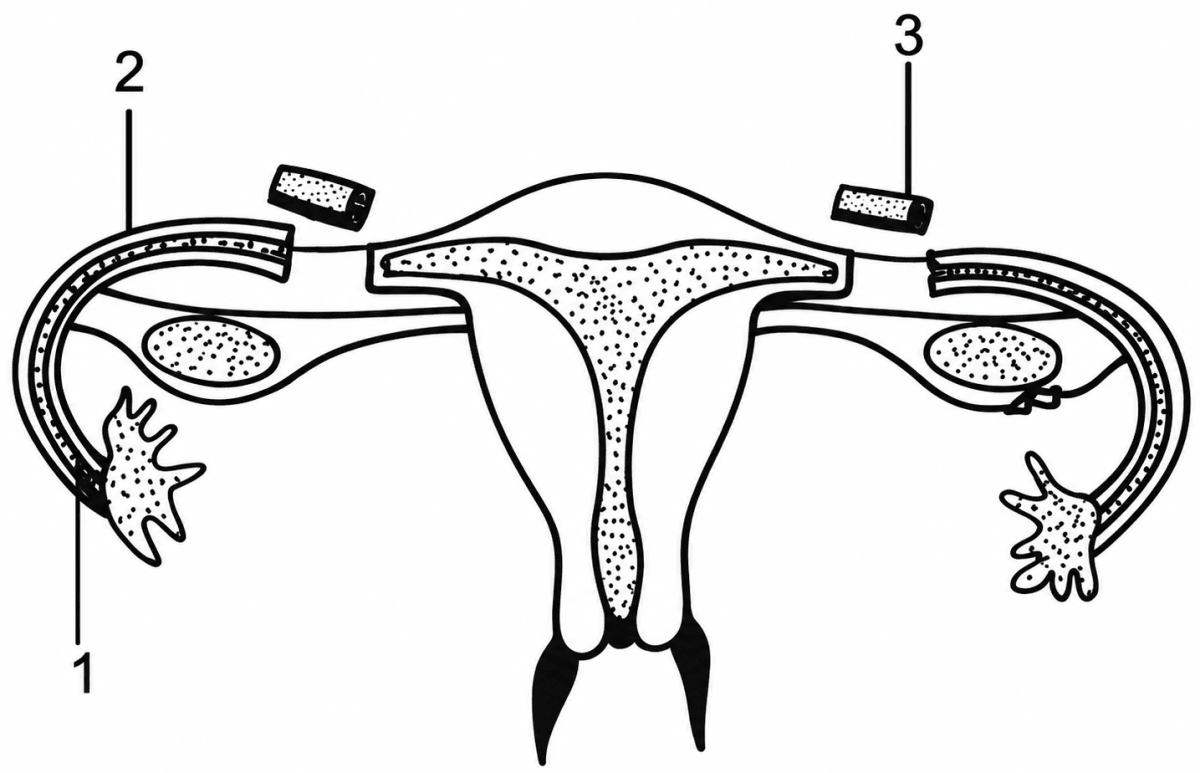
The figure given alongside is a technique. Answer the questions that follow:
(i) Name the process/technique shown.
(ii) What is the purpose of this technique?
(iii) Name the organs numbered 1 to 3.
(iv) Name a similar technique adopted in males.
Show SolutionHide Solution↓
(i) The technique shown is tubectomy.
(ii) It is a surgical method of permanent sterilisation in females. The fallopian tubes (oviducts) are cut and ligated so that the sperm and ovum cannot meet, thereby preventing fertilisation and pregnancy.
(iii) The organs numbered 1 to 3 are:
1 → Infundibulum (fimbriated end of the oviduct)
2 → Ampulla of the oviduct
3 → Cut/ligated part of the oviduct
(iv) A similar technique adopted in males is vasectomy.
1Choose Most Appropriate Answer
Maximum number of individuals an environment can support is called
(a)biotic potential
(b)carrying capacity
(c)birth rate
(d)mortality
Show SolutionHide Solution↓
carrying capacity
Reason — Carrying capacity is the maximum number of individuals an environment can support. This limit is set by the food supply or by some other critical resource in short supply and is represented by a constant K.
2Choose Most Appropriate Answer
Cutting and ligating vas deferens is called
(a)vasectomy
(b)tubectomy
(c)amniocentesis
(d)IUCD
Show SolutionHide Solution↓
vasectomy
Reason — In vasectomy, a small cut is made in the scrotum, the vas deferens (sperm duct) is ligated and a small piece between the two ligatures is removed, preventing sperms from reaching the semen.
3Choose Most Appropriate Answer
Which of the following is not a method of birth control?
(a)Tubectomy
(b)Contraceptive pills
(c)Vasectomy
(d)Amniocentesis
Show SolutionHide Solution↓
Amniocentesis
Reason — Amniocentesis is a technique used to detect genetic disorders and abnormalities in the foetus. It is not a method of birth control, whereas tubectomy, contraceptive pills and vasectomy are all methods used to prevent pregnancy.
4Choose Most Appropriate Answer
The age restrictions for marriage for boys and girls by law in India is:
(a)Boys 18 years, Girls 21 years
(b)Boys 17 years, Girls 16 years
(c)Boys 21 years, Girls 18 years
(d)Boys 20 years, Girls 17 years
Show SolutionHide Solution↓
Boys 21 years, Girls 18 years
Reason — By law in India, the minimum age of marriage for boys is 21 years and for girls is 18 years. This age of marriage should be followed strictly and child marriage should be discouraged.
5Choose Most Appropriate Answer
The number of live births per thousand people per year is called:
(a)Mortality
(b)Population density
(c)Population growth rate
(d)Natality
Show SolutionHide Solution↓
Natality
Reason — Natality (birth rate) is the number of live births per 1000 individuals in the population per year.
6Choose Most Appropriate Answer
Assertion (A): IUDs prevent the implantation of fertilised egg in uterus.
Reason (R): Condoms prevent the sperms from reaching the cervix.
(a)Both (A) and (R) are true
(b)Both (A) and (R) are false
(c)Both (A) and (R) are true and (R) is the correct explanation of (A)
(d)Both (A) and (R) are true but (R) is not the correct explanation of (A)
Show SolutionHide Solution↓
Both (A) and (R) are true but (R) is not the correct explanation of (A)
Explanation
IUDs (like Copper-T or Loop) are placed in the uterus and prevent the implantation of the fertilised egg, so (A) is true. Condoms are barrier devices that prevent the sperms from reaching the cervix, so (R) is also true. However, both statements describe two different contraceptive methods, so (R) does not explain (A).
7Choose Most Appropriate Answer
Surgical method of sterilization in a woman involves cutting and tying of
(a)Ureters
(b)Uterus
(c)Urethra
(d)Oviducts
Show SolutionHide Solution↓
Oviducts
Reason — In tubectomy, the surgical method of sterilisation in females, the oviducts (fallopian tubes) are cut and tied (ligated) to close the passage of eggs so that the egg cannot reach the uterus.
8Choose Most Appropriate Answer
Geeta has decided to adopt a method to prevent future pregnancies. Geeta is 35 years old and has already given birth to two children. Based on her situation, which procedure would be most suitable for her?
(a)Contraceptive oral pill
(b)Tubectomy
(c)MTP
(d)Femidom
Show SolutionHide Solution↓
Tubectomy
Reason — Since Geeta has already completed her family and wants to prevent future pregnancies permanently, tubectomy (a permanent surgical method of sterilisation in females) is the most suitable procedure for her. Oral pills and Femidom are temporary methods, while MTP is a method of terminating an existing pregnancy.
9Choose Most Appropriate Answer
The magnitude of population growth refers to
(a)The total population of an area
(b)The number of persons added each year
(c)The rate at which the population increases
(d)The number of females per thousand males
Show SolutionHide Solution↓
The number of persons added each year
Reason — The magnitude of population growth refers to the actual number of persons added to the population each year.
10Choose Most Appropriate Answer
The statistical study of human population is called:
(a)Mortality
(b)Demography
(c)Natality
(d)Equality
Show SolutionHide Solution↓
Demography
Reason — Demography is the statistical study of human population with reference to size, density, distribution and other vital statistics.
11Choose Most Appropriate Answer
The main cause for the high growth of our population is
(a)Rise in death rate
(b)Decrease in birth rate
(c)Decline of death rate
(d)None of these
Show SolutionHide Solution↓
Decline of death rate
Reason — The main cause for the high growth of population is the decline in the death rate due to better health facilities and medical care, while the birth rate has remained high.
12Choose Most Appropriate Answer
The number of individuals in a unit land area are referred as
(a)Population growth
(b)Growth rate
(c)Population density
(d)Growth curve
Show SolutionHide Solution↓
Population density
Reason — Population density is the number of individuals per unit area (per square kilometre) at any given time.
13Choose Most Appropriate Answer
Which one of the following is the most significant feature of the Indian population?
(a)Declining birth rate
(b)Improvement in the literacy level
(c)The size of its adolescent population
(d)Improvement in health condition
Show SolutionHide Solution↓
The size of its adolescent population
Reason — A significant feature of the Indian population is its large adolescent (young reproductive-age) population, which adds greatly to future population growth.
14Choose Most Appropriate Answer
The primary reason for increase in human population is
(a)The increase in agricultural production
(b)The increase in birth rate and decrease in death rate
(c)The improvement in medical technology
(d)All of these
Show SolutionHide Solution↓
All of these
Reason — Increased food availability due to agricultural production (Green revolution), a high birth rate along with a declining death rate, and improvements in medical technology together have contributed to the increase in human population.
15Choose Most Appropriate Answer
Growth rate of population is the difference between the birth rate and
(a)carrying capacity
(b)biotic potential
(c)death rate
(d)population explosion
Show SolutionHide Solution↓
death rate
Reason — Growth rate of population is the difference between the birth rate and the death rate. If the birth rate exceeds the death rate, the population grows.
16Choose Most Appropriate Answer
Pooja is learning some population-related terms. She wrote down the following definitions:
Term
Definition
P
Demography
Q
Population density
Which of the following correctly matches the definitions of these terms?
(a)P - The number of individuals per square kilometre, Q - Study of vital statistics in a population over time.
(b)P - Study of vital statistics of populations, Q - Number of individuals per square kilometre at any given time.
(c)P - Rate of growth, Q - Study of population density.
(d)P - Study of population growth, Q - Number of births per year per 1000 individuals.
Show SolutionHide Solution↓
P - Study of vital statistics of populations, Q - Number of individuals per square kilometre at any given time.
Reason — Demography (P) is the study of the vital statistics of populations, while population density (Q) is the number of individuals per square kilometre at any given time.
1Very Short Answer Questions
Name the following:
(i) Average number of children per unit time.
(ii) The process by which fallopian tubes are ligated.
(iii) The statistical study of human population of a region.
(iv) Surgical method of contraception in men and women.
(v) The number of persons living per square kilometre at any given time.
(vi) The number of individuals inhabiting per unit area.
Show SolutionHide Solution↓
(i) Birth rate (Natality)
(ii) Tubectomy
(iii) Demography
(iv) Vasectomy (in men) and Tubectomy (in women)
(v) Population density
(vi) Population density
2Very Short Answer Questions
Mention if the following statements are true/false. If false, rewrite the wrong one in the correct form by changing the words printed in bold face:
(i) Overpopulation has no effect on resources.
(ii) Tidal, wind and nuclear energy are the conventional forms of energy.
(iii) The cutting of fallopian tube in female is called vasectomy.
(iv) Mortality is the number of deaths per thousand of the population per decade.
(v) Tubectomy is the surgical method of sterilisation in males.
Show SolutionHide Solution↓
(i) False Corrected Statement — Overpopulation has an adverse effect on resources.
(ii) False Corrected Statement — Tidal, wind and nuclear energy are the non-conventional forms of energy.
(iii) False Corrected Statement — The cutting of fallopian tube in female is called tubectomy.
(iv) False Corrected Statement — Mortality is the number of deaths per thousand of the population per year.
(v) False Corrected Statement — Tubectomy is the surgical method of sterilisation in females.
1(i)Short Answer Questions
Define Birth Rate.
Show SolutionHide Solution↓
Birth rate (natality) is the number of births per 1000 individuals in the population per year, or the average number of children per unit time.
1(ii)Short Answer Questions
Define Death Rate.
Show SolutionHide Solution↓
Death rate (mortality) is the number of deaths per 1000 individuals in the population per year.
1(iii)Short Answer Questions
Define Demography.
Show SolutionHide Solution↓
Demography is the study of the vital statistics of populations and how they change over time, especially with reference to size, density, distribution and other vital statistics.
1(iv)Short Answer Questions
Define Census.
Show SolutionHide Solution↓
Census is the physical counting of individuals present in a given area at a given time.
2Short Answer Questions
Explain the term 'Population density'.
Show SolutionHide Solution↓
Population density is the number of individuals per square kilometre (km2) at any given time.
3Short Answer Questions
Name the two surgical methods of population control.
Show SolutionHide Solution↓
The two surgical methods of population control are:
Tubectomy (in females)
Vasectomy (in males)
4Short Answer Questions
Mention two factors responsible for population explosion in India.
Show SolutionHide Solution↓
Two factors responsible for population explosion in India are:
Desire for a male child.
Illiteracy and Lack of awareness about birth control measures.
5Short Answer Questions
Name any two resources which come under pressure due to rising population.
Show SolutionHide Solution↓
Two resources which come under pressure due to rising population are:
Water
Forests
6Short Answer Questions
Mention three reasons why the growth of population has not been appreciably checked in India.
Show SolutionHide Solution↓
Three reasons why the growth of population has not been appreciably checked in India are:
Lack of education — The illiterate rural population is unaware of family planning methods.
Religious customs and old beliefs — Children are considered God-gifted, and family planning is thought to be against religious and social customs.
Desire to have a male child — People keep having children in the hope of getting a son.
7Short Answer Questions
Give the difference between the birth rate and the death rate.
Show SolutionHide Solution↓
Birth Rate
Death Rate
Birth rate (natality) is the number of live births per 1000 individuals in the population per year.
Death rate (mortality) is the number of deaths per 1000 individuals in the population per year.
It tends to increase the size of the population.
It tends to decrease the size of the population.
1Long Answer Questions
How is poverty related to population? Explain.
Show SolutionHide Solution↓
Poverty and population are closely linked to each other. Poverty prevails mainly because of illiteracy and traditional beliefs among the economically weaker sections of society. Such people regard children as a gift of God and as helping hands to increase the family income, so they keep producing more children. This increases the population. A rising population puts great pressure on the limited natural resources, lowers the per capita income and reduces the quality of life, which in turn deepens poverty. Thus, poverty leads to a rise in population and a rising population leads to more poverty, forming a vicious cycle.
2Long Answer Questions
List the advantages of having small families. What is meant by family welfare centres?
Show SolutionHide Solution↓
Advantages of having small families are:
Parents can provide better education to their children.
The family has better savings and economic security.
The health of the mother and children remains good with proper diet and nutrition.
The family enjoys a better standard of living.
Family welfare centres are the departments or institutions such as hospitals and dispensaries which are committed to providing advice and help about family planning and the total welfare of the family, including the care of the mother and the children.
3Long Answer Questions
Give a brief of pressure of population on our natural resources.
Show SolutionHide Solution↓
With the increase in population, pressure mounts on natural resources leading to their scarcity:
Food — Population rises in geometrical progression while food production increases in arithmetic progression, so food falls short, leading to undernourishment, malnutrition and famines.
Forests — Forests are cleared to meet the demand for housing and agricultural land, leading to deforestation, droughts, floods and soil erosion.
Water — Pollution of rivers, ponds and lakes increases, leading to scarcity of clean drinking water.
Minerals — Non-renewable resources like iron, copper and aluminium are being depleted due to mining.
Energy — Fossil fuels like coal and petroleum are depleting fast due to increasing demand for energy.
4Long Answer Questions
What is population explosion? How is it affecting the condition of people of a country?
Show SolutionHide Solution↓
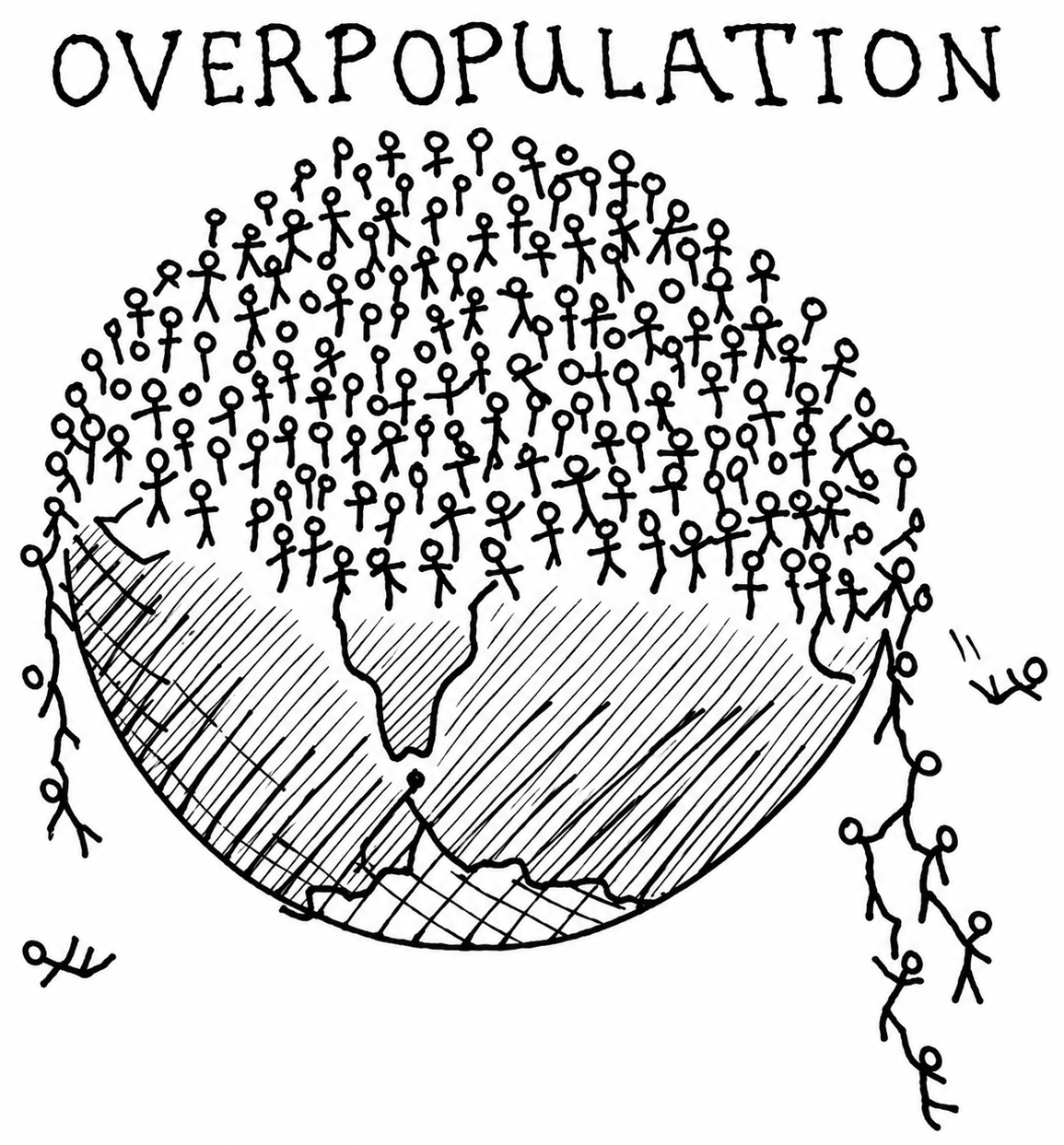
Population explosion is a rapid and excessive increase in population over a relatively short period of time.
It affects the condition of the people of a country in the following ways:
It leads to unemployment.
It causes over-exploitation of natural resources.
It results in low per capita income and price rise.
It causes pollution and environmental degradation.
It leads to shortage of food, space, clothing and drinking water.
It results in poor health, poverty and the growth of slums.
5Long Answer Questions
How can an educated person be benefitted by the family planning methods? Give a brief of a surgical method suitable for a man.
Show SolutionHide Solution↓
An educated person understands the need to limit the size of the family, to space the births of children properly and to be aware of the disadvantages of a large family. Such a person can therefore adopt suitable family planning methods to keep the family small and healthy, which ensures a better standard of living, better education and good health for all family members.
A surgical method suitable for a man is vasectomy. In this surgery, a small cut is made in the scrotum, the vas deferens (sperm duct) is ligated, and a small piece between the two ligatures is removed. This prevents the sperms from reaching the semen.
6Long Answer Questions
The need to limit the size of the family is more vital today than ever before. Give two reasons.
Show SolutionHide Solution↓
Overpopulation — A large population puts pressure on resources like food, water, and housing, leading to shortages and poor living conditions.
Economic Stability — Smaller families can provide better education, healthcare, and opportunities for each child, improving overall quality of life.
7Long Answer Questions
In the last century, the human population has increased tremendously. Death rate has reduced and life expectancy has increased. This rapid growth has placed significant pressure on resources. Global cooperation is needed for environmental preservation.
(i) Mention any one reason for reduction in the death rate.
(ii) Name any one resource that is under pressure due to population explosion.
Show SolutionHide Solution↓
(i) The death rate has reduced due to better healthcare and new discoveries in medical sciences (such as large-scale immunisation against fatal diseases and fewer infant deaths).
(ii) Food is one resource that is under pressure due to population explosion.
1Structured Questions
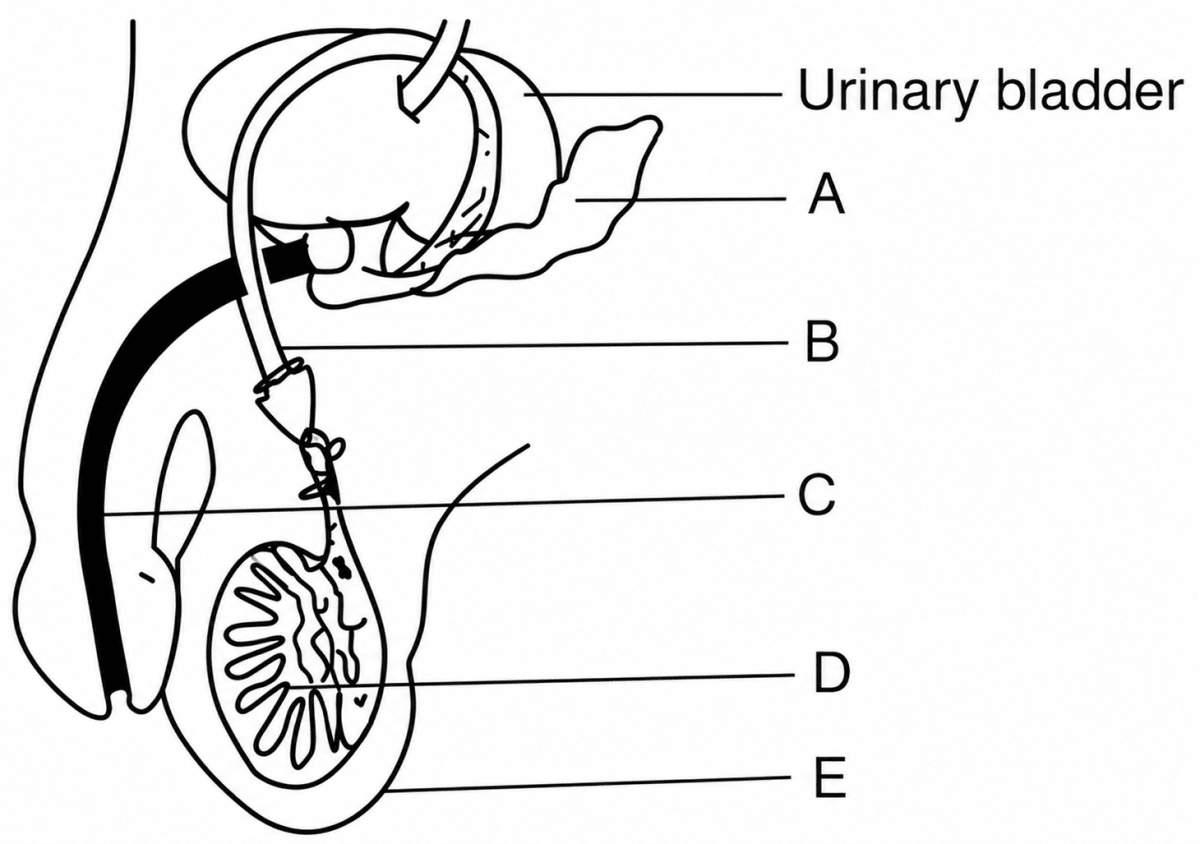
The diagram given below represents a surgical sterilisation method in males. Study the same and answer the questions that follow:
(i) Name the parts marked A, B, C, D and E.
(ii) Give the name of the surgical method represented in the diagram.
(iii) Which part is ligated or cut?
(iv) Name the corresponding surgical method conducted on females.
Show SolutionHide Solution↓
(i) The parts marked A, B, C, D and E are:
A → Seminal vesicle
B → Vas deferens (sperm duct)
C → Urethra
D → Testis
E → Scrotum
(ii) The surgical method represented in the diagram is vasectomy.
(iii) The vas deferens (sperm duct) is ligated or cut.
(iv) The corresponding surgical method conducted on females is tubectomy.
2Structured Questions
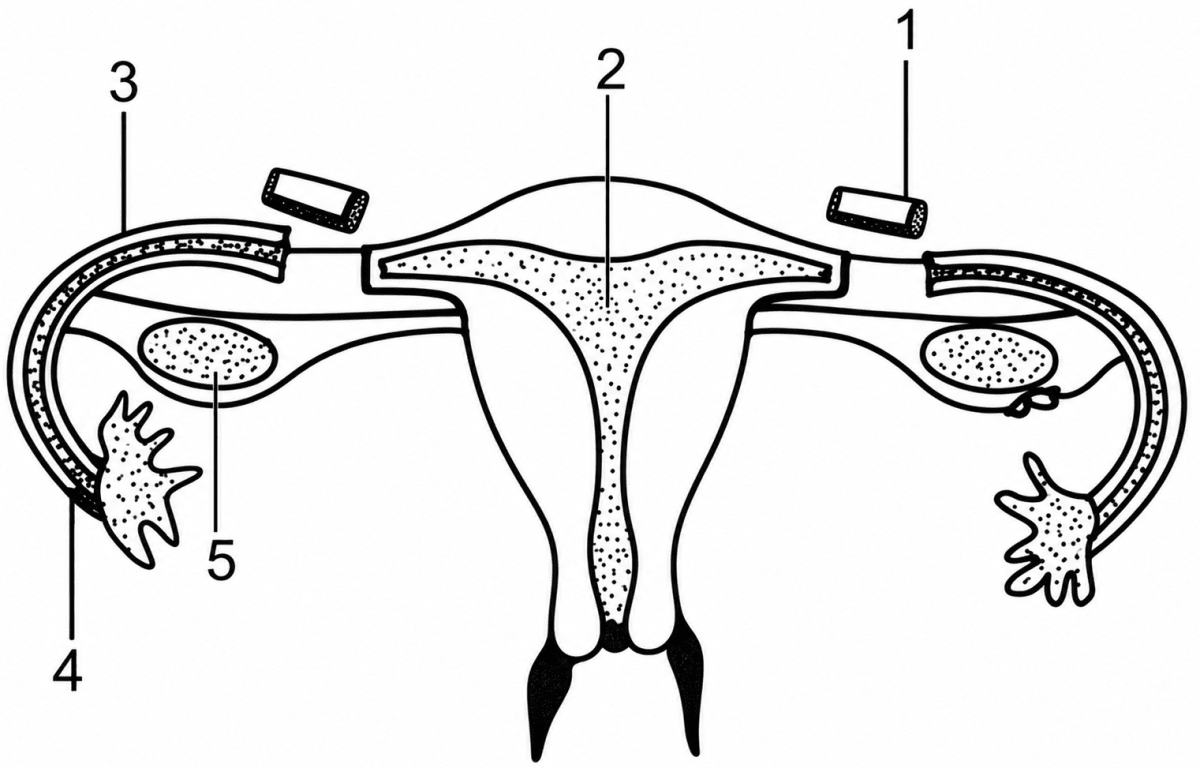
Look at the given below figure carefully and answer the questions that follow:
(i) Name the technique.
(ii) Give the purpose of this technique.
(iii) Name the similar technique adopted in men.
(iv) Name the organs numbered 1 to 5.
(v) Name the part which is ligated in females. Why?
Show SolutionHide Solution↓
(i) The technique is tubectomy.
(ii) Tubectomy is a surgical method of permanent sterilisation in females. The fallopian tubes (oviducts) are cut and ligated so that the sperm and ovum cannot meet, thereby preventing fertilisation and pregnancy.
(iii) The similar technique adopted in men is vasectomy.
(iv) The organs numbered 1 to 5 are:
1 → Cut/ligated part of the oviduct
2 → Uterus
3 → Fallopian tube (Oviduct)
4 → Infundibulum with fimbriae
5 → Ovary
(v) The fallopian tube (oviduct) is cut and ligated in females so that the sperm and ovum cannot meet in the oviduct. Thus, fertilisation is prevented.