ICSE Class 10 Biology · Goyal New Approach Biology · 64 solved questions
Exercise
1Test Yourself 1
Give the characteristics of hormones pertaining to:
(i) Nature of message
(ii) Speed of action
(iii) Area of response
(iv) Manner of transportation
Show SolutionHide Solution↓
(i) Nature of message — The message carried by hormones is chemical in nature, as hormones are chemical signals or regulators.
(ii) Speed of action — The action of hormones is usually slow.
(iii) Area of response — Hormones have a general effect as they can influence many cells in many different parts of the body.
(iv) Manner of transportation — Hormones are poured into the blood and are transported to the target organ through blood.
2Test Yourself 1
Mention if the following statements are true (T) or false (F):
(i) Exocrine glands secrete enzymes or other useful substances.
(ii) Hormones are transported by blood.
(iii) Hormone's site of production and the organs of influence are same.
(iv) Hormones regulate physiological processes.
Show SolutionHide Solution↓
(i) True
(ii) True
(iii) False Corrected Statement — Hormone's site of production and the organ of influence are different.
(iv) True
1Test Yourself 2
Fill in the blanks:
(i) Secretion of thyroid hormones that regulate calcium ion concentration is ............... .
(ii) Exophthalmic goitre results due to ............... .
(iii) Overgrowth of adrenal cortex in mature woman leads to ............... .
(iv) Cushing syndrome is caused by the ............... of adrenal cortex.
Show SolutionHide Solution↓
(i) Secretion of thyroid hormones that regulate calcium ion concentration is calcitonin.
(ii) Exophthalmic goitre results due to over secretion of thyroxine.
(iii) Overgrowth of adrenal cortex in mature woman leads to adrenal virilism.
(iv) Cushing syndrome is caused by the hypersecretion of adrenal cortex.
2Test Yourself 2
List any two functions of mineralocorticoids.
Show SolutionHide Solution↓
Two functions of mineralocorticoids are:
They regulate mineral metabolism and control the sodium-potassium ratio in the body by stimulating the kidneys to retain sodium and excrete potassium.
They increase the reabsorption of sodium from saliva, sweat and bile to avoid their loss from the body, and also increase reabsorption of water from urine.
3Test Yourself 2
List any two disorders caused due to hyposecretion of thyroxine.
Show SolutionHide Solution↓
Two disorders caused due to hyposecretion of thyroxine are:
Cretinism (in infants)
Myxoedema (in adults)
1Test Yourself 3
Write the full form of:
(i) GH
(ii) FSH
(iii) LH
(iv) ADH
(v) ACTH
Show SolutionHide Solution↓
(i) GH — Growth Hormone
(ii) FSH — Follicle Stimulating Hormone
(iii) LH — Luteinizing Hormone
(iv) ADH — Antidiuretic Hormone
(v) ACTH — Adrenocorticotropic Hormone
2Test Yourself 3
Name the hormones secreted by these cells of pancreas:
Reason — Both cretinism and myxoedema are disorders of hypothyroidism, i.e. they are caused due to the less (hypo) secretion of thyroxine.
2Choose Most Appropriate Answer
A gland which secretes both hormone and enzyme is the
(a)Pituitary
(b)Pancreas
(c)Thyroid
(d)Adrenal
Show SolutionHide Solution↓
Pancreas
Reason — Pancreas is a heterocrine gland. As an exocrine gland it secretes pancreatic juice (enzymes) into the duodenum, and as an endocrine gland it secretes the hormones insulin and glucagon into the blood.
3Choose Most Appropriate Answer
Assertion (A): The beta cells of pancreas secrete insulin hormone.
Reason (R): Insulin helps in lowering blood sugar level.
(a)Both (A) and (R) are true
(b)Both (A) and (R) are false
(c)Both (A) and (R) are true and (R) is the correct explanation of (A)
(d)Both (A) and (R) are true but (R) is not the correct explanation of (A)
Show SolutionHide Solution↓
Both (A) and (R) are true but (R) is not the correct explanation of (A)
Explanation
The beta cells of pancreas secrete insulin, so (A) is true. Insulin lowers the blood sugar level, so (R) is also true. However, (R) only describes the function of insulin and does not explain why insulin is secreted by the beta cells. Hence, (R) is not the correct explanation of (A).
4Choose Most Appropriate Answer
Gigantism and acromegaly are due to
(a)Hyposecretion of thyroxine
(b)Hypersecretion of growth hormone
(c)Hypersecretion of thyroxine
(d)Hypersecretion of growth hormone
Show SolutionHide Solution↓
Hypersecretion of growth hormone
Reason — Hypersecretion of growth hormone in childhood leads to gigantism, while its hypersecretion in adults leads to acromegaly.
5Choose Most Appropriate Answer
Consider the following statements.
A. Iron is essential for the synthesis of thyroxine hormone.
B. Thyroxine is secreted by thyroid gland.
C. Thyroxine regulates the basal metabolic rate and growth of body.
D. Hypersecretion of thyroxine causes goitre.
Choose the option that represents incorrect statements.
(a)B and D
(b)A and D
(c)C and D
(d)B and C
Show SolutionHide Solution↓
A and D
Reason — Statement A is incorrect because iodine (not iron) is essential for the synthesis of thyroxine. Statement D is incorrect because simple goitre is caused by hyposecretion of thyroxine (iodine deficiency); hypersecretion of thyroxine causes exophthalmic goitre.
6Choose Most Appropriate Answer
Alpha cells of Pancreas secrete:
(a)Glycogen
(b)Glucose
(c)Glucagon
(d)Insulin
Show SolutionHide Solution↓
Glucagon
Reason — Alpha cells of the islets of Langerhans in the pancreas secrete the hormone glucagon, which raises the blood sugar level.
7Choose Most Appropriate Answer
Select the mis-matched pair
(a)Adrenaline : Pituitary gland
(b)Testosterone : testes
(c)Oestrogen : Ovary
(d)Thyroxine : Thyroid gland
Show SolutionHide Solution↓
Adrenaline : Pituitary gland
Reason — Adrenaline is secreted by the adrenal medulla of the adrenal gland, and not by the pituitary gland. Hence, this pair is mis-matched.
8Choose Most Appropriate Answer
Seema explored the feedback control mechanisms in the endocrine system and organized her findings as follows:
Hormone
Function
A
Regulates metabolism and growth
B
Stimulates thyroid to produce thyroxine
Identify the correct pairing of hormones and their functions.
(a)A - Thyroid-stimulating hormone (TSH), B - Thyroxine.
(b)A - Thyroxine, B - Thyroid-stimulating hormone (TSH).
(c)A - Insulin, B - Triiodothyronine.
(d)A - Adrenaline, B - Insulin.
Show SolutionHide Solution↓
A - Thyroxine, B - Thyroid-stimulating hormone (TSH).
Reason — Thyroxine regulates metabolism and growth of the body, while thyroid-stimulating hormone (TSH) stimulates the thyroid gland to produce thyroxine.
9Choose Most Appropriate Answer
Dwarfism results due to
(a)Excess secretion of thyroxin
(b)Less secretion of growth hormone
(c)Less secretion of adrenaline
(d)Excess secretion of growth hormone
Show SolutionHide Solution↓
Less secretion of growth hormone
Reason — Hyposecretion of growth hormone in childhood leads to slower growth of bones and body organs, and the person remains short-statured. This condition is called dwarfism.
10Choose Most Appropriate Answer
A doctor advised a person to take an injection of insulin because
(a)his blood pressure was low
(b)his heart was beating slowly
(c)he was suffering from goitre
(d)his sugar level in blood was high
Show SolutionHide Solution↓
his sugar level in blood was high
Reason — Insulin lowers the blood sugar level. A high blood sugar level indicates diabetes mellitus, which is treated by injecting insulin.
11Choose Most Appropriate Answer
The hormone which increases the fertility in male is
(a)Oestrogen
(b)Testosterone
(c)Insulin
(d)Growth hormone
Show SolutionHide Solution↓
Testosterone
Reason — Testosterone is the male hormone secreted by the testes. It brings about the development of male sexual characters and increases fertility in males.
12Choose Most Appropriate Answer
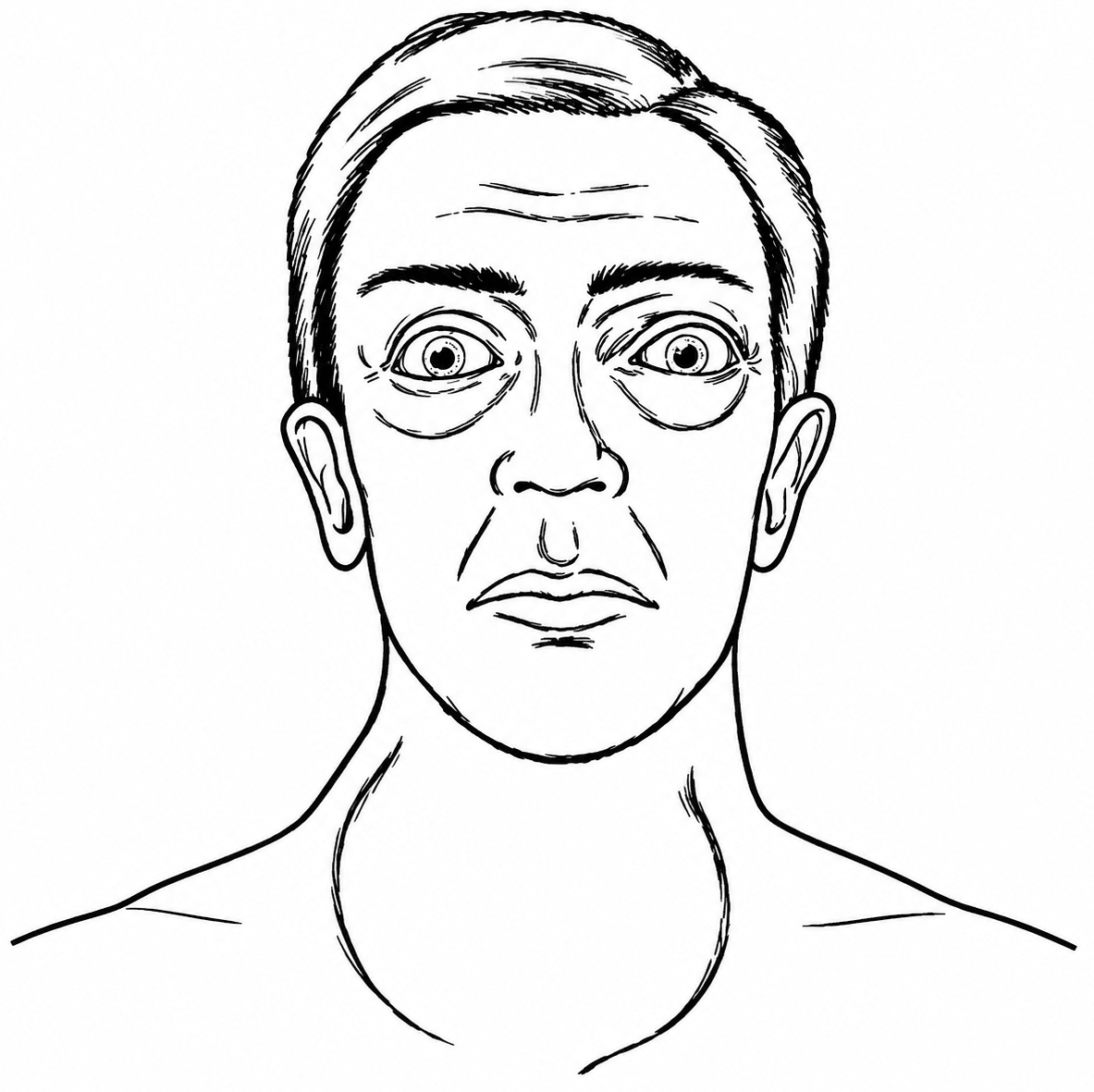
Observe the following picture, identify the defect and the cause of the defect.
(a)Simple goitre, under secretion of thyroxine.
(b)Ex-ophthalmic goitre, over secretion of thyroxine.
(c)Simple goitre, over secretion of thyroxine.
(d)Ex-ophthalmic goitre, under secretion of thyroxine.
Show SolutionHide Solution↓
Ex-ophthalmic goitre, over secretion of thyroxine.
Reason — The picture shows protruding eyeballs, which is a characteristic feature of exophthalmic goitre (Grave's disease). It is caused due to the over secretion of thyroxine.
13Choose Most Appropriate Answer
Progesterone helps to maintain
(a)growth
(b)height
(c)pregnancy
(d)glucose level
Show SolutionHide Solution↓
pregnancy
Reason — Progesterone prepares and maintains the lining of the uterus and thus helps to maintain pregnancy.
14Choose Most Appropriate Answer
TSH is secreted by
(a)Thyroid gland
(b)Anterior lobe of pituitary
(c)Pancreas
(d)Adrenal gland
Show SolutionHide Solution↓
Anterior lobe of pituitary
Reason — Thyroid stimulating hormone (TSH) is one of the six hormones secreted by the anterior lobe of the pituitary gland. It stimulates the thyroid to produce thyroxine.
15Choose Most Appropriate Answer
Which of the following controls glucose level in body?
(a)Insulin
(b)Adrenaline
(c)Thyroxine
(d)Testosterone
Show SolutionHide Solution↓
Insulin
Reason — Insulin lowers the blood glucose level and initiates the deposition of extra glucose as glycogen in the liver and muscles, thereby controlling the glucose level in the body.
16Choose Most Appropriate Answer
The emergency hormone that prepares the body for fight and flight reaction is
(a)Thyroxine
(b)Adrenaline
(c)Insulin
(d)Oxytocin
Show SolutionHide Solution↓
Adrenaline
Reason — Adrenaline is called the emergency hormone or the 'flight or fight' hormone as it prepares the body to either flee from an enemy or face a stressful situation.
17Choose Most Appropriate Answer
Which one of the following hormones is not secreted by pituitary gland?
(a)GH
(b)ACTH
(c)TSH
(d)Glucagon
Show SolutionHide Solution↓
Glucagon
Reason — Glucagon is secreted by the alpha cells of the pancreas. GH, ACTH and TSH are hormones secreted by the pituitary gland.
18Choose Most Appropriate Answer
The glands which regulate calcium level in blood is
(a)Thyroid
(b)Parathyroid
(c)Adrenal
(d)Pituitary
Show SolutionHide Solution↓
Parathyroid
Reason — The parathyroid gland secretes parathormone, which regulates calcium and phosphorus metabolism, thereby maintaining the calcium level in the blood.
19Choose Most Appropriate Answer
Which of the following endocrine glands is unpaired?
(a)Adrenal
(b)Testes
(c)Pituitary
(d)Ovary
Show SolutionHide Solution↓
Pituitary
Reason — Adrenal, testes and ovaries are paired glands, whereas the pituitary gland is single (unpaired).
20Choose Most Appropriate Answer
Islets of Langerhans are located in:
(a)Liver
(b)Pituitary gland
(c)Spleen
(d)Pancreas
Show SolutionHide Solution↓
Pancreas
Reason — Islets of Langerhans are special groups of cells scattered in the substance of the pancreas.
1Very Short Answer Questions
Name the following:
(i) Hormones which regulate the secretion of other endocrine glands.
(ii) The endocrine gland which is referred to as the gland of emergency.
(iii) The cells of the testes that produce male hormones.
(iv) The hormone that helps increase the reabsorption of water from the kidney tubules.
(v) The gland which produces testosterone.
(vi) Hormones which stimulate other endocrine glands to produce their specific hormones.
(vii) The cells of islet of Langerhans that secrete glucagon.
Show SolutionHide Solution↓
(i) Tropic hormones
(ii) Adrenal gland
(iii) Interstitial cells (Leydig cells)
(iv) Antidiuretic hormone (ADH) or Vasopressin
(v) Testes
(vi) Tropic hormones
(vii) Alpha cells
2(i)Very Short Answer Questions
Simple goitre is usually seen in people living in the hilly regions. Give two reasons for the statement.
Show SolutionHide Solution↓
Two reasons for the statement are:
The soil and water of hilly regions are deficient in iodine, so the food grown there also lacks iodine.
Iodine is essential for the synthesis of thyroxine. Its deficiency causes less production of thyroxine, which leads to the enlargement of the thyroid gland, seen as simple goitre.
2(ii)Very Short Answer Questions
What is Adrenal Virilism? What causes this condition?
Show SolutionHide Solution↓
Adrenal virilism is a condition in which a female develops male secondary sexual characters such as beard, moustache and deep voice.
It is caused when sex corticoids (androgens) are secreted in excess by the adrenal cortex in a female.
2(iii)Very Short Answer Questions
Name the endocrine gland that secretes Thyroxine. Give any one function of thyroxine.
Show SolutionHide Solution↓
Thyroxine is secreted by the thyroid gland.
One function of thyroxine is that it controls tissue metabolism and growth of the body.
2(iv)Very Short Answer Questions
Give the full form of the abbreviation ACTH. Which gland secretes this hormone?
Show SolutionHide Solution↓
ACTH — Adrenocorticotropic Hormone.
It is secreted by the anterior lobe of the pituitary gland.
2(v)Very Short Answer Questions
Name the hormones whose deficiency causes:
(a) Diabetes mellitus
(b) Diabetes insipidus
Show SolutionHide Solution↓
(a) Insulin
(b) Antidiuretic hormone (ADH) or Vasopressin
3Very Short Answer Questions
Mention the following statements as true/false, If false, rewrite the sentence by changing the words printed in bold face:
(i) Mineralocorticoids regulate the metabolism of carbohydrates, proteins and fats.
(ii) Malfunctioning of thyroid in infants results in Myxoedema.
(iii) Progesterone regulates menstruation and prepares uterus to receive the fertilised egg.
(iv) The alpha cells of the pancreas secrete insulin.
(v) The pituitary gland is both exocrine and endocrine in function.
Show SolutionHide Solution↓
(i) False Corrected Statement — Glucocorticoids regulate the metabolism of carbohydrates, proteins and fats.
(ii) False Corrected Statement — Malfunctioning of thyroid in infants results in Cretinism.
(iii) True
(iv) False Corrected Statement — The alpha cells of the pancreas secrete glucagon.
(v) False Corrected Statement — The pancreas is both exocrine and endocrine in function.
4Very Short Answer Questions
Expand the following:
(i) ICSH
(ii) ACTH
(iii) MSH
(iv) TSH
Show SolutionHide Solution↓
(i) ICSH — Interstitial Cell Stimulating Hormone
(ii) ACTH — Adrenocorticotropic Hormone
(iii) MSH — Melanocyte Stimulating Hormone
(iv) TSH — Thyroid Stimulating Hormone
5(i)Very Short Answer Questions
Match the items given in Column A with the most appropriate ones in Column B and rewrite the correct matching pairs.
Column A
Column B
(i) Cretinism
(a) Hypersecretion of adrenal cortex
(ii) Diabetes insipidus
(b) Hyposecretion of Thyroxine
(iii) Exophthalmic Goitre
(c) Hyposecretion of growth hormone
(iv) Adrenal virilism
(d) Hyposecretion of Vasopressin
(v) Dwarfism
(e) Hyposecretion of adrenal cortex
(f) Hypersecretion of Growth hormone
(g) Hypersecretion of Thyroxine
Show SolutionHide Solution↓
Column A
Column B
(i) Cretinism
(b) Hyposecretion of Thyroxine
(ii) Diabetes insipidus
(d) Hyposecretion of Vasopressin
(iii) Exophthalmic Goitre
(g) Hypersecretion of Thyroxine
(iv) Adrenal virilism
(a) Hypersecretion of adrenal cortex
(v) Dwarfism
(c) Hyposecretion of growth hormone
5(ii)Very Short Answer Questions
Match the items given in Column A with the most appropriate ones in Column B and rewrite the correct matching pairs.
Column I
Column II
Hyposecretion of Thyroxine in adults
Diabetes insipidus
Hypersecretion of Insulin
Myxedema
Hypersecretion of Growth hormone in childhood
Dwarfism
Hypersecretion of ADH
Gigantism
Hypersecretion of Thyroxine
Diabetes mellitus
Exophthalmic goitre
Cretinism
Show SolutionHide Solution↓
Column I
Column II
Hyposecretion of Thyroxine in adults
Myxedema
Hypersecretion of Insulin
Diabetes mellitus
Hypersecretion of Growth hormone in childhood
Gigantism
Hypersecretion of ADH
Diabetes insipidus
Hypersecretion of Thyroxine
Exophthalmic goitre
1(i)Short Answer Questions
Define Diabetes insipidus.
Show SolutionHide Solution↓
Diabetes insipidus is a disorder caused due to the hyposecretion of antidiuretic hormone (ADH). It leads to frequent and copious urination causing excessive thirst. No glucose is lost in the urine of such patients.
1(ii)Short Answer Questions
Define Tropic hormone.
Show SolutionHide Solution↓
Tropic hormones are hormones that control the release of other hormones. They travel through the blood to the appropriate gland and cause the cells of that gland to start releasing their hormone.
1(iii)Short Answer Questions
Define Hormones.
Show SolutionHide Solution↓
Hormones are organic chemicals (information molecules or chemical regulators) produced by the body and released into the blood or body fluid, which bring about widespread changes and regulate physiological processes. Their site of production and organ of influence are entirely different.
1(iv)Short Answer Questions
Define Pheromones.
Show SolutionHide Solution↓
Pheromones are chemical substances secreted by organisms which act as chemical signals. They are secreted by exocrine glands and released into the external environment, and are used as signals by members of the same species.
2(i)Short Answer Questions
Differentiate between Cushing syndrome and Cons syndrome.
Show SolutionHide Solution↓
Differences between Cushing syndrome and Cons syndrome are:
Cushing syndrome
Cons syndrome
It is caused due to the excess of glucocorticoids.
It is caused due to the excess of aldosterone (mineralocorticoids).
It is characterised by high blood sugar level, obesity and rise in blood volume.
It is characterised by high sodium and low potassium concentration in blood plasma, high blood pressure, muscular weakness, cramps and paralysis.
2(ii)Short Answer Questions
Differentiate between Acromegaly and Cretinism.
Show SolutionHide Solution↓
Differences between Acromegaly and Cretinism are:
Acromegaly
Cretinism
It is caused due to the hypersecretion of growth hormone in adults.
It is caused due to the hyposecretion of thyroxine in infants.
It results in abnormal growth of the long bones of the lower jaw and limbs, but the body does not attain a giant structure.
It results in retarded physical and mental development with short stature.
2(iii)Short Answer Questions
Differentiate between Diabetes mellitus and Diabetes insipidus.
Show SolutionHide Solution↓
Differences between Diabetes mellitus and Diabetes insipidus are:
Diabetes mellitus
Diabetes insipidus
It is caused due to the insufficient secretion of insulin.
It is caused due to the insufficient secretion of antidiuretic hormone (ADH).
Sugar is present in the urine.
No sugar (glucose) is present in the urine.
2(iv)Short Answer Questions
Differentiate between Vasopressin and insulin (Deficiency disorder).
Show SolutionHide Solution↓
Differences between Vasopressin and insulin are:
Vasopressin
Insulin
Deficiency of vasopressin causes diabetes insipidus.
Deficiency of insulin causes diabetes mellitus.
2(v)Short Answer Questions
Differentiate between Testosterone and Oestrogen [organ which secretes].
Show SolutionHide Solution↓
Differences between Testosterone and Oestrogen are:
Testosterone
Oestrogen
Testosterone is secreted by the testes.
Oestrogen is secreted by the ovary.
3Short Answer Questions
Explain the following:
(i) Some women develop beard and moustache.
(ii) Mouth dries up and heartbeat increases during public speaking.
(iii) The pituitary gland is known as the 'Master gland'.
(iv) The role of insulin in maintaining blood sugar level.
(v) People living in hilly regions usually suffer from simple goitre.
Show SolutionHide Solution↓
(i) When sex corticoids (androgens) are secreted in excess by the adrenal cortex in a female, she develops male secondary sexual characters such as beard and moustache. This condition is called adrenal virilism.
(ii) During public speaking, the body faces a stressful situation, so the adrenal gland secretes the hormone adrenaline. Adrenaline makes the heart beat faster and, at the same time, constricts the arterioles of the digestive system, reducing the supply of blood and saliva, which causes the mouth to dry up.
(iii) The pituitary gland is known as the 'Master gland' because it controls the functioning of almost all the other endocrine glands of the body.
(iv) Insulin lowers the blood sugar level by promoting the utilisation of glucose by the body cells. It also initiates the deposition of extra glucose in the liver and muscles as glycogen, thus maintaining the blood sugar level.
(v) The soil and food of hilly regions are deficient in iodine. As iodine is essential for the synthesis of thyroxine, its deficiency causes less production of thyroxine and enlargement of the thyroid gland, resulting in simple goitre.
4Short Answer Questions
State the exact location of the following structures.
(i) Thyroid gland
(ii) Islet of Langerhans
Show SolutionHide Solution↓
(i) The thyroid gland is situated in front of the neck, below the larynx.
(ii) The islets of Langerhans are scattered in the substance of the pancreas, which lies behind the stomach.
5Short Answer Questions
Choose the odd one out from the following terms and name the category to which the others belong.
(i) ADH, TSH, ACTH, NADP
(ii) GH, FSH, ADH, LH
Show SolutionHide Solution↓
(i) Odd term: NADP Category: ADH, TSH and ACTH are hormones secreted by the pituitary gland (NADP is a coenzyme).
(ii) Odd term: ADH Category: GH, FSH and LH are hormones secreted by the anterior lobe of the pituitary gland (ADH is secreted by the posterior lobe).
6Short Answer Questions
Arrange the terms in correct order and write them in logical sequence, beginning with underlined term.
Insulin release, High blood sugar, Lower blood sugar, Stimulates glucose uptake from blood.
Show SolutionHide Solution↓
High blood sugar → Insulin release → Stimulates glucose uptake from blood → Lower blood sugar.
7Short Answer Questions
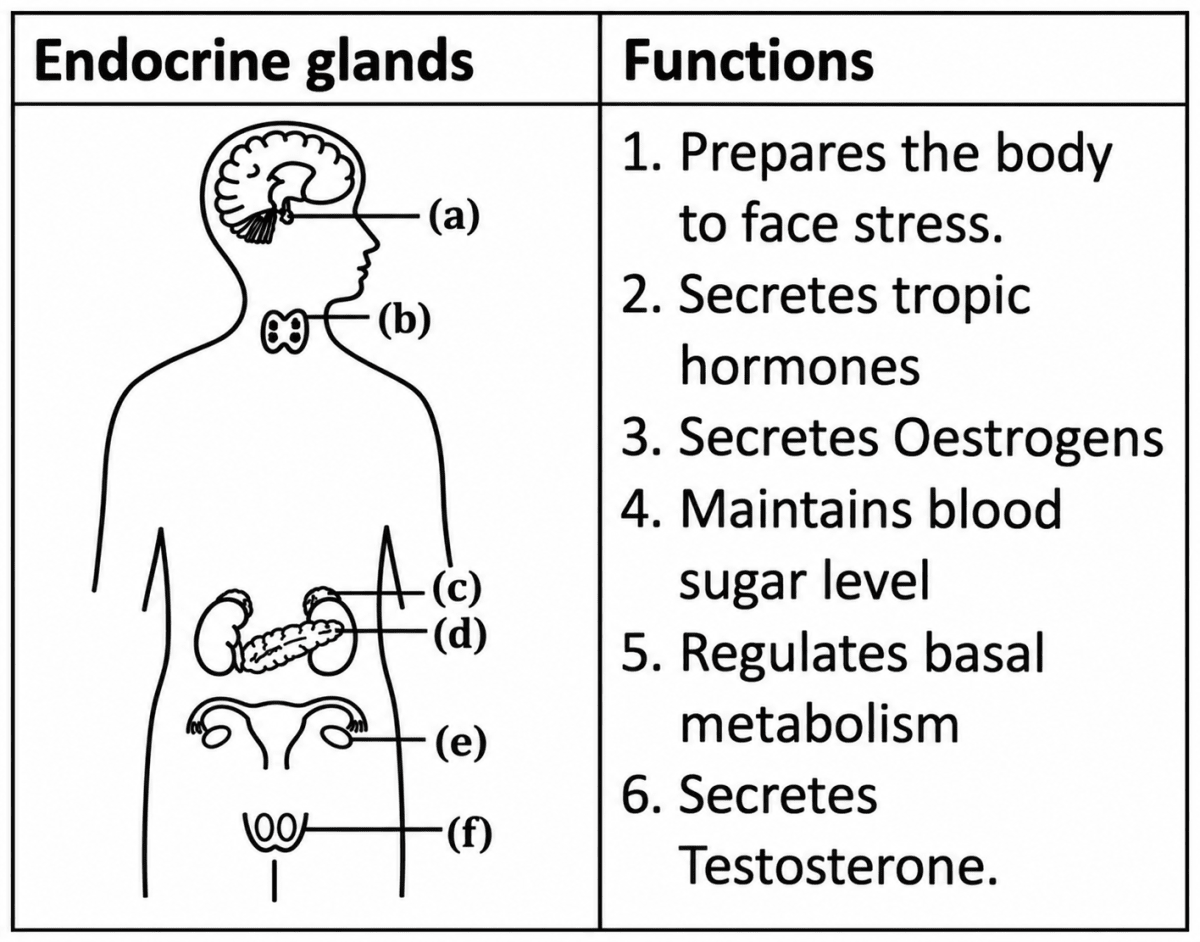
Given below is an outline of the human body showing the important endocrine glands. Match the glands marked (a) to (e) with their correct functions:
Example: (f) - 6. Secretes Testosterone.
Show SolutionHide Solution↓
The correct matching pairs are:
(a) Pituitary gland → 2. Secretes tropic hormones
(b) Thyroid gland → 5. Regulates basal metabolism
(c) Adrenal gland → 1. Prepares the body to face stress
(d) Pancreas → 4. Maintains blood sugar level
(e) Ovary → 3. Secretes Oestrogens
1Long Answer Questions
Name the hormones which lead to the following conditions:
(i) Diabetes Mellitus
(ii) Myxedema
(iii) Gigantism
(iv) Exophthalmic goitre
Show SolutionHide Solution↓
(i) Insulin (deficiency)
(ii) Thyroxine (deficiency)
(iii) Growth hormone (excess)
(iv) Thyroxine (excess)
2Long Answer Questions
Name the hormone responsible for the following functions:
(i) Converting glycogen to glucose
(ii) Regulates basal metabolism
(iii) Ossification of bones
(iv) Prepares the body during emergency
(v) Responsible for normal growth of the whole body
Show SolutionHide Solution↓
(i) Glucagon
(ii) Thyroxine
(iii) Thyroxine
(iv) Adrenaline
(v) Growth hormone (Somatotropic hormone)
3Long Answer Questions
Complete the following paragraph by filling in the blanks (i) to (v) with appropriate words:
The amount of urine output is under the regulation of a hormone called (i) ............... secreted by the (ii) ............... lobe of the pituitary gland. If this hormone secretion is reduced, there is an increased production of urine. This disorder is called (iii) ............... Sometimes excess glucose is passed with urine due to hyposecretion of another hormone called (iv) ............... leading to the cause of a disease called (v)................
Show SolutionHide Solution↓
(i) Antidiuretic hormone / Vasopressin
(ii) Posterior
(iii) Diabetes insipidus
(iv) Insulin
(v) Diabetes mellitus
4(i)Long Answer Questions
Why is Adrenaline called 'The Emergency Hormone'?
Show SolutionHide Solution↓
Adrenaline is called the 'Emergency hormone' because it prepares the body to meet any emergency situation — for "fight", i.e. to face danger, or for "flight", i.e. to run away from it. It increases the heartbeat, blood pressure and blood supply to the muscles, providing extra energy and strength to the body during such situations.
4(ii)Long Answer Questions
Expand the abbreviation - ADH. Give one example of a diuretic substance.
Show SolutionHide Solution↓
ADH — Antidiuretic Hormone.
An example of a diuretic substance is caffeine (present in tea and coffee).
4(iii)Long Answer Questions
Ram has protruding eyes and a high metabolic rate. Name the hormone responsible for this condition.
Show SolutionHide Solution↓
The hormone responsible for this condition is thyroxine. Its over secretion (hypersecretion) causes exophthalmic goitre, marked by protruding eyes and an increased metabolic rate.
4(iv)Long Answer Questions
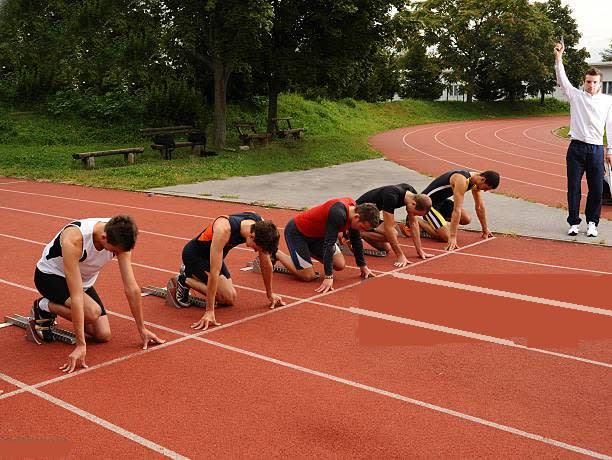
The picture given below shows the athletes lined up at the starting line. The countdown begins and all are focused and alert waiting for the gunshot.
(a) Which hormone prepares the body in such a situation given above?
(b) Name the endocrine gland that secretes the hormone mentioned in (a).
Show SolutionHide Solution↓
(a) Adrenaline
(b) Adrenal gland (Adrenal medulla)
4(v)Long Answer Questions
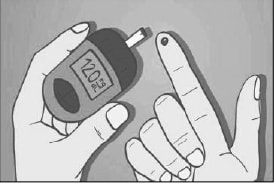
Rohit’s father has increased thirst and hunger with frequent urination. He also gets fatigued very often. His doctor advised him to get a blood sugar profile test done.
(a) Name the disease based on the symptoms given above.
(b) Which is the hormone whose deficiency causes this disorder?
(c) What is the technical term for high blood sugar level?
Show SolutionHide Solution↓
(a) Diabetes mellitus.
(b) Insulin.
(c) Hyperglycemia.
1Structured Questions
Complete the following table by filling in the blanks from 1 to 10 with appropriate terms.
S.No.
Gland
Secretion
Function/Effect on body
1
Thyroid
1
2
2
3
Vasopressin
4
3
5
6
Promotes glucose utilization by the body cells
4
Pancreas
7
8
5
Adrenal medulla
9
10
Show SolutionHide Solution↓
S.No.
Gland
Secretion
Function/Effect on body
1
Thyroid
Thyroxine
Promotes tissue metabolism, growth and differentiation
2
Posterior pituitary
Vasopressin
Increases reabsorption of water from kidney tubules and raises blood pressure
3
Pancreas (Beta cells)
Insulin
Promotes glucose utilization by the body cells
4
Pancreas
Glucagon
Raises blood sugar level by converting glycogen into glucose
5
Adrenal medulla
Adrenaline
Prepares the body to meet emergency by increasing heart beat and blood pressure
2Structured Questions
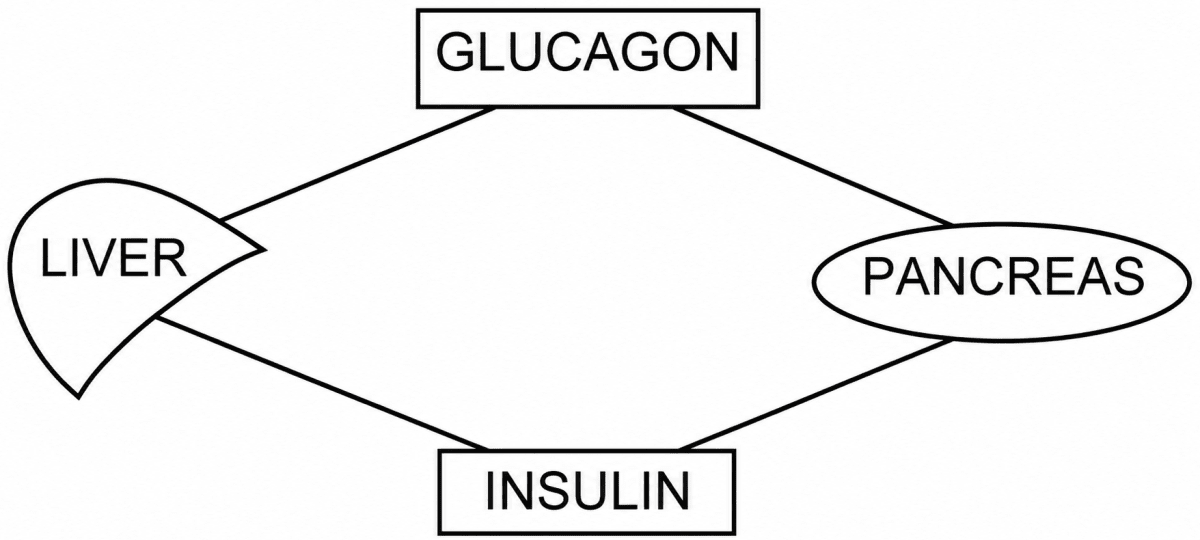
Study the diagram given below and then answer the questions that follow:
(i) Name the cells of the pancreas that produce (1) glucagon (2) insulin.
(ii) State the main function of (1) glucagon (2) insulin.
(iii) Why is the pancreas referred to as a heterocrine gland?
(iv) What is the technical term for the cells of the pancreas that produce endocrine hormones?
(v) Where in the body is the pancreas located?
Show SolutionHide Solution↓
(i) (1) Glucagon is produced by the alpha cells. (2) Insulin is produced by the beta cells.
(ii) (1) Glucagon raises the blood sugar level by converting glycogen (of the liver) into glucose. (2) Insulin lowers the blood glucose level and promotes the utilisation of glucose by the body cells.
(iii) The pancreas is referred to as a heterocrine gland because it works both as an exocrine gland and as an endocrine gland. As an exocrine gland it secretes pancreatic juice into the duodenum for digestion, and as an endocrine gland it secretes the hormones insulin and glucagon directly into the blood.
(iv) The technical term for these cells is the Islets of Langerhans.
(v) The pancreas is located behind the stomach in the upper left part of the abdomen.
3Structured Questions
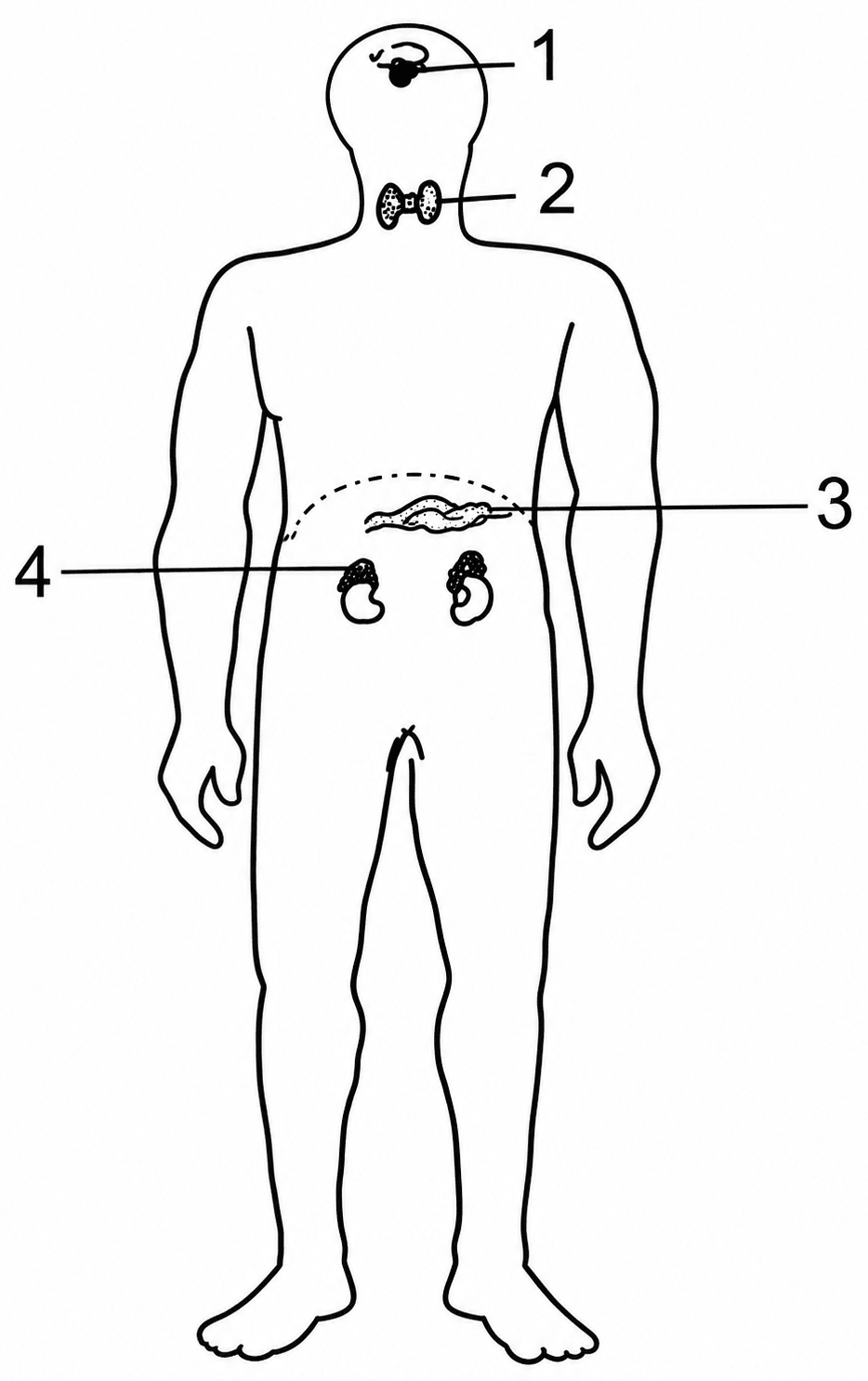
Given below is the outline of the human body showing the important glands:
(i) Name the glands marked 1 to 4.
(ii) Name the hormone secreted by part 2. Give one important function of this hormone.
(iii) Name the endocrine part of the gland numbered 3.
(iv) Why is the part labelled 1 called the master gland. Which part of the forebrain controls the gland labelled 1?
(v) Name the gland that secretes the emergency hormone.
Show SolutionHide Solution↓
(i) The glands marked 1 to 4 are:
1 → Pituitary gland
2 → Thyroid gland
3 → Pancreas
4 → Adrenal gland
(ii) Part 2 (thyroid gland) secretes the hormone thyroxine. One important function of thyroxine is that it controls tissue metabolism and growth of the body.
(iii) The endocrine part of the pancreas (gland numbered 3) is the Islets of Langerhans.
(iv) The part labelled 1 (pituitary gland) is called the master gland because it controls the functioning of almost all the other endocrine glands of the body. The gland labelled 1 is controlled by the hypothalamus of the forebrain.
(v) The adrenal gland secretes the emergency hormone (adrenaline).
4Structured Questions
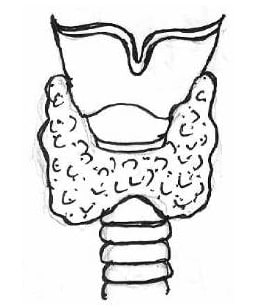
The diagram given below represents the location and structure of an endocrine gland. Study the same and answer the questions that follow:
(i) Name the endocrine gland shown in the diagram.
(ii) Name the secretion of the gland which regulates basal metabolism.
(iii) Name the mineral element required for the synthesis of the above mentioned hormone.
(iv) Name the disease caused due to under secretion of the above mentioned hormone in children.
(v) Name the disease caused due to hypersecretion of the above mentioned hormone.
Show SolutionHide Solution↓
(i) The gland shown in the diagram is Thyroid gland.
(ii) Thyroxine regulates the basal metabolism.
(iii) The mineral element required for the synthesis of the above mentioned hormone is Iodine.
(iv) The disease caused due to under secretion of the above mentioned hormone in children is Cretinism.
(v) The disease caused due to hypersecretion of the above mentioned hormone is Exophthalmic goitre.
5Structured Questions
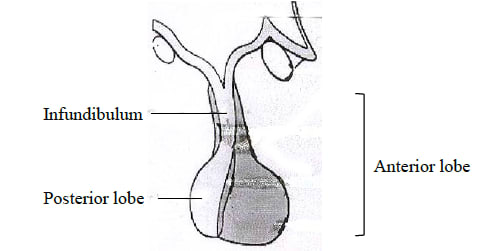
The diagram given below represents an endocrine gland in the human body. Study the diagram and answer the following questions :
(i) Identify the endocrine gland. Where is it located?
(ii) Why is the above gland referred to as the 'Master gland'?
(iii) Name the hormone which in deficiency causes Diabetes Insipidus. How does this disorder differ from Diabetes Mellitus ?
(iv) Explain the term 'Hormone'. What is the role of Tropic hormones in the human body?
(v) Which lobe of the above gland secretes:
(a)Oxytocin
(b)ACTH
(c)Growth hormone
Show SolutionHide Solution↓
(i) Pituitary gland. The pituitary gland is a small pea-shaped gland hanging from the base of the brain, below the hypothalamus.
(ii) The above gland is popularly called the master gland because it controls practically all other endocrine glands.
Difference between Diabetes Mellitus and Diabetes Insipidus is summarised below:
Diabetes mellitus
Diabetes insipidus
Caused due to insufficient secretion of insulin.
Caused due to insufficient secretion of antidiuretic hormone (ADH) / Vasopressin.
Glucose may be present in urine.
No glucose is present in urine.
(iv) Hormone is a secretion from some glandular part of the body, which is poured directly into blood and which acts on the target organs or cells of the same individual, bringing about coordination between distant parts of the body.
Tropic hormones stimulate other endocrine glands to produce their specific hormone.
(v) The lobe for the respective hormones is mentioned below: