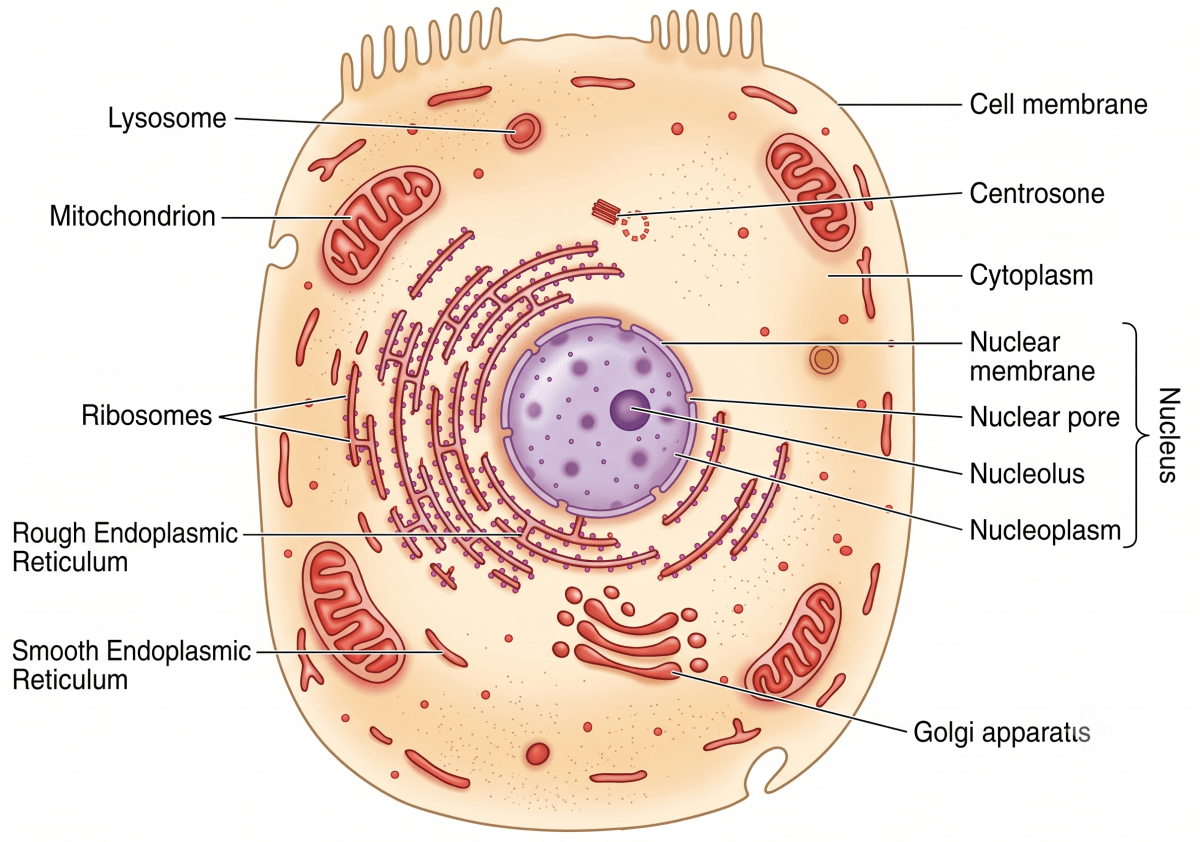
Cell

ICSE Class 10 Biology · Goyal New Approach Biology · 13 solved questions

Exercise
1Test Yourself 1

Name the cell organelles which:

(i) initiates and regulates cell division.
(ii) traps solar energy.
(iii) concerned with ATP production.
(iv) regulates the entry of cell solutes and ions.

Show SolutionHide Solution↓

(i) Centrosome
(ii) Chloroplast
(iii) Mitochondria
(iv) Cell membrane (Plasma membrane)
2Test Yourself 1

Name the longest cell found in human body.

Show SolutionHide Solution↓

Nerve cell.

3Test Yourself 1

Name the largest cell found in human body.

Show SolutionHide Solution↓

Ovum.

1Choose Most Appropriate Answer

Centrioles :

Show SolutionHide Solution↓

Found only in animal cells.

Reason — Centrioles are present within the centrosome, which lies near the nucleus in animal cells. They are absent in plant cells. Hence, centrioles are found only in animal cells.

2Choose Most Appropriate Answer

Cell wall :

Show SolutionHide Solution↓

Gives rigidity and shape to plant cells.

Reason — The cell wall is a non-living, rigid layer made up of cellulose and is found only in plant cells. It provides rigidity and a definite shape to the plant cell. Being freely permeable, it does not regulate the entry of solutes.

3Choose Most Appropriate Answer

Priya attempted to match various cellular components with their corresponding functions.

Cellular ComponentFunction
PSite of protein synthesis
QPowerhouse of the cell

Identify the correct pair of cellular components.

Show SolutionHide Solution↓

P - Ribosomes, Q - Mitochondria.

Reason — Ribosomes are the site of protein synthesis, while mitochondria release energy in the form of ATP and are therefore called the powerhouse of the cell.

4Choose Most Appropriate Answer

During a biology lecture, teacher asked students to identify the types of plastids found in plant cells. The students responded as follows:
Raj - Chloroplasts and Chromoplasts
Sonu - Chromoplasts and Lysosomes
Lata - Chloroplasts and Leucoplasts
Abhay - Leucoplasts and Ribosomes

Who gave the correct answers?

Show SolutionHide Solution↓

Raj and Lata.

Reason — Plastids found in plant cells are of three kinds — chloroplast, chromoplast and leucoplast. Raj and Lata named only plastids, whereas Sonu named lysosomes and Abhay named ribosomes, which are not plastids.

5Choose Most Appropriate Answer

Mohit was studying a plant cell and observed that some green, disc-shaped organelles were responsible for trapping sunlight to produce food. He also noticed another organelle that provided a rigid structure to the cell.

Which organelles was Mohit likely observing?

Show SolutionHide Solution↓

Chloroplasts and Cell Wall.

Reason — Chloroplasts are the green, disc-shaped organelles that trap solar energy for photosynthesis to produce food, while the cell wall is the rigid layer that provides a definite shape and rigidity to the plant cell.

1Very Short Answer Questions

Name the following:

(i) Cytoplasmic organelle that help in the manufacture of starch.
(ii) The smallest known cell.
(iii) The living component of a cell.

Show SolutionHide Solution↓

(i) Leucoplast
(ii) Mycoplasma (PPLO)
(iii) Protoplasm

1Give Cell Organelles Functions

Give the specific functions of the following cell organelles.

(i) Ribosomes
(ii) Nucleus
(iii) Vacuoles
(iv) Centrosome

Show SolutionHide Solution↓

(i) Ribosomes — They are the site of protein synthesis.

(ii) Nucleus — It regulates the growth and reproduction of the cell and transfers hereditary characters from one generation to the next.

(iii) Vacuoles — They give turgidity to the cells and store water and other substances, i.e., food, pigments and waste products.

(iv) Centrosome — It initiates and regulates cell division and forms spindle fibres with the help of asters.

1Differentiate Between

Differentiate between Cell wall and Plasma membrane.

Show SolutionHide Solution↓

Differences between Cell wall and Plasma membrane are:

Cell WallPlasma Membrane
It is the outermost covering in plant cells.It is the outermost covering in animal cells and lies next to the cell wall in plant cells.
It is a non-living and rigid layer.It is a flexible, delicate and living membrane.
It is freely permeable.It is selectively permeable.
It is made up of cellulose.It is made up of lipoproteins.
2Differentiate Between

Differentiate between Ribosomes and Lysosomes.

Show SolutionHide Solution↓

Differences between Ribosomes and Lysosomes are:

RibosomesLysosomes
They are the smallest amembranous cell organelles.They are membranous sacs budded off from the Golgi body.
They consist of RNA and associated proteins.They contain about 40 different types of enzymes.
They occur freely in the cytoplasm or remain attached to the rough endoplasmic reticulum.They lie freely in the cytoplasm.
They help in protein synthesis.They help in intracellular digestion and destroy foreign substances and injured organelles.
1Match Structures

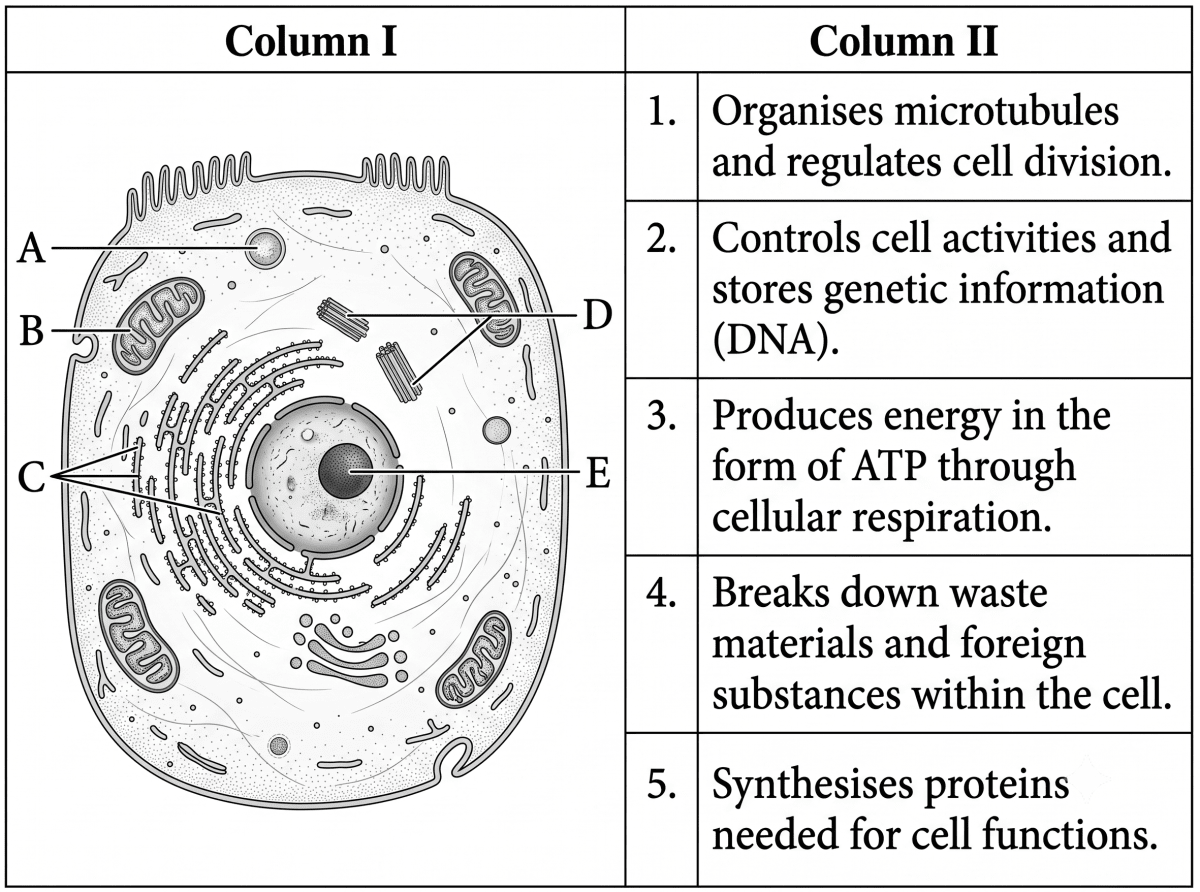
Given below is a structure of animal cell. Match the structures marked (A) to (E) with their correct functions.

Given below is a structure of animal cell. Match the structures marked (A) to (E) with their correct functions. Cell - An Independent Unit of life, ICSE Class 10 Biology Solutions.
Show SolutionHide Solution↓
Given below is a structure of animal cell. Match the structures marked (A) to (E) with their correct functions. Cell - An Independent Unit of life, ICSE Class 10 Biology Solutions.
LabelOrganelleFunction
ALysosomesBreaks down waste materials and foreign substances within the cell.
BMitochondriaProduces energy in the form of ATP through cellular respiration.
CRibosomesSynthesises proteins needed for cell functions.
DCentrosomeOrganises microtubules and regulates cell division.
ENucleusControls cell activities and stores genetic information (DNA).

Press ↓ to reveal a solution and move to the next question. Back to Goyal New Approach Biology.

Free sample bank