The diagram given below is a representation of a certain phenomenon pertaining to the nervous system. Study the diagram and answer the following questions:
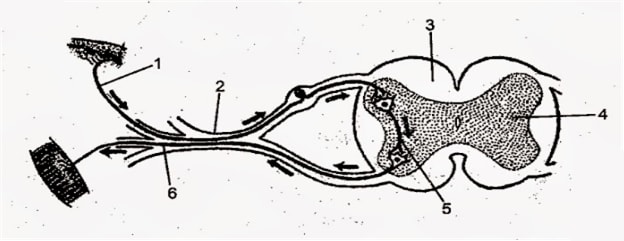
(i) Name the phenomenon which is being depicted.
(ii) Give the technical term for the point of contact between the two nerve cells.
(iii) Name the parts 1, 2, 3 and 4.
(iv) Write the functions of parts 5 and 6.
(v) How does the arrangement of neurons in the spinal cord differ from that of the brain?
Show SolutionHide Solution↓
(i) The phenomenon that is depicted here is the reflex action.
(ii) The term for the point of contact between the two nerve cells is called the Synapse.
(iii) The parts 1, 2, 3 and 4 are:
- 1 → Sensory / Afferent neuron
- 2 → Dorsal ganglion / Dorsal root
- 3 → White matter
- 4 → Grey matter
(iv) Below are the functions of parts 5 and 6:
- The function of 5 (Synapse) — It transmits the sensory impulse from sensory neurons to the motor neurons.
- The function of 6 (Motor neuron / Efferent neuron) — It transmits the command to the effectors part (e.g. muscles).
(v) The arrangement of neurons in the spinal cord differs from that of the brain. In the brain, Gray matter is present on the outside and white matter on the inner side. In Spinal cord, white matter is present on the outside and Gray matter on the inner side.